INTRODUCTION
There is agreement in the empirical literature, the executive management literature and from media commentators that the business environment has rarely been more uncertain and challenging than in recent years (Liedtka, Reference Liedtka1998; Hamel Reference Hamel2000; Welch & Byrne Reference Welch and Byrne2001; Burgelman, Reference Burgelman2002; Burgelman & Grove, Reference Burgelman and Grove2007; Gittens, Reference Gittens2011). The recent global financial crisis has only made this worse. The internet continues to have a major influence on changes to business models in industries such as media, banking, publishing and retailing (Porter, Reference Porter2001; Gittens, Reference Gittens2011). Strategy cycles are getting shorter and shorter (Hamel, Reference Hamel2000). Classic contributions in the strategy literature (Hart, Reference Hart1992; Mintzberg, Reference Mintzberg1994a, Reference Mintzberg1994b; Burgelman, Reference Burgelman2002) and more recent contributions (Floyd, Cornelissen, Wright, & Delios, Reference Floyd, Cornelissen, Wright and Delios2011; Rouleau & Balogun, Reference Rouleau and Balogun2011) have noted the inadequacies of traditional ‘top-down’ approaches to strategy process in an uncertain business environment (Andrews, Reference Andrews1965; Ansoff, Reference Ansoff1965). This gives more importance and influence to middle-line managers in strategy process who are closer to customers and markets in their ‘day-to-day’ work (Mintzberg, Reference Mintzberg1994a, Reference Mintzberg1994b).
Top managers work in the upper echelons of organizations with the ‘day-to-day’ responsibility for managing the organization. These positions have high levels of responsibility including executive powers conferred by the board and/or shareholders (Finkelstein & Hambrick, Reference Finkelstein and Hambrick1996). Middle-line managers (i.e., middle managers) are mid-level professionals working above the lower levels of operational employees in organizations but below top management (Mintzberg, Reference Mintzberg1996; Wooldridge, Schmid, & Floyd, Reference Wooldridge, Schmid and Floyd2008). The insights of middle managers on strategy issues is more valued in an uncertain world as there is greater need for a strategy process that is iterative, ongoing and includes dialogue ‘top-down’ and ‘bottom-up’, allowing learning to take place (Hart & Banbury, Reference Hart and Banbury1994; Burgelman, 1988, Reference Burgelman2002; Burgelman & Grove, Reference Burgelman and Grove2007). The strategy work of middle managers is the focus of this study. Understanding how to manage this in organizations remains a work in progress (Burgelman, Reference Burgelman2002; Fairholm & Card, Reference Fairholm and Card2009; Floyd et al., Reference Floyd, Cornelissen, Wright and Delios2011). So there is a gap in the literature for a holistic, whole and wide investigation of the strategy-making roles of middle managers, and understanding what makes an effective middle manager in strategy work (Wooldridge, Schmid, & Floyd, Reference Wooldridge, Schmid and Floyd2008; Rouleau & Balogun, Reference Rouleau and Balogun2011).
The research reported here mainly draws on the strategy process branch of the strategy field. However, this research also needs to draw on a small number of useful threads of insight from the newer strategy-as-practice field (Whittington, Reference Whittington2006, Reference Whittington2007; Floyd et al., Reference Floyd, Cornelissen, Wright and Delios2011). Strategy process experts tend to focus on processes and activities at various levels of the organization (e.g., corporate headquarters, business unit, functional level) over time. These processes and activities are then linked to particular organizational outcomes including financial returns, decision speed or change management success or otherwise. Strategy process is the older sibling of the newer strategy-as-practice area. Strategy-as-practice experts will consider processes and activities at different levels of the firm also but they have wider interests as well. In the strategy-as-practice perspective strategizing is seen as something that people do; they see strategizing as a human activity that is organized, similar to marriage or war as other examples of organized human activity (Whittington, Reference Whittington2006, Reference Whittington2007; Rasche & Chia, 2010). This connection to sociology introduces issues such as ‘sensitivity to connections and relationships, recognition of social embeddedness and alertness to social problems’ (Whittington, Reference Whittington2007: 1577). Floyd et al. (Reference Floyd, Cornelissen, Wright and Delios2011) make the point that the strategy field will be better informed and richer for research that can draw on the strategy process and strategy-as-practice fields, giving some flexibility to the researcher able to demonstrate rigour and contribution to learning in his or her research.
The purpose of this paper is to provide an update of our understanding of the question of the role of middle managers in the process of strategizing in Australia. The intention is for this paper to find an answer to the following research question: what is the role of middle managers in strategy making in Australia? This area has been identified in the literature as an area that would benefit from further research to advance theory and practice (Whetten, Reference Whetten1989; Wooldridge, Schmid, & Floyd, Reference Wooldridge, Schmid and Floyd2008; Floyd et al., Reference Floyd, Cornelissen, Wright and Delios2011). A mixed method study follows with a quantitative survey and qualitative interviews providing empirical data. Australian middle manager strategy-making work is likely to be similar to other Anglo-American countries including the United States, Canada, the United Kingdom and New Zealand giving the findings of this study some generalizability.
THEORETICAL BACKGROUND
This study has been inspired by literature that indicates that middle managers have been excluded from important strategic conversations by top management team (TMT) members in the past (Mintzberg, Reference Mintzberg1994a, Reference Mintzberg1994b). These middle managers have been handed the strategic plan or an action plan to implement like good soldiers without meaningful involvement in earlier strategy formulation (Hart, Reference Hart1992). In corporate history strategy formulation has been done too often only among the upper echelons in the TMT in too many organizations (Andrews, Reference Andrews1965; Mintzberg, Reference Mintzberg1994a, Reference Mintzberg1994b). This has led to predictably poor outcomes and frustration in the workplace among middle managers asked to implement the strategy with little influence over what they are being asked to do in their strategy work (Mintzberg, Reference Mintzberg1994a, Reference Mintzberg1994b; Bonn & Christodoulou, Reference Bonn and Christodoulou1996; Devinish & Fisher, Reference Devinish and Fisher2001; Jarzabkowski & Spee, Reference Jarzabkowski and Spee2009). This approach can inhibit generation of new ideas and innovation (Hamel, Reference Hamel2000).
There is a growing interest and body of research considering the important role of middle managers in strategy-making (Balogun, Reference Balogun2003; Balogun & Johnson, Reference Balogun and Johnson2004; Currie & Proctor, Reference Currie and Proctor2005; Beck, Reference Beck2009; Floyd et al., Reference Floyd, Cornelissen, Wright and Delios2011). There has been a call in the literature for more research in this area (Wooldridge, Schmid, & Floyd, Reference Wooldridge, Schmid and Floyd2008) as the role of the middle manager continues to evolve over time with the demands of a changing business environment (e.g., the availability of the internet since 1994; the use of e-mail in the workplace) with implications for the strategy work of middle managers (Jarzabkowski & Spee, Reference Jarzabkowski and Spee2009). Wooldridge, Schmid, and Floyd, (Reference Wooldridge, Schmid and Floyd2008) have suggested the research opportunity is in taking a holistic look at the role of middle managers to identify in theory the most frequently performed and important strategy-making activities, then engaging with industry practitioners to examine if that theory holds up in practice. Whetten (Reference Whetten1989) argues theory contributions should be comprehensive and holistic, erring on the side of including more insight into the issue(s) being investigated.
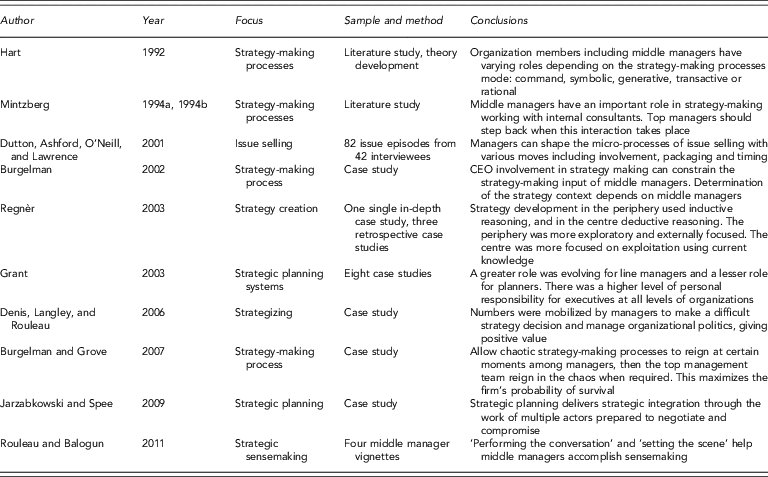
Table 1 provides a summary of representative literature reviews and qualitative studies of the role of middle managers in strategy processes and/or strategy practice. Key among the learning from these studies is that it is important for the firm that the TMT and middle managers each exert strategic influence and that favourable performance consequences result when this takes place (Burgelman, Reference Burgelman2002; Burgelman & Grove, Reference Burgelman and Grove2007). There is an increasing appreciation that middle managers through their own initiative can use their knowledge of the strategy context including the firm, their colleagues in the firm and the industry to influence strategy outcomes (Burgelman, Reference Burgelman2002; Hoon, Reference Hoon2007; Jarzabkowski & Balogun, Reference Jarzabkowski and Balogun2009).
Representative literature reviews and qualitative studies: Middle managers and strategy process/strategy practice

Given this background, in contemporary strategy-making, there is an increasing appreciation that all staff can think strategically (Mintzberg, Reference Mintzberg1994b; Liedtka, Reference Liedtka1998) with middle managers now actively seeking autonomy and responsibility in their jobs (Bonn & Christodoulou, Reference Bonn and Christodoulou1996; Rouleau & Balogun, Reference Rouleau and Balogun2011; Shimizu, Reference Shimizu2012). Strategy-making is now more open and democratic than it has traditionally been (Mintzberg, Reference Mintzberg1994a, Reference Mintzberg1994b) though recent research indicates that there is more the TMT can do here (Rouleau & Balogun, Reference Rouleau and Balogun2011). TMT communication and encouragement to middle managers has an important influence on the success of strategizing in firms (Hill, Seo, Kang, & Taylor, Reference Hill, Seo, Kang and Taylor2012; Shimizu, Reference Shimizu2012). There is stronger emphasis now within organizations on culture, communication, education and training to provide staff with the skills necessary to think, analyse and act on the run (Bonn & Christodoulou, Reference Bonn and Christodoulou1996; Galbreath, Reference Galbreath2012). Middle managers are encouraged to be ‘active players’ (Hart, Reference Hart1992: 340). The emphasis now is on middle managers playing an important ‘boundary spanning’ role, gathering information on customer and market trends, passing this information on up through the organization and liaising with internal planners on the development of creative strategic ideas (Mintzberg, Reference Mintzberg1994a, Reference Mintzberg1994b; Floyd & Wooldridge, Reference Floyd and Wooldridge1997; Burgelman, Reference Burgelman2002; Ambrosini & Bowman, Reference Ambrosini and Bowman2009; Beck, Reference Beck2009).
Hamel (Reference Hamel1996, Reference Hamel2000) draws attention to the frustration felt by middle managers in some organizations still dominated by cautious bureaucrats. These managers are frustrated that their efforts to pass ideas and information up through the organization are not as successful as they would like to be. Hamel (Reference Hamel1996, Reference Hamel2000) champions the cause of managers as ‘freethinking’ strategy revolutionaries (Hamel, Reference Hamel1996: 71). Similar to Hamel (Reference Hamel2000), Burgelman and Grove (Reference Burgelman and Grove2007) and Shimizu (Reference Shimizu2012) each identified the value of fostering the generation of ideas and an innovation culture among middle managers as critical to enhancing change capability and performance. The whole organization must be sensitive to the environmental context all the time to provide the organization with the best chance of strategy success.
TMT members not listening to middle managers is a missed opportunity for the TMT as middle management are close to customers (Burgelman, Reference Burgelman2002). Hirst, van Kippenberg, and Zhou (Reference Hirst, van Kippenberg and Zhou2009) have recently observed that fostering team learning behaviour in organizations also encourages individual creativity and learning. These favourable creative, team-oriented aspects of strategy-making increase the ‘evolvability’ of the organization (Burgelman & Grove, Reference Burgelman and Grove2007: 966) and are a key component of strategy-making (Mintzberg, Reference Mintzberg1994a, Reference Mintzberg1994b). Businesses that evolve with the business environment have a greater probability of survival (Darwin, Reference Darwin1859; Burgelman & Grove, Reference Burgelman and Grove2007; O'Shannassy, Kemp, & Booth, Reference O'Shannassy, Kemp and Booth2010).
Middle managers are a special case as they lack the influence over strategy process given to TMT members by their formal role (Burgelman, Reference Burgelman2002; Burgelman & Grove, Reference Burgelman and Grove2007; Rouleau & Balogun, Reference Rouleau and Balogun2011). There is also a greater population of managers compared with TMT members, not only in a single firm, but across industries making this topic of much significance to the potential improvement of business productivity (Wooldridge, Schmid, & Floyd, Reference Wooldridge, Schmid and Floyd2008). Managers need to ‘craft and share a message that is meaningful, engaging and compelling within his/her context of operation’ (Roleau & Balogun, Reference Rouleau and Balogun2011: 954) and be seen to be performing at a commendable level. This engenders trust and confidence among the middle managers TMT colleagues, leading to greater opportunity to participate in and influence strategy process (Burgelman & Grove, Reference Burgelman and Grove2007; Hoon, Reference Hoon2007). Improvements in strategic influencing by a broader population of managers in a firm that values staff experience, training and development has the potential to make a genuine and measureable difference to firm performance over the short, medium and long term (Galbreath & Galvin, Reference Galbreath and Galvin2008). Developing a holistic understanding of the role of the manager in strategy-making is a useful area in which to make a contribution to theory and practice (Wooldridge, Schmid, & Floyd, Reference Wooldridge, Schmid and Floyd2008).
METHODOLOGY AND RESEARCH DESIGN
Methodology
This paper has an inside-out organization focus, seeking to identify the role of middle managers inside organizations in strategy-making (Rouse & Daellenbach, Reference Rouse and Daellenbach2002). Mixed methods were used for this study with a quantitative survey and semi-structured qualitative interviews to assist in achieving this inside-out focus. Ethics clearance for this study was provided by Monash University.
Miles and Huberman (Reference Miles and Huberman1994: 5) have argued that: ‘No study conforms to a standard methodology; each one calls for the researcher to bend the methodology to the peculiarities of the setting’. This empirical project draws on traditional elements of the positivist perspective plus threads of insight from the tradition of critical realism in strategic management research with a quantitative study evidencing a large sample, cross-industry, national engagement. The focus in the quantitative study is achieving a progressively better understanding of reality with rigorous scientific research. The qualitative study applies the Miles and Huberman (Reference Miles and Huberman1994) method of qualitative data analysis. Miles and Huberman (Reference Miles and Huberman1994) have traditionally seen themselves as realists and in more recent years have moved closer to a transcendental realism approach (Bhaskar, Reference Bhaskar1978, Reference Bhaskar1989). Mir and Watson (Reference Mir and Watson2000: 947) confirm: ‘…qualitative methods may be deployed within a realist methodology’ in strategic management research. There is also a place for the interpretive perspective in the qualitative study where reality is held in the mind of participants in the strategy process in organizations (Miles & Huberman, Reference Miles and Huberman1994).
Quantitative sample and method
The quantitative analysis reported in this study emerges from a survey completed by middle managers (N = 72) in relation to their role in strategy process and their use of external consultants. The 12 items in the quantitative survey (refer Appendix 1) follow from the theoretical background for this paper and were developed exclusively for this research from a synthesis of the literature. The 12 survey items were reviewed by two senior academics before the conduct of the survey who agreed the items reflected explanations in the theoretical background in this paper on the role of the middle manager in strategy work. In the survey respondents were asked to identify from the list of 12 items in rank order the three roles they most commonly play in strategy process in their organization. The next question asked respondents for a ‘Yes’ or ‘No’ answer on whether they used external consultants. The 72 responses were obtained from an administration on site in August 2002 to Executive Master of Business Administration students working in a range of industries and studying at RMIT University. The response rate was 100% for private-sector employees working for non-government organizations. Descriptive statistics were prepared using SPSS FREQUENCIES to facilitate the quantitative analysis below (Coakes & Steed, 2001). Survey respondents were mainly from the automotive (N = 14), banking and finance (N = 11) and information technology (N = 7) industries. Professional services (N = 4), private education (N = 3), telecommunications (N = 3), and food and beverage (N = 3) each provided small numbers of respondents and the remainder of the sample comprised a range of miscellaneous industries.
Qualitative sample and method
For the qualitative study the interviewees whose insights are reported in this paper agreed to participate in a mixed method Australian study investigating contemporary strategy process inside Australian organizations. Interviewees were identified from the list of RMIT University MBA programme alumni or the Australian Stock Exchange website. Each interviewee was mailed a plain language statement explaining the study and advising the researcher would telephone within 5 business days to arrange the interview. This approach proved to be successful in arranging the 18 interviews reported in this research. The interviews were conducted in the period March 2002 to December 2002.
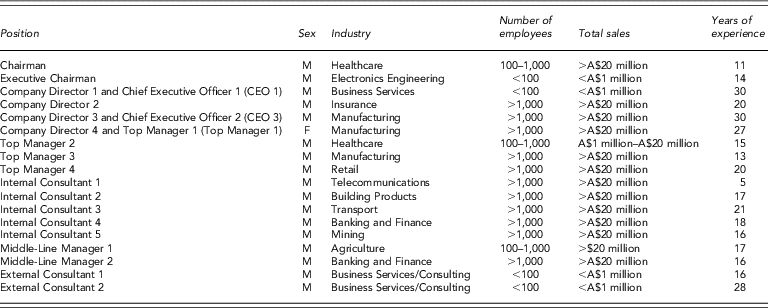
Demographic data of the interviewees is detailed below in Table 2. The interviewees include a number of leading figures in the Australian business community. Representatives from 12 of the Australian Stock Exchange Top 100 listed companies are included in the sample. Four small and medium-sized enterprise (i.e., companies with fewer than 100 employees) executives and two external consultants are also included among the 18 interviewees to increase the generalizability of results. The strategy here was to increase the sample size and include a wider range of the business community to ascertain if there was wide agreement or any disagreement among interviewees. Company directors and CEO responses (N = 5) are analysed first, then top managers (N = 4), then internal consultants (N = 5), then middle managers (N = 2) and finally management consulting professionals (N = 2). All interviewees had completed the quantitative survey before a qualitative interview; only the middle manager survey responses are included in the quantitative results from 72 respondents for this paper.
Qualitative interviews respondent demographic data
Interviews were undertaken either in the researcher's office at RMIT University or in the professional office of the interviewee. Average interview time was 55 min in total with the shortest 30 min and the longest 1 hr and 45 min. All interviewees consented to the interview being taped. Interview questions focused on strategy-making processes, the role of middle managers in these strategy-making processes, how the interviewees work with middle managers in their work areas and how middle managers work across the chain of command in their organization. A summary note for each interview was prepared within 24 hr of the interview. Interview tapes were forwarded to a transcriber for preparation of the interview transcripts. These interview transcripts were then checked for accuracy by the interviewer (Miles & Huberman, Reference Miles and Huberman1994; Tharenou, Donohue, & Cooper, Reference Tharenou, Donohue and Cooper2007).
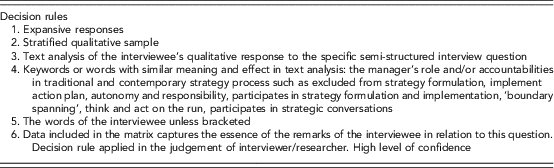
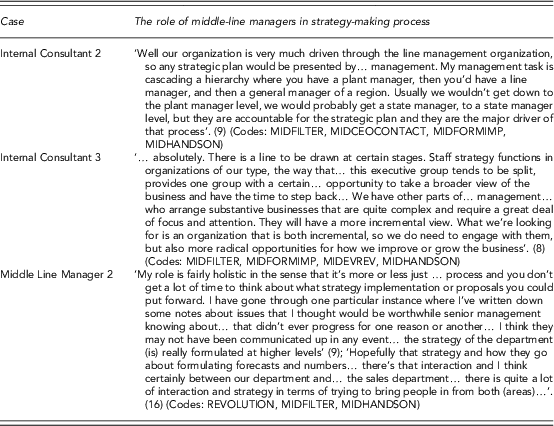
For the qualitative interview study the impressive rigour of the Miles and Huberman (Reference Miles and Huberman1994) approach to qualitative data analysis was used. A more objective, standardized, analytical style of examining the interview transcripts was preferred given the existing body of theory and research on the topic. Analysis commenced with identification of keywords and themes from the literature survey and the quantitative study. These keywords and themes provided the basis for the preparation of decision rules (refer Table 3) for the selection of interview excerpts to be included in summary matrices to facilitate data reduction (Miles & Huberman, Reference Miles and Huberman1994). Table 4 provides an example excerpt of the summary matrices.
Qualitative data analysis decision rules for summary matrices
Example summary qualitative analysis matrix and codes: The role of middle line managers in strategy-making process
Example Codes:
MIDINVOLVE: Company directors and CEOs will involve middle-line managers in strategy process from time to time, when this involvement is desirable, allowing them an influencing role.
TOPCON: Top managers must have confidence and trust in middle-line managers.
MIDCEOCONTACT: There may be limitations on how far down the organization chart direct contact with the CEO goes – this depends on the internal and external context.
MIDFILTER: Middle-line managers can be an important source of information filtering ideas and insights from the ‘bottom-up’ through the organization to the CEO and top managers.
MIDFORMIMP: Middle-line managers can make a significant contribution to strategy formulation and implementation.
REVOLUTION: Some frustration expressed by middle-line managers on their level of inclusion (or exclusion really) in strategy process. Hamel's (Reference Hamel2000) ‘revolutionaries’.
MIDHANDSON: Middle-line managers are ‘hands on’ (i.e., ‘doer’ strategy process role) with strategy implementation.
MIDEVREV: Middle-line managers can be hired and trained to perform a diverse range of roles, some strategic (e.g., ‘generator of ideas’, ‘analyst’), some operational (e.g., ‘controller, monitor’) and some functional (e.g., ‘information source’); when this diverse range of roles and skills is orchestrated effectively the sum result can be the capacity of an organization to perform evolutionary and revolutionary change.
The next step was to use a range of tactics to analyse the excerpts in the summary matrices in an iterative activity. Counting and clustering was initially undertaken, then patterns and themes were noted in a memoing activity, then weighing the evidence and contrasting. The purpose was to seek plausibility in the explanation to conclude the memos and move to the write-up stage (Miles & Huberman, Reference Miles and Huberman1994). The outcome of this analysis was then compared with the quantitative study and then a further iteration of comparison of the quantitative results with the qualitative interview transcripts was undertaken. The qualitative interview analysis was checked and reviewed by two academics during the development of the summary matrices, and then during and after the analysis of the summary matrices. There was general agreement among the three researchers on the themes and patterns evident in the data that is presented in the write-up that follows.
RESULTS
Quantitative results
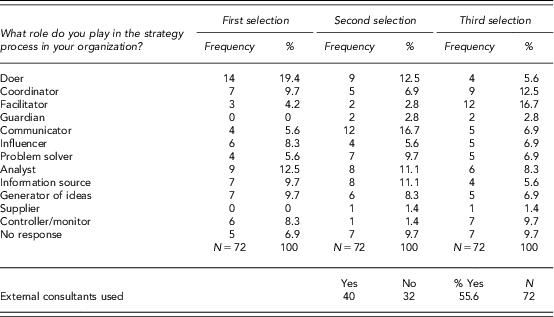
Table 5 displays the results in the aggregate for how the 72 managers understood their role from the survey. Middle manager's most frequent first selection for describing their role in the strategy process was as a ‘doer’. Other frequent first choice mentions were ‘analyst’, ‘coordinator’, ‘information source’ and ‘generator of ideas’. Most frequent second choice was ‘communicator’ and third choice ‘facilitator’. This conveys a very ‘hands on’ role for the middle manager in the practice of strategy. Across the three possible selections the top four choices were ‘doer’ (N = 27), ‘analyst’ (N = 23), ‘coordinator’ (N = 21) and ‘communicator’ (N = 21).
Middle-line manager roles in strategy-making process and the use of external consultants
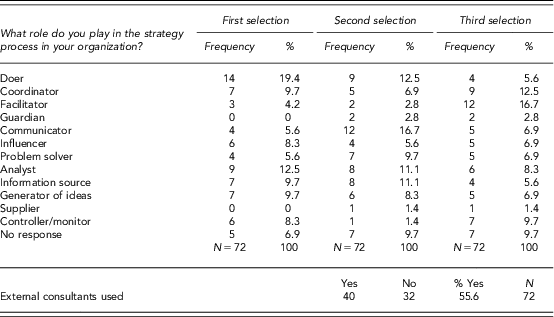
Table 5 also shows that a range of external consultants from a variety of disciplines were hired by 55.6% of all organizations. Managers perceived the role of external consultants to be first as a ‘generator of ideas’, then as an ‘analyst’ and also a ‘problem solver’. So, overall, the role of the Australian middle managers here is very hands on, very much involved with the doing in strategy implementation plus the analytical work. This insight from the quantitative survey was then used to assist investigation of the qualitative interview transcripts.
Qualitative results
As noted Table 4 gives the example of the summary matrices prepared with the qualitative data. The summary matrices comprise more than 5,000 words of data over several pages and are too lengthy to include in full. Write-up of results is grouped for each organization level. Company directors and CEO responses are analysed first, then top managers, then internal consultants, then middle managers and finally management consulting professionals. The learning from the quantitative survey was used to inform the investigation of the summary matrices from the qualitative interviews. An indication of this work can be seen in the development of the codes from the qualitative analysis for Table 4. For example, Code 5 refers to the middle manager as a filter of information from the bottom of the organization up to the CEO and top managers; this activity relates to the search for evidence of the ‘information source’ item in the quantitative survey. A second example occurs with Code 9 that refers to the managers as being ‘hands on’ with strategy implementation. This reflects the search in the qualitative transcripts for the connection to the ‘doer’ item in the quantitative survey.
Company directors and CEOs
Two clear themes emerged from the interview responses at this level. First, four of five interviewees at this level commented that in principle managers should be involved in the strategy process. Second, managers should generate and sell operational and/or strategic ideas up the organization to help the organization perform better and to get some personal recognition for their performance. These themes are evidenced in this excerpt from CEO 1:
I don't constrain anybody in terms of being a source of good ideas. It is how they get communicated and owned as they go up the tree and the… manager is important in… being a champion of either his own ideas or ideas of people in his own organization. I just see it as part of their job. I don't see it as a particular issue… in terms of those who do it strategically and those who don't. I just see it as part of the job. (Business Services/14)
So managers need to sell their views and ideas, and also the views and ideas of influential other people they work with actively in the organization. Involvement of managers does not simply happen managers need to work at it to make it happen. Three of five interviewees communicated in broader conversation on this topic that technology can help the strategy process in their organization, giving access to information and data, improving data analytics, and helping communication and dialogue. Consequently, in later interviews the issue of technology helping strategy process was raised in conversation.
Top managers
The first theme to emerge from the analysis at this level is that managers provide a spanning role for top managers, inside and outside the organization, with the extent of this interaction with internal and external stakeholders and the diversity of contacts they work with determined by their job description. Second, organizational influencing may take place through formal or informal channels with middle managers selling ideas and also the value of their contribution up through the organization. This work is important to their career success. The importance of the top managers having confidence and trust in middle managers was identified in the response of Top Manager 3. Each response from the top managers was quite positive in support of their ability to involve managers in strategy process and their initiatives to do this. Technology helping strategy process was verified in three of the four interviews. Technology can assist timeliness of capture of financial and operational data, analysis of this data, accuracy of data, general ease of communication and overall capability to include people in strategy work, resulting in more participative strategizing:
We as a business are trying to rid ourselves of the administrative stuff, with better use of technology so we can spend more time on analysis and evaluating. Evaluating is not putting the numbers together, evaluating is in actually thinking about what the numbers are telling you and how you need to respond as a consequence. (Top Manager 2/Healthcare/12)
Internal consultants
Internal consultants also reported efforts to give involvement, freedom and autonomy to middle managers. However, Internal Consultant 2 indicated there may be a limit as to how far down the organization chart this involvement, freedom and autonomy goes evidenced in the following remarks:
Well our organization is very much driven through… management… so any strategic plan would be presented by… management. My management task is cascading a hierarchy where you have a plan manager, then you'd have a line manager, and then a general manager of a region. Usually we wouldn't get down to the plan manager level, we would probably get… to a state manager level… they are accountable for the strategic plan and they are the major driver of that process. (Building Products/9)
Each of the internal consultants confirmed that middle managers at the middle level and operational staff had the opportunity to filter ideas up through the organization as well as being ‘hands on’ with strategy implementation issues and work. Each interviewee indicated their organization performed this task well and that their managers made a significant contribution to strategy formulation and implementation, as evidenced by this interview remark:
… it's all about how you maximize the intellect… of the organization by harnessing everyone's brain… and everyone is doing strategy… the individuals in the front line whether it be front office or back office. Your operational people can make big changes… It's about everyone having a degree of power and control… we… believe that is the best way of generating long term performance… So without question it is a very decentralized collaborative way… (and) you've got to be able to communicate the strategy in a form that everyone can understand…. (Internal Consultant 4/Banking and Finance/13)
Thus, the way managers communicate their views and ideas on strategy issues, and the views and ideas of influential colleagues, has an influence on their impact in the organization. It was evident talking to the internal consultants that some managers are better at this strategy work than others, with some managers highly effective, some not very effective and others something in between.
In the transport sector the involvement of middle management in strategy process was quite sophisticated. This case evidences taking a configurational strategy school approach to the interaction of managers and top managers and this helped to facilitate evolutionary and revolutionary change capabilities:
… Staff strategy functions in organizations of our type… this executive group tends to be split… (this) provides one group with… (an) opportunity to take a broader view of the business and have the time to step back (and take that broader view). We have other parts of our… management team who arrange substantive businesses that are quite complex and require a great deal of focus and attention. They will have a more incremental view. What we are looking for is an organization that is both incremental… but also (able to take advantage of) more radical opportunities for how we improve and grow the business. (Internal Consultant 3/Transport/8)
This approach to managing is consistent with Tushman and O'Reilly's (Reference Tushman and O'Reilly2004) ambidextrous organization exploiting existing products or services in one business unit and developing innovation products and/or services in another business unit or team at the same time.
Technology was understood unanimously among the internal consultants to be of much assistance to strategy process. Remarks from Internal Consultant 1 highlighted the value of an intranet as an information resource that could be used as a shared resource:
I guess the internet has certainly made communications much more effective and… it can keep you up to date more regularly… when we conduct quarterly strategic reviews we'll summarise the results… on the internet and make it available under password to the strategy people in the company so it's there and readily available in a few days… if it changes we can change it quite quickly as well. (Internal Consultant/Telecommunications/20)
Middle-line managers
Each middle manager communicated a desire for a greater level of influence and involvement in strategy process. The feel of the responses was somewhat ‘downbeat’ on the success of top managers in their efforts to empower managers and make them feel genuinely included in the strategy process. The managers were dissatisfied with this aspect of their jobs. This finding is consistent with Hamel's (Reference Hamel2000: 314) insights on ‘revolutionary’ voices in management jobs in the organization. This finding is also counter to remarks made at the company director and CEO, top manager and internal consultant levels of this qualitative analysis. Manager 2 (Banking and Finance/9) also expressed concern about time constraints in his role limiting his opportunity to participate in strategy process. Manager 2 indicated engagement with outside stakeholders was likely to occur in his role. From the middle manager perspective the focus of top managers seemed to be on getting the job done and company survival by achieving acceptable sales and profit outcomes for the month, quarter and year. There did not appear to be the availability of resource slack to refine, polish and nurture the strategy process in these businesses in which the two middle managers work. Top manager awareness of the need to not only include managers in strategy process, but to effectively integrate use of financial, marketing and information technology resources with human resources also appeared to be limited, causing some frustration for the managers.
External consultants
External (management) consultants confirmed unanimously the important role of managers in strategy process. External Consultant 1 observed the range of demands placed upon managers:
The role… I think it is like a mini-CEO role. It is a case of they have to be leaders, they have to operationalize, both the issues that are handed down to them and the issues which emerge. (9)
The view from external consultants was that in an uncertain world the demands on managers are becoming increasingly complex. Both external consultants noted the importance of technology in helping people work together on strategy in organizations: ‘Technology is now more sophisticated. Access to technology is greater now and everyone needs to be up to speed with it’ (External Consultant 1/Business Services/1). External Consultant 2 highlighted the benefits of using decision support tools to maximize use of the amount of available data now by exploring that data and sharing the knowledge gained: ‘In terms of smart systems, in terms of being able to capture transactions at the source, being able to segment and report, convert data to intelligence, to knowledge, to wisdom’ (Business Services/7). This can greatly assist participative strategizing and innovation capability.
DISCUSSION
The literature indicates we need to better understand the role of middle managers in strategy work (Wooldridge, Schmid, & Floyd, Reference Wooldridge, Schmid and Floyd2008; Beck, Reference Beck2009; Moldoveanu, Reference Moldoveanu2009). Research focusing on the role of middle managers in strategy-making is sparse and the availability of survey and interview data talking to the business community about this area of strategy work is rare. This provides an opportunity to build knowledge of theory and practice (Whetten, Reference Whetten1989). Specific studies in this area of middle management involvement in strategy process from Bonn and Christodoulou (Reference Bonn and Christodoulou1996) and Floyd and Wooldridge (Reference Floyd and Wooldridge1997) provide empirical insight, while Mintzberg's (Reference Mintzberg1994a, Reference Mintzberg1994b) notable contribution in this area is based on literature review. There is agreement in the literature that there is more to be learned in relation to middle managers and their role in strategy-making, especially studies that take a holistic view of the work of managers and those that seek to understand what makes an effective middle manager in their strategy work (Hutzschenreuter & Kleindienst, Reference Hutzschenreuter and Kleindienst2006; Wooldridge, Schmid, & Floyd, Reference Wooldridge, Schmid and Floyd2008).
The quantitative survey results convey a very ‘hands on’ role for the middle manager in the practice of strategy and a role quite different to a TMT member whose role will be more creative, visionary, leadership and communication focused (Mintzberg, Reference Mintzberg1994a, Reference Mintzberg1994b; Hill et al., Reference Hill, Seo, Kang and Taylor2012). Prominent mentions of the role of the middle manager included ‘doer’, ‘analyst’, ‘coordinator’, ‘information source’, ‘generator of ideas’, ‘communicator’ and ‘facilitator’. The aggregate insights from the survey relate well to observations in the literature (Mintzberg, Reference Mintzberg1994a, Reference Mintzberg1994b; Rasche & Chia, Reference Rasche and Chia2007). This learning from the synthesis of the literature and then investigated with the quantitative survey helped to guide analysis of the qualitative interview data providing keywords used to explore the transcripts and summary matrices.
In the qualitative results company directors, CEOs, top managers and internal consultants were quite consistent in stating that they made a real effort to involve managers in strategy-making. However, in their qualitative interviews middle managers did not confirm the views of company directors, CEOs, top managers and internal consultants on the freedom and autonomy granted to them in their roles. This was an interesting anomaly in the research. There were moments during interviews where more than a little frustration was expressed by managers on their level of inclusion in strategy-making and their capacity to influence upwards as effectively they would wish – evidence of the frustration of Hamel's (Reference Hamel2000: 251) ‘revolutionaries’. It was evident across all the interview analysis that top managers are making an effort to restore the strategy-making work of middle managers, however, they can do more to encourage middle managers to be heard and participate in strategy-making. This could be through more open, participative activities in the workplace, or training and development initiatives (Forster, Reference Forster2007). It was also evident that some middle managers are more adept at influencing upwards in their organizations than others. This finding is consistent with remarks from Rouleau and Balogun (Reference Rouleau and Balogun2011) in their UK study on the need to focus more on the socialization and development of middle managers in research and practice now. Middle managers noted that often upper echelon executives lacked the required time and resource slack to really make strategy-making inclusive.
A shared and unexpected perspective in the results at each level of analysis (i.e., top manager, internal consultants, etc.) was found with 14 of 18 interviewees remarking on the importance of technology helping middle managers perform their role, engage with peers, enhance their job capability and as a consequence help the strategy performance of the organization. There are real benefits to the organization in helping the participative, transactive aspects of strategizing (Hart, Reference Hart1992) by using technology well. This is done by capturing transactions and data at the source, exploring the data, being able to segment and report, sharing the knowledge gained from the data on a central database or intranet, converting data to intelligence, and allowing the insight gained from this work to be communicated to other middle managers and strategy workers. This information can greatly assist creativity, analysis, communication, learning and innovation capability for the firm (Kotha, Zheng, & George, Reference Kotha, Zheng and George2011). Another benefit is the increasing efficiency of strategy workers able to use e-mail, decision support tools, the firm intranet and/or the internet to source data and information, and solve strategic problems efficiently without needing to refer to other employees (Gittens, Reference Gittens2011).
In terms of understanding the contribution to theory in this research Wooldridge, Schmid, and Floyd (Reference Wooldridge, Schmid and Floyd2008) noted the benefit to the field of developing a holistic understanding of the role of middle managers in strategy-making (Whetten, Reference Whetten1989). This research has set out to develop a theory of the role of the middle manager to better understand what they do in strategy-making (Hart, Reference Hart1992; Jarzabkowski & Spee, Reference Jarzabkowski and Spee2009). The evolution in the role comes about because of the evolution of the business environment (e.g., advances in technology) that impacts the strategy work of middle managers and the way this is done in organizations. The theoretical background undertakes a synthesis of insights from empirical and some relevant executive management literature (e.g., Hamel, Reference Hamel1996, Reference Hamel2000) to identify what middle managers do most often and in what priority in their strategy work. This background guided the empirical research. The theoretical development also noted that better middle management capability in an organization enhances the ‘evolvability’ (Burgelman & Grove, Reference Burgelman and Grove2007: 966) of the organization to changes in the business environment (e.g., competitive pressures). This helps organizations achieve their business goals and objectives (Burgelman, Reference Burgelman2002; Burgelman & Grove, Reference Burgelman and Grove2007).
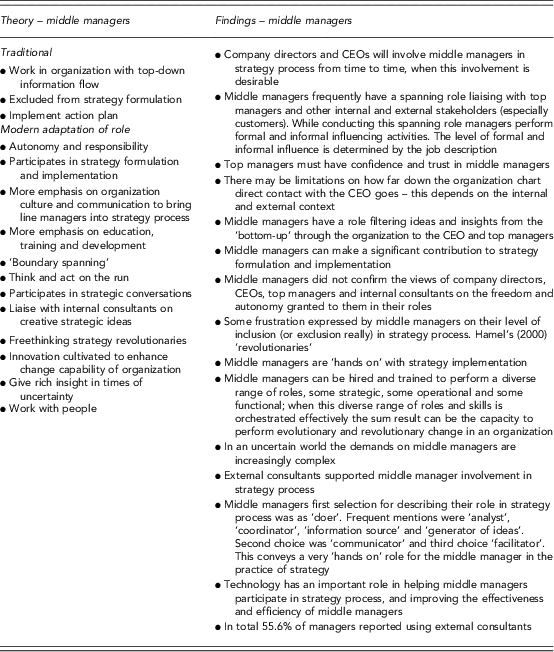
In terms of understanding the contribution to practice in this research, Mintzberg (Reference Mintzberg1994a, Reference Mintzberg1994b) communicated the importance of middle managers in strategy work. Mintzberg (Reference Mintzberg1994a, Reference Mintzberg1994b) emphasized the importance of creativity in this activity and the useful insights middle managers can provide to top managers from their day-to-day interaction with customers and markets (Beck, Reference Beck2009). The empirical findings of this study are summarized in Table 6. There is clear evidence that Australian organizations have moved on from the ‘top-down’ strategy approach practiced in the 1960s that Mintzberg (Reference Mintzberg1994a; Reference Mintzberg1994b) criticized. The role of middle managers in strategy-making set out in Table 6 is quite broad and there will be some flexibility in organizations, and between product lines and/or functions in organizations, on how managers do their strategy work. It is important to say that not every job description for a middle manager will be the same and include every aspect of the findings in Table 6. However, the insights here in this research may be a useful source of information for practitioners in designing middle manager job descriptions and preparing managers through training and experience for strategy work. It does appear in the results that for middle managers there appears to be a little less emphasis on creative strategy work and a more hands on analytical, information source, coordination-type role performed (Mintzberg, Reference Mintzberg1994a, Reference Mintzberg1994b). Burgelman (Reference Burgelman2002) found in his Intel Corporation study in the United States that the presence of TMT members working too closely with middle managers can stifle the development of creative new product ideas. We have seen in the literature and in this study the middle manager has a key role in strategy implementation (Floyd et al., Reference Floyd, Cornelissen, Wright and Delios2011; Rouleau & Balogun, Reference Rouleau and Balogun2011). In this way the study adds to the strategy-making literatures.
Theory and findings on the evolution of the role of middle-line managers in the process of strategizing
Limitations
This mixed method research gets close to the action by surveying and interviewing a useful cross-section of the Australian business community (O'Shannassy, Reference O'Shannassy2005). The key limitation is that only Australian companies were studied. Australian culture is very open and democratic, and it is possible that insights from countries and cultures (e.g., China, India, Singapore, Thailand) with different social and political norms may yield different results. Nonetheless, the results here are likely to be similar to studies in other Anglo-American-developed economies (e.g., United States, United Kingdom, Canada, New Zealand). The second limitation is that only one researcher conducted the qualitative analysis, however, the results were reviewed and criticized by three senior academics during the iterative activity of data analysis and write-up somewhat mitigating this shortcoming.
Future research
Middle management continues to be an important perspective from which to develop rigorous empirical insight into strategy work (Wooldridge, Schmid, & Floyd, Reference Wooldridge, Schmid and Floyd2008). An interesting point of learning from this research has been the disagreement between middle managers and senior business figures interviewed on the strategy role played by the middle managers. Future research could build larger samples of TMT members and middle managers, respectively, to explore this issue from the perspective of each of the TMT sample and the middle manager sample. As an alternative future research could investigate a comparison of the role of the middle manager between countries with different business cultures such as Australia, China and India that may allow interesting and contrasting insight. The socialization, training and development of managers has recently been highlighted as worthy of investigation as this impacts their strategy-making performance (Rouleau & Balogun, Reference Rouleau and Balogun2011). Wooldridge, Schmid, and Floyd (Reference Wooldridge, Schmid and Floyd2008) suggest that examining strategic role conflict between TMT members and middle managers may also be an area worthy of investigation. Exploring the effectiveness of firm mission statements to inspire and focus middle managers in their strategy work is another matter for investigation (Braun, Wesche, Frey, Weisweiler, & Peus, Reference Braun, Wesche, Frey, Weisweiler and Peus2012). There are a number of avenues for future research in this area.
CONCLUSION
Findings from this research include verification of existing knowledge (Hart, Reference Hart1992; Bonn & Christodoulou, Reference Bonn and Christodoulou1996; Liedtka, Reference Liedtka1998) as well as additional, fresh and subtle insight into the role of middle managers. This study gives Australian and international researchers the opportunity to get a close look at the strategy-making work of Australian middle managers. There is an interesting contradiction of insight between top managers and middle managers in their responses to the interview questions with top managers quite positive on their efforts to include middle managers, yet, middle managers were not in agreement. Middle managers were critical and argued that they had something valuable to add to strategy and that they should be heard, a point made in recent European research (Rouleau & Balogun, Reference Rouleau and Balogun2011) and reinforced here. Hamel's (Reference Hamel2000) writing argues for these revolutionary voices to be heard and encouraged as they are the source of innovation and better performance.
Appendix 1 Quantitative Middle-line Manager Survey