In 1950, the publication of Time in New England, a collaborative venture between the photographer Paul Strand and the writer, critic, and curator of photography Nancy Newhall, was met with little critical attention. Despite Strand's existing reputation as a photographer, Time in New England (abbreviated hereafter as TINE) was seen largely as a quaint homage to New England life, a coffee-table project rather than a complex exercise in photo-textual collaboration. As Alan Trachtenberg puts it in his introduction to Paul Strand: Essays on His Life and Work, the pairing of landscapes and portraits of local inhabitants with a cross-section of historical and fictional accounts of New England from 1630 to 1950 seemed to present a relatively straightforward “concept of New England rectitude, individualism, and perseverance.”Footnote 1 This concept of New England, whilst in keeping with an idea of the region as the cradle of American democracy, nonetheless also operates as a critical, and even potentially subversive, commentary on American postwar politics. For Strand, and for Nancy Newhall, TINE was more than an attempt to synthesize images and writing into an idealized narrative of the nation-state, it was a way to reexamine – in a time of increasing domestic political strife – the unresolved schisms and fractures within that narrative. Similarly, even though Strand's photographs, at first sight, appear to be primarily timeless images of locations and people from New England devoid of any overtly political context, the intersections between text and photography tell a different story.
The book is structured in four parts: Part I, “The First Settlers”; Part II, “The Revolutionary Period”; Part III, “Abolition and Transcendentalism”; and Part IV, “Nineteenth and Early Twentieth Century Responses to New England.” As such, it moves from the original settlers, their religiosity, superstitions, and attempts to set up a workable society (William Bradford, “Arrival Plymouth November 1620,” facing an image entitled “Storm and Sea”), onwards to civil strife, disobedience, slavery, and suffrage (Margaret Fuller, “A Man's Ambition with a Woman's Heart,” preempted by an image entitled, “Dried Seaweed”). The book's very last image is prefaced by Van Wyck Brooks's “New England: Indian Summer” (1940), in which Brooks concludes, “Americans had a stake in New England … as a palladium of truth, justice, freedom and learning.”Footnote 2
The texts, ranging from affidavits from Salem witch trials to abolitionist pamphlets, were chosen and edited by Nancy Newhall and set up adjacent to the photographs. Although the extracts appear to complement the subject matter of the photos, they also constitute a counterpoint to Strand's images in ideological terms. If the subjects photographed by Strand seem primarily to be a series of symbolic landscapes, replete with church steeples and fallen tombstones, then other images – landscapes of looming clouds, and close-ups of the local flora and fauna – do not immediately to present themselves as iconic. Adding to this is the fact that with over ninety photographs and more than a hundred textual extracts, the juxtaposition between the static images of buildings, plants and inhabitants and the explosive textual evidence of an often violent American history is far from transparently linked to an idea of democracy. In fact, at regular intervals throughout the book, anecdotal material detailing Indian massacres, cruelty to runaway slaves, and the horrifying narratives of witch hunts markedly set themselves apart from the placid images. If anything, it is as if the chosen extracts counter the visual iconography of Strand's portraits of New England residents, whose faraway gazes and static postures show them as calm and ennobled, rather than as the inheritors of regional strife and violence.
A paradox is thus at work in TINE. On the one hand, the book clearly does not function as a well-illustrated travel guide through the history of New England, just as Nancy Newhall's chosen extracts cannot be read as simply a collage of famous New England writings. On the other hand, in political terms, the inscription of a democratic heritage into the very fabric of New England is also far from ideologically transparent. Nonetheless, the concept of democracy is present in TINE; it is there in the persistence of the native, of the indigenous, and of the local; and it is through this that images of vegetation, a fisherman's face, or the facade of his barn take on added meaning.
The complex interaction between images and text likewise complicates any claims that TINE is simply an arena for a particular form of realist photography or that it constitutes a straightforward extension of Strand's 1930s documentary politics. Unlike Strand's critique of domestic politics in films such as Native Land (1942) and The Plow that Broke the Plains (directed by Pare Lorentz, 1936), TINE is a much more subtle investigation into the hopes and aspirations of a nation caught between a prewar belief in collective democracy and postwar anxieties concerning the erosion of civil liberties. According to Lili Corbus Bezner, Strand was known for his ability to “blend a concern for aesthetics with a commitment to social awareness,” an ability that enabled him to have a “broader vision of photography beyond didactic political uses.”Footnote 3 Bezner charts Strand's committed defence of the Photo League, a progressive collective of socially concerned photographers blacklisted by Attorney General Tom Clark in 1947 for alleged Communist affiliations of which both Strand and the Newhalls were members. While both Strand and Nancy Newhall were vocal in their support of the Photo League, as Bezner notes, Beaumont Newhall nonetheless omitted the importance of the Photo League in his revised The History of Photography (1947), a decision possibly based on not hampering the broad appeal of the book by referring to the organization's fraught history.Footnote 4
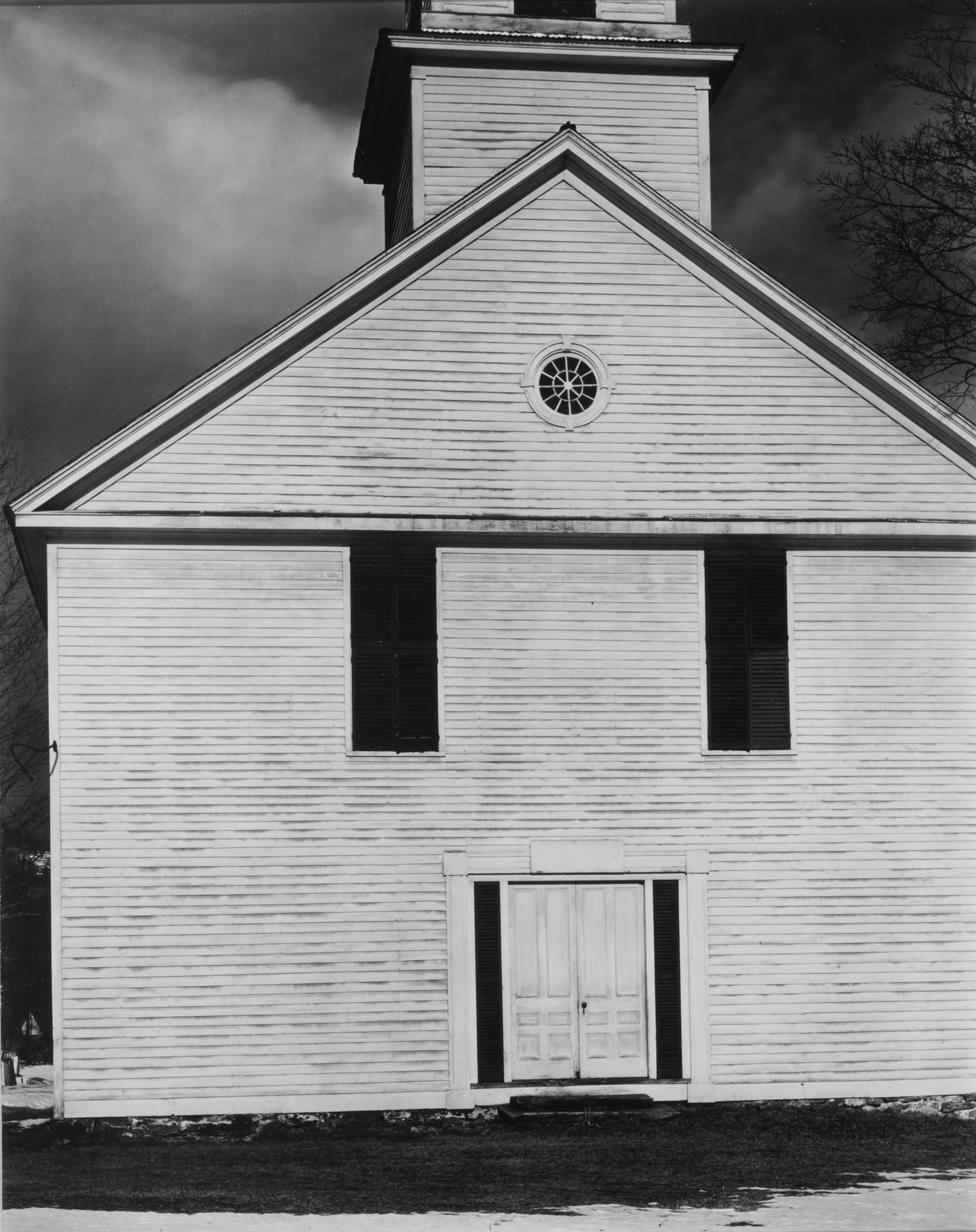
Church, 1944. The Paul Strand Retrospective Collection, 1915–75, gift of the estate of Paul Strand, 1980.

Despite the inevitable connection between the aggressive blacklisting of the league by the late 1940s and a possible diffusion of political ideals in the execution of TINE, there is little to indicate an overt impact on the subsequent collaboration between Nancy Newhall and Paul Strand despite the fact as well that the book was nearly five years in the making. In fact, one of the more curious things about TINE is that it seems both geographically and ideologically somewhat removed from the tempestuous events of the late 1940s. Nonetheless, the sense of political turmoil can be traced in the book's structure. According to Amanda N. Bock, “alternating patterns of acquiescence and revolt are acted out through texts … even if personal narratives are privileged over the iconic texts one might expect to attend these themes.”Footnote 5 As I will argue, the way in which TINE navigates this terrain is by using a New England vernacular as an ideological and aesthetic mechanism capable of crossing several borders: between the textual and the visual, between the photo-text as predominantly social or more arts-based, and between the personal and the collective.
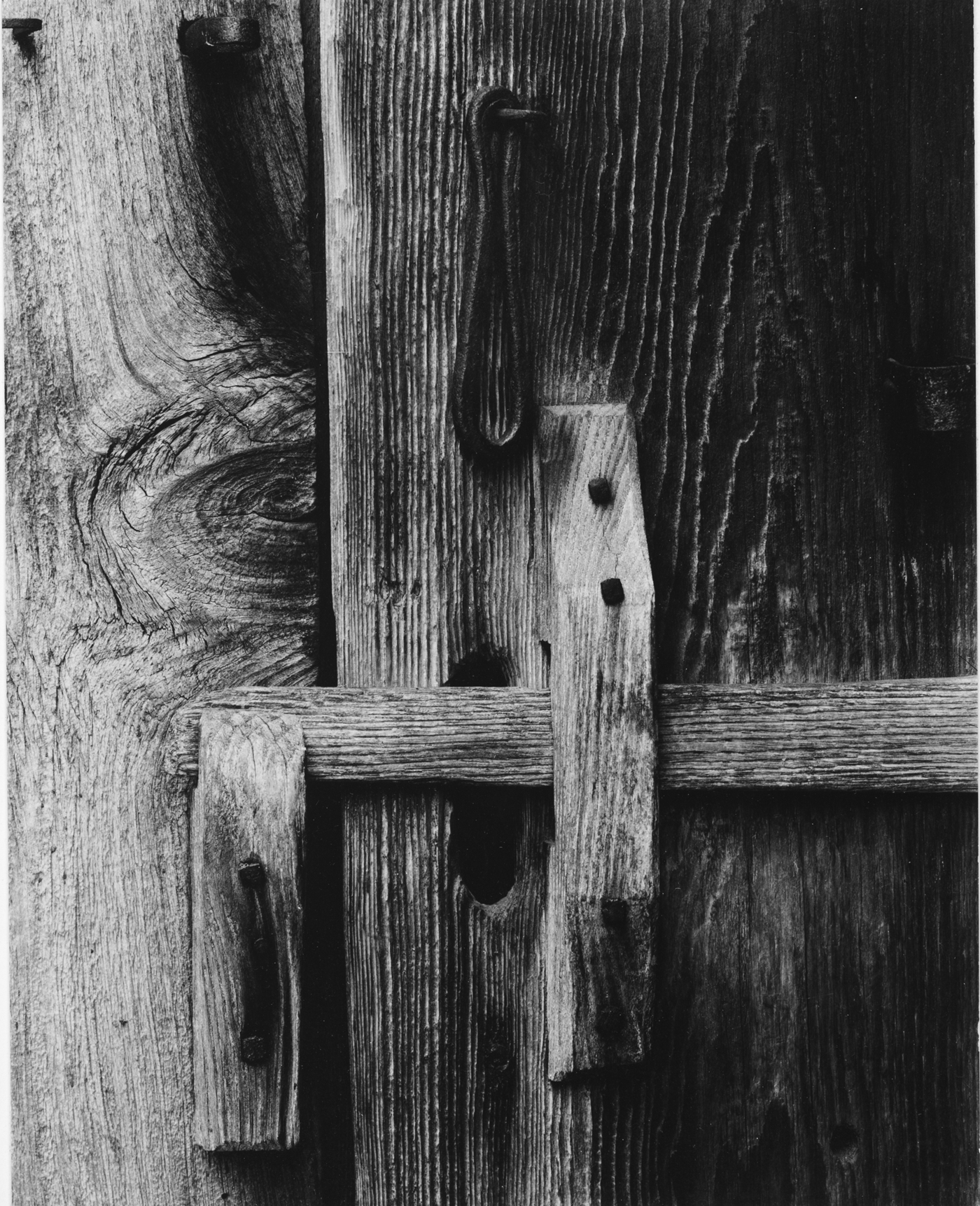
The attempt to straddle such a vast terrain, in aesthetic as well as ideological terms, was clearly one of the reasons why TINE did not provide the comforting vision of democracy that a publisher might have sought in 1950. However, TINE compensated for this through its use of the vernacular, in the voices of the New Englanders and the “look” of their surroundings as a fundamentally lyrical take on America. In many ways, the presence of the vernacular is there, not only in the narratives provided by New Englanders themselves but also in the tenor and urgency with which the textual extracts impose various meanings on the photographs. In the section entitled “Foothold,” two extracts from Captain Edward Johnson's 1654 Wonder Working Providence of Sion's Saviour bookend the image of a latch on a wooden door (see Figure 2).
Door Latch, Stockburger's Farm, East Jamaica, Vermont. The Paul Strand Collection, from the Collection of Dorothy Norman, 1969.
The photograph of the latch, an item nearly unchanged from the fifteenth century to the twentieth, is cropped to foreground the simplicity of the mechanism itself. Unlike similar architectural studies by Strand's contemporary, Walker Evans, a photographer equally fascinated by the vernacular aspects of facades, artisanal decorations, and other indicators of craftsmanship and local labor, the meaning of Strand's latch appears more symbolic largely because of the accompanying text. In Johnson's diary, Boston, “the center town and metropolis of this wilderness,” is on “constant watch to foresee the approach of foreign dangers.”Footnote 6 The latched door thus connotes both a barrier against the “wilderness” in historical terms, and a more contemporary desire to close off the region, to bar it against foreign and undesired influences. In this instance, despite the book's occasional use of homely allegory, seascapes often accompany narratives of journeys; for example, the alignment provides a more complex vision of the book's agenda in which the “narrative,” rather than chart the progressive nature of democratic values, seems to contradict it. In the example of the latched door, the approach of foreign dangers – whilst historically reasonable in 1654 – also operates as a subtle reminder of the anti-leftist, antiforeign rhetoric of the postwar era.Footnote 7
If TINE questions the problematic reliance on a visible connection between democratic values, as set out in Nancy Newhall's textual extracts, and Strand's photographs of a more “timeless” New England, it is also an investigation into the use-value of documentary photography itself. How do Strand's photographs both maintain a potentially reductive version of New England as the cradle of American democracy and render it a distinct living regional location? How does the camera, in other words, alter the perception of New England? How does the fact that the camera places itself both in opposition to and with the textual material make us read Strand's use of “time” in New England? Of course, the title Time in New England indicates a deliberate conflation of the regional and the photographic, but the conflation is so obvious, in a sense, that the connection is often overlooked. By referencing the vernacular and the photographic, TINE is both an essential component in exposing the “essence” of New England and a crucial component in the mechanical process of photography itself. In other words, it is not just politics but “time” itself that becomes a process that both reflects and inflects its regional subject. In these terms, the integration of text and imagery, rather than illuminate the book's aesthetic and philosophical undercurrents, also questions the mimetic qualities and purposes of the camera itself.
To look at TINE as a book about the mimetic properties of the camera does not, of course, preclude a consideration of the timing of the project in historical terms. As indicated in the image of the latch, numerous photographs carry potential as symbolic postwar responses to the trauma of fascism in Europe, establishing TINE as an attempt to confirm the intrinsic values of America as a haven for democratic principles in an increasingly volatile political climate. It is not coincidental that in 1950, the year TINE was published, Strand finally left the US because of increasingly aggressive right-wing politics, the self-same sociopolitical environment that had effectively stifled the Photo League. Nonetheless, TINE was read primarily – in reviews of the time – as a clear-cut confirmation of America as a site for democratic principles. Thus the importance of regionalism as an internal, as well as external, landscape became a way to bolster New England as a site of honor, rectitude and perseverance, rather than a way to articulate anxieties about ideology and territorial ownership on a larger scale. In this context, TINE not only responds to the anti-leftist sentiment of the postwar years, it also constitutes an investigative process – particularly by Strand – into the limitations as well as the possibilities of the documentary aesthetic in a post-Depression era.
John Rohrbach's “Time in New England: Creating a Usable Past” links the structure and concerns of TINE with Strand's earlier projects, such as Native Land (1942), another polemic, according to Rohrbach, on the importance of “free and open dissent” as “the core of American democracy and moral culture.”Footnote 8 Rohrbach's reading of TINE as essentially an ambitious and well-thought-out commentary on the “fortitude central to New England's settlement” nonetheless underestimates the importance of the schisms between the textual material and the images. Presenting a predominantly “symbolic” landscape rather than “specific places,” Rohrbach argues that the images “become metaphors for the surrounding text” designed to synthesize a vision of New England as a site for freedom – a contested site, but a site for freedom nonetheless. By indicating that a form of restitution and, indeed, containment is delivered in TINE, Rohrbach delivers a paradoxically homogeneous notion of the photo-text that echoes that of the early reviews. However, in Strand's foreword to TINE, the idea of a “great democratic tradition” is already established as something both hard-won and vulnerable:
The freedom of the individual to think, to believe, and to speak freely was an issue fought out here more than once … Men gave their lives in the struggle against political tyranny, and when it took courage to speak out against human slavery … and the threat of mob violence, they spoke out … It was this concept of New England that, like a scenario, gave the clues to the photographs … and brought them into relationship with the text. I was led to try to find in present-day New England images of nature and architecture and faces of people that were either part of or related in feeling to its great tradition.Footnote 9
Strand's commentary, whilst ostensibly about a certain American idealism, unity, and coherency, is on a more oblique level also about the outward manifestation of an inward movement – a movement spurred on by ideology as much as by historical necessity. Not only does this movement begin in the seventeenth century, emphasizing the ideology of the original settlers, but it also introduces what will become a running theme throughout TINE, namely the persistence of a transcendentalist ethos. The concept of a transcendental faith and its resulting cultural and literary tradition is thus established as a fundamental part both of the landscape of New England and of the voices that inhabit that landscape. Extracts by Emily Dickinson, Herman Melville, Nathanael Hawthorne, Cotton Mather, and Jonathan Edwards are all infused by a desire to genuinely inhabit the American landscape, not only physically, but spiritually as well. By creating a lineage of democratic concern and in turn linking this with the language of transcendentalism, these writers and thinkers become precursors for a modernist outlook that in turn is colonized by Strand's lens. Thus while writers such as Melville and Mather occupy different territory in artistic and ideological terms, New England becomes the place where Strand's photographs enable the channeling of transcendentalist concerns into a fundamentally contemporary question: how do we occupy America as a collective and as individuals simultaneously?
Despite the book's mixing of genres, the use of travelogue, historical narrative, and factual documents, the overall gist is that a transcendentalist ethos binds these various voices together. Regardless of the varied nature of the narratives supplied, the voices all signal an America marked by a belief in the intrinsic connections between all things, man-made, natural, and spiritual. By moving from more overtly Puritan doctrine to later transcendentalist thought, the very foundations of American culture become firmly embedded in the one place where those connections are made visible, namely New England.
On the one hand, the use of transcendentalist rhetoric could be seen as a literary shortcut of sorts, a way to signal a heritage of letters distinctly American in outlook and philosophy and a way to position the photo-text as an endeavor on a par with previous attempts to create a faith-based art form. This spiritual dimension may, then, seem incongruous compared to the more secular and realist outlook of Strand's previous documentary efforts, particularly those done under the auspices of Nykino and other more overtly politicized organizations.Footnote 10 At the same time, it is a way to insert TINE into a longer tradition of writing on American photography – a tradition established by such figures as William Carlos Williams and Lincoln Kirstein, who both defined Walker Evans's documentary focus as variants of a more puritanical and even sermonizing style.Footnote 11 For Kirstein, American photography was on equal footing with other vernacular art forms and thus able to render a “poetic vision … however provincial, that was purer in essence than the decadent European echoes” that followed it.Footnote 12
In many ways, the artistic remit for TINE, according to Nancy Newhall, supports the idea of the book as an exercise in how to Americanize photography. In Emersonian terms, the linking between the thing seen and its most accurate linguistic representation lies not in ornate language or sophisticated metaphors but in the creation of alignments both believable and true – alignments that the photo-text is particularly able to do. In the Ebb section, Section I of Part IV, Emerson laments, “It is the age of severance, of disassociation … Instead of the social existence, which all shared, was now separation.”Footnote 13 Newhall's task is thus to prove the persistence of the opposite in New England, a vision of a region that still carries the germ of something integral to American culture. As Newhall “ransacked libraries” for material,
Neither of us was looking for illustrations. Independently, following the twists and turns of our material, we set out for our common goal, the definition of the New England spirit … We wanted an integration so complete that either medium could state or develop a theme. The emotional and intellectual clarity of each passage was our goal …Footnote 14
Newhall's desire for emotional and intellectual clarity, like the transcendentalist idea of a transparency and immediacy, requires a connection that spiritually is so compelling, that even though the link between some of the photographs and the textual extracts is far from obvious, they nonetheless render a sense of integration. Newhall's term for this integration of text and image is “the additive caption”:
In the Additive Caption, the basic principle is the independence – and interdependence – of two mediums. The words do not parrot what the photographs say, the photographs are not illustrations. They are recognized as having their own force … The additive principle at this stage looks like a whole new medium in itself. Its potential seems scarcely explored, like a continent descried from a ship.Footnote 15
At first sight, Newhall's use of the terms “dependence and interdependence” simply describes the use of text and imagery as symbiotically aligned. Nevertheless, setting up her collaboration with Strand as an exploratory one, in line with that of the pilgrims embarking on a voyage to a new continent, Newhall signals an almost religious enterprise at the heart of the project. In her editor's foreword Newhall writes,
Could language – not captions, nor the usual pseudo-poetic phrases, but language intimate, alive, and often of real intensity, extend and clarify the condensed meaning of these photographs? Even more important, could words and images from different authors in different periods become an integral whole? The temptation was irresistible.Footnote 16
Newhall describes the “irresistible temptation” of abolishing conventional captions and “pseudo-poetic phrases.” With little sense of the “political tyranny or mob violence” referenced in Strand's foreword, Newhall's description renders TINE more of an aesthetic than a practical exercise. And yet reviews such as the Boston Sunday Post's “The True Christmas Spirit Survives in New England” placed its emphasis not on the novel use of text and images, but on New England as the “symbol of spiritual hardihood”:
Much of this precious loveliness has been captured between the covers of a book entitled “Time in New England” … None of the pictures is captioned, and Nancy Newhall's text consists entirely of original documents – letters, poems and diaries, all the way from governor Bradford to Robert Frost, with lots of little people in between. Nancy is a New England girl, born in Swampscott and educated in Boston and at Smith College. Paul Strand is one of the three or four greatest living photographers. Here … the faces of New Englanders … are carved out of granite … In their eyes is eloquence no pen can express; in their features is the kind of courage Americans need today.Footnote 17
Owens's review emphasizes the native credentials of the book and Newhall as a born-and-bred “New England” girl. More importantly, the book contains the courage that “Americans need today” (a reference to the Cold War) and stoicism “carved out of granite” like the presidential faces at Mount Rushmore. The fact that “little people in between” have been included indicates that, despite its lofty purpose, the book contains an emphatic and human approach as well. For Owens, this is a work with a recognizable iconography; natural elements are glorious and clean, as opposed to menacing and daunting; and the impression of New England as welcoming prevails.
The result of Newhall's down-toning of the more radical implications of the Puritan legacy is a vision of New England as a refuge rather than a contested site. In Newhall's original version of the introduction, later changed for publication, a sharper tone regarding New England politics is in evidence:
The source of New England character lies in the seventeenth century – in the puritan, arch revolutionary and archconservative. It lies in … family and the burning immediacy of god (or truth, or liberty, or his own special revelation) … Again and again in his humanity and his inhumanity he is born into the centuries, as Samuel Adams, John Brown, Thoreau and Mathers of many names, called forth as persecutor and apostle by issues essentially unchanging – hanging of Quakers or electrocution of Sacco and Vanzetti, rebellion against Britain or crusade against slavery. How to compress this dark and brilliant panorama!Footnote 18
In the published version the “darkness” of the panorama in the original version has been lightened:
The source of New England character lies in the seventeenth century. But the great music of seventeenth century prose that led pilgrim and puritan across the ocean and sustained them in the wilderness was for our ears choked by obscurities and redundancies. Yet in those cadences was the sound of the sea and in their thought the germ of a nation. The sound of that lost time was essential; so were the brisk, bright marching tunes of the Revolution and the dark–bright music of America beginning to sing in its own voice in the nineteenth century.Footnote 19
In comparing the two versions, Newhall's original stress on the revelatory nature of New England, in terms of both “humanity and inhumanity,” persecutor and apostle alike, brings forth a darker vision. By omitting the “hanging Quakers” and the electrocution of political prisoners, and instead focussing on the “brisk, bright marching tunes of the Revolution,” a more patriotic version emerges. Not all reviews, however, were oblivious to the presence of a more complex narrative. According to the Christian Science Monitor,
The book is roughly chronological in concept; with headings and subheadings; almost one might say plots and subplots; Wilderness, Savages, Witchcraft, Revolution. And later, Hill and Town, The Sea, Protest, Abolition, Ebb, and ultimately, Affirmations. Puritanism merges imperceptibly into rationalism, rationalism into “the age of severance, of disassociation, of freedom, of analysis, of detachment” (the description is Emerson's) … If the text then tells of the past, the dirt-root past as well as the flowering, the photography tells us of the past in the present.Footnote 20
Unlike Owens's review, Chapin acknowledges a link between the layout of the book and its thematic approach. She also acknowledges the idea of time in New England as having a philosophical as well as a constructive purpose. More importantly, Chapin links the Puritan legacy to a wider philosophical lineage in which the merger between Puritan ideals and American rationalism mutates into a desire for freedom, a freedom very distinctly described in Emersonian terms. Chapin's demarcation between the task of the text and that of the images is perhaps a bit too neat, but it indicates TINE's potential as a sort of secular scripture that carries the emotional resonance of the past into the future. Acknowledging how “Puritanism merges imperceptibly into rationalism,” Chapin acknowledges that the book's genuine agenda may be the tracing of an ideological history, as much as a regional one.
The layout of TINE provides a sense of the complex arrangement that in ideological terms constitutes the book overall: Part I has seven different sections, starting with “New World” and ending with “Witchcraft;” Part II has three sections, starting with “Native Earth” and ending with “Revolutions;” Part III five sections, starting with “Hill and Town” and ending with “Abolition;” Part IV three sections, starting with “Ebb” and ending with “Affirmations.”
Despite a potentially uplifting trajectory, Newhall's subheadings are extremely messy. If one takes her edict that the additive caption “extend and clarify the condensed meaning of the photographs” as a ground rule, then the many sections and subsections seem almost excessive. For example, the “Protest” section contains a selection of Thoreau's freedom manifestos and Susan B. Anthony's “Rights of a Woman,” and yet any sense of political urgency is diffused in the following “Ebb” section, in which Emily Dickinson's funeral coincides with Robert Frost's melancholy poem “An Old Man's Winter Night.” In this sense TINE – as indicated in the subcaptions – is governed by its own ebb and flow, by a sense of flux that complicates a reading of the text as straightforwardly progressive. If narrative and historical continuity is less seamless than it first appears, the ideological fissures within the sequencing of the textual extracts illuminate how Nancy Newhall, too, may have had a political axe to grind.
Although Nancy Newhall's position in terms of the House Un-American Activities Committee was less volatile than that of Strand, her immersion in the New York Photo League, as noted previously, meant that she was also at risk. During World War II, Beaumont Newhall had been ousted from his position as curator of photography at MoMA. The position was taken over by Edward Steichen shortly thereafter, partly because Steichen's take on photography was seen as more populist and appealing to financial patrons. Beaumont Newhall's autobiography Focus: Memoirs of a Life in Photography elaborates on the political machinations behind his ousting in 1945, and tells of the museum's refusal to allow Beaumont to officially curate with his wife Nancy, despite the fact that she had effectively been in charge whilst her husband was in the army.Footnote 21
In this respect, TINE responds to a changing of the guard in the photographic establishment of postwar America, and it indicates Nancy Newhall's desire to pursue projects outside the museum environment, to cement her position as a proponent of photography irrespective of her previous affiliation with the Photo League or any other institution.Footnote 22 Whether Newhall's investment in the publication of the book meant that she downplayed what might have been perceived as overt criticism of American values is hard to gauge. Newhall may have felt that she, too, was a potential victim of current antidemocratic forces and yet, bound by her role as the editor/facilitator of the project, was in a somewhat different role from that of Strand the artist. In an essay written four years earlier for the catalogue published in connection with the Paul Strand retrospective at MoMA, Paul Strand: Photographs, 1915–1945, Newhall introduces some of the images that will later appear in TINE:
Where generations of painters and photographers have found only the superficial and the picturesque, Strand reached into the essence of New England. The shuttered white church stands on patches of snow like the terrifying grip of an ideal. In the worn doorlatch, the tar paper patch, the crazy window among rotting clapboards, appear the ancient precision and mordant decay of New England.Footnote 23
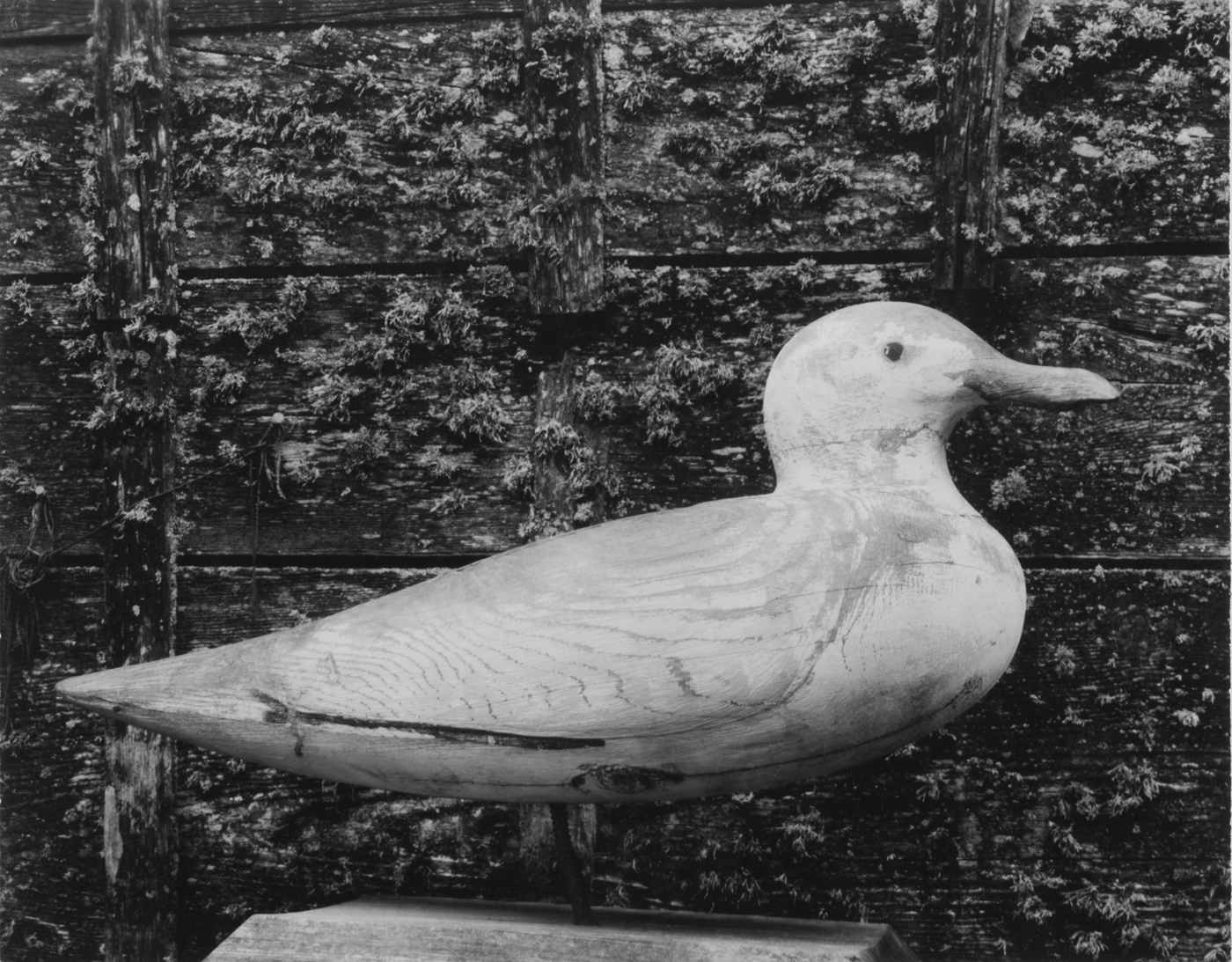
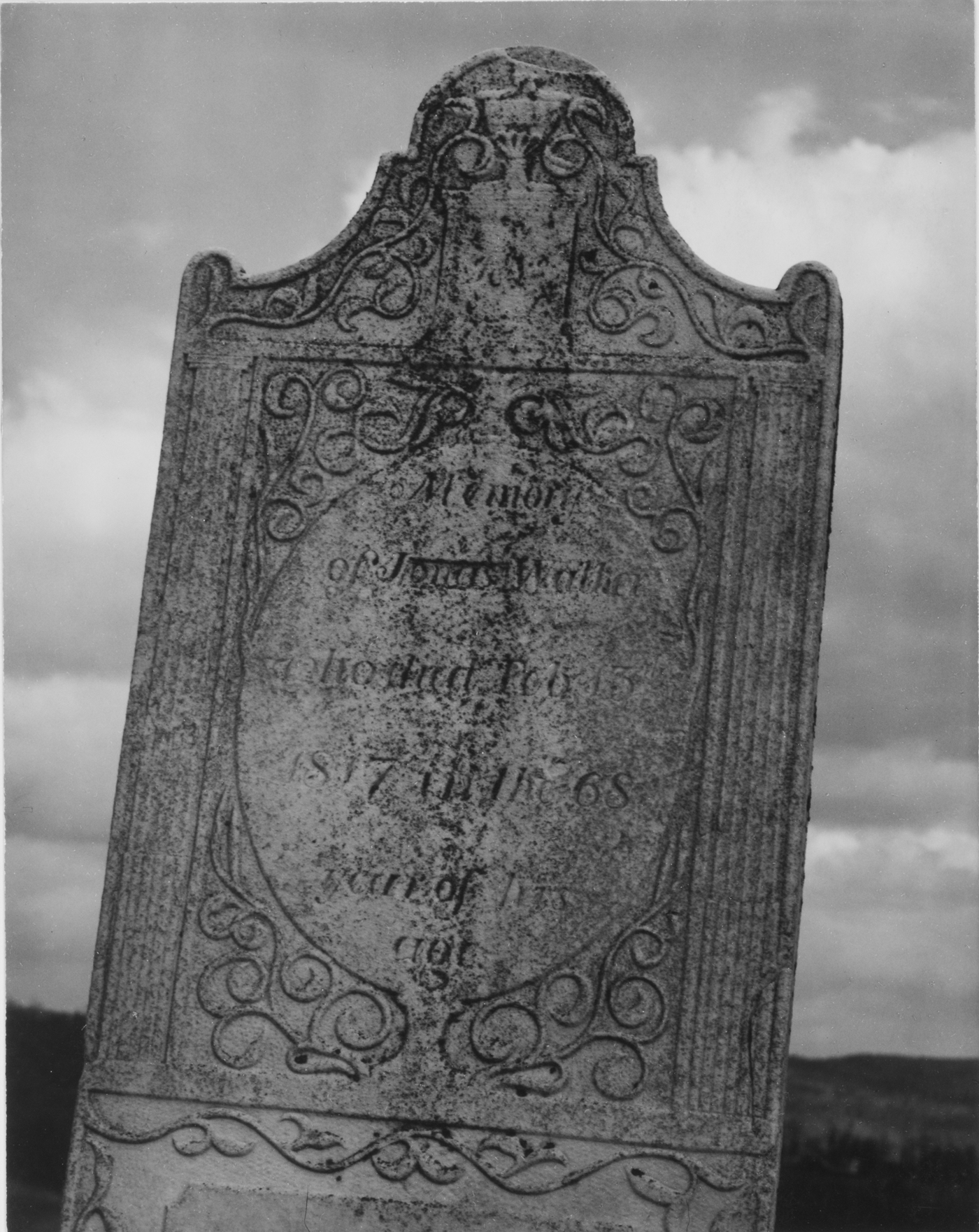
“The terrifying ideal” and “mordant decay” of New England signal the presence of something that reappears in TINE, albeit in ways that are unspoken compared to Newhall's original descriptions. Photographs of objects such as the modest decoy duck (see Figure 3), whose unassuming demeanor is matched by its sparse background, appear at first glance as the antithesis to earlier Strand images from the 1920s in which Machine Age objects, such as Strand's own Akeley camera, appear as homages both to the medium itself and to modernism's fascination with photography. In TINE, however, architectural decorations, furniture, and tools appear animated precisely because of their preindustrial vernacular context, because of their “ancient precision” – as Newhall puts it – and not despite it. Thus the objects, implements, and vernacular ornaments, contrary to the Machine Age objects of modernism, signify handicraft and singularity of design and production. Likewise, the objects in TINE are photographed differently than are Strand's more formalist-inspired, angular close-ups from the 1920s. The very essence of New England is shown through a focus on vernacular objects as portraits in their own right; the decoy presents itself with some pride, the tombstone with a sense of melancholy. The upward angle on many of the photographs provides a nearly heroic quality as though the objects – like the immigrant settlers who have originally made them – are survivors from an earlier time.
Decoy. The Paul Strand Collection, purchased with Museum Funds, 2010.
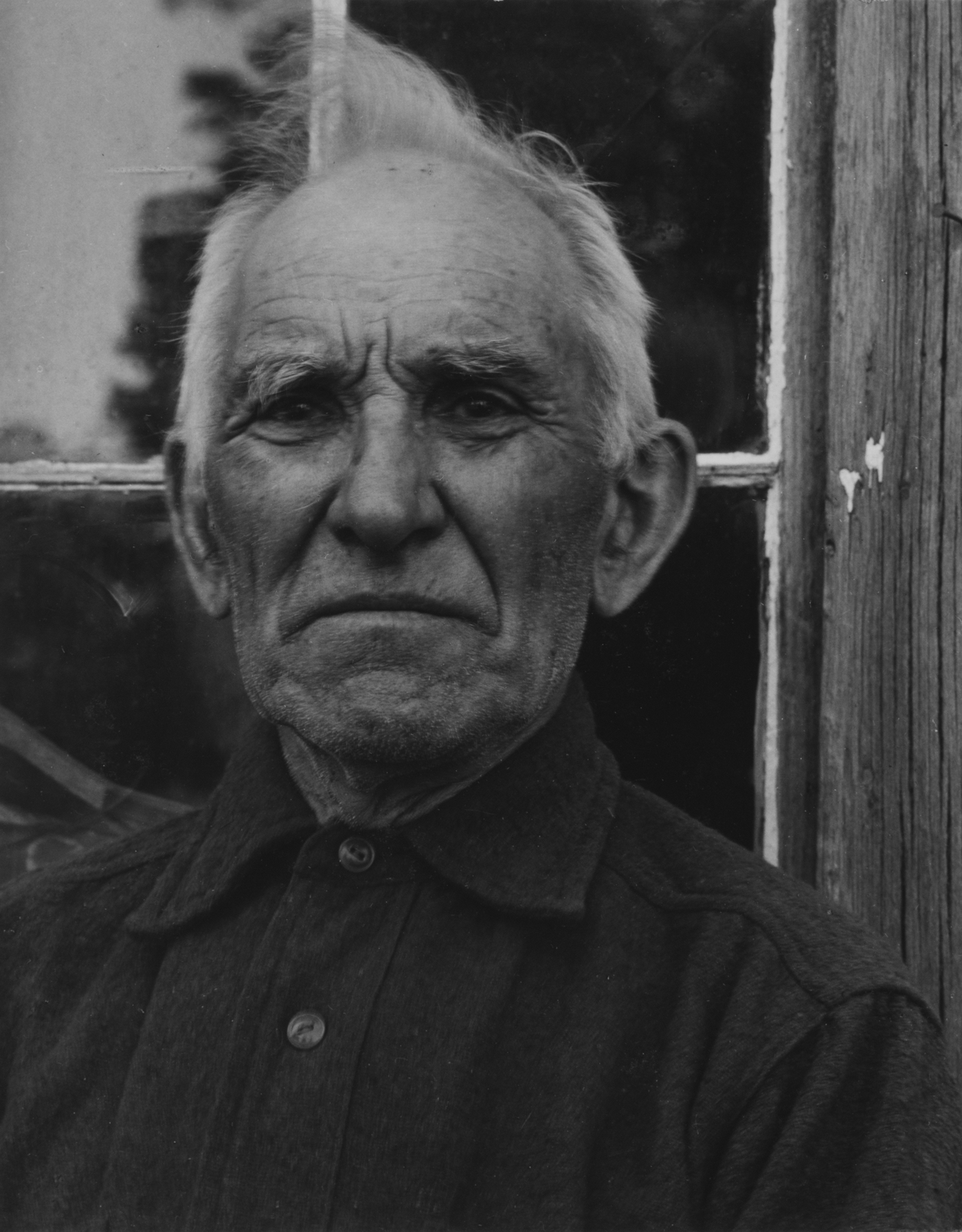
While this “heroic” quality harks back to the indexicality favored by earlier Farm Security Administration studies, Strand's photographs of vernacular objects rely to a much larger extent on their aesthetic qualities, on the beauty of the subject matter. As Nancy Newhall puts it in the 1945 catalogue, “The portrait of the old farmer [see Figure 4] … is one the most eloquent and poignant in photography.”Footnote 24 The weathered skin of a fisherman, the proud posture of his wife – all indicate not so much their innermost beings as the importance of their external demeanor and what it tells us. If these people and objects function as political and aesthetic markers simultaneously, it is not simply because they are typified in terms of region; it is because they signify an unmistakable American individualism.
Henry Wass, Split, Maine. The Paul Strand Collection, gift of Lynne and Harold Honickman, 2013.
Residing somewhere between melancholy resignation and an affirmation of American values, it is no wonder, then, that TINE occupied unfamiliar territory for viewers at the time. Adding to this, a potentially uncomfortable narrative of colonization is also present despite the outward narrative of progress and democracy. Strand had lived periodically in New England, but TINE nonetheless navigates Strand's own integration into a landscape both familiar and alien to him. The issue is not necessarily that Strand considered himself another “settler,” simply that he was astute about the importance of the Puritan experience as an antecedent for something quintessentially American, namely the struggle to integrate and appropriate foreign territory.
In this respect, despite the affirmative value of many of the textual extracts, other extracts in TINE indicate a long history of internal strife, from the subjugation of Native Americans to the return of runaway slaves. While such histories are blatant examples of the effects of a ruthless colonization, other extracts, the self-effacing poetry of Dickinson, Melville's anxious letters to Hawthorne, are more subtle examples of self-doubt and fear. If the desire to appropriate territory is a fundamental part of New England history, the inevitable anxiety that accompanies it – TINE seems to say – has both regional and psychological ramifications. By choosing New England as his American swan song, Strand thus both implicates and distances himself from the profoundly ideological ramifications of appropriation and colonization on a wider level. It is no coincidence that Strand will later chose a series of locations for his collaborative photo-texts, such as Tir a'Mhurain: Outer Hebrides, Ghana: An African Portrait, and Living Egypt, for whom a colonial past colors the present.Footnote 25 In Un Paese: Portrait of an Italian Village, Cesare Zavattini's interviews with the locals contextualize the somber portraits by Strand, linking the issue of regional identity directly to a collective history of territorial strife.Footnote 26 The fact that Strand's photographs of the people marked by these events seem strangely placid in the face of historical turmoil and aggression says as much about his own limitations as an ethnographer as it does about his abilities as a photographer. Despite Strand's self-professed interest in the politics of documentary photography, his tendency to universally render his subjects dignified and timeless in their beauty risks undercutting the images as complex ethnographic studies. Even though Strand had an uncanny ability to collaborate with writers immersed in and conversant with the culture portrayed in his later books, the regional studies remain problematic in terms of what may or may not constitute documentary verisimilitude.
Recent rereadings of Strand's later photo-texts, such as the posthumously printed Ghana: An African Portrait and Tir a'Mhurain: Outer Hebrides has shown that the oftentimes oblique, yet nonetheless persistent, anticolonial sentiment underlying these books shares TINE's focus on the democratic aspirations of individual communities. While there is much to say about the postwar recuperation of regionalism in photography, in Strand's case simply reading his photo-texts as primarily about self-governance and freedom is too simplistic. However, much critical work – in its desire to safeguard Strand's political credentials – tends to ignore what could be construed as a somewhat paternalistic vision. A more complex investigation into how nostalgia plays a part in the construction of regional identity vis-à-vis a national one, for instance, might illuminate some of Strand's limitations as an ethnographer.Footnote 27
If ethnography is not the chief impetus behind TINE, a type of photographic colonization is nonetheless present, and it provides an additional and crucial link to the legacy of seventeenth-century immigration signposted throughout TINE. With its overly Puritan contextualization of a region and its people, TINE is also a narrative about finding oneself metaphorically in the wilderness. If we take the colonizing effect of photography as enabled by the appropriation of its subject matter, by the reorganizing of places and people in terms of typography and sections, TINE itself continues a process that goes back to the originators of the American Dream centuries before. Likewise, while the transcendentalist desire to merge the thing seen with its proper name and designation is given a distinctly visual angle in TINE, it is also a marker for a more subtle form of appropriation, a linguistic version of the documentary impulse that Strand was familiar with: the impetus to own one's surroundings by naming and photographing them. In Part III, “Fine Auroras,” an Emerson quote articulates how the urge to name and identify is linked to nature and place:
Adam in the garden. I am to new name all the beasts in the field and all the gods in the sky. I am to invite men drenched in time to recover themselves and come out of time, and taste their native immemorial air.Footnote 28
Emerson's invitation to “come out of time” gives us a sense of TINE as a spiritual rather than an ethnographic vision of New England. Transformed through Emerson's delight in renaming his surroundings, the sacred and the secular combine here through a distinctly vernacular vision; it is the “native immemorial air” that allows Strand's unassuming church front to be as sacred or secular as the entrance to a cottage, the voice of the minister, as holy or profane as that of his neighbor. Similarly, Newhall's description of “the shuttered white church” and the “worn doorlatch,” rather than being signs of dilapidation, indicate the potency of vernacular architecture. In Strand's photograph of a framed doorway of a house, it is the distinctive facade, and not whether someone has just entered or left, that is crucial.
Leaving the door ajar for multiple interpretations is another indication that the photographs in TINE are as much about intimated as about actual presences. If the door is literally left ajar in New England, it opens up a series of interpretations, of which the political is merely one possibility. In the last section of TINE, the private letters of Sacco and Vanzetti are followed by the image of a large plant closely cropped, the texture of the leaves matt and silvery. The letters are preceded by a gravestone from 1868, a harbinger of the execution awaiting the two correspondents (see Figure 5).
Tomb Stone and Sky, Vermont. The Paul Strand Collection, purchased with Museum Funds, 2010.
Such symbolic alignments of text and imagery enable something other than a “history” of New England, and while the photographs are fixed here by the writing to an actual political context (in this case Sacco and Vanzetti as “honorary” New Englanders), the images themselves move away from the specifics of the text. By bookending the letters with images of plants and gravestones, Sacco and Vanzetti are taken “out of time”; they, too, are somehow timeless in New England.
For the cinematographer and artist Hollis Frampton, Strand's regional studies were, above all, about time and the ontological nature of photography itself:
Strand has returned often to his accustomed sites, and two adjacent photographs, from Vermont, for example, may be dated thirty or forty years apart. Predictably, they differ from one another no more than they might if made on consecutive days … The meaning is quite clear. Still photography has, through one and another stratagem, learned to suspend or encode all but one of our incessant intuitions: I refer to what we call time. Paul Strand seems consciously intent, in his presentation of his work as in the work itself, on refuting time. It seems expressly forbidden that the problem shall ever arise.Footnote 29
The twin strategy that Frampton refers to – the suspension and encoding of photographic material through a lack of information – touches at the heart of Strand's enterprise and possibly at the limitations of Newhall's. In TINE, to suspend or encode entails, as the words indicate, two different things. If we take “suspend” to indicate a halt to meaning regeneration, then “encode,” paradoxically, imbues something with meaning. For Frampton, a strange canceling-out effect takes place in Strand's photographs. Objects are suspended in time – and maybe this is what TINE really implies – and simultaneously imbued with symbolic meaning. Nonetheless, the attempt to stop time in New England is doomed to failure; meaning will always regenerate itself, much like the many photographs of plants that survive changing times and political regimes only to re emerge. Even if, as Frampton points out, “Strand might photograph the whole terrain of the world the issue of change cannot be circumvented. In this respect, Strand's use of objects emblematic of continuation and survival make him paradoxically somewhat of an un-documentarian.”Footnote 30 Like a still-life painter, he is interested in the formal and timeless aspects of the objects photographed, whereas Nancy Newhall's textual choices are all about change, about liberation and the articulation of ideology, even if that ideology is problematic.
For other critics, the coexistence of a politicized narrative with an aesthetic that appears to illuminate some essential timeless truth poses a serious moral problem. For others, it proves that Strand's work is, indeed, timeless and as such worthy of canonization. According to Alan Sekula, documentary photography of the American scene continues to be “caught between the conditions of a kind of binary folklore, in which the rendition of specifically regionalized subjects – regardless of whether termed indigenous, real, folkloric, or vernacular – is always ‘embroiled in an expressionistic structure’.”Footnote 31 No matter how much the documentary aesthetic pretends to be neutral, to be “real,” it inevitably ends up empathizing with its subject.
Even if, in this case, Strand operates within the limits of an acceptable level of empathy, his aesthetic masks, according to Sekula, an often untenable celebration of abstract humanity divorced from any real political agency. One could argue that in TINE the celebration of a folk region doomed to extinction is mourned but not countered in any way, a charge one could levy against many of Strand's later regional studies as well. While for Sekula this amounts to a depoliticization of the documentary process, for some Strand scholars Strand's ability to render a palatable version of abstract humanity in which the folkloric is made synonymous with authenticity and truth proves that he is, indeed, a great photographer. According to Milton Brown, in one of the seminal collected works of Strand, Paul Strand: A Retrospective Monograph 1971,
Strand believes in human values, in social ideals, in decency and in truth. These are not clichés to him. That is why his people, whether Bowery derelict, New England Farmer, Italian Farmer, French artisan … are all touched by the same heroic quality – humanity. To a great extent this is a reflection of Strand's personal sympathy and respect for his subjects. But it is just as much the result of his acuteness of perception, which finds in the person a core of human virtue and his unerring sense of photographic values that transmits that quality to us.Footnote 32
For Brown, Strand's subjects are heroic figures – mythologized to such an extent that their actual social and economic backgrounds become inconsequential. Brown's quote exemplifies the paternalistic camera that Sekula is weary of, a vision in which the subjects ultimately do not need their own subjecthood as long as they are discernibly Strand's “people.” Another problem with the paternalistic camera is that it often fails to take into account the dynamics between image and text. In simply looking at Strand's images in isolation, we may forget that the photographs compete at some level with Newhall's extracts, and that this, in turn, unsettles both the editor's and the photographer's authorial status in ways that inherently politicize the photographic process.
Strand's morose heroism (a term coined by his long-term collaborator in the 1930s, Harold Clurman) is another reason why he shies away from creating any overtly emotive alignments between the images and the text. There are, for example, numerous textual extracts that deal with the issue of slavery and emancipation (W. E. B. Dubois's “I Dream of a World” is one of the penultimate extracts), but no images that portray actual African American faces.
There is, of course, a fine line between what we might call Nancy Newhall's more cautious optimism and Strand's “morose heroism,” a heroism that seems quite suited to the Puritanical context of the book overall. The signposting of a religious history in the very last image, shown in Figure 1, of an austere-looking New England church is no coincidence in this respect. The white wooden church, manufactured by and for the people, signifies a respectful homage to vernacular culture in nearly every documentary project of the 1930s, but contrary to similar photographs (by Walker Evans, for example), Strand's church is ominously decentered; the dark sky contrasted with the whiteness of the church fits with Newhall's description of it as a “terrifying ideal.” As is usual for Strand, we have no sense of whether this church is in temporary repose or long-abandoned.
To end TINE with an image of a church acknowledges the religiosity inscribed into the very fabric of New England. Nevertheless, even in something as visually canonical as a church the issue remains oblique. Is this the funereal end of TINE? Is it an image that embodies a sacred rather than a secular vision of the “spirit” of New England? In the section entitled “Foothold,” the first New England primer from 1648, a biblical primer for the instruction of children, is reprinted from A to Z:
A In Adam's Fall We sinned all
B Heaven to find The Bible Mind
C Christ Crucified For Sinners died
Here the alphabet is defined in terms of a sacred discourse; one cannot learn the building blocks of language without going through an instructive rota of biblical material. In the same way that a biblical primer constitutes the foundations for a later, more secular, American discourse, Strand's images, paradoxically, also hark back to a time when the sacred was present in the everyday. The photograph that precedes the alphabetic primer is, in fact, the “worn doorlatch” referenced by Newhall, weather-beaten and so gnarled by age it forms a recognizable cross. After the primer there is an image of a fern, partly shaded and lit by diffused sunlight. Thus although Strand's plants mimic the Emersonian marvel at nature, they are, while native to the region, by no means exclusive to it. Their true impact lies not in their regionalism, but in their continued survival. Man may be temporal, but time in New England is the same for these organisms, regardless of historical change and political exigencies.
This sense of something atemporal, as persisting in New England, is shown through the images of nature and the sense of an organic design throughout the book. Because it is difficult to delineate between the vernacular designs on wooden implements, doors and hinges, and the natural forms that have inspired those designs, nature is instilled as the most apt way to emblematize the homegrown. Once again, an Emersonian alignment between word and image, tool and environment, is in some ways reenacted here, even if it is curiously devoid of the artisans who created the alignment in the first place.
If we return to Sekula's argument, that Strand's documentary aesthetic creates a potentially problematic form of folklore, then TINE could be critiqued for presenting a defunct idea of a democratic America, an America desperately trying to prove that fascism cannot encroach on its territory. As readers, we want Strand's version of New England to be more than an idyllic construction, but the question remains: what is the book's actual intention? The combination of text and photographs is simply too politically obtuse, too questioning of its own iconicity, to make for something entirely legible in an ideological sense. For Frampton, Strand's artistic aspirations were one of the reasons why he retreated into a form of aestheticism numbed to its true political potential. As previously mentioned, there is an argument to be made that Strand's later regional studies are perfected examples of a photographic attempt to arrest time, an attempt possibly commenced but never completed in TINE. In studies of the Sudan and the Hebrides Strand's aestheticism is largely left unchecked by the text that accompanies it. For all of Newhall's gentility in terms of acquiescing to Strand's superior abilities as an artist, it is worth noting – in comparison – just how instrumental the textual extracts are in TINE. Where TINE differs from Strand's later regional studies is in its attempts to make something timeless, in a visual sense, coincide with a distinctly recognizable narrative of democracy and faith in a historical sense.
One such example is the extract from Anne Bradstreet's poem “Spirit to Flesh” (1650) – toward the end of the “Wilderness” section. Here flesh, “the unregenerate part,” is admonished to
For Bradstreet the unregenerate soul is the soul who has not yet conquered the material world, whose spirit – as Bradstreet puts it – remains twinned with the worldly. This dichotomy also lies at the heart of a Puritan poetic and it is this duality, between the spiritual and the worldly, between a discernible past and an uncertain future, which is expressed through the synthesis, as well as the ambiguity, of image and text in TINE.
In the end, then, TINE must be seen as an indication of Nancy Newhall's desire to merge the past with the present, and to present the culture of New England as a truly collective, democratic, and personal experience. While this partially explains Nancy Newhall's choice of extracts – the private ruminations and anxieties of famous New Englanders – it also explains Strand's hesitation in providing the photographic equivalent. In Strand's photographs, attempting to stop time, to exist outside and beyond the texts accompanying them, we discern a fittingly puritanical form of “morose heroism,” and a growing sense of nostalgia for an America that Strand was soon to leave behind.