Introduction
The Permian/Triassic (PT) boundary witnessed the largest biotic crisis among all Phanerozoic mass extinctions, resulting in the disappearance of 80% to 90% of marine species (Raup, Reference Raup1979; Song et al., Reference Song, Wignall, Tong and Yin2013; Stanley, Reference Stanley2016). This major event coincided with high temperatures (Joachimski et al., Reference Sun, Joachimski, Wignall, Yan, Chen, Jiang, Wang and Lai2012; Sun et al., Reference Sun, Joachimski, Wignall, Yan, Chen, Jiang, Wang and Lai2012; Romano et al., Reference Romano, Goudemand, Vennemann, Ware, Schneebeli-Hermann, Hochuli, Brühwiler, Brinkmann and Bucher2013), potential anoxia (Wignall and Twitchett, Reference Wignall and Twitchett1996; Song et al., Reference Song, Wignall, Tong, Bond, Song, Lai, Zhang, Wang and Chen2012), and acidification (Clarkson et al., Reference Clarkson, Kasemann, Wood, Lenton, Daines, Richoz, Ohnemueller, Meixner, Poulton and Tipper2015) in the oceans, as well as pronounced perturbations in the carbon cycle (Payne et al., Reference Payne, Lehrmann, Wei, Orchard, Schrag and Knoll2004; Galfetti et al., Reference Galfetti2007) and intensified continental weathering (Algeo and Twitchett, Reference Algeo and Twitchett2010; Song et al., Reference Song2015a). A delayed recovery has often been proposed to have followed the PT mass extinction (Hallam, Reference Hallam1991; Tong et al., Reference Tong, Zhang, Zuo and Xiong2007; Chen and Benton, Reference Chen and Benton2012). However, studies of some groups, such as conodonts, ammonoids and foraminifers, show that the recovery was well under way by at least the Smithian (Orchard, Reference Orchard2007; Brayard et al., Reference Brayard, Escarguel, Bucher, Monnet, Brühwiler, Goudemand, Galfetti and Guex2009a; Song et al., Reference Song, Wignall, Chen, Tong, Bond, Lai, Zhao, Jiang, Yan and Niu2011), less than 1 million years after the PT mass extinction (Galfetti et al., Reference Galfetti2007; Baresel et al., Reference Baresel, Bucher, Brosse, Cordey, Guodun and Schaltegger2017). Some assemblages documenting relatively high taxonomic richness during the late Griesbachian–early Dienerian also challenge previous claims of a globally delayed recovery (Twitchett et al., Reference Twitchett, Krystyn, Baud, Wheeley and Richoz2004; Ware et al., Reference Ware, Bucher, Brayard, Schneebeli-Hermann and Brühwiler2015; Foster et al., Reference Foster, Danise, Price and Twitchett2017; Wang et al., Reference Wang, Chen, Dai and Song2017).
To decipher the causes of the PT crisis and associated recovery patterns and processes, a high-resolution biostratigraphic frame is a prerequisite. With coupled high origination and extinction rates, the ammonoid turnover was extremely fast in the Early Triassic (Brayard et al., Reference Brayard, Bucher, Escarguel, Fluteau, Bourquin and Galfetti2006, Reference Brayard, Escarguel, Bucher, Monnet, Brühwiler, Goudemand, Galfetti and Guex2009a; Brühwiler et al., Reference Brühwiler, Bucher, Brayard and Goudemand2010a; Ware et al., Reference Ware, Bucher, Brayard, Schneebeli-Hermann and Brühwiler2015). Ammonoids are, therefore, one of the most useful index fossils for biostratigraphy in this interval (Jenks et al., Reference Jenks, Monnet, Balini, Brayard and Meier2015). For example, on the Northern Indian Margin, a total of 12 and 14 regional ammonoid unitary associations have been recognized for the Dienerian and Smithian, respectively (Brühwiler et al., Reference Brühwiler, Bucher, Brayard and Goudemand2010a, Reference Brühwiler, Bucher, Roohi, Yaseen and Rehman2011; Ware et al., Reference Ware, Bucher, Brayard, Schneebeli-Hermann and Brühwiler2015); this represents an unprecedented high-resolved biostratigraphic scale compared with coeval records from other regions, such as the western USA basin, which has six Smithian ammonoid unitary associations (Jattiot et al., Reference Jattiot, Bucher, Brayard, Brosse, Jenks and Bylund2017; Jenks and Brayard, Reference Jenks and Brayard2018).
South China is renowned for its PT marine and terrestrial records, and the Global Stratotype Section and Point (GSSP) of the PT boundary is located at Meishan, Zhejiang Province (Yin et al., Reference Yin, Zhang, Tong, Yang and Wu2001). In the past 50 years, approximately 100 geological sections spanning the PT boundary and the Early Triassic and representing various shallow to deep-marine environments (e.g., Brayard and Bucher, Reference Brayard and Bucher2008; Galfetti et al., Reference Galfetti, Bucher, Martini, Hochuli, Weissert, Crasquin-Soleau, Brayard, Goudemand, Brühwiler and Guodun2008; Song et al., Reference Song, Wignall, Chen, Tong, Bond, Lai, Zhao, Jiang, Yan and Niu2011; Bai et al., Reference Bai, Dai and Song2017; Wang et al., Reference Wang, Chen, Dai and Song2017) have been documented in South China. From these rather exhaustive environmental records, many clades and geochemical proxies were studied to decipher the regional biotic recovery signal. The diversity of both benthic and nektonic organisms was analyzed mainly from foraminifers (Song et al., Reference Song, Wignall, Chen, Tong, Bond, Lai, Zhao, Jiang, Yan and Niu2011, Reference Song, Yang, Tong, Chen, Tian, Song and Chu2015b), brachiopods (Chen et al., Reference Chen, Tong, Song, Luo, Huang and Xiang2015; Wang et al., Reference Wang, Chen, Dai and Song2017), bivalves (Yin, Reference Yin1985; Huang et al., Reference Huang, Tong, Fraiser and Chen2014), gastropods (Pan et al., Reference Pan, Erwin, Nützel and Zhu2003; Kaim et al., Reference Kaim, Nützel, Bucher, Brühwiler and Goudemand2010), conodonts (Zhang et al., Reference Zhang, Tong, Shi, Lai, Yu, He, Peng and Jin2007; Zhao et al., Reference Zhao, Orchard, Tong, Sun, Zuo, Zhang and Yun2007; Jiang et al., Reference Jiang, Lai, Sun, Wignall, Liu and Yan2014; Brosse et al., Reference Brosse, Bucher, Bagherpour, Baud, Frisk, Guodun and Goudemand2015, Reference Brosse, Bucher and Goudemand2016; Liang et al., Reference Liang, Tong, Song, Song, Tian, Song and Qiu2016; Bai et al., Reference Bai, Dai and Song2017), and ammonoids (Chao, Reference Chao1959; Xu, Reference Xu1988; Mu et al., Reference Mu, Zakharov, Li and Shen2007; Brayard and Bucher, Reference Brayard and Bucher2008; Brühwiler et al., Reference Brühwiler, Brayard, Bucher and Guodun2008). Paleoenvironmental and paleoclimatic signals were also intensively studied from numerous South Chinese sections (Payne et al., Reference Payne, Lehrmann, Wei, Orchard, Schrag and Knoll2004; Galfetti et al., Reference Galfetti2007, Reference Galfetti, Bucher, Martini, Hochuli, Weissert, Crasquin-Soleau, Brayard, Goudemand, Brühwiler and Guodun2008; Song et al., Reference Song, Wignall, Tong, Bond, Song, Lai, Zhang, Wang and Chen2012, Reference Song2017). Regarding these studies, the biostratigraphic framework used is crucial for correlation among different biotic and environmental signals and between distant areas. Nevertheless, only a limited number of ammonoid biostratigraphic schemes have been proposed for the Early Triassic of South China (e.g., Tong et al., Reference Tong, Zakharov and Wu2004; Galfetti et al., Reference Galfetti2007; Brayard and Bucher, Reference Brayard and Bucher2008; Brühwiler et al., Reference Brühwiler, Brayard, Bucher and Guodun2008).
Early Triassic ammonoid faunas in South China have been sporadically studied over the past 80 years. Tien (Reference Tien1933) initially described some ammonoid specimens from Hubei and Guizhou provinces. Then Hsü (Reference Hsü1937) reported a few ammonoid taxa based on deformed specimens from Jiangsu, Zhejiang, and Hubei provinces. In 1959, Chao illustrated a diverse, well-preserved ammonoid fauna from Guangxi, but with only rare Griesbachian and Dienerian specimens. Following the work of Chao (Reference Chao1959), a few Early Triassic ammonoid faunas were described (Xu, Reference Xu1988; Reference Mu, Zakharov, Li and ShenTong and Wu, 2004; Mu et al., Reference Mu, Zakharov, Li and Shen2007). Due to their relatively poor preservation and spatiotemporally restricted occurrences, the taxonomy, biostratigraphy, and diversity patterns of ammonoids from South China remained largely imperfectly known until recently. New ammonoid material from Guangxi and Guizhou provinces provided a biostratigraphic framework for small parts of the Griesbachian and Dienerian (Brühwiler et al., Reference Brühwiler, Brayard, Bucher and Guodun2008) and for the Smithian–Spathian interval (Galfetti et al., Reference Galfetti2007; Brayard and Bucher, Reference Brayard and Bucher2008). However, due to mistakes in the taxonomy and to scattered occurrences of ammonoids in different sections with very little superposition information, the preliminary Griesbachian–Dienerian (Induan) zonation remained poorly resolved with many uncertainties for large-scale correlation among distant basins. So overall, our knowledge of the Griesbachian–Dienerian ammonoid taxonomy and biostratigraphy based on South Chinese data remains very incomplete.
Here, we document a new Griesbachian-Dienerian ammonoid succession based on bed-by-bed sampling of the Gujiao section, which can complement previous regional biostratigraphic schemes and can help correlation with other worldwide zonations.
Geologic setting
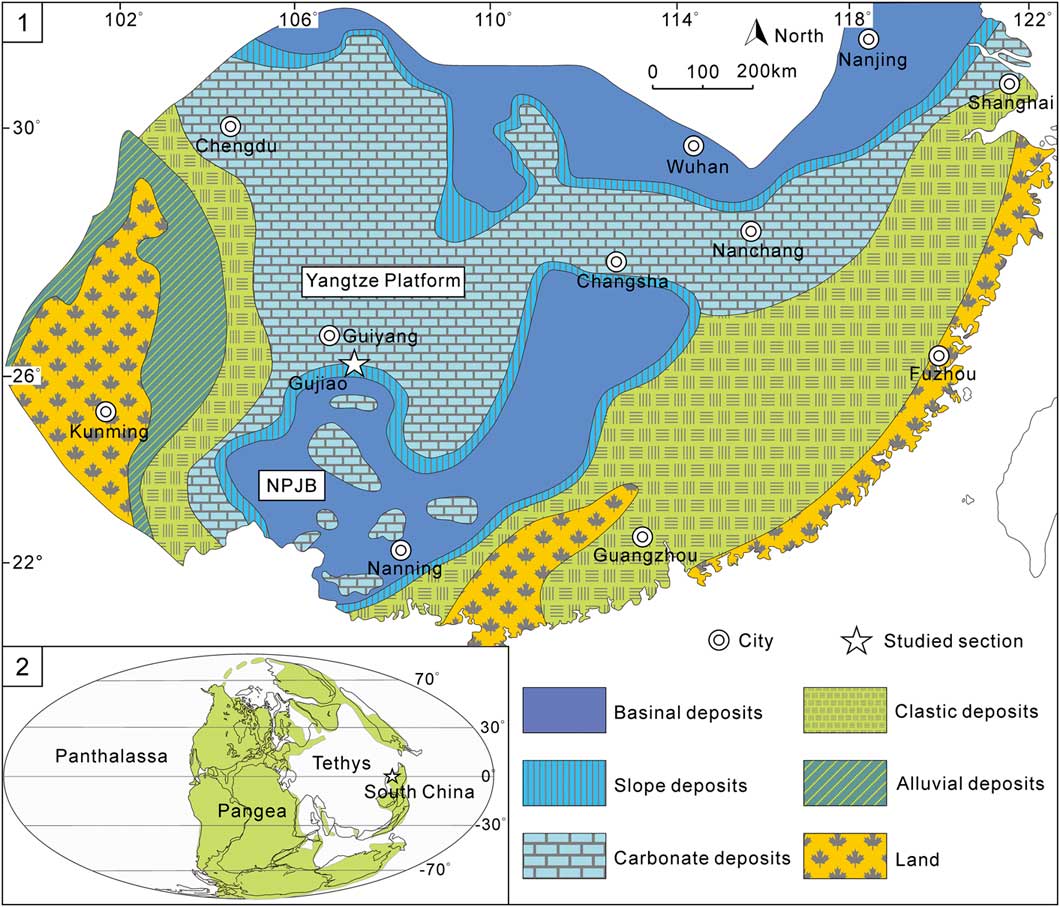
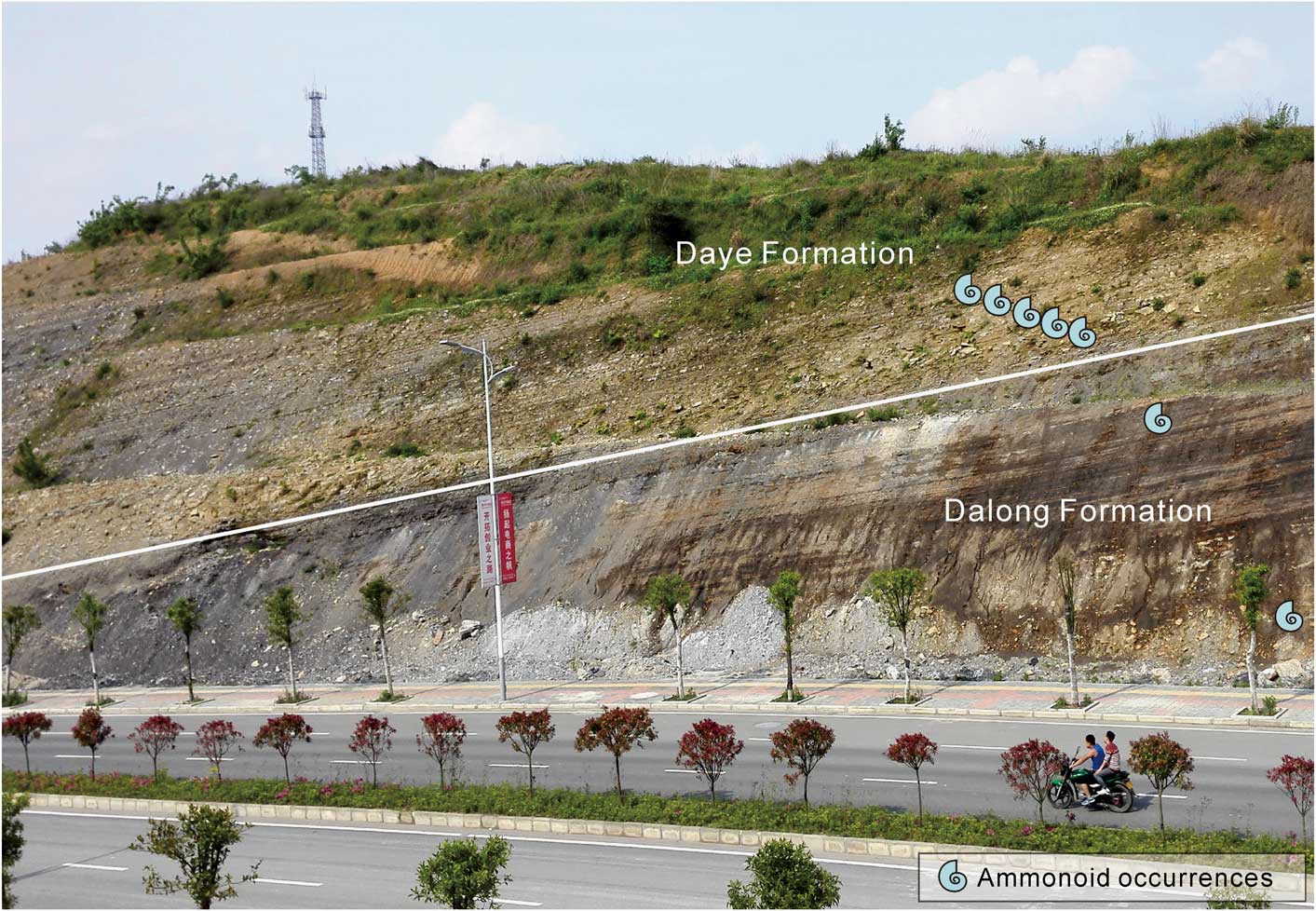
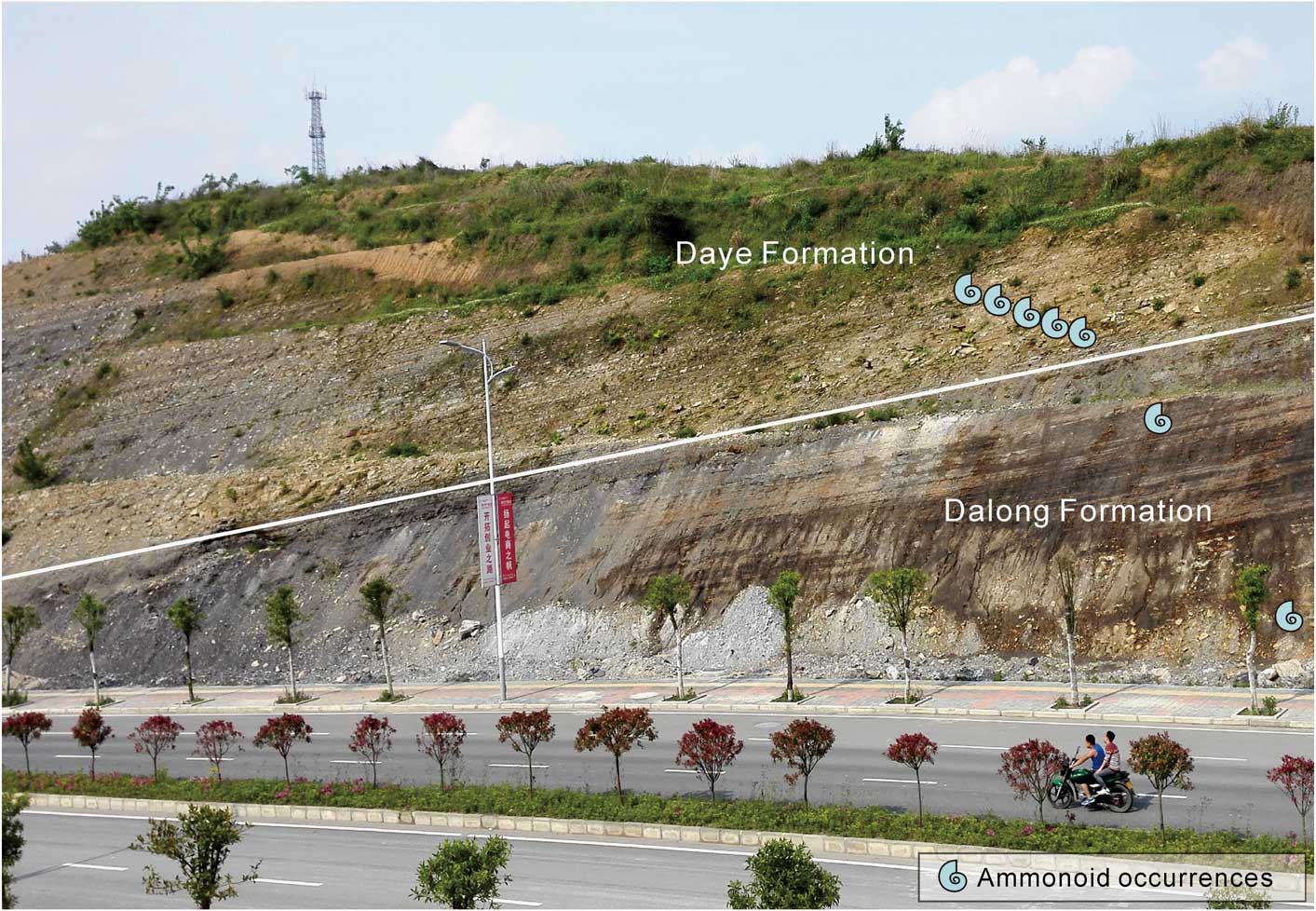
The Gujiao section is located ~20 km southeast of Guiyang, the capital of the Guizhou Province, South China. During the Early Triassic, it was located in the transitional zone between the Yangtze Platform and the Nanpanjiang Basin (Fig. 1). A new and well-exposed outcrop excavated along a new road in 2015 exposed Permian and Triassic strata (Fig. 2). These exposures include the upper Permian Changxing and Dalong formations and the Lower Triassic Daye Formation.
(1) Early Triassic paleogeographic map of South China, modified from Feng et al. (Reference Feng, Bao and Liu1997), Lehrmann et al. (Reference Lehrmann, Wei and Enos1998), and Bagherpour et al. (Reference Bagherpour, Bucher, Baud, Brosse, Vennemann, Martini and Guodun2017). NPJB=Nanpanjiang Basin. Note that the exact paleogeography of the southern part of the NPJB is controversial (see Bagherpour et al., Reference Bagherpour, Bucher, Baud, Brosse, Vennemann, Martini and Guodun2017). (2) Early Triassic paleogeographic reconstruction of Tethys, Pangea, and Panthalassa, modified from Scotese (Reference Scotese2001).

View of the Gujiao section.
The Changxing Formation consists of massive bioclastic and cherty limestones (Zhao et al., Reference Zhao, Liang and Zheng1978) yielding abundant and diverse typical Permian organisms, such as brachiopods, gastropods, corals, dasycladacean algae, ammonoids (Zhao et al., Reference Zhao, Liang and Zheng1978; Zheng, Reference Zheng1981), and foraminifers, indicating a well-developed carbonate platform environment.
At Gujiao, the Dalong Formation is ~10 m in thickness and is dominated by cherty limestones, siliceous mudstones alternating with black or gray shales, and volcanic ash beds, representing a deeper basinal environment. At the bottom of the Dalong Formation, a limestone bed ~30 cm thick contains abundant and well-preserved ammonoids with, for example, Pseudotirolites and Pseudogastrioceras, indicating a late Changhsingian age (Zhao et al., Reference Zhao, Liang and Zheng1978).
The lower part of the Triassic Daye Formation is ~50 m thick and consists of marlstones interbedded with shales. It directly overlies the Dalong Formation without apparent unconformity, although earliest Griesbachian ammonoids are missing. Abundant ammonoid and bivalve specimens as well as some gastropods were collected in the lowermost 6 m. Trace fossils also occasionally occur. Ammonoids from the shales are deformed and cannot be identified. Although generally difficult to extract from the argillaceous limestones, a few specimens could be extracted from some beds. Recrystallized ammonoid specimens were abundantly sampled from bed GJ-40. Judging from observed facies, the lower Daye Formation corresponds to a basin or basin-margin environment.
Materials
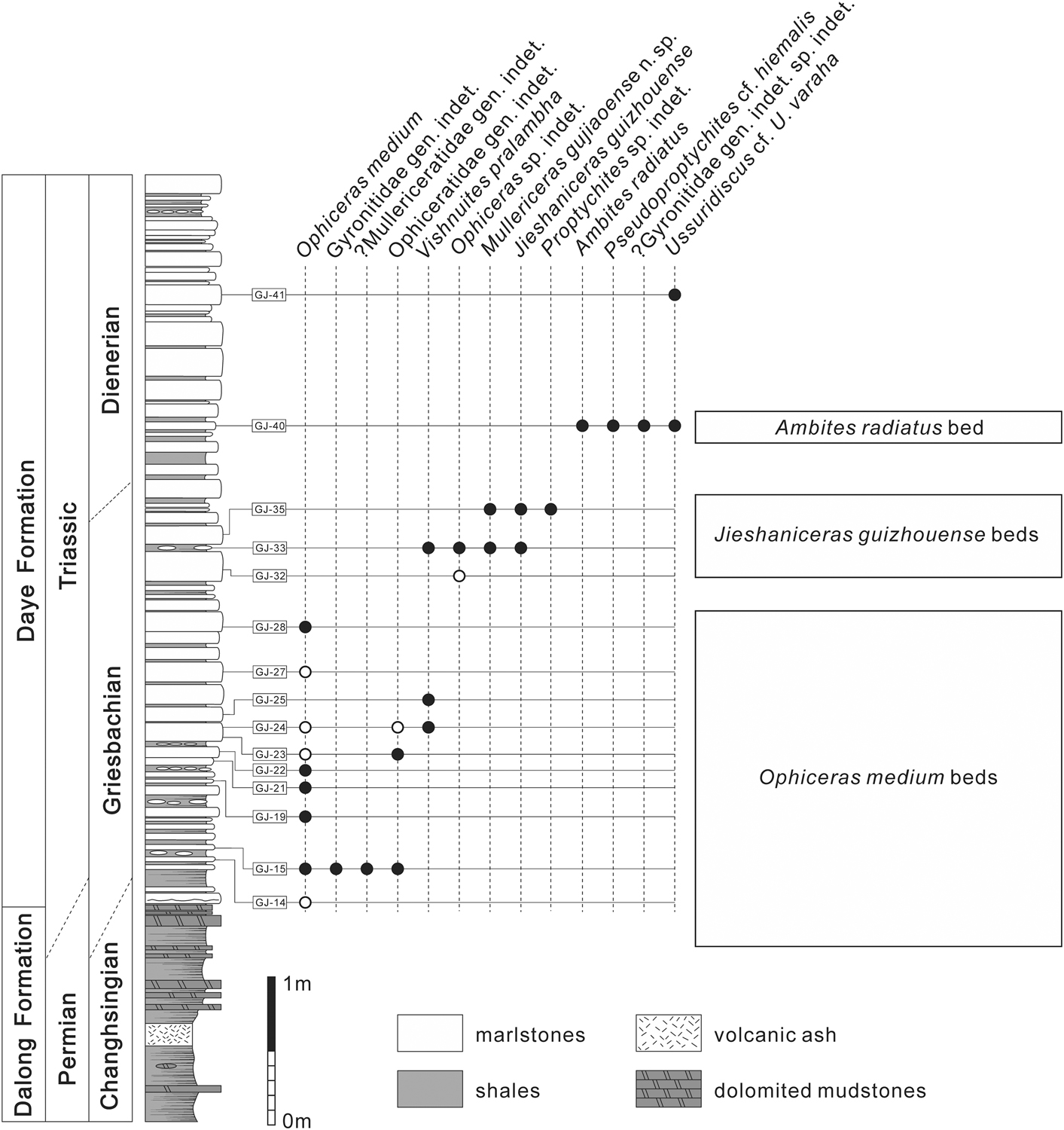
A total of 749 ammonoid specimens were collected. Although often not well preserved, they represent eight genera and 13 species (Fig. 3), including Ophiceras medium Griesbach, Reference Griesbach1880, Ophiceras sp. indet., Vishnuites pralambha Diener, Reference Diener1897, Ophiceratidae gen. indet., Ambites radiatus (Brühwiler et al., Reference Brühwiler, Brayard, Bucher and Guodun2008), Gyronitidae gen. indet. sp. indet., ?Gyronitidae gen. indet. sp. indet., Proptychites sp. indet., Pseudoproptychites cf. P. hiemalis (Diener, Reference Diener1895), Jieshaniceras guizhouense (Zakharov and Mu in Mu et al., Reference Mu, Zakharov, Li and Shen2007), Mullericeras gujiaoense n. sp., Ussuridiscus cf. U. varaha, and ?Mullericeratidae gen. indet.
Distribution of ammonoid taxa in the Gujiao section. Open dots indicate occurrences based on fragmentary or poorly preserved specimens.

Repository and institutional abbreviation
YFMCUG: Yifu Museum of China University of Geosciences, Wuhan.
Systematic paleontology
Systematic descriptions mainly follow the classification established by Tozer (Reference Tozer1994) and refined by Brühwiler et al. (Reference Brühwiler, Brayard, Bucher and Guodun2008) and Ware et al. (Reference Ware, Jenks, Hautmann and Bucher2011, Reference Ware, Bucher, Brühwiler, Schneebeli-Hermann, Hochuli, Roohi, Ur-Rehman and Yaseen2018). Synonymy lists and taxa in open nomenclature are annotated following the recommendations of Matthews (Reference Matthews1973) and Bengtson (Reference Bengtson1988); ‘v’ implies that the authors have checked the original material of the reference; ‘p’ indicates that the reference applies only in part to the species under discussion. The morphological range of each taxon has been quantified using the four classic geometrical parameters of the ammonoid shell: diameter (D), whorl height (H), whorl width (W), and umbilical diameter (U).
Order Ceratitida Hyatt, Reference Hyatt1884
Family Ophiceratidae Arthaber, Reference Arthaber1911
Genus Ophiceras Griesbach, Reference Griesbach1880
Type species
Ophiceras tibeticum Griesbach, Reference Griesbach1880 from Shalshal Cliff, Painkhanda, Niti region, Himalayas, India.
Remarks
Ophiceras is the most abundant and widely distributed genus among the Ophiceratidae. It differs from Vishnuites, Wordieoceras, and Shangganites by a distinct rounded venter and from Discophiceras, Ghazalaites, and Kyoktites by a more evolute conch. It has a broad paleogeographic distribution with numerous species described from both the Tethys area (South China, Spiti, Kashmir, Salt Range, and South Tibet) and high-latitude regions such as Greenland and Arctic Canada. Ophiceras was first documented by Griesbach (Reference Griesbach1880) from the Otoceras beds at Shalshal Cliff in Himalaya. Diener (Reference Diener1897) then described 10 species of Ophiceras from the Himalayas (mostly from Shalshal Cliff) and divided them into two groups, the O. tibeticum and the O. sakuntala groups, essentially based on their different shell ornamentation. The O. tibeticum group displays some relatively low folds, sometimes becoming nodes near the umbilical shoulder, whereas the O. sakuntala group usually exhibits a smooth shell, with only fine growth lines. In addition, species of the O. tibeticum group are usually more evolute than those of the O. sakuntala group. As noticed by Diener (Reference Diener1897), there is no distinct boundary between the two groups, and some species might be variants of other ones. Kummel (Reference Kummel1972) took intraspecific variability into account and proposed only three valid species: O. tibeticum, O. serpentinum, and O. medium. His discussion was short, but he provided illustrations of Diener’s (Reference Diener1897) type material and of additional unpublished material. However, Kummel’s (Reference Kummel1972) revision is based on specimens in old collections lacking detailed stratigraphic context (i.e., without bed-by-bed collecting), and given the stratigraphic uncertainty must be considered with caution. Here, in the absence of a proper revision of these faunas, the opinion of Kummel (Reference Kummel1972) is followed.
Spath (Reference Spath1930, Reference Spath1935) described several new species of Ophiceras from East Greenland. He proposed several subgenera such as Lytophiceras, Discophiceras, Metophiceras, and Acanthophiceras. Trümpy (Reference Trümpy1969) included Metophiceras in Xenodiscidae, erected Discophiceras as a full genus, and considered Lytophiceras and Acantophiceras as synonyms of Ophiceras, rejecting the subgeneric subdivision of Ophiceras. Tozer (Reference Tozer1994) illustrated several forms of Ophiceras from Arctic Canada, which are identical to those from East Greenland. Ophiceras specimens from South China are usually poorly preserved or juvenile specimens too small for a proper identification, thus making comparison with other regions difficult. The relationships of Ophiceras faunas among Himalayas, Arctic Canada, East Greenland, and South China remain unclear.
Ophiceras medium Griesbach, Reference Griesbach1880
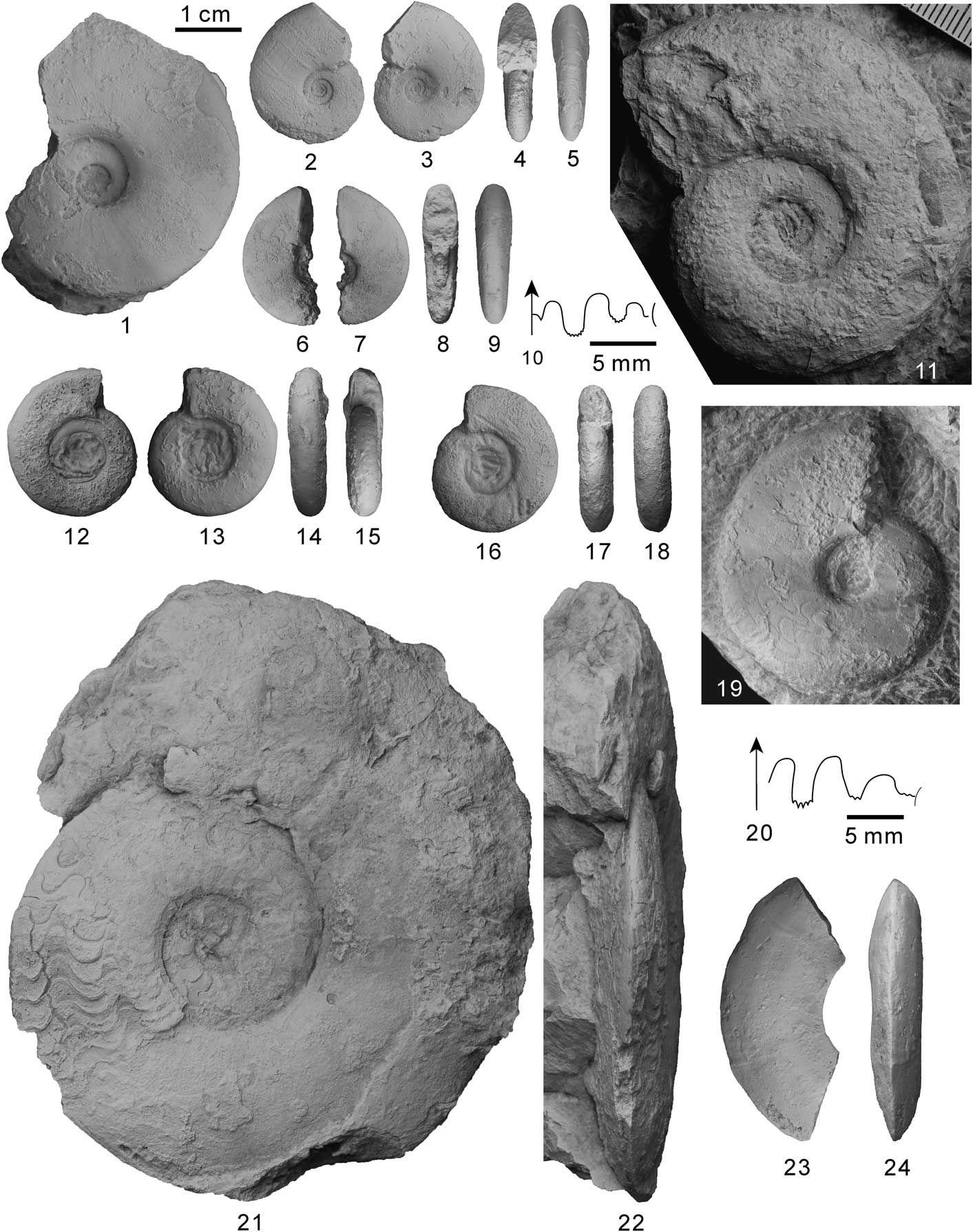
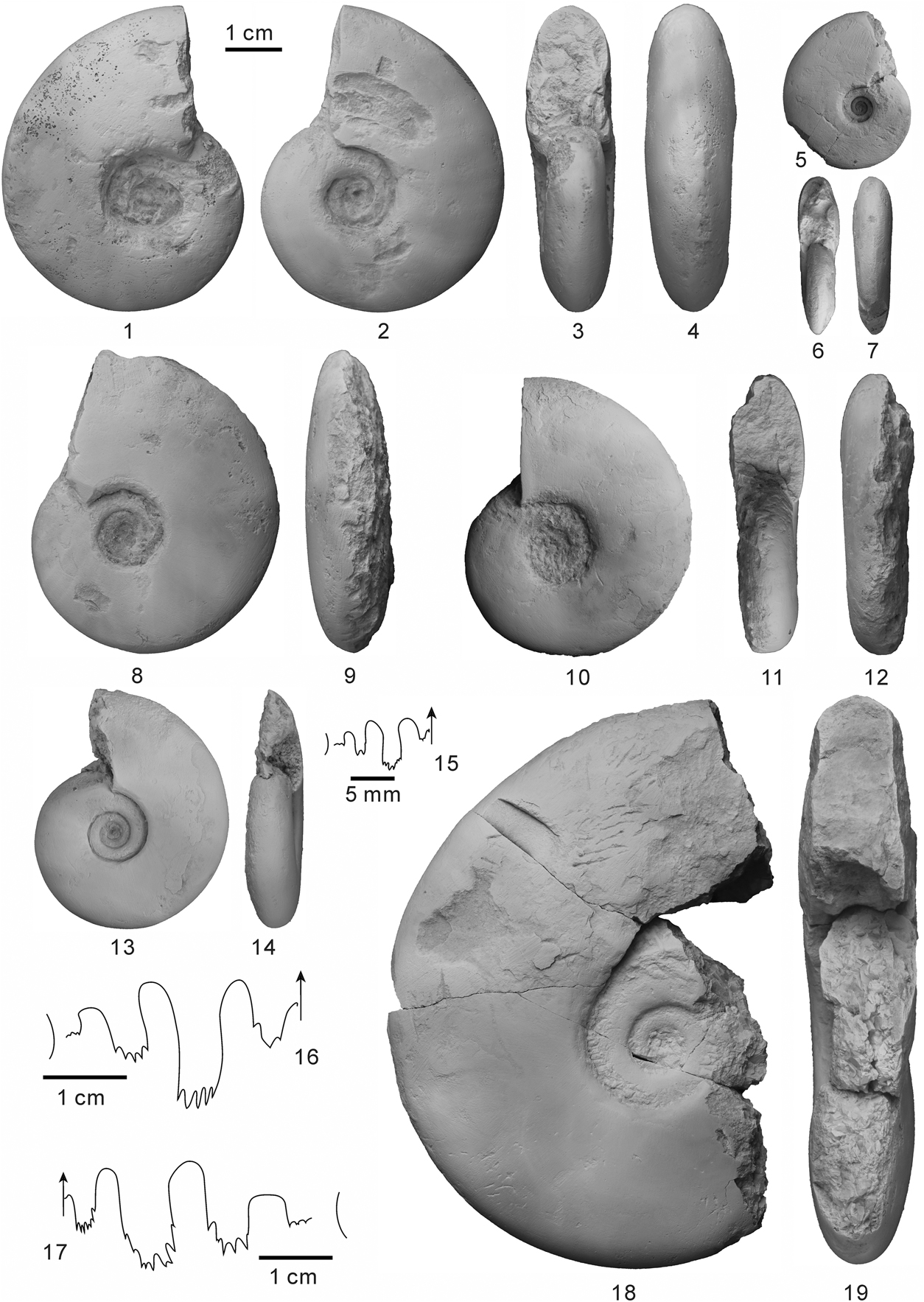
(1–11) Ophiceras medium Griesbach, Reference Griesbach1880, (1) YFMCUG 00001, from GJ-15; (2–5) YFMCUG 00002, from GJ-15; (6–10) YFMCUG 00003, from GJ-15, suture line at H=6.2 mm; (11) YFMCUG 00008, from GJ-28. (12–18) Ophiceras sp. indet., (12–15) YFMCUG 00066, from GJ-33; (16–18) YFMCUG 00071, from GJ-33. (19–20) Ophiceratidae gen. indet., YFMCUG 00010, from GJ-23, suture line at H=13.0 mm. (21–24) Vishnuites pralambha Diener, Reference Diener1897, (21, 22) YFMCUG 00007, from GJ-25; (23, 24) YFMCUG 00051, from GJ-33.

1880 Ophiceras medium Reference Song, Wignall, Chen, Tong, Bond, Lai, Zhao, Jiang, Yan and NiuGriesbach, p. 111, pl. 3, fig. 9.
1880 Trachyceras (?) gibbosum Reference Song, Wignall, Chen, Tong, Bond, Lai, Zhao, Jiang, Yan and NiuGriesbach, p. 111, pl. 3, fig. 10.
1897 Ophiceras gibbosum; Reference DienerDiener, p. 108, pl. 9, fig. 47.
1897 Ophiceras platyspira Reference DienerDiener, p. 113, pl. 12, figs. 5, 6.
1897 Ophiceras sakuntala Reference DienerDiener, p. 114, pl. 10, figs. 1–7; pl. 11, figs. 1, 2, 4.
1897 Ophiceras medium; Reference DienerDiener, p. 118, pl. 9, figs. 1, 2.
1897 Ophiceras ptychodes Reference DienerDiener, p. 120, pl. 11, figs. 3, 5, 6.
1897 Ophiceras demissum; Reference DienerDiener, p. 121, pl. 14, figs. 1–7.
1897 Ophiceras chamunda Reference DienerDiener, p. 123, pl. 12, figs. 1–4.
?1913 Ophiceras sakuntala; Reference DienerDiener, p. 15, pl. 1, figs. 1, 2.
?1933 Ophiceras tingi Reference TienTien, p. 9, pl. 1, fig. 4a–c.
?1937 Ophiceras sp.; Reference HsüHsü, p. 319, pl. 2, figs. 4, 5.
1972 Ophiceras medium; Reference KummelKummel, pl. 7, figs. 1–13; pl. 8, figs. 1–16; pl. 9, figs. 1–14; pl. 10, figs. 1–18.
1976 Ophiceras (Lytophiceras) sakuntala; Reference Wang and HeWang and He, p. 272, pl. 2, figs. 4–6; p. 270, text-fig. e.
2003 Ophiceras cf. O. sakuntula; Reference Krystyn, Richoz, Baud and TwitchettKrystyn et al., p. 336, fig. 4D.
?2004 Ophiceras sp.; Reference Tong, Zakharov and WuTong et al., p. 196, pl. 1, figs. 3–5.
?2004 Lytophiceras sp.; Reference Tong, Zakharov and WuTong et al., p. 196, pl. 1, fig. 6.
?2006 Lytophiceras cf. L. chamunda; Reference Bu, Wu, Zhang, Meng, Zhang and ZhangBu et al., fig. 3c.
?2006 Ophiceras tingi; Reference Bu, Wu, Zhang, Meng, Zhang and ZhangBu et al., fig. 3h, i.
?2006 Ophiceras sp.; Reference Bu, Wu, Zhang, Meng, Zhang and ZhangBu et al., fig. 3g, j, k.
?2009 Ophiceras sp.; Reference Zhang, He, Zhang, Yang and WuZhang et al., fig. 5j.
?2009 Hypophiceras sp.; Reference Zhang, He, Zhang, Yang and WuZhang et al., fig. 5k.
?2009 Lytophiceras sp.; Reference Zhang, He, Zhang, Yang and WuZhang et al., fig. 5l.
Lectotype
GSI 5973 (Griesbach, Reference Griesbach1880, pl. 3, fig. 9; Diener, Reference Diener1897, pl. 9, fig. 2; Kummel, Reference Kummel1972, pl. 8, figs. 15, 16), from the Otoceras beds at Rimkin Paiar encamping ground, Shalshal Cliff, Painkhanda, Niti region, Himalayas, India.
Occurrence
Late Griesbachian. Himalayas (Griesbach, Reference Griesbach1880; Diener, Reference Diener1897; Wang and He, Reference Wang and He1976), South China (this work).
Description
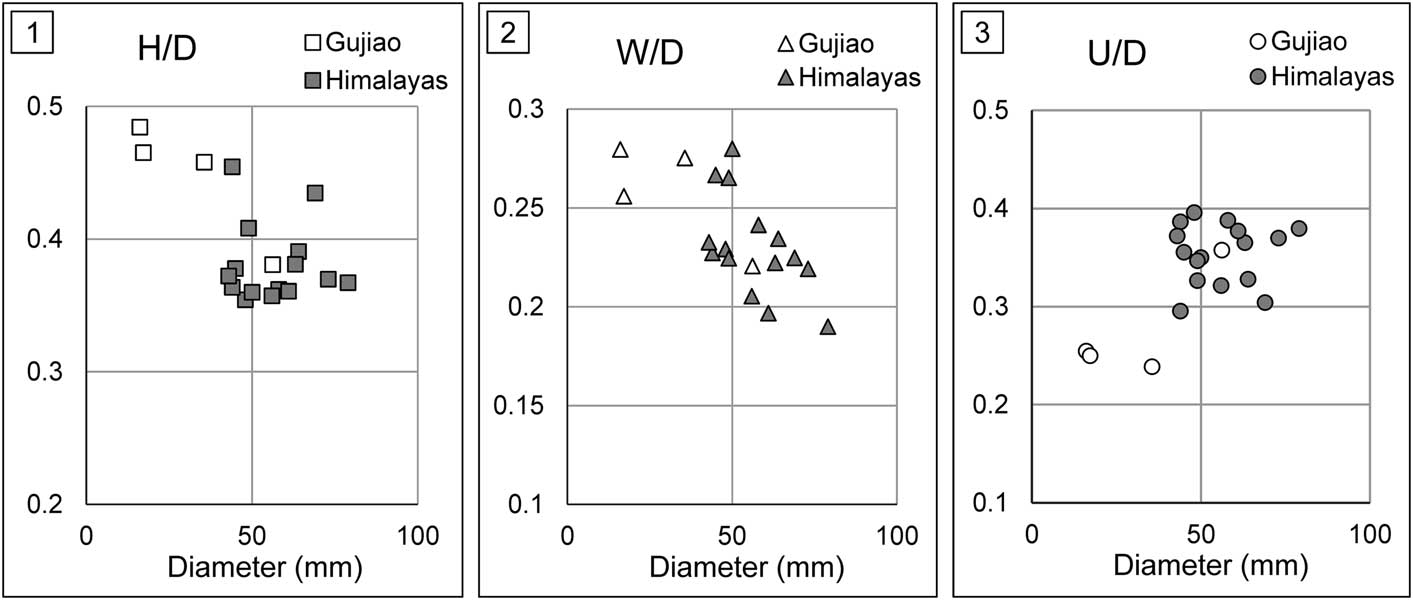
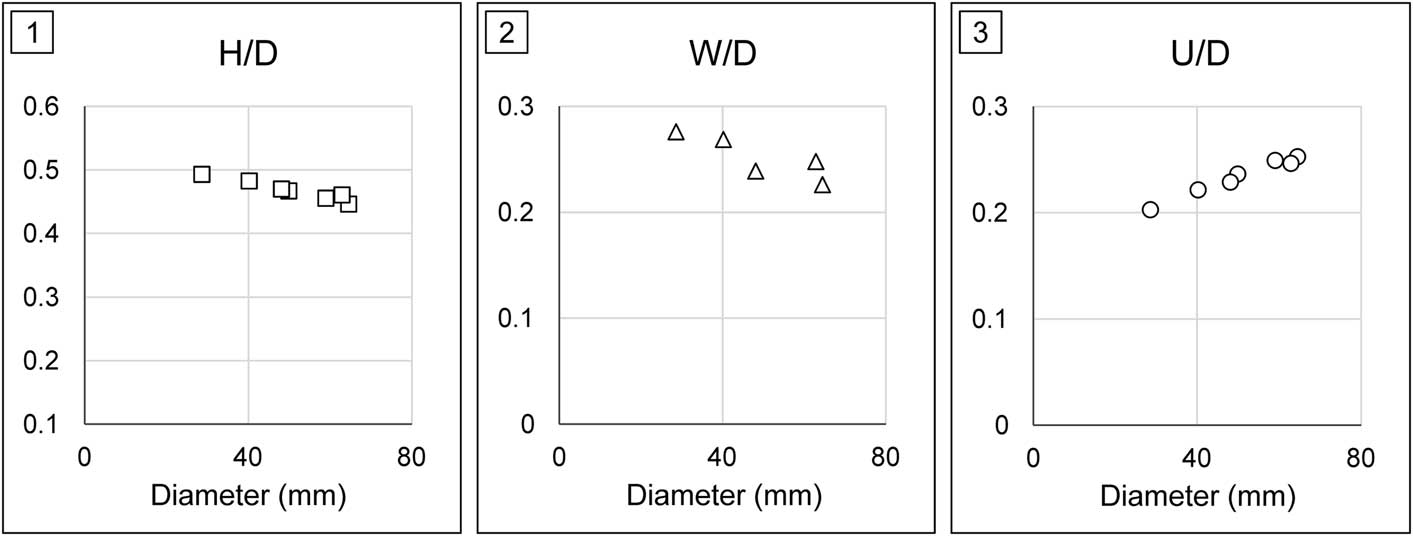
Discoidal, relatively involute, and compressed (W/H ~0.58, W/D ~0.26) shell displaying a growth allometry with coiling becoming more evolute during ontogeny. The largest specimen sampled at Gujiao displays a U/D ~0.36, while the smallest displays a ratio of ~0.25 (Fig. 5). The venter is narrow and rounded, without distinct ventrolateral shoulders. Flanks slightly convex with maximum whorl width near the inner third of the flanks. The umbilical wall is moderately deep with a rounded shoulder. The flanks only exhibit fine slightly curved growth lines. Suture line ceratitic. The ventral lobe is shallow with two pointed branches. The first lateral lobe is twice as deep as the second lateral lobe. Both of them show fine indentations at their base. Saddles are rounded, and the second lateral saddle is slightly asymmetric.
Scatter diagrams of (1) height/diameter (H/D), (2) width/diameter (W/D), and (3) umbilic/diameter (U/D) for Ophiceras medium. Data from the Himalayas are from Diener (Reference Diener1897) (n=16). White symbols indicate specimens from Gujiao section (n=4).

Materials
Three specimens from bed GJ-15, one specimen from bed GJ-28, and several questionable specimens from beds GJ-13, GJ-14, GJ-20, GJ-22, GJ-23, and GJ-27 (Fig. 3). Registered specimens: YFMCUG 00001, YFMCUG 00002, YFMCUG 00003, and YFMCUG 00008.
Remarks
Our specimens differ from O. tibeticum by their more involute coiling and smooth flanks and from O. serpentinum by a more compressed and involute shell. Previous descriptions of Ophiceras from South China are based on very poorly preserved specimens, so their assignment is often questionable, preventing their use for further discussion. Described specimens are typically severely distorted, without suture lines and visible venter (e.g., Zhang et al., Reference Zhang, He, Zhang, Yang and Wu2009, fig. 5j) and may be confused with smooth gyronitids, for example. Thus, these deformed specimens were not included in our taxonomic discussion. In South China, O. tingi was first described by Tien (Reference Tien1933) and is morphologically close to O. medium. O. tingi is characterized by an unusual ‘V’-shaped second lateral lobe, which is most probably the result of intense weathering or degradation during preparation of the suture line. O. sinense documented from Guiyang (Tien, Reference Tien1933) shows some fine folds and nodules near the umbilical shoulder, which correspond to some forms of O. tibeticum from Himalayas. No well-preserved specimens of this species were retrieved, and its validity is questioned. Brühwiler et al. (Reference Brühwiler, Brayard, Bucher and Guodun2008) reported several well-preserved juvenile specimens of Ophiceras with some ribs from Guangxi Province, which might be juvenile individuals of O. sinense. However, due to their small size and in the absence of study concerning their ontogeny, this remains an open question. An in-depth review of Ophiceras from South China with better-preserved specimens would be necessary to decipher its taxonomy.
Ophiceras sp. indet.
?1988 Gyrophiceras plicatum; Reference XuXu, p. 446, pl. 2, fig. 7.
?2007 Gyrophiceras subplicatum; Zakharov and Reference Mu, Zakharov, Li and ShenMu in Mu et al., p. 866, figs. 10.10–10.16, 10.19, 11.2, 11.3.
Occurrence
Late Griesbachian of South China.
Description
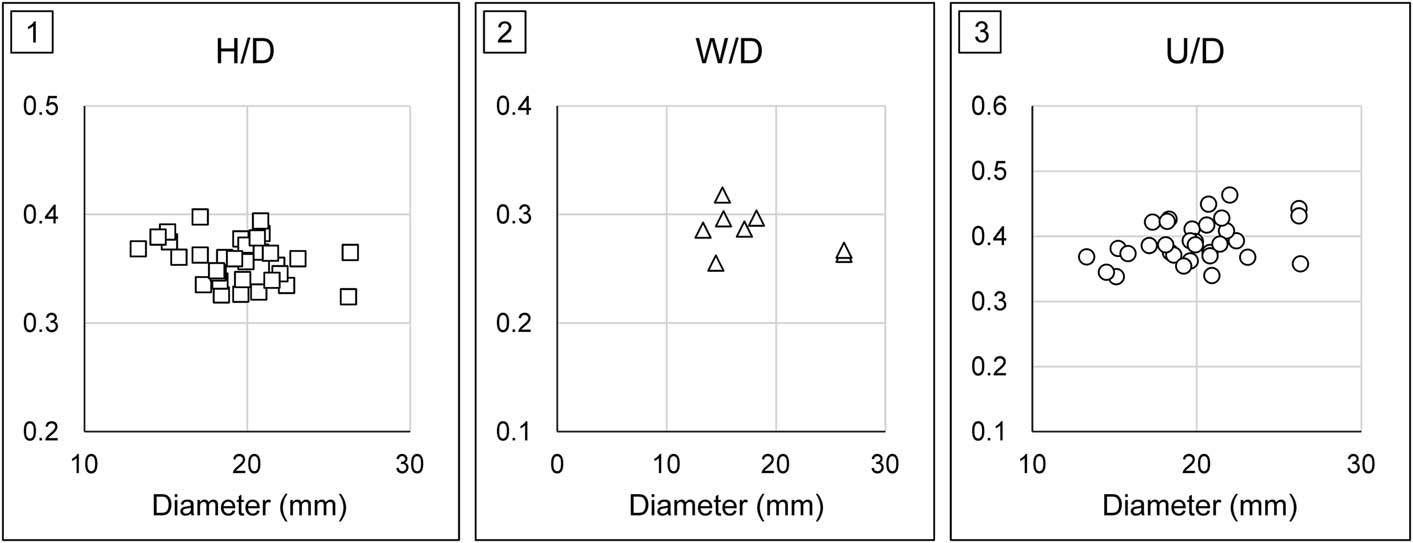
Subevolute (U/D ~0.38), serpenticonic (W/D ~0.3) shell with a subcircular (W/H ~0.8) whorl section (Fig. 6) and an arched venter with rounded ventrolateral shoulders. Flanks convex with maximum whorl width near mid-flanks. Umbilicus is broad and moderately deep with a low vertical umbilical wall and a rounded umbilical shoulder. No ornamentation visible on our specimens, but this might be due to their poor preservation. Suture line not sufficiently preserved to be drawn and described.
Scatter diagrams of (1) height/diameter (H/D), (2) width/diameter (W/D), and (3) umbilic/diameter (U/D) for Ophiceras sp. indet. (n=33).

Materials
Very abundant in bed GJ-33. Registered specimens: YFMCUG 00052-00084.
Remarks
Similar specimens have been reported from South China and assigned to Gyrophiceras plicatum and G. subplicatum (Xu, Reference Xu1988; Mu et al., Reference Mu, Zakharov, Li and Shen2007). Gyrophiceras was erected by Spath (Reference Spath1934) based on the species Lecanites gangeticus Waagen, Reference Waagen1895 (holotype on pl. 39, fig. 4a–c.) and assigned to Gyronitidae. However, according to the taxonomic revision of Gyronitidae by Ware et al. (Reference Ware, Bucher, Brühwiler, Schneebeli-Hermann, Hochuli, Roohi, Ur-Rehman and Yaseen2018), the holotype is a pathological specimen that most probably belongs to Gyronites, so Gyrophiceras is considered invalid. Specimens from South China assigned to Gyrophiceras by Xu (Reference Xu1988) and by Zakharov and Mu (in Mu et al., Reference Mu, Zakharov, Li and Shen2007) belong to different genera and families. Xu (Reference Xu1988) reported three species of Gyrophiceras: G. hubeiense, G. orientale, and G. plicatum, but only the latter is similar to our specimens. G. hubeiense and G. orientale are more involute and thicker than our specimens. G. subplicatum (Zakharov and Mu in Mu et al., Reference Mu, Zakharov, Li and Shen2007) does not exhibit any marked difference from our specimens and thus may be considered synonymous. G. plicatum was initially described by Chao (Reference Chao1959) from Smithian specimens, which likely belong to Dieneroceras. The Induan specimens assigned by Xu (Reference Xu1988) and Zakharov and Mu (in Mu et al., Reference Mu, Zakharov, Li and Shen2007) to G. plicatum were thus likely misidentified and actually correspond to an undetermined Ophiceras species. As our specimens and Xu’s material are too poorly preserved and small to establish whether they are a new species, or juveniles of another Ophiceras species, whose ontogeny is unknown (e.g., O. serpentinum), we prefer to keep this taxon in open nomenclature.
Genus Vishnuites Diener, Reference Diener1897
Type species
Vishnuites pralambha Diener, Reference Diener1897.
Remarks
This ophiceratid genus is characterized by an acute venter. A detailed discussion of this genus is available in Brühwiler et al. (Reference Brühwiler, Brayard, Bucher and Guodun2008).
Vishnuites pralambha Diener, Reference Diener1897
1897 Xenaspis (Vishnuites) pralambha Reference DienerDiener, p. 88, pl. 7, figs. 4, 5.
?1959 Vishnuites marginalis Reference ChaoChao, p. 190, pl. 11. Figs. 17, 18.
1972 Vishnuites pralambha; Reference KummelKummel, pl. 12, figs. 1–4.
?1988 Vishnuites huazhongensis Reference XuXu, p. 441, pl. 1, fig. 8, text-fig. 6.
?1988 Vishnuites lichuanensis Reference XuXu, p. 441, pl. 1, fig. 3, pl. 2, fig. 10, text-fig. 7.
?1988 Vishnuites marginalis Reference XuXu, p. 443, pl. 2, fig. 1, text-fig. 8.
?1988 Vishnuites orientalis Reference XuXu, p. 443, pl. 2, fig. 6, text-fig. 9.
1988 Vishnuites yangziensis Reference XuXu, p. 444, pl. 1, fig. 9, pl. 2, fig. 3, text-fig. 10.
2007 Vishnuites wenjiangsiensis Zakharov and Mu in Reference Mu, Zakharov, Li and ShenMu et al., p. 860, figs. 3.12–3.17, 5.1.
2007 Vishnuites cf. V. yangziensis; Zakharov and Mu in Reference Mu, Zakharov, Li and ShenMu et al., p. 860, figs. 5.2, 6.3, 6.4, 6.6, 6.8, 6.10, 6.12.
v 2008 Vishnuites pralambha; Reference Brühwiler, Brayard, Bucher and GuodunBrühwiler et al., p. 1161, pl. 1, figs. 18–21.
Lectotype
GSI5950 (Diener, Reference Diener1897, pl. 7, fig. 4; Kummel, Reference Kummel1972, pl. 12, fig. 1) from the Otoceras beds at Rimkin Paiar encamping ground, Shalshal Cliff, Painkhanda, Niti region, Himalayas, India.
Occurrence
Otoceras beds of the Himalayas (Diener, Reference Diener1897); late Griesbachian of South China (Xu, Reference Xu1988; Mu et al., Reference Mu, Zakharov, Li and Shen2007; Brühwiler et al., Reference Brühwiler, Brayard, Bucher and Guodun2008; this work).
Description
Moderately evolute (U/D ~0.41) compressed shell with an acute venter. Convex flanks with maximum whorl width at the middle of flanks. Umbilicus broad and shallow, with a low wall and a rounded umbilical margin. Ornamentation not preserved. Suture line very poorly preserved, but remains of a developed auxiliary series are visible (see Fig. 4.21).
Materials
Several specimens from beds GJ-24, GJ-25, and GJ-33, with only a single measurable specimen. Registered specimens: YFMCUG 00007 and YFMCUG 00051.
Remarks
Vishnuites species erected by Chao (Reference Chao1959), Xu (Reference Xu1988), and Zakharov and Mu (in Mu et al., Reference Mu, Zakharov, Li and Shen2007) based on rather poorly preserved specimens from South China have been considered synonyms of V. pralambha Diener, Reference Diener1897 by Brühwiler et al. (Reference Brühwiler, Brayard, Bucher and Guodun2008). However, this genus and its species are poorly known. It has been erected from two fragmentary specimens, which lack detailed stratigraphic context. Diener (Reference Diener1897) mentioned that they come from the “Otoceras beds” in Shalshal Cliff. These so-called “Otoceras beds” correspond to a ~1 m thick interval encompassing the Griesbachian up to at least the middle Dienerian, and Shalshal Cliff is situated at the border between India and China in the central Himalayas and has never been reinvestigated. The ontogeny, intraspecific variability, and exact stratigraphic position of this species thus remain unknown. We here decided to keep the name Vishnuites pralambha for specimens from South China despite minor differences from the holotype (e.g., slightly thicker whorl section, higher umbilical wall, longer auxiliary series) for continuity with previous works on South Chinese ammonoids. However, it is awaiting a proper revision to confirm or reject the synonymy between the material from South China and that from central Himalaya. Pseudovishnuites Zakharov and Mu (in Mu et al. Reference Mu, Zakharov, Li and Shen2007) exhibits a wider and deeper ventral lobe with distinct adventitious elements but was considered a synonym of Vishnuites by Brühwiler et al. (Reference Brühwiler, Brayard, Bucher and Guodun2008). More material with well-preserved suture lines is needed to confirm the validity of Pseudovishnuites. V. (‘Paravishnuites’) oxynotus and V. (‘P’) striatus described by Spath (Reference Spath1935) from East Greenland are relatively more involute and display fine radial folds on their flanks.
Ophiceratidae gen. indet.
Occurrence
Lower Daye Formation, Guizhou, South China. Ophiceras medium beds, late Griesbachian.
Description
Moderately involute, compressed shell with rounded venter, flanks slightly convex, and maximum whorl width near the umbilical margin. Umbilicus small with an oblique wall and a rounded umbilical shoulder. Ornamentation not preserved. Suture line ceratitic. The ventral lobe is not visible. The first lateral lobe is rather deep, with small, regular denticulations at its base. First and second lateral saddles are elongated and slightly asymmetric. The third lateral saddle is short with a broad rounded tip. Auxiliary series is quite short with fine indentations.
Material
A single specimen from bed GJ-23. Registered specimen: YFMCUG 00006.
Remarks
This specimen is close to involute forms of Ophiceratidae, such as Discophiceras, Ghazalaites, and Kyoktites. However, the poor preservation prevents further identification.
Family Gyronitidae Waagen, Reference Waagen1895
Genus Ambites Waagen, Reference Waagen1895
Type species
Ambites discus Waagen, Reference Waagen1895 from Salt Range, Pakistan.
Remarks
Ambites can be distinguished from Gyronites by its typical bottlenecked venter. A detailed discussion of this genus can be found in Ware et al. (Reference Ware, Bucher, Brühwiler, Schneebeli-Hermann, Hochuli, Roohi, Ur-Rehman and Yaseen2018).
Ambites radiatus (Brühwiler et al., Reference Brühwiler, Brayard, Bucher and Guodun2008)
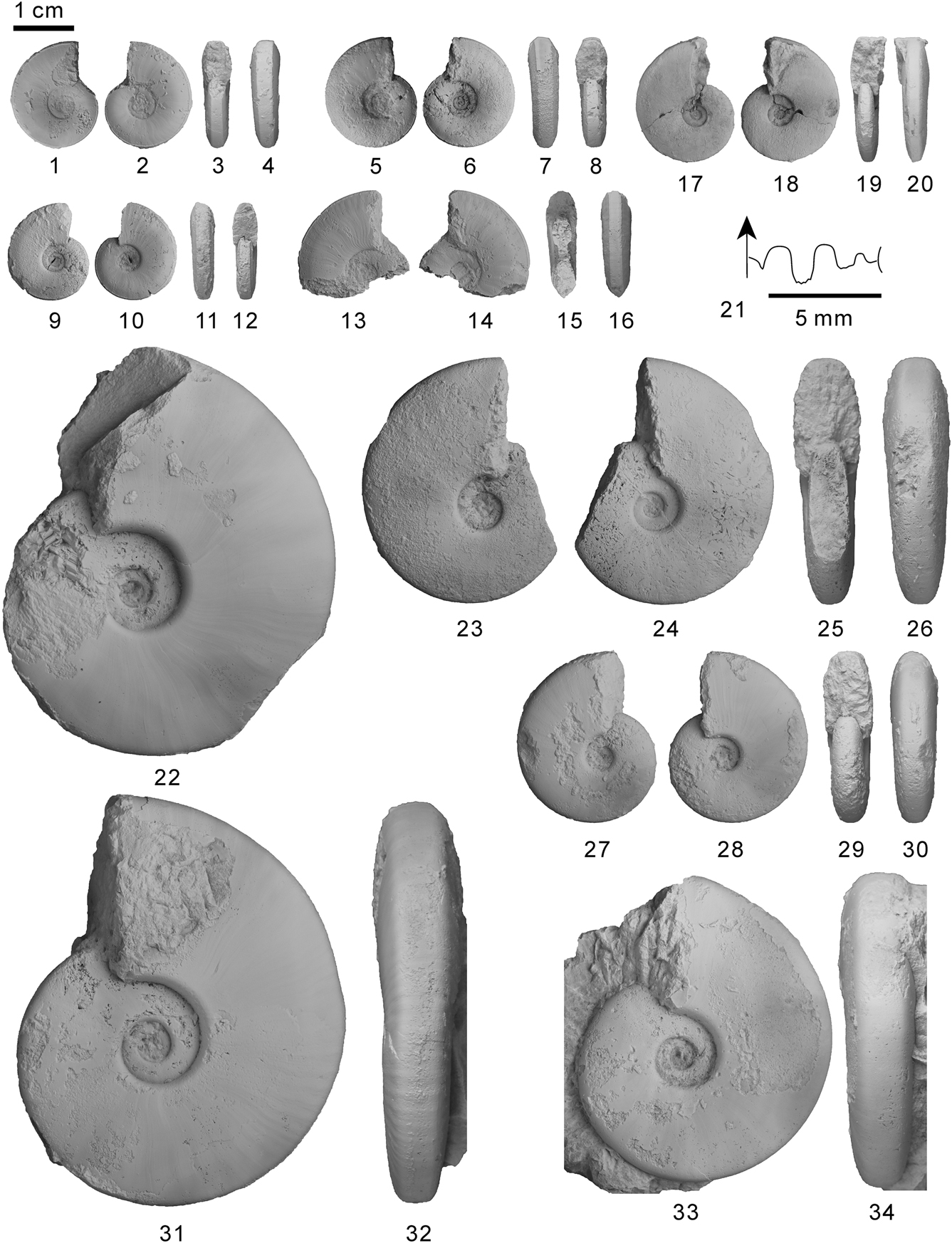
(1–16) Ambites radiatus (Brühwiler et al., Reference Brühwiler, Brayard, Bucher and Guodun2008), (1–4) YFMCUG 00088, from GJ-40; (5–8) YFMCUG 00087, from GJ-40; (9–12) YFMCUG 00086, from GJ-40; (13–16) YFMCUG 00089, from GJ-40. (17–21) Gyronitidae gen. indet., YFMCUG 00005, from GJ-15, suture line at H=5.0 mm. (22–34) ?Gyronitidae gen. indet. sp. indet., (22) YFMCUG 00095, from GJ-40; (23–26) YFMCUG 00097, from GJ-40; (27–30) YFMCUG 00098, from GJ-40; (31, 32) YFMCUG 00094, from GJ-40; (33, 34) YFMCUG 00096, from GJ-40.

v 2008 Pleurambites radiatus Reference Brühwiler, Brayard, Bucher and GuodunBrühwiler et al., p. 1168, pl. 5, figs 1 (holotype), 2, 3.
v 2018 Ambites radiatus; Reference Ware, Bucher, Brühwiler, Schneebeli-Hermann, Hochuli, Roohi, Ur-Rehman and YaseenWare et al., pl. 9, figs. 11–28.
Holotype
PIMUZ 26766 (Brühwiler et al., Reference Brühwiler, Brayard, Bucher and Guodun2008, pl. 5, fig. 1) from Jinya, Guangxi, South China.
Occurrence
Middle Dienerian of the Northern Indian Margin (Ware et al., Reference Ware, Bucher, Brayard, Schneebeli-Hermann and Brühwiler2015) and South China (Brühwiler et al., Reference Brühwiler, Brayard, Bucher and Guodun2008; this work).
Description
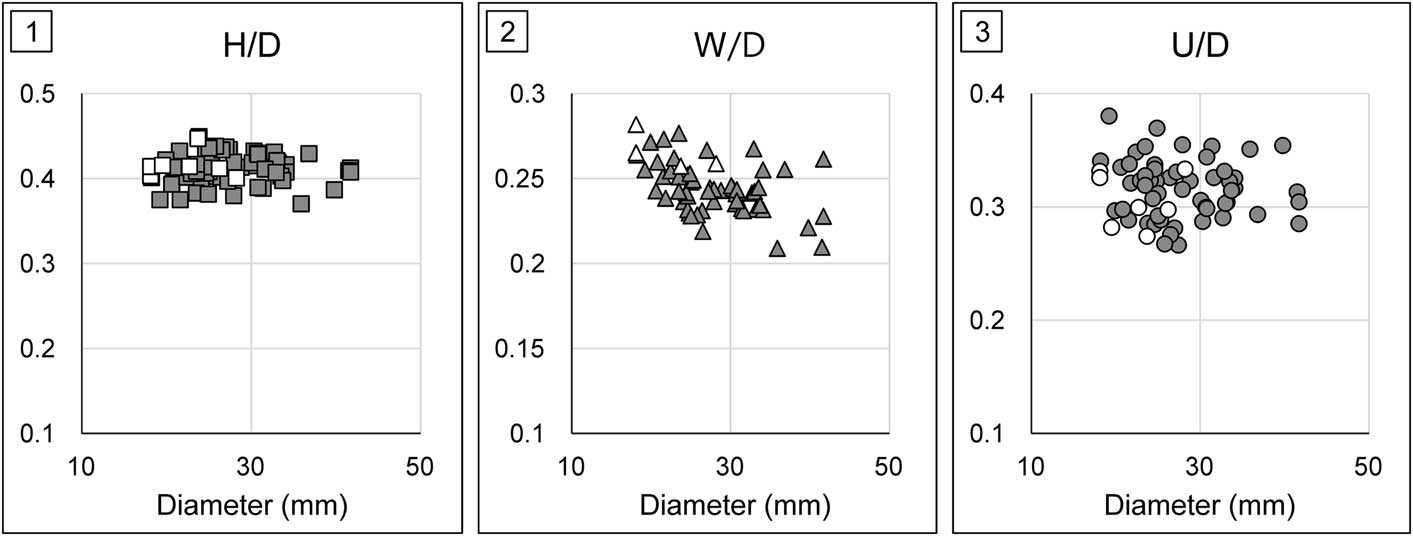
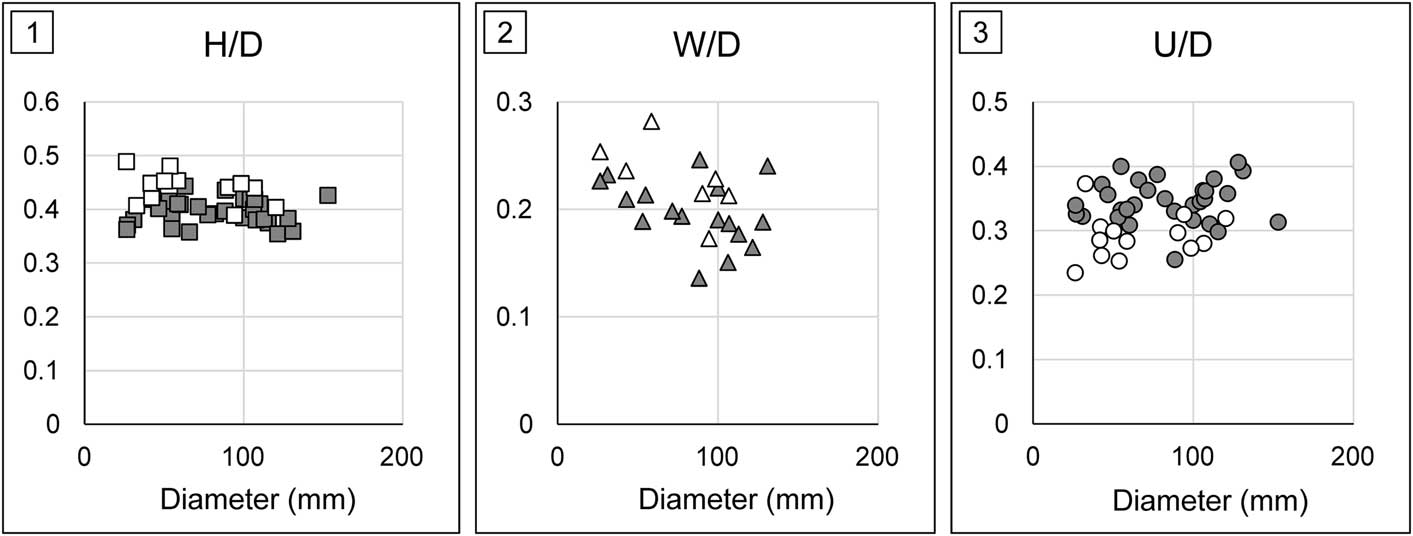
Small, subevolute (U/D ~0.31, Fig. 8) shell with a weakly compressed whorl section (W/H ~0.62, Fig. 8). The venter is tabulate with angular shoulders and shows a bottleneck shape at the beginning of the flanks. Flanks are longitudinally divided into two parts by a low spiral ridge, which is not apparent on juvenile specimens, and located near the outer third of the flanks. The inner part is flat while the outer part is slightly inclined toward the ventrolateral shoulder. Umbilicus displays a low vertical wall. Umbilical shoulder is rounded. The ornamentation consists of a fine biconcave growth line and weak folds on the flanks. Suture line not preserved.
Scatter diagrams of (1) height/diameter (H/D), (2) width/diameter (W/D), and (3) umbilic/diameter (U/D) for Ambites radiatus (Brühwiler et al., Reference Brühwiler, Brayard, Bucher and Guodun2008). White symbols indicate specimens from Gujiao section (n=7), and gray symbols indicate data from Ware et al. (Reference Ware, Bucher, Brühwiler, Schneebeli-Hermann, Hochuli, Roohi, Ur-Rehman and Yaseen2018) (n=55).

Materials
Eight specimens from bed GJ-40. Registered specimens: YFMCUG 00085–00089, YFMCUG 00122, YFMCUG 00123-1, and YFMCUG 00127-6.
Remarks
Ware et al. (Reference Ware, Bucher, Brühwiler, Schneebeli-Hermann, Hochuli, Roohi, Ur-Rehman and Yaseen2018) provided a detailed review and definition of this species. The rather wide, tabulate venter of our specimens and their evolute shape clearly allow identifying them as A. radiatus. Comparisons with measurements of specimens of Ware et al. (Reference Ware, Bucher, Brühwiler, Schneebeli-Hermann, Hochuli, Roohi, Ur-Rehman and Yaseen2018) highlight this congruence (Fig. 8).
Gyronitidae gen. indet. sp. indet.
Occurrence
Lower Daye Formation., Guizhou, South China. Ophiceras medium beds, late Griesbachian.
Description
Small subinvolute (U/D ~0.25), compressed (W/H~0.46, W/D ~0.26) shell with a tabulate venter and sharp ventrolateral shoulders. Flanks slightly convex with maximum whorl width near the inner third of the whorl height. Umbilicus moderately deep with a vertical wall and a rounded umbilical shoulder. Shell surface smooth. The ventral lobe is subdivided into two branches without any indentations visible at their base. The first lateral saddle is broad and shows a rounded tip. The third lateral saddle is relatively small. Only obscure indentations can be seen at the base of the first and second lateral lobes. Auxiliary series not preserved.
Material
One specimen from bed GJ-15. Registered specimen: YFMCUG 00005.
Remarks
The tabulate venter and suture lines similar to Gyronites allow its inclusion in Gyronitidae, and it might correspond to an involute form of the genus. However, only one poorly preserved juvenile specimen is available, so we prefer to keep it in open nomenclature.
?Gyronitidae gen. indet. sp. indet.
Occurrence
Lower Daye Formation, Guizhou, South China. Ambites radiatus bed, middle Dienerian.
Description
Subinvolute (U/D ~0.23) platyconic shell with a moderately compressed (W/H ~0.54) whorl section (Fig. 9). Subtabulate venter with a distinct rounded ventrolateral shoulder. Flanks subparallel, very slightly convex, with maximum whorl width at mid-flank. Umbilicus deep with a vertical wall and a rounded shoulder. Shell with thin, slightly biconcave growth lines crossing the venter. Suture line not preserved.
Scatter diagrams of (1) height/diameter (H/D), (2) width/diameter (W/D), and (3) umbilic/diameter (U/D) for ?Gyronitidae gen. indet. sp. indet. (n=7).

Materials
Seven specimens from bed GJ-40. Registered specimens: YFMCUG 00094–00098, YFMCUG 00121.
Remarks
This species differs from Mullericeratidae by a broad subtabulate venter and a more evolute and thicker shell. It differs from Proptychitidae by a more compressed shell and subtabulate venter. In proptychitids, the venter is always rounded. According to the emended description of Gyronitidae (Ware et al., Reference Ware, Bucher, Brühwiler, Schneebeli-Hermann, Hochuli, Roohi, Ur-Rehman and Yaseen2018), this species fits within this family. It is quite close to Ambites bojeseni Ware and Bucher in Ware et al., Reference Ware, Bucher, Brühwiler, Schneebeli-Hermann, Hochuli, Roohi, Ur-Rehman and Yaseen2018 (which co-occurs with Ambites radiatus in the Northern Indian Margin), differing only by its venter, which is not bottleneck-shaped. This difference, however, excludes it from Ambites, so it probably represents a new genus and species within Gyronitidae. However, in the absence of a well-preserved suture line, it is not possible to provide a complete diagnosis, so we prefer to keep it in open nomenclature.
Family Proptychitidae Waagen, Reference Waagen1895
Genus Jieshaniceras Brühwiler et al., Reference Brühwiler, Brayard, Bucher and Guodun2008
Type species
Wordieoceras guizhouensis Zakharov and Mu in Mu et al., Reference Mu, Zakharov, Li and Shen2007 from Guiding, Guizhou, South China.
Diagnosis
Compressed and evolute Proptychitidae. Venter rounded without ventrolateral shoulders. Flanks convex. Suture line with elongated saddles. Lobes with numerous irregular indentations both at the base and along the sides of lobes.
Remarks
This genus was included in Flemingitidae by Brühwiler et al. (Reference Brühwiler, Brayard, Bucher and Guodun2008) based on its phylloid saddles. However, Flemingitidae are known to abundantly occur only in the early Smithian (e.g., Brayard and Bucher, Reference Brayard and Bucher2008; Brühwiler et al., Reference Brühwiler, Bucher, Ware, Hermann, Hochuli, Roohi, Rehman and Yaseen2012a) and are usually distinctly ornamented with ribs and strigation, which is not the case in Jieshaniceras. Brühwiler et al. (Reference Brühwiler, Brayard, Bucher and Guodun2008) stated this family assignment remains uncertain. Phylloid saddles also exist in proptychitids (e.g., Proptychites ammonoides Waagen in Ware et al., Reference Ware, Bucher, Brühwiler, Schneebeli-Hermann, Hochuli, Roohi, Ur-Rehman and Yaseen2018). Our new material with better-preserved suture lines shows that lobe indentations are often not restricted to their base, but also run along the lower part of their sides, particularly on the first lateral lobe (e.g., Fig. 10.17). This last trait, together with the rounded venter without ventrolateral shoulders, is typical of Proptychitidae (Ware et al., Reference Ware, Bucher, Brühwiler, Schneebeli-Hermann, Hochuli, Roohi, Ur-Rehman and Yaseen2018). We therefore consider here this genus a compressed and evolute form of Proptychitidae.
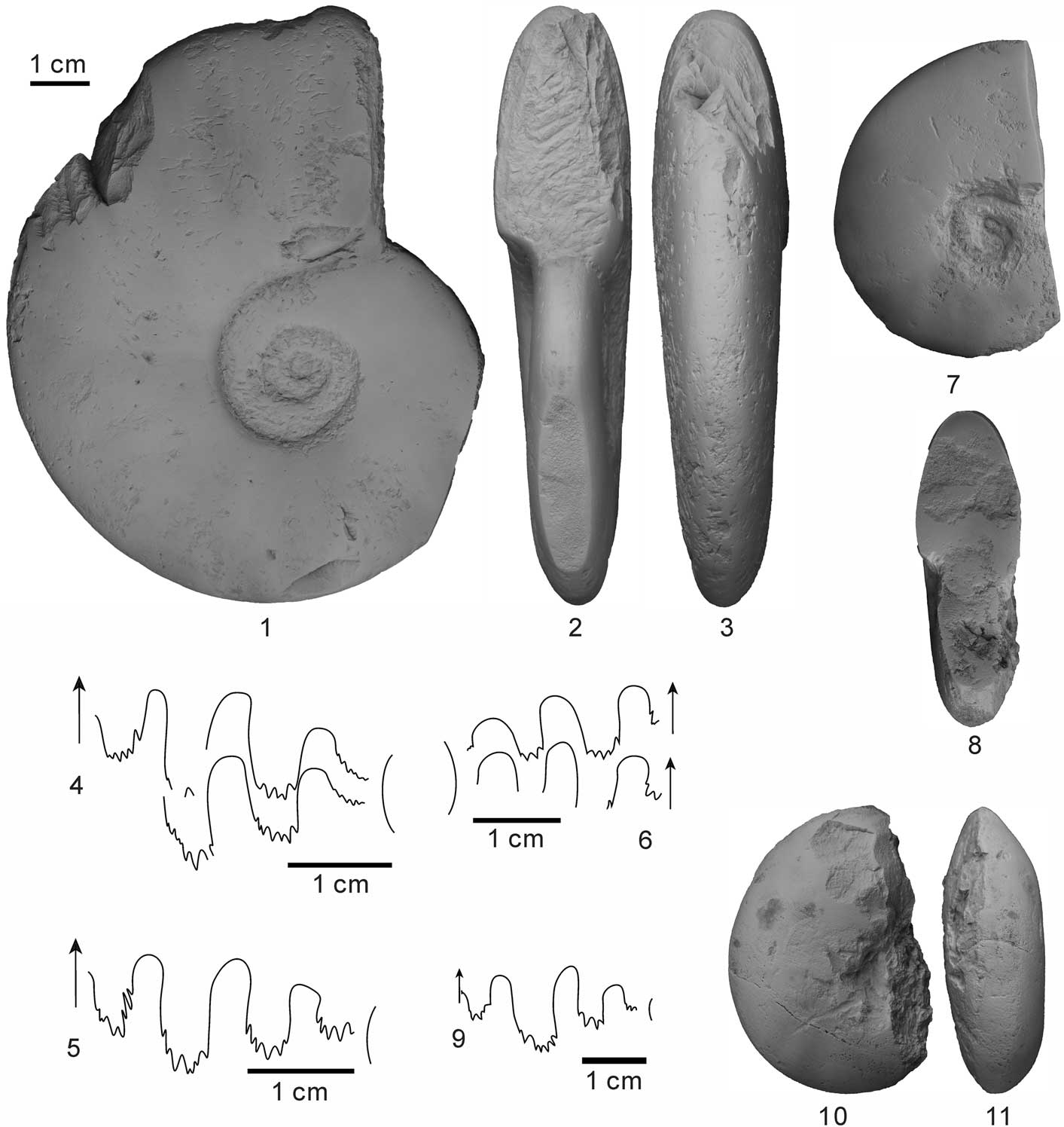
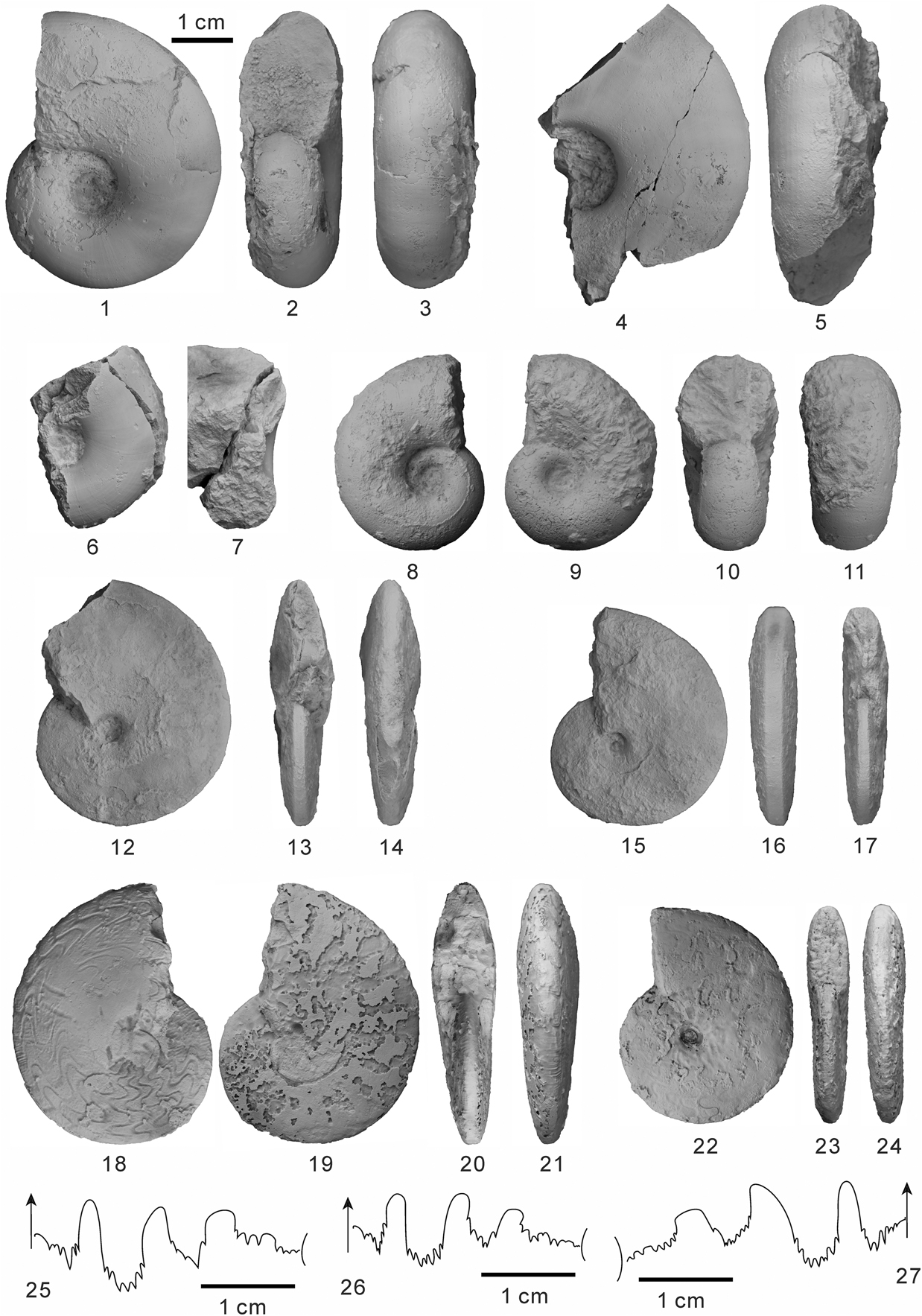
Jieshaniceras guizhouense (Zakharov and Mu in Mu et al., Reference Mu, Zakharov, Li and Shen2007), (1–4, 16) YFMCUG 00009, from GJ-33, suture line at H=22.3 mm; (5–7) YFMCUG 00013, from GJ-33; (8, 9) YFMCUG 00010, from GJ-33; (10–12) YFMCUG 00014, from GJ-35; (13–15) YFMCUG 00012, from GJ-33, suture line at H=12.1 mm; (17–19) YFMCUG 00015, from GJ-35, suture line at H=30.4 mm.

Jieshaniceras guizhouense (Zakharov and Mu in Mu et al., Reference Mu, Zakharov, Li and Shen2007)
Figures 10, 11.1–11.6
(1–6) Jieshaniceras guizhouense (Zakharov and Mu in Mu et al., Reference Mu, Zakharov, Li and Shen2007), (1–3) YFMCUG 00045, from GJ-35; (4) YFMCUG 00046, from GJ-35, suture line at H=24.8 mm; (5) YFMCUG 00047, from GJ-35, suture line at H=24.3 mm; (6) YFMCUG 00043, from GJ-35, suture line at H=24.0 mm. (7–11) Proptychites sp. indet., (7–9) YFMCUG 00049, from GJ-35, suture line at H=23.8 mm; (10, 11) YFMCUG 00050, from GJ-40.

?1933 Meekoceras kweichowense Reference TienTien, p. 16, pl. 2, fig. 1a–e.
?1988 Paranorites elegans Reference XuXu, p. 448, pl. 4, figs. 4, 5.
?2007 Proptychites aff. P. candidus; Zakharov and Mu in Reference Mu, Zakharov, Li and ShenMu et al., p. 864, figs. 10.17, 10.18, 11.1.
2007 Wordieoceras aff. W. wordiei; Zakharov and Mu in Reference Mu, Zakharov, Li and ShenMu et al., p. 862, figs. 6.7, 6.9, 6.11, 7.1, 7.2, 8.
2007 Wordieoceras guizhouensis Zakharov and Mu in Reference Mu, Zakharov, Li and ShenMu et al., p. 862, figs. 7.3, 9.1, 9.2.
v 2008 Proptychites candidus; Brühwiler Reference Brühwiler, Brayard, Bucher and Guodunet al., p. 1162, pl. 2, figs. 1, 2.
v 2008 Jieshaniceras guizhouensis; Brühwiler Reference Brühwiler, Brayard, Bucher and Guodunet al., p. 1174, pl. 6, figs. 1–4.
Holotype
NIGP 140012 (Mu et al., Reference Mu, Zakharov, Li and Shen2007, fig. 9.1, 9.2) from the Wenjiangsi section, Guiding, Guizhou, South China.
Occurrence
Late Griesbachian of South China.
Description
Large, moderately evolute (U/D ~0.3) shell with a strongly compressed (W/H ~0.49) whorl section (Fig. 12). Rounded venter lacking ventrolateral shoulders and convex flanks with maximum whorl width near mid-flanks. Umbilicus with a low vertical wall and rounded shoulders. Ornamentation not preserved on our specimens. Suture line with high rounded and slightly asymmetric saddles, the first lateral saddle sometimes being phylloid. The third lateral saddle is low and occasionally square (Fig. 11.5). Lobes with numerous deep and irregular indentations. Auxiliary series relatively short with numerous small indentations.
Scatter diagrams of (1) height/diameter (H/D), (2) width/diameter (W/D), and (3) umbilic/diameter (U/D) for Jieshaniceras guizhouense (Zakharov and Mu in Mu et al., Reference Mu, Zakharov, Li and Shen2007). Data from Mu et al. Reference Mu, Zakharov, Li and Shen2007 (n=21), Brühwiler et al. Reference Brühwiler, Brayard, Bucher and Guodun2008 (n=9), and this work (n=6). White symbols indicate specimens from Gujiao section.

Materials
One specimen from bed GJ-32, one specimen from bed GJ-33, and six specimens from GJ-35. Registered specimens: YFMCUG 00042–00048.
Remarks
Our specimens fit within the description of the species by Zakharov and Mu (in Mu et al., Reference Mu, Zakharov, Li and Shen2007) and Brühwiler et al. (Reference Brühwiler, Brayard, Bucher and Guodun2008). Our specimens are slightly more involute than the holotype (Mu et al., Reference Mu, Zakharov, Li and Shen2007, fig. 9.1, 9.2) and have a wider second lateral saddle and more indentations on the lobes, a difference that is interpreted as part of the species’ intraspecific variability.
Genus Proptychites Waagen, Reference Waagen1895
Occurrence
Late Griesbachian of South China.
Description
Subinvolute (U/D ~0.22) shell with a weakly compressed (W/H ~0.70) whorl section and a broadly rounded venter. Flanks are convex with maximum whorl width near the umbilical shoulder. Umbilicus is deep with an apparently vertical wall and rounded shoulders. The ornamentation is quite obscured on our specimens. Suture line ceratitic, with a broad ventral lobe divided by a high ventral saddle into two branches with serrated base. The first and second lateral saddles are high and narrow, gently bent toward the umbilicus. The first lateral lobe is larger than the others, with marked denticulations at its base and a couple fine ones on the base of its flanks. Auxiliary series is potentially present but barely visible on our specimens.
Materials
Two specimens from bed GJ-35. Registered specimens: YFMCUG 00049 and YFMCUG 00050.
Remarks
Our specimens are quite close to Proptychites lawrencianus (de Koninck, Reference de Koninck1863), but their suture line is distinct with a broader first lateral lobe. Saddles of our specimens are also narrower than in P. lawrencianus. Compared to P. candidus, these specimens show a thicker shell and a broader first lateral lobe. More material is needed to make an unequivocal species assignment.
Genus Pseudoproptychites Bando, Reference Bando1981
Type species
Proptychites scheibleri Diener, Reference Diener1897.
Pseudoproptychites cf. P. hiemalis (Diener, Reference Diener1895)
(1–11) Pseudoproptychites cf. hiemalis, (1–3) YFMCUG 00090, from GJ-40; (4, 5) YFMCUG 00091, from GJ-40; (6, 7) YFMCUG 00092, from GJ-40; (8–11) YFMCUG 00093, from GJ-40; (12–27) Mullericeras gujiaoense n. sp., (12–14) holotype, YFMCUG 00018, from GJ-33; (15–17) YFMCUG 00021, from GJ-33; (18–21) YFMCUG 00024, from GJ-33; (22–24) YFMCUG 00026, from GJ-33; (25) YFMCUG 00017, from GJ-33, suture line at H=25.3 mm; (26) YFMCUG 00019, from GJ-33, suture line at H=24.8 mm; (27) YFMCUG 00016, from GJ-33, suture line at H=24.4 mm.

?1895 Proptychites hiemalis Reference DienerDiener, p. 34, pl. 2, figs. 2, 4, pl. 5, fig. 4.
?1968 Proptychites hiemalis; Reference ZakharovZakharov, p. 93, pl. 17, figs. 6, 7, text-figure 20c.
v 2008 Proptychitid gen. indet. sp. indet.; Reference Brühwiler, Brayard, Bucher and GuodunBrühwiler et al., p. 1164, pl. 2, figs. 6–8.
?2009 Pseudoproptychites hiemalis; Reference Shigeta and ZakharovShigeta and Zakharov, p. 106, figs. 92.7–92.12, 94, 95.
Occurrence
Middle Dienerian of South China.
Description
Subinvolute (U/D ~0.25) shell showing a growth allometry. Small individuals display a rounded (W/H ~1.00) whorl section, whereas larger specimens exhibit a moderately compressed (W/H ~0.74) whorl section. The venter is broadly arched without ventrolateral shoulders. Flanks highly convex with maximum whorl width at mid-flanks. Umbilicus deep with a vertical wall and a rounded umbilical shoulder. Shell with thin, dense growth lines and a weak strigation. Suture line not visible on our specimens.
Materials
Four specimens from bed GJ-40. Registered specimens: YFMCUG 00090–00093.
Remarks
These specimens are similar to Pseudoproptychites hiemalis from South Primorye (Shigeta and Zakharov, Reference Shigeta and Zakharov2009). However, this species is poorly known, especially concerning its ontogeny; our specimens are much smaller than the holotype and their suture line is not preserved, preventing any firm species assignment. Brühwiler et al. (Reference Brühwiler, Brayard, Bucher and Guodun2008) assigned two specimens to Proptychitidae in open nomenclature. They show a similar subrounded whorl section and a high expansion rate; these are clearly synonymous with our specimens.
Family Mullericeratidae Ware et al., Reference Ware, Jenks, Hautmann and Bucher2011
Genus Mullericeras Ware et al., Reference Ware, Jenks, Hautmann and Bucher2011
Type species
Aspidites spitiensis Krafft in Krafft and Diener, Reference Krafft and Diener1909.
Mullericeras gujiaoense new species
vp 2008 Koninckites cf. K. timorense; Reference Brühwiler, Brayard, Bucher and GuodunBrühwiler et al., p. 1165, pl. 3, figs. 1, 3, 4.
Holotype
YFMCUG 00018, from bed GJ-33, Guojiao section, Guizhou Province, South China. Jieshaniceras guizhouense beds, late Griesbachian.
Diagnosis
Involute compressed Mullericeras with a narrow tabulate venter and slightly convex flanks converging toward the venter. Umbilicus is very small but never occluded. Suture line is typical for Mullericeras, with a wide ventral lobe with many denticulations at its base and a long auxiliary series characterized by numerous irregular indentations.
Occurrence
Jieshaniceras guizhouense beds, late Griesbachian of Guizhou, South China.
Description
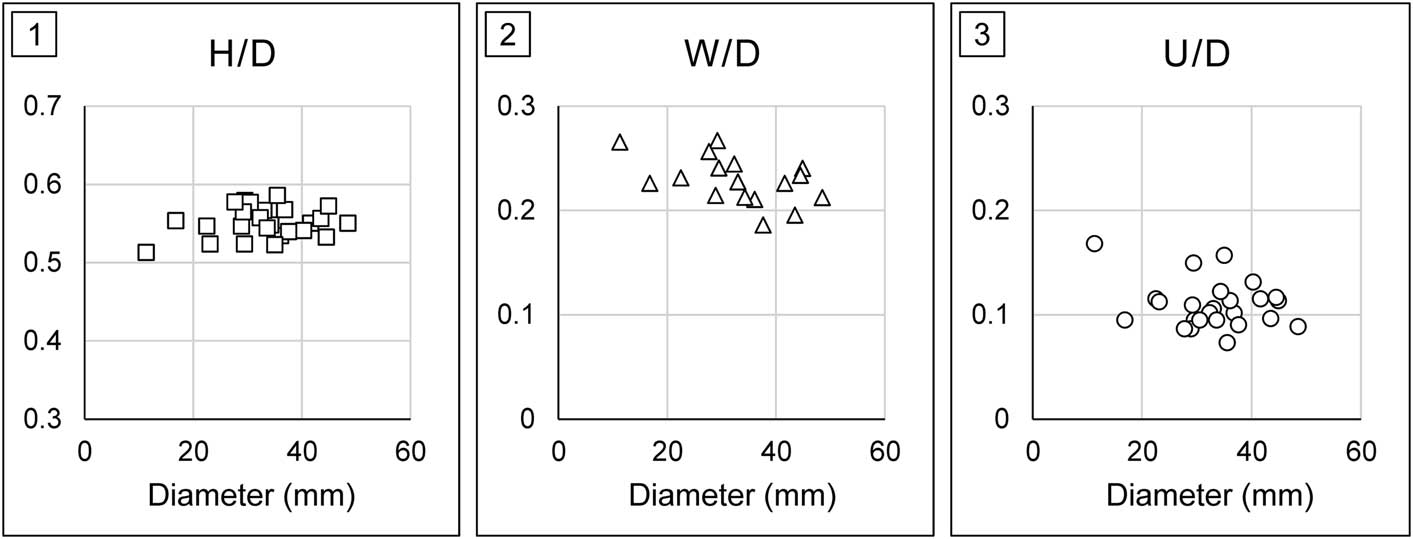
Very involute (U/D ~0.13) shell with a strongly compressed (W/H ~0.42) whorl section (Fig. 14). Venter is narrow and tabulate. Flanks convex, converging toward venter. Umbilicus is small and deep with a vertical wall and a rounded umbilical margin. No ornamentation visible on our specimens. Suture line with a broad ventral lobe with numerous irregular indentations, which become larger toward the first lateral saddle. The indentations sometimes go along the side of first lateral saddle. The first and second saddles are narrow and quite high with a narrow, rounded tip, the second one being asymmetric. The first lateral lobe is wide with many rather regularly spaced denticulations at its base. The third lateral saddle is small and sometimes with a flattened tip. Auxiliary series very long with numerous irregularly spaced indentations.
Scatter diagrams of (1) height/diameter (H/D), (2) width/diameter (W/D), and (3) umbilic/diameter (U/D) for Mullericeras gujiaoense n. sp. (n=25).

Etymology
Named after Gujiao County.
Materials
Very abundant from bed GJ-33. Registered specimens: YFMCUG 00016–00041.
Remarks
Mullericeras mostly differs from Ussuridiscus by a broad ventral lobe bearing numerous small indentations (Ware et al., Reference Ware, Bucher, Brühwiler, Schneebeli-Hermann, Hochuli, Roohi, Ur-Rehman and Yaseen2018). As our specimens have this feature, we assign them to Mullericeras. Our specimens differ from M. spitiense (Krafft in Krafft and Diener, Reference Krafft and Diener1909) and M. fergusoni Ware et al., Reference Ware, Jenks, Hautmann and Bucher2011 by their small but never occluded umbilicus and narrow tabulate venter, and from M. shigetai Ware and Bucher in Ware et al., Reference Ware, Bucher, Brühwiler, Schneebeli-Hermann, Hochuli, Roohi, Ur-Rehman and Yaseen2018 and M. indusense Ware and Bucher in Ware et al., Reference Ware, Bucher, Brühwiler, Schneebeli-Hermann, Hochuli, Roohi, Ur-Rehman and Yaseen2018 by their narrower venter and deeper indentations at the base of the lobes. M. gujiaoense n. sp. is also more involute than M. indusense. It differs from M. niazii Ware and Bucher in Ware et al., Reference Ware, Bucher, Brühwiler, Schneebeli-Hermann, Hochuli, Roohi, Ur-Rehman and Yaseen2018 by a thicker whorl section. M. gujiaoense n. sp. occurs in the Jieshaniceras guizhouense beds and are thus older than the Mullericeras from Candelaria Hills (Ware et al., Reference Ware, Jenks, Hautmann and Bucher2011) and Salt Range (Ware et al., Reference Ware, Bucher, Brühwiler, Schneebeli-Hermann, Hochuli, Roohi, Ur-Rehman and Yaseen2018), which are all middle Dienerian. Some specimens identified by Brühwiler et al. (Reference Brühwiler, Brayard, Bucher and Guodun2008) as Koninckites cf. K. timorense from Jieshan Lake, found together with Jieshaniceras guizhouense and thus of the same age as the present species, are clearly identical to our specimens. The other illustrated specimens they attribute to the same species from Shanggan are younger, from the middle Dienerian (co-occuring with a species synonymized with Ambites bjerageri, see Ware et al., Reference Ware, Bucher, Brühwiler, Schneebeli-Hermann, Hochuli, Roohi, Ur-Rehman and Yaseen2018). They are not well preserved, and their suture line is not visible, so it is not possible to decipher whether they are conspecific with our specimens; considering the age difference, they likely represent a different species. These smooth, involute, compressed, and tabulate Early Triassic forms are very difficult to classify without large populations and good preservation due to frequent homoplasy (see, for example, the similarities between Mullericeratidae, some involute Ambites, involute Paranoritidae, some Hedenstroemiidae such as Clypites and Hedenstroemia, and some Prionitidae such as Meekoceras, which are difficult if not impossible to differentiate without large populations and well-preserved suture lines). The different Chinese species from Xu (Reference Xu1988) and Mu et al. (Reference Mu, Zakharov, Li and Shen2007), which Brühwiler et al. (Reference Brühwiler, Brayard, Bucher and Guodun2008) synonymized with Koninckites cf. K. timorensis, are too poorly preserved for a precise taxonomic assignment.
Genus Ussuridiscus Shigeta and Zakharov, Reference Shigeta and Zakharov2009
Type species
Meekoceras (Kingites) varaha Diener, Reference Diener1895.
Ussuridiscus cf. U. varaha Shigeta and Zakharov, Reference Shigeta and Zakharov2009
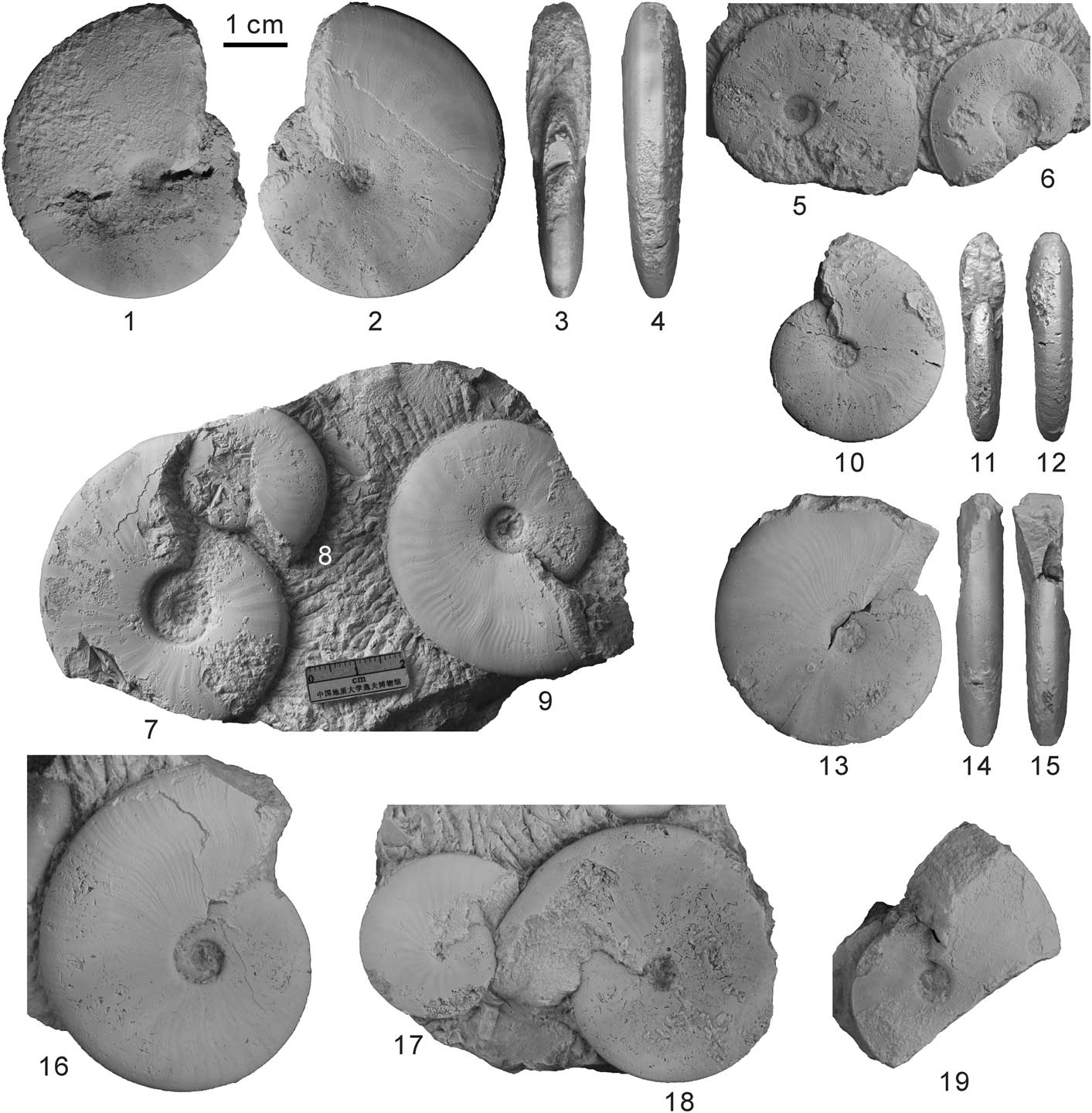
(1–5, 8–18) Ussuridiscus cf. varaha, (1–4) YFMCUG 00100, from GJ-40; (5) YFMCUG 00123-2, from GJ-40; (8) YFMCUG 00118-3, from GJ-40; (9) YFMCUG 00118-2, from GJ-40; (10–12) YFMCUG 00101, from GJ-40; (13–15) YFMCUG 00102, from GJ-40; (16) YFMCUG 00109, from GJ-40; (17, 18) YFMCUG 00125, from GJ-40. (6) Ambites radiatus (Brühwiler et al., Reference Brühwiler, Brayard, Bucher and Guodun2008), YFMCUG 00123-1, from GJ-40. (7) ?Gyronitidae gen. indet. sp. indet., YFMCUG 00118-1, from GJ-40. (19) ?Mullericeratidae gen. indet., YFMCUG 00004, from GJ-15.

?2009 Ussuridiscus varaha; Reference Shigeta and ZakharovShigeta and Zakharov, p. 69, figs. 50.5–50.6, 55–57.
Occurrence
Middle Dienerian of South China.
Description
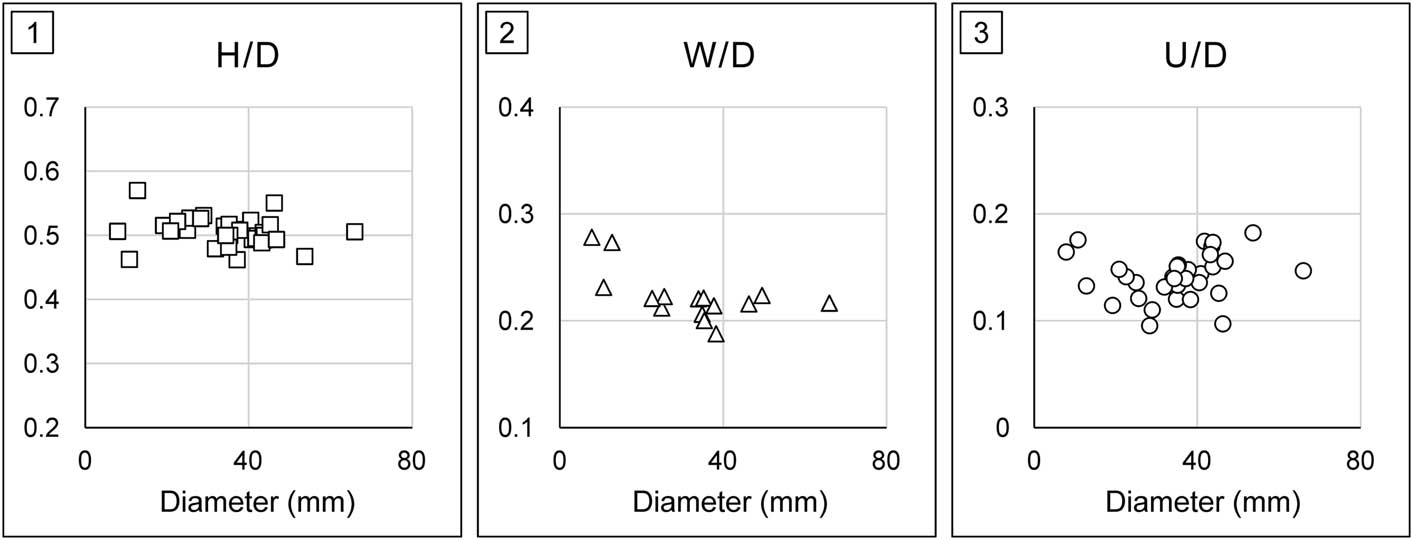
Involute (U/D ~0.15) shell with a strongly compressed (W/H ~0.43) whorl section (Fig. 16). Tabulate to subtabulate venter with a narrowly rounded ventrolateral shoulder. Flanks are flat from the umbilical shoulder to the mid-flank and then progressively converge toward ventrolateral shoulder. Umbilicus very small, with a deep vertical wall and a rounded umbilical shoulder. Fine, dense growth lines are visible, as well as low folds on the outer part of flanks, especially on lager specimens. Suture line poorly preserved in our specimens. Only an auxiliary series is visible and shows a distinct auxiliary lobe and saddle.
Scatter diagrams of (1) height/diameter (H/D), (2) width/diameter (W/D), and (3) umbilic/diameter (U/D) for Ussuridiscus cf. varaha (n=33).

Materials
Abundant in bed GJ-40. Registered specimens: YFMCUG 00099–00120, YFMCUG 00123-2, YFMCUG 00124, YFMCUG 00125-1, YFMCUG 00125-2, YFMCUG 00126, YFMCUG 00127-1–00127-5.
Remarks
Compared with Ussuridiscus varaha from South Primorye (Shigeta and Zakharov, Reference Shigeta and Zakharov2009) and the Salt Range (Ware et al., Reference Ware, Bucher, Brühwiler, Schneebeli-Hermann, Hochuli, Roohi, Ur-Rehman and Yaseen2018), our specimens exhibit a tabulate to subtabulate venter, which is only visible on larger specimens from South Primorye (see Shigeta and Zakharov, Reference Shigeta and Zakharov2009, p. 70, fig. 55.20–55.23). In addition, U. varaha typically displays an overhanging umbilical wall, whereas our specimens display a vertical one. ‘Koninckites’ cf. K. timorense described by Brühwiler et al. (Reference Brühwiler, Brayard, Bucher and Guodun2008), reassigned to Ussuridiscus varaha by Shigeta and Zakharov (Reference Shigeta and Zakharov2009) and Ware et al. (Reference Ware, Bucher, Brühwiler, Schneebeli-Hermann, Hochuli, Roohi, Ur-Rehman and Yaseen2018), is more depressed than our specimens and shows converging flanks toward the ventrolateral shoulders. By contrast, our specimens display relatively flattened flanks. Some specimens of Brühwiler et al. (Reference Brühwiler, Brayard, Bucher and Guodun2008) are clearly synonyms of Mullericeras gujiaoense (see the preceding). The suture line is nearly completely obscured on our specimens but, where visible, exhibits an auxiliary series with a small saddle (Fig. 17). This small saddle was not observed on Shigeta and Zakharov’s (Reference Shigeta and Zakharov2009) specimens. Overall, our specimens superficially resemble U. varaha from South Primorye but exhibit slight differences that may indicate they pertain to another new taxa; specimens with better-preserved suture lines would be necessary to confirm this.
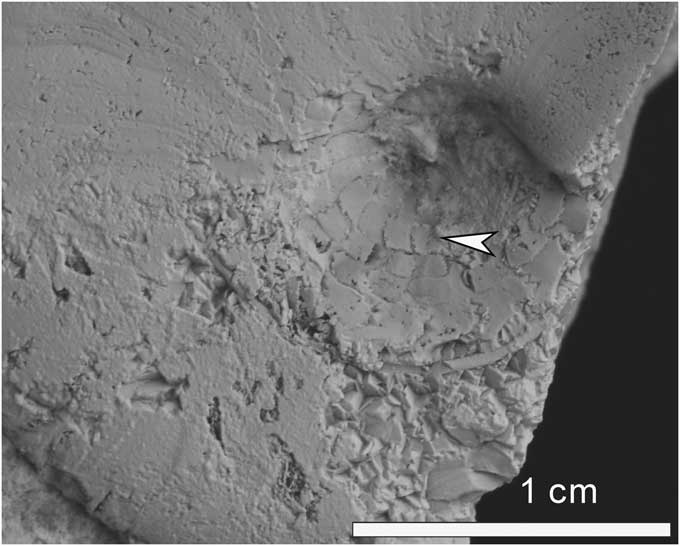
Partly preserved suture lines of Ussuridiscus cf. varaha showing an auxiliary saddle (white arrow).

?Mullericeratidae gen. indet.
Occurrence
Lower Daye Formation, Guizhou, South China. Ophiceras medium beds, late Griesbachian.
Description
Involute (U/D ~0.14) shell with a strongly compressed (W/H ~0.42) whorl section and a tabulate venter with an angular ventrolateral shoulder. Slightly convex flanks with the maximum whorl width near mid-flank. Umbilicus deep and small with a vertical wall and a rounded shoulder. Shell with very fine growth lines. Suture line not visible.
Material
Only one poorly preserved specimen from sample GJ-15. Registered specimen: YFMCUG 00004.
Remarks
The involute shell and tabulate venter of this specimen resemble some Mullericeratidae. This specimen may represent the oldest known occurrence for this family. However, this assignment remains to be confirmed.
Biostratigraphy
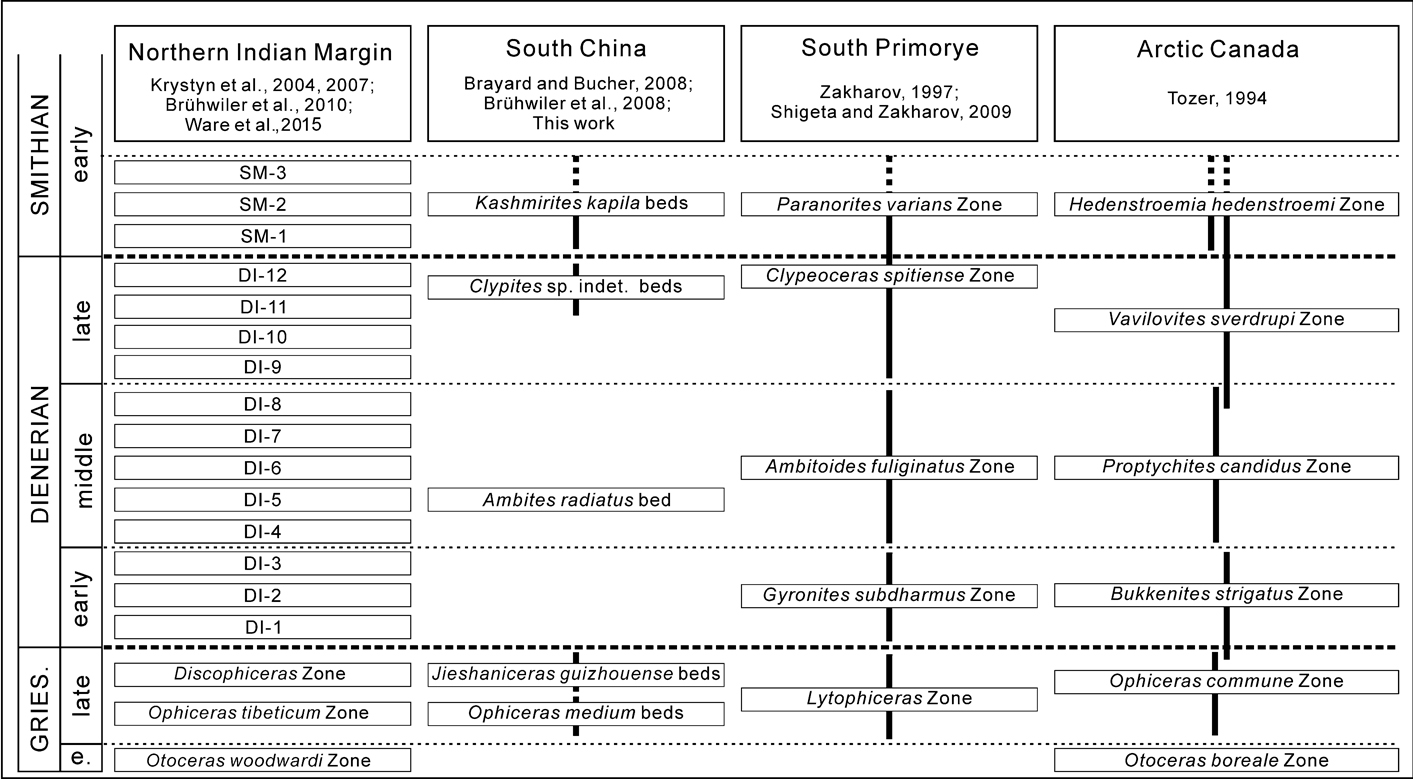
Induan ammonoid faunas and their correlations are still poorly known when compared with Smithian ammonoid faunas (Jenks et al., Reference Jenks, Monnet, Balini, Brayard and Meier2015). The Dienerian ammonoid biostratigraphy has been recently refined by Ware et al. (Reference Ware, Bucher, Brayard, Schneebeli-Hermann and Brühwiler2015), based on ammonoid data from the Salt Range (Pakistan) and Spiti (India). Ware et al. (Reference Ware, Bucher, Brayard, Schneebeli-Hermann and Brühwiler2015) especially proposed to subdivide the Dienerian into three parts: the early Dienerian corresponding to the first occurrence of the genus Gyronites and including three UA-zones (DI-1 to DI-3); the middle Dienerian being based on the occurrence of the genus Ambites and comprising five UA-zones (DI-4 to DI-8); the late Dienerian representing the first occurrences of Paranoritidae and Hedenstroemiidae and containing four UA-zones (DI-9 to DI-12). However, detailed correlation of this high-resolution ammonoid zonation with other regions shows many uncertainties (Fig. 18; Jenks et al. Reference Jenks, Monnet, Balini, Brayard and Meier2015). The Griesbachian ammonoid zonation is generally less detailed than for the Dienerian and often shows the successive Otoceras and Ophiceras Zones (Jenks et al., Reference Jenks, Monnet, Balini, Brayard and Meier2015). Otoceras has been found mainly in middle- and high-latitude regions, thus preventing firm correlation with low-latitude regions. Ophiceras is much more cosmopolitan and can be considered a good index of the late Griesbachian (Fig. 18).
Induan ammonoid zonation of South China and global correlation.

Intensive sampling of the lower part of the Daye Formation, which spans the late Griesbachian–middle Dienerian transition, led to the definition of three successive ammonoid beds. In ascending order, these consist of the late Griesbachian Ophiceras medium and Jieshaniceras guizhouense beds followed by the middle Dienerian Ambites radiatus bed (Figs. 3, 18). Typical early Dienerian faunas are thus absent from the Gujiao section. Owing to a preservation gap, no ammonoid specimen was found between Jieshaniceras guizhouense beds and Ambites radiatus bed. Abundant bivalves (e.g., Claraia radialis [Leonardi, Reference Leonardi1935], C. stachei [Patte, Reference Patte1935], and C. aurita [von Hauer, Reference von Hauer1850]) were found in Jieshaniceras guizhouense beds and Ambites radiatus bed, also indicating a Griesbachian–Dienerian age for these beds.
Ophiceras medium beds.—
These beds are characterized by the occurrence of Ophiceras medium. Other co-occurring taxa are ?Mullericeratidae gen. indet., Gyronitidae gen. indet., Vishnuites pralambha, and Ophiceratidae gen. indet. This assemblage indicates a late Griesbachian age. Ophiceras or Ophiceras-Lytophiceras zones have been reported from many areas of South China, for example the Meishan section in Zhejiang Province (Wang, Reference Wang1984; Yin et al., Reference Yin, Zhang, Tong, Yang and Wu2001), the Qinglongshan section in Jiangsu Province (Wang, Reference Wang1984), and the Chaohu section in Anhui Province (Tong et al., Reference Tong, Zakharov and Wu2004). However, most illustrated specimens from these sections are poorly preserved, preventing any firm taxonomic assignment and correlation among sections. Brühwiler et al. (Reference Brühwiler, Brayard, Bucher and Guodun2008) also recognized Ophiceras sp. indet. from the Laren and Shanggan sections in Guangxi. Ophiceras is a widely distributed Griesbachian genus and has been documented in the Himalayas (e.g., Diener, Reference Diener1897; Wang and He, Reference Wang and He1976; Krystyn and Orchard, Reference Krystyn and Orchard1996), in East Greenland (Spath, Reference Spath1930, Reference Spath1935; Trümpy, Reference Trümpy1969), in Arctic Canada (Tozer, Reference Tozer1994), in Oman (Krystyn et al., Reference Krystyn, Richoz, Baud and Twitchett2003), in the Salt Range (Schindewolf, Reference Schindewolf1954; Kummel, Reference Kummel1966; Ware et al., Reference Ware, Bucher, Brühwiler, Schneebeli-Hermann, Hochuli, Roohi, Ur-Rehman and Yaseen2018), and in South China (Tien, Reference Tien1933; Tong et al., Reference Tong, Zakharov and Wu2004; Brühwiler et al., Reference Brühwiler, Brayard, Bucher and Guodun2008), permitting worldwide correlation among ‘Ophiceras beds,’ but their temporal resolution and potential subdivisions remain to be analyzed in depth.
Jieshaniceras guizhouense beds.—
These beds contain Jieshaniceras guizhouense, Proptychites sp. indet., Mullericeras gujiaoense n. sp., Ophiceras sp. indet., and Vishnuites pralambha. Jieshaniceras guizhouense is associated with Ussuridiscus varaha in some sections (e.g., Jieshan Lake and Jianzishan, Brühwiler et al., Reference Brühwiler, Brayard, Bucher and Guodun2008; Bai et al., Reference Bai, Dai and Song2017). The age assignment of these beds, if based exclusively on ammonoids, remains problematic. U. varaha was found restricted to the first Dienerian zone of the Northern Indian Margin (Ware et al., Reference Ware, Bucher, Brayard, Schneebeli-Hermann and Brühwiler2015, Reference Ware, Bucher, Brühwiler, Schneebeli-Hermann, Hochuli, Roohi, Ur-Rehman and Yaseen2018), but its occurrence in South Primorye is less effectively constrained and assigned to the late Griesbachian through to the middle Dienerian (Shigeta and Zakharov, Reference Shigeta and Zakharov2009). Use of this taxon for biostratigraphic correlation thus does not bring much clarity. Proptychitids occur from the latest Griesbachian to the Smithian and do not provide any useful biostratigraphic information. Ophiceras together with Otoceras represent iconic Griesbachian genera and have yet to be found in younger strata, suggesting a Griesbachian age. However, Mullericeras is only known in the middle Dienerian of South Primorye (Shigeta and Zakharov, Reference Shigeta and Zakharov2009), Nevada (Ware et al., Reference Ware, Jenks, Hautmann and Bucher2011), and Northern Indian Margin (Ware et al., Reference Ware, Bucher, Brayard, Schneebeli-Hermann and Brühwiler2015, Reference Ware, Bucher, Brühwiler, Schneebeli-Hermann, Hochuli, Roohi, Ur-Rehman and Yaseen2018), so its occurrence in these beds suggests a Dienerian age instead. This assemblage was found in Jieshan Lake by Brühwiler et al. (Reference Brühwiler, Brayard, Bucher and Guodun2008), who considered it as a direct correlative of the Dienerian Proptychites candidus beds of Tozer (Reference Tozer1994), but Mu et al. (Reference Mu, Zakharov, Li and Shen2007) considered the same assemblage in Wenjiangsi as late Griesbachian in age. Overall, the ammonoid assemblage found in the J. guizhouense beds at Gujiao shows that our knowledge on the temporal distribution of several Induan ammonoid taxa, especially around the Griesbachian/Dienerian boundary, remains unclear, making the Griesbachian/Dienerian boundary hard to determine based on ammonoid faunas only.
Conodonts show an important turnover at this boundary, with the replacement of anchignathodids by neospathodids and other segminate conodonts (Orchard, Reference Orchard2007; Brosse et al., Reference Brosse, Baud, Bhat, Bucher, Leu, Vennemann and Goudemand2017). Mu et al. (Reference Mu, Zakharov, Li and Shen2007) reported some typically Griesbachian conodonts such as Neogondolella krystyni Orchard and Krystyn, Reference Orchard and Krystyn1998 and N. carinata (Clark, Reference Clark1959) in Wenjiangsi. Samples from the same beds where Brühwiler et al. (Reference Brühwiler, Brayard, Bucher and Guodun2008) found Jieshaniceras guizhouense also contain some neogondolellids and Hindeodus parvus Kozur and Pjatakova, Reference Kozur and Pjatakova1976 (N. Goudemand, personal communication, 2017). In addition, Bai et al. (Reference Bai, Dai and Song2017) reported several species of Hindeodus in the Jieshaniceras guizhouense beds and slightly higher in the Jianzishan section. Using this conodont turnover as a proxy for the Griesbachian/Dienerian boundary, the Jieshaniceras guizhouense beds are therefore clearly late Griesbachian in age and represent the oldest occurrence of the genus Mullericeras.
Ambites radiatus bed.—
This bed yields Ambites radiatus, Ussuridiscus cf. U. varaha, ?Gyronitidae gen. indet. sp. indet., and Pseudoproptychites cf. P. hiemalis. This assemblage is middle Dienerian in age and can be directly correlated with the UA-zone DI-5 from Salt Range and Spiti (Ware et al., Reference Ware, Bucher, Brayard, Schneebeli-Hermann and Brühwiler2015). It also roughly corresponds to the Ambitoides fuliginatus Zone in South Primorye (Shigeta and Zakharov, Reference Shigeta and Zakharov2009), based on the occurrence of Ussuridiscus. However, Ussuridiscus is a long-ranging genus, and the assignment of our specimens to Ussuridiscus varaha remains to be firmly confirmed. Additional well-preserved material is therefore needed to verify this correlation. The Proptychites candidus Zone in Arctic Canada contains several forms of Ambites, which is the index of middle Dienerian (Tozer, Reference Tozer1994; Ware et al., Reference Ware, Bucher, Brayard, Schneebeli-Hermann and Brühwiler2015), thus it can be roughly correlated with the Ambites radiatus bed at Gujiao.
Diversity pattern
Ammonoids almost went extinct during the Permian-Triassic mass extinction, but their rediversification during the Early Triassic was extremely rapid, reaching in less than 1 myr (i.e., during the Smithian) diversity levels higher than during the Permian (Brayard et al., Reference Brayard, Escarguel, Bucher, Monnet, Brühwiler, Goudemand, Galfetti and Guex2009a). This nondelayed recovery after the PT mass extinction probably results from intrinsic ammonoid parameters related, for example, to their high evolutionary rates (e.g., Brayard et al., Reference Brayard, Escarguel, Bucher, Monnet, Brühwiler, Goudemand, Galfetti and Guex2009a; Stanley, Reference Stanley2009; Brühwiler et al., Reference Brühwiler, Bucher, Brayard and Goudemand2010a), dispersal abilities (e.g., Brayard et al., Reference Brayard, Bucher, Escarguel, Fluteau, Bourquin and Galfetti2006, 2007a), and positions in trophic webs (e.g., Brayard et al., Reference Brayard, Escarguel, Bucher, Monnet, Brühwiler, Goudemand, Galfetti and Guex2009a). The first ammonoids found in the Griesbachian often show a rather cosmopolitan distribution (e.g., Brayard et al., Reference Brayard, Escarguel and Bucher2007a, Reference Brayard, Escarguel, Bucher and Brühwiler2009b), suggesting that they were rather generalist organisms at that time. This may agree with hypotheses of Harries et al. (Reference Harries, Kauffman and Hansen1996), Kauffman and Harries (Reference Kauffman and Harries1996), and Bambach (Reference Bambach, Knoll and Sepkoski2002) suggesting that some surviving organisms were favored after mass extinctions if generalist and motile. However, this configuration rapidly shifted from the Dienerian up to the Spathian toward more and more-endemic genera; this was possibly related to successive changes in ocean temperature and chemistry and highlight that Early Triassic ammonoids became highly sensitive to environmental fluctuations during this time interval (e.g., Brosse et al., Reference Brosse, Brayard, Fara and Neige2013; Romano et al., Reference Romano, Goudemand, Vennemann, Ware, Schneebeli-Hermann, Hochuli, Brühwiler, Brinkmann and Bucher2013; Ware et al., Reference Ware, Bucher, Brayard, Schneebeli-Hermann and Brühwiler2015; Jattiot et al., Reference Jattiot, Bucher, Brayard, Monnet, Jenks and Hautmann2016).
Only three different surviving ammonoid lineages survived the PT mass extinction: Episageceratidae, Xenodiscaceae, and Otocerataceae (e.g., Brayard et al., Reference Brayard, Bucher, Brühwiler, Galfetti, Goudemand, Guodun, Escarguel and Jenks2007b; Brayard and Bucher, Reference Brayard and Bucher2015). Early Triassic Episageceratidae are represented by a single genus: Episageceras. This taxon is rare and documented mainly from Himalaya and Russia (Diener, Reference Diener1897; Zakharov, Reference Zakharov1978). Only two genera, Otoceras and Proharpoceras, derived from Otocerataceae have been documented from the Griesbachian and Smithian, respectively (e.g., Brayard et al., Reference Brayard, Bucher, Brühwiler, Galfetti, Goudemand, Guodun, Escarguel and Jenks2007b; Brühwiler et al., Reference Brühwiler, Bucher, Goudemand and Galfetti2012b; Jenks and Brayard, Reference Jenks and Brayard2018). It is thus commonly accepted that all other Triassic Ceratitids root in Xenodiscaceae (e.g., Brayard et al., Reference Brayard, Bucher, Escarguel, Fluteau, Bourquin and Galfetti2006; Zakharov and Popov, Reference Zakharov and Popov2014). However, many uncertainties remain about the exact phylogeny of Early Triassic ammonoids. For example, whether Proptychitidae are derived from Ophiceratidae or Otoceratidae remains an open question (Zakharov, Reference Zakharov2002; Ware et al., Reference Ware, Bucher, Brühwiler, Schneebeli-Hermann, Hochuli, Roohi, Ur-Rehman and Yaseen2018).
In total, 13 ammonoid species have been recognized in the Induan of Gujiao (Fig. 3). Five species are identified in the Ophiceras medium beds, five species in the Jieshaniceras guizhouense beds, and four species in the Ambites radiatus bed. The apparent absence of typical early Dienerian ammonoids may result from local environmental change or taphonomic conditions, while no distinct unconformity or facies change was observed in the field from upper Griesbachian to middle Dienerian.
Although our data are scarcer than in the Northern Indian Margin (NIM), ammonoid diversity patterns appear relatively congruent, especially when combined with data from previous publications on Early Triassic Chinese ammonoids (e.g., Brayard and Bucher, Reference Brayard and Bucher2008; Brühwiler et al., Reference Brühwiler, Brayard, Bucher and Guodun2008). NIM diversity pattern shows a maximum species richness during the early Dienerian, followed by low values during the middle–late Dienerian and a marked diversification after the Dienerian/Smithian boundary (Brühwiler et al., Reference Brühwiler, Bucher, Brayard and Goudemand2010a, Reference Brühwiler, Ware, Bucher, Krystyn and Goudemandb; Ware et al., Reference Ware, Bucher, Brayard, Schneebeli-Hermann and Brühwiler2015). The Chinese ammonoid diversity fluctuations resemble those observed for the NIM. However, the sampled species richness in South China is apparently lower than in the NIM, which shows 47 species for the Dienerian (Ware et al., Reference Ware, Bucher, Brayard, Schneebeli-Hermann and Brühwiler2015). Therefore, some uncertainties on regional diversity patterns remain and potentially result from preservational and sample biases in South China. The Griesbachian–Dienerian ammonoid fauna remains quite scattered and rare.
In addition, the Induan (Griesbachian and Dienerian) and early Smithian ammonoid diversity fluctuations may be closely related to local oceanic redox conditions. Recent analysis of the size distribution of pyrite framboids at Gujiao indicates that the late Griesbachian Ophiceras medium beds and Jieshaniceras guizhouense beds were probably oxic (Dai et al., Reference Dai, Song, Wignall, Jia, Bai, Wang, Chen and Tian2018). This hypothesis is also supported by the relatively high abundance of ichnofossils (e.g., Arenicolites). Using the same indicators, the Ambites radiatus bed and overlying beds were probably dysoxic or anoxic. Therefore, the observed low taxonomic richness is concomitant with the potentially more dysoxic/anoxic conditions. A similar trend has been observed on the Northern Indian Margin (Hermann et al., Reference Hermann, Hochuli, Méhay, BuYincher, Brühwiler, Ware, Hautmann, Roohi, ur-Rehman and Yaseen2011; Ware et al., Reference Ware, Bucher, Brayard, Schneebeli-Hermann and Brühwiler2015).
Similar relatively high diversity levels in ameliorated environments occur in other locations of South China during the late Griesbachian–early Dienerian (Xu, Reference Xu1988; Song et al., Reference Song, Wignall, Tong, Bond, Song, Lai, Zhang, Wang and Chen2012; Tian et al., Reference Tian, Tong, Algeo, Song, Song, Chu, Shi and Bottjer2014; Wang et al., Reference Wang, Chen, Dai and Song2017). Relatively high taxonomic richness for the same time interval is also reported from other regions, such as the western United States (Hofmann et al., Reference Hofmann, Hautmann, Wasmer and Bucher2013) and Oman (Krystyn et al., Reference Krystyn, Richoz, Baud and Twitchett2003). This supports the hypothesis of a first diversification phase during the late Griesbachian–early Dienerian when deleterious environmental conditions potentially decreased or ceased after the Permian–Triassic mass extinction. However, the accurate spatiotemporal extent of such diversity pattern, as well as its underlying processes, remains to be determined.
Conclusions
Three different Induan ammonoid faunas occur at Gujiao, consisting of eight identified genera and 13 species, including one new species: Mullericeras gujiaoense n. sp.
Three successive ammonoid zones were identified: the late Griesbachian Ophiceras medium beds and Jieshaniceras guizhouense beds and the middle Dienerian Ambites radiatus bed.
Integrated with data from previous publications on Early Triassic Chinese ammonoids, our data suggest that the regional Induan taxonomic richness trend rather resembles the one identified from the extensively sampled Northern Indian Margin, indicating that this signal is probably global. High and low ammonoid richness levels, respectively, in the late Griesbachian and in the middle Dienerian, can be identified at Gujiao.
Acknowledgments
We thank J. Chen, X. Xiong, Y. Zhao, X. Sun, S. Jiang, E. Jia, J. Yan, F. Wang, X. Liu, K. Wang, and R. Bai for their help in the field. This study is supported by the National Natural Science Foundation of China (41622207, 41530104, 41661134047) and the 111 Project (B08030). This is a contribution to the ANR project AFTER (ANR-13-JS06-0001-01; to A.B.) and to the IGCP-630.
Accessibility of supplemental data
Data available from the Dryad Digital Repository: https://doi.org/10.5061/dryad.9hh49g6.