Introduction
Cotton (Gossypium hirsutum L.) is the most important fibre crop in the world. The demand for cotton production is increasing because of the growing population and preferences for natural fibre for clothing (Townsend, Reference Townsend, Kozłowski and Mackiewicz-Talarczyk2020). Drought has been identified as a major threat for global crop production worldwide, affecting ~40% of the world's land area (Dunn et al., Reference Dunn, Stanitski, Gobron and Willett2020). The drought stress reduces the cotton lint yield by 31–60% and it reduces the bolls per plant on the fruiting branches (Wang et al., Reference Wang, Ji, Zhang, Meng, Wang, Chen and Zhou2016; Abdelraheem et al., Reference Abdelraheem, Esmaeili, O'Connell and Zhang2019). Drought stress affects the plant's growth and productivity by disturbing the ionic and osmotic equilibrium of the cell (Fahad et al., Reference Fahad, Bajwa, Nazir, Anjum, Farooq, Zohaib, Sadia, Nasim, Adkins, Saud and Ihsan2017; Shafqat et al., Reference Shafqat, Jaskani, Maqbool, Khan and Ali2019). Drought tolerance is a mechanism of genetic control, which is related to many physiological and agronomic characteristics of plants (Shafqat et al., Reference Shafqat, Jaskani, Maqbool, Chattha, Ali, Naqvi, Haider, Khan and Vincent2021). The inhibitory effect of drought stress on photosynthesis and stomatal conductance was observed in cotton (Meeks et al., Reference Meeks, Snider, Babb-Hartman and Barnes2019). Osmotic adjustment is considered to be the main adaptive response to drought stress because it increases the solute concentration in cells and can maintain the water potential (Ψ w) gradient that is required to ensure continuous water uptake during the water-deficit period (Blum, Reference Blum2017). This process involves the accumulation of organic acids, ions and sugars in the cytosol to reduce the osmotic potential (Ψ s), which then helps to keep the leaf water potential near the optimal level (Bai et al., Reference Bai, Dai, Sun, Chen and Sun2019).
Heritable differences for different agro-physiological traits exhibited that selection could be effective at developing drought-tolerant varieties; however, their effectiveness is determined by different types of gene actions (Meredith and Bridge, Reference Meredith and Bridge1972; Yar et al., Reference Yar, Iqbal, Mehmood and Naeem2020). Environmental influence on gene action shows that traits need to be improved and analysed under such an environment, in which breeding has to be done (Chattha et al., Reference Chattha, Muhammad, Amir, Akram, Khan, Muhammad and Sohail2019). These traits show various types of inheritance patterns such as monogenic, polygenic, additive and non-additive gene actions. The inheritance pattern for various traits under stress conditions is a valuable tool to enhance cotton productivity (Mahdy et al., Reference Mahdy, Ahmed, Abdel-Zaher, Sayed and Husein2017). Yields can be increased under stressful environments by modifying the cultural practices or by improving the genetic potential of the crop.
The accurate knowledge about the presence of genes that are responsible for specific agronomic and physiological traits is necessary for the establishment of drought-tolerant cotton breeding programmes. Many researchers have studied the effect of genes on yield under normal and drought conditions. Mahdy et al.(Reference Mahdy, Ahmed, Abdel-Zaher, Sayed and Husein2017) conducted a detailed analysis on the seed cotton yield of each plant. Their results showed that the effects of additive, dominant and epistatic genes are essential for the inheritance of seed cotton yield.
The main obstacle in the improvement of cotton drought tolerance potential is the unavailability of genetic information in the available germplasm. The objective of the current study is to unveil the gene action, based on the comparisons of the mean values among P̅1, P̅2, F̅1 and mid-parent for various physiological and agronomic traits under normal and drought conditions for better parent selection.
Materials and methods
The experiments were performed during the years 2018 and 2019 at the University of Agriculture Faisalabad, a semi-arid region. During the first year of study, 10 drought-tolerant i.e. FH-329, MNH-886, IR-6, VH-291, S-15, VH-289, FH-159, FH-153, FH-207 and FH-322 and three drought-sensitive i.e. NS-131, KZ-191 and AA-703 cotton genotypes were planted in the greenhouse. The daytime greenhouse temperature was kept at 30°C and night at 20–25°C with humidity ranging from 60 to 65%. These genotypes were crossed in a direct cross fashion. The drought-tolerant genotypes were used as females and sensitive as males in crossing. Self-seeds were also produced of all genotypes. In the second year, parents and their hybrids were planted in field under normal and drought conditions. The experiment was planted in a split-plot design under RCBD with three replications. The total irrigation water applied was 22-acre inches and 12-acre inches under normal and drought conditions, respectively. The distances between row to row and plant to plant were kept at 75 and 30 cm, respectively. The distance between stress and non-stress plots was 100 cm. All recommended plant protection measures were adopted throughout the crop season. Data were recorded for different physiological and yield-related traits. Data were recorded for water potential, osmotic potential, pressure potential, chlorophyll fluorescence, canopy temperature, proline contents, total soluble proteins, bolls per plant and seed cotton yield.
Leaf water potential was measured with a pressure chamber (Model 600, Pressure Chamber Instrument, PMS International Company) as suggested by Scholander et al. (Reference Scholander, Hammel, Hemmingsen and Bradstreet1964). Leaf sap was collected and osmotic potential was measured by using a cryoscopic osmometer (Osmomat 030-D, Cryoscopic osmometer printer, Gonotec). The pressure potential was calculated using the formula: Ψ p = Ψ w − Ψ s (Hopkins, Reference Hopkins1999). Chlorophyll fluorescence of fully expanded leave of selected plants was used for measurement in vivo after 30 min dark adaptation using a portable fluorimeter plant analyzer (Hansatech Instruments, King's Lynn, Norfolk, UK). Measurements were carried out in the early morning from 7.00 to 9.00 a.m.
Canopy temperature was measured two times during the season at midday with an infrared thermometer (Model 510B; Everest Interscience Inc., Tucson, AZ, USA). The proline contents from cotton leaves were estimated by following the method given by Bates et al. (Reference Bates, Waldren and Teare1973). Total soluble proteins of leaves were estimated using the method of Lowry et al. (Reference Lowry, Rosebrough, Farr and Randall1951). To measure the bolls per plant, the mature bolls from all pickings were counted and the collective record was maintained for each selected plant. For seed cotton yield, the mature bolls were picked in three pickings and seed cotton was collected in paper bags individually for each selected plant. The final yield for each plant was calculated using an electronic balance.
Statistical analysis
Mean data for all the traits were subjected to principal component and heat map analyses using statistical packages prcomp and ggplot2, respectively, in statistical software R 3.6.1. The mean values of F̅1, P̅1, P̅2 and mid-parent for each trait were calculated and the gene actions were determined based on different comparisons (Sharma, Reference Sharma1994). Broad sense heritability was estimated according to the formula given by Allard, (Reference Allard1960). Genetic advance values were determined as described by Johnson et al. (Reference Johnson, Robinson and Comstock1955).
Results
Genotypic variability studies under normal and drought conditions
Detailed analysis of variance for each trait was assessed under normal and drought stress conditions. Mean square values for chlorophyll fluorescence, water potential, osmotic potential, pressure potential, proline contents, bolls per plant and seed cotton yield were highly significant (P < 0.01). Under the drought conditions, all the genotypes differed highly significantly except for protein contents (online Supplementary Table S1).
Principal component and heat map analyses of different traits under normal and drought conditions
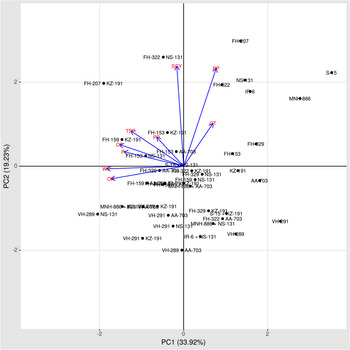
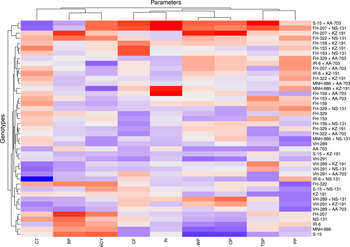
The principal component analyses revealed 53.99 and 53.15% for the first two principal components of variability for normal and drought conditions, respectively (online Supplementary Fig. S1; Fig. 1). Heat map analysis classified all studied genotypes into six and seven major clusters for normal and drought conditions, respectively, based on several agro-physiological traits (online Supplementary Fig. S2; Fig. 2). Three cotton genotypes viz. FH-207 × NS-131, FH-207 × KZ-191 and S-15 × AA-703 were identified as drought-tolerant under drought conditions attaining higher values for all traits except for canopy temperature as depicted by heat map analysis (Fig. 2). These crosses may be proliferated till later generations to identify transgressive segregates for drought tolerance in cotton.
Principal component analysis for studied traits under drought conditions in cotton. CT, canopy temperature; BP, bolls per plant; SCY, seed cotton yield; CF, chlorophyll fluorescence; Pr, proline contents; WP, water potential, OP, osmotic potential; TSP, total soluble proteins; PP, pressure potential.

Heat map analysis for studied traits under drought conditions in cotton. CT, canopy temperature; BP, bolls per plant; SCY, seed cotton yield; CF, chlorophyll fluorescence; Pr, proline contents; WP, water potential; OP, osmotic potential; TSP, total soluble proteins; PP, pressure potential. Note: In the figure, the genotypes on the upper extreme showed the higher mean values for all the traits. Meanwhile red and blue colour shows the higher and lower value respectively of each trait respective to a specific genotype.

Heritable differences between F̅1 and mid-parent under normal and drought conditions
The mean value of F̅1 (0.81) and mid-parent (0.81) for chlorophyll fluorescence was equal under the normal conditions that showed the additive type of gene action is involved but under drought conditions, the value of F̅1 (0.76) was greater than the mid-parent value (0.74) that shows the presence of dominant gene action (Table 1). Canopy temperature showing fewer values of F̅1 (25.01 and 26.53) than mid-parent values (26.33 and 26.99) which means the non-additive type of gene action is prevalent under normal and drought conditions, respectively. Water potential and osmotic potential showed a dominant type of gene action under drought and normal conditions. Pressure potential and proline content showed non-additive gene action under normal conditions, whereas proline content showed dominant gene action under drought conditions as well. Protein contents exhibited dominant gene action under normal and drought conditions. For the bolls per plant and seed cotton yield, the non-additive type of gene action is involved under normal as well as drought conditions (Table 1).
Heritable differences between F̅1 and mid-parent for some physiological and agronomic traits under normal and drought conditions in cotton

CF, chlorophyll fluorescence; CT, canopy temperature; WP, water potential; OP, osmotic potential; PP, pressure potential; P, protein contents; Pr, proline contents; BP, bolls per plant; SCY, seed cotton yield.
Heritable differences between F̅1 and P̅1 under normal and drought conditions
The mean value F̅1 (0.81) of chlorophyll fluorescence was less than P̅1 (0.82) under normal conditions, showing partial dominance but under drought conditions, there was over dominance. Canopy temperature had partial dominance under normal and drought conditions. Water potential and osmotic potential had over dominance under normal and drought conditions. Pressure potential and proline contents showed partial dominance under normal conditions and showed over dominance under drought conditions. For the bolls per plant and seed cotton yield, the value showed partial dominance under normal and drought conditions (Table 2).
Heritable differences between F̅1 and P̅1 for some physiological and agronomic traits under normal and drought conditions in cotton

CF, chlorophyll fluorescence; CT, canopy temperature; WP, water potential; OP, osmotic potential; PP, pressure potential; P, protein contents; Pr, proline contents; BP, bolls per plant; SCY, seed cotton yield.
Heritable differences between F̅1 and P̅2 under normal and drought conditions
The value F̅1 (0.81) of chlorophyll fluorescence was greater than P̅2 (0.80) under drought conditions showing complete negative dominance but under drought conditions, there was over dominance due to an equal value of F1 (0.76) and P2 (0.76). Canopy temperature showed partial dominance under normal and drought conditions. Water potential and osmotic potential had negative over dominance under normal and drought conditions. Pressure potential, proline contents, bolls per plant and seed cotton yield showed partial dominance type of gene action under normal and drought conditions (Table 3).
Heritable differences between F̅1 and P̅2 for some physiological and agronomic traits under normal and drought conditions in cotton

CF, chlorophyll fluorescence; CT, canopy temperature; WP, water potential; OP, osmotic potential; PP, pressure potential; P, protein contents; Pr, proline contents; BP, bolls per plant; SCY, seed cotton yield.
Heritability and genetic advance under normal and drought conditions
Chlorophyll fluorescence under normal conditions showed low heritability (29.61) and high-genetic advance (25.73) whereas under drought heritability (26.80) and genetic advance (5.71) both were low. Canopy temperature showed low heritability (5.38) and low-genetic advance (1.24). Water potential showed moderate heritability (32.66 and 32.46) and high-genetic advance (−37.74 and −20.94) under normal and drought conditions. Osmotic potential showed moderate heritability (29.04) and high-genetic advance (−36.20) under normal conditions but under drought heritability was high (32.78) and the genetic advance was low (−18.31). Pressure potential showed low heritability (13.14) and high-genetic advance (37.65) under normal conditions. Under drought conditions, moderate heritability (29.16) was followed by a high-genetic advance (44.55) for pressure potential. Proline contents showed moderate heritability (31.12) and high-genetic advance (50.11) under normal conditions whereas under drought conditions showed high heritability (33.24) and high-genetic advance (21.02). The bolls per plant showed low heritability (29.33) and high-genetic advance (21.15) under normal conditions whereas under drought conditions high heritability (30.64) and high-genetic advance (33.76). Seed cotton yield indicated moderate heritability (29.60 and 21.62) and high-genetic advance (32.22 and 48.78) under normal and drought conditions, respectively (Table 4).
Heritability and genetic advance of mean for some physiological and agronomic traits under normal and drought conditions in cotton

CF, chlorophyll fluorescence; CT, canopy temperature; WP, water potential; OP, osmotic potential; PP, pressure potential; P, protein contents; Pr, proline contents; BP, bolls per plant; SCY, seed cotton yield.
Discussion
The development of drought-tolerant cotton cultivars either through natural or deliberate selection depends on the availability of two components. Firstly, the variability in plant character must be present and secondly, this variability must be controlled by significant additive components (Chattha et al., Reference Chattha, Muhammad, Amir, Akram, Khan, Muhammad and Sohail2019; Yar et al., Reference Yar, Iqbal, Mehmood and Naeem2020). To study, the variation under drought conditions, different types of physiological and agronomic markers were reported by plant physiologists. Chlorophyll fluorescence and canopy temperature have also been reported as a drought-tolerant indicator by earlier researchers (Banks, Reference Banks2018). Sensitive varieties have negative water and osmotic potential than tolerant ones and a high canopy temperature (Martínez-Vilalta and Garcia-Forner, Reference Martínez-Vilalta and Garcia-Forner2017). The plant water potential is inversely proportional to the volume of the water inside the cell. With less concentration of water present in the soil and a higher concentration of organic and inorganic solutes, the plant is rehydrated proportionally according to the availability of the water. Therefore, the water potential in the plants was witnessed as more negative with the rise of drought (de Melo et al., Reference de Melo, de Souza, de Almeida and Mulas2018). In our case, the FH-207 × KZ-191 attained the higher water potential, osmotic potential and chlorophyll fluorescence.
The seed cotton yield reduction of 20 and 43% has been reported due to drought conditions (Rahman et al., Reference Rahman, Ullah, Ashraf, Stewart and Zafar2008). Under the water stress conditions, the production of photosynthates decreases that leads to the low filling up of seeds, which in turn are shrivelled and small seeds and fewer bolls per plant (Gao et al., Reference Gao, Snider, Bai, Hu, Wang, Meng, Wang, Chen and Zhou2020). In the current study, the higher seed cotton yield was recorded for S-15 × AA-703 and FH-207 × NS-131 under drought conditions.
The study of gene action is helpful for the selection of crop cultivars. For the selection of quantitative traits, additive genes are more effective than epistasis and dominance in selecting better genotypes (Liu et al., Reference Liu, Xu, Zhang, Cui, Sze, Smith, Xu and Zhang2020). The higher bolls per plant in the cotton is a highly desirable trait, was controlled by additive genes in our study which means this trait can be utilized as a basis of selection in the future breeding programme for drought tolerance.
Kaur et al. (Reference Kaur, Saxena and Malhi2010) revealed that additive and non-additive type of gene actions are involved in proline contents. Our results showed non-additive gene action for proline contents and seed cotton yield under drought conditions. Chattha et al. (Reference Chattha, Muhammad, Amir, Akram, Khan, Muhammad and Sohail2019) studied the 30 hybrids to assess the inheritance of seed cotton yield. It was observed that the yield of seed cotton was mainly controlled by the non-additive type of gene action.
Chlorophyll concentration is considered an index for the evaluation against drought stress (Baghalian, et al., Reference Baghalian, Abdoshah, Khalighi-Sigaroodi and Paknejad2011). In our study, the chlorophyll fluorescence showed the dominant type of gene action under drought. Osmotic adjustment in plants maintains the turgor by lowering osmotic potential that arises from the accumulation of solutes under drought and is controlled by dominant genes (Chattha et al., Reference Chattha, Muhammad, Amir, Akram, Khan, Muhammad and Sohail2019). Khan et al. (Reference Khan, Azhar, Khan and Ahmad2014) indicated three kinds of gene actions i.e. additive, dominance and interaction for the bolls per plant, and additive gene action for canopy temperature in cotton and improvement can be performed in reducing canopy temperature through plant breeding (Khan et al., Reference Khan, Azhar, Khan and Ahmad2014). We have recorded the non-additive type of gene action for canopy temperature and bolls per plant. In another study, the additive gene action with partial dominance was found to control the seed cotton yield (Sarwar et al., Reference Sarwar, Baber, Hussain, Khan, Naeem, Amanullah and Khan2011).
High heritability and genetic advance help in predicting the gain under selection due to additive gene action. High heritability but low-genetic advance show non-additive gene action and selection would not be effective. Low heritability and low-genetic advance indicate that trait is highly influenced by environment and selection would not be effective (Johnson et al., Reference Johnson, Robinson and Comstock1955). The high heritability but low-genetic advance has been found for chlorophyll fluorescence and canopy temperature in cluster beans (Jitender et al., Reference Jitender, Verma and Bhusal2014). In our study, chlorophyll fluorescence and canopy temperature showed low heritability and genetic advance under drought.
For canopy temperature, high estimates of narrow-sense heritability have been reported at the maturity stage in cotton (Khan et al., Reference Khan, Azhar, Khan and Ahmad2014). Leaf water potential is an important quantitative measurement of drought tolerance of cotton (Hu et al., Reference Hu, Snider, Wang, Zhou, Chastain, Whitaker, Perry and Bourland2018). In our case, lower heritability estimates and high-genetic advance were recorded for leaf water potential and pressure potential under drought. In contrast, the osmotic potential showed high- and low-genetic advance under drought. High heritability and low-genetic advance for osmotic potential have been reported in pearl millet under optimal and drought conditions (Singh et al., Reference Singh, Chhabra, Ndiaye, Garcia-Peterson, Mack and Ahmad2018). The proline contents showed high heritability and high-genetic advance under drought conditions. For proline contents, high heritability and high-genetic advance have also been reported in Chenopodium quinoa (Al-Naggar et al., Reference Al-Naggar, El-Salam, Badran, Boulos and El-Moghazi2018). These results indicate that selection on the basis of proline contents can be effective under drought stress. Heritability and genetic advance for the bolls per plant and seed cotton yield were low (Dahab et al., Reference Dahab, Elhag, Husnain and Muhammad2012). In our results, the bolls per plant showed high heritability and high-genetic advance under drought conditions. The selection based on higher values of heritability will be rewarding while based on low heritability may mislead due to environmental effect (Yar et al., Reference Yar, Iqbal, Mehmood and Naeem2020). For seed cotton, we have recorded moderate heritability and high-genetic advance under drought conditions. Riaz et al. (Reference Riaz, Saeed, Fiaz and Riaz2019) evaluated the seed cotton yield of parents and hybrids to evaluate heritability and genetic advance under adequate irrigation conditions and found that the seed cotton yield showed moderate to highest estimate of heritability. Genetic advance has shown that additives with the role of some dominant types of genes indicate the feasibility of selection in early segregating generations. Moreover, traits indicating dominance or over dominance can be selected for the production of hybrids rather than carrying them forward for the breeding programme.
Supplementary material
The supplementary material for this article can be found at https://doi.org/10.1017/S1479262121000332.
Acknowledgements
The instrumental facility for this research was provided by Agronomic Research Institute, Ayub Agricultural Research Institute, Faisalabad, Pakistan.