

Although society has a significant interest in protecting children from premature sexual activity, we must acknowledge that Wilson’s crime does not rise to the level of culpability of adults who prey on children…
—Wilson v. State, 282 Ga. 520, 530 (2007)In 2003, a group of eight teenagers gathered at a Days Inn hotel room in Douglasville, Georgia, to celebrate New Year’s Eve. The two girls and six boys drank shots of brandy and smoked marijuana, and they engaged in sexual activities with one another. The next morning, the seventeen-year-old girl woke up naked, and she believed that she had been sexually assaulted. When police officers began to investigate her allegations, they discovered condoms and a video recording from the night, which corroborated the girl’s claims. The second girl, who was fifteen years old, reported that she had engaged in wanted oral sex, but because she was under the age of consent, her own understanding of her experience did not matter. Prosecutors charged the six male teenagers with serious sex crimes; five of the boys accepted plea deals, while the sixth one fought the charges. Genarlow Wilson, seventeen years old at the time, was a star football player and Homecoming King. At Wilson’s trial, the jury acquitted him of the rape of the older girl but convicted him of aggravated child molestation of the younger girl, which carried a mandatory minimum sentence of ten years imprisonment.Footnote 1
Media coverage of the Wilson case focused on the criminalization of a young African American man—certainly not an incidental element of the case given Georgia’s long history of white racial dominance—and much commentary, including an editorial in the New York Times, argued that this was a case of overzealous prosecutors. But the case also offers a unique comparative opportunity to analyze how gender and age inform legal understandings of sexual consent. Wilson’s conviction was based on his sexual contact with the younger girl, who maintained throughout the judicial process that she desired the interaction. In contrast, the jury did not find the older girl’s claims of sexual assault credible, despite substantiating video evidence that showed her to be in a semiconscious state during the sexual activity (Baker Reference Baker2007; Johnson Reference Johnson2007). This paradoxical outcome illuminates how legal actors—in this case, jurors—subordinate teenaged girls’ voices in assessments of their possible victimization and how, in turn, determinations of sexual consent are situated within broader social contexts.
The Genarlow Wilson case reveals the complexities that emerge at the intersection of law, adolescent sexuality, and sexual violence. On the one hand, aggressive state intervention into the sex lives of young people often functions as a proxy for addressing cultural anxieties about out-of-control teenagers (Levine and Elders Reference Levine and Elders2003). Historically, teen pregnancy, queer sex, interracial pairings, and female desire have all produced concerns about the social order (Odem Reference Odem1995; Hodes Reference Hodes1999; Canaday Reference Canaday2011; Haynes Reference Haynes2015). Moreover, statutory rape laws were as often focused on moral or economic concerns as they were about sexual victimization. At the same time, young people, especially girls, are disproportionately vulnerable to sexual coercion, objectification, and assault (Impett, Schooler, and Tolman Reference Impett, Schooler and Tolman2006; Shute, Owens, and Slee Reference Shute, Owens and Slee2008; Bay-Cheng and Fava Reference Bay-Cheng and Fava2014). Although the Genarlow Wilson case is an outlier in many respects, it nonetheless raises important questions about how state actors parse instances of sexual contact involving teenagers. When do children transition from a state of sexual innocence and become sexual agents in the eyes of the law? What is at stake when a young person no longer occupies a default position of ascribed innocence? How do prosecutors assess criminal harm in cases involving sexually mature youth? How do age, gender, race, and sexual identity shape our understandings of what it means to be a sexually vulnerable subject?
The standard of sexual consent, widely adopted in the sweeping rape law reforms of the 1970s and 1980s, broadened the range of behaviors that fell under the rubric of sexual assault (Haag Reference Haag1999; Ehrlich Reference Ehrlich2001). This was an important remedy for the law’s prior limitations. Historically, legal definitions of rape required force and violence (Spohn and Horney Reference Spohn and Horney1992; Temkin Reference Temkin2003), and the sources of harm were at the family and community level, focusing on the victim’s sullied reputation and reproductive potential, rather than the trauma that she may have experienced (Frank, Camp, and Boutcher Reference Frank, Camp and Boutcher2010; Freedman Reference Freedman2013). More recently, following in the lead of institutions like Antioch College in the 1990s, some US states have also begun to implement laws and policies mandating that young people be taught about “affirmative consent” (Anderson Reference Anderson2016; Halley Reference Halley2016; Tuerkheimer Reference Tuerkheimer2016). In this formulation, individuals engaging in a sexual encounter should look not just for the absence of a “no,” but should also hear a resounding “yes” before proceeding with sexual advances.
The state bears a peculiar relationship toward sexual consent and adolescent intimacy. Teenagers occupy a liminal space between childhood and adulthood in which they are afforded rights and responsibilities in some arenas even as they are conceptualized as needing protection and supervision in others. Sexuality emerges as one of the most fraught points of contention within this legal landscape. On the one hand, teenagers are physically mature, and many of them are sexually active: Nearly half of unmarried Americans aged fifteen to nineteen years old have had sexual intercourse (Guttmacher Institute 2017). On the other hand, young people are victims of sexual assault at disproportionate rates as compared to their adult counterparts (Planty et al. Reference Planty, Langton, Krebs, Berzofsky and Smiley-McDonald2013). Age of consent and statutory rape laws are ostensibly designed to address the unique sexual vulnerabilities of teenagers, but in practice they are limited because they are subtly informed by normative ideas about the reproduction of family life and economic independence, which are tangential to ensuring the sexual security and autonomy of young people (Cocca Reference Cocca2004). Moreover, it is difficult to determine the precise nature of the criminal harm in a case like Wilson’s involving close-in-age peers (notwithstanding the older girl’s allegations of assault); the distinctions between sexual desire, harm, and victimization remain ambiguous.
In this article, I investigate the logics of prosecutorial discretion in statutory rape cases. I find that in distinguishing between victimization and consent (which is distinct from desire), prosecutors rely on commonplace notions of appropriate adolescent sexual behavior, which are informed by cultural ideologies about age, gender, race, and sexual identity. By examining the ways that prosecutors apply statutory rape laws differentially based on the “victim’s” group-based identity, we begin to see how the legal actors produce constrained sexual subjectivities.Footnote 2
The data presented below suggest that we should hold a healthy skepticism toward state regulation of teenage sexuality. While teenagers are sexually vulnerable due to their young ages and relative inexperience, they also are desiring and agentic people. Statutory rape laws hold little space for adolescent sexual subjectivity, and too often, their implementation functions as a justification to discipline individuals in subordinate social groups. Moreover, teenaged girls and boys are situated asymmetrically in relation to sexuality because of gendered socialization (Martin Reference Martin1996; Tolman Reference Tolman2005). Girls still experience disproportionate negative repercussions for articulating and acting on their sexual desires (Tanenbaum Reference Tanenbaum2000; Armstrong et al. Reference Armstrong, Hamilton, Armstrong and Lotus Seeley2014; Farvid, Braun, and Rowney Reference Farvid, Braun and Rowney2017). Thus, the legal challenge is to strike a delicate balance between prosecutorial advocacy in the event of sexual violation and legal recognition of the realities of teenagers’ sexual lives.
YOUTH AT SEXUAL RISK AND LEGAL PROTECTIONS
Of the many ways in which the state intervenes in the lives of young people, one of the most fraught is the regulation of sexuality (Rubin Reference Rubin and Vance1984; Best Reference Best1993; Coupet and Marrus Reference Coupet and Marrus2015). Scholars offer three approaches to explaining the complex relationship between the law and adolescent sexuality.
Some scholarship understands the law as protecting sexually vulnerable youth. Social reformers in the late nineteenth century turned to the law to defend the sexual respectability of young women, albeit in classed and racialized ways (Abrams Reference Abrams2000; Donovan and Barnes-Brus Reference Donovan and Barnes-Brus2011; Bowler, Lilly, and Leon Reference Bowler, Lilly, Leon and Sarat2016). More recently, activists have turned to the law to address social problems that impact adolescents, such as human trafficking and sexual abuse in the Catholic Church. In the wake of 9/11, fears about sexual trafficking, in particular, reemerged around the world as the fragility of women’s bodies came to symbolically represent the threat that terrorists seemingly posed to Western national borders (Bernstein Reference Bernstein2010; Small Reference Small2012). Since then, laws designed to fight against domestic minor sex trafficking have swept across the United States (Lutnick Reference Lutnick2015; Musto Reference Musto2016). The logic here is that legal mobilization is a critical mechanism for solving these problems of labor, exploitation, and sex work. Relatedly, activists against sexual abuse in the Catholic Church have prioritized legal solutions, such as increasing, or even eliminating, the statute of limitations (Hamilton Reference Hamilton2012). Such activists understand the law as a neutral and effective tool with which to intervene in cases of adolescent sexual violation or exploitation. This builds on the work of legal activists like Catharine A. MacKinnon and Andrea Dworkin who mobilized a generation of antirape feminists through interventions focused primarily on legal reforms (Dworkin Reference Dworkin1981; MacKinnon Reference MacKinnon1983). Indeed, rape law reforms were arguably the most successful and enduring project of second-wave feminism (Bevacqua Reference Bevacqua2000).Footnote 3
Other scholarship exposes the law as ineffective in protecting youth sexual vulnerability at both theoretical and empirical levels. Legal regulations of sexuality and sexual violence target individual-level harms, which are conceptually based on a liberal model of citizenship (Nussbaum Reference Nussbaum2000; du Toit Reference du Toit2008). Feminists critique liberal models of citizenship as limited because they imagine human beings as autonomous, equal to, and isolated from one another (Pateman Reference Pateman1988; Fraser Reference Fraser1990; Fineman Reference Fineman2005; Schwartzman Reference Schwartzman2007). (Notably, the autonomous, rights-bearing citizen has been historically formulated around white heteromasculinity.) In reality, human beings are defined by their collective vulnerability (Fineman Reference Fineman2008), which is erased in liberal models of citizenship. It should be noted that the recognition of social, legal, and economic vulnerability as the defining feature of human life does not obscure the fact that relative vulnerability varies significantly based on any given individual’s location in the social structure as well as their status in relation to others. For instance, Levine (Reference Levine2006a) argues that prosecutors subtly offer an “intimacy discount” in statutory rape cases where the victim and defendant know one another, based on the logics of sexual privacy, even though this informal proxy for exploitation is inadequate for assessing the harm that the victim may have experienced. In addition to the theoretical limitations of law’s efficacy, research indicates that legal interventions around adolescent sexuality simply do not generate the desired outcomes. Among youth populations, rates of sexually transmitted infections, unintended pregnancies, and sexual coercion and assault all remain relatively high (Guttmacher Institute 2017), despite state efforts to decrease these negative outcomes. While skeptics might reasonably argue that it is naïve to believe that the law would be sufficient to reduce such complex social problems, in policy and public discourse, it is frequently cited as a singular solution. Thus, the capacity of the law to improve the sexual autonomy and well-being of young people remains suspect.
A third category of scholarship argues that laws protecting sexual vulnerability give the state a mechanism to discipline marginalized groups (Rubin Reference Rubin and Vance1984; Bernstein and Schaffner Reference Bernstein and Schaffner2004; Halperin and Hoppe Reference Halperin and Hoppe2017). This is where the line blurs between protecting victims of sexual assault and repressive regulation of sex. In the name of protecting supposedly vulnerable women, the criminalization of sexual assault can effectively function to target poor men and men of color (Chapkis Reference Chapkis2003; Soderlund Reference Soderlund2005; Small Reference Small2015). These critiques emerge from sex-positive feminists, queer scholars, and intersectional feminists (not necessarily mutually exclusive groups, to be sure) who are deeply skeptical about the potentially destructive authority of law. Sex-positive feminists and queer scholars focus on the harmful effects in relation to sex itself: for instance, perpetuating a culture of sexual shaming, especially in relation to gay relationships or adolescent female sexuality (Tolman Reference Tolman2005; Schalet Reference Schalet2009; Egan and Hawkes Reference Egan and Hawkes2012; McClelland and Fine Reference McClelland and Fine2014), and the unfair and inaccurate targeting of adult gay men as pedophiles (Lancaster Reference Lancaster2011; Mogul, Ritchie, and Whitlock Reference Mogul, Ritchie and Whitlock2012). Intersectional feminists focus more on the intersection with race and subordinate masculinities, arguing that legal intervention into the sex lives of poor girls of color is simply a paternalistic justification for criminalizing the supposedly unbridled and contaminating bodies of men of color (Meiners Reference Meiners2016). Whichever the specific analytical focus, this scholarship broadly illuminates how girls’ bodies (and occasionally their male counterparts’) function as a symbolic terrain through which to engage deeper cultural anxieties and hierarchies (Jenkins Reference Jenkins2004; Egan Reference Egan2013).
Yet none of these approaches—protective, ineffective, and punitive—incorporates the crucial insight that law is constitutive of the social landscape and of sexualities in particular (Calavita Reference Calavita2001; Smyth Reference Smyth2006; Saguy and Stuart Reference Saguy and Stuart2008; Kornbluh Reference Kornbluh2011). Teenagers are in a stage of significant transition from childhood to adulthood, and according to Joseph Fischel (Reference Fischel2016), they are queer—not in terms of the gendered subjects of their desire, but in the sense that their sexual desires, preferences, and identities are still in flux. And although teenaged boys must deal with the difficult strictures of hegemonic masculinity (Connell and Messerschmidt Reference Connell and Messerschmidt2005; Pascoe Reference Pascoe2011), which is demonstrated through heterosexual prowess, teenaged girls must navigate the arguably more complicated terrain of appearing sexy without being sexual (Tolman Reference Tolman2005; Orenstein Reference Orenstein2017). Teenagers are sexual people, even if they are relative novices when it comes to communicating and interacting with other people in sexual ways (Powell Reference Powell2010). Yet the social conditions in which most young people grow up offer minimal guidance or space in how to develop a healthy sexuality (Fields Reference Fields2005). This pedagogical absence creates a landscape in which the logics of consent become paradoxical, especially for girls. To give (or withhold) consent, one needs to first be a rights-bearing subject, but there is virtually no room to imagine teenaged girls—or indeed, for them to claim agency—as desiring sexual subjects, given the severe sanctions directed toward girls who skirt the line between “respectable” and “slutty” behaviors.
Such normative ideas about adolescent sexuality matter for statutory rape prosecutions. Although teenagers under the age of consent are formally protected by the law—and indeed, young people are active agents in formulating their own understandings of experiences of sexual victimization (Hlavka Reference Hlavka2014)—prosecutors exercise considerable discretion in terms of if and how they proceed on cases that cross their desk.
RESEARCH DESIGN
This analysis is based on in-depth interviews with forty-three prosecutors who have worked on statutory rape cases. I focus on prosecutors because of the power they wield in determining criminal case outcomes. While parents and family members, educators and health professionals, child welfare workers, and police officers may play important roles in the early stages of an investigation, their relative influence decreases as allegations move through the criminal justice process. The prosecutors I interviewed worked in one of three states—Georgia, Michigan, and Idaho—that are geographically disparate, represent a range of political orientations, and offer variation in legal statutes.
Interviews were conducted over an eight-month period in 2011–2012, and they lasted between thirty minutes and two hours. Of the forty-three respondents, fourteen practiced in Michigan, fourteen in Idaho, and fifteen in Georgia. They practiced in twenty-five different counties, of which 75 percent were metro and 25 percent were nonmetro.Footnote 4 Women accounted for 20 percent of the sample, which is not surprising given that law, and specifically the prosecutorial profession, is still a male-dominated profession (Fandos Reference Fandos2015; American Bar Association 2018). Respondents ranged from younger assistant prosecutors, who did much of the frontline work, to more experienced prosecutors, who were in leadership positions. At the time of the interview, several respondents were no longer prosecutors, having moved on to different positions. Generally, I met respondents in their offices, and I used a semistructured interview guide that focused on their work with sexual assault cases. As much as possible, I let the respondents guide our conversation, encouraging them to describe their professional experiences in a narrative format (Gubrium and Holstein Reference Gubrium and Holstein1997). They discussed hypothetical scenarios as well as real cases on which they had worked. I draw on both in the analysis that follows because both reveal the discursive frameworks that influence how prosecutors make their professional decisions. Interviews were digitally recorded and transcribed verbatim, and I coded the interview transcripts using grounded theory to develop thematic categories (Strauss and Corbin Reference Strauss and Corbin1998; Charmaz Reference Charmaz2014).
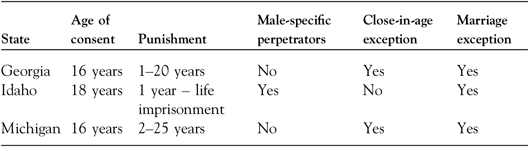
The nuances of statutory rape laws vary considerably by state. In Georgia and Michigan, the age of consent is sixteen years, whereas in Idaho, the age of consent is eighteen years. The criminal code in Michigan organizes all sex offenses under one umbrella called “criminal sexual conduct,” while in Georgia and Idaho, prosecutors have multiple charging options ranging from, for instance, child molestation to sexual battery to statutory rape. Table 1 compares some of the key features from each state’s criminal code as they relate to the regulation of adolescent sexuality. Notably, each of these three states has a marriage exception, which means that if the minor and the adult are married (regardless of their age span), then the adult may not be charged with statutory rape (although marital rape would be a possibility). In sum, all sexual encounters involving minors can be legally classified as criminal, with some exceptions for same-age or close-in-age pairings.
Age of Consent Law by State

I take an intersectional approach to the sociological study of sexual violence (Crenshaw Reference Crenshaw1989). Much previous research in this area has examined the intersection of gender with race and ethnicity. I extend this productive line of inquiry to also investigate the intersection of gender, race, and age. Dominant understandings of sexuality are predicated on a distinction between the maturity of children and adults, and this distinction undergirds the logic of statutory rape laws. Yet there is little understanding of how cultural ideas about youth shape the way our legal system defines sexual violence or differentially situates the sexual vulnerabilities of teenage boys and girls. By examining how legal actors distinguish ordinary adolescent sexuality from criminally actionable encounters, we begin to unpack broader patterns of how consent is operationalized in the criminal justice process.
The analysis that follows proceeds in three parts. First, I examine prosecutorial logics of intervention into adolescent sexuality. Second, I show how prosecutors interlace assessments of sexual consent with cultural ideas about sexual identity, effectively creating different default settings for the age of sexual majority based on the gender configurations of the younger and older individuals involved. Third, I discuss cases of sexual assault that become illegible to police investigators and prosecutors due to dominant ideas about sex and teenagers.
SEXUALITY, MORAL DECAY, AND THE AUTHORITY OF THE STATE
Statutory rape laws are a key site of state regulation of adolescent sexuality (Cocca Reference Cocca2004; Drobac Reference Drobac2016). The authority of distinguishing between criminal and noncriminal sexual encounters rests primarily in the hands of prosecutors. Here is how one prosecutor described the justification for state protectionism:
I must say for the record though that victim harm is not really something we take into account…for example, the girl who was fifteen years old saying, “I had sex with him consensually. I don’t want you to prosecute this.” I could sit back and say, “Well, she didn’t really seem to suffer a lot so I’m not going to prosecute that.” That never enters my mind at all. Because it’s a crime and I have to enforce the law as I see fit. When you’re dealing with minors, the law is predicated on the concept that minors cannot knowingly consent to anything. They lack the mental capacity. Hence, you can’t go down and engage in a contract to purchase a car. You’re just too young and dumb to know what you’re getting into. The same thing with sex and their bodies.
His assumption, rooted in the citizenship models of modern liberalism, is that the fifteen-year-old girl will someday grow into a rights-bearing citizen who will assume full autonomy for her body. The teenager is simply not there yet, and thus in this interim period, the state assumes control over what happens to her body. The sexual desires of the girl are silenced to make room for the authority of the state, as defined by the wisdom of the prosecutors. In this particular case, the prosecutor reported that the girl had been involved with an older man who targeted young women; the girl decided reluctantly to cooperate with the prosecution only upon learning that the man had been dating multiple women concurrently. From the perspective of the alleged victim (at least according to the prosecutor’s account), the harm experienced was a deceptive or coercive relationship, not sexual assault. Thus, the respective narratives of victimization—between the girl and the prosecution—are misaligned. Although in this case the prosecutor minimized his discretion in pursuing criminal cases by arguing that he is simply an unbiased agent who applies the law, in most of my interviews prosecutors drew explicitly on cultural narratives of morality in explaining their decision of whether to pursue statutory rape cases. Moreover, the decision to investigate and prosecute statutory rape allegations is always discretionary, and despite this prosecutor’s implicit claim toward neutral application of the law, the vast majority of potential violations are overlooked by the state.
Because young women’s bodies are the site of intense social scrutiny, perceived as both vulnerable and dangerous, adolescent female sexuality posed particular challenges to prosecutors. Prosecutors indicated that it was difficult to distinguish between sexual agency and sexual victimization when it came to teenaged girls. While they cannot legally consent to sexual activity, they may still engage in wanted sexual encounters. Using child sexual abuse cases as his reference point, one prosecutor described the challenge:
It’s pretty easy with kids. You always have a sympathetic victim because they’re kids. It gets dicier as the victims get older. It becomes a real question of: Is this a crime? Or is this a parenting issue? If your kid is fifteen years old and sneaking out of the house and going to a party and drinking and she has sex with somebody, yes, she is only fifteen years old so it’s a crime. But he’s only eighteen years old, and maybe it’s not as much of a crime as we think it should be. So then you have to start balancing policy issues. You have to explain, “Look, there’s a certain amount of personal responsibility that goes along with this. Maybe going to the frat party and getting drunk and passing out in a room where you know all of the things that were going on wasn’t a good choice on your part. It doesn’t mean you deserve to be victimized, and you absolutely deserve to be protected. But let’s talk about what you can do now so that you have control over what happens to you and not waiting for other people to take control over what happens to you.”
As this prosecutor worked through the hypothetical scenario, he revealed the complexities in defining the state’s relationship to teenaged girls’ sexuality. Although he acknowledged that age automatically qualified the sexual encounter as criminal, he then hedged this assertion as he introduced more context to the scenario. The criminality of the sexual encounter is reduced if the girl had taken steps that put her at risk, such as sneaking out of the house, drinking alcohol, and falling asleep in a fraternity house. That she was still legally a child mattered little in the prosecutor’s calculation. She and her parents still bore responsibility for what might have happened to her. The prosecutor’s logic is undergirded by a neoliberal model of the responsibilization of morality, whereby individuals largely bear primary responsibility for whatever bad things may happen to them, including criminal victimization. This shows how social conditions affect prosecutorial assessments of legible and credible sexual victimization.
Statutory rape laws are concerned not only with young women’s sexuality but also with pregnancy outside of marriage (Donovan Reference Donovan1996). Cocca (Reference Cocca2004) shows how renewed cultural anxiety about statutory rape in the 1980s and 1990s coincided with—and indeed, bolstered—conservative agendas that focused on creating autonomous families that required no material support from the state.Footnote 5 (Research has shown, however, that the expansion of statutory rape laws did not impact teenage birth rates as some policy makers had expected (Frakes and Harding Reference Frakes and Harding2015)). Accordingly, teenage pregnancy loomed large in the prosecutors’ discussions of statutory rape. I quote the following two prosecutors at length because their characterization of the application of statutory rape laws illuminates the emotional intensity that teenage pregnancy provokes.
A fourteen-year-old girl has no business in a car with a fifty-year-old, except she’s got no father. No father at home, no self-esteem, and so she goes out and gets pregnant by the first guy who says, “You’re pretty.” Right? It’s horrible. It sucks. A sixteen-year-old girl having a child is pathetic to me because she’s just thrown her whole life away, she doesn’t have a father, there was no father in that house, and if there had been, this wouldn’t have happened. That’s judgmental, but they’re street people.
I said, “Look, in my jurisdiction anymore, you get one free baby. The next time you come in here as a victim, I’m going to charge you with a crime if you continue to have sex with people who are older than you. You’re going to be charged with fornication, and we’ll take you away from your parents.” Because the parents were watching these kids walk in with boys and heading back to their bedrooms. I said, “I’ll charge the parents, too.” To get them to realize they can’t keep doing it and getting away with it.
When discussing pregnancy, the prosecutors vacillated in their paternalistic characterizations of teenaged girls. At times they described them as victims of their circumstances, as products of “bad parenting” (structural inequities such as sexism, racism, and poverty were not mentioned) who needed state protection. Other times, they identified the girls as culpable. One prosecutor described how he tried to provide life skills coaching to an alleged victim of statutory rape who had dropped out of high school and kept an irregular schedule, often sleeping into the afternoon. Notably absent from these particular discussions of statutory rape and teenage pregnancy was the role of the boys or men having sex with the girls. Responsibility for the girls’ virginity and morality fell largely on the shoulders of the girls and their parents.
The mobilization of statutory rape laws on the ground emerges as a mechanism for defining and policing community morals. If teenage pregnancy is an indicator of fiscal irresponsibility, then excessive teenage sexual behavior is a measure of moral decay. One prosecutor described a blended family that was notorious in his community for their chaotic life circumstances. The eight children, he reported, received little adult supervision, which led to premature sexual experimentation as well as drug and alcohol use. The sexual behaviors of two early-adolescent stepsisters particularly troubled him.
It was a whole family of degenerates. The parents just allowed the kids to run wild: alcohol, pot, sex. They lived in abject squalor. We had all the kids in Child Protection cases, and we had them on juvenile probation and we had them as victims of crimes. Two of these girls would hitch rides to the labor camp and have sex with the guys down there for money. That’s how they earned cash, and the parents were completely in the know about it. It’s ridiculous and it’s awful. At some point, you can no longer just turn a blind eye and go, “Okay, everybody who was having sex with these girls is a criminal,” because you have to get the girls to stop their behavior, too, before they become lifelong victims.
The classed connotations—with both cultural and material imagery—figure large in the prosecutor’s description of this family. Disparaging stereotypes about the supposed chaos of poor people emerge clearly with details such as the “abject squalor” of the house and the girls’ unbridled sexual behaviors. But based on the prosecutor’s narration, there is virtually no indication of how the girls understand these experiences. Are these girls sexual victims? Or are they juvenile delinquents? The prosecutor describes the girls as willingly engaged in sexual behavior, but they are obviously doing so with severely constrained economic resources and under potentially exploitative conditions, which, in turn, limits their opportunities to explore their developing sexuality in a safe environment. Ultimately, the prosecutor decided that the girls were victims of their familial circumstances and that the application of statutory rape laws could potentially prevent them from becoming “lifelong victims.” The prosecutor’s logic here illuminates how the specter of moral decay shapes the implementation of statutory rape laws.
CONSENT AND SEXUAL IDENTITY
As a legal concept introduced by second wave feminists, sexual consent replaced the requirement of force or violence from the definition of rape, which drew a new distinction between criminal and noncriminal sexual interactions. Feminists celebrated the broadening of the category of sexual assault to include a much wider range of inequitable sexual interactions that they saw as reproducing gender hierarchies (Brownmiller Reference Brownmiller1975; MacKinnon Reference MacKinnon1988). Although feminist theorists have critiqued the efficacy of sexual consent, it remains at the forefront of Western legal understandings of rape. It is usually understood as a fixed and universal indicator, especially in relation to young people. However, in legal practice, sexual consent—and, specifically, a person’s ascribed ability to give it—is variable and dependent on social conditions. In cases involving teenagers, prosecutors assess the degree of sexual violation, if any, according to an informal metric against which they evaluate the plausible likelihood of the victim ever agreeing to sexual activity with the accused. As I show in this section, these informal assessments of sexual consent are undergirded by dominant cultural understandings of sexual identity and default assumptions about appropriate sexual interactions. A prosecutor’s assessment of whether or not consent occurred is more than a dichotomous pathway: It also turns on whether this particular (gendered) person might engage in a sexual encounter with that other particular (gendered) person. In essence, the social identities of the individuals matter for the exogenous identification of sexual consent.
Gender is linked up intricately in popular formulations of sexual consent. Teenaged boys bring this dynamic into sharp relief. Like their female counterparts, teenaged boys encounter coercive and assaultive sexuality in a variety of settings (Frías and Erviti Reference Frías and Erviti2014; Hlavka Reference Hlavka2017). They may be sexually assaulted by their same-age peers (especially in homosocial settings, like athletic hazing rituals); by older men or women; or in statutory rape scenarios, in which they desired the sexual interaction but could not technically give consent due to age of consent laws. Moreover, publicity around high-profile cases like the Jerry Sandusky and Catholic Church scandals, respectively, renders the sexual vulnerability of boys and young men conceivable and knowable, whereas historically, so-called rapeability was the sole province of the feminine and the female-bodied. Yet recognition of the sexual vulnerability of teenaged boys hinges on the gender of the assailant: men who target this group are seen as horrifically deviant, whereas views of women assailants are much more complex (Levine Reference Levine2006b). In turn, the age at which teenaged boys are socially perceived as sexually vulnerable occupies the far extremes of adolescence. If their perpetrator (or sexual partner, depending on the case specifics) is a woman, then their sexual vulnerability is virtually erased; but if their perpetrator is a man, then the upper age limit of their vulnerability is increased significantly. Notably, what is at stake with the sexual vulnerability of teenaged boys is their heteromasculinity (Hlavka Reference Hlavka2017), whereas with teenaged girls, the sexual risk turns on the possibility of out-of-wedlock pregnancy (Rikabi Reference Rikabi2016).
In cases involving teenaged boys, the dominant social construction of sexual harm focuses on their tarnished masculine identity and their potential initiation into gay cultures. Although there is increasing cultural tolerance of sexual diversity, heterosexuality remains the default assumption, especially for young people. Adolescents are presumed to be straight, unless there is evidence to the contrary, and the stakes of nonnormative sexual exploration for boys and young men are particularly high, given the rigidity of hegemonic masculinity (Pascoe Reference Pascoe2011). Indeed, Chaffin, Chenoweth, and Letourneau (Reference Chaffin, Chenoweth and Letourneau2016) find that there are arrest disparities in same-sex statutory rape cases involving a male offender, which indicates that police officers may demonstrate disproportionate concern when the presumed heterosexuality of teenaged boys is threatened. It is quite plausible that prosecutors would act similarly.
Prosecutors were sensitive to these dynamics when they encountered teenaged boys who were sexual assault victims. They engaged in identity work with the young men to reestablish the youths’ burgeoning sense of masculinity during their investigatory meetings. Here is how one prosecutor described the ways that he addressed the anticipated shame experienced by a victimized teenaged boy.
Being a guy, I said, “Look, I know you’ve got a lot of worries now about your sexual identity. I understand that; I can appreciate that. But just remember this: your eyes are in your head, and they’re not below your belt. You can’t tell if this is a man’s hand, a woman’s hand, a man’s mouth or a woman’s mouth. It feels good. Thank God, or we wouldn’t be here. Let me just ask you a personal question. If tonight you had a choice, would you rather have sex with me, or would you rather have sex with Lisa?” And they said, “Lisa, Lisa. Mr. Smith, do you think we can arrange that?” I said, “No, no, no. We’re just talking hypothetical here.”
Lisa was an investigator who the prosecutor characterized as “a very attractive blond and young.” By invoking the specter of a sexual encounter with Lisa, this prosecutor addressed the shame that the boy could have been feeling while simultaneously reestablishing his heterosexual identity through homosocial camaraderie. Moreover, he offered the boy a plausible explanation—sexual stimulation feels good, regardless of the gender of one’s partner—for how he might have ended up in a “homosexual” encounter. (I put the term in quotes here because although sullied heterosexuality is a genuine concern for many male sexual victims (Walker, Archer, and Davies Reference Walker, Archer and Davies2005), it is not an accurate characterization of sexual assault due to the fact that it assumes sexual desire.) It is ironic to invoke a grown woman in the hypothetical scenario precisely because an actual sexual encounter between her and a boy would be legally categorized as a sexual assault. In essence, heterosexual statutory rape serves as a “cure” for homosexual statutory rape. Ostensibly, this prosecutor is attempting to manage and build rapport with a witness who may be particularly reluctant to participate in the prosecutorial process due to heightened shame, but this covert strategy ultimately reinstates normative and aggressive masculine sexual desire that is not vulnerable to feminine sexuality, no matter the age of the woman partner (Levine Reference Levine2006b). By examining the case of sexually victimized teenaged boys, we begin to see how legal understandings of consent are contingent on factors such as the gender of the youth’s older partner.
Prosecutors capitalized on negative cultural associations with homosexuality to build evidence at trial in statutory rape cases involving teenaged boys. Based on the logics of potential consent, a postpubescent boy was not only presumed to be heterosexual, but the fragility of his masculinity rendered any evidence to the contrary especially powerful. One senior prosecutor had tried several different cases over the course of his career that generally involved adult men targeting teenaged boys, most of whom were in their middle adolescence and otherwise vulnerable in some way. (His descriptions of these cases suggested that the defendants were predatory and that the boys were victimized, although there remains the possibility, as discussed above, that the boys may have had some degree of sexual desire and agency in the interactions.) In such cases, the prosecutor emphasized homosexual disgust when presenting the evidence to juries. Here is how he described his narration to jurors in cases involving teenaged boys and adult men.
We would ask boys about places or moles or descriptions of genitalia, and how it all happened. It would gross the jurors out, but you’d come back and say, “I knew you were sick in your stomach. I asked them that because if I hadn’t made you sick to your stomach, you wouldn’t have believed them. We cannot gloss over what happened with these boys.”
This is a standard process of presenting evidence to the jury that sexual contact occurred. In sexual assault cases, there are two pathways of defense: either the sexual contact did not occur or the sexual contact was consensual. With legal minors, the latter defense is not possible, so prosecutors need only provide convincing evidence that sexual contact occurred between the complainant and the defendant. Thus, if the complainant demonstrates intimate knowledge about the genitals of the defendant, it is presumed that this knowledge was gathered from firsthand experience, which signifies the occurrence of a sexual assault. However, the narrative framing of the evidence above was not value-free. By suggesting that jurors would be “sick to their stomachs” when hearing about sexually victimized teenaged boys, the prosecutor primed jurors to take the criminal charges very seriously. Prosecutors reserved invoking disgust and emotionality for cases they perceived as extreme in one way or another. While the prosecutors I interviewed were often judgmental about the behaviors of sexually victimized teenaged girls, none invoked this rhetoric of disgust in cases involving heterosexual pairings.
SEXUAL BAGGAGE AND THE (IN)VISIBILITY OF VULNERABILITY
Criminal prosecution legitimates a claim of sexual violence as worthy of state intervention. It is a powerful symbolic act. Yet as I have shown, there remains significant variation at the case level in terms of which allegations prosecutors deem important enough to justify deploying scarce state resources. Potential consent emerges as the lynchpin around which prosecutors assess the credibility of the allegations. In turn, they configure their understanding of potential consent around an intersection of age, gender, and sexual identity. Assumptions about consent render some bodies as always-already innocent, even as they erase the sexual vulnerability of other bodies. In this section, I examine how the sexual victimization of some teenagers remains completely illegible to prosecutors due to dominant cultural beliefs about (some) young people’s excessive sexuality.
Sexual maturity renders a child victim less credible because they are no longer perceived to fall into the untouchable category of a presexual person. As soon as a child enters puberty, she is seen as a potentially sexual person who might desire sexual activity with another person. This is particularly true for girls of color, who are accorded decreased sexual innocence throughout their childhood and whose bodies are hypersexualized in media representations (Dagbovie-Mullins Reference Dagbovie-Mullins2013; Epstein, Blake, and González Reference Epstein, Blake and González2017). (Notably, the sexualization of postpuberty youth occurs regardless of whether or not they are actually engaged in sexual activity.) The logics of prosecutorial decision-making dovetail with these dominant cultural norms. Here is how one Georgia prosecutor explained the legal complications that emerge as youth victims age through puberty.
They [teenagers] come with more baggage because a lot of those kids are already sexually active. It’s more difficult for them to convince a jury. One of the things that we use with small kids in terms of corroborating what they’re saying is age inappropriate knowledge. You lose that with older kids who have experienced sex with peers. You lose that innocence at puberty. I can tell you, it’s just clear it’s at puberty. It’s when the girls start having breasts, and the boys start having a deeper voice. My favorite victims are four-year-olds.
This prosecutor’s explanatory logic of sexual baggage pivots between the foreclosed legal strategies available to him as well as the anticipation of diminished community sympathy. The alleged victim is no longer “innocent” because he or she might be sexually knowledgeable or active in other contexts. His preference for very young victims is simply an informal legal reality that younger children are more convincing to juries. Skilled prosecutors are always looking “downstream” to anticipate juror reactions, and they see sexual experience, whether real or imagined, as complicating the child’s credibility. Thus there is effectively a two-tier system of young sexual complainants: one tier that prosecutors often perceive as always-already perceived as vulnerable and at-risk and a second tier that they view with the same degree of suspicion and disbelief accorded to adult victims.
Gender matters in determining the presence and severity of harm in statutory rape cases. Cases involving older women and teenaged boys are often seen as less obviously problematic than those involving older men. Here a slightly different kind of sexual baggage emerges: the weighty demands of hegemonic masculinity. The combination of a heterosexual pairing and cultural assumptions about omnipresent masculine desire render it difficult to identify these as genuine cases of sexual assault. In my interviews with prosecutors, many initiated conversations about these cases in which they recognized the inconsistency of not applying the same legal standards to male and female defendants. “It’s kind of hard to think of women in terms of being a predator,” one prosecutor explained. Another reported that he reluctantly pursued a statutory rape case involving a woman due to public pressure, even though he did not personally believe that a crime had occurred. “I had to prosecute the wife of a lawyer who was a school teacher for having sex with one of her eighteen-year-old students. Certainly, she should have lost her teaching certificate. Prosecuted, absolutely not. Because she was not taking advantage of that kid at all. It was mutual, consensual, and he was having the time of his life, and would have kept having the time of his life. But the problem with eighteen-year-old boys is they can’t keep their mouth shut.” To be sure, not all respondents minimized the proverbial Mrs. Robinson cases, but they were nonetheless hesitant to identify them as serious sexual assault cases, even when they were cognizant of their own logical inconsistencies. Importantly, the prosecutorial minimization of cases involving women and teenaged boys is not simply an effect of slightly older victims; rather, the interaction of the perpetrator’s gender and sexual identity profoundly influence how prosecutors perceived otherwise similar cases. Thus, the assessment of potential consent is a crucial—yet often overlooked—step in the legal recognition of sexual assault.
Cultural ideas about adolescent female sexuality are so symbolically overwrought that they erase the sexual subjectivity of girls and young women (Fine Reference Fine1988; Tolman Reference Tolman2005). Just as the real sexual desires of teenaged girls matter little in prosecutors’ decisions to pursue statutory rape charges, it turns out that their articulations of sexual violence also matter little. One prosecutor described a case in which police investigators doubted the words of a teenager who claimed that she was raped by a stranger outside her home. Notably, this story emerged when I asked the prosecutor to tell me about the most memorable sexual assault case he had worked on in his career. Here, he mapped out the trajectory of the case:
She had snuck out of her house, and she was still at her yard one night. She claimed that a man came by in the dark and attacked her and raped her. She told her parents, and the police were called and they sort of investigated. No one believed, there was a lot of doubt. “Let’s see. You were outside, it was night, you’ve had sex. Maybe we’ve got a boyfriend or a whatever involved.” It was three or four years later—a rape kit had been done on the girl—the DNA was located when they were running inmates’ DNA samples against other unsolved cases. They hit on a sex offender who was in prison who had raped someone in another part of the state. It matched the test kit from that girl, and the whole time she had told the truth. She had been raped, and they proved it.
The language that this prosecutor used to explain the investigators’ initial skepticism is informative: “You were outside, it was night, you’ve had sex.” So not only did she have sexual experience, but she was also breaking the norms of feminine comportment by being outside at night by herself (never mind that she was still in her own yard). The girl’s account held little weight against the investigators’ views about adolescent sexuality and deviant behavior. The girl’s experience became legally credible only years later when a DNA match popped up. Yet even after this error in investigatory judgment, the prosecutor still attributed the credit for closing the case to the state actors, rather than to the girl’s account. “She had been raped, and they proved it.” In this linguistic configuration, the victim remained passive; the perpetrator was eclipsed from the retelling; and the investigators emerged as the agentic heroes. The prosecutor did not identify the girl’s relative social status (her class and racial identities would be especially important to consider), but it is clear that she and her family were not able to effectively mobilize police investigators to act beyond their minimum obligations of, for instance, collecting a rape kit.
By examining cases in which youth sexual victimization is illegible, we begin to see the ways that statutory rape laws are inadequate for protecting young people from sexual risk. Cultural ideas about sexuality—even in relation to youth who are relatively inexperienced in the sexual realm—silence young people’s narratives of either desire or victimization.
DISCUSSION AND CONCLUSION
In this article, I use statutory rape cases as a lens through which to investigate legal constructions of sexual consent. By examining an age-based class—teenagers—that occupies a liminal space in the lifelong arc of sexual development, we begin to see how prosecutors distinguish between sexual desire and victimization. I argue that the legal identification of sexual consent is a sociological process. Prosecutorial decision making in statutory rape cases is informed by cultural ideas about appropriate adolescent sexual development. These cultural ideas are, in turn, interwoven with assumptions about age, race, gender, and sexual identity.
Prosecutorial assessments of consent are shaped by default assumptions about commonplace sexual pairings: Might this person (who is situated according to their aged, gendered, raced, and sexed identities) have ever consented to sexual activity with this other particular person? In the case, for instance, of a teenaged boy with an older man, the default assumption is that the youth would never, under any circumstances, consent to such homosexual activity. In contrast, teenaged girls (especially those who do not benefit from class and racial privileges) are viewed with greater suspicion.
These dynamics raise broader questions about how we conceptualize the harm of sexual violence, where responsibility lies, and how to best reduce its prevalence. On the one hand, it is important to empower girls and young women to claim sexual agency (Fine Reference Fine1988; Tolman Reference Tolman2005; Fine and McClelland Reference Fine and McClelland2006). Feminist theorists suggest that female agency in all arenas of life, including sexual interactions, leads to a greater sense of personal efficacy and even increased political inclusion (Young Reference Young1980). In practice, this might lead to some age-discordant pairings that are not harmful. On the other hand, it is also important to recognize the age-based power differential between young people and adults, especially in cases involving young women, who still face considerable social pressures to be passive and accommodating. By examining how prosecutors draw lines between appropriate and criminal sexuality, we can see the fault lines of relying on state paternalism to protect against sexual victimization. The formidable challenge is to create social and legal spaces in which teenagers’ sexual subjectivities are recognized as important and valuable. This pathway forward cannot be subsumed by danger rhetoric, and it must recognize the real vulnerabilities that young people experience.
Future research might explore two important avenues of investigation. First, a more systematic inquiry into the racialization of statutory rape laws would be useful. My data focus primarily on the intersection of gender and age. Yet we know that legal and cultural understandings of sexual violence are deeply interwoven with ideas about race (Sokoloff and Dupont Reference Sokoloff and Dupont2005; Armstrong, Gleckman-Krut, and Johnson Reference Armstrong, Gleckman-Krut and Johnson2018), so we would build a more comprehensive understanding of statutory rape if race were also centered. Second, a more nuanced analysis into how the law produces sexual desires would be instructive (e.g., Rosenbury and Rothman Reference Rosenbury and Rothman2010). Criminal law’s manifest function is to identify instances of sexual victimization, and as such, most of the prosecutors I interviewed focused on victimization. Their assessments were based on an implicit comparison between victimization and desire, but their talk focused on the former. Moreover, sexual consent should not be understood as analogous to sexual desire. Understanding the ways that the legal field also constructs sexual desire, in an explicit way and through the ordinary actions of legal actors—which queer and postcolonial scholars have previously suggested—would be fascinating.