1. INTRODUCTION
Dynamic trajectory prediction is an active research area in the field of navigation and positioning, it has great practical value in intelligent traffic control systems, the digital battlefield and auxiliary driving systems (Qiao et al., Reference Qiao, Jin, Han, Tang and Gutierrez2015a; Annamalai et al., Reference Annamalai, Motwani, Sharma, Sutton, Culverhouse and Yang2015). With the improvement of Global Navigation Satellite Systems (GNSS), dynamic platform satellite navigation and positioning technology has found a wide range of applications. Trajectory prediction has a certain delay due to signal reception, location resolution and other restrictions; this delay is more obvious for high-speed dynamic platform applications. In practice, it is necessary to output not only the position information in real-time, but also the predicted position or the trajectory for the next time period. For example, in an auxiliary driving system, trajectory prediction is helpful for drivers in analysing potential safety risks and facilitating autonomous driving functions (Fujise et al., Reference Fujise, Kato, Sato, Harada, Morinaga, Kohno and Sampei2002; Retscher and Kealy, Reference Retscher and Kealy2006). Thus, trajectory projection can contribute towards safe operation conditions on a dynamic vehicle and can help prevent traffic accidents (Wu and Nie, Reference Wu, Nie and He2012; Tang et al., Reference Tang, Xue, Chen, Zhang and Qingquan2017).
Dynamic trajectory prediction algorithms can be divided into two categories based on motion trajectory spatial distribution characteristics (Liu, Reference Liu2016): non-restricted motion trajectories such as aircraft, ship and other free trajectory prediction algorithms and restricted motion trajectories such as road vehicles, trains and other specific trajectory prediction algorithms. This paper mainly concerns trajectory prediction in car navigation which belongs to the restricted motion trajectory category. According to platform motion characteristics, trajectory prediction algorithms can be divided into two categories: trajectory prediction based on Euclidean space and trajectory prediction based on road network limitations. At present, more research is based on Euclidean Space trajectory prediction. For example, Li (Reference Li2013) introduced a Recursive Motion Function (RMF) method to simulate the short-term movement trend of a platform accurately; Lin and Ju (Reference Lin and Ju2011) proposed a GNSS integrated navigation system based on a Back Propagation (BP) neural network prediction algorithm and Jeung et al. (Reference Jeung, Liu, Shen and Zhou2008) introduced a hybrid prediction model, which estimated an object's future locations based on its neural network pattern information as well as the existing motion functions of the object's recent movements. Kim et al. (Reference Kim, Won, Kim, Shin, Lee and Kim2007) and Guo et al. (Reference Guo, Ding, Hu and Chen2010) introduced a trajectory prediction method that gives the starting point and destination in the road network; Liu and Karimi (Reference Liu and Karimi2006) presented a model that was derived from the probability of turning at the intersection by counting the user's historical trajectory.
Wang et al. (Reference Wang, Cai, Li and Yu2017) and Tian et al. (Reference Tian, Salcic, Wang and Pan2016) proposed a pedestrian dead reckoning algorithm, in which trajectory prediction was carried out by using previous time position information and the heading angle of the pedestrian. An indoor pedestrian's movement has higher prediction accuracy compared with high-speed vehicle movement. Han and Wang (Reference Han and Wang2010) proposed an initial alignment method with an Inertial Navigation System (INS)-assisted vehicle GNSS navigation system, using a second-order Kalman filter to establish a dynamic model of the INS errors. Experimental results show that the method can complete the initial alignment more accurately, but it requires INS-assisted GNSS navigation, which cannot be universally applied in GNSS-only vehicles. Qiao et al. (Reference Qiao, Jin, Han, Tang and Gutierrez2015a) proposed a trajectory prediction model using a Hidden Markov configuration. Although the model improves the performance of trajectory prediction to a certain extent, the prediction accuracy is low and real-time trajectory prediction cannot be achieved in an environment with large interference, especially when the platform is moving at high speed; real-time features cannot be guaranteed. Qiao et al. (Reference Qiao, Shen, Wang, Han and Zhu2015b) proposed a trajectory prediction method based on a Gaussian mixture model, which can effectively predict the uncertain trajectory of the objects. It is effective for monitoring analysis and traffic condition prediction, but the computational complexity is high.
In order to reduce the complexity of the algorithm and improve the accuracy of carrier trajectory prediction, especially to solve the problem of real-time deterioration when the carrier movement direction changes greatly, a new algorithm for navigation trajectory prediction based on a generalised extension extrapolated model is proposed in this paper. The algorithm is based on Euclidean space for navigation trajectory prediction, and from the trajectory a mathematical model is established to further predict the location information for the next epoch. Then, an algorithm is used to fit either a linear or nonlinear motion model to simulate the carrier motion trajectory using the laws of motion. The feasibility of the algorithm has been verified through data simulation and the application of a land vehicle navigation field experiment.
This paper is organised as follows: in Section 2, the principle of the traditional predictive model is reviewed, and the generalised extension extrapolation model is introduced. In Section 3, the feasibility of the proposed algorithm is analysed in detail by theoretical simulation and practical experiment, and the algorithm is proved to be superior to other extrapolation algorithms by a real outdoor experiment. Finally, conclusions are given in Section 4.
2. NEW GENERALISED EXTENSION MODEL OF NAVIGATION TRAJECTORY PREDICTION
To predict the trajectory of an existing spatial carrier, the main trend of current research is based on the trajectories to establish a linear or nonlinear model. The linear model (Li et al., Reference Li, Guo, Huang, Zhu, Tang and Dong2015) has been widely used because of simple modelling and easy calculation. However the linear model has limitations in describing complex platform trajectories, especially when the platform's movement direction changes rapidly, and in these cases, it is difficult to achieve a high-precision trajectory prediction. Compared with the linear model, the nonlinear model is more accurate for real movement trajectories (Qiao et al., Reference Qiao, Jin, Han, Tang and Gutierrez2015a), but there are disadvantages of complex modelling, such as difficulty in solving equations and large computational complexity. To solve the above problems, a new generalised extension extrapolated model with high prediction precision and a low computation burden is presented in this paper.
2.1. Traditional predictive model
From a mathematical point of view, the prediction first solves the problem of describing the known elements by establishing an approximate description function, and then solves the extrapolation of this approximate function. Dynamic platform navigation should not only measure parameters such as position, speed, acceleration of current time and past times, but also use this data to predict the state, trend and trajectory of the platform for the next time period. It is necessary to build an approximate forecasting function which can reflect the change of the trajectory by using previous and current trajectory status information (Morzy, Reference Morzy2006; Song and Barabási, Reference Song and Barabási2010; Qiao et al., Reference Qiao, Jin, Han, Tang and Gutierrez2015a). Therefore, the optimal approximate function of the known state and the extrapolated model of the trajectory at the next time period are key to solving the forecasting problem.
2.1.1. Dead reckoning algorithm
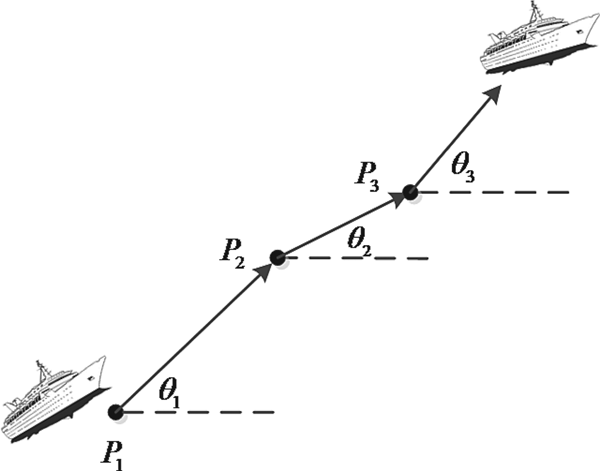
The dead reckoning algorithm was originally widely used in navigation and positioning of ships and vehicles (Hwang, Reference Hwang2002; Retscher and Kealy, Reference Retscher and Kealy2006). The platform is considered to be in linear motion, and the next time position of the platform can be predicted when a priori information and the course angle of the current time position are known. The dead reckoning algorithm is illustrated in Figure 1.
A schematic diagram of the dead reckoning algorithm.

Assuming the position  $p_{t_{n}} \lpar x_{t_{n}}\comma \; y_{t_{n}}\rpar $ at time t n, previous velocity
 $v_{t_{n}}$ and course angle
 $\theta_{t_{n}}$ are known, the position of
 $p_{t_{n+1}} \lpar x_{t_{n+1}}\comma \; y_{t_{n+1}}\rpar $ at time t n+1 can be calculated by the dead reckoning algorithm as Equation (1).
 $$\left\{\matrix{x_{t_{n+1}}=v_{t_n}\lpar t_{n+1}-t_n\rpar \cos\lpar \theta_{t_n}\rpar +x_{t_n} \cr y_{t_{n+1}}=v_{t_n}\lpar t_{n+1}-t_n\rpar \sin\lpar \theta_{t_n}\rpar +y_{t_n}}\right. $$
In actual dead reckoning applications, information such as the velocity  $v_{t_{n}}$, course angle
 $\theta_{t_{n}}$, etc, may be provided by the on board sensors such as a speedometer, magnetic compass and GNSS receiver.
2.1.2 Least squares fitting method
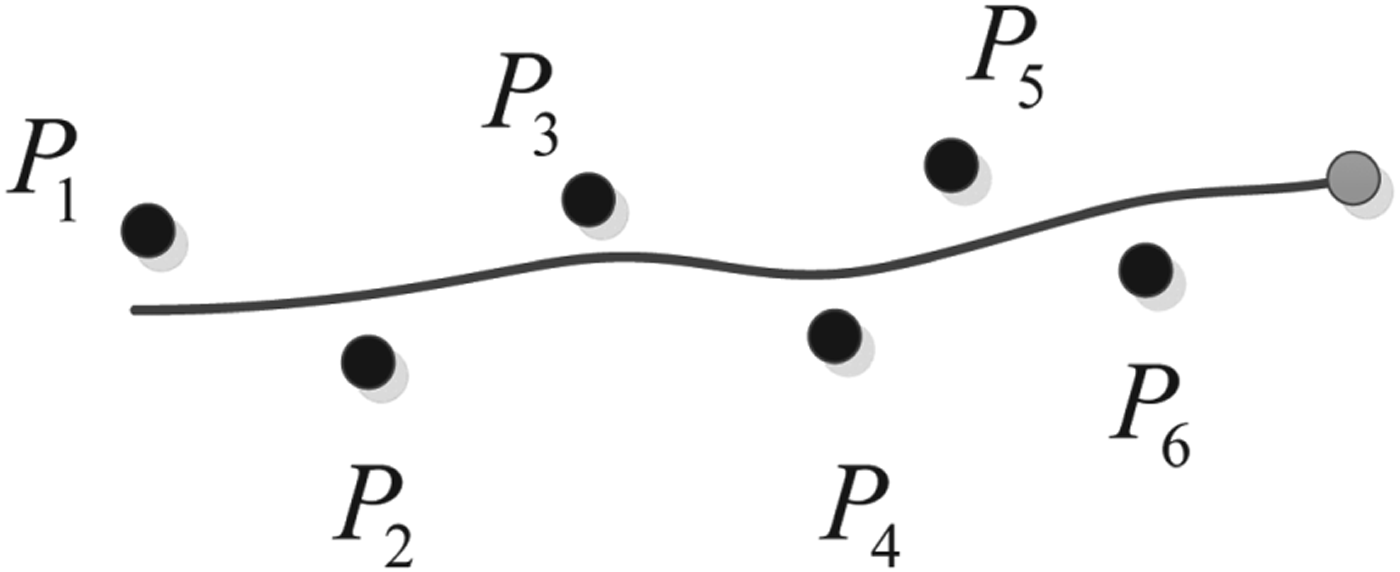
In the fitting process of the navigation trajectory, the least squares fitting method is used to solve the platform trajectory fitting and then the next time position data is obtained by extrapolation on the fitting curve by the inertia principle (Wang et al., Reference Wang, Wang, Xiong and He2016), as shown in Figure 2. In Figure 2, according to the six known coordinate points, a curve is fitted by the least squares criterion, and then the position of the next moment is extrapolated on the curve.
Least squares fitting-extrapolation algorithm illustration.

Given the position coordinates  $\lpar x_{t_{1}}\comma \; y_{t_{1}}\rpar \comma \; \lpar x_{t_{2}}\comma \; y_{t_{2}}\rpar \comma \; \lpar x_{t_{3}}\comma \; y_{t_{3}}\rpar \comma \; \ldots\comma \; \lpar x_{t_{n}}\comma \; y_{t_{n}}\rpar $ at time t 1, t 2, t 3, …, t n, the coordinates at time t n+1 can be extrapolated through the least squares fitting curve. The coordinates x and y can be calculated by Equations (2) and (3):
 $$\left\{\matrix{\min X = \sum\limits_{i=1}^n \, \lpar \, f\lpar t_i\rpar -x_{t_i}\rpar^2 \cr \min Y = \sum\limits_{i=1}^n \lpar \varphi \lpar t_i\rpar -y_{t_i}\rpar^2}\right. $$
 $$\left\{\matrix{x_{t_{n+1}}=f\lpar t_{n+1}\rpar \cr y_{t_{n+1}}=\varphi \lpar t_{n+1}\rpar }\right. $$
where f(t i), φ(t i) are the polynomial fittings of the x-axis and the y-axis. The two fitting curves are used to extrapolate the coordinate  $\lpar x_{t_{n+1}}\comma \; y_{t_{n+1}}\rpar $ in the next time period.
The least squares extrapolated model has been widely used, but in some applications, such as when a dynamic platform moves at high speed or when turning through large angles, it is difficult for the extrapolated model to reflect the movement of the platform. In order to solve this problem, a new approximate model and a new solution are proposed in this paper. The key idea is to take advantage of the information such as the angle of the platform at the current time to predict the future trajectory of the dynamic platform, so it can reflect dynamic platform trends better.
2.2. Generalised extension extrapolation mathematical model
The trajectory prediction model of a dynamic platform is divided into two categories: fitting and interpolation. The representative mathematical models include the least squares fitting polynomial function, the power polynomial interpolation function, the spline function containing the derivative value and the Kalman filtering method. A generalised extension extrapolation model that combines interpolation and fitting two approximation elements is proposed in this paper. The method introduces the angle information which is effective for prediction and it can improve the accuracy and performance of the prediction.
The generalised extension extrapolated model proposed in this paper is different from the traditional extrapolated model. It takes the advantages of dead reckoning and least squares fitting extrapolation and takes into account the a priori information of the real-time platform position information such as angle information to fit the extrapolation. At the same time, real-time angle information is added as a constraint condition, which makes the new model more robust against external changes and it can respond quickly to the change of the latest data points, especially when adapting to a large change in the angle of the vehicle's trajectory. In this model, the random error of the motion parameters can be filtered by fitting, and the constraints of interpolation can make full use of the important motion parameters to improve the accuracy of extrapolation, so it can improve the accuracy and performance of prediction.
The specific mathematical formula of the generalised extension extrapolated model (Shang et al., Reference Shang, Cheng, Sheng, Shi and Yue2016) using a known trajectory in the model is fitted with the quadratic curve under the minimum error criterion, and then the angle information of the current moment is added as the constraint condition.
 $$\left\{\matrix{\min I = \sum\limits_{i=m}^{n} \, \lpar ax_i^2+bx_i+c-y_i\rpar^2 \hfill \cr subject\, \, to\, \, 2ax_n+b=\tan\alpha_n \hfill \cr}\right. $$
where I is the objective optimisation function; x i, y i are the position of measurement point i; (x m, y m), (x m+1, y m+1), …, (x n, y n) are all fitting points in the model; α n is the angle value (0 ≤ α ≤ 2; π) between velocity direction of the point n and positive x-axis and a, b and c are the coefficients of the extrapolated polynomial.
The optimal solution of the parameters a, b and c can be obtained using Equation (4). Using the fitting curve and the velocity information, the coordinates of the prediction point (x n+1, y n+1) can be obtained using Equation (5):
 $$\left\{\matrix{y_{n+1} = ax_{n+1}^2+bx_{n+1}+c \hfill \cr \lpar x_{n+1}+x_n\rpar^2+\lpar y_{n+1}+y_n\rpar^2=\lpar v_nT\rpar^2}\right. $$
where v n is the velocity value and T is the time interval.
2.3. The motion model for trajectory prediction
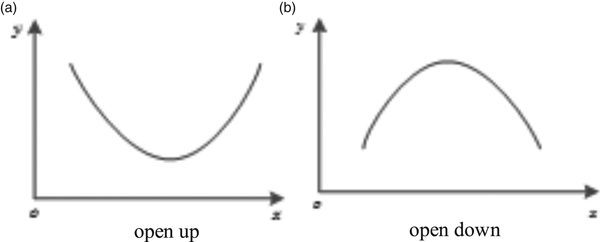
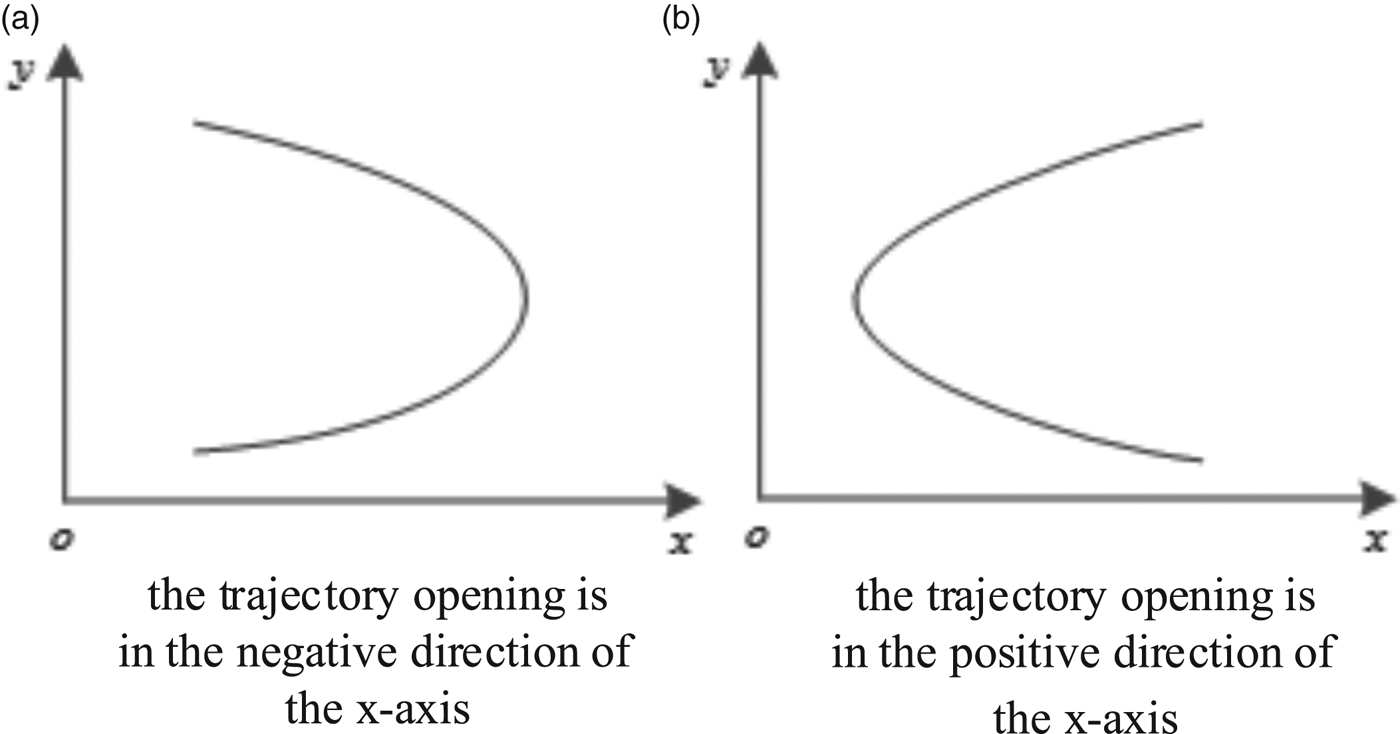
From Equation (4), the approximate polynomial of the generalised extension extrapolated model is a quadratic polynomial and the quadratic polynomial function is limited: in the curve shown in Figure 3, the expression of the quadratic function is fitted easily because the curve has obvious analytical expressions, but in Figure 4, the curve does not have the form of an analytic function; it is more difficult to fit the curve when the quadratic function is used. To solve the problem, a coordinate transformation is used to make the platform trajectory meet the approximate quadratic polynomial. The coordinate transformation makes full use of the symmetry of the quadratic function about the pole and avoids the extreme solution problem when the tangent function value is infinite in the mathematical model.
Quadratic function basic graphics.

The quadratic polynomial cannot approach the situation.

The method of coordinate transformation is as follows:
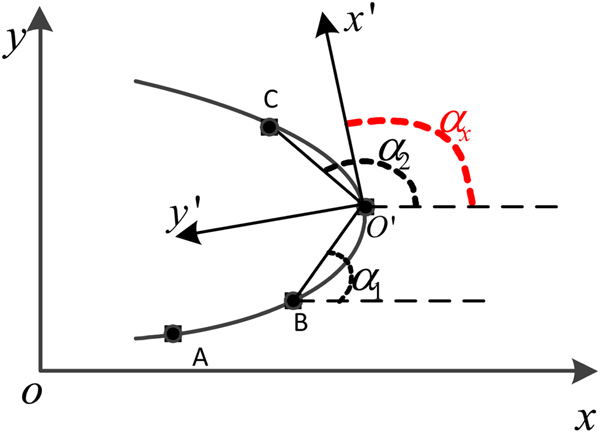
Take the current position O ′ of the platform as the new coordinate origin, define the tangent direction of the arc that is formed by the prior motion trajectory and motion direction current time as the x ′-axis. Define the angle of the bisector formed by the prior point and the direction of motion as the y ′-axis direction. See Figure 5.
Coordinate transformation diagram.

In Figure 5, ABO ′C is the platform trajectory curve. Point O ′ is the current point. The line O ′C is the current motion direction. A and B are a priori points. Define the tangent direction of curve BO ′C as the x ′-axis. Define the angle bisector direction of curve ∠BO ′C as the y ′-axis.
The position of the next point C can be extrapolated from the points A, B, O ′. Assuming that the coordinates of A, B, O ′ in the original coordinates are (x n−2, y n−2), (x n−1, y n−1), (x n, y n). The angle between BO ′ and the x-axis is α 1. The angle between O ′C and the x-axis is α 2 and the angle between the x ′-axis and the positive direction of the x-axis is α x.
When α 2 − α 1 > 0, the angle between the x ′-axis and the x-axis positive direction is:
 $$\alpha_x=\displaystyle{{1}\over{2}}\lpar \alpha_2-\alpha_1\rpar +\alpha_{1} $$
When α 2 − α 1 < 0, the angle between the x ′-axis and the x-axis positive direction is:
 $$\alpha_x=\displaystyle{{1}\over{2}} \lsqb \lpar \alpha_2-\alpha_1\rpar +2\pi\rsqb +\alpha_1 $$
The coordinates of A, B, O ′ in the new coordinate system are obtained (Ye, Reference Ye2006) by the coordinate transformation formula:
 $$\left[\matrix{x^{\prime}_{n-2} \cr y^{\prime}_{n-2}}\right]= \left[\matrix{x_{n-2}-x_n & y_{n-2}-y_n \cr y_{n-2}-y_n & x_{n}-x_{n-2}}\right]\left[\matrix{\cos\alpha_x \cr \sin\alpha_x}\right]$$
 $$\left[\matrix{x^{\prime}_{n-1} \cr y^{\prime}_{n-1}}\right]= \left[\matrix{x_{n-1}-x_n & y_{n-1}-y_n \cr y_{n-1}-y_n & x_{n}-x_{n-1}}\right]\left[\matrix{\cos\alpha_x \cr \sin\alpha_x}\right]$$
The point O ′ is the new coordinate origin, so the coordinate of the point O ′ is  $\lpar x^{\prime}_{n}\comma \; y^{\prime}_{n}\rpar =\lpar 0\comma \; 0\rpar $, then substitute
 $\lpar x^{\prime}_{n-2}\comma \; y^{\prime}_{n-2}\rpar $,
 $\lpar x^{\prime}_{n-1}\comma \; y^{\prime}_{n-1}\rpar $, (x ′n, y ′n) into Equation (4) to solve the approximate quadratic polynomial. The position of the next time point C is extrapolated using the fitted polynomial and the velocity information from the current time, and the algorithm uses Equation (10) to solve the coordinates
 $\lpar x^{\prime}_{n+1}\comma \; y^{\prime}_{n+1}\rpar $ of point C.
 $$\left\{\matrix{y^{\prime}_{n+1}=a x_{n+1}^{\prime 2}+bx^{\prime}_{n+1}+c \hfill \cr \lpar x^{\prime}_{n+1}-x^{\prime}_n\rpar^2+\lpar y^{\prime}_{n+1}-y^{\prime}_n\rpar^2=\lpar v_nT\rpar^2}\right. $$
In Equation (10), v n is velocity at time n and T is the time interval between time n and n + 1. Then the coordinates of point C in the original coordinate system can be obtained using the coordinate inverse transformation, as shown in Equation (11).
 $$\left[\matrix{x_{n+1} \cr y_{n+1}}\right]=\left[\matrix{x^{\prime}_{n+1} & -y^{\prime}_{n+1} \cr y^{\prime}_{n+1} & x^{\prime}_{n+1}}\right]\left[\matrix{\cos\alpha_x \cr \sin\alpha_x}\right]+\left[\matrix{x_n \cr y_n}\right]$$
3. FEASIBILITY ANALYSIS
3.1. Algorithm simulation
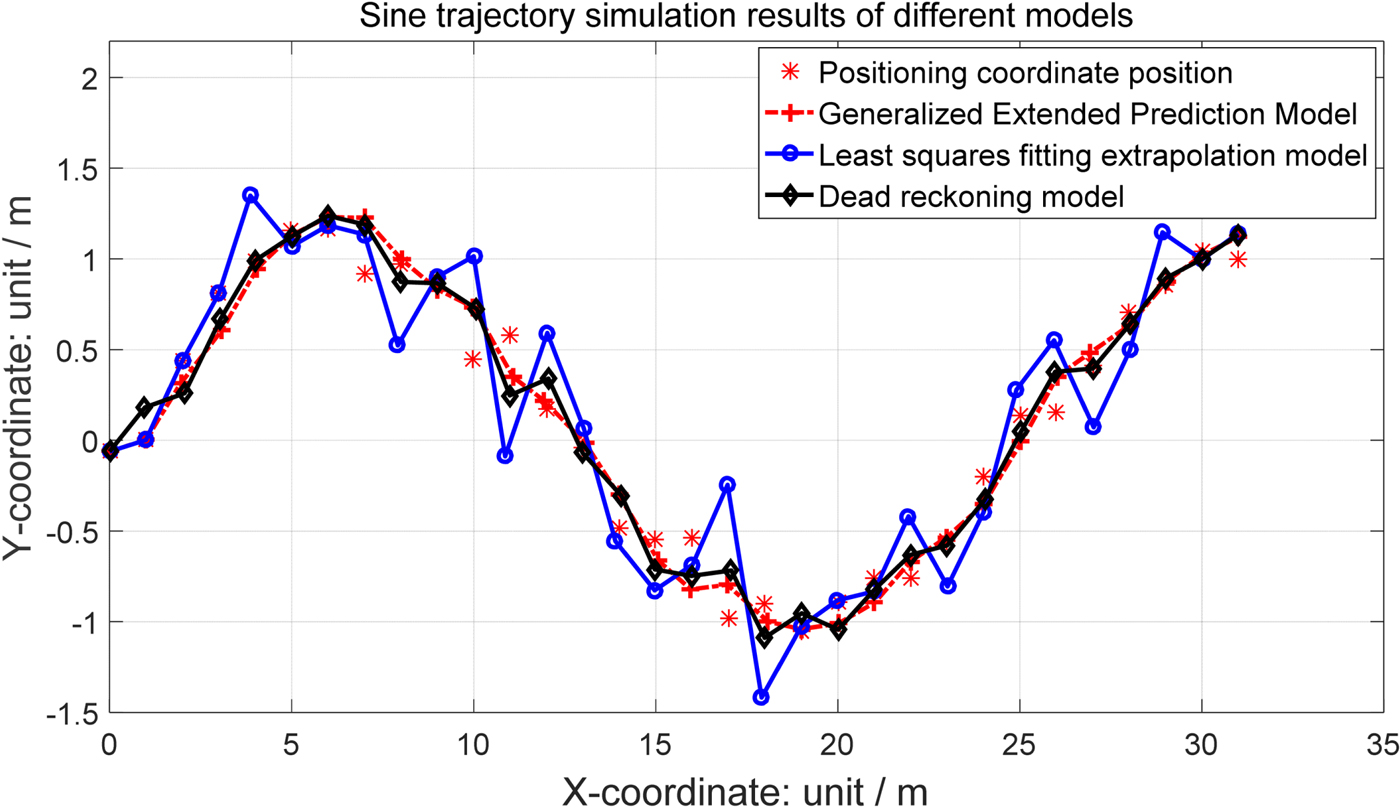
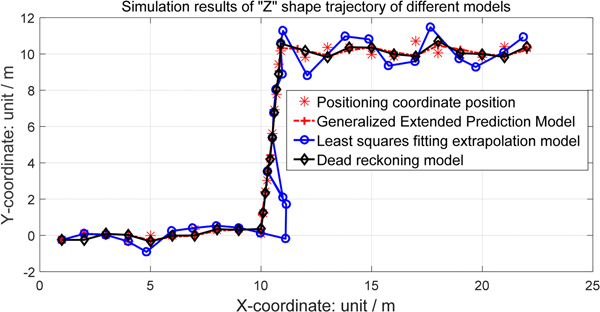
The simulation was based on the MATLAB-2012a simulation platform. First, a theoretical trajectory was defined and a random error was added to the theoretical trajectory to give initial positioning points. Epoch data was then extrapolated by using the generalised continuation extrapolated model, least squares fitting model and dead reckoning algorithm. The simulation results are shown in Figures 6 and 7. In the figures, the red “*” sign is the positioning coordinate. The dotted red line “ + ” is the positioning trace curve of the generalised extended prediction model, the straight blue line “o” is the positioning trace curve of the least squares fitting extrapolation model and the straight black line “⋄” is the positioning trace curve of the dead reckoning model.
Sine trajectory simulation results.

Simulation results of “ ” shape trajectory.

In Figures 6 and 7, the generalised extension extrapolated model proposed in this paper, the least squares extrapolated model and dead reckoning model are used to predict the next future position. According to Figures 6 and 7, using the least squares fitting model, the extrapolation data using the principle of inertia has an obvious overshoot phenomenon when a rapid change in platform motion direction occurs. The dead reckoning algorithm simplified the platform motion model to linear motion, so the prediction accuracy depends entirely on the positioning accuracy of the current point and time interval between two epochs. The positioning error of the current point is totally inherited in the prediction. The generalised extension extrapolated model can not only respond extremely quickly to the change of platform motion, but also makes full use of prior data, so it has a better accuracy for extrapolation.
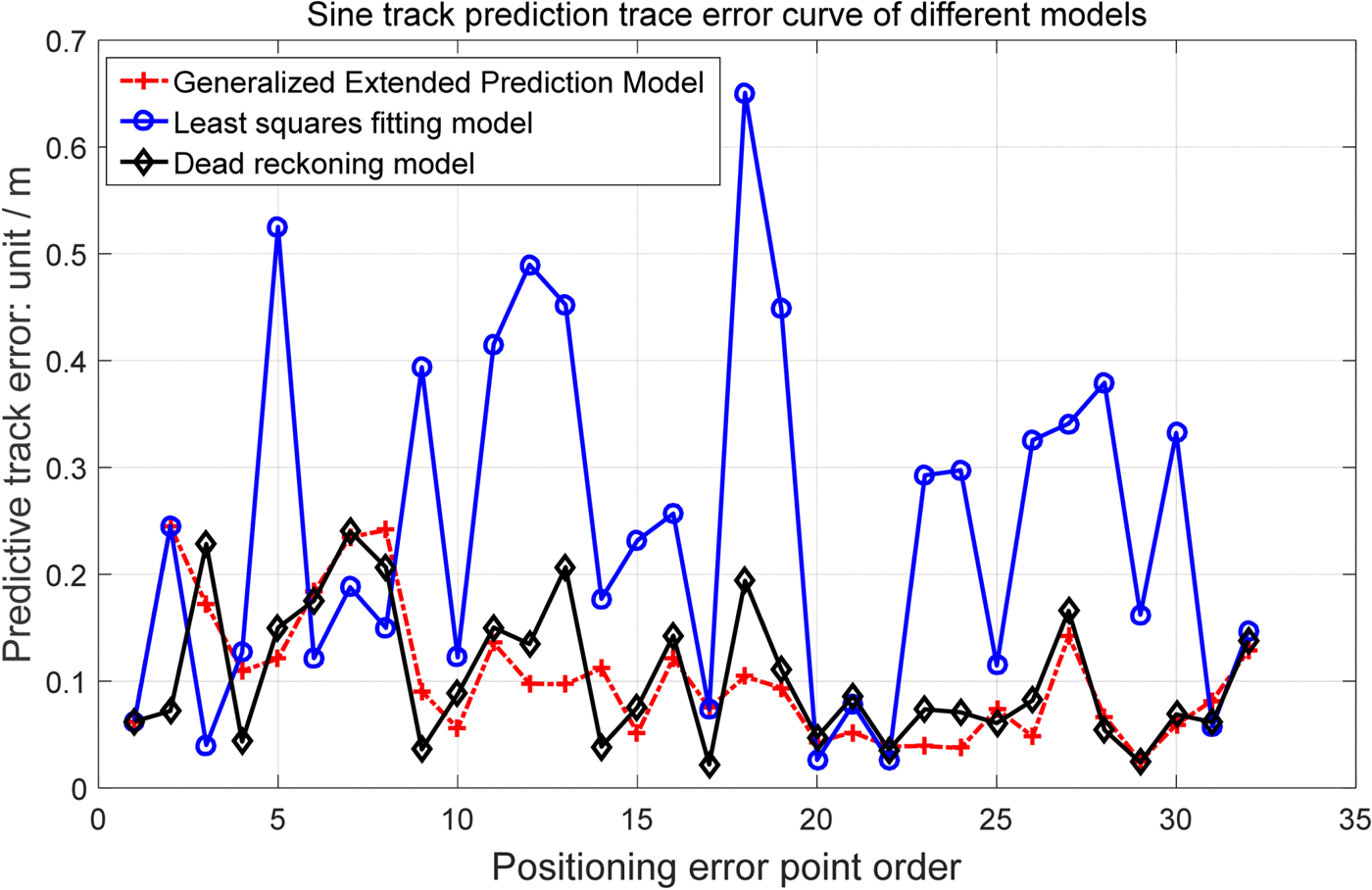
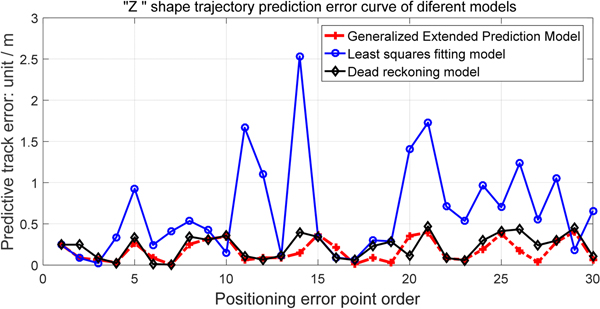
In order to further analyse the performance of the algorithm, the error curve of prediction values from different algorithms of two motion trajectories are shown in Figures 8 and 9. In the figures, the dotted red line “ + ” is the positioning error of the generalised extended prediction model, the straight blue line “o” is the positioning error of the least squares fitting extrapolation model, and the straight black line “⋄” is the positioning error of the dead reckoning model.
Sine track prediction trace error curve.

Prediction error of “” shape trajectory.

For the above two trajectories, the mean errors of the different models are shown in Table 1.
Different extrapolated model prediction error.

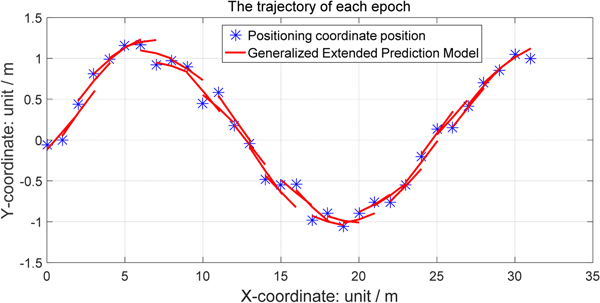
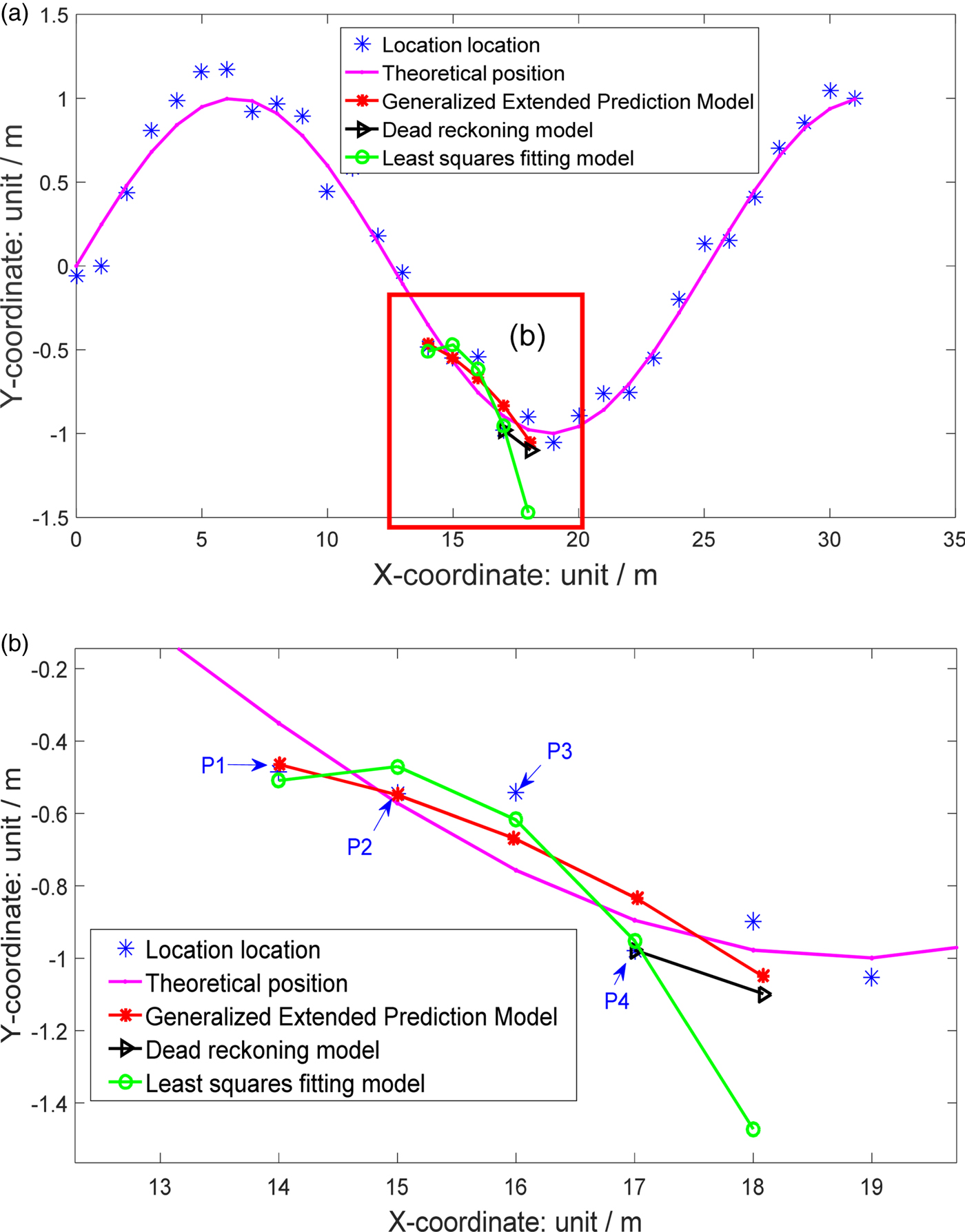
Table 1 shows that the prediction error of the generalised extension extrapolated model is less than 0.2 m, which is remarkably smaller than the prediction error of the least squares extrapolated model and the dead reckoning model. Therefore, the forecasting function can achieve a high precision. The extrapolated trajectory of each epoch under the sinusoidal trajectory is simulated and shown in Figure 10. Simultaneously the details of the prediction trajectories of the different algorithms under partial data are amplified, the results are shown in Figure 11. Figure 11(b) is an enlarged section of the red frame in Figure 11(a) to highlight the details of the positioning effect.
The trajectory of each epoch.

Extrapolated trajectory comparison chart.

In Figure 11(b), positioning points P 1, P 2, P 3, P 4 are known. The extrapolated predictive trajectories of the generalised extension extrapolation, the least squares extrapolation and the dead reckoning extrapolation are given, respectively. The theoretical position trajectory at the time of simulation and the predicted position trajectory under the three methods are given, and a partial magnification is given in the lower right corner. It can be seen from the partial enlargement diagram that the predicted value of the generalised extension extrapolated model is the closest to the theoretical position, the accuracy is higher than the initial positioning point at the next time, and the extrapolated curve is smoother. Therefore, the feasibility of the algorithm has been verified by simulation.
3.2. Experimental application in real environment
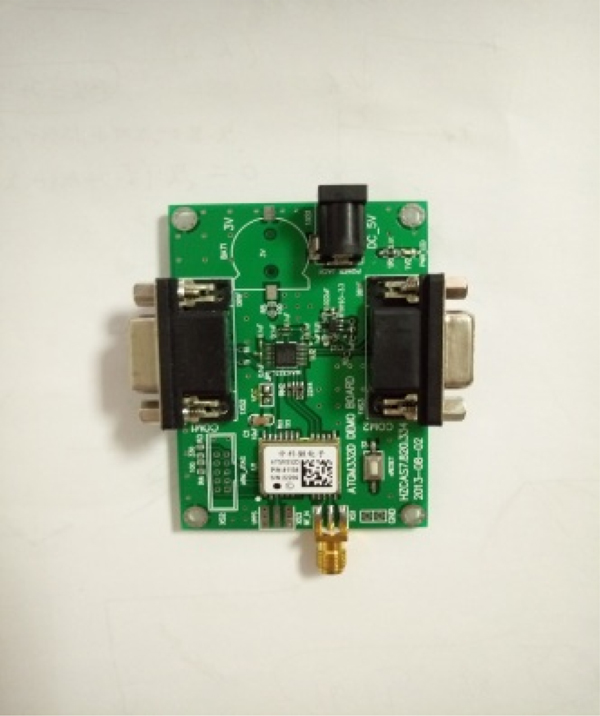
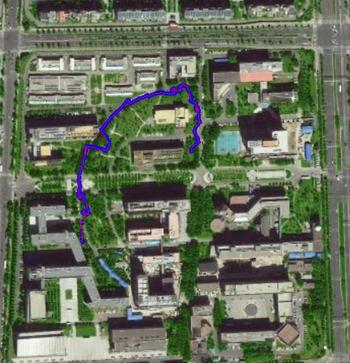
A GNSS receiver carried on chip ATGM332D from Zhongke microelectronics was selected to test car navigation positioning in the Beijing Olympic Park of the Chinese Academy of Sciences (CAS) to verify the practical application effect. The hardware of the receiver is shown in Figure 12. The receiver's mean positioning accuracy was 2·5 m (in Wide-Open Field). The tracking sensitivity was −162 dBm. The cold-start capture sensitivity was −148 dBm and the output frequency was 1 Hz.
GNSS receiver hardware device.

The detailed testing procedures are as follows.
1. Obtain some prior data through vehicular GNSS, such as P t−1(x t−1, y t−1), P t(x t, y t).
2. Use the prior data to extrapolate the position at the next time
 $P^{\prime}_{t+1}\lpar x^{\prime}_{t+1}\comma \; y^{\prime}_{t+1}\rpar $ by generalised extension extrapolated model.
3. At time t + 1, obtain the position P t+1(x t+1, y t+1) at time t + 1 through GNSS, which can be taken as prior data so that the position
$P^{\prime}_{t+2}\lpar x^{\prime}_{t+2}\comma \; y^{\prime}_{t+2}\rpar $ of the next time can be extrapolated.4. Obtain the location coordinate P t+2(x t+2, y t+2) at time t + 2, which can be taken as prior data so that the position
$P^{\prime}_{t+3}\lpar x^{\prime}_{t+3}\comma \; y^{\prime}_{t+3}\rpar $ of the next time can be extrapolated; repeat the above until time n.


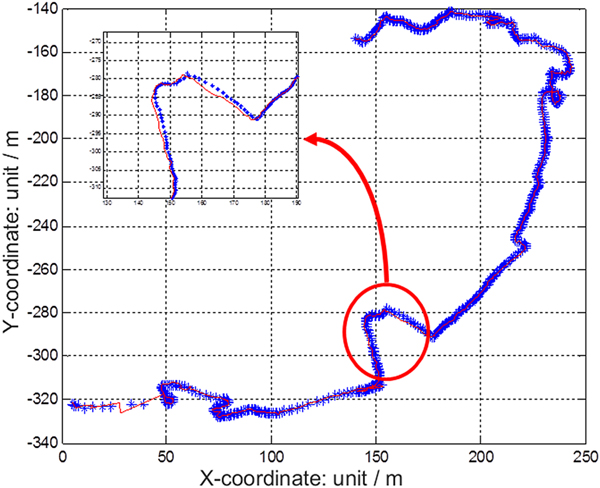
The test result is shown in Figure 13. The original location points P t−1, P t, P t+1, …, P n are marked with blue “*” in Figure 13. The extrapolated trajectory points  $P^{\prime}_{t-1}\comma \; P^{\prime}_{t}\comma \; \ldots\comma \; P^{\prime}_{n}$ are marked with the red curve in Figure 13. The velocity of the platform and course angle were provided by data from the $GPVTG message in GNSS positioning information.
Measured data extrapolated effect graph.

To further demonstrate the extrapolated effect of this method, Figure 14 gives a detailed view of the corner. The original location points are marked with blue “*”, the extrapolated trajectory points are marked with a red curve. From the enlargement diagram we can see that the method can also have good prediction effect when the vehicular vector angle is large and can provide real-time prediction of the moving trajectory at the next time with high extrapolation precision. Therefore, the practical feasibility of the algorithm is verified by the experiment in a real practical environment.
Measured data details.

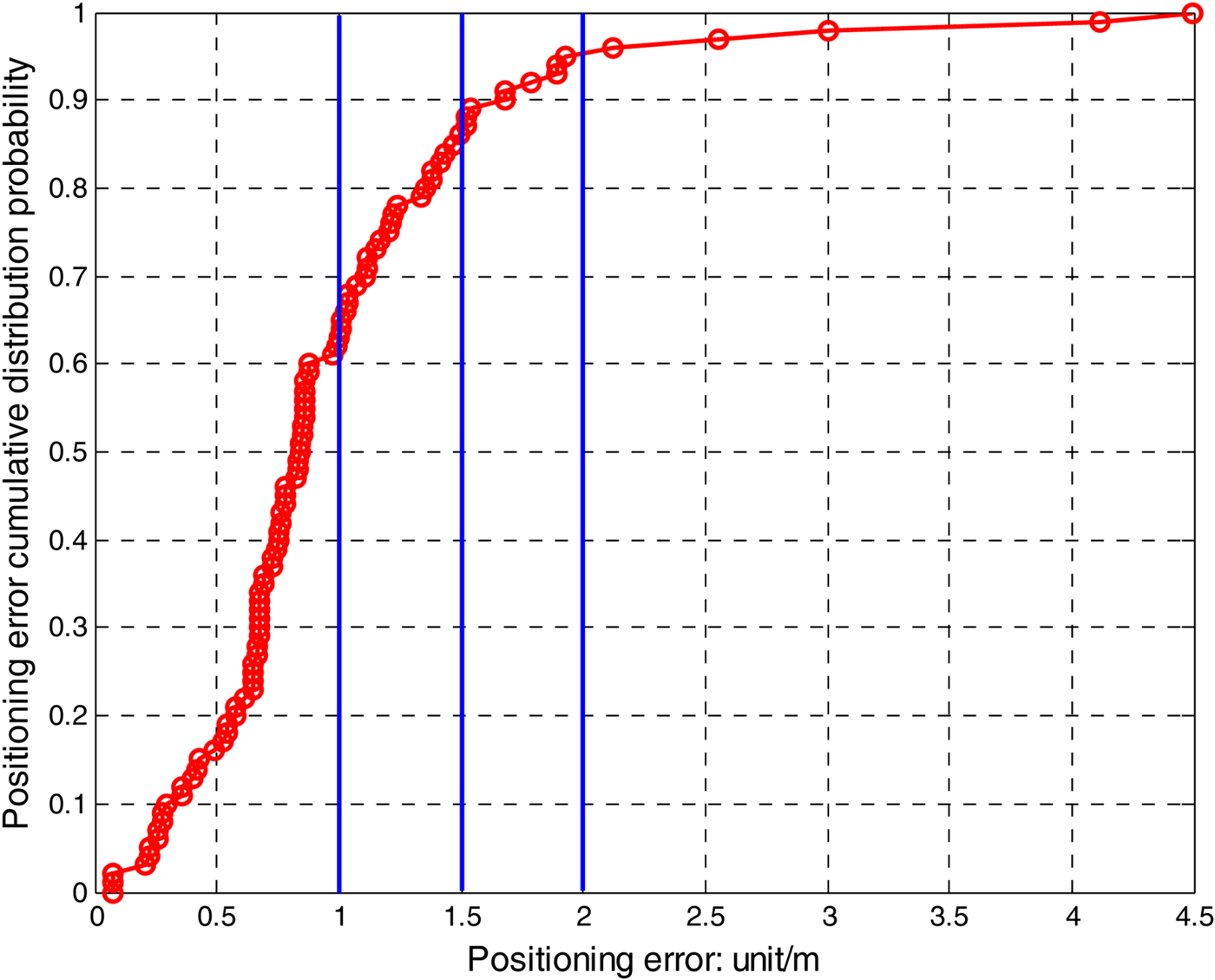
Figure 15 is the accumulation curve of the positioning trajectory error from Figure 14. It can be seen that the confidence probability distributions of the positioning errors within 1 m, 1.5 m and 2 m are 65.3%, 89.8% and 96.4%. The average positioning accuracy is 0.72 m and the positioning error of 90% probability is less than 1.5 m. Therefore, the proposed algorithm can achieve high-precision trajectory prediction for land vehicle navigation applications.
Positioning error cumulative distribution curve.

4. CONCLUSIONS
Dynamic trajectory prediction has become an active research direction in the field of navigation and positioning, especially for the analysis of highly dynamic platforms, for example in missile guidance systems and automotive applications. Trajectory prediction can improve the missile's hit rate, and may improve the performance of the missile's interception system. In an automotive positioning system, if the vehicle can predict the trajectory in advance, it can not only relieve traffic pressure, but also potentially reduce traffic accidents.
In order to reduce the complexity of the algorithm and improve the accuracy of the carrier trajectory prediction, and particularly solve the problem of real-time deterioration when the carrier movement direction changes greatly, a new generalised extension extrapolated model for dynamic trajectory prediction is introduced in this paper. The model uses information such as angle, velocity and a priori position trajectory data at the current platform time, and establishes quadratic function modelling of the predicted trajectory by using coordinate transformation. The feasibility of the algorithm has been verified by simulation and real environment experiments. The accuracy of the prediction error is less than 0.2 m, which is clearly smaller than with more traditional prediction algorithms. Therefore, it has high extrapolation accuracy. The experimental results show that the model can not only meet the extrapolated application under the normal operation of the platform but can also be applied for high precision prediction when a land vehicle platform is moving with a large anglular rate.
ACKNOWLEDGMENTS
This study is supported by the National Natural Science Foundation of China (No. 11603041).