Introduction
In the past 20 years, China's economy has flourished. However, there have been simultaneous reports of higher personal medical expenditure and increased divorce rate. These reports may be associated with large-scale psychological and social problems (Twenge, Reference Twenge2000; Xin et al., Reference Xin, Zhang and Liu2010), with the elderly being particularly vulnerable. A cross-temporal meta-analysis showed gradual birth cohort increases in depressive symptoms in Chinese older adults from 1987 to 2010 (Shao et al., Reference Shao, Li, Zhang, Zhang, Zhang and Qi2013). A particularly important negative indicator of happiness and cognitive ability in older people is loneliness (Gow et al., Reference Gow, Pattie, Whiteman, Whalley and Deary2007), although, to our knowledge, little research has considered changes in birth cohort in this content, particularly in China. Thus, in the present study, we aimed to examine whether loneliness levels in Chinese older adults had increased since the early 1990s and what social factors may have influenced any observed changes.
Loneliness (perceived social isolation) is a negative experience occurring when social needs and expectations are not fulfilled; it has significant life effects (Hawkley and Cacioppo, Reference Hawkley and Cacioppo2010). Loneliness has independent and chronic effects on physical and mental health (Cacioppo et al., Reference Cacioppo, Hughes, Waite, Hawkley and Thisted2006; Hawkley and Cacioppo, Reference Hawkley and Cacioppo2007). Further, it is a significant predictor of psychological factors such as negative life satisfaction (Gow et al., Reference Gow, Pattie, Whiteman, Whalley and Deary2007), suicide intention (Shiovitz-Ezra and Ayalon, Reference Shiovitz-Ezra and Ayalon2010), decline in cognitive ability (Gow et al., Reference Gow, Pattie, Whiteman, Whalley and Deary2007; Hawkley and Cacioppo, Reference Hawkley and Cacioppo2007; Andrew and Rockwood, Reference Andrew and Rockwood2010), and negative changes in intelligence over the life span (Gow et al., Reference Gow, Pattie, Whiteman, Whalley and Deary2007).
Given the combination of these dire effects of loneliness and older adults’ vulnerability, large-scale increase in loneliness could be detrimental to the national standard of living (through increased costs associated with medical, psychological, and economic problems). It is thus important to determine whether loneliness in Chinese older adults has indeed changed in recent decades, and if it has, then to determine what factors have governed these changes. It is also important to note that China is experiencing sharp increase in the number of older adults in its population, and is also a rapidly developing economy. These factors contribute to changes in the vulnerability of older adults to the experience of loneliness.
Yang and Victor (Reference Yang and Victor2008) reported an increase in loneliness over time when comparing the Survey of the Support System for the Elderly in China (SSSE) 1992 and the Survey of the Aged Population in China (SAS) 2000. However, the conclusiveness of this study may be limited: First and most importantly, the data analyzed were just from two time points (1992 and 2000), which may not exactly illustrate the changing tendency of loneliness across that period. Second, the two comparison studies employed different and simple measures of loneliness, such as loneliness was assessed by a single question in SSSE, “ni gan dao gu du ma?” (Do you feel lonely?), and the following single question was employed in SAP: “wo chang chang gan dao gu du” (I often feel lonely). One way to address limitations of these studies is to conduct a cross-temporal meta-analysis of loneliness studies.
Cross-temporal meta-analysis makes it possible to study birth cohort differences in scores on various psychological tests (Twenge, Reference Twenge2000; Twenge and Im, Reference Twenge and Im2007; Twenge and Kasser, Reference Twenge and Kasser2013). Furthermore, it is markedly different from conventional meta-analytic approaches. First, in cross-temporal meta-analysis, data are sampled sequentially by year collected and calculations take advantage of variances in mean psychological test scores, rather than effect size (Cohen's d). Second, cross-temporal meta-analysis compares multiple scores on one questionnaire over time, whereas conventional meta-analysis compares scores on multiple questionnaires each measuring the same construct (Twenge, Reference Twenge2000; Reference Twenge2011). By recording the year of administration of one scale for a series of equivalent samples, the cross-temporal meta-analysis is clearly reliable and valid. In China, an instrument widely employed to assess older adults’ loneliness is the University of California at Los Angeles Loneliness Scale, third version (UCLA LS-Ⅲ; Russell and Cutrona, Reference Russell and Cutrona1988). This scale has been in use since the 1990s, and therefore contains a useful database for the application of cross-temporal meta-analysis to reveal changes in loneliness over time.
Loneliness and the larger social environment
Bronfenbrenner (Reference Bronfenbrenner1979) proposed a theory that the environment influences the development of an individual through the myriad interactions among its layers, meaning that large-scale social changes may affect and even change individual's personality. This proposition has been supported by the findings of Twenge and colleagues (e.g. Twenge, Reference Twenge2000; Twenge and Im, Reference Twenge and Im2007). Previous models of loneliness have identified many significant contributing factors, for example, social networks, telephone contacts, physical illness, anxiety, income, and employment (de Jong Gierveld, Reference Gierveld1987; Wenger et al., Reference Wenger, Davies, Shahtahmasebi and Scott1996; Hawkley and Cacioppo, Reference Hawkley and Cacioppo2007). In the present study, we grouped these factors according to three constructs for explaining changes in loneliness. These are social connectedness (loneliness increases as social bonds weaken), economic conditions (loneliness increases as economic conditions deteriorate), and health threats (loneliness increases as health threats increase). There is already some evidence for these constructs from research concerning birth cohort effects on older adults’ loneliness (Bowman, Reference Bowman1955; Yang and Victor, Reference Yang and Victor2008). Therefore, we employed the following three key constructs: social connectedness, economic conditions, and health threats.
Low social connectedness
Social connectedness focuses on the level of connection a person feels with friends, family, coworkers, and society in general. People with high social connectedness often receive more acceptance and social support from groups they belong to. In contrast, people with low connectedness are frequently ignored and receive little social support (Bowman, Reference Bowman1955; Yang and Victor, Reference Yang and Victor2008). An influential review concluded that lack of connection with society may lead to alienation and feelings of loneliness (Epley et al., Reference Epley, Akalis, Waytz and Cacioppo2008). Researchers have also found that higher levels of social support are correlated with fewer self-reports of loneliness (Gow et al., Reference Gow, Pattie, Whiteman, Whalley and Deary2007; de Jong Gierveld and Tesch-Romer, Reference de Jong Gierveld and Tesch-Römer2012), especially in China (Zhan and Montgomery, Reference Zhan and Montgomery2003).
Recently, Chinese society has experienced a noticeable decrease in social connectedness (Li et al., Reference Li, Liang, Toler and Gu2005) and many social statistics confirm this assertion. The divorce rate has doubled in the past 20 years and may have contributed to negative effects on family relationships, reduced intimacy levels, and increasing loneliness in the elderly, especially in the context of China's collectivist culture (Katz et al., Reference Katz, Lowenstein, Phillips, Daatland, Bengston, Acock, Klein and Dilworth-Anderson2005). In addition, the increased industrialization of cities (and increasingly many counties) has disrupted the traditional family structure, resulting in larger numbers of non-traditional (empty-nest, skip-generation, by-turns) families and reduced connectedness between family members (Tian, Reference Tian2002; Ogunseitan, Reference Ogunseitan2005). Indeed, there is no doubt that low social connectedness may lead to loneliness (Zhan and Montgomery, Reference Zhan and Montgomery2003; Yang and Victor, Reference Yang and Victor2008). Therefore, we selected the variables “divorce rate” and “urbanization level” as measures of the social connectedness construct.
Economic conditions
Economic conditions, in the present study, are defined as the state of economy in China. The changed economic conditions may influence individual's income, daily expenses, and living conditions. Authors have found that finance or income-related issues negatively correlated with loneliness in the elderly adults (Li et al., Reference Li, Liang, Toler and Gu2005). Certainly, economic difficulties are detrimental to the quality of life for older adults and may lead to social withdrawal; for older adults, financial problems may be viewed as a threat and be associated with loneliness (de Jong Gierveld and Tesch-Romer, Reference de Jong Gierveld and Tesch-Römer2012).
Although a wider perspective indicates that China's economy is booming, according to the National Bureau of Statistics of China (2012), the unemployment rate has increased dramatically in the last three decades. Most Chinese older adults depend on their children to support them and will often experience poverty if their children are unemployed. Thus, living conditions of older adults may be threatened by unemployment rate, which may finally lead to more loneliness (Yang and Victor, Reference Yang and Victor2008). In addition to unemployment rate, the Gini coefficient, a measure of inequality of income and wealth, has risen from 0.3 to 0.47 in the past 30 years, indicating that the country is experiencing greater economic inequality. A series of studies have showed that this deepening socioeconomic inequality may have led to an increase in loneliness (e.g. de Jong Gierveld et al., Reference de Jong Gierveld, Van, Dykstra, Vangelisti and Perlman2006). Thus, for the present study, we selected the variables, “Gini coefficient” and “unemployment rate” as measures of the economic conditions construct.
Health threats
In the present study, health threats, as measured by overall health conditions, were defined as the number of people with an illness, injury impairment, or physical or mental problem who went to hospital, and by expenditures for hospital care in China. We defined health threat in this way because we proposed that poor overall health contributes the most serious threat to health. The state of health of people is negatively associated with general emotional well-being (Liu and Guo, Reference Liu and Guo2008) and positively with levels of loneliness (Victor et al., Reference Victor, Scambler, Bowling and Bond2005; Yang and Victor, Reference Yang and Victor2008). Further, increased health threat poses an explicit health problem, but can also implicitly lead to anxiety or fear about health. Threats to health can occur when the activities of older people are limited by themselves, families, or communities, indicating that the social network of older people may be diminished by health threats and may result in greater social isolation (de Jong Gierveld, Reference Gierveld1987; de Jong Gierveld et al., Reference de Jong Gierveld, Van, Dykstra, Vangelisti and Perlman2006; Hawkley and Cacioppo, Reference Hawkley and Cacioppo2007).
Numerous social statistics illustrate a rise in health threats to Chinese people. In the past 30 years, the number of people who went to hospital with illness, injury, and physical or mental conditions has doubled. This increased number of patients may reflect poor health conditions and an associated increase in health threats. In addition, personal medical expenditure increased by 68 times from 1985 (¥26.4) to 2011 (¥1801.2). This increased expenditure may indicate that more people had serious health problems or that health problems were more frequent during this period. In accordance with current statistics, we concluded that Chinese people have confronted severe health threats in the past 30 years. Therefore, we selected the variables “number of patients” and “personal medical expenditure” as measures of the health threats construct.
The current study
We examined changes in loneliness of Chinese older adults since the early 1990s and sought to identify relevant social indicators of change. Given the changes in socioeconomic status and health threat described above, we expected an increase in the loneliness of Chinese older adults across last few decades. Thus, we utilized a cross-temporal meta-analysis to study birth cohort differences in loneliness (Twenge, Reference Twenge2000; Reference Twenge2011; Twenge and Im, Reference Twenge and Im2007; Twenge and Kasser, Reference Twenge and Kasser2013). We then employed correlation and regression analyses to identify correlations between social indicators and loneliness.
Methods
Measurements and literature search
In China, the most prevalent questionnaire for measuring loneliness is the UCLA LS-Ⅲ (Russell and Cutrona, Reference Russell and Cutrona1988), which consists of 20 items rated on a 4-point scale (1 = never, 4 = often). Higher scores indicate more intense feelings of loneliness. We analyzed data from Chinese studies that employed the UCLA-Ⅲ (Chinese version translated by Wang et al., Reference Wang, Wang and Ma1993) and reported scores for older adults.
In order to make the data representative of respective birth cohort populations, we used “aging,” “Chinese,” and “UCLA loneliness scale” as key terms to search the three most prevalent Chinese academic databases: Wanfang Date, China National Knowledge Infrastructure (CNKI), and Chongqing VIP. Collectively, these databases contain a vast majority of Chinese social science literature. Further, using the same keywords, we searched the following four English language academic databases: Web of Science, ProQuest Psychology Journals, ProQuest Education Journals, and PsycARICLES.
Inclusion criteria
We established specific criteria for including studies in meta-analysis: (a) all participants had to be Chinese (excluding those from Hong Kong, Macao, and Taiwan) older adults; (b) participants were healthy, at least 60 years of age, and not staying in a hospital; (c) studies had employed the UCLA LS-Ⅲ to measure older adults’ loneliness; (d) studies reported the means, mean deviations, and sample sizes for the total sample; and (e) if the same data set was published repeatedly, the earliest study was included. Furthermore, if the time of data collection was not reported, the year of data collection was coded as two years before publication (Oliver and Hyde, Reference Oliver and Hyde1993; Twenge and Im, Reference Twenge and Im2007).
In accordance with the literature search and screening, we obtained 25 articles of interest containing data from 13,280 older adults collected between 1995 and 2011 (for details of articles, see supplementary Table 1, available as supplementary material attached to the electronic version of this paper at www.journals.cambridge.org/jid_IPG). We assumed that these 13,280 older adults represent their peers in the same decade according to the literature search and the established criteria. In the 25 articles of interest, only one paper did not report the standard deviation statistics. We therefore included this paper in the correlation and regression analyses, but excluded it when calculating effect sizes (Twenge and Im, Reference Twenge and Im2007).
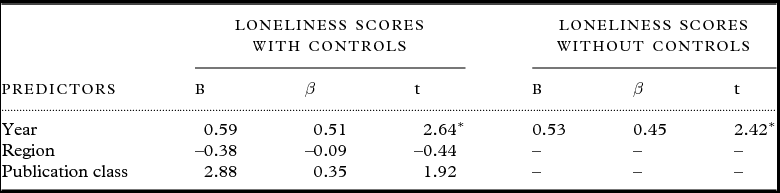
Correlations between loneliness and data collection year, weighted by sample size. Number of studies = 25

Notes: Year = year data collected; region = east, northeast, middle, or west China; publication type = first class, second class, third class.
*p < 0.05.
Sources of social indicators
Social indicators were selected using two main criteria identified by Twenge (Reference Twenge2000): (1) Indicators had to be readily available and easily quantified as meaningful continuous variables, and (2) indicators were selected as representatives of general trends. By applying these criteria, the selected indicators were divorce rate, urbanization level, the Gini coefficient, personal medical expenditure, unemployment rate, and number of patients (as noted above). The data sources were the China Statistical Yearbook (National Bureau of Statistics of China, 2012), China Health Statistical Yearbook (Ministry of Health, 2012), and Social Development Statistical Bulletin (Ministry of Civil Affairs, 2012). According to previous studies (Twenge, Reference Twenge2000; Xin et al., Reference Xin, Zhang and Liu2010) and current expectations, we defined divorce rate and urbanization level as indices of social connectedness, the Gini coefficient and unemployment rate as indices of economic conditions, and personal medical expenditure and number of patients as indices of overall threat.
Control variables
We acknowledge that regional differences in participant and type/quality of publication may be confounded with the loneliness data for older adults. Therefore, we controlled these two variables. The Chinese region was coded into four parts: east, central, west, and multiple (participants contributed toward the data in two or more regions; Xin et al., Reference Xin, Zhang and Liu2010). Publications were classified and coded according to three types: (a) first class, including Social Science Citation Index (SSCI), Science Citation Index (SCI), Chinese Social Science Citation Index (CSSCI), and Chinese Science Citation Index (CSCI); (b) second class (publication from other academic sources); and (c) third class (dissertations and master's theses).
Results
Correlations between mean scores of loneliness and year
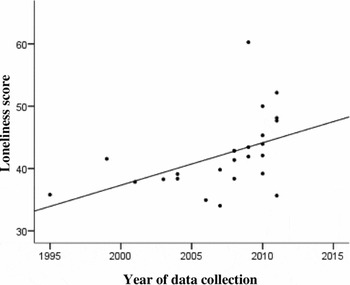
The meta-analysis revealed that in older adults in China, levels of loneliness increased between 1995 and 2011 (see Figure 1). When sample size was weighted, there was a significant correlation between loneliness scores and year of data collection (r = 0.45, p < 0.05). Importantly, when two potentially confounding variables (region and publication type) were controlled, the correlation remained significant (r = 0.51, p < 0.05), indicating a linear effect of loneliness scores over time (see Table 1). There was no significant correlation between loneliness level and either region or publication type.
Changes in Chinese older adults’ level of loneliness, 1995–2011. Note a steady (linear) increase in reported loneliness with time.

Magnitude of change
While there was significant increase in older adults’ loneliness, the more important question relates to the size of this effect. To assess this, we used regression equations weighted by the sample size. The regression formula was y = Bx + C, with B entered as an unstandardized regression coefficient, x as a year, C as a constant, and y as mean score. This formula yielded the position of the regression line (loneliness scores on the y-axis) for a particular year. We then obtained the average standard deviation (SD) by averaging the within-sample SD scores reported in the articles of interest; this reflects the average variance of the loneliness measure in the sample of individuals. It is important to note that this method avoids ecological fallacy (Twenge and Im, Reference Twenge and Im2007).
The regression equation showed that the mean scores for loneliness increased by 8.94 over the period of interest, representing an increase of 1.02 in SD from 1995 to 2011. According to Cohen (Reference Cohen1992), this is a large effect size (i.e., it exceeds the value of d > 0.8). We converted the d-value (1.02) into a value for r2 (variance explained by the year) and found that the proportion of variance explained was 21% (see Table 2).
Magnitude of change in loneliness among Chinese older adults from 1995 to 2011

Correlations of loneliness with social indicators
We were interested in further investigating the specific social indicators underlying increase in loneliness in older adults. We therefore assessed the correlation between loneliness scores and select social indicators for the following three periods (Twenge, Reference Twenge2000): (a) ten years before data were collected, (b) five years before data were collected, and (c) during the year of data collection.
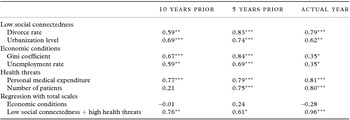
Low social connectedness was a good predictor of loneliness scores (Table 3). Urbanization level and divorce rate generally preceded loneliness levels, and both were positively correlated with loneliness scores for all periods (p < 0.01).
Correlations between social indicators and Chinese older adults’ loneliness scores, weighted by sample size, from 1995 to 2011. Number of studies = 25

Notes: “Total scales” refers to the above indices combined.
*p < 0.05; ** p < 0.01; *** p < 0.001.
Results for economic condition variables were significant. The Gini coefficient and unemployment rate were significantly and positively related to increased loneliness for all time periods (p < 0.05).
Health threats were good predictors of loneliness. Personal medical expenditure significantly and positively predicted loneliness (p < 0.001). For the number of patients, correlations for all periods were positive and significant (p < 0.01), except for the ten years before data were collected.
Our analyses suggest that aspects of the larger environment affect levels of loneliness in older adults; however, we were further interested in the most influential social indicators. To investigate this, we converted social statistics in each category into z-scores, and constructed indices. Since low social connectedness and high levels of health threat were significantly correlated (r = 0.92, p < 0.001), these two indicators were combined into a single index (social connectedness/health threats). We then entered the two indices (economic and social connectedness/health threats) into a regression equation with loneliness scores as dependent variable. When the social connectedness/health threats index was controlled, economic conditions were not good predictors of loneliness. However, when the economic conditions index was controlled, the social connectedness/health threats index was a good predictor of loneliness scores. Thus, low social connectedness and high levels of health threat explained loneliness, whereas economic hardship did not.
Discussion
Consistent with our hypothesis, we found that loneliness increased in Chinese older adults between 1995 and 2011. Further, we found that the macro-environment has a significant effect on the levels of loneliness. Social problems such as increased divorce rate, urbanization level, personal medical expenditures, the Gini coefficient, and unemployment rate all predicted loneliness in Chinese older adults.
In the current study, divorce rate, urbanization level, personal medical expenditures, the Gini coefficient, and unemployment rate were all good predictors of loneliness in older adults regardless of time period (at testing five or ten years prior). Urbanization levels may have been a good predictor due to the migration of young people away from their parents’ homes (Yang et al., Reference Yang2013), but this migration likely caused an increase in the number of older adults who live alone. Urbanization is also associated with the migration of some older adults to reside with their children in urban settings, meaning that older people leave their hometowns and therefore their existing social supports (Li et al., Reference Li, Liang, Toler and Gu2005; Yang and Victor, Reference Yang and Victor2008), perhaps causing further loneliness (de Jong Gierveld et al., Reference de Jong Gierveld, Dykstra and Schenk2012; Warner and Kelley-Moore, Reference Warner and Kelley-Moore2012).
As a good predictor of loneliness, marital state shows possessed cross-cultural homogeneity (Dykstra and de Jong Gierveld, Reference Dykstra and de Jong Gierveld2004; Victor et al., Reference Victor, Scambler, Bowling and Bond2005) but may be especially vital in collective societies such as China (Yang and Victor, Reference Yang and Victor2008). Problems surrounding divorce are not confined to the divorcing couple but may also cause problems for the entire family. It is especially detrimental for older people who are concerned with family integrity and treat divorce as a humiliating event, thus resulting in more loneliness with increased divorce rate (Yang and Victor, Reference Yang and Victor2008). Among older people, marriage may act to prevent loneliness, that is, it is a crucial predictor of low levels of loneliness (de Jong Gierveld et al., Reference de Jong Gierveld, Dykstra and Schenk2012). The increasing divorce rate, therefore, may have contributed to greater loneliness among older adults.
Increasing personal medical expenses also contributed to loneliness in elderly adults. Since medical insurance is underdeveloped in China, this increase in expenditures is associated with an increase in health problems and survival threat. In addition, increasing health problems may make people vulnerable to loneliness by reducing their ability to take part in social activities (de Jong Gierveld and Dykstra, Reference de Jong Gierveld and Dykstra2008).
An increase in the Gini coefficient between 1995 and 2011 indicated that wealth gaps between the rich and poor have increased steadily. In this context, culture may be important because most Chinese people are more concerned with the relative average of resource distribution. They consider more about resource differences with others such as income and living conditions (Xing, Reference Xing2011). Sharp changes (inequality) in income and living conditions may therefore cause older people to feel lonelier (de Jong Gierveld et al., Reference de Jong Gierveld, Van, Dykstra, Vangelisti and Perlman2006; Halleröd, Reference Halleröd2009).
As Chinese older adults usually rely on their adult children, and these children themselves tend to feel considerable pressure to acquire and maintain employment, the increasing unemployment rate among young adults may contribute to reduce social and economic support for older adults, thereby increasing their loneliness (Yang and Victor, Reference Yang and Victor2008).
Effects of low social connectedness and high levels of health threat
The present study found that low social connectedness and high levels of health threat were associated with an increase in loneliness among Chinese older adults. It is clear that societies with low levels of social connectedness (Epley et al., Reference Epley, Akalis, Waytz and Cacioppo2008) and high overall levels of health threat may lead to increasing loneliness in the population of older adults (Cacioppo et al., Reference Cacioppo2002). Such results demonstrate the singular importance of social bonds, attachment to other human beings, and physical and psychological quality of life. For example, it has been shown that an individual's mental health can be affected by negative changes in macro-environment (Bronfenbrenner, Reference Bronfenbrenner1979).
One surprising finding of the present study was that economic conditions appeared to have little independent effect on loneliness. Although several authors have claimed that economic status correlated with loneliness among elderly adults (Li et al., Reference Li, Liang, Toler and Gu2005), social and emotional influences should clearly not be ruled out, as shown by the results of the present and previous studies (Zhan and Montgomery, Reference Zhan and Montgomery2003; Yang and Victor, Reference Yang and Victor2008). To some extent, we can explain our findings using the social–emotional selectivity theory, which suggests an increased need for emotion regulation and familiar, intimate relations in later adulthood, over and above the need for economic substance (Charles and Carstensen, Reference Charles, Carstensen and Gross2007). Indeed, research has shown that older people living in one-person households are at higher risk of social isolation and loneliness (Victor et al., Reference Victor, Scambler, Bond and Bowling2000; Dykstra and de Jong Gierveld, Reference Dykstra and de Jong Gierveld2004). Therefore, it may be the perception rather than the reality that is more important in the development of loneliness.
Implications and limitations
Our findings have far-reaching implications in applied and clinical contexts. The results concerning the several social indicators of loneliness in the elderly suggest that higher levels of social connectedness could be achieved by providing more family and social support and general social stability for elderly citizens. In addition, helping older adults to maintain good physical and psychological quality of life may reduce their loneliness (Hawkley and Cacioppo, Reference Hawkley and Cacioppo2007).
Another implication of the present study concerns interventions designed by clinical psychologists to enhance a sense of connectedness in the population with the expectation that loneliness will be reduced (Yárnoz et al., Reference Yárnoz, Plazaola and Etxeberria2008). Most of these interventions have focused on microenvironments such as a person or a group. However, our results suggest that the macro-environment plays a significant role in either increasing or reducing the loneliness of older adults. This demonstrates that interventions for reducing loneliness in older people could be designed at the macro (societal) as well as micro (individual) levels.
Limitations
Although the present research utilized the reliable and valid UCLA LS-III, other instruments (e.g., the Rasch-type scale) have been employed to explore loneliness changes and their social indicators among Chinese elderly citizens. To improve on our findings, further studies should analyze results from different types of scales in order to deepen the understanding of loneliness as it relates to aging. A particular limitation of our study was that since we chose to focus on a relatively short time period, the number of studies meeting our criteria was fewer than for previous meta-analyses (Twenge, Reference Twenge2000; Xin et al., Reference Xin, Zhang and Liu2010; Xin et al., Reference Xin, Niu and Chi2012).
Conclusions
Loneliness levels in Chinese older adults increased by more than 1 SD from 1995 to 2011. In light of our findings, it seems pertinent to discuss how to reduce loneliness in the older adult population in China. Our results suggest that increasing the social connectedness and decreasing the level of health threat would be effective in combating loneliness. Furthermore, decreasing the rate of urbanization and working toward minimizing the divorce rate would result in better social integration and less loneliness of older adults. Other pertinent goals should be to improve physical and psychological quality of life for older people. If measures are taken to at least partially address these societal problems, there should be a corresponding decrease in loneliness as measured at the national level.
Conflict of interest
None.
Description of authors’ roles
Zhimin Yan and Xun Yang contributed equally to this study and should be regarded as joint first authors. Zhimin Yan and Xun Yang posited the research question and were responsible for the statistical design and analyses and writing the manuscript. Lin Yu supervised the statistical analyses and assisted with writing the manuscript. Lei Wang and Yuhan Zhao helped in collecting the data and gave some advice concerning data analysis.
Acknowledgments
We would like to thank Dr. Glenn Hitchman for his considerate and thoughtful help for English manuscript. This research was funded by Research Team Projects, School of Psychology at Southwest University (TR201204-3).