





1. Introduction: the issues
A fruitful strategy for researching agreement has been to look at instances where simple matching of feature values fails. These instances include lexical hybrids (like family) and constructional mismatches (like brother and sister), which allow singular (syntactic) agreement in attributive position and plural (semantic) agreement in the predicate. I shall enrich the range of evidence by analyzing examples based on metonymy of different types and their interactions. This proves a substantial step forward. First, because metonymy productively induces agreement alternatives, thus dramatically increasing the material available to work with. Second, because metonymy creates surprising effects on agreement, as novel data from Norwegian and Lithuanian demonstrate. And third, because these new types of agreement alternative do not fit straightforwardly into familiar notions of ‘semantic agreement’. I therefore propose an explicit underpinning of this notion in a way which allows us to accommodate the new patterns of agreement. Specifically, I formalize ‘semantic agreement’ by invoking the Hierarchy of Agreement Sources, as a valuable complement to the Agreement Hierarchy. And while most agreement alternatives are binary, a further type of progress is to show how the metonymy data enable us to take forward the analysis of agreement systems with three and more possibilities.
Linguistic metonymy involves substituting one term for a closely related one. It covers patterns of transfer of the type ‘a writer’s name can be used for reference to their work’, as in I enjoy reading Jane Austen. Several terms are in use (Ward Reference Ward2004: 262–263, Nunberg Reference Nunberg, Horn and Ward2006: 350), including ‘regular polysemy’ (Apresjan Reference Apresjan1974) and ‘logical metonymy’ (Pustejovsky Reference Pustejovsky1995). Routes into the substantial literature are given in Section 7.1. Nunberg analyzes examples of metonymy like (1)Footnote 1 , Footnote 2:
-
(1) English (eng, Nunberg Reference Nunberg1995: 115)
That (*those) french fries is (*are) getting impatient.
Since such examples require a specialized context, Nunberg (Reference Nunberg1995: 116) calls this an ‘occurrent metonymy’.Footnote 3 Example (1) would work in a restaurant, used by a waiter to refer to a customer by means of the dish ordered. This usage, perhaps unfamiliar, becomes more accessible given the right context. Hence, for linguists going out after a guest talk, saying to a waiter the french fries is at the other end of the table is a more promising pragmatic gambit than the french fries are for the visiting phonologist.
These English examples do not give rise to agreement alternatives, as Nunberg’s judgments in (1) indicate. The referent, the customer, is an individual, and this accounts for the singular agreements (the plural appears for multiple customers). This fits a pattern: English is typologically extreme in giving semantic factors a major role in agreement (Corbett Reference Corbett2006: 32):
five pounds/dollars is too much, the United States is restricting imports, the Brothers Karamazov always moves me, to walk and to chew gum is challenging, pie and chips is always popular, the Times hasn’t covered this story, Australia have won the test match.
This means that to understand metonymy and its interaction with agreement more fully, we must look beyond examples like (1). We need situations where metonymy induces agreement alternatives. I therefore analyze languages other than English, and agreement in gender as well as in number.Footnote 4 I begin with German in Section 2, and specifically instrument-for-player metonymy, where the gender of the instrument may not match that of the player. Section 3 reviews the typology of agreement alternatives, aiming to handle the patterns induced by metonymy while using existing machinery. We want a typology to work, of course, but we now also demand an ‘underpinning’, an account of how it relates to the underlying attributes of a domain (Round & Corbett Reference Round and Corbett2020: 495–496). This has been provided for the Agreement Hierarchy, at least as far as the notion of ‘semantic agreement’ is concerned, by the complementary Hierarchy of Agreement Sources in Corbett (Reference Corbett2023).Footnote 5 To go further, I turn to new data from Norwegian (Section 4). The rich evidence of Norwegian includes not only instrument-for-player metonymy but also entity-for-eventuality metonymy. This combination enables us to contrast and isolate the different sources of agreement specification. From this fertile source of agreement alternatives, I move on to a more general review of systems with multiple (more than two) agreement alternatives in Section 5. And then I examine confirming evidence from Lithuanian (Section 6), which is significant since the morphosyntactic environment is rather different from that of Norwegian but the key alternatives, and their relation to each other, remain the same. The themes of agreement and metonymy are pulled together in Section 7.
The paper makes three main contributions: (i) it expands the range of agreement alternatives by integrating two types of metonymy, which are distinguished by their agreement profiles; (ii) it provides a principled underpinning for ‘generalized semantic agreement’ by anchoring it to the sources of agreement specifications; and (iii) it advances the typology of those rare agreement constructions which induce more than two outcomes.
2. Metonymy and agreement: German
Drawing on material in Panther (Reference Panther, Brdar-Szabó, Knipf-Komlósi and Péteri2009), Köpcke, Panther and Zubin (Reference Köpcke, Panther, Zubin, Schmid and Handl2010: 176–178) discuss this key example:
(2)
German (deu, Egg Reference Egg2004: 45)
Gitarre
gesucht,
die
sich
nicht
zu
schade
ist,
guitar(f)
seek.pst.ptcp
rel.sg.
f
refl
neg
to
pity
be.prs.3sg
auch
mal
den
Bass
in
die
Hand
also
sometimes
def.sg.m.acc
bass(m)
in
det.sg.f.acc
hand(f)
zu
nehm-en.
to
take-inf
‘Guitar [player] wanted who is not above also playing bass sometimes.’
Egg (Reference Egg2004: 45) uses this example to show the fluidity between lexical and transferred meaning (compare
Gitarre
‘guitar’ and
Bass
‘bass’ in (2)). Köpcke, Panther and Zubin (Reference Köpcke, Panther, Zubin, Schmid and Handl2010: 176–178) home in on the agreement issue, which is also our focus. In (2) a feminine noun Gitarre ‘guitar’ is used metonymically of the player. This works in the specialized context of the music world; note that this usage is not blocked by the existence of
Gitarrist(in)
‘guitarist’. Köpcke, Panther and Zubin assume a male guitarist; even then the relative pronoun in German must be
die
, which is feminine, as in (2). A possible continuation is this:
(3)
German, continuing (2) (Köpcke, Panther & Zubin Reference Köpcke, Panther, Zubin, Schmid and Handl2010: 177)
Er
sollte
auch
Schlagzeug
spiel-en
könn-en.
3sg.
m
should
also
drums(n)
play-inf
can-inf
‘He should also be able to play the drums.’
In this increasingly optimistic advert, the personal pronoun is masculine. There are other agreements to consider:
(4)
German (Köpcke, Panther & Zubin Reference Köpcke, Panther, Zubin, Schmid and Handl2010: 177)
Die
erst-e
Geige
hat
leider
gestern
nach
det.sg.f
first-sg.f
violin(f)
aux.3sg
unfortunately
yesterday
after
dem
Konzert
sein-e
Partitur
vergessen.
det.sg.n.dat
concert(n)
poss.3sg.
m
-sg.f.acc
score(f)
forget.pst.ptcp
‘Unfortunately the first violin forgot his score after the concert yesterday.’
In (4) we see that the attributive modifiers are feminine singular, even though the intended referent is male (Köpcke, Panther & Zubin again choose a male referent, since a female referent would not give rise to the difference in agreement). This shows the important contrast with English examples like (1) where, even within the nominal phrase, agreement in number is determined by the possessor, and the agreements are consistent across agreement targets. The possessive pronoun in (4) also deserves attention. The important part is the stem sein- ‘his’, which is masculine singular, controlled by the referent. (The inflection ‑e is feminine singular, marking agreement with Partitur ‘(musical) score’, which is feminine; this is not relevant here.) Possible continuations of (4) would require the masculine pronoun er. Thus, taking together examples (2), (3) and (4), the judgements of Köpcke, Panther and Zubin give this picture:
-
• attributive position: gender agreement controlled by the noun
-
• predicate: no gender agreement available in GermanFootnote 6
-
• relative pronoun: gender agreement controlled by the noun
-
• possessiveFootnote 7 and personal pronouns: gender agreement according to the referent
The important point to retain is that the German examples (2)–(4) reveal the competition between two sources of featural specification for agreement. The first is the morphosyntactic specification of the lexeme ( Gitarre ‘guitar’ or Geige ‘violin’, both feminine), the value given in our glossing. The second source is less obvious; I suggest that it is the lexical semantics of the noun, in its metonymic use (it is used of a male, hence masculine); compare Köpcke, Panther and Zubin (Reference Köpcke, Panther, Zubin, Schmid and Handl2010: 176–177). To justify this analysis, I review the constraints on such alternatives (Section 3) and return to the German data in Section 3.5. At that point the fuller data available in Norwegian (Section 4) will prove illuminating.
3. Agreement alternatives: the Agreement Hierarchy and related constraints
The distribution of the different agreements with instrument-for-player metonymy in German recalls the Agreement Hierarchy (Corbett Reference Corbett1979), as Köpcke, Panther and Zubin (Reference Köpcke, Panther, Zubin, Schmid and Handl2010: 179) point out. Taking this approach prompts useful clarification of the typology of agreement alternatives. To account for examples involving metonymy, we need to examine three ‘dimensions’ which constrain agreement alternatives: agreement targets, the sources of agreement alternatives, and the controllers which induce agreement alternatives.Footnote 8
As a baseline, consider straightforward agreement: imagine a ‘vanilla’ noun (a canonical noun) like spatula, which induces the same agreements under all circumstances, directly or indirectly (within the phrase and beyond). Simple rules of agreement for the given language, whether modelled by copying or unification, would be adequate. Of course, there are many interesting examples which require more to be said; these allow agreement alternatives. Example (5) represents a familiar type:
-
(5) This family have travelled a long way to be at the gathering.
Clearly, family allows more than one agreement possibility. To characterize this adequately requires three dimensions.Footnote 9 First, the alternatives are constrained by the agreement targets: while the predicate in (5) can be has or have, the attributive modifier must be this (not *these); thus we need to specify where the alternatives are found. Second, we must specify the nature of the alternatives. In (5) the choice is between singular and plural; in other examples it may involve gender, or indeed more fundamental distinctions. We ask which agreement alternatives occur, a question typically treated under the umbrella notion of semantic agreement.Footnote 10 Third, we recognize that the presence of family in (5) is crucial; we need to specify possible controllers. The issue here is why alternatives are possible. We tackle these three dimensions in turn, having an eye on their interactions.
3.1. Targets (where alternative agreements are found)
The contribution of targets to agreement alternatives is specified by the Agreement Hierarchy, consisting of four basic syntactic positions (Figure 1).
The Agreement Hierarchy (Corbett Reference Corbett2006: 207).

The hierarchy gives an ordering of successively less canonical agreement targets (Corbett Reference Corbett2006: 207).Footnote 11 For example (5), just the attributive position on the Agreement Hierarchy has fixed agreement, while all the others allow both alternatives, and this is a pattern conforming to the hierarchy (for statistical data see Corbett Reference Corbett2006: 211–213). Recent research relating to the Agreement Hierarchy includes Sagna (Reference Sagna2019); Shen (Reference Shen2019); Birkenes, Fleischer & Leser-Chonau (Reference Birkenes, Fleischer and Leser-Cronau2020: 233–242); Bruening (Reference Bruening2020); Salzmann (Reference Salzmann2020); Hanitsch (Reference Hanitsch2021, Reference Hanitsch2022); An & Abeillé (Reference An and Abeillé2022: 276–277); Binanzer, Schimke & Schunack (Reference Binanzer, Schimke, Schunack, Diewald and Nübling2022); Birkenes & Fleischer (Reference Birkenes, Fleischer, Diewald and Nübling2022); Corbett (Reference Corbett2022b); Sturt (Reference Sturt2022); Van de Velde (Reference Van de Velde2022: 917–920); Bettega & D’Anna (Reference Bettega and D’Anna2023) and Messick (Reference Messick2023, Reference Messick2025). Thus, if we find agreement alternatives, they may be available for some targets only, and the likelihood of one or other possibility may differ according to the particular agreement target. The Agreement Hierarchy, then, constrains where the alternative agreements can be found.
3.2. (Generalized) semantic agreement (which alternative shows greater generalized semantic agreement)
We then require a constraint on the agreement patterns. With family, as in (5), the alternatives involve number. We need to explain which value of number is found to the right on the Agreement Hierarchy (plural in this instance). Originally this was stated in terms of ‘semantic agreement’; later, to cover more complex cases, the constraint referred to ‘greater semantic justification’:
-
(6) Semantic agreement (to be replaced in (9)) (Corbett Reference Corbett2006: 207)
For any controller that permits alternative agreements, as we move rightwards along the Agreement Hierarchy, the likelihood of agreement with greater semantic justification will increase monotonically (that is, with no intervening decrease).
The term ‘semantic agreement’ and indeed ‘greater semantic justification’ allows us to generalize over features and values. For family, plural has greater semantic justification than singular, while for German Mädchen ‘girl’, feminine has greater semantic justification than neuter (in attributive position we find only das Mädchen ‘the girl’, where das is neuter, but the personal pronoun can be es (neuter) or sie (feminine)). We want to generalize over the features number and gender, and so we invoke the notion of semantic agreement (plural and feminine in these instances). These examples, involving lexical hybrids which induce options within number and gender, may seem straightforward. However, the scope of the Agreement Hierarchy extends beyond these examples to less obvious cases and so, to ensure that the typology is firmly grounded, we need a better account of ‘semantic agreement/semantic justification’. Put simply, if there are agreement alternatives (A and B), we should be able to predict which of them occurs to the right on the Agreement Hierarchy (why this family and has/have travelled are possible, but not *these family).Footnote 12 Some instances below are more challenging: (i) in some it is not evident which alternative should be labelled ‘semantic’, and (ii) in some we encounter more than two alternatives.
The way forward, according to Corbett (Reference Corbett2023: 7–15), is to move away from thinking of individual features and their values, and to focus rather on the competing sources of agreement information. Thus for family, the morphosyntactic specification (singular) is in competition with the lexical semantics (denotes a multiplicity).Footnote
13 Our approach, based on competing sources, generalizes to less obvious instances. These trickier types, to be discussed in Section 3.4, include examples which are ‘less semantic’ than the familiar instances of semantic agreement: one locus of information determining agreement is a single cell of the paradigm of the controller, and an example is Polish
ręka
‘hand’ (see Section 3.4). Equally, less obvious instances can be found at the other extreme; these are ‘more semantic’ than the usual examples of semantic agreement: one locus of agreement information is extraneous to the controller, and examples are honorific agreement and Scandinavian pancake sentences. Consider this Norwegian example:
(7)
Norwegian (Bokmål nob/Nynorsk nno, Faarlund Reference Faarlund1977: 240)
Pannekake-r
er
god-t.
pancake-pl
cop
good-
sg.n
‘Pancakes is good.’ (‘Eating pancakes is good.’)
We see that the subject pannekaker ‘pancakes’ is used in an entity-for-eventuality metonymy (discussed below, Section 4.2). For now, the important point is that the subject phrase is specified as plural. However, in this usage, the predicate does not match this agreement specification. Instead, agreement is determined by information extraneous to the agreement controller ( pannekaker ‘pancakes’), namely the eventuality semantics, and we find a default specification, the neuter singular.
Since, as we shall see (Section 4.2), these phenomena are subject to the Agreement Hierarchy, though they are not instances of straightforward semantic agreement, we use the term ‘generalized semantic agreement’ to encompass the full range. The five sources of agreement information are given in Figure 2, with more canonical to the left.
Hierarchy of Agreement Sources (Corbett Reference Corbett2023: 7).

Like any normal scale, the hierarchy in Figure 2 runs from low to high, being rooted at the minimum value (just as we measure length or temperature from zero). Simple matching, where there is a unique morphosyntactic specification of the controller which is realized on the target, is the most canonical; it is uncontroversially agreement. Moving rightwards, we come to less canonical situations. At the extreme, where we have an extraneous source (as in (7)), some would treat that as a failure to agree, and the scale could be extended into neighbouring phenomena.
This Hierarchy of Agreement Sources is orthogonal to the Agreement Hierarchy; it tightens the vaguer notion of semantic agreement, as in this definition:
-
(8) Generalized semantic agreement
Where there is a mismatch between sources of agreement information, the source to the right on the Hierarchy of Agreement Sources will be the one with the greater degree of generalized semantic agreement.
Why this revision? The Hierarchy of Agreement Sources captures the fact that the evidence for agreement alternatives may involve a single feature value (plural vs. singular) or something more substantial. The Norwegian pancake sentences (examples (13)–(15)) show clearly that two different sources for the agreement specification are in competition. And this carries over to the more familiar instances, where it might appear that a single feature is in play.
This Hierarchy of Agreement Sources explicates the constraint in (8): it determines which agreement source will be favoured to the left and to the right of the Agreement Hierarchy. We begin with instances involving two competitors (but a key contribution will be to understand better the examples with more than two competitors).
We can now give the link from the Hierarchy of Agreement Sources (which determines generalized semantic agreement) to the Agreement Hierarchy by adopting the revision in (9):
-
(9) Revised constraint of the Agreement Hierarchy (Corbett Reference Corbett2023: 10), replacing (6)
For any controller that permits alternative agreements, as we move rightwards along the Agreement Hierarchy, the likelihood of agreement with a greater degree of generalized semantic justification will increase monotonically (that is, with no intervening decrease).
Thus the Hierarchy of Agreement Sources (Figure 2) provides the which: it specifies which agreement alternative shows greater semantic justification. This feeds into the Agreement Hierarchy (Figure 1), which determines the where: it tells us where agreement alternatives, which show greater semantic justification, can occur, relative to those with lesser semantic justification. The constraint in (9) refers to ‘any controller that permits alternative agreements’; we therefore turn to controllers.
3.3. Controllers (why there are alternative agreements)
We need to specify the controllers which induce agreement alternatives (thus adding a third dimension to our typology); we ask why agreement alternatives are available. We give the outline here, and return to a more detailed account in Section 4.4. Controllers vary dramatically. Even within ‘committee nouns’, we find considerable differences, with family more likely to take plural agreement (generalized semantic agreement) than committee (see Corbett Reference Corbett2006: 211–213 for sources, notably Levin Reference Levin2001, and more recently Lakaw Reference Lakaw2024).Footnote 14 Moving up from the individual controllers to the types of controller, there is again considerable variation. Thus while we have ‘constructional mismatch’ as one of the types on the Hierarchy of Agreement Sources, there are several intermediate subtypes between noun and nominal construction, documented in Corbett (Reference Corbett2022b).
Our goal is to understand this three-dimensional typology. We will first take key examples of controllers and investigate how the Hierarchy of Agreement Sources allows us to specify which type of agreement will count as showing generalized semantic agreement.
3.4. Controllers and the Hierarchy of Agreement Sources
We can now appreciate how these improvements allow us to cover both the familiar agreement controllers (like family and brother and sister), as well as some less well-known instances, which are also subject to the constraint of the Agreement Hierarchy. We tackle here four different types of controllers (side of Table 1), with examples which – in the given language – do allow agreement alternatives. The aim is to determine, for each controller type, which of the alternatives counts as ‘generalized semantic agreement’. This is the task of the Hierarchy of Agreement Sources (top of Table 1).
Core and generalized semantic agreement (adapted from Corbett Reference Corbett2023: 9)

Table 1. Long description
Beginning at the leftmost column, controller type spans four rows: split hybrid (Polish r e with ogonek k a ‘hand’), lexical hybrid (family), constructional mismatch (brother and sister), and extraneous (Norwegian pancake sentences). Moving right, the next five columns represent the hierarchy of agreement sources: specification of cell, morpho-syntactic specification, lexical semantics, complex lexical construction, and extraneous source. In the split hybrid row, A appears under specification of cell, B under morpho-syntactic specification, with remaining cells empty. For lexical hybrid, A is under morpho-syntactic specification, B under lexical semantics. Constructional mismatch has A under lexical semantics, B under complex lexical construction. Extraneous type has A under complex lexical construction, B under extraneous source. The table visually maps the progression from core to generalized semantic agreement.
Table 1 shows four different types of controller (left side); those shaded are the core, familiar instances of controllers which can take semantic agreement. For lexical hybrids we take English family as our example. There is a mismatch between the morphosyntactic specification (singular for this noun) and the lexical semantics (denotes a multiplicity). This mismatch induces alternative agreements: that following the morphosyntactic specification, indicated A (singular in this instance), and that from the lexical semantics, indicated B (plural). Since the latter source is further from canonical on the hierarchy, it is B which counts as showing the greater degree of generalized semantic agreement. The important A vs. B mismatches are those between contiguous cells left and right of the heavy line; this is where we see immediately the effect of the Hierarchy of Agreement Sources. But an example can fit the description of more than one cell. This is covered, since (8) refers to the source on the right, giving a clear prediction concerning greater generalized semantic agreement.
With constructional mismatches, for which we take the complex nominal construction brother and sister, the mismatch is between specification of the parts (conjuncts) and of the whole. The parts, represented by A, are singular, while the whole, indicated by B, is plural. According to the Hierarchy of Agreement Sources, it is B which has the greater degree of generalized semantic agreement; compare Krifka and Modarresi (Reference Krifka, Modarresi, Zhang, Zhao, Cho and Wu2024). (And so, linking back to the Agreement Hierarchy, it follows the constraint (9), since we find singular in this brother and sister, but plural when the example continues … have always got on well.)
Lexical hybrids (like family)Footnote 15 and complex nominal constructions (like brother and sister) are the core instances traditionally treated under ‘semantic agreement’. Figure 2 also includes examples of less familiar agreement mismatches. Polish ręka ‘hand’ is basically a feminine noun, as its inflection class would lead us to expect. However, one cell of its paradigm, the locative singular, has two possibilities: the expected one and an irregular form ręku . For some speakers, this irregular locative form can induce alternative agreements: (i) agreement, justified by the specific form, as in w lewym ręku ‘in the left hand’, where the adjective takes a syncretic masculine/neuter form; and (ii) feminine agreement, justified by the morphosyntactic specification of the lexeme as a whole, if the phrase continues with the relative pronoun która ‘which’ (see Corbett Reference Corbett2023: 11–12 for details). Thus the noun ręka ‘hand’ is a hybrid just in respect of this one form in its paradigm. The distribution of the agreement alternatives (masculine/neuter in attributive position vs. feminine of the relative and personal pronouns) is in accord with the Agreement Hierarchy. Yet the mismatch between the specification of the single cell and the lexeme as a whole is not a straightforward instance of ‘semantic agreement’. Accommodating such examples is part of the motivation for the term ‘generalized semantic agreement’. This term covers both the familiar lexical hybrids and constructional mismatches, and those like Polish ręka ‘hand’, where the mismatch falls within the general pattern of the Hierarchy of Agreement Sources, as presented in Table 1. At the other extreme of this hierarchy, an extraneous source, as found in Norwegian ‘pancake sentences’, will be a major theme below (examples (13)–(15)).
Let us check the logic of Table 1. In the canonical world, all the available information from different sources would match, and controllers would take consistent agreement. Thus the top left corner of Table 1 represents the most canonical agreement (while the bottom right is the least canonical, arguably even the failure to agree). We are most interested in the situations where information from different sources conflicts. Logically, there are four main types of mismatch: between the sources to the left of the heavy black line and those to the right, with the source to the right giving rise to generalized semantic agreement (B), as stipulated in the Hierarchy of Agreement Sources. The key instances are those where the conflict is between sources contiguous on the hierarchy, since these provide the justification for the full set of positions. However, the Hierarchy of Agreement Sources allows more general predictions, as in (8); it is not restricted to contiguous sources. Furthermore, it applies to instances with more than two competing specifications, as we shall see in Table 2.
It might seem that there is a divide between positions 1–3 on the Hierarchy of Agreement Sources (the more canonical ones, those relating to the lexeme, its morphology and lexical semantics) and the other positions 4–5 (the less canonical, relating to syntactic constructions). This suggestion captures part of the picture; however, there is no sharp divide since, as already mentioned, complex nominal constructions come in different guises, bridging the gap between lexeme and construction (Corbett Reference Corbett2022b: 193–201). Nevertheless, while the featural specifications from positions 1–3 can often be mutually compatible (the canonical situation, with no agreement alternative), once positions 4 or 5 are involved, there are two potential sources and so it is probable that there will be incompatibility and hence agreement alternatives. Thus the Hierarchy of Agreement Sources brings together lexeme‑internal and lexeme‑external sources of agreement, which may conflict. The issue of targets having different controllers is laid out by Comrie (Reference Comrie, Brown, Corbett and Tiberius2003) under the notion of ‘trigger-happy agreement’ and discussed in Corbett (Reference Corbett2006: 18–19). Clearly in the fully canonical situation there is a single, consistent source of agreement information.
The term ‘mismatch’ (or conflict) implies no more than that the information from different sources is not fully consistent; for instance, family is morphologically singular (its morphosyntactic specification) but denotes more than one person (its lexical semantics). It is this mismatch that underlies the claim that plural agreement for family has greater generalized semantic agreement than singular. This greater degree of semantic justification is evidenced in the comparison of the agreements found with different agreement targets and in different contexts. It does not imply that singular agreement has no semantic potency. The singular may be favoured for semantic reasons in particular contexts: for instance, if a predicate highlights family from a legal perspective, rather than highlighting separate actions of family members (compare Janda & Nesset Reference Janda, Nesset, Davidjiuk, Isaev, Mazurova, Tatevosov and Fedorova2023 on football teams in Norwegian). Now given that both possibilities in an agreement choice may be semantically potent, a possible view is to claim that agreement is semantic in nature. This more general claim, that agreement is simply semantic, rather than being subject to conflicting pressures of form and meaning, is clearly false. First, in instances of mismatch, the semantic influence may be inadequate: with English nouns like forest, denoting more than one tree does not enable plural agreement, so an additional restriction is required. And where there is an agreement choice, no degree of semantic pressure makes *these committee possible. Second, the idea that agreement is driven by semantics in general fails spectacularly to simple examples like Russian èta kniga ‘this book’, where èta ‘this’ is feminine singular because kniga ‘book’ belongs to an inflection class whose members are typically feminine; there is no role for semantics here.
And so, since agreement is subject to formal and semantic pressures, we need a way of measuring their relative impact. It is here that mismatches are so important. We measure from the canonical type, where all information is consistent. And we calibrate the effect of semantics (taken broadly) according to the Hierarchy of Agreement Sources.
Let us take stock. The Agreement Hierarchy (Figure 1) gives an ordering of agreement targets (where); different agreement outcomes (induced by different sources) must follow a monotonic pattern with respect to those targets. (There cannot be a variety of English in which the agreements for committee would be this combination: * these committee, the committee is in agreement, the committee … they . A variety with such a pattern of agreement is excluded since we do not see a monotonic increase.) The complementary role of the Hierarchy of Agreement Sources is to give the ordering of the sources; it specifies which source of agreement feature values has the greater degree of generalized semantic agreement, and so will win out with targets to the right on the Agreement Hierarchy (it tells us which source is A, and which is B). This is simpler where there are just two alternatives. We shall look at larger (multiple) systems below (Section 4).
3.5. How the German data fit
With this groundwork in place, we return to German. Köpcke, Panther and Zubin (Reference Köpcke, Panther, Zubin, Schmid and Handl2010: 176–190) discuss what they call ‘metonymic’ agreement, as in examples (2), (3) and (4) above. A noun like Gitarre metonymically denotes ‘guitar player’ and induces agreement alternatives, in accordance with the Agreement Hierarchy. Corbett (Reference Corbett2023: 10n9) suggested that the phenomenon could be seen as ‘extraneous agreement’, but that suggestion fails, as we shall see in Section 4.3. The key point is that Köpcke, Panther and Zubin identified an interesting phenomenon, which appears to be subject to the Agreement Hierarchy. We now ask whether it can be accommodated within the framework elucidated above, and our solution is close to their position.
Clearly, we wish to treat the construction in (2)–(4) as falling under the constraint of the Agreement Hierarchy. One motivation is that it is realized through the normal agreement morphology. This is a reason to avoid the term ‘metonymic agreement’, as being at the wrong level of generalization. We have, rather, another instance of ‘generalized semantic agreement’; we use this term to generalize over a range of constructions (which can be specified as ‘honorific semantic agreement’, ‘pragmatic semantic agreement’ and so on). And the metonymy does not require there to be a difference in agreement; it is available in situations where normal and metonymic readings induce the same featural specification.
Our task now is to show how the German construction fits within the typology. For instances of agreement alternatives, I claim above that there are always (at least) two sources of agreement (featural) information, which give rise to the mismatch. We start from the metonymically derived lexeme Gitarre ‘(male) guitar player’. This maintains its morphosyntactic specification as feminine singular,Footnote 16 and we find this in attributive agreement (this would be A in Table 1). This morphosyntactic specification can conflict with the lexical semantics, namely guitar player, hence human; this gives the possibilities of masculine or feminine, according to the referent. Köpcke, Panther and Zubin (Reference Köpcke, Panther, Zubin, Schmid and Handl2010) assume a male referent, hence masculine; that is, specification B in Table 1. This conflict (morphosyntactic specification vs. lexical semantics) gives rise to agreement alternatives. We treat this briefly here, because the richer data of Norwegian will provide additional arguments. The argument for treating the mismatch as being within the relevant lexemes is that both the type of shift and the lexemes involved are language‑specific. The Norwegian data will show how treating the metonymy as a matter of the lexical semantics of such nouns allows an analysis which is consistent with the Hierarchy of Agreement Sources.
4. Multiple agreement alternatives: Norwegian
The data and analyses presented so far argue for a set of interlocking constraints. We now seek further evidence to clarify the relations between the different agreement phenomena. Making progress is not straightforward, since the key phenomena involving metonymy have so far been found in few languages. To see where metonymy fits within the broader picture, we turn to Norwegian. This is no obvious move, since Norwegian inflectional morphology has syncretisms which reduce the gender distinctions where they could be significant for our purposes.Footnote 17 However, this difficulty is outweighed by Norwegian’s predilection for ‘pancake sentences’, which are major instances of logical metonymy, as we shall see.
4.1. Instrument-for-player metonymy
We start with data comparable to the German examples already analyzed, to establish that Norwegian allows instrument-for-player metonymy:
(10)
Norwegian (Bokmål, Hans-Olav Enger and Tore Nesset)Footnote
18
Vi
har
fått
en
ny
bratsj
1pl
have
receive.pst.ptcp
indf.m
new.indf.m/f
viola(m)
i
orkester-et.
Hun
er
kjempeflink.
in
orchestra-def.n
3sg.
f
is
really.good
‘We have got a new viola in the orchestra. She is really good.’
In (10),
bratsj
‘viola’ is originally a masculine noun, but metonymic reference to a female viola player requires a feminine personal pronoun. In fact, most instruments in the orchestra are masculine in Norwegian. So to find the reverse situation, we switch to a band:
(11)
Norwegian (Bokmål)
Den
nye
fel-a
i
band-et
deres,
han
er
def.m/f
new.def
fiddle-def.f
in
band-def.n
poss.2pl
3sg.
m
is
jammen
god.
sure
good.m/f
‘The new fiddle in your band, he sure is good.’
Here the syncretisms mentioned earlier come into play. The determiner
den
distinguishes only masculine/feminine (called common in Scandinavian linguistics) from neuter;
nye
‘new’ is definite and so is unchanging for gender. But the source noun
fele
‘fiddle’ is unambiguously feminine: we see this when it is indefinite (
ei fele
‘a fiddle’), and when definite (
fela
‘the fiddle’), as in the example. There has been considerable discussion of the status of forms like
fela
‘the fiddle’, which includes Enger (Reference Enger2004b); Enger & Corbett (Reference Enger and Corbett2012); Svenonius (Reference Svenonius, Gribanova and Shih2017) and Solbakken, Eik, van Baal & Lohndal (Reference Solbakken, Eik, van Baal and Lohndal2024). For our purposes it is sufficient that the original noun is unambiguously feminine. And the point of (11) is that we have the masculine pronoun
han
, while
fele
‘fiddle’ is feminine, hence this is the opposite situation compared with that in (10). The predicate in the second clause does not differentiate masculine from feminine; this means that the evidence of compliance with the Agreement Hierarchy is limited (Lithuanian provides clear evidence, given its richer inflectional morphology, as we shall see in Section 6.2). However, the Norwegian predicative adjective does distinguish the neuter and the plural, which will be useful in what follows. The forms available to the adjective are given in (12):
(12)
god ‘good’ in Norwegian (based on Enger & Kristoffersen Reference Enger and Kristoffersen2000: 104)
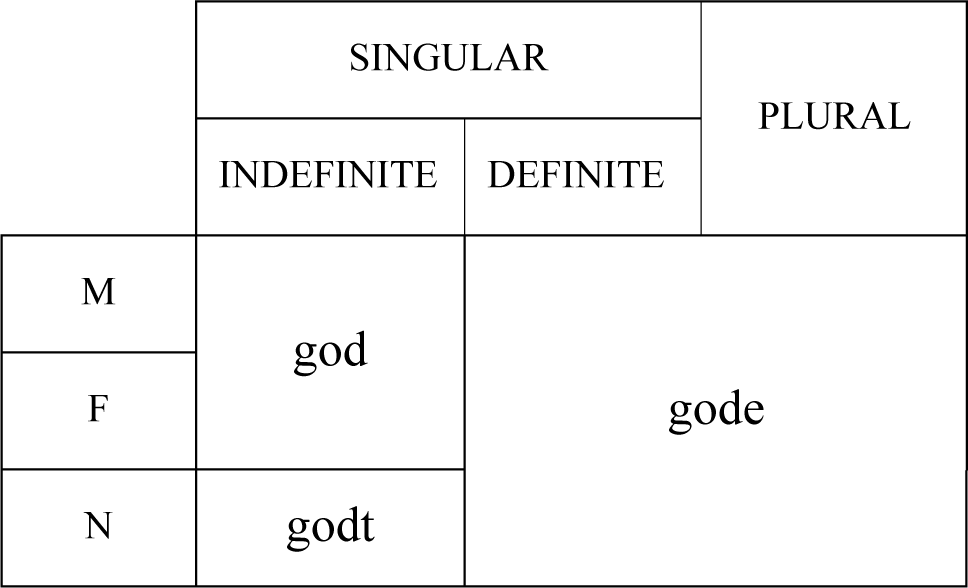
As in German and more generally, there are no special forms for use with metonymy: the normal agreement forms are employed.
4.2. Entity-for-eventuality metonymy (pancake sentences)
We next turn to a different type of metonymy, pancake sentences, which are a prevalent phenomenon in Scandinavian languages. Here is a famous Norwegian example:
(13)=(7)
Norwegian (Bokmål/Nynorsk, Faarlund Reference Faarlund1977: 240)
Pannekake-r
er
god-t.
pancake-pl
cop
good-
sg.n
‘Pancakes is good.’ (‘Eating pancakes is good.’)
The construction takes its name from this example (Enger Reference Enger2004a). We see that the subject
pannekaker
‘pancakes’ is used in an entity-for-eventuality metonym. As Wechsler (Reference Wechsler, Hofmeister and Norcliffe2013) points out, these pancake sentences involve logical metonymy (Pustejovsky Reference Pustejovsky1995: 54):Footnote
19 the nominal phrase is not treated as a normal nominal phrase, and the shift in meaning is systematic. Given that the nominal phrase is not a normal one, the agreement of the predicate reflects this, in failing to match the feature values of the subject, and instead taking the neuter singular. We need to check the other possible agreement targets:
(14)
Norwegian (Bokmål, Enger Reference Enger2004a: 20)
Nystekt-e
pannekake-r
er
god-t.
new.fried-pl
pancake-pl
cop
good-
sg.n
‘Newly fried pancakes is good.’ (‘Eating newly fried pancakes is good.’)
Within the nominal phrase, agreement operates normally, and this contrasts with neuter singular agreement in the predicate. This neuter singular agreement is ‘default agreement’, which is the type of agreement found where there is no straightforward agreement controller. So here we are contrasting two types of agreement (normal agreement and default agreement). This is worth stressing; the conflict is between two sources of agreement, rather than between feature values (which are the symptom, not the cause). We find an Agreement Hierarchy effect: example (15) includes other target possibilities, and these show default agreement:
(15)
Norwegian (Bokmål, Hans-Olav Enger, personal communication, Corbett Reference Corbett2006: 223)
Narkotika,
som
er
grusom-t
for
både
misbruker-e
og
narcotic(m)[sg],
comp
cop
awful-
sg.n
for
both
addict-pl
and
pårørende,
de-t
skulle
aldri
vær-t
oppfunn-et.
relatives.spouses,
it-
sg.n
should
never
be-pst.ptcp
invent-pst.ptcp
‘Drugs, which is awful for both addicts and those close to them, it should never have been invented.’
The complementizer som controls neuter singular agreement on grusomt ‘awful’,Footnote 20 and the personal pronoun det ‘it’ is also neuter singular.
The use of default agreement arises from factors which are extraneous to the controller. Moreover, the distribution of agreement alternatives fits under the constraint of the Agreement Hierarchy: we find normal agreement in attributive position, and default agreement at all other positions of the hierarchy. Indeed, the fact that pancake sentences fit in this way was one of the arguments which demonstrated that the notion ‘semantic agreement’ needed further work (Corbett Reference Corbett2023). There are two ways forward. We could say that the agreement pattern found in the pancake sentences of Norwegian (and other Scandinavian languages) is quite different to other agreement alternatives, which would require us to complicate the typology of alternative agreements. Or we say:
-
(i) the distribution of agreements with pancake sentences fits the constraint of the Agreement Hierarchy pattern; this requires us to expand the notion of semantic agreement (hence ‘generalized semantic agreement’, as in (9)), and
-
(ii) the mismatch fits logically into the pattern of the Hierarchy of Agreement Sources, shown in Table 1.
The parsimonious approach, therefore, is to adopt the analysis based on generalized semantic agreement, as the simpler account.
There is a little more preparation needed to understand the full richness of the Norwegian data. Some key examples make the effect of default agreement particularly clear, through the contrast with normal agreement:
(16)
Norwegian (Nynorsk, Faarlund Reference Faarlund1977: 251)
Ein
ny
utanriksminister
ville
ikkje
ver-e
så
indf.sg.m
new[indf.sg.m/f]
foreign.secretary
would
neg
be-inf
so
dum-t.
stupid-
sg
.
n
‘A new foreign secretary would not be a bad idea.’
In example (16), the neuter singular agreement indicates that the example includes one of those subjects which are ‘interpreted as unbounded participants in virtual, ungrounded processes’ (Haugen & Enger Reference Haugen and Enger2019: 571–572). It is ‘having a new foreign secretary’ which is in question. This ‘pancake-style’ reading is the appropriate one for (16), and it is reflected in the neuter singular adjective. If the adjective agrees (dum ‘stupid’, the singular, masculine/feminine form), that is insulting to the present foreign secretary. This telling example reprises a comparable Swedish example (Wellander Reference Wellander1949: 201–202).
For further information on pancake sentences, see Faarlund (Reference Faarlund1977), Enger (Reference Enger2004a, Reference Enger2013), Haugen & Enger (Reference Haugen and Enger2019) and Klingvall, Beijer & Heinat (Reference Klingvall, Beijer and Heinat2026); Corbett (Reference Corbett2006: 223–224) makes the link to the Agreement Hierarchy; Wechsler (Reference Wechsler, Hofmeister and Norcliffe2013, Reference Wechsler, Kiss and Alexiadou2015) discusses Swedish data, and is explicit about the nature of the metonymy. Källström (Reference Källström1993: 192–241) also considers Swedish and gives a survey of different types of analysis which have been proposed. Corbett (Reference Corbett2022b) provides references to other languages which have the construction, and Åkerblom (Reference Åkerblom2020) surveys the literature.
4.3. Relations between constructions
We would like to integrate the instrument-for-player metonymy into the scheme of agreement alternatives. Yet there are few opportunities to compare the sources of agreement for the different types of metonymy. Norwegian is invaluable in this respect, and we have now assembled the necessary components. We can combine two of the example types already analyzed; specifically, we can take the instrument-for-player type of metonymy and put it into an entity-for-eventuality context:
(17)
Norwegian (Bokmål)
En
ny
bratsj
i
orkester-et
indf.sg.m
new[indf.sg.m/f]
viola(m)
in
orchestra-def.n
hadde
ikke
vær-t
så
dum
/
så
dum-t.
had
neg
be-pst.ptcp
so
stupid-
sg.m/f
so
stupid-
sg.n
‘A new viola in the orchestra would not be so stupid/would not be a bad idea.’
As with the foreign minister example (16), in (17) the different agreements are induced by different agreement sources, and realize different interpretations. Normal (masculine/feminine) agreement is rude towards a current incumbent, while default (neuter) agreement suggests that having a new viola player would not be a bad idea. We see that the instrument-for-player metonymy, which would induce masculine/feminine agreement, is overridden by the more abstract entity-for-eventuality metonymy, which induces neuter agreement.
Going further, we consider other sources of agreement specification. In example (18), we have two sources which are contiguous on the Hierarchy of Agreement Sources, namely lexical semantics and complex nominal construction. The latter, less canonical, source wins out, since we have number resolution: two singular nominal phrases control plural agreement:
(18)
Norwegian (Bokmål)
Magnus
Carlsen
og
Bobby
Fischer
er
berømt-e.
Magnus
Carlsen
and
Bobby
Fischer
be.prs
famous-pl
‘Magnus Carlsen and Bobby Fischer are famous.’
Our next example, (19), is a less familiar type. It shows competition between a complex nominal expression (conjoined noun phrases) and an extraneous source:
(19)
Norwegian (Bokmål)
Magnus
Carlsen
og
Bobby
Fischer
hadde
vær-t
super-t.
Magnus
Carlsen
and
Bobby
Fischer
had
be-pst.ptcp
super-
sg.n
‘Magnus Carlsen and Bobby Fischer would have been wonderful.’
What would have been wonderful is for them to have played a chess match (for instance). Example (19) shows the conjoined noun phrases (a complex nominal construction in the Hierarchy of Agreement Sources), which would induce plural agreement (as in (18), overriding the lexical semantics), but this is overridden by the extraneous source (pancake type, the least canonical source), which induces default agreement (neuter singular).
Where then do examples of instrument-for-player metonymy (as in (17)) fit in the Hierarchy of Agreement Sources? Example (20) makes this clear:
(20)
Norwegian (Bokmål)
En
ny
bratsj
og
en
indf.sg.m
new[indf.sg.m/f]
viola(m)
and
indf.sg.m
ny
fiolin
i
orkester-et
hadde
ikke
new[indf.sg.m/f]
violin(m)
in
orchestra-def.n
had
neg
vær-t
så
dumm-e
/
så
dum-t.
be-pst.ptcp
so
stupid-pl
so
stupid-
sg.n
‘A new viola and a new violin in the orchestra would not be so stupid/would not be a bad idea.’
We see that instances of instrument-for-player metonymy behave as a type of hybrid noun. Their morphosyntactic specification and lexical semantics are mismatched. When the instances of instrument-for-player metonymy are conjoined, the complex nominal expression overrides, and we find plural agreement; this in turn can be overridden by an extraneous source (in a pancake sentence).Footnote 21 This pattern shows precisely where their sources of agreement specification fit on the Hierarchy of Agreement Sources.
4.4. The fit with the Hierarchy of Agreement Sources (Norwegian)
The pattern of the Norwegian data is revealed in Table 2, which is anchored in canonical agreement (top left). The sources of agreement information are given along the top, moving from more to less canonical, and the examples from Sections 4.1–4.3 are down the side of Table 2. The relevant specifications are given in the cells.
Constraint of the Hierarchy of Agreement Sources: Norwegian data

Table 2. Long description
The table has eight rows of examples, each labeled by number in the second column, with the first column labeled ‘example.’ The five agreement source columns, from left to right, are specification of cell, morpho-syntactic specification, lexical semantics, complex nominal construction, and extraneous source. For example (10), morpho-syntactic specification is m, lexical semantics is f. For (11), morpho-syntactic specification is f, lexical semantics is m. For (13)–(15), lexical semantics is pl, extraneous source is n (default). For (16), morpho-syntactic specification is m, lexical semantics is m, extraneous source is n (default). For (17), morpho-syntactic specification is m, lexical semantics is f or m, extraneous source is n (default). For (18), specification of cell and morpho-syntactic specification are both sg m plus sg m, lexical semantics is pl. For (19), specification of cell and morpho-syntactic specification are both sg m plus sg m, lexical semantics is pl, extraneous source is n (default). For (20), specification of cell is sg m plus sg m, morpho-syntactic specification is sg f or m plus sg f or m, lexical semantics is pl, extraneous source is n (default). A footnote indicates that for examples (17) and (20), the entity-for-eventuality reading is taken.
* The entity-for-eventuality reading is taken for these examples.
When different sources show the same feature specification (for instance, with the morphosyntactic specification and the lexical semantics in example (16)), that represents the canonical situation (matching). In the more interesting, non-canonical situation, we see competition between two (or more) agreement sources. The less canonical one (shaded red) shows greater generalized semantic agreement.
Examples (10) and (11) establish instrument-for-player metonymy (Section 4.1), with lexical semantics overriding the morphosyntactic specification. Examples (13)–(15) demonstrate entity-for-eventuality metonymy, with the extraneous source overriding the morphosyntactic specification (Section 4.2). The striking ‘foreign secretary’ example (16) illustrates lexical semantics matching the morphosyntactic specification, and these are overridden in the entity-for-eventuality reading. The key examples show where the different types of metonymy fit in the overall scheme (Section 4.3). Example (17) shows that instrument-for-player metonymy is overridden by entity-for-eventuality metonymy. Then (18) shows conjoined noun phrases (individually singular and masculine, according to the morphosyntactic specification and the lexical semantics) which, according to the appropriate resolution rule (Corbett Reference Corbett2006: 242–243), take plural agreement. However, this source (the complex nominal construction) is in turn overridden by entity-for-eventuality metonymy (19). All this comes together in (20), where we have four potential agreement sources. We have the morphosyntactic specification and lexical semantics; these are found within a complex nominal construction, in this case conjoined noun phrases. This source is less canonical and overrides the others (potentially giving plural agreement). However, it is overridden in turn by the entity-for-eventuality metonym, which requires default agreement, the least canonical possibility.
So, to recap, it is clear where the instrument-for-player metonymy fits; the competing agreement sources are the morphosyntactic specification and the lexical semantics. There is no need for an additional place on the Hierarchy of Agreement Sources. And the suggestion that instrument-for-player metonymies should be treated as having an extraneous source (as noted above) is shown to be unnecessary, as is demonstrated by their behaviour when conjoined.
We can see more clearly the logic of the Hierarchy of Agreement Sources. We have canonical agreement, the baseline, on the left; ordinary feature values are outranked by successively less canonical sources; features matching the lexical semantics (the player) are outranked by the complex nominal expression, which is in turn outranked by the eventuality metonymy. We have used the possible mismatches to confirm that the Hierarchy of Agreement Sources covers the data, and allows us to fit the instrument-for-player metonymy in the scheme (there is no need for any extension). More generally, we can predict which source will give rise to generalized semantic agreement. Given that, we can constrain possible agreement patterns, according to the Agreement Hierarchy; all of this fits with the overarching idea that morphosyntactic variation is constrained by monotonicity of mappings (Graf Reference Graf2019).
By comparing across the different examples in this section, we have established where instrument-for-player metonymy fits in the typology, crucially in terms of where it gets the conflicting agreement specifications (morphosyntactic specification vs. lexical semantics). This is shown by the data from conjoining and the extraneous source (entity-for-eventuality metonymy). We see this particularly clearly in example (20), where there are no less than four potential sources of agreement features: the morphosyntactic specification, the lexical semantics, the complex nominal construction (conjoined phrases), and the extraneous source (entity-for-eventuality metonymy). It is the last, least canonical source which provides the agreement features. This remarkable example is a graphic confirmation of the Hierarchy of Agreement Sources (Figure 2), which establishes which specification represents generalized semantic agreement for each of the conflicts we have examined.
5. Review of multiple systems
The special properties of Norwegian have allowed us to make substantial progress. We review this progress in terms of the evidence for multiple systems and the logic underpinning them.
5.1. The evidence
Evidence for multiple agreement systems is hard to find. Typically they involve a combination of factors, and while languages may have one or another interesting phenomenon, they rarely have the required combination. In particular, instances of extraneous sources are scarce. Thus pancake constructions are rare (though I suspect more will be recognized and reported), and the honorific agreement found in nineteenth-century Russian, to be discussed below, is also unusual (see Houtzagers Reference Houtzagers2018 for its distribution within Slavonic, and Houtzagers Reference Houtzagers, Genis, de Haard, Kalsbeek, Keizer and Stelleman2012 for further examples). To make matters worse, the interesting phenomena may mask each other: if we wish to investigate the interaction of nineteenth-century Russian honorific agreement with conjoining, we are stymied by the fact that both are realized by plural agreement.
The examples of multiple systems already known are presented in Corbett (Reference Corbett2023: 25–27), where references can be found. In brief, they are:
-
(i) Russian (rus) rjad , which literally means ‘row, series’, but is frequently used as a vague quantifier ‘number’. It may take (in order of increasing generalized semantic justification) masculine singular, neuter singular, and plural agreement. Though the data are limited, they fit our typology particularly well.
-
(ii) Swedish (swe) has examples like facket ‘the trade union’, which can take neuter singular (the original gender), or ‘common gender’ (the syncretic masculine/feminine form), or else such nouns can take the plural.
-
(iii) Serbo-CroatFootnote 22 deca ‘children’ has four possibilities, feminine singular, neuter plural, masculine plural and feminine plural.
-
(iv) Numeral phrases in the Cushitic language Qafar (aar), spoken in north-eastern Ethiopia, Djibouti and southern Eritrea, have three possible agreements (see Hayward & Corbett Reference Hayward and Corbett1988: 268–270).
Honorific agreement in nineteenth-century Russian deserves a fuller mention. Plural agreement is used to show respect to a third person (under the special condition that the speaker has an in‑group relationship with the person referred to, Houtzagers Reference Houtzagers2018: 1). The special agreement may occur with an ordinary nominal phrase as controller:
(21)
Russian (19th century) (Turgenev Nakanune 1860: ch. 30)
Papen′k-a
gnevaj-ut-sja
father.dim-sg.nom
rage-3pl
-refl
‘(Your) father is angry’ (literally ‘are angry’)
In (21) a maid addresses her mistress, referring to the latter’s father. She shows him respect by using plural agreement. Note that this is reference (in the father’s absence), not address. This honorific component is extraneous to the noun papen′ka ‘father’, a normal noun (diminutive), which would otherwise take masculine singular agreement. This honorific use may also be found with titles. Russian titles were typically abstract nouns, such as prevosxoditel′stvo ‘excellency’. If this title was used of a male, the three possibilities were neuter singular (following the morphosyntactic specification of the noun), or masculine singular (following the lexical semantics), or plural (the agreement extraneous to the nominal, resulting from the honorific use), comparable to (21) above. This three-way choice is one of the examples which showed the need to extend semantic agreement, since it is not immediately obvious which agreement should count as having greater semantic justification. Treating the honorific agreement as being induced by an extraneous source means that the patterns found in all the data available are consistent with the constraints laid out above (Astafyev Reference Astafyev2022; Corbett Reference Corbett2023: 22, 26–27).
An additional point of interest is that Astafyev (Reference Astafyev2022: 51–54) finds examples of ‘parallel targets’ which follow the parallelism constraint:
-
(22) Parallelism constraint (Corbett Reference Corbett2006: 235)
If parallel targets show different agreements, then the further target will show semantic agreement.
Here is an example from Tolstoy’s War and Peace (1869):
(23)
Russian (Tolstoy, cited by Astafyev Reference Astafyev2022: 52)
on
u
nas
nočeva-l
i
tože
3sg.m
at
1pl.gen
spend.night-pst[
sg.m
]
and
also
s
nami
ed-ut
with
1pl.ins
ride-3pl
‘… he spent the night with us and now is riding with us’
We see that (23) does indeed follow the constraint, with normal agreement (singular) shown by the nearer target, and honorific (plural) agreement on the further. All of Astafyev’s examples obey the constraint. The reason for highlighting this type of agreement is that it is a type of extraneous agreement (position 5 on the Hierarchy of Agreement Sources), which is rather different from the more familiar pancake sentences. And while we might wonder which type of agreement represents greater (generalized) semantic agreement here, the parallelism examples reinforce the analysis which puts the extraneous source of this honorific agreement as less canonical than the alternative, and hence at a higher point on the Hierarchy of Agreement Sources.Footnote 23
A new multiple pattern is reported in Icelandic, involving the names of sports teams, like
Stjarna
n (literally ‘the star’). As a common noun,
stjarna
is straightforwardly feminine. As the name of a team, it may take feminine singular agreement as expected, or neuter singular agreement (Sigurðsson, Snorrason & Tómasdóttir Reference Sigurðsson, Snorrason and Tómasdóttir2024). Textual data show that the latter is much more frequent. We may think of neuter agreement as arising from a non-core (crazy) gender assignment ruleFootnote
24; it is found also with team names based on masculine nouns. Furthermore, names of sports teams may also control the familiar plural agreement. The two options give a multiple system, though to date the two have been investigated separately. Sigurðsson, Snorrason and Wood (Reference Sigurðsson, Snorrason, Wood, Lam and Ozaki2023) show how coordinated clauses whose subject involves names of sports teams show a ‘3/4 pattern’. Both clauses may have singular agreement or both have plural. But while singular then plural is possible (24), the reverse is not (25):
(24)
Icelandic (isl, Sigurðsson, Snorrason & Wood Reference Sigurðsson, Snorrason, Wood, Lam and Ozaki2023: 108)
Stjarna-n
er
með
bolt-ann
og
sæk-ja
fram.
star-def.sg.nom
be.prs.3
sg
with
ball-def.sg.acc
and
advance-prs.3
pl
forward
‘Stjarnan (‘Star’ team) has the ball and are on the attack.’
(25)
*Stjarna-n
er-u
með
bolt-ann
og
sæk-ir
fram.
star-def.sg.nom
be.prs.3
pl
with
ball-def.sg.acc
and
advance-prs.3
sg
forward
‘*Stjarnan have the ball and is on the attack.’
The pattern shown by these examples is covered by the Parallelism Constraint, given in (22) above.
5.2. The logic of multiple alternatives
We have seen systems with more than two agreement alternatives. We have a means to order them according to the degree of generalized semantic justification, namely the Hierarchy of Agreement Sources. But we need a means to integrate this ordering into the constraint of the Agreement Hierarchy. Thus if we label the possible agreements A, B and C, and this is the ranking from the Hierarchy of Agreement Sources, how do we state the constraint on possible distributions over the Agreement Hierarchy? There is quite a list of plausible suggestions, which fail. The solution turns out to be simple and elegant; we retain the constraint as it stands:
-
(26)=(9) Revised constraint of the Agreement Hierarchy (Corbett Reference Corbett2023: 10)
For any controller that permits alternative agreements, as we move rightwards along the Agreement Hierarchy, the likelihood of agreement with a greater degree of generalized semantic justification will increase monotonically (that is, with no intervening decrease).
This applies iteratively; thus if B shows greater generalized semantic justification than A, then the likelihood of this agreement will increase monotonically as we move rightwards along the Agreement Hierarchy, and if C shows greater generalized semantic justification than B, then the likelihood of this agreement will increase monotonically as we move rightwards along the Agreement Hierarchy. This produces exactly the result we need.Footnote 25
6. Confirming data: Lithuanian
Lithuanian provides striking confirming evidence. The agreements are comparable to those of Norwegian in the important respects. However, the morphosyntactic setting is different (Section 6.1). The key data on metonymy are analyzed (Section 6.2), and the fit with the Hierarchy of Agreement Sources provides a summary of the evidence (Section 6.3). We then look briefly at corpus data (Section 6.4).
6.1. The morphosyntactic setting
Lithuanian has richer inflectional morphology than Norwegian, including additional distinctions in the predicate and in the relative pronoun. Here are simple examples of agreement:
(27)
Lithuanian (lit, Ambrazas, Geniušienė, Girdenis, Sližienė, Tekorienė, Valeckienė & Valiulytė Reference Ambrazas, Geniušienė, Girdenis, Sližienė, Tekorienė, Valeckienė and Valiulytė1997: 483)
Vaik-ai
buvo
laiming-i.
child(m)-pl.nom
be.pst.3
happy-pl.nom.m.indf
‘The children were happy.’
(28)
Mergait-ės
buvo
laiming-os.
girl(f)-pl.nom
be.pst.3
happy-pl.nom.f.indf
‘The girls were happy.’
The adjective agrees in number and gender. It has definite and indefinite forms, as we shall see; in predicative use the indefinite is usually found, as in our examples here (Ambrazas et al. Reference Ambrazas, Geniušienė, Girdenis, Sližienė, Tekorienė, Valeckienė and Valiulytė1997: 146). The verb does not show number in the third person. We see evidence for two gender values, masculine and feminine, but there is more to the gender system. Lithuanian has a mismatch between the controller genders (the number of sets into which nouns are divided) and the target genders (the distinctions made by agreement targets, such as adjectives, Corbett Reference Corbett1991: 151, 159–160). The controller values have been reduced to two: nouns can be masculine or feminine. Yet there are three target gender values, since many adjectives have retained the third, neuter, gender forms (Ambrazas et al. Reference Ambrazas, Geniušienė, Girdenis, Sližienė, Tekorienė, Valeckienė and Valiulytė1997: 134–135, Semėnienė Reference Semėnienė2003a, Reference Semėnienė, Holvoet and Judžentis2003b)Footnote 26; for example, puik-us (m), puik-i (f), puik-u (n) ‘fine, wonderful’. The neuter does not distinguish number. It is available for various constructions, including pancake sentences (Ambrazas et al. Reference Ambrazas, Geniušienė, Girdenis, Sližienė, Tekorienė, Valeckienė and Valiulytė1997: 136–137, 484, 645, 768, 769). Importantly, however, it is not used exclusively for pancake sentences. Rather the neuter has a range of uses including agreement with ‘unspecified’ nominal phrases, such as infinitive phrases (Adamson & Šereikaitė Reference Adamson and Šereikaitė2019).
6.2. Metonymy in Lithuanian
First, we need to establish that the instrument-for-player metonymy works in Lithuanian (as in German and Norwegian). In its normal use, as an instrument,
smuikas
‘violin’ is masculine. It permits the metonymy we are interested in:
(29)
Lithuanian (Emilija Tribocka)Footnote
27
Mes
tur-ime
nauj-ą
smuik-ą
mūs-ų
1pl.nom
have-1pl
new-sg.acc.m/f.indf
violin(m)-sg.acc
1pl-gen
orkestr-e.
orchestra-sg.loc
‘We have a new violin in our orchestra.’
(a)
Ji
labai
talenting-a.
3sg.f.nom
very
talented-sg.nom.f.indf
‘She is very talented.’
(b)
Jis
labai
talenting-as.
3sg.m.nom
very
talented-sg.nom.m.indf
‘He is very talented.’
Since smuikas ‘violin’ is masculine, the (29a) version with ji ‘she’ shows the metonymy clearly. If the violinist is a male, there is no clash of gender, as the continuation (29b) with jis ‘he’ demonstrates. (The feminine noun fleita ‘flute’ is comparable in allowing both pronouns.) As (29) shows, the verb ‘be’ can be omitted in the present tense.
The fuller paradigms of Lithuanian allow us to check all the Agreement Hierarchy positions. In attributive position, we find only the gender value expected from the morphosyntactic specification of the noun (masculine), as here:
(30)
pirm-asis
/
*pirm-oji
smuik-as
mūs-ų
first-sg.nom.
m
.def
first-sg.nom.f.def
violin(m)-sg.nom
1pl-gen
orkestr-e
orchestra-sg.loc
‘the first violin in our orchestra’
The predicate position is interesting:
(31)
Nauj-asis
smuik-as
mūs-ų
orkestr-e
new-sg.nom.m.def
violin(m)-sg.nom
1pl-gen
orchestra-sg.loc
labai
talenting-as
/
talenting-a.
very
talented-sg.nom.
m
.indf
talented-sg.nom.
f
.indf
‘The new violin in our orchestra is very talented.’
Here most speakers allow both forms (according to the sex of the violinist); one allowed only masculine (whatever the sex). The relative pronoun takes gender agreement according to the sex of the referent (semantic agreement):
(32)
Mes
tur-ime
nauj-ą
smuik-ą
mūs-ų
1pl.nom
have-1pl
new-sg.acc.m/f.indf
violin(m)-sg.acc
1pl-gen
orkestr-e,
kur-is
labai
talenting-as
/
orchestra-sg.loc
rel-sg.nom.
m
very
talented-sg.nom.m.indf
kur-i
labai
talenting-a.
rel-sg.nom.
f
very
talented-sg.nom.f.indf
‘We have a new violin in our orchestra, who is very talented.’
Here speakers took the simple semantic route, having a masculine relative pronoun for a male and feminine for a female (though one speaker was not happy with either variant). We saw the personal pronoun in (29) above. Thus we can see that Lithuanian has instrument-for-player metonymy, with syntactic agreement in attributive position; mainly generalized semantic agreement in predicate position, and generalized semantic agreement for relative and personal pronouns. This is a pattern clearly in accord with the constraint of the Agreement Hierarchy (Figure 1 and (9)).
As in Norwegian, we can conjoin these instrument-for-player metonymies:
(33)
Nauj-asis
smuik-as
ir
nauj-asis
alt-as
new-sg.nom.m.def
violin(m)-sg.nom
and
new-sg.nom.m.def
viola(m)-sg.nom
mūs-ų
orkestr-e
labai
talenting-i
/
1pl-gen
orchestra-sg.loc
very
talented-pl.nom.
m
.indf
(talenting-os).
talented-pl.nom.
f
.indf
‘The new violin and the new viola in our orchestra are very talented.’
Most speakers had masculine plural agreement, whether the players were two women, two men or one of each. One speaker had the feminine plural talentingos ‘talented’ when there were two female players, otherwise the masculine plural. Thus we have the complex nominal construction (conjoined noun phrases) winning out over the metonymy based on the lexical semantics of the nouns.
We now ask whether we can see the effect of extraneous agreement, by introducing an entity-for-eventuality metonymy. As a preliminary, we check that it is possible together with a single instrument-for-player metonymy:
(34)
Nauj-as
smuik-as
mūs-ų
orkestr-e
new-sg.nom.m.indf
violin(m)-sg.nom
1pl-gen
orchestra-sg.loc
būtų
puik-u.
be.sbjv.3
wonderful-
n
‘A new violin in our orchestra would be wonderful.’
(It would be wonderful to have a new violin in our orchestra.)
Then we go on to check conjoined noun phrases, as our complex nominal construction, together with the entity-for-eventuality metonymy:
(35)
Nauj-as
smuik-as
ir
nauj-as
alt-as
new-sg.nom.m.indf
violin(m)-sg.nom
and
new-sg.nom.m.indf
viola(m)-sg.nom
mūs-ų
orkestr-e
būtų
puik-u.
1pl-gen
orchestra-sg.loc
be.sbjv.3
wonderful-
n
‘A new violin and a new viola in our orchestra would be wonderful.’
(It would be wonderful to have a new violin and a new viola in our orchestra.)
Example (35) shows that in Lithuanian we see the pancake construction ‘winning out’; the evidence is the neuter singular agreement (despite the conjoined phrases in the subject), indicating the logical metonymy, entity-for-eventuality. The effect is as in Norwegian, even though the morphosyntactic setting is different, since in Lithuanian the neuter is a target gender value only; there are no nouns in this gender. In both languages the default is triggered by the agreement information being extraneous to the nominal subject.
Lithuanian’s richer morphology allows us to check the other Agreement Hierarchy positions, and indeed we find a pancake effect for the relative pronoun:
(36)
Mes
tur-ime
nauj-ą
smuik-ą
mūs-ų
1pl.nom
have-1pl
new-sg.acc.m/f.indf
violin(m)-sg.acc
1pl-gen
orkestr-e,
k-as
puik-u.
orchestra-sg.loc
rel-nom
wonderful-
n
‘We have a new violin in our orchestra, which is wonderful.’
We find the relative kas ‘who, what’, which does not have a gender contrast in its form (Ambrazas et al. Reference Ambrazas, Geniušienė, Girdenis, Sližienė, Tekorienė, Valeckienė and Valiulytė1997: 183, 473–474) but which induces gender agreement; it takes the default neuter in (36).
And the pronoun, the rightmost position on the Agreement Hierarchy, stands in the neuter form (and takes neuter agreement):
(37)
Mes
tur-ime
nauj-ą
smuik-ą
mūs-ų
1pl.nom
have-1pl
new-sg.acc.m/f.indf
violin(m)-sg.acc
1pl-gen
orkestr-e.
Tai
puik-u.
orchestra-sg.loc
dem.
n
wonderful-n
‘We have a new violin in our orchestra. That’s wonderful.’
The special interest of Lithuanian is that it confirms the key evidence from Norwegian within a different morphosyntactic environment. It has richer morphosyntax, which allows us to see the Agreement Hierarchy effect more clearly. And it has a non-lexical neuter gender, which shows the pancake sentence effect well. A key point concerns the results from conjoining. It was established earlier where conjoining (as an instance of a complex nominal construction) fits in the Hierarchy of Agreement Sources. The Lithuanian examples confirm where the instrument-for-player metonymy fits in that hierarchy. Together, these results demonstrate that this type of metonymy can be accommodated without additional machinery.
6.3. The fit with the Hierarchy of Agreement Sources (Lithuanian)
We can now see how the Hierarchy of Agreement Sources has a key role in accounting for the Lithuanian data.
Parallel to Table 2 which summarized the Norwegian data, Table 3 reveals the pattern of the Lithuanian data. Again the sources of agreement information are given along the top, moving from more to less canonical, and the numbers of the examples from Section 6.2 are down the side of Table 3. Relevant specifications are given in the cells.
Constraint of the Hierarchy of Agreement sources: Lithuanian data.

Table 3. Long description
The table has seven columns and four rows of data. The first column labels all rows as example. The second column lists example numbers: (29)–(32), (33) with an asterisk, (34), (36), (37), and (35). The next five columns, from left to right, are labeled specification of cell, morpho-syntactic specification, lexical semantics, complex nominal construction, and extraneous source. The top header indicates a left-to-right scale from canonical to less canonical. In the first data row ((29)–(32)), morpho-syntactic specification is m, lexical semantics is f forward slash m, other cells are empty. In the second row (33), morpho-syntactic specification is sg m plus sg m, lexical semantics is sg f forward slash m plus sg f forward slash m, complex nominal construction is pl m, other cells are empty. In the third row ((34), (36), (37)), morpho-syntactic specification is m, lexical semantics is f forward slash m, extraneous source is n with default in parentheses, other cells are empty. In the fourth row (35), morpho-syntactic specification is sg m plus sg m, lexical semantics is sg f forward slash m plus sg f forward slash m, complex nominal construction is pl m, extraneous source is n with default in parentheses, other cells are empty. A footnote marked with an asterisk refers to factors affecting alternative agreements being discussed in the earlier text.
* See the text above for the factors bearing on the alternative agreements.
Table 3 accounts for which featural outcome counts as having greater semantic justification. It shows again that it is not a binary distinction of syntactic vs. semantic agreement, rather there can be up to four competing sources of agreement specification, as in example (35). Note that the first source (specification of cell) is not involved in the examples we have discussed (for the need for this position on the hierarchy see Corbett Reference Corbett2023: 11–12).
The Hierarchy of Agreement Sources determines which featural specification counts as showing the greater degree of semantic justification. Where the alternative possibilities are distributed over the targets is constrained by the Agreement Hierarchy (Figure 1 and (9)), as we see by comparing examples (29)–(32) and (35)–(37).
6.4. Corpus data
It seems unlikely that the type of example we need will appear in a corpus. However, querying the Corpus of the Contemporary Lithuanian languageFootnote
28 proved interesting. The corpus comprises 208 million words, and searching for
smuikas
‘violin’ yielded over 600 hits, mainly but not exclusively in the nominative singular. A frequent type of example is the following:
(38)
Solist-ai
P. Bermanas
(smuik-as,
Italij-a),
R. Vigulfas
soloist-pl.nom
P. Bermanas
violin-sg.nom
Italy-nom,
R. Vigulfas
(klarnet-as,
Norvegij-a).
clarinette-sg.nom,
Norway-nom
‘Soloists P. Bermanas (violin, Italy), R. Vigulfas (clarinette, Norway).’
In concert programme notes, Lithuanian (like Norwegian and English) regularly uses instrument-for-player metonymy as here. Perhaps surprisingly, over 40% of the examples involved instrument-for-player metonymy, with examples like (38) being the most common. However, the only corpus instances relevant for agreement I have found so far are attributive modifiers. Here we find the expected masculine agreement: for instance, in the phrase antrasis smuikas ‘second violin’, antrasis ‘second’ is masculine even when the violinist is a woman. Thus the type of metonymy that interests us is frequent, but agreement effects resulting from it are not.
7. Conclusions
Let us pull together what we have established about metonymy and multiple agreement systems.
7.1. Metonymy
The literature on metonymy is extensive. We started with the often-cited work of Nunberg (Reference Nunberg1995). There has been considerable interest within cognitive grammar; see Peirsman and Geeraerts (Reference Peirsman and Geeraerts2006) for an extensive survey, casting the net wide, and Croft (Reference Croft2006) for a substantive critique of that paper, and for references to earlier work in the cognitive linguistics tradition. In contrast, Carston (Reference Carston2023) gives a recent relevance‑theoretic perspective on metonymy. Explicit arguments for treating pancake sentences as metonymy are given by Wechsler (Reference Wechsler, Müller, Abeillé, Borsley and Koenig2024: 248), who concludes, ‘The metonymy analysis captures the fact that the subject has a clause-like meaning but not clause-like syntax’. In relation to metonymy, the current paper: (i) indicates that there are different levels of metonymy (Sections 4.1 and 4.2); (ii) shows that these different levels can co-occur (Sections 4.3 and 6); and (iii) demonstrates, most importantly, that the different levels are reflected in the agreement evidence (Sections 4.4 and 6). And as a general consideration we should recall that the different types of metonymy vary across languages (whether they are available or not, Panther & Thornburg Reference Panther, Thornburg, Geeraerts and Cuyckens2007: 254), but also within languages (some are specialized, to musicians, for example, while others are not).Footnote 29
7.2. Multiple agreement systems
Agreement constructions with multiple possibilities are rare and exciting. We have made progress on understanding those constructions which are induced by different types of metonymy. Once we establish their ranking according to the Hierarchy of Agreement Sources, we can accommodate them with no additional machinery. The constraint of the Agreement Hierarchy applies iteratively (as we saw in Section 5.2).
7.3. Factors and interactions
We have unpacked the different factors which influence the choice between agreement alternatives. The agreement target is vital, and the constraining hierarchy, the Agreement Hierarchy, provides the bedrock of the current paper. This hierarchy appeals to the notion of (generalized) semantic agreement, since the claim is that the likelihood of agreement with a greater degree of generalized semantic justification will increase monotonically (Section 5.2). And while semantic agreement may sometimes seem obvious, there are several situations (Sections 4.2, 4.4 and 5.1) where it is not. We have been able to make progress here by relying on the claim that semantic agreement rests on a conflict of at least two sources of agreement specifications (in the obvious as well as in the more difficult cases); furthermore, the ranking of these agreement specifications is the task of the Hierarchy of Agreement Sources (Section 3.2). Of course, the particular controllers in question have a major role, both cross-linguistically and within individual languages. The main contribution of the paper for controllers has been to document and analyze a particularly significant type of controllers, those that induce multiple agreement alternatives, and to tease out their interaction with the Hierarchy of Agreement Sources.
7.4. Prospects
We have made substantial progress in our understanding of the factors determining the distribution of agreement alternatives. Equally, we offer numerous testable predictions. These suggest: (i) more detailed fieldwork on the languages shown to be of particular interest; (ii) further corpus work on these languages; and (iii) typological investigation to establish which other languages show significant combinations of the properties we need. Agreement was once considered a simple test for investigating trickier syntactic phenomena. No longer.
Acknowledgements
I am grateful to Hans-Olav Enger and Tore Nesset for sharing their expertise and making this paper possible. I also thank Emilija Tribocka, and her relatives and friends, for the Lithuanian data, and Peter Arkadiev for pointing me to Lithuanian as allowing pancake sentences. This project started from the impulse to tie up a loose end–the German instrument-for-player metonymy. This became a larger theme, and an invitation to Tromsø, for which I thank Marit Westergaard and Terje Lohndal, allowed me the chance to develop it. The paper now looks forward, offering a key to investigating both the relations between metonymy and agreement alternatives and the complexities of multiple agreement systems. For insightful comments on drafts, I thank Matthew Baerman, Hans-Olav Enger, Tom Ennever, Axel Holvoet, Steven Kaye, Tore Nesset, Erich Round, Anna Thornton and Emilija Tribocka. Versions were read at the 14th Mediterranean Morphology Meeting, University of Zadar, 13 June 2025, and at the CRISSP Concord & Agreement seminar series, online 27 November 2025. Both audiences offered constructive suggestions. Three JL referees provided positive, critical and extremely helpful reports, which led to numerous improvements. Maria Copot and Lucie Janků provided valuable technical help, and Ewa Jaworska was a very supportive editor throughout. I thank Dr Julia Cissewski, linguist, primatologist, musician, activist, for her help with the German data, and dedicate the paper to her memory.
Competing interests
The author has no competing interests to declare.
Appendix: Stacking
We might imagine we are dealing with stacking in examples with conflicting agreement sources like (20). Stacking is found where a target and a controller form a unit which then takes a further target of similar type, thus giving a structure of the type [target [target controller]]. This is illustrated in (i):
(i)
Serbo-Croat (Marković Reference Marković1954: 95, Corbett Reference Corbett2006: 234)
[[ov-i
[privatn-e
zanatlij-e]]
dem- pl.nom.
m
private-pl.nom.
f
artisan-pl.nom
‘these private artisans’
Serbo-Croat nouns like zanatlija ‘artisan’ permit both masculine and feminine modifiers; they are ‘split hybrids’ in that the alternatives are restricted to the plural (Corbett Reference Corbett2022a: 50). If we find stacked modifiers, usually both take the same form. Rarely, both agreement alternatives occur together. According to Leko (Reference Leko2010: 103–104), many speakers do not accept this combination, rather they would have ov-e dem-f.pl. Those who do accept different forms in stacked modifiers have them as in (i), with the form with the greater degree of generalized semantic agreement, the masculine, further from the controller (we do not find the reverse: *ove privatni zanatlije ). The constraint is this:
-
(ii) Stacking Constraint
If stacked targets show different agreements, the target further from the controller will show the form with the greater degree of generalized semantic agreement.
In principle, this constraint applies to the different Agreement Hierarchy positions; most often examples are found in attributive position. For examples of stacked targets with different agreements see Corbett (Reference Corbett1991: 239–240) and Landau (Reference Landau2016: 1003–1008).
Though there is an analogy here, stacking is not what we are dealing with in (20). In genuine instances of stacking (like (i)) there are two targets, and the Stacking Constraint regulates the possible combinations of their agreements. (Of the four theoretical possibilities, one is ruled out.) In contrast, in the examples we seek to account for, like (20), we have three sources of feature values: the specification of the noun, the lexical semantics of the instrument-for-player metonymy, and the default agreement induced by the entity-for-eventuality metonymy. For all this, the agreement features are realized on a single target. The related issue of parallelism, which can be viewed as minimal stacking, is discussed in Section 5.1.



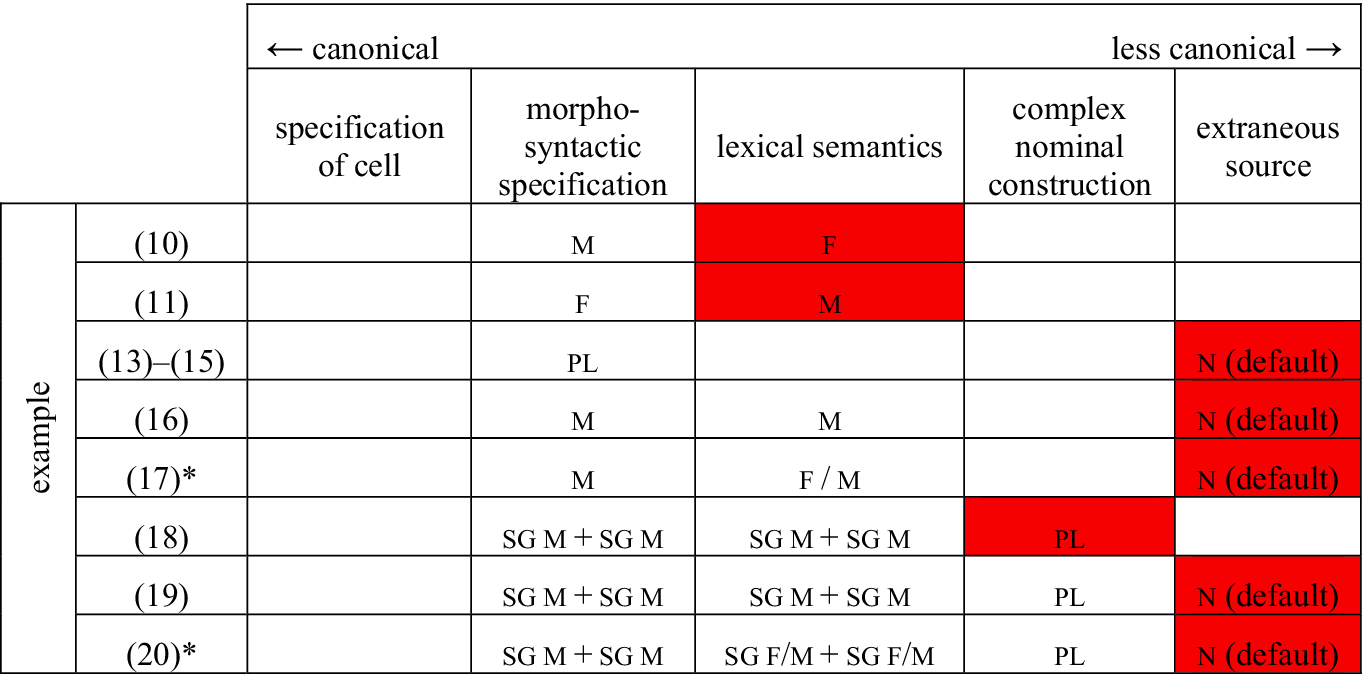
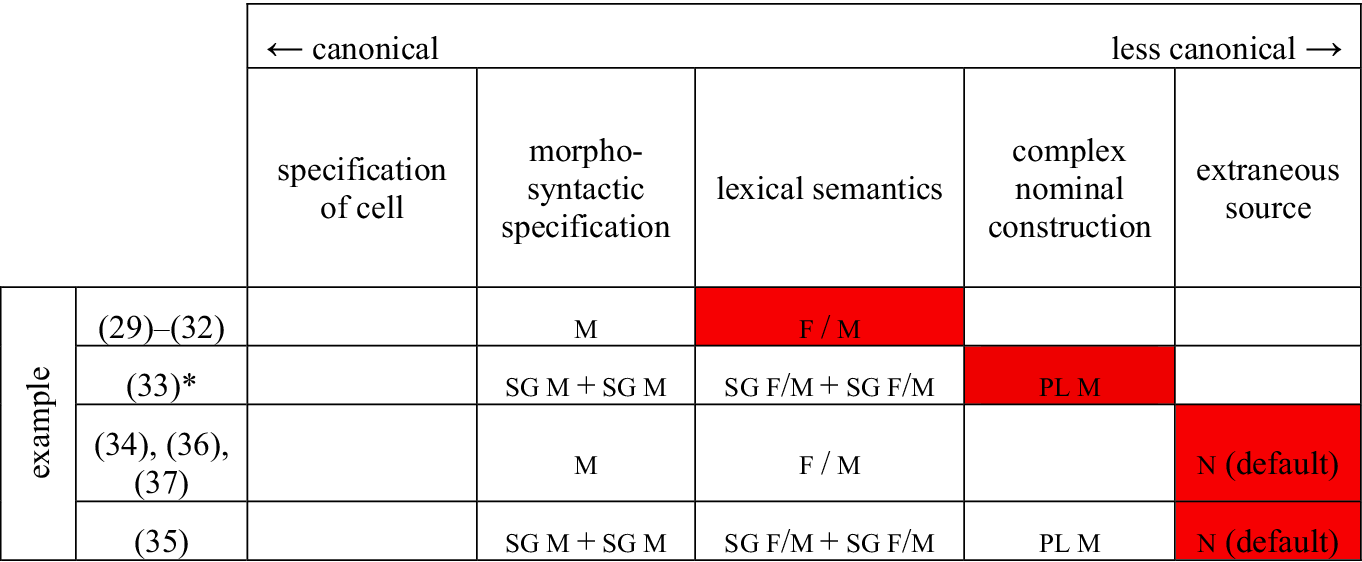

 Open access

