

Introduction
Homelessness continues to be a significant social issue in the United Kingdom. A range of specialist voluntary and statutory services has developed to support people often experiencing the most complex of needs. Despite this, a significant number of people who are homeless still need more support in relation to their health, in particular those experiencing mental health problems (Homeless Link, 2010). Policy increasingly pushes services towards more joint working, in particular to solve complex health and social problems (Department of Communities and Local Government, 2006; Cabinet Office Social Exclusion Task Force, 2007), yet the benefits or disadvantages of interagency working for the health of people who are homeless are poorly understood.
This article reports on a study on how the health needs of people who were homeless were addressed by multiple providers in one city. It provides an overview of the health of people experiencing homelessness, and describes some of the services created. The evidence of the effectiveness for interagency working in this area is reviewed and the study context and methods briefly explained. The findings focus on how services worked together, their networks of referral and collaboration and the extent to which preoccupations with risk overshadowed service user priorities for their health. The article concludes that a focus on the health needs and behaviours of people that are homeless that are perceived as being a risk to the general population directly influences interagency working and how professional networks organise themselves.
The health of people who are homeless
Since the 1960s, UK research on the health needs of single homeless people consistently highlights that people who are homeless have disproportionate levels of ill health compared with the rest of the population. Between 30 per cent and 50 per cent of single homeless people have mental health problems compared to 10 per cent to 25 per cent of the general population (Warnes et al., Reference Warnes, Crane, Whitehead and Fu2003), one third of people who are homeless have alcohol problems (Alcohol Concern, 2003) and there is an acknowledged overlap between homelessness and drug use (Neale, Reference Neale2008). Rough sleepers in particular are more susceptible to infectious disease, most notably tuberculosis (TB), (Kumar et al., Reference Kumar, Citron, Leese and Watson1995) and hepatitis B and C (Croft-White and Rayner, Reference Croft-White and Rayner1999).
Services supporting health
The provision of health services for people experiencing homelessness has a long history of multiple types of provider in the face of what has been seen to be problematic access and disinterest from mainstream health services. Until the mid-1970s, the voluntary sector organised most services, and in some instances also took responsibility for providing health care services. While small projects were established, some involving the employment of nurses or working with GPs (Smith et al., Reference Smith, Mose and Murphy1975), a case was made for government funding to improve health care provision (Davies, Reference Davies1976). A number of National Health Service (NHS) initiatives emerged to supplement mainstream primary care services. Examples included primary health care on the street (Ramsden et al., Reference Ramsden, Nyiri, Bridgewater and El Kabir1989) and in hostels (Maclean and Naumann, Reference Maclean and Naumann1979), and health advocate services for homeless families (Reilly et al., Reference Reilly, Graham-Jones, Gaulton and Davidson2004).
More recently, the government has introduced, under statute, new contractual mechanisms for NHS funding to be diverted to locally sensitive primary health care services for homeless people. Locally agreed Personalised Medical Services (PMS) contracts, to specifically deliver services to people who were homeless, could be made between general practitioners (GPs) and Primary Care Trusts (PCTs) (Homelessness Directorate, 2003a). National Enhanced Services for Homeless People contracts enabled GPs working under the General Medical Services (GMS) contract to receive extra payments to deliver additional specific services specifically to homeless people. Alternative Provider Medical Services (APMS) contracts enabled businesses and voluntary sector organisations to employ a health care professional to deliver a specific service (Department of Health, 2005).
In response to the high visibility of homeless people with mental health problems, the Homeless Mentally Ill Initiative (HMII) was established in central London in 1990 (Craig et al., Reference Craig, Baylis, Klein, Manning and Reader1995). Consequently, in many areas specialist multi-disciplinary mental health services exist to support homeless people with severe and enduring mental health problems. The numerous projects delivering primary health care and mental health services however are often context specific, and successful innovations may not achieve widespread uptake (Riley et al., Reference Riley, Harding, Underwood and Carter2003). The ways in which different services work together for this population are not well understood and it is not known how their effectiveness might be judged.
Interagency working
Co-operation between statutory and third sector services to support the health of people who are homeless has been recommended since the 1960s in order to avoid duplication of effort and dangerous gaps in care (Scott et al., Reference Scott, Gaskell and Morrell1966; Medical Campaign Project, 1988; Royal College of General Practitioners, 2002). Identifying evidence of effectiveness is, however, difficult as collaboration is often implicit or poorly described. Several models of health services have been established using multi-agency principles, but limited information is available about their efficacy or acceptability (Kennedy et al., Reference Kennedy, Lynch and Goodlad2001).
Interventions to promote collaboration between the health service and homeless populations have been able to improve levels of GP registration (Curran and Flannigan, Reference Curran and Flannigan1997) and increase engagement with the complex needs of homeless people (Pannell and Parry, Reference Pannell, Parry, Kennett and Marsh1999). Yet many projects are constrained by short-term funding and the need for quick outcomes or more rapid commitment (Crane and Warnes, Reference Crane and Warnes2001). Even where service models have been tested under controlled conditions, and where liaison and collaboration are identified as an integral part of the individual service, the role and input of partner organisations may not have been explored, providing only one perspective of success (Graham-Jones et al., Reference Graham-Jones, Reilly and Gaulton2004; Reilly et al., Reference Reilly, Graham-Jones, Gaulton and Davidson2004). The most effective interventions appear to focus around a specific health aspect, such as TB (Southern et al., Reference Southern, Premarante, English, Balazs and O'Sullivan1999) or hepatitis A (Judge and Sarangi, Reference Judge and Sarangi2003; Syed et al., Reference Syed, Hearing, Shaw, Probert, Brooklyn, Caul, Barry and Sarangi2003).
While services perceive interagency working to be worthwhile, the perspective of service users is unclear. Reported evidence based on the service perception alone does not explain why services were viewed as acceptable to service users (Curran and Flannigan, Reference Curran and Flannigan1997; Southern et al., Reference Southern, Premarante, English, Balazs and O'Sullivan1999) or include the views of those not accessing a service (Wood et al., Reference Wood, Sclare and Love2001). This article reports on a study that aimed to understand and evaluate the ways in which services worked together to support the health of people who were homeless, incorporating the perspectives of those in receipt of services as well as those delivering them.
Method and theoretical framework
The study took place in an inner-city area with a high transient population and a long history of providing services to people experiencing homelessness.Footnote 1 The study focused around two hostels with a combined population of 218 (hostels A and B) and aimed to consider what supported or inhibited interagency working to promote the health of, and delivery of health services to, people who were homeless.
Within an overall framework of participatory research (Kemmis and McTaggart, Reference Kemmis and McTaggart1988), five focus groups and two consultation events involving twenty-eight hostel residents explored and reflected on their health priorities. The majority of residents that participated were male, and while the health priorities discussed in this article are not gender specific, one limitation is that they do not include issues specific to women's health.
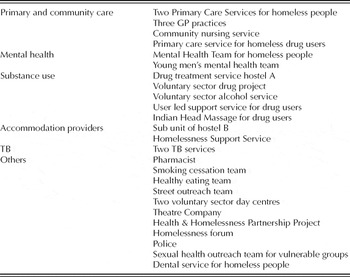
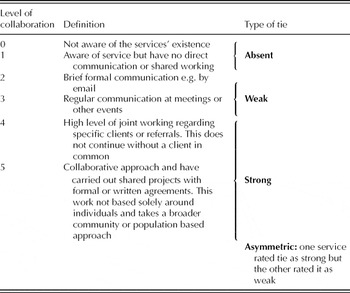
Semi-structured interviews, focus groups and consultation events were carried out with 102 representatives from thirty-two services (Table 1) considered to have some form of involvement in health. Questions included how they supported health and worked with other services. A taxonomy of interagency working was developed based on a taxonomy of professional collaboration between members of a primary health care team (Bond et al., Reference Bond, Cartlidge, Gregson, Barton, Philips, Armitage, Brown and Reedy1987; Gregson et al., Reference Gregson, Cartlidge and Bond1992). The refined taxonomy (shown in the first two columns of Table 2Footnote 2) included an additional level of no collaboration to account for the possibility that some services may not be aware of others existence. Service participants used the taxonomy during nine focus groups and thirty-two interviews to rate the level at which they worked with others using a list of services identified previously by hostel staff.
Services provided

Taxonomy of inter-agency working

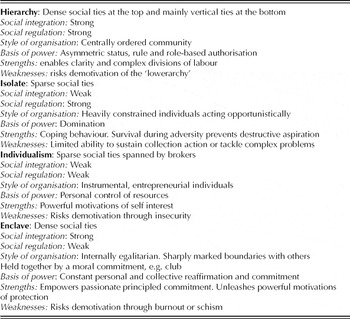
Granovetter's network theory was used to interpret how different services for people who are homeless organised care, and how they worked together and with mainstream health care services (Granovetter, Reference Granovetter1973). Granovetter suggested that a weak or strong tie within and across social networks of support is dependent upon four related factors: time, emotional intensity, intimacy and reciprocity. Data collected using the taxonomy survey were categorised as either an absent, weak, strong or asymmetric tie, as shown in the third column of Table 2. The resulting networks were further analysed to explore to what extent different network types (enclaves, hierarchies, isolates and individualisms (6 et al., Reference Six, Goodwin, Peck, Freeman, Goodwin, Peck and Freeman2006) addressed the health priorities identified by services and service users, as well as those contained in the local homelessness strategy. The characteristics of these networks are explained in Table 3 and throughout the following findings section.
Network characteristics

Findings
Thirty-six services for people who were homeless were identified of which thirty-two participated in the study. Twenty identified at least three services they worked with or relied on to be able to provide care. The network types showed that how they worked together varied according to the extent to which they were accountable to each other (social integration) and the degree to which they were governed by and accountable to rules and roles (social regulation). A focus on the management of risk, in particular where there was a threat to the wider community, emerged as a key factor in how networks of services were organised. The following two sections firstly present networks that addressed risk issues and then those that addressed service user priorities.
Networks addressing risk
Enclave networks comprise dense social ties held together by a strong moral commitment. They are characterised by intense mutual support between organisations within the network, but are likely to have confrontation with those outside. Three enclave type networks addressed issues of risk concerning people who were homeless. These were networks of specialist and mainstream services organised around the containment and treatment of TB, networks linked by attempts to reduce antisocial behaviour and a small network providing drug treatment services within one hostel. These networks were principally driven by legislation and their associated local policy initiatives.
Tuberculosis
The risk of contagion and the threat posed by drug resistant strains of TB in people failing to comply with treatment were found to drive significant interagency working. National and local priorities, sharing a common aim, and the need for better management of TB in temporary accommodation led to this focus. There was a network of strong ties between the two TB services and the services they worked with. Both specialist and mainstream services demonstrated a high level of awareness of how these two teams operated.
I've had lots of calls from interested GPs, interested in what's happening with TB, and how they can access the service. And then I've got some very good long-standing relationships with some of the GPs . . . particularly one GP [at one primary care service for homeless people] where we pick up on a lot of the patients going there from hostel A. So we have very good networks with some of those GPs and we're always trying to develop a bit more and improve on that. (TB team focus group)
Antisocial behaviour
Another network worked to address street-level antisocial behaviour – defined as begging, rough sleeping, sex work, drug use and drug dealing, and alcohol misuse. Co-ordinated by a voluntary sector street outreach team, this involved a fortnightly ‘tasking’ meeting where the behaviour of those involved in street-level antisocial behaviour were reviewed by a large network of services. In contrast to the network organised around TB services, some services remained on the periphery or outside of the enclave. While this initiative involved community mental health and drug services, there was no involvement of primary health care services who were not perceived by those within the enclave to be required. This demonstrated that a tie could relate to one aspect of joint working, but not be indicative of services involvement in other aspects of interagency working. Those that were involved, however, were committed to a common aim of preventing people from being arrested or returning to the street.
Now one example is a particular person who we found on the street after they had been excluded from one hostel. There was a warrant out for this persons arrest; we managed to find the person a B&B [bed and breakfast] to give her some stability. The police decided to work flexibly with the tasking process, and we said . . . we will put her in a B&B, we will discuss with you what the needs are, and if there is a warrant out for her arrest, we will work with her from that point. Now we put her in a B&B, she'd already broken her ASBO [antisocial behaviour order] and the police said ‘we are not going to arrest her, we've spoken to the Crown Prosecution Service and they are satisfied that because of the work that we're hoping in partnership, we can work much more flexibly with you to make sure she's not arrested . . . From that experience everybody in those tasking meetings felt more confident about working with the police, about sharing information. (Street team)
That some health-related services were part of this network, while others were not, is significant. Services within the enclave were limited in the range of services with whom they could interact, and where service users had particularly complex needs, this made it difficult for services to seek support. This was partly due to a lack of knowledge of the roles and remit of other services, but also because bridging weak ties between services, such as the street team and mainstream services, simply did not exist.
Drug treatment
Finally, a smaller enclave type network between a statutory drug treatment service and a pharmacist successfully delivered drug treatment services in hostel A. This network had clearly defined shared objectives. Its cohesiveness, with its specific clear aim, contributed towards its success, and was a positive enclave for all. However, its intensive pattern of collaboration, characteristic of enclaves with a small network of services, meant it operated in relative isolation, which worked against it becoming known more widely and inhibited opportunities to share good practice.
Networks addressing service user health priorities
Isolate networks are characterised by networks comprising sparse social ties. Although they can exhibit valuable coping behaviour, they are limited in their ability to sustain collective action or tackle complex problems. In contrast to the enclaves addressing risk issues, isolate type networks addressed issues principally affecting the health of people who were homeless. Even though some of these issues featured in the local homelessness strategy, the nature of these networks meant services were limited in their ability to address them. Although these issues presented risks to service users, the imperative to work together was not as strong as when there was no perceived risk to the wider society.
TB was not a health priority for residents but one underlying factor of TB, poor diet and nutrition, was a concern. No services were involved in improving diet for residents in one hostel, despite limited food availability and choice. While one main meal was served daily, there were no self-catering or food storage facilities for residents, of whom some reported using soup kitchens and eating out of litterbins. Even though the hostel had links to a range of health and social care services, these were not sufficient to address the issue.
Individualism networks also have sparse social ties, but in contrast to isolate networks these networks include entrepreneurial organisations or individuals who take on brokering roles, which can be used to control resources, define opportunities and bestow rewards. The creation of a new service with such a brokering role – the health and homelessness partnership project (HHPP) – consequently acted as a bridge between the hostel and the healthy eating strategy team to attempt to improve the situation for residents. This service, funded for two years, comprised a small team tasked to work with the two hostels to enable people who were homeless to access and benefit from mainstream services with a focus on joining up services.
Another example of where service users’ needs were not given priority was in the management of injecting-drug use in one hostel. Many residents were reported to use illicit drugs, yet sharps boxes were not supplied in communal areas or for individuals, and drug paraphernalia was widely discarded. Consequently, residents, staff and visiting services were at risk of needle stick injury.
No (there are no sharps boxes in the hostel), I think maybe the cleaners have one for when they go round. (There are) none in the toilets, none in any of the rooms. And some of those rooms are overflowing with syringes. (Resident, hostel B)
I once tried to flush the toilet and the toilet wasn't working and I nearly got nicked by a needle as there was one put in the cistern, because I had to – because the handle was not working. (Resident, hostel B)
The only service that could address this was the HHPP, who again acted as a bridge between services. Whereas hostel staff did not provide sharps boxes to residents, staff in a sub-unit of the hostel did on request. The latter practice was correct and thereafter the HHPP led on developing and implementing a new, clearer drugs policy with hostel B.
The third issue of concern for residents was how their safety and mental well being was maintained. A range of behaviours and situations affected their physical and mental health, including concerns about weapons, alcohol intoxication and illicit drugs:
On one floor, we have a separate unit. It can be quite intimidating because people are in there just for a shortish time and they haven't got the investment in long-term being here, so it can be quite rowdy and sometimes frankly out of control. [It can go on] for an hour, it can be a near riot, the people chasing each other with weapons. (Resident, hostel B)
Noise, and bullying and intimidation of vulnerable residents were also a significant problem and residents perceived their rights to peace and quiet were not given the same consideration as the general population.
If you had neighbours doing that in a block or outside your bedroom window, because that's where the disturbance is, outside your bedroom door, you would certainly get other agencies involved. In today's environment where we have the antisocial behaviour order, you'd be talking about that for people doing that in the streets outside where you are, and it's a fairly commonplace thing now I believe. I think some of the guys here have antisocial behaviour orders not to do certain things in the area . . . but if they are doing it inside apparently there is no sanction, short of them actually doing something drastic to cause them to be punished for what they have done . . . it wouldn't be tolerated if it were happening outside. (Resident, hostel A)
Many services acknowledged these problems, but the hostel was only able to provide minimal support, and no network considered ways to resolve them. Ties between the hostel and community mental health services for example did not focus on the needs of the wider hostel population. Therefore, there was an imbalance between the impact of hostel life on residents, and the corresponding input from services. To begin to address this, the HHPP used its co-coordinating role to work with two agencies, resulting in what was thought to be the first anti-bullying policy for hostels. This indicates that the role of a partnership project specific to health could begin to facilitate change for the benefit of residents.
Discussion
The analysis of these networks has shown that patterns of interagency working are driven by different factors, which do not necessarily engage with or account for the health priorities of people who are homeless. These factors reflect the perceived ‘risk’ homeless people pose to the wider society.
An appropriate focus on risk
Legislation and policy specific to homelessness (Homelessness Directorate, 2003b) and criminal justice (Home Office, 2008) strongly influence how health and social care services approach homelessness. Drugs policy has been criticized, for what was previously a health problem led by the medical profession is now a crime prevention and criminal justice problem led by the Home Office, the police and other law enforcement agencies, resulting in individual and public health being neglected (RSA, 2007). Health services are relatively new players to this field and their involvement is yet to be determined. This perhaps helps us understand why risk issues have overtaken other aspects affecting people who are homeless. Yet is this response to risk appropriate and balanced, and if it detracts from the wider health issues for homeless people being addressed, what can be done to redress it?
In this study, the service response to the risks arising from street-level antisocial behaviour demonstrates significant monitoring of people who are homeless. Hostels, day centres, night shelters and supported accommodation are all places of support and refuge, yet they have been identified as places also of containment and control (Johnsen et al., Reference Johnsen, Cloke and May2005; Fopp, Reference Fopp2002). Rough sleepers and hostel residents, however, are more likely to be victims rather than perpetrators of antisocial behaviour (Millie et al., Reference Millie, Jacobson, Hough and Paraskevopoulou2005), and hostels are known to be places of fear and violence (Daiski, Reference Daiski2006). Yet, most violent incidents towards people who are homeless remain unreported (Newburn and Rock, Reference Newburn and Rock2005), and data mapping the incidence of crimes against homeless people are not collected (Walker et al., Reference Walker, Kershaw and Nicholas2006), concealing the extent of the problem. There is evidence to suggest interventions to address street-level antisocial behaviour have benefited rough sleepers as well as the wider public (Johnsen and Fitzpatrick, Reference Johnsen and Fitzpatrick2010). Yet the findings of this study indicate an apparent imbalance between how services respond individually and collectively to the potential and actual risks to the general population, compared to the potential and actual risks facing residents living within hostels – arguably compounding rather than reducing social exclusion.
In comparison, interagency working to manage TB has long been recommended (Lewis, Reference Lewis1950). Here the overriding public health interest in TB appears to initiate services’ response, rather than a service user led demand. Other research has shown that people who are homeless are concerned about TB, but have sub-optimal knowledge about the causes, routes of transmission and treatments (West et al., Reference West, Gadkowski, Østbye, Piedrahita and Stout2008). This suggests that in this study site TB was not identified as a priority, either because it was so well managed or that other issues such as inadequate nutrition outweighed concerns about TB.
The way in which risk is defined and prioritised by different groups has pushed services to respond to a manufactured uncertainty (Beck, Reference Beck and Franklin1998) in which scientific efforts to control risk, such as TB prevention and control, and political efforts to control risk, such as the use of crime prevention strategies in the management of homelessness, are what essentially drive interagency working. Services are therefore required to assess and respond to risks, which may not take into account risks of higher priority to other groups. In this study, that GPs were more responsive to TB services than any others indicates that when an issue is deemed of sufficient priority, and matches services’ own perceptions of risk, they can be motivated to initiate and maintain an interagency relationship. The public health interest to eliminate TB means it deserves a high profile approach and TB services can therefore provide a model for interagency working from which others can learn. However, where policy is not present to drive services to form networks, and when services are not held accountable for failing to adequately implement those policies that do, motivating factors other than risk may be required.
The value of bridging services
How health issues are tackled at a population level within hostel settings remains an area requiring consideration by services and policymakers. While many people eventually move to more settled accommodation, for those with complex needs this is less likely (Crane and Warnes, Reference Crane and Warnes2007). For that reason, some hostels continue to accommodate people with high health support needs indefinitely.
The number of services identified in this study suggests there are challenges for service professionals in understanding services roles and in developing working relationships, and helps understand why service users and services face challenges in navigating them. The role developed by the HHPP signified a culture shift whereby health as defined by service users was beginning to gain priority. The team's role and skills in developing networks with so many services was of specific relevance and interest.
The need for professionals with responsibility for linking services together is not a new concept (Powell, Reference Powell1987; Powell, Reference Powell1988a, Reference Powell1988b; Curran and Flannigan, Reference Curran and Flannigan1997; Southern et al., Reference Southern, Premarante, English, Balazs and O'Sullivan1999; Graham-Jones et al., Reference Graham-Jones, Reilly and Gaulton2004; Reilly et al., Reference Reilly, Graham-Jones, Gaulton and Davidson2004). In Wales, health and homelessness co-coordinators have been recommended at the strategic level (Homeless Link Cymru, 2005) and in 2007 a post of health and homelessness facilitator was created (Wales Audit Office, 2007). This is a rare example of a policy directive leading to a post with a bridging function, despite the value of such types of posts to address the health of people who are homeless already being recognised. In contrast, partnership working to manage antisocial behaviour has been a statutory requirement since 1998 (Home Office, 2008). That the HHPP was so instrumental in creating bridges between services suggests there is a need for more research to explore these roles further, to evaluate not only the effect of interagency working on services, but also on service users.
Conclusions
This study has shown that interagency working to support health has been dominated by legislation and policy in relation to risk. It is clear that interagency working is a complex process and services in large cities face challenges in identifying the range of services it is possible to work with and in choosing with whom to invest time. How this fits with other health and social care policies remains to be seen. The implementation of personalisation for people experiencing homelessness is in its infancy (Hough and Rice, Reference Hough and Rice2010), and while this may improve support and outcomes for individuals, how will a focus on the individual be able to influence health improvement in the wider sense for hostel communities? It is unlikely such policies will obviate the value of individuals or services with a more strategic co-ordinating role. To exploit interagency working on issues other than ones that preoccupy wider society and also to give homeless people access to mainstream services, specialist services are required, which rather than directly providing services can instead assess their local networks and link and bridge these different networks of provision. Then perhaps not only the needs of individuals can be addressed, but also those of the wider homelessness community.
Acknowledgments and disclaimer
The study was funded by a fellowship supported by an Inner London Primary Care Trust. The opinions in the article are those of the authors and not necessarily those of the PCT or the NHS.