

1. Introduction
Universal Credit (UC) is a major reform to UK welfare benefits introduced in 2012 with the stated aims of simplifying working-age benefits and incentivising paid work. Overseen by the Department for Work and Pensions (DWP), UC is a non-contributory, means-tested working-age welfare benefit, designed for a range of unemployed and low-income people (DWP, 2010). It is a monthly payment, with the exact amount based on claimants’ circumstances (e.g., age, relationship status, disability status, children, income). It replaces six legacy benefits (Housing Benefit, Income Support, Jobseeker’s Allowance, Employment and Support Allowance, Child Tax Credit, and Working Tax Credit). UC has been progressively introduced for different groups and different areas and is now available at Jobcentres nationwide, but implementation remains incomplete, with many continuing to receive legacy benefits (Buchanan, Reference Buchanan2018; DWP, 2012). As of July 2021, 40.2% of UC recipients in England were in employment (Local Government Association, 2021).
1.1. Welfare conditionality and Universal Credit
While eligibility for any programme depends on conditions, such as status (citizenship, age) or need (income, employment), Watts and Fitzpatrick (Reference Watts and Fitzpatrick2018) note that, since the 1990s, conditions on people’s conduct are increasingly employed. In many developed welfare states, conditions emphasise labour market activity, whereby claimants must demonstrate that they are working or actively seeking employment. Such schemes have been characterised as ‘workfare’ (Peck, Reference Peck2001) or ‘activation policy’ (Bierbaum, Reference Bierbaum2019).
Conditionality is central to UC (Dwyer and Wright, Reference Dwyer and Wright2014). To receive UC, claimants sign a personal Claimant Commitment detailing their obligations. Generally, they must seek employment, maximise their hours/income, participate in Jobcentre interviews, complete training, and notify the DWP of changes to their circumstances. Sanctions, in the form of benefit withdrawal, are imposed for non-compliance. UC expands conditionality to working low-income people, who previously received Tax Credits with fewer conditions (Clegg, Reference Clegg2015).
One way in which UC can be considered more conditional than the legacy benefits it replaces is how it uses sanctions. Webster (Reference Webster2017) outlines three ways in which sanctioning in UC differs to the legacy system. First, sanctions are now consecutive, rather than concurrent, effectively lengthening sanction periods for people who receive multiple sanctions. Additionally, hardship payments, emergency payments for which UC recipients can apply to meet their basic needs if they have been sanctioned, have been made repayable. Compounding this, claimants are now required to demonstrate ‘compliance’ for seven days before they can apply for hardship payments, and need to re-apply every four weeks.
Welfare conditionality polarises. Proponents make moral arguments based on reciprocity, fairness, and intolerance of ‘free-riding’ (Miscampbell, Reference Miscampbell2014; Watts and Fitzpatrick, Reference Watts and Fitzpatrick2018). Central is the paternalist principle that the State can and should inflict short-term hardship and distress on welfare claimants through conditions and sanctioning because it is in their long-term best interest to leave welfare and enter employment (Mead and Beem, Reference Mead, Beem, Mead and Beem2006). The UK government characterises conditionality in UC as helping “people along a journey toward financial independence from the state” (DWP, 2010, p. 31) by leading them to employment. Others highlight that politicians are unwilling to provide ‘something for nothing’, and that conditionality has popular support (Schüring, Reference Schüring2010). British survey data reveals that many believe benefits are overly generous and discourage work (Sage, Reference Sage2019). Petersen et al. (Reference Petersen, Slothuus, Stubager and Togeby2011) demonstrated that people often rely on a ‘deservingness heuristic’ in response to cues from public debate and the media in welfare issues, focusing on who is ‘deserving’ of assistance. Conditionality can be considered a method of establishing ‘deservingness’. People are generally less demanding of older people and parents (Van Oorschot and Roosma, Reference Van Oorschot and Roosma2015). Nonetheless, even previously sanctioned homeless claimants express “widespread support for a system of conditionality” (McCarthy et al., Reference McCarthy, Batty, Beatty, Casey, Foden and Reeve2015, p. iv).
Critics argue that conditionality is immoral, incoherent, stigmatising, ineffective at achieving its stated aims, and a source of unnecessary financial and psychological distress for claimants and their families. Sepúlveda and Nyst (Reference Sepúlveda and Nyst2012) identify friction between States’ obligations to meet basic needs as a human right and the imposition of conditions for the fulfilment of those needs. Whitworth (Reference Whitworth2016) argues that conditional welfare programmes carry ideological contradictions, because they simultaneously encourage independence and responsibility, while paternalistically imposing conditions so that claimants behave ‘correctly’. Bierbaum (Reference Bierbaum2019) notes that, in the Netherlands’ conditional Participation Act, a very narrow view of autonomy is endorsed, emphasising financial self-sufficiency, but disregarding authentic freedom. Others highlight stigmatisation, connecting caricatures of ‘skivers’ and ‘strivers’ with Victorian notions of the deserving and undeserving poor (Valentine and Harris, Reference Valentine and Harris2014). Psychological distress, disproportionate for vulnerable groups, is widely observed (Dwyer et al., Reference Dwyer, Scullion, Jones, McNeill and Steward2020; Wright and Patrick, Reference Wright and Patrick2019).
Evidence suggests that, although conditionality decreases welfare caseloads, it often does not increase employment, or guarantee suitable, high-quality jobs. Evans and Griggs’ (Reference Evans and Griggs2010) review indicates that, in the short term, sanctions in conditional unemployment benefit systems can lead to benefit exit and employment entry. They note that, while severe sanctions, such as the immediate full-family withdrawal of benefits, significantly reduce welfare caseloads, evidence on unemployment and earnings is broadly unfavourable. In Germany, Schneider (Reference Schneider2008) found that unemployment benefit recipients who were sanctioned were no more likely to enter employment than the non-sanctioned. Arni, Lalive, and van Ours (Reference Arni, Lalive and van Ours2009) showed that sanction-driven unemployment benefit exits often result in poor quality employment, low earnings, and job instability. Wright and Patrick (Reference Wright and Patrick2019) identify that, in the British system, the pressure to take any job can undermine claimants’ ability to obtain work suitable to their character, skills, and circumstances.
1.2. The impact of Universal Credit
Welfare benefits are complex in their effects, and process tracing is difficult. In addition to the income received, one must consider all the mechanisms, practices, and interactions involved.
Brewer et al. (Reference Brewer, Joyce, Waters and Woods2019) investigated the actual and predicted impact of UC on household finances over the 8 years leading to 2024. They identified that the shift from the legacy system to UC involves a £2 billion annual decrease in entitlements, partly from benefit freezes and the two-child limitFootnote 1 . There were winners and losers. While 17% were estimated to lose over £1000 yearly, 14% would gain that much. Losers included those with financial assets, the low-earning self-employed and ‘gig workers’, couples in which one member is above the state pension age, and some disability benefits claimants. Winners included working rented households. Although the magnitude of these differences is predicted to decrease gradually, Brewer et al. (Reference Brewer, Joyce, Waters and Woods2019) demonstrate that UC “disproportionately reduces incomes among poorer adults” (p. 3).
Others have investigated whether UC incentivises work. A government evaluation demonstrated that UC claimants were, on average, 6% more likely to be in work following the start of their claim than their counterparts on Jobseeker’s Allowance (DWP, 2018). UC claimants reported undertaking more job search activity than Jobseeker’s Allowance claimants. Curiously, the two benefits involve similar conditionality regimes, implying that the difference is due to other design or participant characteristics. Other labour incentive analysis has been primarily performed through economic simulations (Brewer et al., Reference Brewer, Browne and Jin2012; Brewer and De Agostini, Reference Brewer and De Agostini2015), and empirical evidence from ex-post analysis remains scarce.
UC claims must be initiated online. As millions claimed UC during the COVID-19 pandemic (DWP, 2020), remote application has clear advantages. Moreover, reducing in-person meetings might minimise costs and caseworker workloads and be time-efficient for some claimants (DWP, 2010). However, an online system may not identify nuances in people’s circumstances and impede discretionary behaviour. Additionally, online payment calculation may cause opacity, with claimants unaware how decisions are reached (Lepri et al., Reference Lepri, Staiano, Sangokova, Letouzé, Oliver, Cerquitelli, Quercia and Pasquale2017). This information asymmetry can prevent claimants from challenging claim-related decisions. People without technology access/skills, and people with learning difficulties, might struggle in particular (Cheetham et al., Reference Cheetham, Moffatt, Addison and Wiseman2019; Jones and Tucker, Reference Jones and Tucker2019).
Qualitative studies have explored the wellbeing impact of UC. Cheetham et al. (Reference Cheetham, Moffatt, Addison and Wiseman2019) conducted interviews and focus groups with UC claimants and staff from local government, housing, community, and voluntary sector organisations in Northeast England. They highlight that applying for UC can be difficult because the online system lacks human support, especially for claimants that struggle with computers. Interviewees cited financial difficulties arising from the five-week wait, leading to many claimants “going into debt, rent arrears and suffering serious hardship which included going without food and utilities” (Cheetham et al., Reference Cheetham, Moffatt, Addison and Wiseman2019, p. 4). Moreover, payments “fluctuated unpredictably and were affected by administrative errors and delays, punitive deductions and sanctions” (Cheetham et al., Reference Cheetham, Moffatt, Addison and Wiseman2019 pp. 4-5). Some were £100 worse off per month after moving onto UC, and the authors noted the impact of the associated financial strain on claimants’ family and social lives. Diminished physical and mental health was attributed to the system’s hostility, inflexibility, insensitivity, and difficulty to navigate. Support staff reported fearing for clients and described their own increased workload and strain. Other work mirrors these results (Patrick, Reference Patrick2014; Patrick, Reference Patrick2017a; Patrick, Reference Patrick2017b).
1.3. The present study: Universal Credit and life satisfaction
While some have explored the impact of UC beyond economic indices, little research has quantitatively investigated how objective changes in people’s circumstances because of UC affect recipients’ ability to live a satisfying life. From an evidence-based policy-making perspective, it is important to investigate all potential impacts of a reform. Considering the broader social and economic impact of poor wellbeing and mental ill-health, subjective outcomes have instrumental, as well as intrinsic, importance (Doran and Kinchin, Reference Doran and Kinchin2019; Layard, Reference Layard2017).
Psychologists treat life satisfaction as one of three dimensions of subjective wellbeing, alongside positive and negative affect (Diener et al., Reference Diener, Emmons, Larsen and Griffin1985). While the two affective components refer to the emotional aspects of wellbeing, life satisfaction encapsulates its cognitive-judgemental dimension, representing a subjective evaluation of one’s life as a whole (Andrews and Withey, Reference Andrews and Withey1976). According to Shin and Johnson (Reference Shin and Johnson1978), life satisfaction is “a global assessment of a person’s quality of life according to [their] chosen criteria” (p. 478). Meanwhile, the capability approach emphasises the connection between human development, wellbeing, and the freedom to be and do the things one has reason to value (Alkire and Deneulin, Reference Alkire, Deneulin, Alkire and Deneulin2009).
In both views, values determine which choices are relevant for an individual. Indeed, greater perceived control is associated with better subjective wellbeing (Lang and Heckhausen, Reference Lang and Heckhausen2001). Consequently, conditional welfare policies, like UC, that impose normative judgements about what constitute valuable choices clash strongly with these conceptualisations of life satisfaction. UC obliges claimants to fulfil a routine set of job-seeking activities, and requires claimants to accept any job, even if it contradicts their character and motivations (Dunn, Reference Dunn2010). Following this reasoning, and bearing in mind specific design characteristics of UC like the five-week waiting period for new claimants (Jones and Tucker, Reference Jones and Tucker2019; National Audit Office, 2020), one would expect an overall direct negative effect of UC on recipients’ life satisfaction.
Furthermore, one might expect an indirectly negative effect of UC on life satisfaction via increased psychological distress. Looming sanctions may negatively affect life satisfaction by causing psychological distress. Aggregating qualitative longitudinal research, Wright and Patrick (Reference Wright and Patrick2019) demonstrated that coercive practices, including sanctioning, were usually experienced as unnecessary and harmful. Further, they noted that poverty was prevalent among claimants in and out of work, and that this deprivation tended to worsen after the move to UC, pushing many close to destitution. The threat or application of sanctions can amplify the distressing effects of poverty. This is supported by a large-scale impact evaluation of Universal Credit on psychological distress by Wickham et al. (Reference Wickham, Bentley, Rose, Whitehead, Taylor-Robinson and Barr2020). They identified that self-reported psychological distress increased significantly among unemployed people after UC was introduced in their area. Research has linked psychological distress and overall life satisfaction, especially when experiencing negative life events, including financial strain (Marum et al., Reference Marum, Clench-Aas, Nes and Raanaas2014). Pervasive sanctioning in UC might diminish claimants’ life satisfaction by inflicting psychological distress on financially and multidimensionally vulnerable individuals. One might expect an indirect negative effect of UC on life satisfaction, mediated by increased psychological distress.
Because UC is designed to be received by a range of people with varied personal circumstances and backgrounds, it is conceivable that UC might have certain heterogenous effects on claimants based on their characteristics.
Single parents, for example, merit consideration. UC subjects all single parents with a youngest child aged one or older to work-based conditionality, increasing as the child ages (Turn2us, 2019). Graham and McQuaid (Reference Graham and McQuaid2014) report that, whilst lone parents do in general want to work for the financial, social, and psychological benefits this confers, they face challenges finding suitable work, which welfare conditionality can exacerbate. Barlow et al. (Reference Barlow, Duncan, James, Carling, Duncan and Edwards2002) argue that the logic of welfare conditionality is based on false assumptions about lone parents’ economic rationality and morality. When lone parents do not enter employment, they are wrongly categorised as irresponsible or irrational, when they are simply making a personal choice to remain outside of the formal labour force. Considering these premises, one would expect single parents’ life satisfaction to disproportionately suffer from UC recipience, compared to coupled parents and non-parents.
UC generally subjects individuals who work more to less severe conditionality. Those above the Conditionality Earnings Threshold, earning the equivalent of 35+ hours a week at minimum wage, receive their payments without any conditional requirements (Work and Pensions Committee, 2018). UC was designed to incentivise paid work and if it simply tops up the wages of the full-time employed, the effect on their life satisfaction could be positive. These individuals, as well as constituting financial winners under UC (Brewer et al., Reference Brewer, Joyce, Waters and Woods2019), could benefit from its design in terms of life satisfaction. Thus, one might anticipate a significantly more positive effect of receiving UC on the life satisfaction of those working 35+ hours weekly, than those working fewer than 35 hours.
Similarly, one might expect UC to have a different effect based on one’s employment status. Aside from a select few groups (e.g. people with severe disabilities/illnesses, people with children younger than one, full time carers) any recipient who does not work is expected to meet the most demanding of work-search conditions (Work and Pensions Committee, 2018). If conditionality is the driver of a decrease in life satisfaction, one might expect people not in paid work, who generally have more conditions placed on them, to experience a greater decrease in their life satisfaction due to UC enrolment than those who are in paid work. Following this reasoning, this should be the case regardless of whether an individual is unemployed, or not in paid work for another reason.
Using a fixed-effects regression strategy, alongside other quantitative techniques, this study investigates whether UC has a negative effect on life-satisfaction, exploring these potential mediation mechanisms and effect heterogeneities.
2. Data and Methodology
2.1. Data
Data is sourced from Understanding Society: The United Kingdom Household Longitudinal Study (UKHLS); (University of Essex, Institute for Social and Economic Research, 2020). UKHLS includes questions covering a range of topics, including household finances, employment, education, mental health and wellbeing, illnesses and disabilities, welfare benefits, and more. UKHLS is a panel survey, with the same individuals interviewed repeatedly over time. It comprises ten waves of data, spanning January 2009 to May 2020. Waves stretch over multiple years, but individuals are interviewed only once in each wave. Because the first Universal Credit recipients do not appear until wave 5 (2013-2015), only waves 4-10 are analysed in the main model.Footnote 2 The final sample includes 223,790 observations from 53,201 working age individuals (aged 16-64).
2.2. Main analysis
As the main analytical method, a fixed-effects longitudinal regression approach is adopted, including various control variables. This approach enables one to capture within person variation in life satisfaction after exposure to UC. The average variation effect is represented by the regression coefficient. It is important to notice that numbers for UC beneficiaries vary at every wave: and individuals might be receiving the benefit only at one time point, while others remain beneficiaries for several waves. The main ‘treatment’ variable used is a categorical variable with four mutually-exclusive levels:
0. Receives no benefits (comparison group)
1. Receives UC
3. Receives a legacy benefit replaced by UCFootnote 3
4. Receives a benefit other than UC or legacy benefits
The outcome in this model is life satisfaction, “a global assessment of a person’s quality of life according to [their] chosen criteria” (Shin and Johnson, Reference Shin and Johnson1978, p. 478). All ten waves of UKHLS contain one item measuring overall life satisfaction. Participants were presented the text “Please choose the number which you feel best describes how dissatisfied or satisfied you are with the following aspects of your current situation” followed by four 7-point Likert scales ranging from “completely dissatisfied” (1) to “completely satisfied” (7) for “your life overall”. The score is considered both as a continuous measure and as a binary indicator assigning value of 1 to individuals at least “somewhat satisfied” with their life (i.e. values 5, 6, and 7) in the analysis.
Self-evidently, past literature has identified many more factors influencing life satisfaction besides enrolment in a benefit alone (Helliwell et al., Reference Helliwell, Huang, Harris, Dutta, Ray and Somanathan2009; Palmer et al., Reference Palmer, Donaldson and Stough2002; Schimmack et al., Reference Schimmack, Diener and Oishi2002; Schwarz and Strack, Reference Schwarz, Strack, Kahneman, Diener and Schwarz1999). The most relevant of these factors were included as covariates, to control for their influence. These included participants’ relationship status, the number of respondents’ own dependent children in their household, their OECD equivalence scale adjusted monthly income, whether they have a long-term illness or disability, whether they live in an owner-occupied property, their level of education, whether they live in an urban or rural area, their age in years, and their employment status.
A key assumption of OLS models is regressor exogeneity, or that the main explanatory variable UC iw is uncorrelated with the error term u iw . By including time fixed-effects and covariates the model reduces omitted variable bias concerns. Conceivably, selection bias may be present, whereby differences exist in life satisfaction between UC recipients and non-recipients before the benefit is distributed. However, pre-treatment differences between beneficiaries and non-beneficiaries are bound to UC targeting criteria (i.e. a focus on unemployed and low-income individuals) and should not affect the benefit’s ability to affect life satisfaction. Indeed, evidence from European countries has shown that generous labour market policies have the potential to reduce individuals’ dissatisfaction with life (Wulfgramm, Reference Wulfgramm2014). In any case, alternative model specifications are employed as robustness checks to account for potential pre-treatment differences (see section 3.3).
2.3. Legacy benefits and other benefits
While this paper is principally concerned with the effect of UC, its effect in comparison to other benefits, including those it replaces, need consideration. To calculate the effect of these other benefits on life satisfaction prior to UC’s implementation, a separate model is run using data from waves 2-4 of UKHLS. This model is the same as the main model but lacks the UC recipience variable (UC was not implemented during these waves). Instead, it retains the other two categories of the treatment variable (legacy benefit recipience, other benefit recipience). The comparison group remains those who receive no benefits.
2.4 Mediation models
To test the hypothesised mediation mechanism, a multi-stage process, illustrated in Figure 1 and based on Krull and MacKinnon (Reference Krull and MacKinnon2001), is applied. The total effect (c) of UC recipience on life satisfaction is calculated by regressing the latter on the former. The indirect effect is calculated by taking the product of the coefficients of the effect of UC recipience on psychological distress (a) and the effect of psychological distress on life satisfaction (b). The direct effect of UC on life satisfaction, then, is given by subtracting the indirect effect via psychological distress (a*b) from the total effect (c). All coefficients described here are calculated using fixed-effects regressions, including all the same covariates as the main model.
Visual representation of the mediation model. Note. a = effect of UC recipience on psychological distress; b = effect of psychological distress on life satisfaction; c = total effect of UC recipience on life satisfaction when psychological distress is not included as a mediator; c’ = direct effect of UC recipience on life satisfaction when psychological distress is included as a mediator.

Psychological distress is operationalised using the 12-item General Health Questionnaire (GHQ-12) measure of psychological distress, designed to identify non-psychotic and minor psychiatric disorders (Gao et al., Reference Gao, Luo, Thumboo, Fones, Li and Cheung2004). Total scores, ranging from 0-36, are taken as a continuous measure, with higher scores indicating greater distress.
2.5. Heterogeneity analysis
Following the rationale outlined earlier in the paper, three sets of heterogeneity analysis are performed. This is done by repeating the main model but including an interaction term of UC recipience and relevant moderator variables. These include (1) a categorical variable for parenthood status with three categories: non-parent, single parent, coupled parent, (2) a binary variable for whether an individual works 35+ hours in a typical week, and (3) a categorical variable for employment status with three categories: in paid work, unemployed, and not in paid work for another reason.
3. Results
3.1. Descriptive statistics
Tables A1 and A2 in the Appendix display the descriptive statistics for the study sample. Overall life satisfaction levels had their ups and downs through time, decreasing steadily between wave 1 and 5, then increasing until wave 7 (2015-2017), when they began decreasing again. Average number of hours worked per week remained constant through time, as did the percentage of married individuals and people living in urban areas. Property ownership appears to be more volatile, although no major shocks appear to have occurred in any of the waves.
3.2. Universal credit and life satisfaction
Figure 2 compares mean levels of life satisfaction for individuals, based on the benefits they receive, over survey waves 4-10. It shows that life satisfaction is highest, on average, among those who do not receive benefits (M = 5.26, 95% CI [5.24, 5.27]), followed closely by those who receive benefits other than UC or legacy benefits (M = 5.16, 95% CI [5.14, 5.19]). Those who receive legacy benefits report even lower life satisfaction on average (M = 4.58, 95% CI [4.56, 4.60], and those who receive UC report the lowest life satisfaction (M = 4.39, 95% CI [4.28, 4.50]). This provides an initial indication that UC might have a negative effect on life satisfaction, and that this effect could be more negative than that of other benefits. Nonetheless, the following analysis provides more robust evidence.
Bar graph displaying mean levels of life satisfaction, based on the type of benefits received, for waves 4-10. Survey probability weights were used, and error bars display 95% confidence intervals. N = 128,776.

Table 1 displays results from the main fixed-effects model specifications. When accounting only for individual-level fixed-effects, a significantly negative effect of UC on life satisfaction is found (column 1). The effect remains significantly negative when including region*wave fixed-effects (column 2) and controls (column 3). This third specification represents the complete, preferred model. It shows that, on average, controlling for fixed-effects and relevant covariates, UC recipients report lower life satisfaction than those who do not receive benefits by 0.28 points on the 7-point scale, and that this effect is significant at the 1% level. This is larger in magnitude than the mean difference between legacy benefit recipients and non-benefit-recipients (β = −0.10, 1% significance) and the difference between those who receive other benefits and non-benefit-recipients (β = −0.03, 10% significance). Considering covariates, the effect of UC recipience is larger than the effect of being married/in a civil partnership/cohabiting (β = 0.14, 1% significance), having a long-term illness or disability (β = −0.14, 1% significance), or being unemployed (β = −0.22, 1% significance). The negative effect of UC remains consistent when considering life satisfaction as a dummy (column 4); UC recipients are 5.6 percentage points less likely to report being satisfied with their life overall than non-benefit-recipients, on average, at the 1% significance level.
Results for Fixed Effects Linear Regressions of Life Satisfaction on Universal Credit Recipience and Covariates

Note: Household-clustered standard errors in parentheses. Survey probability weights were used. *** p<0.01, ** p<0.05, * p<0.1.
3.3. Robustness checks
Several tests are run to check the robustness of the main specification. First, to check for correlation between regressors, the variance inflation factor (VIF) is calculated for each regressor in the main model. An average VIF of 3.07 is obtained, significantly reducing concerns about correlation between regressors.
Second, the analysis is repeated using different standard error clustering, at the individual, region, and country-level. Results mirror the main analysis in magnitude and direction, suggesting robustness to the choice of standard error (appendix Table A3). Alternative model specifications were explored to support the identification strategy.
To dispel doubts on comparability between individuals receiving UC and those not receiving it, inverse probability weights (IPW) are calculated, accounting for the likelihood of an individual being enrolled in a programme (Barter, Reference Barter2017). The main purpose of this process is to increase comparability between the treatment group (UC recipients) and those who do not receive UCFootnote 4 . Table 2 displays results of the new specification. Results resemble the main analysis in both direction and magnitude, albeit with a slightly smaller coefficient for the continuous outcome, and larger coefficient for the binary outcome.
Results for Fixed Effects Linear Regressions of Life Satisfaction on Universal Credit Recipience and Covariates, Using Inverse Probability Weights

Household-clustered standard errors in parentheses. Inverse probability weights were used. *** p<0.01, ** p<0.05, * p<0.1
Another alternative specification compares beneficiaries and non-beneficiaries before and after UC was implemented (comparing wave 4 with wave 10). This difference-in-differences (DiD) method considers all UC beneficiaries in wave 10 as ‘enrolled’ in the program in wave 4 to compare their life satisfaction with that of the rest of the population between waves. Results (Table 3) agree with the main specification. Specifically, the interaction term indicates that, compared to those who received no benefits at wave 10, those who received UC at wave 10 showed a −0.45 points more negative change in life satisfaction between waves 4 and 10, on average (1% significance).
Difference-in-Differences Analysis by OLS Linear Regression of Life Satisfaction on the interaction of Universal Credit Exposure and Time, and Covariates
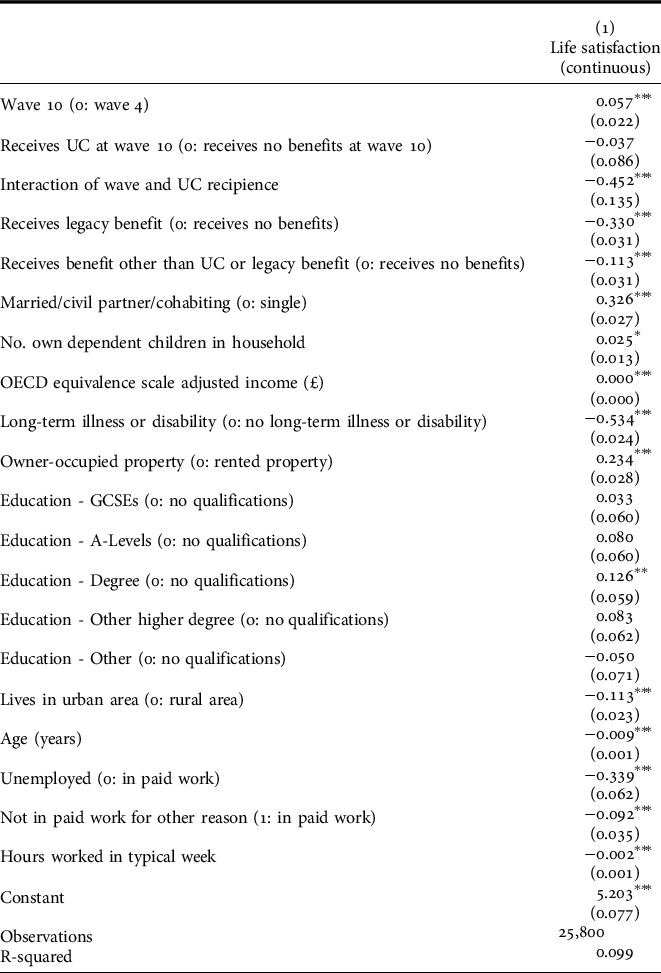
Household-clustered standard errors in parentheses. Survey probability weights were applied. *** p<0.01, ** p<0.05, * p<0.1.
DiD is based upon the parallel trends assumption, that levels for life satisfaction future UC recipients and non-recipients were trending similarly before UC’s implementation. This is measured by comparing future UC recipients’ and non-recipients’ life satisfaction in wave 4 with their life satisfaction in previous waves. Results from comparing wave 4 with wave 2 and 3 both produce non-significant interactions, showing that recipients’ and non-recipients’ life satisfaction levels were following the same trends before the implementation of UC (appendix Table A5).
A final alternative specification looks at the effect of receiving UC for different numbers of survey waves. If UC has a negative effect on life satisfaction, one might expect that effect to become more negative if one receives UC for longer. Table 4 displays the effect of receiving UC for 1, 2, 3, 4, and 5 survey waves. Results suggest that receiving UC for only one wave reduces life satisfaction by −0.29 points, compared to those who receive no benefits, at the 1% significance level. This effect is similar in magnitude to that of the main specification. Receiving UC for 2, 3, and 4 waves also has a negative effect on life satisfaction, although this effect is not statistically significant. What is interesting to note is that the negative effect of UC is incremental between wave 2 and 4, culminating in a 0.79 points lower life satisfaction for individuals who received UC for 5 waves. This in effect is more than double in magnitude than that of 1 wave beneficiaries and it is significant at the 5% level. In sum, results seem to indicate that the longer one is exposed to UC, the worse his life satisfaction becomes. However, new recipients (i.e. those receiving UC for 1 wave) appear to show a malus compared to those who have been part of the programme from 2-to-4 waves.
Results for Fixed Effects Linear Regressions of Life Satisfaction on the Number of Survey Waves of Universal Credit Recipience and Covariates

Household-clustered standard errors in parentheses. Survey probability weights were used. *** p<0.01, ** p<0.05, * p<0.1
3.4. Legacy benefits and other benefits
Results from the relevant models indicate that, for waves 2-4 of UKHLS, recipients of legacy benefits, and other benefits, did significantly differ from those who received no benefits at all in their life satisfaction (Table 5). The magnitude of these coefficients (0.07 and 0.08 respectively, both significant at 5%) are not too dissimilar to those in the main model, and are still substantially smaller than the coefficient of UC in the main model. This gives credence to the notion that the negative effect of UC is more than a mere general benefit effect.
Results for Fixed Effects Linear Regressions of Life Satisfaction on Legacy Benefit and Other Benefit Recipience and Covariates

Household-clustered standard errors in parentheses. Survey probability weights were used. *** p<0.01, ** p<0.05, * p<0.1
3.5. Mediation
Results, summarised in Table 6, are consistent with the hypothesised mediated effectFootnote 5 . Path a indicates a significantly positive effect of UC recipience on psychological distress. On average, UC recipients report 0.86 points higher psychological distress than non-recipients. Furthermore, path b reveals a negative effect of psychological distress on life satisfaction, such that each additional point on the psychological distress scale is associated with a 0.09-point decrease in life satisfaction on average. Multiplied together, these suggest a net negative indirect effect −0.08. Thus, partial mediation can be inferred, whereby UC recipience is associated with increased psychological distress, which is in turn associated with decreased life satisfaction. Specifically, coefficients indicate that 28.2% of the total negative effect of UC recipience on life satisfaction is mediated by psychological distress.
Mediation of the Effect of Universal Credit on Life Satisfaction via Psychological Distress

Covariates: receives legacy benefits, receives other benefits, relationship status, number of own dependent children in household, OECD equivalence scale adjusted income, long-term illness, lives in owner-occupied property, education, lives in urban area, age, employment status, number of hours worked in a typical week. Models include individual and region*wave fixed effects.
3.6. Heterogeneity analysis
Results for the heterogeneity analysis are displayed in Table 7. First, results in column 1 suggests that the effect of UC on life satisfaction is somewhat more positive for those who report working 35+ hours in a typical week (compared to those who work fewer than 35 hours) by .28 points, although this effect is only significant at the 10% level, and the overall effect for this group remains negative. Second, results in column 2 suggest that the effect of UC on life satisfaction does not significantly differ between those who are unemployed and those in paid work. However, the effect of UC on life satisfaction is significantly more negative for those not in paid work (for reasons other than unemployment) than those who are in paid work (β = −0.25, 1% significance). Finally, column 3 suggests that the effect of UC on life satisfaction is in fact more positive for single parents than non-parents (β = 0.26, 1% significance), although still negative overall. There is not a significant difference in the effect of UC on life satisfaction, between coupled parents and non-parents. The implications of these findings are explored further in the discussion.
Testing for Heterogenous Effects Based on Parental Status and Hours Worked Using Fixed Effects Linear Regressions of Life Satisfaction on Universal Credit Enrolment, Interacted with Parental Status, Working 35+ Hours Per Week, and Employment Status, Alongside Covariates

Household-clustered standard errors in parentheses. Survey probability weights were used. Models include individual and region*wave fixed effects. (1) Heterogeneity model interacting whether respondents worked 35+ hours per week with UC recipience. (2) Heterogeneity model interacting whether respondents were in paid work with UC recipience. (3) Heterogeneity model interacting parental status with UC recipience. *** p<0.01, ** p<0.05, * p<0.1
4. Discussion
Universal Credit represents a substantial shift in how UK welfare works. This study aimed to shed light on whether the reform supports or frustrates recipients’ ability to live a satisfactory life.
4.1. Discussion of findings
Main analysis, robustness checks, and alternative specifications support the hypothesis that there is a negative effect of UC recipience on life satisfaction. Robustness checks and alternative specifications confirm the initial results. It does indeed appear that UC recipients are less satisfied with their lives than comparable individuals who claim no benefits. One explanation of these findings is that the conditionality which is pervasive in UC and similar benefits undermines recipients’ agency and ability to be and do the things which they have reason to value (Alkire and Deneulin, Reference Alkire, Deneulin, Alkire and Deneulin2009; Diener, Reference Diener1984; Dunn, Reference Dunn2010; Wright and Patrick, Reference Wright and Patrick2019). Job-related activity requirements, especially those pertaining to careers of little interest and poor fit to recipients, reduce opportunities for people to pursue their own idea of a satisfying life. Moreover, these requirements can make it harder for recipients to focus on activities and tasks that do bring them satisfaction, such as spending time with their children, pursuing training and education, developing hobbies, socialising, volunteering, and being active in their communities.
A potential mediator of the negative effect of UC on life satisfaction is identified in increased psychological distress, potentially because of looming sanctions. These findings are corroborated by those of Wickham et al. (Reference Wickham, Bentley, Rose, Whitehead, Taylor-Robinson and Barr2020), who found that psychological distress increased among unemployed people after UC was introduced in their area, bearing in mind that psychological distress and life satisfaction are closely connected, especially among those experiencing stressful circumstances and financial strain (Marum et al., Reference Marum, Clench-Aas, Nes and Raanaas2014).
Unexpectedly, the effect of UC on life satisfaction was significantly less negative for single parents than non-parents, while the effect did not differ between coupled parents and non-parents. This contradicts previous literature, which indicates that elements of UC’s design may be especially problematic for single parents (Barlow et al., Reference Barlow, Duncan, James, Carling, Duncan and Edwards2002; Graham and McQuaid, Reference Graham and McQuaid2014). However, this might be because, compared to other groups, single parents are subjected to less conditionality when their children are young (Turn2us, 2019). It may also be that receiving benefits in general is less stigmatising for single parents than other groups if there is a societal expectation that they may require additional support. As Zagel and Hübgen (Reference Zagel, Hübgen, Niewenhuis and Maldonado2018) point out, single parenthood is not so much a uniform family type as it is a heterogenous status. Single parenthood can result from divorce, the birth of a child to a single person, adoption, the death of a partner, the termination of an abusive relationship, or some other event. These might all influence life satisfaction in different and complex ways, and receiving UC could mean dramatically different things depending on individual circumstances.
Results suggest that UC’s effect might be somewhat less negative for individuals who work 35+ hours per week, although this effect was only marginally significant there remains a small overall negative effect for this group. One explanation for this, highlighted in the introduction, is that those individuals who work 35+ hours per week are subjected to less strict conditionality regimes, meaning that their capabilities to be and do what they have reason to value are less restricted than other claimants (Alkire and Deneulin, Reference Alkire, Deneulin, Alkire and Deneulin2009; Work and Pensions Committee, 2018). Furthermore, while results show that the effect of receiving UC is not especially negative for unemployed recipients (compared to those in paid work), it is especially negative for those who are not in paid work for other reasons (e.g., because of care responsibilities). Conceivably, that is because the job-search requirements and other conditional elements of UC interfere with these recipients’ other responsibilities and priorities. Unemployed recipients, meanwhile, are likely to be engaged in job-searching activity regardless of benefit recipience. Future mixed-methods work should further explore how these groups each experience conditionality in the benefits system, as well as other elements of UC.
4.2. Policy implications
UC has played a central role in the UK’s response to the COVID-19 outbreak. Between the 16th March 2020 and the 23rd June 2020, the DWP received 3.2 million claims of UC (DWP, 2020). Several changes to Universal Credit were made to better support people during the COVID-19 pandemic. The government cut the five-week waiting period for new claimants, paused sanctioning for three months, and implemented a £20 ‘uplift’ in weekly payments. Arguably, the changes made to UC in response to COVID-19 represent a temporary shift towards something resembling a Universal Basic Income (UBI), with a short-term reduction in conditionality and expansion in coverage. Martin (Reference Martin2016) points out that UC and UBI share certain goals, such as ensuring that welfare recipients benefit financially from moving into work and simplifying the benefits system. Dent (Reference Dent2019) suggests that UC could learn from UBI in terms of its simplicity and reduced punitiveness. However, this transition would require a substantial reorientation in how welfare is perceived, especially with regards to ‘deservingness’ (Petersen et al., Reference Petersen, Slothuus, Stubager and Togeby2011).
The UK government have already begun reversing the changes made to UC during the pandemic. Because the present study revealed that receiving UC in its pre-COVID-19 form was associated with decreased life satisfaction, including via increased psychological distress, it may be wise to retain the changes. Maintaining these alterations, especially the cessation of sanctioning, should ease the burden on welfare claimants when experiencing personal struggles, inside and outside of times of national and global crisis.
This recommendation carries the assumption that benefit recipients’ life satisfaction is a priority. To support such prioritisation, one might point towards evidence that welfare conditionality does little to increase employment entry and quality (Arni et al., Reference Arni, Lalive and van Ours2009; Evans and Griggs, Reference Evans and Griggs2010; Schneider, Reference Schneider2008) and that reducing conditionality by eliminating sanctions would simplify and reduce administrative costs (Dent, Reference Dent2019). Arguably, given the public social and economic cost of stress, distress, and mental ill-health (Doran and Kinchin, Reference Doran and Kinchin2019; Layard, Reference Layard2017), and because managing the consequences of poverty cost the UK government an estimated £78 billion in 2016 (Bramley et al., Reference Bramley, Hirsch, Littlewood and Watkins2016), alleviating psychological distress and poverty should take precedent over conditionally incentivising paid work.
4.3. Limitations
Many steps were taken in the analysis of this paper to increase confidence that the identified relationship between UC recipience and life satisfaction is strong. These include the use of multiple levels of fixed-effects, studying the same individuals over time, the inclusion of numerous covariates, the implementation of alternative quasi-experimental specifications (inverse probability weighting, difference-in-differences), robustness checks, mediation analysis, and heterogeneity analysis. Moreover, the study is situated within a field of qualitative literature that has identified similar themes. Nonetheless, in the absence of a true randomised controlled trial, and bearing in mind that UC is a complex and multifaceted policy applied in diverse contexts, one cannot be confident that the relationships uncovered are wholly causal. Further research which confirms these findings using a range of other quasi-experimental impact evaluation strategies, as well as innovative theory-based evaluation methods like contribution analysis (Mayne, Reference Mayne2012), could provide additional evidence of the relationships identified in this study.
Supplementary material
To view supplementary material for this article, please visit https://doi.org/10.1017/S0047279422000241
Competing interests
The authors declare none.



