INTRODUCTION
Seed is the basic agricultural input, and access to preferred and adapted seed is a prerequisite for sustainable production. Formal seed systems produce and diffuse modern varieties and certified seed, but there is growing research and policy interest in informal seed systems, as informal channels provide 80–90% of the materials farmers sow in their fields worldwide (Cooper, Reference Cooper1993). However, while self-provisioning and exchange networks are increasingly studied (e.g. Aw-Hassan et al., Reference Aw-Hassan, Mazid and Salahieh2008; Badstue et al., Reference Badstue, Bellon, Berthaud, Juárez, Manual Rosas, Solano and Ramírez2006), there is still little explicit attention paid to informal markets as venues for acquiring and selling seed (Lipper et al., Reference Lipper, Anderson and Dalton2009). The role in seed security of the many decentralized, often open markets, where farmers obtain food and basic supplies (e.g. sugar, matches) remains poorly understood and presents a serious gap to our understanding of the current mechanisms supporting small farmers' livelihoods.
There are several reasons why informal markets have been obscured when thinking about farmers' seed provision options. Popular conceptions often idealize the notion of self-sufficiency, consequently over-emphasizing the importance of home supply for seed security and portraying the use of off-farm channels as a sign of vulnerability (as seen in Cromwell, Reference Cromwell1996). The formal seed sector is also reluctant to recognize seed obtained from local channels, including markets, as representing ‘seed’ at all. Alongside these stereotypes, study of local seed markets faces practical challenges stemming from the special nature of seed in local markets: it is not labelled, and material purchased as ‘seed’ may later be used as ‘food’ (or vice-versa). Appropriate concepts and methods are needed to identify seed transactions, and to understand better the decisions and actions of both farmers and traders before the importance of informal markets can be appreciated.
This paper takes significant steps toward filling the gap on informal seed market analysis. It draws from the available literature to highlight situations where informal markets are especially important for seed security (particularly in Africa). Building on this cross-site review, it analyses farmers' rationales for using informal markets, and their strategic actions in selecting seed out from grain. The paper also introduces some conceptual aids for analysing informal seed markets, and applies these to data on traders in eastern Ethiopia. Analysis of farmers' and traders’ practices helps illuminate where and why these markets are used and complements more output-focused studies of market function (e.g. Lipper et al., Reference Lipper, Anderson and Dalton2009). Better understanding of informal markets is an important precursor to strengthening them, as they have unrealized potential to deliver more, and higher quality, seed, and a greater range of modern and local varieties. Conclusions suggest ways to support informal seed markets, conceptually and in practice.
THE IMPORTANCE OF INFORMAL SEED MARKET USE
In much of the world, informal markets are important sources of seed for small farmers, for most food crops except maize and vegetable seed. Field accounts highlight diverse trends in market use.
Informal markets can be the major source of farmers' seed for key crops
The case of groundnut in dryland zones of Mali shows that local markets can be farmers' prime source for seed. In the Douentza Circle area, groundnuts are difficult to store: moulds build up easily and, if not well-dried, stocks lose germination capacity with the escalating heat. Groundnuts are easily saleable (so are sold when specific needs arise) and the few common varieties sown are widely found in the market (E. Weltzien, personal communication, November 2007). For all these reasons, farmers let traders assume the challenge of keeping stocks, and farmers purchase a large portion of their groundnut supply every season. In this region of northern Mali, farmers' own production provides the vast bulk of seed (≥80%) for all major crops (sorghum, pearl millet, sesame, okra), except for groundnut and cowpea seed – where local markets dominate supply (CRS and Partners, 2006).
Market use for seed varies by client wealth group
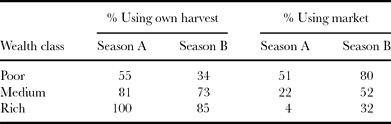
Market use for seed proves to be particularly important for poorer farmers. Fieldwork from Rwanda (CIAT, 1991) indicates that almost half the poor buy 90% of their bean seed during the main growing season, while only 6% of relatively ‘rich’ farmers use the market at all. The difference is not just quantitative, but also qualitative: poorer farmers use markets because they have to; richer farmers because they want to, i.e. to seek out new varieties. Bean source data for consecutive seasons in Burundi show similar wealth-related trends (Table 1). Other studies document increased market use by poorer farmers for bean seed in the Democratic Republic of Congo, Malawi and Uganda (David and Sperling, Reference David and Sperling1999), and for sorghum seed in Ethiopia (McGuire, Reference McGuire2008).
Proportion (%) of bean farmers using major seed channels in Burundi in 1992, by wealth class and season.
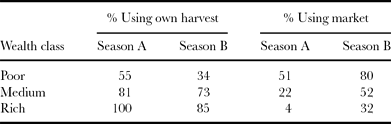
Modified from Sperling (Reference Sperling1994).
Markets prove critical for supplying seed in crisis periods
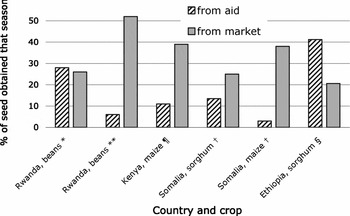
Somewhat surprisingly, informal grain markets prove key for seed security across periods of instability, including drought, flood and, even, civil strife. With the decline in home stocks (from stores or harvests) comes a concomitant rise in use of markets for seed. This is especially so for crops whose seed is regularly obtained from grain stocks, such as rice, beans or maize. In different types of crises, analyses show that 20–50% of seed sown has been obtained from informal markets. In fact, the few studies that assess both seed supplied from relief aid and seed obtained from markets suggest the latter is more important to farmers in stress periods (Figure 1). Markets offer farmers flexibility to choose crops and varieties in response to immediate, and possibly changing, production and economic conditions (McGuire and Sperling, Reference McGuire and Sperling2008).
Seed sources used following a crisis in selected sub-Saharan African countries, showing proportion of all seed sown of specified crop coming from emergency aid and from local markets. *: seed sown in 1995 and ** 1996 (Sperling, Reference Sperling1997); ¶: 1997 (Sperling, Reference Sperling2002); †: 2000, combining Deyr and Gu seasons (Longley et al., Reference Longley, Jones, Ahmed and Audi2001); §: many seasons, for West Hararghe Zone, calculated from Sperling et al. (Reference Sperling, Deressa, Assefa, Assefa, McGuire, Amsalu, Negusse, Asfaw, Mulugeta, Dagne, Hailemariam, Tenaye, Teferra, Anchala, Admassu, Tsehaye, Geta, Dauro and Molla2007).

Specialized seed markets provide key plant genetic resources and function within localized production systems
The existence of seed villages suggests the phenomenon of specialized seed markets within local production systems. In northern Mali, a cluster of villages is renowned for producing an early maturing pearl millet variety needed for the more arid areas of Douentza Circle. While these villages help maintain seed security (and plant genetic resource security) for parts of the Circle in normal times, their role becomes critical in crisis periods. Following consecutive stresses in 2003–05 (drought, locust attack, flood), farmers streamed in from regions such as Timbuktu, Goassi, Gao, and from Burkina Faso, to buy millet seed, which then sold for up to 25 000 CFA francs/100 kg, 10 000 more than normal (1US$ ≈ 450CFA francs). Pearl millet dominates production and farmers prefer to grow their own varieties, as the range of adaptation is narrow because of flowering date, local rainfall patterns and differences in soil types (CRS and Partners, 2006). So seed security in this stressed region depends on finding the right seed, the right plant genetic resource material – and specialized local seed production centres are recognized.
The point of this review is not to posit that local markets are superior to other seed channels. Rather it emphasizes that: a) informal seed/grain markets are a supply force that merits attention more generally, and b) for those interested in vulnerable populations (e.g. the poor or during crises), informal markets merit intensive analysis.
REASONS WHY FARMERS USE MARKETS FOR SEED
The previous section established the significance of informal seed/grain markets in providing seed to farmers, but what is the rationale for their use? It is often assumed that farmers use informal markets as a last resort, after exhausting other options (of home stocks, bartering with neighbours, sometimes formal channels). Available evidence reveals a more complex set of reasons, including proactive and reactive factors. Further, these causal factors may occur at a single point in time, but also may drive longer-term trends towards using local markets to obtain seed. The evidence below summarizes reasons for farmer seed market use, grouped by motive and time frame.
Single point in time – reactive
Farmers may seek seed from the market in response to a short-term crisis that reduces or eliminates their on-farm seed stocks. Poor yields may cause some farmers to set aside little or none of the harvest for seed, prioritizing consumption or sale. Seed stocks can also be depleted or spoiled due to pest predation, disease, theft or other disasters (e.g. fire, water intrusion in storage sites). Even where farmers have their own stocks, germination may fail because of variable rainfall or poor soil quality, or seedlings lost to grazing animals or disease. In the above examples, markets may be used to fill an immediate gap in seed supply, often caused by acute stresses (McGuire, Reference McGuire2007; Sperling, Reference Sperling1994). Equally, when acute needs for cash arise, such as with illness, all home stocks may be sold.
Single point in time – proactive
There is increasing realization that farmers also use informal markets to respond to positive opportunities, as a way to obtain novel varieties. For instance, farmers in East Africa will complement their own portfolios of pigeonpea varieties by purchasing small amounts of new varieties which traders, or other farmers, put on offer (Sperling et al., Reference Sperling, Scheidegger and Buruchara1996). Informal markets may also be used because they provide services in addition to seed, such as credit. Some farmers prefer informal markets to borrowing seed from neighbours, as they wish to avoid arduous transaction costs, or stigma, associated with requesting seed (e.g. David and Sperling, Reference David and Sperling1999; McGuire, Reference McGuire2008).
Trend over time – reactive
The above factors generally reflect idiosyncratic events affecting individuals. There is also evidence to suggest trends towards increased market use for acquiring seed. Supply from other sources (neighbours or kin) is in decline, for varied reasons. First, in many sites, recurrent stress is eroding the capacity of farmers to supply seed to others, and often a small number of farmers are identified as ‘key seed suppliers’ by their neighbours (McGuire, Reference McGuire2008). Second, seed exchange between households depends on the social ties between them (Badstue et al., Reference Badstue, Bellon, Berthaud, Juárez, Manual Rosas, Solano and Ramírez2006) and social networks that underpin this exchange appear to be in decline due to factors such as commercialization, labour migration, livelihood diversification and even prolonged conflict (Bellon, Reference Bellon2004; Sperling, Reference Sperling1997). The trend to greater market use may also result from chronic poverty, whereby more farmers need to procure larger amounts of seed, off-farm and more regularly (Dalton et al., Reference Dalton, Timothy, Lipper and Cavatassi2010).
Trend over time – proactive
Finally, some trends are leading to more routine, proactive use of markets. For seed of crops difficult to store (e.g. groundnuts in northern Mali, discussed above) or of high-value crops that are vulnerable to theft, farmers sometimes prefer to obtain seed from merchants. This effectively transfers risk to merchants, who may have better and more secure storage facilities. Also, where crops have to meet specific standards for quality or uniformity in output markets, farmers may purchase higher-quality seed from discriminating merchants or farmers' unions to help their production attain quality standards, as in the case of beans destined for export in Ethiopia (Rubyogo et al., forthcoming). In both these examples, merchants perform specialized functions for farmers, conserving seed, absorbing risk or meeting quality standards.
These reasons are not exhaustive, but illustrate the need to move away from viewing informal markets always as the seed source of ‘last resort’, whose use exposes farmers to unacceptable risks and indicates desperation (for examples, see FEWS Net, 2009; Ndjeunga, Reference Ndjeunga2002; Republic of Kenya, 2005). The notion that farmers who use markets do so ‘without constructive cause’ is simplistic (and patronizing). Farmers may source seed from informal markets for ‘positive’ (proactive) or ‘negative’ (reactive) reasons, and markets can provide opportunities or serve as a safety net. These drivers function both in the immediate and longer term. Whatever the underlying reason for using informal markets, farmers are responding strategically to specific circumstances.
STRATEGIC ACTIONS IN LOCAL MARKETS: GRAIN, IMPLICIT SEED AND SEED
We now turn to look at actual seed market functioning. This is no easy task as there are few institutional boundaries for delineating a seed from a food market. Even the material itself can transform from to seed to food, or sometimes vice-versa, depending on its specific qualities and time of the year. To help analyse local market functioning, we introduce the term ‘implicit seed’. Much that is sold in local markets is used for grain (for consumption, for livestock feed, for brewing). However, there is a special subset of this grain which can implicitly also be used for seed. Only rarely do local market traders sell seed outright, that is, a product destined only for sowing (e.g. material treated for storage which cannot be consumed).
Below, we suggest several ways in which farmers (buyers) and traders (sellers) distinguish between seed (that is, implicit seed) and grain, and how they then manage stocks accordingly. Providing seed from markets involves a series of strategic actions from farmers and traders alike.
How farmers select and manage seed
Farmers exercise agency in using informal markets, that is, they act consciously and strategically to maximize benefit and limit their exposure to risks. As with formal sector seed purchases, farmers selecting seed consider aspects of both variety quality (genetic attributes, such as plant type, growth cycle, seed colour) and seed quality (physical, physiological and sanitary attributes, such as the germination rate, and the absence/presence of disease, and stones). To obtain a good product, farmers assess the attributes of the product as well as of its provider.
Farmers’ use of product attributes may include seeking particular named varieties with known traits and adaptation, or relying on colour, shape and size characteristics to identify grain types with which they have had prior good experience. Farmers also indirectly assess storage conditions, looking for insect damage or discarding batches that have a musty smell. In some cases, farmers further sort their purchases prior to sowing, just as they would with their own production. This sorting removes damaged, broken or other obviously non-viable or inert material (David and Sperling, Reference David and Sperling1999). In this way, the amount of seed they actually plant will be less than the ‘implicit seed’ they purchase.
Of course, it is not always possible to ‘see’ seed quality, so farmers also assess attributes of the provider. Buyers may choose farmer-sellers known for producing good seed or merchants from whom they have previously bought high-quality materials. In the absence of formal regulation, social certification within a community can be a powerful tool. Those shown to have delivered poor-quality seed risk losing clients (and their neighbours and relatives) not only in the short term, but also in the longer term, and for grain as well as seed (T. Remington, personal communication, May 2006). This social certification contrasts with the better-known formal certification, put forward as a guarantee by commercial companies selling packaged products. In practice, such formal certification is of little direct value to farmers purchasing sub-standard seed. Formal enforcement lies within a complicated web of expensive and often far-removed regulators.
What the above evidence suggests is that seed and grain are both sold within informal markets. To reiterate the broad processes: 1) When grain is on offer, it may or may not also be useful as seed: it has to be adapted and show farmer-acceptable qualities. 2) In scouting out implicit seed, farmers seek out specific varieties, usually from sellers they know, to increase the chances that the material purchased will produce on their own farms. They also screen for visible quality traits. 3) Farmers often buy implicit seed (maybe within a larger grain batch) and make the refinements for ‘seed’ at home, sorting out the non-seed trash (inert matter and damaged seed). Hence, in informal markets, grain and implicit seed may be sold side-by-side.
How traders select and manage seed
Traders and informal markets have also long responded to the grain, implicit seed and, even, seed categories. They shape practices in several areas, including agro-ecological provenance, seed management per se and pricing, all presented briefly below.
Agro-ecological zones of acquisition reflecting seed/grain differences. Traders who understand agriculture and anticipate their customers’ needs recognize that certain agro-ecological zones can provide implicit planting material and others not. The potential for provision differs markedly by crop, and whether the varieties on offer are broadly or narrowly adapted. Knowledge of the agro-ecology of the source is one important factor when farmers consider whether to buy material which comes from afar. Traders also have to factor in agro-ecological provenance when acquiring stocks which they hope to sell as seed.
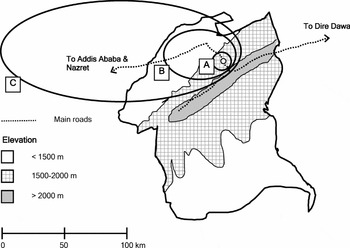
To illustrate the principle of source agro-ecology as a market indicator for identifying implicit seed, Figure 2 presents an example from a drought-prone area in eastern Ethiopia. West Hararghe has considerable agro-ecological variation, and adaptation is a serious concern; the main crops (sorghum, maize, beans) have quite distinct potential zones for acquiring seed. As Figure 2 shows, sorghum seed is best acquired locally (within 10 km), while beans, for instance, can be obtained from zones much further afield (e.g. from the Central Rift Valley, >150 km away).
Different scales of adaptation for seed in West Hararghe Zone, Ethiopia. Sorghum varieties have narrow adaptation, and its seed generally has very local provenance (ellipse A), maize seed can be sourced from further afield (ellipse B); improved bean varieties are widely adapted, with seed obtained from large producers far away (ellipse C).

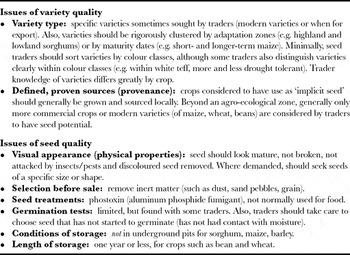
Trader seed management behaviour. Traders can also give clear signals that they offer implicit seed, as opposed to grain alone, through their management behaviour. While provenance represents one key management decision, mostly affecting the ‘variety quality’ of implicit seed, much of traders’ management concentrates on post-harvest actions which mainly affect ‘seed quality’ per se. Examples, drawn again from West Hararghe, list some of the seed-related management attributes mentioned by traders (i.e. what they consider as ‘good practices’) which may guide their management of seed supply (Table 2).
How traders potentially distinguish between seed and grain (from West Hararghe, eastern Ethiopia).

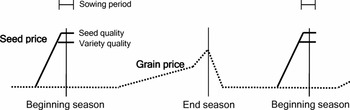
Seed and grain price differences. Informal markets also reflect grain, implicit seed and seed categories by manifesting price differences. During non-sowing periods, grain, implicit seed and seed remain relatively undistinguished in terms of price. However, during sowing periods, extending some 4–8 weeks prior to planting, two trends can be observed. First, prices spike for the most sought-after varieties for sowing, that is, for the plant genetic materials that are most adapted, productive or which give the highest income return (i.e. those which could be used as implicit seed). In areas of high stress, where few varieties may perform at all, prices between desired and non-desired varieties can differ by as much as 25–50%. Thus, in western Kenya, root rot resistant varieties sell for about Ksh 80/kg, while the local types go for Ksh 40–60/kg (Otsyula et al., Reference Otsyula, Rachier, Ambitsi, Ndiya, Buruchara, Sperling, Sperling, Remington, Haugen and Nagoda2004). Second, around planting time, traders may distinguish among batches of the same variety (plant genetic material) which are ‘well sorted and stocked’ from batches ‘less well sorted and stocked’, adding a price premium (≈5%) for the cleaner materials, which presumably demand less labour to prepare for sowing. So sometimes prices reflect the differences between seed and grain in terms of ‘varietal quality’, and sometimes reflect the differences in terms of ‘seed quality’. Farmers who pay these price premiums are undoubtedly buying seed per se.
Seed-related prices, unlike grain prices, do not rise during the hunger gap periods (and immediately pre-harvest) so the patterns of price rise and fall are quite distinct for seed and grain. Figure 3 conceptually suggests these price trends. The pattern below is sketched mainly for didactic reasons: grain price trends, in particular, may be highly variable by environment and time period.
Trends in crop and seed prices in local seed/grain markets through the season, showing seed price peaks at sowing time and grain price peaks before harvest. Seed price differential takes into account variety quality (for the most sought-after varieties), plus sometimes additional seed quality features (i.e. a price premium for well-sorted stocks).

In brief, seed and grain are distinguished in informal markets, on a routine basis. Even if sales do not explicitly advertise and label seed separately from grain, agro-ecological zones of acquisition, trader seed management practices and price differences at key sowing periods accomplish, de facto, the same function.
TRADERS’ SEED/GRAIN PRACTICE IN EASTERN ETHIOPIA
This section presents a case study of trader management of seed resources in local markets. To date, there have been very few practical analyses of how grain merchants deal with seed (but see CRS and Partners, 2006; Smale et al., Reference Smale, Diakité, Dembélé, Traoré, Guindo and Konta2008). Given the magnitude of farmers' use of these markets for seed, and the enhanced role of traders in serving vulnerable farmers and during high stress periods, this remains a serious gap. For ease of presentation, from here on, we use the term ‘seed’ to include categories of implicit seed, and specialized seed per se. Cases are of the latter are rarer, but we do highlight several examples below.
To explore actual practice, grain traders in eastern Ethiopia were interviewed about their strategy and actions. All operated in Miesso and Chiro districts of West Hararghe Zone, where mixed farming systems produce sorghum, maize and haricot beans as the main crops. The region is drought-prone, and many households are vulnerable to environmental stress due to low production and weak asset ownership. In recent years, West Hararghe has received regular emergency seed assistance, along with food and other humanitarian aid. The main town Asebe Teferi is the commercial hub for a vast region in eastern Ethiopia, and a secondary trade link between Addis Ababa and eastern cities and export markets. This location is therefore useful for analysing seed trade in stressed contexts. The trader study formed part of a larger investigation of humanitarian aid in Ethiopia (Sperling et al., Reference Sperling, Deressa, Assefa, Assefa, McGuire, Amsalu, Negusse, Asfaw, Mulugeta, Dagne, Hailemariam, Tenaye, Teferra, Anchala, Admassu, Tsehaye, Geta, Dauro and Molla2007).
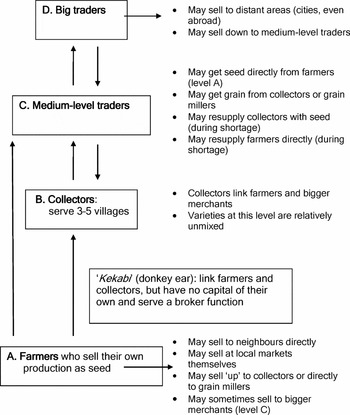
Twenty-one traders were interviewed, evenly split between those in the Miesso lowlands, and those in the highland ecologies of Chiro; though some worked out of Asebe Teferi, most were based in smaller centres. The sample included large- and medium-scale merchants (n = 9), as well as ‘collectors’ who work very locally (n = 12; see Figure 4 below). The scale of trader commerce was assessed ‘relatively’, by traders themselves, as these business people were reluctant to reveal the absolute scale of their commerce. Features such as presence and size of storage facilities, number of trucks owned or rented, and number of flour mills owned also helped to make distinctions among trader groups.
Flows of seed/grain (implicit seed) in informal market flows in West Hararghe, from Sperling et al. (Reference Sperling, Deressa, Assefa, Assefa, McGuire, Amsalu, Negusse, Asfaw, Mulugeta, Dagne, Hailemariam, Tenaye, Teferra, Anchala, Admassu, Tsehaye, Geta, Dauro and Molla2007).

Traders distinguish between grain and seed
All traders (n = 21) were aware of how seed differed from grain in terms of germination ability and the need to understand provenance (and hence adaptation potential). However, they only occasionally managed the two clusters separately, with distinct seed management largely linked to specific customer demands, for instance a demand for seed suited to a specific environmental condition or output market.
Most management of seed related to post-harvest actions, such as selecting out visibly damaged grains or inert material (pebbles, dust). All traders also kept varieties separate to some degree (mostly sorting by colour). Those working directly with farmers nearly always distinguished among named varieties. Even larger traders sometimes grouped varieties by geographic origin as a proxy for adaptation zone (e.g. sorghum from Miesso v. Jijiga). Traders who gave some effort to retaining variety identity were particularly: those involved with export crops such as haricot beans; those selling modern varieties (e.g. of open-pollinated maize or wheat); and those who dealt with varieties especially adapted to harsh zones. Such attention to adaptation may reflect the considerable agro-ecological variation in the region (Miesso and Chiro range from 1300 to 2300 m asl); simply, for some crops, highland varieties will not perform in the lowlands.
The majority of traders (n = 16) had also had occasional experience selling seed as a distinct product from grain, preceded with specific seed management practices, when seed per se was demanded. Government officials sometimes contracted traders to multiply modern varieties (maize, wheat), or highly adapted local ones (sorghum), for seed. In normal years, seed sales were a small proportion of grain sales (traders’ estimates varied from 1 to 5%), although they reported paying farmer producers a premium when purchasing seed specifically. For instance, a ‘collector’ buying directly from farmers paid 5–10 Birr/100 kg extra (≈0.5–1.0 US$) for good local seed of indigenous crops such as sorghum, roughly a 5% premium. For white haricot beans, an export crop, traders higher up the chain reported paying 100 Birr/100 kg (≈10 US$) more for pure, clean seed, a 33% premium.
Distinguishing among traders is key for determining seed flows
Distinguishing different levels of seed/grain trade also helped determine whether seed-related practices varied among traders; for instance, whether collections from different sites were mixed as stocks were amalgamated up the trading chain. Figure 4 maps the seed/grain flows in West Hararghe, as charted through trader interviews. The mapping of flows differed by crop; while food staples (sorghum, teff, maize) flow back to local levels for resale to farmers during the hungry season, this generally does not happen for export crops like coffee or beans.
Several comments related to Figure 4 are in order. Collectors clearly distinguish seed from grain. Dealing directly with farming communities (often via resident brokers), collectors may seek out individual farmers known for producing good seed. In some cases, they give standing orders for ‘this type of bean’, or ‘this quality of sorghum’. With such specific demand, farmer-producers know in advance that they are producing ‘seed’ from the moment the crop is sown, and manage the crop accordingly.
Some traders also are able to respond to demands for specific materials, i.e. varieties adapted to particular (often harsh) agro-ecological conditions. For example, the non-governmental organization (NGO) CARE reported a case from Achar (a district near Asebe Teferi) where a specific pearl millet variety (Dekuny) was in high demand after the 2003 drought, but apparently not locally available. The local trader provided seed from his storage houses, which had been separated and well-maintained throughout the year. In a sense, this trader served as a community backup during a stress period, not just for seed security (by making seed available), but also by maintaining a key plant genetic resource.
Further, researchers had predicted that seed-related knowledge would become less specific, and the seed/grain distinction more poorly managed, higher up the trading chain. This assumption proved not to apply in a well-defined number of cases. There were very large traders (e.g. 100 t sorghum per season) who acquired their seed only through direct contacts with hundreds of farmers, and who kept stocks separate according to defined agro-ecological zones or varieties. One trader in Asebe Teferi monopolized the seed/grain supply over three districts: his scale was large but fairly uniform in terms of the varietal adaptability of the goods he put on offer. Additionally, traders dealing with crops for urban consumption or export (e.g. haricot beans, wheat, maize) also aimed to maintain strong standards even as volumes rose. This makes economic sense: losses become great if large quantities of grain have to be discarded in order to deliver a high-quality product. Such high-quality material often has better potential for seed.
In sum, traders’ practical distinction of seed and grain varied with their place in the supply chain (and by crop). However, surprisingly, some large traders also ‘did seed’, and traders in highly stressed areas had basic knowledge of what types of varieties might be adapted for sowing. In addition, when presented with specific requests for ‘seed’, from government officials, urban dwellers or exporters, traders’ seed management could become more refined.
Trader practice during high stress periods
Trader experience during high stress periods yielded especially valuable insight into the seed trade. The sample of 21 traders had had long experience of regional seed/grain commerce: between 6 and 40 years (mean 18) for medium- to large-scale traders, and between 5 and 12 years (mean 8) for local collectors. Moreover, 10 of the 12 collectors had long resided in adjacent farming communities, and could draw upon 3–5 decades of first-hand observations of crop production fluctuations. All had conducted business during normal and stressed periods, experiencing crises due to drought, pest attack and (for a few) civil unrest.
Traders highlighted a number of trends associated with periods of stress. While West Hararghe has received emergency seed aid since at least 1984, and nearly every year since the mid-1990s, all traders asserted that seed for key crops had been constantly available directly within the region or within reach of the region (suggesting that it has been unnecessary to bring seed into the region as aid). In terms of specific signals associated with stress, traders indicated changes in: volumes of seed supplied, price; geographic source of seed and scale of seed loans. The first two areas are documented below to underscore the value of further investigating seed market fluctuations.
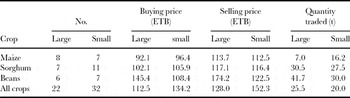
Traders estimated buying and selling prices, as well as volumes traded, for two seasons they could recall in detail, one ‘normal’ and one ‘crisis’. Most drew from the previous six years, focusing on the three crops most marketed as seed. Table 3 shows mean values reported for a normal season, which serve as a baseline for the price and volume changes reported below. Prices for maize and sorghum seed are broadly similar for larger traders and smaller collectors, though larger traders offer and receive significantly higher prices for beans (p < 0.05, Mann-Whitney U test). This difference reflected transport costs for the larger traders who sourced high-quality bean seed from the Rift Valley (see Figure 2). Also striking is that mean volumes traded were similar for both groups, suggesting that the seed trade has greater relative importance for smaller collectors.
Mean buying and selling prices, and volumes of seed traded for key crops, as reported by medium to large traders (large) or smaller collectors (small) in West Hararghe.

ETB: Ethiopian birr.
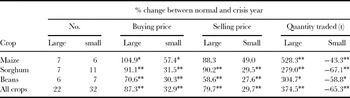
Volume changes in seed supplied. Table 4 shows how prices and volumes changed in a crisis year. The responses of medium to large traders differed significantly from collectors in most cases. Medium and larger traders increased their seed business during periods of stress, directly in response to farmers' demand. Several even commented that they sell no seed at all in normal times for crops such as sorghum. The magnitude of change was high: average volumes sold for each crop more than tripled in stressed periods. This change was most dramatic for maize, possibly reflecting the importance of fast-maturing maize for coping with drought.
Changes in buying price, selling price, and volume of seed traded in crisis seasons, in relation to prices and volumes in a ‘normal’ seasons in West Hararghe, eastern Ethiopia, by crop and scale of merchant – medium to large traders (large) or smaller collectors (small); differences between larger traders and local collectors significant at p < 0.10 (*) and p < 0.05 (**).

In contrast, local collectors actually decreased the volume of seed purchased from the surrounding farms in stress periods. These decreases were large, with volumes dropping 65% on average in crisis years. Collectors commented that local farmers prefer to keep the bulk of their harvests in stress years, which greatly reduces quantities available for sale locally.
Price fluctuations. Meaningful and reliable absolute price values would require intensive investigation (e.g. to account for price variations between seed and grain, or intra-seasonal fluctuations). However, within-trader comparisons provide useful insights, indicating clear trends in relative price increases (Table 4).
Traders at all scales increased prices during stress periods, though at a significantly higher rate further up the trader chain. While larger traders increase sales during stress, local collectors actually have less seed to supply them, so the former must seek supplies from further away. These interviews with larger traders suggest that transport costs are the biggest factor affecting seed price during crisis times, not rise in the price in the crop material per se. However, traders indicated that changes in external demand can also cause substantial local price fluctuations, particularly for export crops such as beans.
Expanding trader roles in crisis and normal periods
The case study from West Hararghe established the current roles of traders: during normal times they are increasingly supplying Ethiopian farmers with some of their seed (Dalton et al., forthcoming), and during crises they are critical seed suppliers to farmers, as well as to government and NGOs involved in seed aid. In terms of expanding Ethiopian traders’ roles in seed-related business, several areas of interest were explored during the case study: interventions related to variety quality, seed quality and the passing of seed-related information.
Farmers across Ethiopia lack access to new (modern) varieties. Official figures from 2005 show only 3–5% of area sown to improved seed, mostly wheat and maize (Byerlee et al., Reference Byerlee, Spielman, Alemu and Gautam2007). Research on seed aid in dispersed regions of Ethiopia showed ‘receipt of modern varieties’ as the major benefit farmers cite from ‘emergency assistance’ (McGuire and Sperling, Reference McGuire and Sperling2008), even though this diffusion might better be performed by extension or by informal market processes. Seed/grain traders in West Hararghe currently have had only limited access to modern varieties, mostly of beans and maize (e.g. Katumani). However, traders could be powerful partners in moving such varieties in several ways. Distribution of variety samples (to stimulate demand), sale of small packets of seed and more systematic sale of modern varieties in bulk are approaches that have had marked success in other countries in East and Central Africa (P. Seward, personal comment, May 2008; Rubyogo et al., forthcoming).
Seed/grain traders could also be partners in improving the seed quality per se. Procedures for (inter alia) segregating among varieties and reducing percentage of sub-standard grains could give farmer clients a better return for their purchase. Initial quality-related interventions have had promising results in West Hararghe. Since 2002, those supplying CARE's relief seed programme in Asebe Teferi have been required: to have a licence; separate out varieties; have a warehouse; and maintain specific seed stores (which are clean and insect free). CARE also trains traders in seed quality issues and withdraws contracts from those who deliver substandard material. Such awareness-raising, capacity building and monetary incentives (such as CARE's) might be possible measures for encouraging gradual seed/grain quality improvements in other places.
Traders could also be key sources for disseminating variety and seed information (e.g. which varieties are available and from where, cost, quality, performance). Traders move even in remote communities and equipping them with up-to-date seed-related information would raise awareness quickly among clients, but also among other important trader suppliers. To date, the information-sharing capabilities of traders have been little exploited, and links between traders and formal extension have been idiosyncratic, at best.
DISCUSSION AND CONCLUSIONS
The informal seed/grain trade receives little attention from governments or researchers for two clusters of reasons. The first has to do with ignorance or stereotypes surrounding informal seed markets. Traders are commonly seen as relatively minor sources of seed or as a hazard, foisting poor-quality material on vulnerable farmers. Such negative portrayals rarely appear to reflect empirical assessment of local markets, but rather express a belief in ideals of self-sufficient farmers or of efficient, modern formal markets. The analyses of farmer and trader practice, presented within this paper, challenge such negative assumptions about informal local markets, which, far from a minor phenomenon, prove critically important for millions of farmers. Informal markets are an important secondary source of seed security, especially for the vulnerable, during stress periods or for specialized products. If trends continue, local seed markets could become the primary source of seed in many contexts. This analysis also shows that farmers use markets strategically and discriminately to get the seed they want and need, and (along with some merchants) take actions to safeguard seed and variety quality. Local markets even have a role in plant genetic resource conservation. Thus, informal seed/grain markets merit much more attention and support from research and development organizations.
A second cluster of reasons for the under-recognition of informal markets centres on conceptual and methodological challenges. This paper presents several concepts and practical aids to help tease apart the seed trade from the larger grain trade which usually surrounds it. One important concept is the distinction between grain, implicit seed and seed. Understanding seed flows requires better understanding of farmers' knowledge and action in deriving seed from implicit seed (e.g. in selecting a vendor or sorting material purchased). Some merchants also distinguish seed and grain through separate management practices. This paper suggests aids for analysing seed flows, showing how price data can help identify seed demand, agro-ecological seed maps clarify seed acquisition strategies, and trader classification hierarchies show distinct roles and seed flow patterns for actors at different scales. These concepts and aids can be sharpened through further empirical study focusing on actual practices of farmers and traders.
One key situation for further empirical work might be during periods of crisis or chronic stress, when markets supply much more seed than in normal times. Markets help safeguard farmers' seed security, and also help them tailor crops and variety portfolios to changing environmental conditions. Additionally, the poorest farmers tend to use markets more, across all types of seasons. Thus, informal markets are important for vulnerable farmers, and their role deserves more consideration from those involved in social protection or humanitarian aid. However, there are also non-vulnerable situations where the informal seed trade is increasing, as traders and farmers identify roles or market niches that are not being fully exploited by more formal markets. These may include dissemination of new varieties, provision of specialized products (e.g. varieties with specific adaptations or desirable traits), maintenance of valued crop genetic resources in a region or risk-transfer around seed quality. These situations highlight how informal seed markets are also highly relevant for agricultural development and even biodiversity utilization and conservation.
There is much untapped potential for public action to work with traders as a positive force. Whether the goals relate to agricultural development, supporting vulnerable farmers or maintaining key genetic resources, conceptual shifts are needed to make the informal seed trade more visible. Analytical aids and more detailed indicators (such as market prices) will be important, as will better understanding of how different market actors preserve, and even enhance, the value of seed. Partnerships between traders and formal-sector actors show much potential here: for example, by disseminating new varieties through small seed packets, or by helping traders to improve their seed management practices. As these markets by definition operate outside of formal regulation, mechanisms for quality control are clearly important. Formal sector organizations can promote their own incentives for this, though it is likely that multi-faceted social relationships among buyers and sellers will remain important for building trust and confidence around seed transactions, as seen in weakly regulated market relationships more broadly. There is clearly potential in harnessing the informal seed trade to provide important benefits to farmers. However, this can only happen in a systematic way when there is more appreciation, and a fuller analysis, of how these informal markets function.
Acknowledgements
For the Ethiopian work, the authors gratefully acknowledge the support of Aberra Deressa the Ethiopian Minister of Agriculture, and Solomon Assefa and Tsedeke Abate of the Ethiopian Institute of Agricultural Research. Research team members involved in the market surveys included: Teshale Assefa, Berhanu Amsalu, Belete Dagne, Kassaye Negash and Yealembirhan Molla. CARE personnel Hailu Merga and Kiros Tsegaye also offered key and gracious assistance in linking with traders in Asebe Teferi. The International Development Research Centre and US Agency for International Development funded this research, with Wardie Leppan, Laura Powers, Julie March and Eric Witte offering valuable support.