In a world in which media dominate our daily lives, young children spend much time with on-screen activities (i.e., watching television, playing computer games) at the expense of reading print books (Zeijl, Crone, Wiefferink, Keuzenkamp, & Reijneveld, Reference Zeijl, Crone, Wiefferink, Keuzenkamp and Reijneveld2005). The growing body of educational computer programs that has become available in the last decennium may be particularly promising for enriching young children's language and literacy experiences (Marsh, Reference Marsh, Bus and Neuman2009). Presenting stories through new media, such as computers, phones, tablets and e-readers, allows additional multimedia features that are not possible in print (Ito, Reference Ito2009). Apart from an audio narration, electronic storybooks may include motion pictures, sounds, and background music, resulting in an animated presentation of the story. Electronic storybooks may also include interactive features (e.g., hotspots that activate an animation or a word meaning explanation). The current study was designed to examine whether both additional multimedia and interactive features benefit language skills and story comprehension and whether effects accumulate, thereby making the animated e-book enhanced with interactive features the best alternative.
ANIMATED PRESENTATION OF THE STORY
Storybooks for young children are lavishly illustrated; these detailed pictures make storybooks particularly suitable to extracting meanings and deriving unknown words from the book context. An eye-tracking study demonstrated that young children's eye-gaze patterns are influenced by the summoning power of oral text processing: Children fixate more often and longer on details in illustrations that the text highlights than on elements that are not highlighted in the story text (Verhallen & Bus, Reference Verhallen and Bus2011). According to the dual-coding theory (Paivio, Reference Paivio1986), advantages of presenting pictures and text simultaneously may result from stronger encoding when information is processed through both the visual and verbal channel instead of only one channel. In line with this view, children's recall of the story improves when a narration is accompanied by illustrations (Hayes, Kelly, & Mandel, Reference Hayes, Chemelski and Birnbaum1986; Greenfield & Beagles-Roos, Reference Greenfield and Beagles-Roos1988).
Animated e-books can offer a media environment that optimizes temporal congruity of text and illustrations: built-in effects such as zooming or motion can guide children in selecting the details in the illustration where the narration refers to. For instance, in the e-book Tim op de Tegels (Pete on the Pavement; Veldkamp, Reference Veldkamp2004) the computer voice reads aloud that a truck driver wants to lift Pete off a pile of paving stones. The camera zooms in on Pete and the driver and, in synchrony with the narration, we see the driver reaching his arms toward Pete. This way, animated e-books may facilitate the learner's understanding of the scene and of complex expressions like “lift off” (Schnotz & Rasch, Reference Schnotz and Rasch2005). When motion and zooming exactly match the story text children can make sense of pictures without much effort. Improving temporal proximity of text and images may help the child to select content for processing the story and may strengthen recalling and retaining the story language (Mayer, Reference Mayer2001).
Nonverbal support for word learning may be especially important when children have limited vocabulary knowledge, because these children have fewer words with which to comprehend new words through verbal communication alone (Silverman & Hines, Reference Silverman and Hines2009). For that reason, the effectiveness of animated e-books has been studied in groups of second language (L2) learners (Silverman & Hines, Reference Silverman and Hines2009; Verhallen & Bus, Reference Verhallen and Bus2010; Verhallen, Bus, & de Jong, Reference Verhallen, Bus and de Jong2006). Studies thus far have demonstrated that L2 students learned more words after they repeatedly heard e-books enriched with motion pictures, background music, and sound compared to electronic versions of the same stories with merely static pictures. Animated e-books were also effective for story understanding and particularly for making L2 children aware of goals, intentions, motivations, and feelings of story characters (Verhallen et al., Reference Verhallen, Bus and de Jong2006). By contrast, Silverman and Hines (Reference Silverman and Hines2009) reported that a synergy of media was not superior for vocabulary growth in first language (L1) learners, concluding that static pictures may suffice to support learning new words when language skills are well developed. However, rather than comparing animated e-book with static e-book versions, Silverman and Hines used storybooks with embedded videos (i.e., they presented video clips apart from the storybook as an additional source of information). In the current study, the same storybooks are presented in either animated or static format to test whether animated e-book versions that optimize temporal congruity of text and illustrations aid both vocabulary acquisition and story comprehension in a normative group of L1 learners, as may be expected based on theories of (multimedia) learning (Mayer, Reference Mayer2001; Paivio, Reference Paivio1986).
Interactivity
Computer programs may be more motivating when they include interactive features that elicit actions in response to the user's activity. In general, most first-generation e-books included interactive features, as appeared from content analyses of Dutch (de Jong & Bus, Reference De Jong and Bus2003) and Israeli e-books (Korat & Shamir, Reference Korat and Shamir2004). In many recent e-books and apps, the user can click on or touch (hot)spots on screen, thus revealing a reaction that the computer software generates automatically. Hotspots usually activate an animation (e.g., clicking on a light bulb may switch on the light) or reveal a word meaning explanation.
Research conducted so far has provided us with several “dos” and “don'ts” for developing interactive e-books, among which the main guideline is that the animations should have relevance to the story (Roskos, Brueck, & Widman, Reference Roskos, Brueck and Widman2009; Zucker, Moody, & McKenna, Reference Zucker, Moody and McKenna2009). Adding extraneous information to a multimedia presentation can interfere with extracting meaning from the main message (Mayer, Reference Mayer2001). For example, a case study evidenced that appealing animations that are incongruent with or incidental to the story resulted in the child's inability to retell the story in a cohesive way and fostered passive viewing (Labbo & Kuhn, Reference Labbo and Kuhn2000). Experimental research has shown that the iconic modes of interactive e-books (e.g., animations, games) attract 4- and 5-year-old children's attention at the expense of their listening to the oral story text, and such modes can disrupt the beneficial effects of storybooks on vocabulary and story comprehension (de Jong & Bus, Reference De Jong and Bus2002).
In adult–child (print) book reading sessions, labeling and defining words as an extratextual activity has been demonstrated to stimulate vocabulary learning (e.g., Biemiller & Boote, Reference Biemiller and Boote2006; Blewitt, Rump, Shealy, & Cook, Reference Blewitt, Rump, Shealy and Cook2009; Brabham & Lynch-Brown, Reference Brabham and Lynch-Brown2002; Collins, Reference Collins2010). Several studies have reported that interactive e-books with extratextual vocabulary instructions facilitate word learning as well. For instance, e-books with animated cues for explaining word meanings (e.g., watching an animation of someone playing the bongos) concretize the words, which supports vocabulary acquisition (Higgins & Cocks, Reference Higgins and Cocks1999; Higgins & Hess, Reference Higgins and Hess1999). Moreover, positive effects on word learning are reported for e-books that include extratextual explanations of word meanings, for example by adding vocabulary games (e.g., asking a child to click on a target object in the picture; Segers & Verhoeven, Reference Segers and Verhoeven2002, Reference Segers and Verhoeven2003) or a dictionary option that defines words (e.g., Korat, Reference Korat2010; Korat & Shamir, Reference Korat and Shamir2008; Shamir & Korat, Reference Shamir, Korat, Bus and Neuman2009; Shamir, Korat, & Shlafer, Reference Shamir, Korat and Barbi2011). The current study tested whether extratextually defining difficult words through hotspots benefits vocabulary acquisition from onscreen storybook reading. Unlike the studies mentioned above, the current study includes a read-only condition for animated e-books to isolate effects of the interactive vocabulary instructions from other factors that may explain the effects of e-books.
We expect word learning to be superior when e-books include hotspots with vocabulary instructions modeled on the way parents or teachers interrupt the narration to repeat, label, and define words (e.g., Dickinson & Smith, Reference Dickinson and Smith1994). Due to limited processing capacity of the cognitive system (Baddeley, Reference Baddeley1998), interrupting stories for explaining word meanings might interfere with children's understanding of story language and the story line. So far, however, there is no evidence indicating that repeated interruptions for clarifying complex words disrupt story comprehension (Segers, Takke, & Verhoeven, Reference Segers, Takke and Verhoeven2004; Shamir, Korat, & Barbi, Reference Shamir, Korat and Barbi2008; Smeets & Bus, Reference Smeets and Bus2012). Moreover, if understanding the vocabulary is a main component of story comprehension (e.g., Cain, Oakhill, & Lemmon, Reference Cain, Oakhill and Lemmon2004; Lynch et al., Reference Lynch, van den Broek, Kremer, Kendeou, White and Korch2008; Stahl & Fairbanks, Reference Stahl and Fairbanks1986), interactive storybooks with vocabulary instructions may benefit story comprehension indirectly through stimulating familiarity with the book-based vocabulary (Stahl & Fairbanks, Reference Stahl and Fairbanks1986).
This study
The current study aims at testing whether electronic picture storybooks stimulate word learning and story comprehension and whether learning and comprehension are further increased when the books also include both multimedia additions (motion pictures, sounds and background music) and interactive vocabulary instructions. The following hypotheses were tested:
-
1. In a normative group of kindergarten children, we expect that children's independent readings of e-books (regardless of the books’ formats) support vocabulary learning and text comprehension.
-
2. Motion pictures, sounds, and background music are hypothesized to be valuable additions to e-books, and it is expected that e-books with such additions support vocabulary learning and text comprehension more than static versions of the same e-books.
-
3. Interactive animated e-books are hypothesized to be the best alternative with highest gains in target vocabulary and, possibly due to vocabulary learning, also gains in story comprehension.
METHOD
Participants
Participants were 136 kindergarten children (68 boys) ranging between 4 and 6.5 years of age (M = 63.47 months, SD = 7.82). Children were selected from 15 Dutch primary schools in the Western part of the Netherlands. Ten additional schools were invited to participate but refused because they were involved in other research projects. None of the participating schools qualified for additional staff funding due to large numbers of pupils learning Dutch as a L2 or from families where parents had only a few years of vocational training. Informed parental consent to participate in the experiment was obtained, on average, for 50% of eligible children (i.e., particular age range, typically developing, Dutch as L1). The number of participants per school varied from 4 to 19. Eligible children were randomly assigned to one of four conditions, stratified for school and gender.
Design
The added value of animated versions of e-books and interactive features is examined in a randomized control trial with four experimental conditions:
-
• Static e-books (N = 33): Children independently read four e-books in which static illustrations were accompanied by an oral reading of the text.
-
• Animated e-books (N = 36): Children independently read four animated e-books in which animated illustrations (including motion, music, and sound) were accompanied by an oral reading of the text.
-
• Interactive animated e-books (N = 33): Children independently read four animated e-books that were interrupted for vocabulary instructions; the books included hotspots that revealed a definition of a target word when clicked on.
-
• Control condition (N = 34): children independently played nonliteracy related computer games during the intervention period.
Comprehension was only posttested, whereas the target vocabulary was pre- and posttested. We preferred one vocabulary test to multiple tests to prevent that a repeated exposure to target words in tests could explain the outcomes (Biemiller & Boote, Reference Biemiller and Boote2006; Verhallen & Bus, Reference Verhallen and Bus2010).
Procedure
Because most schools had a special room for computer assignments, intervention sessions took place in this room. In schools where such a room was not available, children worked in a spare room. The intervention took eight sessions spread over 4 weeks (two per week). Children read two stories per session: four different stories each four times. The order of the stories was randomized, under the condition that each story was read once per week. Each session lasted 12 to 14 min. In most schools, two computers were available for kindergarten, which enabled two children to work simultaneously. To prevent children from disturbing each other or their classmates they wore headphones while listening to the stories. When reading static and noninteractive animated e-books, children did not use the computer mouse because pages turned automatically. Only when reading interactive animated e-books did children use the computer mouse to search for hotspots in the pictures and activate those by clicking. None of the children had problems manipulating the mouse. During storybook reading sessions, an experimenter was present in the same room. After starting up the stories, the experimenter did not interfere in the child's activities except in extreme cases of distraction (e.g., children played with a toy in their pocket or continuously tried to engage the experimenter in a conversation), when she encouraged children to attend to the story. Children in the control group spent exactly the same amount of time at the computer as those in groups listening to the static and animated books (12-min sessions). When hotspots were included the session lasted 1–2 min longer.
All children were pretested during two sessions of about 10 min. In a spare room at school, the Peabody Picture Vocabulary Test (PPVT), the Taaltest voor Kinderen (TvK; Language Test for Children), and the target vocabulary test were administered. About 3 to 4 days after the last treatment session, children were asked to retell one of the four stories that they had heard during the intervention. During the same session, the target vocabulary was posttested. Three days later (one week after the last story session), story comprehension (questions), the PPVT, and TvK expressive vocabulary task were posttested.
Intervention materials
Storybooks
We selected five award-winning Dutch storybooks that were available as e-books in all three formats: Tim op de Tegels (Pete on the Pavement; Veldkamp, Reference Veldkamp2004), Beer is op Vlinder (Bear Is in Love With Butterfly; van Haeringen, Reference Van Haeringen2004), Rokko Krokodil (Rokko the Crocodile; de Wijs, Reference De Wijs2001), Bolder en de Boot (Bolder and the Boat; Hoogstad, Reference Hoogstad2005), and Met Opa op de Fiets (Cycling With Grandpa; Boonen, Reference Boonen2004). Each book presents a simple story around familiar events such as making a bike ride with your grand dad (Met Opa op de Fiets), being jealous of younger siblings (Rokko Krokodil), or being in love (Beer is op Vlinder). All books included detailed illustrations but not detailed enough to enable the child to understand the story without narration. The length of the story text in the five books varied from 206 to 574 words (M = 391, SD = 150). Participants in the experimental conditions read four of the five stories either as static e-books, animated e-books, or interactive animated e-books. The set of five books was counterbalanced across the conditions so that each of the five books was used with equal frequency in each condition, and effects of books and conditions were not confounded.
Static versus animated e-books
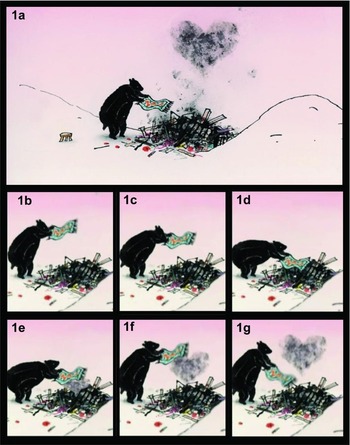
In static e-books, pictures of the original (printed) storybooks were presented on screen, accompanied by an oral reading of the text. After the computer voice had read the narrative on a page, the book automatically turned to the next page. Animated e-books included the same voice for the narrative; backgrounds in the illustrations and story characters looked exactly the same as in the static version; however, effects were added to set characters and objects in motion. Figure 1 illustrates how visual information may differ between static and animated books. The animated e-books included sound effects supporting the story events; for instance, you can hear a child ring a bell (cycling with Grandpa), a motor humming (Bolder and the boat), or a crackling fire where Bear is fanning the fire (Bear is in love with Butterfly). Finally, music was added to make children aware of suspense, sadness, or happiness, another way to dramatize the story by adding multimedia additions. Neither in static nor in animated e-books was print presented on screen, which we did not consider as a loss as print does not attract much attention in the age range of our subjects (Roy-Charland, Saint-Aubin, & Evans, Reference Roy-Charland, Saint-Aubin and Evans2007). Reading the static or animated version took about 6 min.
(a) An illustration in the static storybook Bear Is in Love With Butterfly and (b–g) successive screenshots of the animated version of the same scene. More than the static illustration, the animated version shows what bear successively does to fan the fire and how smoke takes the form of a heart. The static version includes the narrator voice as audio alone (reading that “Bear is fanning the fire”). The animated story also includes the sound of a crackling fire. Background music was not part of this scene.

Interactive animated e-books
The hotspots in interactive animated e-books focused on difficult words that are unknown to most children in kindergarten according to Schrooten and Vermeer's (Reference Schrooten and Vermeer1994) analyses of various bodies of verbal contexts (e.g., storybooks, teacher–child talk). In a pilot study among 20 typically developing children in the same age range, the original set of 70 verbs, nouns, and adjectives was reduced to a final set of 53 words that were known expressively by a maximum of 35%.
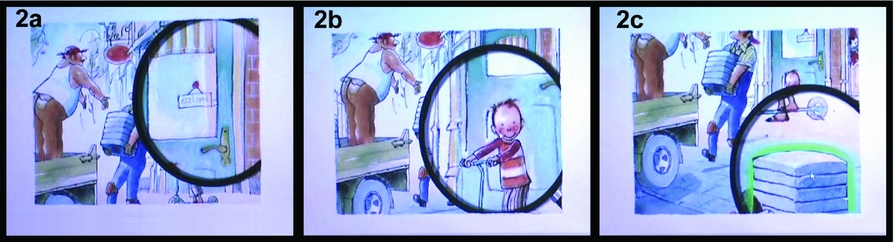
After one of the target words appeared in a text passage, the motion picture froze for a moment. Simultaneously, the computer mouse turned into a magnifying glass as Figure 2a–c illustrates. Gliding over the hotspot the magnifying glass revealed a green line that encircled the target detail, as can be seen in Figure 2c. After a mouse click on the hotspot the narrator repeated the relevant phrase from the story text (e.g., “Pete is going outside by himself”) and defined the target word (“he is going outside all alone”). Children were allowed to search for the hotspot for a maximum of 30 seconds to prevent children spending more time playing with the magnifying glass than listening to the oral text (de Jong & Bus, Reference De Jong and Bus2002; Labbo & Kuhn, Reference Labbo and Kuhn2000). If the hotspot was not activated after 30 s, the magnifying glass automatically moved to the target detail and the narrator provided the definition. Then the story continued until the next target word was encountered in the text. With four interruptions the interactive sessions lasted at most 2 min longer than sessions with static or animated e-books.
(a) The scene with Pete on his scooter freezes and a looking glass appears that the child can move over the scene. (b) The looking glass magnifies what is under it; see for instance, (a) the tag fixed at the door and (b) Pete. (c) When the looking glass moves over the hotspot, here paving stones, it colors green. Clicking on the green circled hotspot results in a repetition and definition of the target word (in this case, “Here you see paving stones. Paving stones are used for making the pavement.”). If the child does not click on the hotspot, after 30 s the green encircled object appears and the computer voice repeats and defines the target word.

As the number of slots for extratextual vocabulary instruction (4 interruptions per story × 4 repeated readings = 16 slots) exceeded the number of target words per story, some words appeared twice as hotspots spread over the four sessions and some only once. The story Bolder en de Boot included the lowest number of difficult words (8), so each of these words was explained twice. Rokko Krokodil included the highest number of target words (14), so only two hotspots appeared twice. Within each story, we selected the words with lowest frequencies (Schrooten & Vermeer, Reference Schrooten and Vermeer1994) to appear twice as a hotspot. In total, 37 words were instructed once, compared to 16 words that were instructed twice.
Math games
During the intervention period, children in the control group played math games on the computer (e.g., Sesame Street's number quiz). The instructions for carrying out the tasks were verbalized in simple words.
Tests
PPVT, TvK, expressive vocabulary, and target vocabulary were pre- and posttested, whereas retelling one of the stories and questions about the stories were only posttested. All tests were double coded by the two authors. Differences in coding were resolved through discussion.
PPVT
The Peabody Picture Vocabulary Test (PPVT-III-NL; Schlichting, Reference Schlichting2005) is a standardized test that was used to assess children's level of general receptive vocabulary. Children were asked to select one of four pictures matching a word named by the examiner. The intraclass correlation was 0.998.
TvK expressive vocabulary task
To assess children's level of general expressive vocabulary, we administered the subtest woordenschat/productie [expressive vocabulary] of a standardized Dutch language test the TvK (Language Test for Children; van Bon & Hoekstra, Reference Van Bon and Hoekstra1982). In this test, the experimenter showed pictures while reading aloud incomplete sentences. Children were asked to complete sentences such as “A bird flies in the . . .? [air]”; “The girl is not allowed to drive a car yet, because she is too . . .? [young]”; or “This finger is . . .? [bleeding].” The intraclass correlation was 0.984.
Target vocabulary test
A target vocabulary test was administered to assess children's knowledge of target words in the storybooks. In prior experiments on the efficacy of electronic storybooks, most consistent results were found with a sentence-completion task (Smeets & Bus, Reference Smeets and Bus2012; Verhallen et al., Reference Verhallen, Bus and de Jong2006; Verhallen & Bus, Reference Verhallen and Bus2010); children were asked to complete sentences while pictures of a story event were presented on screen. As a prompt, a synonym was presented. For example, Pete is playing all alone [synonym]: he is playing on his <own>? The stimulus sentences in the test always differed from the sentences including the target word in the story text. When children completed sentences with a word that was less specific than the target word (e.g., “sleep” instead of “taking a nap”), responses were coded as incorrect because the target words express meaning best (e.g., “sad” is less specific than the target word “broken-hearted”). The number of target words varied between 39 and 45 words as the number of target words was not equal for all stories, ranging from 8 (Bolder en de Boot) to 14 (Rokko Krokodil). To make outcomes comparable we calculated the percentage of items correct at pre- and posttest for each child. Alpha reliabilities for pre- and posttest were 0.67 and 0.88, and the intraclass correlation was 0.996.
Story retelling
At posttest, children were asked to retell one of the four stories they had heard during the intervention. As a rule we took the story that they heard last. Because the order of stories in the intervention was randomized, all stories appeared equally in each experimental condition. In the retelling task, experimenters asked, “You heard the computer voice read this book several times. Now I would like to hear the story with your voice. Please read me this book.” During the task, all pictures from the static storybook were shown on screen. When children indicated that they had completed a page, the experimenter showed the next page.
Story retellings were used to examine whether animated books are particularly effective to promote awareness of protagonists’ goals, feelings, and motivations (implied elements). Similar to the procedure reported by Verhallen and colleagues (Reference Verhallen, Bus and de Jong2006), we divided each of the five stories into actions and implied elements. Rokko's parents telling Rokko that he will be getting siblings is labeled an action. Rokko's emotional responses to this event, first being happy but soon getting jealous, are coded as implied elements. The five stories that were used in this experiment differed in number of actions and implied elements. For instance, Bolder en de Boot includes in all 10 story elements, of which 5 are actions, whereas Beer is op Vlinder includes 7 actions and 10 implied elements. Two coders independently calculated the percentage of action and implied elements in the retellings of each story. Correlations for all books were substantial, ranging from .73 to .98.
Story comprehension questions
Per book we designed a story comprehension task that included six open-ended questions about story events, modeled on comprehension tasks in other studies (Ricci & Beal, Reference Ricci and Beal2002; Segers et al., Reference Segers, Takke and Verhoeven2004; Shamir et al., Reference Shamir, Korat and Barbi2008). Illustrations of the events were displayed on screen while children answered questions. Two questions were descriptive (e.g., “What happens here?”), three questions targeted characters’ feelings and motivations (e.g., “How does he feel?,” “Why is he sad?”), and one question targeted a complex phrase (e.g., “Bolder is going to sail until the sky touches the ocean. What does until the sky touches the ocean mean?”). Two coders independently rewarded each item with a score of 0 (incorrect), 1 (not correct, yet the answer contains some good elements), or 2 (correct), resulting in a maximum score of 48 for four stories. For 17 of the 30 items, the κ statistic ranged between 0.81 and 1.00, indicating a high interrater reliability (Landis & Koch, Reference Landis and Koch1977). For 12 items, the κ statistic was substantial (range = 0.61–0.80) and on 1 item moderate (κ = 0.58). Disagreements between raters were resolved through discussion. Internal consistency of the total scale equaled 0.79 (Cronbach α).
Statistical analyses
Because participants were recruited from 15 different schools, the Huber–White sandwich estimator was applied to correct for interdependence of results within the same schools (cf. Hatcher et al., Reference Hatcher, Hulme, Miles, Carroll, Hatcher and Gibbs2006; Kegel, Bus, & van IJzendoorn, Reference Kegel, Bus and van IJzendoorn2011). After adapting standard errors per school, we used a complex sample general linear model (SPSS 19) to test three orthogonal contrasts: (a) control versus experimental (the groups were effect-coded by assigning a value of −3 to the control group and 1 to the three other groups); (b) static versus animated (effect coded by assigning a value of 1 to animated, −1 to static, and 0 to the other two conditions); and (c) noninteractive animated versus interactive animated (effect coded by assigning a value of 1 to interactive animated, −1 to noninteractive animated and 0 to the other conditions; Cohen, Cohen, West, & Aiken, Reference Cohen, Cohen, West and Aiken2003). Four separate regression analyses were carried out with pretest scores (if available) and a general language measure (TvK) as covariates, a priori contrasts as factors and target vocabulary, comprehension questions, action elements, and implied elements as dependent measures.
RESULTS
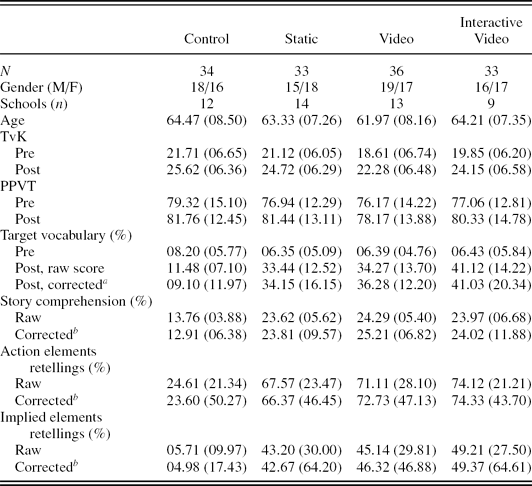
Because of technical problems, there was 1 missing case on the TvK expressive vocabulary task, 12 missing cases on the story comprehension questions, and 11 missing cases on the story retellings. The number of participants thus differed for each complex sample general linear model analysis (N = 135 for vocabulary, N = 123 for story comprehension questions, N = 125 for story retellings). Table 1 provides an overview of descriptive statistics. For all variables, distribution of scores was satisfactory for assuming normality (skewness and kurtosis < 1.00). No differences between the four conditions were found on any of the variables at pretest.
Means (standard deviations) on all measures, for each group separately

Note: Scores on Peabody Picture Vocabulary Test (PPVT) and Taaltest voor Kinderen (TvK, Language Test for Children) are unstandardized scores; target vocabulary scores and action/implied elements in story retellings reflect the percentage of items correct; story comprehension means are absolute scores (max score = 48).
a Corrected for TvK and target vocabulary pretest scores using complex sample general linear model (CSGLM).
b Corrected for TvK using CSGLM.
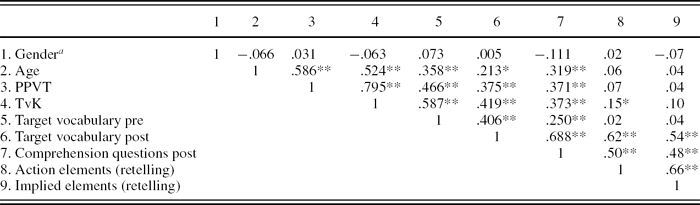
Correlations between dependent and predictor variables in experimental conditions are presented in Table 2. The control group was not included in calculating correlations because of bottom effects on dependent variables in this group. A general vocabulary test like the PPVT was related with target vocabulary but only moderately strong. Furthermore, all vocabulary scores were linked to comprehension but the link between target vocabulary at posttest and comprehension questions was by far strongest (r = .69, p < .001). After correction for the pretest score on target vocabulary, children who knew more target words answered more questions correctly than did children with more limited vocabularies (r = .67, p < .001).
Correlations between dependent and predictor variables for experimental groups only

Note: N = 123–136. PPVT, Peabody Picture Vocabulary Test; TvK, Taaltest voor Kinderen (Language Test for Children).
a Gender (0 = boy, 1 = girl).
*p < .05 (two tailed). **p < .01 (two tailed).
Target vocabulary
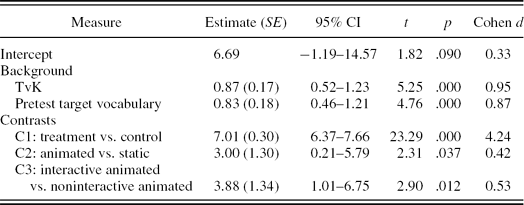
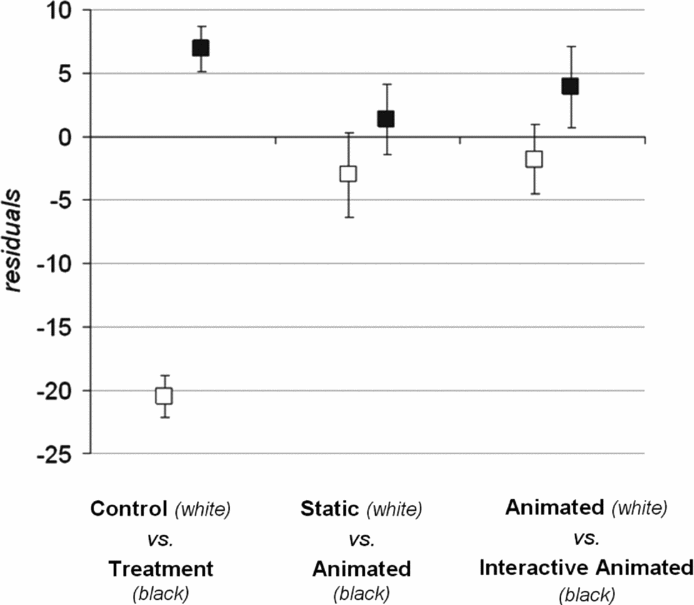
In the analysis with target vocabulary as dependent measure, we initially entered the following factors as covariates: gender, age, and scores on the PPVT, TvK, and target vocabulary pretest. In the final regression model displayed in Table 3, explaining 76% of the total variance, we included as covariates the TvK expressive vocabulary test, F (1, 14) = 27.540, p < .001, and pretest scores on the target vocabulary task, F (1, 14) = 22.684, p < .001. None of the other covariates were significant. All three a priori contrasts were significant: (a) a treatment effect was found with higher scores for (pooled) experimental groups compared to the control condition, F (1, 14) = 542.633, p < .001; the experimental groups scored on average 28% (about 12 words) higher than the control group, C1 = (1*7.01) − (−3*7.01); (b) the contrast C2 between animated and static e-books revealed a significant contrast with higher scores for animated storybooks, F (1, 14) = 5.321, p = .037; in the animated e-book condition children learned on average 6% (about 2 words) more than in the static e-book condition, C2 = (1*3.00) − (−1*3.00); and (c) scores were 8% (about 4 words) higher for interactive animated e-books than for noninteractive animated e-books, F (1, 14) = 8.386, p = .012; C3 = (1*3.88) − (−1*3.88). Estimates of the three contrasts are plotted in Figure 3; corrected means per condition are presented in Table 1. Regression models with general vocabulary tests (TvK and PPVT) as dependent measures did not reveal significant effects of the interventions.
Final model of regression analysis (complex sample general linear model) of target vocabulary (%) with TvK, target vocabulary pretest, and three contrasts as covariates

Note: N = 135. The Cohen d was calculated in a separate analysis using the formula 2t/✓n −2 (Thalheimer & Cook, 2002). TvK, Taaltest voor Kinderen (Language Test for Children).
Three contrasts with target vocabulary posttest as the dependent measure after correction for pretest scores on the Taaltest voor Kinderen and target vocabulary.

In the interactive animated condition, a minority of words (n = 16) appeared twice as hotspots, whereas the majority of words appeared as hotspots only once (n = 37). To examine an effect of repeated instruction, a repeated measures analysis of variance was conducted on target vocabulary scores in the interactive animated condition with Time (pre vs. post) and Exposure (instructed once vs. twice) as within subject factors. The nonsignificant interaction Time × Exposure suggests that presenting word definitions once or twice did not affect word learning. However, the words presented twice may have been more complex words.
Story understanding
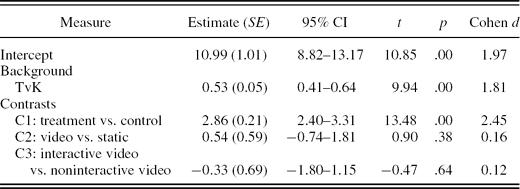
In the regression analysis with story comprehension questions as dependent measure, we initially controlled for gender, age, and scores on the PPVT, TvK, and target vocabulary pretest. In the final regression model in Table 4 that explained 63% of the variance, only the TvK expressive vocabulary test was a significant covariate, F (1, 14) = 98.701, p < .001. The contrast between pooled treatment groups and control group also revealed a significant effect with highest scores on story comprehension for the treatment groups, F (1, 14) = 181.820, p < .001). No differences were found between static versus animated storybooks, or noninteractive versus interactive animated e-books.
Final model of regression analysis (complex sample general linear model) of story comprehension with TvK and three contrasts as covariates

Note: N = 123. The Cohen d was calculated in a separate analysis using the formula 2t/✓n − 2 (Thalheimer & Cook, 2002). TvK, Taaltest voor Kinderen (Language Test for Children).
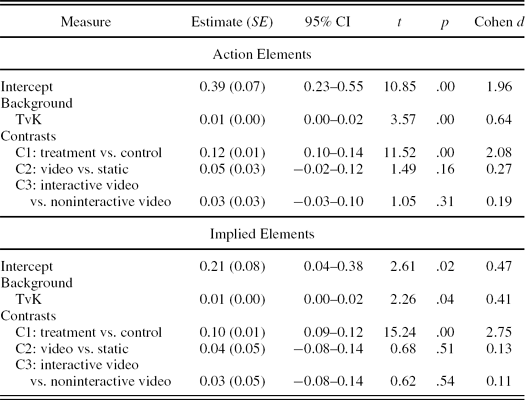
Findings for the story retellings were similar. The final regression model for actions that is displayed in Table 5 explained 45% of the variance. TvK expressive vocabulary test was a significant covariate, F (1, 14) = 12.78, p < .01. The contrast between pooled treatment groups and control group revealed a significant effect in favor of the experimental groups, F (1, 14) = 132.63, p < .001, but differences between experimental conditions were not found. The final model for implied elements explained 33% of the variance (see Table 5). TvK expressive vocabulary test revealed a significant effect, F (1, 14) = 5.12, p < .05. The contrast for treatment effect was also significant, F (1, 14) = 232.33, p < .001, but other differences between conditions were not found.
Final model of regression analysis (complex sample general linear model) of story retellings with TvK and three contrasts as covariates

Note: N = 125. The Cohen d was calculated in a separate analysis using the formula 2t/✓n − 2 (Thalheimer & Cook, 2002). TvK, Taaltest voor Kinderen (Language Test for Children).
DISCUSSION
The current study demonstrates the relevance of technology in supporting children's language skills. In a short period of time (eight 12-min sessions spread over 4 weeks), repeated reading of e-books without adult support resulted in an average vocabulary increase of 28% (12 words). Growth is not the result of pretesting combined with natural encounters with the words in daily life given the finding that children in the control condition on average learned only 2% of the difficult words that were tested (1 word). The motion pictures, sounds, and background music in the animated e-books provide more opportunities for vocabulary expansion than did stories with just static pictures and without sounds or music and resulted in an additional 6% increase in word learning (2 words). When animated e-books include hotspots that define word meanings, children gained another 8% of word meanings (4 words). Thus, hotspots that automatically provide word definitions seem very capable of focusing children's attention on difficult words and stimulate word learning. One of the strengths of this study is that outcomes are based on an intervention that included five different stories instead of just one.
Vocabulary growth
We found superior vocabulary gains for animated e-books compared with static versions of the same books, similar to previous findings in groups of L2 learners (e.g., Silverman & Hines, Reference Silverman and Hines2009; Verhallen & Bus, Reference Verhallen and Bus2010; Verhallen et al., Reference Verhallen, Bus and de Jong2006). Unlike the study by Silverman and Hines (Reference Silverman and Hines2009), the current findings show that additional multimedia promote vocabulary learning also in L1 learners. The animated e-books used in our study were designed in a way that there was close temporal proximity between narration and nonverbal information (motion pictures, music, and sounds). For instance, motion was not added to make the scene more realistic (trees moving in the wind or birds singing songs) but to attract children's attention to elements in the illustrations that are highlighted in the narration. Motion was therefore parsimoniously added to the illustrations. Zooming was used to focus attention on elements mentioned in the text. It seems therefore a plausible hypothesis that these features of the animated e-books may have facilitated word learning by reducing the amount of effort that is required for matching the pictures with the story language (Schnotz & Rasch, Reference Schnotz and Rasch2005). Stronger connections between spoken words and phrases with relevant parts of the illustrations and other nonverbal information (music and sounds) can result in more effective memory traces (Mayer, Reference Mayer2001).
Our findings show a perfect match with the hypothesis that nonverbal information does not “use up” the capacity of storing language in short-term memory but enables children to figure out the meaning of unknown words and store those in long-term memory (Paivio, Reference Paivio and Neuman2008; Wickens, Kramer, Vanasse, & Donchin, Reference Wickens, Kramer, Vanasse and Donchin1983). Studies on television viewing in the early 1980s are in line with an alternative model of cross-modal attention processes. Hayes, Chemelski, and Birnbaum (Reference Hayes, Chemelski and Birnbaum1981), for instance, found higher retention of visual information than of audio information, which was denoted as the visual superiority effect: Children pay greatest attention to visual aspects of televised presentations, largely ignoring language features. Further research is needed to explain under which conditions multiple deliveries of information, instead of just one, bootstrap development of language and when attentional limitations might become more relevant than in the current study.
There is no evidence for the hypothesis that animated e-books affect word learning through improved story comprehension; none of the comprehension measures revealed an effect of book format. Neither is it very plausible that the additional features in the animated e-books caused a novelty effect that might dissipate over time, considering that animated e-books are effective even though most young children are continuously exposed to cartoons on television. It is possible that superior effects of animated e-books on vocabulary growth may be explained because animated e-books are more effective in attracting children's attention than are static e-books. Evidence for this comes from a previous study in which we found that children's level of arousal as indicated by skin conductance while listening to a story was higher in response to the animated e-book than to the static version of an e-book, especially after a few repetitions (Verhallen & Bus, Reference Verhallen and Bus2009).
A unique finding of the current study is that, as with an adult explaining difficult words while sharing a book with a child (for meta-analytic evidence, see Mol, Bus, & de Jong, Reference Mol, Bus and de Jong2009; Mol, Bus, de Jong, & Smeets, Reference Mol, Bus, de Jong and Smeets2008), a word meaning explanation by the computer can improve word learning over reading alone. Hotspots that did not require verbal responses on the part of the child were successful in promoting vocabulary learning. Merely focusing children's attention on a difficult word as parents may also do during shared reading (e.g., “see he is shy, his cheeks turn red”) apparently is a boost for storing and recalling meanings of unknown words (Whitehurst et al., Reference Whitehurst, Falco, Lonigan, Fischel, DeBaryshe and Valdez-Menchaca1988).
Improvement in story comprehension
Unlike previous work with L2 learners (Verhallen et al., Reference Verhallen, Bus and de Jong2006), the current findings do not support effects of animated e-books and extratextual vocabulary instruction on understanding story events. Repeatedly hearing the oral text and seeing the static or animated pictures improved children's story comprehension equally. The failure to find a significant differential effect on comprehension measures is disappointing at first sight. However, there are a number of plausible explanations for these null effects.
Expanding vocabulary may not improve understanding the text and following the story line as it may have done in a group of L2 learners (Verhallen et al., Reference Verhallen, Bus and de Jong2006). Effects of additional vocabulary instruction on story comprehension were absent, probably because lags in word knowledge were not so substantial that they would interfere with understanding the story line in a normative group. According to the substantial bimodal and partial correlations between vocabulary and comprehension (rs > .50), larger book-specific vocabularies do benefit story comprehension (e.g., Cain et al., Reference Cain, Oakhill and Lemmon2004; Hu & Nation, Reference Hu and Nation2000; Lynch et al., Reference Lynch, van den Broek, Kremer, Kendeou, White and Korch2008). However, familiarity with a few difficult words more as a result of reading the animated e-books or vocabulary instructions may not lead up to better story comprehension.
Furthermore, a long history of adult-led traditional shared book reading as may apply to most participants in this study probably made children experienced in inferring the story line from listening to the oral text combined with static illustrations. The current sample of children may not need additional information sources, such as motion pictures, music, and sounds, to select content for processing the story.
As can be expected, young children have much more difficulty understanding implied elements than actions (cf. Gibbons, Anderson, Smith, Field, & Fischer, Reference Gibbons, Anderson, Smith, Field and Fischer1986). Animated pictures did not additionally benefit the comprehension of actions, probably due to a ceiling in the scores (>68% of the action elements). In contrast to Verhallen et al.'s study (Reference Verhallen, Bus and de Jong2006), animated pictures also failed to benefit the comprehension of implied elements beyond the very elementary ones, which may be attributed to a developmental ceiling in understanding goals, motives, and emotions. In the early school years, children become less action-oriented and more sensitive to the protagonists’ goals and feelings (Van den Broek, Lorch, & Thurlow, Reference Van den Broek, Lorch and Thurlow1996).
Limitations
The current study has limitations resulting from the study's design. A within-subjects design might have been optimal because TvK and pretest book vocabulary were significant control variables in the analyses. However, the lack of well-designed electronic books with the appropriate additions prompted us to prefer a between-subjects to a within-subjects design.
Furthermore, it is difficult to unravel which characteristics of e-books explain effects. For instance, the design of extratextual vocabulary instructions, first repeating and then defining a target word, makes it hard to disentangle effects of repetition and definition. Merely repeating a word may result in more vocabulary growth (e.g., de Temple & Snow, Reference De Temple, Snow, van Kleeck, Stahl and Bauer2003). However, providing a definition could be important for acquiring a greater depth of semantic knowledge (e.g., Coyne, McCoach, Loftus, Zipoli, & Kapp, Reference Coyne, McCoach, Loftus, Zipoli and Kapp2009). Comparing a condition in which words are merely repeated with a condition in which a definition is added may shed more light on this matter.
Finally, the bulk of commercial e-books and applications for young children may differ from the materials used in the current experiment and may not benefit learning to the same extent. Unlike commercial materials, interactivity in the e-books used here was highly controlled: we inserted only one hotspot per interactive moment, children were allowed to play for a maximum of 30 s with a hotspot, and the number of hotspot moments was restricted to four per session. This way, children did not have a chance to prefer playing to reading text (de Jong & Bus, Reference De Jong and Bus2002; Labbo & Kuhn, Reference Labbo and Kuhn2000). Likewise, animated pictures, sounds, and music in our e-books matched the story text, which may not be the case when, for instance, a print or digital book is combined with hyperlinks to a website which plays video.
CONCLUSIONS
Current findings show that electronic storybooks fulfill the promise that multimedia additions can enrich book reading experiences when used properly. Interactive animated e-books seem to be the best alternative; vocabulary is stimulated, which may contribute to children's growing story comprehension and interest in reading (Mol & Bus, Reference Mol and Bus2011). The multimedia theory of close temporal proximity implies that the quality of animations is vital. The animated pictures are hypothesized to facilitate word learning only when they succeed in focusing children's attention on relevant visual details mentioned in the story text. E-books may not have the same effects when they include animations that do not match the story text. Where the visualization is not an animation of an illustration to focus attention on particular details, animated e-books may not benefit vocabulary learning (e.g., Silverman, Reference Silverman2013). The integration of commercial movie footage with written text, as in so-called vooks, may not fulfill the minimum requirement of temporal contiguity. It is important that educators take responsibility in creating a literacy-supportive technology environment for young children by designing e-books that include effective multimedia and interactive features and by supervising the selection of good materials among the numerous low quality e-books available on the internet (Bus & Neuman, Reference Bus, Neuman, Bus and Neuman2010).
ACKNOWLEDGMENTS
This study was supported by a grant from the Netherlands Organization for Scientific Research to Adriana G. Bus (Project 411-05-117). The e-books were designed by Christiaan Coenraads, Het Woeste Woud, Groningen, Netherlands. This study was made possible in part by the Dutch organization EDICT whose aim is to promote ICT use in education.