Implications
An adequate supply of dietary amino acids (AAs) without oversupplying CP is important for the health of piglets and for the utilization, excretion and emission of nitrogen. Bacillus subtilis selected to overproduce Val may be a means of providing dietary AAs. However, the results in the current experiment do not provide sufficient evidence that the Bacillus subtilis mutant can be used to provide Val to pigs, and the solution cannot be applied yet.
Introduction
The risk of impaired pig health caused by diarrhea is lower when feeding low-CP diets (Heo et al., Reference Heo, Kim, Hansen, Mullan, Hampson and Pluske2008; Wellock et al., Reference Wellock, Fortomaris, Houdijk and Kyriazakis2008), whereas an oversupply of dietary protein results in lower energy efficiency and impaired animal performance because the catabolism of surplus AA is an energy-consuming process (Just, Reference Just1982). Furthermore, the negative environmental impact of nitrogen excretion and emission is alleviated by reducing the surplus dietary CP (Hansen et al., Reference Hansen, Nørgaard, Adamsen and Poulsen2014; Nørgaard et al., Reference Nørgaard, Hansen, Soumeh, Adamsen and Poulsen2014). In European starter and grower diets, Val is often among the five first limiting AA along with Lys, Met, Thr and Trp. These five AA are commonly included as crystalline AA in piglet diets, which allows reducing the content of CP while maintaining the dietary supply of indispensable AA to support optimum growth performance and reduce nitrogen excretion (Gloaguen et al., Reference Gloaguen, Le Floc’h, Corrent, Primot and van Milgen2014; Nemechek et al., Reference Nemechek, Tokach, Dritz, Goodband and DeRouchey2014).
Bacillus subtilis has been used in the pig industry for >15 years as a probiotic with positive effects on growth performance reported in piglets (Link and Kovac, Reference Link and Kovác2007), grower-finisher pigs (Wang et al., Reference Wang, Cho, Chen, Yoo, Huang, Kim and Kim2009) and sows (Alexopoulos et al., Reference Alexopoulos, Georgoulakis, Tzivara, Kritas, Siochu and Kyriakis2004). Mutants of Bacillus subtilis have been found to overproduce specific AA (Hoch et al., Reference Hoch, Roth, Crawford and Nester1971; Kisumi et al., Reference Kisumi, Kato, Sugiura and Chibata1971; Holtzclaw and Chapman, Reference Holtzclaw and Chapman1975; Kato et al., Reference Kato, Kisumi, Takagi and Chibata1977). Kisumi et al. (Reference Kisumi, Kato, Sugiura and Chibata1971) observed an increased Arg production by Bacillus subtilis mutants from 0.1 mg/ml in the wild-type strain to 4.3 mg/ml in the mutant strain, and Kato et al. (Reference Kato, Kisumi, Takagi and Chibata1977) obtained a mutant that produced more than two-fold the amount of l-Arg produced by the parent wild-type strain. Previously, Nørgaard et al. (Reference Nørgaard, Canibe, Nielsen, Carlson, Knap, Cantor and Poulsen2012) evaluated a Bacillus subtilis mutant strain shown to overproduce Val in vitro, but concluded that the mutant at the applied dose of 1.28×10⁶ cfu/g feed was not sufficient to alleviate the detrimental effect of feeding Val-deficient diets to pigs. It was hypothesized that a Bacillus subtilis mutant strain, which had been shown to overproduce Val in vitro, added to the feed at a high dose could supply the host with absorbable Val in an amount that compensates for a dietary Val deficiency. Before in situ production of AA by Bacillus subtilis, mutants can be considered as an alternative to crystalline AA in pig diet formulations, in vivo studies are needed to validate the reported in vitro results.
A study with piglets was conducted with the objective of evaluating the effect of supplementing a Bacillus subtilis mutant able to overproduce Val in vitro to Val-deficient diets on performance and plasma AA in young pigs. To address this objective, a Bacillus subtilis mutant was evaluated against a wild-type Bacillus subtilis strain and a negative (0.63 standardized ileal digestible (SID) Val : Lys) and a positive (0.67 SID Val : Lys) control.
Material and methods
All animal experimental procedures were carried out in accordance with the Danish Ministry of Justice, Law no. 253 of 8 March 2013 concerning experiments with animals and care of experimental animals, and license issued by the Danish Animal Experiments Inspectorate, Ministry of Food, Agriculture and Fisheries, Danish Veterinary and Food Administration.
Three strains of Bacillus subtilis were tested: two Val-overproducing mutants (mutant 1 (M1), DSM25483; mutant 2 (M2), M2DSM 26668) and the parent wild-type strain, DSM5750. The mutants were obtained after several rounds of UV mutagenesis followed by dominant selection on minimal medium (Chapman, Reference Chapman1972) containing Val analogues as described in the European Patent EP2379704B1 (Cantor et al., Reference Cantor, Derkx, Knap, Knarreborg, Leser and Lund2013).
Experiment 1
Animals and diets
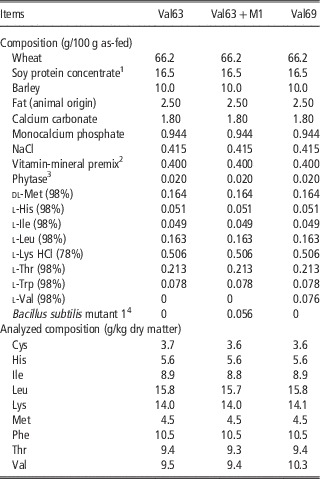
In total, 18 gilts (Duroc×(Danish Landrace×Yorkshire)) from six litters with an initial BW of 15.0±1.1 kg were included in the study. Each littermate was assigned to one of the three experimental diets and housed individually. No physical contact was allowed between the animals. Two experimental diets were formulated to contain a SID Val : Lys ratio of 0.63 (Val63) of which one was used as the negative control, and the other was supplemented with 1.28×10⁸ cfu Bacillus subtilis mutant 1/g feed (Val63+M1). This dose corresponds to 100 times the recommended level of inclusion of the commercial probiotic product (BioPlus 2B; Chr Hansen A/S, Hørsholm, Denmark), which is based on Bacillus subtilis and Bacillus licheniformis. A third diet containing 0.69 SID Val : Lys (Val69) was used as a positive control as we recently confirmed this level to be sufficient (Soumeh et al., 2015) (Table 1). Diets were formulated to be isoenergetic (9.7 MJ net energy (NE)/kg as-fed). The dietary Lys concentration was planned to be 11.6 g total Lys/kg and 10.7 g SID Lys/kg, corresponding to 95% of the Lys recommendation (Tybirk et al., Reference Tybirk, Sloth and Jørgensen2012). The supplementation of l-Val was at the expense of l-glutamic acid to formulate isonitrogenous diets (167 g CP/kg as-fed). Other essential AA were supplied in accordance with Danish recommendations for pigs weighing 20 to 30 kg (Tybirk et al., Reference Tybirk, Sloth and Jørgensen2012). The experimental diets were mixed individually, pelleted and analyzed for AA and Bacillus subtilis to confirm correct mixing of diets.
Ingredient and analyzed composition of the experimental diets in Experiment 1 containing 0.63 (Val63) or 0.69 (Val69) SID Val : Lys, or 0.63 SID Val : Lys added a Val-producing Bacillus subtilis mutant 1 strain (Val63+M1)

1 HP300 (Hamlet Protein, Horsens, Denmark).
2 Provided the following per kg of diet: 10 000 IU vitamin A, 2000 IU vitamin D3, 94 IU vitamin E, 2.4 mg vitamin K3, 2.4 mg vitamin B1, 4.8 mg vitamin B2, 2.4 mg vitamin B6, 0.02 mg vitamin B12, 12 mg d-panthotenic acid, 26 mg niacin, 0.2 mg biotin, 200 mg Fe (Fe(II) sulfate), 165 mg Cu (Cu(II) sulfate), 200 mg Zn (Zn(II) oxide), 56 mg Mn (Mn(II) oxide), 0.3 mg KI, 0.3 mg Se (Se-selenite).
3 Natuphos 5000 (BASF, Ludwigshafen, Germany).
4 Dose to provide 1.28×10⁸ cfu Bacillus subtilis/g diet.
Experimental procedure
The animals were fed a daily amount corresponding to 3.2% to 3.8% of their BW in two equal meals at 0800 and 1500 h. On day 15 of the study, pigs were fitted with a permanent jugular vein catheter, and on days 17 and 18, blood samples were collected. On the day of sampling, the animals were fed 37 g diet/kg metabolic BW at 0900 h, and blood was collected in sodium heparinized tubes at 0830, 1000, 1100, 1200, 1300, 1400 and 1500 h.
Experiment 2
Animals and diets
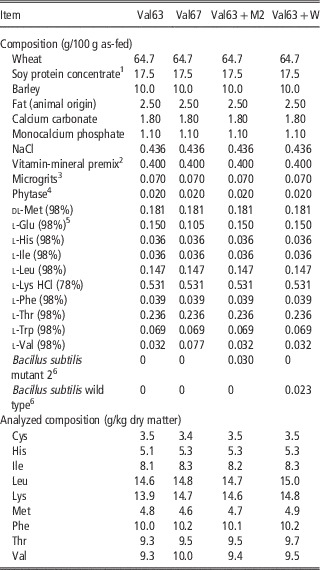
In total, 80 cross-bred (Duroc×(Danish Landrace×Yorkshire)) female pigs with an initial BW of 9.1±1.1 kg were weaned on day 28 and fed the same commercial starter diet for 5 days. Four experimental mash diets based mainly on wheat, soya protein concentrate and barley (Table 2) were formulated to be isoenergetic (10.0 MJ NE/kg as-fed). The dietary Lys concentration was planned to be 11.8 g total Lys/kg and 10.9 g SID Lys/kg, corresponding to 92% of the Lys recommendation (Tybirk et al., Reference Tybirk, Sloth and Jørgensen2012). Diets with two levels of Val concentrations were formulated to contain SID Val : Lys ratios of 0.63 (Val63) and 0.67 (Val67). The supplementation of l-Val was at the expense of l-glutamic acid to formulate isonitrogenous diets (170 g CP/kg as-fed). Other essential AA were supplied in accordance with Danish recommendations for pigs weighing 9 to 30 kg (Tybirk et al., Reference Tybirk, Sloth and Jørgensen2012). To test the effect of the Bacillus subtilis mutant, two additional diets were composed on the basis of the Val63 diet by supplementing 1.28×10⁸ cfu Bacillus subtilis mutant strain/g feed (Val63+M2) or 1.28×10⁸ cfu Bacillus subtilis wild strain/g feed (Val63+W). The experimental diets were mixed individually and analyzed for AA and Bacillus subtilis to confirm correct mixing of diets.
Ingredient and analyzed composition of the experimental diets in Experiment 2 containing 0.63 (Val63) or 0.67 (Val67) SID Val : Lys, or 0.63 SID Val : Lys added a Val-producing Bacillus subtilis mutant 2 strain (Val63+M2) or a Bacillus subtilis wild-type strain (Val63+W)

1 HP300 (Hamlet Protein, Horsens, Denmark).
2 Provided the following per kg of diet: 10 000 IU vitamin A, 2000 IU vitamin D3, 94 IU vitamin E, 2.4 mg vitamin K3, 2.4 mg vitamin B1, 4.8 mg vitamin B2, 2.4 mg vitamin B6, 0.02 mg vitamin B12, 12 mg d-panthotenic acid, 26 mg niacin, 0.2 mg biotin, 200 mg Fe (Fe(II) sulfate), 165 mg Cu (Cu(II) sulfate), 200 mg Zn (Zn(II) oxide), 56 mg Mn (Mn(II) oxide), 0.3 mg KI, 0.3 mg Se (Se-selenite).
3 Jadis Additiva, Haarlem, the Netherlands. Colored corn bran to visually differentiate diets.
4 Natuphos 5000 (100 g/ton) (BASF, Ludwigshafen, Germany).
5 Included to compose isonitrogenic diets.
6 Dose to provide 1.28×10⁸ cfu Bacillus subtilis/g diet.
Experimental procedure, growth performance study
A 3-week performance study was conducted during two successive 3-week blocks. The pigs were allotted to dietary treatments according to litter and their BW and were individually housed in 1.1×2.2 m pens comprised of 1/3 concrete floor and 2/3 cast iron slatted floor. Five identical rooms were used in each block with two pens per treatment in each room. Pigs were offered feed ad libitum through an open stainless steel feeder and had permanent access to drinking water provided through a nipple drinker. The initial room temperature was 24°C and was lowered to 22°C during the 21-day period. The relative humidity was controlled in the range of 60% to 65%. Individual BW and feed consumption were registered on days 0, 7, 14 and 21 for calculating average daily gain (ADG), average daily feed intake (ADFI) and feed conversion ratio (FCR). On day 17 of the study, feed was removed from all pens at 1500 h. On day 18, animals were offered 14 g diet/kg metabolic BW from 0730 h with 2 min intervals between pigs, and 3 h later, blood samples were taken from the jugular vein in sodium heparinized tubes.
Experimental procedure, kinetics of Val absorption study
The performance study was followed by a study on Val absorption kinetics using a subset of the same pigs now weighing 15.0±1.1 kg. Six litters of four littermates (six pigs per treatment) were used in this subsequent study on Val absorption kinetics. The animals continued on their experimental diets and were housed individually with no physical contact between animals. As pigs had been offered feed ad libitum during the initial 3 weeks, a 3-day period was included to allow the animals to adapt to eat twice daily. During this period, the animals were offered their diets (880 g/day) at 0800 and 1500 h. On days 24 to 26 of the study, pigs were fitted with a permanent jugular vein catheter, and 2 days later, blood samples were collected. On the day of blood sampling, the pigs were fed 35 g diet/kg metabolic BW at 0900 h, and blood was collected in sodium heparinized tubes at 0830, 1000, 1100, 1200, 1300, 1400 and 1500 h.
Analytical methods
Representative samples of the diets were hydrolyzed for 23 h at 110°C with (Cys and Met) or without (Arg, His, Ile, Leu, Lys, Phe, Tyr, Thr and Val) performic acid oxidation, and AA were separated by ion exchange chromatography and quantified by photometric detection after ninhydrin reaction (European Commission, 1998). Bacillus spores in feed were enumerated on LB agar (1.10285; Merck, Darmstadt, Germany) after heat treatment (80°C for 10 min) and incubation at 37°C for 1 day under aerobic conditions.
All blood samples were placed on ice immediately after collection and subsequently centrifuged at 1050×g during 10 min to collect plasma, which was stored at −80°C until analysis. Free AA and urea concentrations in plasma collected on day 18 in Experiment 2 were analyzed using an AA analyzer fitted with a lithium high performance system for physiological AA (Biochrome 30+Amino Acid Analyzer; Biochrome, Cambridge, UK). The AA analyzer was calibrated using standards for acidic, neutral and basic AA (Sigma Aldrich, St. Louis, MO, USA). In the kinetics studies, plasma samples were analyzed only for free Val and Lys by precipitation of protein with perchloric acid, derivatization of the AA by addition of flourenylmethyl chloroformate, and quantification of AA by using an Agilent 1200 series HPLC chromatograph (Agilent Technologies, Santa Clara, CA, USA) equipped with a Phenomenex Kinetec 2.6 µm C18 100×4.6 mm column (Phenomenex Inc., Torrance, CA, USA).
Calculations and statistical analyses
The experimental unit was the individual pig. FCR was calculated as ADFI divided by ADG. The results were statistically analyzed by ANOVA using mixed linear models of SAS (Version 9.2; SAS Institute Inc., Cary, NC, USA). The effect of diet on plasma AA concentrations in Experiment 1 was analyzed by including diet, time after feeding and their interaction as fixed effects and considering litter as a random effect. To account for the correlation between measurements made on the same animal at various time points, the repeated statement of SAS was used. The data on Val and Lys absorption in Experiment 2 were analyzed with the same model, except that block and the interaction between block and diet were included as fixed effects. An ante-dependence or compound symmetry variance structure was assumed.
The models used to analyze the impact of the treatments on ADFI, ADG and FCR included diet as fixed effect, initial BW as a covariate and room and block as random effects. The model used for the plasma AA and urea data from samples collected on day 18 in Experiment 2 included diet as fixed effect and room and block as random effects. Multiple comparisons were adjusted using the Bonferroni–Holm method (Holm, Reference Holm1979). Statistical significance was accepted at P⩽0.05 and tendencies at P⩽0.10. Data are presented as least squares means and SEM.
Results
The number of Bacillus spores (cfu/g feed) was 1.8×10⁷ in Val63+M1, 7.5×10⁷ in Val+M2 and 4.6×10⁷ in Val63+W. The baseline level of Bacillus in the diets not supplemented with Bacillus subtilis was below 1×10⁵ cfu/g feed.
Experiment 1
The Val plasma concentration was higher in the Val69 at all times compared with the Val63 treatment (Figure 1). Supplementation of Bacillus subtilis mutant 1 to the feed tended (P<0.10) to increase the plasma levels of Val at 2 and 3 h post-feeding compared with the Val63 treatment. The highest concentration of Val in the Val63 and Val69 treatments was measured 1 h after feeding followed by a decrease in the remaining period, whereas for the Val63+M1 treatment, the highest concentration was measured 2 h after feeding. Diet had no significant effect on plasma Lys concentration.
Plasma concentrations (Experiment 1) of (a) Val and (b) Lys in pigs fed 0.63 (Val63) or 0.69 (Val69) SID Val : Lys, or a 0.63 SID Val : Lys diet supplemented with a mutant 1 Val-producing Bacillus subtilis strain (Val63+M1). The pigs were fed at time 0. n=6. a,bValues within time point with different superscript letters are statistically different after Bonferroni–Holm adjustment (P<0.05). For Val, the interaction between treatment and time was significant (P<0.001). 1At 2 h after feeding: Val63+M1 v. Val63, P=0.09. 2At 3 h after feeding: Val63+M1 v. Val63, P=0.09; Val63+M1 v. Val69, P=0.09.

Experiment 2
Growth performance study
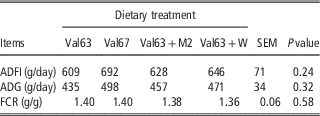
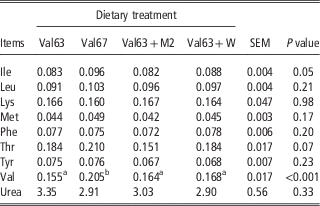
Supplementing the Bacillus subtilis mutant 2 and wild-type strains resulted in animal ADG (P=0.32) and ADFI (P=0.24) neither different from the negative control treatment Val63 nor from the positive control treatment Val67 (Table 3). The plasma Val concentration was not different among treatments, although like for ADG and ADFI, the plasma concentrations of most AA in pigs fed the Bacillus subtilis strains were in between the levels measured in pigs fed the Val63 and Val67 treatments (Table 4).
Average daily feed intake (ADFI), average daily gain (ADG), and feed conversion ratio (FCR) of pigs in Experiment 2 fed 0.63 (Val63) or 0.67 (Val67) SID Val : Lys, or a 0.63 SID Val : Lys diet supplemented with a Val-producing Bacillus subtilis mutant 2 strain (Val63+M2) or a Bacillus subtilis wild-type strain (Val63+W) during 21 days from 1 week after weaningFootnote 1

1 Values are least squares means (n=20).
Plasma concentrations (mmol/l) of amino acids and urea 3 h after feeding pigs in Experiment 2 fed 0.63 (Val63) or 0.67 (Val67) SID Val : Lys, or a 0.63 SID Val : Lys diet supplemented with a Val-producing Bacillus subtilis mutant 2 strain (Val63+M2) or a Bacillus subtilis wild-type strain (Val63+W) during 21 days starting 1 week after weaningFootnote 1

a,bValues with different superscript letters are statistically different after Bonferroni–Holm adjustment (P<0.05).
1 Values are least squares means (n=20).
Kinetics of Val absorption study
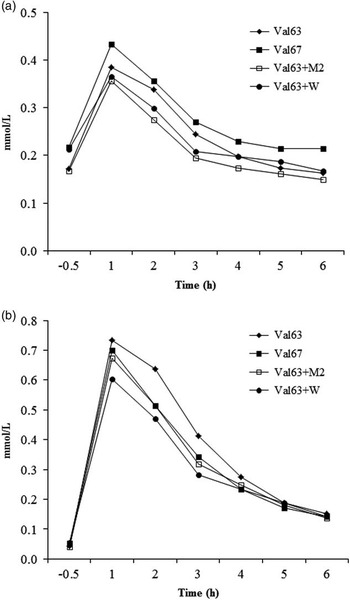
The maximum plasma concentration of both Val and Lys was measured 1 h after feeding in all treatments followed by a steep decrease until 3 to 4 h after feeding and a less pronounced reduction during the remaining hours (Figure 2). Considering the effect of Bacillus subtilis on Val plasma concentrations, the Val63+M2 treatment was not different from the Val63 treatment but lower (P<0.05) than the Val67 treatment, whereas the Val63+W was not different from the Val63 and Val67 treatments. There was no difference among diets regarding the plasma Lys concentration.
Plasma concentrations (Experiment 2) of (a) Val and (b) Lys in pigs fed 0.63 (Val63) or 0.67 (Val67) SID Val : Lys, or a 0.63 SID Val : Lys diet supplemented with a Val-producing Bacillus subtilis strain mutant 2 (Val63+M2) or a Bacillus subtilis wild-type strain (Val63+W). Pigs were fed at time 0. n=6.

Discussion
An initial study (Experiment 1) with the aim of investigating the in situ production of Val by the Bacillus subtilis mutant 1 by measuring the Val plasma concentration in pigs was conducted, which indicated a positive effect of the mutant. To confirm these indications, a second study was then performed with another mutant strain (M2), with a higher Val production measured in in vitro studies. In Experiment 2, both growth performance and plasma Val concentrations were measured.
Bacillus subtilis alone or in combination with other bacteria are used in the pig industry as a probiotic. However, the objective of the current experiments was not to evaluate the probiotic effect of Bacillus subtilis, but to study if Bacillus subtilis mutants selected for overproduction of Val were able to produce Val in vivo in measurable amounts. As the developed mutants may still express probiotic effects, a treatment in which the wild strain (Val63+W) was added to the feed, was included in Experiment 2 to distinguish between a general probiotic effect and a specific in situ Val production.
The Val plasma concentration profile from 0.5 h pre-feeding to 6 h post-feeding with maximum levels ~1 h after feeding measured in both studies confirms the post-prandial pattern of plasma Val concentration reported by Gloaguen et al. (Reference Gloaguen, Le Floc’h, Corrent, Primot and van Milgen2012) feeding piglets a diet fulfilling the Val requirement. The blood samples taken in Experiment 2 on day 18 were obtained 3 h after feeding to assure a steady Val absorption. This time point was set up based on our own data obtained in Experiment 1 and on measurements on absorption kinetics in pigs showing a maximum absorption of nutrients from 0.5 to 2 h after feeding whereafter it decreases until ~6 h post-feeding (Rerat et al., Reference Rerat, Giusi-Perier and Vaissade1993; van der Meulen et al., Reference van der Meulen, Bakker, Smits and De Visser1997; Kristensen et al., Reference Kristensen, Nørgaard, Wamberg, Engbaek, Fernandez, Zacho and Poulsen2009). Although the AA in focus was Val, other AA and metabolites were also measured. The analysis of items other than Val was important to establish whether any changes in Val levels were exclusive for this AA or whether they followed trends of several AA, thus, general changes. Like the results on growth performance, the levels were in between the negative and positive control diets, but addition of either of the two Bacillus subtilis strains (mutant 2 and wild type) did not significantly affect the plasma AA concentration on day 18. The indications of Val overproduction by the mutant observed in Experiment 1 compared with the negative control, which are in line with the results obtained on day 18 in Experiment 2, were however not confirmed when measuring the Val absorption kinetics in Experiment 2. An explanation for these results is not evident.
To have a clear indication of an in situ Val production by the Bacillus subtilis mutants, the design of the experiment required that the Val63+M treatment resulted in improved animal performance compared with both the Val63 and Val63+W treatments. The numerically higher performance measured in the Val63+M2 group compared with the negative group (Val63) may be an indicator of an in situ Val production. However, the results showed that the mutant was not able to produce the Val needed to improve the growth performance of pigs fed a diet containing a SID Val : Lys ratio of 0.63 to the level of those fed a diet with a ratio of 0.67. Further, the Val63+M2 treatment showed no indication of being different from the Val63+W treatment. This suggests that the numerically beneficial effects observed by supplementing Bacillus subtilis mutant may be attributed to a more general probiotic effect of this bacterium than to an overproduction of Val by the mutant strain.
Conclusions
The mutant Bacillus subtilis strain was not able to compensate for a dietary Val deficiency, and did not result in performance which was different from pigs fed the parent Bacillus subtilis strain. More studies are needed to study the ability of Bacillus subtilis for colonizing the intestine and the conditions needed to obtain an overproduction of AA in vivo.
Acknowledgments
This work was supported by the Danish National Advanced Technology Foundation [Grant No. 062– 2010-3; Copenhagen, Denmark], Chr. Hansen A/S (Hørsholm, Denmark), and Aarhus University (Foulum, Denmark).