Adolescence is a period of human development between 10 and 19 years old (WHO, 2004) characterized by the confluence of intense biological, cognitive, cultural, and psychosocial changes (Smetana, Campione-Barr, & Metzger, Reference Smetana, Campione-Barr and Metzger2006). These changes make young people especially vulnerable to acquiring new behaviors, including behaviors that impair their well-being (Abasse, Oliveira, Silva, & Souza, Reference Abasse, Oliveira, Silva and Souza2009). Research in neuroscience have shown that the higher vulnerability to risk-taking at this stage of life is explained by an increased dopaminergic activity within the socio-emotional system combined with a slow maturation of the cognitive-control system, which is responsible for regulating impulses (Steinberg, Reference Steinberg2007; Steinberg, Reference Steinberg2010). Thus, the tendency to act impulsively looking for adventure, challenging dangerous situations or trying to solve or alleviate their psychosocial crises is a typical characteristic of adolescents. In this process, young people can make choices that bring negative consequences to their development in the short and long term. Brazilian population data show that there is a significant incidence of risky behaviors among adolescents, such as alcohol and drug use, antisocial behavior, and suicide attempts (Abasse et al., Reference Abasse, Oliveira, Silva and Souza2009; SEDH, 2008; SENAD, 2010).
Therefore, researchers have sought to identify contextual factors that promote engagement in risky behaviors, contributing to poor adjustment. From a metatheoretical point of view, psychosocial adaptation in adolescence has been investigated primarily by means of ecological models (Smetana et al., Reference Smetana, Campione-Barr and Metzger2006), which is based on the work by Bronfenbrenner (Bronfenbrenner & Morris, Reference Bronfenbrenner, Morris and Damon1998). The Bioecological Model of Human Development (BMHD, Bronfenbrenner, & Morris, Reference Bronfenbrenner, Morris and Damon1998) is focused on understanding interactions among developing persons, contexts of development, and processes that account for human development (Smetana et al., Reference Smetana, Campione-Barr and Metzger2006). Based on this view of development, the focus of scientific research lies not only on the proximal influence of the family on the adolescent, but also on the impact of other environments such as school and community (Loukas, Ripperger-Suhler, & Horton, Reference Loukas, Ripperger-Suhler and Horton2009; Mayberry, Espelage, & Koenig, Reference Mayberry, Espelage and Koenig2009; Prelow, Bowman, & Weaver, Reference Prelow, Bowman and Weaver2007; Youngblade et al., Reference Youngblade, Theokas, Schulenberg, Curry, Huang and Novak2007). Adolescents are inserted in these environments and the interaction between them in terms of mesosystem suggests possibilities of redundant, amplifying, countervailing, and unique social forces acting on the adaptive processes. Due to the interrelation between different contexts, investigating only one context can lead to the overestimation of its contributions to the behavior (Ennett et al., Reference Ennett, Foshee, Bauman, Hussong, Faris, Hipp and Cai2010).
Family and school are primary social environments, thus their independent effects on adjustment are often investigated. According to the BMHD (Bronfenbrenner & Morris, Reference Bronfenbrenner, Morris and Damon1998), these contexts have primacy over exosystems (e.g. community) in their potential to influence developmental pathways. In this sense, research has demonstrated the protective role of the family while promoting the development of healthy psychological characteristics such as positive self-esteem and expression of pro-social behavior (Dennis, Basañez, & Farahmand, Reference Dennis, Basañez and Farahmand2010; Musito, Jiménez, & Murgui, Reference Musitu, Jiménez and Murgui2007). Conversely, there is also accumulation of evidence suggesting that negative or conflicting family relationships are associated with engagement in risky behavior, such as delinquent acts, as observed in European youths (Eichelsheim et al., 2009). Similarly, associations between school environment, specifically school connectedness, and behavioral outcomes have been demonstrated. School connectedness can be expressed by a sense of belonging to the educational environment, satisfaction with school, and trust in teachers and classmates (Loukas et al., Reference Loukas, Ripperger-Suhler and Horton2009; Wilson, Reference Wilson2004). Low school connectedness was related to internalizing and externalizing problems, including emotional distress, anxiety, depressive symptoms, alcohol use, violence, and conduct problems (Henry, Stanley, Edwards, Harkabus, & Chapin, Reference Henry, Stanley, Edwards, Harkabus and Chapin2009; Loukas et al., Reference Loukas, Ripperger-Suhler and Horton2009; Shochet, Dadds, Ham, & Montague, Reference Shochet, Dadds, Ham and Montague2006).
In recent years, however, the influence of multiple contexts or multisystems on adaptation in adolescence has been demonstrated. Thus, in addition to the family and school environments, the inclusion of the variable community as a development context has been highlighted in recent studies (Ennett et al., Reference Ennett, Foshee, Bauman, Hussong, Faris, Hipp and Cai2010; Mayberry et al., Reference Mayberry, Espelage and Koenig2009; Mrug, Loosier, & Windle, Reference Mrug, Loosier and Windle2008; Prelow et al., Reference Prelow, Bowman and Weaver2007; Raffaelli, Koller, Cerqueira-Santos, & Moraes, Reference Raffaelli, Koller, Cerqueira-Santos and Morais2007; Youngblade et al., Reference Youngblade, Theokas, Schulenberg, Curry, Huang and Novak2007). A study (Youngblade et al., Reference Youngblade, Theokas, Schulenberg, Curry, Huang and Novak2007) involving U.S. youths found that the contextual variables family (closeness/conflict), community (community connectedness), and school (exposure to violence at school) were associated with indicators of positive adjustment (social competence, health-promoting behaviors, self-esteem) and lower rates of negative adjustment (academic problems and internalizing and externalizing behavior) in adolescents. However, this study was based on the parents’ reports instead of being based on youths’ perception.
Recently, methodological advances have made it possible not only to demonstrate the combined influence of different contexts on indicators of adaptation, but also to investigate the impact of the interaction between these contexts on such indicators. An ecological model for substance use was tested in the study conducted with adolescents of U.S. schools (Mayberry et al., Reference Mayberry, Espelage and Koenig2009). The authors found that the systems family, peers, school, and community influenced and interacted in the expression of the behavior assessed. The results showed that a positive perception of the school and community environments was associated with lower substance use. Additionally, the positive perception of the community served as a protective factor in young people, since it moderated the relationship between peers and the parental influence on substance use. A similar study by Ennett et al. (Reference Ennett, Foshee, Bauman, Hussong, Faris, Hipp and Cai2010) applied the ecological contextual perspective in the use of tobacco. U.S. adolescents were tested at five different times over two years. The results showed independent and combined contributions of the contexts family, peers, school, and community to cigarette consumption. The authors concluded that the characteristics of social ties moderated smoking “within” and “between” the contexts family and peers. A study of U.S. Hispanic and non-Hispanic white adolescents living in the United States is also worth mentioning. Stressful events in the three contexts (family, school, and community) were cross-sectionally and longitudinally related to negative adjustment measures - academic problems, depression, and aggression - with different paths in each predictive model (Morales & Guerra, Reference Morales and Guerra2006).
In Brazil, several studies on adolescence were based on the bioecological approach, with predominant analysis of the influence of individual characteristics and family environment on adaptation in this age group (Avanci, Assis, Oliveira, Ferreira, & Pesce, Reference Avanci, Assis, Oliveira, Ferreira and Pesce2007; Caputo & Bordin, Reference Caputo and Bordin2008). Fewer studies, however, have simultaneously examined the characteristics of different development contexts. One of the few studies found (Raffaelli et al., Reference Raffaelli, Koller, Cerqueira-Santos and Morais2007) was conducted with adolescents from low socioeconomic status. The results showed that higher levels of exposure to economic risk within the family and the community were associated with negative affect, suicide attempt, and substance use. Conversely, low risk levels were predictive of higher self-esteem and positive affect.
Taken together, the studies reviewed provided evidence that multiple contexts are associated with a variety of psychosocial outcomes, including risky behavior and presence of psychopathology, as well as expression of positive psychological characteristics. In Brazil, where there are very few studies involving multiple contexts, there is need to investigate to what extent each developmental context is associated with the adaptive processes in adolescence. Do multiple contexts (family, school, and community) show different patterns of association for different indicators of psychosocial adjustment? More specifically, are contextual variables of risk and protection differently associated with the adjustment? Does perception about multiple contexts and adjustment vary depending on gender and age? The present study investigated associations of contextual variables of risk (stressful events and exposure to violence in the community), variables of protection (family environment, school connectedness, and perception of the community), and demographic variables (age and gender) with three indicators of psychosocial adjustment (self-esteem, involvement in illegal activities, and alcohol use in the past month) among adolescents. Based on the studies reviewed, we hypothesized that: a) contextual variables of protection related to family, school, and community would be positively associated with self-esteem (Youngblade et al., Reference Youngblade, Theokas, Schulenberg, Curry, Huang and Novak2007); b) contextual variables of protection related to family, school, and support in the community would be inversely associated with involvement in illegal activities (Eichelsheim et al., 2009; Loukas et al., Reference Loukas, Ripperger-Suhler and Horton2009; Shochet et al., Reference Shochet, Dadds, Ham and Montague2006); c) contextual variables of protection related to family, school, and community would be inversely associated with alcohol use/month (Henry et al., Reference Henry, Stanley, Edwards, Harkabus and Chapin2009; Mayberry et al., Reference Mayberry, Espelage and Koenig2009); and d) illegal activities and alcohol use/month would be positively associated with contextual variables of risk (stressful events and exposure to violence in the community), since there is evidence that maladaptive behaviors are associated with environmental risk (Morales & Guerra, Reference Morales and Guerra2006; Youngblade et al., Reference Youngblade, Theokas, Schulenberg, Curry, Huang and Novak2007).
Method
Participants
This cross-sectional study was conducted with 685 adolescents (61.1% girls) aged between 12 and 18 years (M = 15.10, SD = 1.52). Students were enrolled at public schools (from 7th grade to 2nd year of high school) of Porto Alegre, capital city of the state of Rio Grande do Sul, Brazil. According to self-reported data, 61.1% of students were white, 17.9% were black, and 21% had other racial backgrounds (e.g., native-Brazilian, brown, etc.).
Instruments
We used the Brazilian Youth Questionnaire (Questionário da Juventude Brasileira, QJB - Dell’Aglio, Koller, Cerqueira-Santos, & Colaço, Reference Dell’Aglio, Koller, Cerqueira-Santos, Colaço, Dell’Aglio and Koller2011) to investigate risk and protective factors in adolescents. The QJB consists of 77 questions, including binary questions and metric scale questions (e.g., school connectedness, perception of community support, and the Rosenberg’s Self-Esteem Scale), whose psychometric properties were evaluated in a previous study (Libório & Koller, Reference Libório and Koller2009). The present study analyzes the subset of QJB items assessing perception of school connectedness, perception of community support, exposure to stressful events, exposure to violence in the community, as well as self-esteem, involvement in illegal activities, and alcohol use in the past month. We also administered the Family Climate Inventory (Inventário do Clima Familiar, ICF - Teodoro, Allgayer, & Land, Reference Teodoro, Allgayer and Land2009), which was developed in Brazil based on instruments used worldwide to assess family relationships (Family Climate Inventory - Kurdec, Fine, & Sinclair, Reference Kurdek, Fine and Sinclair1995; Family Adaptability and Cohesion Evaluation Scale - Olson, Portner, & Lavee, Reference Olson, Portner and Lavee1985). The contextual variables of risk and protection are described based on these two instruments (QJB and ICF).
Contextual Variables of Protection
Perception of family environment: it was evaluated using the ICF (Teodoro et al., Reference Teodoro, Allgayer and Land2009), which investigates the quality of family relationships based on the dimensions cohesion, hierarchy, support, and conflict. The inventory consists of 22 items arranged in a five-point Likert scale ranging from “I do not agree at all” to “I fully agree”. Examples of questions are: “People feel close to each other,” “Some people solve problems in an authoritarian manner,” “We try to help family members when we realize they have problems,” and “People criticize each other often” (α = .86).
School connectedness: the adolescents answered seven items. For example: “I feel good when I’m at school,” “I can count on my teachers,” “I trust my classmates,” “I can count on members of school staff (supervisor/coordinator)” scoring on a five-point scale ranging from “Strongly disagree” to “totally agree” (α = .73).
Perception of the community: six items assessed the participants’ perceptions of their community/neighborhood. For example: “I can trust people in my community/neighborhood,” “I can count on my neighbors when I need their help,” “I feel safe in my community/neighborhood.” The response options varied between 1 (Never) to 5 (Always) (α = .77).
Contextual Variables of Risk
Stressful events: eighteen different stressful events were assessed: “I’ve gone hungry,” “I had a serious accident,” “I’ve been robbed,” “My parents split up,” “My father/mother remarried,” “Someone in my family is/was arrested,” “Someone very important to me died,” etc. The items were arranged in a binary format (0 = no, 1 = yes) and the total score was calculated by adding the number of “yes answers”. The mean number of events was 3.30 (SD = 2.05), with minimum 0 and maximum 12.
Exposure to violence in the community: we evaluated the occurrence of five types of violence in the community/neighborhood: threat or humiliation, punching or beating, assault using an object (e.g., wood, belt, wire, cigarette, etc.), forcible touching, and forced sexual intercourse. The items were arranged in a binary format (0 = no, 1 = yes) and the total score was calculated by adding the number of “yes answers”. The mean exposure to violence was .73 (SD = .91), with minimum 0 and maximum 5.
Psychosocial Adjustment
Three indicators of psychosocial adjustment were selected in the QJB: self-esteem, involvement in illegal activities, and alcohol use in the past month.
Self-esteem: it was assessed using the Rosenberg’s Self-Esteem Scale - RSES (Rosenberg, Reference Rosenberg1965, adapted to Brazil by Reppold & Hutz, Reference Reppold and Hutz2002). Its items investigate positive aspects (e.g., “I think I have many good qualities”) and negative aspects (e.g., “All things considered, I feel a failure”) of self-esteem. The response options ranged from 1 (Never) to 5 (Always) (α = .84).
Involvement in illegal activities: it was investigated using six items. “Involvement in fights with physical aggression/violence against other people”, “Destruction of property,” “Graffiting”, “Robbery”, “Stealing”, and “Drug dealing”. The total score was calculated by adding the number of illegal activities in which the adolescent was involved (α = .70).
Use of alcohol in the past month: it was assessed by means of a question in the four-point Likert format, ranging from “not used” to “used five or more times a week”. Because this variable showed little distribution between the options, it was dichotomized (0 = not used and 1 = used).
Data Analysis
First, the total scores of the contextual measures were categorized based on equal percentiles with two cutoff points, creating three levels of classification. After this procedure, the quantitative scales were classified into low, medium, and high, and the total score of stressful events and exposure to violence in the community were classified according to the number of events or violence acts.
The adolescents’ percentage of scoring in each variable was calculated and their associations with gender and age group (12–14, 15–16, 17–18) were investigated using the chi-square test (χ2). Next, bivariate associations (χ2) were realized between contextual variables of risk and protection and demographic variables (gender and age) with each indicator of adjustment. The variables associated with each indicator (p < .001, p < .01, and p < .05) were tested regarding their combined contributions in the logistic regression analyses using the Forward Wald Method for self-esteem, involvement in illegal activities, and alcohol use in the past month. The adequacy of the fit of the final regression models was checked using the Hosmer-Lemeshow test.
Procedures and Ethical Considerations
Cluster sampling was used to choose the participating schools. Thus, schools were randomly selected among all public schools in the city of Porto Alegre. Thirteen schools were selected and only one school refused to participate. Data collection was completed with 12 schools because the required number of participants was reached. The number of participants (n) was determined based on sample calculation (Barbetta, Reference Barbetta2001), with a margin of error of 4% (n 0 = 1/(0.04)2 = 625), considering the total number (N = 194,124) of students enrolled in primary and secondary education in the public schools of the city. The calculation formula was n = N. n 0 / N + n 0 . A mean of 50 adolescents from each school participated in the study.
All ethical procedures ensuring the integrity of the research subjects were assured (Resolution no. 196/1996 of the Ministry of Health). The adolescents’ parents signed a written consent form allowing their children to participate, while the adolescents signed an informed consent form expressing their desire to be included in the study sample. In addition, participants were informed that their participation was voluntary, they could drop out from the study at any time, and confidentiality of personal data was ensured. Data collection was collectively conducted between April and September 2010. Data were collected in the classroom by a researcher and two research assistants trained in the administration of the instruments. The questionnaires were handed out to be completed by the students. If they had any doubts, participants could ask the researchers for clarification. No blank questionnaires were returned, but some of them were partially completed. All questionnaires containing blank items (items that are part of a survey or a metric scale) were excluded from the analysis. Data collection sessions lasted for a maximum period of 75 minutes. The project was approved by the Research Ethics Committee of the university (Process no. 2009060).
Results
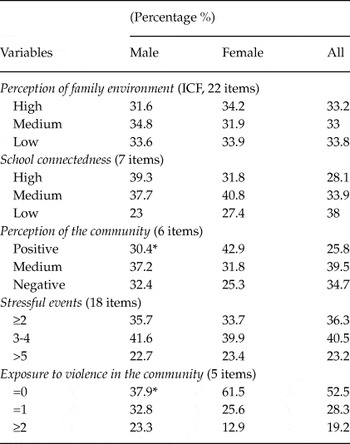
Table 1 shows the percentage of responses related to each contextual variable according to gender and for all participants. Regarding the contextual variables of protection, 33.2% of adolescents had high scores on the ICF, demonstrating a positive perception of family relationships. High school connectedness and positive perception of the community were shown by a smaller proportion of adolescents, with percentages of 28.1% and 25.8%, respectively. As for the contextual variables of risk, about 23.2% of adolescents reported having experienced five or more stressful events and 19.2% experienced two or more than five types of violence in the community. Perception of the community and exposure to violence in the community were associated with male sex (p < .001).
Descriptive Analysis of Contextual Variables by Gender

Note:
Family Climate Inventory (FCI). N ranged from 610 to 685 due to missing values. Maximum N = 266 boys and 419 girls.
* Differences by gender, p < .001
As for indicators of adjustment, 53.6% of adolescents (50.2% boys, 55.7% girls) had a score below the median (< 43) in self-esteem. Approximately 20% of the sample (33.7% boys, 10.7% girls) was involved in one or more illegal activities, and this behavior was associated with males (p < .001). About 20.1% of the sample consumed alcohol in the past month (23.7% boys, 17.9% girls).
With regard to age, the analysis showed that the presence of 3–4 and 5 or more stressful events was associated with the age group 12–14 years (p < .05). Additionally, the age group 15–16 years was associated with the presence of two or more types of violence in the community (p < .001). Alcohol consumption in the past month was associated with the age groups 15–16 and 17–18 years (p < .001).
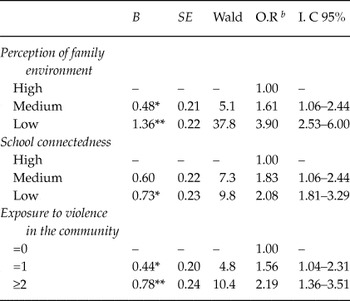
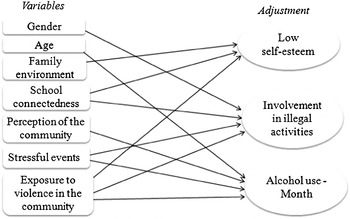
In the logistic regression analyses, those variables that showed bivariate association with each indicator of psychosocial adjustment (criterion variables) with significance levels of p < .001, p < .01, and p < .05 were tested as independent variables. The logistic model for low self-esteem (Table 2) included the perception of family environment, school connectedness, and exposure to violence in the community. Low score on the ICF showed the highest association. The model explained 17% of the total variability (Nagelkerke R 2 = .17).
Logistic Regression for Low Self-esteem a

Note:
a Hosmer–Lemeshow goodness of fit p =.12, -2 LL 753.527, Nagelkerke R2 =.17
* p < .05, **p < .001
b Odds Ratio = Exp(B)
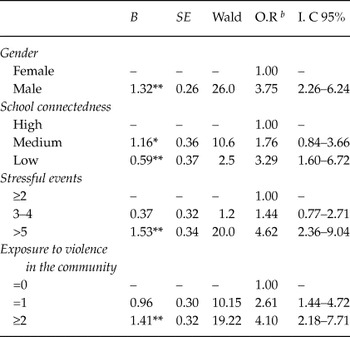
The final model for illegal activities (Table 3) included the variables gender, school connectedness, exposure to five or more stressful events, and exposure to violence in the community. We found that exposure to only one type of violence in the community doubled the adolescents’ chances of engaging in illegal activities, and these chances reached 4.10 when the adolescent experienced two or more types of violence. The model explained 31% of the variability of the responses for involvement in illegal activities (Nagelkerke R 2 = .31).
Logistic Regression for Illegal Activities a

Note:
a Hosmer–Lemeshow goodness of fit p=.68, −2 LL 422.588, Nagelkerke R2 =.31
* p < .05, ** p < .001
b Odds Ratio = Exp(B)
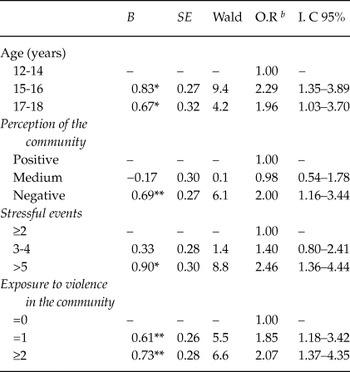
With regard to alcohol use in the past month (Table 4), the variables included in the final model were age (mainly the age group 15–16 years), negative perception of the community, exposure to five or more stressful events, and exposure two or more types of violence in the community. These variables increased the adolescents’ chances of consuming alcohol in the past month. The model explained 12% of the variability (Nagelkerke R 2 = .12).
Logistic Regression for Alcohol Use in the Past Month a

Note:
a Hosmer–Lemeshow goodness of fit p=.30, −2 LL=520.820, Nagelkerke R2 =.12
* p < .05; ** p < .001
b Odds Ratio= Exp(B)
Figure 1 presents a summary of the results observed in the logistic models, showing different association patterns between the variables. We found that the contextual variable of risk “exposure to violence in the community” was the only one associated with three indicators of adjustment.
Summary of results obtained in logistic regression models for self-esteem, involvement in illegal activities and alcohol use in the past month.

Discussion
Many studies have investigated the influence of multiple contexts on adolescent psychosocial development. Evidence indicates that the perception of family, school, and community environment and the relations established within these contexts may serve as protective or risk factor for adjustment (Loukas et al., Reference Loukas, Ripperger-Suhler and Horton2009; Mayberry et al., Reference Mayberry, Espelage and Koenig2009; Prelow et al., Reference Prelow, Bowman and Weaver2007; Raffaelli et al., Reference Raffaelli, Koller, Cerqueira-Santos and Morais2007; Youngblade et al., Reference Youngblade, Theokas, Schulenberg, Curry, Huang and Novak2007). Descriptive analysis of present study revealed that only a small proportion of adolescents had high scores on the instruments that measured their perception of family environment, school connectedness, and perception of the community. This suggests that these environments may not be functioning as protective factors, which tends to increase adolescents’ vulnerability to risk. Another risk factor found was higher vulnerability to experiencing stressful events in early adolescence, which is in disagreement with other Brazilian studies that showed a positive correlation between stressful events and age (Kristensen, Leon, D’Incao,& Dell’Aglio, 2004; Wathier & Dell’Aglio, Reference Wathier and Dell’Aglio2007).
The objective of this study was to investigate simultaneous associations of contextual variables of risk (stressful events and exposure to violence in the community) and contextual variables of protection (family environment, school connectedness, and perception of the community), as well as gender and age with self-esteem, involvement in activities illegal, and alcohol use in the past month among adolescents. The results showed that each indicator of adjustment was associated with specific variables. The variables related to family, school, and community were associated with adolescents’ self-esteem and confirmed the first hypothesis of the study. More specifically, the association between low self-esteem and negative perception of family environment–(characterized by lower levels of cohesion, support, hierarchy, and conflict) and low school connectedness (characterized by weak socio-emotional ties with teachers, coaches, and classmates) confirms international evidence that the relationships established within these environments can influence what adolescents think of themselves (Dennis et al., Reference Dennis, Basañez and Farahmand2010; Musito et al., Reference Musitu, Jiménez and Murgui2007). Additionally, this study suggests that self-esteem may be influenced by exposure to violence in the community, which was also found in studies with U.S. adolescents (Bámaca, Umaña-Taylor, Shin, & Alfaro, Reference Bámaca, Umaña-Taylor, Shin and Alfaro2005; Behnke, Plunkett, Sands, & Bámaca-Colbert, Reference Behnke, Plunkett, Sands and Bámaca-Colbert2011; Youngblade et al., Reference Youngblade, Theokas, Schulenberg, Curry, Huang and Novak2007).
Contrary to the second and third hypotheses of our study, the logistic models regarding involvement in illegal activities and alcohol use in the past month did not include variables related to the three contexts investigated. In the model for alcohol use, school connectedness did not contribute significantly, which is in disagreement with results of U.S. studies (Henry et al., Reference Henry, Stanley, Edwards, Harkabus and Chapin2009; Mayberry et al., Reference Mayberry, Espelage and Koenig2009). In addition, both illegal activities and alcohol use were not associated with the adolescents’ perception of family environment. Nevertheless, it is not possible to exclude the influence of the family on these behaviors, since the instrument used to assess stressful events also included events related to family context. Thus, although the perception of positive aspects related family relationships did not contribute to explain involvement in illegal activities and alcohol use/month, stressful family situations were associated with these variables.
The model for illegal activities included the male sex, reinforcing the existing data demonstrating that illegal acts are predominantly practiced by male adolescents (Gallo & Williams, Reference Gallo, Williams and de2008). Conversely, the association with low school connectedness is in agreement with the results of other studies (Henry et al., Reference Henry, Stanley, Edwards, Harkabus and Chapin2009; Ozer, Reference Ozer2005), suggesting that the educational environment is an important protective factor against behavioral problems. School is considered one of the most influential socialization environments in adolescents’ life (Catalano, Haggerty, Oesterle, Fleming, & Hawkins, Reference Catalano, Haggerty, Oesterle, Fleming and Hawkins2004; Lisboa & Koller, Reference Lisboa, Koller, Boruchovitch and Bzuneck2004). In this sense, it is essential that adolescents feel comfortable at school, establish emotional bonds with teachers and classmates who have pro-social attitudes, including pro-social attitudes towards school, and social support behaviors (Dessen & Poland, Reference Dessen and Polonia2007; Lisboa & Koller, Reference Lisboa, Koller, Boruchovitch and Bzuneck2004). In addition, the higher association of involvement in illegal activities with stressful events and exposure to violence in the community is in agreement with the conclusions by Stouthamer-Loeber (Domburgh, Loeber, Bezemer, Stallings, & Stouthamer-Loeber, Reference Domburgh, Loeber, Bezemer, Stallings and Stouthamer-Loeber2009) that environmental risks are related to higher levels of illegal acts among young people.
Regarding alcohol use in the past month, first, it is noteworthy that the percentage of consumption in the present study was similar to those observed in population-based studies conducted in other regions of Brazil (Gomes, Alves, & Nascimento, Reference Gomes, de, Alves and Nascimento2010; Strauch, Pinheiro, Silva, & Horta, Reference Strauch, Pinheiro, Silva and Horta2009). In terms of multivariate analysis, the adolescents aged 15–16 years old were more likely to consume alcohol when compared with other age groups. Multiple risk factors (stressful events, exposure to violence in the community, and negative perception of the community environment) increased the chances of consuming alcohol among the adolescents included in this study. Other studies have demonstrated that only the fact of witnessing violence in the community increased the chances of consuming alcohol (Mrug & Windle, Reference Mrug and Windle2009). Conversely, it has also been found that adolescents who used alcohol were more likely to suffer violence in the community (Moreira et al., Reference Moreira, Belmonte, Vieira, Noto, Ferigolo and Barros2008). Therefore, these factors seem to be strongly related, even though it is not possible to determine the direction of this relationship.
Our fourth hypothesis was confirmed, as illegal activities and alcohol use/month were associated with stressful events and violence in the community, and this last variable was significant in the results because it contributed to the understanding of the three indicators of adjustment. Oppositely, perception of the community, which was considered a variable of protection, was only associated with the use of alcohol. It is noteworthy that the construct “perception of the community” has been little investigated in the literature; therefore, there is not much knowledge about its protective factors. In addition, studies addressing this issue have used different approaches, with some of them focusing on the socioeconomic characteristics of the context, other investigating the presence of certain types of violence and prejudice, or even the quality of relations of trust and support among people. Thus, it is difficult to perform knowledge systematization on this issue (Song et al., Reference Song, Reboussin, Foley, Kaltenbach, Wagoner and Wolfson2009). Researchers (Behnke et al., Reference Behnke, Plunkett, Sands and Bámaca-Colbert2011; Patchin, Huebner, McCluskey, Varano, & Bynum, Reference Patchin, Huebner, McCluskey, Varano and Bynum2006; Song et al., Reference Song, Reboussin, Foley, Kaltenbach, Wagoner and Wolfson2009) have stressed the need to identify community protective factors that differentiate adolescents who engage in illegal acts (Patchin et al., Reference Patchin, Huebner, McCluskey, Varano and Bynum2006) and alcohol consumption (Song et al., Reference Song, Reboussin, Foley, Kaltenbach, Wagoner and Wolfson2009) from those who are not involved in these activities. The present study, similarly to that by Mayberry et al. (Reference Mayberry, Espelage and Koenig2009), suggests that relationships of trust, sense of well-being, and community safety may have an influence on alcohol use. Conversely, these characteristics of the community were not associated with self-esteem; therefore, it is necessary to investigate the mechanisms by which the community has a positive influence on adolescents’ self-esteem. Recently, a study by Behnke et al. (Reference Behnke, Plunkett, Sands and Bámaca-Colbert2011) suggested that self-esteem was associated with socioeconomic aspects of the community in U.S. adolescents. Further studies are needed to analyze community aspects that constitute important protective factors in youths.
Finally, based on the Bioecological Approach (Bronfenbrenner & Morris, Reference Bronfenbrenner, Morris and Damon1998) and the Positive Psychology (Seligman & Csikszentmihalyi, Reference Seligman and Csikszentmihalyi2000), we believe that the different contexts examined in this study are interdependent, and the adolescents establish activities, roles and, interpersonal relationships within these contexts. Since these environments pose risks, they increase adolescents’ vulnerability to experiencing adverse situations. If adolescents cannot rely on a functional support network based on trust among people when facing difficulties, their vulnerability to risk behaviors is increased. Therefore, the results emphasize the importance of strengthening support and protection networks in adolescence, since the effect of the risk is worse when these networks are poor or insignificant for the individual (Haggerty, Sherrod, Garmezy, & Rutter, Reference Haggerty, Sherrod, Garmezy and Rutter2000). We usually assume that protective factors reduce negative outcomes by means of the interaction with risk factors because of the reduction of their effects or the direct influence on the individual (DeMatteo & Marczyk, Reference DeMatteo, Marczyk, Heilbrun, Goldstein and Redding2005).
The ecological approach (Bronfenbrenner & Morris, Reference Bronfenbrenner, Morris and Damon1998) facilitated the understanding of psychosocial adjustment in the adolescents studied because the contextual variables showed associations with self-esteem, involvement in illegal activities, and alcohol use. A methodological advance of this study is the fact that it approached multiple contexts using variables of risk and protection. We found that the context showed different patterns of association depending on the psychosocial outcome assessed. In addition, a random sampling method was used, which enabled us to investigate a representative portion of adolescents from public schools in southern Brazil.
This study also has limitations. It is a cross-sectional study and thus causal relationships cannot be inferred. It is also important to note that illegal activities and alcohol use/month cannot be considered as long-term risk actions, since there was not a longitudinal evaluation. Thus, it is possible that these behaviors are part of the process of occasional experiences typical of adolescence.
Furthermore, the relatively small percentage of explained variance of the logistic models, although observed in other studies (Prelow et al., Reference Prelow, Bowman and Weaver2007; Raffaelli et al., Reference Raffaelli, Koller, Cerqueira-Santos and Morais2007), may suggest the need to refine the instruments and/or stress the complexity of the phenomena studied. This is because self-esteem, involvement in illegal activities, and alcohol use are phenomena influenced by a number of factors, some of which were not addressed in the present study. An example would be the group of peers, which is very important for understanding the development of adolescents (Ennett et al., Reference Ennett, Foshee, Bauman, Hussong, Faris, Hipp and Cai2010; Mayberry et al., Reference Mayberry, Espelage and Koenig2009). Another important variable that was not addressed in this study was the participants’ socioeconomic status, because, although they are all adolescents from public schools, it is know that this population is not homogeneous in terms of purchasing power. Socioeconomic class is considered a risk factor for adjustment (Raffaelli et al., Reference Raffaelli, Koller, Cerqueira-Santos and Morais2007) and it must be addressed in future studies.
Despite these limitations, the present study provides evidence about the impact of contextual variables of risk and protection on adolescence. Brazilian researchers need to continue investigating the environments in which adolescents are inserted, in an attempt to identify the effect of the combination of contexts, as well as their mediator or moderator effects on other indicators such as general health and social and academic competence. The use of mixed research methods that are able to provide more dynamic analyses of the development is also advisable. The results of the present study might assist in planning public policies and interventions that enable the social support network to serve as a protective factor for the adolescent population.