1 Introduction
Indirect costs to society from ill health include the production lost while patients undergo treatment or convalesce, reduced productivity at work, and the recruitment and training of replacement personnel. In addition, poor health may entitle an individual to non-wage income – for example, disability benefits (Cai and Kalb, Reference Cai and Kalb2006; Disney et al., Reference Disney, Emmerson and Wakefield2006). Collectively, these are costs that accompany but are not directly related to the treatment. Conversely, indirect benefits of health care include the early return to work of patients, their retention in the workforce when they would have otherwise died, and increased productivity. They are “the production gains to society because more people are well, or alive, and able to return to work” (Torrance, Reference Torrance1986: 2).
Should such indirect costs and benefits be taken into account when health programmes and services compete for limited funding and priorities must be set? The case for including indirect costs and benefits is clear; they can be large compared with direct costs and benefits and can significantly affect the availability of resources in the economy (Riddiough et al., Reference Riddiough, Sisk and Bell1983). However, their inclusion can also have significant distributive effects between patients, which might be seen as unfair. For example, including indirect benefits is likely to advantage high income-earners and disadvantage the poor, the unemployed and the elderly. While there has been ongoing controversy about whether such costs and benefits should be included in evaluations of health services, this has revolved around technical issues such as how indirect costs and benefits are best measured – for example, the ‘human capital approach’ vs the ‘friction cost method’ (Koopmanschap et al., Reference Koopmanschap, Rutten, Ineveld and Roijen1995; van Roijen et al., Reference van Roijen, Koopmanschap, Rutten and van der Maas1995; Johannesson and Karlsson, Reference Johannesson and Karlsson1997; Weinstein et al., Reference Weinstein, Siegel, Garber, Lipscomb, Luce, Manning and Torrance1997; Liljas, Reference Liljas1998). By contrast, little consideration has been given to the indirect benefits generated by those in the non-monetary workforce, even though, in principle, their contribution is no different from those in the monetary economy from a social welfare perspective. More generally, there has been little attention paid to the equity issues associated with the inclusion or exclusion of indirect costs and benefits.
Below, we report the results of a survey of the Australian public regarding the inclusion/exclusion of indirect benefits in the evaluation of services for Medicare, Australia's publicly funded health scheme. The results of a follow-up study, aimed at throwing further light on the results of the initial study, are also reported. The studies were undertaken in the belief that it is important for policy makers to know what the public thinks about these issues. It is not our claim that policy makers should necessarily do what the public wants, but that health policy should be informed by public values and expectations. As such, this paper sits within a broader programme of public consultation on a range of normative problems in health economics, looking at issues such as whether priority should depend on age (Nord et al., Reference Nord, Street, Richardson, Kuhse and Singer1996; Johannesson and Johansson, Reference Johannesson and Johansson1997; Rodríguez and Pinto, Reference Rodríguez and Pinto2000; Tsuchiya et al., Reference Tsuchiya, Dolan and Shaw2003), severity of illness per se (Nord, Reference Nord1993; Ubel et al., Reference Ubel, Loewenstein, Scanlon and Kamlet1996, Reference Ubel, Spranca, DeKay, Hershey and Asch1998), potential to benefit (Nord et al., Reference Nord, Richardson, Street, Kuhse and Singer1995a; Abellan-Perpiñán and Prades, Reference Abellan-Perpiñán and Prades1999; Ubel et al., Reference Ubel, Richardson and Baron2002) or direct treatment costs (Abelson et al., Reference Abelson, Lomas, Eyles, Birch and Veenstra1995; Abellan-Perpiñán and Prades, Reference Abellan-Perpiñán and Prades1999; McKie et al., Reference McKie, Shrimpton, Richardson and Hurworth2009).
Theoretical issues related to the topic are discussed in Section 2. In Section 3, a number of previous empirical studies are identified and discussed. The method and study hypotheses relating to the initial survey are outlined in Section 4 and the results reported in Section 5. The follow-up study is outlined in Section 6 and the results reported in Section 7. In Section 8, the implications of the results are discussed. Section 9 outlines some limitations of the study, and Section 10 constitutes a summing-up.
2 Background
It is not uncommon for economists to advocate a ‘societal perspective’ for economic evaluation studies, which implies that all (incremental) costs and benefits should be taken into account, not only those relevant to the health sector or health-care budget (Johannesson, Reference Johannesson1995; van Roijen et al., Reference van Roijen, Koopmanschap, Rutten and van der Maas1995; Gold et al., Reference Gold, Siegal, Russell and Weinstein1996; Drummond et al., Reference Drummond, O'Brien, Stoddard and Torrance1997; Johannesson and O'Conor, Reference Johannesson and O'Conor1997). This perspective is particularly common in ‘cost-of-illness’ studies, where the focus is on the illness rather than the intervention, and the aim is to estimate the net economic costs to society of the illness. Studies aimed at estimating the economic ‘burden of disease’ also fall into this category (Henke and Behrens, Reference Henke and Behrens1986; Murray and Lopez, Reference Murray and Lopez1996). There are practical problems associated with the societal perspective, particularly gathering the relevant information, but its theoretical advocacy is widespread. Why leave out large costs and benefits associated with health programmes and services just because they are indirect?
However, two shortcomings of this approach should be noted. First, decision makers are not normally interested in all the societal costs and benefits that could be incorporated into economic evaluations, but limit consideration to those that bear fairly directly on health. This is the rationale for ‘extra-welfarism’: the view that health, not welfare more generally (overall happiness or preference satisfaction), is the main (or only) relevant outcome for conducting normative analysis in the health sector (Hurley, Reference Hurley2000: 63). Economists diminish their capacity to support decision makers in allocating limited resources if they deal with costs and benefits in ‘a broad and undifferentiated way’ – that is, if they attempt to include all indirect costs and benefits (Brouwer et al., Reference Brouwer, van Exel, Baltussen and Rutten2006: 342).
Second, as noted above, the inclusion of indirect costs and benefits can have significant distributive effects between patient groups. The inclusion of indirect benefits will favour working people, especially those with high incomes, as the size of production gains is measured by their income. It may also disadvantage the elderly, the young, the chronically ill and permanently disabled – arguably, those whom a national health insurance scheme is designed to protect. By contrast, if resource limitations are managed on the basis of ‘equal access for equal need’, there is no justification for including indirect costs and benefits at all (Mooney, Reference Mooney1991; Olsen and Rogers, Reference Olsen and Rogers1991). High taxpayers and low taxpayers will be treated equally if the decision rule is ‘equal access for equal (health) need’. In this respect, it is not uncommon for national guidelines for the evaluation of pharmaceuticals to discount or exclude indirect costs and benefits, or to set the level of evidence required to demonstrate their existence at a level that effectively precludes their inclusion (Commonwealth of Australia, 1995; NICE, 2004; Vuorenkoski et al., Reference Vuorenkoski, Toiviainen and Hemminki2008).
The main argument for taking account of non-pecuniary indirect costs and benefits in evaluation studies is similar to the arguments above. Non-pecuniary costs and benefits still contribute to social welfare and should be taken into account when priorities are set, along with all other sources of utility. But here too it may turn out that the inclusion of some costs and benefits would be widely considered unfair. For example, it is unclear whether an informed public would wish to pay for and include in their universal health scheme the social benefits arising from caring for children or elderly parents by former patients, if this means that others will be a lower priority.
3 Previous studies
The empirical work on social attitudes towards the inclusion of indirect costs and benefits in prioritising health services is quite limited. In an early study, Charny et al. (Reference Charny, Lewis and Farrow1989) conducted a general population survey in Wales, which indicated a preference for treating an employed person over an unemployed person, for a teacher over a lorry driver, but also for an unskilled worker above a director. This provides ambiguous evidence of societal support for indirect benefits, since it is not clear what factors influenced subjects’ choices, particularly as occupation may be valued in terms of social contribution or for other reasons (Katz, Reference Katz1970: 676–677; Tancredi, Reference Tancredi1982: 98).
In a US study, Skitka and Tetlock asked subjects to rate a number of allocation procedures on an ‘appropriateness scale’ ranging from ‘extremely inappropriate’ to ‘extremely appropriate’ (Skitka and Tetlock, Reference Skitka and Tetlock1992: 509). Subjects rated need as the most appropriate way of setting priorities. The two criteria rated lowest were merit (i.e. ‘priority should be based on the contributions people have made to society’) followed by market-based allocation (‘priority should be given to the highest bidder’). It is not clear what interpretation of ‘appropriate’ and ‘inappropriate’ respondents had in mind in answering these questions, nor to what aspects of health practices they were applying the terms. But the low rating given to merit, and high rating given to need, again casts doubt on public support for the inclusion of indirect benefits.
In Australia, Nord et al. (Reference Nord, Richardson, Street, Kuhse and Singer1995b) asked a random sample of the public whether working people and non-working people should have equal priority when they have the same illness or whether people in the workforce should have some priority over non-working people in order to limit possible economic losses to the country. The results showed that 87% of respondents rejected participation in the workforce as an important criterion for assigning priority. Follow-up interviews in stage 2 confirmed these findings with a slight increase in the percentage rejecting workforce participation as a criterion for assigning priority.
Taking a different approach, Neuberger et al. questioned the general public, family doctors and gastroenterologists in the United Kingdom about which factors should be used to select patients for liver transplantation (Neuberger et al., Reference Neuberger, Adams, Macmaster, Maidment and Speed1998). Of the gastroenterologists, 77% included work status (‘those who are likely to return to paid work or caring for family after transplant’) among their chosen criteria. Of the family doctors, 57% chose work status, but only 44% of the general public chose this criterion. ‘Value to society’ was selected by 31% of family doctors and gastroenterologists, and only 21% of the general public chose this criterion. This suggests that the general public attaches less significance to indirect benefits than the medical profession.
Finally, in a British study Dolan et al. (Reference Dolan, Cookson and Ferguson1999) found that 97% of respondents thought the unemployed should have the same priority for treatment as the employed and 95% would give the same priority to those who ‘contributed a lot’ and to those who did not. Discussion and deliberation had no effect on the first response and a negligible effect on the second.
Overall, these results give some indication of public aversion to including indirect benefits in the evaluation of health services, and a rejection of employment status, income, type of work, contribution to society, and so on, as appropriate criteria for setting priorities. The two surveys reported below attempted to look more closely at why the general public in Australia rejects the inclusion of indirect benefits, and aimed to ensure that participants were fully aware of the implications of their choices, on the assumption that only when motivations and reasonings are clear is it possible to attach appropriate weight to them.
4 The initial survey
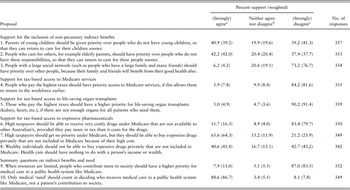
The questions in the initial survey aimed to elicit the public's views about the fairness of taking indirect benefits into account in setting priorities in Medicare. Most questions asked respondents to compare two groups of patients. In such cases, they were asked to assume that the patients are alike in all respects apart from those mentioned, in particular that they would gain as much from treatment. They were also asked to assume that resources are limited and that some groups must be given priority. The questions are reproduced in Table 1.
Initial survey questions

aResponded with 1 or 2 on the five-point scale.
bResponded with 3 on the five-point scale.
cResponded with 4 or 5 on the five-point scale.
Several questions focused on taxes because they are of general benefit and are more likely to influence people positively than indirect benefits that primarily accrue to the patients who generate the benefits. Our aim was to ensure that the aversion to including indirect benefits observed in previous studies was not the result of ignoring the social benefits of giving high taxpayers priority. For this reason, we refer to ‘high taxpayers’ in the questions rather than ‘high income-earners’.
One hundred questionnaires were used for pre-testing and another 1500 sent to households in eight suburbs in Melbourne, Australia, purposely chosen to represent five different socio-economic areas (or ‘SEIFA’ groups – Socio-Economic Indicator For Areas). Addresses within suburbs were chosen at random from an electronic version of the Melbourne telephone directory.
5 Results
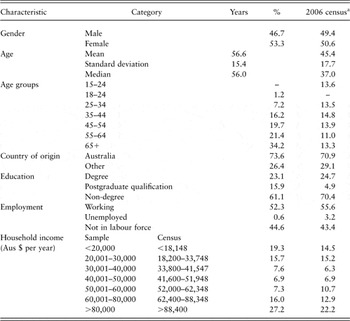
The demographic characteristics of respondents are given in Table 2 along with the most recent Australian Bureau of Statistics (ABS) Housing and Population Census data for each category. The overall response rate was 27.5% (n = 359) after one reminder letter and a replacement copy of the questionnaire were sent.
Respondent characteristics

aAustralian Bureau of Statistics 2006 Housing and Population Census.
A possible criticism of this, and similar survey-based studies, is that respondents may have been atypical of the broader population. We therefore compared a number of key demographic characteristics of our sample with the ABS census data in Table 2. This revealed some differences implying a possible bias in our sample. These were primarily in relation to age and level of education. Results from different age and education groups were therefore weighted to align the importance of each category with the composition of the Australian population (Elliot, Reference Elliot1991). (Partial weighting was applied to avoid extreme values resulting from small overall response numbers in some categories.) In Table 1, both weighted and unweighted data are presented for comparative purposes.
5.1 Non-pecuniary benefits
The first three questions in Table 1 deal with non-pecuniary indirect benefits. Only 6.2% of respondents were in favour of giving priority to patients with a large social network (proposal 3). There was significantly more support for proposals 1 and 2, which dealt with giving priority to parents (40.9%) and carers (42.2%). But this was almost exactly matched by those disagreeing with the proposals. That is, respondents were evenly divided with respect to prioritising the treatment of parents and carers.
5.2 Tax-based priority
Of respondents, 84.2% rejected the suggestion that high taxpayers should have priority access to Medicare services even though “their taxes help to pay for roads, education, and other health services”. There was also strong opposition to the suggestion that high taxpayers should have priority access to life-saving organ transplants. This question was included because it was thought that respondents would have less difficulty in accepting that transplantable organs are in short supply. It also focuses on life-saving treatment rather than Medicare services generally, making the implications of non-treatment very clear and providing a test of internal consistency.
Questions 6, 7 and 8 started with a preamble, which pointed out that all Australians would be better off if those individuals who paid more than $100,000 in tax per year were given high cost medications at a subsidised rate provided the drugs would allow them to return to work (and this would not happen without the drugs), because these individuals would pay more in tax than it would cost to provide them with the drugs. As Table 1 shows, respondents rejected proposal 6: that high taxpayers should have access to pharmaceuticals that are unavailable to other Australians. The response to proposal 7 shows that respondents distinguished between publicly funded and privately funded health care and were more tolerant of inequity based on wealth and income in the private system. Of respondents, 65.6% agreed with the proposal that high taxpayers should be able to buy expensive drugs privately that are not included in Medicare because of their cost. But again, when respondents were reminded that this would link access to income and wealth, 40.6% agreed that “wealthy individuals should not be able to buy expensive drugs privately that are not included in Medicare”. Consistent with other answers, there was a general aversion to taking account of indirect benefits in the case of publicly subsidised pharmaceuticals.
5.3 Summary questions
Responses to the summary questions confirm the previous results. Of those surveyed, 87% (strongly) disagreed that when resources are limited people who contribute more to society should be a higher priority for medical care in a public health system like Medicare (proposal 9). Similarly, 88.6% agreed that only medical ‘need’ should count in deciding who receives medical care, not a patient's contribution to society (proposal 10).
5.4 Demographics
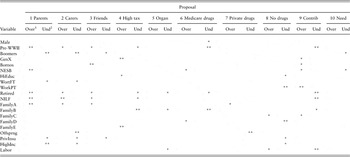
Table 3 shows how responses differed across a range of socio-demographic variables. It can be seen that individuals at different stages of life and from different backgrounds differed in the importance they attached to indirect benefits in different contexts. Regarding proposal 1, for example, being elderly, being from a non-English-speaking background, being retired, being out of the labour force and having adult children, all predict a significantly higher probability of agreeing that parents of young children should be given priority. By contrast, baby boomers, those who work full time, who have private health insurance or have a high income, were significantly less likely to agree. The results show that responses are not the effect of randomly distributed choices, but reflect opposing ways of thinking about these issues, based on stage of life and life experiences. Interestingly, high- and low-income individuals only differed on one question relating to taxation-based indirect benefits: high-income individuals were less inclined to agree that “wealthy individuals should not be able to buy expensive drugs privately that are not included in Medicare”.
Effect of socio-demographic characteristics on choices

Variable explanation: Pre-WWII: born before or during Second World War; Boomers: born between 1946 and 1964; GenX: born after 1964; Bornos: born overseas; NESB: non-English-speaking background; HiEduc: university degree; WorkFT: working full time; WorkPT: working part time; NILF: not in labor force; FamilyA: family composed of all senior adult offspring; FamilyB: family composed of all young adult offspring; FamilyC: family composed of teenage and adult children; FamilyD: family composed of all teenage children; FamilyE: family composed of all young children; Offsrping: have children; PrivInsu: have private health insurance; HighInc: high income (above A$60,000); Labor: labor voter (left wing party).
1 Over = over-represented among those who agreed with the proposal.
2 Und = under-represented among those who agreed with the proposal.
* = significant at the 0.05 level; ** = significant at the 0.01 level.
6 The follow-up study
The above results imply that respondents would reject a policy that could, in principle, increase the availability of medical services. More generally, rejecting such a policy would mean that there is less to spend on education, the environment, public transport and so on. Perhaps respondents failed to fully grasp the concept of an opportunity cost – the potential benefits foregone by not taking account of indirect benefits? To throw light on this, we included follow-up questions on the Monash Health and Social Values Survey. Our intention was two-fold. First, to make even clearer to respondents the opportunity costs of failing to take account of indirect benefits so there could be no serious doubt that they were aware of the implications of their choices. Second, to further investigate respondents’ reasons for downplaying the importance of indirect benefits.
The Monash Health and Social Values Survey was conducted between 2006 and 2007. It was a large questionnaire, administered (to the same sample) in three parts over several months, containing approximately 150 questions. Its aim was to explore the demographic, economic, political and ethical determinants of views regarding health-care rationing in Australia, particularly relating to policy and spending issues. As in the initial survey, names were gathered from a public-domain telephone number database in the state of Victoria with a slight over-sampling of the rural population. The suburbs and towns chosen, however, reflected a balance of socio-economic groups.
Respondents were asked to imagine that a hospital has approached the government to fund two health programmes: programme A and programme B. Each would cost $2 million and would cure 40 patients per year, all of them equally ill. Respondents were asked to assume that the government has agreed to provide half of the requested funding, meaning that only one programme can be funded. They were then asked to consider the following proposal:
If programme A is given only to patients who pay $50,000 per year or more in tax, then programme B can be funded from the tax that is paid by patients in programme A when they return to work ($50,000 × 40 patients = $2,000,000).
Although this example is over-simplified, it presents the underlying principle clearly, and makes explicit, in terms of the numbers treated, the opportunity costs of failing to take account of indirect benefits. It was explained that implementing this suggestion would result in both programmes being funded and 80 patients could be treated each year instead of 40. However, it would also mean that programme A would only be available to high taxpayers. “Programme A would not be offered to the long-term unemployed, the elderly, the very young, or those performing home duties”.
Respondents were then asked the three questions below, to which they could answer ‘yes’, ‘no’ or ‘unsure’. After the first question, they were again reminded of the implications of their answer in terms of how many patients would receive treatment:
Q1. If you could be ABSOLUTELY CERTAIN that the taxes gained from programme A would be used to PAY FOR PROGRAMME B, would you support the suggestion?
Q2. If you could be ABSOLUTELY CERTAIN that the taxes would increase the government's HEALTH BUDGET, but would not necessarily be used specifically to pay for programme B, would you support the suggestion?
Q3. If the taxes would only contribute to GENERAL TAX REVENUE, but would not necessarily be specifically used to pay for programme B, or for health care, would you support the suggestion?
7 Results
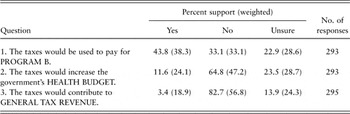
In total, 455 completed questionnaires were received. The three questions concerning indirect benefits were included on around three-fifths of these, and hence the results in Table 4 are generalised from a sample of 304. The response rate was around 15%, reflecting the size of the task required of respondents. Further background information on the Monash Health and Social Values Survey can be found in the American Journal of Economics and Sociology (Anderson et al., Reference Anderson, Richardson, McKie, Iezzi and Khan2011).
The follow-up study questions

It can be seen from Table 4 that when the opportunity costs of not taking account of indirect benefits were made very clear, 43.8% of respondents said they would support offering programme A exclusively to high taxpayers if they could be certain the extra revenue would be used for programme B (Q1). This represents a significant increase in support for indirect (monetary) benefits compared with the initial survey. However, such support fell to 11.8% when the taxes would increase the government's health budget (Q2), and to 3.4% when it would contribute to general tax revenue (Q3). These figures roughly match the minimal degree of support for indirect benefits in the initial survey. Even though there was an increase in support for indirect benefits when the tax receipts would be used to fund a specific programme, 33.1% of respondents still rejected limiting access to programme A and a further 22.9% were unsure.
8 Discussion
8.1 Efficiency and equity
In the initial survey, and to a lesser extent in the follow-up, respondents rejected taking account of indirect pecuniary benefits in setting priorities. It is possible to adopt a hard-line approach to this and argue that governments should take no notice of public preferences that are based on a lack of appreciation of what is in the public's best interests. Indirect costs and benefits must be included in an economic analysis if the net resource costs of a programme or service are to be minimised. Prima facie society is better off if a health gain is obtained with the minimum loss of resources. That is, direct costs less indirect benefits should be minimised whether or not the public realises it.
It must be kept in mind, however, that the achievement of efficiency is but one objective of most national health schemes. Another main objective is equity, and indirect benefits are tightly linked to particular economic characteristics of patients in almost exactly the way a universal health insurance scheme seeks to offset. As noted, their inclusion in the prioritisation formula would disadvantage the elderly, those with permanent disabilities and chronic illnesses, the unemployed, the working poor and other groups. These distributional consequences can be overcome, or diminished, by excluding indirect benefits. Even in the follow-up study, when the opportunity costs of failing to take account of indirect benefits were made very clear, never more than 43.8% of respondents supported their inclusion. It is tempting to speculate that respondents distinguished between the goodness of a person and their usefulness – between their moral and their social worth – and based their assessments at least partly on the (equal) moral worth of persons despite their (differing) social worth (Harris, Reference Harris1985; Nord, Reference Nord1999; Lippert-Rasmussen and Lauridsen, Reference Lippert-Rasmussen and Lauridsen2010). Be that as it may, it would be unwise to reject the results because they conflict with principles of economic efficiency, given that economic efficiency is but one objective of most national health schemes.
8.2 Explaining the differences between the two surveys
There are two possible explanations for the difference in the level of support observed in the two surveys – more precisely, in the difference between the first question in the follow-up study and the other questions in both surveys. First, respondents may have held a particular view about their public health system: namely, that the objective of Medicare is the maximisation of health rather than welfare generally (subject to budget and ethical constraints). That is, they may have rejected the following sort of view:
… why should we require that savings from bedside rationing must go to purchase other health care services? When physicians ration at the bedside, they should be thinking about patients’ interests in the broadest sense…. When physicians withhold marginally beneficial services they free up money that could reduce government debt, increase insurance company revenues, or fatten patients’ wallets (Ubel, Reference Ubel2000: 146).
By contrast, respondents may have held ‘extra-welfarist’ views. Extra-welfarism “replaces utility [patients’ interests in the broadest sense] with health as the primary outcome of interest for evaluation” (Hurley, Reference Hurley1998: 375), or at least sees it as an independently important objective (Culyer, Reference Culyer1989, Reference Culyer1990; Wagstaff, Reference Wagstaff1991). For example, in the initial study, it was stated that high taxpayers ‘help to pay for roads, education, and other health services’. Respondents with ‘extra-welfarist’ leanings may have thought that improving roads and education (or ‘reducing government debt, increasing insurance company revenues’, etc.) are irrelevant to prioritising health programmes.
However, this can only be considered a partial explanation since it does not explain the low level of support for indirect benefits when the extra taxes would increase the health budget (Q2). If respondents were in favour of tax benefits generated from priority setting decisions being spent on further health care, then they should have been in favour of the extra tax revenue ‘increasing the government's health budget’.
Alternatively therefore, while not rejecting the use of Medicare to achieve other (non-health related) social goals, respondents may have been sceptical that the tax generated by including indirect benefits would be used for a beneficial purpose if it was not pre-committed to an identifiable programme. This would explain the decline in support for both the general tax revenue option and the health budget option in the follow-up study. Responses to the questions on non-pecuniary indirect benefits offer some support for this. In the initial survey, respondents were evenly divided on giving priority to parents of young children and carers of elderly relatives compared with other groups. This suggests that many respondents did not object to the use of Medicare to achieve non-health-related goals. However, directing public funds to parents of young children and carers of elderly relatives serves the objective of helping those in identifiable need, by contrast with the undefined and diffuse economic benefits associated with greater tax revenues. That is, respondents may have been reluctant to support the inclusion of indirect benefits unless the benefits were earmarked for a specific purpose with clearly defined social benefits, a phenomenon also observed in the ‘rule of rescue’ (Hadorn, Reference Hadorn1996; Jenni and Loewenstein, Reference Jenni and Loewenstein1997; McKie and Richardson, Reference McKie and Richardson2003).
Most likely, both of the above explanations played some role in respondents’ choices: a desire to have the health budget focused on health, and an independent preference for specific programmes with identifiable outcomes.
8.3 Health sector implications
It might be argued that if indirect benefits are ignored, then the macro benefits of health care and the implied optimal size of the health sector might be significantly underestimated. This concern may suggest the need to impute an average level of productivity to additional days or years in the workforce or, to avoid age discrimination, to impute the same productivity to all additional labour or leisure time, including retirement. It would be relatively easy to implement the latter proposal, as a single study would provide the appropriate ‘productivity loading’ to be included in all studies.
However, this solution is ad hoc and, at least in the short run, is not needed. Health budgets are not presently determined by the summation of the costs of services where benefits exceed costs. Indeed, there is no reported monetary value of a QALY (quality-adjusted life year) agreed in any country, and economic evaluation is usually concerned with ranking services. This implies that the principal effect of the inclusion of indirect benefits would be the adoption of a lower cost-to-QALY threshold and a reordering of the services included in a universal health insurance scheme with the macro-budget determined, as at present, by relatively unrelated historical and institutional factors, and by the performance of the economy. Our results suggest that this new priority order would conflict with important social values in Australia and, we suspect, in other countries.
9 Study limitations
9.1 Response rates
The response rate of 27.5% per cent for the main survey is fairly typical of ‘cold call’ postal surveys of this kind. At 15%, the response rate of the follow-up is on the low side. Both figures are deceptive, however, since they make no allowance for ‘legitimate’ refusals on the basis of old age, illness, difficulty with English and so on. Similar studies conducted at the Centre for Health Economics, which have taken such factors into account, have achieved an ‘adjusted’ response rate of 40–45% (Richardson et al., Reference Richardson, Peacock, Iezzi, Day and Hawthorne2007: 10). In the health and epidemiological literature, very high response rates are deemed essential, but this relates, firstly, to the peculiar nature of these data (they do, generally, differ from social science data), and, secondly, because of the prevalence of low sample sizes (an unavoidable characteristic of some low-incidence health studies). These concerns are less pressing with social science surveys (Siemiatycki and Campbell, Reference Siemiatycki and Campbell1984; Keeter et al., Reference Keeter, Miller, Kohut, Groves and Presser2000; Evans and Kelly, Reference Evans and Kelly2002). Nevertheless, it remains a possibility that those who did not respond to our surveys held different views from those who did regarding the questions asked. For this reason, the surveys described here should be thought of as preliminary studies. Other studies may confirm or disconfirm the findings.
9.2 Response weighting
It can be seen from Table 1 that ‘weighting’ the responses to minimise discrepancies between our sample and the Australian population profile, particularly with respect to age and education (where the differences were greatest), affects the results only negligibly. In neither the main survey nor the follow-up is the direction of the preferences changed by the weighting. This allows for some confidence that over/under sampling in the age and education demographic categories is not skewing the results. Nevertheless, as mentioned above, our respondents may have been unrepresentative, and for this reason even the weighted responses must be treated with caution.
9.3 Taxation
Caution must be exercised in implying preferences for social benefit when these preferences are elicited by a taxation payment vehicle. The problem is that many individuals may have an aversion to taxation for ideological or other reasons, and responses may be influenced by this general aversion rather than underlying preference for the benefit. However, in the present study, taxation was not used as a means of valuing an independent benefit – for example, a more reliable train service or cleaner air. In fact, if a respondent did have an aversion to taxation for ideological reasons – for example, if they thought it was wrong for privilege in society to be based on tax contribution – and this lead them to reject giving preference in the health-care context to high taxpayers, this would be understandable and quite consistent. In brief, there is a difference between using taxation as a vehicle for eliciting people's preferences about public transport or clean air – where taxation per se is incidental – and asking them whether high taxpayers themselves should get priority access to services in a taxpayer-funded health system. The present study did not use taxation; it asked people about the taxation system – in particular, whether high taxpayers should get priority access to health services.
10 Conclusion
Official government guidelines and reports of government-appointed commissions (Dutch Committee on Choices in Health Care, 1992; Campbell and Gillett, Reference Campbell and Gillett1993; Swedish Health Care and Medical Priorities Commission, 1993) attest that one of the most important reasons for creating a national health service is to ensure the achievement of fairness-related objectives in the health sector. For this reason, health economists have generally recognised the importance of fairness, and there is a growing literature on the distribution of health costs and benefits and various theories of social justice. The inclusion of indirect benefits in the economic evaluation of health services, in particular, can have potentially significant distributive effects between patients, disadvantaging a number of vulnerable groups, including the elderly, the disabled and the long-term unemployed. Reflecting this, there was little support in the initial survey for including indirect benefits in the priority setting formula.
Opposition to including indirect benefits lessened in the follow-up study, but only when the consequences of doing so were guaranteed and linked to identifiable health outcomes. When, for example, the extra tax receipts would increase the government's health budget or contribute to general tax revenue, support slipped back to the low levels observed in the initial survey. This probably reflects both a degree of mistrust in government and/or bureaucratic management of the health budget, and a focus on health as the appropriate ‘efficiency’ objective in the health sector. In general, the surveys reveal a willingness to sacrifice health benefits to secure equity goals within the public health sector, even when the opportunity costs of doing so are made very clear. The rejection of non-pecuniary indirect benefits was less decisive, no doubt because their inclusion would advantage identifiable, ‘altruistic’ groups: parents of young children and carers of elderly relatives.
The objection is often heard that “investment decisions about health service priorities are being made by health authorities without knowledge of what the people for whom they are making these decisions are thinking” (Bowie et al., Reference Bowie, Richardson and Sykes1995: 1155). This is primarily due to the lack of data on societal preferences, and the acceptable trade-offs between social goals. We hope that the findings of the present study contribute to a better understanding of health-care ‘consumers’ in Australia (which we suspect are not unique to Australia), and the values they would like to see reflected in their public health service.
Acknowledgements
This work was supported by a grant from the Australian Research Council (Grant No. DP0345542). The authors gratefully acknowledge the support of the council. Our thanks also to Malcolm Anderson and Munir Khan for help with the data analysis, and to Angelo Iezzi for survey management.