INTRODUCTION
Global forest destruction has accelerated in the last few decades particularly in the tropics where between 25% and 50% of the forest have been converted to other land-uses (Lewis Reference LEWIS2006, Pimm & Raven Reference PIMM and RAVEN2000). While many studies have addressed the impact of clear-cutting and fragmentation on biodiversity and ecological processes (Lewis Reference LEWIS2006, Turner Reference TURNER1996), local forms of forest disturbance such as selective logging have been investigated less intensively but can have complex effects on forest ecosystems (Lewis Reference LEWIS2006). Even if only 3–10% of trees in a selectively logged forest are removed, around 50% of the trees are damaged as a result of falling trees bringing down neighbouring trees (Struhsaker Reference STRUHSAKER1997). This damage leads to reduction in canopy cover and creation of large gaps, changing tree distributions (Struhsaker Reference STRUHSAKER1997). Furthermore, large gaps promote the survival of early-successional species and reduce the number of late-successional species (Laurance et al. Reference LAURANCE, FERREIRA, RANKIN-DE MERONA, LAURANCE, HUTCHINGS and LOVEJOY1998).
In the long term, species persistence in selectively logged areas depends on the availability of seeds, seedlings and saplings (Martînez-Ramos & Soto-Castro Reference MARTÎNEZ-RAMOS and SOTO-CASTRO1993). Seedling communities of long-lived tree species may therefore indicate the regeneration potential of forests. Logging of forests has been demonstrated to affect seedling diversity and abundance through reduced availability of seeds (Makana & Thomas Reference MAKANA and THOMAS2004, Plumptre Reference PLUMPTRE1996), increased seedling predation (Struhsaker Reference STRUHSAKER1997), decreased survival and growth of seedlings (Ramirez-Marcial Reference RAMIREZ-MARCIAL2003) and reduced overall sapling recruitment (Terborgh et al. Reference TERBORGH, NUNEZ-ITURRI, PITMAN, VALVERDE, ALVAREZ, SWAMY, PRINGLE and PAINE2008). Elevated hunting of mammals in forests has been shown to affect the seedling composition (Peres & van Roosmalen Reference PERES, VAN ROOSMALEN, Levey, Silva and Galetti2002, Terborgh et al. Reference TERBORGH, NUNEZ-ITURRI, PITMAN, VALVERDE, ALVAREZ, SWAMY, PRINGLE and PAINE2008). In addition, changes in abiotic conditions such as light, temperature and humidity have an impact on seedling establishment (Ellison et al. Reference ELLISON, DENSLOW, LOISELLE and BRENES1993, Makana & Thomas Reference MAKANA and THOMAS2005). There is evidence that the density and species diversity of seedlings is lower in heavily compared with lightly logged forests (Farwig et al. Reference FARWIG, SAJITA, SCHAAB and BÖHNING-GAESE2008a). These impacts of selective logging on seedling communities, in the long term, probably lead to changes in tree communities (Hurtt & Pacala Reference HURTT and PACALA1995, Terborgh et al. Reference TERBORGH, NUNEZ-ITURRI, PITMAN, VALVERDE, ALVAREZ, SWAMY, PRINGLE and PAINE2008).
Most studies on effects of selective logging on tree communities and long-term patterns of seedling establishment have been carried out within a restricted study area (Chapman & Chapman Reference CHAPMAN and CHAPMAN1997, Farwig et al. Reference FARWIG, SAJITA, SCHAAB and BÖHNING-GAESE2008a, Makana & Thomas Reference MAKANA and THOMAS2005, Terborgh et al. Reference TERBORGH, NUNEZ-ITURRI, PITMAN, VALVERDE, ALVAREZ, SWAMY, PRINGLE and PAINE2008). Yet, it is vital to understand whether selective logging shows comparable effects on larger spatial scales, i.e. among different forests within a larger region. A study on the impact of differences in logging histories in three East African tropical forests showed reduced numbers of frugivorous birds and diminished seed dispersal of a small-seeded tree in heavily compared with lightly logged sites in each of the three forests (Kirika et al. Reference KIRIKA, FARWIG and BÖHNING-GAESE2008a). Also, the density of seedlings of the focal tree tended to be lower in heavily disturbed compared with lightly logged sites (Kirika et al. Reference KIRIKA, FARWIG and BÖHNING-GAESE2008a). Thus, it is reasonable to hypothesize that selective logging might modify also the seedling community on this regional scale.
In this study, we tested: (1) whether differences in logging histories led to modifications in the tree communities due to selective logging of late-successional species and (2) whether modified tree communities and reduced numbers of frugivorous birds in highly disturbed forest sites led to changes in the composition of the seedling communities due to reduced recruitment of late-successional species. We therefore tested the impact of differences in logging histories on species richness, diversity, abundance and composition of late-successional and early-successional trees and seedlings in three East African tropical forests.
METHODS
Study areas
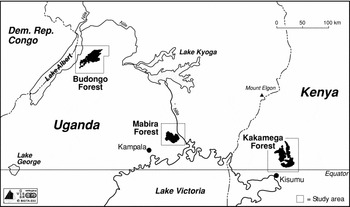
The study was carried out in three East African tropical forests, Budongo Forest and Mabira Forest in Uganda and Kakamega Forest in Kenya (distances: Budongo-Mabira 190 km, Budongo-Kakamega 385 km, Mabira-Kakamega 195 km, Figure 1). The three forests have been subjected to varying levels of past and present anthropogenic disturbances with selective logging having the most prominent impact on forest structure, especially canopy openness (Bleher et al. Reference BLEHER, USTER and BERGSDORF2006). Prior to the investigation, we selected lightly and heavily logged sites within each forest. In addition, Budongo Forest has one site that could be classified as never logged, primary forest that we used as a control site. We used this undisturbed site only for descriptive statistics, but did not include it in the statistical comparison among the three forests to avoid an unbalanced design.
Map of Kenya and Uganda showing the location of Budongo, Mabira and Kakamega Forests. Courtesy of G. Schaab.

Budongo Forest (1°35′N–1°55′N, 31°8′E–31°42′E, 1100 m asl, 428 km2 of forest cover) is the most western of the three forests and closest to the Congo–Guinean rain-forest belt (Figure 1). Average annual precipitation is about 1410 mm with rainfall mostly between April and May and between August and October. Budongo Forest is described as a medium-altitude, semi-deciduous forest, with a tendency for Cynometra alexandri C. H. Wright to become monodominant (Plumptre Reference PLUMPTRE1996). Selective logging and treatment with arboricides has created a mosaic of forest types of which mixed forest is now the most common type (Plumptre Reference PLUMPTRE1996). The forest has over 260 species of trees (Howard Reference HOWARD1991, Sheil Reference SHEIL1996). The study was carried out in compartment N3 (logged in 1947–1952), a lightly logged site, and W22 (logged in 1963–1964 and again in 1996–1997), a heavily logged site. In addition we sampled trees and seedlings in N15 (never logged), a never logged, primary forest stand. For more details on Budongo Forest see Eggeling (Reference EGGELING1947), Howard (Reference HOWARD1991) and Plumptre (Reference PLUMPTRE1996).
Mabira Forest (0°23′N–0°35′N, 32°50′E–33°7′E, 1150 m asl, about 306 km2 forest cover) is located in Mukono district of central Uganda and lies between Budongo and Kakamega Forest (Figure 1). Annual precipitation is 1640 mm. The vegetation can be broadly classified as medium-altitude, moist semi-deciduous forest (Howard Reference HOWARD1991). Mabira Forest reserve has been subjected to extensive encroachment, pit-sawing, charcoal burning and hunting in the past and present. The forest has 189 tree species (Boffa et al. Reference BOFFA, KINDT, KATUMBA, JOURGET and TURYOMURUGYENDO2008). The study sites in Mabira Forest were identified from land-use maps and geographic information system coverage compiled by the Forest Department. Within the forest we selected lightly logged sites (Buwola area), characterized by relatively undisturbed forest with only localized pit-sawing activity, and heavily logged sites (Najjembe area) located close to settlement areas and characterized by intense selective logging. For more details on Mabira Forest see Howard (Reference HOWARD1991) and Naidoo (Reference NAIDOO2004).
Kakamega Forest (0°10′N–0°21′N, 34°47′E–34°58′E, 1550–1650 m asl) is a mid-altitude tropical forest and is considered to be the easternmost outlier of the Congo–Guinean rain-forest belt (Kokwaro Reference KOKWARO1988) (Figure 1). Kakamega Forest receives an average annual rainfall of 1910 mm. The main forest area covers about 85 km2 of near-natural forest that is surrounded and interspersed by secondary forest, clearings and glades, as well as tea and timber plantations (Lung & Schaab Reference LUNG and SCHAAB2006). Kakamega Forest has over 112 species of trees many of which are of Congolean lowland forest affinities (Althof Reference ALTHOF2005). Areas managed by the Kenya Wildlife Service have low levels of human disturbance, especially of selective logging, whereas those managed by the Kenya Forest Service have high levels of disturbance (Bleher et al. Reference BLEHER, USTER and BERGSDORF2006). We selected study sites under the management of the Kenya Wildlife Service as lightly logged (Buyangu area, northern part of main forest block) and those under the management of the Kenya Forest Service as heavily logged sites (Isecheno area, southern part of main forest block). For more details on Kakamega Forest see Bleher et al. (Reference BLEHER, USTER and BERGSDORF2006) and Kokwaro (Reference KOKWARO1988). The selected little and heavily logged sites within each forest correspond to the ones in Kirika et al. (Reference KIRIKA, FARWIG and BÖHNING-GAESE2008a).
Data collection
We established in Budongo Forest twelve 1-ha plots (six plots in primary forest as control plots, three plots in lightly logged sites and three plots in heavily logged sites, distance range: 0.3–4.7 km) and in each of the two other tropical forests, Mabira and Kakamega Forests, six 1-ha plots (three plots in lightly logged sites and three plots in logged disturbed sites, distance range: 0.4–6.3 km, 0.4–13.5 km, respectively). Note that the 1-ha plots with the same logging histories within a forest are located relatively close to each other (range 0.3–1.6 km) while distance among heavily and lightly logged plots was on average 5 km. Unfortunately, we could not avoid this design due to logistical reasons. The three forests have only very few access roads and we were forced to select sites that were within reasonable walking distance from these roads. Still 300 m as a minimum distance between plots of the same logging histories should be sufficient to treat them as independent replicates (Farwig et al. Reference FARWIG, SAJITA, SCHAAB and BÖHNING-GAESE2008a, Makana & Thomas Reference MAKANA and THOMAS2005).
Censuses of the tree and seedling communities of the three forests were carried out in two sessions from November 2004 to March 2005, and from October 2005 to March 2006 (Budongo: November 2004 to January 2005 and October to November 2005, Mabira: January to February 2005 and February to March 2006, Kakamega: February to March 2005 and December 2005 to January 2006). During each session we sampled tree and seedling communities of six plots in Budongo (three plots in primary forest, and either two in lightly logged and one in a heavily logged sites or vice versa) and three plots in Mabira and Kakamega (two in lightly logged and one in a heavily logged sites or vice versa).
Plots of 100 × 100 m in size were laid out at least 100 m from the forest edge in order to reduce edge effects. Each of the 1-ha plots consisted of five line transects of 100 m length. Within each plot we selected nine point locations with three points placed along the first line transect (at 10, 50 and 90 m), three points along the third line transect and three along the fifth line transect. Additionally, we established ninety 1-m2 subplots following the design by Harms et al. (Reference HARMS, WRIGHT, CALDERÓN, HERNÁNDEZ and HERRE2000). The 1-m2 subplots were established in groups of three with six groups along each line transect (at 0, 20, 40, 60, 80 and 100 m) and placed at a distance of 2 m perpendicularly to the transect.
To quantify logging history we visually estimated canopy openness at each point location by looking vertically through a 5-cm-long tube with a diameter of 5 cm and estimating the percentage of the diameter through which the sky was visible. We then calculated the average over the nine measurements for each plot.
We identified and counted all trees >10 cm diameter at breast height (dbh) on the 1-ha plots by walking along five line transects separated from each other by 20 m, and recording all trees within 10 m to the left and 10 m to the right of the line transect (thereby covering a total area of 1 ha). We defined all woody plants with a dbh >10 cm as trees. Trees were identified using Beentje (Reference BEENTJE1994) and Hamilton (Reference HAMILTON1991). All trees were later classified as late-successional or early-successional depending on the ability to survive in forest shade following Lwanga (Reference LWANGA2003), Sheil et al. (Reference SHEIL, JENNINGS and SAVIL2000) and E. Fischer (pers. comm.).
We quantified the seedling community on the ninety 1-m2 subplots. During mapping wire frames were laid down to demarcate the area. All recently germinated seedlings of tree species were identified to species level and their numbers were counted. We defined as seedlings all plant individuals that had cotyledons and/or first or second sets of true leaves and absence of a woody stem. Species identification was carried out by a local taxonomist (B. Dumbo) from 20 y of experience in identifying tree and seedling species in Kenya, Uganda, Rwanda and Democratic Republic of Congo. Seedlings were classified into the same successional classes as the trees.
Data analysis
We calculated rarefied species richness (Hurlbert Reference HURLBERT1971), species diversity (Simpson index) and total abundance separately for late- and early-successional species per 1-ha plots for trees and over the ninety 1-m2 subplots per hectare for seedlings. We tested the effect of selective logging, distinguishing between lightly and heavily logged sites (fixed effect) and of forest (random effect) on canopy openness, rarefied species richness, species diversity, and abundance of late-and early-successional trees and seedlings. For analysis, canopy openness was arcsine-square-root-transformed and abundance was log (x + 1) transformed. We use the species sampled in the primary forest site in Budongo Forest to evaluate how many of the tree and seedling species in this site were unique to this site and did not occur in lightly or heavily logged forest sites.
We used non-metric multidimensional scaling (NMDS using Bray–Curtis index based on abundance data) and Multi Response Permutation Procedure (MRPP) to assess differences in the tree and seedling composition among the three forests and two disturbance regimes. NMDS produces a two-dimensional graphical representation of the sample units according to the association among species and are not constrained by predictors (McCune & Grace Reference MCCUNE and GRACE2002). MRPP is similar to multivariate analyses of variance without requirement of multivariate normality and homogeneity of variance. MRPP compares the observed within-group average distances with the average distances that would have resulted from all the other possible combinations of the data under the null hypothesis using 999 permutations. A chance-corrected estimate of the proportion of the distances explained by group identity (A) is calculated that is analogous to a coefficient of determination in a linear model. All analyses were done in Program R version 2.9.0 using the package vegan.
RESULTS
Canopy openness
Canopy openness differed significantly between lightly and heavily logged sites but not among the three forests (mixed-effect ANOVA: disturbance: F1,2 = 20.0, P < 0.001; forest: F2,12 = 0.72, P = 0.51; forest × disturbance: F2,12 = 2.07, P = 0.16). Lightly logged sites in the three forests had on average 27.3% canopy openness while heavily logged sites in the three forests had rather open canopies with an average value of 50.0%. Control plots in primary forest sites in Budongo Forest had on average 18.3% canopy openness.
Trees
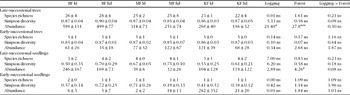
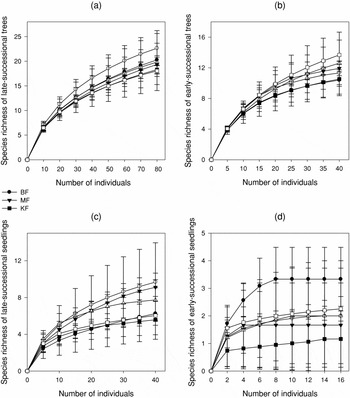
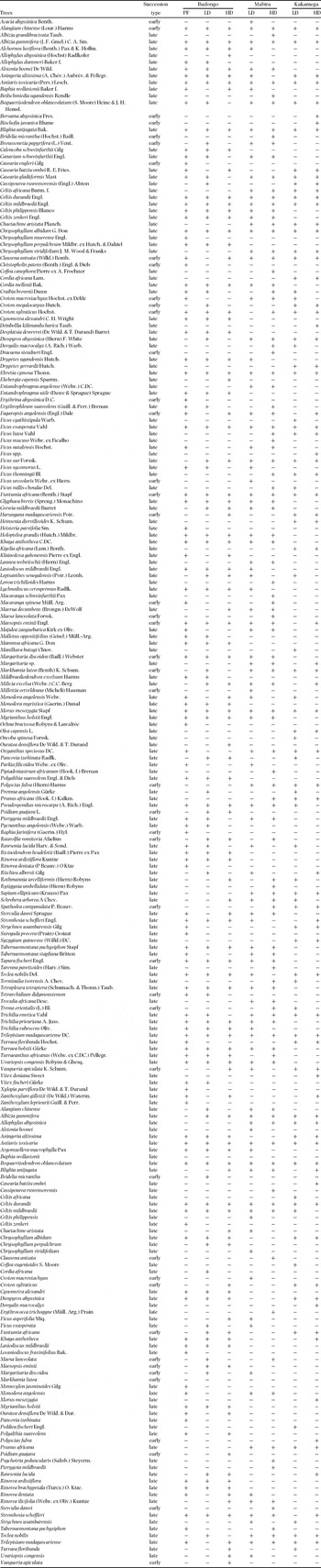
We recorded 160 tree species in the three forests, with 127 classified as late-successional and 33 as early-successional species (Appendix 1). Difference in logging history had no significant effect on late-successional or early-successional tree species richness or diversity (Table 1, Figure 2a, b). Further, species richness and diversity of late- and early-successional trees did not differ among the three forests (Table 1). The number of late-successional individuals was significantly higher in lightly compared with heavily logged sites (Table 1). In contrast, differences in logging history did not affect the number of early-successional tree individuals (Table 1). Budongo Forest had the largest number of late-successional tree individuals (Table 1). The number of late-successional tree individuals was lower in Kakamega Forest and Mabira Forest compared with Budongo Forest (Table 1) whereas the number of early-successional trees did not differ among the three forests (Table 1).
Species richness, Simpson diversity and abundance of late- and early-successional trees (on 1 ha) and seedlings (on 90 m2) in lightly logged (ld) and heavily logged (hd) sites of Budongo (BF), Mabira (MF) and Kakamega Forest (KF) as well as results for differences in logging histories, forest and the interaction term logging × forest from mixed-effect ANOVAs. Shown are untransformed abundance data (mean ± SD) but F-values and their significance refer to transformed data, N = 18; degrees of freedom: logging 1, 2, forest 2, 12, logging × forest 2, 12, ns = not significant, *P < 0.05, ***P < 0.001.

Rarefaction curves (mean ± 1 SD) for late-successional trees (a), early-successional trees (b), late-successional seedlings (c) and early-successional seedlings (d) in Budongo Forest (BF), Mabira Forest (MF) and Kakamega Forest (KF). Closed symbols indicate lightly logged sites and open symbols indicate heavily logged sites.

Seedlings
We recorded seedlings of 68 species in the three forests; of these 55 were late-successional and 13 were early-successional species (Appendix 1). For seedlings neither species richness nor diversity, nor number of individuals of late- or early-successional species were affected by differences in logging histories (Table 1, Figure 2c, d). Further, species richness and diversity of late-and early-successional seedlings did not differ among the three forests (Table 1). However, the number of late-successional individuals was lower in Mabira Forest than in Budongo Forest (Table 1).
NMDS of tree and seedling communities
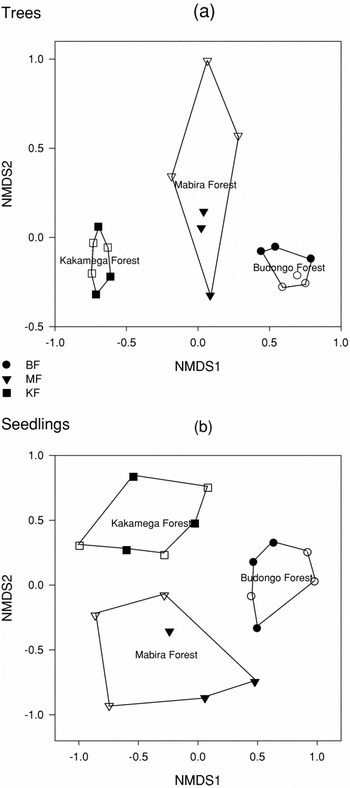
The NMDS enabled us to plot sites and predictors in a two-dimensional species space (Figure 3a, b, convergent solutions found, two dimensions, trees: stress = 10.9, seedlings: stress = 21.5). The MRPP showed significant differences among the forests both for the tree and seedling communities (trees: A = 0.22, P = 0.001, seedlings: A = 0.10, P = 0.001) while tree and seedling communities did not differ between heavily and lightly logged sites (trees: A < 0.01, P = 0.28, seedlings: A < 0.01, P = 0.37). On the right side of the NMDS plot for tree communities are the plots located in Budongo Forest, in the middle the plots located in Mabira Forest and on the left the plots located in Kakamega Forest (Figure 3a). Placement of lightly and heavily logged sites differed among the three forests, being interspersed in Kakamega Forest, and distinctly different along the second NMDS axis in Mabira and Budongo Forest, although the effect was not significant (Figure 3a). The pattern of the NMDS plot for seedlings is not as distinct as for trees (Figure 3a, b). Plots located on the right side of the scaling plot are located in Budongo Forest, plots located towards the lower left are located in Mabira Forest and plots located towards the upper left are located in Kakamega Forest (Figure 3b). Plots of lightly and heavily logged areas are interspersed (Figure 3b).
NMDS biplot ordination for tree (a) and seedling (b) communities of Budongo Forest (BF), Mabira Forest (MF) and Kakamega Forest (KF). Closed symbols indicate lightly logged sites and open symbols indicate heavily logged sites. Solid lines connect sites by forest.

DISCUSSION
Our results show significant differences in canopy openness between lightly and heavily disturbed sites that are similar among the three forests. Heavy logging significantly reduced the abundance of late-successional tree species. However, tree species richness or diversity was not affected by differences in logging histories concurring with a previous study conducted in Kakamega Forest (Farwig et al. Reference FARWIG, SAJITA, SCHAAB and BÖHNING-GAESE2008a). This could be explained by quick colonization of canopy openings through early-successional species in the course of forest succession (Kariuki & Kooyman Reference KARIUKI and KOOYMAN2005) maintaining an overall high tree species richness. The number of late-successional individuals was lower in heavily than in lightly logged sites, probably because specific trees had been selectively logged (Baranga Reference BARANGA2007, Bleher et al. Reference BLEHER, USTER and BERGSDORF2006, Laurance et al. Reference LAURANCE, NASCIMENTO, LAURANCE, ANDRADE, FEARNSIDE, RIBEIRO and CAPRETZ2006, Plumptre Reference PLUMPTRE1996, J. M. K. pers. observation). Other explanations for changes in the density of tree species may be higher mortality of certain tree species, microclimatic changes or increased hunting (Laurance et al. Reference LAURANCE, OLIVEIRA, LAURANCE, CONDIT, NASCIMENTO, SANCHEZ-THORIN, LOVEJOY, ANDRADE, D'ANGELO, RIBEIRO and DICK2004, Reference LAURANCE, NASCIMENTO, LAURANCE, ANDRADE, FEARNSIDE, RIBEIRO and CAPRETZ2006; Nascimento et al. Reference NASCIMENTO, ANDRADE, CAMARGO, LAURANCE, LAURANCE and RIBEIRO2006, Terborgh et al. Reference TERBORGH, NUNEZ-ITURRI, PITMAN, VALVERDE, ALVAREZ, SWAMY, PRINGLE and PAINE2008). For instance, several studies have shown that reduced numbers of large-vertebrate seed dispersers resulted in shifts in relative abundance of tree species (Peres & van Roosmalen Reference PERES, VAN ROOSMALEN, Levey, Silva and Galetti2002, Terborgh et al. Reference TERBORGH, NUNEZ-ITURRI, PITMAN, VALVERDE, ALVAREZ, SWAMY, PRINGLE and PAINE2008). However, the abundance of animal- and wind-dispersed species did not differ between lightly and heavily logged sites in this study (data not shown). Thus, the most likely explanation for reduced densities of late-successional trees in heavily logged sites seems to be selective logging of these tree individuals.
In contrast to the tree community, seedling species richness, diversity and number of individuals seemed unaffected by differences in logging histories. Similarly, selective logging did not affect diversity and abundance of seedlings of most tree species in central Amazonia (Magnusson et al. Reference MAGNUSSON, DE LIMA, REIS, HIGUCHI and RAMOS1999) and in Kibale Forest, Uganda (Chapman & Chapman Reference CHAPMAN and CHAPMAN1997). It appears that selective logging has fewer negative effects on early seedling establishment than on the adult tree community. One reason for relatively similar seedling establishment in differently logged sites could be that seed production of adult trees is increased in heavily disturbed sites, thus resulting in enhanced seed rain and seedling establishment. Some studies report increased seed production of trees in logged sites (Herrerías-Diego et al. Reference HERRERÍAS-DIEGO, QUESADA, STONER and LOBO2006). However, Celtis durandii did not differ in seed production between heavily and lightly logged areas in the same three forests (Kirika et al. Reference KIRIKA, FARWIG and BÖHNING-GAESE2008a). Relatively increased seedling establishment might also be caused by better seed dispersal by frugivorous birds and mammals in heavily logged versus lightly logged sites. Whereas one study indeed provides support for enhanced fruit removal of Prunus africana in intensively logged sites (Farwig et al. Reference FARWIG, BÖHNING-GAESE and BLEHER2006), fruit removal of Ficus thonningii and of C. durandii is reduced in heavily than in lightly logged forest stands (Kirika et al. Reference KIRIKA, FARWIG and BÖHNING-GAESE2008a, Reference KIRIKA, BLEHER, BÖHNING-GAESE, CHIRA and FARWIG2008b). Such diminished fruit removal rates might be linked to reduced animal diversity and abundance in selectively logged forest due to hunting (Peres & van Roosmalen Reference PERES, VAN ROOSMALEN, Levey, Silva and Galetti2002, Terborgh et al. Reference TERBORGH, NUNEZ-ITURRI, PITMAN, VALVERDE, ALVAREZ, SWAMY, PRINGLE and PAINE2008). For instance, Peres & van Roosmalen (Reference PERES, VAN ROOSMALEN, Levey, Silva and Galetti2002) showed that the abundance of late-successional seedlings could be linked to the abundance of large-vertebrate seed dispersers. Also, Terborgh et al. (Reference TERBORGH, NUNEZ-ITURRI, PITMAN, VALVERDE, ALVAREZ, SWAMY, PRINGLE and PAINE2008) demonstrated that hunting alters tree recruitment with large-seeded species showing depressed recruitment. However, abundance of late- and early-successional seedlings as well as animal- and wind-dispersed species did not differ among lightly and heavily logged sites in our study (data not shown).
Still, comparable numbers of recently germinated seedlings in differently logged forest stands such as found in our study might not necessarily result in abundant forest regeneration. Whereas seedling establishment was not affected by selective logging in Kibale forest, a negative effect of disturbance on sapling densities could be detected (Chapman & Chapman Reference CHAPMAN and CHAPMAN1997). Thus, it is possible that selective logging is impairing recruitment into the sapling stage. We did not sample saplings in our study. However, it might be possible that in our study sites early-successional species out-compete late-successional species in sites where the canopy is more open. In general, forest gaps seem to maintain high density and diversity of early-successional trees and species dispersed by abiotic means (Lawton & Putz Reference LAWTON and PUTZ1988, Terborgh et al. Reference TERBORGH, NUNEZ-ITURRI, PITMAN, VALVERDE, ALVAREZ, SWAMY, PRINGLE and PAINE2008). In contrast, gaps do not appear to promote high species diversity of late-successional, shade-tolerant species (Hubbell et al. Reference HUBBELL, FOSTER and O'BRIEN1999, Schnitzer & Carson Reference SCHNITZER and CARSON2001). Even though we did not reveal negative effects of forest disturbance on seedling densities, there might be cryptic genetic effects. For example, in Prunus africana, the genetic diversity of seedlings declined in heavily logged sites in comparison to that of adult trees (Farwig et al. Reference FARWIG, BRAUN and BÖHNING-GAESE2008b). The most plausible explanation for similar numbers of recently germinated seedlings seems to be the ability of the forest trees to recover their reproductive capacity.
In another study, species richness at the seedling size class was lower in heavily logged than in lightly logged sites comparing only study sites within Kakamega Forest (Farwig et al. Reference FARWIG, SAJITA, SCHAAB and BÖHNING-GAESE2008a). The difference between our results and those of Farwig et al. (Reference FARWIG, SAJITA, SCHAAB and BÖHNING-GAESE2008a) could be due to the different sampling regimes adopted by the two studies. We sampled each seedling plot only once, thus, estimating species richness only for a ‘snapshot’ in time. In contrast, Farwig et al. (Reference FARWIG, SAJITA, SCHAAB and BÖHNING-GAESE2008a) sampled seedling plots over several years reporting higher richness and density of seedlings on the same area than in the present study. Also other studies revealed strong differences in among-year germination and seedling survival rates (Hampe Reference HAMPE2008, Lehouck et al. Reference LEHOUCK, SPANHOVE, GONSAMO, CORDEIRO and LENS2009). This highlights the importance of taking samples over several years to understand effects of disturbance on forest regeneration.
The results of both the mixed-model ANOVAs and the NMDS ordinations in combination with MRPP demonstrated for trees and seedlings clear differences among the three forests. These differences in species composition among the three forests seem to mirror the overall composition of the forest species pools, i.e. the decreasing gradient of species richness from west to east, from closer to more distant to the Congo–Guinean rain-forest belt (Wagner et al. Reference WAGNER, KÖHLER, SCHMITZ and BÖHME2008). Similarly, a previous study on frugivore assemblages in these three forests showed significant differences among the forests (Kirika et al. Reference KIRIKA, FARWIG and BÖHNING-GAESE2008a). These studies stress the importance of comparative studies in several forests to reveal a more general understanding of effects of selective logging.
In general, this study suggests that different intensities of selective logging of tropical forests may still result in similar numbers of recently germinated seedlings. However, this should be viewed with caution since in this study we focused on species richness of the complete tree and seedling community not taking into account habitat specialization or threat status of the specific species. Although differences in logging histories seem to have no effect on tree and seedling species richness in this study, there is evidence suggesting that common species benefit at the expense of species specialized to primary forests (Tabarelli & Peres Reference TABARELLI and PERES2002). For instance, reduced regeneration has been frequently reported for important timber species in Africa (Hall et al. Reference HALL, HARRIS, MEDJIBE and ASHTON2003, Mwima et al. Reference MWIMA, OBUA and ORYEM-ORIGA2001, Struhsaker Reference STRUHSAKER1997). In our study, five tree species (Chrysophyllum muerense, Heisteria pavifolia, Suregada procera, Rinorea dentata, Xylopia parvifolia and Zanthoxylum leprieurii) and seedlings of two species (Memecylon jasminoides and Celtis zenkeri) were only found in the primary forest. Thus, our findings should not diminish the importance of preserving undisturbed forest areas, which include distinct species and communities different from logged forests (Laurance & Bierregaard Reference LAURANCE and BIERREGAARD1997, Martin et al. Reference MARTIN, SHERMAN and FAHEY2004). Nevertheless, our results suggest that recently germinated seedlings can establish in selectively logged forests which might contribute to the regeneration and resilience of disturbed forest ecosystems. However, further research is required to determine whether the seedling communities of disturbed forests are able to persist over time.
ACKNOWLEDGEMENTS
This study was funded by the German Federal Ministry of Education and Research within the framework of BIOTA East Africa (01LC040 subproject E11). We thank the Kenyan Ministry of Education and Research for the permission to carry out research in Kakamega Forest and the Kenya Wildlife Service and the Kenya Forest Service for granting us access to their reserves. We thank the Ugandan Council for Science and Technology and the Forest Department for permission to work in Budongo and Mabira Forest reserves. We thank the Paper Club of the Department of Ecology, University of Mainz, and four anonymous reviewers for helpful comments on an earlier version of the manuscript.
Species list of trees and seedlings recorded during the study. Given for each species are succession type (early or late) and presence (+) or absence (−) in the three forests. PF = primary forest, LD = lightly logged and HD = heavily logged.