For close to a decade, the Gulf Coast of the United States has been in almost constant disaster recovery mode; this has affected Gulf Coast communities from Texas to Florida. The presence of longer-term stressors, such as multiple disasters, has been implicated as negatively affecting behavioral health, with extensive literature noting the association among cumulative adversities and negative mental and physical health outcomes.Reference Lowe, Tracy and Cerda 1 - Reference Solomon, Zur-Noah and Horesh 7 While the past decade has presented many challenges to residents of the Gulf Coast, a number of lessons have also been learned that will prove beneficial to current and future disaster response in this area and across other regions of the United States. The purpose of this report was to describe the natural development of a Gulf Coast Resilience Coalition and demonstrate its effectiveness through continuation, procurement of funding to provide response services, and increased membership to ensure sustainability. The widespread impact from natural and technological disasters underscored what the residents and various local and statewide emergency response groups within Alabama, Florida, Louisiana, and Mississippi have repeatedly experienced: as long as the 4 states operate with siloed emergency response and recovery strategies, they will continue to encounter less than optimal response and recovery outcomes. The Gulf Coast states have common challenges—socially, politically, and environmentally—which allows for shared expertise and lessons learned. They are linked horizontally in terms of how disaster strikes, owing to their main shared resource—the Gulf of Mexico. These states are also linked closely by residents who share family across the region and to whom they evacuate or give support to across disasters. When the Deepwater Horizon oil spill in the Gulf occurred on April 20, 2010, the opportunity for building and implementing an across-state integrated recovery response and recovery plan emerged. This report is a discussion and assessment of how a fledgling, multistate collaboration first emerging after Hurricane Katrina evolved into a vital, diverse, multidisciplined, and effective mental and behavioral health coalition through various funding mechanisms and shared activities.
Background
Disasters Along the Gulf Coast
Environment and location play important roles along the Gulf Coast; this area represents a major economic hub for US port, petroleum, and fishing industries. However, the location also exposes the population to both natural and technological disasters, including Hurricane Katrina and the Gulf oil spill.
Natural Disasters: Hurricanes
In September 2004 Hurricane Ivan made landfall in Gulf Shores, Alabama. Although there had been numerous tropical cyclones before 2004, this was the start to a decade-long recovery process. The forces of Ivan were directly responsible for 25 deaths in the United States, which occurred in Florida, North Carolina, Georgia, and Mississippi. Ivan was also indirectly responsible for approximately 32 deaths in the United States. Estimated US losses approximated $14 billion, with an additional $800 million of sustained damage losses at the US Naval Air Station at Pensacola, Florida.Reference Stewart 8
Almost 1 year later, Hurricane Katrina caused unprecedented community devastation, including displacement, property destruction, and financial loss, to those living along the central Gulf Coast. Hurricane Katrina made landfall on Monday, August 29, 2005, on the southeast Louisiana coastline. It caused severe destruction along the Gulf Coast from central Florida to Texas, much of it due to the storm surge, flooding, and resulting tornadoes. There were over 1800 known fatalities and hundreds more individuals remain missing; these deaths occurred in Louisiana, Mississippi, Florida, Georgia, and Alabama. Hurricane Katrina is likely to remain one of the costliest hurricanes in US history at an estimated $108 billion of total damages.Reference Knabb, Rhome and Brown 9 Less than 1 month following Hurricane Katrina, Hurricane Rita made landfall on September 24, 2005, between Sabine Pass, Texas, and Johnsons Bayou, Louisiana. Seven direct fatalities and over 50 indirect fatalities were attributed to the forces of Hurricane Rita in Louisiana, Texas, Mississippi, and Florida. Total damage due to Hurricane Rita has been estimated at $12 billion.Reference Knabb, Brown and Rhome 10
Only 3 years later, Hurricane Gustav made landfall on the morning of September 1, 2008, near Cocodrie, Louisiana. As a direct result of Hurricane Gustav, 11 people died in Louisiana and Florida. Over 40 indirect deaths related to this hurricane were also reported. Total damage from Hurricane Gustav is estimated at approximately $4 billion dollars.Reference Beven and Kimberlain 11 Less than 1 month later, Hurricane Ike made US landfall at Galveston, Texas, on September 13, 2008. Hurricane Ike caused devastation from the Louisiana coastline all the way to Corpus Christi, Texas. In addition, Ike caused flooding and significant damage along the Mississippi coastline and through the Florida panhandle. As a direct result of Hurricane Ike, 20 people died in Texas, Louisiana, and Arkansas, and over 65 additional indirect deaths were reported. Total damage from Hurricane Ike is estimated at about $25 billion dollars.Reference Berg 12 Again in 2012, on the seventh anniversary of Hurricane Katrina, Hurricane Isaac made landfall on the coast of Louisiana. As a direct result of Hurricane Isaac, 5 deaths were reported in Mississippi and Louisiana. Hurricane Isaac caused massive flooding and approximately 17 tornadoes. The total US damage has been estimated at about $2.35 billion.Reference Mainelli 13
Technological Disaster: Oil Spill
On April 20, 2010, compounding effects of previous hurricanes and the resulting recovery processes that were occurring throughout the Gulf Coast region, the Deepwater Horizon oil spill occurred. The disaster was caused by an explosion at an offshore oil platform approximately 50 miles southeast of the mouth of the Mississippi River, which spewed an estimated 5 million barrels of oil for 3 consecutive months and is the largest marine oil spill in history. 14 The oil spill both directly and indirectly affected individuals in Alabama, Florida, Louisiana, Mississippi, and Texas. Five years later, communities and residents impacted by this massive ecological disaster are still struggling to comprehend and resolve its consequences on the Gulf waters, wildlife, wetlands, local communities, and most importantly, the people of the Gulf Coast. The ensuing cleanup, involving the release of 2.1 million gallons of oil dispersant and over 30,000 cleanup workers; recovery efforts by local, state, and federal agencies; and private recovery efforts by BP and its contractors, has also been historic in scope. 14 There have been a few similar disasters and lessons learned, specifically the Exxon Valdez oil spill in Alaska, but climate, socioeconomic, and cultural differences warrant a very different response. In addition, this was the first widespread use of dispersants, which further emphasizes the importance of tracking recovery over time. The consequences of the Gulf Coast oil spill and the results of the recovery activities are not yet fully understood.
Mental and Behavioral Health Following Disasters
In a post-disaster environment, understanding the behavioral health factors that directly and indirectly influence disaster recovery is extremely important. 15 , Reference Reeves, Strine and Pratt 16 In fact, the importance of behavioral health in disaster recovery has been named 1 of the 9 core principles in the National Disaster Recovery Framework. 17 , 18 Although variations exist on the level of symptomatology that can be expected following disasters, numerous studies attempting to understand the sociological and psychological impact of disasters have identified common mental and behavioral health symptoms. The body of research conducted throughout the world affirms the nature of human suffering associated with large-scale technological and natural disasters.Reference Norris, Friedman and Watson 19 , Reference Goldmann and Galea 20 In a review of 160 samples of disaster victims, psychological symptoms were found to be 1 of 6 major post-disaster problems. Significant psychological problems were identified in 121 (77%) of those samples, with post-traumatic stress symptoms, depression, and anxiety being most prevalently represented. More specifically, post-traumatic stress disorder (PTSD) was identified in 68% of the studies, followed by depression in 36% and anxiety in 20%.Reference Foa, Stein and McFarlane 21
Gulf Oil Spill
Recent studies that assessed the compounded effect of the Gulf oil spill in communities recovering from previous hurricanes found increased mental health problems such as anxiety, depression, and post-traumatic stress. Results of a study of Louisiana residents in impacted communities showed that the factors having the greatest effect on mental health following the Gulf oil spill were the extent of disruption on participants’ lives, work, family, and social engagement, with greater disruption resulting in increased symptoms of anxiety, depression, and post-traumatic stress. Given that the location of the oil spill affected individuals and communities with prior devastation from Hurricane Katrina, the results also revealed that losses from Hurricane Katrina were highly associated with continued negative mental health outcomes after the oil spill.Reference Osofsky, Osofsky and Hansel 22 Additional studies conducted across the Gulf states have concurred with these findings of mental health concerns and symptoms following the Gulf oil spill.Reference Buttke, Vagi and Bayleyegn 23 - Reference Langhinrichsen-Rohling, McCullars and Var 31 Importantly, unique to technological disasters is the prolonged recovery due to chronic stressors associated with the recovery process.Reference Couch and Coles 32 As individuals in impacted communities remain “stuck” in various stages of recovery, the health of the community at large is impacted.Reference Picou, Marshall and Gill 33 , Reference Palinkas, Petterson and Russell 34 As the recovery process from the Gulf oil spill continues, people are confronted with new supportive services (community outreach, clinical services through integrated health care, and financial reimbursement) and continued challenges (recent 5-year anniversary, anxiety, uncertainty about impact, and residual effects, such as oil found on rocks) that can either facilitate healing and resolution or inhibit the recovery process, respectively. 35 , Reference Osofsky, Osofsky and Wells 36
Resilience
Resilience and the strengths individuals bring to the recovery process are an understudied yet important facet of post-disaster recovery. Over the last decade, researchers have investigated factors that may influence positive behavioral health outcomes in individuals. Studies show that the majority of persons who experience disasters demonstrate the ability to “bounce back” from the paralyzing emotions encountered and move forward with constructive decision-making. This ability to rebound eventually leads to the reestablishment of a positive vision for one’s future and the future of one’s significant others.Reference Bandura 37 - Reference Norris, Tracy and Galea 41 In the field of public health, there has been increasing recognition of the need to identify and cultivate this adaptive process in the wake of disasters.Reference Masten and Obradovic 42 - Reference Svendsen, Baine and Northridge 44 Despite many studies finding extensive mental and behavioral health problems following the cumulative Gulf Coast disasters, studies have found that Gulf Coast residents are also highly resilient.Reference Osofsky, Osofsky and Hansel 22 , Reference Shenesey and Langhinrichsen-Rohling 45 , Reference Gill, Ritchie and Picou 46 Given both the continued need for mental and behavioral health support and the promising impact resilience can have on disaster recovery, the Gulf Coast Resilience Coalition was founded with a vision of resilience promulgated by reinforcing and utilizing the strengths of individuals and communities, while organizing a system of response to address the negative behavioral health effects along the Gulf Coast.
Coalition Development
A health care coalition has been defined as a collaborative network of organizations and their respective public and private sector response partners within a defined region. The US Department of Health and Hospitals (2012) emphasizes that health care coalitions can serve as a multi-agency coordinating group that assists with preparedness, response, recovery, and mitigation activities related to the disaster operations of health care organizations. The unique issues with mental and behavioral health care warrant the establishment of individual coalitions or subgroups within existing broad-based health care coalitions that can address the specialized and imperative mental health needs associated with disastrous incidents. Coalitions can also provide multi-agency coordination, situational awareness of mental and behavioral health needs, and the coordination of resources during a response effort. Health care coalitions tend to begin with preparedness efforts, 47 but given the continued disasters in the Gulf Coast region, coalition development has also been founded on a culmination of lessons learned and shared disaster recovery experiences.
Practice Directorate
The early stages of the Gulf Coast Resilience Coalition began following Hurricane Katrina, with the Louisiana Practice Directorate (PD). The PD comprised local, state, and national experts in disaster mental health and was created to operationalize the Specialized Crisis Counseling Services (SCCS). Weekly video conferences were held including all members; additional in-person and conference calls were held regularly as needed. SCCS services were developed as an extension of the Federal Emergency Management Agency (FEMA)-funded Crisis Counseling Assistance and Training Program to meet the longer-term mental health effects.Reference Speier, Osofsky and Osofsky 48 The PD organized and advised the 5-step SCCS services model, which included (1) assessing the current needs of survivors; (2) reviewing cases through team meetings to determine appropriate services; (3) providing services and resources to survivors; (4) monitoring and supporting staff through ongoing training, supervision, and consultation; and (5) reviewing successes and further resource needs with survivors during the final visit.Reference Hansel, Osofsky and Steinberg 49 The PD was integral to the success of SCCS and the numerous Hurricane Katrina survivors who received longer term services. Following SCCS services, the PD was called upon once again to respond to the Deepwater Horizon oil spill. In addition, the Louisiana State University Health Sciences Department of Psychiatry members of the PD hosted a conference funded by the Substance Abuse and Mental Health Services Administration (SAMHSA) titled “Lessons Learned From Gulf Coast Hurricanes: Multidisciplinary and Multicultural Perspectives Related to Readiness, Response and Resiliency.” One of the goals of this conference was to increase representation of the PD to other mental and behavioral health providers in the communities and to help to organize and coordinate the Gulf oil spill response. 50
Tri-State Consortium
Following the Gulf oil spill, a unique application of the SAMHSA Emergency Response Grant (SERG) funds was used to (1) improve understanding of who was affected and what their mental health needs were, (2) determine how services should be directed, and (3) improve methods for real-time data collection and surveillance infrastructure following disasters. SAMHSA provides SERG funding in rare emergency situations in which state and local resources are overwhelmed and no other federal resources are available.Reference Broderick 51 Louisiana State PD members received these funds and the PD grew to include Mississippi and Alabama; this became known as the SERG Tri-State Consortium.
While the collaboration of multiple states is unique, it is intuitively efficient given the shared coastlines and borders of the states involved. 52 In each state, a governmental department or office partnered with investigators located within a local university. As part of the grant requirements, quarterly meetings were held, rotating locations among the 3 states; conference calls were also held as needed. Once the collaborations between states and universities were made, the collaboration across the 3 states grew over time and with each subsequent meeting of the 6 parties across the state lines. The 3 states met on a quarterly basis for the first year of the program. Each state operated independently of the others in a partnership with its corresponding university. In Alabama, the Alabama Department of Mental Health partnered with the Department of Psychology at the University of South Alabama. In Louisiana, the Department of Health and Hospitals, Office of Behavioral Health, partnered with the Department of Psychiatry at the Louisiana State University Health Sciences Center. In Mississippi, the state government partnered with the School of Social Work at the University of Southern Mississippi.
Tri-State Consortium Products
The Tri-State Consortium yielded several different methodologies for collecting mental and behavioral health data that were unique to each area and were designed to assess unique needs and risks that were specific to that state. States also tended to utilize several different methodologies for assessment to ensure that all relevant information was being collected—some of these methods included partnering with local agencies such as domestic violence shelters to share data, working with government agencies to access suicide hotline call data, and monitoring and evaluating youth services programs. However, several common indicators were discussed and agreed upon to structure the different but related state activities. SERG activities included direct psychosocial data collection from individuals affected by the oil spill; community- and region-level indicators, such as number of calls to suicide hotlines, psychiatric hospital intakes and waiting lists, number of calls for general crisis response, police reports, and shelter statistics; and technological development for real-time data collection through web-based downloads. 53
The variety of SERG activities for the Tri-State Consortium was designed to utilize the expertise and resources of each state and to meet the specific informational needs that were deemed important by the affected communities in that state. In many instances, local communities experience disasters in different ways; thus, certain risk factors may be more or less relevant to specific local regions. For instance, following Hurricane Katrina, the destruction on Mississippi’s Gulf Coast was primarily damage from wind and storm surges in which homes and neighborhoods were flattened, 54 , Reference Fritz, Blount and Sokoloski 55 whereas the experiences in the city of New Orleans were those in which the structures remained intact but there was mass flooding (80% of the city flooded). Consequent problems then included mold in homes in addition to wind and storm surge damage in coastal regions of Louisiana. 54 Thus, data collection activities must be flexible and specific to not only the disaster experience but also the expertise and resources of the affected communities. Correspondingly, each state carried out their own SERG-related activities. However, as a direct consequence of our regional collaboration, common indexes of mental health were agreed upon and methodologies to collect surveillance data were employed among 3 states in the Gulf Region: Alabama, Mississippi, and Louisiana.
Data
Consistent with literature noting the increased rates of depression following disasters and the need for a common behavioral health measure among the 3 states, we collectively chose to use the Center for Epidemiologic Studies Depression Scale along with participant age, sex, and location. Agreement on similar data collection efforts was an important goal of the SERG activities, because these funds were provided to develop common post-disaster surveillance methods that can improve real-time comparable data sets to inform disaster recovery. While the common symptom indicator was depression, the methods of gathering the data and sampling differed for each state. A total of 2067 respondents completed the psychosocial assessments, and the results suggested that for all states approximately 27% met the criteria for significant depressive symptoms: 11% for Alabama, 33% Louisiana, and 22% for Mississippi.Reference Rehner, Kolbo and Trump 56 Each state had differing sampling techniques; thus, it is important not to view the states as direct comparisons. Rather, these data are presented to better understand the range (10-30%) of depressive symptoms incurred by Gulf Coast residents and to highlight that disasters should not be considered isolated events. For example, existing symptoms and vulnerability of residents due to Hurricane Katrina were exacerbated by the oil spill, which is likely reflected in the high rates of depression obtained in Louisiana. Importantly, these data were critical in demonstrating service needs immediately following the Gulf oil spill and for developing methods for future disaster surveillance.
Disaster PAST
A major product produced by the SERG funding was the Disaster Psychosocial Assessment and Surveillance Toolkit (Disaster-PAST), which was based on state consortium members’ expertise and efforts from existing research methodologies.Reference Osofsky, Osofsky and Hansel 22 , Reference Shenesey and Langhinrichsen-Rohling 45 , Reference Fritz, Blount and Sokoloski 55 Disaster-PAST was created to assist communities impacted by disaster and provide understanding of mental and behavioral health needs. Disaster-PAST is a culmination of the SERG Tri- State mental health efforts in assessing well-being of residents and subsequently determining when, where, and what type of mental health services are needed.Reference Rehner, Kolbo and Trump 56 - Reference Hansel 58 Existing research and past experiences can provide some information for estimation in the immediate aftermath, but in order to provide the most useful recovery services in the most efficient manner, direct surveillance procedures are imperative.Reference Speier 59 - Reference North and Pfefferbaum 61 FEMA suggests that knowledge of the disaster environment and key components to recovery planning should include post-disaster screenings and assessments. 17 Screenings also have utility in a post-disaster environment beyond the attainment of traditional research knowledge.Reference North and Pfefferbaum 61 While the importance of disaster surveillance for mental and behavioral health effects has been noted, there was not a clear guide of best practices to use following a disaster. Given that the disaster environment can be quite difficult to navigate for researchers, the Disaster-PAST toolkit was developed to help guide future responders in how to assess for mental and behavioral health effects following disasters. Disaster-PAST emphasizes the consortium’s expertise not only in disaster methodology, such as conducting face-to-face interviews, multistage cluster sampling, and creating surveys, but also in conducting community participatory action research to ensure adequate representation and accuracy of findings. This type of collaborative research, outlined in Disaster-PAST, not only allows for a more shared screening process, but can also be a tool for empowerment for those involved.Reference Gershon, Rubin and Qureshi 62 , Reference McIntyre 63
Gulf Coast Resilience Coalition
In efforts to disseminate knowledge about Disaster-PAST and increase representation of the consortium, a conference was hosted titled “Collaborative Efforts Toward Understanding Disasters and Future Preparedness in the Gulf Coast: Knowledge Dissemination, Planning, and Readiness.” 52 The conference was held to extend the PD and Tri-State Consortium to include multidisciplinary responders, stakeholders, local governments, and service providers. Importantly, this conference marked the formalization of the Gulf Coast Resilience Coalition.
Whereas the Gulf Coast Resilience Coalition has been ongoing in its development, several guiding purposes have emerged. First, the coalition can provide a regional perspective about mental health in the individual states as well as for the Gulf Coast region as a whole. Second, the coalition utilizes the diverse expertise of its differing members, along with the prestige and resources of the various local universities. Third, the coalition establishes response networks for future extreme events. Because the Gulf Coast is in an area prone to natural disasters such as hurricanes, tornados, and seasonal flooding, coalition members have agreed to continue coalition efforts, which enable rapid response mobilization including the ability to act quickly, and with the aid of other coalition members, when future disasters occur. Benefits of the coalition have been noted as increased expertise, development of preparedness activities, behavioral health connectedness, more effective response, and the ability to provide and receive assistance for areas with higher impact in future disasters.
The shared vision of the Gulf Coast Resilience Coalition has not only continued but has expanded to become a 4-state coalition under the Mental and Behavioral Health Capacity Project (MBHCP)—Alabama, Florida, Louisiana, and Mississippi—which is embedded under the Gulf Region Health Outreach Program. The evidence from the success of the past collaborative experiences came to fruition with the funding of recovery work following the BP medical settlement. Currently, mental and behavioral health services are being delivered to residents in the 17 counties and parishes in Alabama, Florida, Louisiana, and Mississippi designated by the federal district court as most impacted by the Gulf oil spill.Reference Wilson, Minkler and Dasho 64 These services, designed to increase capacity on a sustainable basis, are provided through the Deepwater Horizon Medical Benefits Class Action Settlement: the Gulf Region Health Outreach Program (GRHOP)—Mental and Behavioral Heath Capacity Project (MBHCP). Four institutions across each of the 4 most impacted states collaborate to carry out the MBHCP. These institutions are the 3 in the original Gulf Coast resilience coalition, the University of South Alabama, Louisiana State University Health Sciences Center, and the University of Southern Mississippi, with the addition of the University of West Florida.
With input from clinics, schools, and community stakeholders, MBHCP has worked collaboratively in federally qualified health centers (FQHCs), community clinics, and schools identified in the court-designated parishes and counties. The areas being served are largely rural and incorporate vast geographic expanses. Prior to the MBHCP initiatives, there were gross disparities in available health care, which was especially pronounced in mental and behavioral health care. Services provided include supplemental therapeutic consultations and treatment in clinics on-site and with telepsychiatry and supportive strength based services in clinics and schools. The MBHCP raises awareness of the need and increases availability of mental and behavioral health services by providing education and training, including cross-state training in evidence-based services, as well as by participating in events with other GRHOP projects and community partners. Louisiana MBHCP psychiatrists have been licensed to provide clinic consultations and training across state lines. Together with the GRHOP Primary Care Capacity Project, MBHCP is working to achieve intraoperative access to medical records for populations being served. Integration of these electronic health records and medical databases can provide baseline disaster statistics and longitudinal data related to patient biological and mental health outcomes. In addition, to outreach more fully in communities and to broaden the impact, MBHCP collaborates in the 4 states with other GRHOP projects and a large number of community partners.Reference Osofsky, Osofsky and Wells 36 , 65 , Reference Osofsky, Langhinrichsen-Rohling and Rehner 66 The provision of behavioral health assessment and consultation services including intra- and cross-technological availability of such services following technological disasters can be an important aspect of post-disaster recovery. The coalition’s focus on knowledge and strength-based services is also important in promoting resilience and reducing symptoms during recovery. Further, the MBHCP mission, which incorporates integrated mental health care, supports the coalition’s enhancement of integrated mental and physical health disaster response; this is much appreciated by primary care clinics, schools, and other community stakeholders. The coalition and collaborations further allow for additional model development, which can increase its applicability to other Gulf Coast communities and to rural communities with discrepancies in available integrated mental health services.
Conclusion
The Gulf Coast Resilience Coalition in its 10-year history expanded from a 3-state to a 4-state coalition following the Gulf oil spill. The coalition recognizes site-specific differences in clients and providers, including those related to accessibility and discrepancies in available care. At the same time, it focuses on individual and community strengths, with local and cross-site assessments, education, consultations, and both supportive and therapeutic services. Unfortunately, it is only a matter of time until the next disaster in one of the states in this area. This multistate coalition has the opportunity to provide a prepared response to the inevitable by drawing on the network’s expertise, shared experience, and ongoing activities. The coalition’s mission is to improve the overall health and well-being of residents, increasing the capacity for services in primary care clinics, schools, and the communities. It further has the promise of improving preparedness and response for future disasters. The coalition focuses on resilience. We assert that recovery will be more successful if we build on existing strengths and if we learn both from past disasters and from partners trying different solutions in other similar states. To date, our lessons learned include the following: (1) the need for pre-established local university and state partnerships, because each entity has connections and expertise; (2) inclusion of mental health scientists in post-disaster recovery efforts, because they have strong knowledge about evidence-based services and the importance of delivering services while assessing effectiveness and planning for sustainability; and (3) recognition that the Gulf Coast states have common social, political, and environmental challenges that allow for shared experience and the potential for accelerating the implementation of recovery efforts. Although these are regional experiences, the lessons learned are worth replicating as a preparedness or recovery model in other parts of the country prone to disasters.
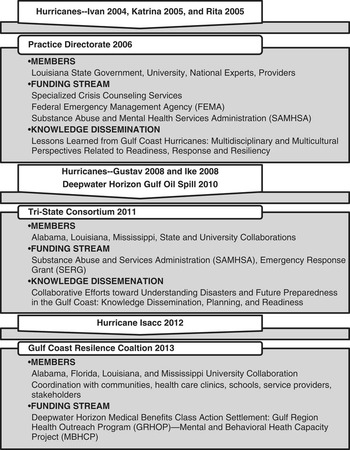
In relation to disasters, the Gulf Coast Resilience Coalition has enhanced response, recovery, and resilience by providing strategic plans for dissemination of knowledge; post-disaster surveillance and service provision; effective relationships and communication with local, state, and regional partners; disaster response informed by past experience; a network of professionals and community residents; and the ability to improve access to and efficiency of future behavioral health coordination through an organized response. 47 , Reference Padilla 67 Importantly, although university-led, the coalition includes community participation as strong partners committed to their own recovery, thus encouraging strength-based behaviors and a resilient perspective toward their own community and the recovery of the Gulf. Development of the coalition has continued and has been enhanced, with the coalition growing from a 3-state to a 4-state coalition through funding of the MBHCP (funding which will end in October 2018). However, the coalition plans to continue and combine efforts and will seek future funding to ensure sustainability and maintain connection. The network development plan can be further enhanced with emergency funding following a future disaster, as demonstrated through the Practice Directorate and the initial SERG Tri-State Consortium. Over the past 10 years, the coalition (Figure 1) in its various forms has produced the following outputs: (1) cohosted many health care collaborative functions, (2) provided efforts to understand and enhance sustainability in mental and behavioral health services in states and communities prone to disaster or with existent discrepancies in care, (3) served to assess and help meet mental health needs following disasters, (4) shared disaster experience and expertise, (5) engaged community members as experts, (6) disseminated knowledge, and (7) coordinated and provided services to meet mental health needs. 68 The Gulf Coast Resilience Coalition can not only improve readiness and response but can work toward a shared vision of improved overall mental and behavioral health and thus resilience, with implications beneficial for the Gulf South as well as for other communities and regions in the United States.
Gulf Coast Resilience Coalition.