Introduction
Cardiac arrest is a significant public health risk with over 359,000 out-of-hospital cardiac arrests (OHCA) occurring in 2013. 1 The American Heart Association (AHA; Dallas, Texas USA) guidelines recommend establishment of strong comprehensive cardiac arrest systems, which include post-resuscitative care as an important aspect in the chain of survival.Reference Travers, Rea and Bobrow 2 As part of this management, the AHA, the International Liaison Committee on Resuscitation (ICLOR; Edegem, Belgium), and the European Resuscitation Council (ERC; Niel, Belgium) have recommended the use of therapeutic hypothermia post-cardiac arrest.Reference Perberdy, Callaway and Neumar 3 Patients treated with therapeutic hypothermia demonstrated improved neurologically intact survival following OHCA. 4 , Reference Bernard, Gray and Buist 5
Since delaying therapeutic hypothermia may negate benefits of treatment and simple, inexpensive methods are efficacious at achieving targeted hypothermia, a number of prehospital providers have initiated this treatment. 4 - Reference Nolan, Morley and Hoek 9 A simple treatment protocol in the prehospital setting is administering cold saline to achieve targeted hypothermic temperature.Reference Kim, Olsufka and Longstreth 10
Recently, the efficacy of prehospital hypothermia treatment has come into question. Bernard et al did not find a difference in patient outcomes at hospital discharge between hypothermia initiated in the prehospital setting versus in-hospital.Reference Bernard, Smith and Cameron 11 Furthermore, the efficacy of targeted hypothermia has come into question as well. In an international, randomized trial, Nielsen et al failed to demonstrate a difference in mortality and neurologic outcomes in post-cardiac arrest patients with return of spontaneous circulation (ROSC) maintained at 33°C or 36°C.Reference Nielsen, Wetterslev and Cronberg 12 Kim et al reported no improvement in survival or neurological status in patients treated with therapeutic hypothermia.Reference Kim, Nichol and Maynard 13 Most concerning is the possibility that treatment with therapeutic hypothermia may cause complications which place patients at increased risk of poor outcomes. Patients treated with prehospital therapeutic hypothermia had an increased incidence of prehospital re-arrests, diuretic use, and pulmonary edema.Reference Kim, Nichol and Maynard 13 With the possible increased complication risk and questionable impact on survival, many local Emergency Medical Services (EMS) agencies have considered removing therapeutic hypothermia from their operating protocols.
It is unclear whether these evaluations of prehospital therapeutic hypothermia are generalizable to all EMS systems. These evaluations were done in a region distinguished by an experienced EMS system with high bystander cardiopulmonary resuscitation (CPR) rates (50%-73%), extensive public access to automated external defibrillators (AEDs), and excellent response times.Reference Nielsen, Wetterslev and Cronberg 12 , Reference Kim, Nichol and Maynard 13 Multiple factors in the chain of survival are optimized. More commonly, there are many regions that experience lower rates of bystander CPR, and public access defibrillation is abated. 14 In these less-optimized EMS systems, therapeutic hypothermia may continue to play an important role for improving survival from OHCA. This study evaluated the effect of therapeutic hypothermia in a metropolitan area located in the United States with 822,553 residents and a rate of bystander CPR of 40%. 14 The objective for this study was to understand the OHCA survival and complication profile of patients treated with therapeutic hypothermia in an EMS system in a community with low bystander CPR rates.
Methods
This investigation was a retrospective chart review of all patients treated with therapeutic hypothermia in the metropolitan area of Columbus, Ohio (USA) from January 1, 2013 through November 30, 2013. This area is serviced by the City of Columbus Division of Fire, which is the primary provider of EMS in the area. The study population included all patients with an OHCA with ROSC and initiation of prehospital therapeutic hypothermia. Patients were excluded if therapeutic hypothermia was not initiated in the prehospital setting, if ROSC was not obtained, or patients were 17 years of age or younger. A waiver from The Ohio State University Institutional Review Board (Columbus, Ohio USA) was obtained for this retrospective chart review study.
The City of Columbus Division of Fire is an urban, fire-based EMS system that serves a population of over 822,000 constituents covering 217 square miles. There are approximately 130,000 calls requesting EMS per year. This EMS system includes 32 Advanced Life Support (ALS) ambulances and 34 ALS engine vehicles. Each ambulance is staffed with two paramedics, and each engine vehicle is staffed with at least one paramedic and two or three emergency medical technicians (EMTs). There are seven EMS supervisors that oversee EMS operations in their respective battalions. Cardiac arrests are attended to by two ambulance paramedics, one paramedic, and at least two EMTs on an engine vehicle, and an EMS supervisor. Routinely, post-cardiac arrest therapeutic hypothermia is initiated on patients with ROSC through the administration of ice-cold normal saline. The following criteria must be met to initiate therapeutic hypothermia: 16 years of age or greater, successful endotracheal intubation, non-traumatic etiology of arrest, patient is not obviously pregnant, and patient is not responding to painful stimuli. 15
Prehospital data were extracted from the electronic patient care report (Safety PAD, OPEN, Inc.; Minneapolis, Minnesota USA) and hospital data were obtained via EMS liaisons at each receiving hospital in Columbus, Ohio. Hospital-appointed EMS liaisons are trained personnel that work closely with the City of Columbus Division of Fire to facilitate the continuous quality improvement process. The City of Columbus Division of Fire personnel do not have access to hospital electronic patient records, and therefore, they rely on EMS liaisons for patient information.
A data sheet was created for study variables. The EMS liaison data abstractors were not aware of the hypotheses of this investigation. Because initial charts were not available to study personnel, inter-rater reliability was not performed. However, all extracted variables were present as discrete data points in the medical records and did not require interpretation by the abstractor. Analysis was performed using Microsoft Excel (Microsoft Corporation; Redmond, Washington USA) and STATA v.12 (STATACorp; College Station, Texas USA). Data were reported as proportions with 95% confidence intervals (CI) and means with standard deviations (SD).
The primary outcomes were the proportion of post-cardiac arrest patients achieving ROSC with initiation of prehospital therapeutic hypothermia that survived to hospital admission, the proportion of post-cardiac arrest patients achieving ROSC with initiation of prehospital therapeutic hypothermia that survived to hospital discharge, and the complication profile of therapeutic hypothermia in this population. The complication profile included vasopressor use, diuretic use, antibiotic use, initial blood glucose measurement, initial chest radiograph (CXR) findings (as documented by hospital radiologist), pH, PaO2, PaCO2, pulse oximetry, and the proportion of patients discharged from the hospital.
Results
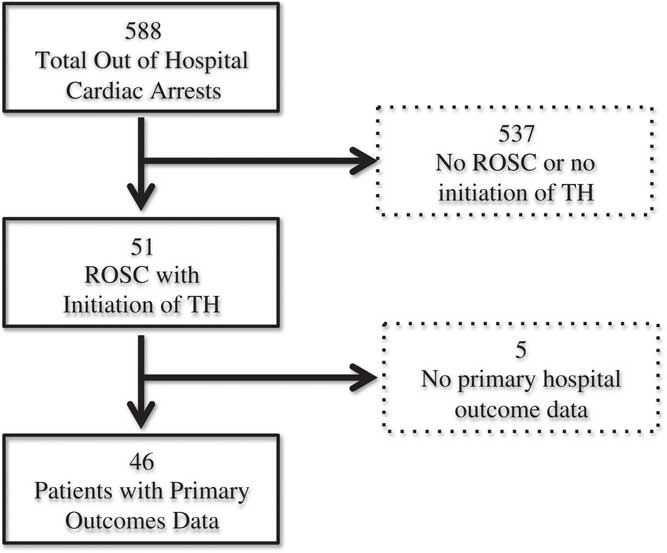
The total number of OHCA which were responded to during the study period was 588 arrests (Figure 1). Of these arrests, 51 patients were designated as cardiac etiologies of arrest, had ROSC, and had prehospital therapeutic hypothermia initiated. Primary outcome information was missing on five patients; therefore, analysis was performed on 46 patients (n=46).
Flow Diagram of OHCA Patients. Abbreviations: OHCA, out-of-hospital cardiac arrest; ROSC, return of spontaneous circulation; TH, therapeutic hypothermia.

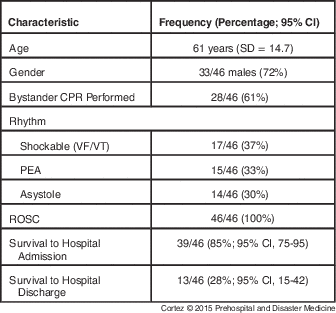
Demographic characteristics and survival data for this population are described in Table 1. The mean age was 61 years (SD=14.7 years) and 33 (72%) were male. Bystander CPR was performed on 28 (61%) of the study patients. Initial rhythm was ventricular fibrillation or pulseless ventricular tachycardia in 17 (37%) of the study patients. Of these individuals who presented to the emergency department, 39 (85%) survived to hospital admission. Of the total population, 13 (28%) of these individuals survived to hospital discharge (95% CI, 14-41).
Demographic and Survival Data of Individuals Presenting with Cardiac Arrest Treated with Therapeutic Hypothermia (n=46)

Abbreviations: CPR, cardiopulmonary resuscitation; PEA, pulseless electrical activity; ROSC, return of spontaneous circulation; VF, ventricular fibrillation; VT, ventricular tachycardia.
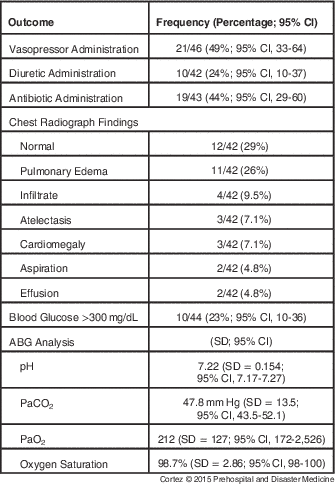
Patient complications following treatment with therapeutic hypothermia was tabulated in Table 2. Of all study patients, 21 (49%; 95% CI, 33-64) were administered vasopressors, 10 (24%; 95% CI, 10-37) were administered diuretics, and 19 (44%; 95% CI, 29-60) were administered antibiotics. Initial CXR findings were normal in 12 (29%) patients. Abnormal CXR findings were noted in 30 (72%), with pulmonary edema (11; 26%) and infiltrates (4; 10%) being the most significant. Ten (23%) patients had an elevated glucose greater than 300 mg/dL. Blood gas analysis of the population noted acidosis with a pH of 7.22 (95% CI, 7.17-7.27) with adequate oxygenation (99%; 95% CI, 98-100%).
Primary and Secondary Outcomes

Abbreviation: ABG, arterial blood gas.
Discussion
Prehospital therapeutic hypothermia has been suggested to improve survival and neurological outcomes following cardiac arrest. With conflicting reports in the literature about the efficacy of this treatment, local evaluation of survival rates and complication profiles for cardiac arrest patients is important to understand the risks and benefits of the use of therapeutic hypothermia for EMS.
The evaluation identified a population of patients treated with therapeutic hypothermia following OHCA. The regional EMS system in central Ohio is a sophisticated network of EMS providers and hospital systems. There are nine emergency departments and three stand-alone emergency departments that receive patients from the City of Columbus Division of Fire. The mean response time (dispatch to scene) for ALS care is approximately four minutes, and the mean transport time (scene to hospital) is approximately eight minutes. All receiving emergency departments and intensive care units continue prehospital-initiated therapeutic hypothermia.
In 2013, the bystander CPR rate (40.1%) and proportion of patients surviving to hospital admission (31.1%) for the City of Columbus Division of Fire were above the national average. 14 However, while above the national average, the bystander CPR rate was less impressive than other regions. For example, Kim et al reported a total bystander CPR rate of approximately 57% between 2007 and 2012 in Seattle, Washington (USA).Reference Kim, Nichol and Maynard 13 Several other aspects of the study region’s cardiac arrest system are less-optimal than other regions. There was no centralized AED location database and no link between AED locations and the dispatch system. The proportion of patients surviving to hospital discharge was at the national average (10.2%). The region did not designate hospitals as resuscitation centers.
In this retrospective chart review of patients receiving therapeutic hypothermia following ROSC from an OHCA, nearly 85% survived to hospital admission and 28% survived to hospital discharge. The survival to hospital admission is similar to the data reported by Kim et al (approximately 87% for both control and intervention groups).Reference Kim, Nichol and Maynard 13 Since the City of Columbus Division of Fire initiates therapeutic hypothermia on all patients with ROSC, the study cohort represents the same patient cohort of the Kim et al investigation before randomization. This study’s patients had a bystander CPR rate of 61%, whereas Kim et al reported a total bystander CPR rate of 57%.
The survival to hospital discharge was approximately 38% and 37% for the Kim et al intervention and control groups, respectively.Reference Kim, Nichol and Maynard 13 Twenty-eight percent of this study’s patients survived to hospital discharge. Differences in survival to hospital discharge were not statistically significant (P=.10 and P=.11).
Although hypotheses testing was not utilized, when comparing this study’s secondary outcome data with the Kim et al intervention group, the City of Columbus Division of Fire patients had a lower incidence of antibiotic use (46% vs 64%), a lower PaCO2 (48 vs 59), and a similar pulse oximetry reading (98% vs 94%).Reference Bernard, Smith and Cameron 11 When comparing with the Kim et al control group, the City of Columbus Division of Fire patients had a lower incidence of antibiotic use (46% vs 64%), a higher incidence of pulmonary edema (44% vs 30%), and a similar pulse oximetry reading (99% vs 96%).Reference Kim, Nichol and Maynard 13
In a less-optimized system of OHCA care, the study criteria identified patients with ROSC that were similar to the Kim et al patients. Bystander CPR rates, survival to hospital admission, and survival to hospital discharge were similar. While several differences in complication rates for this population were found, the clinical significance of such findings is unknown.
Limitations
The study was limited in several ways. First, this was a retrospective chart review that began as a local quality assurance project, and was underpowered with wide ranges of confidence intervals. Second, the proportion of patients with neurologically intact survival was not evaluated. This is the optimal outcome measure of interest in the population studied. Third, there were five patients with no emergency department information; the outcomes of these patients may have affected the data reported. Fourth, the results of this study may lack external validity. Outcome from cardiac arrest is a multi-factorial process with several variables. Confounding factors may have been present and not recognized.
Lastly, selection bias may have been present when choosing who received therapeutic hypothermia. All patients with ROSC following cardiac arrest, regardless of initial rhythm, were supposed to have therapeutic hypothermia initiated. However, several operational factors may have prevented some patients from receiving therapeutic hypothermia. For example, cardiac arrests that occurred in close proximity to emergency departments may not have received therapeutic hypothermia secondary to short transport times. Another issue may have been failure to establish sufficient vascular access to accommodate the delivery of therapeutic hypothermia.
Conclusion
Recent reports have questioned the efficacy and safety of prehospital therapeutic hypothermia. In this evaluation, in the setting of unstandardized post-arrest care, 85% of the patients who received therapeutic hypothermia following ROSC survived to hospital admission and 28% survived to hospital discharge, with a complication profile which was similar to that noted in other studies. This suggests that further evidence may be needed before EMS systems stop administering therapeutic hypothermia to appropriately selected patients. In less-optimized systems, therapeutic hypothermia may still be an essential link in the chain of survival.