The structural context of the shift towards new welfare
A substantial literature in recent years points to the development of new directions in state welfare, variously termed, the ‘new welfare state’ (Bonoli and Natali, Reference Bonoli and Natali2012; Esping-Andersen et al., Reference Esping-Andersen2002), ‘social investment’ (Morel et al., Reference Morel, Palier and Palme2012), ‘active social welfare’ (Daguerre, Reference Daguerre2007), the ‘Third Way’ (Giddens, Reference Giddens2001), ‘new risk’ welfare ( Taylor-Gooby, Reference Taylor-Gooby2004) and ‘pre-distribution’ (Hacker, Reference Hacker2011). While there are differences in scope and emphasis in the programmes described (or promoted) by commentators, there is sufficient commonality in general direction across states and across regime types to justify grouping them together under the general heading of the ‘new welfare state’. This is defined by Bonoli and Natali as ‘an institution that puts the emphasis less on income replacement and more on the promotion of labour market participation through activation and investment in human capital’ (Bonoli and Natali, Reference Bonoli and Natali2009: 8).
Welfare states have always pursued diverse objectives: at the political level, balancing the potential conflicts inherent in democratic capitalist societies (Offe, Reference Offe1984; O’Connor, Reference O'Connor1984); at the economic level, helping to ensure national growth and competitiveness and maintain stability (Pierson, Reference Pierson2001); and, at the social level, managing social needs and problems. Policies to achieve these objectives must address a number of tensions: at the political level between the interests of capital and labour or business and workers (Gough, Reference Gough1976), at the economic level between equality and efficiency (Okun, Reference Okun1975) or growth, employment and equality (Iversen and Wren, Reference Iversen and Wren1998) and at the social level between the mass of the population and the more marginal groups (immigrants, the disreputable poor, long-term unemployed people (Van Oorschot, Reference Van Oorschot2006; Korpi and Palme, Reference Korpi and Palme2003) – and, perhaps, between young and old).
During much of the post-war period, welfare states addressed these issues through a variety of interventions within a broadly Keynesian economic policy framework. The main policy directions were, at the political level, expanding popular social programmes as growth allowed; at the economic level, supporting private sector investment, managing employment, education and training and implementing counter-cyclical interventions; at the social level, running horizontally redistributive mass health care, pension and benefit programmes and vertically redistributive welfare programmes to address poverty (Flora, Reference Flora1986).
The context of the post-war settlement has shifted in response to changes at three levels: the transition to more globalised and post-industrial societies and financialised economies; a concomitant decline in the proportion of gross domestic product (GDP) returned to labour, together with disappointing poverty outcomes and growing inequality; and political shifts that promote the adoption of new welfare as a policy framework.
Globalisation and post-industrialism
As discussed extensively elsewhere (for a magisterial review, see Pierson, Reference Pierson2001), the various changes in the transition to a more globalised, financialised and post-industrial society have fragmented the political forces sustaining the previous welfare settlement, constrained the abilities of governments to pursue directly interventionist economic management (Scharpf and Schmidt, Reference Scharpf and Schmidt2000; Jessop, Reference Jessop2002) and led to substantial deregulation of labour markets (Standing, Reference Standing2009). So far as the individual citizens of welfare states are concerned, they have created a range of new social needs and risks in relation to changes in family life (Lewis, Reference Lewis, Gray and Webb2010) and working life (Emmenegger, Reference Emmenegger2012). These needs are variously discussed (Esping-Andersen, Reference Esping-Andersen1999; Esping-Andersen et al., Reference Esping-Andersen2002 ), but most accounts of new social risks include three broad areas:
• gender-related needs for child and elder care, family-friendly work-practices and clear sex discrimination policies as more women and mothers move into full-time paid work;
• employment-related needs for training, better access to jobs (especially for lower-skilled people) and greater security in work as labour markets become more flexible (Emmenegger, Reference Emmenegger2012; Hemerijck, Reference Hemerijck2013);
• poverty-related needs, as the trend to greater inequality in market incomes (Atkinson, Reference Atkinson2007) generates concern about junk jobs (Esping-Andersen, Reference Esping-Andersen2002) and pay levels inadequate to support decent family life (Standing, Reference Standing2011).
However, these risks need to be set in the context of the broader politico-economic and social changes identified above. It is now harder for governments to tackle them through traditional post-Keynesian interventions. In any case, the social institutions that mediate the relationship between capital and labour (trade unions and the labour movement) have grown weaker as the result of labour market deregulation and the shift towards labour relations characterised by the service rather than the manufacturing sector.
Inequalities, poverty and the declining return to labour
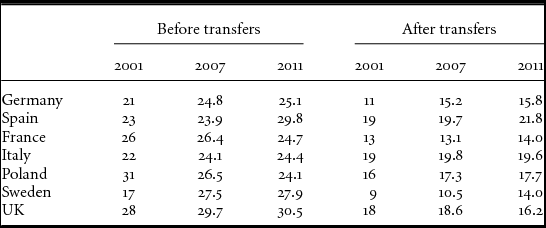
Table 1 gives Eurostat data on at risk of poverty rates for the six largest EU members and for Sweden. Poverty is measured as bottom-end inequality in terms of incomes, before social transfers apart from pensions, in order to focus on the market income effects that new welfare seeks to address. Poverty rose in all countries during the period (except the rather less post-industrial and financialised Poland on the pre-transfer measure). This increase largely took place in the economically benign climate of the early 2000s, when all the countries mentioned enjoyed consistent growth, but typically continued after the 2007 crisis. Welfare state transfers sharply reduced the impact of inadequate market incomes but failed to compensate adequately for the increase even during the good times. Atkinson's longer time series from 1980 to 2005 shows how this follows a pattern of growing inequality in market incomes across most western economies (particularly marked in Anglo-Saxon countries but also including Corporatist economies such as Germany, where 90th percentile incomes rose twice as fast as those at the 10th percentile, and social-democratic Sweden, where the relative increase was about one-and-a-third times: Atkinson, Reference Atkinson2007). These trends and the limited success of EU policies in mitigating them are discussed elsewhere (see Cantillon, Reference Cantillon2011).
At risk of poverty 2001–2011, selected EU countries (Eurostat)
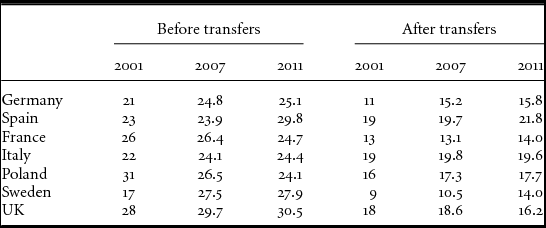
Note: 60% median income threshold; data for equivalised persons; total population.
Disappointing (relative) poverty and inequality trends might not matter so much, since real growth up to 2007 increased available resources. However, there is an established longer-term trend for a greater proportion of GDP to flow to capital and less to labour. The political economy approach interprets this as evidence of a shift in the balance of forces between capital and labour in a post-industrial and more globalised and competitive world (Rodrik, Reference Rodrik1997). Neo-classical models, based on analysis of international competition (Stolper and Samuelson, Reference Stolper and Samuelson1941), place more stress on the mobility and relative abundance of capital and labour in more- and less-developed countries.
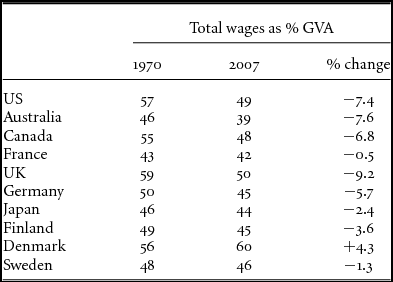
Bailey and colleagues (Bailey et al., Reference Bailey, Coward and Whittaker2011) use OECD data to calculate the proportion of gross value added in the economy returned to labour in the form of wages and employment benefits in a range of countries. They show that the return to labour has fallen, most strikingly in the Anglo-Saxon economies and less dramatically in Corporatist economies, with a mixed pattern in Social Democratic countries (Table 2; see also ILO, 2013: 19). The analysis also examines distributional issues and follows the predictions of globalisation and post-industrial theories in showing that the declining wage-share is particularly marked among lower-income groups. Labour market deregulation reinforces these trends.
Trends in wages as a proportion of national income, selected countries
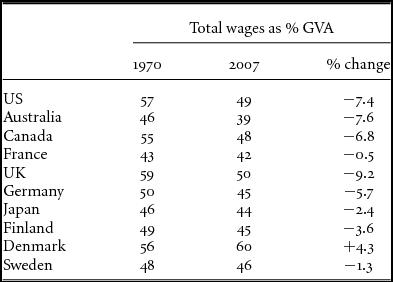
Source: Calculated from Bailey et al., Reference Bailey, Coward and Whittaker2011, Table 4.
The politics of new welfare
Welfare states face simultaneous pressures for retrenchment to enhance competitiveness and for expansion to meet social risks and the needs of an ageing population (Palier, Reference Palier2010). Much discussion of the politics of new welfare focuses on the tactics used by governments to manage these pressures rather than the structural context of the falling wage share, growing inequality and deregulation in which they emerge. Pierson's influential discussion of political responses to new risk pressures at the end of the twentieth century stressed cost-containment, re-commodification and recalibration (Pierson, Reference Pierson2001: 422). He identified three main methods used by governments to limit the damage to electoral support from retrenchment: compensation, obfuscation through complex changes to entitlement rules and division of the constituencies which support particular areas, for example pension reforms which defer cuts so they affect younger but not older age-groups.
Bonoli and Natali (Reference Bonoli and Natali2012) point out that Pierson's emphasis on blame avoidance needs to be complemented by attention to the opportunities for ‘affordable credit-claiming’ which new welfare allows. New welfare states identify areas in which programmes can be expanded at relatively modest cost (day and elder care, training and work programmes; regulations improving family-friendly working; non-discrimination and human rights legislation) for which credit can be claimed from new risk groups. These new areas allow opportunities to gain support, particularly from younger voters most affected by new risks, and offer a basis for consensus-forming, political compromise and political exchange.
New welfare policies typically allow some retrenchment of established old social risk programmes but expand new risk provision, for example the combination of support programmes which help disabled people into paid work and better, more targeted benefits for those who remain unable to work. Similarly, more accessible childcare may be coupled with benefit cuts for single parents. Such compromises are more viable where left and centre parties, and unions defending the welfare state, include both younger groups with daycare and work-related needs and workers in traditional industries (Bonoli and Natali, Reference Bonoli and Natali2012: chapter 13).
Since 2007, recession, followed by stagnation across most of Europe, has imposed further demands on competitiveness, legitimacy and public spending (Farnsworth and Irving, Reference Farnsworth and Irving2011; Hemmerijk, Reference Bonoli and Natali2012). In general, centre-left supporters of state welfare have lost political power as the crisis continues, intensifying the search for attractive new welfare programmes (Barnes and Hicks, Reference Barnes and Hicks2013).
The new welfare state emphasises social investment, activation and fairer access to opportunities. The intention is that social policies should prioritise helping people get decent market incomes, since raising taxes to finance benefits may damage national competitiveness and perhaps electoral popularity. Hacker's argument that public policy should put greater emphasis on ‘pre-distribution’ (policies to ensure adequate working-class pay in the first place) and less on ‘re-distribution’ has substantial resonance (Hacker, Reference Hacker2011). However, most advocates do not argue that new welfare should displace the more established tax-and-spend approaches (Vandenbroucke and Vleminckx, Reference Vandenbroucke and Vleminckx2011: 458; Esping-Andersen et al., Reference Esping-Andersen2002) but should complement them. Spending on cash benefits for these groups has not fallen in recent years (taking into account the economic cycle) but replacement rates have, as market incomes grow more unequal. This is of particular concern at a time of economic and social uncertainty, when social risks related to life-course or labour market transitions are less predictable and insurable than previously.
The practical assessment of new welfare programmes is complicated by the variety of policies pursued within different contexts, and by problems in assembling good quality comparative evidence. There is considerable dispute about the effectiveness of existing policies in EU countries in mitigating disappointing poverty trends, and their potential to do so as economies recover (Cantillon, Reference Cantillon2011; Cantillon and Van Lancker, Reference Cantillon and Van Lancker2013; Vaalavuo, Reference Vaalavuo2013; Pintelon et al., Reference Pintelon, Cantillon, Van den Bosch and Whelan2013; Van Kersbergen and Hemerijck, Reference Van Kersbergen and Heemerijck2012; Vandenbroucke et al., Reference Vandenbroucke, Hemerijck and Palier2011; Bonoli and Natali, Reference Bonoli and Natali2012: 302).
The track record of the European Employment Strategy and the Lisbon 2000 Open Method of Co-ordination programme in relation to poverty is not impressive (Kok, Reference Kok2004). Policies intended to expand the workforce appear to have been more successful, especially in relation to women. Female employment rates in European countries rose by between a quarter and a third from the 1960s to 2007 (Bonoli and Natali, Reference Bonoli and Natali2012: 115). Further improvement to a rate of 75 per cent of twenty to sixty-four year-olds is the first stated target of the current Europe 2020 programme (EC, 2013a). There is considerable evidence that education interventions, particularly those at an early age, improve outcomes (Esping-Anderson, 2004), and indications that training programmes generate higher employment rates, especially in high-quality jobs in knowledge-based industries (Nelson and Stephens, Reference Nelson, Stephens, Morel, Palier and Palme2012). The egalitarian Nordic welfare states spend relatively more on services. This fact is often used to reinforce the argument that governments should expand services such as child and social care, education and active labour market (ALMP) programmes, rather than compensating low incomes through benefits. The corresponding point that these countries score well in quality of employment protection is less often noted.
Social investment is variously interpreted (Jenson, Reference Jenson, Bonoli and Natali2012: 41; Pintelon et al., Reference Pintelon, Cantillon, Van den Bosch and Whelan2013: 52), with all approaches sharing a distinctive emphasis on the ‘productive functions of social policy’ (Nygård and Krüger, Reference Nygård and Krüger2012; Morel et al., Reference Morel, Palier and Palme2012; Vandenbroucke et al., Reference Vandenbroucke, Hemerijck and Palier2011; De Deken, Reference De Deken2012). Early and continuing investment in human capital is seen as crucial to enable people to grasp opportunities in a knowledge society and to adapt to changes in demand for different skills (Nolan, Reference Nolan2013; Jenson, Reference Jenson, Morel, Palier and Palme2009).
Some commentators argue that middle-class groups are typically better able to exploit opportunities and use common services through superior access to resources and their social skills (Goodin and Le Grand, Reference Goodin and Le Grand1987; Titmuss, Reference Titmuss1976). Expansion of services such as childcare may attract middle-class electoral support but fail to reduce inequalities unless targeted. A strict investment logic will prioritise growth over the current consumption provided through many welfare state services (Nolan, Reference Nolan2013: 463). For example, human capital investment may not direct resources to the most needy because a better return is available from those at a somewhat higher level of achievement (BIS, 2012). One response by proponents of social investment is to expand the concept to include a range of services beyond those on which immediate returns can be expected to generate broader social gains over an extended period. In addition to childcare and training, an extended social investment programme may include better housing and social provision to improve public health, more general educational spending to create a ‘learning society’ and policies to reduce inequalities and advance social cohesion (Jenson, Reference Jenson, Bonoli and Natali2012: 41).
Work-centred new welfare has been increasingly prominent in the policy debate to address problems of economic competitiveness and working-age poverty. The OECD's ‘Jobs Strategies’ from 1985 to 2007 argued for stronger incentives, a lower tax wedge and deregulation to improve labour market flexibility (2011: 40–1). These themes are reinforced in the EU's initial 2000 Lisbon Strategy with its commitment that Europe should ‘become the most competitive and dynamic knowledge-based economy in the world capable of sustainable economic growth with more and better jobs and greater social cohesion’. More recently, the Europe 2020 Strategy with its goals of ‘smart, sustainable and inclusive growth’, in which ‘better educational levels help employability and progress in increasing the employment rate helps to reduce poverty’, builds on this approach (EC, 2010). Early investment in skills in addition to spending on effective and efficient social protection is central to the strategy (EC, 2013, 2014).
More and better jobs
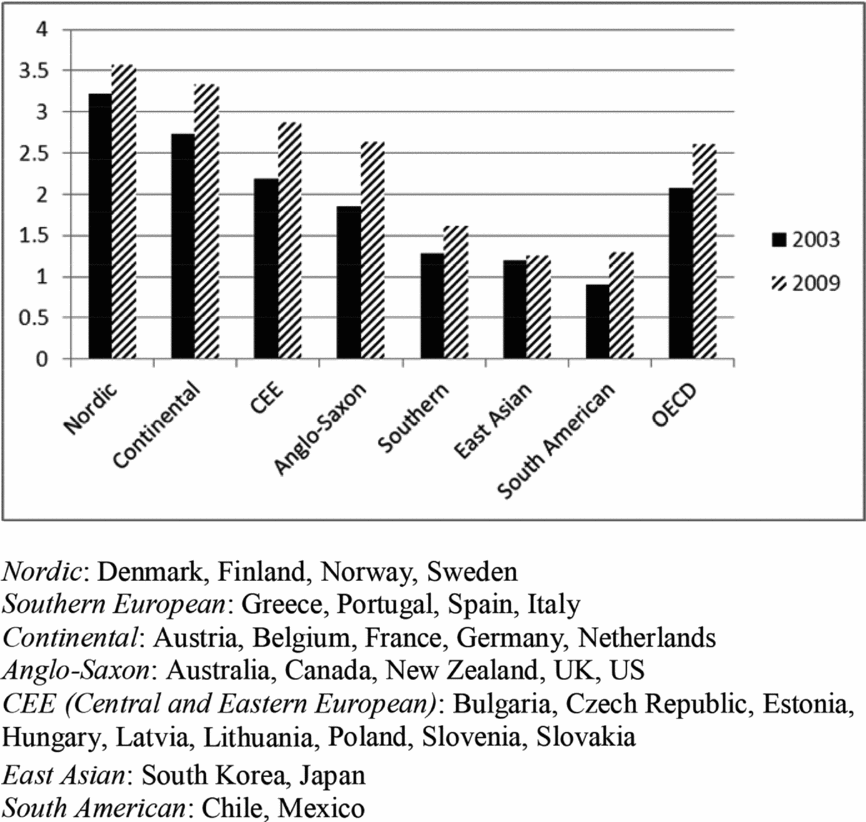
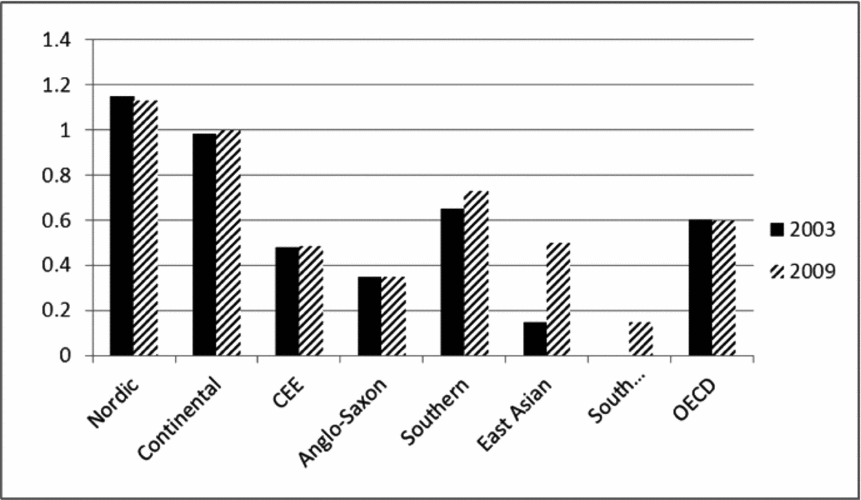
At the level of individual needs, new welfare programmes link together two main areas to do with quantity and quality of work. The first includes various programmes intended to address gender and employment-related needs by increasing the proportion of the population in paid work. This may be pursued through the provision of childcare and elder care, to enable those with family responsibilities to direct more time and energy to work, coupled with greater parents’ rights and working practices that are more family-friendly. Family-related spending generally has continued to increase across Europe in the 2000s and accounts for an average of about 2.5 per cent of GDP (Figure 1). In addition, governments have developed a wide range of ALMP programmes, including job creation, supported employment for marginal groups, work incentives, job sharing, early retirement and training. These occupy fewer resources than gender-related mobilisation programmes, have generally expanded and been most vigorously pursued in Nordic and Continental Corporatist countries (Figure 2).
Family spending (benefits, services and tax breaks) 2003–2009 OECD

ALMP spending (job creation, training, insertion etc.) 2003–2009 OECD
The second area covers policies intended to improve the quality of (and reward from) work. These include better education and training, intended to both raise productivity and to help people command employment that is more secure, of higher quality and more knowledge intensive. In relation to labour market regulation, there has been a shift away from collective rights in areas such as strike action or regulation of dismissal and working hours towards individual rights concerned with opportunities and discrimination on grounds of gender, ethnicity, faith, sexuality and age. Contractual rights have grown somewhat weaker in Europe since 1990, but with the weakest performers converging upwards towards the highest-scoring Nordic, Corporatist and Mediterranean countries (uncounted informal employment may distort statistics for the last group: Figure 3).
Employment Protection Index scores, formal labour market: OECD 1990–2008
Different aspects of new welfare have been emphasised in different countries. Obinger and colleagues sum up these directions in policy and relate them to regime type (Obinger et al., in Emmenegger, Reference Obinger and Emmenegger2011). They distinguish:
• Liberal approaches which combine low social and employment protection but pursue ‘make work pay’ workfare programmes to increase employment. Here ‘new welfare’ stresses opportunities and incentives as in the UK Universal Credit reforms and Work Programme.
• Dualisation, most common in continental and southern Europe, which provides good protection for labour market insiders, but not for outsiders, who are subject to a more liberal regime, for example the development of part-time ‘mini-jobs’ from 2003 in Germany with limited protection.
• The Nordic tradition of encompassing security, with high protection levels for all and high-quality training and support into work, demonstrated in the high spending on activation.
• Flexi-curity systems in modernised welfare states, which link high levels of social protection with low employment protection and pursue investment in human capital, for example part-time working in the Netherlands.
All except the liberal approach include active support into paid work and training, but job quality is only a feature of the dualised regime (and then only for insiders) and the encompassing welfare regime. Otherwise the approach to social cohesion is through acceptance of market outcomes (liberalisation) or compensation for their deficiencies (flexi-curity). This reinforces the evidence that the emphasis in new welfare has been on the mobilisation of workers rather than the quality of jobs. It also indicates that new welfare and social investment policies differ in relation to institutional, socio-economic, political and cultural context (Fenger and Ellison, Reference Fenger and Ellison2013).
New welfare state programmes are attractive because they address the practical problems of meeting need that are the immediate business of welfare states without damaging national competitiveness under the altered circumstances of post-industrial societies. In addition, they promise to do so in ways that gain electoral support and legitimacy (through improved opportunities) without damaging economic goals. One aspect is the shift from direct commitment to address poverty ex post facto through tax-financed transfer payments to policies intended to improve access to market incomes in the first place. This shifts responsibility for final outcomes (Cantillon and Van Lancker, Reference Cantillon and Van Lancker2013) away from government and towards the individual, who must grasp opportunities for training and gaining a job which meets their needs. Market outcomes are arbitrary (like the weather: von Hayek, Reference von Hayek1944). The category of just or unjust does not apply to them. However, under a developed new welfare system, market experience is increasingly moralised. The shift of responsibility may help reconcile demands for fairness with obvious market inequalities.
New welfare in practice
To sum up the argument so far, economic, social and political changes, to do with the shift to more post-industrial, globalised and financialised societies, have put pressures on welfare states. The key changes as they affect individuals are: disappointing poverty trends and greater inequality, the emergence of new social risks and the weakening of the political forces and institutional factors which sustained the previous redistributive settlement. One result has been the development of a new social investment or activation approach to welfare. In practice, this is designed to increase employment rates and also the quality of and returns from work. The social policies of new welfare are about more and better jobs.
If new welfare is to deliver both social and economic benefits and to help manage the big trade-off between economic efficiency and equality, the policies must generate better quality and better rewarded work at the bottom end as well as supplying more and perhaps better-trained workers to business. A structural analysis would emphasise the underlying conflict of interests between capital and labour, the overall shifts in wage share and income inequality and the deregulation of employment. Individual level analyses focus on the needs experienced by particular and often fragmented social groups. From the first perspective, the risk that growth may not benefit the poor is pressing. Governments facing demands from different groups in the electorate tend to adopt the second. They may seek policy trade-offs that provide opportunities for credit-claiming but are not primarily directed at improving bottom-end incomes. The politics of new welfare often focuses on micro-politics, the detail of the compromises and exchanges that policies exploit, rather than the changing macro-level context which influences the bargaining power of different groups and the resources available to them.
We develop the argument through exploratory analysis of empirical data on new welfare in institutional context.
Analysis: data and methods
The above discussion raises three questions:
• To what extent are ‘new welfare’ policies successful in improving employment?
• To what extent do they help reduce poverty?
• What is the contribution of the institutional factors (contractual rights, employment protection, trade union influence) that the new welfare analysis downplays, alongside the family-friendly working, labour market activation, human capital improvements and anti-discrimination measures that it commends?
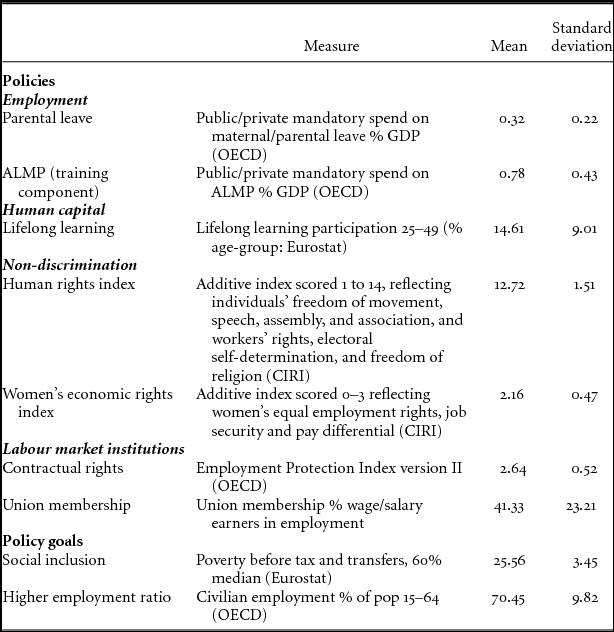
To examine these questions data were drawn from the OECD's Socx and other databases, Eurostat and the CIRI Human Rights index (for details see the Appendix). These include:
• For labour mobilisation policies: spending on parental leave and the training element in ALMP. Parental leave is preferred to daycare spending as a measure of support for family-friendly working since daycare includes care for older and disabled people, which may be concerned to enhance their capacity to live independent lives rather than permit parents and carers to take paid jobs. OECD's ALMP spending measure includes a wide range of policies, some of which (for example, early retirement) are not typically seen as part of new welfare and which may not enhance employment. The training component is directed both at helping lower-skilled people into work and at improving the productive capacity of those on low wages.
• For human capital improvement policies: participation in lifelong learning for people of core working age (twenty-five to forty-nine). This is preferred to measures of general educational participation or spending since education policy includes a wide range of activities that may not improve employability and because lifelong learning is a common objective of new welfare and social investment and is a core component in ‘ET2020’, the Education and Training DG's contribution to Europe 2020 (EC, 2013b).
• For non-discrimination policies: the human rights and women's economic rights indices developed by the CIRI institute. Human rights provide a general measure of legislation to counter discrimination across a number of political, economic and social areas. Women's economic rights include the benefit and employment rights, notably equal pay intended to improve working conditions and reward and encourage more women to take paid work.
• For institutional factors bearing on job quality: the OECD employment protection index (version I) and union membership; the former measuring contractual rights in relation to employment and dismissal, the latter institutional bargaining power.
Policy outcomes are measured as follows:
• The employment rate is simply the proportion of the population aged sixteen to sixty-four in civilian employment, from OECD data.
• Poverty is measured using Eurostat data on the proportion of the population falling below a 60 per cent poverty line before transfers (apart from pensions). Incomes before transfers reflect the new welfare objective of improving market incomes, especially at the bottom, rather than relying on tax-and-spend. The variable includes non-workers as well as those in work so that the impact on the whole population can be studied.
Five difficulties limit the scope of the research and ensure that the conclusions are at a general level:
Firstly, adequate data are only available for the relatively recent past and for seventeen European countries: Austria, Belgium, Denmark, Finland, France, Germany, Greece, Iceland, Ireland, Italy, Luxembourg, Netherlands, Norway (not EU), Portugal, Spain, Sweden and the UK. This gives a good coverage of different varieties of European welfare states, apart from CEE members.
Secondly, any analysis must take into account the economic cycle, which has strong effects on poverty and employment. The analysis focuses on the period between 2001 and 2007, one of the strongest and most consistent periods of stability, expansion and rising employment in the countries considered. The severe banking crisis of 2007–08 and the consequent recession and the recovery programmes had major impacts on policy, including a massive expansion in spending on unemployed and low-paid people via ‘automatic regulators’, exceptional measures to sustain employment, retrenchment on a scale not seen since the 1920s and 1930s in some countries and many policy innovations. For these reasons, developments beyond 2007 are excluded.
Thirdly, the relatively small number of countries and of data-points (17 × 7 = 119) is a severe constraint on analysis. As a result, data are pooled across all countries and years considered, so that the impact of the different national policy emphases discussed above is not explored. This is justified in a broad brush analysis over a period in which economic indicators are broadly consistent, limiting national variation. The analysis only supports broad generalisations about the impact of new welfare policies as a whole across European countries in a period of growth, and is presented as such.
Fourthly, the complexity of the interactions between the various policy areas imposes limitations on multivariate analysis. New welfare programmes are often pursued as a package, and education spending, lifelong learning, training and other human capital investments are typically highly correlated as are human and gender rights policies. These problems were addressed by choosing specific variables to represent particular aspects of the programmes.
Fifthly, the data include private spending but may under-report training, lifelong learning or parental leave based on collective agreements.
We first conducted exploratory correlational analyses to examine the relationship between each of the welfare variables and the employment and poverty rates. Secondly, a Prais Winsten regression model with Panel Corrected Standard Errors (PCSE) was estimated on a balanced panel. This model was chosen to overcome the limitations of traditional OLS models for the estimation of time-series cross-section data, which include panel heteroscedasticity and serial correlation of errors (Beck and Katz, Reference Beck and Katz1995, Reference Beck and Katz2004). To deal with serial correlation of errors an autocorrelation parameter (AR1) was included in the model. This was preferred to the incorporation of a lagged dependent variable as predictor, as the lagged dependent variable may obscure the relationship between the substantive independent variables and the dependent variable (Achen, Reference Achen2000; Beck and Katz, Reference Beck and Katz2004; Plumper et al., Reference Plümper, Troger and Manow2005). Fixed effects (country dummies) were not included since, given the small time period considered (T = 7), to do so would reduce degrees of freedom and eliminate variance (Beck, Reference Beck2001). All independent variables were lagged one year to allow for time effects of the policies on both the employment and poverty rates. Given that the data were collected at different time points each year, lagging was also performed to ensure the correct temporal sequence of cause and effect and, therefore, to avoid reverse causality. A sensitivity analysis examining immediate effects produced similar relationships to the ones found with the PCSE model.
New welfare, employment and poverty
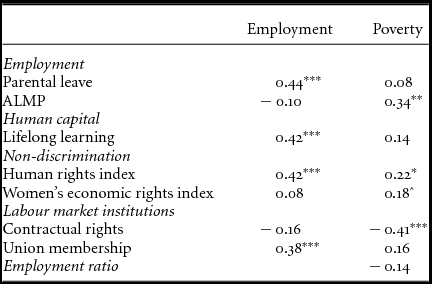
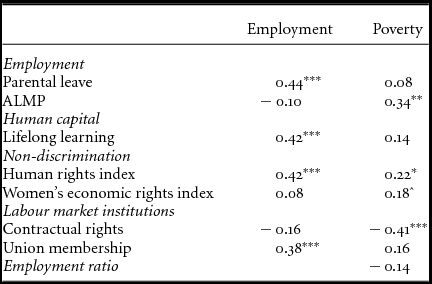
The analysis first examined correlations between relevant policies and outcomes (Table 3). Family-friendly working, participation in lifelong learning, better human rights and union density had a moderate and positive effect on employment. For contractual rights, the effect is negative and not significant. Women's economic rights have no independent effect beyond family-friendly working, nor does activation spending.
Employment rates, poverty and new welfare policies, 2001–07 (Pearson correlations)
Notes: N = 119.
^ p<0.06; *p<0.05; **p<0.01; ***p<0.001.
The impact of parental leave, of lifelong learning and union density is as expected. Better human rights may help people into work, but equally may be a feature of societies which also have higher employment. The weak negative effect of contractual rights may be because such rights make employers unwilling to engage staff who are more difficult to dismiss. The impact of women's economic rights is positive but weak and not significant: such rights may improve standards in employment but not greatly expand the labour force.
Column one in Table 3 shows that many core new welfare policies appear, prima facie, to have achieved their first objective, higher employment rates, at least in the prosperous years of the early twenty-first century, although they do not obviously improve contractual rights or women's economic rights.
The second column of Table 3 gives the correlations with poverty rates. Interestingly, the spending on ALMP training and, more weakly, human rights and women's economic rights are associated with higher levels of poverty, although in the case of women's economic rights the association is marginally significant. One explanation of the link between stronger human and women's economic rights and higher poverty is that these programmes do not necessarily help those at the bottom most. Instead it is groups whose incomes are above those of the poorest who make best use of these opportunities, so that the gap between those in the middle and those at the bottom stretches out. Employment protection is strongly linked to lower poverty. Conversely, family-friendly working, lifelong learning and union density do not seem to reduce poverty.
Columns one and two scores for most variables differ substantially. Parental leave spending, lifelong learning and union density score positively for employment but are not significant for poverty. The logic of new welfare is that its policies reconcile the economic goal of higher employment and the social goal of greater social inclusion. In fact, the only policy which appears to be successful in reducing poverty is the stronger guarantee of contractual rights measured by employment protection, not typically part of the new welfare package. This variable has a weaker and negative effect on employment. The suggestion is that new welfare is more effective in increasing employment than in cutting poverty. Higher employment is itself associated with lower poverty but the effect is not significant.
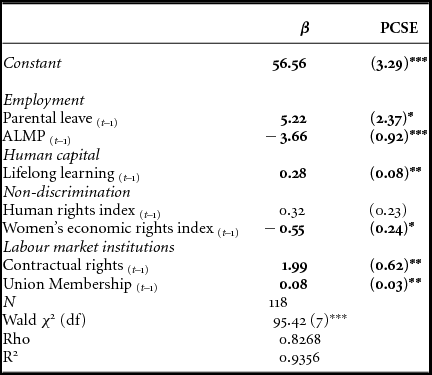
Table 4 shows the relationship between the various policies and institutional factors and employment rates. Sensitivity analyses indicate that the inclusion of the AR1 variable in the model is responsible for the very high R-squared of 0.94 (see Beck and Katz, Reference Beck and Katz2004: 17. If the AR1 variable is removed and the dependent variable lagged, explanatory power remains satisfactory at 0.90. Statistically significant coefficients are in bold. The model statistics confirm the findings from Table 3: across this group of countries and time-period, parental leave, lifelong learning, contractual rights and union membership enhance employment. The multivariate model brings out the statistical significance of contractual and women's economic rights. The model also highlights the negative and statistically significant impact of ALMP on employment.
New welfare policies, institutions and employment rates, Prais Winsten regression with Panel Corrected Standard Errors (PCSE), 2001–2007
Notes: Prais Winsten regression with AR1 autocorrelation parameter and panel corrected standard errors (PCSE). Model estimated with Stata SE 11.1 with xtpcse command with AR1 option.
*p<0.05; **p<0.01; ***p<0.001.
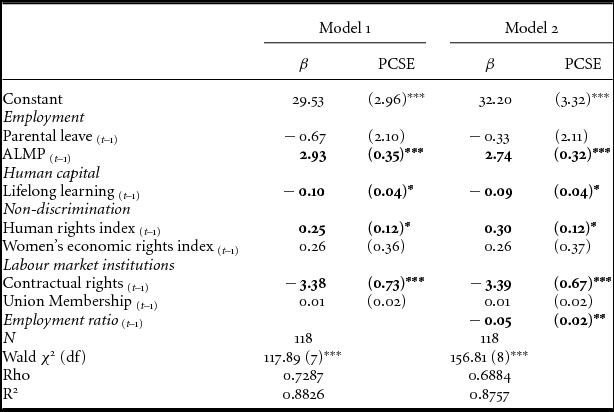
Table 5 examines the impact of new welfare policies on poverty. Two models are presented to address the argument that new welfare policies may reduce poverty through their employment effect, by helping low-income people move from benefits into work or to better paid jobs. In Model 1 the effects of the welfare variables on poverty are estimated. Model 2 includes employment rates (lagged one year). R-squared statistics for both models are satisfactory, at 0.88. In both models, ALMP training and human rights are associated with higher poverty; both contractual rights and, more weakly, lifelong learning reduce poverty. An increase in employment is also found to reduce poverty, yet by a very small amount (β = – 0.05, p<0.01) (Model 2). This confirms the negative and weak correlation found in Table 3 (r = –0.14, p>0.05). The positive effects of ALMP and the negative effect of contractual rights are similar to those in Table 3, while lifelong learning and employment now become statistically significant. The relationship with contractual rights is the strongest and most highly significant in the models. One explanation of why such rights reduce poverty while union membership plays a limited role is that they apply across the labour market, while unions may deploy defensive strength in the interests of particular groups, especially in the more dualised economies. Parental leave, which increases employment, reduces poverty, but the effect is not significant.
New welfare policies, institutions and poverty, Prais Winsten regression with Panel Corrected Standard Errors (PCSE), 2001–2007
Notes: Prais Winsten regression with AR1 autocorrelation parameter and panel corrected standard errors (PCSE). Model estimated with Stata SE 11.1 with xtpcse command with AR1 option.
*p<0.05; **p<0.01; ***p<0.001.
These findings generally support the view that the new welfare objective of mobilising more people into paid work can conflict with that of increasing social inclusion and cutting poverty. Family-friendly working and lifelong learning improve employment, as expected. However policies which are not typically associated with new welfare such as stronger contractual rights and union membership appear more effective, and the new welfare policy direction of active labour market spending, especially on training, seems to reduce employment. In relation to the parallel objective of reducing poverty, lifelong learning has an effect, but contractual rights are much more powerful. Active labour market policies perversely seem to increase poverty, as do human rights. The fact that higher employment is weakly associated with lower poverty lends some limited support to the new welfare logic in this area. In general, the analysis supports the argument that the new welfare package is more successful in mobilising people into paid work than in addressing poverty. It also indicates that, while some new welfare programmes contribute to a reduction in poverty, it is institutional factors, such as contractual rights, which play the strongest role.
Conclusion
This article discusses the emergence of the family of policies sometimes described as ‘new welfare’ alongside traditional social contribution and tax-and-spend ‘old welfare’ during the past two decades. New welfare programmes have in common that they seek to improve employment rates and the productiveness of labour and to reduce poverty, thereby addressing both economic and social goals. They are attractive to business, because they offer an expanded and more highly skilled and productive labour force, to governments because they are cheaper than tax-and-spend and less likely to involve unpopular tax increases or jeopardise international competitiveness through higher borrowing and labour costs, and to voters because they promise better working conditions and opportunities and are seen as fairly rewarding individual effort. Because they include a number of different policy directions, they are amenable to the kind of compensatory political strategies analysed by Bonoli and Natali (Reference Bonoli and Natali2012).
Moves in these directions may help moderate an endemic conflict within western welfare states, reconciling the pressures for inequality that stem from capitalism operating across a global market with the demands for social progress associated with democracy. One risk is that programmes to mobilise and upskill the labour force may conflict with programmes to improve job quality and spread opportunities because they serve different interests.
An analysis of the impact of new welfare on employment rates and poverty, by market income measures in seventeen European countries during the years of confident prosperity (2001 to 2007), brings out these conflicts. The findings are limited by the available data and can only support the most general conclusions. They indicate that many new welfare policies are associated with higher employment, but that some (notably ALMP training) are also linked to higher poverty. Lifelong learning, however, both raises employment and reduces poverty. Higher employment in itself appears to have a limited impact on poverty outcomes, despite claims that more jobs are the best route to social inclusion. Other policies which are not typically part of the new welfare package, most notably stricter labour market regulations, have a stronger and independent effect in mitigating poverty, as is also shown in the OECD analysis (2011: 31).
These findings point to three conclusions. First, new welfare programmes have varied and complex effects and advantage some groups more than others. This reinforces Bonoli and Natali's analysis (Reference Bonoli and Natali2012) of the politics of new welfare as a domain of interaction, compromise and exchange between different interest groups. Secondly, if policy-makers are to lay equal stress on achieving social as well as the economic goals, there is a strong case for linking new welfare programmes to regulatory interventions, such as employment protection, and to stronger contractual rights across the board. These might help ensure that benefits flow to the weakest as well as the most productive groups in the labour force. Thirdly, the new welfare approach is based on a limited analysis of political forces in post-industrial globalised welfare states. This operates at an individual and micro-political rather than a macro level. It pays little attention to structural factors, such as the falling wage share and labour market deregulation and puts at the centre of its analysis the opportunities open to individuals and their capacity to grasp them. It downplays the enhanced structural power of capital in a more globalised world and the importance of corresponding action to strengthen the defensive capacity of labour.
Acknowledgements
We are grateful to Professor Armingeon and colleagues for the Comparative Political Dataset, to David Cingranelli, and colleagues for the Comparative Human Rights Dataset, to the EU for financing the research through the Inspires project (FP7/320221) and to Trude Sundberg for comments.