


In October 2015, Turkish President Recep Tayyip Erdoğan canceled a planned trip to Turkmenistan following the Ankara terrorist attack. In May 2014, he postponed a scheduled visit to Albania to travel to the site of the Soma mining disaster. Likewise, in 2011, a planned trip to Brussels—where he was to meet the leadership of the European Union (EU)—was deferred so that he could attend the funeral of Necmettin Erbakan, the founding leader of Turkey’s Islamist political movement. Unlike these sudden domestic developments disrupting high-level diplomatic travel, an even stronger constraint emerges during election campaigns. In the run-up to the March 2019 municipal elections, for example, Erdoğan embarked on a nationwide campaign marathon, addressing voters in 57 provinces and 14 districts within 48 days, often holding multiple rallies in a single day (TRT Haber 2019). Unlike unexpected crises, which may cause foreign visits to be postponed or rescheduled, such tightly packed campaign schedules systematically consume the time that leaders otherwise might devote to international diplomacy. This raises a broader question: To what extent do domestic commitments constrain participation in foreign-policy engagements?
The scholarly literature on leaders’ foreign travel is based on a simple argument: time and attention are the most finite resources available to those at the apex of political power (Balcı et al. Reference Balcı, Kim, Moyer, Meisel, McKee, Baturo, Woo, Choi, Ku, Van Rythoven and Holmes2025). Because leaders are at the center of decision making, their direct involvement creates what Lindsey and Hobbs (Reference Lindsey and Hobbs2015) famously described as an “executive bottleneck.” Foreign trips, therefore, carry a built-in tension. Especially during periods of intense domestic pressure—most notably, election campaigns—the share of time devoted to external affairs tends to decline markedly. Face-to-face diplomacy, like campaigning, cannot be delegated downward through the bureaucracy. It demands a leader’s personal presence and, with it, careful calculation about how to allocate limited attention across competing domestic and international priorities. Time spent preparing for, undertaking, and following up on overseas visits is time not spent managing the economy, shepherding legislation, and cultivating electoral support at home. The literature consistently frames these choices in terms of “opportunity costs” (Malis and Smith Reference Malis and Smith2021, 241; Ostrander and Rider Reference Ostrander and Rider2019, 839): when leaders are abroad, they necessarily are absent from the domestic political arena that most directly shapes their survival.
Face-to-face diplomacy, like campaigning, cannot be delegated downward through the bureaucracy.
This article examines whether the electoral constraints on leader diplomacy identified in the US context apply to a non-US case with frequent elections, intense campaign mobilization, and an active foreign policy. Existing knowledge about the relationship between elections and leaders’ foreign engagement is derived largely from studies of the United States. Outside of the US context, only one study—on India (Kutty and Ladwig Reference Kutty and Ladwig2025)—considers election proximity as a possible determinant of leadership travel; however, electoral dynamics are not its primary focus. The Turkish case provides a valuable setting for examining this question for two reasons. First, despite authoritarian tendencies in recent years, Turkey remains a highly competitive electoral system characterized by high participation rates and closely contested parliamentary and municipal elections (Aras and Helms Reference Aras and Helms2021; Dalay and Toremark Reference Dalay and Toremark2024). These conditions require party leaders to devote substantial time and attention to domestic campaigning. Second, Turkey is a major practitioner of leader diplomacy. Turkish leaders ranked 14th globally in diplomatic travel between 1990 and 2020—or seventh when the count was restricted to visits involving meetings with host-country leaders. During the 2010s, Turkey was the eighth most-active visiting country overall—or second, after France, when considering only visits with host-leader meetings (Moyer et al. Reference Moyer, Meisel, Szymanski-Burgos, Scott, Matteo, Kurkul, Hughes, Kettlun, McKee and Matthews2025).
Understanding when domestic political competition constrains leaders’ diplomatic engagement helps to clarify how electoral incentives shape the allocation of leaders’ limited time and attention between domestic and international politics. Examining this relationship also sheds light on the conditions under which governments temporarily may reduce high-level diplomatic activity despite ongoing international demands. The article proceeds as follows. The first section reviews the theoretical debate on the relationship between elections and leaders’ foreign visits. The second section introduces the Turkish case and briefly discusses the extent to which Turkish leaders allocate their time to foreign-policy activities. The third section presents the empirical model and discusses the results of the study. The fourth section is the conclusion.
ELECTIONS AND FOREIGN VISITS
Whereas the broader literature recognizes that elections reshape leaders’ political incentives, surprisingly little empirical research examines how electoral competition affects the allocation of leaders’ time to foreign diplomacy. Lindsey and Hobbs (Reference Lindsey and Hobbs2015) provided the most direct test using monthly data on US presidential activity; however, no comparable analyses exist outside of the United States. They conceptualized elections as an “exogenous shock” that systematically alters the distribution of presidential attention. Leaders face numerous domestic demands, from legislative bargaining to economic management. However, elections provide a useful analytical benchmark because their timing is known in advance and their effects on political incentives are clear. As Lindsey and Hobbs (Reference Lindsey and Hobbs2015) noted, researchers often struggle to determine whether events drive attention or attention drives events. Elections largely avoid this problem because they impose predictable pressures on leaders’ schedules regardless of developments in the international environment (Lindsey and Hobbs Reference Lindsey and Hobbs2015, 1092). Their analysis revealed that the time US presidents devote to foreign policy declines significantly in the months preceding a presidential election.
This argument has been extended in the broader literature on leader visits and personal diplomacy. Because time and attention are scarce resources at the apex of political power, periods of intense domestic competition are expected to constrain leaders’ engagement abroad. Election years therefore often are portrayed as moments when foreign travel declines due to the opportunity costs imposed by domestic campaigning. Incumbent leaders must devote considerable time to rallies, party organization, and electoral competition, leaving less capacity for international diplomacy (Cavari and Ables Reference Cavari and Ables2019, 315). Empirical evidence from the United States largely supports this expectation. Ostrander and Rider (Reference Ostrander and Rider2019, 844) showed that US presidents spend approximately six fewer days abroad during reelection years—a reduction of approximately 30%—because of what they described as the “executive bottleneck.” Cavari and Ables (Reference Cavari and Ables2019, 323) similarly found that presidents travel 35% less frequently and visit 38% fewer countries during election years. The magnitude of this decline also varies with the intensity of electoral competition: that is, presidents facing difficult reelection campaigns reduce foreign travel the most, whereas those confronting weaker challengers may scale it back less dramatically (Doherty Reference Doherty2009, 326). Electoral cycles also can affect incoming diplomatic travel. Foreign leaders often avoid visiting countries that are facing elections because uncertainty about the incumbent’s political future may complicate diplomatic commitments (Malis and Smith Reference Malis and Smith2021, 251).
Scholars also have identified more complex dynamics linking elections and diplomatic travel (Balcı Reference Balcı2024, 17). Studies suggest that electoral pressures occasionally may encourage rather than discourage foreign visits. Brace and Hinckley (Reference Brace and Hinckley1993), for instance, argued that presidents may deliberately schedule foreign trips during reelection campaigns to project a “presidential” image and enhance domestic approval. Leaders also may use foreign-policy actions to signal commitment to key constituencies. Matush (Reference Matush2023, 904) showed that leaders intentionally may provoke a “costly backlash” from foreign audiences shortly before an election to demonstrate ideological resolve to domestic voters. Despite this strategic behavior, the broader empirical literature generally finds that the net effect of electoral pressure is a reduction in foreign travel. When electoral constraints disappear—such as during a president’s second term, or final “lame-duck” years—leaders frequently expand diplomatic engagement abroad. Cavari and Ables (Reference Cavari and Ables2019, 324), for example, demonstrated that US presidents take substantially more trips and visit more countries during the final years of their administration as they seek to consolidate their foreign-policy legacy.
Although much of the literature on leader visits has developed through the US case, recent studies have begun to explore how electoral cycles influence diplomatic engagement in other democracies. These analyses broadly confirm that elections can reshape patterns of foreign travel, although the mechanisms may vary across institutional contexts. In the case of India, Kutty and Ladwig (Reference Kutty and Ladwig2025) identified a strategic division of labor within the executive branch. Their study showed that the Indian prime minister becomes significantly less likely to travel abroad during general election periods, thereby preserving time and attention for domestic campaigning. In contrast, the external affairs minister increases international travel in the year preceding an election. This pattern suggests that governments may attempt to maintain diplomatic engagement and generate positive foreign-policy headlines through cabinet ministers while preserving the head of government’s domestic-campaign presence. These findings highlight the institutional flexibility with which governments respond to the opportunity costs imposed by electoral competition.
Despite these advances, several gaps remain in the literature. First, empirical evidence linking elections and diplomatic engagement relies heavily on the US case, with only limited extensions to other democracies. Studies of France (Yang and Kuokštytė Reference Yang and Kuokštytė2025), Italy (Corda and Casiraghi Reference Corda and Matteo2025), and Israel (Kurt Reference Kurt2025), for example, examined patterns of leader visits but did not directly test how electoral cycles shape leaders’ allocation of time to foreign policy. The Indian case analyzed by Kutty and Ladwig (Reference Kutty and Ladwig2025) remains the only study that explicitly evaluates the electoral constraint on diplomatic travel outside of the United States.
Second, most existing analyses relied on yearly data, which risks obscuring the mechanism through which elections affect leaders’ schedules. Because electoral competition intensifies mainly in the final weeks or months before an election, treating the entire year as an election period introduces measurement error and may bias estimates toward null findings. Higher-frequency data, therefore, provide a more precise test of the attention-diversion mechanism identified by Lindsey and Hobbs (Reference Lindsey and Hobbs2015).
Third, the literature focuses almost exclusively on top executives and rarely considers the role of other senior political actors. With the exception of Kutty and Ladwig’s research (2025), foreign ministers largely are absent from the analysis, despite that in many parliamentary and semi-presidential systems they are prominent party officials who actively participate in election campaigns. Therefore, incorporating foreign ministers provides a more comprehensive measure of how electoral competition constrains a country’s diplomatic engagement.
THE TURKISH CASE
The Turkish case has several distinctive features that make it particularly well suited for examining how election campaigns affect foreign-policy engagement. First, all elections—including municipal contests—demand significant time and attention from national leaders. Both general and local elections are highly competitive, and even municipal setbacks can carry substantial political costs by shaping media narratives and voter perceptions of leadership performance (Bekaroğlu and Osmanbaşoğlu Reference Bekaroğlu and Osmanbaşoğlu2021, 15; Taşkın Reference Taşkın2021). In this sense, local elections often function as a de facto mid-term referendum on the incumbent leadership, which encourages party leaders to campaign intensively across the country. Second, similar to the United States and unlike many European countries, electoral campaigns in Turkey remain highly intense, with campaign rallies continuing to play a central role despite the expansion of modern communication technologies. Third, participation in election campaigns is not limited to party leaders; other senior party officials, including cabinet ministers, are actively mobilized to support candidates nationwide. Fourth, as a middle and regional power, Turkey maintains an active foreign policy and engages frequently in high-level diplomatic interactions.
The involvement of leaders in political party activities is not confined to the formal campaign period, which typically begins about two months before an election. Although it is difficult to systematically track all activities of Turkish political leaders, recently published volumes titled Aşkınan Koşan Yorulmaz (“Those Who Run with Love Never Tire”) provide detailed day-to-day records of President Recep Tayyip Erdoğan’s public schedule. These records illustrate the extent to which domestic political engagement occupies the president’s time even outside of election periods. In a non-election year such as 2025, for example, Erdoğan participated in 82 party-related events, including 24 provincial party congresses (AKY 2026). During the run-up to the 2024 municipal elections, he held 50 campaign rallies in different cities during February and March alone. Similarly, before the 2023 general elections, he organized 32 rallies and conducted extensive meetings with voters in earthquake-affected provinces (AKY 2025). These examples highlight the substantial time commitment that domestic party politics requires from national leaders in Turkey. These numbers also demonstrate that election months require a much higher level of leaders’ physical participation in campaign activities and that municipal elections demand a level of engagement comparable to that of general elections.
Election campaigns in Turkey also are demanding for ministerial-level party officials. On the eve of the 2024 municipal elections, for example, President Erdoğan instructed all ministers to participate actively in the campaign, telling them to “be present in the field and stay with citizens day and night until the election” (Milliyet 2024). As a result, senior cabinet members including Foreign Minister Hakan Fidan were mobilized for intensive domestic campaign activities. According to journalist Sedat Ergin’s (Reference Ergin2024) observations, Fidan took part in numerous campaign events across different cities, visiting local markets, attending party-organized iftar dinners (i.e., the evening meal that breaks the daily fast during Ramadan), and delivering speeches that occasionally combined domestic campaign messages with references to foreign-policy issues. Foreign policy therefore is not absent from Turkish election campaigns. Political parties devote space to foreign policy in their election manifestos and foreign-policy issues form part of campaign agendas (Yılmaz Reference Yılmaz2025). Yet, this domestic salience does not necessarily translate into more foreign travel during election periods. Instead, foreign-policy officials may be drawn into domestic campaign trips. Fidan’s campaign itinerary included stops in the cities of Kırıkkale, Bursa, Kırşehir, İstanbul, Adana, İzmir, and Ankara, and he often appeared alongside local mayoral candidates to support their campaigns. These examples illustrate how even those officials who are responsible for foreign policy are drawn into intensive domestic political mobilization during election periods.
Foreign policy constitutes a highly demanding domain of activity for Turkish leaders. As a long-time candidate for EU membership, a neighbor to protracted conflicts in the Middle East, and a country heavily dependent on energy imports, Turkey historically has pursued an active and outward-looking foreign policy. Its geographic location and the enduring legacy of the Ottoman past further reinforce this engagement with international affairs. Reflecting these structural pressures, Turkish leaders devote a significant portion of their time to diplomatic activity. In 2024, for example, the Turkish president engaged in foreign-policy–related activities on at least 150 of 365 days, amounting to 41.1% of the year (AKY 2025). These activities included overseas visits, meetings with visiting heads of state and government, receiving ambassadors’ credentials, telephone diplomacy, and participating in virtual international gatherings.
THE MODEL
This study focuses on leaders’ foreign travel rather than other forms of diplomatic engagement such as hosting foreign leaders, virtual diplomacy, and telephone diplomacy. Foreign travel imposes the highest time cost on leaders because it requires preparation, travel, and several days abroad. By contrast, hosting meetings and conducting telephone and virtual diplomacy usually can be accommodated within a leader’s domestic schedule. For example, during the intense campaign period of the March 2024 local elections, President Erdoğan combined daily campaign rallies with a dense diplomatic schedule in Ankara: hosting leaders such as Mahmoud Abbas and Volodymyr Zelenskyy, holding several calls with foreign counterparts, and receiving multiple ambassadors’ credentials. Foreign travel therefore provides a clearer indicator of how leaders allocate their limited time and attention between domestic politics and international diplomacy. A comparison of average visits across election-related and non-election months illustrates this pattern. Turkish leaders conducted, on average, 0.44 foreign visit in election months between 1990 and 2025, compared with 1.00 visit in the month immediately preceding an election and 1.25 visits two months prior. In all other months, the average increased to 1.70 visits (see online appendix figure A1).
To evaluate whether electoral campaigns reduce outgoing diplomatic engagement, I estimated count models of monthly official visits by Turkish heads of government and foreign ministers (Balcı Reference Balcı2026). Monthly data are necessary because election campaigns in Turkey intensify mainly in the two months preceding the vote; yearly data would combine election and non-election months and could mask the temporary decline in diplomatic travel. I compiled the visit data from official government records and newspaper archives, producing a monthly time series covering 1990–2025. Because the dependent variable—that is, the number of visits in a given month—is a discrete, non-negative count with a right-skewed distribution, I used Poisson regression models as the primary specification. As a robustness check, I also estimated negative binomial models, which relax the Poisson assumption that the conditional mean and variance are equal and allow for potential overdispersion in the data. Because election timing is predetermined institutionally and unrelated to diplomatic travel decisions, the risk of omitted-variable bias is limited. Moreover, month-of-year fixed effects and a linear year trend absorb seasonal patterns and long-term changes in diplomatic activity.
The key explanatory variables were constructed from a mutually exclusive three-window timing design: an indicator for the election month, an indicator for the month immediately preceding the election, and an indicator for the month two months prior; all remaining months served as the baseline. This design captured the gradual intensification of campaign activity in the run-up to Election Day while preserving a clean, non-election baseline against which each window was evaluated. Elections were defined to encompass both national legislative and presidential contests and local municipality elections because both types generate comparable domestic campaign pressures on incumbent officials (see online appendix table A4). In additional robustness checks, I re-estimated all models using Newey–West heteroskedasticity and autocorrelation-consistent standard errors with 12 monthly lags—which followed the approach of Lindsey and Hobbs (Reference Lindsey and Hobbs2015)—and found that my conclusions were unchanged (see online appendix table A3). I also replicated the analysis using the number of days spent abroad on diplomatic visits rather than the count of visits as the dependent variable (see online appendix table A1). The results remained substantively identical.
One concern is that foreign visits often are scheduled months in advance. Therefore, the observed decline might reflect strategic scheduling rather than an actual diversion of attention. Two considerations mitigate this concern. First, whereas some diplomatic trips are planned well in advance, others respond to evolving international developments and are organized on shorter notice. Second, even if leaders deliberately avoid scheduling foreign visits close to elections, this behavior itself reflects the opportunity costs imposed by electoral competition. Foreign-policy demands do not disappear during campaigns. Rather, leaders postpone or forego diplomatic travel in order to prioritize domestic political activities.
Foreign-policy demands do not disappear during campaigns.
RESULTS
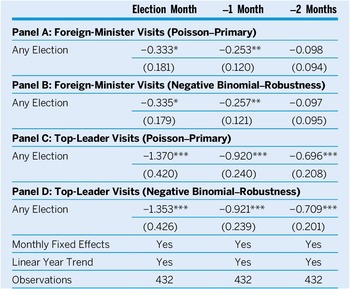
Table 1 presents results of the monthly models estimating the effect of elections on Turkey’s outgoing official visits. The table reports Poisson count models as the primary specification and negative binomial models as robustness checks, with separate analyses for foreign-minister and top-leader visits. All models include month-of-year fixed effects and a linear year trend to account for recurring seasonal patterns and long-term changes in diplomatic activity.
Effect of Turkish Elections on Outgoing Official Visits, 1990 m1–2025 m12

Table 1 Long description
The table is organized into four panels, each analyzing the effect of ‘Any Election’ across three time windows: Election Month, minus 1 Month, and minus 2 Months. All panels show negative coefficients, indicating a decrease in visits.
* Panel A: Foreign-Minister Visits (Poisson Primary). Election Month is minus 0.333 (p < 0.10); minus 1 Month is minus 0.253 (p < 0.05); minus 2 Months is minus 0.098.
* Panel B: Foreign-Minister Visits (Negative Binomial Robustness). Election Month is minus 0.335 (p < 0.10); minus 1 Month is minus 0.257 (p < 0.05); minus 2 Months is minus 0.097.
* Panel C: Top-Leader Visits (Poisson Primary). Election Month is minus 1.370 (p < 0.01); minus 1 Month is minus 0.920 (p < 0.01); minus 2 Months is minus 0.696 (p < 0.01).
* Panel D: Top-Leader Visits (Negative Binomial Robustness). Election Month is minus 1.353 (p < 0.01); minus 1 Month is minus 0.921 (p < 0.01); minus 2 Months is minus 0.709 (p < 0.01).
Standard errors are provided in parentheses below each coefficient. The bottom of the table confirms that all models include Monthly Fixed Effects (Yes), Linear Year Trend (Yes), and are based on 432 observations.
Notes: Robust standard errors are in parentheses. *p<0.10, **p<0.05, ***p<0.01. Coefficients are log incidence-rate ratios. Any Election=1 if a general (parliamentary or presidential) or municipality election falls in the timing window. Top-Leader Visits=prime minister trips before June 2018; president trips from June 2018 onward. All models include month-of-year fixed effects and a linear year trend.
The results reveal a substantial and temporally structured decline in leader-level diplomatic engagement during election periods, consistent with the executive-bottleneck hypothesis (see online appendix figure A2 for the coefficient plot). In the Poisson specification, the expected number of leader visits declined by approximately 75% in the election month (b=−1.370, p<0.01). The effect emerged even before the election month: leader visits were approximately 60% lower in the preceding month (b=−0.920, p<0.01) and approximately 50% lower two months prior (b=−0.696, p<0.01). The effect was detectable but more modest for foreign ministers. In the visit-count models—that is, the robustness models using days spent abroad provide stronger support (see online appendix table A1)—foreign-minister visits were approximately 28% fewer in the election month (b=−0.333, p<0.10). However, this coefficient should be interpreted as only marginally statistically significant. The effect was clearer in the month preceding elections, when foreign-minister visits declined by approximately 22% (b=−0.253, p<0.05), and the two-month window produced a smaller and statistically insignificant coefficient. This weaker pattern suggests that foreign ministers, unlike heads of government, retain greater institutional capacity to maintain routine diplomatic activity during election periods. The robustness of these findings was confirmed by the negative binomial specifications, which produced almost identical estimates across all timing windows and both outcome series. This reduced the possibility that results were an artifact of the Poisson equidispersion assumption.
Whereas this analysis focuses on electoral campaigns as the primary source of distraction from diplomatic engagement, other domestic developments also temporarily may disrupt leaders’ foreign-travel schedules. Sudden domestic crises—including terrorist attacks, industrial accidents, natural disasters, and a leader’s health problems—can demand immediate attention and constrain international mobility in ways unrelated to electoral cycles. To address this concern, online appendix table A2 re-estimates the main models with controls for coalition government and ReliefWeb-recorded disaster months. Coalition governments often are unstable; therefore, the political bargaining they require may create incentives for leaders to remain at home. The results were substantively similar to the main models: the leader-level election effects remained large and statistically significant across all three timing windows, whereas the foreign-minister coefficients remained negative but more modest. ReliefWeb-recorded disaster months were not significantly associated with visit counts. This latter finding was somewhat surprising, but it may reflect the fact that most sudden domestic events are short-lived and do not systematically alter a leader’s schedule during a month-long period. Finally, these two controls cannot capture every possible domestic disruption. The results therefore should be interpreted more cautiously as evidence that election timing remains strongly associated with reduced diplomatic travel after accounting for two observable sources of domestic political constraint.
CONCLUSION
This study demonstrates three interrelated findings with implications for how the relationship between domestic affairs and foreign-policy engagement is understood. First, electoral campaigns impose a substantial and temporally structured constraint on the diplomatic activity of Turkish leaders. Second, this constraint extends beyond the apex of the executive hierarchy—foreign ministers, who are prominent party figures actively mobilized for campaign activities, also reduce their diplomatic travel during election periods, although the effect is more modest. This pattern contrasts with evidence from India, where electoral periods produce a division of labor within the executive: prime-ministerial travel declines whereas foreign-ministerial travel increases (Kutty and Ladwig Reference Kutty and Ladwig2025). Third, the consistency of these findings across both general and municipal elections in a non-US political context suggests that the executive bottleneck is not an institutional artifact of the American presidency. Rather, it is a general feature of electoral regimes wherever leaders must personally compete for political survival.
...electoral campaigns impose a substantial and temporally structured constraint on the diplomatic activity of Turkish leaders.
It is important to acknowledge the limits of what can be inferred from this analysis and the challenges involved in assessing the broader consequences of leaders’ reduced attention to foreign affairs. Unlike studies of great powers, there are few reliable proxies that allow measurement of the outcomes of shifts in diplomatic attention in the Turkish case. Some indicators may appear suggestive but remain difficult to interpret. For example, research shows that terrorist activity in Turkey often increases during election periods (Özkan Reference Özkan2024). Yet, this pattern may stem from electoral dynamics themselves—such as strategic timing by violent actors—rather than from a decline in leaders’ attention to foreign policy (Aksoy Reference Aksoy2014). Future research could explore alternative indicators, including negotiation outcomes and crisis diplomacy, to better assess the substantive consequences of electoral constraints on foreign-policy engagement.
SUPPLEMENTARY MATERIAL
To view supplementary material for this article, please visit http://doi.org/10.1017/S1049096526102480.
ACKNOWLEDGMENTS
I thank Ayşe Nur Külünk and the anonymous reviewers for their constructive feedback and comments. Additionally, I thank the Turkish Academy of Sciences (TÜBA) for funding my academic studies. This research was supported by the Scientific and Technological Research Council of Türkiye (TÜBİTAK) under Grant No. 124R138.
DATA AVAILABILITY STATEMENT
Research documentation and data that support the findings of this study are openly available at the PS: Political Science & Politics Harvard Dataverse at https://doi.org/10.7910/DVN/AUVDK2.
CONFLICTS OF INTEREST
The author declares that there are no ethical issues or conflicts of interest in this research.


 Open access

