A primary developmental task during adolescence and young adulthood is to develop their identities, representing an answer to the question “Who am I?” (Erikson, Reference Erikson1950). Researchers have referred to the extent to which individuals form identities as crucial for understanding patterns of (mal)adaptation throughout the life span (Montgomery, Hernandez, & Ferrer-Wreder, Reference Montgomery, Hernandez and Ferrer-Wreder2008), which is also indicated in the fifth edition of Diagnostic and Statistical Manual of Mental Disorders (DSM-5, American Psychiatric Association, 2013). Erikson (Reference Erikson1968) emphasized that one's identity has valence (i.e., identity content valence) defined by socioculturally positive and negative identity elements, such as social roles, self-images, and values. Theoretically, youth having identities with high levels of positive (negative) identity elements show high levels of adaptative (maladaptive) functioning, whereas individuals’ adaptive (maladaptive) functioning becomes their positive (negative) identity elements (Erikson, Reference Erikson1968; Swann & Bosson, Reference Swann, Bosson, John, Robins and Pervin2008). However, empirical studies have conceptualized identities in terms of the processes through which youth form their identities (e.g., exploration and commitment; Crocetti, Reference Crocetti2018), and have neglected the valences of one's identity. To provide an appropriate understanding of the link between identities and (mal)adaptation, it is essential to consider identity content valences. Therefore, this study adds novel knowledge regarding the reciprocal associations between identity content valences and (mal)adaptation patterns in a longitudinal framework, which can have implications on how researchers and practitioners assist the healthy development of youth.
Identity development and identity content valences
Erikson's psychosocial theory emphasizes that overall valences of individuals’ identities (hereafter, referred to as “identity content valence”) are defined based on both socioculturally positive and negative identity elements, which are important aspects of the self that serve as a basis of their identities (e.g., social roles, self-images, and values; Côté & Levine, Reference Côté and Levine1987; Erikson, Reference Erikson1968; Schachter, Reference Schachter2005). The valences of identity elements (i.e., positive, negative, or neutral) are affected by desirable and undesirable images that are widely shared in the sociocultural contexts (“ideal and evil images”; Erikson, Reference Erikson1964, p. 31), such as good and bad and superior and inferior. Specifically, positive identity elements refer to socioculturally acceptable aspects, such as desirable characters/physical features (e.g., “I am healthy”), positive relationships (e.g., “I am close with my colleagues”), prosocial nature toward others/societies (e.g., “I want to get a job that contribute to our society”), internalization of socioculturally positive labels (e.g., “I am a student of a prestigious university”), and high self-worth/ability (e.g., “I am good at playing tennis”). In contrast, negative identity elements represent socioculturally unacceptable aspects, such as undesirable characters/physical features (e.g., “I am easily upset”), social rejection (e.g., “I do not have any friends”), defiant nature toward others/societies (e.g., “I hate people in my school”), internalization of socioculturally negative labels (e.g., “I am a member of delinquent group”), and low self-worth/ability (e.g., “I am a worthless person”) (Erikson, Reference Erikson1964, Reference Erikson1980; Way & Rogers, Reference Way, Rogers, McLean and Syed2015). Valences of one's identity are socially evaluated based on expectations in broader sociocultural contexts, which continue to change dynamically in history (Erikson, Reference Erikson1968). This sociocultural nature of valences capture aspects of youth development that have not been examined in other fields, such as positive psychology (e.g., virtues; Peterson & Seligman, Reference Peterson and Seligman2004) and positive youth development (e.g., adaptation to environment; Benson, Scales, Hamilton, & Sesma, Reference Benson, Scales, Hamilton, Sesma and Lerner2007).Footnote 1
Theoretically, youth generally attempt to develop identities that align with sociocultural expectations (i.e., positive identities) by internalizing positive identity elements and rejecting negative ones; this is because negative identity elements are assumed to be “irreconcilable” (Erikson, Reference Erikson1975, p. 20) aspects that may not be integrated with other identity elements in a coherent manner (Schachter, Reference Schachter2018). Conversely, some youth who lack positive identity options and who are experiencing severe identity crises (which causes a rearrangement of identity elements during childhood), form identities that are contrary to sociocultural expectations (i.e., negative identities) by choosing negative identity elements and rejecting positive ones (Erikson, Reference Erikson1964).
Although previous theoretical works have contributed to improving the understanding of valences in individuals’ identities, these identity content valences have largely been neglected in empirical studies. Researchers in this field have mainly relied on the identity status approach (Crocetti, Reference Crocetti2018; Marcia, Reference Marcia1966), which focuses on how youth deal with identity issues via the processes of exploration and commitment. Specifically, previous research based on this approach has defined youth with high levels of exploration and commitment as representing the “identity achievement” status, which is associated with positive adaptation (Crocetti, Jahromi, & Meeus, Reference Crocetti, Jahromi and Meeus2012). Meanwhile, some works have considered valence in one's identity (Umaña-Taylor, Yazedjian, & Bámaca-Gómez, Reference Umaña-Taylor, Yazedjian and Bámaca-Gómez2004), but these studies have been limited to the domain of ethnicity and rely on a measure that does not optimally capture negative valence (i.e., a single affirmation scale with ceiling and range restrictions). Thus, investigation of identity content valences defined by both positive and negative identity elements represents a missing aspect in empirical research regarding identity.
Associations of identity content valences with adaptive and maladaptive functioning
Several theories have suggested reciprocal relationships between identity content valences and (mal)adaptive functioning. On the one hand, individuals’ identity content valence may influence their (mal)adaptive functioning. Erikson's (Reference Erikson1968) psychosocial theory assumes that youth guide their adulthood-related decisions (e.g., career choices) in line with their identity content valences (Hihara et al., Reference Hihara, Sugimura and Syed2018; Schwartz et al., Reference Schwartz, Beyers, Luyckx, Soenens, Zamboanga, Forthun and Waterman2011). Similarly, identity negotiation theory (Swann & Bosson, Reference Swann, Bosson, John, Robins and Pervin2008) supposes that youth act consistently with their identity contents in order to present a consistent personality. These models imply that youth who have identities with high levels of positive identity elements make adulthood-related decisions adaptively and manifest high levels of desirable behaviors (e.g., prosocial behaviors). Conversely, youth who have identities with high levels of negative identity elements may navigate their lives in a socioculturally undesirable direction and exhibit high levels of maladaptive behaviors. For example, theorists have assumed that youth with negative identities are likely to show externalizing symptoms (Silverstein, Reference Silverstein1994), social withdrawal, and suicide (Erikson, Reference Erikson1968).
On the other hand, individuals’ (mal)adaptive functioning may influence their identity content valence. Erikson's (Reference Erikson1968) psychosocial theory and identity negotiation theory (Swann & Bosson, Reference Swann, Bosson, John, Robins and Pervin2008) posit that youth develop their identities based on interactions with and feedback from societies. As socioculturally desirable behaviors are likely to be accepted by societies, youth who manifest adaptation can perceive positive identity options in their societies, which then become important positive identity elements. Consistent with this view, one study reported that community involvement promoted political identity achievement (Hardy, Pratt, Pancer, Olsen, & Lawford, Reference Hardy, Pratt, Pancer, Olsen and Lawford2010). Conversely, since socioculturally undesirable behaviors are less likely to be accepted by societies, youth who exhibit maladaptation may lack positive identity options. Furthermore, such unacceptance may cause youth to clearly focus on negative identity options, which consequently become important negative identity elements (Erikson, Reference Erikson1980). Several studies have identified people with identities based on maladaptation, for example, individuals with tendencies for self-injury (Breen, Lewis, & Sutherland, Reference Breen, Lewis and Sutherland2013), and delinquency (Mak, Heaven, & Rummery, Reference Mak, Heaven and Rummery2003).
Despite these theoretical postulations, no empirical study has examined the interplay between identity content valences and (mal)adaptive functioning. Only one previous study investigated relationships between identity content valences and psychosocial beliefs (Hihara, Umemura, & Sugimura, Reference Hihara, Umemura and Sugimura2019). Hihara et al. (Reference Hihara, Umemura and Sugimura2019) assessed positive and negative identity elements by analyzing answers to the self-description-based question, “Who am I?” Of the study sample, individuals who had identities with high levels of positive identity elements and low levels of negative ones exhibited the highest level of social trust, while individuals who possessed identities with low levels of positive identity elements and high levels of negative ones showed the highest level of hostility toward society. Although these results indicate how individuals’ identity content valences are correlated with their social relationships, this study did not directly investigate reciprocal associations of identity content valences with (mal)adaptive functioning. Therefore, it is necessary to obtain empirical evidence in this regard.
Identity content valences and maladaptation among contemporary Japanese youth
Previous works on linkages between identity content valences and (mal)adaptation have predominantly focused on Western youth (e.g., Silverstein, Reference Silverstein1994). Thus, to obtain fundamental and comprehensive knowledge regarding these relationships, it would be useful to accumulate socioculturally specific findings. As a result, it is essential to consider youth from non-Western countries, such as Japan (Sugimura, Reference Sugimura2020).
Japanese youth may exhibit unique patterns of relationships between identity content valences and (mal)adaptation. The existing literature on negative identity has mainly focused on externalizing symptoms, such as delinquent (Burke, Zilberg, Amini, Salasnek, & Forkin, Reference Burke, Zilberg, Amini, Salasnek and Forkin1978) and criminal behaviors (Silverstein, Reference Silverstein1994). However, prior statistics have revealed that Japanese youth are less likely to engage in such externalizing psychopathology. For example, the proportion of youth that are victims of a physical assault or other types of crime in Japan is lower than the rate in many Western countries (OECD, 2009).
Alternatively, Japanese youth are likely to show internalizing psychopathology, such as hikikomori symptoms and suicidal ideation (Arnett, Žukauskienė, & Sugimura, Reference Arnett, Žukauskienė and Sugimura2014). Hikikomori symptoms are mental health problems characterized by acute social withdrawal (1.6% of Japanese people aged 15–39 years; The Cabinet Office of Japan, 2016). People with hikikomori symptoms withdraw into their homes and spend time lying in bed, engaging in communication over the internet, and so on (Furlong, Reference Furlong2008). Previous research reported that almost half of hikikomori cases (45.5%) did not experience psychiatric disorders (e.g., anxiety disorder and mood disorder) in their lifetime (Koyama et al., Reference Koyama, Miyake, Kawakami, Tsuchiya, Tachimori and Taleshima2010). Case studies have indicated that these individuals tend to withdraw to avoid failure in the future, not because of a psychiatric disorder (Suwa & Suzuki, Reference Suwa and Suzuki2013). In Japan, a certain number of young people have trouble keeping up with peers in a highly competitive educational system and have difficulty in deciding their future careers in an unstable labor market (Furlong, Reference Furlong2008). Accordingly, cases of hikikomori symptoms have been discovered in various countries around the world; however, the vast majority of cases have been found in Japan (Teo et al., Reference Teo, Fetters, Stufflebam, Tateno, Balhara, Choi and Kato2015; Teo & Gaw, Reference Teo and Gaw2010). Hence, hikikomori symptoms are closely related to the Japanese sociocultural context.
Suicide is another serious problem in Japan. The suicide rate among individuals aged 15–39 years is higher than any other age group, accounting for 39.4% of all deaths and the leading cause of death within this age group. Furthermore, Japan is the only developed country where suicide is the leading cause of death among individuals aged 15–34 years (Ministry of Health, Labor and Welfare, 2018).
Taken together, hikikomori symptoms and suicidal ideation are socioculturally relevant forms of maladaptation in Japan. Given the prevalence of hikikomori symptoms and suicidal ideation, Japanese youth having identities with high levels of negative identity elements may be likely to manifest these types of maladaptation rather than externalizing symptoms. In addition, youth showing socioculturally relevant maladaptation may tend to receive negative feedback and internalize negative identity elements based on such maladaptation. Thus, in the present study we focused on hikikomori symptoms and suicidal ideation.
The present study
The purpose of the present study was to examine reciprocal relationships between identity content valences and (mal)adaptive functioning among Japanese young adults. We collected three-wave longitudinal data with six-month intervals. To examine associations between identity content valences and (mal)adaptive functioning, we first assessed degrees of positive and negative identity elements, employing the procedure used in Hihara et al. (Reference Hihara, Umemura and Sugimura2019). This strategy is consistent with an essential part of Erikson's (Reference Erikson1968) theory, which assumes that one's identity content valence is defined by both positive and negative identity elements. Second, we examined reciprocal associations between degrees of positive and negative identity elements and (mal)adaptive functioning using three-wave longitudinal data. We examined multiple aspects of (mal)adaptive functioning, including socioculturally relevant indices for Japanese youth. Meanwhile, we assessed adaptive functioning by prosocial behaviors (Erikson, Reference Erikson1968; Hardy et al., Reference Hardy, Pratt, Pancer, Olsen and Lawford2010). In addition, in accordance with theoretical assumptions that possessing identities with high levels of negative identity elements leads to externalizing and internalizing maladaptive functioning (Erikson, Reference Erikson1968; Silverstein, Reference Silverstein1994), we examined externalizing symptoms, hikikomori symptoms, and suicidal ideation. We included age and gender as covariates based on previous findings indicating the moderate roles of age and gender on relationships between identity and adaptive (Crocetti et al., Reference Crocetti, Jahromi and Meeus2012) and maladaptive (Hatano, Sugimura, & Crocetti, Reference Hatano, Sugimura and Crocetti2016) functioning.
Following the suggestions that there are reciprocal associations between identity content valences and (mal)adaptive functioning (Erikson, Reference Erikson1968; Swann & Bosson, Reference Swann, Bosson, John, Robins and Pervin2008), we developed two hypotheses. First, regarding the effects of identity content valences on (mal)adaptive functioning, we hypothesized that, whereas positive identity elements would predict higher levels of adaptive functioning, negative identity elements would predict higher levels of maladaptive functioning. Second, regarding the effects of (mal)adaptive functioning on identity content valences, we hypothesized that, whereas adaptive functioning would positively predict positive identity elements, maladaptive functioning would positively predict negative identity elements. In addition, based on Erikson's (Reference Erikson1968) theory, which emphasizes the role of the balance between positive and negative identity elements on (mal)adaptation, we explored the interaction effects of positive and negative identity elements on (mal)adaptive functioning.
Method
Participants
Data for this longitudinal study were collected across three measurement waves, with six-month intervals, using MACROMILL (http://www.macromill.com/), an online research company. At Time 1 (T1), 2,313 Japanese young adults who are in higher education (i.e., university students, technical school students, and junior college students) answered the questionnaires.Footnote 2 Of these, the number who participated at Time 2 (T2) and Time 3 (T3) was 912 (39.43%) and 448 (19.37%), respectively. The timeline for entering the labor market has been prolonged in Japan (Côté & Levine, Reference Côté and Levine2015), and most high school students (about 70%) enter higher educational institutions (Ministry of Education, Culture, Sports, Science and Technology in Japan, 2019). Considering that youth in Japan make a variety of identity-related decisions (e.g., career choice) during young adulthood (Schwartz et al., Reference Schwartz, Beyers, Luyckx, Soenens, Zamboanga, Forthun and Waterman2011), they may experience rapid changes in their identities in this period. A previous study suggested that identity-related distress, which is assumed to be closely related to identity content valences, substantially changes across adolescence and young adulthood (Palmeroni et al., Reference Palmeroni, Claes, Verschueren, Bogaerts, Buelens and Luyckx2020). In addition, the majority of Japanese institutions of higher education adopt the semester system, in which students receive credit for a course in six months and begin to study more advanced content in the next six months. In other words, students may have the opportunity to deepen and clarify their life paths and identities in various domains every six months. Hence, we expected that this middle-term longitudinal research design is appropriate for the purpose of this study, which captures rapid changes in identity. Our longitudinal data are available on https://osf.io/9hp3m/.
At all three time points the majority of the participants were women; 70.95% at T1, 72.37% at T2, and 67.19% at T3. The mean age at T1, T2, and T3 was 20.43 (SD = 1.57, range = 18–25), 20.97 (SD = 1.50, range = 18–26), and 21.52 years (SD = 1.55, range = 19–26), respectively. Across all three time points, most of the participants were students in higher education: 100% at T1, 99.01% at T2, and 77.01% at T3. Most of the participants lived in urban areas (i.e., Kanto, Chubu, and Kansai) in Japan: 75.75% at T1, 77.52% at T2, and 78.79% at T3. In terms of parents’ education, 62.50% of the participants’ mothers and 62.17% of the participants’ fathers had completed higher education.
To examine missing data, we administered Little's (Reference Little1988) missing completely at random (MCAR) test to the entire sample (N = 2,313). This returned a significant result (χ2 (366) = 466.82, p < .001), suggesting that the data may not be missing completely at random. In addition, we compared respondents who did or did not participate at T2 and T3, respectively, in terms of the study variables and demographic variables at T1. A series of t tests indicated that those who participated at T2 scored higher on age, compared to those who did not participate at T2 (t (2,311) = 2.67, p = .008). Meanwhile, respondents who participated at T3 exhibited lower scores on prosocial behaviors (t (2,311) = 3.30, p = .001) and higher scores on age (t (2,311) = 2.20, p = .028), compared to those who did not participate at T3. However, these effect sizes were small (Cohen's d = 0.11–0.17). Furthermore, chi-square tests revealed no significant gender differences in the distribution of participants who did or did not report at T2 (χ2 (1, N = 2,313) = 1.48, p = .224, Cramer's V = .03) and T3 (χ2 (1, N = 2,313) = 3.81, p = .051, Cramer's V = .04). In order to conduct reliable estimation based on data with missing values, we used full information maximum likelihood (FIML) strategy that estimated model parameters using all available information, including participants who had missing data (Enders, Reference Enders2010). In addition, we utilized a maximum likelihood robust estimator (Satorra & Bentler, Reference Satorra and Bentler2001) in Mplus 8.3 (Muthén & Muthén, Reference Muthén and Muthén1998–2017) to deal with deviations from a normal distribution for the study variables.
Procedure
At T1, registrants of the research company who were students in higher education received an e-mail, which comprised (a) descriptions of the study purpose and (b) a hyperlink for participating in the web-based survey. There was a possibility that an item regarding suicidal ideation would make respondents feel mentally burdened; therefore, in the descriptions of the study purpose we clearly explained that the questionnaires included such an item. Across all time points, only those who provided signed informed consent answered the questionnaires. Those who participated at T1 also received the e-mails for participation at T2 and T3. Respondents received approximately 0.50 USD as rewards for answering the questionnaires at each time point. This longitudinal study was approved by the Ethical Committee of Hiroshima University in Japan.
Measures
Identity content valences
Degrees of socioculturally positive and negative identity elements were measured by applying the strategy used by Hihara et al. (Reference Hihara, Umemura and Sugimura2019). This procedure involves the use of the Twenty Statements Test (TST; Kuhn & McPartland, Reference Kuhn and McPartland1954), which asks individuals to write up to 20 self-descriptive statements in response to the identity-related question: “Who am I?” Obtained self-descriptions are spontaneously expressed aspects of individuals’ identities but are not self-reports of their attitudes; hence, these descriptions can be regarded as important aspects of the self that serve a basis of one's overall identity. The TST can be used to identify respondents’ identity elements and the degree to which each identity element defines their overall identity (e.g., McGuire & Padawer-Singer, Reference McGuire and Padawer-Singer1976). Thus, our strategy assessed both positive and negative identity elements, which enabled us to accurately understand identity content valences based on Erikson's postulations (Erikson, Reference Erikson1968). To prevent items of other variables from affecting contents of self-descriptions, the TST was placed at the beginning of our questionnaires. This procedure was validated through the mixed-methods approach, in which both quantitative and qualitative methods were used in combinationFootnote 3 (Hihara & Sugimura, Reference Hihara and Sugimura2017). Identity content valence can also be assessed by the narrative identity approach, which shares a linguistic orientation with TST (Syed & McLean, Reference Syed and McLean2016). The procedure using TST, which examines brief expressions of identity narratives, is appropriate for a longitudinal research design with a large sample, and can provide robust results (Hihara et al., Reference Hihara, Sugimura and Syed2018).
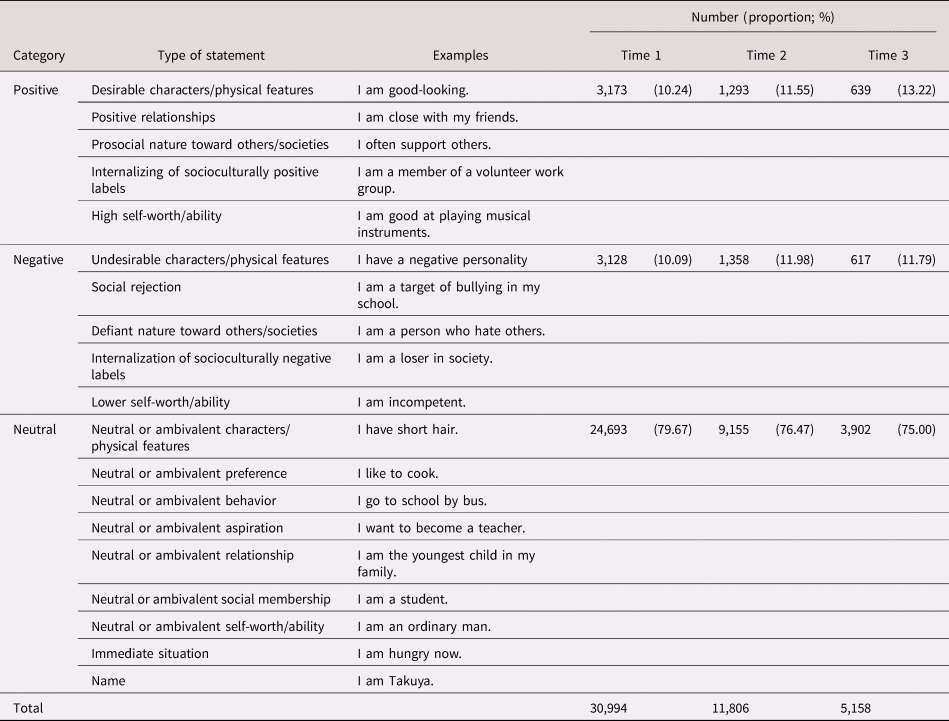
We categorized all of the TST responses into one of three categories: positive (i.e., statements representing socioculturally desirable roles), negative (i.e., statements representing socioculturally undesirable roles), or neutral (i.e., statements representing both socioculturally positive and negative elements or neither) elements. Table 1 shows the types, examples, numbers, and proportions for each category. To accurately determine valences of one's self-descriptions defined by desirable and undesirable images that are widely shared in sociocultural contexts, the categorizations were made by two coders who were familiar with Japanese sociocultural contexts (the first author and one research assistant, who were blind to the purpose of this study). Coefficients of inter-rater reliability were acceptable across three waves (kappa coefficients ranged from .78 to .84). When there were disagreements regarding classification, the coders made a final decision after careful discussion. We regarded proportions (%) of positive and negative category responses as degrees of positive and negative identity elements, respectively.
Coding system for the Twenty Statements Test and the proportion of responses in each category

Prosocial behaviors
For all waves, prosocial behaviors were assessed using a subscale of the self-rated Strength and Difficulty Questionnaire (SDQ; Goodman Reference Goodman1997; for the Japanese version, see Youthinmind, 2020). This scale comprises five items (a sample item is: “I am helpful if someone is hurt, upset, or feeling ill”), which are scored using a 3-point Likert-type scale, ranging from 1 (not true) to 3 (certainly true). Cronbach's alphas were .66 at T1, .66 at T2, and .67 at T3.
Externalizing symptoms
At all time points, externalizing symptoms were assessed by the conduct problem (a sample item is “I get very angry and often lose my temper”) and hyperactivity (e.g., “I am constantly fidgeting or squirming”) subscales of the SDQ. Each subscale comprises five items that are scored using a 3-point Likert-type scale, ranging from 1 (not true) to 3 (certainly true). Scores for conduct problem and hyperactivity were averaged to calculate a composite measure of externalizing symptoms. Cronbach's alphas were .65 at T1, .67 at T2, and .69 at T3.
Hikikomori symptoms
For all waves, hikikomori symptoms were assessed using the hikikomori symptoms scale developed by the Cabinet Office of Japan (2010). This scale comprises four items (a sample item is “When bad things happen, I do not feel like I want to go outside”). To capture a wider range of their expression, we applied the approach of Umemura, Watanabe, Tazuke, Hirano, and Kudo (Reference Umemura, Watanabe, Tazuke, Hirano and Kudo2018), using a 6-point Likert-type scale ranging from 1 (absolutely not true) to 6 (absolutely true) for each item. Cronbach's alphas were .79 at T1, .81 at T2, and .83 at T3.
Suicidal ideation
For all waves, suicidal ideation was measured using one item from the Beck Depression Inventory –second edition (BDI-II; Beck, Steer, & Brown Reference Beck, Steer and Brown1996; for the Japanese version, see Kojima et al. Reference Kojima, Furukawa, Takahashi, Kawai, Nagaya and Tokudome2002), which was rated using a 4-point scale ranging from 1 (I don't have any thoughts of killing myself) to 4 (I would kill myself if I had the chance). Although there are several alternative measurement tools that assess suicidal ideation using multiple items (e.g., the Suicide Intent Scale; Beck, Kovacs, & Weissman, Reference Beck, Kovacs and Weissman1979), we used the single item from the BDI-II to minimize the mental burden of the respondents.
Analytic strategy
The present study provides a richer understanding of longitudinal associations between identity content valences and (mal)adaptive functioning by utilizing both between- and within-person approaches (Orth, Clark, Donnellan, & Robins, Reference Orth, Clark, Donnellan and Robins2020). The between-person approach, which has been examined mainly by cross-lagged panel model (i.e., CLPM; Little, Reference Little2013), compares individuals’ scores relative to others’ scores in the same sample. The within-person approach, which can be conducted by random intercept cross-lagged panel model (i.e., RI-CLPM; Hamaker, Kuiper, & Grasman, Reference Hamaker, Kuiper and Grasman2015), focuses on temporary fluctuations within individuals overtime. In other words, the CLPM estimates between-person prospective effects, whereas it does not accurately estimate within-person prospective effects (Hamaker et al., Reference Hamaker, Kuiper and Grasman2015). By contrast, the RI-CLPM estimates within-person prospective effects only, but not between-person prospective effects (Orth et al., Reference Orth, Clark, Donnellan and Robins2020). Based on theoretical postulation (Erikson, Reference Erikson1968; Swann & Bosson, Reference Swann, Bosson, John, Robins and Pervin2008), we can assume both between- and within-person effects. For example, regarding effects of identity content valences on (mal)adaptive functioning, the CLPM would indicate that youth having identities with relatively high levels of positive (negative) identity elements than others are likely to show subsequent higher levels of adaptation (maladaptation) than others; conversely, the RI-CLPM would reveal that youth having identities with higher levels of positive (negative) identity elements than usual at a particular measurement wave exhibit a subsequent increase in the levels of adaptation (maladaptation) at the next measurement wave. When both between- and within-person effects are theoretically assumed, it is preferable to conduct both the CLPM and RI-CLPM (Orth et al., Reference Orth, Clark, Donnellan and Robins2020). Thus, this study utilizes both the CLPM and RI-CLPM.
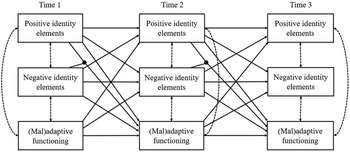
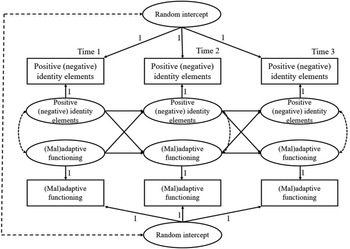
Specifically, in the CLPM with observed variables, positive and negative identity elements and all indicators of (mal)adaptive functioning were included together (see Figure 1). All cross-lagged paths, all stability paths, and all within-time correlations among the variables were estimated. In addition, the interaction effects of positive and negative identity elements on (mal)adaptive functioning were examined. Age and gender (0 = men; 1 = women) were included as control variables. In contrast, in the RI-CLPM, we estimated random intercepts for the levels of identity content valences and (mal)adaptive functioning to examine stable individual differences between respondents (see Figure 2). Within-person variance captures individuals’ overtime fluctuations relative to their own trait-level scores. The RI-CLPM allows us to examine relationships between within-person changes in identity content valences and (mal)adaptive functioning by separating trait-level individual differences from within-person fluctuations across three measurement waves. Consistently with the CLPM, all indicators of identity content valences and (mal)adaptive functioning were included together. We estimated all cross-lagged paths, all stability paths, and all within-time correlations among within-person components. Age and gender (0 = men; 1 = women) were included as control variables.
Conceptual model of the cross-lagged panel analysis linking between identity content valences and adaptive and maladaptive functioning. For the sake of clarity, within-time correlations are presented in dotted line, and paths from age and gender are not displayed.

Conceptual model of the random intercept cross-lagged panel analysis linking between identity content valences and adaptive and maladaptive functioning. For the sake of clarity, within-time correlations are presented in dotted line, and paths from age and gender are not displayed.

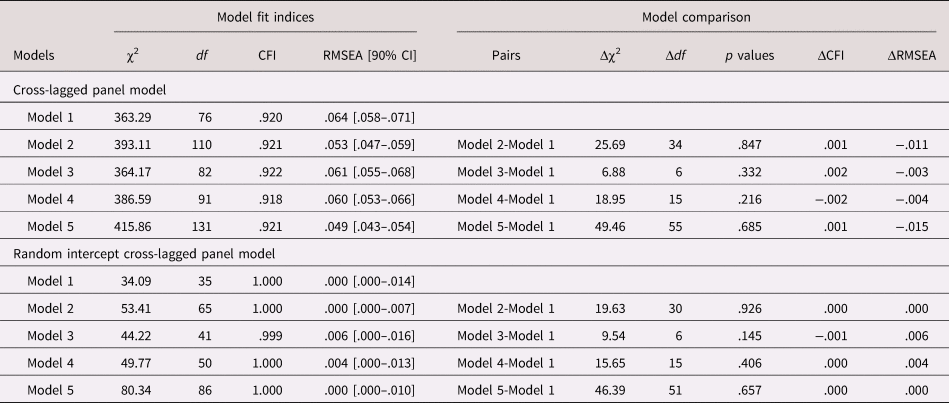
To make the CLPM and RI-CLPM as parsimonious as possible, we conducted time invariance tests for all cross-lagged paths, all stability paths, and all T2–T3 within-time correlations. We constrained within-time correlations across T2–T3, because within-time correlations at T1 (simple correlations) and those at T2–T3 (i.e., the degrees of relationships between over-time changes in identity content valences and (mal)adaptive functioning; correlated changes) had different meanings. An unconstrained model (Model 1) was compared to a model with time invariant cross-lagged paths (Model 2), a model with time-invariant stability paths (Model 3), a model with time-invariant T2–T3 within-time correlations (Model 4), and a model with time invariant cross-lagged paths, stability paths, and T2–T3 within-time correlations (Model 5). The fit of each model was evaluated using the comparative fit index (CFI) and the root mean square error of approximation (RMSEA). CFI values higher than .90 and RMSEA values lower than .08 indicate an acceptable fit (Chen, Reference Chen2007). To determine that the model fits significantly differed between models, at least two of the following three criteria had to be matched: $\Delta {\rm \chi }_{{\rm SB}}^2$ significant at p < .05, ΔCFI < −.010, and ΔRMSEA > .015 (Chen, Reference Chen2007; Satorra & Bentler, Reference Satorra and Bentler2001).
Results
Preliminary analyses
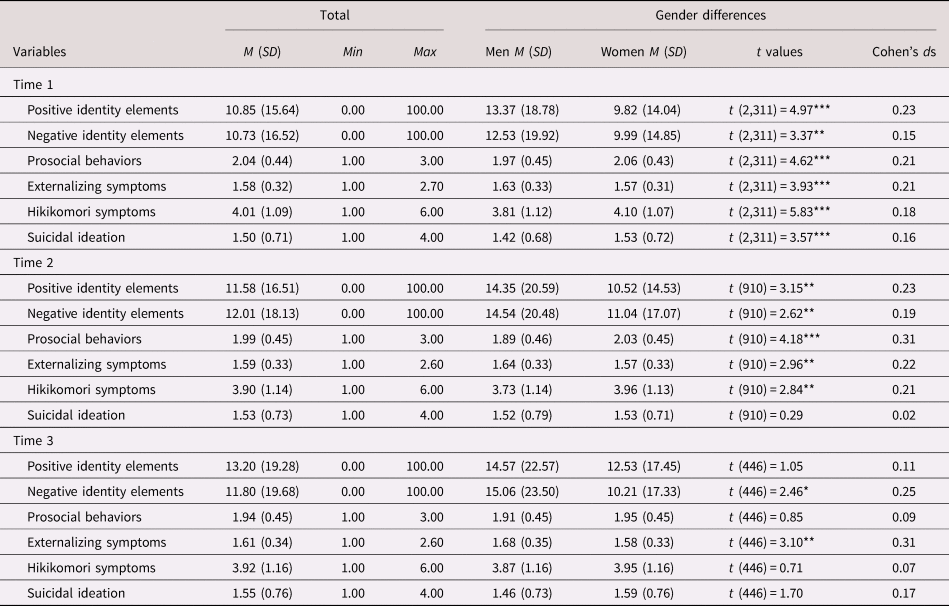
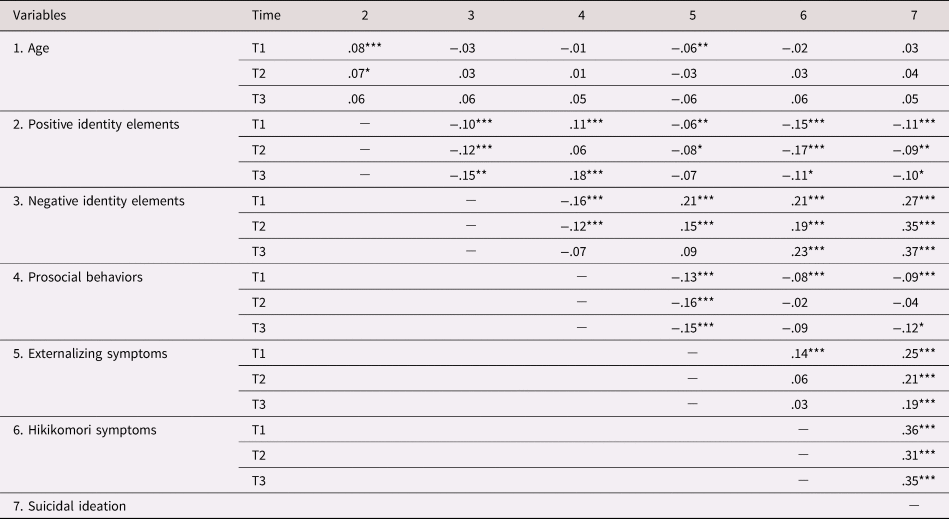
As a preliminary step, we performed descriptive analyses (Table 2) using SPSS version 25.0 (Arbuckle Reference Arbuckle2016). We explored gender differences in the study variables (i.e., positive and negative identity elements and [mal]adaptive functioning) using t tests. As presented in Table 2, when compared to men, women reported lower levels of positive identity elements at T1 and T2, negative identity elements across T1–T3, and externalizing symptoms across T1–T3. Meanwhile, women scored higher for prosocial behaviors at T1 and T2, hikikomori symptoms at T1 and T2, and suicidal ideation at T1, when compared to men. We then inspected associations among age and study variables. Age was positively associated with positive identity elements at T1 and T2 and negatively related to externalizing symptoms at T1 (Table 3).
Descriptive statistics for the study variables

Note. M = mean value; Max = maximum value; Min = minimum value; SD = standard deviation.
* p < .05, **p < .01, ***p < .001.
Within-time correlations among demographic characteristics and the study variables

Note. T = time.
* p < .05, **p < .01, ***p < .001.
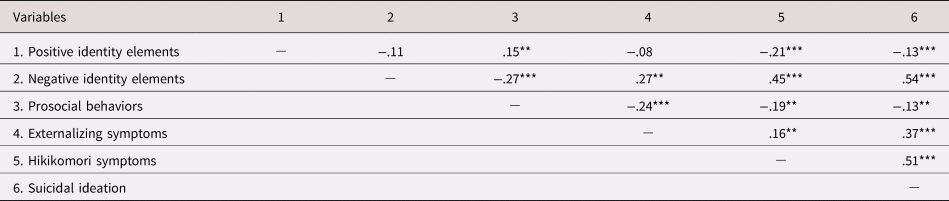
Within-time correlations among the study variables are presented in Table 3. Positive identity elements were positively associated with prosocial behaviors at T1 and T3, and negatively related to externalizing symptoms at T1 and T2, hikikomori symptoms across T1–T3, and suicidal ideation at T1 and T2. Meanwhile, negative identity elements were positively correlated with externalizing symptoms at T1 and T2, hikikomori symptoms across T1–T3, and suicidal ideation across T1–T3, and were negatively related to prosocial behaviors at T1 and T2.
Reciprocal associations of identity content valences with adaptive and maladaptive functioning
Between-person associations
To examine between-person relationships between identity content valences and (mal)adaptive functioning, we estimated a CLPM with observed variables. Based on the results of the abovementioned preliminary analyses, positive identity elements at T1 and T2 and externalizing symptoms at T1 were controlled by age; meanwhile, positive identity elements at T1–T2, negative identity elements at T1–T3, prosocial behaviors at T1–T2, externalizing symptoms at T1–T3, hikikomori symptoms at T1–T2, and suicidal ideation at T1 were controlled by gender. As results of time invariance tests, the most parsimonious model (Model 5) fitted the data equally well with an unconstrained model (Model 1) across these criteria (see Table 4). Consequently, cross-lagged paths, stability paths, and T2–T3 within-time correlations were constrained to be time invariant.
Fit indices and model comparisons for cross-lagged panel models and random intercept cross-lagged panel models

Note. T = Time; Model 1 = baseline model; Model 2 = model with cross-lagged paths fixed to be time invariant; Model 3 = model with stability paths fixed to be time invariant; model with T2–T3 within-time correlations fixed to be time invariant; Model 5 = model with cross-lagged paths, stability paths, and T2–T3 within-time correlations fixed to be time invariant; CFI = comparative fit index; RMSEA = root mean square error of approximation; 90% CI = 90% confidence interval; Δ = change in parameter.
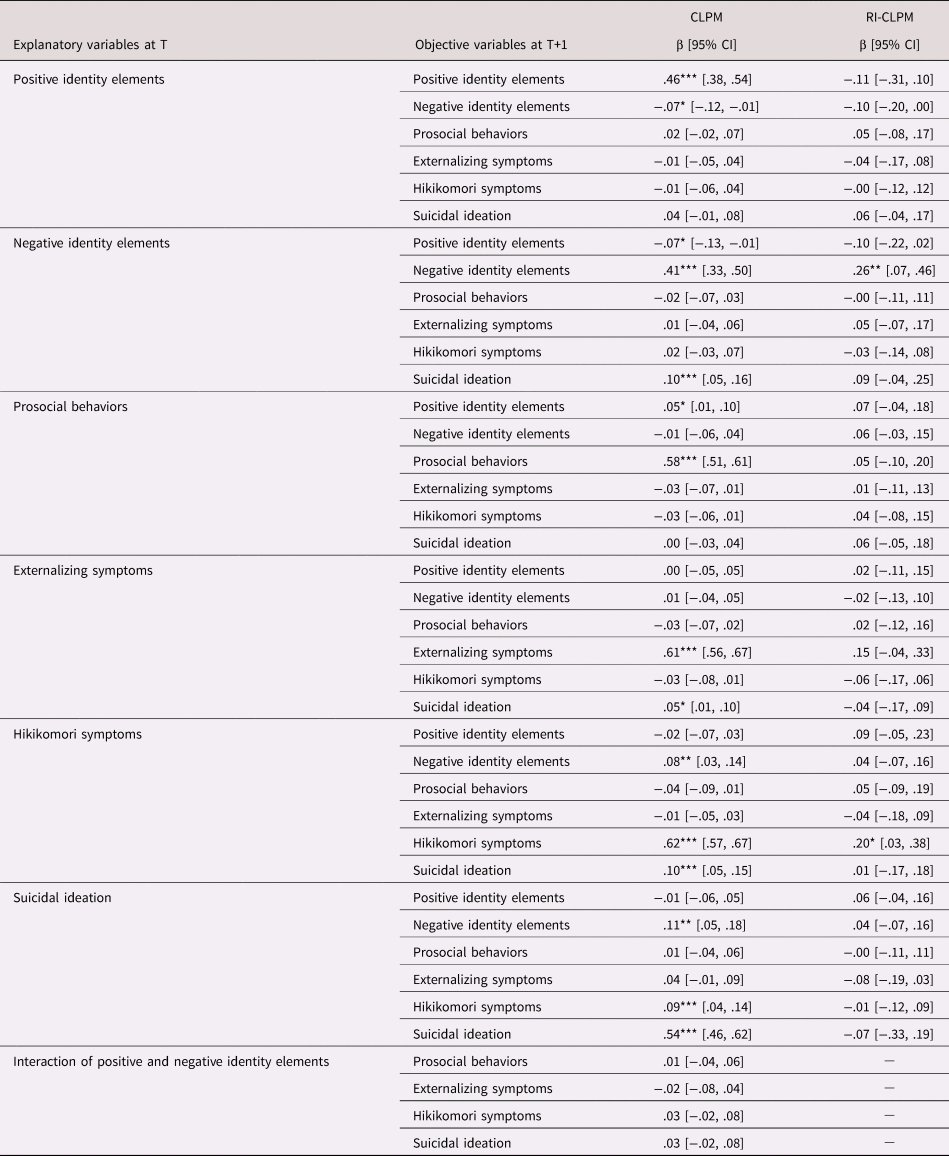
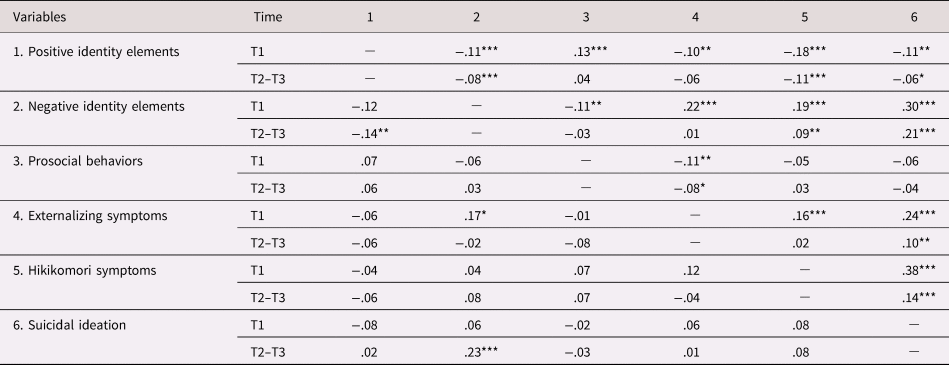
Cross-lagged paths and stability paths are reported in Table 5. Regarding cross-lagged effects of identity content valences on (mal)adaptive functioning, negative identity elements positively predicted suicidal ideation. By contrast, with regard to cross-lagged effects of (mal)adaptive functioning on identity content valences, prosocial behaviors increased later levels of positive identity elements; additionally, hikikomori symptoms and suicidal ideation predicted higher levels of negative identity elements. All interaction effects of positive and negative identity elements on (mal)adaptive functioning were not significant. Table 6 shows within-time correlations across T1–T3. At T1, positive identity elements were positively correlated with prosocial behaviors and negatively related to externalizing symptom, hikikomori symptoms, and suicidal ideation. Meanwhile, negative identity elements were positively associated with externalizing symptoms, hikikomori symptoms, and suicidal ideation, and were also negatively correlated with prosocial behaviors. Furthermore, at T2–T3, positive identity elements were negatively associated with hikikomori symptoms and suicidal ideation, whereas negative identity elements were positively associated with hikikomori symptoms and suicidal ideation.
Cross-lagged and stability paths for the cross-lagged panel analysis and random intercept cross-lagged panel analysis

Note. T = Time; CLPM = cross-lagged panel analysis; RI-CLPM = random intercept cross-lagged panel model; 95% CI = 95% confidence interval.
* p < .05, **p < .01, ***p < .001.
Within-time correlations for the cross-lagged panel analysis and random intercept cross-lagged panel analysis

Note. T = time; correlations and correlated changes in the cross-lagged panel model are displayed above the diagonal; correlations and correlated changes in the random intercept cross-lagged panel model are displayed below the diagonal.
* p < .05, **p < .01, ***p < .001.
Within-person associations
To examine within-person relationships between identity content valences and (mal)adaptive functioning, we estimated a RI-CLPM with observed variables (Hamaker et al., Reference Hamaker, Kuiper and Grasman2015). As reported in Table 4, the most parsimonious model (Model 5) fitted the data equally well with unconstrained model (Model 1) in terms of $\Delta {\rm \chi }_{{\rm SB}}^2$ , ΔCFI, and ΔRMSEA. Consequently, we constrained all cross-lagged paths, stability paths, and T2–T3 correlated changes to be time invariant.
Table 5 displays cross-lagged paths and stability paths at the within-person level. As for cross-lagged paths linking between identity content valences and (mal)adaptive functioning, no path was statistically significant. Stability paths were positive for negative identity elements and hikikomori symptoms. Regarding within-time relationships between identity content valences and (mal)adaptive functioning, as shown in Table 6, negative identity elements were positively related to externalizing symptoms at T1. Meanwhile, correlated changes between negative identity elements and suicidal ideation were positive across T2–T3. Table 7 shows the relationships between the random intercepts. Random intercept of positive identity elements was positively related to random intercept of prosocial behaviors and negatively associated with random intercepts of hikikomori symptoms and suicidal ideation. Meanwhile, random intercept of negative identity elements was positively related to random intercepts of externalizing and hikikomori symptoms and suicidal ideation, and negatively correlated to random intercept of prosocial behaviors.
Correlations between random intercepts in the random intercept cross-lagged panel analysis

**p < .01, ***p < .001.
Discussion
Erikson's theoretical postulation highlights that one's identity has valence defined by socioculturally positive and negative identity elements (Erikson, Reference Erikson1968; Hoare, Reference Hoare2013). However, existing studies of identity development have largely overlooked to investigate this identity content valence. The present study aimed to assess identity content valences in terms of positive and negative identity elements, and examine their associations with (mal)adaptive functioning among Japanese young adults. To obtain an in-depth understanding of these associations, the present study applied a longitudinal research design and examined both between- and within-person effects. In addition, we included indices that were socioculturally relevant to youth in Japan (i.e., hikikomori symptoms and suicidal ideation).
Associations of identity content valences with adaptive and maladaptive functioning
Concurrent associations
The present study's findings highlighted that positive and negative identity elements are associated with (mal)adaptive functioning in an inverse relationship. The CLPM revealed that, at T1, positive identity elements were positively related to prosocial behaviors and negatively related to externalizing and hikikomori symptoms, and suicidal ideation. Conversely, at T1, negative identity elements were positively related to externalizing and hikikomori symptoms and suicidal ideation, but negatively related to prosocial behaviors. In addition, these relationships were also found in the association between random intercepts obtained in the RI-CLPM. These findings are in accord with theoretical assumptions (Erikson, Reference Erikson1968; Hihara et al., Reference Hihara, Sugimura and Syed2018) that young adults who have identities aligned with sociocultural expectations exhibit adaptation, whereas those who have identities opposing sociocultural expectations exhibit maladaptation.
As for correlated changes between identity content valences and (mal)adaptation, the CLPM revealed that positive identity elements were negatively associated with hikikomori symptoms and suicidal ideation, whereas negative identity elements were positively correlated with hikikomori symptoms and suicidal ideation. Moreover, the RI-CLPM indicated that negative identity elements were positively related to suicidal ideation at the within-person level. In other words, over-time decrease (increase) in positive (negative) identity elements corresponds with an increase in hikikomori symptoms and suicidal ideation, highlighting that identity content valences are longitudinally correlated with socioculturally relevant indices.
Effects of identity content valences on adaptive and maladaptive functioning
Several theoretical models imply that identity content valences can affect (mal)adaptive functioning. Specifically, Erikson's (Reference Erikson1968) psychosocial developmental theory assumes that youth navigate their various choices in adolescence and young adulthood in accordance with their identity content valence (positive or negative). Similarly, identity negotiation theory (Swann & Bosson, Reference Swann, Bosson, John, Robins and Pervin2008) supposes that individuals act in accordance with the contents of their identities in order to present a consistent personality. Our findings provide empirical evidence and, partly consistent with previous works (Hihara et al., Reference Hihara, Umemura and Sugimura2019), highlight that identity content valences affect (mal)adaptive functioning. These results were found only at the between-person level.
Regarding the effects of positive identity elements on adaptive functioning, we found that positive identity elements do not predict prosocial behaviors at either between- or within-person level, which was inconsistent with our hypothesis. Although previous cross-sectional studies based on the identity status approach have found positive relationships between identities and prosocial behaviors (Crocetti et al., Reference Crocetti, Jahromi and Meeus2012), to date, longitudinal research has only found evidence for these relationships in the religious identity domain (Hardy et al., Reference Hardy, Pratt, Pancer, Olsen and Lawford2010). Prosocial behaviors have multiple aspects, such as community, volunteer, and political engagement. Considering that maintaining harmonious relationships with society remains a powerful social practice in Japan (Sugimura & Mizokami, Reference Sugimura and Mizokami2012), forming identities with high levels of positive identity elements may have roles especially on promotion of community engagement among Japanese young adults.
Regarding the effects of negative identity elements on maladaptive functioning, negative identity elements predicted higher levels of suicidal ideation at the between-person level. This finding supported our hypotheses, which indicated that young adults with identities that oppose sociocultural expectations are likely to renounce their relationships with society and the world. The significant effects of negative identity elements on socioculturally relevant maladaptation suggest that young adults who possess negative identities reveal their maladaptation in socioculturally undesirable ways. In previous studies conducted in Western countries, theorists who have considered youth with negative identities have typically focused on externalizing psychopathology (e.g., criminal behaviors; Silverstein, Reference Silverstein1994). However, Japanese young adults who possess negative identities may be likely to exhibit internalizing psychopathology, such as renouncing their relationships with society (e.g., through suicide). It was intriguing that this effect was not found for hikikomori symptoms. This result may reflect that forming negative identities drives youth into extreme/radical behaviors (Hihara et al., Reference Hihara, Sugimura and Syed2018; Knutson, Reference Knutson, Alexander and Gleason1981). Suicide is an eternal way of passive renunciation from the society, whereas hikikomori can be considered a temporal solution. Therefore, suicidal ideation may be a stronger marker as an outcome of Japanese youth's negative identity, compared to hikikomori symptoms. Taken together with positive effects of hikikomori symptoms on negative identity elements, our results imply their dynamic developmental sequence; youth with hikikomori symptoms tend to construct identities based on negative identity elements, which subsequently manifest high levels of extreme/radical outcome, such as suicide.
Our results regarding the insignificant interaction effects of positive and negative identity elements on (mal)adaptive functioning are also worthy of attention. The results suggest that each identity element (positive or negative) may be separately associated with (mal)adaptive functioning. Our findings highlight that considering both positive and negative identity elements is important for fully understanding (mal)adaptation.
Effects of adaptive and maladaptive functioning on identity content valences
Most literature on the link between identity and (mal)adaptive functioning has predominantly neglected the issue of how individuals’ (mal)adaptive functioning are internalized into a core part of their identity. Based on the psychosocial theory (Erikson, Reference Erikson1968) and identity negotiation theory (Swann & Bosson, Reference Swann, Bosson, John, Robins and Pervin2008), we can expect that individuals’ (mal)adaptive functioning can also have an impact on their identity content valences. The results of the present study provide strong support for this hypothesis only at the between-person level.
Regarding the effects of adaptive functioning on positive identity elements, in accordance with our hypothesis, prosocial behaviors positively predicted positive identity elements at the between-person level. This result supports the theoretical assumption that young adults who manifest adaptive functioning are likely to have positive identities subsequently (Erikson, Reference Erikson1980; Hardy et al., Reference Hardy, Pratt, Pancer, Olsen and Lawford2010). Individuals’ desirable cognition and behaviors are likely to be accepted by society, and such acceptance may provide young adults with positive identity options that can become important positive identity elements. In other words, engaging in prosocial behaviors helps an individual construct a sense of becoming a socioculturally desirable person, which has the role of “anchoring of man's transient existence” (Erikson, Reference Erikson1968, p. 42) in society.
Regarding the effects of maladaptive functioning on negative identity elements, hikikomori symptoms and suicidal ideation positively predicted negative identity elements at the between-person level. These findings support our hypotheses, indicating that young adults who show high levels of maladaptation tend to hold negative identities subsequently. Young adults who show maladaptive functioning are likely to receive negative feedback. When young adults with severe identity crises notice possible negative identity options from such feedback, they may attempt to solve their identity crises by prematurely fixating on these negative identity elements (Erikson, Reference Erikson1964; Hihara et al., Reference Hihara, Sugimura and Syed2018). Our results, in accordance with those studies regarding individuals who form identities based on maladaptation (Breen et al., Reference Breen, Lewis and Sutherland2013; Mak et al., Reference Mak, Heaven and Rummery2003), support these theoretical propositions. Interestingly, these associations were found only for socioculturally relevant indices. Thus, young adults with socioculturally relevant maladaptation may be likely to receive negative feedback and internalize such maladaptation into core parts of their identities.
General conclusion
Overall, the present study highlighted the importance of focusing on one's identity content valence defined by positive and negative identity elements. Although developing identities with high levels of positive identity elements is adaptive, forming identities with high levels of negative ones is maladaptive. Our findings also revealed that, consistent with suggestions from several theories (Erikson, Reference Erikson1968; Swann & Bosson, Reference Swann, Bosson, John, Robins and Pervin2008), identity content valences and (mal)adaptation interplay during young adults’ development. In addition, these relationships were found prominently for internalizing symptoms that were culturally relevant in Japan (i.e., hikikomori symptoms and suicidal ideation), not for externalizing symptoms that were the main focus in studies in Western countries; hence, these results suggested the importance of considering the sociocultural contexts. Nonetheless, it should be noted that these reciprocal relationships were not confirmed at the within-person level. This might be because the length of longitudinal research design in this study (i.e., one-year length with six-month intervals) was short to capture within-person changes in identity content valences and (mal)adaptation. Despite this limitation, in summary, the present study adds significant knowledge regarding identity content valences and (mal)adaptive functioning among Japanese young adults, a topic that has largely been neglected in existing research.
Clinical implications
The present study provides three clinical implications for identity research, which is a type of research that requires an integration of developmental and clinical perspectives (Kaufman, Montgomery, & Crowell, Reference Kaufman, Montgomery and Crowell2014). First, the observed effects of maladaptive functioning on negative identity elements suggest that clinicians should not impose socioculturally negative labels on youth who show maladaptive functioning. Erikson mentioned that, if clinicians diagnose or treat young people as inherently negative people, they will choose “a negative identity, [and] that young person may well put his/her energy into becoming exactly what the careless and fearful community expects him/her to be” (Erikson, Reference Erikson1980, p. 175).
Second, reciprocal relationships between negative identity elements and socioculturally sensitive maladaptation suggest that the perspective of identity content valence is useful for understanding socioculturally relevant maladaptation. For example, while previous studies have revealed associations between hikikomori symptoms and interpersonal difficulties (Yong & Nomura, Reference Yong and Nomura2019) and other psychopathological conditions (e.g., mood disorder; Koyama et al., Reference Koyama, Miyake, Kawakami, Tsuchiya, Tachimori and Taleshima2010), few empirical studies have examined relationships between hikikomori symptoms and identity (Hihara, Ishibashi, Umemura, & Sugimura, Reference Hihara, Ishibashi, Umemura and Sugimura2020). The present study provides clinicians with a new perspective for helping youth who have socioculturally relevant maladaptation.
Finally, the effects of adaptive functioning on positive identity elements imply that early intervention strategies for promoting positive identity elements may be effective. Researchers (Eichas, Montgomery, Meca, & Kurtines, Reference Eichas, Montgomery, Meca and Kurtines2017; Hihara et al., Reference Hihara, Sugimura and Syed2018) have proposed several organizational supports, which promote positive identity development through prosocial activities (e.g., volunteerism and group work that can encourage self-discovery). Based on the findings of the present study, future research should examine whether these intervention programs help youth develop identities with high levels of positive identity elements.
Strengths and limitations of the present study, and suggestions for future research
Our findings should be considered in terms of both strengths and limitations, which can represent important information for future studies. The first strength is that the present research expands knowledge of the link between identity and (mal)adaptive functioning based on Erikson's theorization, which highlights that positive and negative valences exist in one's identity (Hoare, Reference Hoare2013). We accomplished this by using the TST, which can accurately assess participants’ important positive and negative identity elements (Hihara et al., Reference Hihara, Umemura and Sugimura2019). However, use of this strategy involves the following three limitations. First, societal expectations may be shared among multiple social circles in some cases but not in other cases. Although in the present study two coders who are familiar with the sociocultural background of participants categorized all TST responses, future study should employ a wide variety of raters in terms of social positions. Second, while this research used variable-oriented approach, it does not provide in-depth understanding of how youth construct their identities based on positive and negative identity elements, which related to (mal)adaptation. A person-oriented approach, such as the narrative identity approach, would be useful for unpacking processes that youth construct coherent life stories (i.e., identities) by interweaving both positive and negative identity elements (Gyberg, Frisén, & Syed, Reference Gyberg, Frisén and Syed2019; Syed & McLean, Reference Syed and McLean2016). Moreover, based on this approach, future qualitative study can also examine how individuals’ (mal)adaptation become a central part of their identity. Finally, the TST can only examine positive/negative valences clearly expressed in short self-descriptions. The narrative approach is also effective to capture minute and complex nuance in valences.
A second strength was that we utilized a longitudinal research design and examined longitudinal associations with both the between- and within-person approaches. Although most previous studies that examined the link between identity and (mal)adaptive functioning were cross-sectional (Klimstra & Denissen, Reference Klimstra and Denissen2017), we provide important suggestions of the reciprocal associations between them. However, an important limitation is that the percentage of participants who provided data at all three waves was relatively small (i.e., 19.54% of the total sample at T1). Previous longitudinal research regarding identity among Japanese youth has also shown a low retention rate (e.g., 29.8% at T1 in Hatano & Sugimura, Reference Hatano and Sugimura2017). This may be because of the small reward provided for participation (i.e., approximately 0.50 USD), although this amount is a typical reward for participation in Japanese studies. We addressed this issue through full information maximum likelihood estimation following a series of missing data analyses (i.e., comparisons of those who did or did not participate at T2 and T3 and Little's MCAR test). Nonetheless, to obtain more robust results, future research should attempt to decrease attrition rate by raising rewards for participation. In addition, although we expected that the present sample experienced substantial changes in their identities, the mean level changes in the study variables were small, and stability paths were strongly positive. Moreover, all within-person effects linking between identity content valences and (mal)adaptation were statistically insignificant. Considering that developmental changes in the study variables have been found in long-term longitudinal studies (Hatano & Sugimura, Reference Hatano and Sugimura2017), it is necessary to collect longer-term longitudinal data in the future research.
A third strength was the inclusion of socioculturally relevant indices that afforded greater understanding of maladaptation among Japanese youth (i.e., hikikomori symptoms and suicidal ideation). We revealed the relationship between negative identity elements and such maladaptation, suggesting that identity content valences are important for understanding socioculturally relevant maladaptation. Future studies can further reveal these linkages by focusing on the following aspects. Firstly, although we used normative young adults and provided fundamental knowledge of normative development that is important for understanding (mal)adaptation (Sroufe & Rutter, Reference Sroufe and Rutter1984), it is also essential to include pathological youth. This may be useful for evaluating whether the small effect sizes in the present study are robust. Secondly, although most respondents in this study was women and higher educational students, future research should examine whether findings in this study are replicated using balanced data in terms of these sociodemographic variables. Thirdly, while a self-report strategy is useful to measure identity content valences, using this strategy for all (mal)adaptive functioning may have increased correlations among the study variables. For example, a positive self-description “I often support others” partly overlaps with an item of prosocial behavior “I am helpful if someone is hurt, upset, or feeling ill.” It is essential to utilize a multi-informant strategy for (mal)adaptive functioning in future research. Lastly, although we examined adaptive functioning only by prosocial behaviors, future studies need to include diverse indices of socioculturally relevant adaptation, such as construction of harmonic relationships with other people (Azuma, Reference Azuma, Shimizu and LeVine2001).
Conclusion
The present study examined identity content valences defined by positive and negative identity elements and provided significant knowledge regarding their associations with (mal)adaptive functioning, a topic that has largely been neglected. Our findings indicated that negative identity elements predicted high levels of maladaptive functioning at the between-person level. In addition, adaptive functioning positively predicted positive identity elements, whereas maladaptive functioning positively predicted negative identity elements at the between-person level. There results were remarkable for culturally relevant internalizing psychopathology in Japan (i.e., hikikomori symptoms and suicidal ideation), emphasizing the importance of considering the roles of sociocultural contexts on these linkages. We hope that researchers and practitioners focus on both socioculturally positive and negative aspects of identity and accumulate useful data that can improve interventions designed to help youth develop positive identities.
Financial Statement
This work was supported by grants the first author received from the Uehiro Foundation on Ethics and Education (Grant number A-066 and C-013).
Conflicts of Interest
None.