





Aboriginal Peoples’ occupation on what is now known as the Australian continent dates back over 60 000 years(Reference Rasmussen, Guo and Wang1). The Australian continent’s ecological diversity led to specific adaptations and intimate knowledge systems across Aboriginal Communities(Reference Morton, Stafford Smith and Dickman2–Reference Pascoe4). Despite this, colonial portrayals of Aboriginal Australians as primitive hunter-gatherers historically supported the doctrine of terra nullius (Reference Pascoe4,Reference Banner5) .
Moreover, this portrayal overlooks the sophisticated land management practices of Aboriginal Australians, evidenced by deliberate practices across over 250 Countries(Reference Pascoe4,6) . Greater understanding of the customs governing food relationships offers insight into Australian Aboriginal food systems. Such practices, collectively termed traditional foodways, encompass the social, cultural and economic practices, which influence food preferences, procurement, preparation and consumption(Reference Alkon, Block and Moore7).
Explorations of the traditional food systems of Aboriginal Australian Peoples have highlighted their complexity and intricate connections to Country and culture(Reference Gammage3,Reference Pascoe4,Reference Anderson, Elder-Robinson and Ferguson8) . Traditionally, the Aboriginal Australian diet was highly diverse and influenced by seasonal availability, provided essential nutrients and was sustained through physically intensive procurement(Reference O’Dea, Jewell and Whiten9). The arrival of Europeans had a profound impact on Aboriginal Peoples foodways. Many Aboriginal Peoples were forcibly removed from their traditional lands, restricted from traditional practices and subjected to government rations contrasting starkly with traditional foods. These rations reinforced government dependency, while contributing to the nutritional decline and demoralisation of Aboriginal Peoples(Reference Kuhnlein and Receveur10–Reference Haebich12).
Colonisation continues to profoundly impact Aboriginal Australians, who experience widespread health inequities, including a significant life expectancy gap, and disproportionate rates of chronic disease compared with non-Aboriginal Australians(13–16). Alongside this dietary shift, food insecurity(Reference Ferguson, O’Dea and Chatfield17,18) , reduced physical activity(14), socio-ecological disadvantages(14), systemic racism(Reference Paradies19) and intergenerational trauma(14) continue to contribute to health disparities. Similar health inequities have been observed in other global Indigenous populations, highlighting the shared impacts of forced dietary transition and ongoing colonisation(Reference McCartan, van Burgel and McArthur20). Despite this, Aboriginal Australian and global Indigenous foodways continue to evolve(Reference Anderson, Elder-Robinson and Ferguson8,Reference Kuhnlein and Receveur10) .
This scoping review focuses on the Kabi Kabi Peoples, who are the Traditional Sovereign Custodians of the lands across South East Queensland, including the areas of Moreton Bay, Sunshine Coast, Noosa, Maryborough and Gympie(Reference Adams21). The impacts of colonisation are reflected in Kabi Kabi Peoples’ Country, whose access to traditional lands, practices and foodways have been shaped by the disruption of colonisation from the year 1799 onwards. Kabi Kabi Peoples were subjected to violence and land dispossession as a result of settler expansion for timber and agricultural land(Reference Adams21,Reference Kerkhove22) . Despite this, small groups and families continued traditional practices into the 20th century(Reference Kerkhove22). Today, cultural festivals have re-emerged, notably the reimagining of the Bunya Nut Festival as the Bunya Dreaming(Reference Kinniment23), providing a space to celebrate the cultural revitalisation and continuation of Kabi Kabi Peoples(Reference Adams21,Reference Kerkhove22) . In the face of colonisation, a strength-based perspective highlights the resilience of the Kabi Kabi Peoples, Communities and families.
Research indicates that a return to a traditional diet improves health markers in specific Indigenous Communities, while supporting cultural identity and connection to Country(Reference Lewis, Lind and Møller24–Reference DeBruyn, Fullerton and Satterfield26). Access to traditional foods and cultural traditions fosters empowerment, healthy eating practices and self-determination(Reference Anderson, Elder-Robinson and Ferguson8,Reference Lopes, Mihrshahi and Ronto27,Reference Christidis, Lock and Walker28) . Historically, Australian Aboriginal health has been interpreted through a deficit-based lens, marginalising Indigenous knowledge systems and framing Western ideologies as superior(Reference Bryant, Bolt and Botfield29). Adopting a strength-based approach supports positive, long-term change(Reference Bryant, Bolt and Botfield29,Reference Prehn30) . However, limited synthesised research of specific traditional Aboriginal Australian food systems hinders Nation-specific, Community-led initiatives and the development of culturally grounded, evidence-based dietary strategies(Reference Anderson, Elder-Robinson and Ferguson8,Reference O’Dea, Jewell and Whiten9) .
Cultural mapping involves the documentation and visual representation of tangible (e.g. culturally significant species and places) and intangible (e.g. language, cultural practices and knowledge) cultural components to support education, intercultural dialogue and heritage and ecological management. As a strength-based approach, it facilitates the preservation and communication of Indigenous Peoples’ Knowledges and has the capacity to support cultural revitalisation(Reference Crawhall31).
Conversely, Western mapping methods have historically supported colonial agendas, particularly dispossession of Indigenous lands and reinforcing government control(Reference Mesquita32). Incorporating Indigenous Knowledges into the mapping process translates what may appear abstract through Western eyes into tangible forms to key decision makers. Furthermore, mapping supports learning, intercultural dialogue and management of heritage sites, while acknowledging that traditional Country extends beyond geographic areas, encompassing knowledge repositories, culture and memory(Reference Crawhall31).
However, culturally mapping has rarely been applied to traditional Aboriginal Australian food systems. In the context of this review, cultural mapping integrates historical and thematic evidence with the contemporary distribution of traditional food species identified from the literature to visually contextualise the relationship between people, traditional foods and food practices and Country. This scoping review aims to explore and synthesise literature on the traditional foods and foodways of the Kabi Kabi Peoples and to highlight any gaps in the existing literature.
Methods
Materials and methods
Given the exploratory nature of the research questions, a scoping review was deemed appropriate to identify and synthesise available research literature. Review findings informed the development of five cultural maps of Kabi Kabi/Gubbi Gubbi Country, a nutritional analysis of traditional foods and thematic analysis of traditional foodways and influencing factors.
Positionality and terminology
Due to the influential role of author positionality, it is important to highlight the research team’s composition. The lead author (TC) is a non-Aboriginal male Dietetics Honours Student. The team consisted of an Aboriginal academic (LS) and non-Aboriginal Australian (TC, JM and AL) members. LS is a Mandandanji Aboriginal Women, born on Kabi Kabi Country, and is a Senior Lecturer and nursing academic at the University of the Sunshine Coast (UniSC). JM is an academic supervisor on the project and a Senior Lecturer and nutrition and dietetics academic at UniSC. As non-Aboriginal Australians, TC, JM and AL approached this research with cultural humility, acknowledging the ongoing impacts of colonisation and the inequities experienced by Aboriginal and Torres Strait Islander Peoples. The researchers applied culturally safe, decolonising research practices, supporting cultural revitalisation and knowledge preservation and recognising that decolonisation is an ongoing, relational process(Reference Wilson33).
The term ‘Aboriginal’ is used to refer to Indigenous Peoples of mainland Australia and Tasmania and excludes Torres Strait Islander Peoples(34). The use of Kabi Kabi Peoples is informed by the written works of Dr Hope O’Chin, a Sovereign Custodian and Elder of the Kabi Kabi Peoples who was awarded a Doctor of Philosophy (2021) from the UniSC. The authors recognise that ‘Kabi Kabi’ and ‘Gubbi Gubbi’ are used interchangeably and thus included both terms in the search strategy to capture all relevant sources. All content was drawn from existing sources, with no direct engagement with the Kabi Kabi Peoples. Thus, the findings of this review represent a synthesis of the published literature rather than the perspectives of the Kabi Kabi Community.
In this review, the term ‘traditional foods’ is used to describe culturally significant foods, consumed across numerous generations(Reference Galli, Cavicchi and Santini35) reflecting this review’s focus on traditional diets and foodways.
Study design
This review was conducted in accordance with the Joanna Briggs Institute methodology for scoping reviews(Reference Peters, Godfrey, McInerney, Aromataris, Lockwood, Porritt, Pilla and Jordan36) and reported following the Preferred Reporting Items for Systematic Reviews and Meta-Analyses extension for Scoping Reviews(Reference Tricco, Lillie and Zarin37). Given the exploratory nature of the review questions, a scoping review was deemed appropriate to systematically identify, map and synthesise the breadth of available evidence from diverse sources relating to the traditional foods and foodways of the Kabi Kabi Peoples. A predefined protocol was developed a priori and is available through the UniSC Research Bank(Reference Castello, Stuart and Maher38) and Supplementary Material.
Research questions and objectives
The following research questions guided this review:
-
1. What foods were consumed in the traditional diet of the Kabi Kabi Aboriginal Australian Peoples, and in what proportions?
-
2. What are the traditional foodways of the Australian Kabi Kabi Aboriginal Peoples?
-
3. What key factors influence traditional food intake among the Australian Kabi Kabi Aboriginal Peoples, and how do elements such as seasonality and gender roles influence traditional foodways?
To address these research questions, the following objectives were established:
-
1. Synthesise the nutritional profiles of the traditional dietary components of the Kabi Kabi diet.
-
2. Thematically analyse the traditional foodways and factors influencing traditional dietary intake and foodways of the Kabi Kabi Peoples.
-
3. Develop cultural maps of significant traditional foods of the Kabi Kabi Peoples.
Search strategy
A search strategy was developed to identify relevant literature discussing traditional foods or foodways of the Kabi Kabi Peoples. Search terms were generated through an initial limited search of PubMed and Scopus before being adapted to each academic database where required. Subsequently, a systematic search of academic databases was conducted across PubMed, Web of Science and Scopus.
A comprehensive search of grey literature was undertaken and informed by Grey Matters guidelines (CADTH, 2015)(39). Searches were conducted across Google, Google Scholar, Trove, AIATSIS, Australian Indigenous HealthInfoNet, the State Library of Queensland, Moreton Bay Libraries, Sunshine Coast Libraries and the UniSC Library catalogue. Where required, physical sources identified through these catalogues were accessed from the respective library collections.
Searches were completed in December 2024, and the reference lists of extracted sources were screened for additional sources. For full search strategies see Supplementary Tables S1 and S2.
Eligibility criteria
Sources published in English only were included, with no restriction on publication date. Evidence from primary research, peer reviewed journal articles and meta-analyses met eligibility. Grey literature, including theses, dissertations, government reports, historical archives, traditional knowledge and published or recorded oral or written accounts, was included.
The PCC framework guided inclusion and exclusion criteria:
-
• Population (P): Literature focussed on the Kabi Kabi Peoples or Country.
-
• Concept (C): Sources describing traditional food consumption, traditional foodways or factors influencing dietary intake.
-
• Context (C): Australia and/or South-East Queensland.
Source selection
Results were imported into EndNote 21 (Clarivate Analytics) and duplicates removed. Screening and extraction were managed in Covidence (2024, Veritas Health Innovation), with additional duplicates removed. Two independent reviewers (TC and AL) screened titles, abstracts and full texts according to the eligibility criteria. Discrepancies were resolved through a third reviewer (JM).
Data extraction
Data extraction utilised a pre-prepared table developed by the research team capturing: (1) study details (title, authors, objective and article type); (2) traditional foods (food names, nutritional profile and quantities consumed); (3) foodways (procurement, preparation and storage); (4) influencing factors (seasonality, cultural significance, environmental and ethnobotanical information, transmission of knowledge, taste and sensory profile and additional details) and (5) reported findings (key findings, strengths and limitations and primary outcomes). Extraction was performed independently by two reviewers (TC and AL). Where reported, consumption quantities were extracted verbatim from the extracted source.
Quality assessment
Various quality appraisal tools were used across appropriate sources by a single reviewer (TC). Archaeological, qualitative, anthropological, ethnohistorical and historical narrative sources were appraised using the Joanna Briggs Institute critical appraisal checklists(Reference Lockwood, Munn and Porritt40,Reference McArthur, Klugarova and Yan41) .
Sources involving Aboriginal and Torres Strait Islander Communities were evaluated with the Centre of Research Excellence in Aboriginal Chronic Disease Knowledge Translation and Exchange Aboriginal and Torres Strait Islander Quality Appraisal Tool(Reference Harfield, Pearson and Morey42). Grey literature and community text were appraised according to the Authority, Accuracy, Coverage, Objectivity, Date, Significance checklist(Reference Tyndall43).
Traditional foods
Raw extracted food terms were exported into Microsoft Excel (2024, Microsoft Corporation). Food terms were extracted verbatim from the original sources, including Aboriginal Australian language names where reported, and subsequently standardised using common English names, allowing vague, inconsistent or colloquial descriptions to be consolidated for nutritional analysis.
Higher-order taxonomic categories (e.g. ‘fish’) were excluded where specific food terms (e.g. ‘mullet, whiting, bream’) were reported, supporting the accuracy of nutrient composition data. Broad categories were only retained where no further taxonomic detail was provided or were they represented a culturally distinct food.
After duplicates were removed, remaining terms were scored by frequency of reference. Food items cited ≥3 times were shortlisted to reduce the influence of anecdotal or sporadic mentions and subsequently screened for the availability of nutrient composition data. When numerous closely related species were cited, the most nutritionally distinct term was included.
Nutritional analysis
Macronutrients (energy, fat, saturated fat, protein and carbohydrates) and micronutrients (vitamins A and C, folate, Ca, Fe and iodine) were selected for their roles in biological functions, relevance to deficiency and excess intake and importance in nutritionally profiling the Kabi Kabi Peoples’ traditional diet. Traditional foods (n 68) were nutritionally analysed using Foodworks (2024, Xyris Software) and supplemented with data from Tables of Composition of Australian Aboriginal Foods(Reference Brand-Miller, Maggiore and James44). Nutrient profiles were compiled and standardised to 100 g edible portions in Microsoft Excel. When preparation methods or species were unspecified, the most likely nutritional equivalent was used. Nutrient values were expressed as a percentage of the recommended dietary intake for adults aged ≥19 years(45) based on 100 g edible portions to provide a comparative basis between foods and do not represent actual daily consumption.
Thematic analysis
Data on traditional foodways and influencing factors were analysed using deductive reflexive thematic analysis(Reference Braun and Clarke46) in Microsoft Excel. Thematic analysis was conducted by a single reviewer (TC). Content was coded during extraction according to predetermined categories, including procurement and preparation methods, storage, seasonality, cultural significance, taste and sensory profile and environmental knowledge. Gender roles emerged as an additional theme beyond the initial predefined categories.
Developing the cultural map
The five most frequently cited species from the food groups of plants, terrestrial mammals, fish, birds and other marine mammals were selected for cultural mapping: bunya pine (Araucaria bidwilli), kangaroo (Macropus spp.), mullet (Mugil cephalus), dugong (Dugong dugon) and emu (Dromaius novaehollandiae). Species distribution data were obtained from the Atlas of Living Australia, encompassing occurrence records from 1844 to 2025, restricted to Queensland occurrence data (animal presence, human observation, point occurrence) and mapped in QGIS (v3.42.2). The Kabi Kabi Peoples’ native title boundary was sourced from Queensland Globe (v2.15, 2023, Queensland Government), and maps were refined in QGIS for clarity and presentation.
Results
Search results
Of the initial 810 sources identified, forty-three discussing the traditional foods and foodways of the Kabi Kabi Peoples were included for extraction and analysis. The selection and screening process is outlined in Figure 1.
Flow chart of identification and screening process for selection of sources discussing the traditional diet, foodways and or influencing factors of the Kabi Kabi Peoples.

Source characteristics
Various source types documented traditional foods and foodways, enabling the synthesis of recurring observations despite the limitations of individual sources. Of the sources (n 43), historical or ethnohistorical research (n 15)(Reference Draper47–Reference Towner61), archaeological studies (n 7)(Reference Jones62–Reference Walters68), early historical accounts (n 8)(Reference Bancroft69–Reference Petrie76), environmental studies (n 1)(Reference Cooke, Ens and Clarke77), broader historical discussions (n 6)(Reference Adams21,Reference Alexander78–Reference Van Reyk82) , educational works (n 5)(Reference Cooke, Ens and Clarke77,Reference Larner83–Reference Whittington86) and mixed method approaches (n 2)(Reference Fahey87,Reference Fahey, Rossetto and Ens88) were included. The source publications cover a wide temporal range from 1866(Reference Bancroft69) to 2024(Reference Cooke, Ens and Clarke77), reflecting the year of publication rather than the historical period described.
All forty-three sources reported at least one traditional food term(Reference Adams21,Reference Draper47–Reference Fahey, Rossetto and Ens88) , several discussed nutritional profiles (n 12)(Reference Adams21,Reference Kerkhove50,Reference Swan58,Reference Symons and Symons59,Reference McNiven64,Reference Mathew74,Reference Petrie76–Reference Alexander78,Reference Van Reyk82,Reference Fahey87,Reference Fahey, Rossetto and Ens88) and quantities consumed (n 17)(Reference Adams21,Reference Kerkhove48,Reference Kerkhove50,Reference McNiven55–Reference Steele57,Reference Thurstan60,Reference McNiven63–Reference McNiven65,Reference Smith67,Reference Green, Green and Green70,Reference Green, Green and Green71,Reference Mathew74,Reference Petrie76,Reference Alexander78,Reference Amanda81) .
Comprehensive source characteristics are provided in Supplementary Material Table S3.
Quality appraisal
Quality appraisal was completed using JBI, ACCODS and the Aboriginal and Torres Strait Islander Quality Appraisal Tool where appropriate. Overall, most sources scored moderate to high for methodological quality, although some historical sources and gray literature scored lower due to limited reporting and contextual information. Studies appraised using the Aboriginal and Torres Strait Islander Quality Appraisal Tool demonstrated varying scores of cultural quality. Recent sources demonstrated relatively stronger reporting of Community engagement and Aboriginal and Torres Strait Islander research leadership, although Community-determined priorities, Aboriginal and Torres Strait Islander governance and knowledge translation were inconsistently addressed. All sources were retained for extraction. Full quality appraisal results are provided in Supplementary Tables S4–S8.
Traditional foods
From 861 reported food terms cited across extracted sources, 270 unique food terms remained following standardisation and removal of duplicates and general food terms. Plants comprised the largest group (n 89), followed by fish (n 43), shellfish (n 43), terrestrial mammals (n 31), birds (n 21), insects and grubs (n 13), animal-derived products (e.g. honey and eggs) (n 15), reptiles (n 12) and marine mammals (n 3).
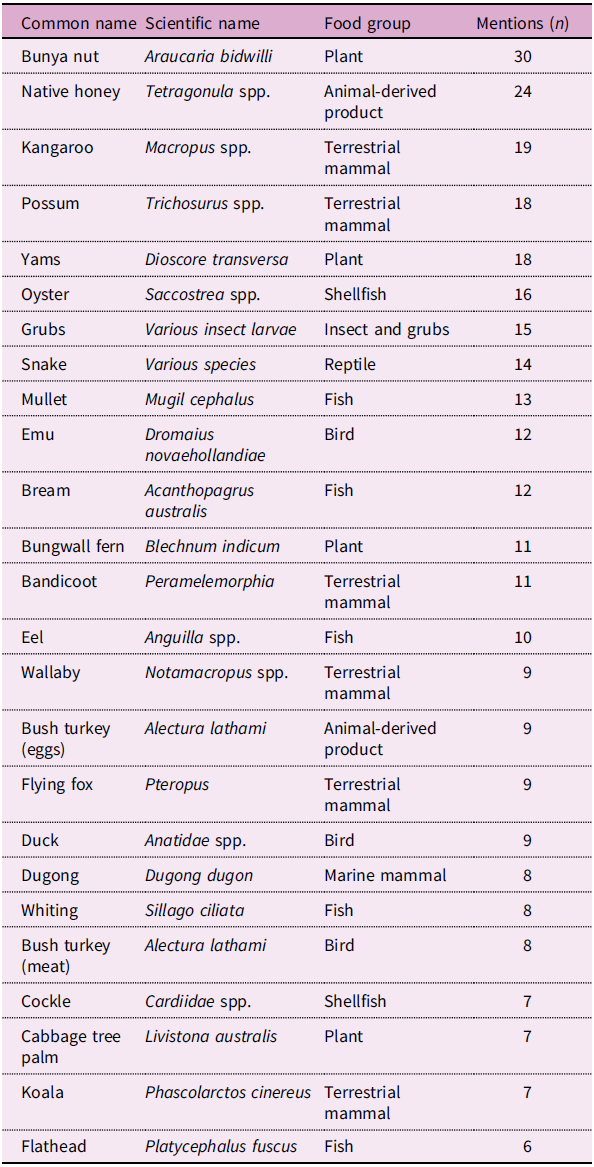
Table 1 presents the top twenty-five most frequently mentioned foods. This overview provides a point of reference for detailed results in the following sections. Full listings of raw and standardised food terms are provided in Supplementary Tables S9 and S10.
25 most frequently mentioned traditional foods

Table 1. Long description
A table listing the 25 most frequently mentioned traditional foods. The table has 4 columns: Common name, Scientific name, Food group, and Mentions (n). It contains 25 rows of data. Row 1: Bunya nut, Araucaria bidwillii, Plant, 30. Row 2: Native honey, Tetragonula spp., Animal-derived product, 24. Row 3: Kangaroo, Macropus spp., Terrestrial mammal, 19. Row 4: Possum, Trichosurus spp., Terrestrial mammal, 18. Row 5: Yams, Dioscorea transversa, Plant, 18. Row 6: Oyster, Saccostrea spp., Shellfish, 16. Row 7: Grubs, Various insect larvae, Insect and grubs, 15. Row 8: Snake, Various species, Reptile, 14. Row 9: Mullet, Mugil cephalus, Fish, 13. Row 10: Emu, Dromaius novaehollandiae, Bird, 12. Row 11: Bream, Acanthopagrus australis, Fish, 12. Row 12: Bungwall fern, Blechnum indicum, Plant, 11. Row 13: Bandicoot, Peramelemorphia, Terrestrial mammal, 11. Row 14: Eel, Anguilla spp., Fish, 10. Row 15: Wallaby, Notamacropus spp., Terrestrial mammal, 9. Row 16: Bush turkey (eggs), Alectura lathami, Animal-derived product, 9. Row 17: Flying fox, Pteropus, Terrestrial mammal, 9. Row 18: Duck, Anatidae spp., Bird, 9. Row 19: Dugong, Dugong dugon, Marine mammal, 8. Row 20: Whiting, Sillago ciliata, Fish, 8. Row 21: Bush turkey (meat), Alectura lathami, Bird, 8. Row 22: Cockle, Cardiidae spp., Shellfish, 7. Row 23: Cabbage tree palm, Livistona australis, Plant, 7. Row 24: Koala, Phascolarctos cinereus, Terrestrial mammal, 7. Row 25: Flathead, Platycephalus fuscus, Fish, 6.
Quantities consumed
Direct reference to specific quantities of foods consumed was limited. However, evidence from archaeological findings, historical observations and qualitative descriptions provides insight into the dietary contribution of specific foods. For example, direct discussion regarding quantities of eggs consumed was scarce. Historical accounts note the collection of bird and reptile eggs however, whether these were considered a major dietary resource was not evident in the sources. Limited archaeological evidence also constrains interpretation, as this may reflect preservation bias or disposal practices rather than consumption habits(Reference Draper47,Reference Kerkhove48,Reference Kerkhove50,Reference Kerkhove51,Reference Kerkhove53,Reference McNiven63,Reference McNiven64,Reference Nolan66,Reference Smith67,Reference Green, Green and Green72,Reference Mathew74,Reference Petrie76,Reference Whittington86) .
Archaeological fish remains are limited, likely due to poor preservation or different disposal practices, rather than low consumption(Reference McNiven64,Reference McNiven65) , historical observations report that the Kabi Kabi Peoples ‘lived on fish’(Reference Adams21), with one historical account reporting adult males consuming up to three large fish per day(Reference Green, Green and Green70).
Plant foods, such as the bunya nut, could be consumed in vast quantities during the Bunya Festival, with attendees reportedly arriving thin and returning visibly well-nourished and sometimes becoming incapacitated due to overconsumption(Reference Adams21,Reference Kerkhove48,Reference McNiven55,Reference McNiven64,Reference Green, Green and Green70,Reference Mathew74) . Moreover, several historical accounts described the bungwall fern as a dietary staple(Reference Draper47,Reference Kerkhove51,Reference Nolan66) .
Extensive shellfish remains were uncovered in middens across Kabi Kabi Peoples’ Country suggesting high consumption(Reference Reeder-Myers, Braje and Hofman56,Reference McNiven65,Reference Smith67) . Oysters (commercial and toothed) were the most abundant, while club whelk remains were also frequently uncovered(Reference McNiven65,Reference Smith67) . Cockles, pipis, hairy mussels, periwinkles, limpets, sand snails and murex were less common within midden assemblages than oysters or club whelks(Reference McNiven65).
Terrestrial mammals, such as kangaroos, were likely a major dietary resource. Historical observations report that 30–40 kangaroos could be captured in a single hunt(Reference McNiven64), with archaeological remains similarly suggesting that macropods were a prominent dietary resource(Reference McNiven63,Reference McNiven64) .
Marine mammals were infrequently discussed; however, accounts describe the Kabi Kabi Peoples ‘gorging themselves’ on dugong(Reference Adams21), while the opportunistic whale strandings supported large groups for up to a week(Reference Alexander78).
Nutritional profiles of significant food sources
Of the 270 food terms, standardised, sixty-eight were cited ≥3 times and were sufficiently specific to meet the inclusion criteria for nutritional analysis. Of these, twenty-five lacked nutritional information. The remaining forty-three foods were analysed for vitamins (A, C and folate), minerals (Ca, iron and iodine) and macronutrients (energy, carbohydrates, protein, total and saturated fat).
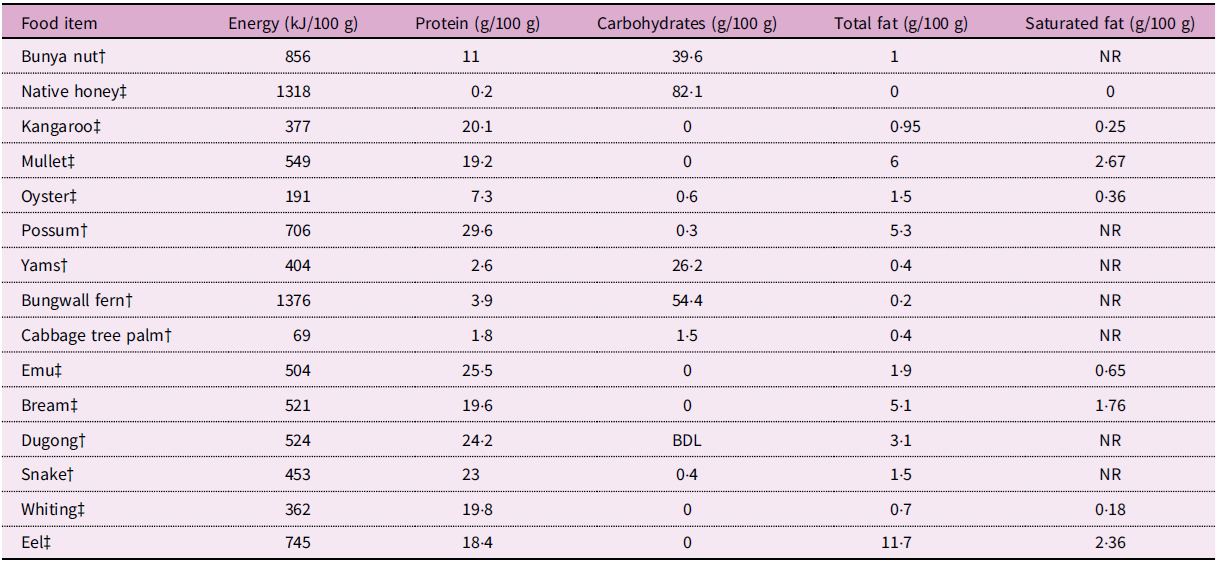
Table 2 highlights the macronutrient composition of the fifteen most frequently cited foods. Energy content ranged from 191 kJ/100 g (oysters) to 1318 kJ/100 g (honey). Animal meats were protein-dense, specifically possum (29·6 g/100 g), while bunya nut (11 g/100 g) was the most significant plant-based source. Carbohydrate-rich sources were predominantly plant derived, with honey the highest contributor (82·1 g/100 g). Fat content was typically low, with eel (11·7 g/100 g) having the highest total fat content. Saturated fat was similarly low and exclusively from animal meats with mullet (2·67 g/100 g) and eel (2·36 g/100 g) having the greatest content.
Macronutrient content of frequently cited traditional foods (per 100 g serving)

Table 2. Long description
A table comparing the macronutrient content of various traditional foods per 100g serving. The table has 15 rows and 5 columns. The columns are labeled Food item, Energy (kJ/100 g), Protein (g/100 g), Carbohydrates (g/100 g), Total fat (g/100 g), and Saturated fat (g/100 g). Row 1: Bunya nut, 856, 11, 39.6, 1, NR. Row 2: Native honey, 1318, 0.2, 82.1, 0, 0. Row 3: Kangaroo, 377, 20.1, 0, 0.95, 0.25. Row 4: Mullet, 549, 19.2, 0, 6, 2.67. Row 5: Oyster, 191, 7.3, 0.6, 1.5, 0.36. Row 6: Possum, 706, 29.6, 0.3, 5.3, NR. Row 7: Yams, 404, 2.6, 26.2, 0.4, NR. Row 8: Bungwall fern, 1376, 3.9, 54.4, 0.2, NR. Row 9: Cabbage tree palm, 69, 1.8, 1.5, 0.4, NR. Row 10: Emu, 504, 25.5, 0, 1.9, 0.65. Row 11: Bream, 521, 19.6, 0, 5.1, 1.76. Row 12: Dugong, 524, 24.2, BDL, 3.1, NR. Row 13: Snake, 453, 23, 0.4, 1.5, NR. Row 14: Whiting, 362, 19.8, 0, 0.7, 0.18. Row 15: Eel, 745, 18.4, 0, 11.7, 2.36.
† Data sourced from Tables of Composition of Australian Aboriginal Foods(Reference Brand-Miller, Maggiore and James44).
‡ Data sourced from Foodworks (2024, Xyris Software, Brisbane, Australia).
Key: BDL = below detectable limit; NR = not reported or assessed in source material.
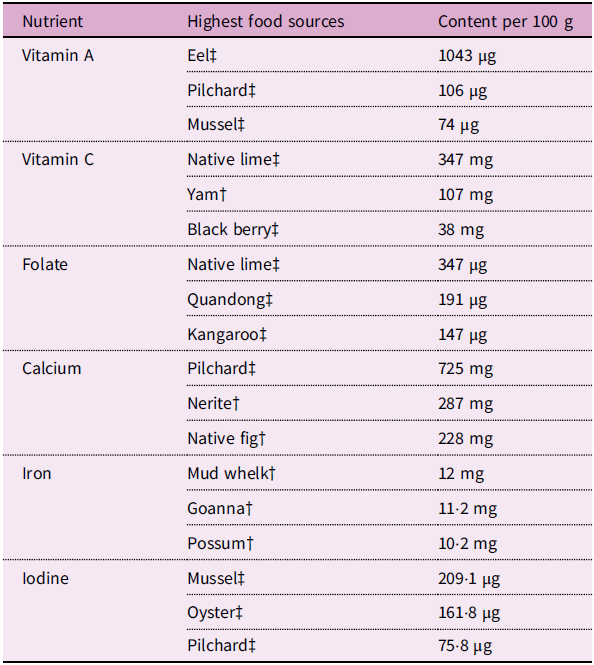
Table 3 outlines the three highest traditional food sources of essential vitamins and minerals per 100 g serve. Eels’ vitamin A content was the highest (1043 µg/100 g) exceeding the RDI for both males and females. Native lime was the richest source of vitamin C (347 mg/100 g; over 1100 % of RDI) and was also a substantial source of folate (347 µg/100 g; 87 % of RDI). Pilchard was the highest Ca source (725 mg/100 g), while mud whelk was Fe rich (12 mg/100 g) exceeding the male RDI by 150 % and covering 67 % of the female RDI. Goanna (11·2 mg/100 g) and possum (10·2 mg/100 g) were significant Fe sources. Mussel provided the most iodine (209 µg/100 g) contributing 139 % of the adult RDI. The full nutritional analysis and those lacking nutritional data are available in Supplementary Tables S11–S14.
Highest traditional food sources of selected micronutrients (per 100 g serving)

Table 3. Long description
A table comparing traditional food sources of selected micronutrients per 100g serving. The table has 6 rows and 3 columns. The columns are labeled Nutrient, Highest food sources, and Content per 100 g. The rows list different nutrients and their highest food sources along with the content per 100 grams. Row 1: Vitamin A, Eel, 1043 µg; Pilchard, 106 µg; Mussel, 74 µg. Row 2: Vitamin C, Native lime, 347 mg; Yam, 107 mg; Black berry, 38 mg. Row 3: Folate, Native lime, 347 µg; Quandong, 191 µg; Kangaroo, 147 µg. Row 4: Calcium, Pilchard, 725 mg; Nerite, 287 mg; Native fig, 228 mg. Row 5: Iron, Mud whelk, 12 mg; Goanna, 11.2 mg; Possum, 10.2 mg. Row 6: Iodine, Mussel, 209.1 µg; Oyster, 161.8 µg; Pilchard, 75.8 µg.
† Data sourced from Tables of Composition of Australian Aboriginal Foods(Reference Brand-Miller, Maggiore and James44).
‡ Data sourced from Foodworks (2024, Xyris Software, Brisbane, Australia).
Thematic analysis: traditional foodways and influencing factors
Thematic analysis of data extracted from the forty-three included sources utilised both deductive and inductive approaches. Eight key themes were identified, reflecting both foodways and influencing factors: (1) procurement methods (n 38)(Reference Adams21,Reference Draper47,Reference Kerkhove48,Reference Kerkhove50–Reference Thurstan60,Reference Jones62–Reference McNiven64, Reference Nolan66–Reference Green, Green and Green72,Reference Mathew74–Reference Whittington86,Reference Fahey, Rossetto and Ens88) , (2) preparation methods (n 37)(Reference Adams21,Reference Draper47,Reference Kerkhove48,Reference Kerkhove50,Reference Kerkhove51,Reference Kerkhove53–Reference Symons and Symons59, Reference Towner61–Reference Van Reyk82,Reference Neill and Foulds84,Reference Stuart, Clark and Clark85,Reference Fahey87) , (3) storage practices (n 19)(Reference Adams21,Reference Draper47,Reference Kerkhove48,Reference Kerkhove51,Reference Steele57–Reference Symons and Symons59,Reference Towner61,Reference Walters68,Reference Green, Green and Green72,Reference Mathew74–Reference Cooke, Ens and Clarke77, Reference Galloway80– Reference Van Reyk82,Reference Fahey87,Reference Fahey, Rossetto and Ens88) , (4) seasonality (n 26)(Reference Adams21,Reference Draper47,Reference Kerkhove48,Reference Kerkhove51,Reference Kerkhove53,Reference Swan58,Reference Thurstan60,Reference Towner61,Reference McNiven63,Reference McNiven64,Reference Nolan66–Reference Walters68,Reference Green, Green and Green72,Reference Mathew74–Reference Larner83,Reference Fahey87,Reference Fahey, Rossetto and Ens88) , (5) taste and sensory profile (n 17)(Reference Draper47,Reference Kerkhove48,Reference Kerkhove50,Reference Ma Rhea and Ma Rhea54,Reference Swan58,Reference Symons and Symons59,Reference Smith67,Reference Green, Green and Green70–Reference Mathew74,Reference Petrie76–Reference Alexander78,Reference Galloway80,Reference Fahey87) , (6) cultural significance (n 30)(Reference Adams21,Reference Draper47,Reference Kerkhove48,Reference Kerkhove50,Reference Kerkhove51,Reference Kerkhove53,Reference McNiven55,Reference Reeder-Myers, Braje and Hofman56,Reference Swan58,Reference Thurstan60,Reference Towner61,Reference McNiven64,Reference Nolan66,Reference Walters68–Reference Green, Green and Green70,Reference Green, Green and Green72–Reference Larner83,Reference Fahey87,Reference Fahey, Rossetto and Ens88) , (7) gender roles (n 17)(Reference Adams21,Reference Draper47,Reference Kerkhove48,Reference Kerkhove51,Reference Steele57,Reference Symons and Symons59,Reference Nolan66,Reference Walters68,Reference Green, Green and Green70,Reference Green, Green and Green71,Reference Mathew74,Reference Petrie76,Reference Alexander78–Reference Galloway80,Reference Whittington86,Reference Fahey87) and (8) environmental knowledge (n 14)(Reference Adams21,Reference Draper47,Reference Kerkhove48,Reference Kerkhove51,Reference Swan58–Reference Thurstan60,Reference Jones62,Reference Walters68,Reference Petrie76,Reference Cooke, Ens and Clarke77,79,Reference Fahey87,Reference Fahey, Rossetto and Ens88) .
Foodways included a range of procurement strategies such as nets, traps, spears, controlled fire drives, hand collection and land and resource management practices including intentional burns, replanting of bungwall fern and oyster and shipworm cultivation. Preparation involved baking, roasting, smoking, grinding and plant detoxification. Storage practices included fermentation, preservation, submersion in water and burial. Seasonality and environmental knowledge influenced these foodways, guiding resource use, while gender roles structured collection and preparation and taste preferences informed choices. Tables 4 and 5 provide an overview of traditional foodways and influencing factors, with selected examples illustrating the breadth of diverse practices. The complete results of the thematic analysis are provided in the Supplementary Tables S15 and S16.
Themes and indicative examples of the Kabi Kabi Peoples’ traditional foodways

Table 4. Long description
A table detailing themes and indicative examples of traditional foodways. The table has three columns: Overarching themes, Subthemes, and Indicative examples. It is divided into three main themes: Procurement, Preparation, and Storage. Under Procurement, subthemes include Intentional resource cultivation and landscape management, Cooperative hunting and fishing strategies, Gathering duties allocated by gender and ownership-based harvesting, Use of plant toxins to support fish collection, Construction and placement of aquatic traps, Extensive net use to capture diverse range of animal resources, and Symbiotic human and animal hunting partnerships. Preparation includes Consumption of raw foods, Diverse cooking methods including baking, roasting and boiling, Butchering, grinding, and processing to enhance edibility, and Detoxification methods to render toxic plants safe for consumption. Storage covers Preservation in mud, running water, earth or hung from trees, and Intentional fermentation to improve storage life and palatability. Each subtheme lists specific examples of practices.
Themes and indicative examples of influencing factors on the traditional Kabi Kabi Peoples’ foodways

Table 5. Long description
A table with four columns and multiple rows. The columns are labeled ‘Overarching theme’, ‘Subtheme’, ‘Indicative examples’, and ‘References’. The table describes various themes and subthemes related to the traditional foodways of the Kabi Kabi Peoples, along with indicative examples and references. Themes include ‘Taste and sensory profile’, ‘Gender roles’, ‘Seasonality’, ‘Cultural significance’, and ‘Environmental knowledge’. Each theme is broken down into subthemes with specific examples provided for each. The table captures the diverse practices and influencing factors on the Kabi Kabi Peoples’ foodways.
Cultural mapping results
Five cultural maps were developed illustrating the geographic distribution of frequently cited traditional food sources are presented in Figure 2.
Geographic distribution of five frequently cited foods within Kabi Kabi Peoples’ Country: (a) Bunya Nut (Araucaria bidwillii), (b) Dugong (Dugong dugon), (c) Emu (Dromaius novaehollandiae), (d) Mullet (Mugil cephalus) and (e) Kangaroo (Macropus spp.). Maps were generated in QGIS, using point occurrence data (1844–2025) sourced from the Atlas of Living Australia. The Kabi Kabi Peoples’ native title boundary sourced from Queensland Globe.

These maps provide a visual representation of the contemporary distribution of traditional dietary resources identified in the reviewed literature and do not infer pre-colonial species distributions. For example, kangaroo is widely distributed across Kabi Kabi Peoples’ Country today, whereas bunya pine distribution is more concentrated within the southern areas, emu populations are confined to the far south and north (Hervey Bay area), while dugongs and mullet feature across coastal and inland waterways. These maps highlight the geographic diversity of species relevant to the Kabi Kabi Peoples’ traditional food systems.
Discussion
To the best of the authors’ knowledge, this scoping review is among the first to culturally map traditional foods frequently mentioned in the sources, describe their nutritional profiles and thematically analyse the traditional diet and foodways of the Kabi Kabi Aboriginal Peoples of Australia. Conducted in collaboration with Indigenous and non-Indigenous researchers, this review addressed three questions: (1) What foods were consumed in the traditional diet of the Australian Kabi Kabi Aboriginal Peoples and in what proportions? (2) What are the traditional foodways of the Australian Kabi Kabi Aboriginal Peoples? and (3) What key factors influenced traditional food intake among the Australian Kabi Kabi Aboriginal Peoples and how do elements such as seasonality and gender roles influence traditional foodways? The results indicate that the Kabi Kabi Peoples’ traditional diet was highly diverse, nutrient-dense, sophisticated and shaped by geographic and environmental factors, while challenging reductive colonial portrayals of Aboriginal Australian food systems. Furthermore, these findings are consistent with contemporary literature on Aboriginal Australian traditional foods, foodways, and food systems, which similarly highlight the role of ecological knowledge, seasonality and cultural practices in shaping traditional food systems(Reference Gammage3,Reference Pascoe4,Reference Anderson, Elder-Robinson and Ferguson8,Reference Kuhnlein, Erasmus and Spigelski89) .
Contemporary dietetic practice emphasises dietary variety, nutrient density and moderation of processed food, mirroring key components of the traditional Kabi Kabi Peoples’ diet, which supported health and well-being(Reference Freeland-Graves and Nitzke90). With 270 unique food terms identified in this review, dietary diversity was a prominent aspect of the traditional food system. Such diversity supports the immune system, providing essential nutrients and facilitating the immune response, while fostering a rich and diverse microbiome(Reference Xiao, Wang and Su91,Reference Calder, Ortega and Meydani92) . Dietary diversity also reduces chronic disease risk by providing fibre, micronutrients and polyphenols, whilst displacing highly processed foods(Reference Houshialsadat, Cediel and Sattamini93,Reference de Oliveira Otto, Anderson and Dearborn94) . Conversely, a lack of variety can disrupt the balance of the microbiome increasing the likelihood of colonisation by undesirable species and increases the risk of diet-related chronic disease(15,Reference Xiao, Wang and Su91) . Beyond physiology, variety promotes enjoyment and facilitates sustainable healthy eating practices. Historical accounts of the Kabi Kabi Peoples describe a preference for fatty foods, with delicacies including wood grubs and dugong blubber reportedly being highly esteemed(Reference Draper47,Reference Symons and Symons59,Reference Green, Green and Green73,Reference Petrie76) . This likely reflects the desirability of fatty foods rather than their frequency of consumption and suggests that food procurement was motivated by more than subsistence. In stark contrast, contemporary Western diets typically lack variety, with inadequate fruit, vegetable and wholegrain intake and excessive intake of processed foods, elevating chronic disease risk(15). Comparatively, the Kabi Kabi Peoples’ traditional diet highlights the benefits of variety across the lifespan to support health and cultural identity.
Nutrient profiling illustrates that many traditional foods were rich sources of macro- and micronutrients capable of promoting health and supporting a physically demanding lifestyle and subsistence activities. Comparison with contemporary nutrient reference values, based on a standardised 100 g edible portion, indicates that many traditional foods contained significant quantities of key nutrients that may contribute to recommended daily nutrient intakes while remaining within safe upper limits(45). Nonetheless, limited consumption data restrict the analysis to descriptive comparisons, with future research needed to model dietary patterns and generate more accurate representations of traditional intake. This may be achieved in partnership with the Kabi Kabi Peoples through the integration of cultural knowledge, archaeological evidence and historical records to support the estimation and refinement of traditional dietary patterns.
Seasonal cycles shaped the Kabi Kabi Peoples’ traditional diet, whereby ecological knowledge such as the flowering of plants or animal behaviours, signalled resource availability, supported resource prioritisation and mitigated the risk of resource overexploitation(Reference Prober, O’Connor and Walsh95,Reference Clarke96) . This detailed ecological knowledge was bound to connection to Country, providing a framework for sustainable food practices that was subsequently fragmented by colonisation(Reference Pascoe4,Reference Sherwood11,Reference Haebich12) .
Colonial narratives justified the dispossession of Aboriginal Peoples lands and suppression of traditional practices(Reference Pascoe4,Reference Banner5,Reference Sherwood11) , disrupting intergenerational knowledge transfer and eroding cultural practices and knowledge(Reference Sherwood11,Reference Haebich12,Reference Crawhall31) . This illustrates both the complexity and vulnerability of the Kabi Kabi Peoples’ traditional food systems(Reference Pascoe4,Reference Sherwood11) . These narratives also marginalised Aboriginal Australian Peoples perspectives within health discourse, contributing to deficit-based perspectives that persist today(Reference Prehn30). Consequently, colonisation embedded inequities and forced dietary transition(Reference Kuhnlein and Receveur10), while ongoing food insecurity and limited access to nutritious food exacerbate these inequities(Reference Sherwood11,Reference Ferguson, O’Dea and Chatfield17,18) . Cumulatively, these barriers have contributed to disproportionate rates of diet-related chronic diseases, while reinforcing the life expectancy gap between Aboriginal and non-Aboriginal Australians(13,14) . In response to the ongoing effects of colonisation, research indicates that cultural mapping supports the preservation of traditional knowledges and fosters knowledge sharing amongst Aboriginal and non-Aboriginal Australians(Reference Crawhall31). The cultural maps developed for this review visually represent the relationship between people, species and Country(Reference Crawhall31), contextualising the geographic distribution of traditional foods. When considered alongside the historical and thematic findings, they provide contextual insight into seasonal eating patterns and movement across Country within the Kabi Kabi Peoples’ traditional food system, illustrating the adaptive use of diverse dietary resources. While the maps reflect current occurrence data, pre-colonial distributions were likely broader, with colonisation contributing to displacement, invasive species introduction and environmental degradation(Reference Legge, Rumpff and Garnett97). Together, the thematic, historical and geographic findings highlight the interconnected relationship between food practices, the environment and Country, a relationship that has been obscured within modern food systems(Reference Lopes, Mihrshahi and Ronto27,Reference Wang, Wu and Zhao98) .
Contemporary food systems are heavily industrialised and global, contributing to carbon emissions, biodiversity loss and environmental degradation, compromising local food system resilience and exacerbating environmental pressures(Reference Wang, Wu and Zhao98). Sustainable practices such as regenerative agriculture, permaculture and food forests on the other hand more closely align with traditional global Indigenous food systems, operating within environmental synergy rather than under human dominance(Reference Lopes, Mihrshahi and Ronto27). These practices echo the stewardship of the Kabi Kabi Peoples’ foodways, whereby environmental knowledge and seasonal eating supported biodiversity, resilience and the sustainability of local food systems(Reference Lopes, Mihrshahi and Ronto27). Incorporating native Australian foods and foodways within contemporary food systems and diets may offer pathways towards healthier and more environmentally sustainable futures(Reference Lopes, Mihrshahi and Ronto27).
Taken together, the findings of the review suggest that the traditional Kabi Kabi foodways reflect intentional and complex resource management systems beyond opportunistic subsistence. Practices such as resource cultivation, seasonal eating and cultural commitments to Country illustrate detailed ecological understanding(Reference Prober, O’Connor and Walsh95,Reference Clarke96) . These were grounded in connection to Country and guided by cultural lore, reciprocity and responsibility to the community and environment(Reference Gammage3,Reference Pascoe4) . Aboriginal Australian knowledge systems have long supported communities, biodiversity and environmental health(Reference Gammage3,Reference Pascoe4,Reference Lopes, Mihrshahi and Ronto27) . These principles hold contemporary relevance. For example, traditional burning practices reinforce connections to Country and cultural identity while simultaneously reducing bushfire risk(Reference Gammage3,Reference Pascoe4,Reference Steffensen99) . In contrast, Western land management has often ignored this knowledge, contributing to increased bushfire frequency and severity, highlighting the importance of recognising Indigenous knowledges and management practices(Reference Gammage3,Reference Steffensen99) .
Beyond subsistence, foods and foodways are deeply intertwined with culture and spirituality, exemplified by the bunya nut and the triennial ‘Bunya Festival’(Reference Pascoe4). Historically, this event, one of Australia’s largest inter-tribal gatherings, involved feasting, ceremony and cultural exchange and was paralleled by other seasonal gatherings such as the bogong moth harvest in Victoria(Reference Pascoe4). The contemporary revitalisation of the ‘Bunya Festival’ illustrates its enduring importance and showcases the resilience of the Kabi Kabi Peoples(Reference Kinniment23). Other seasonal events such as the mullet run, or successful dugong hunts facilitated large gatherings and feasts(Reference Nolan66), strengthening community cohesion, cultural identity and intergenerational learning(Reference Anderson, Elder-Robinson and Ferguson8,Reference Lopes, Mihrshahi and Ronto27) .
In addition to their cultural significance, foodways activities were shaped by gender roles, providing the framework for a balanced and flexible food system(Reference Bliege Bird and Bird100). This division of labour balanced the high-risk act of hunting with the more consistent and reliable collection of plant and marine resources, ensuring a dependable food supply and supporting community resilience. By embedding food practices within social organisation, they reinforced food security, cultural commitments and well-being(Reference Bliege Bird and Bird100). However, direct discussion regarding gender roles was inconsistent and often linked to food procurement or preparation. Although similar patterns are observed in other communities, this is not universal, with research indicating that women participated in hunting within specific communities(Reference Hoffman, Farquharson and Venkataraman101).
The findings of this review highlight the distinct contrast between the Kabi Kabi Peoples’ traditional diet and contemporary Western diets. The traditional diet was nutrient-dense, minimally processed and diverse, with food procurement strategies requiring high levels of physical activity. Conversely, Western dietary and lifestyle patterns are typically characterised by excessive intake of processed foods, low intake of fruits and vegetables(15) and a predominantly sedentary lifestyle(16). In conjunction with wider research, these findings indicate that reincorporating traditional foods and foodways may enhance chronic disease prevention(Reference Pour, Binge and Cross25,Reference DeBruyn, Fullerton and Satterfield26) and sustainability(Reference Lopes, Mihrshahi and Ronto27). Moreover, such approaches strengthen cultural identity(Reference Anderson, Elder-Robinson and Ferguson8,Reference Christidis, Lock and Walker28) and align with strength-based and decolonising frameworks that acknowledge Aboriginal Australian resilience, knowledge and cultural continuity(Reference Bryant, Bolt and Botfield29,Reference Prehn30) .
Despite the potential benefits of revitalising the traditional diet, it remains unclear whether this is a current priority for the Kabi Kabi Peoples themselves. This underscores the importance of Aboriginal Australian leadership, ensuring that any revitalisation or health promotion efforts are community led, culturally safe and responsive(Reference Prehn30). Recognising the diversity of over 250 Aboriginal and Torres Strait Islander Countries across Australia(6) ensures revitalisation efforts that remain grounded within specific communities and cultures(Reference Bryant, Bolt and Botfield29). Doing so aligns with cultural safety principles, fosters strength-based care and builds trust between Aboriginal Australians and the healthcare system(Reference Bryant, Bolt and Botfield29,Reference Prehn30) .
Incorporating traditional food systems within contemporary healthcare must challenge deficit-based narratives, which have historically framed Aboriginal Australian diets as inadequate(Reference Prehn30). Conversely, evidence from the Kabi Kabi Peoples’ traditional diet highlights nutrient density, deliberate resource management and complex, resilient food systems that sustained communities for millennia. Therefore, supporting the revitalisation and re-engagement with Aboriginal Australian traditional food systems presents a strength-based perspective, acknowledging not only their capacity to support physical health but also the reciprocal relationships between Traditional Custodians and Country(Reference Gammage3,Reference Pascoe4,Reference Anderson, Elder-Robinson and Ferguson8) . Beyond physical health outcomes, revitalising traditional food systems may strengthen cultural identity, self-determination and the continuation of cultural practices, providing a culturally appropriate approach to supporting well-being and sustainability(Reference Anderson, Elder-Robinson and Ferguson8,Reference Christidis, Lock and Walker28,Reference Prehn30) .
Strengths
A key strength of this review was adherence to Joanna Briggs Institute and PRISMA-ScR frameworks. Synthesising diverse historical, ethnographic and academic sources enabled the partial reconstruction of the traditional Kabi Kabi Peoples’ traditional food system. Comparison against contemporary dietary reference values provided a lens for assessing potential historical nutritional intake.
Limitations
Limitations include the use of recommended daily intakes as a comparative benchmark, which may not reflect physiological needs. The use of 100 g portions provides a point of reference, though likely does not represent traditional consumption patterns. Nutrient data were limited for various traditional foods, and the majority of the included sources were authored by non-Aboriginal Australians, who may have misrepresented the Kabi Kabi Peoples’ knowledge. Nutritional analysis selection was based on frequency of mention, which may not reflect the foods’ true cultural significance or dietary contribution. Finally, as a literature-based synthesis, this review is constrained by the limitations of the available evidence base and cannot fully capture the traditional diet, foodways or food systems of the Kabi Kabi Peoples.
Further research
Further research that prioritises the Kabi Kabi Peoples’ voices and epistemologies is required to deepen our understanding of their traditional food systems. Engagement with Traditional Custodians is essential to determine community priorities. Co-designed studies could document traditional food practices and traditional knowledges. Nutritional analysis of culturally significant foods would provide a more precise nutrient profile, while Kabi Kabi-led cultural mapping may generate more culturally informed depictions of traditional food systems and foster intergenerational learning.
Research should also examine the practical, economic, and cultural barriers to re-engaging with traditional foods and investigate how health professionals can appropriately incorporate traditional foods and foodways into Aboriginal Australian health and well-being. Future research must recognise Aboriginal Peoples’ sovereignty over knowledge, align with Indigenous research guidelines, and consider the ongoing effects of colonisation on food systems and health inequities.
Conclusions
Findings from this review suggest the Kabi Kabi People’s traditional diet was diverse, nutrient-rich and informed by environmental knowledge, seasonal changes and social and cultural commitments. This review builds upon an existing and growing body of evidence recognising the sophistication of traditional Aboriginal Australian food systems by providing a Nation-specific synthesis of available sources relating to the Kabi Kabi Peoples’ traditional foods, foodways and food systems. In doing so, it challenges colonial narratives, showcases the sophistication of the Kabi Kabi Peoples’ food systems, emphasises the importance of community-led cultural revitalisation efforts and highlights the relevance of traditional foods for sustaining health and well-being. Accordingly, these findings have implications for public health nutrition by providing a foundation for future nation-specific, culturally informed and community-led nutrition research and community-led health promotion initiatives.
Supplementary material
For supplementary material accompanying this paper visit https://doi.org/10.1017/S1368980026103590.
Acknowledgements
The authors acknowledge and pay respect to the Kabi Kabi Peoples, the Traditional Custodians of the lands and waters on which this research was conducted and honour their continuing connection to Country, culture and community.
Author contributions
JM, LS & TC contributed to the conception and design of the work. TC and AL conducted data screening and extraction, with JM resolving conflicts. TC performed collated and analysed the extracted data with input from JM and LS. JM, LS & TC participated in data interpretation and in the review and revision of the final manuscript. All authors have read and approved the final version and consent to its publication.
Financial support
None.
Competing interests
None.
Ethical standards
No human participants or animals were involved in this research. Ethics approval was therefore not required.



 Open access

