INTRODUCTION
The shellfish production is of great contribution to the economy of Tunisian fishery. The bulk of shellfish landings, as reported by fisheries production statistics for the past 8 years, count as less than 1% of the whole tonnage of fisheries products (DGPA, 2009). Nonetheless, the shellfish exploitation is focused on only two species, the clams Ruditapes decussatus (Linnaeus, 1758) and Venerupsis aurea (Gmelin, 1791), which are collected from the intertidal zone on the southern Tunisian coasts including vast mudflats and sandy beaches favourable for infaunal bivalves (Ben Salem et al., Reference Ben Salem, Franquesa and El Abed2002). In 2009, capture production of these two shellfish species was evaluated as 900 tons equivalent to almost 0.01% of world clams capture production (DGPA, 2009).
The reform of strategies in fisheries sector policy pointed towards the diversification of the exploitable species and areas. The promotion of the shellfish sector became a major issue and prompted the Laboratory of Living Resources from the National Institute of Sea Sciences and Technologies government agencies to carry out a research programme for the exploration of new potential shellfish production sites along Tunisian coasts and the assessment of their stocks.
Among the prospected areas on the northern coasts, the Gulf of Tunis represents an area of particular interest in terms of biodiversity and fisheries catches, especially for fish and crustaceans (Azzouz, Reference Azzouz1973; Zarrad et al., Reference Zarrad, El Abed, M'rabet, Missaoui and Romdhane2003, Reference Zarrad, Missaoui, Alemany, Hamza, Romdhane, García, Jarboui and M'rabet2008). The Gulf of Tunis is located in the occidental basin of the Mediterranean Sea and opens up on its northern side to the Tuniso-Sicilian and Tuniso-Sardinian Straits. This Gulf exchanges waters with Ghar El Melah Lagoon and Tunis Lagoon in the west and receives the outflow of the two major rivers in Tunisia, Medejerda and Meliane, located respectively on the north-western coast of the gulf and in the centre of the Bay of Tunis (Added et al., Reference Added, Ben Mammou, Abdeljaoued, Essonni and Fernex2003).
The first study investigating the malacological fauna in the Gulf of Tunis was that of Pallary (Reference Pallary1914), who listed more than 300 species of gastropods and bivalves, and also mentioned the species that were commercialized at that time in the Tunis market such as Donax trunculus (Linnaeus, 1758), Solen marginatus (Pulteney, 1799), Hexaplex trunculus (Linnaeus, 1758) and Murex brandaris. Subsequent works added new species to this first inventory (Moilinier & Picard, Reference Moilinier and Picard1954; Mars, Reference Mars1958; Azzouz, Reference Azzouz1973; Zaouali, Reference Zaouali1971; Zouari, Reference Zouari1985, Enzenross & Enzenross, Reference Enzenross and Enzenross2001) but overlooked the species with commercial relevance. Some other explorations were performed in the Tunis lagoon and pinpointed the invasion of exotic shellfish species unsuitable for human consumption (Zamouri et al., Reference Zamouri, Chouba and Abed2001; Charef et al., Reference Charef, Zamouri-Langar, Romdhane, Houas-Garsallah and Khazri2005). The literature review clearly indicates the lack of studies aimed at characterizing the edible mollusc stock sizes, while other sporadic inventories were limited in spatial coverage.
The present paper depicts a quantitative assessment method of bivalve populations conducted along the coasts of the Gulf of Tunis. The study area was first entirely explored and numerous species were identified, although, only six target bivalve species are considered relevant in terms of their high potential of commercialization. The aim of this work is to establish the weight–length relationships of target species and to determine their stock size and their corresponding spatial distribution.
MATERIALS AND METHODS
Sampling protocol and operations
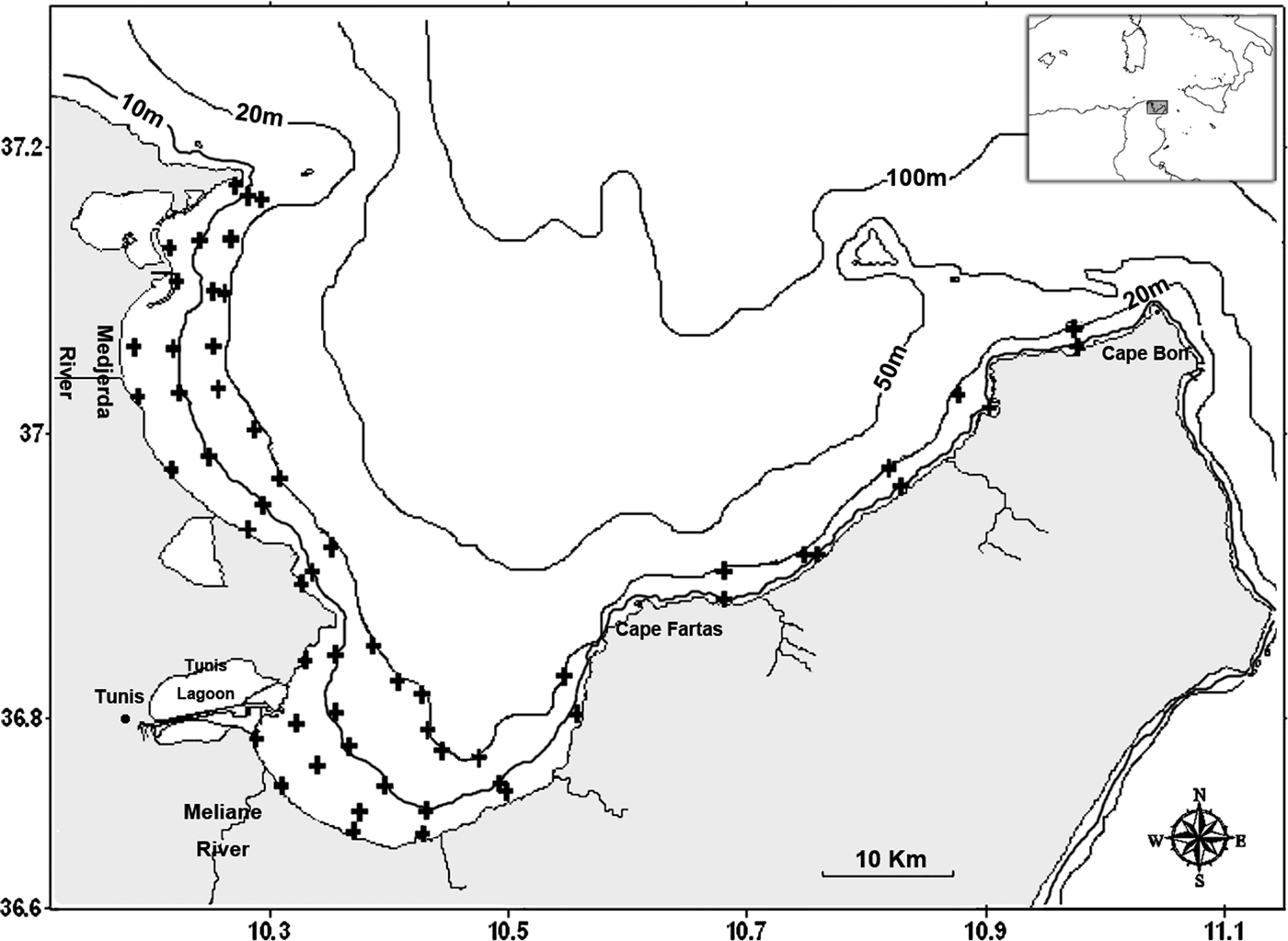
Sampling operations were conducted in January 2006 along the coasts of the Gulf of Tunis. The study area covers about 600 km2 (Figure 1) of soft bottoms comprising between 20 and 2.5 m depth, the latter being the shallowest waters reachable by boat.
Study area and the positioning of sampling stations in the Gulf of Tunis.
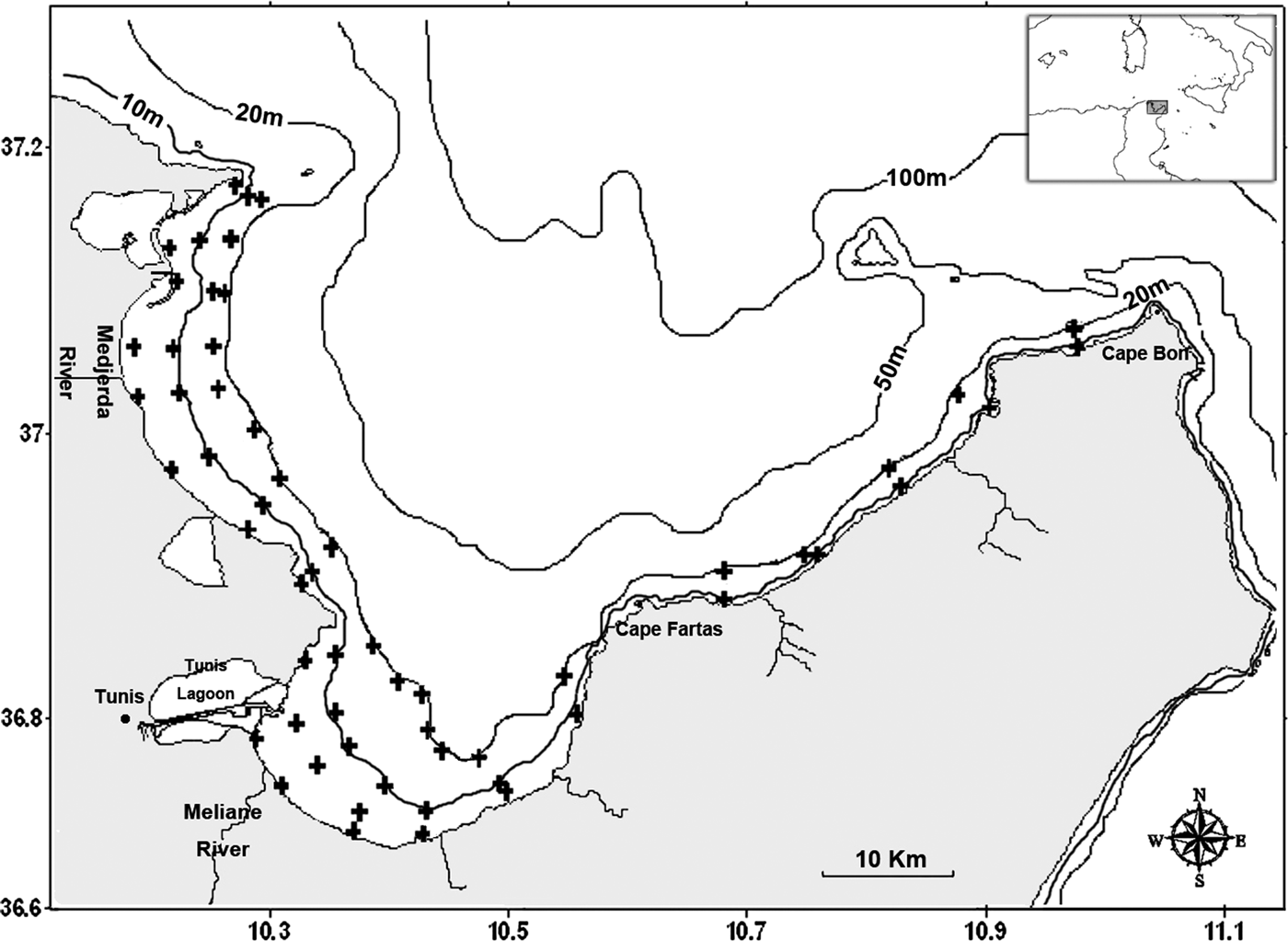
A stratified sampling protocol based on bathymetric levels was performed. On the whole, twenty transects were projected, one every 3 miles, perpendicularly to the coastline (Figure 1). On the western coasts of the Gulf, three stations were set along each transect, and arranged at the isobath every 3, 10 and 20 m. Instead, on the eastern Gulf coasts, due to the peculiar bottom topographic characteristics and hydrodynamic conditions of the Gulf of Tunis, along the six transects only two stations were prospected for each. On the Bay of Tunis, three more stations on the 6 m isobath were added. For each station five samples were taken on the whole, 285 samples were obtained from a total of 57 stations.
Sampling operations were undertaken from a coastal fishing boat and samples were collected using a VanVeen grab (on a 0.1 m2 area). They were immediately sieved on-board through a 2 mm-mesh size. Every sample was assigned a unique reference label and it was preserved in 7% buffered formalin. In the laboratory, shellfish specimens were meticulously arranged into size-classes and then systematically identified down to the species level. After sorting, specimens of target shellfish species were isolated and then preserved in 70% alcohol, to serve as material for data analysis.
Data analysis
WEIGHT–LENGTH RELATIONSHIP
For each individual of the target shellfish species, the maximum length shell anterior–posterior length was measured to the nearest lower 0.1 mm by a Vernier caliper. The wet weight (including intra-valves water) was obtained using a digital balance to an accuracy of 0.01 g. Weight–length relationships were estimated by fitting an exponential curve to the data:

where parameters a and b are estimated by linear regression analysis over log-transformed data:

where W is the total weight (g), L the total length (mm), a being the intercept and b the slope. The degree of association between the variables W and L (or log (W) and log (L)) was evaluated by the correlation coefficient (R2).
The allometry coefficient is expressed by the exponent b of the linear regression analysis. The relationship reflects an isometric growth when b = 3, meaning that the relative growth of weight and length are perfectly identical (Mayrat, Reference Mayrat1970). In order to verify if calculated b was significantly different from the isometric value 3, the Student's t-test, testing the hypothesis H0: β = 0 against H1: β ≠ 0, was employed with two confidence levels, of ±95% and ±99% (α = 0.05 and α = 0.01 respectively) (Sokal & Rohlf, Reference Sokal and Rohlf1987; Zar, Reference Zar1996).
In the case of abundant target species, additional samples were collected from areas with high concentration in order to ensure a better estimation of descriptors of the weight–length relationship.
ABUNDANCE AND BIOMASS ESTIMATION
The stock size estimation of target species from the Gulf of Tunis is based on a direct stratified sampling protocol with two levels, the first corresponding to the station and the second to the replicate. The area of a sampled station is defined by this equation:

where D is the ship length corresponding to the diameter of the ship activity around sampling point of the grab. Therefore, S is estimated to 113 m2. The abundance by station was computed using this equation:
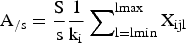
where S is the surface of the sampling station, s is the surface of quadrat (0.1 m2), ki is number of quadrats per station, and Xijl number of measured individuals per length–frequency l, per station i, per replicate j.
The biomass by station and the total biomass were calculated with respectively (4) and (5):
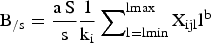

where a and b are the coefficients of the weight–length relationship of each species, l is the mean value of a size-class, n number of the stations and STot is the total surface of the sampling area.
RESULTS
Bivalve species richness
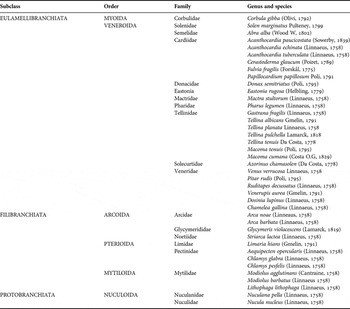
The systematic inventory of 7096 bivalve specimens collected from 285 replicates permitted the identification of 40 species belonging to 19 families. The systematic classification of identified bivalve species is shown in Table 1. The most represented family was Tellinidae with seven species, nearly followed by Cardiidae (six species) and Veneridae (six species), and then by Mytilidae (three species), Pectinidae (three species) and Arcidae (two species). Each of the remaining 13 families was represented by one species only.
Systematic classification of bivalve species (class of Bivalvia) identified from samples collected along the Gulf of Tunis coasts.

Weight–length relationship
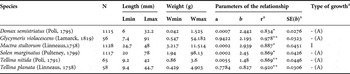
The number of individuals, as well as minimum and maximum length and weight of each species and the intercepts and the slopes of relative weight–length relationships are given in Table 2.
Descriptive statistics, estimated parameters and type of growth of the weight–length relationship of selected bivalve species caught along the Gulf of Tunis coasts.

*, P < 0.05; **, P < 0.01; 1, SE(b): standard error of b; I, isometric; -(A), negative allometric.
The sample size ranged from 56, accounted for Glycymeris violacescens (Lamarck, 1819), to 1117 individuals, for Solen marginatus. The estimation of the slope b of all weight–length relationships showed that these estimates are slightly different from the isometric value (b = 3) in the case of Donax semistriatus (Poli, 1795) and Solen marginatus (P < 0.05), and highly different for the remaining species (P < 0.01), with the exception of Mactra stultorum (Linneaus, 1758) which had b equal to 3. The coefficient of determination (R2) is ranging from 0.83 to 0.98.
The size of individuals ranged from a minimum of 6 mm for Donax semistriatus to a maximum of 76 mm for Solen marginatus. In the case of Tellina nitida and Tellina planata, the bulk of individuals measured between 15 and 21 mm, with a mean length of 19 mm and 16 mm respectively. These two populations are composed mostly of small individuals of considerable prominence in terms of both biomass and abundance.
In the case of all the remaining species, length–frequency distributions break down into roughly two main groups distinguishing between small and bigger-size individuals. The small size individuals are outnumbering adults but their biomasses are much less considerable.
Estimation and spatial distribution of abundance and biomass
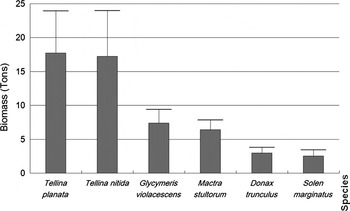
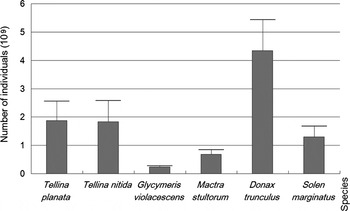
The total population of shellfish species in the Gulf of Tunis is estimated to 10.27 (±2.94) million individuals. The layout of total biomass by species is set out in Figure 2. The maximum of mean abundance is attained for Donax semistriatus, which counts 38 ind.m−2, whilst the minimum is recorded in the case of Glycymeris violascescens, with 2 ind.m−2.
Biomasses and their standard deviation of the six shellfish species along the coasts of the Gulf of Tunis.

The total biomass of the six shellfish species collected from the stations in the Gulf of Tunis is evaluated at 55 tons, broken down according to species (Figure 3). The total biomass for each of the six species is ranging from 2.5 tons for Solen marginatus to 17.7 tons for Tellina planata, with a standard deviation ranging from 18.13% for Glycymeris violacescens to 40.91% for Tellina nitida.
Count of individuals and their standard deviation of the six shellfish species along the coasts of the Gulf of Tunis.

Spatial distribution of abundance and biomass
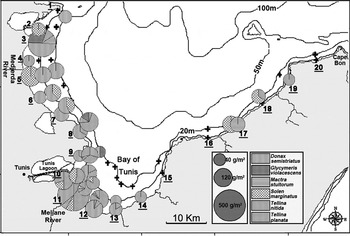
The distribution of shellfish species revealed a discrepancy between the eastern and western gulf coasts. The latter are more populated and include two areas of high species concentration in terms of both abundance and biomass (Figure 4). The first area corresponding to only one station located on transect 3, contains 4 species among which Donax semistriatus is the most abundant. The second area, covering 60 km2, is situated in the shallow areas of the Bay of Tunis near the mouth of the Meliane River and includes 10 stations positioned along transects 10 to 13. This area is even more important qualitatively and quantitatively because all the species are present, with the exception of Glycymeris violacescens, accounting all together for more than 28 tons. The density per station of all species combined reaches 514 g/m2 in the station located northward the mouth of the Medjerda River with a predominance of Donax semistriatus.
Spatial distribution of biomass of the six selected shellfish species along the coasts of the Gulf of Tunis. (+) indicates stations where samples did not contain target species.

The stations prospected in the two previously mentioned regions, record highest densities and biomasses values. Donax semistriatus is omnipresent in these two regions as well as along western coasts. Owing to the small numbers of individuals collected or their absence in some stations, data are not presented for stations where no/very few individuals were collected (Figure 4).
DISCUSSION
Weight–length relationship
The establishment of the weight–length relationship of the selected potential species revealed an isometric relationship in the case of Mactra stultorum pointing out that the weight increase is accompanied by a growth in length. This isometric relationship is in agreement with the work of Gaspar et al. (Reference Gaspar, Santos and Vasconcelos2001) on southern coasts of Portugal.
The five remaining species showed negative allometric relationships, indicating that the growth in length is superior to the weight gain (Table 1). In the case of species with negative allometric growth, the shell is elongated and streamlined. These morphological features might correspond to a strategy of adaptation that facilitates the burrowing of the bivalve into the sediment, leaving siphons extended to the sediment surface, particularly in the case of Solen marginatus (Lauzier et al., Reference Lauzier, Hand, Campbell and Heizer1998).
The negative relationship of Glycymeris violacescens confirms the findings of Savina (Reference Savina2004) studying a species belonging to the same genus Glycymeris glycymeris (dog cockle), which presents similar shape characteristics. Weight–length relationships of both species Tellina planata and Tellina nitida showed negative allometric growth and low value of the slope b, implying that the growth in length is even higher than the increase in weight. This finding is not surprising, due to the peculiar shape of the species. It seems that the adoption of the ‘cube law’ relationship (Equation 1) most likely skew the weight–length relationship of these two species. An alternative relationship should be applied to fit better the weight and length data. The negative allometric growth identified for the species Donax semistriatus, corroborates conspicuously studies in some other areas such as the southern Spanish and Portuguese coasts (Tirado & Salas, Reference Tirado and Salas1999; Gaspar et al., Reference Gaspar, Santos and Vasconcelos2001). Several authors (Ansell, Reference Ansell, McLachlan and Erasmus1983; Le Moal, Reference Le Moal1993; Gaspar et al., Reference Gaspar, Chicharo, Vasconcelos, Garcia, Santos and Moteiro2002) mentioned that the spatial distribution of Donax spp. obey to an age gradient with depth that makes adult individuals populate deep waters down to their ecological limit, while juveniles or immature individuals are found in shallower regions at the mid-tide depth. Other authors' findings showed though that Donax semistriatus lives confined mainly to the area of 4–5 m depth (Ansell & Lagardère, Reference Ansell and Lagardère1980; Neuberger-Cywiak et al., Reference Neuberger-Cywiak, Achituv and Mizrahi1990). In the present study, it is worth noting that it is very unlikely the weight at length relationships of Donax semistriatus did not include early age size individuals, living in inshore areas. In fact, the sampling area was stretched to reach as far as the very shallow waters.
Estimation and distribution of abundance and biomass
The variance within and among stations was large in this assessment and confidence limits of the biomass and abundance were correspondingly wide. The mean density of Donax semistriatus in the Gulf of Tunis, evaluated to 7.2 ind.m−2, was much higher compared to the densities recorded on the southern coasts of the Gulf of Gabès (Zarzis coasts, Tunisia), which was estimated to 0.109 ind.m−2 (Ben Abdallah et al., Reference Ben Abdallah, Ben Hadj Hamida and Jarboui2006). On north Israeli coasts, D. semistriatus was found in higher concentration and the mean density value approached 30 ind.m−2 (Neuberger-Cywiak et al., Reference Neuberger-Cywiak, Achituv and Mizrahi1990).
The spatial segregation of shellfish colonization between the eastern and western coasts might be attributed to ecological and physiological properties of the bivalves, namely their affinity for substrate type. Several studies characterized the Gulf's sediment type as soft sandy on the western coasts whereas eastern coasts are composed of clastic coastal sediments (Lubet & Azzouz, Reference Lubet and Azzouz1969; Added et al., Reference Added, Ben Mammou, Abdeljaoued, Essonni and Fernex2003). For marine bivalves there seems to be a very tight relationship between form and function, with shell shape being adapted to the habitat colonized (Kaufmann, Reference Kaufmann and Moore1969). Such sandy sediment can be an appropriate settlement for the accommodation of the burrowing bivalves (Stanley, Reference Stanley1970). As mentioned by Urban (Reference Urban1994), the selected target species, with the exception of Mactra stultorum, are considered as deep burrowing species owing to their elongated shells. These species burrow into the sediment with greater efficiency since their movements require much less energy. The deep burrowing is naturally an essential strategy to avoid potential predators (Zaklan & Ydenberg, Reference Zaklan and Ydenberg.1997). Donax semistriatus has a wedge-shaped shell which seems to be an adaptation for rapid burrowing and for migrating between tide levels in dynamic environments (Stanley, Reference Stanley1970). These ecological and physiological properties were confirmed by the omnipresence of D. semistriatus, along all transects from 1 to 13, corresponding to high energy beaches (Zeggaf Tahri, Reference Zeggaf Tahri1999) (Figure 4). Along Bay of Tunis coasts, considered as more sheltered littoral, the six target species inhabit sandy habitats in high biomass values and higher densities (Figure 4). Physical parameters, namely current surface and depth, might play a major role in affecting the distribution patterns and aggregation densities of shellfish concentrations in shallow waters down to 10 m depth (Odum, Reference Odum1971; Neuberger- Cywiak et al., Reference Neuberger-Cywiak, Achituv and Mizrahi1990).
On the opposite side, along eastern shores, explored through six transects form 15 to 20 m depth, only 4 stations were populated by target species. This spatial distribution confirms the interaction of shellfish species with sediment type, characterized by a majority of clastic coasts under severe hydrodynamic conditions (Zeggaf Tahri, Reference Zeggaf Tahri1999). Mactra stultorum and Solen marginatus are the most abundant species in these four stations concentrated in confined patches. These spots of concentration correspond to reduced areas of sandy sediment, most likely originated from a confinement of rivers outlets near cliffy beaches (Morrisey et al., Reference Morrisey, Howitt, Underwood and Stark1992).
Another plausible explanation of the variability of species spatial distribution is the food availability in the two regions corresponding geographically to the mouths of the two most important rivers in Tunisia, Medjerda and Meliane Rivers (Figure 1). The rivers' runoff represents the source of high food availability. Suspended particulate organic matter in the water column is accumulated particularly in the Bay of Tunis due to alongshore currents and waves generated from onshore winds (Zeggaf Tahri, Reference Zeggaf Tahri1999; Van Langevelde & Prins, Reference Van Langevelde and Prins2007). The surf zone of Tunis Bay constitutes a sheltered shore favourable for shellfish settlement.
Ayari & Afli (Reference Ayari and Afli2003) found that the Bay of Tunis is an area with a dominance of suspension feeders. This faunal group is essentially composed of bivalves consuming the nutrients by filtration of the water column such as Solen marginatus (Grall & Glemarec, Reference Grall and Glemarec1997). Moreover, this area constitutes an ecosystem with high primary productivity and rich phytoplankton diversity with 158 species (Daly Yahia et al., Reference Daly Yahia, Daly Yahia-Kefi, Souissi, Maamouri and Aissa2005). Several studies have confirmed the correlation between patterns of community structure with the primary production. In particular, the local abundance and biomass of filter-feeders was correlated with both intertidal productivity and nearshore primary productivity (Menge & Olson, Reference Menge and Olson1990; Bustamante et al., Reference Bustamante, Branch, Eekhout, Robertson, Zoutendyk, Schleyer, Dye, Hanekom, Keats, Jurd and McQuaid1995).
These assumptions of spatial distribution patterns may explain the prevalence of the shellfish species in these particular grounds. In the same order, it shows the importance of environmental factors in controlling the density and then the biomass of shellfish aggregations.
Perspectives of stock management
The present study revealed the localization of the main concentrations of target shellfish species with potential commercial value in the Gulf of Tunis. Furthermore, this work was the first attempt to estimate their stock size and the parameters responsible for its variability. Thus, this survey can be used as a base line and should be coupled with exhaustive sampling operations, by adding more transects and sampling stations, in order to refine the estimation of the stock size located in the areas of high concentrations.
For production purposes, further biological and ecological studies should be undertaken to carefully monitor shellfish exploitation and to put into practice fisheries management measures. To this aim, recent work focusing on population dynamics of target shellfish species has been conducted to obtain estimates about shellfish stock production in these zones. The fishing effort should be under surveillance, at least at the beginning of exploitation, in order to determine appropriate fishing technologies for a sustainable exploitation. Adopting and implementing management policies, such as individual size limitation and closed seasons, will be required to regulate the shellfish ranching and protect this new exploitable fishery resource.
ACKNOWLEDGEMENTS
We would like to thank the crew of the fishing ship for their skilful handling of the boat and the sampling gear. We thank also the numerous volunteers who have participated on the surveys cruises for their dedication to collecting high quality biological data.