INTRODUCTION
The tholos tomb at Kokla belongs to an extensive and rich Mycenaean necropolis which lies on the western edge of the Argive plain, approximately 5 km south-west of Argos, on the lower piedmont overlooking the Argive plain and the Gulf of Argos. The Kokla cemetery can be compared with other important Mycenaean cemeteries in the Argolid, particularly those at Dendra and Prosymna.Footnote 1
The tomb can be dated to the Late Helladic (LH) IIB–IIIA1 period, as shown by the finds from inside the tholos and the dromos fill. These finds date the tomb to around the end of the fifteenth century bc, specifically the transition from LH IIB to LH IIIA1 (the end of the fifteenth to the beginning of the fourteenth century bc), just prior to the Mycenaean Palatial period. The cemetery containing the chamber tombs, however, had a longer chronological span, from LH I down to LH IIIB (Demakopoulou Reference Demakopoulou, Zerner, Zerner and Winder1993, 57–9, fig. 1). The cemetery lies on a gentle slope. Nine chamber tombs and five pit graves were excavated, but there must have been more tombs in the area. The tholos tomb is situated near the cluster of chamber tombs (Fig. 1). The chamber tombs, cut into the natural rock, were unplundered and richly furnished. They have short or long, steep dromoi and square or elliptical chambers with niches in the walls and pits in the floors. Burials were found in situ on the floors, some of them pushed aside or swept into the pits.
Plan of the Mycenaean cemetery at Kokla.

The finds from the chamber tombs are of considerable importance, and include remarkable pottery comprising 232 complete vases (Demakopoulou Reference Demakopoulou, Zerner, Zerner and Winder1993, 59–80, pls 2–14) and other artefacts, such as handmade terracotta figurines, sealstones – one of them talismanic and made from carnelian – and jewellery, including a gold bead in the shape of a figure-of-eight shield, as well as bronze daggers, cleavers and knives. The settlement with which the Kokla necropolis was associated has not yet been identified. However, a probable location for a contemporary settlement is on a hill 300–400 m north of the cemetery; it is still unexplored.
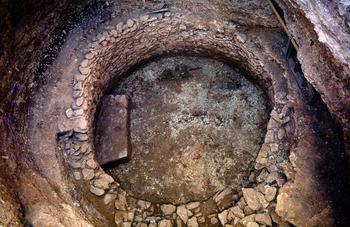
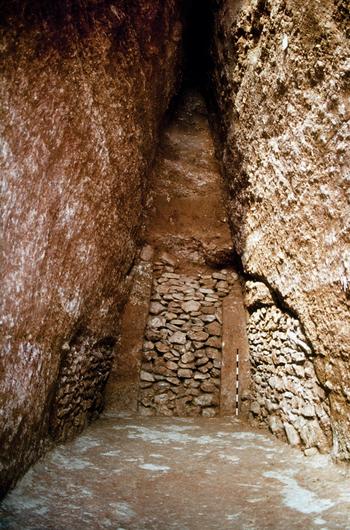
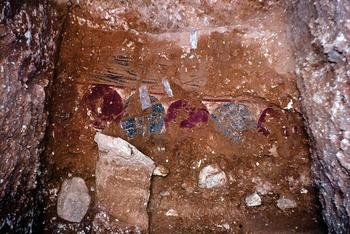
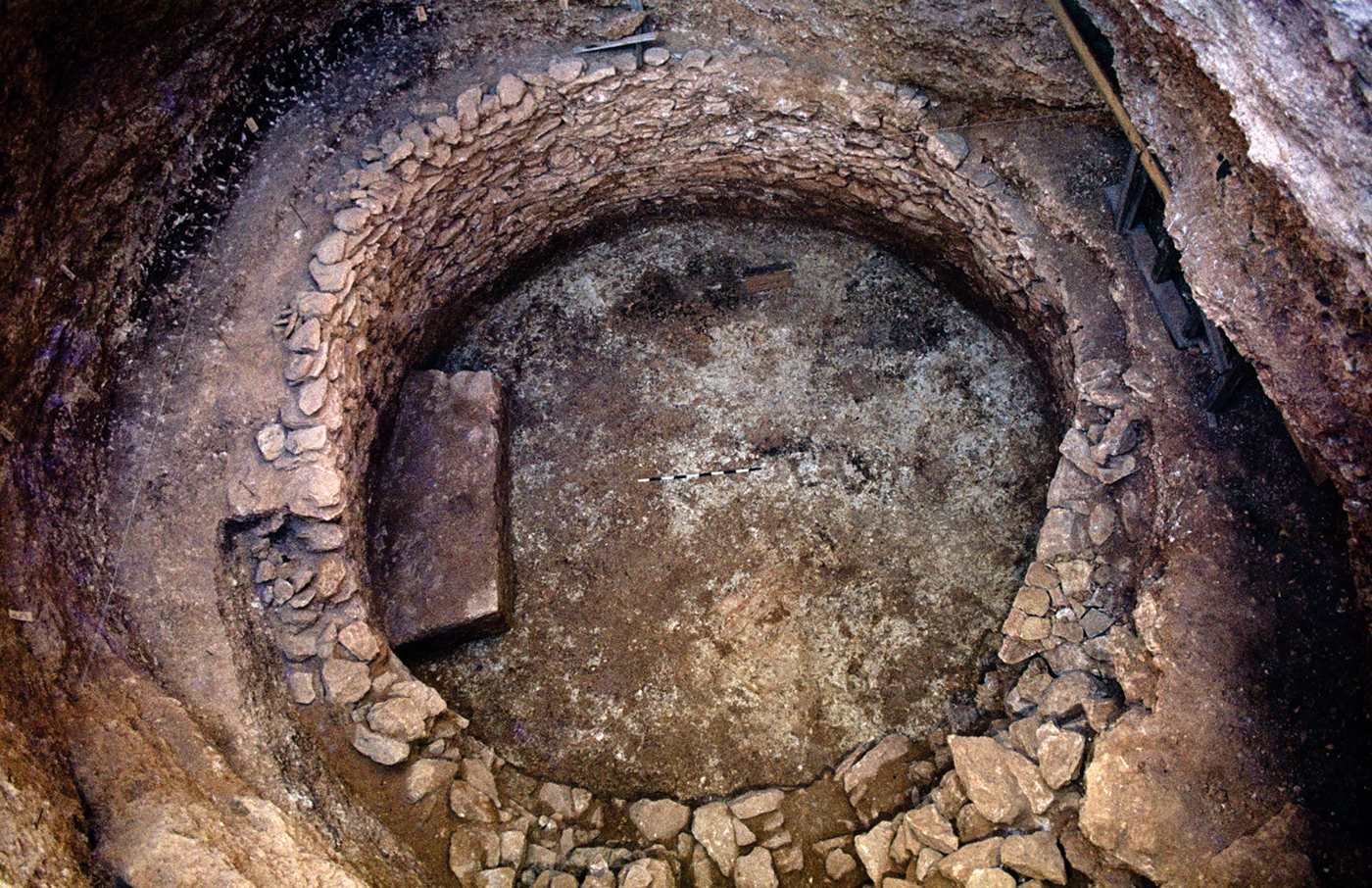
There are 14 other known tholos tombs in the Argolid (nine at Mycenae, two at Tiryns and one each at Dendra, Prosymna and Kazarma); on its discovery in 1981, the Kokla tholos became the 15th member of the Argive group of tholoi. It is an early Mycenaean tholos tomb which, based on its features, can be assigned to the first group of Argive tholoi according to Alan Wace's definition (Wace Reference Wace1949, 16–19). It also belongs to the group of small tholoi which, according to Olivier Pelon, are the earliest (Pelon Reference Pelon1976, 391). It is noteworthy that it combines features of a tholos and a chamber tomb. The walls of the tholos, which is a circular burial chamber cut out of the natural rock, 5.4 m in diameter and 5–5.5 m in estimated height, were dressed in stone, in a similar manner to other corbel-vaulted tholoi (cf. French Reference French2002, 41). The stomion jambs were also dressed in stone. However, the dromos walls and the façade of the tholos above the entrance were dug into the natural rock and have no stone lining, apart from a small section to the right and left of the stomion, which is 2.65 m high and 1.25 m wide (Figs 2, 3). The dromos is 23 m long and 2–2.2 m wide; it descends quite steeply to the stomion and has a blocking wall near its head. This is a common feature of the tholoi of the Argolid, with examples known from Mycenae and Tiryns (Pelon Reference Pelon1976, 169, 173, 180, pls 60, 62, 65, 72, 83). The rock surface above the entrance was coated with a thick layer of clay and plaster, on which a painting of blue and red discs, with a zone of fine blue lines on a whitish ground, was found, although in poor condition (Fig. 4). The discs doubtless represent wooden beam ends from the roof of a building. This must be one of the earliest-surviving Mycenaean frescoes. It was removed for protection and is now housed in the Argos Archaeological Museum. There is only one other tholos tomb, at Tiryns, with traces of a fresco on its façade, but they are known also from several chamber tombs of the Argolid (Demakopoulou Reference Demakopoulou, Hägg and Nordquist1990, 113–15).
View of the tholos tomb with bench.
The dromos and entrance of the tholos tomb.

Fresco above the entrance of the tholos.

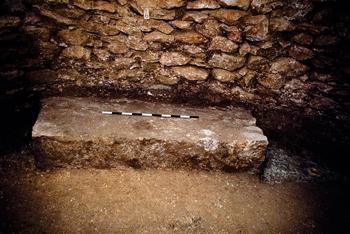
In the Kokla tholos tomb, which had not been looted, no burials were found in situ (either on the floor or in a pit) and there were no human bones from previous burials that had been pushed aside (Demakopoulou Reference Demakopoulou, Hägg and Nordquist1990, 120). However, evidence of burial ritual in the tomb is provided by a built stone bench adjacent to the encircling wall of the tholos (Fig. 5) (Demakopoulou Reference Demakopoulou, Hägg and Nordquist1990, 122). This low rectangular bench is 2.25 m long, 1 m wide and 0.5 m high. Benches are a characteristic feature encountered in other tholos and chamber tombs of mainland Greece (Demakopoulou Reference Demakopoulou, Hägg and Nordquist1990, 122 with references), as well as on Crete, at Phaistos (Savignoni Reference Savignoni1904, 526–7, figs 15–16) and in the monumental Tomb of the Double Axes at Knossos (Evans Reference Evans1914, 33–40, figs 52–3).
The built bench in the tholos tomb.

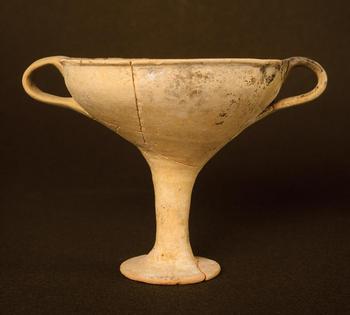
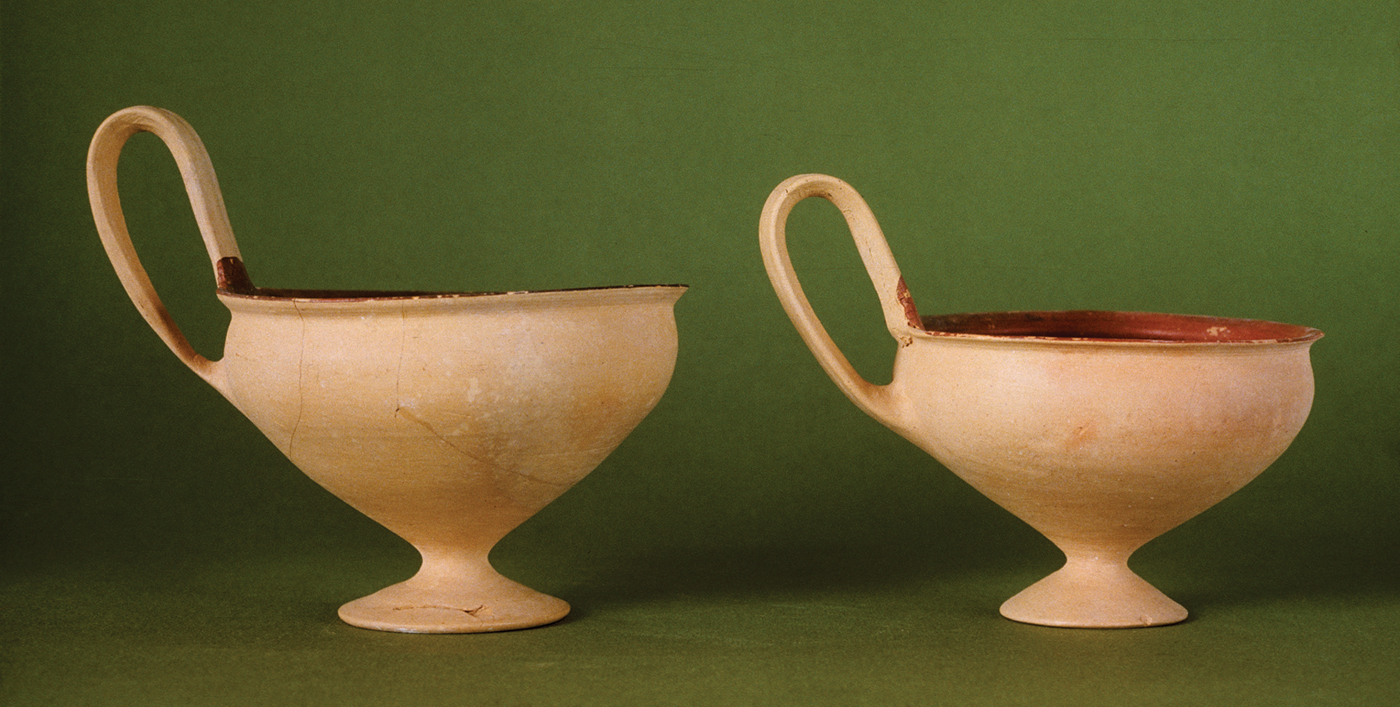
Very little pottery was found in the tholos tomb: a restored small to medium piriform jar (FS 30, 31),Footnote 2 dated to LH IIB–IIIA1 (Mountjoy Reference Mountjoy1986, 40, 55, figs 42, 61; Demakopoulou Reference Demakopoulou, Hägg and Nordquist1990, 119, fig. 20), inside the tholos and two LH IIIA1 unpainted two-handled kylikes (FS 259) in front of the entrance of the tomb (Fig. 6).Footnote 3 Both could have been used for a farewell drink after a burial ceremony in the tholos. Moreover, the dromos fill contained some fragments of three-handled palace style jars and an Ephyrean goblet, all dated to LH IIB (Demakopoulou Reference Demakopoulou1981, 94).
Unpainted two-handled kylix found in front of the tomb entrance.

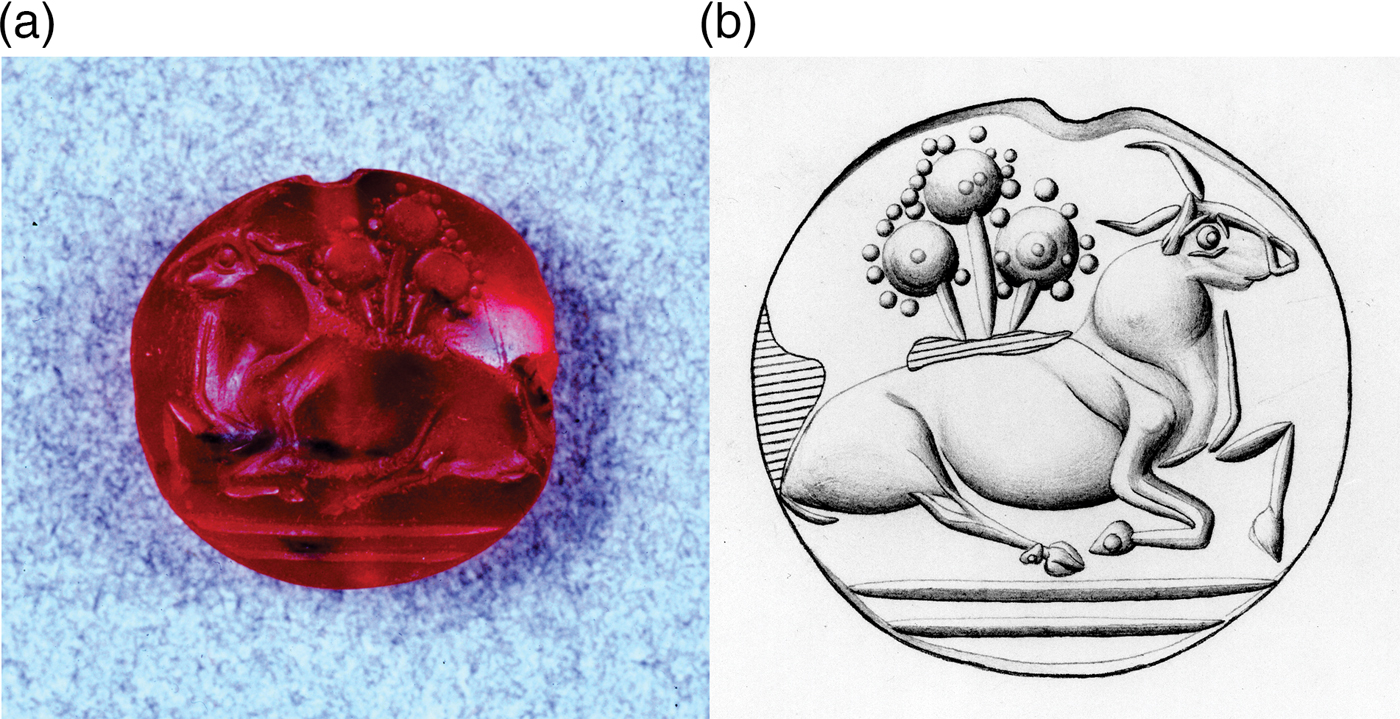
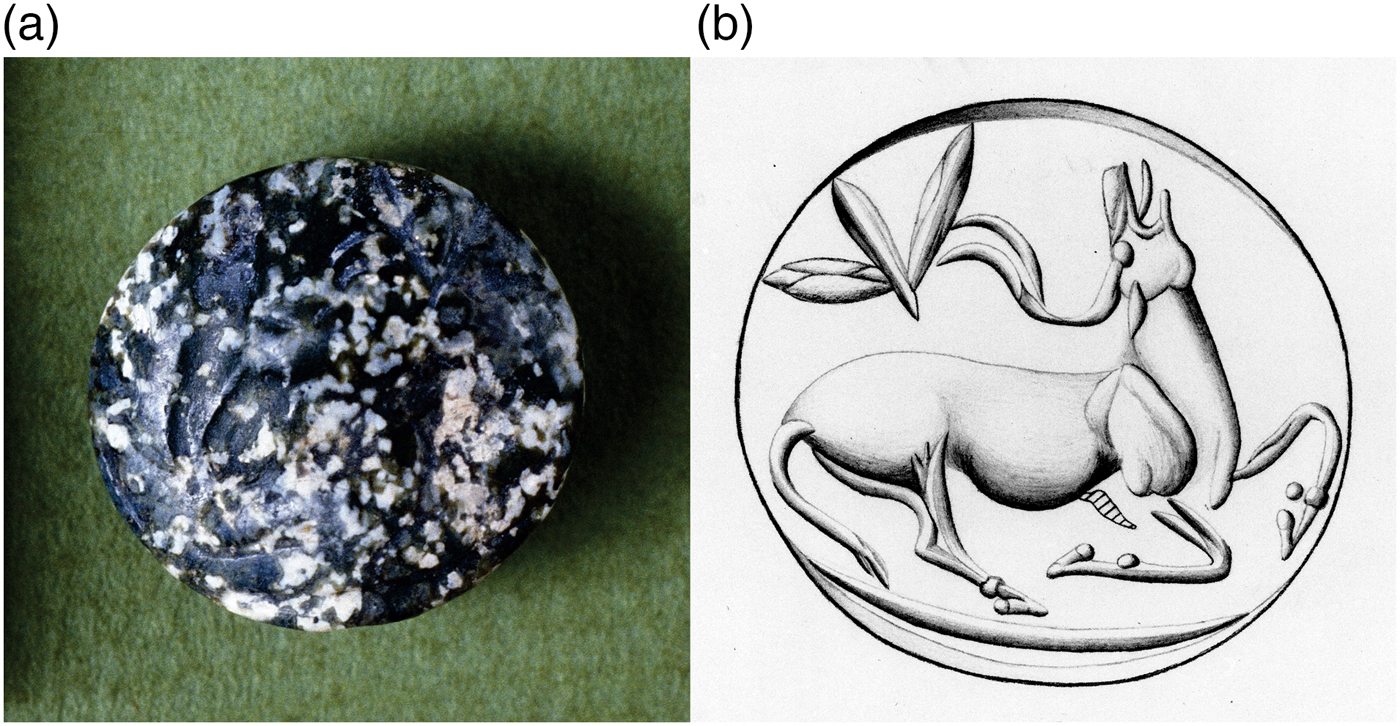
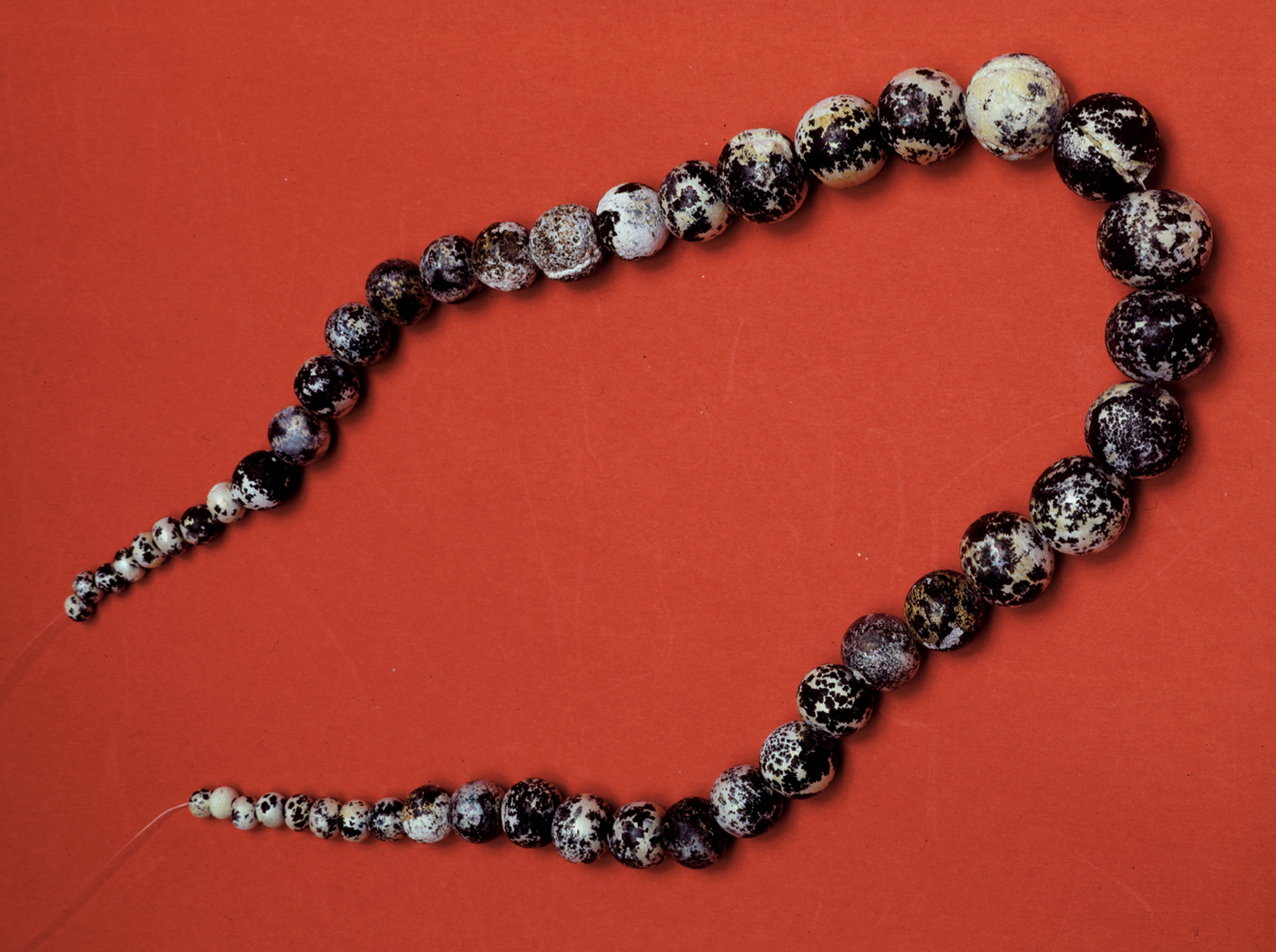
The tholos tomb yielded a significant group of precious objects: nine metal vessels (two of gold and seven of silver), an ivory relief plaque, two lentoid sealstones – one of orange-red carnelian with a depiction of a sitting bull (Fig. 7) and the other of hard greenish stone with white mottling, depicting a running bull (Fig. 8) (Pini Reference Pini1993, 58, 74, nos 68–9) – and numerous spherical glass beads, which might have originally formed a necklace (Fig. 9). Most of these offerings are Mycenaean, and only two appear to be purely Minoan in character: a gold one-handled shallow cup with embossed decoration of whorl shells on the rim and handle, dated to Late Minoan (LM) II–IIIA1/LH IIB–IIIA1, and a narrow ivory plaque with relief marine decoration, dated to LM IB. The Mycenaean works include four silver kylikes dated to LH IIIA1, a two-handled deep kylix and three one-handled carinated kylikes. There are also three silver conical cups probably of Mycenaean manufacture, although they show a strong Minoan influence. They may be dated to the LH IIB period. A circular gold-sheet overlay, which must have formed part of another metal vessel, is probably also of Mycenaean origin, dated to LH IIB–IIIA1.
(a) Lentoid sealstone of carnelian; (b) drawing of the sealstone impression.

(a) Lentoid sealstone of hard greenish stone with white mottling; (b) drawing of the sealstone impression.

Necklace of glass beads.

The silver vessels were all associated with the bench. Two kylikes and two conical cups sat on the bench, while the other three, two kylikes and a conical cup, were located on the floor beneath it, neatly stacked within each other. This close association indicates that the seven silver vessels formed a group, which was most likely intended for use in the burial ritual. The two gold objects, the shallow cup and the overlay, were found on the floor of the tholos chamber, with the glass beads of the necklace placed inside the gold cup. Also on the floor were the ivory plaque and the two sealstones. Scattered on the floor were other small metal finds, all of bronze, such as 12 hairpins, which could alternatively have been used as decorative elements on a kind of cap, as well as 14 arrowheads and a finger ring (Demakopoulou Reference Demakopoulou, Hägg and Nordquist1990, 119–20, figs 18–19). Obviously, the numerous precious grave-offerings in the Kokla tholos demonstrate the high social status of the deceased; given their proximity, it is reasonable to argue that the tholos and the rich chamber tombs of the Kokla cemetery may have been used to bury the elite of Argos.
The absence of burials in the richly furnished Kokla tholos tomb is strange given that there is evidence of burial ritual within it – not only the bench with the associated silver vessels, but also the gold vessels and the other precious grave-offerings. This situation is open to several interpretations.Footnote 4
Catalogue
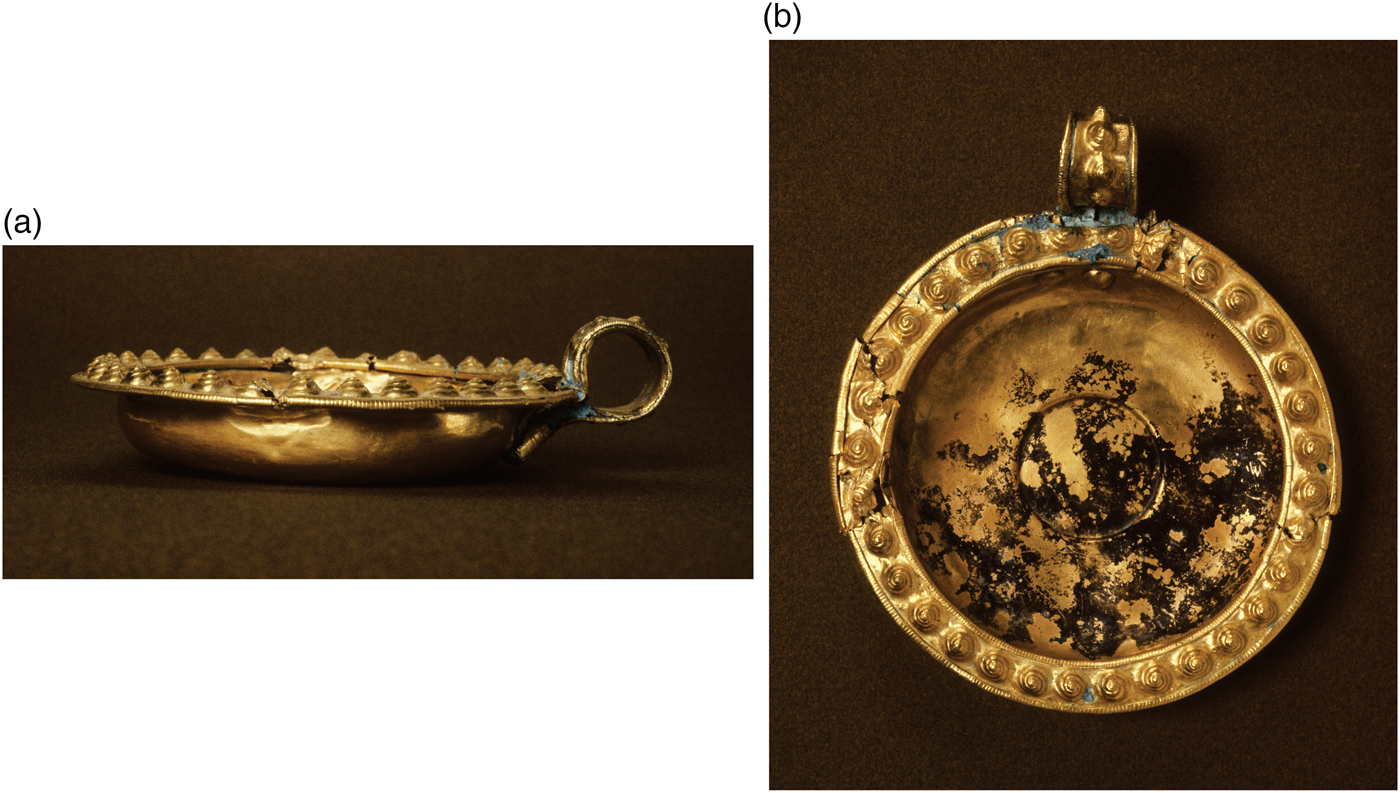
1. Gold shallow cup (Figs 10, 11)
Demakopoulou Reference Demakopoulou, Hägg and Nordquist1990, 119, fig. 13.
(a) Gold shallow cup in profile; (b) gold shallow cup.

Gold shallow cup (drawing by †Elizabeth Catling).

Height: 0.032 m; rim diameter: 0.1307 m; weight: 124 g.
This gold shallow cup is generally well preserved. There are several small dents in the body. Copper-based corrosive products from bronze or, more likely, unalloyed copper components within the cup have damaged the surface of the rim and handle, particularly the latter. Some parts of the rim have completely lost their copper core, leaving only the gold foil. The inside of the bowl contains black traces of tarnish from the placement of a silver vessel within it (or possibly from the glass beads); there are some scratch marks in this area which are probably associated with an attempt to remove this discolouration.
The cup has a flat and even base with an offset central foot 0.04 m wide and 0.003 m deep. The vertical wall of the body is quite low and has a gently curving base-to-wall transition. There is a single ring-handle fixed with three rivets set as an upside-down triangle. The placement of the handle is slightly off-centre. The rivet heads are rounded inside the vessel bowl and the outer two were sheared off flush with the handle on the outside of the cup. The lower central rivet was manufactured from copper or bronze that was then gilded (probably on both the inside and outside, but the outer foil has been lost). The other two rivets show no sign of copper-based corrosion and therefore may have been made of gold. On the outside, the head of the lowest of these handle rivets is larger than the others and may have originally had a decorative shape.Footnote 5 Preserved along the handle are nine raised whorl shells with clockwise spirals, although it is possible that the handle originally had ten such shells; there is a clear rounded lump of copper corrosion just above the terminal of the handle that may represent the remains of the core of another whorl shell. The handle edges, which were thickened to 0.0034 m as part of the cast plate rather than with handle wires,Footnote 6 are decorated with incised lines. The lower handle terminal is marked by a thickened squarish concave section (0.0156 m by 0.0116 m) that was cast with the rest of the handle and likewise gilded. The lowest handle rivet sits in the middle of the depression. The terminal is decorated with three or four ridges of varying width. The upper handle terminal flares outwards at the end to a width of 0.0337 m and was left undecorated. The maximum internal height of the handle is 0.019 m and the maximum internal width is 0.021 m. There are 32 similar whorls on the rim with the same type of incisions along both the inside and outside edges. The rim, 0.0142 m wide, overhangs the vessel wall on both sides.
The body of this cup was raised from a single billet of gold and provided with an outwardly flaring rim. A small circular depression in the base indicates the use of a compass (Davis Reference Davis1977, 350–1), which would have improved the regularity of its form. The whorl-shell decoration is also very regular and consistent; the mould into which the copper elements were cast was probably itself made using a three-dimensional stamp to create the negative impressions for the whorl-shell ornament. The cup was fitted with a secondary rim through a complex and unusual form of attachment (Fig. 12). The secondary rim consists of a gilded cast copper bar into which the whorl-shell decoration had already been incorporated. The act of working the gold foil over the decoration would have mechanically attached it to the cast bar. This secondary rim is held in place with a separate gilded copper strip that was folded over the outside edges of the body rim and secondary rim. The gilding on this strip was attached mechanically through the use of decorative incisions. A matching gilded copper strip was added to the inside edge of the secondary rim but this had an ornamental function only, to maintain the symmetry of the decorative scheme. The handle was also manufactured from a gilded cast copper bar, with whorl-shell decoration and especially thickened edges already incorporated. Similar decorative incisions were used to secure the gold foil in place.
Schematic diagram showing the method of secondary rim attachment applied to the gold shallow cup from Kokla. The copper elements are shown in black, the lower gold vessel rim in dark grey and the gold foil in light grey. The thicknesses of the gold foil and thin copper brackets have been exaggerated for visual clarity. It is not possible to tell if the secondary copper rim was originally completely gilded underneath as well. The gilding of the secondary rim does continue beneath the brackets, indicating that it had been covered by gold foil before being attached to the cup (drawing by Stephanie Aulsebrook).

This type of shallow cup, with added cast copper elements and decorated with raised whorl shells on its rim and handle, is a common Aegean product, stylistically of Minoan origin.Footnote 7 All other known parallels to this vessel have a body manufactured from silver with a gilded handle and rim (Fig. 13); these cups are thought by Ellen Davis and Hartmut Matthäus to be of Minoan craftsmanship (Davis Reference Davis1977, 260–1; Matthäus Reference Matthäus1980, 222–4). The cup from the Kokla tholos is the only example of a shallow cup with a secondary rim that has its body manufactured from gold. Other gold shallow cups have a plain rim (Davis Reference Davis1977, 125–7 no. 25, 304 no. 133), an everted rim (Davis Reference Davis1977, 253–5 no. 101) or were finished with a gilded metal strip (Davis Reference Davis1977, 267–9 no. 110, 276–80 no. 116).
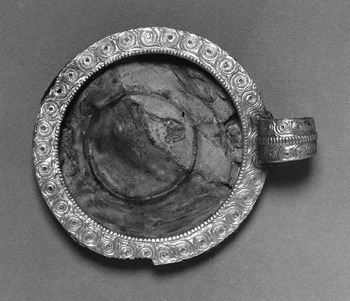
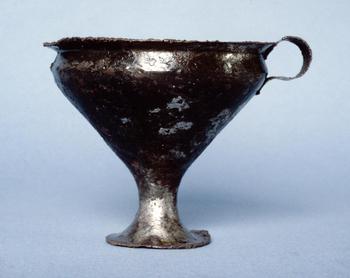
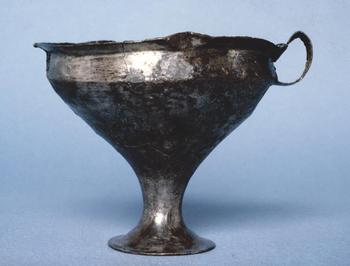
Silver shallow cup with gold overlay on its rim and handle from Chamber Tomb 10 at Dendra cemetery.

In addition, the technique used on the Kokla gold cup to secure the secondary rim is unique. It is a reinterpretation of a method used on two gold vessels from nearby Dendra (Persson Reference Persson1931, no. 2; Reference Persson1942, no. 19).Footnote 8 On the vessels from Dendra, a second rim was formed from a thin strip of gilded metal that had been wrapped over the vessel edge then cross-ribbed to create a mechanical attachment (Davis Reference Davis1977, 267–9 no. 110 figs 214–16, 276–80 no. 116 figs 224–7). On the Kokla gold cup, the cross-ribbed gilded strips were used to hold a completely separate secondary rim in place. The use of this unusual method may have been intended to avoid unsightly rivet heads spoiling the effect of the rim decoration. That this was considered troublesome to the overall aesthetic effect is demonstrated by the attempts made on other vessels to place the rivets subtly within the decorative scheme.Footnote 9 It was also common practice, when rivets manufactured from another metal were used, to plate the rivet heads in order to make them less obtrusive.
The technique employed for the attachment of the secondary rim to the Kokla vessel has proved to be less effective than the conventional use of rivets; the secondary rim has shifted slightly from its original seating and now is held in place in part only by corrosion products that have been generated from its copper core and brackets. It is possible that this damage occurred before deposition. Otherwise, the quality of its production is very high, with a regular profile and even decoration.
The tall conical whorl-shell decoration is a standard Aegean design found on copper and bronze basins.Footnote 10 The projections on the rim would have made it very awkward to drink from this vessel. Furthermore, the seal between the primary and secondary rims would not have been waterproof (Christina Clarke personal communication). It is therefore unlikely that this gold vessel was used for the purpose of drinking; it is probable that it was used for eatingFootnote 11 or libations instead.Footnote 12
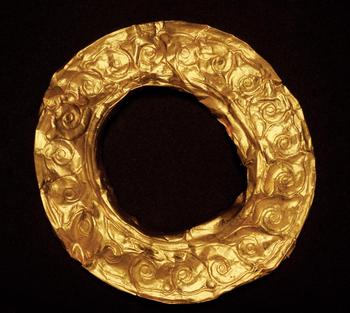
2. Gold-sheet overlay (Fig. 14)
Demakopoulou Reference Demakopoulou, Hägg and Nordquist1990, 119, fig. 15.
Gold-sheet overlay.

Diameter: c.0.17 m; weight: 17 g.
This gold sheet is now folded and crumpled across much of its surface and generally deformed. There are several small tears and holes. At its outer edge the sheet is folded in on itself; this may have been an original fold line. There are small traces of brownish corrosion, which are more apparent on the underside.
This is a high-quality gold-sheet overlay probably designed to cover part of a relatively large vessel, such as a jug. It is suitable for covering a wide expanse and must have fitted onto a tapering section of the vessel profile, such as the area of the neck and shoulder. It may have been intended to mask the join between the main body and upper part of a large jug, as found on many bronze examples. A good parallel is an elegant bronze jug with a bronze overlay from Chamber Tomb I:5 at Asine (Frödin and Persson Reference Frödin and Persson1938, 393, no. 2, figs 257–8; also Demakopoulou Reference Demakopoulou1988, 228, 230, no. 223). The neck of a large silver ewer from Grave V in Circle A at Mycenae was originally gilded (Karo Reference Karo1930–3, 148, no. 855; Davis Reference Davis1977, 149–55 no. 43) and bimetallic jugs are also found on scenes from Theban tombs showing tribute carried by individuals in Aegean-style dress, although these are shown with silver on top and gold below (Wachsmann Reference Wachsmann1987, 56, 69). Then again, this gold-sheet overlay could have been intended to cover a very broad rim, although this seems much less likely given the known repertoire of Late Bronze Age Aegean vessel shapes. Wood and stone must be considered as possible alternatives to metal with regard to the material used to manufacture the now missing body of this vessel (Demakopoulou Reference Demakopoulou, Hägg and Nordquist1990, 119). There are no traces underneath to indicate what type of material this gold sheet originally covered.
The overlay has 19 running spiral whorl-shell shapes aligned approximately along its centre as a single row. The shell shapes all face in the same direction. One groove runs inside the band of shells. This decoration is visible on both sides due to the thinness of the foil. The decoration is a standard Aegean motif.Footnote 13 The remainder of the overlay is blank.
The underside bears no apparent trace of any adhesive to affix this overlay to another surface; the attachment was probably mechanical, made by tooling the design over a ready-made impression on the surface to which it was affixed. If the fold lines are original, then the edges of the overlay may have been folded over the object beneath it in order to strengthen the attachment.
The regularity of its form and thickness suggests the use of a compass or template to mark the line of the outer and inner edges on a gold sheet, which would have been hammered from an appropriately sized billet. The inner circle was then removed to create the aperture.
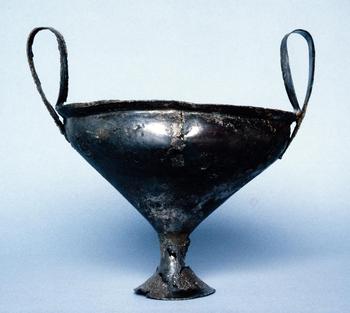
3. Silver two-handled deep kylix (Fig. 15)
Demakopoulou Reference Demakopoulou, Hägg and Nordquist1990, 119, fig. 8.
Silver two-handled deep kylix.

Height: 0.209 m; rim diameter: 0.196 m by 0.153 m; weight: 179 g.
The foot of this kylix is cracked and slightly deformed; the stem is much more badly damaged and has been partially restored. The pattern of surface corrosion differs somewhat between the foot and the stem, on the one hand, and the bowl, on the other. There is a dent in the vessel bowl and its surface has a few small holes caused by corrosion of the silver plate. One of the handles has been forcefully pushed inwards. This must have occurred some time ago as a bubble of corrosion products has formed between the vessel body and the section of this handle that has been pushed closest to the vessel wall. The handles themselves are quite corroded and are missing several small fragments. A thin layer of polyamide now covers the inside of the bowl and part of the rim has been restored.
The concave base of this kylix (diameter 0.0689 m) curves into a short but broad stem, approximately 0.04 m in length. The vessel bowl is deep and conical with a slightly convex shoulder and everted flaring rim, 0.0117 m wide and set at an angle of approximately 55 degrees. The mouth is elliptical, with the handles positioned at the furthest ends of the ellipse (this is the original shape of the mouth; there are no signs that it has been bent out of shape). In general, the wall profile of the bowl is somewhat uneven, although it may have been deformed after deposition. There are two ribbon handles that rise above the vessel body. They both have elongated T-shaped upper terminals that fit into the width of the underside of the rim and attach with two rivets; there is a single rivet through each lower terminal to attach them to the body. The lower terminals are not elaborated in any way. All the rivets have rounded heads on the inside of the bowl and have been sheared off flush with the handle terminals on the outside. At their broadest point, the two handles are 0.0224 m and 0.0231 m wide. At the lower terminal they are 0.0172 m and 0.0175 m wide. The internal maximum height and width of one handle are 0.0666 m and 0.0256 m respectively; for the other they are 0.0655 m and 0.0209 m (the internal width of the second handle has been reduced due to the fact that it has been pushed inwards towards the body of the vessel). The thickness of the handles is 0.001 m and 0.0009 m. Both handles are decorated with two shallow parallel lines, spaced a little less than 0.005 m apart from each other, that run along the entire length of the handles down their centre.
The body and foot were raised together from a single billet of silver, with the metal folded back upon itself at the transition between the base and stem to leave the stem hollow. There is no sign that an internal dividing plate was fitted between the stem and the bowl to prevent liquid entering the former. Such dividing plates were used on stemmed vessels, such as the two silver kylikes and silver stemmed krater from Dendra Chamber Tomb 10 (Davis Reference Davis1977, 273–5). Any evidence for the use of a compass during the production of this kylix has been obscured by corrosion. The two handles were formed separately from thin silver plate and their edges have not been thickened. The upper T-bar shape handle terminals were designed to fit exactly the width of the flared rim. The rounded internal heads of the upper handle rivets sit on top of the rim, not inside the body as is more conventional; their diameter matches the width of the rim (see Fig. 20 below).
The placement of the upper handle rivets on top of the rim makes them unusually visible. In her 1977 study of gold and silver Aegean vessels, Davis notes this type of attachment on only one vessel: the gold shallow cup from the Acropolis Treasure (Thomas, H. Reference Thomas1938–9, no. II, ANM 961). She suggests that this demonstrates it was an experimental product (Davis Reference Davis1977, 295) and perhaps resulted from the necessity of a similar attachment for the associated goblets from the same deposit (Thomas, H. Reference Thomas1938–9 nos Ia–d, AMN 957–60) due to their handles terminating in dogs’ heads that were intended to appear to ‘bite’ the rim. A similar arrangement can also be seen on the two silver kylikes and silver krater from Chamber Tomb 10 at Dendra; on these vessels the rivet heads are flat rather than rounded (Persson Reference Persson1942, 87–9, nos 34–6, fig. 99:1–3; Davis Reference Davis1977, 273–5, nos 113–15). This similarity may indicate a workshop connection between the Kokla kylikes and the Acropolis Treasure cup, although whether this can be said of the Dendra vessels as well is unclear as Davis argues that the use of flat and rounded rivet heads distinguishes different crafting traditions (1977, 249). Perhaps, as an adaptation required to overcome the difficulty of attaching a handle to a vessel with a significantly everted rim, this feature should be considered a solution common to multiple smiths rather than associated with a particular workshop.
A good parallel for this silver two-handled kylix is a LH IIIA1 ceramic plain type (FS 272) with high handles (Mountjoy Reference Mountjoy1993, 66, 69, no. 148). There is also another LH IIB–IIIA1 ceramic parallel: a goblet with high handles (Mountjoy Reference Mountjoy1993, 58, 62, no. 116). The overall shape of this vessel can be compared to the LH IIB clay goblets with a single high handle (FS 254) from the chamber tombs of the Kokla cemetery (Fig. 16) (Mountjoy Reference Mountjoy1986, 49, fig. 55:1). The design of the two-handled deep silver kylix from Kokla seems inherently unstable, as the foot is too small to counterbalance the spread of the body and handles. It is also very light in weight for its size. The care taken with the shaping of the upper handle terminals seems mismatched with the apparent irregularities in the wall profile, which may indicate the scale of the technical challenge to produce a vessel of this size from a single billet.
Clay kylikes with high-swung handles.

Stemmed cups were an important element of the Mycenaean repertoire of metal vessels, representing the third most common form behind Vapheio and shallow cups; they are also one of the least standardised shapes (Aulsebrook Reference Aulsebrook2018a). There are, therefore, no direct parallels to this particular form in metal, which incorporates several unusual features such as the elliptical mouth, the presence of two handles and the positioning of the handles so that they rise above the rim. Its closest relations in metal are the stemmed krater from Dendra Chamber Tomb 10 (Persson Reference Persson1942, 87–8, no. 34) and the gold goblets from the Acropolis Treasure (Thomas, H. Reference Thomas1938–9, nos Ia–d, AMN 957–60). However, although they have similar profiles, none of these vessels have handles that rise above the rim or an elliptical mouth. Furthermore, there are clear differences in their methods of manufacture.
Stemmed cups were very common in ceramic throughout the Mycenaean period, with the development of several clear types that came in and out of fashion over time. They appear in great numbers within certain contexts, such as the pantries and feasting debris found in the palace at Pylos (Bendall Reference Bendall, Halstead and Barrett2004). They also seem to have been accorded a specific role in mortuary rituals from LH IIIA onwards, as they are found deposited in the dromoi of tombs (Cavanagh Reference Cavanagh and Branigan1998, 111). Kylikes are amongst the gold vessels offered on the Linear B tablet Tn 316 from Pylos (logogram *215VAS), possibly as dedications to a deity (Weilhartner Reference Weilhartner and Varias2012, 222–3). This has led some scholars to suggest that stemmed cups, especially kylikes, were accorded an important symbolic status (Galaty Reference Galaty1999; Reference Galaty, Galaty and Parkinson2007), whereas others argue that, since they are present in almost every type of context, their appearance within special activities should not be regarded as bestowing any particular significance upon the objects themselves (Rutter Reference Rutter and Parkinson2001, 345; Thomas, P.M. Reference Thomas2004, 116).
4. Silver one-handled carinated kylix (Fig. 17)
Demakopoulou Reference Demakopoulou, Hägg and Nordquist1990, 119, fig. 9.
Silver one-handled carinated kylix.

Height: 0.089 m; rim diameter: 0.1151 m; weight: 57 g.
This kylix is almost complete, although small corrosion holes are present and tiny fragments are missing from the edges of the base and rim. The surface is covered by a multitude of corrosion marks. The rim has been slightly deformed; it is now not perfectly circular, although, unlike object 3, this is certainly due to damage post-manufacture. Its angle of eversion is now also inconsistent due to the same deformation. There are two dents on the body and the edge of the base is slightly bent. A thin layer of polyamide has been applied inside.
The concave circular base of this vessel (diameter 0.0505 m) curves into a short stem, 0.0195 m high. As seen on object 3, there are no signs that the stem and bowl of this kylix were physically separated. The straight-sided conical wall has a sharp vertical carination, 0.0093 m below the rim; the rim itself flares outwards at an angle of roughly 55 degrees. The width of the rim is 0.0069 m. Overall, the profile can be considered akin to the ceramic FS 267 form. This kylix has a single ribbon handle of silver plate, 0.0013 m thick, formed into a ring and attached in the same fashion as on object 3. The maximum width of the handle is 0.018 m; it is 0.0135 m wide at its lower terminal. The internal maximum height and width of the handle are 0.0171 m and 0.0189 m respectively. It is decorated with the same ornament as the handles of object 3. There is a small circular depression at the centre of the base, which indicates the use of a compass during its manufacture (Davis Reference Davis1977, 350–1). Around this mark is a slightly off-centre horseshoe-shaped groove. Otherwise, the method of manufacture for this cup is identical to that for object 3.
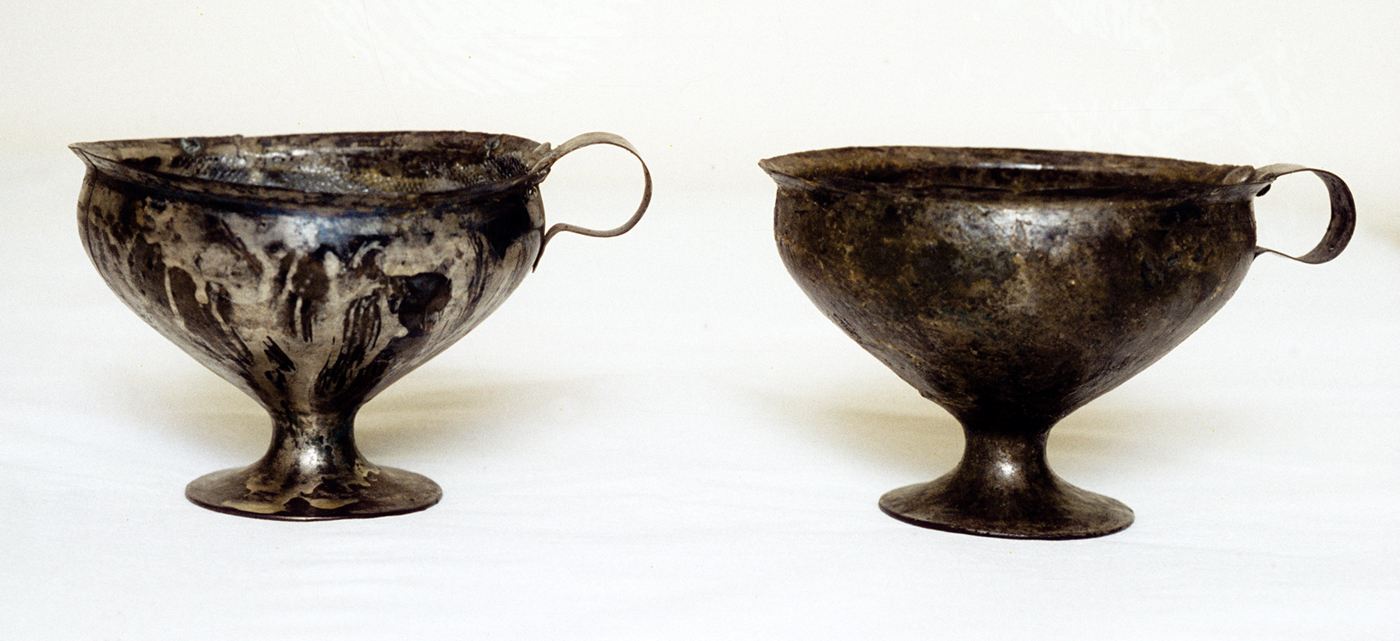
5. Silver one-handled carinated kylix (Fig. 18)
Demakopoulou Reference Demakopoulou, Hägg and Nordquist1990, 119, fig. 10.
Silver one-handled carinated kylix.

Height: 0.084 m; rim diameter: 0.109 m; weight: 60 g.
At some point in the past, the handle of this kylix received a heavy impact that drove the lower part of the handle into the body of the vessel. This caused a dent in the wall and deformed the handle as well. Part of the rim and upper body are missing. Generally, the majority of the corrosion damage is on the inside wall of the bowl, and this has caused a large number of small bubbles to form on the internal surface. There are several cracks in the wall and the rim has been partially deformed. Pieces of epoxy resin have been added to replace the missing fragments and a thin layer of polyamide has been applied inside.
This kylix is very similar in form to object 4. It too has a concave circular base (diameter 0.0484 m) that curves into a straight but very short stem, 0.0186 m high with a minimum width of 0.0176 m. The body has a straight-sided conical wall with a sharp vertical carination, which is placed 0.0105 m below the rim. There are no signs that the body and stem were physically separated internally. The rim itself flares outwards and slightly upwards, at an angle of about 10–15 degrees from the horizontal. It is 0.008 m wide. The rim was not intentionally thickened. This kylix also has a single ribbon handle, 0.0011 m thick, formed into a ring with the same terminals and rivet configuration as found on object 3. The maximum width of the handle is 0.0161 m (the damage to the handle and body means it is not possible to ascertain the width of the lower handle terminal; the handle is also too deformed for internal measurements to be taken). This vessel shares the same ornamentation as the handles of the other kylikes from this tomb. It seems that its method of manufacture was the same as that used for object 4.
6. Silver one-handled carinated kylix (Figs 19, 20)
Demakopoulou Reference Demakopoulou, Hägg and Nordquist1990, 119, fig. 11.
Silver one-handled carinated kylix, fragmentary.

Schematic diagram based upon the underside of a silver one-handled carinated kylix from Kokla (object 6), highlighting the method of securing the handle to the body of these cups. The T-bar shaped upper terminal (held by two rivets) was designed to fit the width of the everted rim (drawing by Stephanie Aulsebrook).

Height: (preserved) 0.052 m; rim diameter: 0.1137 m; weight: 32 g.
The stem and foot of this kylix are missing, along with approximately one-fifth of the lower bowl. There are multiple corrosion holes, marks, scratches and cracks visible on the surface of the vessel, as well as a large dent on one side of the body. A thin polyamide layer has been applied inside.
The preserved profile is of a straight-sided conical body with a sharp vertical carination, 0.0099 m below the rim. This kylix probably shared the same complete profile as objects 4 and 5. The rim flares outwards almost horizontallyFootnote 14 and is 0.0069 m in width. Like the other kylikes, its rim was not intentionally thickened. The cup has a single ribbon handle of silver plate, 0.0011 m thick, formed into a ring. Its maximum width is 0.018 m and it is 0.0129 m wide at its lower terminal; the handle is affixed to the body in the same way as for object 3. The maximum internal width of the handle is 0.019 m and its maximum internal height is 0.0177 m. The handle on this kylix shares the same form of decoration as that found on the other three kylikes from this tomb. It also shares the same method of manufacture.
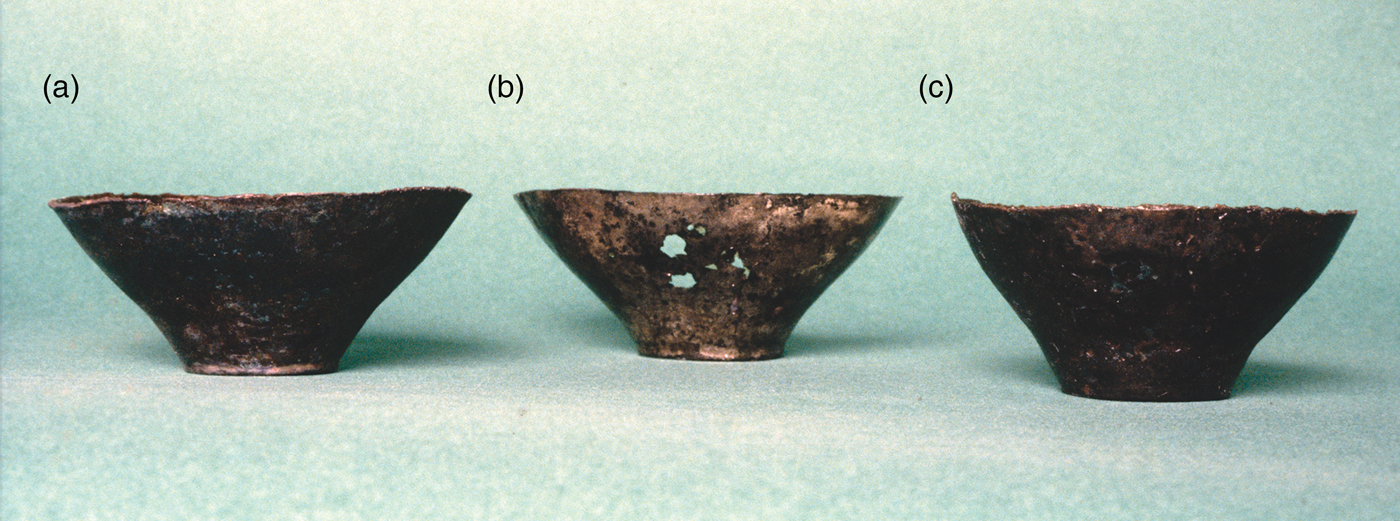
7. Silver handleless conical cup (Fig. 21c)
Demakopoulou Reference Demakopoulou, Hägg and Nordquist1990, 119, fig. 12 right.
Silver conical cups.

Height: 0.044 m; rim diameter: 0.0977 m; weight: 21 g.
The rim of this vessel has been slightly deformed; there are signs of corrosion along its edge and it also has a small dent. There are plentiful scratch marks and signs of corrosion across the surface of this cup generally. A thin layer of polyamide has been added inside the vessel and part of the rim has been restored.
The otherwise flat base (diameter 0.0399 m) has a small hollow. There is a sharp transition between the base and the wall. The wall then continues roughly vertically upwards before flaring outwards towards the rim. The thickness of the vessel wall is relatively uniform (averaging, where measurable, 0.0011 m), including the rim. As the rim was left unthickened, making the edge quite sharp, care would need to have been taken if it was intended for liquids to have been consumed directly from it.
The cup was left undecorated. It was raised from a single billet of silver, and the small circular indentation in its base indicates the use of a compass during its manufacture (Davis Reference Davis1977, 350–1).
There are very few examples of this shape in metal, and the only other known metal specimens outside of Kokla are of bronze.Footnote 15 This is despite the fact that its design would have been relatively simple to produce. On Crete it is known as the conical cup and is found in such plentiful quantities that it is considered one of the key elements of Minoan culture (Knappett and Hilditch Reference Knappett, Hilditch and Glatz2015, 98) and has persistently appeared in discussions concerning the significant cultural change visible across the Aegean during the middle of the second millennium BC that has been termed ‘Minoanisation’ (e.g. Wiener Reference Wiener, Hägg and Marinatos1984; Gillis Reference Gillis, Hardy, Doumas, Sakellarakis and Warren1990a). Conical cups are found at almost every Minoan settlement from at least Early Minoan (EM) II–III to LM IIIC (Gillis Reference Gillis1990b, 1), although their most recognisable form as a widespread, plain, mass-produced drinking vessel was not developed until the Neopalatial period, during which time the form became increasingly standardised (Knappett and Hilditch Reference Knappett, Hilditch and Glatz2015, 95–6). It is this specific Middle Minoan (MM) III–LM I form that most closely matches the shape of the silver handleless conical cups found in the Kokla tholos. On Crete, conical cups are often found in ritual and funerary contexts (Knappett Reference Knappett, Betancourt, Karageorghis, Laffineur and Niemeier1999, 415). The conical cups found in Cretan mortuary contexts are usually manufactured from inferior clays, are almost never decorated and can be irregularly formed; this implies that they should be interpreted as containers rather than as gifts to the dead in their own right (Gillis Reference Gillis1990b, 150). Conical cups are also found in the Minoan stone corpus (Warren Reference Warren1969, 37–8, type 16).
In the mainland ceramic corpus, the conical cup is considerably rarer (French and Tomlinson Reference French, Tomlinson, Betancourt, Karageorghis, Laffineur and Niemeier1999, 259). Its trajectory on the Greek mainland differs in several other ways to its trajectory on Crete. The shape was apparently introduced to the Greek mainland at approximately the same time as Late Helladic lustrous dark-on-light ware was developed, in LH I, and it seems to have fallen out of favour during or after LH IIIB1 amid general changes to the mainland ceramic repertoire, so that overall it had a much shorter period of use on the mainland than on Crete (Dickinson Reference Dickinson and Laffineur1989, 134; Wiener Reference Wiener, Hardy, Doumas, Sakellarakis and Warren1990, 137–9; French and Tomlinson Reference French, Tomlinson, Betancourt, Karageorghis, Laffineur and Niemeier1999, 259, 261). Furthermore, although often made in coarser fabrics, the quality of its manufacture was consistently quite reasonable (French and Tomlinson Reference French, Tomlinson, Betancourt, Karageorghis, Laffineur and Niemeier1999, 259). Therefore, it has been suggested that this shape should be referred to as the ‘handleless cup’ when found in mainland contexts in order to make clear this distinction (French and Tomlinson Reference French, Tomlinson, Betancourt, Karageorghis, Laffineur and Niemeier1999, 259). Uses for the ceramic handleless cup on the mainland include funerary deposition, as lamps and as containers for fresco pigments; it may have played a role in cultic practices as well (French and Tomlinson Reference French, Tomlinson, Betancourt, Karageorghis, Laffineur and Niemeier1999, 261). Gold handleless bowls also seem to be listed on the Pylos tablet Tn 316 (*213VAS) (Weilhartner Reference Weilhartner and Varias2012, 222).
8. Silver handleless conical cup (Fig. 21a)
Demakopoulou Reference Demakopoulou, Hägg and Nordquist1990, 119, fig. 12 left.
Height: 0.041 m; rim diameter: 0.1038 m; weight: 22 g.
The body of this cup has become slightly deformed. There is some visible damage to the rim, including the loss of small fragments that have corroded away. The surface of the cup is covered by cracks, scratches and traces of corrosion as well as several small holes where the thin sheet has now completely corroded through. A thin layer of polyamide has been applied inside the vessel.
The base of the cup (diameter 0.0378 m) is slightly concave with a sharp transition between the base and the wall. The lower part of the wall slopes very slightly outwards; this lower section is less vertical and shorter than that of object 7. The wall profile then flares outwards into a conical shape. The wall thickness is apparently quite uniform (averaging, where measurable, 0.001 m). The cup is undecorated. It was manufactured in a similar way to object 7.
9. Silver handleless conical cup (Fig. 21b)
Demakopoulou Reference Demakopoulou, Hägg and Nordquist1990, 119, fig. 12 centre.
Height: 0.044 m; rim diameter: 0.1091 m; weight: 19 g.
Approximately one-third of the body of this cup is now missing. Many other small fragments have corroded away, although the very edge of the rim is still intact. There are cracks visible on its surface. The vessel has been coated inside and outside with a layer of polyamide.
This vessel is very similar in form to object 8, with the same slightly concave base (diameter 0.0414 m), sharp base-to-wall transition and wall profile. As with objects 7 and 8, this cup is undecorated and its wall is relatively uniform with regard to its thickness (averaging, where measurable, 0.0009 m). It also shares the same method of manufacture as the other two silver handleless conical cups from this tomb.
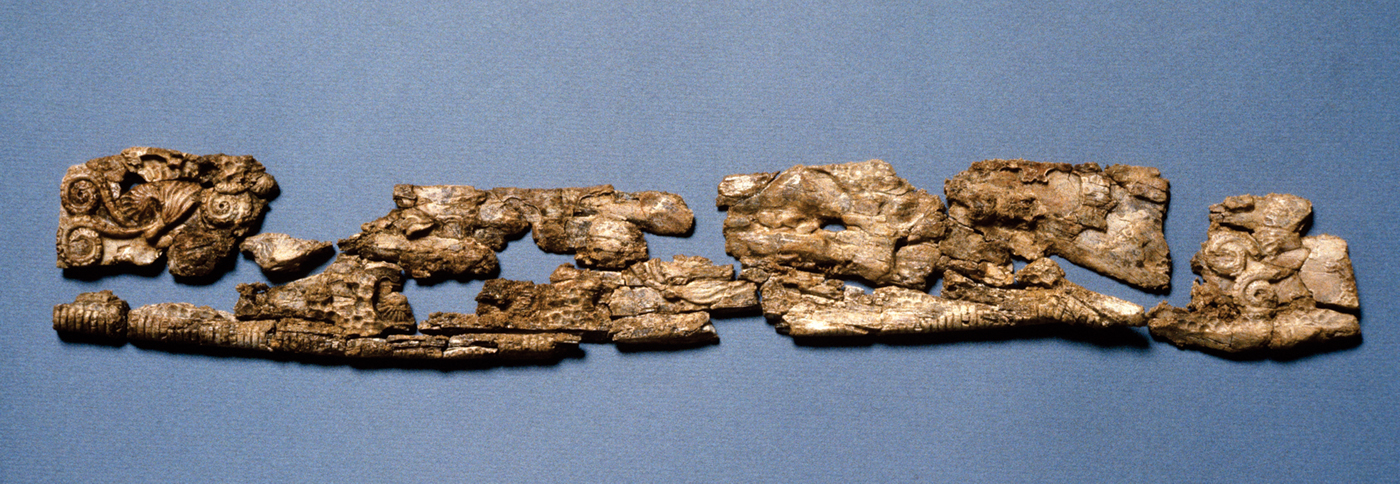
10. Ivory relief plaque (Figs 22, 23)
Demakopoulou Reference Demakopoulou, Hägg and Nordquist1990, 119, fig. 16.
Ivory relief plaque.

Ivory relief plaque (drawing by Theodora Kakarouga).

Length: 0.395 m.
The second Minoan object in the Kokla tholos is a narrow ivory plaque carved in relief, which probably decorated a piece of wooden furniture. The decoration consists of a unified scene with marine motifs, such as a procession of argonauts, seashells, rockwork and seaweed. The craftsmanship and the inspiration for the decoration seem to be Cretan. The closest parallels for this marine scene occur on objects of different materials, particularly of metal and stone, such as the gold dolphin cup from Shaft Grave III of Grave Circle A at Mycenae (Karo Reference Karo1930–3, 54, no. 73, fig. 95, pl. 103) and the gold octopus cup from the tholos tomb at Dendra (Persson Reference Persson1931, 31–2, 43–4, pls 9–11). Some Minoan stone vases also have good examples, such as the serpentine spherical vase, a fine specimen of the classic LM IB Marine Style with rockwork and octopuses in relief, from a chamber tomb at Mycenae (Warren Reference Warren1969, 88, 176; Xenaki-Sakellariou Reference Xenaki-Sakellariou1985, 91–2, pl. 18:2490). Another parallel of the same date is the so-called Ambushed Octopus Vase from Knossos (Warren Reference Warren1969, 176; Hood Reference Hood1978, 143, fig. 136). The rockwork on both these Minoan vases resembles that on the Kokla plaque. Similar scenes on Marine Style clay vases of LM IB or LH IIA date are also good parallels (Betancourt Reference Betancourt1985, 144–5, fig. 107, pl. 200). Certainly, the Marine Style was used not only for carved ivories, but also for the decoration of various artworks, such as frescoes and vessels of stone, metal and clay.
Most of the motifs on the Kokla plaque are encountered in Mycenaean ivory carving too, but as isolated decorative motifs, often stylised. Examples are the ivory pyxis with argonauts from a chamber tomb at Mycenae (Poursat Reference Poursat1977, 91–2, pl. 29:296; Xenaki-Sakellariou Reference Xenaki-Sakellariou1985, 129–30, pl. 36:2477) and the ivory pyxis with argonauts from the Athens Agora (Poursat Reference Poursat1977, 25, pl. 1:2), both in relief.
In conclusion, the craftsmanship and decoration of the Kokla ivory plaque are different from the Mycenaean examples. The combination of the marine elements in a unified scene of purely Marine Style suggests a Minoan origin.
CONCLUDING REMARKS
There is good reason to believe that the four silver kylikes from the Kokla tholos were made in the same workshop and possibly even by the same artisan. In each case the body and foot were raised together from a single billet, creating a hollow stem. There is no sign on any of these kylikes that the stem was divided from the foot. The profiles of three of these vessels are also very similar. There are other minor details of their manufacture which link these kylikes. The upper T-bar handle terminals were in each case carefully shaped to ensure a snug fit against the vessel rim. To accommodate the everted rim, the heads of the upper two rivets used to secure each handle sit on top of the rim. This causes these rivet heads to be unusually visible. In all cases the diameters of these rivet heads were made to match the width of the rim and the three rivets were always placed in the same alignment.
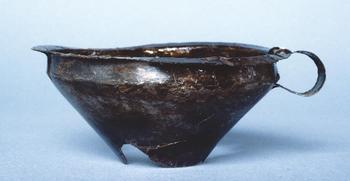
The decoration applied to these four vessels is also very similar. It consists of two parallel grooves running along the entire length of the handles. This simple decoration was worked in the same way on all four kylikes, chased from the front. It is reminiscent of the simple triple-groove decoration added to three silver vessels from the Vapheio tholos tomb (Davis Reference Davis1977, 258–63, nos 105, 106, 108), and may have been intended to reinforce the perception of these four kylikes as a set. The two silver one-handled kylikes from Chamber Tomb 10 at Dendra (Fig. 24) and the accompanying larger silver krater, whose similarities to the Kokla silver kylikes have already been discussed above, could also have been manufactured deliberately for use as a set (Persson Reference Persson1942, 87–9, fig. 99:1–3; see also Aulsebrook Reference Aulsebrook2018b). Overall, it is difficult to escape the conclusion that the Kokla kylikes were made to be used together. Whether there were ever more than four vessels in this group is impossible to say; certainly no similar vessels have been found thus far.
Silver one-handled kylikes from Chamber Tomb 10 at Dendra cemetery.

The other three silver vessels from the Kokla tholos are handleless conical cups. As discussed above, this is a relatively rare shape in the Aegean metal repertoire. All three were raised from a single billet and the small circular depressions in the centres of their bases indicate the use of a compass during manufacture (Davis Reference Davis1977, 350–1). However, as the handleless cup shape is so simple, it is not possible to assess whether they were produced by the same workshop. Decoration was not used to unite these three vessels visually; since the decoration of the kylikes was limited to their handles alone, this precluded the application of the same ornament to the handleless conical cups. Nevertheless, their simplicity means it is not possible to be certain whether the three handleless cups were manufactured to be used specifically in conjunction with the set of kylikes.
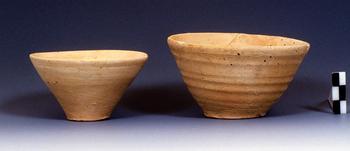
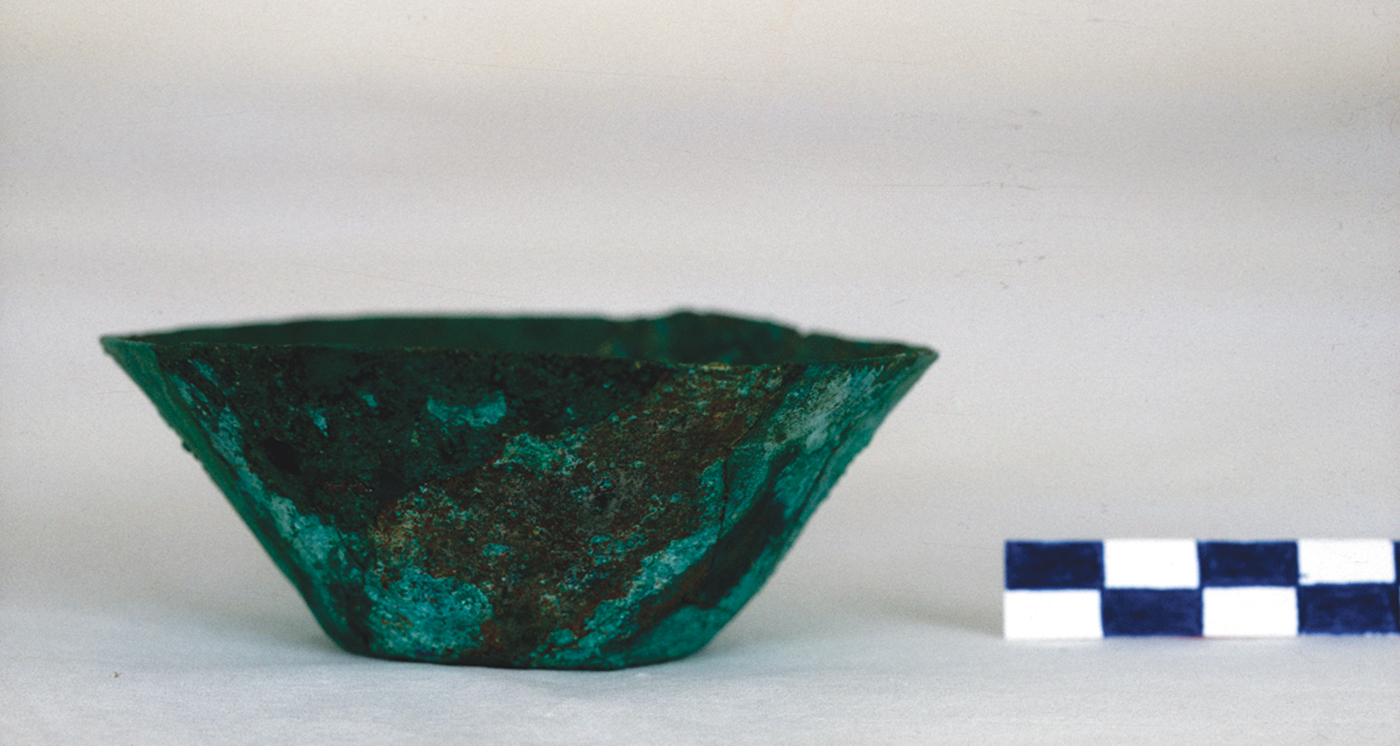
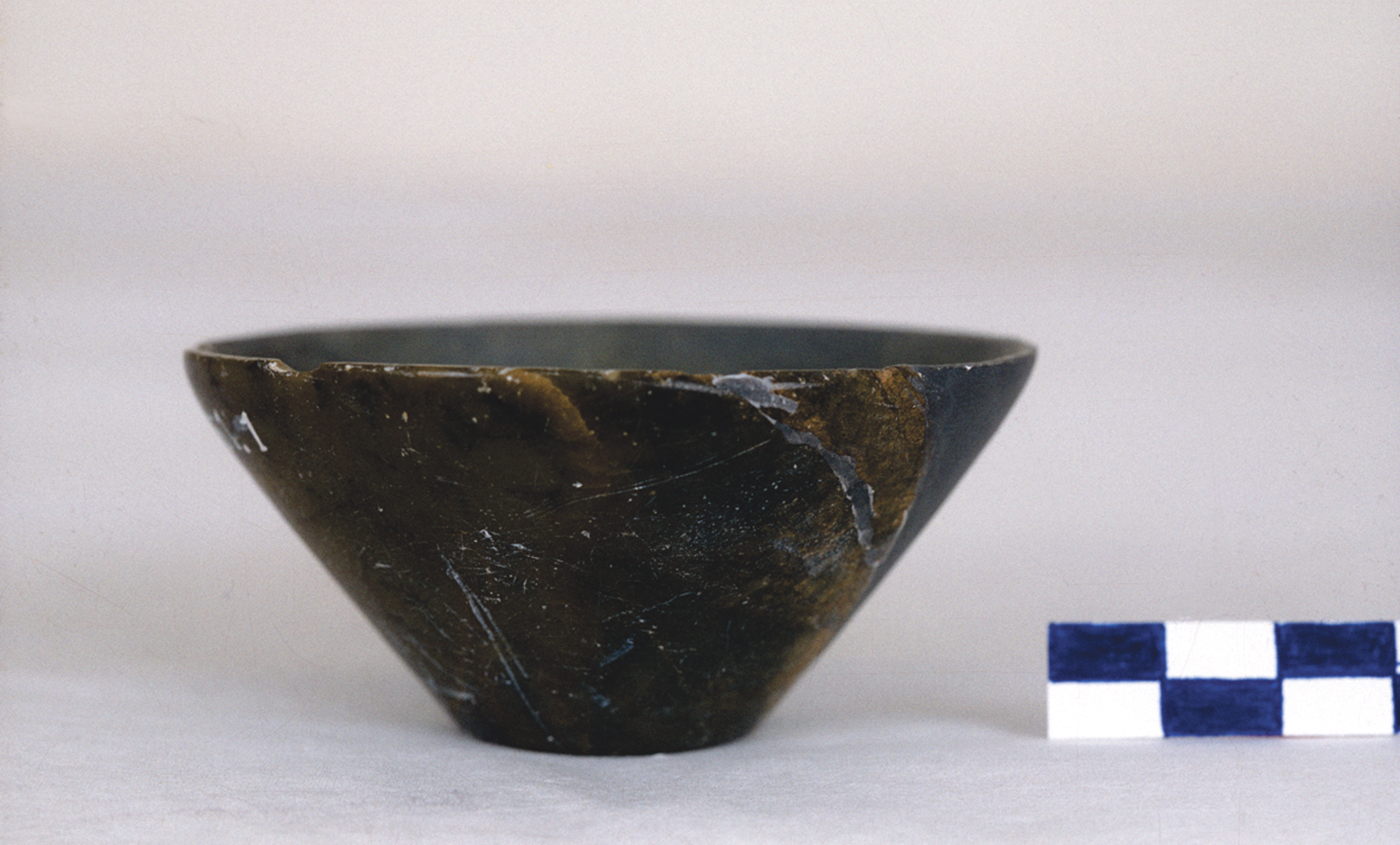
The silver handleless conical cups from the Kokla tholos are important in that they copy the common MM III to LM I clay conical cups. This ceramic type appears on mainland Greece from the LH I period onwards in small quantities in comparison with Crete (Dickinson Reference Dickinson and Laffineur1989, 134; Wiener Reference Wiener, Hardy, Doumas, Sakellarakis and Warren1990, 137–9). Conical cups of metal are very few in number from both areas, as already mentioned. The three silver cups from Kokla are the only known examples manufactured from a precious metal. They are dated to LH IIB, as are a few clay conical cups (FS 204) recovered from Early Mycenaean chamber tombs within the Kokla necropolis (Fig. 25). It seems that in this period there were close relations between the Argolid and Crete in terms of pottery production (Dickinson Reference Dickinson1972, 104). Among the few known bronze handleless conical cups, noteworthy is the example from the Tholos Tomb of the Genii at Mycenae (Fig. 26).Footnote 16 Of the Minoan stone conical cups, the three fragmentary versions of antico rosso and serpentine from the Vapheio Tholos Tomb (Fig. 27) deserve special mention (Warren Reference Warren1969, 37–8).Footnote 17
Clay conical cups.

Bronze tinned conical cup from the Tholos Tomb of the Genii at Mycenae.

Stone conical cup from the Vapheio Tholos Tomb.

The fact that these two shapes are rooted in different ceramic traditions – the kylix continuing the long-lived mainland preference for stemmed vessels whereas the conical cup was clearly a predominantly Cretan phenomenon – may indicate that the seven silver vessels in the Kokla tholos were unlikely to have been intended to be used together as a single group. However, as discussed previously (Aulsebrook Reference Aulsebrook2018b), the Kokla silver vessels are an unusual group that in some ways demonstrate greater affinity with the make-up of tinned ceramic assemblages than with the few known Aegean precious-metal assemblages. This is significant because, although kylikes dominate these assemblages of tinned ceramics, they are often found in conjunction with conical/handleless cups. Deliberately bringing together two shapes that had very different origins may have been a meaningful act. That the seven silver vessels from the Kokla tholos were found so closely grouped together reinforces their identification as a single combined set. The presence of one larger vessel, the two-handled kylix, and two accompanying sets of three vessels may imply that a liquid was mixed in the bigger cup and then dispensed into the smaller vessels. However, all these cups would have been relatively awkward to use for drinking, due to their unthickened rims and wide mouths, and, furthermore, it has been suggested that the ceramic FS 267 angular kylix, to which the smaller silver one-handled carinated kylikes bear the strongest resemblance, were used for eating rather than drinking (Lis Reference Lis, Hitchcock, Laffineur and Crowley2008, 145; Thomas, P.M. Reference Thomas, Gauss, Lindblom, Angus, Smith and Wright2011, 301).
It is unclear whether the gold shallow cup found in the Kokla tholos and indeed the ninth vessel, sadly now only represented by the gold-sheet overlay, should be associated with the use of the silver vessels from the same tomb. It may be important to note that the Dendra Chamber Tomb 10 (Persson Reference Persson1942) and the Acropolis Treasure (Thomas, H. Reference Thomas1938–9), which as discussed above both contained stemmed vessels that share some similarities with the silver kylikes from the Kokla tholos, also both contained metal shallow cups. Unlike the vessels in the Acropolis Treasure, there is nothing in terms of manufacturing technique that links the Kokla shallow cup with the kylikes from the same tomb. The difference may be explained by the Minoan origin of the gold cup, whereas the silver kylikes are stylistically Mycenaean. Furthermore, the gold vessels were not grouped together with the silver vessels in the tomb. It may well be that the gold shallow cup and the vessel to which the gold-sheet overlay belonged should be interpreted as straightforward grave-goods, with no active role in the mortuary proceedings beyond the action of their deposition.
The ivory plaque carved in relief, although fragmentary, is an important find. It can be included in the precious objects from the Kokla tholos, based on its material and the characteristic Marine Style decoration. The craftsmanship and the decoration of the plaque strongly suggest a Minoan artistic influence. Possibly, the plaque was carved in Crete during the LM IB period and deposited in the Kokla tholos in the LH IIB period as a valued import and, of course, an heirloom. It is also possible that the plaque was carved by a Cretan craftsman working in the Argolid during the LH IIB period or by a Mycenaean under Cretan instruction. During LH I–II there were very strong connections between Crete and the Argolid, where Minoan craftsmen were working in its great centres (Dickinson Reference Dickinson1977, 54–5; Hood Reference Hood1978, 40–1, 169). Whatever the case, the ivory plaque should be included, together with the two gold vessels, in the group of grave-offerings in the Kokla tholos tomb that were not associated with funerary ritual.
The Kokla group is one of the largest assemblages of precious-metal vessels, together with other precious objects, discovered on the Greek mainland that can be dated to the period after the Shaft Graves at Mycenae were in use. As such, the publication of this material, following that of the similar material from the contemporary Dendra cemetery, provides important new evidence regarding the manufacture and lifecycle of precious-metal vessels in the post-Shaft Grave era.
ACKNOWLEDGEMENTS
The authors wish to thank their colleagues and the staff of the National Archaeological Museum, Athens, for help provided during this study of the tholos tomb finds. They are grateful to the reviewers of this paper for their valuable comments which helped to improve the study.
Katie Demakopoulou wishes to thank her friend and colleague Nicoletta Divari-Valakou for her support and help in the preparation of the article.
Stephanie Aulsebrook wishes to thank Katie Demakopoulou for allowing her to study the metal vessels from the Kokla tholos tomb and for inviting her to co-write this article. She also thanks the Michael Ventris Memorial Award for financial assistance.