Press coverage of Russia in the 1990s made Americans well aware of the numerous problems plaguing that country. Steep economic contraction and runaway inflation created widespread poverty and human suffering. Political conflict spilled over into armed combat on the streets of Moscow. A deteriorating public health system and rampant alcoholism contributed to an alarming rise in mortality. War and human rights violations raged in the southern republic of Chechnya. Most centrally, corruption permeated Russian society and its incipient capitalist economy in epidemic proportions.
While these problems were well known to Western audiences, over the course of 1999 the American public was treated to something new as a flurry of criticism appeared in the media blaming these deplorable outcomes on policies pursued by international economic organizations and Western governments. While the specifics of these criticisms varied widely and even frequently contradicted each other, a critical mass of them held that the “Washington Consensus” of rapid marketization, privatization of industry, and macroeconomic stabilization represented disastrous prescriptions for post-communist Russia. Hence, the International Monetary Fund and the Clinton administration were assigned the lion's share of the blame for Russia's decline since they had urged Moscow to adopt these policies and provided support for President Boris Yeltsin and the other free-market reformers who implemented them. In addition, Bill Clinton came under fire for overpersonalizing the U.S.–Russian relationship and investing too heavily in Yeltsin's political survival to the detriment of other American objectives.
If such criticisms of American policy are sound, they would constitute a major stain on Clinton's legacy in foreign affairs for several reasons. First, Clinton was personally involved in the formulation of policy toward Russia to a greater extent than in any other area of foreign policy. As Strobe Talbott, his chief adviser on the former Soviet Union, observes in his memoirs, the president himself quickly became “the U.S. government's principal Russia hand, and so he remained for the duration of his presidency.”Footnote 1 And second, immediately after coming to power, the Clinton administration declared Russia's successful transition from communism to liberal democracy to be a vital American interest. “Nowhere is [U.S.] engagement more important than in our policies toward Russia and the newly independent states of the former Soviet Union,” the president stated in his first major speech on the subject in April 1993. “Their struggle to build free societies is one of the great human dramas of our day. It presents the greatest security challenge for our generation and offers one of the greatest economic opportunities of our lifetime.”Footnote 2 Other administration officials reinforced this message. “We must understand that helping consolidate democracy in Russia is not a matter of charity but a security concern of the highest order,” Secretary of State Warren Christopher told the American people. “It is no less important to our well-being,” he continued, “than the need to contain a hostile Soviet Union was at an earlier day.”Footnote 3
The effectiveness of the Clinton administration's efforts to promote democracy in Russia—and, in particular, the wisdom of the support it extended to Russian President Boris Yeltsin—are evaluated in this article on the basis of a comparative analysis of political outcomes throughout the post-communist region. We find that the Russian Federation in the 1990s was more democratic than the Soviet Union in the late 1980s, most of the other states of Eastern Europe and Eurasia that similarly experienced the collapse of communism between 1989 and 1991, and Russia during Vladimir Putin's two terms in office. Moreover, Russia was as democratic or more democratic than every other member of the Commonwealth of Independent States (CIS). On the basis of these findings, we conclude that democracy in Russia during Yeltsin's tenure in office fared better than should have been expected given the country's starting conditions and that it almost certainly would have fared worse in the absence of Yeltsin's leadership. Hence, Washington's interventions into Russia's internal power struggles in support of Russia's beleaguered president both served immediate American interests in Eurasia and promoted the prospects for democratic consolidation in Russia, thereby fulfilling the dictates of both real- and idealpolitik.
Our comparative analyses also reveal that the magnitude of the democratic backsliding that Russia experienced during the Putin presidency is striking, whether considered in longitudinal or cross-national perspective. In particular, Russia's democratic performance fell well below that of the vast majority of post-communist states and the country went from being a leader in terms of democratic performance within its closest peer group—the Orthodox states of the CIS—to being a laggard. Both Russia's relatively high democratic standing under Yeltsin and the inversion of its ranking under Putin demonstrate the pivotal role played by presidential leadership in Russia's political development.
This article proceeds as follows. First, we review the opposing sides in the debates over both U.S. policy and Yeltsin's credentials as a democratic leader and also evaluate American policy through the prisms of both real- and idealpolitik. Second, we discuss many of the obstacles to successful democratization that existed in Russia and explain how they create an impediment to accurate inference that can be overcome by means of comparative research. Third, we examine the extent to which democracy flourished in Russia under both Yeltsin and Putin via both focused longitudinal comparisons and large-N cross-national statistical analyses. And fourth, we spell out the implications of our findings for Yeltsin's, Putin's, and Clinton's historical legacies and our general understanding of post-communist transitions from authoritarianism.
Realpolitik, Idealpolitik, and Yeltsin's Democratic Credentials
The debate over U.S. policy toward Russia became highly charged with the start of the presidential election campaign of 2000.Footnote 4 For instance, while serving as an adviser to then candidate George W. Bush, Condoleeza Rice argued that “Russia's economic troubles and its high-level corruption” resulted in part from a misplaced focus in the White House on individuals as opposed to principles. “The problem for U.S. policy,” she wrote in Foreign Affairs,
is that the Clinton administration's embrace of Yeltsin and those who were thought to be reformers around him has failed …. support for democracy and economic reform became support for Yeltsin. His agenda became the American agenda. The United States certified that reform was taking place where it was not, continuing to disburse money from the International Monetary Fund in the absence of any evidence of serious change. The curious privatization methods were hailed as economic liberalization; the looting of the country's assets by powerful people either went unnoticed or was ignored.Footnote 5
During Vice-President Al Gore's second debate with Bush, the future president himself echoed these sentiments, declaring that “we went into Russia, we said here is some IMF money, and it ended up in [former Prime Minister] Viktor Chernomyrdin's pocket, and others, and yet we played like there was reform.”Footnote 6 The full gamut of acrimonious exchanges over these issues that took place on the campaign trail and in the press was quickly dubbed the “Who lost Russia?” debate.
While the national attention received by U.S. policy toward Russia as a result of the election campaign was new, the issues behind “Who lost Russia?” had been debated by academic analysts throughout the 1990s. For instance, Thomas Carothers criticizes the Clinton administration for its “‘Great Leader’ approach to promoting democracy.” A “habitual mistake” and “principal error,” he writes,
is the U.S. tendency in a transitional country to equate a particular leader with democracy and to assume that steadfast support for that leader is the best means of promoting democracy. Through such policies the U.S. government often gives too little support to the systemic reforms that are needed for real democratization, alienates other political forces in the society, and holds onto leaders in decline long after they have been discredited domestically.
“U.S. policy toward Russia since 1991,” he adds, “vividly embodies [this problem].”Footnote 7
Many area studies specialists are even more critical of both Russia's president and U.S. policy. “The great responsibility for the missed opportunity to democratize Russia lies fairly and squarely with Boris Yeltsin,” Lilia Shevtsova writes. “A leader's quality is seen in his capacity to rise above pressures from society and the political class and to offer a new vision. Yeltsin showed no such ability.” She adds that “all Western leaders” made a mistake “by relying on Yeltsin and believing that he would guarantee a Russian transition.”Footnote 8 Chrystia Freeland similarly describes the Russian president as “a man driven by power, not by ideology.” In her interpretation, Yeltsin's “overriding political objective” was not the construction of a liberal polity or even preventing the communists from returning to power, but simply “to remain in command.”Footnote 9 An even more strident critique is offered by Peter Reddaway and Dmitri Glinski, who castigate President Yeltsin for “illegally suspending the constitution and dissolving the Russian parliament,” as well as more generally introducing “an authoritarian police regime.” Moreover, they bemoan his victory in the presidential election of 1996 and suggest that his opponent, the leader of the Communist Party of the Russian Federation (KPRF) Gennady Zyuganov, would have formed a more representative government. “Zyuganov's potential victory would not have been a threat to democracy,” they write, “because his political weakness and lack of foreign support would have compelled him to cooperate with some of his opponents among the democratic reformers and to govern by coalition—something that was not to be expected from Yeltsin.”Footnote 10
In sum, in the judgment of much of the scholarly community, Russia in the 1990s represents a failed democratic transition resulting from the purposeful actions of a leader with autocratic tendencies. The country could have developed in a more democratic direction under alternative leadership. Washington's interventions into Russia's domestic power struggles in support of Yeltsin therefore represent major blunders in U.S. foreign policy, both morally and strategically.
One aspect of these critiques—that the U.S. government during Clinton's years as president lent support, both material and moral, to Boris Yeltsin for the purpose of keeping him in power—is not open to dispute. For instance, as part of his “strategic alliance with Russian reform,” Clinton devoted his first trip abroad to a summit with Yeltsin and pushed through a nearly twenty-fold increase in U.S. aid to Russia during his first two years in office. Moreover, much of this aid was explicitly justified as necessary to help Russia's president prevail in his intractable power struggle with a hostile legislature.Footnote 11 In October 1993, when Russia's president finally resolved that debilitating conflict by military means, Clinton put the blame for the bloodshed on the parliamentary opposition, adding that Yeltsin had “no other alternative but to try and restore order.”Footnote 12 When in December 1994 the Kremlin launched a brutal war to reincorporate secessionist Chechnya into the Russian Federation, Clinton administration officials expressed their support for Russia's territorial integrity and labeled the war “an internal Russian affair.” Moreover, a year and a half into the conflict, after tens of thousands of civilians had been killed but also just two months before the Russian presidential elections of 1996, Clinton publicly defended Yeltsin by comparing the war to Abraham Lincoln's efforts to preserve the union.Footnote 13 Even more tangibly, the administration simultaneously pressured the International Monetary Fund to grant a substantial loan to Moscow that the Kremlin viewed as vital to Yeltsin's prospects for reelection.Footnote 14 In his autobiography, Clinton openly acknowledges that strengthening Yeltsin against his domestic opponents was one of his central concerns throughout his presidency.Footnote 15 In this regard, he reports that on at least one occasion, “Boris and I spent the morning talking about his precarious political situation. I reminded him that I had done everything I could to support him.”Footnote 16 Moreover, this policy of personal support emanated principally from the president himself and the public aspects of Clinton's embrace of Yeltsin were frequently pursued against the advice proffered by other members of the administration.Footnote 17
The overall thrust of the criticisms of U.S. policy that are embodied in the “Who lost Russia?” debate, however, is open to dispute from the perspective of realpolitik. That is, if one asserts the primacy of security over moral concerns in foreign policy, a strong case can be made that the Clinton administration's support for Yeltsin served American interests and thus represented the most appropriate policy. First, when Yeltsin disbanded the Communist Party of the Soviet Union in August 1991, he delivered the final blow to the central ideological challenge to liberal democracy of the twentieth century. Second, even though Russia's sympathies rested with the Serbian victims of NATO's military intervention in Bosnia in August 1995, just months later the Kremlin ordered the Russian military to participate in the NATO-led force charged with implementing the Dayton Peace Plan that denied the Bosnian Serbs their desired reunification with Yugoslavia. Moreover, in that deployment Russian troops de jure served under an American general and de facto served in NATO's chain of command.Footnote 18 Third, Moscow swallowed its opposition to the expansion of NATO into the territory of its former Eastern European empire without any military response.Footnote 19 And fourth, even though the vast majority of the Russian elite reacted to NATO's 1999 war against Yugoslavia over its treatment of Kosovo's Albanian population with virulent hostility and even alarm, the Kremlin's defense of Yugoslavia never went beyond diplomatic gestures. Moreover, Yeltsin's personal representative for ending the war, Viktor Chernomyrdin, played a crucial role in the diplomacy that coerced Belgrade into full compliance with NATO's peace terms.Footnote 20 In sum, during Yeltsin's rule, the Cold War remained a thing of the past, cooperation rather than competition was the defining element of Russian-American relations, and American security was greatly enhanced.
Equally as important, Russia's post-Soviet leadership accepted the sometimes arbitrary and often unfavorable borders inherited from the USSR, manifested little more than benign neglect of discontented ethnic Russians left outside those borders, and—with the sole exception of Chechnya—forsook the reconquest of Moscow's centuries-old former empire by military force.Footnote 21 In the process, Russia lost a quarter of its territory and close to half of its population, and the much-feared “Yugoslavia with nukes” failed to materialize. At the end of the 1990s, not only had ethnically divided Ukraine retained its sovereignty, but even such tiny, internally fractured polities as Azerbaijan and Georgia had survived as independent states. Hence, to the extent that the United States had a security interest in the reduction of Russian military power and its withdrawal to the periphery of Europe, support for Yeltsin served American interests.Footnote 22 This is especially the case since there is more than ample reason to believe that imperial restraint would not have prevailed had the Kremlin been occupied by either Vice-President Aleksandr Rutskoi or Gennady Zyuganov, Yeltsin's two main challengers for political power.Footnote 23 Fully aware that these individuals longed for a restoration of empire to a far greater extent than did Russia's president, the leaders of Russia's newly independent neighbors joined Clinton throughout the 1990s in extending maximum political support to Yeltsin.Footnote 24 For instance, at the May 1996 summit of the CIS, every head of state without exception gave a speech in strong support of Yeltsin's candidacy for reelection to the presidency.Footnote 25
Nonetheless, from the perspective of idealpolitik, all of Moscow's cooperation and accommodation of Washington's strategic desires might still represent small compensation for any damage inflicted on Russian democracy by Yeltsin for at least three reasons. First, democracies commit less genocide and mass murder as well as experience fewer economic disasters than do their autocratic counterparts. As Amartya Sen observes, “no famine has ever taken place in the history of the world in a functioning democracy.”Footnote 26 Second, substantial theoretical and empirical bases exist for believing that democracies also behave more peacefully in the international arena, especially toward fellow democracies.Footnote 27 On the basis of this belief, the Clinton administration itself made “enlarging the community of market democracies” the centerpiece of its strategic doctrine. “The more that democracy and political and economic liberalization take hold in the world, particularly in countries of geo-strategic importance to us,” the White House declared, “the safer our nation is likely to be and the more our people are likely to prosper.”Footnote 28 Moreover, the Bush administration's second national security doctrine took these ideas a step further. “It is the policy of the United States,” it states in its very first sentences, “to seek and support democratic movements and institutions in every nation and culture, with the ultimate goal of ending tyranny in our world. In the world today, the fundamental character of regimes matters as much as the distribution of power among them.”Footnote 29 And third, in light of both Russia's geopolitical significance throughout the twentieth century and the military-industrial potential it still possesses even after the dissolution of the Soviet Union, promoting democracy in Russia takes on especially great significance. Indeed, the Clinton administration itself repeatedly expressed its recognition of this reality, describing Russia as a “key state” in regard to democratic enlargement.Footnote 30
Clinton administration officials, however, have never accepted the proposition that support for Yeltsin involved a trade-off between short-term American interests and realpolitik, on the one hand, and its long-term interests and idealpolitik, on the other. For instance, in her memoirs, Clinton's second Secretary of State, Madeleine Albright, refers to Yeltsin positively, commenting, “Despite his occasional resemblance to W.C. Fields, the Russian president played a pivotal role in putting his nation on a democratic path. He was a major transformational figure.”Footnote 31 Clinton himself has been even more complimentary. At the Vancouver summit held just three months into his presidency, he publicly identified the cause of freedom and democracy in Russia with Yeltsin.Footnote 32 In his autobiography, he comments that Yeltsin “had made his share of mistakes, but against enormous odds he had also kept Russia going in the right direction.”Footnote 33 “Bill Clinton knew one big thing,” writes Strobe Talbott, expressing the central thesis of his own memoirs. “On the twin issues that had constituted the casus belli of the cold war—democracy versus dictatorship at home and cooperation versus competition abroad—he and his friend Boris Yeltsin were now, in principle, on the same side.”Footnote 34 By the end of Yeltsin's presidency, Clinton's esteem for Yeltsin had grown even greater. “A pluralist political system and civil society, competing in the world markets and plugged into the Internet, have emerged from a totalitarian monolith that was closed off from the outside world,” Clinton writes in his political farewell to his Russian counterpart. “No one deserves a larger share of the credit for this transformation than Yeltsin himself. For all his difficulties, he has been brave, visionary and forthright, and he has earned the right to be called the Father of Russian Democracy.”Footnote 35
Moreover, several academic analysts share the administration's view that Russia's prospects for democracy were bolstered by Yeltsin's tenure in office. Dmitry Mikheyev calls Russia's president “an extraordinary personality” whose “critics often confuse his operational style with his core motivations and ambitions.” As both leader of the democratic opposition to communist rule and then president of the new Russian state, “Yeltsin has proved to be impeccably democratic and immune to the temptations and corruptions of power.”Footnote 36 Leon Aron goes so far as to place Yeltsin in a premier position in the pantheon of Russian leaders. “In the systemic character of reforms that redefined the fundamentals of the relationship between the Russian state and society to the benefit of the latter,” he writes, “no other Russian leader came closer to Alexander II than Yeltsin, who may have even surpassed the ‘Tsar-Liberator.’”Footnote 37 A second biographer, Timothy Colton, largely agrees with this assessment. “In the 1980s and 1990s … , Yeltsin made fateful decisions that put his society on a much more promising road than it had been on since 1917,” he writes. “As a democratizer, he is in the company of Nelson Mandela, Lech Walesa, Mikhail Gorbachev, and Vaclav Havel.”Footnote 38 After four years of additional reflection since penning her critical history of privatization in Russia, Chrystia Freeland concludes that “rated on the courage and importance of his achievements, Mr. Yeltsin is the greatest European leader of the past 25 years.”Footnote 39
Finally, it is worth noting that throughout his years in office Yeltsin consistently portrayed himself as a committed liberal democrat. For instance, in the annual State of the Federation address given during his campaign for reelection in 1996, Yeltsin highlighted all of the following as accomplishments of his presidency:
Whatever difficulties our country has experienced, her citizens have obtained freedom …. Entering or exiting the country no longer presents a problem …. Today Russia no longer adheres to any single ideology. Ideological uniformity and the censorship that maintained it have been replaced by the principle of pluralism. Governmental coercion in the realm of culture has been eliminated. Many generations have dreamed of this …. The ban on the Bible, the Koran and other holy works that existed for many decades no longer exists …. In our country we have complete freedom of any kind of political, social or trade-union activity, freedom of conscience, freedom of the press, freedom of information, freedom of assembly and the freedom to hold a demonstration.Footnote 40
Yeltsin then concluded his address with the following appeal. “It is important for us to understand,” he told both the assembled parliamentarians and the voters watching at home, “that freedom and democracy are not someone's phony invention, nor are they a peculiarity of any one nation …. They represent the only possibility for ensuring a life worth living. They are the main prerequisites for progress and prosperity.”Footnote 41
In sum, these many judgments about and pledges by Boris Yeltsin make it clear that if a liberal democratic order emerged in Russia to a lesser extent than should have been expected given the country's starting conditions or would have been the case under alternative leadership, then both he and Bill Clinton should receive failing grades for a central task of their presidencies. In either case, both Yeltsin and Clinton would indeed deserve much of the criticism they have received from academic analysts and fellow politicians alike. In order to assess whether such criticism is deserved, the many impediments to democratic consolidation that existed in post-Soviet Russia apart from either potentially flawed leadership or possibly detrimental American policies need to be factored into the analysis.
Russia as Least-Likely Case and the Comparative Method
As George Breslauer notes, “Leadership cannot be evaluated without some conception of its flip-side: opportunity. If the challenge was so great as to be impossible to achieve, then, by definition, no amount of brilliant leadership could have overcome the constraints.”Footnote 42 In this regard, any assessment of the impact of either Boris Yeltsin's leadership or U.S. policy on Russia's democratization needs to take into account the fact that authoritarianism and democratic breakdown were overdetermined in Russia regardless of who occupied the presidency. In fact, at least seven factors greatly increased the likelihood of such an outcome.
First, many have claimed that Russia's historical development produced an autocratic political culture that elevates the interests of the state over those of the individual or society at large.Footnote 43 Similarly, since at least Max Weber and Emile Durkheim, it has been argued that that Orthodox or Eastern Christianity, like Islam, promotes beliefs and values that are less conducive to democratic governance than those promoted by either Catholicism or Protestantism.Footnote 44 Whether or not either of these views is correct, it is certainly the case that the perception by many Russian elites that their country represents a distinct civilization based on Orthodoxy and traversing a separate and superior path of development from the West has for centuries generated resistance to the adoption of liberal political and economic institutions.Footnote 45
Second, Russia's geographic location presents obstacles to cultural diffusion from the West. In particular, location at the eastern periphery of Europe reduced “the flow of ideas and resources” that Russia received from the wealthy, powerful, and liberal states located on Europe's western periphery, thereby constraining its ability to democratize.Footnote 46 In this regard, Russian membership in either the European Union or NATO was too remote a possibility in the 1990s for the prospect of accession to those organizations to alter either elite or mass views of the desirability of adopting democratic institutions, as requirements for accession to the European Community did in Greece, Portugal, and Spain in the 1970s.Footnote 47
Third, as Samuel Huntington observes, “in the twentieth century very few countries created stable democratic systems on their first try. It is reasonable to conclude that prior democratic experience is more conducive than none to the stabilization of third wave democracies.”Footnote 48 In this regard, Russia's largely unbroken history of autocratic rule provided its post-communist rulers with little concrete experience with and few examples of democratic practices and institutions. Moreover, the Russian Federation emerged as an independent state with a constitution that was designed as a “decorative façade” for rule by the communist party and therefore left Russia with an unclear and blurred division of power among the various institutions, branches, and levels of government.Footnote 49 As Boris Yeltsin himself comments in his memoirs, “we had to figure out everything from the start. What was a vice president? How should a Russian constitutional court look? There was nothing but blank space because no such institutions had previously existed in Russia …. As a result, there emerged beautiful structures and pretty names with nothing behind them.”Footnote 50
Fourth, post-Soviet Russian elites were polarized into opposing camps whose worldviews and visions for the country's future possessed little in common. At one end of the political spectrum, Russia's liberal democrats sought to build a capitalist society pursuing peaceful integration with what they called the “civilized states” of Europe and North America. At the other end of the spectrum, Russia's nationalists and communists sought to return the country to socialism, autarky, and global competition with the West. These huge ideological and policy distances between the major competitors for political power greatly increased the stakes involved in political competition, the risks involved in transferring power to the opposition, and thus the incentives for incumbents not to jeopardize their hold on power in elections.Footnote 51
Fifth, elite dissensus also extended to questions related to the proper boundaries of the state and membership in the political community. Whereas Yeltsin was content to accept the largely symbolic borders that demarcated the Russian Soviet Federated Socialist Republic from the other republics of the USSR as the international borders of the Russian Federation, his “red-brown” opponents viewed those borders as “ridiculous” and “criminal.”Footnote 52 In addition, the leadership of Chechnya was equally as disdainful of the Russian Federation's borders and was willing to fight to alter them.Footnote 53 Unsettled borders have long been identified as presenting a major obstacle to democratization. As Dankwart Rustow argues, “the difficulty that democracy finds in resolving issues of community emphasizes the importance of national unity as the background condition of the democratization process. The hardest struggles in a democracy are those against the birth defects of the political community.”Footnote 54
Sixth, Russia's transition to democracy was complicated by an overburdened agenda of policy choice. As Michael McFaul writes, previous research on transitions to democracy has concluded that “the narrower the agenda of change, the more likely that pacts and eventually new democratic institutions will emerge.”Footnote 55 In addition to the issue of whether the Russian Federation should remain within its borders, the country's leaders had to grapple with, among other things, how (and even whether) to implement major economic reforms as well as whether to create new political institutions—and if so, what kind.Footnote 56 As Lilia Shevtsova comments, “Yeltsin and his team were obliged to attempt four revolutions at once: creating a free market, democratizing the political regime, liquidating an empire, and seeking a new geopolitical role for a country that had only recently been a nuclear superpower.”Footnote 57
And seventh, the transition to democracy throughout the post-communist world was almost universally accompanied by major economic contraction (or at least dislocation), an explosion of a host of social problems, and a “crisis of governability.”Footnote 58 Moreover, in Russia this situation was compounded by the fact that in 1992 the Central Bank (which was subordinate to the legislative, not executive, branch of government) exported close to a quarter of Russia's gross national product in the form of subsidies of various kinds to the other former republics of the Soviet Union.Footnote 59 As a result, a majority of Russia's population experienced declining living standards for much of the 1990s, thereby aggravating the “disappointment and disillusionment” that, as Huntington notes, are often experienced in new democracies and promoting nostalgia for Russia's authoritarian past in the eyes of many of its citizens.Footnote 60 In this regard, surveys conducted in Russia in 1993 and 1995 show that levels of support for both political and economic liberalism dropped noticeably among mass respondents over that mere two-year period.Footnote 61
In light of these many obstacles to democratic consolidation in Russia, it is easy to understand how a prominent analyst could write, “it is difficult to imagine the dissident Andrey Sakharov as the leader of the new Russia. Someone like Vaclav Havel or Lech Walesa is absolutely unthinkable for Russia.”Footnote 62 It is equally as easy to understand why many analysts regarded the creation of liberal democracy in Russia to be an “almost impossible task” for any leader.Footnote 63 In this regard, these obstacles also present a special challenge to any attempt to estimate the independent impact of presidential leadership on the success or failure of democratization in Russia since such research needs to avoid conflating the impact of individuals with the many preexisting structural constraints on the democratic project.
A straightforward solution to this problem is to engage in quasi-experimental analysis with careful attention paid to case selection.Footnote 64 That is, evaluating Russian outcomes against the backdrop of those achieved in a control group of polities sharing as many attributes and historical experiences with Russia as possible—but lacking the treatment (in this case, Yeltsin's leadership)—would provide a basis to assume that levels of all other causal factors are equal across treatment and control groups. On the basis of this assumption, one can then attribute differences in outcomes to the impact of the treatment. While comparative analysis in this manner is far from foolproof in that even seemingly similar cases never perfectly equalize all other sources of variance, it nonetheless allows one to make an informed inference about causality. Moreover, some of the limitations of the method can be overcome by the use of large samples and inferential statistics. In this regard, it is worth noting that none of the works discussed above that are critical of Yeltsin makes a serious effort to place Russia's political development in a comparative perspective. Instead, these works focus only on Russia and make little allowance for the fact that their conclusions regarding the baneful impact of Yeltsin's leadership and American support for him are reached on the basis of a “most-likely” case for any theory of democratic breakdown.
A quasi-experimental approach to the study of the Russian transition naturally begs the question, To what countries should Russia be compared in order to achieve the most fully controlled comparisons? In our view, the polities that should be expected to share the greatest number of attributes and historical experiences with Russia under Yeltsin are represented by Russia itself at other, especially chronologically adjacent, points in time and other states in transition that had been governed in the past by the same institutions as Russia. As a result, we will conduct comparisons using the following five reference groups:
1. The Soviet Union during the last decade of its existence;Footnote 65
2. The Russian Federation during Putin's tenure as president;
3. The ten former republics of the Soviet Union that, like Russia, came under Soviet rule in the aftermath of the Bolshevik Revolution and the Russian Civil War of 1918–1921. Those ten states are: Armenia, Azerbaijan, Belarus, Georgia, Kazakhstan, Kyrgyzstan, Tajikistan, Turkmenistan, Ukraine, and Uzbekistan;
4. Those ten states plus the four former republics that had been incorporated into the USSR during World War II. Those four states are Estonia, Latvia, Lithuania, and Moldova; and
5. All of the formerly communist states of Eastern Europe and Eurasia. This group consists of the fourteen previously mentioned states with the addition of twelve states in Eastern Europe: Albania, Bosnia-Herzegovina, Bulgaria, Croatia, the Czech Republic, Hungary, Macedonia, Poland, Romania, Slovakia, Slovenia, and Serbia and Montenegro.Footnote 66
The fourth and especially the fifth of these groups of states expand the number of observations used in our analyses, yet they also lessen the degree to which other sources of variance are equalized across treatment and control groups. In particular, both of these groups incorporate several states that differ from Russia in numerous ways that, as we have seen, are potentially consequential for a country's democratization: Catholicism or Protestantism historically have been dominant among their populations; they are geographically proximate to Western Europe; they experienced periods of democratic rule in the interwar period; their politics were not sharply polarized between communists and anti-communists; and they did not experience any significant political or armed conflict over state borders in the 1990s.Footnote 67 Use of the third group thereby offers the potential for the most fully controlled cross-national comparisons, yet we will conduct comparisons utilizing all five groups (as well as two further subsets of them) in order to maximize the robustness of our findings.Footnote 68
Our point of departure for conducting these comparisons consists of the yearly ratings of political rights and civil liberties produced by Freedom House.Footnote 69 When rating countries and territories, Freedom House uses “basic standards that are derived in large measure from the Universal Declaration of Human Rights” and evaluates “the real-world rights and freedoms enjoyed by individuals.” In assigning the political rights rating, Freedom House assesses, among other things, the extent to which there are free and fair elections, meaning that “those who are elected rule, there are competitive parties or other political groupings, and the opposition plays an important role and has actual power.” It also considers whether “minority groups have reasonable self-government or can participate in the government through informal consensus.” The civil liberties rating reflects how each country fares in terms of “freedom of expression, assembly, association, education, and religion,” among other things. Countries with favorable ratings on this dimension “are distinguished by an established and generally equitable system of rule of law” and also “enjoy free economic activity and tend to strive for equality of opportunity.”Footnote 70 Freedom House assigns every country separate scores for political rights and civil liberties on a seven-point scale, with one representing the highest degree of freedom and seven the least.
Freedom House's ratings are widely used and appear to possess a high degree of validity regarding the countries we analyze. Nonetheless, questions about their accuracy have been raised. In particular, Freedom House was frequently criticized during the Cold War for bias in favor of U.S. allies.Footnote 71 However, we have not encountered any analogous charges made during the post-Cold War era, and Freedom House's ratings of European countries for 2003 have been shown to have a high level of agreement with two other prominent data sets: Marshall, Jaggers, and Gurr's Polity IV and the World Bank's “Voice and Accountability” index.Footnote 72 Nevertheless, it is worth considering whether the countries under examination differed in the degree to which they complied with U.S. desires and how bias on the part of Freedom House would thereby influence the comparative analyses we will undertake. During the 1990s, Moscow engaged in vigorous diplomatic opposition to both NATO expansion and the two U.S.-led wars in the former Yugoslavia, whereas almost all of the other post-communist states of Eastern Europe and Eurasia either supported or were neutral in regard to those policies. In addition, the important assistance that the Kremlin during Putin's first term in office gave to the United States' war against the Taliban stands in considerable contrast to the vociferous criticism of the Kosovo War of 1999 that emanated from the Russian government under Yeltsin. Hence, if Freedom House's ratings are biased in the hypothesized manner, then Russia's scores in the 1990s would be skewed in the direction of underestimating the level of democratization that was achieved, whereas most of the other postcommunist states' scores as well as Russia's scores between 2001 and 2004 would be skewed in the opposite direction. What such measurement error would mean for the present study is that our analyses would actually underestimate the magnitude of the differences we find and that our conclusions would be understated.
For all of these reasons, we feel comfortable basing our comparative and statistical analyses on Freedom House's data. Below we present these analyses and explain what light they shed on the relationship between Boris Yeltsin's leadership and Russian democratization.
Russian Democracy in Comparative Perspective
Russia vs. the USSR
Our analyses of Freedom House's ratings of political rights and civil liberties reveals three sets of findings with relevance to the present study. First and not surprisingly, they show that the Russian Federation in the 1990s fared better in these realms than did the Soviet Union a decade earlier. In the early and mid-1980s Freedom House assigned the USSR scores of either 6 or 7 for political rights and 7 for civil liberties. After the launch of Gorbachev's program of demokratizatsiya, these scores improved to 6 and 5, respectively, in 1988 and 1989, 5 and 4 in 1990, and 4 and 4 in 1991. In contrast, from 1992 through 1997 Russia consistently received a score of 3 for political rights and 4 for civil liberties. In its explanation of these scores for 1992, Freedom House observes that “in February, President Yeltsin pardoned the last known political prisoners from labor camps.”Footnote 73 Freedom House's summary of Russian politics in 1993 notes that Russia held democratic elections to parliament and also possessed “a multitude of political parties and groupings, as well as non-political civic, cultural, social, youth and women's organizations.”Footnote 74 Its overview of 1994 reports that “the media came under increased pressure from the government, particularly after the Chechnya crisis,” but that “nevertheless, even though many are state-funded, dailies as well as the weeklies reported candidly on events.”Footnote 75 As of 1995, Freedom House notes, “over 150 independent television and radio companies operate in Russia, and foreign cable and satellite broadcasts are available in large cities.”Footnote 76 “Freedoms of assembly are generally respected,” states the report for 1998. “Through the year, there were many political rallies, anti-government demonstrations, and worker protests. Political parties are allowed to organize.”Footnote 77
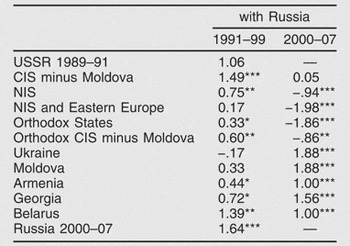
In figure 1, we display summary statistics of Freedom House data aggregated over the final three years of Gorbachev's reign in power and the eight and a half years of Boris Yeltsin's presidency (plus six months of his tenure as head of parliament during the first half of 1991).Footnote 78 The first two lines in the figure show that the mean of the ratings received by the USSR during this period (which are also the most democratic three years of its existence) is 4.67, which compares unfavorably to Russia's mean of 3.61 during Yeltsin's years in office. The first row of table 1 presents the resulting difference of means of 1.06 (which has a p-value of .13).Footnote 79Figure 1 also reveals that Russia's mean score during the 1990s is superior to the best score (4.0) achieved by the USSR under Gorbachev. In short, according to Freedom House, Russia's political life after the revolution of 1991 was freer than that of the Soviet Union even at the height of perestroika.
Mean, minimum, and maximum values of Freedom House ratings for the USSR and Russian Federation, 1989–2007

Differences of means of Freedom House ratings among the USSR and various post-communist states, 1989–2007

Source: Freedom House, “Freedom in the World Country Rankings, 1972 to 2007,” available at http://www.freedomhouse.org.
Notes: * = p < .10; ** = p < .01; *** = p < .001; Russia is excluded from each group of post-communist states.
Russia vs. Other Post-Communist States
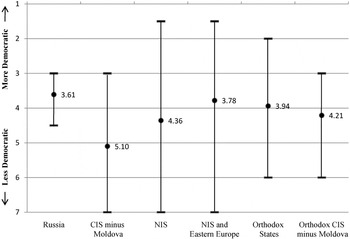
The second set of findings revealed by our analyses of Freedom House's ratings is that the Russian Federation during Yeltsin's reign in power was more democratic than most of the other post-communist states of Eastern Europe and Eurasia. Moreover, this finding holds up across comparisons with several different subsets of these states. Russia's superior performance is evident from the statistics presented in figure 2, which again displays the means, minima, and maxima of the ratings received by Russia and five other groups of countries from 1991 to 1999. The second line in the figure reveals that the mean of the scores for the ten states that, like Russia, came under Soviet rule in the early 1920s (represented by the CIS minus Moldova) is 5.10. The resulting difference of means with Russia of 1.49 (presented in the second row of table 1) spans fully twenty-five percent of the entire range of Freedom House's scales and is statistically significant at the .001 level.Footnote 80
Mean, minimum, and maximum values of Freedom House ratings for the Russian Federation and various groups of post-communist states, 1991–1999
Note: Russia is excluded from each group.

The third line in figure 2 reveals that when the control group is expanded to include the three Baltic states and Moldova—lands that were not part of the USSR in the interwar period—the gap between Russia and other former Soviet republics becomes smaller. In particular, Lithuania, Latvia, and Estonia all approached the status of consolidated democracies, receiving ratings from Freedom House of either 1 or 2 for both political rights and civil liberties from 1995 on. In light of Latvia's and Estonia's restriction of the franchise largely to citizens of interwar Latvia and Estonia and their descendents, however, Freedom House's ratings are arguably too generous. The resulting disenfranchisement extended to more than two-third of those states' Slavic populations and roughly forty percent of their total populations. Hence, Philip Roeder's classification of these states as “exclusive republics” rather than democracies would seem to be more accurate.Footnote 81 Nevertheless, even when the ratings received by these states are averaged into the sample, the overall picture remains essentially unchanged: the mean for the fourteen other newly independent states (NIS) of Eurasia is 4.36, or .75 less democratic than the mean for Russia. The third row of table 1 shows that such a difference of means is statistically significant at the .01 level.
The fourth line in figure 2 displays the summary statistics when the control group is expanded to encompass the states of Eastern Europe. Like the three Baltic states, many of these states have a Western Christian heritage, are close to Western Europe, experienced democratic rule in the interwar period, and avoided both polarized politics and conflict over borders in the 1990s—characteristics that, as previously discussed, should be expected to promote their democratization. True to expectations, the mean for these twenty-six states is 3.78, or 1.32 points lower than that for the ten states of the CIS displayed in the second line in the figure. Notwithstanding the cultural, geographic, and historical advantages possessed by many of these states, however, the mean for this group is still .17 higher, or less democratic, than Russia's mean (see table 1).
Whereas the previous two control groups expand the amount of information utilized in each comparison at the expense of the equalization of other likely determinants of democracy aside from presidential leadership, these groups can also be narrowed in order to move the comparisons with Russia even closer to the experimental ideal. For instance, if states whose dominant religion is Islam, Catholicism, or Protestantism are removed from the sample and comparisons are conducted solely among countries in which Orthodoxy is historically dominant, then both religious tradition and national culture are held constant to a significant extent. Moreover, doing so would also provide some measure of control over both imperial legacy and geography. As Steven Fish observes,
Hapsburg/German, Russian, and Ottoman legacies overlap extensively with Catholic/Protestant, Orthodox, and Muslim traditions, respectively. What is more, the variables capture potentially significant geographical distinctions. All Catholic/Protestant countries are located in the western reaches of the [post-communist] region; eastern Christian countries spread over the east and southeast European and Caucasian portions of it; and Muslim countries occupy the “southern rim” (with the exception of Albania in the Balkans).Footnote 82
Restricting the control group to states with an Orthodox heritage results in a sample consisting of the following nine states: Armenia, Belarus, Bulgaria, Georgia, Macedonia, Moldova, Romania, Ukraine, and Serbia and Montenegro. As is displayed in the fifth line in figure 2, the nine-year mean for Russia's fellow Orthodox states of Eastern Europe and Eurasia is 3.94, or .33 less democratic then Russia's score (a difference that is statistically significant at the .10 level).
If the control group is narrowed further by removing states that were not incorporated into the USSR in the early 1920s, then we are left with the following set: Armenia, Belarus, Georgia, and Ukraine. A major virtue of using this group is that all of its members share the following attributes and experiences with Russia: Orthodoxy, seventy (as opposed to forty) years of communist rule, direct rule from Moscow, current membership in the CIS, and the absence of any significant experience with democracy.Footnote 83 As is displayed by the sixth line in figure 2, the nine-year mean for these four states is 4.21, or .60 less democratic than Russia's (a difference that is statistically significant at the .01 level). This finding powerfully demonstrates that Russia in the 1990s possessed some factor that both strengthened its incipient democracy and was absent in its post-Soviet Orthodox peers.
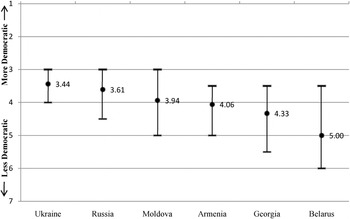
This inference is reinforced by a more in-depth examination of all six of the Orthodox states of the CIS. Both figure 3 and table 1 present statistical summaries of these countries' Freedom House ratings aggregated over the nine years under examination. They show that Russia vastly outperformed Belarus, significantly outperformed Georgia, somewhat outperformed Armenia and Moldova, and virtually tied for first place with Ukraine (which had the lowest mean rating of any member of the CIS). Specifically, Russia's mean score is only .17 of a point higher (i.e., less democratic) than Ukraine's—a difference that is not statistically significant at even the .30 level. Moreover, in light of the strong geographic pattern to the spread of democracy in the postcommunist region, that Russia and Ukraine are essentially tied is surprising given how much closer Kiev (not to mention Minsk) is to Western Europe than is Moscow.Footnote 84
Mean, minimum, and maximum values of Freedom House ratings for the Orthodox states of the CIS, 1991–1999

The Transformation of the Polity under Putin
If Boris Yeltsin's strong commitment to democratic governance (relative to that of most other post-Soviet chief executives, that is) is the factor that accounts for Russia's more extensive democratization in the 1990s, then we might expect the Russian polity to have experienced some degree of democratic backsliding after Yeltsin's resignation of the presidency on New Year's Eve of 1999.Footnote 85 Indeed, this is the case. Whereas Russia in the 1990s was more democratic than both the Soviet Union during perestroika and most of the other post-communist states during the same time period, the third set of findings revealed by our analyses of Freedom House's ratings revolves around the fact that the Russian polity became significantly less democratic under Vladimir Putin's leadership. Moreover, this trend is equally apparent whether examined in longitudinal or cross-national perspective.
Russia received ratings of 4 for political rights and 5 for civil liberties in 1999, yet at the end of Putin's first year as president, Freedom House downgraded Russia's rating for political rights from 4 to 5 “due to reports of serious irregularities in the March presidential elections and President Putin's increasing consolidation of central government authority.”Footnote 86 Moreover, anti-democratic trends, especially regarding freedom of the media, continued throughout Putin's first term in office. As Freedom House observes, “since June 2003, when the last independent national television network, TVS, was seized by the government, allegedly to settle the company's debts, all Russian national television networks have been controlled by the government or by economic interests that support the government and uniformly praise the president.” Moreover, after Putin announced “constitutional reforms [that] will make the post of governor appointed by the president rather than elected,” Freedom House lowered Russia's rating for political rights in 2004 from 5 to 6 and downgraded the country's status to “not free”—scores last received by the Soviet Union in 1989.Footnote 87
The mean, minimum, and maximum scores received by the Russian Federation during the eight years of Putin's presidency are displayed in the third line in figure 1. As is shown there, Russia's mean during the Putin era of 5.25 compares rather unfavorably to the Yeltsin era mean of 3.61. As is presented in the twelfth row of table 1, the resulting difference of 1.64 is statistically significant at the .001 level. Figure 1 also reveals that the best score attained by Russia under Putin (5.0) is worse than the worst score attained under Yeltsin (4.5). Finally, table 1 reveals an interesting finding: namely, that the difference between Russia's mean scores across these alternative leadership eras is larger than any of the differences between Russia's mean score in the 1990s and those of the various groupings of post-communist states that were analyzed above. Among other things, these results lend support to interpretations of Russian politics that maintain that the Putin regime differs from its predecessor not only in degree but in kind.Footnote 88
The transformation of Russian politics that followed Putin's rise to power is equally obvious when examining Russian democracy in cross-national perspective. As was discussed earlier, Russia in the 1990s outperformed all five of the groupings of post-communist states that we examined and substantially outperformed one grouping—the other members of the CIS excluding Moldova. The comparable statistics for this decade that are displayed in figure 4, however, reveal that Russia's mean score under Putin is almost identical to the mean for the states of the CIS (5.30) and is considerably worse than the means for the four remaining groups. In particular, the fourteen other newly independent states, with a mean rating of 4.31, outperform Russia by close to a point; the entire post-communist region and its Orthodox subset, with mean ratings of 3.27 and 3.39, respectively, outperform Russia by nearly two full points; and Russia's most similar peer group (consisting of Armenia, Belarus, Georgia, and Ukraine), with a mean of 4.39, bests Russia by .86 of a point, on average. Moreover, as the third through sixth rows of the second column of table 1 reveal, all of these differences are statistically significant at either the .01 or .001 level.
Mean, minimum, and maximum values of Freedom House ratings for the Russian Federation and various groups of post-communist states, 2000–2007
Note: Russia is excluded from each group.

A comparison of the findings displayed in figure 2 with those in figure 4 also serves to dispel the notion that the degradation of Russian democracy under Putin was the product of any kind of regional trend toward autocracy. In fact, the means of the two groups that include Eastern European states (the fourth and fifth lines in both figures) are both lower (i.e., more democratic) by roughly half a point (from 3.78 to 3.27 and 3.94 to 3.39, respectively) in this decade than they were in the 1990s. On the other hand, two of the other groups did experience slight regression: the mean for the states of the CIS minus Moldova (the second line in both figures) increased (i.e., became less democratic) by .20 of a point (from 5.10 to 5.30); and the mean for the Orthodox states of the CIS minus Moldova (the sixth line) increased by .18 of a point (from 4.21 to 4.39). However, this very moderate movement away from democracy among the post-Soviet states cannot account for the much larger changes in Russia's scores. Rather, it is much more conceivable that the transformation of Russian politics under Putin produced a small anti-democratic ripple effect in some of Russia's neighbors.Footnote 89
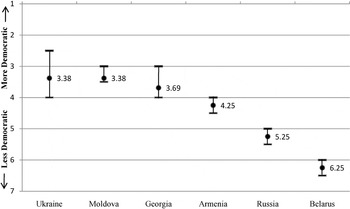
Russia's democratic backsliding relative to its post-communist peers becomes even more apparent from an in-depth examination of the Orthodox states of the CIS. Whereas Russia's Freedom House scores in the 1990s were basically tied for first place among these six states (see figure 3), figure 5 reveals that Russia ranks second to last among them in this decade. In particular, Russia is outperformed by Moldova and Ukraine by almost two full points, by Georgia by just over one and a half points, and by Armenia by exactly a point. Moreover, as is displayed in the seventh through tenth rows of the second column of table 1, all of these differences are statistically significant at the .001 level. In contrast, Russia's performance is superior to that of only Belarus. In short, instead of being a leader in terms of democracy among its closest peers, Russia became a laggard.
Mean, minimum, and maximum values of Freedom House ratings for the Orthodox states of the CIS, 2000–2007

Russia's standing relative to these various groups of states makes clear that Russia possessed some factor during the Putin years that both undermined its nascent democracy and was absent in most of the other post-communist states. That this factor is a chief executive possessing a much weaker commitment to freedom of speech and genuine political competition than either his predecessor or most of his postcommunist counterparts seems, at a minimum, highly plausible.Footnote 90
Conclusions
While the end of the Cold War and the subsequent dissolution of the Soviet Union eliminated the major international threat to the United States of the previous four decades, the potential reemergence of an authoritarian, expansionist, and anti-Western Russia loomed over that country's post-communist transition. The Clinton administration recognized that preventing such an outcome was a vital U.S. strategic interest and immediately made Russia the highest priority of its foreign policy.Footnote 91 The administration's strategy for preventing a return to the Cold War was to promote the consolidation of market and democratic institutions in Russia. Its central tactic was to help Boris Yeltsin remain in power. In a major assault on Clinton's historical legacy, much of the scholarly community maintains that this tactic was fundamentally flawed. In the view of these analysts, post-Soviet Russia's founding president derailed the country's progress toward democracy and presided over an authoritarian regime.
However, the conclusions reached by this body of research should be regarded as suspect for at least three reasons. First, these works fail to make allowance for the fact that many of Russia's initial conditions aside from potentially autocratic leadership—including an allegedly autocratic national culture, location on the eastern periphery of Europe, lack of experience with democratic institutions, polarized elites, the absence of a consensus on the state's proper borders, an overburdened agenda of policy choice, and declining living standards for the majority of the population—militated against democratic consolidation and even survival. In other words, there were little grounds for optimism about the prospects for democracy in Russia under any leadership. Second, these works almost universally analyze Russia in isolation and ignore the experiences of the more than two dozen other post-communist states and even of Russia itself at other points in time. And third, comparative inquiry that corrects for both of these methodological shortcomings generates inferences that suggest the opposite about the overall impact of Yeltsin's leadership.
Specifically, our cross-national and longitudinal analyses reveal that Russia during Yeltsin's presidency was more democratic than the Soviet Union in the 1980s, much more democratic than most of its counterparts in the CIS, considerably more democratic than most of the fourteen other states that similarly emerged from the USSR in 1991, and even slightly more democratic than the average of all of the formerly communist states of Eastern Europe and Eurasia. Moreover, Russia was considerably more democratic than should be expected of a Soviet successor state with an Orthodox religious heritage. In short, these comparisons indicate both that Yeltsin preserved and even extended the democratic gains from Mikhail Gorbachev's liberalizing policies and that he steered Russia in the direction of democracy to a greater extent than did most of his post-communist counterparts and to a much greater extent than did almost all of his counterparts in the CIS. In fact, not a single leader of any of the twelve states of the CIS nurtured democratic institutions in the 1990s significantly more successfully than did Yeltsin.
Further proof of Yeltsin's positive influence on Russia's democratization is provided by the evolution of Russian politics since his departure from the Kremlin. Soon after becoming president, Vladimir Putin implemented policies that centralized power in the Kremlin and sharply curtailed freedom of speech, thereby demonstrating once again that Russian democracy during Yeltsin's tenure in office was, relatively speaking, a success. Indeed, with Yeltsin out of the Kremlin, little was left to restrain the various structural pressures for autocracy that existed in Russia. As a consequence, Russia's democratic performance fell well below that of the vast majority of post-communist states and the country went from being a leader among its closest peers to being a laggard. Whether or not Putin's anti-democratic inclinations are the product of his professional socialization in the KGB, there can be little doubt that the former president (and also current prime minister) personally contributed to the polity's reconstitution in an authoritarian direction.
In sum, a wide array of both cross-national and longitudinal comparisons strongly indicates that American policy toward Russia in the 1990s was based on a solid premise: contrary to what seems to be the majority opinion on this subject, Russian democracy would have fared worse in the absence of Yeltsin's leadership. Of course, it is also true that, as Lilia Shevtsova writes, Yeltsin “failed to create a sustainable foundation for a liberal and democratic state.”Footnote 92 In addition, it is certainly possible that the Russian polity would have been more democratic had the country been ruled instead by Aleksandr Rutskoi or Gennady Zyuganov, the only two individuals who came close to unseating Yeltsin. However, creating a sustainable foundation for democracy in less than a decade most likely represented an impossible task for any Russian leader. Moreover, no conclusive evidence can possibly exist to support either of these counterfactual scenarios and we see little in the public records of either of those individuals to undercut the Clinton administration's view that the viable alternatives to Yeltsin were less democratic than he.Footnote 93 In addition, Zyuganov's assumption of the presidency clearly would have negatively impacted other U.S. interests, including the preservation of peace throughout the vast expanse of Eurasia. For all of these reasons, Bill Clinton's historical legacy seems safe in regard to the political support he extended to and personal relationship he forged with his friend “Boris.”
Our findings also suggest that a modification to our general understanding of post-communist transitions is warranted. In particular, Russia's relatively strong performance in terms of democratization in the 1990s, its relatively weak performance in this decade, and the magnitude of the transformation of the polity under Putin all demonstrate that the ability of Russia's leaders to shape political outcomes is great. Moreover, such might very well be the case in any country in which the success or failure of democratic transition is by no means foreordained by elite or societal consensus.Footnote 94 In other words, while theorizing about the post-communist transitions has illuminated the impact of numerous structural and institutional variables, the role played by leadership has received less attention than it deserves.Footnote 95 Indeed, Russian history since 1985 makes clear that the most significant agent of that country's democratization—or its reversal—is the man occupying the Kremlin.