1 Introduction
Equity-linked products are a class of insurance products that offer returns based on the stock market while guaranteeing a minimum rate of return. They typically provide limited participation in the performance of an equity index for an equity-indexed annuity (EIA) or mutual funds in the case of variable annuities (VAs). The monograph by Hardy (Reference Hardy2003) has comprehensive discussions on the subject. Introduced by Keyport Life Insurance Co in 1995, EIAs have been the most innovative annuity product over the last 20 years. Equity-linked products have become increasingly popular since their debut and in the case of EIAs the sales have steadily increased and hit a record high of  $\$ $69.9 billion in 2018 (see IRI, 2019).
Equity-linked products are long-term financial derivatives with diverse embedded guarantees. Due to their specifications, they should be evaluated in an incomplete market framework. Incomplete markets arise in finance when the number of securities is less than the number of risk factors. For example, realistic finance frameworks including jumps and/or stochastic volatility, as well as non-Markovian processes whose outcomes depend on history, often lead to incomplete financial markets. Incomplete markets are also attributable to the discontinuity of trading opportunities and to market frictions: transaction costs, taxes, and borrowing issues.
In a complete market framework, it is possible to replicate exactly the payoff of any derivative by self-financing hedging strategies involving simpler assets such as stock, cash, or other assets. In incomplete markets, this exact replication is so far not reachable and one has to rely on risk management criteria such as risk measures or utility functions to keep dynamic self-financing optimal-replication strategy as close as possible from being exact. One of the first models developed to deal with the incomplete dynamic propose to choose the optimal martingale measure that minimises the expected square of the terminal hedging errors which is known as a quadratic hedging strategy. It was first introduced in the financial context by Föllmer & Sondermann (Reference Föllmer and Sondermann1986) and was later applied in an actuarial context in equity-linked products by Moller (Reference Moller1998). It has the advantage of being computationally simple. Schweizer (Reference Schweizer1988) and Föllmer & Schweizer (Reference Föllmer and Schweizer1988) propose a local risk-minimising strategy that minimises the square of the error process sequentially, which can be extended to non-self-financing strategies. Coleman et al. (Reference Coleman, Li and Patron2006) apply this approach to options embedded in guarantees with ratchet features. However, the disadvantage is that the square of the error does not distinguish between positive errors that are losses and negative errors that are gains. Gaillardetz & Moghtadai (Reference Gaillardetz and Moghtadai2017) introduce an optimal iterated approach that minimises the cost of the replicating portfolio together with limiting the risk. Gaillardetz & Hachem (Reference Gaillardetz and Hachem2019) extend this approach by allowing the hedging strategy to invest in multiple assets involving options and the eventual use of multiple risk measures to better shaping the error process. This framework has the advantage to not penalise gains and of making few assumptions about financial models and products (both path-dependent and path-independent) leaving these decisions to the issuers for the particular applications. The later authors use the results obtained by Rockafellar & Uryasev (Reference Rockafellar and Uryasev2000), where they show how linear programming can be used to minimise the conditional value-at-risk or to impose an upper bound on this risk measure in the constraints of a portfolio optimisation problem.
There are various ways to analyse surrender behaviour. A reasonable way is to assume that the policyholders are rational. Grosen & Jørgensen (1997) show that, under this assumption, a product with a revenue guarantee is essentially equivalent to an American option. Grosen & Jørgensen (2000) take this idea a step further separating the equity-linked contract into three components: the risk-free bonds, bonus option, and surrender option. They price each component using Monte Carlo simulations. Bacinello (Reference Bacinello2004) makes the same assumption to price the contract where the surrender value is calculated endogenously. Although these methods are theoretically sound, they lead to high prices.
The behavioural finance field raises many arguments against rationality. Assuming that non-rational investors contradicts many fundamental financial theories such as the efficient market hypothesis. In the case of equity-linked products, the policyholders are all individual investors. Barber & Odean (Reference Barber and Odean2011) show that this category of investors often under-performs benchmarks due to various irrational behaviours. Kuo et al. (Reference Kuo, Tsai and Chen2003) also show that lapse rates for insurance portfolios are influenced by the short-term interest rate and the unemployment rate. Therefore, it is reasonable to assume that a portion of the cohort will not act optimally. De Giovanni (Reference De Giovanni2010) studies irrational policyholder behaviours on insurance participating policies. He proposes to model the intensity surrender rate using the moneyness and the interest rate. Forsyth & Vetzal (Reference Forsyth and Vetzal2014) and Kling et al. (Reference Kling, Ruez and Ruß2014) examine the effects of irrationality by comparing the hedging costs of VAs under optimal and sub-optimal surrender behaviours. In addition to the Black-Sholes financial framework, the former focuses on the Markov regime-switching framework while the latter uses the Heston model.
Kling et al. (Reference Kling, Ruez and Ruß2014) model the surrender rates based on two different continuation values: internal and external values. The former refers to the issuer’s indigenous evaluation of the contracts. The latter assumes that investors evaluate the contract to take their surrender decisions. In this article, the sub-optimal behaviour presented by Forsyth & Vetzal (Reference Forsyth and Vetzal2014) is extended to include a deterministic rate of surrender based on an external continuation value. Hence, the investor’s moneyness ratio (MR) is independent of the hedging strategy performed by the issuer. In the case of VAs, the contract moneyness is based on the account and surrender values. In the case of EIA’s, there is simply no account value. This is overcome by deriving the MR based on the surrender value and a surrender option price. It is obtained by simplifying the EIA contact and assuming that the investor is rational. As a consequence, the contract is equivalent to price Bermudian options. The risk-control strategies can also handle surrender rates based on internal values. Remark 1 shows an example of how the optimisation problem can be modified to include this type of surrender rates.
Forsyth & Vetzal (Reference Forsyth and Vetzal2014) and Kling et al. (Reference Kling, Ruez and Ruß2014) use the martingale approaches while our hedging strategies are obtained without this assumption. In this paper, the EIA contract is evaluated using the risk-control strategy propose by Gaillardetz & Hachem (Reference Gaillardetz and Hachem2019). This hedging strategy is very flexible and can control the global risk pathwise. It can handle easily transaction costs and multiple hedging assets such as vanilla options (see Gaillardetz & Hachem, Reference Gaillardetz and Hachem2019). In addition, the super-replicating strategy can be recovered using specific parameters of the risk measure, which leads to a riskless exercise for the issuer. While Kling et al. (Reference Kling, Ruez and Ruß2014) study the performance of the delta-hedging strategy, our numerical illustrations show how the enrichment of the set of investments by standard European options can reduce the hedging cost.
In Section 2, the actuarial notations are introduced along with the risk measures and surrender scheme. The hedging portfolio and the loss function are defined in Sections 3. Section 4 presents the dynamic partial hedging portfolio and its valuation through the use of local-risk minimising strategy while Section 5 defines the capital requirement for the issuers. In Section 6, a numerical example is detailed along with a study of the impacts of different parameters on the initial capital requirement.
2 Financial Model
This section introduces a general discrete lattice model that describes the stock index dynamic. Lattice models have been intensively used to model stocks, stock indices, interest rates, and other financial securities due to their flexibility and tractability. We conclude this section by introducing the standard actuarial notation and risk measures.
First, assume, for the sake of simplicity, that each year of the n-year planning horizon is divided in N periods of equal length  $\Delta=1/N$. Let r be the constant force of interest. Let
 $S=\{S_t,\break t=0,\Delta,2\Delta,...\}$ be the process representing the stock price for which the random variable
 $\frac{S_{t+\Delta}}{S_t}|\mathcal{F}_{t}$ takes values in some fixed finite set
 $\Omega$, where
 $\mathcal{F}_t$ is the filtration related to the index process. Using a fixed finite set
 $\Omega$ for the moves of the index is referring to a lattice model where
 $\theta_{t,j}$
 $(\,j=1,\ldots,m)$ describes a state and
 $q_{t,j}$ denote the probability to reach this state. A complete financial market is achieved if the number of branches m equals the number of assets. This paper considers m larger than the number of assets, which leads to an incomplete financial market. We also assume that the issuer can reduce the risk using vanilla options. Let P(k, T) denote the time-k price of the vanilla option with maturity T. Without loss of generality, we assume that issuer can invest in a European option, which payoff is given, for a strike price K, by
 $(S_T-K)_+$ in the case of a call option. The model assumes the usual frictionless market: no tax, no transaction cost, etc. Without loss of generality, let us assume that the time-0 index value is one unit.
This financial setting provides inputs for the local risk-control strategy proposed by Gaillardetz & Hachem (Reference Gaillardetz and Hachem2019).
2.1 Mortality and surrender models
In this section, the actuarial notations for the mortality and surrender process will be introduced. It is assumed that the surrenders occur at the very beginning of a period  $\Delta$ and the benefits associated with deaths are paid at the end of the period.
Let  $l_0$ be the number of mutually independent policyholders aged
 $x_1,\ldots,x_{l_0}$ at time of issue, and
 $T(x_i)$ and
 $U(x_i)$ be the time until death and time until surrender for policyholder
 $(x_i)$ at time
 $t=0$, respectively. Then, the curtate future lifetime of
 $x_i$ is given by
 \begin{align*}K(x_i)= \lfloor N T(x_i) \rfloor \Delta\end{align*}
computed up to multiples of  $\Delta$ periods. Note that
 $\lfloor \cdot \rfloor$ is the yearly floor function. The curtate time until exit is defined as
 \begin{align*}K^*(x_i)= \min \left ( K(x_i),U(x_i) \right )\end{align*}
From here forth, without loss of generality, it will be assumed that  $l_0$ contracts are signed with
 $l_0$ policyholders at time 0. It is also assumed that the policyholders are all independent, of the same age x with the same contract (same maturity n), and their mortality follows the same law.
The surrender process is that of a discrete decrement that occurs at the beginning of each period  $\Delta$, independent from mortality. Let the rate of surrender for the period
 $[k,k+\Delta)$ be denoted by
 $ {}_{}{q}^{\prime({s})}_{k}$. The probability of death for the period
 $[k,k+\Delta)$ is denoted by
 $ {}_{{\Delta}}{q}{}^{\prime({d})}_{x+k}$.
Let the probability that (x) remains in the cohort k years be denoted by  $_kp^{(\tau)}_x=\Pr\![K^*(x)\geq k]$. Then let
 $_{k|\Delta}q^{(\tau)}_x$ denote the probability that (x) remains a policyholder for k years and exits within the following
 $\Delta$ period, i.e
 \begin{align*} {}_{k|\Delta}{q}{}^{({\tau})}_{x} = \Pr\![K^*(x) = k] &= {}_{k}{p}{}^{(\tau)}_{x} {}_{\Delta}{q}{}^{({\tau})}_{x+k} = {}_{k}{p}{}^{({\tau})}_{x} \left ( {}_{}{q}{}^{\prime({s})}_{k} + {}_{}{p}{}^{\prime({s})}_{k} {}_{{\Delta}}{q}{}^{\prime({d})}_{x+k} \right )\end{align*}
for  $k\in\{0,\Delta, 2\Delta,\ldots \}$. Similarly the probability of remaining a policyholder by the end of the period is
 $ {}_{\Delta}{p}{}^{({\tau})}_{x+k}= {}_{}{p}{}^{\prime({s})}_{k} {}_{{\Delta}}{p}{}^{\prime({d})}_{x+k}$. Note that the surrender probabilities do not depend on the age of the policyholder. The choice of these probabilities will be presented in the following section.
Let  $ \mathcal{{L}}_{k}$ be the cohort of remaining policyholders right before the surrenders at time k:
 \begin{align} \mathcal{{L}}_{k} &= \sum_{i=1}^{l_0} \textbf{1}_{\{\min\{T(x_i),U(x_i)\} \geq k \}}\end{align}
where  $1_{\{.\}}$ is the indicator function. Then let
 $ {}_{}{\mathcal{{D}}}{}^{({s})}_{k}$ and
 $ {}_{}{\mathcal{{D}}}{}^{({d})}_{k}$ be the number of policyholders that surrender at time k and die in the period
 $[k,k+\Delta)$ for
 $k\in\{0,\Delta,\ldots\}$, respectively, i.e.
 \begin{align} {}_{}{\mathcal{{D}}}{}^{({s})}_{k} &= \sum_{i=1}^{l_0} \textbf{1}_{\{ T(x_i)>k,U(x_i) = k \}}, \nonumber \\[3pt] {}_{}{\mathcal{{D}}}{}^{({d})}_{k} &= \sum_{i=1}^{l_0} \textbf{1}_{\{ T(x_i) \in [k,k+\Delta), U(x_i)>k\}}\end{align}
2.2 Aggregate input process
The two-dimensional cohort process defined by (1) and (2) states that surrenders have to be among survivals at the beginning of the period. Each outcome of this process is a pair of numbers: number of surrenders and number of survivals (the number of deaths during the transition period  $\Delta$ can be obtained from the difference).
Since these two random components are independent, for each outcome at time k, the number of immediate transitions to  $k+ \Delta$ is the number of all the meaningful possibilities of survivals, surrenders, and deaths. This process can be represented by a recombined tree. At each level of this tree, the different node represents exactly all the non-redundant possibilities of the couple (survival/death and surrender).
The aggregate input process or tree should include the three sources of uncertainty affecting the equity-linked products: stock index, mortality, and random surrendering behaviour. The cohort process outcomes are independent of the index process outcomes; only the surrender probabilities depend on the stock outcomes. Hence, the aggregate input process outcomes are all the non-redundant possible combinations of the cohort and stock index processes. If the individual stock index process is Markovian, representing the three-dimensional process by a multinomial recombining tree leads to a significant reduction in the computational complexity, by comparison to represent the process as an unfolded tree or a scenario tree.
The nodes of the tree represent the possible values of the aggregate input process and the arcs the transitions. Since the planning horizon is cut-off equally into successive dates, all the outcomes (or nodes) of the process at a certain date can be aligned on the same level, the more advanced is the date the higher is the level. For the first level, the beginning or time equal zero, the event tree has one node since the present is assumed to be fully known. Let  $\mathcal{ F^*}$ be the enlarged filtration generated by the index process S as well as the cohort processes
 $ {}_{}{\mathcal{{D}}}{}^{({s})}_{}$ and
 $ \mathcal{{L}}_{k} $. The augmented state space
 $\Omega^*$ is still finite taking values
 $\theta^*_{t,j}$
 $(\,j=1,\ldots,m^*)$ with probabilities
 $q_{t,j}^*$. This proposed aggregate evaluation framework leads to an incomplete financial market.
2.3 Surrender scheme
In this paper, the issuer evaluates the EIA contract assuming that policyholders could act irrationally. Our approach relaxes both the risk-neutral assumption using the risk-control strategy and the policyholder’s rational assumption by introducing surrender rates. The proposed hedging strategies rely on risk measures and involve random surrendering behaviour.
Let  $(1-z_k)D(x,k)$ denote the surrender exercise value at time k, where
 $z_{k}\in[0,1]$ is the surrender fee and D the EIA payoff at time k for the policyholder x. The surrender probabilities
 $ {}_{}{q}{}^{\prime({s})}_{k}$ are based on the MR, which is given by
 \begin{align}MR(k) &= \dfrac{(1-z_k)D(x,k)}{\hat{V}(k^+)}\end{align}
where  $\hat{V}(k^+)$ is surrender option value if the investor decides to continue the contract at time k, which will be defined later.
The surrender rates idea is based on the assumption that policyholders react differently to the level of the MR. For example, a portion of the cohort will surrender independently of the market for various reasons such as personal financial issues. Another portion of the population will surrender if the MR is high enough. For this reason, the surrender probability  $ {}_{}{q}{}^{\prime({s})}_{k}$ will be a piece-wise function of the MR ratio (see Figure 1).
Surrender rates for different thresholds.

It is equal to  $\nu_0$ for
 $MR(k)<1$ and increases for
 $MR(k)\geq 1$ up to a particular threshold
 $\nu_1$, where it becomes equal to 1. The surrender rate is assumed to be a linear function of the MR, that is
 \begin{align} {}_{}{q}{}^{\prime({s})}_{k}= \begin{cases} \nu_0,& MR(k)<1, \\ \nu_0 + \dfrac{1-\nu_0}{\nu_1}\left ( MR(k)-1 \right ), \,\,1\leq & MR(k)< \nu_1+1, \\ 1, & MR(k) \geq \nu_1+1 \end{cases}\end{align}
for  $\nu_0,\nu_1>0$. Note that as
 $\nu_1\to 0$ then,
 \begin{align} {}_{}{q}{}^{\prime({s})}_{k} = \begin{cases} \nu_0,& MR(k)<1, \\ 1, & MR(k) \geq 1 \end{cases}\end{align}
which implies that all policyholders will surrender as soon as the MR is higher than 1. When  $\nu_0$ is also set to 0, it implies that the policyholder is reactive, which means that he will surrender the contract as soon as the option value is smaller than the surrender value.
Similarly as  $\nu_1\to \infty$, the probability of survival is
 $ {}_{}{q}{}^{\prime({s})}_{k} =\nu_0$ and does not depend neither on the financial market performance nor the surrender value. Moreover,
 $\nu_0=0$ implies that the policyholder does not surrender. Also note that the method presented by Forsyth & Vetzal (Reference Forsyth and Vetzal2014) can be written as
 \begin{align} {}_{}{q}{}^{\prime({s})}_{k}= \begin{cases} 0,& MR(k)< \nu_1+1 \\[3pt] 1, & MR(k) \geq \nu_1+1 \end{cases}\end{align}
in this framework.
2.4 Risk measures
Risk measures have been widely used by financial institutions such as insurance and investments companies to evaluate the risk level of business lines. This widespread use is mainly due to its meaningfulness in a business setting. The most common and well-known risk measure is the Value-at-Risk (VaR). VaR is widely used due to its ease of implementation and interpretability in risk management and regulatory requirements. The use of the VaR within optimisation problems generally makes tractable problems harder to solve.
More recently, the conditional value-at-risk (CVaR) has been lauded as a more meaningful and appropriate risk measure because of the recognition that coherence, as defined by Artzner et al. (Reference Artzner, Delbaen, Eber and Heath1999), is a desirable property of risk measures. Essentially, a coherent risk measure is said to possess the properties of monotonicity, sub-additivity, positive homogeneity, and translation invariance. Note that VaR does not possess the sub-additivity property and is therefore not a coherent risk measure. In this paper, the focus will be mostly on CVaR, due to the fact that CVaR retains its coherence for discrete distributions.
Definition 2.1. The value-at-risk at time k is defined as the c-quantile of the discounted loss random variable L. That is
 \begin{align}\textnormal{VaR}_\alpha\left ( L|\mathcal{ F^*}(k)\right ) = \inf \{ y \in \mathbb{R} : \Pr\![L>y|\mathcal{ F^*}(k)] \leq 1-\alpha \}\end{align}
for  $\alpha\in[0,1]$,
 $k \in \{0,\Delta,2\Delta,\ldots\}$.
Definition 2.2. The CVaR risk measure, which represents the expected value of the worst  $(1-\alpha)$ losses, is given at time k by
 \begin{align}\textnormal{CVaR}_\alpha\left ( L|\mathcal{ F^*}(k) \right ) = \operatorname{E} \left [ L|\mathcal{ F^*}(k),L>\textnormal{VaR}_\alpha(L|\mathcal{ F^*}(k)) \right ].\end{align}
In the case of a discrete loss random variable this can be approximated using
 \begin{align}\textnormal{CVaR}_\alpha\left ( L|\mathcal{ F^*}(k) \right ) = \pi_\alpha + \dfrac{ \operatorname{E} \left [ (L-\pi_\alpha) \textbf{1}_{\{L>\pi_\alpha\}} |\mathcal{ F^*}(k) \right ] }{1-\alpha},\end{align}
where  $\pi_\alpha=\textnormal{VaR}_\alpha\left ( L|\mathcal{ F}^*(k)\right )$.
3 Hedging Portfolios and Loss Functions
Hence, the considered contracts involve mortality and surrender guarantees linked to the financial market. The random payoff denoted  $B(x,K^*(x))$ is given by
 \begin{align}&B(x,K^*(x))=&\nonumber \\[3pt] &\begin{cases} (1-z_{K^*(x)}\textbf{1}_{\{K^*(x)=U(x)\}})D(x,K^*(x)+\Delta \textbf{1}_{\{K^*(x)=K(x)\}}),& K^*(x)=0,\Delta,...,n-\Delta \\[3pt] D(x,n),& K^*(x)=n,...\end{cases}\end{align}
where D is both the value of guarantees in case of surrender and death. Note that here we assume that the death and surrender benefits are paid at the end  $K^*(x)+\Delta$ and beginning
 $K^*(x)$ of the period, respectively.
Let  $\mathcal{ A} = \{a(k),b(k),c(k)\}$ denote the hedging strategy at time
 $k\in\{0,\Delta,\ldots\}$, where a(k) is the dollar portion invested in index shares, b(k) the proportion invested in financial option, and c(k) is the dollar portion invested in the risk free asset at time k. For sake of notational simplicity, we omit the node indexations, but keep in mind that most outcomes are function of the filtration
 $\mathcal{ F^*}$. Let
 $W(t,k),\,k\geq t$ denote the value of the accumulated aggregate hedge portfolio at time k. Then,
 $W(k,k)=a(k)+b(k)P(k,T)+c(k)$ for
 $k\in\{0,\Delta,\ldots\}$ and
 $T>k$ and
 $W(0,\ 0)=a(0)+b(0)P(0,T)+c(0)$ is the initial value of this hedging strategy. Similarly
 $W(k,k+\Delta^-)$ denotes the value of the hedge portfolio prior to any benefit payment at time
 $k+\Delta$, then we have that the accumulated hedge portfolio at time
 $k+\Delta^-$ is the hedge portfolio from time k accumulated for 1 period,
 \begin{align}W(k,k+\Delta^-) = a(k)\dfrac{S_{k+\Delta}}{S_k} +b(k)P(k+\Delta,T)+c(k)e^{r\Delta}\end{align}
for  $k\in\{0,\Delta,\ldots,n-\Delta\}$. If
 $T=k+\Delta$, the option price is nothing but the value at maturity
 $(S_{k+\Delta}-K)_+$.
The framework put forth will use the discounted loss random variables that represent the aggregate losses incurred by the issue of these contracts. These include the gains and expenses that occur in the portfolio. The discounted loss random variable needs to take into consideration the benefits for the current period as well as the risk associated with the remaining cohort. The conditional discounted loss random variable is the discounted difference between the expenses and the accumulated investment portfolio
 \begin{align} L(a(k),b(k),c(k))|\mathcal{ F^*}(k) & = {}_{}{\mathcal{{D}}}{}^{({s})}_{k} (1-z_{k})D(x,k) + e^{-r \Delta} ( {}_{}{\mathcal{{D}}}{}^{({d})}_{k} D(x,k+\Delta)\nonumber \\[3pt] &\quad + W(k+\Delta,k+\Delta) - W(k,k+\Delta^-)) \end{align}
for  $k\in\{0,\Delta,\ldots,n-\Delta\}$ where a(k),b(k),c(k) are used in
 $W(k,k+\Delta^-)$ and
 $W(n,n)= \mathcal{{L}}_{n} D(x,n)$ is the guaranteed living benefit.
The first term of (12) is the benefits paid to policyholders in case of surrender, in this case amount  $(1-z_{k})D$ is known at time k and
 $ {}_{}{\mathcal{{D}}}{}^{({s})}_{k}$ is a random variable taking values in
 $\{0,1, ..., \mathcal{{L}}_{k} \}$. The second term is the death benefit payable at the end of the period, both
 $ {}_{}{\mathcal{{D}}}{}^{({d})}_{k}$ and D are random variables depending on the actual states. The counting variable
 $ {}_{}{\mathcal{{D}}}{}^{({d})}_{k}$ belongs to
 $\{0,1, ..., \mathcal{{L}}_{k}- {}_{}{\mathcal{{D}}}{}^{({s})}_{k}\}$ and D depends on
 $S_k$ and
 $\theta_{k,j}$ (
 $j=1,...,m$). The third term is the amount required for the surviving cohort, which is a random variable that depends on the actual state with
 $m^*$ different outcomes. These three terms represent the insurer’s obligation at the end of the period. The last term is the accumulated hedging portfolio, which is also a random variable that depends on
 $\theta_{k,j}$ (
 $j=1,...,m$) and is given by (11). The discounted losses represent the mismatches between insurer’s obligations and the hedging portfolio. These amounts could be either negative or positive, which refer to withdrawals or deposits, respectively. Note that the loss function is linear with respect to the hedging portfolio components according to (11).
The surrender benefit is proportionate to the number of surrenders associated with an outcome. It is equal to zero at the beginning. There is no surrendering at the end date n since the contracts reach maturity. For any other outcome, this benefit is known since the number of surrenders and the index price are given by the outcome at the node.
The death benefit is proportionate to the number of policyholders who died in the last period  $\Delta$. It is then transition dependent and for a given destination node, this amount changes according to the transitions leading to this node. The death benefit is then known for all outcomes and periods.
For the end date, the issuer guaranteed living benefit W(n, n) relative to any outcome is simply the payoff for policyholder survivors, which is proportional to the number of survivors among policyholders. For any other outcome, W(k, k) is the continuation value or the investment needed to pursue the hedging.
As a resume, the boundary conditions which are the issuer commitments are known for all end date outcomes. For any outcomes before the end date, the issuer commitments are known except for W(k, k). In order to make  $W(k-\Delta, k-\Delta)$ known for any outcome of
 $k-\Delta$, it is meaningful to keep this hedging investment as low as possible while keeping control on losses or self-financing inexactitudes. Proceeding that way,
 $W(k-\Delta, k-\Delta)$ becomes known for all the outcomes of
 $k-\Delta$. Hence, the boundary conditions have moved one period back to
 $k-\Delta$. By repeating this procedure up to the initial outcome, the initial hedging investment becomes known. This is the essence of our backward dynamic local optimisation approach.
4 Dynamic Hedging Portfolio
Our approach is based on a backward stochastic dynamic framework. To clarify its logic, let us scrutinise first the problematic at an outcome just before the end date ( $k = n-\Delta$) and its subsequent transitions. For an outcome at k, the decision variables are a, b, and c that compose the hedging strategy and the total value of this investment at the destination node is (11). The issuer commitments associated to the given transition are known and given by
 \begin{align} {}_{}{\mathcal{{D}}}{}^{({s})}_{k} (1-z_{k})D(x,k) + e^{-r \Delta} ( {}_{}{\mathcal{{D}}}{}^{({d})}_{k} D(x,k+\Delta)+ W(k+\Delta,k+\Delta) )\end{align}
where the first term is the surrender benefits, the second term is the death benefits, and the third term is the living benefit. For any outcome before the end date, the continuation value  $W( k+\Delta, k+\Delta )$ is not an input. It is made known by the backward computation.
The loss function (12) is the difference between the known issuer commitments at the destination outcome and the value of the assets invested at the node at time k, that is  $L( a(k),b(k),c(k)) |\mathcal{ F}^*(k)$.
Our backward approach uses separate local optimisation for the outcomes at k to select an optimal hedging or investment local strategy, while controlling self-financing errors at the end date outcomes by using risk measure. For k from  $n-\Delta,\ldots,0$ and all nodes at period k, the approach calculates the optimal local hedging strategy using
 \begin{align}W(k,k)= \underset{a,b,c \in \mathcal{ R} ^3}{\operatorname{min} } a + bP(k,T)+c\end{align}
such that
 \begin{align}\textnormal{CVaR}_\alpha(L(a,b,c)|\mathcal{ F}^*(k))\leq \gamma \end{align}
where  $L(a,b,c)|\mathcal{ F}^*(k)$ is given by (12). The purpose of the constraint is to limit the deposits in the hedging portfolio.
Our approach is a based on backward stochastic dynamic framework. The hedging is assumed to occur at every node of the tree except those of the end period. This framework is very special since the recursive cost-to-go function is simply a number: the continuation value. The model and the algorithm are inseparable. They do not fit the Bellman equation since what is calculated in the objective function goes into the constraints and not in the objective function of the next backward hedging. Similarly to the local risk-minimising strategy, we do not know if there is a global formation for the whole stochastic dynamic programming problem.
Using the formulation presented by Rockafellar & Uryasev (Reference Rockafellar and Uryasev2000), the CVaR constraint (15) can be written using linear expression. First, let  $L^{(\,j)}(a,b,c)|\mathcal{ F^*}(k)$,
 $j\in\{1,\ldots,m^*\}$, denote the jth state of the discounted loss random variable based on the specific outcome
 $\theta^*_{k,j}$. Using auxiliary variables
 $u_j$,
 $j\in\{1,\ldots,m^*\}$, the CVaR constraint becomes
 \begin{align}-L^{(\,j)}(a,b,c)|\mathcal{ F}^*(k) + \pi_\alpha^+ - \pi_\alpha^- + u_j &> 0,\,\, \text{for}\ j\in\{1,\ldots,m^*\}, \end{align}
 \begin{align}u_j & \geq 0,\ \ \text{for}\ j\in\{1,\ldots,m^*\}, \end{align}
 \begin{align}\pi_\alpha^-,\pi_\alpha^+ &\geq 0, \end{align}
 \begin{align}\pi_\alpha^+ - \pi_\alpha^- + \sum_{j=1}^{m^*} \dfrac{u_j q^*_{k,j}}{1-\alpha} & \leq \gamma\end{align}
where  $(\pi_\alpha^+-\pi_\alpha^-)$ is the VaR
 $_\alpha$ and (19) is the constraint where CVaR
 $_\alpha$ is set below
 $\gamma$, which is obtained using the representation given by (9). Since the loss function
 $L^{(\,j)}|\mathcal{ F}^*(k)$ is linear, the above optimisation problem can be solved using standard linear programming software.
To summarise, the optimisation is done using backward dynamic programming approach. First,  $W(n-\Delta,n-\Delta)$’s are defined using (14) for all possible nodes at time
 $n-\Delta$. Then,
 $W(n-2\Delta,n-2\Delta)$’s are obtained using (14) for all possible nodes at time
 $n-2\Delta$ based on
 $W(n-\Delta,n-\Delta)$. This backward process leads to the initial value W(0, 0).
Remark 1. One could use the risk-control approach combined with rational investor assumptions. Similarly to Bacinellao (2004), this requires that surrender decisions are based on the maximum between the surrender value and the continuation value, which is interval to the issuer’s portfolio management. Bacinello’s model can be handled by modifying the optimisation problem to include the maximum between both values. This translates into modifying the objective function, i.e.
 \begin{align}W(k,k) = \underset{a,b,c \in \mathcal{ R} ^3}{\operatorname{min} } \max\![a + bP(k,T)+c, (1-z_k)D(x,k)]\nonumber\end{align}
This optimisation problem can easily be handled in the same way as linear programs. The surrender rates introduced by Kling et al. (Reference Kling, Ruez and Ruß2014) based on the internal continuation values can also be handled using similar technics. We do not explore these approaches since the continuation values are dependent on the issuer’s future decisions related to the replicating portfolios.
5 Hedging Errors
The hedging errors are mismatches between the accumulated portfolio and the issuer future obligations. These happen each time the issuer rebalanced the replicating portfolio and represent incomes or expenses for the issuer. Using (12), the random variable M, representing the discounted value of the hedging errors along a given path, is given by
 \begin{align}M=\sum_{k=0}^{nN-1} e^{-k \Delta r}L(a(k\Delta),b(k\Delta),c(k\Delta))|\mathcal{ F}^*(k\Delta)\end{align}
Similarly to Gaillardetz & Moghtadai (Reference Gaillardetz and Moghtadai2017), the capital requirement is the combination of the initial value of the hedging portfolio W(0, 0) and VaR $_{99\%}$ of the discounted hedging errors M. We also subtract the initial investment from the investor, that is
 $CR=W(0,\ 0)+\textnormal{VaR}_{99\%}(M)-1$. In other words, the issuer holding the amount CR at the beginning will face positive loss over the contracts’ span with exactly 1% probability. This form of capital requirement implies that the issuer invests (borrows) the excess (deficit) of fund from the difference between the premium and W(0, 0) in the risk-free asset.
6 Numerical Examples
Our numerical example consists of the point-to-point EIA where the index is governed by a regime-switching process. It is assumed that the period is fixed to one month, and each period is divided into four subperiods. Hence, the index makes four movements per periods and the insurer observes and rebalances its hedging portfolio each month according to the local risk minimising strategy.
6.1 Equity-indexed annuities
Equity-indexed products appeal to investors because they offer the same protection as conventional annuities by limiting the financial risks while they are linked to the performance of equity index. When concluding the contract, the insured may usually opt for diverse financial guarantees, such as Guaranteed Minimum Death Benefits (GMDB) as well as Guaranteed Minimum Living Benefits (GMLB).
The GMDB pays a guaranteed amount in case the insured dies during the deferred period. The GMLB are separated into three types: Guaranteed Minimum Accumulation Benefits (GMAB), Guaranteed Minimum Income Benefits (GMIB), and more recently Guaranteed Minimum Withdrawal Benefit (GMWB). GMAB is the simplest form of these benefits, where the insured is entitled to the single premium or a roll-up benefit base at maturity, the roll-up benefit base is defined by Bauer et al. (Reference Bauer, Kling and Russ2008) as the theoretical value of the compounded single premium with a constant interest rate, namely the roll-up rate. The GMIB offers the choice to obtain the account value, annuitise the account value, or annuitise some guaranteed amount at specified rates. The GMWB gives the possibility to withdraw a certain amount in small portions annually. The focus will be on GMDB and GMAB guarantees, where the annual capital requirements may be obtained using the approaches presented in this paper.
To illustrate an equity-linked product valuation, we consider one of the simplest design of EIAs, known as the point-to-point with term-end design where the index growth is based on the growth between two time points over the entire term of the annuity. This design has embedded GMDB and GMAB insurances with the payoff at time k represented by
 \begin{align}D(x_i,k)=\max\!\left[\min \left[ 1+\xi R(k),(1+\zeta)^k\right],\beta(1+g)^k \right]\end{align}
for  $k=1,\ldots,n_i$, where
 $\xi$ is the participation in the index. The “gain” R(k) is defined by
 \begin{equation} R(k)=\frac{S_k}{S_0}-1\end{equation}
EIAs provide participation in the index return at the level  $\xi$ as well as protection against the loss from a down market
 $\beta(1+g)^t$, where
 $\beta$ and g are given constants. The cap rate
 $\zeta$ reduces the cost of such a contract since it imposes an upper bound on the maximum return.
6.2 Moneyness ratio
The external continuation option value  $\hat{V}$ embedded in the MR (3) needs to be estimated. For example, Kling et al. (Reference Kling, Ruez and Ruß2014) set the external continuation value as the net present value of the future benefits. Because of the surrender option, this assumption should undervalue the EIA contract and overestimate the surrender rates. In order to overcome this drawback, the surrender option embedded in the equity-linked product is assumed to be a Bermudian option with an exercise fee and whose valuation is based on the martingale approach. From the buyer’s perspective, the policyholder continuation value is obtained assuming that, at each exercise time, he evaluates his position rationally without considering the mortality risk. Similarly to Bermudian options, the k-time contact value under these assumptions is given by
 \begin{align}\hat{V}(k) &= \underset{\tau\in\{k,k+\Delta,...,n\}} {\sup}\hat{E}[e^{r(k-\tau)} (1-z_\tau)D(x,\tau)|\mathcal{ F}(k)]\end{align}
where  $\hat{E}$ is the expected value under the risk-neutral measure and
 $\tau$ a stopping time.
Under a complete market with no arbitrage opportunities, the surrender option value can be priced using the unique risk-neutral measure. Such conditions lead to a unique price. In the case of an incomplete market, the price is no longer unique since there exists an infinite number of risk-neutral measures. The Esscher transform introduced by Gerber & Shiu (Reference Gerber and Shiu1994) will be used to obtain the risk-neutral probability. The risk-neutral probability to reach the state  $\theta_j$ is
 \begin{align}\hat{q}_{k,j}(h) = \dfrac{ \exp{\left ( h \textrm{e}^{-\Delta r} \dfrac{S_{k+\Delta}}{S_k} \right )} q_{k,j}}{ \sum_{i=1}^m \exp{\left ( h\textrm{e}^{-\Delta r } \dfrac{S_{k+\Delta}}{S_k} \right )} q_{k,i} }\end{align}
for  $h\in\mathbb{R}$ and
 $j=1,\ldots,m$. It should be noted that this implies that there is an uncountably infinite number of possible risk-neutral measures. The parameter will be set at the end of this section.
In a discrete framework with a fixed risk-neutral measure, (23) can be solved using dynamic programming. As introduced in Subsection 2.3,  $\hat{V}(k^+)$ denotes the contract continuation value, which is the surrender option value given that the investor did not surrender at time k. That is
 \begin{align}\hat{V}(k^+) =\hat{E} [\textrm{e}^{-\Delta r}\hat{V}(k+\Delta)|\mathcal{ F}(k)]\end{align}
for  $k\in\{0,\Delta,\ldots,n-\Delta\}$ where
 $\hat{V}(n)=(1-z_n)D(x,n)$. A rational investor will always pick the highest value between the exercise value
 $(1-z_k)D(x,k)$ and the continuation value, i.e.
 \begin{align}\hat{V}(k) &= \max\!\left \{ (1-z_k)D(x,k) , \hat{V}(k^+) \right \}\end{align}
for  $k\in\{0,\Delta,\ldots,n-\Delta\}$, which is the Bermudian option value at time k.
A meaningful value is needed for the parameter h in (24) used to set the risk-neutral probability  $\hat{q}$. Following Moghtadai (Reference Moghtadai2014), the Esscher parameter is fixed to
 $h=-2.5$. For this value, the discounted stock process is approximately a martingale when the force of interest is 4%.
6.3 Index model
Many multiperiod discrete models may be used to model the index dynamic. Similarly to Gaillardetz & Moghtadai (Reference Gaillardetz and Moghtadai2017), we implement the discrete approximation of the continuous lognormal regime-switching model introduced by Bollen (Reference Bollen1998). The regime-switching model has been popularised by Hamilton (Reference Hamilton1989) in the financial/economical context. The Bollen (Reference Bollen1998) pentanomial lattice structure is an efficient recombining tree and reduces the complexity of the dynamic programming algorithm comparing to a none Markovian process.
The lognormal regime-switching model allows the volatility to change randomly over time while keeping many of the simplicities of the original lognormal model. In a continuous framework, the stock dynamic is given by the following stochastic differential equation
 \begin{align}dS_t=S_t \mu_{\rho_t}dt+ S_t \sigma_{\rho_t}dW_t\end{align}
where  $S_0$ is known,
 $\rho_t\in \{1,2\}$ is a continuous Markov chain, and
 $W_t$ is a standard Wiener process. The parameters
 $\mu_{\rho_t}$ and
 $\sigma_{\rho_t}$ are, respectively, the drift and volatility of the stock in state
 $\rho_t$. Both processes W and
 $\rho$ are assumed to be independent.
We refer the readers to Bollen (Reference Bollen1998) for the discrete approximation presentation of the lognormal regime-switching model while we shall use the notation from Gaillardetz & Moghtadai (Reference Gaillardetz and Moghtadai2017). The weekly dynamic of the index could be summarised by
 \begin{align}\frac{S_{t+\Delta}}{S_t}|\mathcal{ F} _t=\left\{\begin{array}{lll}e^{- \rho_t \phi}&\textrm{with}\ \textrm{probability} &\psi^{(-)}_{\rho_t}\\[3pt]1&\textrm{with}\ \textrm{probability} &\psi^{(0)}_{\rho_t}\\[3pt]e^{\rho_t \phi}&\textrm{with}\ \textrm{probability} &\psi^{(+)}_{\rho_t}\\ \end{array}\right.\end{align}
where  $\rho_t=1,2$ is the state of the Markov chain,
 $\{e^{-\rho_t \phi},1,e^{\rho_t \phi}\}$ are returns in the case of a weekly down, middle, and up index mouvement, respectively.
The fitted regime-switching lognormal model parameters obtained by Gaillardetz & Moghtadai (Reference Gaillardetz and Moghtadai2017) are

The fitted values for the weekly index tree

6.4 Numerical results
In absence of indication to the contrary, we assume the following
 \begin{align*}l_0=1,\ n=7,\ r=4\%,\ \beta=100\%,\ g=0\%,\ \zeta=\infty,\ \textrm{and}\ \xi=50\%.\end{align*}
The hedging portfolio is assumed to be rebalanced monthly ( $\Delta=1/12$) with weekly index movements. In this case,
 $m=15+2*(\rho_t-1)$,
 $\theta_{t,j}=e^{(\,j-0.5m-1.5)\phi}$ for
 $j=1,...,m$, and
 $q_{t,j}$’s are given by combinations of
 $\psi^{(-)}_{\rho_s}, \psi^{(0)}_{\rho_s},$ and
 $\psi^{(+)}_{\rho_s}$, where
 $s=t,t+\Delta,...,t+3\Delta$ and
 $\rho_t$ is the Markov chain state at time t.
We also assume that all policyholders in the cohort are 50 years of age and their mortality rates are extracted in the illustrative table in Bowers (Reference Bowers1997). The uniform distribution of death is used for fractional ages. The optimal replicating portfolio is obtained using the approach presented in Section 4. Without loss of generality, the issuer can invest, every month, in a 1-month European call option at the money. The prices of these options as well as the continuation value in the MR are obtained using the Esscher measure.
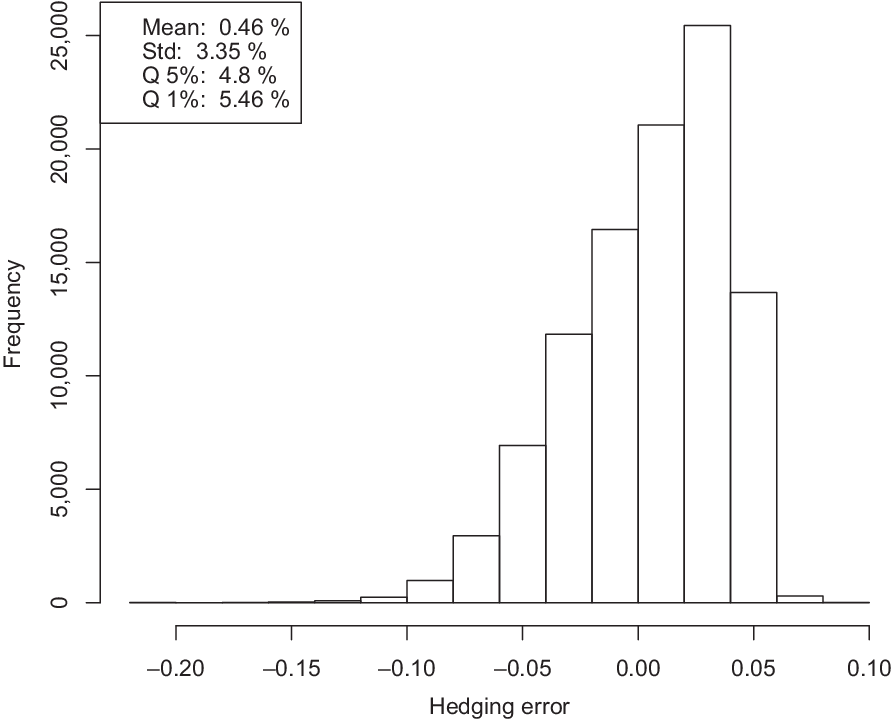
Once the contract’s parameters are set, the hedging portfolio can be obtained numerically and the distribution of hedging errors can be estimated. We use 100,000 simulations to approximate the distribution of M defined in (20). Figure 2 gives the histogram of the discounted loss random variable using the local risk minimising strategy with  $c=95\%$,
 $\nu_0=\nu_1=1\%$,
 $\gamma=0$, and
 $z_k=0$ for all k. The error has a left-skewed distribution with a mean close to 0. In this setting, the issuer will have to raise 5.46% in capital in order to reach a 99% confidence level.
Histogram of the hedging error.

To set the risk measure parameters, we proceed as follows. According to Gaillardetz & Moghtadai (Reference Gaillardetz and Moghtadai2017), the threshold  $\gamma_0$ has a reduced impact on these contracts. Hence, it is set to 0. They also show that the retention level c depends on the equity-linked contracts. On the one hand, the initial cost of the hedging strategy W(0, 0) is an increasing function of the retention level that reduces the set of admissible investments. On the other hand, the value-at-risk of the hedging error VaR
 $_{99\%}$(M) is a decreasing function of c since higher c’s reduce the possibility of errors. Hence, the lowest capital requirement is a relevant guideline to fix c.
For different surrender rate parameters  $\nu_0$ and
 $\nu_1$ and retention levels
 $c = 10\%, 20\%, ...., 90\%$, the capital requirements are generated based on VaR
 $_{99\%}$(M). The retention levels that generated the lowest capital requirements are reported in the tables. The tables also provide the replicating portfolio initial value W(0, 0).
First, the effect of the surrender fee will be looked at under different surrender scenarios. In most tables, the MR threshold  $\nu_1$ is set to 0, 0.1%, 1%, 10%, and
 $\infty$. Recall that the probability of surrender is 1 if the MR is above
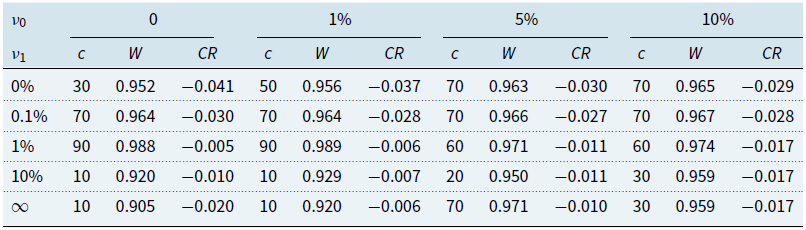
 $1+\nu_1$. In Tables 1 and 2, the results are given for different values of non-rational surrender monthly rates
 $\nu_0$ (0, 1%, 5%, and 10%). Table 1 assumes that the surrender charges are set to 0, whereas Table 2 assumes a decreasing surrender charge of 1% per year ranging from 7% to 1%.
Capital requirements for different surrender rates without surrender charge

Capital requirements for different surrender rates with decreasing surrender charges

According to Table 1, the capital requirement increases with the non-rational surrender rate  $\nu_0$ whatever the setting of the other parameters (
 $\nu_1$ and c). This is due to the fact that the probability of surrender increases independently from the market performance. The worst capital requirements are reached when the policyholder does not promptly react to the market performance and allows some latitude to the MR. For these worst cases, the capital requirement could be higher than 5%. The reason for these results is that the maneyness ratio is independent of the issuer’s hedging strategy. The optimal behaviour in our assumed risk-neutral approach is different than the one that could be obtained from the risk-control approach, which explains the discrepancy in terms of risk. When no deterministic surrender rate is assumed (
 $\nu_0=0$), the lowest capital requirements correspond to the case where there is no surrender related to the market performance (
 $\nu_1$ is large). In the presence of non-rational rates (
 $\nu_0\geq1\%$), the lowest capital requirement occurs when the investor promptly reacts to the market performance.
As one would expect, as the surrender fee increases, the initial capital requirements (CR) decreases (see Table 2). This is due to the fact that the issuer retains the surrender fee. With surrender fee, the lowest capital requirement is always reached when the investor quickly reacts to the market conditions ( $\nu_1=0$). Otherwise, both Tables 1 and 2 have similar results interpretations. Unless specified otherwise,
 $\nu_0$ is set to 0% for the following examples.
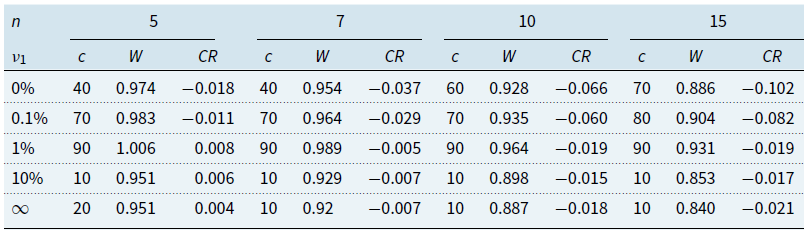
Table 3 shows that the capital requirements are decreasing with the contract’s maturity (5, 7, 10, and 15 years). They are decreasing despite the fact that they are based on the entire contract’s life. This is due to the fact that our financial model has a positive “drift”. For example, for  $\nu_1=0$, the capital requirement is decreasing by as much as 8.4% when the contract’s term is increased from 5 to 15 years. The impact on the capital requirements of longer maturities decreases for larger values of
 $\nu_1$. According on these results, issuers should target and give incentives to long-term investors.
Capital requirements for different maturities

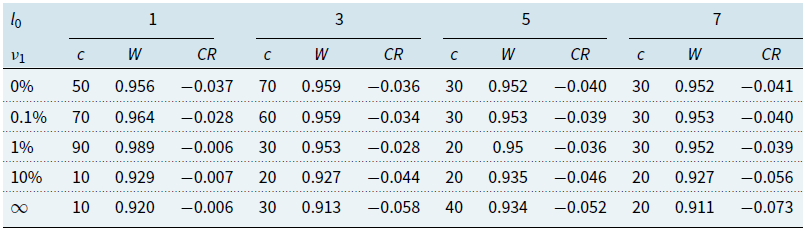
Table 4 gives the replicating portfolio initial values W(0, 0) and the capital requirements CR for a cohort of 1, 3, 5, and 7 homogenous policyholders. Note that the values are normalised with respect to the cohort size, i.e. they are divided equally among the policyholders. The number of policyholders has a direct effect on the capital requirement. As expected, the capital is decreasing when the number of policyholders is increasing. The improvement is mitigated under the reactive assumption ( $\nu_1=0$). This is because the surrender risk cannot be diversified as the mortality risk. However, the decay in the capital requirement becomes more significant as threshold
 $\nu_1$ increased. The capital could decrease by 6.7% when the number of policyholders increase from 1 to 7 policyholders. If the number of policyholders keeps increasing, the capital requirement increases at a slower pace.
Capital requirements for different cohort sizes

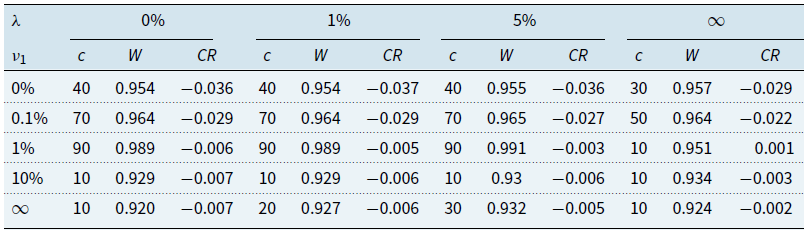
Table 5 gives capital requirements for different European call prices. For this table, the option’s price is assumed to be multiplied by a factor  $(1+\lambda)$ for some values between 0 to
 $\infty$. The case
 $\lambda=\infty$ means that the option is to expensive to be used in the hedging portfolio. As expected, the capital requirements are increasing with respect to the parameter
 $\lambda$. The issuer could reduce the capital requirement by roughly
 $0.7\%$ when investing in European options. Moreover, these reductions are not sensitive to small changes (increases) of
 $\lambda$. The issuer should be able to reduce the capital even in the presence of bid-ask prices.
Capital requirements with loaded option prices

7 Conclusions
The purpose of this paper is to evaluate and measure the impact of the surrender options on equity-linked products using a dynamic risk-control strategy. The non-rational investor behaviour is modelled using the MR and a constant non-rational surrender rate. This is due to the fact that a portion of the cohort will surrender independently of the market and another portion will surrender if the option passes a certain threshold. Our surrender rates generalise the behaviour presented by Forsyth & Vetzal (Reference Forsyth and Vetzal2014). The capital requirement is determined using the optimal dynamic risk-control strategy and European options among the possible investment.
A detailed numerical analysis is performed for a point-to-point EIA based on a pentanomial lattice tree for the index. The results show that the reactive assumption is not necessarily the worst scenario for the issuer in term of capital requirements. More capital could be required if the policyholders act non-rationally. Moreover, the impact of longer maturities is not negligible and could reduce substantially the capital requirement for the issuers. Our methodology can be extended to other securities such as VAs (segregated fund contracts in Canada) because of the similarities in their payoff structure.
Declarations
Funding
This research was supported by the Natural Sciences and Engineering Research Council of Canada and the Fonds de recherche Nature et technologies of Quebec.
Conflicts of interest
The author declares no conflict of interest.
Availability of data and material
There are specific data for this article.
Code availability
The programming code is available on demand.