War finance has been studied by examining how available domestic resources are used by belligerents.Footnote 2 But relatively little attention has been given to what defeated nations have been compelled to deliver to a victor. Based on the failure of Germany to pay its post-World War I reparations, conventional wisdom generally doubts that reparations or occupation charges are feasible in spite of the fact that they were common and often successful.Footnote 3 We examine perhaps the most successful case where the collapse of the French Third Republic left Hitler's Germany in control of a nearly equally powerful industrial economy. With the notable exception of Alan Milward's 1970 book, most research on Vichy France has focused on the political rather than the economic issues and the central question of the degree to which the government and the people collaborated.Footnote 4 That collaboration was willing is now undeniable, and thus we concentrate on the choices that faced occupier and occupied, what France delivered to Germany, and what the consequences were for the economy.
To finance its continuing war on other fronts, Germany secured a massive and, perhaps, unparalleled transfer of resources from France. Once they determined the occupation payments, the Germans left the French to decide how to raise the funds and contend with any resistance from the population. Added to this burden was a transfer of labor to Germany, first by the retention of French POWs and later by a civilian draft. From the outset, French cooperation was predicated on the generally held belief that the Nazi victory had ushered in a new era. Vichy's economic regime and its considerable success in delivering resources to Germany was based on this conviction. Our empirical exercise is framed by this expectation of a complete defeat of the Third Reich's enemies being achieved either in 1942 or 1945, after which Vichy would have pursued its own postwar stabilization policy.
Although the outlines of Vichy's fiscal and financial policies are generally known, the short- and long-term effects of transferring over a quarter of annual GDP are not well understood.Footnote 5 This article analyzes the policies employed by the collaborating government in Vichy to supply resources to the Nazi war machine, measuring the output and welfare costs of wartime programs and postwar stabilization plans and assaying the reasons for their choices. After comparing the magnitude of Vichy's payment to other episodes of reparations and war finance, we examine how it was funded and employ a neoclassical growth model to assess both wartime and postwar policies. Although this type of model makes the extreme assumption of a frictionless economy where policy interventions create the only costly distortions, it guarantees that we do not overestimate the costs, as market imperfections would amplify the burden imposed on France. Yet, even with this downward bias, the costs of the occupations were alarmingly high. We find that the burden imposed on the French economy caused it to shrink at a rapid pace, severely curtailing consumption and creating large debt and monetary overhangs. Although Vichy intended to manage the postwar debt burden with higher tax rates, the postwar taxes funded the new welfare state instead, as rapid inflation had slashed the real value of the debt.
COLLABORATORS OR RESISTERS?
Whether resources can be extracted from a conquered country depends on the degree of cooperation from the defeated. The extent of collaboration by the French government and people has been a contentious and divisive subject ever since 1944.Footnote 6 Following Liberation, French archives were closed, many desired to forget, and the official Gaullist view was that, except for a few traitors, the Germans were responsible for the horrors of occupation, with most people quietly or actively supporting the Resistance and De Gaulle. One of the first histories of Vichy was Robert Aron's 1955 work.Footnote 7 Based on the postwar trials of Vichy officials, the book argues that France had been under the thumb of the Nazis and it was their intention to “Poland-ize” France. France was “shielded” from this fate by the regime in Vichy, which secretly engaged the Allies, while the public eagerly waited for the tide to turn. When protection of France failed, it was not the responsibility of the patriotic head of state Marshal Philippe Pétain but of his traitorous chief minister Pierre Laval and others.
This widely accepted interpretation was challenged and then shattered by subsequent research, beginning with Robert O. Paxton's 1972 book.Footnote 8 Paxton and other scholars showed that there were few differences among the leaders of Vichy.Footnote 9 Contacts with the Allies were almost nonexistent; and far from shielding France until the day of liberation, Vichy negotiated to improve its position in the new order of Nazi-dominated Europe. Collaboration was not a minimalist “state collaboration,” adhering to the limits of the armistice, but a voluntary collaboration offering much more than was required. Until late in the war, Pétain and Laval were convinced that Britain would soon surrender; and Laval's temporary replacement, Admiral François Darlan, believed that a German Europe was superior to one dominated by Britain, where France would become a third class power. Hitler told Darlan in May 1941 that France could help speed up victory by further concessions.Footnote 10 In turn, Darlan reported to Pétain: “France, having been beaten by Germany, cannot hope to survive unless she draws closer to her . . . I have chosen the path of integrating France into the European bloc.”Footnote 11 Hitler did not seek the eradication of France but a neutralized state from which manpower and resources could be drawn. As Hitler explained to Benito Mussolini on 17 June 1940, he wanted “a French government functioning on French territory as a party to the negotiations” so that Germany would not have to assume direct responsibility for administration.Footnote 12 Hitler retained Pétain and kept the French fascists out of power because the old marshal seemed most likely to ensure the continued passivity of the population and exploitation of the economy.Footnote 13 Consequently, little German manpower was required to occupy France. Until 1943 when the threat of invasion arose, a maximum of 40,000 men of the Home Guard battalions, mostly unfit, overage men, were assigned to the task.Footnote 14 The French authorities maintained order and ensured the delivery of French goods by the creation of the comités d'organisation (organization committees) of the leading employers for each industry.Footnote 15
Although the conquered Slavic nations were more ruthlessly exploited with a view to their eventual eradication, the contributions to the Nazi war machine of other conquered countries in Western Europe and satellite states in the South were comparable to those of France. They are probably representative of the maximum degree of exploitation that is feasible when a state is left intact. Paxton calculated that French manpower drafted into Germany was roughly on a par with the rest of Western Europe, regardless of the occupation regime.Footnote 16 In Belgium the government fled, the king was placed under house arrest, and the country was ruled directly by secrétaires généreaux (the administrative heads of ministries) under the direct supervision of the German military; whereas in the Netherlands both the queen and her government fled to Britain and a civilian German governor was imposed on the kingdom. Yet, French workers drafted into the German economy totaled 3.3 percent of the population, compared to 3.4 percent for Belgium and 3.0 percent for the Netherlands.Footnote 17 In the East and South, countries that were not initially occupied in the war, Hungary, Romania, and Slovakia behaved like France, reaching official agreements with Berlin, setting bilateral trade, labor transfers, and compensation agreements. Examining these cases led Yves Durand to conclude that “across Europe collaboration engendered behaviors and acts comparable to those of Vichy.”Footnote 18
The economic support of the Reich's vassal nations was crucial. Before the war broke out, Germany's rearmament was severely constrained by the absence of any significant foreign exchange reserves to obtain vital raw materials. Adam Tooze has shown that Hitler was well aware that Germany's chances for victory hinged on quickly expanding its armaments capacity.Footnote 19 Feeling the pinch of the British blockade after 1940, Germany sought to extract vital resources from its victims. Even though he gravely erred in underestimating Soviet industry, Hitler was aware that Britain, thanks to its alliance with the United States, could generate far more war material than the Reich.Footnote 20 According to Tooze, Blitzkrieg was a pre-emptive strategy, as Hitler had nothing to gain by waiting.Footnote 21 The two biggest constraints on the German armaments industry were raw materials and labor. Germany's dependence on foreign inputs was dangerously high. In 1940 when the military accounted for 36 percent of German GDP, imports accounted for 7 percent of total GDP. By 1943, when military spending had risen to 60 percent of GDP, 16 percent of GDP was obtained abroad.Footnote 22 To feed Germany's armaments machine, France and other countries supplied key inputs—especially food, coal, and oil—practically ensuring that their manufacturing sectors would shrink. France was reduced to 8 percent of its prewar supply of oil, and it was cut off from 40 percent of its coal, which typically had come from German sources. Consequently, French output slumped in 1940 and never recovered. Shortages of food led to productivity declines, which were particularly acute in the mines, where there was a close correlation between caloric intake and output.Footnote 23 French production of weapons thus was severely constrained. In 1941 France agreed to produce 3,000 aircraft under license, but by the end of the war, hampered by shortages, the nation had delivered only 2,517.Footnote 24 Germany gained the lion's share of what was produced. In 1943 Germany took 50 percent of French iron ore, 99 percent of cement, 92 percent of trucks, and 76 percent of locomotives.Footnote 25
Labor was an equally serious problem for the Reich as more and more Germen men were drafted to the fronts. By the autumn of 1944, foreign civilians and POWs in Germany totaled 7.9 million, accounting for 20 percent of the labor force. They were concentrated in the armaments industry, where they formed one-third of the workers; and in the Luftwaffe-controlled industries, foreigners constituted 40 percent of labor. French skilled and semi-skilled workers were extremely desirable compared to the unskilled but more numerous laborers from east of the Reich.Footnote 26
Although Milward has carefully detailed the specifics of Germany's exactions and Tooze has drawn out some of the consequences for the French economy, most historians of Vichy have glided over how these affected the economy, concentrating on resolving the political and social questions about collaboration. Beginning with Paxton, the details of the transfer of labor have received considerable attention, but the mammoth occupation payments are usually given the briefest mention.Footnote 27 Yves Durand focused primarily on the transfer of labor, as did Robert Gildea, who also chronicled the pervasive hunger.Footnote 28 While noting that German purchases were funded by the occupation charges, Philippe Burrin concentrated on a narrative of the waste and disarray produced by each German service opening its own purchasing office to buy goods and materials.Footnote 29 Jean-Paul Cointet's only comment was that the enormous indemnities and overvalued exchange rate asphyxiated the French economy.Footnote 30 Julian Jackson's new synthesis devoted one paragraph to the overvalued exchange rate and the occupation payments and concluded on no other evidence that “Germany siphoned off so much of the French economy that it would have become counter-productive to take any more.”Footnote 31 Although it was clear even from the outset of occupation that the Germans heavily taxed the French economy, the purpose of this article is to provide a more comprehensive and analytical assessment of the German exactions, the choices that faced occupier and occupied, the performance of the economy, and—last but not least—French welfare.
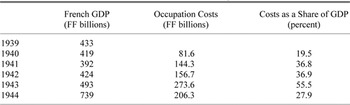
FRENCH PAYMENTS TO GERMANY, 1940–1944

Sources:
Carré, Dubois, and Malinvaud, French Economic Growth, provides the GDP data; Milward, New Order, p. 271, gives the French payments to Germany.
THE MAGNITUDE OF VICHY'S PAYMENTS
During World War II the French economy became a vital part of the German war machine. Table 1 shows the total payments made to Germany during each year of occupation and the share of GDP. Even though the measure of GDP is fragile and an underestimate because of the substantial black market, which may have reached 20 percent of the economy, the total resources extracted by the Nazis are stunning. In the partial first year of occupation, nearly 20 percent of GDP was transferred, rising to well over a third of GDP in 1941 and 1942. The German defeat at Stalingrad led to complete mobilization and a higher level of exploitation in 1943 and 1944.
Furthermore, in the heady days of victory, the Nazis went on a binge of looting. Though not shown in Table 1, the seizure of assets, concentrated in 1940 and including works of art, was estimated by Milward to total 154 billion 1938 francs for 1940–1944. Roughly a third of the total, 52.4 billion francs, was military equipment.Footnote 32 Although it was far from trivial, for purposes of our formal analysis, we exclude looting because this seizure of assets was effectively a lump-sum tax that did not distort the incentives to produce output.
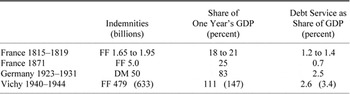
A COMPARISON OF WAR REPARATIONS

Notes:
For Vichy, the totals are in 1939 francs. The numbers in parentheses have looting and requisitions added to the occupation payments.
Sources:
White, “Making the French”; Klug, “Theory”; and Table 1.
How should the size of these occupation payments be viewed? Some idea of their magnitude can be assessed with two comparisons, the first relative to other war reparations and the second relative to the cost of war for belligerents. Defeat in 1940 was the third French loss in a modern war where occupation costs or reparations were imposed. After Napoleon's defeat at Waterloo and after the Franco-Prussian war, France was forced to pay reparations for occupation and the cost of the war in 1815 and 1871. Imposing occupation payments on the French in 1940, the Germans made pointed comparisons to the post-World War I reparations settled on them. Table 2 shows the size and burden of these reparations relative to one year's GDP, with the looting added to the Vichy totals in parentheses. Another measure of the burden assumes that reparations were financed wholly by foreign loans so that the burden becomes the debt service.Footnote 33 Financing reparations by borrowing abroad is optimal in the sense that it smoothes the path of consumption. It is, thus, the method that minimizes the cost of paying reparations, and hence an important measure of their size.Footnote 34 The 1815 and 1871 reparations were paid in full and ahead of schedule by the French government, borrowing partly from abroad. The post-World War I German reparations were set much higher than earlier French reparations.Footnote 35 However, Germany did not meet its reparations obligations. Given that Weimar Germany borrowed more additional funds than it repaid, the effect was to reverse reparations, raising income and consumption.Footnote 36
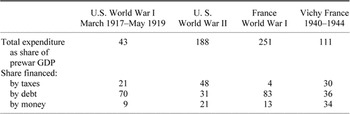
A COMPARISON OF WAR FINANCE

Sources:
Friedman and Schwartz, Monetary History; Fisk, French Public Finance; Ferguson, Pity; Goldin, “War”; INSEE, Annuaire; Patat and Lutfalla, Monetary History; and Toutain, “Le produit intérieur brut.”
Unlike previous reparations, delivered at the end of hostilities, the occupation costs imposed on defeated France in 1940 were open-ended; Hitler was adamant that he would only consider a peace treaty once the war was over. For Vichy, the figure for French reparations is the total sum of reparations paid over the years of occupation; 479 billion French francs is the sum of the real value of the payments.Footnote 37 The base year for comparing the indemnity to GDP and tax revenues is 1939, a year of relatively high employment; its use reduces the burden compared to the war years when national income was lower. If looting is included, the total rises to 633 billion francs. Favorable conditions, a long-term French growth rate of 2 percent and an interest rate of 4.4 percent—the same as used for Germany—are employed here and impart a downward bias to emphasize the minimum magnitude of the burden. Furthermore, in contrast to 1815 or 1871 or post-World War I Germany, Vichy had no access to outside capital markets and, hence, did not have the option to finance its obligations with foreign loans. But as a measure of size, potential debt service reveals that France's burden at minimum matched Germany's. Of course, France made these payments; Germany did not. As will be seen, the methods of payment proved “crushing,” reducing consumption far more than the 2.6 percent dedicated to debt service in Table 2.
In Table 3, Vichy's methods of financing occupation payments are compared to French finance during World War I, when it had access to foreign markets, and to American finance during both World Wars, which was dependent on domestic finance. Occupation finance for 1940–1944 differs considerably from Republican France's financing of World War I, in which most expenditure was covered by debt issues. Although the American participation in World War I only began in 1917 and her total expenditures relative to GDP were less, the pattern of financing is similar to French finance in the Great War. The strongest resemblance is between Vichy finance and the United States in World War II, although the United States was less reliant on money creation, utilizing taxes more heavily. The similarity is strengthened by the fact that both Nazi-occupied France and the United States used wage and price controls, rationing, and financial repression. A signal difference is that the economy of Vichy France shrank, whereas the United States had a robust growth of output.
THE OCCUPATION AND GERMAN DEMANDS
The blitzkrieg against France began on 10 May 1940. Its spectacular success led to the resignation of the French government and the appointment of Marshal Philippe Pétain, as head of government. Pétain sued for peace and signed an Armistice on 22 June 1940. Following the Armistice, nearly half of the two million French prisoners of war were released. The remaining POWs provided forced labor for their captors.Footnote 38 Under the terms of the agreement, France ceded territory to the Reich-occupied Belgium, and Italy. The remainder was divided into the Occupied Zone, under direct German control, and the Free Zone. Pétain moved the government to Vichy in the Free Zone, where the constitution was suspended and plenary powers were granted to the Marshal's government. The Germans marched into the Free Zone in November 1942 when Allied success in North Africa threatened the Mediterranean coast. However, from almost the beginning, the government in Vichy retained control of economic policy, which was generally uniform across both zones, with laws subject to the approval of German authorities when they were implemented in the Occupied Zone.Footnote 39
Extraction of resources began the moment the German Army first rolled into France. The military were initially supplied with an occupation currency, the Reichkreditkassenschein, which was legal tender only in the occupied countries and could not be spent in Germany or exchanged against the Reichsmark. The Bank of France was required to accept these notes and redeem then in francs, charging them as costs of occupation to the French government. The 50 billion francs of Reichkreditkassenschein are thus included as part of the occupation payments.Footnote 40 The issue of this currency ceased once the agreement on occupation payments provided the German authorities with French francs to spend, and it was gradually demonetized between 30 April 1941 and 1 December 1943.Footnote 41
The exchange rate between the franc and the Reichkreditkassenschein was proclaimed to be 20 to one, which later became the official rate between the Reichsmark and the franc. According to Milward, this rate overvalued the mark by 50 percent using the dollar-franc and dollar-Reichsmark rates of June 1940, or 54 to 63 percent using the exchange rates against the pound in 1939.Footnote 42 Exchange rates for 1 September 1939 implied an even greater overvaluation.Footnote 43 French goods were therefore intended to be cheap for the occupying German army.
International trade between the Reich and the vanquished Republic was restructured with a bilateral clearing agreement based on the arrangements that Germany had engineered with Central and Southeastern European countries in the 1930s.Footnote 44 Foreign exchange was strictly controlled and allocated for government-approved imports. The Bank of France bought marks from exporters at the fixed rate of exchange, producing an expansionary monetary policy fueled by a net surplus that stood at 111.4 billion francs by the war's end.Footnote 45 Yet, the transfer of resources under the bilateral clearing agreement was relatively modest compared to the direct occupation costs. The charges were set far above the actual cost of occupation, providing the German authorities with considerable means to purchase war goods and other products in France. In the Armistice talks in late 1940, the French were stunned and protested when they were informed during the negotiations that they would be obliged to pay occupation costs of 20 million Reichsmarks, or 400 million francs a day. Added to these were indemnities paid to owners of property occupied by the German army and compensation for requisitions.Footnote 46
According to the French negotiators contesting the occupation costs in 1940, the head of the German economic delegation Hans Hemmen “indicated that the French money payments would be spent in France: but with that money the Germans will be able to buy the whole of France.” He justified the reparations by reminding the French of those imposed on Germany in the treaty of Versailles. He acknowledged that:
The payment demanded is very heavy, and Germany knows by experience how ruinous such charges are. That is why the German government has seen this question from an economic point of view, since at the same time that it has demanded these payments from France, it has proposed to her an economic system which frees France from the anxiety of ruin.Footnote 47
At the outbreak of the war, French real GDP per capita exceed Germany's, and the Germans saw no reason why this difference should be sustained. The willingness of Vichy to collaborate with the Nazis reflected the rough consensus of the majority of the French political class that cooperation was in the long-term national interest. Faced with Nazi ruthlessness and the threat to society on many levels, the French concluded that collaboration was a lesser evil, permitting a peaceful rather than a violent seizure of resources, with the costs of extraction kept quite low for the exploiter.Footnote 48 Occupation costs would be paid by the creation of money in Germany's account in the Bank of France. If Vichy wished to contain the inflationary potential of this policy, the government could issue bonds to the French public and sterilize the creation of francs.
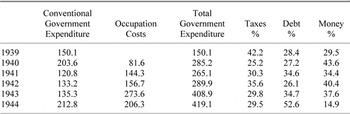
Funds from the occupation charges initially proved greater than the Germans could spend and accumulated as unspent credits, a consequence of the Blitzkrieg's success.Footnote 49 The rising unused credits and French protests, combined with an offer to exchange French shares in Polish and Balkan firms desired by the Reich, produced a new agreement on occupation costs. In May 1941 they were lowered to 15 million Reichsmarks or 300 million francs per day. However, the failure of the Blitzkrieg to deliver the Soviet Union to the Reich prompted a complete mobilization of Germany and its satellites for war. Occupation costs were raised to 25 million Reichsmarks or 500 million francs a day on 15 December 1942. Occupation charges (presented in Table 4 and including bilateral trade credits) quickly overshadowed ordinary government expenditures. Taxes were increased to pay for some of the costs.
HOW FRANCE FINANCED GERMANY'S EXPLOITATION (billions of francs)

Sources:
INSEE, Annuaire; Patat and Lutfalla, Monetary History; and Milward, New Order.
In spite of the shrinking economy and inflation, real tax revenue was nearly constant between 1938 and 1944, ranging from 55 to 59 billion 1938 francs. Tax rates on capital and on personal incomes were all increased, the base was broadened, and the collections were improved.Footnote 50
Fearful that inflation would frighten investors and would raise government financing costs by driving up yields, Vichy's policy makers sought to prevent the growing stock of currency from having its full inflationary effect. Vichy's first finance minister, Yves Bouthillier based his policy on an analysis of the problems his predecessors had encountered during World War I and aimed to limit inflationary pressure by having the government “close the circuit” (the so-called politique de circuit) by selling bonds to repay its liabilities to the Bank of France.Footnote 51 Bouthillier, his successor Pierre Cathala, and officials at the Bank of France and the Treasury watched for any “leaks” from the circuit, deploying the tools of financial repression to plug them and induce the public to buy bonds or place their cash in financial institutions that would in turn buy bonds.
Both Vichy finance ministers, Bouthillier and Cathala, concurred that inflationary finance was unacceptable; and the latter termed the defense of the franc a “national duty.”Footnote 52 Bouthillier, like other officials, believed that an accommodating French government would be less onerous than direct German administration. Ultimately, by controlling inflation he hoped to preserve a healthy, stable economy by the end of the war so that France would have a place in the new economic order of Europe. The governor of the Banque de France, Yves Bréart de Boisanger and a member of the French delegation to the armistice commission, conceded that “I constantly forced myself not to view the occupation charges from a purely financial point of view. If I had done so, I would have soon demanded that the government suspend payments. I did not do so because I was convinced of the need to reconcile the two countries and I believed that it would be necessary not just to think in terms of solely France's interest but it would be tightly tied to the question of the economic organization of Europe.”Footnote 53
Concerned about its financing costs, Vichy wanted to keep interest rates low. Beginning in 1939, the Bank of France's discount and 30-day advance rates were set at 2 percent and the rate on advances against securities at 3 percent. The only revision was in 1941, when the rates were set at 1.75 and 3 percent. Open market operations were employed to keep the rate on the long-term bonds, the rentes, at approximately 3 percent. However, in this inflationary environment, financial repression was needed to maintain low yields. Banks and savings banks were pressured to buy bonds, shifting their portfolios away from commercial and mortgage credit to government bonds.Footnote 54 From one-third of their portfolios in 1938, short-term bonds rose to 90 percent in 1943.
Wage and price controls were imposed from the very beginning in 1939. Wages soon began to lag prices and Michel Mitzakis estimated that, by 1944, wages had risen on average by 60 percent and prices, excluding the black market, had increased by 150 percent.Footnote 55 Price controls led to shortages and the French government instituted a system of strict rationing in August 1940. To receive rations, people had to register with authorities and with their usual baker, butcher, and other providers. Rations were set for adults and children and increased for farm workers and manual laborers. The huge reduction in oil supply limited both farming and fishing; car traffic almost disappeared as did coal for heating. The average daily caloric intake of adults fell from 2,500 calories before the war to 1,200–1,500 during occupation, as rations were cut.Footnote 56 A black market quickly emerged; coupled with tax evasion, the demand for currency increased. Rationed consumer goods and the lack of alternative investment opportunities encouraged the public to deposit funds in low interest bank and savings accounts; the money in the accounts was then invested in government bonds.
In general, this collection of policies was successful in keeping the nominal yields for government bonds low. Real rates were considerably lower. Even at the official rates, which certainly are underestimates, inflation ranged between 17 and 24 percent for 1940–1944, implying negative real rates of interest. The drive to sell bonds and channel savings into government securities reduced new capital formation and the ability to supply the German war machine. The low interest policy did produce a boom in the stock market, which was then subjected to capital controls.Footnote 57 However, the government could not completely suppress the equities market as new investment was required to re-equip French industry so that it could provide for the Nazi war machine.
FRENCH POWS AND CIVILIAN WORKERS IN GERMANY, 1939–1944

Sources:
Herbert, Hitler's Foreign Workers; and Liberman, Does Conquest.
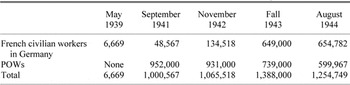
The final important feature of occupation was the transfer of labor from France to Germany (Table 5). In addition to the POWs who remained in Germany, Hitler demanded the conscription of French workers to work in Germany in May 1942. After initially attempting to exchange three French workers for each prisoner of war, Vichy bowed to conscription. Compulsory labor service was established on 16 February 1943; all men born between 1 January 1920 and 31 December 1922 were liable for two years service. This coercive approach soon led many Frenchmen to join the resistance. In September 1941 there had been 1,000,567 POWs and 48,567 civilian workers in Germany; by the fall of 1943 POWs had fallen to 739,000 and civilians rose to 649,000. These 1,388,000 workers in Germany represented a reduction of about 10 percent of the French labor force. Added to the loss of the industrialized regions of the Nord and Alsace-Lorraine, the drastic reduction in oil and coal supplies, and credit restrictions, this reduction of the labor force seriously compromised France's productive capacity and her ability to deliver goods to Germany.Footnote 58
A MODEL OF OCCUPATION FINANCE
To assess Vichy's policies and alternate strategies to manage the huge burden imposed by occupation, we begin with Lee Ohanian's basic model of a wartime economy.Footnote 59 We expand our version of this neoclassical growth model to include financial assets and allow for wartime controls. In our model, there are a large number of identical, infinitely lived households, competitive firms owned by households, and a government. There is no uncertainty, and all agents have perfect foresight. There is a single nondurable good, which is produced with capital and labor and is used for consumption and investment. The two financial assets are money and one-period government bonds.
Except for specified policy interventions, there are no distortions in this model economy. Obviously, this is a frictionless economy where agents can easily adjust. However, while there were certainly many frictions in the real French economy that reduced its efficiency, this model may be useful to evaluate German exactions because it provides estimates of their minimum cost, which frictions would increase. Thus we do not exaggerate their magnitude; and yet they are still far from trivial. Furthermore, our model captures the basic movements in the key variables of the economy as recorded in the data, suggesting that we have captured the major channels by which Nazi demands affected the French economy.
In our model, households own capital and make all investment decisions. Capital depreciates at the rate δ, 0 < δ < 1. Households are endowed with one unit of time per period, which can be spent on leisure lt or labor nt. However, to account for the POWs and the labor drafted to work in Germany, we assume that the labor available is lowered exogenously by dt hours, so the time constraint is nt + lt = 1 − dt.
The household lifetime utility function isFootnote 60

which depends on consumption ct, real cash balances Mt + 1 / Pt, and leisure lt. For the period utility function u, we adopt the functional form

where the last term becomes Ψ ln(lt) in the case that the labor supply elasticity η takes the benchmark value of one. This functional form implies that consumption and labor decisions are independent of the households' portfolio decisions. Again, as the assumption that money is superneutral omits the effects of money on the real economy, we have set a lower bound on the costs.Footnote 61 The additional costs associated with inflation would further raise our baseline estimates of the cost of German policies.
Households start period t with kt units of capital, Bt units of government bonds, and Mt units of money, rent out labor and capital at the wage and rental rates Wt and Qt, and receive profits Zt and bond revenue (1 + rt) Bt. They use this income to pay taxes; purchase goods for consumption, investment, and net exports at the price Pt; invest in new government bonds; and modify their cash balances. Their budget constraint is then

where τnt, τkt and τbt are respectively the tax rates on income from labor, capital, and bonds, and Tt is lump-sum taxes. Equation 3 states that income is composed of after-tax labor income (1 − τnt)Wtnt, after tax capital income (1 − τkt)Qtkt, profits Zt (in the flexible price competitive equilibrium Zt = 0), and the bond revenue (principal and after-tax interest). This income is used for consumption Ptct, investment gross of depreciation Pt[kt + 1 − (1 − δ)kt], net exports Ptnxt, lump-sum taxes Tt, investment in new bonds Bt + 1, and increases in cash balances Mt + 1 − Mt.
The households' optimization problem is to maximize their lifetime utility subject to the previous time and budget constraints, and transversality conditions requiring that the present discounted values of future bonds and money converge to zero in the limit. Firms rent labor and capital, and produce consumption and investment goods with the Cobb-Douglas production function

where the labor-augmenting technology At grows at the constant rate. Firms act competitively to maximize profits Zt = Ptyt − Wtnt − Qtkt.
The government sets public consumption gt, taxes, bonds, and money satisfying the period budget constraints

which state that expenditures for goods and payments for bonds (principal and interest) must be financed with taxes on labor, capital, and bonds; lump-sum taxes; issues of new bonds; and seigniorage. A consequence of the transversality conditions is that, in equilibrium, the present discounted value of all government expenditures is equal to the present discounted value of all government revenues.
The equilibrium condition for the goods market is

which states that the aggregate goods supply is equal to the aggregate goods demand for private consumption, investment, net exports, and government expenditure. There is no capital account, as controls eliminated international capital movements.
The values for the labor drafted to Germany, tax rates, lump-sum taxes, government expenditure, and net exports are treated as exogenously determined, as are the initial values for capital, bonds, and money. The labor draft, occupation charges, and exports represent the policy choices of the Nazis, while the tax rates and lump-sum taxes are the policy instruments that Vichy could manipulate to manage war-time and postwar expenses. Like consumption and leisure, money and debt holdings are chosen by the representative household. A competitive equilibrium is, then, a set of sequences of quantities and prices such that: given prices, households and firms solve their optimization problems; the government's period budget constraints are satisfied; and the labor, capital, goods, and bonds markets clear. It is easy to show that the government's period budget constraints follow from the other equilibrium conditions (Walras' Law).
To model the wage controls imposed during the war, we also introduce the following alternative equilibrium, where λ represents the share of the economy subject to wage and price controls. In each war year, the real wage is equal to a weighted average of the exogenously controlled wage and the wage that would clear the labor market in that year if there were no real wage controls, with the weights respectively equal to λ and 1 − λ. Whereas labor supply is determined by the households, labor demand is set by firms subject to an additional rationing constraint in wartime, requiring their labor demand not to be larger than average (per firm) labor supply. By the manipulation of wage and price controls, the wartime government exogenously affects the real wage, leaving households to make their labor supply decision.
One key feature of wartime finance we do not attempt to directly model is the financial repression. Although there were no official regulations, financial institutions were under pressure from the government to absorb government bonds. Price controls and rationing produced shortages that induced the French public to hold money in low interest bank accounts, which was then invested by banks in government bonds. At the same time the decline in economic activity reduced the demand for loans, leading to a huge rise in bonds as a share of banks' and other financial institutions portfolios. By compelling financial institutions to fill their portfolios with bonds, Vichy was able to control the price of government securities as supply expanded, and, with some minimum intervention, the Bank of France was able to maintain constant low nominal yields.Footnote 62 Our model has no explicit financial institutions sector, but it still reproduces the sharp rise in bond holdings. Again any additional frictions from financial repression that we do not capture would serve to increase the costs of occupation.
After normalizing all nominal variables by the price level, we solve the system of nonlinear equations describing the equilibrium using the shooting algorithm.Footnote 63 To begin the calibration, we require information not only on the initial state of the economy at the outset of the war and the wartime path of the exogenous variables, but also on the steady-state variables.
THE STRUCTURE AND PARAMETERS OF THE ECONOMY
The selection of the parameters for the steady state is not a trivial exercise, as it should reflect what Vichy's policy makers thought would be the long-term path of the economy when they made wartime financial decisions. For most of the war and in the crucial years when the leaders of Vichy determined how to respond to German demands, they believed that France's future lay within the orbit of a new European order dominated by the Nazi masters in Berlin. France's international trade would be controlled by Germany, and there would be no access to outside capital markets; and if the Nazis prevailed there is no reason to believe that this regime would change after the war. Vichy had more freedom over its internal economic policies. Many leaders of Vichy, and in particular Pétain, had a strong traditional outlook, emphasizing a return to an economy with a larger agricultural sector and a relatively small state. As previously pointed out, French fascists who might have envisioned a large role for the state were effectively marginalized by the Nazis, who preferred the traditionalist and more passive regime headed by Pétain. Thus, our choice of parameters should reflect the expectations of Vichy leaders as they contemplated the future of France's economy in Nazi-ruled Europe.
The first question is the underlying growth rate of the economy. Growth in the interwar years was highly uneven; however, from the late nineteenth century to 1929 and during the post-World War II period, it was approximately 2 percent, the value we adopt here for the steady-state growth rate.Footnote 64 This is the long-term rate that policy makers would have optimistically hoped to see in the postwar period. The length of a period in the model is one year, and we set the preference discount factor β equal to 0.98, which implies a 2 percent preference discount rate and, given the 2 percent growth rate of the economy, a 4 percent steady-state real interest rate.
The outbreak of the war and its attendant shocks drove the economy far from its steady-state values. The wartime values for our exercise, from the 1939 military build up to 1944, were obtained from a variety of sources; estimates of GDP were obtained from Jean-Jacques Carré, Paul Dubois, and Edmond Malinvaud's book.Footnote 65 There are no data on aggregate wartime consumption and investment, although qualitative evidence points to vary large declines in these components.Footnote 66
Only limited prewar and postwar data are available to set the parameter values for the production function. Using the years 1938 and 1949–1958, we find that the factor shares are fairly stable, and these are taken to represent their steady-state values.Footnote 67 For 1938, labor earned 67.7 percent of national income, and for 1949–1958 it ranged between 66 and 68 percent; hence 67 percent is selected. Consequently, the parameter θ, capital's share of total output, is set at 0.33. The depreciation rate, δ, is 10 percent, a number that makes the observed postwar capital-output ratio consistent with the steady-state capital-output ratio implied by the model. This depreciation rate is very close to the observed 10.6 in the data.Footnote 68 There were large changes in factor shares during World War II. Thomas Piketty's factor shares closely match Institut National de la Statistique et des Études Économiques's (INSEE) estimates, with labor's portion climbing from 70 percent in 1940 to 87 percent in 1943 before drifting back to approximately 68 percent.Footnote 69
For the steady state, we assume small government fin-de-siècle values for the ratio of government expenditure to GDP and tax rates, reflecting Vichy's traditionalist outlook. Before the First World War (1911–1913), the share of government was about 10 percent.Footnote 70 After the postwar stabilization, in the good years of 1927–1931, it was 14 percent, although this higher level still contained some World War I costs, notably veterans' benefits and interest payments. The share of government jumped after World War II, reflecting the appearance of the modern welfare state. Choosing a higher value from this period for the steady state seemed inappropriate as it is unlikely that Vichy officials would have anticipated or sought this increase. Their goal was closer to a restoration of the pre-World War I period, and thus we set the value for government expenditure to national income at 10 percent, which is also close to what would have been attained once the effects of the First World War had disappeared. We assume that government expenditures were exogenously determined during the Second World War, consisting of the very limited conventional expenditures of Vichy plus the required transfers to the Nazis. The Germans used the funds in their account at the Bank of France to purchase goods in France as their war effort required. They were not interested in some nominal level of transfer but in obtaining real resources. To set what they extracted in the model, we fix the ratio of actual government expenditures to the steady-state GDP. The use of official wartime output would be somewhat misleading as this omits the black market, which should have figured in the Nazis calculations, as they probably thought of what they could obtain in terms of the some steady-state GDP.
Although it would be preferable to have marginal tax rates, average tax rates are employed here in the absence of a thorough study of the tax structure and its incidence. Tax rates on labor and capital are imputed by taking the total tax revenues levied on each factor divided by their share of national income. We estimate that in 1913 the tax rates were 11 percent for labor and 10 percent for capital, yielding a small budget surplus.Footnote 71 For the period from 1930–1938, the tax rates for labor and capital were estimated to be 14 and 11 percent. We selected the pre-World War I tax rates because, as in the case of government spending, it probably represented the government's long-term objective. As will be seen in our calibrations, the estimated sustainable debt in the steady state for these values is close the observed debt at the outset of the war. To obtain the wartime tax rates, Piketty's decomposition of the state's revenue into taxes levied on capital, labor, and mixed sources and INSEE's data are employed, splitting the mixed revenues between capital and labor.Footnote 72 The combined effects of the rise in wartime tax rates and the fall in capital's share of income led the tax rate on capital to rise from 11.8 percent in 1938 to a peak of 59.8 percent in 1943, while the tax rate on labor increased to 16.0 percent.
INSEE gives the total nominal debt of the central government.Footnote 73 In 1939 it stood at 423 billion francs, climbing to 1334 billion by the end of the war. The debt-to-GDP ratio thus rose from 0.98 to 2.16. The steady state for the French economy was considerably lower. Michael Bordo and Pierre-Cyrille Hautcoeur find the debt-to-GDP ratio to be about 0.80 in 1910 and falling to nearly 0.70 at the beginning of World War I. After the postwar stabilization this ratio returned to 0.80 in 1930.Footnote 74
We view the steady-state exchange rate regime to be the gold standard, although it is not explicitly modeled. Until the break up of the Bretton Woods System, the French ideal exchange rate regime was the gold standard; and the Vichy government, like its interwar predecessors and postwar successors, sought its return.Footnote 75 We approximate a steady-state gold standard equilibrium by setting net exports and inflation equal to zero. We treat imports and exports as exogenous given the highly regulated Nazi trade regime. There were no international capital flows as they had ceased with the outbreak of war and capital controls. Controls remained in place after the war; and it seems most likely that Germany would have maintained or imposed very rigid regulations.
In the steady state, the ratio of money (M2) to GDP is set at 40 percent, as this was approximately the ratio in the “good years” of 1927–1931 and in the late 1940s and early 1950s. In addition, we place the steady-state growth rate of the money supply at 2 percent to mirror the growth of the economy. For the war years, we employ INSEE's retail price index as a measure of inflation.Footnote 76 The estimates of M2 during the occupation are provided by Jean-Pierre Patat and Michel Lutfalla.Footnote 77
There are no estimates of the capital stock for the late 1930s. Carré, Dubois, and Malinvaud estimate the total capital-output ratio in 1949 to be 3.06 and for productive capital 1.93, which then slowly declined in the 1950s, reaching 1.61 by 1959.Footnote 78 For our purposes, we use 2 as a rough estimate for productive capital. However, we do know that the occupation took its toll on capital, just as it did on labor. Carré, Dubois, and Malinvaud set the value of gross productive capital on average at 56 billion francs in 1956 prices in 1921–1930, 59 billion for 1931–1940, and only 15 billion for 1941–1945.Footnote 79
Measurement of the labor force is crucial, given its decline during the War. For 1938, Carré, Dubois, and Malinvaud put the total population of France at 42.0 million with a labor force of 19.5 million, of which 16.4 million were employed in productive sectors, which excluded the unemployed, draftees, and government officials.Footnote 80 During the war, the labor force shrank, but by 1946 it had recovered to 16.8 million, although it subsequently declined to 16.4 million by 1957. Thus the last figure is used as the steady-state level. The leisure-preference parameters are set equal to values that imply that the representative household spent one-third of its time working in steady state.
During the war, the labor force collapsed from its prewar level of 16.4 million. First, there was the loss of Alsace-Lorraine, which had a population of 1.9 million.Footnote 81 Assuming the same rate of labor force participation as the rest of France in 1938, the loss of Alsace-Lorraine would have reduced the labor force by 0.75 million.Footnote 82 Defeat also brought 300,000 deaths and the initial internment of 1.2 million French prisoners-of-war.Footnote 83 The POWs who were called up to duty are assumed to have been previously productive and should thus be subtracted from the labor force in 1940, leaving a total of 14.1 million workers. According to Carré, Dubois, and Malinvaud, the population continued to shrink by perhaps 100,000 per year, and the work force is thus reduced for 1941 and 1942. As seen in Table 5, the last great shock was the relève or labor conscription, which occurred in 1943–1944 and quickly reduced the labor force until Liberation. Keeping the POWs in Germany and drafting more French labor for German factories should have increased the shadow real wage substantially, inducing more labor from the remaining workers and pulling in more women, old people, and children into the labor force. In the presence of wage and price controls, this effect is probably witnessed in the growth of the black market. However, the decline in purchasing power from the fall in official real wages was reflected by the drop in calories and its attendant effect on health.Footnote 84 The reduction in the real wage by controls, and consequently the willingness and capacity to work, was thus highly effective.
A critical parameter is the elasticity of labor supply. In most business cycle models of the U.S. economy, including Ohanian's model of the U.S. World War II economy, labor elasticity needs to be assumed to be very high in order to mimic the observed behavior of labor and output.Footnote 85 Thus, we set the labor elasticity to be one. However if we assume labor supply to be very elastic and the labor market to be free and competitive, there should have been a boom in Occupied Vichy, contrary to events. But wages were not freely set as wage and price controls plus rationing were imposed at the outset of the war.Footnote 86 Vichy created controls, but as is often the case with wage and price controls, the drift in prices, including uncontrolled goods and the black market, reduced the real wages. Thus, as already described, the government raised wages to adjust for the loss of purchasing power. Very broadly, this policy might be described as setting a fixed real wage. To estimate the real wage, we use the weighted index of male workers and professionals nominal salaries.Footnote 87 Indexed by retail prices, these real wages fell from 100 in 1939 to 60 in 1944. Other measures of wages or earnings show very similar declines. The fixed real wage is set by this series during the war, while wages are competitively determined afterwards. In wartime, workers were paid less than their marginal product. The difference is not assigned to capital but is given back to labor as a lump sum rebate. Although this minimizes the distortion, it produces a drop in the labor supply that approximates the observed decline. In addition, recognizing the fact that many workers evaded the controls and obtained a higher real wage because they worked in the agricultural sector or in the black market, we allow only 75 percent of the labor force to be subject to controls so that we focus on the wartime equilibrium associated with λ = 0.75. The unwillingness of the French to work, driven partly by patriotic motives and partly by below-market wage rates, should be captured by this part of the model.
MEASURING THE REQUISITE POSTWAR STABILIZATION POLICY
Up to this point, we have only considered wartime policies and not how any postwar debt and monetary overhangs would be handled. However, our results require an explicit stabilization policy, otherwise an immediate return to steady-state taxation, expenditure, and inflation policies would leave the debt well above its steady-state value, and it would grow explosively. The surplus generated in the steady state is insufficient to cover war-generated interest payments, even with the lower levels of noninterest expenditures. Thus, in 1944 the government cannot revert to steady-state policies because they do not produce an equilibrium. Some postwar stabilization package is thus required. Most studies of war finance focus only on wartime finance and a separate literature focuses on postwar stabilization policies. Here, we provide a more integrated approach that combines wartime and postwar financing, which would have been included in government plans.
Many types of stabilization packages with different distributional effects were possible after the war. Except for pronouncements about safeguarding the franc, Vichy's postwar plans were opaque; though its choices and those of any liberated government certainly differed. Rather than assume that the public knew in 1939 what stabilization package would be adopted in addition to knowing all the wartime policies, we take an initial agnostic view and instead calculate what would be the required size of a nondistortionary stabilization package to move the economy back to its steady-state path. In our exercise above, we calculated the size of the required program by asking what is the lump-sum tax needed to reduce the postwar debt to its steady-state level. We picked a five year period for the program, and apportioned the lump-sum tax over these years to bring the end-of-war debt down to the sustainable debt to GDP level.Footnote 88
In addition to the debt overhang, a monetary adjustment is also required. Our steady-state, money-to-income ratio is 0.40, which is the rate observed in the data in the immediate prewar period. During the war the real money balances rose as a consequence of the steady monetary expansion. To bring real money down to the steady-state level we impose a deflationary program, consisting of a five year monetary reduction that lowers the real money level to its steady state. This program is similar to the deflationary programs instituted by the British after 1815 and after World War I to put the pound back on the gold standard at its prewar parity. The French considered but did not attempt such a program after World War I.Footnote 89
THE COST OF OCCUPATION
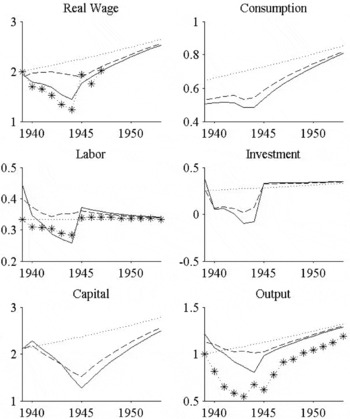
Given that money is superneutral, we can first examine the real side of the economy in Figure 1. The choices for the real sector are separable from the portfolio decision of households and the financing decision of the government. We set the production function parameter A so that steady-state output is one. Thus, in the figures, output, consumption, investment, capital, and debt are presented relative to this benchmark. Labor is set so that the initial supply is equal to one-third of a day. The dotted lines represent the steady-state growth path for each variable and the starred lines the path of the observed variable derived from the data, where it was available.
The behavior of the real sector with a competitive labor market is represented by the dashed line; and when labor is subject to wage and price controls, the path of the variables is indicated by the solid line in Figure 1.Footnote 90 Because of the high labor elasticity in a free labor market, the labor supply does not decline as sharply as the actual data. Its downward movement is only driven by higher labor taxes and the conscription of labor. Consequently, output does not suffer as much if there is a competitive labor market. But, when real wages are controlled, labor supply drops, more closely following the actual data. This reduction in labor produces sharper falls in output, consumption, investment, and capital. Although this collapse is less than the decline officially recorded by the starred lines, the actual data does not include black market activity, which would lower the burden.Footnote 91 Unfortunately, there are only rough estimates of its size. René Sédillot believed that the volume of illegal transactions were 10 to 30 percent of the legal market, with a peak in 1943.Footnote 92 Reviewing the available evidence, Paul Sanders concluded that the black market averaged 20 percent of GDP.Footnote 93 Its inclusion in official data would substantially reduce the gap between these numbers and our model. We do not have series for private capital, investment, and consumption, but the fragmentary data suggest that both seriously shrank over the course of the occupation. The model appears to capture the burden of occupation payments, increased in 1943, as consumption dips again. These huge losses seem realistic given what we know happened to food rations. According to Milward the rations for bread, meat, and fat in 1943–1944 were 70, 18, and 31 percent of the prewar levels.Footnote 94 These were basic necessities and consumption of other perishables and durables collapsed. Although the black market helped to supplement these low levels, it did not make up the difference for the whole population.
THE REAL SECTOR, 1939–1953
 Steady State
 Actual Data
 Model with No Wage and Price Controls
 Model with Wage and Price Controls

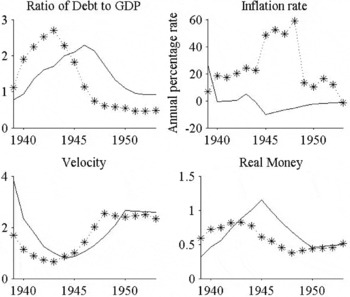
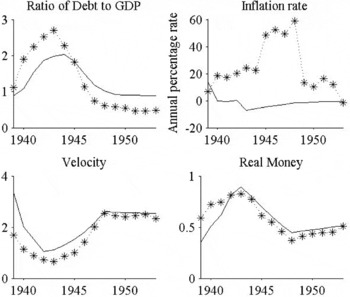
Figure 2 displays the asset side of the economy, with the rapid rise in real debt and money. A key feature of the model is the calculation of the debt level sustainable by the steady-state parameters of the model. In the steady state, there is a small surplus dictated by the fact that government expenditure is 10 percent of GDP and the tax rate on all factors is 11 percent. Given these and other parameters, we can compute the steady-state path of money and the steady-state debt such that the present value of future surpluses plus seigniorage produces a debt to income level that is stationary. If actual debt is more that this ratio, debt will grow explosively; and if it is less, it will implode. The sustainable steady-state debt ratio is 0.864. This value is very close to the pre-World War I (1910–1913) ratio of just under 80 percent and the ratio attained after the post-World War I stabilization (1929–1930) of 80 percent.Footnote 95 Compared to our sustainable ratio, the actual ratio is slightly higher for 1939, which reflects the relatively poor economic performance of the late 1930s.
During the war the debt-to-income ratio and real money climbed as part of Vichy's efforts to finance the war, and our estimated paths for these variables roughly followed their observed trajectories. Their closeness is perhaps surprising as our model has a nondistortionary stabilization program in contrast to the postwar inflationary policies. In these figures, inflation weakly mimics its actual movement, with the calibrated average inflation rate below the observed rate. The average calibrated rate for 1939–1944 was 5.1 percent, well below the average observed rate of 18.2 percent for retail prices. The differential becomes even larger after 1944 when postwar governments resorted to inflation, a feature which will be discussed later.
MONEY, DEBT AND INFLATION, 1939–1953
Actual Data
Model with Wage and Price Controls

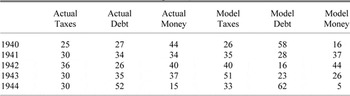
How closely does our baseline model approximate the structure of Vichy war finance? Table 6 reports the shares of government revenue derived from taxes, bond revenue, and seigniorage for the model depicted in Figures 1 and 2.Footnote 96 The shares generated by the model are fairly close to the actual shares.
ACTUAL AND ESTIMATED SHARES OF GOVERNMENT FINANCE (percent)

Source:
See the text.
Wartime finance produced a large accumulated debt that required postwar policies that would substantially deviate from the steady state. The five year program of lump sum taxes that were needed to bring the end-of-war debt down to the sustainable debt-to-GDP level was equal to 97 percent of steady-state GDP—a very large burden to be inherited by the postwar population, because in reality it would be financed by distortionary taxes.Footnote 97 The graph for the debt-to-income ratio in Figure 2 shows the actual data with the starred line and our model's results, including the stabilization, with the solid line. Although the timing of the rise and fall in this ratio is missed, we approximate its movements. The actual path shows a huge fall in the ratio during the politically unstable postwar period, when inflation surged, reducing the real value of the debt. This huge effective default lowered the ratio to 0.53 in 1950, well below the steady-state level of 0.864. The rise in real money balances is roughly tracked in Figure 2, though we have a higher end-of-war level because there is less inflation in our model. The primary difference between the actual and estimated values for seigniorage was produced by the slower inflation and higher real money in our model.Footnote 98 In addition, we capture the behavior of velocity.
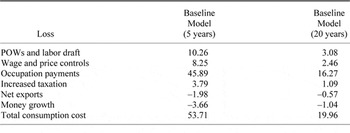
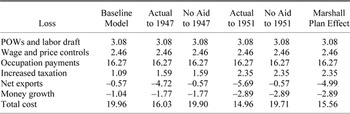
We calculate the welfare cost as the additional permanent annual consumption that would make up the difference between the consumption in wartime and in the steady state over a five year period and over a 20 year period, representing two potential horizons for policy makers. The total annual cost of the wartime policies independent of the stabilization package would have been 53.71 percent of consumption for each of five years or 19.96 percent of annual consumption for a 20 year period.Footnote 99 The relative costs of the individual policies can be seen in Table 7 for a baseline case with a nondistortionary stabilization program. With no access to international capital markets, where they could borrow and smooth consumption over a very long horizon, the French had to pursue very costly policies. The scaling of the costs can be seen by first recalling from Table 2 that optimal finance would have produced a permanent annual loss of 2.6 percent of GDP or 4 percent of consumption. If the costs in Table 7 were spread similarly over an infinite horizon, the total cost would be an annual consumption loss of 7.1 percent of which 6 percent would be directly attributable to the occupation payments. Thus, suboptimal finance by this simple estimate nearly doubled costs.
WELFARE COST OF OCCUPATION POLICIES (percentage of annual steady-state consumption)

Source:
See the text.
A central question faced by the Nazis was whether to deploy French labor in France or in Germany. If all the variables are set at their steady-state levels, and the only imposition on the French economy was the retention of POWs and the labor draft to Germany, the loss would be an annual 10.26 percent cut in consumption, representing a very large decline in living standards. Wage and price controls produced a loss of 8.25 percent per year for each of five years. By far the largest factor was the government spending and occupation payments, which cost consumption annually 45.89 percent. The remaining individual effects are relatively small by comparison. Net exports are slightly expansionary, as is money growth.Footnote 100 The components almost, but do not, add up to the total, reflecting the interaction of these distortions in the economy.
Even these understated welfare costs reveal the shocking effects of Nazi and Vichy policies on the population. But it was the output effects of German policies that most concerned France's masters in Berlin, and in particular whether French labor could be most effectively employed at home or in Germany. The loss of German men to the front and the conclusion that foreign labor would be more productive in Germany led Hitler to set Fritz Sauckel, the General Plenipotentiary for Employment of Labor loose to dragoon as much labor as possible from the Reich's vassal states. Only political concerns that an excessive draft would produce “side effects”—upheaval, flight, and armed resistance—led Albert Speer to try to limit the draft in France. Laval also resisted the pressure to supply more labor, because the draft undermined Vichy's legitimacy and he knew that Sauckel's methods were being criticized in Germany.Footnote 101 The available data made it clear to all observers that German demands were shrinking the French economy.Footnote 102
To examine the debate over how to allocate French labor, we measure the output loss relative to one year's steady-state GDP. In our model, the cumulative loss in output from 1940 to 1944 from the Nazi demands was 59 percent of one year's steady-state output. We consider two simple alternatives. In the first, all the POWs were returned to France and there was no further draft of labor; thus there was no French labor in Germany. In this case, the cumulative output loss for 1940–1944 would have been 45 percent of steady-state output, or a 14 percent reduction in the loss. Alternatively, if Sauckel had prevailed and more labor was drafted, we examine what would have happened if the draft were doubled, resembling more what happened in Eastern Europe. This doubling would have entailed a cumulative loss of 75 percent of one year's GDP or an increase of 16 percent over the actual loss. The latter assumes that the transfer of labor would have been effortless—when it was clearly not and was the motivation behind Speer's opposition.
The argument for transferring labor to Germany was that French workers would be more productive in German factories. According to most contemporary observers, German labor productivity was considerably higher than French productivity, especially in the crucial armaments industries, which had been rebuilt and modernized beginning in the 1930s.Footnote 103 It was reported that labor productivity in French aircraft factories was so low that it took four times as many workers to produce a German aircraft as in Germany. Clearly, in this case, if the transfer of French workers to Germany could raise their output four-fold, it would vastly enhance the productive capacity of the Germany armaments industry. One thorough study was conducted at the firm of Krupp in November 1942, where there were 25,000 foreign workers. Here, French civilians produced 70 to 80 percent as much as equivalent German civilians, whereas Eastern Europeans and Soviets produced at 57 percent and 42 percent of German levels. Foreign performance rose in the next eight months, so that French contributions were 80 to 90 percent that of German workers, and Eastern Europeans and Russians edged up to 60 percent and 50 percent of the German standard. Although it is dubious that the French were only 25 percent as efficient as the Germans in all industries as claimed in the example of the aircraft industry, if domestic French performance were 80 percent of German civilian performance, as in the Krupp study, a transfer might have yielded the Reich with a greater supply of armaments.
Any gain in Germany had to be weighed against a loss of output in France. To obtain some estimate of the effect, we note that in our simple counterfactual exercise, the effects of large changes in the draft of labor are nearly linear on the cumulative loss of output. For the single year 1942 when there was 8.5 percent of the French labor force in Germany, output in our model was 14 percent lower than the steady-state GDP. If there had been no draft, it would have been 11 percent lower, implying a 3 percent output cost. Given our Cobb-Douglass production function where the labor coefficient was 0.67, a change in output of 3 percent would be associated with a labor change of 4.5 percent. But, the labor forced was reduced by 8.5 percent in 1942, implying that the loss of labor and consequent upward wage pressure induced the remaining workers to work more, thus reducing the potentially larger output loss.Footnote 104 Again, although this is a simple model, it does highlight an important fact that the withdrawal of labor in France did not cause a proportional decline in output. The arrival of French workers in Germany could have similarly depressed German work effort if the German workforce remained constant, while native German workers were being drafted and sent to the front.
Assuming that Germany had no other productivity advantage over France, an exact replacement of German labor with 8.5 percent of the French labor would produce no loss for the German war machine and only a loss of 3 percent of French GDP, thus freeing German men for the front at relatively low cost. If on the other hand French workers were only 80 percent as productive as their German counterparts then there would be approximately a 1 percent loss of German output—a tolerable cost for sending more troops to the front.Footnote 105 An additional 6 percent consumption loss would fall on the French for each of five years, as a result of this doubling of the draft. But as Speer was aware, though this policy made sense for keeping the war machine supplied with labor, the French workers perceived a higher cost in low wages and harsh working conditions and began to join the resistance in significant numbers when the draft was introduced.
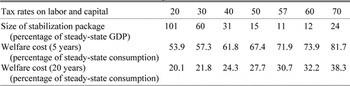
Vichy's government was aware that the loss of labor would hamper its ability to pay the occupation charges. The government's other concern was how the burden of occupation charges should be distributed over time, and it became alarmed by the growth of the debt. Higher taxes and less borrowing could have reduced the size of the postwar adjustment, but at a considerable cost.Footnote 106 If only taxes were increased and the rest of the wartime policies retained, there is no set of tax rates that can completely avoid the need for some stabilization, as shown in Table 8.Footnote 107 As tax rates increase, the tax base begins to shrink, so that total tax revenue exhibits a Laffer curve, first increasing and then decreasing. If both factors were taxed at 40 percent throughout the war, the required stabilization program would have been 31 percent of steady-state GDP. At a 50 percent tax rate, it would have been 15 percent, with the minimal stabilization program occurring at 57 percent tax rates, yielding 11 percent of steady-state GDP; after this point the size of the postwar program and the welfare cost climb. The reason why heavier wartime taxation was not adopted is obvious: the welfare cost is 71.9 percent of annual consumption for each year in a five year period or 30.7 percent of annual consumption for each of 20 years—both huge increases from the baseline welfare costs of 53.7 and 19.9 percent of annual consumption that must be set against the actual costs of stabilization.
HIGHER WARTIME TAXES (percent)

Sources:
See the text.
POSTWAR STABILIZATION
The cost borne by France was extraordinarily high; and to these wartime costs must be added the cost of a stabilization policy that would return the economy to its stationary debt-to-GDP ratio. The natural question is how Vichy intended to manage this burden and what were the choices faced by the post-1944 governments.
Before examining the issue of postwar stabilization, the question of what the public and policy makers expected at the outset of occupation needs to be addressed, given that we are employing a perfect foresight model but are dealing with the uncertainties of war. Most historical accounts agree that in 1940, defeated France was demoralized and accepted the apparent new European order. A reasonable assumption is that the French authorities believed that Germany would “win” by the end of 1942. Evidence from the Vichy bond market reveals that the investing public apparently accepted that Hitler would be victorious.Footnote 108 Until early 1943 the 3 percent rentes issued by the Third Republic and bonds of comparable maturity issued by Vichy traded at similar prices; when the possibility of defeat and potential repudiation of Vichy debt arose later, a premium was commanded by the older rentes, which any government of Liberation was more certain to honor. Furthermore, up until the end of 1942, total short- and medium-term debt was less than half of total debt. The government appeared to be confident that it could sell long-term debt at low nominal yields. After this time, shorter-term debt became more important than long-term debt and stood at 60 percent of all debt by August 1944.Footnote 109 Thus, it appears that until at least early 1943, investors, as well as members of the Vichy government, envisioned a future under German rule.
Even with this favorable scenario, which assumes that German demands on the French economy ceased with victory at the end of 1942, there is a huge postwar burden. Figure 3 shows the asset markets' predicted behavior for this shorter war. The welfare cost of the war ending in 1942 is lower, the equivalent of a 37.88 percent five year annual consumption reduction or a 12.85 percent 20 year annual reduction, an improvement over the cost for the four year war but still very high. The size of the requisite five year fiscal stabilization package would be 88 percent of steady-state GDP, not much lower than the 97 percent for the four year war. In terms of financing the shorter war, the patterns of debt to GDP and real money in Figure 3 more closely match the magnitude and timing of the actual paths of these variables, suggesting that the public believed this be the actual outcome, only to be surprised later. Nevertheless, in this scenario, Vichy was unable to significantly reduce its postwar burden during a shorter war because the model predicts that it would have continued to rely on debt finance. In the years 1940–1942, 57, 26, and 59 percent of expenditures would have been financed by debt producing the need for a large stabilization package.
Given the apparent inability of escaping from the heavy postwar burden with a shorter war, we will focus our analysis on the four year war model, which also ends in a Nazi victory, to address the question of how the postwar debt and money overhang would have been handled by Vichy and the governments of Liberated France. In Nazi Europe, Vichy France would have remained a vassal state. We assume that at the war's conclusion in 1944, occupation payments would have ceased. Trade and capital movements would have remained controlled and the debt would have been managed internally without access to external capital markets. Debt and monetary overhangs would have been eliminated by running budget surpluses. In essence, we assume that Vichy followed a traditional remedy of raising taxes over a long period in order to slowly pay down the debt to its steady-state level. Our counterfactual policy was within the set of policies considered not only by Vichy but the governments following Liberation. In fact, there was some policy continuity between Vichy and the Fourth Republic. One senior Vichy financial official Maurice Couve de Murville defected to De Gaulle's camp late in the war and was put in charge of Corsican finances after the island was taken by De Gaulle in 1943. Couve de Murville devised a rigorous deflationary plan for Corsica. Once the Germans were driven from Metropolitan France, the Provisional Government for the French Republic announced its intention in 1944 to tackle inflation by retiring the “excessive” monetary mass.Footnote 110 The plan was promoted by Pierre Mendès-France, the Commissioner of Finance and was similar to the strict plan implemented in Belgium to reduce the money supply and pay down the debt.Footnote 111 Although there was a half-hearted attempt to tax the public by a forced deflationary monetary conversion, a new Finance Minister in 1945, René Pleven opposed the earlier plans, and the debt continued to increase as the budget remained out of balance.
MONEY, DEBT, AND INFLATION, WITH COUNTERFACTUAL WAR ENDING IN 1942, 1939–1953
Actual Data
Model with Wage and Price Controls

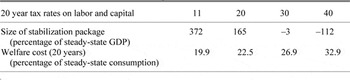
Yet, if Germany had won the war, Vichy would have maintained its strong repressive political apparatus and could have more easily carried out a debt reduction-deflation plan. Table 9 shows the feasibility of managing a return to a steady-state level of debt with small government with varied tax rates, starting with 11 percent, the steady-state rate. Moving back to tax rates of 11 percent in 1945 would have failed and after 20 years, the debt would have exploded to 372 percent of steady-state GDP. The welfare costs, including the wartime costs are also shown. Raising tax rates to 20 percent would still leave a larger stabilization task after 20 years; but at 30 percent tax rates for two decades, the debt would be reduced to approximately its steady-state level. The total welfare cost of this potential policy is 26.9 percent of annual consumption, with the cost of the wartime policies representing 19.9 percent and stabilization an additional 7.0 percent of consumption. Although this is a substantial loss, it is significantly less than the consumption loss that would have been incurred if wartime tax rates had been increased to their maximum and suggests why the government would have preferred to avoid raising its tax rates even higher during the war.
A HYPOTHETICAL VICHY POSTWAR STABILIZATION PROGRAM AND WELFARE COSTS (percent)

Sources:
See the text.
In fact, post-World War II tax rates were dramatically higher on labor and capital than in the Belle Epoque or the best years of the interwar period. In 1947, the tax rates were 22 and 20 percent; and by 1950 they were 31 percent on labor and 27 percent on capital. These would have been sufficient to finance the accumulated debt except that government expenditure was much higher than in the steady state and represented more than 30 percent of GDP by 1950. Not only were there higher expenditures derived from the war, but the modern welfare state was expanding.
The stabilization policies of liberated France followed a very different path. Immediately after the war, the government became heavily dependent on inflationary finance.Footnote 112 The government briefly tried to halt rising inflation with price controls in 1947, but shortages and an expanding black market brought it to an end. At the beginning of 1948, the government imposed a one-time tax on monetary assets that raised 150 billion francs, put credit controls in place, cut expenditures, and impounded all 5,000 franc notes to punish the black market (yielding 300 billion francs). Although these actions temporarily held inflation in check by providing the Treasury with revenue and reducing the money stock, inflation rose rapidly in the second half of the year. Inflation, which ranged between 40 and 60 percent in the immediate postwar years, was then brought down to 1.4 percent in 1949 and 2 percent in 1950. The brief but very rapid postwar inflation contributed to the reduction of the debt overhang. From 181 percent of GDP in 1944, debt fell to 65 percent in 1947 and 51 percent by 1950.
The Marshall Plan was another factor contributing to stabilization. Between April 1948 and March 1952, the United States provided France with $2.4 billion of European Recovery Program funds under the Marshall Plan. This funding equaled 11 percent of France's 1948 GDP, and it financed about a quarter of the French budget deficit in 1948 and half in 1949. The Marshal Plan funds were given in the form of grants of goods and services, conditional on the recipient countries presentation of acceptable budgets and programs. The French government then sold the imported goods to domestic business in exchange for francs. According to Alessandra Casella and Barry Eichengreen, the Marshall Plan funds were most important for solving distributional conflicts and securing agreement among the parties in the French government.Footnote 113 The Marshall Plan assisted with the financing of the balance of payments deficit, which had been covered by substantial foreign credits. In 1944 and 1945 Switzerland and Britain provided trade credits, as did the Export-Import Bank, for a total of $550 million. In the next two years, France financed about half of its trade deficit by exhausting its gold and foreign exchange reserves and by requisitioning French-held foreign securities. The American Treasury and, to a lesser extent, the governments of Canada and New Zealand, the International Monetary Fund, and the World Bank provided the remainder, for a total of nearly 7 percent of French GNP.Footnote 114 Arriving in late 1948, the Marshall Plan may have helped to close the budget deficit and eliminate the need for the government to go to the Banque de France for advances, but it seems less likely to have contributed to the drop in the debt-to-GDP ratio, which had fallen to 45 percent in that year from 247 percent in 1945.Footnote 115
POSTWAR STABILIZATION POLICY ALTERNATIVES (percentage of annual steady-state consumption over 20 years)

Sources:
See the text.
To measure the cost of actual postwar policies, we examine the results of French policies before and after the Marshall Plan, dividing the immediate postwar period into 1945–1947 and 1948–1951. Table 10 explores the postwar policies, with the baseline model providing the measure of wartime costs. Although there were brief periods of controls, we assume that markets became free following the demise of the wartime wage and price controls and the return of drafted labor; and we use the observed tax rates, government expenditures, money growth, and net exports to examine the welfare costs. Aiding this analysis is, of course, the presence of tight capital controls that limited the flow of private capital, thus isolating the French economy.
By the end of 1947, before the Marshall Plan took effect, the total welfare cost of wartime policies and stabilization shows a decline from 19.96 to 16.03 percent. Higher taxes added to the cost, but money growth and net exports reduced it. For purposes of this discussion we treat postwar inflation as unexpected, thus approximating a lump-sum tax with no augmentation of the welfare cost. Given the initial intention of Vichy and the governments of liberated France to prevent inflation, it may well have been unexpected. Again, this assumption will underestimate the cost of the policies. More importantly, even in the absence of this factor, total welfare cost would have declined because of net exports. The international trade credits, described previously, permitted France to run a large trade deficit. For simplicity in this calculation, we treat these long-term, low-interest intergovernmental credits as gifts, giving a slight upward bias to our estimate of the benefit. The next column, “No Aid,” where there were no trade credits and France would have been forced to balance trade after the war, simply shows that the trade credits improve welfare by about 4 percent by 1947. The debt-to-GDP ratio had been reduced by inflation to 45 percent; and what effectively was accomplished was the substitution of domestic debt for some foreign debt that eased the consumption constraint, moving government finance closer to the optimum where foreign transfers would have been financed by long-term foreign borrowing.
Considering the whole of the stabilization period to the end of 1951 when inflation ceased and the Marshall Plan was completed, there is some higher welfare cost from increased taxation, but it is overwhelmed by the higher net imports financed by more trade credits and American aid, reducing the welfare cost by 5.12 percent (5.69 − 0.57). The last column shows only trade credits and no Marshall Plan and reveals that the program lowered the consumption loss by about half a percent (5.69–4.99), a fraction of the benefit from the trade credits. Again, the acceptance of foreign debt to overcome the consumption loss derived from the transfers to Germany represented a welfare-improving policy.Footnote 116
Not only did the policies of liberated France appear to lower the costs of German exactions, but they also had radically different distributional consequences. The struggle over how to balance the budget and ensuing inflation appears to have been costly as it pushed the debt-to-GDP ratio below the steady-state level of 86.4 percent of GDP. The inflation produced capital losses for the owners of government debt. Although apparently little is known about the ownership of the debt, among the largest holders of debt were the banks and other financial institutions that, under the regime of financial repression, had been induced to expand their bond holdings. In 1939 the largest deposit bank, Crédit Lyonnais held 44 percent of its investments and 18 percent of its assets in short-bonds. By 1942 these bonds accounted for 85 percent of its portfolio and 37 percent of its assets.Footnote 117 Part of this expansion of bond holdings by the banks was facilitated by issues of new shares, which in the case of Crédit Lyonnais more than doubled its capital but which kept its capital-to-asset ratio hovering below 5 percent. The postinflation market values of the debt would have threatened the solvency of these institutions. In this light, the 1945 nationalization of the four largest deposit banks, which traditionally has been ascribed to political demands to punish them for collaboration, appears to have been driven, in part, by insolvencyFootnote 118
CONCLUSION
Under even the most optimistic scenario that Vichy's policy makers could have believed, where the war ended in 1942 and there was an immediate termination of occupation costs, the financing of the transfers to the Nazis imposed a minimum welfare cost equal to a 12.6 percent reduction of consumption for 20 years plus the cost of financing a debt overhang equal to 88 percent of steady-state GDP. Where there was a will to pay, even a coerced will, extraordinary sacrifices were feasible. Assuming that Vichy's postwar plans followed its traditionalist program, a budget surplus generated by higher taxes could have eliminated the debt overhang in 20 years at an additional annual cost of 7 percent of consumption. Tax rates did rise to the requisite levels, but the necessary surplus never appeared because the budget was swollen by reconstruction expenditures and higher peacetime expenses associated with the nascent welfare state. It is not a great stretch to imagine that the repressive Vichy regime could have managed to raise taxes to rein in the debt if there had been a Nazi victory in 1942; liberated, democratic France could not. The postwar budgetary struggle arising after Liberation yielded an inflation that slashed the real debt, with the burden of adjustment falling heavily on those—financial institutions and individuals—who had been induced to buy Vichy's bonds. Finally, the cost of stabilization was lowered somewhat by the fact that France could tap international capital markets and could borrow on favorable terms in the critical years of reconstruction.