INTRODUCTION
Motor neuron disease (MND), or amyotrophic lateral sclerosis (ALS), is an incurable progressive neurodegenerative disease (Herz et al., Reference Herz, McKinnon and Butow2006). Although 50% of patients die within three years of its onset, usually from respiratory failure (Mitchell & Borasio, Reference Mitchell and Borasio2007), medical technologies can now prolong the lives of many individuals living with MND (Dawson & Kristjanson, Reference Dawson and Kristjanson2002). The majority of patients retain or have mildly diminished cognitive capacity, though their ability to communicate steadily diminishes along with continual loss of neuromuscular functioning (Talbot, Reference Talbot2002). A range of physiological (e.g., nutrition, respiration, infection) and psychological (e.g., anxiety, depression) issues may impede patients' quality of life (QoL) as the disease advances (Hoffman, Reference Hoffman2008). Decision making related to life-sustaining treatments and care options are likely to be complex and emotionally challenging for both patients and family members. In cases where mechanical ventilation is initiated, it is then required for the remainder of a patient's life, and decisions are irreversible if patients become “locked in” (Hoffman, Reference Hoffman2008).
Advance care planning (ACP) is a patient-centered process, designed to ensure that healthcare decisions are guided by preconsidered patient preferences (Fried et al., Reference Fried, Bullock and Iannone2009). Accurate and timely documentation of patient preferences in relation to life-sustaining treatments via advance directives (ADs) (e.g., healthcare proxy designation, living will) are integral to ACP, as is the consideration and articulation of goals of care and facilitation of family discussion to promote a shared understanding of these goals (Fried et al., Reference Fried, Bullock and Iannone2009). This may provide further assurance that patients' wishes are honored. Benefits from ACP have been reported in general medical settings for patients and caregivers. In one Australian study, patients who engaged in ACP were more likely to have their wishes known and respected, and their relatives reported less stress, anxiety, and depression (Detering et al., Reference Detering, Hancock and Reade2010). Patients with an AD have also been found to have fewer hospitalizations and be more likely to die at home, in a hospice, or nursing home (Molloy et al., Reference Molloy, Guyatt and Russo2000; Teno et al., Reference Teno, Gruneir and Schwartz2007). However, less favorable indications from ACP are also evident in the literature (Schneiderman et al., 1997), and unmet needs during end-of-life care are still commonly reported by bereaved family members (Teno et al., Reference Teno, Gruneir and Schwartz2007). Benditt and colleagues (Reference Benditt, Smith and Tonelli2001) focused on the importance of disease-specific ACP tools to overcome ambiguity in directives and thereby improve outcomes.
In the United States, federally funded healthcare institutions are required to inform patients of their personal right to be involved in decision making and complete an AD (Salmond & David, Reference Salmond and David2005). The rate of completion may be higher in some institutions or regions as a result of such policies. Despite an increasing focus on enhancing patient autonomy and dignity in end-of-life care evidenced by such legislation, the attitude of healthcare professionals (HCPs) toward ADs may be ambivalent. For instance, a Scottish qualitative study found both positive and negative attitudes among HCPs toward ADs and perceived the degree to which patients comprehended their illness and future incapacity as a potential limitation (Thompson et al., Reference Thompson, Barbour and Schwartz2003). In a review of end-of-life care in ALS, Mitsumoto and coworkers (Reference Mitsumoto, Bromberg and Johnston2005) outlined a need for enhanced communication and partnership development among patients, physicians, and family members and recommended investigation of optimal timing and approaches to discussing end-of-life care issues, including identification of decision points and standardized treatment discussions.
Despite the relevance of ACP to MND, there is sparse literature on this topic specifically related to MND, and to our knowledge there are no previous reviews that summarize what is known. The aim of this review was therefore to systematically assess qualitative and quantitative studies investigating ACP in relation to MND. Specifically, the review considered: prevalence and predictors of ACP; optimal timing, content, and format of discussion and documentation processes; perceived benefits of ACP for patients and caregivers; healthcare providers' awareness and acceptance of ACP; and evidence of the impact of ACP on key outcomes.
METHODS
Eligibility Criteria
Peer-reviewed English-language studies investigating ACP in the context of MND/ALS were included. Investigations of ACP could involve discussion and/or documentation of patient wishes and directives or goals of care. Qualitative and quantitative studies were sought for fuller comprehension of the evidence base. Studies involved people living with MND and/or family members and health professionals caring for (or having cared for) this patient population, in any setting. Samples comprising patients, family members, and healthcare professionals with different illnesses were included when separate analyses were conducted for the MND subgroup. Case studies (including legal cases/court rulings), conference abstracts, editorials, commentaries, and reviews were excluded.
Search Strategy and Screening
A search of relevant databases (MEDLINE, CINAHL, EMBASE, and SCOPUS) was conducted. The following terms were used to conduct the search: “motor neuron disease”; “amyotrophic lateral sclerosis”; “Lou Gehrig* disease”; “advance care plan*”; “advance (directive* or decision*)”; “living will”; “right to die”; “power of attorney”; and “Ulysses (contract* or directive*).” These terms were modified slightly to suit the nomenclature of the respective databases. Search results were screened for duplicates and irrelevant articles. The remaining articles were assessed for inclusion in accordance with the eligibility criteria by one author (LM) and verified by the other (PB). The reference lists of included articles were scrutinized for additional articles.
Quality Assessment
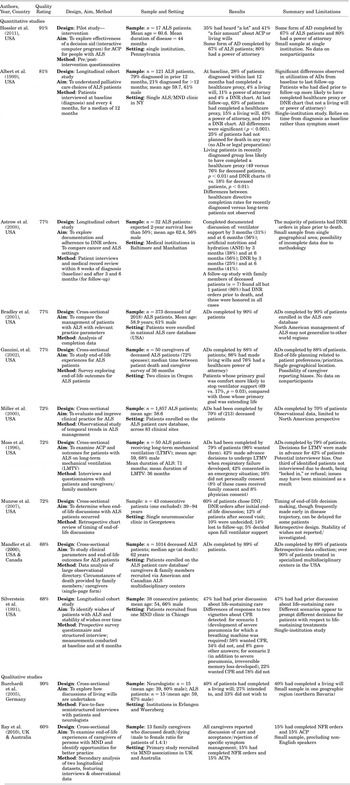
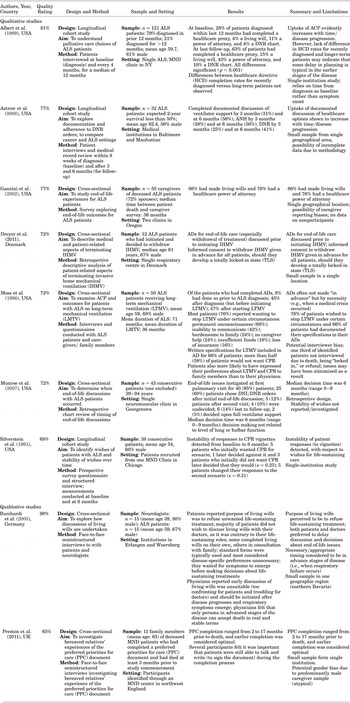
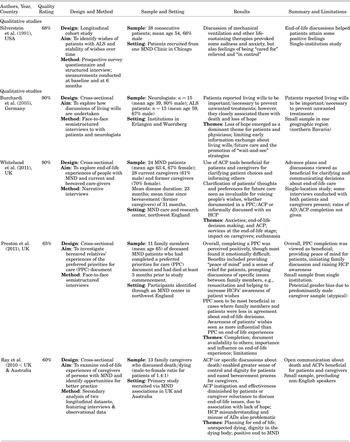
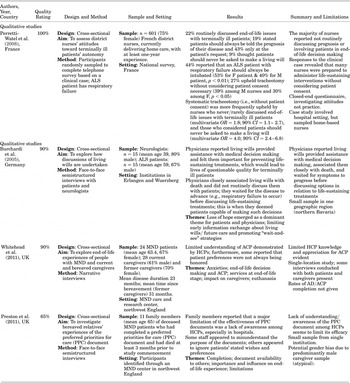
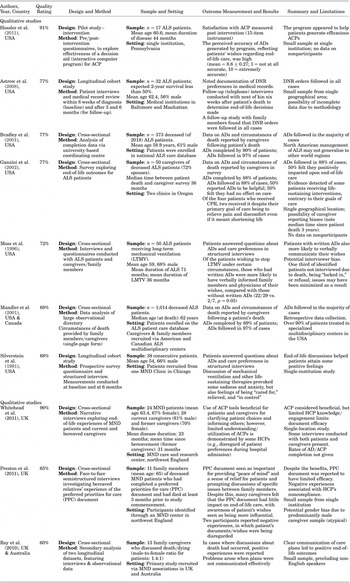
The quality of studies was based on the standardized quality assessment tool “Qualsyst,” developed by Kmet and colleagues (Reference Kmet, Lee and Cook2004) to evaluate primary research papers. This assessment tool was selected due to its separate scoring systems for qualitative and quantitative approaches and its detailed instruction manual for quality scoring. One author (LM) assessed the quality of all studies and the other (PB) assessed a portion of the studies, with any differences detected being resolved through discussion until consensus was reached. The quality of included studies, measured by final scores, is documented in the summary tables (see Tables 1–5).
Prevalence and predictors of ACP/AD for MND/ALS (studies ordered by quality rating)

Optimal timing, content, and format of discussion and documentation process

Perceived benefits of ACP for patients and caregivers

HCPs' awareness/acceptance of ACP

Evidence of the impact of ACP on key outcomes

Data Extraction
Data were extracted from the articles in accordance with the key areas of investigation outlined in the following research domains: prevalence and predictors of ACP; optimal timing, content, and format of discussion and documentation processes; perceived benefits of ACP for patients and caregivers; healthcare providers' awareness and acceptance of ACP; and evidence of the impact of ACP on key outcomes. Summary tables for each research question were created (see Tables 1–5), with articles ordered by quality rating, from highest to lowest. These tables were utilized to clarify discrete research findings and facilitate data synthesis and overall analysis for this review.
Data Synthesis
A narrative approach was adopted to synthesize data for this review following the three steps outlined by Mays and cowrkers (Reference Mays, Pooe and Popay2005). Initially, data extraction tables for each research question were developed for preliminary analysis. More detailed relationships between findings were then explored. Finally, the overall impact of the synthesis produced was considered for each research question. Thematic analyses were conducted (for each research question) for the included qualitative studies. This involved organization of data into descriptive and analytic themes, as described by Barnett-Page and Thomas (Reference Barnett-Page and Thomas2009), to explore the need, appropriateness, and effectiveness of ACP for this population.
RESULTS
Study Selection
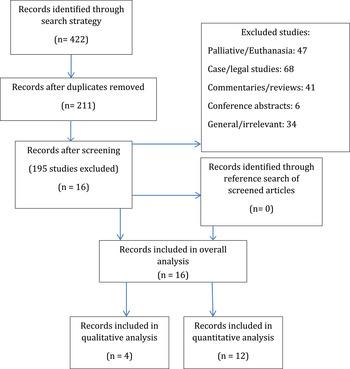
The search strategy produced 422 results. After duplicates were removed, 211 studies were screened with careful consideration for eligibility criteria, and 195 studies were excluded (see Figure 1 for further details of the selection process). Following this, 16 studies (12 quantitative and 4 qualitative) were deemed suitable for our review. Additional studies were not detected from the reference lists of eligible studies.
Selection process for systematic review.

Study Characteristics
Systematic quality scoring determined that four studies (25%) were given scores of 90% or above, four (25%) received scores between 75 and 89%, and eight (50%) between 60 and 74%. The majority of studies (63%) were conducted in the United States. Other studies took place in Europe, and one study featured participants from the United Kingdom and Australia. Nine studies (56%) were published during the previous decade, and the remaining studies were published between 1991 and 2002.
Synthesis of Results
Prevalence and Predictors
Prevalence rates for some form of AD or ACP, or prior discussion of life-sustaining care, were reported in 10 quantitative studies and 2 qualitative studies (numbers ranged from 15 to 90%; see Table 1). Quantitative studies reporting higher rates (70–90%) of ADs (Bradley et al., Reference Bradley, Anderson and Bromberg2001; Ganzini et al., Reference Ganzini, Johnston and Silveira2002; Mandler et al., Reference Mandler, Anderson and Miller2001; Miller et al., Reference Miller, Anderson and Bradley2000) were primarily conducted in the United States, where all hospitals that receive federal funding are obliged to ask patients about ADs (Mandler et al., Reference Mandler, Anderson and Miller2001).
Differences in reported rates may also be explained by temporal differences in data collection, as rates of completion were shown to increase with disease progression. This is demonstrated by two longitudinal studies. One (Albert et al., Reference Albert, Murphy and del Bene1999) followed 121 ALS patients diagnosed within the previous 12 months every 4 months (for 12 months), finding that on first follow-up 28% of patients had completed a healthcare proxy, 4% a living will, 11% a power of attorney, and 4% a “do-not-resuscitate” (DNR) chart. At last follow-up, 63% of patients had completed a healthcare proxy, 15% a living will, 43% a power of attorney, and 10% a DNR chart (all differences were significant, p < 0.001). Similarly, Astrow et al. (Reference Astrow, Sood and Nolan2008) reported that documented discussion of ventilator support by three months (31%) was less than at six months (56%). Notably, one study (Albert et al., Reference Albert, Murphy and del Bene1999) found that being alive versus being deceased predicted DNR rate while time since diagnosis did not, suggesting that declining health rather than time since diagnosis motivates ACP completion.
Three studies explored predictors of ACP. An individual's goals for end-of-life care and specific clinical circumstances also appear to influence decision making about life-sustaining treatments. For example, a study by Ganzini et al. (Reference Ganzini, Johnston and Silveira2002) in 50 caregivers reported that patients whose primary care goal was comfort were more likely to stop ventilator support than those whose primary care goal was extending life (69 versus 17%, p = 0.03). Silverstein et al. (Reference Silverstein, Stocking and Antel1991) reported that patients were more likely to state a preference for CPR in response to vignettes with less serious symptoms and functional loss.
Optimal Timing, Content, and Format of Discussion and Documentation Process
Most studies have explored when an AD or ACP is completed, as opposed to the ideal time to complete one. Timing was reported in six quantitative and two qualitative studies (see Table 2). As noted above, completion rates of ADs/ACP increased with disease progression (Albert et al., Reference Albert, Murphy and del Bene1999; Astrow et al., Reference Astrow, Sood and Nolan2008). One German qualitative study by Burchardi and colleagues (Reference Burchardi, Rauprich and Hecht2005) found that both patients and physicians closely associated living wills with death and tended to wait for serious symptoms to emerge before making decisions about life-sustaining treatments. Patients felt it inappropriate to discuss refusal of unwanted life-sustaining treatments (the purpose of living wills) with physicians, as they considered this contrary to doctors' life-sustaining roles (Burchardi et al., Reference Burchardi, Rauprich and Hecht2005). Physicians reported that early discussion of living wills was unsuitable, as it would be too confronting for both patients and doctors. They felt that only persons in the advanced stages of illness could accept death in real and stable terms (Burchardi et al., Reference Burchardi, Rauprich and Hecht2005).
An alternative perspective is provided by several studies which reported that earlier AD/ACP completion was preferable. One qualitative UK study (Preston et al., Reference Preston, Fineberg and Callagher2012) with 11 family members who had used a “preferred priorities for care” (PPC) document reported that completion ranged from 2 to 17 months prior to death and that earlier completion was considered optimal (Preston et al., Reference Preston, Fineberg and Callagher2012) . For instance, several participants in this study felt it important that patients be actively involved in the completion process and be able to talk about and sign their own documents. Earlier completion was achieved in at least one quantitative study (Munroe et al., Reference Munroe, Sirdofsky and Kuru2007), where end-of-life issues were discussed at the first pulmonary visit for 95% patients, with 60% of patients choosing DNR/DNI (“do-not-intubate”) orders at that time.
The stability of patient wishes may represent an important issue relevant to ACP timing. Though generally underreported in the literature, stability of wishes was examined in one quantitative study by Silverstein et al. (Reference Silverstein, Stocking and Antel1991). These investigators documented instability of responses to two CPR vignettes (from baseline to 6 months), with 20 to 30% of patients changing their responses to the two scenarios.
Content and format issues were discussed in five quantitative studies (Albert et al., Reference Albert, Murphy and del Bene1999; Astrow et al., Reference Astrow, Sood and Nolan2008; Ganzini et al., Reference Ganzini, Johnston and Silveira2002; Munroe et al., Reference Munroe, Sirdofsky and Kuru2007) and three qualitative studies (Burchardi et al., Reference Burchardi, Rauprich and Hecht2005; Preston et al., Reference Preston, Fineberg and Callagher2012; Whitehead et al., Reference Whitehead, O'Brien and Jack2012), all of which focused on typical rather than optimal presentation of ADs/ACP. Disease-specific preferences for life-sustaining treatments were common—such as DNI, DNR, or ANH (“artificial nutrition and hydration”) orders (Albert et al., Reference Albert, Murphy and del Bene1999; Astrow et al., Reference Astrow, Sood and Nolan2008; Munroe et al., Reference Munroe, Sirdofsky and Kuru2007). The PPC document utilized by patients in two UK studies (Preston et al., Reference Preston, Fineberg and Callagher2012; Whitehead et al., Reference Whitehead, O'Brien and Jack2012) was designed to assist patients achieve palliative care goals, particularly their preferred place of death. Living wills, healthcare proxies, and powers of attorneys were also utilized (Albert et al., Reference Albert, Murphy and del Bene1999; Ganzini et al., Reference Ganzini, Johnston and Silveira2002). Where life-sustaining interventions were already in place, a patient's AD might specify the conditions under which they wished invasive procedures to cease. For example, in a Danish study (Dreyer et al., Reference Dreyer, Felding and Klitnæs2012) with 12 ALS patients who had initiated home mechanical ventilation (IHMV), all patients specified withdrawal of IHMV should they develop a totally “locked-in” state.
Perceived Benefits of ACP for Patients and Caregivers
The benefits of ADs/ACP were examined in one quantitative and four qualitative studies (see Table 3). The evidence from these samples suggests that, despite the emotional challenges inherent in discussing or documenting decisions for future care (Preston et al., Reference Preston, Fineberg and Callagher2012; Silverstein et al., Reference Silverstein, Stocking and Antel1991), several positive outcomes emerged, including prevention of unwanted life-sustaining treatments (Burchardi et al., Reference Burchardi, Rauprich and Hecht2005); stronger feelings of being “cared for” and “in control,” thereby providing greater “peace of mind” and “a sense of relief” (Preston et al., Reference Preston, Fineberg and Callagher2012; Ray et al., Reference Ray, Brown and Street2012; Silverstein et al., Reference Silverstein, Stocking and Antel1991); generation of specific discussions between patients and caregivers that clarified patients' choices and raised awareness among family members (Preston et al., Reference Preston, Fineberg and Callagher2012; Whitehead et al., Reference Whitehead, O'Brien and Jack2012); and increased patient dignity and an easier bereavement process for caregivers (Ray et al., Reference Ray, Brown and Street2012). Some patients and caregivers avoided discussion or documentation of end-of-life care, as they were inextricably linked with death and loss of hope (Burchardi et al., Reference Burchardi, Rauprich and Hecht2005; Ray et al., Reference Ray, Brown and Street2012).
HCP Awareness/Acceptance of ACP
The knowledge of HCPs and their attitudes toward ACP were examined in one quantitative and three qualitative studies (see Table 4). Two qualitative UK studies (Preston et al., Reference Preston, Fineberg and Callagher2012; Whitehead et al., Reference Whitehead, O'Brien and Jack2012) found a limited understanding of ACP among HCPs, diminishing the effectiveness of ACP documents and sometimes resulting in medical intervention contrary to patients' stated wishes. In one German qualitative study (Burchardi et al., Reference Burchardi, Rauprich and Hecht2005), physicians reported that living wills assisted medical decision making and prevented life-sustaining treatments for patients with severely impeded QoL. However, these physicians closely associated living wills with death and a loss of hope, and thus tended to delay end-of-life discussions until the disease had advanced considerably (e.g., respiratory failure had occurred). The majority of 601 district nurses in a French national survey (Peretti-Watel et al., Reference Peretti-Watel, Bendiane and Galinier2008) did not routinely discuss prognosis or end-of-life issues with ALS patients, support living wills, or involve patients in end-of-life decision-making; in fact, 44% reported that they would perform intubation and 27% tracheostomy without considering patient consent (especially for women). These views were more common in male nurses.
Evidence of the Impact of ACP on Key Outcomes
The impact of ACP was considered in seven quantitative and three qualitative studies (see Table 5). Four quantitative studies included follow-up with family members (Astrow et al., Reference Astrow, Sood and Nolan2008; Bradley et al., Reference Bradley, Anderson and Bromberg2001; Ganzini et al., Reference Ganzini, Johnston and Silveira2002; Mandler et al., Reference Mandler, Anderson and Miller2001), and patient preferences were reported to be honored in the majority (88–100%) of cases. Notably, all studies were conducted in the United States, and the data were collected retrospectively. The median time since patient death was three years for one study, and reporting biases were possible. Moreover, two studies utilized information from a national ALS database in more than 90% of patients treated in specialized multidisciplinary centers, so that the representativeness of these samples is uncertain. In contrast to these positive findings, in one U.S. study with 50 caregivers of deceased ALS patients, of the four patients reported to have received CPR, two received it despite their primary goal of care being “to relieve pain and discomfort even if it meant shortening life” (Ganzini et al., Reference Ganzini, Johnston and Silveira2002).
Evidence from some qualitative studies suggests that patients' wishes are sometimes miscommunicated or disregarded, resulting in negative experiences for patients and caregivers (Preston et al., Reference Preston, Fineberg and Callagher2012; Ray et al., Reference Ray, Brown and Street2012; Whitehead et al., Reference Whitehead, O'Brien and Jack2012). Preston et al. (Reference Preston, Fineberg and Callagher2012) suggested that family knowledge of preferences is more influential than ACP documents, though documentation processes were considered beneficial by many caregivers for clarifying patient wishes and generating family discussion (Preston et al., Reference Preston, Fineberg and Callagher2012; Whitehead et al., Reference Whitehead, O'Brien and Jack2012). Evidence from one U.S. study with 50 ALS patients receiving LTMV (Moss et al., Reference Moss, Oppenheimer and Casey1996) suggested that verbal discussion of end-of-life decisions was predicted by AD completion (22/29 vs. 2/7 for those who had not completed an AD).
Opportunities to ease the process of documentation and improve the accuracy of ADs may assist MND patients and family members to better prepare for disease advancement. In one study, an interactive computer program was developed as a decision aid for ACP and was piloted on a small sample of MND patients in the United States (Hossler et al., Reference Hossler, Levi and Simmons2011). This program produced some promising preliminary results. Patients' overall satisfaction with the decision aid was measured using a 15-item instrument, with a mean rating of 4.2 ± 0.16 (1 = very dissatisfied, 5 = very satisfied). The perceived accuracy of the generated AD, as reflecting patients' wishes, was a highly rated item, with a mean score of 8.6 ± 0.27 (1 = not at all accurate, 10 = extremely accurate). Interventions such as these may be helpful to patients in the future.
DISCUSSION
The prevalence of advance care planning varied considerably across studies, which may be explained by different timepoints for data collection as well as geographical factors. Recent trends toward patient-centered healthcare policy and shared decision making may be boosting prevalence figures in some regions, especially in America (Mandler et al., Reference Mandler, Anderson and Miller2001; Salmond & David, Reference Salmond and David2005). By contrast, one UK-and-Australian-based qualitative study with caregivers of deceased relatives (Ray et al., Reference Ray, Brown and Street2012) reported relatively low prevalence rates for patients: 15% for NFR (“not-for-resuscitation”) charts and 15% for ACP. Reliance on caregiver reports and retrospective data collection, sometimes after a considerable time lapse (e.g., three-year median in Ganzini et al.'s (Reference Ganzini, Johnston and Silveira2002) study), raises reliability concerns for certain data. In relation to predictors of ACP, disease progression appears to be the strongest catalyst for AD completion, especially in cases characterized by rapid health decline. Personal healthcare goals and clinical circumstances are likely to influence end-of-life decisions as well, though further (quantitative and qualitative) evidence is required to substantiate the preliminary findings.
Relentless and rapid functional loss, typically associated with MND, compels consideration of optimal timing for ACP. The foregoing evidence suggests that many patients delay producing ADs until physical degeneration makes it necessary. However, it is difficult to compare studies due to methodological issues and the different temporal parameters. Earlier instigation of ACP may be beneficial for many patients and help them attain a greater sense of control. On the other hand, symptom progression may be necessary for some patients to accept the seriousness of their condition. According to clinical practice guidelines for communicating prognosis and end-of-life decisions (Clayton, Reference Clayton, Hancock and Butow2007), all patients with a progressive life-limiting illness should be given the opportunity to discuss their prognosis and end-of-life issues. However, patients should be able to defer discussion to a later time as well if they so desire. Instability of wishes was detected in one study documenting individuals' situational responses, which varied over a six-month period (Silverstein et al., Reference Silverstein, Stocking and Antel1991). Though these data were generated from a single institution with a relatively small sample, this may be an issue warranting further investigation. In practice, documented decisions might be periodically reviewed (perhaps every six months) to ensure better consistency over time (Silverstein, Reference Silverstein, Stocking and Antel1991).
The positive outcomes of ACP processes were perceived by several participants (patients and caregivers) from the included studies. Advance directives were frequently associated with feelings of control, relief, and “peace of mind” (Preston et al., Reference Preston, Fineberg and Callagher2012; Whitehead et al., Reference Whitehead, O'Brien and Jack2012). However, contrary views were also reported. In one qualitative study with German patients (Burchardi et al., Reference Burchardi, Rauprich and Hecht2005), respondents linked living wills with death and diminished hope. Notably, most patients from this study held patriarchal views toward healthcare and felt that living wills were at odds with the physician's life-sustaining role.
Our review findings indicate that the efficacy of ADs may be compromised by HCPs' lack of awareness, personal/professional beliefs, and/or reluctance to discuss death (Burchardi et al., Reference Burchardi, Rauprich and Hecht2005; Peretti-Watel et al., Reference Peretti-Watel, Bendiane and Galinier2008). Some patients received interventions contrary to their stated wishes, and a minority of HCPs demonstrated oppositional attitudes to ACP. Insufficient evidence is available for more comprehensive conclusions to be drawn.
Evidence from U.S.-based quantitative studies reporting very high rates of honored patient preferences (Astrow et al., Reference Astrow, Sood and Nolan2008; Bradley et al., Reference Bradley, Anderson and Bromberg2001; Ganzini et al., Reference Ganzini, Johnston and Silveira2002; Mandler et al., Reference Mandler, Anderson and Miller2001) stand at odds with qualitative evidence (from the United Kingdom and Australia) suggesting that patient wishes were often miscommunicated or disregarded (Preston et al., Reference Preston, Fineberg and Callagher2012; Ray et al., Reference Ray, Brown and Street2012; Whitehead et al., Reference Whitehead, O'Brien and Jack2012). Health system differences may be impacting the results, as well as methodological limitations, including retrospective caregiver reports. Notwithstanding this, positive benefits were commonly reported for documentation processes, in order to clarify and communicate patient wishes. Written ADs may positively impact end-of-life outcomes either directly, via HCPs following these directives, or indirectly, by promoting meaningful family discussions (earlier on in the course of illness), following which family members may more confidently advocate patient wishes toward the end of life. Decision aids such as the interactive computer program piloted by Hossler et al. (Reference Hossler, Levi and Simmons2011) may assist patients, caregivers, and HCPs in commencing this difficult decision-making process.
Clinical Implications and Future Directions
Individual preferences should be considered when determining appropriate timing for initiating advance care planning. Raising awareness of the role and importance of ADs within (targeted) medical communities may increase the efficacy of ACP processes and the quality of end-of-life experiences for patients and families. Disease-specific decision aids may facilitate ACP processes and improve decisional accuracy (Hossler et al., Reference Hossler, Levi and Simmons2011). Larger studies supporting preliminary findings for ACP are required to further examine efficacy. More qualitative evidence (including U.S. studies) and examining patients' or caregivers' experiences of AD completion and impact would also be advantageous. The stability of patients' wishes regarding future treatments is a most important topic that requires more rigorous investigation in future MND studies.
LIMITATIONS
The scope and impact of our review was limited by the low number of relevant studies, which often compared nonrandomized groups and utilized diverse methodologies. Search strategies, though formulated in accordance with current research practices, may have missed relevant studies. All included studies were conducted in the context of Western cultures (Western Europe, North America, and Australia), and our findings may not reflect non-Western practices or experiences. Research questions were generated to investigate key elements of ACP but may not have captured all relevant information regarding ACP in MND.
CONCLUSION
Accurate representation of ACP prevalence is indeterminate from our review, though advancing illness seems to predict AD completion. It is difficult to ascertain what constitutes optimal content, format, or timing with respect to completion or discussion of ADs/ACP in the MND setting. Although positive benefits are often associated with ACP, contrary views are reported. HCP's personal beliefs, lack of awareness, or reluctance to discuss death may be interfering with timely ACP processes. Notwithstanding this, varying patient preferences may make flexible ACP approaches and timing necessary. Utilization of ACP decision aids may increase the accuracy and clarity of patient choices and positively impact end-of-life outcomes.