Implications
Knowledge of the numerical size of breeds is important for conservation planning and for the design of incentives and support systems, but censuses are difficult and expensive to conduct. This study describes how the number of registered females in a breed can be estimated objectively by multiplying the number of registrations in a year by a species-specific multiplier. This provides a basis for negotiation between a central authority and a breed society; if the latter disagrees with the estimate, it can conduct a census of the breed.
Introduction
Census information on livestock breeds is necessary for the planning and review of conservation measures. It is fundamental to constructing priority lists and for determining whether individual breeds qualify for incentives.
Within the European Union, many agri-environment schemes now include payments for farmers who keep specified rare or minority breeds, and the numerical status of the breeds (number of breeding females) can confer eligibility for funding. A transparent and fair system is therefore needed to assess population size of breeds, particularly of those which may be, numerically, borderline cases for support. However, a direct count of registered females may not always be practicable.
Transparency would be assured if the population size could be predicted by a validated protocol from publicly available information. Livestock owners often wish to keep aspects of their operations confidential, and the protocol should only require information that is public. For many years, breed societies have operated pedigree registers, whereby the parentage details of individual animals are published, typically in herd-, flock- or studbooks. Some breed societies also publish basic information about how many animals individual breeders keep (termed ‘herd returns’ or ‘flock returns’), but many do not. Some breed societies conduct and publish occasional formal or informal surveys but these may be restricted in their circulation and in whether the raw data can be made available.
A major difficulty with deducing, from pedigree data, how many registered animals there are, is that cessation of breeding careers of individuals is not usually documented. For example, a registered female might be kept but might frequently be used for production of unregistered, perhaps crossbred, offspring (it was estimated that in rare British pigs, ∼43% of litters born to registered females were crossbred or unregistered, Hall, Reference Hall1989a). Such an animal is still available as a genetic resource, but its presence would not be recorded unless herd or flock returns are kept.
In principle, the number of registered breeding females in a breed could be expressed as a function of the number of young females registered, and of a set of age-specific mortality and fecundity rates, together with terms accounting for production of non-registered offspring. This study presents an alternative to this a priori approach, namely to use a sample of breeds to establish an empirical relationship between the number of registrations in a given year and the size of the registered female population for that year. This relationship would take the form of a multiplier or coefficient, with a confidence limit term, to be applied to the number of registrations to yield an estimate of the size of the registered adult female population.
The proportion of females registered is a business decision by the individual farmer, and the cost in cash and in bureaucratic effort is not trivial. In many breeds (Hall, Reference Hall1986, Reference Hall1989a and 1989b), high proportions of females breed in a flock or herd other than the one in which they were born, implying that some farmers will register more females than they need for replacements, with a view to sale, whereas others will register fewer. Overall, if a breed is in a steady state the number of females registered in a year will be a simple function of the number of current breeding females that are anticipated to retire and to be replaced by the new registrations.
The relationship between registrations and breed numerical strength was briefly considered by Donald and El Itriby (Reference Donald and El Itriby1945) and has attracted little, if any, formal attention since (but see Özkütük and Bichard, Reference Özkütük and Bichard1977). Donald and El Itriby (Reference Donald and El Itriby1945) simply stated that an appropriate multiplier for cattle was five, but provided no a priori nor empirical justification. In sheep, Young and Purser (Reference Young and Purser1962) multiplied the number of registered 2-year-old Border Leicester females by four to give the total registered ewe population, again without discussion or justification. Studies on pedigree registrations (e.g. Vu Tien Khang, Reference Vu Tien Khang1983; Caballero and Toro, Reference Caballero and Toro2000; Townsend, Reference Townsend2004) have provided important information for genetic conservation and breed development programmes but have not of themselves, enabled deductions of how many registered females are actually present. Lack of adequate census information is appreciated as a major constraint on effective conservation planning (Groeneveld et al., Reference Groeneveld, Lenstra, Eding, Toro, Scherf, Pilling, Negrini, Finlay, Jianlin, Groeneveld and Weigend2010).
In this study, multipliers have been calculated from overall breed data (the ratio of breed census to total registrations in a year) and from flock/herd level data (the ratio, in each flock, of number of animals to registrations). The ratios have been averaged to yield species-specific and breed-specific multipliers respectively, and the values of the two types of multiplier for deduction of breed numerical size investigated.
Material and methods
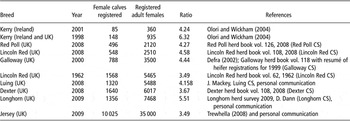
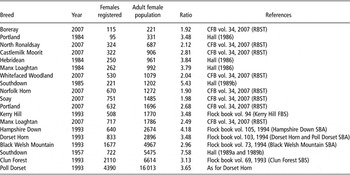
The ratios of numbers of registered females in the breed, to total number of female registrations during a given year, were calculated for the cattle and sheep data sets listed in Tables 1 and 2. In this exploratory study, there was no a priori reason to select particular data sets and the criterion for selection was ease of access to the data, together with availability of a contemporary census of registered females.
Cattle breeds surveyed and ratio of adult female number to number of female registrations (breed-specific multipliers)

CS = Cattle Society.
Sheep breeds surveyed and ratio of adult female number to number of female registrations (breed-specific multipliers)

CFB = Combined Flock Book; RBST = Rare Breeds Survival Trust; FBS = Flock Book Society; SBA = Sheep Breeders’ Association; SBS = Sheep Breeders’ Society.
For Southdown (1985), Kerry Hill, Dorset Horn, Poll Dorset and Black Welsh Mountain ‘females registered’ was the number of pre-breeding females listed in the flock returns. For the others, it is number of individually registered lambs.
For all species, normality of the distributions of these breed-specific multipliers was confirmed (P > 0.05, Kolmogorov–Smirnov test as applied by SPSS version 13.0). Mean and 5% confidence limits were calculated.
Breed-specific multipliers were deduced for Lincoln Red, Longhorn and Dexter cattle herds and Clun Forest, Kerry Hill, Poll Dorset and Dorset Horn sheep flocks. For each breed, the ratio was calculated for each herd or flock. Only herds and flocks that submitted returns and registered females were considered; they were numbered 67, 417 and 457 herds and 67, 49, 208 and 64 flocks. Tests for normality were applied to both the raw and ln-transformed herd/flock ratios.
For eight rare British pig breeds, survey and registration data were available and breed-specific multipliers were compared. Multipliers were deduced for Golden Guernsey goats, Thoroughbred horses and Exmoor ponies.
Cattle
The Lincoln Red Cattle Society herd book (vol. 108, issued December 2008), was used. There were 83 herds, ranging in numbers of adult females from 1 to 169. Mean number of adult females (termed herd size) was 30.24 (s.e.m. = 4.08 and median = 16). For each of the 67 herds that registered female calves that year, the multiplier was calculated.
The Longhorn Cattle Society herd survey of 2009 listed 417 herds, ranging in numbers from 1 to 268 adult females and the adult/calf ratio was calculated for each herd, as for Lincoln Red cattle. Mean herd size was 17.95 (median = 11).
In the Dexter Cattle Society herd book for 2008, 457 herds registered females and submitted herd returns. Herd size ranged from 1 to 105 (mean = 17.60 and median = 7).
Normality of herd size and multiplier was achieved by ln-transformation for the Lincoln Red but not for the other two breeds.
Sheep
In many breeds, especially of sheep, females are not registered individually but the breed society publishes the number of purebred breeding females and young, pre-breeding females in each flock. This was the case for the four breeds considered here.
The Poll Dorset flock book (vol. 103 for 1994) was used. Here, returns for 208 flocks were given consisting of numbers of ewe hoggets (female sheep between being weaned and shorn for the first time) and stock ewes. Range of numbers of female sheep other than lambs was from 1 to 931. The multiplier was calculated for each flock.
Data from the Kerry Hill, Clun Forest and Dorset Horn flock books for 1993 were available (49, 67 and 64 flocks, respectively, enumerating both ewes and lambs) and the multiplier was calculated for each flock, as for the Poll Dorset.
Pigs
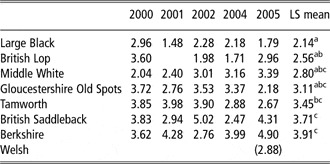
The census and bloodline surveys conducted by volunteer enumerators on behalf of the Rare Breeds Survival Trust and the British Pig Association, with the British Lop Pig Society, were used (Bates, Reference Bates2002; Anonymous, 2003, 2005a and 2005b; Kiddy, Reference Kiddy2003). Numbers of sows in 2005 ranged between 730 (Gloucestershire Old Spots) and 136 (British Lop). British rare pigs are usually kept in small herds; in 2005, overall, the mean number of sows per herd was 3.51 (range: 2.27 for Tamworth to 6.29 for Welsh). A multiplier was calculated for each breed in each year. These were normally distributed and were compared by two-factor analysis of variance (SPSS software version 13.0), with Duncan's test being performed on the least squares means. The multiplier was not tested on other breeds.
Goats
The Golden Guernsey Goat Society published a census report in January 2010 (Searle, Reference Searle2009). A total of 563 Golden Guernsey and 47 British Guernsey females were enumerated in 142 herds (largest herd = 47 females, mean = 5, with 42% of herds comprising one or two goats). Of these 610 goats, 99 were under 1-year-old (defined here as kids); the multiplier was calculated but not tested on other breeds.
Horses
Thoroughbred mare numbers and total foal births for the United Kingdom in 2007 were 11 091 and 5839, respectively (European Federation of Thoroughbred Breeders’ Associations (EFTBA), 2007). A 50 : 50 birth sex ratio was assumed. Across 21 European countries, the ratio of mare numbers to female foals ranged from 2.53 to 9.17 (median = 3.53) but neither this data set nor its ln-transformation were normally distributed. Registered Exmoor pony mares in the United Kingdom are thought to number 1525, while average annual registrations of females over the last 5 years are 109.6 (S. Mansell, personal communication).
Results
Cattle multiplier
The value for the species-level multiplier calculated by averaging those for each of the 10 data sets in Table 1 was 4.418 (s.e. = 0.284, median = 4.255 and 5% confidence levels 3.775 to 5.059). The breed-specific multipliers for Dexter and Longhorn were not normally distributed even when ln-transformed. The back-transformed values for Lincoln Red were mean = 4.224, s.e. = 1.061, median = 4.25 and 5% confidence levels 3.757 to 4.751.
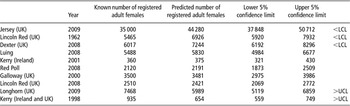
In Table 3, breeds are ranked in ascending order of breed-specific multiplier. The predictions of the species-level multiplier are given with an indication of how the actual adult female numbers are related to the 5% confidence levels of the predictions.
Application of species-level multiplier (4.418) to cattle data

<LCL signifies the known number of registered adult females is less than the lower 5% confidence limit for the predicted value.
>UCL signifies the known number of registered adult females is greater than the upper 5% confidence limit for the predicted value.
Sheep multiplier
The overall mean value for the species-level multiplier, calculated by averaging those for each of the 19 data sets in Table 2, was 3.312 (s.e. = 0.317, median = 3.13 and 5% confidence levels 2.646 to 3.978). The breed-specific multiplier for Clun Forest was not normally distributed even when ln-transformed. For the others, the transformed values were normally distributed and back-transformed values were as follows, for Poll Dorset: mean = 2.816, s.e. = 1.036, median = 2.92 and 5% confidence levels 2.627 to 3.018; for Dorset Horn: mean = 2.337, s.e. = 1.066, median = 2.33 and 5% confidence levels 2.057 to 2.656; for Kerry Hill: mean = 2.142, s.e. = 1.068, median = 2.01 and 5% confidence levels 1.878 to 2.442.
In Table 4, breeds are ranked in ascending order of breed-specific multiplier. The predictions of the species-level multiplier are given with an indication of how the actual adult female numbers are related to the 5% confidence levels of the predictions.
Application of species-level multiplier (3.312) to sheep data

<LCL signifies the known number of adult females is less than the lower 5% confidence limit for the predicted value.
>UCL signifies the known number of adult females is greater than the upper 5% confidence limit for the predicted value.
Pig multiplier
The breeds showed differences in the respective breed-specific multipliers, and there was no overall effect of year (Table 5). The overall F ratio of the general linear model was 2.14 (P = 0.06, d.f. = 11 and 35) and the factor breed had F = 3.05 (P = 0.02, d.f. = 7 and 35). R 2 was 0.51. The overall value for the species-level multiplier calculated by averaging those for each of the 35 data sets was 3.108 (s.e. = 0.150, median = 2.96 and 5% confidence levels 2.803 to 3.413).
Breed-specific multipliers for pigs, with LS means (years combined) for each breed. LS means with different superscripts are significantly different (P < 0.05, Duncan test)

LS means = least squares means.
The Welsh pig was excluded from the statistical analysis as it only featured in the 2005 survey.
Goat multiplier
As the goat multiplier is only derived from one breed no confidence limits can be calculated. The point estimate was 5.16.
Horse multiplier
Point estimates were derived for the Thoroughbred (3.80) and for the Exmoor pony (13.9).
Discussion
This is a preliminary study. The wide range of UK livestock biodiversity (Hall and Clutton-Brock, Reference Hall and Clutton-Brock1988; Department for Environment, Food and Rural Affairs (Defra), 2002) implies that for a definitive study a sampling protocol is needed, probably involving random sampling of breeds according to function or numerical strength.
It is suggested that an estimate (and confidence limits) can be made of the numbers of adult females in a cattle breed in a given year by multiplying the number of female registrations that year by 4.42 (for lower and upper 5% confidence limits, multiply by 3.78 and 5.06, respectively). Corresponding multipliers for sheep are (3.31, 2.65 and 3.98) and for pigs (3.11, 2.80 and 3.41). The broad similarities to those adopted by Donald and El Itriby (Reference Donald and El Itriby1945) and Young and Purser (Reference Young and Purser1962), namely five for cattle and four for sheep, are noteworthy. Further study is needed for confidence limits to be obtained for goat and horse multipliers.
The applicability of a multiplier must be measured by the degree of agreement between predicted and documented adult population sizes. Numbers of Jersey, Dexter and Lincoln Red (in 1962) cattle were overestimated and those of Longhorn and Kerry (Ireland and United Kingdom) underestimated. Similarly, sheep breeds also show a wide variation in this respect. Overestimation is the result of the breed-specific multiplier being low compared with the species-level multiplier and implies that higher proportions of young females are being registered. Reasons for these differences relate to breed function and historical and social factors. For example, in 1962 the Lincoln Red Cattle Society initiated a beef recording scheme, the first UK breed to do so (Hall and Clutton-Brock, Reference Hall and Clutton-Brock1988); and since 2001, the UK has imported 13 000 in-calf Jersey heifers from Denmark (Trewhella, Reference Trewhella2008). Both these factors may have increased interest in registering females, distorting the relationship between registrations and adult numbers. With sheep, intense registration activity in the breeds supervised by the Combined Flock Book of the Rare Breeds Survival Trust is indicated by the low values for breed-specific multipliers. For the Southdown, the breed-specific multiplier was relatively high (7.6) in 1957 at a time when most flocks were large and concentrated on the commercial production of purebred lamb; by 1985, the breed had contracted in numbers and changed in function to a provider of terminal sires whose parents, to comply with trademark requirements, had both to be registered so higher proportions of females were being registered (Hall, Reference Hall1989b). The variation among pig breeds is less easily explained, and the evident difficulty of predicting adult population sizes emphasizes how periodic surveys in this species are preferable to reliance on inferential methods.
The apparently high value for the goat multiplier, when compared with that of sheep, may relate to dairy husbandry practices; lactation length of non-pregnant goats is frequently 2 years (Soffe, Reference Soffe2003), whereas young females are often not mated until their second year of life (Ross, Reference Ross1989). For horses, the widely contrasting values of 3.80 from the Thoroughbred and 13.9 from the Exmoor pony presage a difficulty in deriving acceptable multiplier values for this species.
If breeds were uniform in agricultural function and historical and social background, an approach could be to use estimated rates of survival and fecundity with a life table incorporating demographic stochasticity (Caswell, Reference Caswell2001), but these rates if obtained from standard animal husbandry data may not be applicable to breeds of conservation interest. Thus, for example, Nix and Hill (Reference Nix and Hill1998) give ‘herd life’ of single suckling lowland beef cows as 6 years for spring calving and 5 years for autumn calving, whereas for the 477 Lincoln Red cows listed as dams in the 2006 herd book (S. J. G. Hall, unpublished results) the mean age at that calving was 6.1 years, maximum was 16 years, mode = 3, median = 6 and 25th and 75th percentiles 4 and 8 years – together implying a longer breeding life than in the husbandry system summarized by Nix and Hill (Reference Nix and Hill1998).
A multiplier approach should be applicable in pedigree livestock generally, though the actual numerical values of the multipliers will have to be validated or modified, using known census data from sample breeds, before they are used in a new situation. In practice, census data are only likely to be contentious for a proportion of breeds, specifically those that might be on the threshold of a particular numerical category and this will mean validation work does not need to be conducted for all breeds.
The central authority requiring breed census information could proceed as follows: (i) adopt the multipliers proposed here, or calculate new values; (ii) validate them with known data; (iii) calculate numerical breed sizes for breeds of interest and (iv) present the breed societies with these figures and invite them, should they disagree, to conduct an audited census of the breed.
Acknowledgments
I thank Mr R. Trewhella (Adela Booth Associates), Mr Johnny Mackey (Luing Cattle Society) and Ms Debbie Dann (Longhorn Cattle Society) who kindly provided information about Jersey, Luing and Longhorn cattle, respectively. Mrs Sandra Mansell provided data on Exmoor ponies. I am particularly obliged to Miss E. L. Henson and Mrs C. A. Muddiman for valuable advice and to John Flynn for statistical discussions.