

1. Introduction
In 1982, I urged federal executive branch agencies to adopt the value of a statistical life (VSL) to monetize the mortality risk benefits in regulatory impact analyses when I was asked to settle a dispute between the Occupational Safety and Health Administration (OSHA) and the U.S. Office of Management and Budget (OMB) over the proposed hazard communication regulation (Viscusi, Reference Viscusi2018a). OSHA had assessed the mortality risk reduction benefit based on what the agency called the “cost of death” or the financial costs associated with mortality. My analysis to resolve the controversy took a different approach. To value the health risk reductions from this proposal, I used my labor market estimates of the VSL and the value of nonfatal injury risks, boosting estimated benefits by an order of magnitude. As a result of this analysis, calculated benefits now exceeded costs, and the Reagan administration issued the regulation. Since that time, use of the VSL has become the standard practice to value mortality risk reductions in the government’s regulatory impact analyses. Agencies’ VSL estimates are now in line with the estimated values in the economics literature. This article advocates a much broader applicability of the VSL to inform benefit-cost analyses of policies, corporate risk decisions, the magnitude of regulatory sanctions, and the level of punitive damages in cases involving fatalities.
While the widespread adoption of the VSL in regulatory impact analyses for proposed regulations has been of fundamental policy importance, tremendous opportunities remain for expanding the use of the VSL, as I explored in Viscusi (Reference Viscusi2018a) and discuss here. Some of the applications simply extend the application of the VSL to assess benefit values for a broader set of decisions, while others involve a more fundamental shift in the role of the VSL. In addition to using the VSL to calculate mortality reduction benefits for proposed regulations or safety measures, the VSL also can serve a constructive function in setting penalty levels to establish appropriate levels of deterrence in regulatory and liability contexts. More widespread utilization of the VSL will better align health, safety, and environmental measures with the preferences of the citizenry regarding their valuation of risks.
This article’s discussion of these extensions of the domain for VSL begins with possible applications within government agencies and then turns to the courts and the private sector. The most straightforward extension of the VSL is to use this measure for policy analyses more generally, not simply for proposed new regulations. As the discussion in Section 2 indicates, some of these applications are in contexts where mortality risks play a consequential function but have not generally been the focus of benefit-cost tests, such as making military hardware decisions and assessing the economic costs of war. Beyond the role of the VSL in policy assessments, there is also a potential role with respect to setting the value of regulatory sanctions to establish meaningful incentives for safety. Somewhat surprisingly, the same agencies that routinely use the VSL to value health benefits of prospective regulatory policies have not incorporated the VSL into setting the sanctions for regulatory violations of the regulations leading to fatalities even though the same agency used the VSL to value mortality risks prospectively. Section 3 documents this disconnect, as agencies are in the inconsistent position of placing a high value on prospective mortality risk reductions but using a comparatively trivial value when creating financial incentives for firms to reduce mortality risks. The incentive-related role of financial penalties is also particularly pertinent to the safety incentives created by court awards, which are examined in Section 4. The VSL could serve a more influential role in damages contexts, particularly for tort liability where the objective is to establish incentives for deterrence, whether it be to deter reckless corporate risk behavior or to deter unreasonable police shootings. The greater use of the VSL in setting regulatory sanctions and court awards in turn will produce incentives for corporations and affected government agencies, such as municipalities, to internalize the use of the VSL in setting levels of safety for products and police behavior. Section 5 examines how corporations also could incorporate the VSL to a greater extent on their own initiative if provided with a legal environment that is more receptive to systematic risk analyses using the VSL. Section 6 offers conclusions along with the caveat that this article does not exhaust the potential range of applications of the VSL.
2. Government policies beyond regulatory impact analyses
Government agencies’ regulatory impact analyses have employed the VSL to assess whether the benefits of regulatory proposals exceed the associated costs and to set the stringency of these regulations. The best revealed preference estimates of the VSL are those based on labor market studies of the VSL that calculate wage premium estimates for fatality risks that are measured using the Bureau of Labor Statistics (BLS) Census of Fatal Occupational Injuries (CFOI) data. My VSL estimate based on labor market estimates of the mean VSL after accounting for publication selection biases is 10 million in 2015 USD (Viscusi, Reference Viscusi2018a) or 11 million in 2019 USD. This amount is similar to that currently used by government agencies. After a careful review of recent labor market estimates of the VSL based on the CFOI data, the U.S. Department of Transportation (2016) adopted a value of 9.6 million in 2015 USD. Adjusting this estimate for inflation, but not also for real income changes, leads to a VSL estimate of 10.4 million in 2019 USD. Other agencies are less transparent in the source of their estimates and the rationale for selecting particular studies from the literature in generating their VSL estimate, but the VSL figures that they use currently are in a similar range.Footnote 1 Although the practice of monetizing mortality risks using the VSL is well-established, the application of benefit-cost tests throughout the federal government to evaluate policies other than proposed new major regulations is not the norm. This section considers four diverse policy applications of the VSL – hazardous waste cleanups, military hardware, the mortality costs of war, and policies to deter police shootings.
2.1 Hazardous waste cleanup: superfundFootnote 2
A long-time prominent risk regulation policy is the Environmental Protection Agency (EPA) Superfund program, which is designed to target the cleanup of hazardous waste sites. The structure of allocating resources for cleanup efforts directly parallels the task involved in preparing a regulatory impact analysis. The agency must assess the risks, examine policy alternatives in terms of their cost and their efficacy in reducing the risk, select a policy option, and then require the responsible parties to undertake the cleanup. The Superfund program focuses primarily on the reduction of cancer risks from hazardous wastes. Although EPA uses the VSL to monetize mortality risk reductions in its regulatory impact analyses, there is no comparable benefit-cost approach to the evaluation of hazardous waste site cleanups. While it is feasible for EPA to undertake site-specific benefit-cost analyses to determine the most desirable cleanup option, EPA does not engage in such efforts.
The procedure that EPA uses to target sites for cleanup has a formal administrative structure. The estimated level of cancer risks is the critical determinant of whether the site merits cleanup. However, the nature of the risk assessment bears little resemblance to the comprehensive risk estimates undertaken in regulatory impact analyses. The trigger for the desirability of cleanup is the level of the cancer risk, but this assessment is distorted in several ways. Instead of using mean estimates of the risk, the agency’s analysis incorporates upper bound values for the different components of the probability assessment such as exposure duration, exposure frequency, ingestion rate, chemical concentration, and toxicity of the chemical. The result of this compounded conservatism is that the estimated risk level does not reflect the actual expected risk but rather is beyond the 99.9th percentile of the distribution of the overall cancer risk for each chemical exposure. What the agency does with this upper bound cancer risk assessment also is different from sound analytical practices. The usual risk assessment procedure would multiply the cancer risk probability by the size of the exposed population to calculate the expected number of cancer cases that will be prevented by the cleanup. But EPA’s analysis does not incorporate the size of the affected population. Instead, the agency uses as the trigger for cleanup whether the risk probability exceeds a threshold such as 1/10,000 lifetime cancer risk for any single person currently at risk or any individual who hypothetically might be exposed to the risk in the future, including risks arising after changes in the nature of land use. The size of the exposed population and whether any people are currently exposed are not considered. People who do not currently live near the Superfund site, but who might move there in the future, consequently, receive as much weight as do large exposed populations.
The result of this approach is that there is a serious misallocation of resources, as reflected in a benefit-cost balance that is far outside of any reasonable VSL range. Hamilton and Viscusi (Reference Hamilton and Viscusi1999) constructed cost-effectiveness measures for 150 Superfund sites and found that the median cost per case of cancer averted from the cleanup policies selected by EPA was 11 billion in 2019 USD. When compared to the common governmental practice of using the VSL to value cancer cases, the actual cost expended per case of cancer averted exceeds the VSL by a factor of 1,000. The source of the imbalance between costs and the benefit value of risk reductions does not stem from the numerator of the cost per expected case of cancer calculation but the negligible risk reduction denominator.
Suppose that instead of current practices, EPA used a benefit-cost approach and restricted cleanups to those that cost 9 million in 2019 USD or less per case of cancer. Even with this fairly restrictive requirement that is just below the agency’s VSL for regulatory impact analyses, it would be feasible for the policies that meet this requirement to eliminate 97% of the risk at the 150 sites examined for only 3% of the estimated cleanup costs. Given the glacial pace of cleanup efforts, targeting cleanups using a benefit-cost approach would generate more health gains than a nominally uncompromising approach and will also utilize societal resources more effectively.
2.2 Defense expenditures: military hardware
National defense-related decisions often pose potential mortality risks, particularly to military personnel. Although the planning, programming, and budgeting effort that brought systematic policy analysis to governmental expenditures began with respect to allocations by the Department of Defense (Enthoven, Reference Enthoven2019), few of these analytical efforts have exploited the potential role of the VSL in evaluating different types of allocations. Interestingly, a pioneer in the conceptualization of the VSL, Thomas Schelling, was actively involved in defense-related work at the RAND Corporation, but he focused primarily on strategic matters.Footnote 3 The closest defense-related uses of the VSL have been by the U.S. Coast Guard and the Department of Homeland Security, which have employed a VSL in excess of $9 million in regulatory impact analyses for policies such as reducing risks from terrorist attacks.Footnote 4 Perhaps because Department of Defense decisions are not made with respect to the promulgation of new federal regulations, the VSL has played a less prominent role in that agency. This failure to make the VSL a central component of military analyses is a puzzling oversight, given the integral role of mortality risks in military operations, particularly those that are combat-related.
A recent article by Kniesner et al. (Reference Kniesner, Leeth, Sullivan, Melese, Richter and Solomon2015) provides a case study of how the integration of the VSL in military decisions might be accomplished. Their analysis explores how much protective armor should be provided to wheeled vehicles that are used for day-to-day operations. Protective armor decreases the risk of death, should the vehicle be attacked, but raises both the purchase cost and the operating cost of the vehicle.
The authors consider three gradations of armor – light armor, medium armor, and heavy armor. Medium armor provides more protection than light armor, but heavy armor provides no additional protection compared to the medium armor case. Light armor is the least expensive and is suitable for administrative support units for which the risk is not great. Medium armor triples the vehicle cost, but with a marginal cost per expected life saved of $1 million to $2 million, the additional armor easily passes a benefit-cost test. Heavy armor similarly results in an additional tripling of costs relative to the medium armor case. Even though the heavy armor adds additional protection against improvised explosive devices, it was found that the protection did not appreciably reduce overall fatalities for units in the data – likely due to behavioral responses by the insurgents and our own soldiers, as highlighted by the authors. Therefore, they concluded that heavy armor did not pass a benefit-cost test. Note that for this analysis, it is not essential to perform a complete benefit-cost analysis, as the importance of providing some wheeled vehicles for transportation was clear-cut. Analysis of marginal benefits and marginal costs of different levels of protection is sufficient. The pertinent policy analysis task is to assess the degree to which each of these marginal improvements in safety warrant the additional cost, given that some type of wheeled vehicles are required. For these incremental changes, it was feasible to assess both the pertinent benefits and costs.
2.3 National defense: the costs of war
While the benefits of wars are difficult to quantify, it is feasible to assess the mortality costs associated with wars. When doing so, how should mortality risks to those killed in wars be valued? The VSL over the life cycle displays an inverted-U pattern that peaks in middle age. The VSL for those age 20 is below the average VSL and is also below the VSL of those at age 62 (Viscusi, Reference Viscusi2018a). Analysis of the VSL levels revealed by re-enlistment decisions likewise indicates a VSL below the national average for workers (Rohlfs, Reference Rohlfs2012). However, since regulatory impact analyses by government agencies do not generally make distinctions regarding the differences in VSL levels across the affected population, I will follow the usual practice of employing economy-wide estimates of the VSL. This approach is also consistent with decisions by military commanders during World War II, who valued soldiers’ lives at a level that was generally consistent with the VSL (Rohlfs et al., Reference Rohlfs, Sullivan and Kniesner2016).
Assessing the costs of war provides insight into the overall magnitude of the health costs of wars as well as the changing mix of war-related costs. An interesting economic issue is whether there have been changes in capital-labor mix in the military expenditures for wars. The potential role of the capital-labor mix first gained prominence with respect to analysis of expenditures during World War II (Rohlfs et al., Reference Rohlfs, Sullivan and Kniesner2016). Have changes in the technology of conflicts and the political costs associated with high mortality rates led to a shift in the composition of war-related costs? The analysis in Viscusi (Reference Viscusi2019b) addresses these issues for the Vietnam War and the post-9/11 wars using estimates of the VSL pertinent to the particular time periods for these conflicts – $1.9 million for the Vietnam War in 1974 and $8.9 million for the post-9/11 wars, in 2010. For purposes of these calculations, injuries were converted to fatality equivalents based on the ratio of the value of a statistical injury and the VSL. The role of nonfatal injuries has become increasingly prominent, as the ratio of the number wounded to the number of fatalities has increased from 1.65 in World War II to 2.82 in the Korean War, 5.22 in the Vietnam War and 7.56 in the post-9/11 wars (Congressional Research Service, 2019).Footnote 5 Improved medical treatment of the injured to reduce the death rate from any given injury also may have increased the ratio of the number who were wounded to the number who were killed. Valuing the risk of military injuries using the same value of a statistical injury level as is appropriate for occupational fatalities generally, as is done in Viscusi (Reference Viscusi2019b), may understate the severity of the adverse health impacts incurred by the military.
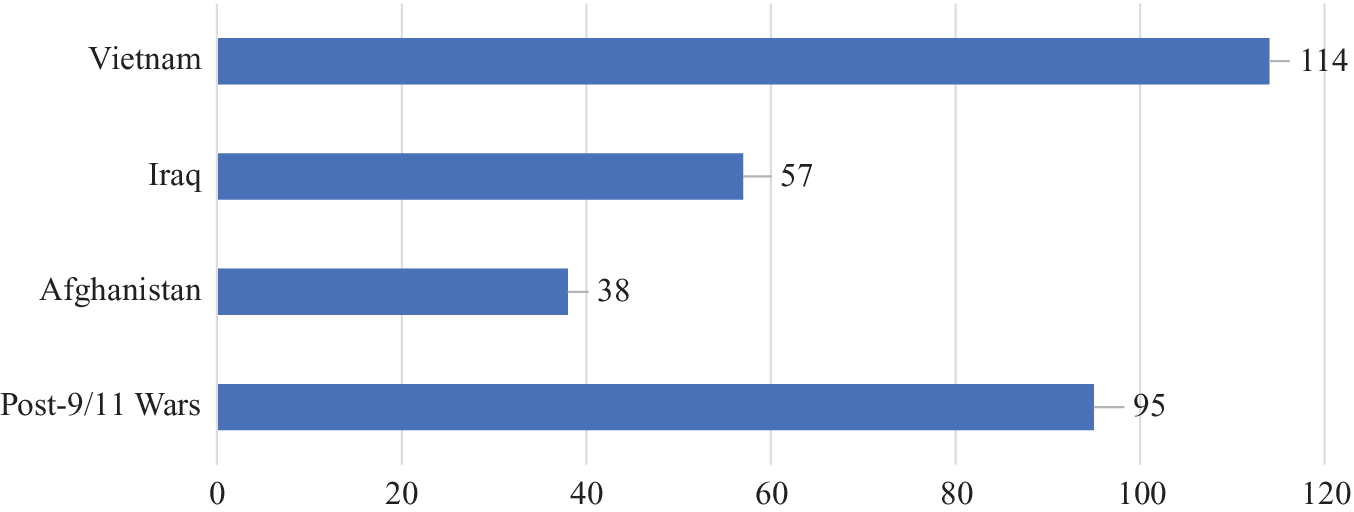
Even using a comparatively low VSL for the Vietnam War that is only one-fifth of the VSL applied to the more recent wars, the nominal value of the direct mortality costs of that conflict exceed those of the subsequent Middle East wars. For concreteness, consider estimates of the mortality costs based on the government estimates of the number of fatalities. The nongovernment assessments are usually larger. Figure 1 illustrates the mortality costs of these different conflicts. The mortality cost of the Vietnam War based on the nominal value of the mortality costs in that era was $114 billion. This cost was the highest value for any of the wars listed in Figure 1 even though each fatality is valued at just over one-fifth of the VSL that is used to value the fatalities in the post-9/11 wars. The mortality cost was $57 billion for Iraq, $38 billion for Afghanistan, and a combined cost of $95 billion for all post-9/11 wars. The relatively substantial human costs of the Vietnam War reflect the very large relative number of military fatalities and fatality equivalents for that conflict – 60,163, as compared to 6,436 for Iraq, 4,273 for Afghanistan, and 10,709 for the combined losses from all post-9/11 wars.
Mortality cost of wars ($ billions). Source: Figures for each conflict are the costs in billions of dollars based on governmental fatality and injury estimates reported in Viscusi (Reference Viscusi2019b).

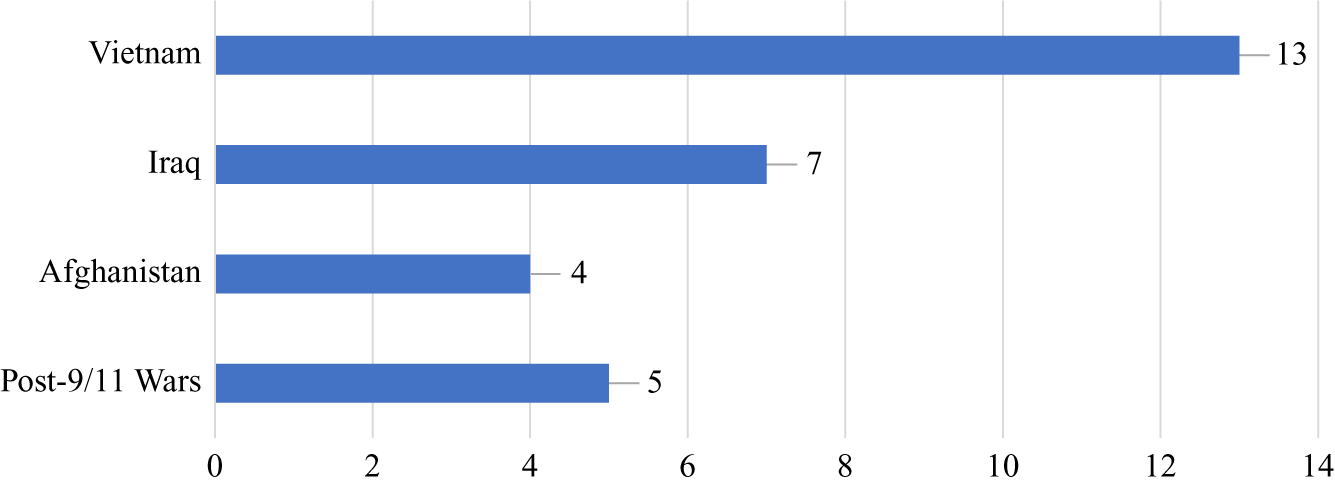
The level of the costs also illustrates the changing nature of the military engagements in terms of the emphasis on personnel who are placed at risk as opposed to the use of capital expenditures such as military airpower and drones. Figure 2 illustrates the fatality cost share of the total cost of these wars. This chart provides an instructive index of the relative capital-labor mix of military operations. During the Vietnam War, the fatality costs comprised 13% of the total costs of the conflict. For the more recent operations, the fatality cost share is 4% for Afghanistan, 7% for Iraq, and 5% for all post-9/11 wars. There has been a pronounced shift in the nature of the conflicts in terms of the role of mortality costs arising from the death of military personnel.
Percentage share of fatality costs in total costs of wars. Source: Estimates are based on governmental fatality estimates reported in Viscusi (Reference Viscusi2019b).

2.4 Unreasonable police shootings
The policy-relevant application of the VSL need not be restricted to federal government agencies. States and municipalities can use the VSL to evaluate risk-related policies. Section 4 examines use of the VSL in setting damages levels to deter unwarranted police shootings. While these awards are set by the courts and can potentially incentivize municipalities to adopt the VSL, municipalities can also use the VSL on their own initiative to monetize the mortality costs of unwarranted police shootings that result in fatalities. Officer training and allocation decisions affect the level of the risks but also impose administrative costs. The legal scholarship literature frequently suggests, incorrectly, that it is not feasible for municipalities to monetize the fatalities that can be prevented. However, application of the VSL can fill this intellectual void. Should municipalities not engage in these efforts on their own initiative, levying court awards following the guidelines discussed in Section 4 will compel them to internalize the use of the VSL to the extent that they anticipate the likely sanctions.
3. Rectifying the shortfall in sanctions for regulatory violations
Government agencies use the VSL to evaluate and set the level of regulatory standards. Promulgating a regulation does not in itself ensure compliance and a policy outcome. Noncompliance with government regulations has been a particularly prominent concern for agencies such as the OSHA, but the potential for noncompliance is more general. Profit-maximizing firms will only comply with regulations if it is in their financial interest to do so. Compliance with regulatory requirements typically involves substantial costs in terms of capital expenditures or changes in the firm’s operations. For example, the regulations designated as major regulations meriting OMB review impose costs of at least $100 million annually, so that the scale of regulatory costs is often considerable. To create adequate incentives for safety, the sanctions should be sufficiently large to lead the company to internalize the costs associated with risks.
Consider a situation in which a firm decides whether to violate a job safety standard and that in doing so there is some probability p that a worker will be killed. If the penalty for regulatory violations is given by the VSL, the expected costs that the firm will anticipate for the regulatory violation will be given by p × VSL. If the penalty level equals the VSL, this penalty will induce a profit-maximizing firm to undertake an economically efficient level of precautions that is consistent with workers’ valuation of the risk. Traumatic fatalities arising in regulatory contexts are generally apparent, so that the regulatory agency can monitor both whether fatalities have occurred and usually whether the fatality occurred as the result of a regulatory violation. Other types of fatalities, such as those resulting from illnesses or exposures with a latency period, may be more difficult to monitor. Let the probability that the fatality-inducing regulatory violation will be detected by the regulatory agency be given by q, where q may be below 1. Then for any given regulatory Penalty, the noncomplying firm will risk expected costs given by q × p × Penalty for a violation that leads to a fatality. To address the shortfall due to the lack of perfect enforcement, the value of the Penalty should be VSL/q in order to establish efficient levels of incentives. Whether the situation is that of perfect monitoring or imperfect monitoring, the VSL plays the critical role in defining the level of the economic harm that should be incorporated in the incentive structure. For concreteness, my discussion below will set aside the imperfect monitoring case and assume that q = 1. Consideration of the situation where the VSL alone should serve as the pertinent value of the regulatory sanction consequently serves as a lower bound on the sanctions needed to establish efficient levels of deterrence.
It is instructive to consider a review of the penalty levels following fatalities that have occurred after regulatory violations for agencies such as OSHA, the Food and Drug Administration (FDA), the Department of Transportation, and EPA. Each of these agencies is required to set sanctions for regulatory violations subject to statutory limitations. These statutory guidelines were typically determined at the establishment of the agency long before the adoption of the VSL for benefit-cost analyses. Since that time, the penalty levels have been updated occasionally for inflation, but there has been no fundamental revisiting of the penalty structure. To date, the VSL has not entered into the process for either setting statutory limits on regulatory sanctions or the selection of the penalty levels associated with these guidelines.
3.1 OSHA penalties for workplace fatalities
OSHA has adopted a quintessential regulatory enforcement approach. The agency sets standards for workplace health and safety, which focus principally on aspects of workplace design, operation, and chemical exposures. OSHA inspects firms to ascertain whether they are in compliance with the standards. Firms out of compliance are subject to regulatory sanctions. Many of these inspections occur after a fatality has occurred. Did the fatality involve a violation of one or more safety standards? How penalties are set when there is such a linkage is the focus here.
If there is a violation of regulatory standards, OSHA has several types of penalties that can be assessed. The category that is most pertinent to hazards that are sufficiently great to cause deaths pertains to violations that are designated as “serious,” which OSHA (U.S. Department of Labor, 1996) defines as follows: “A serious violation exists when the workplace hazard could cause an accident or illness that would most likely result in death or serious physical harm, unless the employer did not know or could not have known of the violation.”
Notwithstanding the gravity of this violation category, the Occupational Safety and Health Act of 1970 established a cap on each serious violation of $1,000, but this cap was subsequently raised to $7,000. The partial updating of penalty amounts for inflation by the Federal Civil Penalties Inflation Adjustment Improvement Act of 2015 undertaken during the Obama administration boosted the cap to $13,260 per violation on January 23, 2019. For violations that are willful or repeated violations, the statutory caps are greater – originally set at $70,000 and subsequently increased to $132,598 in 2018 (AFL-CIO, 2019, p. 18).
The implementation of the enforcement effort is either by federal OSHA inspectors or inspectors in programs administered by the states but only for those states that have been delegated the enforcement responsibilities. The median levels of penalties for regulatory violations associated with the death of a worker were $6,500 for federally operated OSHA efforts and $2,500 for state plans in Fiscal Year 2016 (AFL-CIO, 2017, p. 141). Viewed in terms of the total penalties assessed after fatality investigations rather than penalties per violation, the median penalty in Fiscal Year 2018 was $7,761 for federal inspections and $2,700 for state inspections (AFL-CIO, 2019).
The largest penalties ever levied by OSHA similarly fall short of the levels indicated by application of the VSL.Footnote 6 Accidents involving workplace fatalities figure prominently in the hierarchy of large OSHA penalties, as 9 of the top 10 penalties in OSHA enforcement history were for violations associated with fatalities. The two largest penalties levied by OSHA were against the BP Texas City Refinery in 2005 and 2009. The 2005 penalty of $21.4 million was the largest penalty OSHA had ever levied until that time. The explosion and fire at the Isomerization Unit of the BP Texas Oil Refinery in Texas City, Texas, killed 15 contractor employees and injured at least 170 BP employees and contractor employees. Averaged across the number of fatalities and not taking the nonfatal injuries into consideration, the average penalty was $1.4 million per fatality. Even this record-setting penalty amount was far below the VSL. To limit the level of the sanctions associated with the 2005 violations, BP committed to a series of abatement actions. Nevertheless, subsequently the BP facility experienced other fatalities attributable to regulatory violations. A contractor was killed in 2006 after being crushed between a pipe rack and a scissor lift; another contractor employee was electrocuted in 2007, and in 2008, both a contractor employee and a BP employee were killed. OSHA concluded that BP had failed to correct 270 instances of violations that it had committed to address and was penalized $50.6 million. There was an additional penalty of $30.7 million for 439 willful violations, but after negotiations between BP and OSHA, this penalty was subsequently reduced to $13 million. The total penalties for these two incidents involving the highest penalties in OSHA history are $85 million, which is in a much more meaningful range than the typical regulatory sanction. But even these substantial penalty outliers fall short of the efficient amount dictated by the VSL for the fatalities alone, setting aside all nonfatal injuries and other regulatory violations.
The penalty levels for the other largest regulatory sanctions in OSHA history are more modest. The regulatory violations that led to the fire and series of explosions resulting in 8 deaths and 42 worker injuries at the IMC Fertilizer/Angus Chemical Plant in Sterlington, Louisiana, resulted in penalties of only $11.6 million. In 2008, 14 workers were killed and many more were injured in a sugar refinery explosion at the Imperial Sugar plant in Georgia. The company was guilty of regulatory violations, most of which OSHA characterized as being willful violations. OSHA assessed a penalty of $8.8 million, which it subsequently reduced to $6 million, or about $429,000 per death. Two of the other top 10 penalties in OSHA history were levied in 2015, arising from one incident at the Kleen Energy Systems Natural Gas Power Plant. Hundreds of safety violations led to the death of 6 workers and injuries to 50 additional workers. The penalties for the two contractors involved in this construction-related explosion were $8.3 million and $6.7 million. The three other largest OSHA penalties were similarly below the sanctions that would be warranted based on the VSL. After one worker death associated with 118 regulatory violations at Samsung Guam, Inc., OSHA levied $8.3 million in penalties. An explosion at CITGO Petroleum that killed six workers led to penalties of $8.2 million that subsequently were settled for $5.8 million. Dayton Tire was fined $7.5 million for one worker death and 100 willful violations.
Even the largest sanctions in OSHA’s 50-year history fall short of the level needed to establish efficient incentives. To the extent that the penalties in these cases have been in a nontrivial range, it has not been because the VSL has served as the guidepost for setting penalty amounts. The presence of fatalities does, of course, increase the degree to which OSHA initiates inspections to identify the source of the fatality. However, the existence of a single violation that leads to a fatality does not enable OSHA to override the statutory caps. Usually, the large penalty amounts have emerged because of the myriad of regulatory violations or the presence of numerous repeated willful violations. Despite these additional considerations, the all-time record penalties fall short of the incentive levels warranted by the VSL.
Although the political task may be challenging, the mechanics of altering the statutory limits are straightforward. The approach can be similar for all regulatory agencies discussed below. As indicated in Viscusi (Reference Viscusi2018b), replacing the current penalty limit in 29 U.S.C. § 666(b) (2012) of $12,934 for each violation involving a fatality with the following language will suffice:
Any employer who has received a citation for a serious violation of the requirements of section 654 of this title, or any standard, rule, or order promulgated pursuant to section 655 of this article, or of any regulations prescribed pursuant to this chapter, shall be assessed a civil penalty of up to [$12,934] for each such violation [unless such a violation results in a person’s death, in which case the employer shall be assessed a penalty up to $11,000,000 per death caused by the violation].
3.2 FDA regulatory sanctions
The FDA administers programs involving several different types of products and levies regulatory sanctions that are subject to statutory caps. However, unlike OSHA regulations for which the adverse health outcomes are usually discrete traumatic events, the FDA often addresses incidents involving illnesses, some of which may not be immediately apparent. The area of FDA regulation for which it is most straightforward to assess the level of penalties and their relation to fatality risks is that of food safety because the deaths tend to be acute deaths rather than deferred risks with a substantial latency period. The FDA provisions relating to food safety as of 2017 involve caps of $76,352 for any individual introducing adulterated food into interstate commerce as well as a combined limit of $763,515 for any series of violations in a single proceeding (21 C.F.R. § 17.2, 2018; C.F.R. § 102.3, 2017). Thus, the highest possible penalty for any food safety situation has a penalty cap that is less than one-tenth of the VSL. Even highly publicized incidents of food contamination have not generated substantial sanctions.
In 2011, a Colorado farm operated by Eric Jensen and Ryan Jensen instituted an unsafe process for cleaning cantaloupes. The farm failed to store the cantaloupe in sanitary conditions and to clean the cantaloupe adequately with chlorine spray to remove harmful bacteria. As a result, the contamination of the cantaloupe with Listeria monocytogenes led to a least 33 deaths, possibly 10 additional deaths, 147 hospitalizations, and a miscarriage. The two operators of the farm pleaded guilty to the misdemeanor of introducing adulterated food into interstate commerce, for which they paid $150,000 each in restitution and had some modest nonmonetary obligations – 100 hours of community service, 6 months of home detention, and 5 years of probation.
The government levied a more substantial penalty after an Escherichia coli outbreak from contaminated Odwalla Inc. apple juice. This incident led to the death of a 16-month-old baby as well as illnesses affecting at least 66 people. The U.S. Department of Justice sought criminal sanctions for the adulterated food violations. The result was a penalty of $1.5 million, but $250,000 of this amount took the form of charitable contributions. This was the largest penalty the FDA had levied for a food injury case up until that time.
A subsequent meat-contamination case involving multiple fatalities led to a penalty of $4.4 million. Sara Lee Corporation marketed hot dogs and cold cuts that had Listeria contamination. At least 15 deaths and dozens of illnesses resulted from this contaminated meat. Even excluding any role of the penalties to reflect the value of the illnesses that occurred, the sanction was less than $300,000 per fatality.
In some cases, the FDA may also levy criminal sanctions. The Peanut Corporation of America (PCA) sold contaminated peanuts that it fraudulently claimed were grown and processed in the USA rather than in their actual place of origin, Mexico. The PCA peanuts led to 9 deaths and 22,000 illnesses. Financial sanctions became infeasible because PCA filed for Chapter 7 bankruptcy after the scandal emerged. However, three officials received prison terms ranging from 60 to 336 months.
As in the case of OSHA, the agency is currently constrained with respect to the financial sanctions that it can impose. Rectifying this shortcoming can be achieved in the same manner as for OSHA, through a straightforward modification of the statutory language in 21 U.S.C. § 333(f)(2)(A) to include the additional text: [unless the violation results in death, in which case the person will be fined not more than $11,000,000 per death].
3.3 Department of transportation: motor-vehicle safety
The salience of motor-vehicle accident risks combines with the potential for motor-vehicle defects to make the Department of Transportation’s National Highway Traffic Safety Administration (NHTSA) a particularly prominent agency in providing safety incentives for consumer products. NHTSA penalties are subject to two types of statutory limits, a maximum penalty for any particular regulatory violation and a maximum combined penalty for a related series of violations. The original statutory cap for each violation was set at $5,000, but over time, it has increased to $21,000. The statutory cap for a series of violations had long been $35 million, but in 2016, it increased to $105 million.
As a result of this penalty structure, the General Motors (GM) ignition switch recall incident in 2014 was subject to the modest penalty amounts. The problem with the ignition switch is that because of inadequate torque, it could switch from the “run” position to the “off” position leading to a loss of power and all power-related functions, including power steering, power brakes, and the functioning of frontal airbags. Because of GM’s awareness of the ongoing difficulties with this switch, one GM engineer referred to the switch as “the switch from hell.” The ultimate toll from this defect was 124 deaths and 275 injuries, as well as property damage to vehicles.
The penalty that NHTSA levied in 2014 was the amount specified by the statutory cap for any single defect, or $35 million. In terms of creating efficient levels of penalties for the fatalities alone, the appropriate amount based on VSL levels at that time would have been $1.24 billion. Even the update of the penalty ceiling after the GM ignition switch incident to a higher cap value of $105 million is less than one-tenth of the amount that is needed in order to create efficient incentives for safety.
Other regulatory sanctions are sometimes much greater but are directed at compensation of economic loss rather than incentives to reduce fatalities. NHTSA reached a settlement of $1 billion with the Takata Corporation, which had produced defective airbags. The defective design of the airbags led the airbags to explode, releasing shrapnel that killed 11 people. The product failure also led to a massive, multiyear automobile recall to replace these defective airbags with a less lethal product. It was the financial loss that figured most prominently in the regulatory sanctions, as $975 million was for restitution to the carmakers and the estates of those who suffered losses. There was only a $25 million payment to the USA as a result of this incident. As with the other instances discussed above, there is no reference to the VSL in setting penalty levels, and, more important, there is a disparity between the level of penalties and the incentive amounts that would be effective in creating efficient levels of deterrence.
Aligning regulatory sanctions for motor-vehicle defects with the VSL would lead corporations to internalize the use of the VSL in their corporate risk decisions. Auto companies previously undertook such risk assessments, but instead of the VSL, they valued the expected lives lost using the value of wrongful death awards in court cases. This procedure led to substantial undervaluation of mortality risks. Particularly important from a liability standpoint is that undertaking such analyses before the auto defect incidents indicated to jurors that companies had knowingly manufactured a product that was not as safe as it possibly could have been. The result is that jurors levied punitive damages amounts of at least $100 million for individual accidents involving Ford, GM, and Chrysler vehicles. The risks of undertaking corporate benefit-cost analyses of product safety components may have led companies to abandon this practice, as I document in Viscusi (Reference Viscusi2018a, Reference Viscusi2018b). The Valukas (Reference Valukas2014) report that GM commissioned on its ignition switch problems did not identify any evidence that GM had undertaken a benefit-cost analysis of the merits of safety devices, only an exploration of the costs associated with the recall after the defect had become apparent. From a conceptual standpoint, companies such as GM should incorporate the VSL into their corporate risk decisions as this value reflects the tradeoff that the purchasers of the product make in their purchase decisions. For example, the VSL implied by the optional purchase of airbags for vehicles is similar to labor market estimates of the VSL (Rohlfs et al., Reference Rohlfs, Sullivan and Kniesner2015).
A practical obstacle to regulatory sanctions leading companies to internalize the VSL in their risk analyses is that jurors could still conclude that the behavior of companies satisfied the criteria for punitive damages award if the accident would not have happened if the company had not chosen to forego a safety improvement because of its cost. Experimental studies of hundreds of jury-eligible citizens indicate that use of the VSL in the companies’ analyses would not eliminate the risk of punitive damages. Instead, it might increase the size of the damages award to the extent that the VSL provided a floor on the punitive damages amount or established an anchor that jurors thought that the damages amount should exceed. To eliminate this problem, there should be statutory protections given to companies, so that plaintiffs cannot introduce evidence regarding such analyses. The functioning of such protections would be similar to the legal shield that apology laws provide in medical malpractice contexts. In states with these laws, if doctors apologize to the patient or the patient’s family about an injury that occurred while being treated by the doctor, this apology cannot be introduced as evidence in a malpractice trial.
4. The VSL goes to court
4.1 Conceptualizing the use of the VSL
In much the same way that government agencies use the VSL to ascertain the appropriate money-risk tradeoff for proposed government regulation, it is also feasible to use the VSL to establish appropriate guideposts for safety in litigation contexts. The direct legal counterpart of governmental risk assessments occurs when assessing whether a company was guilty of negligence in producing a potentially dangerous product. The economic test for negligence has a benefit-cost structure. The additional cost of the safety device is warranted if it is less than the expected benefits, which in the case of fatality risks is the expected reduction in the number of deaths, multiplied by the VSL. To date, courts have utilized various negligence tests, with designations such as risk-utility analysis, but the courts have not applied the VSL in formal assessments to evaluate the adequacy of product safety levels.
Doing so could place the courts’ assessment of negligence on much sounder economic footing. At present, there is a tendency of juries to frame the decision in a manner that reflects hindsight bias and does not replicate the context of the safety decisions that companies must make. From the standpoint of a juror, the question is often whether the cost of the particular additional safety measure is less than the worth of the person who was killed. That is an impossible test to pass since the per unit cost of the safety improvement may be quite low, as in the case of the cost to move the placement of the gas tank to reduce the risk of fuel-fed fires, which was $11 per vehicle for Ford and $8.59 per vehicle for GM. The death of the identified victim will always loom larger than the per vehicle cost of such safety improvements. In practice, the corporate decision has a much broader prospective focus on whether the cost of the safety device across the entire product line is below the value of the expected number of lives that will be saved using the device. Recognizing the role of the VSL and conceptualizing its function in this manner would frame the jury’s task in judging corporate negligence in an economically sound manner.
In situations where punitive damages are warranted, the legal objective of providing adequate levels of deterrence coincides with the economic role of the VSL. Setting the total damages amount given by the sum of compensatory damages and punitive damages equal to the VSL establishes these incentives. When there is a probability of detection below 1.0, damages amounts can establish appropriate incentives following the approach outlined in Section 3.
The most frequent manner in which the VSL has surfaced in legal proceedings is in setting the value of compensatory damages in wrongful death cases. This procedure, which has been designated “hedonic damages,” is sometimes suggested as a measure for compensating victims for the loss of enjoyment of life. However, if the victim is already dead, the compensation will not enhance the person’s welfare. As a measure of appropriate compensatory damages in wrongful death cases, the VSL may establish appropriate levels of deterrence but will provide levels of insurance for the income loss to survivors that exceeds the optimal insurance amount. To avoid this problem, I have proposed that use of the VSL to set damages should usually be limited to situations in which punitive damages are warranted, as incentives for deterrence are important in that context. Courts generally have rejected the use of the VSL as a measure of damages in wrongful death cases (Ireland, Reference Ireland2012).
4.2 Deterring police shootings with damages awards based on the VSLFootnote 7
A potential application of the VSL to create effective incentives for safety is with respect to setting damages levels after unreasonable police shootings in which the killings by the police could not be justified based on balanced consideration of the threat posed by the victim and the harm that results from exercising fatal levels of force. These damages in turn would provide financial incentives for municipalities to value the risks posed by police actions. Although the legal guidelines are murky for distinguishing what constitutes an unreasonable killing by the police, there are some definitive guideposts that are sometimes clearly violated. The current U.S. legal standard is that using fatal levels of force against the victim requires that the person pose an immediate threat and that the force level is justified given the level of the threat. The Fourth Amendment to the United States Constitution prevents exercising unreasonable force against the citizenry. Among the legal guidelines that have emerged in landmark court decisions is that in Tennessee v. Garner, 471 U.S. 1, 11 (1985), the court ruled that police cannot use lethal force on an unarmed fleeing suspect. There is further elaboration as to what use of force is reasonable in Graham v. Connor, 490 U.S. 386, 396 (1989). That decision explored the concept of “reasonableness,” alluding to the “totality of circumstances” and whether the victim posed a significant threat to others. Implicit in such discussions is an approach that is in the general spirit of concerns that comprise a benefit-cost conceptualization but lacking in the precision of an actual benefit-cost test.
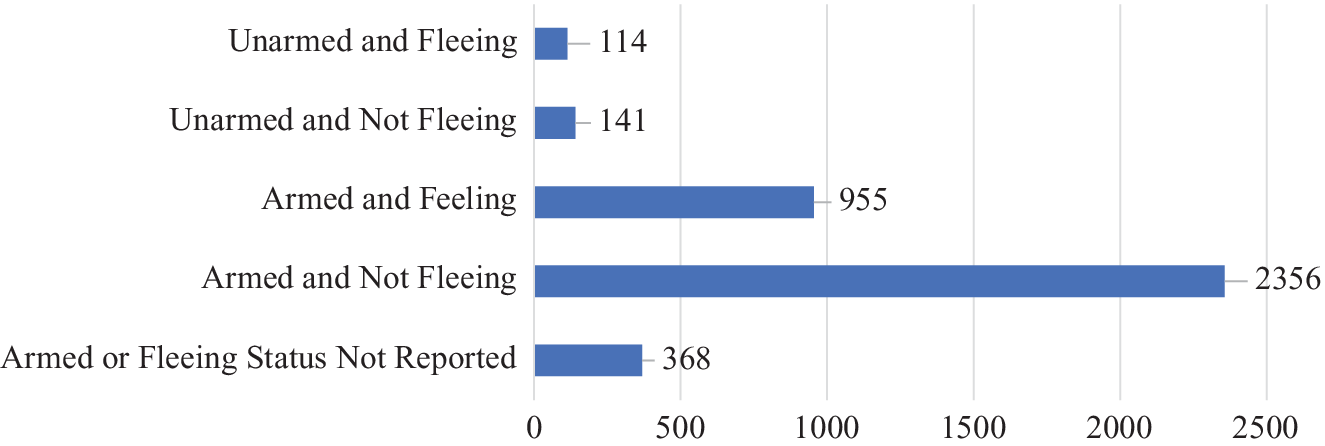
Although there is no definitive categorization in available databases of which police shootings are warranted and which are not, the Washington Post Fatal Force database provides the most comprehensive ongoing monitoring of police shootings and the characteristics of the shooting. Figure 3 illustrates the distribution of deaths from police shootings over the 2015–2018 period and the monetized value using a VSL of $10 million. The categorizations of the types of shootings are instructive, even if not fully dispositive with respect to which shootings constitute a reasonable use of force. Many of these shootings clearly do not meet the criteria for shootings that can be categorized as exercising a reasonable use of force. The most unreasonable cases involving the use of fatal force are those in which the fatally shot victim was unarmed. Fortunately, the number of fatal shootings in which the injured victim is unarmed is relatively low, with 114 shootings where the unarmed victim is fleeing and 141 shootings where the unarmed victim is not fleeing. The largest category of victims of police shootings consists of those who are categorized as being armed, implying that many but not necessarily all such shootings involved reasonable uses of force. The most frequent way in which victims are armed involves a firearm, which was true in 56% of these cases. In at least one instance, the victim had been surprised while working in his garage with the door closed and upon opening the door was holding an unloaded gun. Many of the victims were “armed” with other objects, including a knife, a flashlight, a pen, a stapler, a rake, and a toy gun. Of the armed victims, 955 were fleeing the scene, usually reducing their threat, and 2,356 were not fleeing. The largest category of armed victims who were not fleeing suggests that unwarranted police shootings are not the norm. There were also 368 shootings for which the armed or fleeing status was not reported.
Number of fatal police shootings by victim status, 2015–2018. Source: The shootings counts are from the Washington Post Fatal Force data base, analyzed in Viscusi and Jeffrey (Reference Viscusi and Jeffrey2021). The total number of fatal police shootings in 2015–2018 was 3,934.

If these mortality risks are valued at $10 million per death, the overall mortality cost of the fatal police shootings over the 2015–2018 period is $39.34 billion. In terms of the component costs, the values are $1.14 billion for victims who are unarmed and fleeing, $1.41 billion for victims who are unarmed and not fleeing, $9.55 billion for victims who are armed and fleeing, $23.56 billion for victims who are armed and not fleeing, and $3.68 billion for victims for whom their armed or fleeing status is not reported.
Ideally, there should be efforts to avoid all of these fatalities as well as those to the police and possible bystanders. But, from the standpoint of likely benefit-cost comparison, there may be much greater concern with preventing fatalities that are the result of shootings in which the use of force cannot be judged to be reasonable. Irrespective of their categorization, the calculations above indicate that these fatality costs can be monetized and potentially taken into account when designing administrative efforts to structure policies to promote appropriate use of force.
Setting the level of penalties for police shootings equal to the VSL would be appropriate if the usual criteria for punitive damages amounts are met, such as police actions that are assessed by jurors as being malicious, reckless, or displaying a callous disregard for the well-being of the deceased. The potential role of the VSL is that it establishes a quantitative framework for determining the total value of damages in situations where punitive damages are warranted. Coupling the existence of a well-defined empirical framework with a sound economic and deterrence-oriented rationale should increase the extent to which the courts adopt this approach.
The damages awards to date have fallen short of the values that would emerge based on application of the VSL. Despite the widespread media attention to controversial police killings, the only damages amount that has met the level of the VSL was the $20 million settlement in the killing by the Minneapolis police of Justine Damond, who was also known as Justine Ruszczyk before she changed her name legally to that of her fiancé. This killing of an unarmed recent immigrant from Australia after she had called the police to address a neighborhood disturbance during the night garnered international media attention, no doubt contributing to this case being an outlier in such awards. In this instance, using the VSL as the damages guidepost would lead to a lower payment level than the actual out-of-court settlement.
Other levels of compensation are much lower. One hurdle is that it is difficult to file any successful claim because the police department has qualified immunity. Under Monell v. Department of Social Services, 436 U.S. 658 (1978), it is not possible to proceed against a municipality unless one can demonstrate that there has been a constitutional violation due to policies or customs of municipalities, not just the officer’s actions. To the extent that problems are judged to be systemic, as in the case of the killing in 2020 by Minneapolis police of George Floyd, it may be possible to overcome this hurdle. But in many other instances, there is no prospect for obtaining a damages award.
A detailed review by Viscusi and Jeffrey (Reference Viscusi and Jeffrey2021) found that compensatory damages for wrongful death cases resulting from shootings by the police are about an order of magnitude below the VSL. Based on the Civil Justice of State Courts data, wrongful death cases in which the police are the defendants led to a median court award of $787,500 and a median out-of-court settlement of $650,000. Focusing on a selected sample of the incidents that have received the most media coverage generates a somewhat larger payment level of $1.4 million in these cases.
5. Conclusion
These examples illustrate the more general theme in Viscusi (Reference Viscusi2018a) that the VSL should play a more diverse and prominent role than at present. These functions fall into two principal categories, setting efficient levels of risk and providing adequate financial incentives to reduce risk. The first category of determining efficient risk levels is the now well-established role of the VSL in regulatory impact analyses for proposed major government regulations. But this function could be extended more generally to include governmental policy evaluations that are not proposed regulations, risk analyses by companies to set the levels of product safety, and assessments by the courts of whether risk behaviors and risk components pass a negligence test that is tantamount to a conventional benefit-cost test. The examples of defense-related decisions and hazardous waste cleanups are but two of the many policy areas where benefit-cost analyses employing the VSL could play a more prominent role. The second category of applications of the VSL is more novel in that it involves the use of the VSL to establish the appropriate price signals to generate efficient levels of risk. Government agencies could abandon their current, highly restrictive caps on damages so that the penalties for fatalities resulting from regulatory violations can be aligned with the VSL rather than the comparatively trivial amounts that have changed very little during the half century of risk and environmental regulation. The judicial system also is a prominent social mechanism for establishing safety incentives. Linking the total value of damages in wrongful death cases to the VSL would enable these awards to establish the appropriate price signals for safety and provide much needed structure to the current, highly volatile punitive damages regime.
What is particularly noteworthy is that these roles of the VSL are interactive rather than being on parallel tracks. Incorporating the VSL in setting the value of regulatory sanctions and in determining the level court awards when deterrence issues are a prominent concern will send a price signal to companies that reflects the efficient rate of tradeoff between cost and risks. This price signal in turn will establish the monetary price that firms should attach to mortality risks in their corporate risk analyses. Valuing risks to life in a manner that is consistent with the VSL should not be viewed as antithetical to corporate interests or as an altruistic effort to protect the company’s consumers. Most of the VSL estimates used by government agencies are derived from the market-based preferences for risk reflected by workers in their job risk decisions and by consumers in their product safety decisions. Providing an efficient level of safety for products and in the workplace using the VSL simply incorporates the preferences of consumers and workers with respect to risk.
While much progress can be made based on the initiative taken by government agencies and private companies, there are two principal obstacles to progress. First, the levels of penalties for regulatory sanctions is often constrained by agency statutes. There must be statutory reforms to raise these limits in order for government agencies to impose sanctions at the levels dictated by use of the VSL. Second, if companies undertake explicit risk analyses in which they monetize the value of mortality risks associated with their products, they are likely to be subject to punitive damages because undertaking the analysis itself demonstrates that the company was aware of the risk and nevertheless chose to market a product that did not have every feasible safety feature. An ideal solution to eliminating this disincentive to responsible risk analysis is to provide companies with a statutory shield similar to that provided by apology laws for medical malpractice. In the absence of these statutory reforms, it is likely that governmental and private behaviors will continue to promote levels of safety that fall short of the optimal amount.