Coalition governments pose a dilemma for political parties. Entering a coalition government allows political parties to obtain control over political offices and to enact policies. However, unlike political parties in single-party governments, which can independently decide legislation, political parties in coalition governments are constrained by their coalition partner. Coalition governments are composed of two or more political parties that pursue their own policy goals and issue priorities. In order to ensure the stability of the cabinet and to effectively govern together, coalition parties need to coordinate their efforts. Even though coalition parties typically have different policy goals, governing together and adopting joint policy initiatives therefore requires compromise. However, at the same time, coalition parties are also subject to electoral competition. In order to successfully compete in elections, coalition parties need to differentiate from their partners to strengthen their own policy profile. Thus, while coalition parties govern together, they compete for votes alone. As a result, coalition parties have to reconcile two realities. On the one hand, they need to demonstrate unity, but at the same time, they have to maintain and emphasize their own profile.
In this study, we argue that political communication is an important instrument through which coalition parties can accommodate both imperatives. Governing in coalitions often involves compromise as coalition partners have different policy goals. Coalition parties therefore frequently adopt legislation that accommodate the demands of their partners, but which are not necessarily in line with what voters expect from them. It is therefore important that coalition parties communicate directly with their voters in order to justify their legislative activities and to differentiate themselves from their coalition partner. Political communication constitutes an important channel through which coalition partners can directly communicate their policy priorities to their voters without being constrained by parliamentary rules or their coalition partner (Grimmer Reference Grimmer2013). Coalition parties choose independently what to communicate and when to communicate it which makes political communication an important instrument of party competition.
The literature on coalition governments has devoted little attention to political communication. Rather than focusing on the day-to-day politics when the real business of government takes place, the coalition literature has largely focused on the formation and the dissolution of cabinets. One can distinguish three broad strands of research: studies investigating the formation, the survival, and the governance of coalition governments. First, coalition scholars have devoted considerable attention to explaining which parties are likely to form coalitions and to predicting the allocation of ministerial portfolios and policy benefits among them (see e.g., Laver and Shepsle Reference Klüver and Spoon1996; Bäck, Debus and Dumont Reference Baumgartner and Jones2011; Schermann and Ennser-Reference Schermann and Ennser-JedenastikJedenastik 2014b). Second, with regard to cabinet dissolution, previous research has examined the determinants of cabinet duration and coalition survival (see e.g., Warwick Reference Warwick1994; Lupia and Strøm Reference Lewis-Beck and Stegmaier1995; Saalfeld Reference Saalfeld2008). Third, scholars of coalition governance are concerned with the control mechanisms that make it possible for coalition partners to overcome agency problems created by the delegation to cabinet ministers (see e.g., Thies Reference Thies2001; Müller and Strøm 2008a; Müller and Meyer Reference Meyer2010; Martin and Vanberg Reference Martin and Vanberg2011; Falcó-Gimeno Reference Falcó-Gimeno2014).
While the formation, the governance, and the dissolution of coalition governments have received extensive scholarly attention, there are only very few studies that examine the policy activities of coalition governments throughout the legislative term. Martin (Reference Martin and Vanberg2004) showed that both salience and divisiveness account for the timing of legislative bills in coalition governments. Issues that are attractive to all coalition members are prioritized while divisive issues are postponed. Studying the compliance with semi-annual legislative programs, Zubek and Klüver (Reference Zubek and Klüver2015) similarly find that legislative bills are more quickly approved by coalition governments if they are salient to coalition parties and if there is no disagreement about these issues. Thomson (Reference Thomson2001), however, finds that pledge fulfillment is less likely if coalition parties disagree about a pledge while salience does not have an effect on its enactment. A recent study of three Austrian coalition governments furthermore shows that institutional determinants significantly influence the fulfillment of electoral pledges while party preferences and issue salience do not have an impact on whether and when a pledge is enacted (Ennser-Jedenastik and Schermann Reference Ennser-Jedenastik and Schermann2013; Schermann and Ennser-Reference Schermann and Ennser-JedenastikJedenastik Reference Schaffner2014a).
While analyzing the timing of legislative bills and the conditions under which electoral pledges are fulfilled considerably enhances our understanding of the legislative activities of coalition governments, little attention has been paid to how coalition governments communicate with their voters throughout the legislative term. Martin and Vanberg (Reference Lupia and Strøm2008) analyze how coalition parties use legislative speeches to communicate with voters. Taking the length of legislative speeches as an indicator for the position of political parties on the debated issue, they find that coalition parties use legislative speeches as a device to justify their policy compromise on divisive issues in the light of upcoming elections. However, while Martin and Vanberg (Reference Lupia and Strøm2008) make an important contribution to understanding the parliamentary behavior of coalition parties, speeches are constrained by procedural parliamentary rules and are therefore a problematic data source for measuring political communication. Political parties can only give speeches on policy issues that have been scheduled on the parliamentary agenda. What is more, due to the extensive array of parliamentary control instruments that are available to opposition parties in many parliamentary systems (Saalfeld Reference Riker2000), coalition governments primarily have to respond to opposition parties.
This study therefore aims to close this important gap in the literature by studying the determinants of political communication strategies of coalition parties on the basis of press releases, which constitute an ideal data source to analyze what coalition parties communicate to their voters (see also Klüver and Sagarzazu, Reference King, Tomz and Wittenbergforthcoming). We argue that coalition parties have to respond to different logics: On the one hand, they need to demonstrate unity in order to maintain and strengthen the coalition to effectively govern together. On the other hand, coalition parties need to emphasize their own profile in order to attract voters. We posit that the electoral cycle determines which imperative dominates political communication of coalition parties. Based on a quantitative text analysis of >21,000 press releases published by coalition parties in Germany between 2000 and 2010, we empirically test our theoretical expectations and show that while differentiation prevails at the beginning and the end of the legislative term in close proximity to elections, compromise dominates the middle of the term when coalition governments focus on enacting a common policy agenda.
Issue Attention of Coalition Parties
Drawing on saliency theory, we expect that parties compete with each other by selectively highlighting policy issues to mobilize voters. Building on insights from coalition theory, we argue that coalition governments constrain such party competition as governing in a coalition requires compromise in order not to risk breaking the government. Coalition parties therefore have to reconcile the tension between maintaining their own profile and demonstrating unity with their coalition partner. We hypothesize that the stage of the electoral cycle determines whether differentiation or unity prevails.
Before we theorize about the determinants of political communication, it is important to understand the underlying motivation of coalition party behavior. We assume that parties are rational, goal-oriented and purposeful collective actors that aim to maximize the achievement of their preferences. Following Riker (Reference Riker1962), we consider parties as office-seeking actors. Parties seek to win elections for instrumental reasons as they are primarily interested in political offices. Political parties aim at winning elections in order to gain control over executive posts. We hereby make no assumptions about the underlying motivation for office-seeking behavior of political parties. Political offices might be valued for intrinsic or instrumental reasons (Strøm Reference Strøm1990).
The Electoral Imperative
What strategy do political parties pursue in order to obtain control over political offices? Theories of party competition have largely been dominated by positional theories such as the Downsian proximity model (Downs Reference Downs1957) or the directional model (Rabinowitz and Macdonald Reference Müller and Meyer1989). These theories suggest that parties seek to maximize the number of votes by adjusting their policy positions in response to the preference configuration of voters on certain policy issues. Changing policy positions may, however, be difficult as parties are constrained by their ideology, their reputation and intra-party factors (Meyer Reference Martin2013). Agenda-setting scholars by contrast argue that political parties compete with each other by campaigning on different policy issues (Jones and Baumgartner Reference Jae-Jae and Klüver2005; Green-Pedersen and Mortensen Reference Green-Pedersen and Mortensen2015). The literature on communication refers to this strategy as “priming” certain issues in order to change the importance given to policy issues in political decisions (Iyengar and Kinder Reference Iyengar and Kinder1987). Similarly, Riker (Reference Rabinowitz and Macdonald1993) argues that campaign messages are not designed to engage in a discussion with opposition parties, but to increase the salience of policy issues on which a party is perceived as credible.
Saliency theory applies this thought explicitly to party competition (Budge and Farlie Reference Budge1983; Budge Reference Budge and Farlie1993). The central idea is that parties compete with each other by emphasizing different policy priorities rather than by directly opposing each other on the same issues. Saliency theory argues that parties can gain advantages by selectively highlighting favorable issues irrespective of what position they have on these issues. Political parties prime voters to consider policy issues as important for their vote choice on which they have an advantage. We accordingly argue that winning elections is primarily about selectively highlighting political issues on which political parties can mobilize voters. Political parties seek to influence the campaign agenda by highlighting policy issues that promote their strengths and by avoiding policy issues on which their competitors have an advantage. We therefore expect that political parties engage in selective issue emphasis to increase the salience of favorable policy issues. For instance, a left-wing party may choose to focus on social welfare issues in an election campaign, whereas a liberal party may choose to focus on the economy or on civil rights.
The Coalition Imperative
However, while political parties can independently choose their issue priorities in election campaigns, they are constrained in their selective issue emphasis once they enter a coalition government. Unlike in single-party governments where political parties can independently make decisions, coalition governments require coordination and compromise among coalition parties. Jones and Baumgartner (Reference Jae-Jae and Klüver2005) have referred to this coordination requirement as institutional friction caused by proportional electoral systems. Governments in these political systems cannot single-handedly promote policy change, but are constrained by multiparty governing coalitions. In many parliamentary systems, in particular those with proportional representation, none of the political parties is able to win a majority of the seats in the legislature. In such situations, coalition governments consisting of at least two different parties have typically been formed to avoid the transaction costs, the uncertainty, and the instability of minority governments. Political parties that join a coalition government sacrifice their independence for the sake of controlling political office. Coalition governments are not intrinsically valued, but they constitute a means for office-seeking parties to obtain ministry portfolios.
Research on coalition governance has pointed at the difficulties of governing together in coalition cabinets. Coalition parties typically have diverging policy preferences and issue priorities that need to be reconciled. For instance, when the coalition government between the German Christian Democratic Party (CDU)/Christian Social Union (CSU) and the Free Democratic Party (FDP) was formed in 2009, the FDP first called for a grand tax reform, which was its major policy priority that it advocated for throughout the election campaign. However, the CDU/CSU fundamentally opposed such a large scale reform of the German tax system and it was therefore never enacted. After initially pushing for the reform and differentiating from the CDU/CSU on this policy issue, the FDP later gave in for the sake of maintaining the government even though it implied considerable reputation and electoral costs. Thus, coalition parties cannot independently promote their own policy priorities, but they have to agree on a common agenda. In order to overcome policy disagreements within a cabinet, coalition parties frequently employ control mechanisms such as coalition agreements, junior ministers or parliamentary committees to keep their coalition partners in line (Thies Reference Thies2001; Müller and Strøm Reference Müller and Strøm2008a; Müller and Strøm Reference Müller and Strøm2008b; Müller and Meyer Reference Meyer2010; Martin and Vanberg Reference Martin and Vanberg2011). Accordingly, Baumgartner and Jones (Reference Bäck, Debus and Dumont1993) argue that issue attention cannot be understood by only focusing on one single stage of decision-making as policy-making consists of different stages. If policy issues do not rise on the agenda of a coalition party it may not be caused by the party’s unwillingness to deal with the issue, but by opposition from the coalition partner during the government formation stage in which coalition parties negotiated their common policy priorities.
Hence, an important precondition for the functioning and the survival of a coalition government is unity (Martin and Vanberg Reference Lupia and Strøm2008; Martin and Vanberg Reference Martin and Vanberg2011). Successful governance requires compromise. Once political parties entered a coalition government they have to coordinate their activities with their coalition partner. Parties are not able to single-handedly make political decisions, but they need to consult their coalition partner in order not to risk the breakup of the government (Warwick Reference Warwick1994; Lupia and Strøm Reference Lewis-Beck and Stegmaier1995). The benefits of cooperation are greater than the benefits of differentiation as government stability ensures control over political offices. Office-seeking parties therefore have an incentive to maintain the coalition in order to avoid the loss of executive posts. Instead of focusing on their own policy priorities, coalition parties therefore deal with issues that are supported by all coalition members in order to demonstrate unity and to maintain the stability of the cabinet.
The Electoral Cycle
Coalition parties are therefore torn between two different imperatives. On the one hand, they have to selectively prioritize policy issues on which they have an advantage in order to mobilize voters. On the other hand, they have to coordinate with their coalition partners that typically have diverging policy priorities, which requires compromise between coalition parties. How can we explain which of these forces prevails? Our central argument is that the stage of the electoral cycle explains whether differentiation or unity prevails. The time the government has available until the next election is a major factor that shapes the behavior of coalition parties as the cost-benefit calculation considerably changes over the lifetime of a coalition (Lupia and Strøm Reference Lewis-Beck and Stegmaier1995).
At the beginning of the legislative term, political parties have just come out of an electoral race in which they have competed against each other for votes. Political parties have run a carefully designed election campaign in which they selectively focused on policy issues on which they have an advantage to mobilize voters. We expect that the issue differentiation between political parties, which characterized the election campaign, continues for a while even after the election took place for the following reasons. First, political parties cannot change their policy activities from one day to the next. After campaigning on specific policy issues for several months, they cannot simply abandon these issues as this would considerably disappoint voters and decrease their credibility. Second, political parties make several election promises to voters during the electoral campaign. After the election, coalition parties have an incentive to signal compliance with their commitments to voters by enacting their election promises right at the beginning of the term as media attention and public monitoring is still high at this stage. Accordingly, empirical research on pledge fulfillment finds a cyclical effect according to which coalition parties enact their pledges primarily at the beginning of the term (Ennser-Jedenastik and Schermann Reference Ennser-Jedenastik and Schermann2013; Zubek and Klüver Reference Zubek and Klüver2015). Third, after running in elections alone, political parties have to get used to governing together with a partner. There is therefore a learning effect as coalition parties have to adapt to the new situation in which they have to coordinate their activities with at least one other party. Hence, we argue that the beginning of the legislative term is characterized by considerable differentiation between coalition parties.
However, after an initial period of focusing on different issues, which might have caused problems and conflicts within the cabinet, coalition parties settle on a common issue agenda to effectively govern together and ensure the stability of the government. Coalition parties avoid disagreement in order to strengthen and maintain the coalition to secure the political offices they control. The survival of the government is a precondition for maintaining their political offices and office-seeking coalition parties, therefore have strong incentives to avoid any activities that risk the breakup of the government. Control mechanisms are in place that allow coalition partners to closely monitor their partners and keep them on track (Thies Reference Thies2001; Müller and Strøm 2008a; Müller and Meyer Reference Meyer2010; Martin and Vanberg Reference Martin and Vanberg2011; Falcó-Gimeno Reference Falcó-Gimeno2014). Coalition parties therefore prioritize policy issues that are supported by all members of the coalition while avoiding issues on which they disagree. As the benefits of cooperation outweigh its costs, coalition parties focus on a common issue agenda. Thus, in order to maintain the stability of the coalition, all partners talk about the same uncontroversial issues in the middle of the term when they enact a common legislative agenda.
A the end of the legislative term, coalition parties look ahead and are primarily concerned about reelection to secure political offices in the next legislative term (Lupia and Strøm Reference Lewis-Beck and Stegmaier1995). The imperative to demonstrate unity will be replaced by an imperative to gain reelection. Given that coalition parties suffer from the problem that differences between them are not perceived by voters (Fortunato and Stevenson Reference Fortunato and Stevenson2013), coalition parties adjust their issue priorities to clearly differentiate from their partners. Rather than talking about the same unifying issues, they differentiate from their partners to highlight their own policy profile. Coalition parties therefore abandon policy issues on which they previously worked together and focus on favorable policy issues that separate them from other competitors. They attempt to mobilize voters by directing the public debate toward policy issues on which they are perceived as being more competent than their opponents. The costs of cooperation become larger than its benefits as there are only a few months left in the current government and coalition parties would risk their reelection by not differentiating themselves from their coalition partner (Lupia and Strøm Reference Lewis-Beck and Stegmaier1995). For instance, Wolfgang Kubicki, one of the FDP leaders commented a few days after the Bundestag election in 2013 when the FDP was voted out of the parliament that “coalition parties only win elections if they differentiate from their coalition partner” and that “the FDP should not have collaborated so much with the coalition partner.”Footnote 1 What is more, coalition parties can more easily promote their own issue priorities as their partners are less likely to use control mechanisms toward the end of the electoral cycle (Müller and Meyer Reference Meyer2010).
In conclusion, we expect that the political communication strategies of coalition parties change over the course of the electoral cycle. In order to win elections, political parties selectively highlight policy issues on which they have an electoral advantage. However, when parties entered a coalition government, they cannot independently select their issue focus, but they have to coordinate with their coalition partner. In order to effectively govern together and not to risk the break of the government, coalition parties need to compromise and agree on a common agenda. However, such coordination is costly as coalition parties cannot highlight their particular policy profile to attract voters. Coalition parties therefore have to reconcile the tension between maintaining their own profile and demonstrating unity with their coalition partner. We expect that the stage of the electoral cycle determines what coalition parties communicate to their voters. More specifically, we hypothesize that diversity in issue attention among coalition partners follows a U-shaped form. While differentiation prevails at the beginning and the end of the legislative term in close proximity to elections, compromise dominates the middle of the term when coalition governments focus on enacting a common policy agenda.
Hypothesis: As distance from the last national election increases, the diversity in issue attention among coalition parties decreases; however, as distance to the next national election decreases, diversity in issue attention among coalition parties increases again.
Research Design
Coalition Governments in Germany
In order to test our theoretical claims, we study political communication strategies of coalition parties in Germany for three different reasons. First, Germany is typically governed by multiparty coalition governments. In the post-war period, Germany was only governed once by a single-party government from July 1960 until November 1961. Political parties in Germany therefore have a long-standing experience with coalition governments and are well aware of their electoral implications, which they have to bear in mind for strategically positioning themselves. Second, Germany is characterized by a high degree of government stability. In Germany’s over 60-year history, only four elections were called early out of which one was caused by German reunification. Party competition therefore takes place in a stable environment where the electoral cycle is hardly interrupted. Political parties therefore take into account the timing of elections in their strategic considerations. Finally, as we outline in more detail below, we use daily press releases published by coalition parties to analyze their political communication strategies. As press releases of all Bundestag parties are publicly available on their websites or in archives of political foundations, Germany is also an ideal case due to data availability.
Measuring Issue Attention
In order to analyze political communication strategies of coalition parties, we rely on the press releases published by their party group press offices in the German Bundestag. Press releases are an ideal source for the study of party communication (see also Grimmer Reference Grimmer2010; Grimmer Reference Grimmer2013; Klüver and Sagarzazu, Reference King, Tomz and Wittenbergforthcoming). They are published daily so that we can study issue attention on a day-to-day basis, which makes press releases superior to election manifestos and expert surveys. In addition, they are published by each coalition party so that we can measure issue attention separately for each member of a coalition that constitutes a major advantage over legislative activity data. Press releases are furthermore unconstrained as parties can freely choose what to communicate to the public. Unlike speeches or questions in parliament, press releases are not bound by the parliamentary agenda and parties can choose independently what issues they want to talk about. Press releases are furthermore an ideal instrument to present themselves to their constituents. Newspapers regularly pick up press releases issued by political parties and communicate their content to citizens (Schaffner Reference Saalfeld2006).
We study communication strategies of coalition parties in Germany from 2000 until 2010. This time frame allows us to examine the dynamics of issue attention across four legislative terms and four cabinets with three different partisan compositions. Following 16 years of government by the CDU, its Bavarian sister party (CSU) and the FDP, the Social Democrats lead by Chancellor Gerhard Schröder formed a coalition government with Alliance 90/The Greens (Greens) in October 1998.Footnote 2 The next regular election in 2002 confirmed this government and it was only in 2005 when Chancellor Schröder called for early elections by deliberately loosing a vote of confidence that the composition of the coalition government changed. From November 2005, a so-called “Grand Coalition” composed of the CDU/CSU and the Social Democratic Party (SPD)-governed Germany, which was lead by Angela Merkel (CDU). The next regular election in September 2009 lead to another change in the composition of the German government as the CDU/CSU coalesced with the liberal FDP. Hence, our sample includes very different government types. Table A1 in the online appendix provides information about the changes in cabinet composition from 2000 until 2010.
Every political party in the Bundestag has a press office that is responsible for the publication of press releases of their party groups. We gathered all the press releases published by coalition parties between January 2000 and December 2010. All press releases were electronically available. As all press releases by the SPD and the CDU/CSU were published on their party group websites, a computer script was used to automatically download all press releases. As the press releases of the Greens and the FDP were not available online, we contacted their Bundestag press offices that provided us with all press releases published between 2000 and 2010. According to party officials, our data set contains all press releases published in the years 2000 until 2010 so that there is no selection bias. Table A2 in the appendix shows the total number of press releases published between 2000 and 2010 while Table A5 provides information about their average length.Footnote 3 On average, each party published about 1126 press releases/year, which corresponds to approximately three press releases per day. Press releases therefore provide a detailed account of the daily issue attention of political parties.
It is important to note the distinction between the full universe of press releases published by the four main party groups (N=44,957) and those published by coalition parties (N=22,092). As we first use the press releases to identify the political issues on which German parties compete, we analyzed all the available press releases to make sure that we capture the entire universe of policy issues that structure party competition in Germany and not only government-specific issues. However, in order to measure political communication strategies by coalition parties, we then limit the analysis to the attention that government parties pay to the identified issue areas and therefore only analyze press releases published by coalition parties. It furthermore has to be noted that the CDU/CSU press releases for the year 2000 could not be provided by the party group and could therefore not be included in the data set. However, they only represent <5 percent of the entire sample of press releases and as the CDU/CSU was not in government in 2000, we are therefore confident that the missing press releases do not bias our results.
We classify press releases into issue areas using a quantitative text analysis technique developed by Grimmer (Reference Grimmer2010) that applies a bayesian hierarchical topic model to textual data. This so-called expressed agenda model is an unsupervised learning method that classifies texts into distinct categories based on the co-occurrence of words across documents. The underlying assumption of the expressed agenda model is the well-established idea that topics are expressed with a distinctive set of words. Words that belong to one single issue are mentioned together more often than words that belong to two separate issues. For instance, a press release about environmental protection has a high probability to contain words such as “environment,” “nature” or “conservation,” whereas a statement about unemployment policy has a high probability to include words such as “jobs,” “unemployed” or “work.”
The expressed agenda model is particularly well suited for automatically classifying press releases into issue areas for two different reasons. First, the hierarchical structure of the model very much resembles our text corpus structure as the press releases in our data set are issued by four different political parties, which devote attention to a common set of issues. Second, the expressed agenda model is monothematic as every document is only classified into one single issue area. Unlike other political texts drafted by political parties such as manifestos or speeches, which typically cover several topics, press releases are short statements devoted to one single issue (see the press release examples in the appendix).
In order to apply the topic model to our text corpus, a number of standard preparatory steps (e.g., stopword removal and stemming) are required that are outlined in the appendix (see e.g., Grimmer and Stewart Reference Grimmer and Stewart2013). In order to estimate the model, the researcher has to provide information about the authorship of the press releases (here: which party published the statement) and the number of issue areas in which the press statements should be classified. We decided to classify the press releases into 20 policy issues for substantive and methodological reasons. We hereby followed a procedure that has been established in previous document classification studies (Grimmer and Stewart Reference Grimmer and Stewart2013). At the first stage, we estimated the expressed agenda model varying the number of issues from 15 to 35. At the second stage, we relied on human judgment to select the final model by assessing the quality of the identified thematic clusters.
To ensure the validity of the classification, we followed the recommendations by Grimmer and Stewart (Reference Grimmer and Stewart2013) and relied on three different validation strategies (for details, see the online appendix). First, we evaluated whether the press releases that were grouped into one thematic category are internally consistent by analyzing the key terms, which the expressed agenda model identified for assigning the texts to the different issue areas. Second, as the German Bundestag is a parliament with strong committees, we checked whether the issue areas identified by the text analysis resemble the portfolios of Bundestag committees. Third, we obtained a stratified sample from the text corpus that included ten press statements per thematic category. We then relied on human coding to assign the press releases into the 20 thematic categories. Given that all three checks corroborated the classification results, we are confident that the topic model arrived at a reasonable classification of the text analysis.
Based on the results of the text analysis, we measure the dependent variable as follows: we first estimate the attention that coalition parties pay to the 20 identified issue areas by the share of the press releases published within one month that were devoted to each policy issue. We then measure the diversity in issue attention among the two coalition parties by estimating the issue-specific difference in the attention that both coalitions parties pay to the 20 policy issues. More specifically, we estimated the distance between the attention that is paid by both coalition parties to a given policy issue in a given month (
 $\left| {PartnerA{\minus}PartnerB} \right|$
).Footnote
4
For instance, imagine the SPD has published 100 press releases in January 2000 out of which 20 are devoted to the economy while its coalition partner, the Greens, have published five out of 100 press releases that deal with the economy in the same month. The diversity in the issue area “economy” of the Red–Green government in January 2000 would be calculated as follows:
 $\left| {SPD\,{\minus}\,Greens} \right|\,{\equals}\,\left| {0.20{\minus}0.05} \right|$
=0.15. Given that this measure is highly skewed to the right, we used the logged absolute distance as the dependent variable.
Measuring Independent Variables
In order to empirically test whether political communication strategies of coalition parties systematically vary over the course of the legislative term, we measure the stage of the electoral cycle by the number of months until the next national election. In addition, we also include the squared number of remaining months to capture the hypothesized U-shaped effect of the electoral cycle on issue diversity.
We include additional controls to isolate the effect of the national electoral cycle on issue diversity. First, we take into account the impact of state-level elections by including a dummy variable indicating whether an election takes places in one of the 16 Länder during the same month. Second, we control for the effect of European Parliament (EP) elections on political communication strategies of coalition parties by including a dummy variable capturing whether an EP occurred during the same month. We control for state and EP elections as one might expect greater differentiation during election campaigns at the subnational or European level.
Third, in order to control for the responsiveness of coalition parties to public opinion, we controlled for voter issue attention as previous studies have shown that political parties respond to the issue priorities of voters (Spoon and Klüver Reference Shoemaker and Reese2014; Klüver and Spoon, Reference Klüver and Sagarzazu2014). As a result, we expect that coalition parties differentiate less on issues that are highly salient among citizens. We obtained data on the most important policy issues from the Politbarometer, which is a representative survey that is carried out monthly among German citizens. We matched the most important issues indicated by respondents with the 20 issue areas identified by the text analysis and used the percentage of respondents indicating each issue area as important as a measure for voter issue attention. Fourth, in order to control for the state of the economy we include the unemployment rate in our regression model. As economic performance is an important predictor of citizens’ vote choice (Lewis-Beck and Stegmaier Reference Laver and Shepsle2000), we expect that coalition parties differentiate less if the unemployment rate is high as all governmental parties prioritize this issue in times of economic downturn. Finally, we control for important focusing events that might have caused shifts in political communication strategies of coalition parties throughout the legislative cycle (Walgrave, Varone and Dumont Reference Walgrave, Varone and Dumont2006), namely the BSEFootnote 5 (mad cow disease) crisis, the CDU funding scandal, the 9/11 terror attacks, the war in Afghanistan, the devastating German flood in 2002, the 2006 football world cup in Germany and the current economic crisis.Footnote 6 We expect that coalition parties differentiate less if a focusing event occurs as all coalition parties are equally affected by these external shocks.
Data Analysis
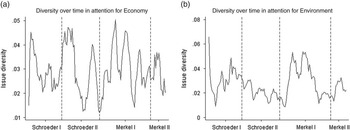
In order to illustrate how issue diversity in coalition governments varies over the course of the legislative term, Figure 1 plots the diversity in attention from 2000 until 2010 for two selected policy issues, economy and the environment and nuclear safety. Higher values signal diversity in issue attention while smaller values indicate that both coalition parties pay similar attention to the same policy issues. The legislative terms are separated by vertical dashed lines, which indicate the federal elections. Figure 1 indicates that issue diversity considerably varies over the course of the electoral cycle. Despite some deviations from the overall trend, Figure 1 shows that differentiation prevails at the beginning and the end of the legislative term while coalition parties tend to talk about similar issues in the middle of the electoral cycle. However, during the first Merkel government (CDU/CSU and SPD), we additionally observe major peaks in issue differentiation during the middle of the electoral cycle which might have been caused by the emergence of the economic crisis and a focus of the SPD on the nuclear phase out which it launched during the preceding legislative term. Hence, despite some deviations from the predicted U-shaped pattern, Figure 1 by and large corroborates our theoretical expectations.
Diversity in issue attention over time

In order to test the effect of the electoral cycle while controlling for potential confounding variables, we estimate a multivariate regression model. Our data set consists of monthly data on issue attention of coalition parties to 20 different policy issues from 2000 until 2010. The data set is therefore simultaneously characterized by a cross-sectional as well as a time-series component. To estimate a model with such a structure requires specific attention to both differences between policy issues and time-series dependencies. Due to the cross-sectional nature of the data set, it is likely that the error terms have a different variance from one policy issue to the next (heteroskedastic errors) and also that they are correlated across issues (serial correlation). In order to address these problems, we follow the approach suggested by Beck and Katz (Reference Beck and Katz1995) and estimate a regression model with panel-corrected standard errors. In order to account for potential autocorrelation, we include the lagged dependent variable (Beck and Katz Reference Beck and Katz1995; Beck and Katz Reference Beck and Katz1996). As diversity in attention levels might vary considerably across issue areas as coalition parties might consider some issues to be more important than others, we additionally include fixed effects for issue areas. We checked the robustness of our findings by estimating a beta regression on the basis of the untransformed dependent variable as a robustness check (see Table A7 in the appendix). The results are substantially the same.
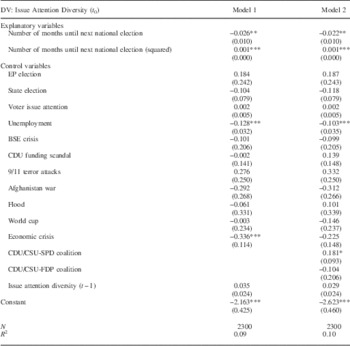
Table 1 presents the results of the time-series cross-section regression analysis. Column 1 reports the results of the basic model while model 2 includes additional fixed effects for coalition government types. Across both model specifications, we find statistically significant effects for the electoral cycle. The number of months until the next national election has a statistically significant negative effect while the squared number of months until the next election has a statistically significant positive effect on the diversity in the attention that coalition parties pay to policy issues. The time-series cross-section regression analysis therefore provides empirical support for our theoretical expectations. Diversity in issue attention follows a U-shaped form over the course of the electoral cycle. While differentiation is high at the beginning and the end of the electoral cycle in proximity to national elections, differentiation is low in the middle of the legislative term when coalition parties pursue a common policy agenda.Footnote 7
Time-Series Cross-Section Regression Analysis

Note: Issue area fixed effects not reported. Standard errors in parentheses.
EP=European Parliament; CDU=Christian Democratic Party; FDP= Free Democratic Party.
***p≤0.01,**p≤0.05,*p≤0.10.
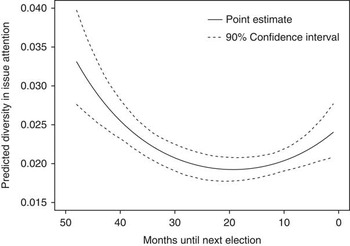
In order to illustrate the effect of the electoral cycle on the diversity in issue attention among coalition parties, we simulated predicted values as suggested by King, Tomz and Wittenberg (Reference Kayser2000). Figure 2 displays the simulated predicted diversity in issue attention among coalition partners as the number of months until the next elections vary while holding all other variables constant. Figure 2 confirms the expected U-shaped relationship between the electoral cycle and the diversity in issue attention among coalition parties. At the beginning of the term, issue diversity is relatively high indicating that coalition parties highlight different political issues. Issue diversity then steadily decreases and reaches its minimum in the middle of the legislative term. In the light of the next upcoming national election, coalition parties differentiate from each other by talking about different issues toward the end of the legislative term. Hence, while coalition parties demonstrate unity in the middle of the term, they differentiate from their coalition partners at the beginning and the end of the electoral cycle. While Figure 2 shows that diversity on average changes by roughly two press releases (0.02) over the electoral cycle, the size of this effect should not be underestimated. Given that the average number of press releases published by a party in a month is 80 with roughly four press releases per issue, a difference of two to four press releases can imply a significant degree of change as it means that a party can duplicate the amount of press releases devoted to a particular issue.
Effect of the electoral cycle on diversity in issue attention Note: the figure is computed based on model 1 reported in Table 1.

With regard to the control variables, the regression analysis shows that only the unemployment rate has a statistically significant effect on issue diversity across both model specifications. The larger the unemployment rate, the smaller the differences in issue emphasis among coalition parties. As unemployment is typically the most important policy issue for German citizens as public opinion surveys indicate, it is hardly surprising that coalition parties spend a similar amount of time and effort on this issue if unemployment levels are high. Model 1, moreover shows that the economic crisis leads to smaller differences in issue emphasis between coalition parties. Given the extensive scope and the important consequences of the crisis for the German and European economy, it is also a very intuitive finding that coalition parties join their forces to fight the economic crisis. The empirical analysis furthermore suggests that issue diversity is considerably larger in the grand coalition while the effect of the electoral cycle however holds. The time-series cross-section regression analysis moreover demonstrates that none of the other control variables has a systematic effect on diversity in issue attention.
Conclusion
Coalition parties need to reconcile the tension between two imperatives. On the one hand, they need to demonstrate unity with their coalition partner in order to effectively govern together and to maintain the stability of the cabinet. On the other hand, they need to highlight their own policy profile in order to attract voters. We posited that political communication constitutes an important instrument through which coalition parties can accommodate both imperatives. In order to shed light on how political communication in coalition governments works, we have analyzed >21,000 press releases published by coalition parties in the German Bundestag from 2000 until 2010 drawing on quantitative text analysis. We have demonstrated that issue attention among coalition parties changes over the course of the electoral cycle. While differentiation prevails at the beginning and the end of the legislative term in close proximity to elections, compromise dominates the middle of the term when coalition governments focus on enacting a common policy agenda.
Our findings have important implications for our understanding of coalition governance. It has largely been argued in the coalition literature that once coalition governments have been formed, coalition parties prioritize unity and cohesion in order to effectively pursue their legislative agenda. Even though coalition parties often have diverging preferences, research on coalition governance has demonstrated that coalition parties use control mechanisms such as coalition agreements, junior ministers or parliamentary committees to keep their coalition partners on track (Thies Reference Thies2001; Müller and Strøm Reference Müller and Strøm2008a; Müller and Strøm Reference Müller and Strøm2008b; Müller and Meyer Reference Meyer2010; Martin and Vanberg Reference Martin and Vanberg2011; Falcó-Gimeno Reference Falcó-Gimeno2014). However, as this study has demonstrated, the day-to-day politics of coalition governments are not only about signaling unity, but also about differentiation. Coalition governance is a mixed-motive game in which coalition parties have to reconcile the tension between policy compromise to maintain government stability and policy differentiation to ensure electoral success. While cooperation prevails in the middle of the legislative term when coalition governments focus on enacting a common legislative agenda, differentiation dominates at the beginning and the end of the electoral cycle. Coalition governance is therefore not as unified as commonly suggested, but coalition parties clearly spell out their policy differences.
Our study has furthermore demonstrated the importance of political communication strategies. Governing in coalitions often requires compromise between coalition parties. Due to the constraints set by governing with at least one other partner, political parties are often not able to enact the policies they promised to their voters. Rather than letting only the legislative record speak for itself, we have shown that political communication is an important instrument through which coalition parties can directly communicate with their voters. Coalition parties strategically use political communication to transmit their policy priorities to their voters and to justify why policy decisions have been made by the cabinet. Accordingly, we observe that coalition parties talk about the same issues to their voters in the middle of the legislative term when they focus on enacting a common legislative agenda. By contrast at the beginning and the end of the legislative term in close proximity to elections, coalition parties emphasize policy issues on which they have an advantage to reap electoral gains.
In conclusion, this study constitutes an important first step in understanding how political communication works in coalition governments. However, there are many questions that remain unanswered. First, in future research, we hope to further open the black box of coalition governments to better understand the dynamics of political communication. For instance, are all coalition parties equally constrained by electoral competition or do junior coalition partners have a much stronger need to differentiate from their coalition partner? Second, in line with salience theory we could show that coalition parties selectively highlight different sets of policy issues to distinguish themselves from their coalition partner. However, what remains unanswered is whether coalition parties also have diverging positions on these policy issues. Hence, future research should extend the presented analysis to also incorporate the issue-specific policy positions of coalition parties to better understand intra-coalition conflict. Third, while our study constitutes an important step in shedding light on the dynamics of political communication in coalition governments, this study was limited to the study of German coalition governments. Even though Germany shares many similarities with other parliamentary systems, future research should extend the analysis to other institutional settings to see how the coalition dynamics work in other countries. For instance, one may argue that in countries where pre-electoral coalitions are the rule (Golder Reference Golder2006a; Golder Reference Golder2006b), the electoral incentive to differentiate is smaller than the coalition imperative to cooperate as coalition parties have committed themselves to govern together for another term and therefore strive to speak with one voice. In addition, another important source of variation across countries is the frequency of early elections. The electoral cycle is not always exogenous as previous intra-cabinet conflicts or strategic considerations might lead to early elections (Lupia and Strøm Reference Lewis-Beck and Stegmaier1995; Kayser Reference Jones and Baumgartner2005). While early elections in Germany are relatively rare, the legislative term in other countries is frequently interrupted by snap elections. In such countries, we would expect that the effect of the electoral cycle on coalition party differentiation is less pronounced than in Germany as cyclical effects are less likely to evolve. Finally, another important avenue for future research is to shed light on the relationship between media coverage and party agendas to explore how the media affects what parties talk about.
Supplementary Material
To view supplementary material for this article, please visit http://dx.doi.org/10.1017/psrm.2015.56