Introduction
PD is the second most common progressive neurodegenerative disorder and is found predominantly in older persons. Anxiety is a frequent concomitant of PD (Dissanayaka et al., Reference Dissanayaka2010), with Diagnostic and Statistical Manual, Fourth Edition (DSM-IV) (American Psychiatric Association, 1994) panic disorder, social phobia, and generalized anxiety disorder (GAD) most frequently reported (Dissanayaka et al., Reference Dissanayaka, White, O'Sullivan, Marsh, Pachana and Byrne2014). Prevalence estimates of current DSM-IV anxiety disorders in PD vary between 25% and 43%. However, many PD patients have clinically significant anxiety symptoms that do not meet diagnostic criteria for a typical DSM-IV anxiety disorder (Pontone et al., Reference Pontone2009; Chen et al., Reference Chen2010; Leentjens et al., Reference Leentjens, Dujardin, Marsh, Martinez-Martin, Richard and Starkstein2011a). The prevalence estimates of this residual category, often described in PD literature following the DSM-IV-Text Revision (DSM-IV-TR) criteria as “Anxiety Disorder Not Otherwise Specified (NOS)”, range between 5% and 25% (Dissanayaka et al., Reference Dissanayaka, White, O'Sullivan, Marsh, Pachana and Byrne2014). To date, there have been limited attempts to precisely define PD-related anxiety symptomatology, although improved characterization of these symptoms may assist with more effective diagnosis and treatment of this group of patients, particularly using psychotherapy. In current practice, a large proportion of anxious PD patients remains undiagnosed and undertreated (Chen and Marsh, Reference Chen and Marsh2014).
To complicate matters further, anxiety in PD exhibits a complex symptomatology, which appears to be related to both the motor symptoms of PD and the motor fluctuations that are a complication of PD medication (Leentjens et al., Reference Leentjens, Dujardin, Marsh, Martinez-Martin, Richard and Starkstein2012). Anxiety related to motor “off” periods in PD is not consistently captured in the DSM-IV-TR criteria for “Anxiety disorder NOS” and not in the new DSM-5 category of “Other Specified Anxiety Disorder”, because no clear diagnostic criteria are provided for such fluctuating anxiety (Pontone et al., Reference Pontone2009). Anxiety relating to PD, including anxiety relating to PD motor fluctuations, can be classified as “Anxiety Due to a General Medical Condition” in DSM-IV or as “Anxiety Disorder Due to Another Medical Condition” in DSM-5. However, this category is also under-reported in the current PD literature (Dissanayaka et al., Reference Dissanayaka, White, O'Sullivan, Marsh, Pachana and Byrne2014). There appears to be a general consensus to avoid this category when diagnosing anxiety or depression in PD (Marsh et al., Reference Marsh, McDonald, Cummings and Ravina2006), perhaps because the diagnostic criteria are described only in very general terms and because of the difficulty of being confident that the anxiety symptoms are “the direct pathophysiological consequence of” PD. Thus, there remains uncertainty both about the nature of the PD-related anxious phenotype and the best way to conceptualise it. Improved phenomenological description might lead to better conceptualisation, and ultimately to improvements in the diagnosis and management of anxiety in people with PD.
The complex interaction between anxiety and motor fluctuations in PD results in unstable and often cyclical symptoms of anxiety, and impacts the utility of existing anxiety rating scales in this context (Leentjens et al., Reference Leentjens2008; Leentjens et al., Reference Leentjens, Dujardin, Marsh, Martinez-Martin, Richard and Starkstein2011a; Leentjens et al., Reference Leentjens, Dujardin, Marsh, Richard, Starkstein and Martinez-Martin2011b; Reference Leentjens, Dujardin, Marsh, Martinez-Martin, Richard and Starkstein2012; Matheson et al., Reference Matheson2012; Forjaz et al., Reference Forjaz2013; Martinez-Martin et al., Reference Martinez-Martin2013; Pachana et al., Reference Pachana2013; Dissanayaka et al., Reference Dissanayaka, White, O'Sullivan, Marsh, Pachana and Byrne2014; Leentjens et al., Reference Leentjens, Dujardin, Pontone, Starkstein, Weintraub and Martinez-Martin2014; Starkstein et al., Reference Starkstein2014). A new PD anxiety scale has recently been introduced (Leentjens et al., Reference Leentjens, Dujardin, Pontone, Starkstein, Weintraub and Martinez-Martin2014). However, this measure is still rather general in nature, and the development of a PD-specific anxiety scale has been suggested (Leentjens et al., Reference Leentjens, Dujardin, Pontone, Starkstein, Weintraub and Martinez-Martin2014).
The etiology of anxiety in PD reflects a complex combination of neurobiological and psychological factors which play out over time (Dissanayaka et al., Reference Dissanayaka, White, O'Sullivan, Marsh, Pachana and Byrne2014). However, there is a dearth of studies investigating the chronology of anxiety in relation to a diagnosis of PD for the purpose of clarifying the onset and anxiety phenotype in PD (Dissanayaka et al., Reference Dissanayaka, White, O'Sullivan, Marsh, Pachana and Byrne2014). Against this background, the current study characterizes PD-specific anxiety symptomatology and explores the onset of anxiety subtypes in relation to the timing of the diagnosis of PD.
Methods
Participants
PD patients were recruited from neurology outpatient clinics in Brisbane, Australia, and the Queensland Parkinson's Project (QPP) database covering the state of Queensland, Australia. The QPP is a collaborative study cohort of over 4,000 PD patients, who have agreed to participate in research. PD patients in the QPP database were originally recruited from Neurology outpatient clinics for studies focused on epidemiology and genetics (Dissanayaka et al., Reference Dissanayaka, Silburn, O'Sullivan and Mellick2009; Reference Dissanayaka, Sellbach, Silburn, O'Sullivan, Marsh and Mellick2011). Although a convenience sampling method was used for the current study, PD patients were not invited in the basis of their anxiety or any other aspect of their neuropsychological status. In each case, a diagnosis of PD according to the United Kingdom Brain Bank criteria (Berg et al., Reference Berg2013) was made by movement disorders neurologists. Patients with signs of dementia (identified by neurologists or by cognitive rating scales) and those who had had neurosurgery were excluded. The study was approved by the human research ethics committees of The University of Queensland and the Royal Brisbane and Women's Hospital. Written informed consent was obtained from all participants prior to commencing the study.
Categorization of anxiety disorders and chronology of anxiety
A semi-structured interview was employed to identify symptoms of anxiety and was administered when each PD patient was in an “on” state. That is, when each patient's PD medication had produced optimal improvement in their motor function. An “inclusive” approach was used, which evaluated all symptoms regardless of causal attribution following recommended guidelines (Marsh et al., Reference Marsh, McDonald, Cummings and Ravina2006). The guidelines also recommend use of an inclusive approach when diagnosing anxiety secondary to a general medical condition; that is, an approach which counts all anxiety symptoms and ignores the potential overlap between symptoms of anxiety disorder and symptoms of PD (Marsh et al., Reference Marsh, McDonald, Cummings and Ravina2006). The present study adhered to these guidelines and used a standardized methodology when diagnosing anxiety disorders in PD. The DSM-IV criteria for current anxiety disorders (American Psychiatric Association, 1994) were applied to identify anxiety disorders using the MINI-plus (Sheehan et al., Reference Sheehan1998). The DSM-5 criteria were not available at study initiation. The DSM-IV current anxiety disorders identified included panic disorder, agrophobia, GAD, social phobia, post traumatic stress disorder, specific phobia, and obsessive compulsive disorder, and they formed the first category of “current DSM-IV anxiety disorders”. We did not apply hierarchichal criteria when diagnosing anxiety or depressive disorders, consistent with the approach utilised in previous PD anxiety studies (Leentjens et al., Reference Leentjens, Dujardin, Marsh, Martinez-Martin, Richard and Starkstein2011a). A non-hierarchichal approach includes the diagnosis of anxiety disorders in presence of major depression. A second category of “Anxiety disorder NOS” meeting the DSM-IV-TR criteria was identified. Anxiety disorder NOS included clusters of significant anxiety symptoms which did not meet DSM-IV criteria for a specific disorder (Dissanayaka et al., Reference Dissanayaka, White, O'Sullivan, Marsh, Pachana and Byrne2014). As a result, the present study included three groups of PD patients which are as follows: (i) those with current DSM-IV anxiety disorder; (ii) those with anxiety disorder NOS; and (iii) those with no current anxiety.
The MINI-plus was also used to identify current depressive disorders according to the DSM-IV-TR criteria, including major depression, minor depression, and dysthymia. Anxiety and depression symptoms were also assessed using the Hamilton Anxiety (HAM-A) and Depression (HAM-D) rating scales, which have been validated for use in PD (Dissanayaka et al., Reference Dissanayaka, Torbey and Pachana2015a; Torbey et al., Reference Torbey, Pachana and Dissanayaka2015). The new Parkinson's Anxiety Scale (PAS) was not available to assess anxiety at study initiation (Leentjens et al., Reference Leentjens, Dujardin, Pontone, Starkstein, Weintraub and Martinez-Martin2014).
The chronology of the onset and recurrence of anxiety symptoms in relation to the diagnosis of PD was recorded during the face-to-face research interview. Participants were directly asked whether the onset of significant anxiety symptoms was before or after their diagnosis of PD. Patients reported their year of PD diagnosis in the self-report questionnaire, which was completed prior to the interview. The reporting of the year of PD diagnosis at the interview was double checked against the self-report answer. Any discrepancies were clarified during the interview. We used the year of PD diagnosis rather than the year of PD onset because we have previously shown that the reliability of reporting the first PD symptom is moderate (κ = 0.64 (standard error = 0.14)), while the reliability of PD patient recall on a year of PD diagnosis is very high (Interclass correlation coefficient = 0.97 (95% confidence interval = 0.92–0.99)) (Dissanayaka et al., Reference Dissanayaka, Sellbach, Silburn, O'Sullivan, Marsh and Mellick2011). Therefore, to minimize recall bias, we used the year of PD diagnosis.
Profiling PD-specific anxiety symptoms
To formulate a list of PD-specific anxiety symptoms, first, a comprehensive literature review was performed and PD-related symptomatology described in the literature was identified (Dissanayaka et al., Reference Dissanayaka, White, O'Sullivan, Marsh, Pachana and Byrne2014). Second, a symptom list was formulated based on the PD-Anxiety Motor Complications Questionnaire (PDAMQ) (Leentjens et al., Reference Leentjens, Dujardin, Marsh, Martinez-Martin, Richard and Starkstein2012). Finally, the total list of PD-related anxiety symptoms was reviewed by an expert clinical panel consisting of a neurologist specialized in movement disorders, two psychiatrists specialized in treating older people and PD, one registered clinical psychologist specialized in older persons’ mental health, and one clinical research fellow specialized in neuropsychiatry in PD. This list was modified by the team using their clinical experience in dealing with PD patients. Subsequently, for each patient, the existence of these anxiety symptoms was investigated by reviewing the semi-structured interview and the PDAMQ. Anxiety symptoms specific to PD were separated from non-disease-specific anxiety symptoms. The PDAMQ specifically inquires whether the anxiety symptom is related or not related to the PD motor symptoms, motor fluctuations, and/or dyskinesias.
Other assessments
Cognitive function was assessed using the Standardized Mini-Mental State Examination (SMMSE) (Molloy et al., Reference Molloy, Alemayehu and Roberts1991) and the Parkinson's Disease-Cognitive Rating Scale (PD-CRS) (Pagonabarraga et al., Reference Pagonabarraga, Kulisevsky, Llebaria, Garcia-Sanchez, Pascual-Sedano and Gironell2008). Participants with a score of <24 on the SMMSE or <64 on the PD-CRS were excluded. The Movement Disorders Society Unified Parkinson's Disease Rating Scale (MDS-UPDRS) was used to measure the severity of PD (Goetz et al., Reference Goetz2007). A self-report questionnaire was administered to obtain demographic information and current medication.
Statistical analysis
All statistical analyses were performed using the SPSS 21.0 statistical package. Statistical comparisons were made between the three groups of participants: (1) DSM-IV current anxiety disorder; (2) current Anxiety disorder NOS; and (3) no current anxiety. Frequencies of PD-related anxiety symptoms were examined according to group membership. Anxiety symptom onset was determined to be either before or after a diagnosis of PD. χ 2 analysis was performed for items with a frequency of ≥5 and Fisher exact tests were performed for n < 5.
Results
Participation and patient characteristics
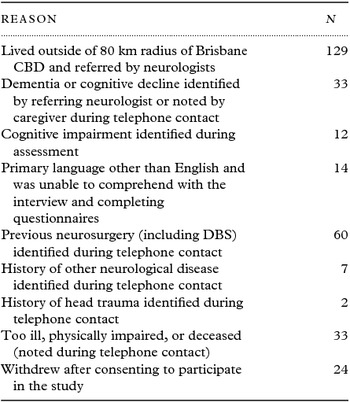
There were 518 patients referred by neurologists or identified from the QPP database for potential participation in the study. Patients who met any exclusion criterion, such as living outside of an 80 km radius of Brisbane CBD or having a history of comorbid neurological disease, were excluded. Three hundred and four patients were contacted (or an attempt to contact them was made) by phone regarding participation in the study. Of them, 126 (41.4%) agreed to participate. However, 12 were later excluded because their scores on the cognitive assessment measures indicated they had significant impairments, and 24 withdrew from the study (Table 1).
Reasons for exclusion and number of patients (N)

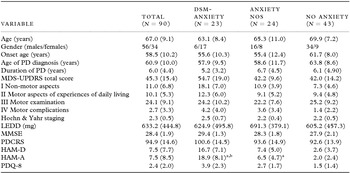
Ninety PD patients completed the study. Patient characteristics are summarized in Table 2. There were 56 males and 34 females. The mean age (standard deviation) was 67.0 (9.1) years. Mean PD onset age was 58.5 (10.2) years. On average, patients had mild to moderate PD (Mean Hoehn and Yahr stage = 2.3 (0.5)). Twenty-four patients (26.7%) were receiving antidepressants or anxiolytics at the time of the interview. Of them, 12 met criteria for a DSM-IV anxiety disorder, while eight were assigned to the Anxiety disorder NOS group. Statistical comparisons of patient characteristics among the three categories of current DSM-IV anxiety disorder, Anxiety disorder NOS, and no anxiety are described elsewhere using the same dataset (Dissanayaka et al., Reference Dissanayaka2015b), and therefore are not included in the present manuscript.
Patient characteristics. Mean (standard deviation) are presented

a Significantly different compared to the no anxiety group at p <0.05. bSignificantly different compared to the other anxiety group at p <0.05. MDS-UPDRS = Movement Disorders Society Unified Parkinson's disease rating scale; LEDD = Levodopa equivalent daily dosage; SMMSE = standardized Mini-Mental State Examination; PDCRS = Parkinson's Disease-cognitive rating scale; HAM-D = Hamilton depression rating scale; HAM-A = Hamilton anxiety rating scale.
Distribution of anxiety and depressive disorders
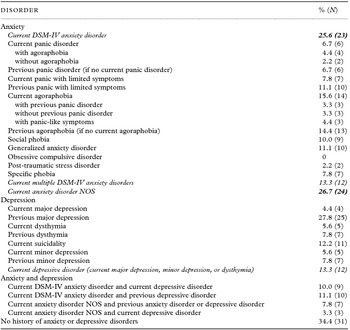
The frequency distribution of anxiety and depressive disturbances in this study sample is described in Table 3. Current DSM-IV anxiety disorder was diagnosed in 25.6% (N = 23) of PD patients. Panic disorder (6.7%), agoraphobia (15.6%), social phobia (10.0%), GAD (11.1%), and specific phobia (7.8%) were common DSM-IV anxiety disorders in this PD sample. Twelve (13.3%) patients met criteria for multiple current DSM-IV anxiety disorders. Current Anxiety disorder NOS was present in 26.7% (N = 24) of PD patients. No current anxiety disorder was identified in 47.8% (N = 43) of PD patients. Comorbidity between current DSM-IV anxiety disorder and depressive disorder was 10.0%, while between current Anxiety disorder NOS and depressive disorder was 3.3%.
The distribution of anxiety and depressive disorders in PD

PD related anxiety symptoms
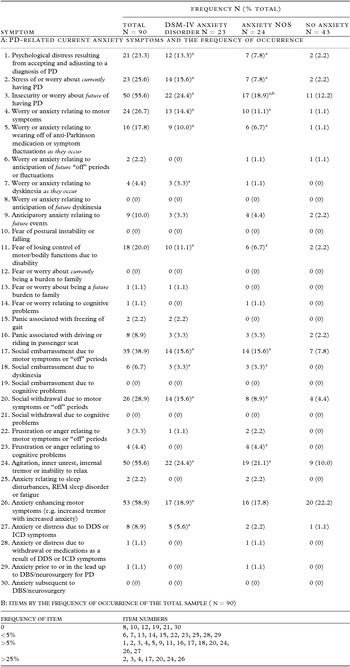
Thirty symptoms were identified as anxiety symptoms relating to PD (Table 4). The total frequency of their occurrence and a comparison of frequencies between the three patient groups are presented in Table 4A. Over half of the listed symptoms occurred at >5% frequency while seven symptoms occurred at a high frequency of >25% (Table 4B). The items with high frequency included worry and insecurity of having PD, future of having PD, or relating to motor symptoms (item 2–4), social embarrassment, and social withdrawal due to PD motor symptoms or “off” periods (items 17 and 20), agitation, inner unrest or inability to relax (item 24), and increased motor symptoms due to anxiety (item 26).
Parkinson's disease (PD) related current anxiety symptoms

Frequencies were compared between the DSM-IV anxiety disorder, Anxiety disorder NOS, and those without a current anxiety using χ 2 analysis. aSignificantly different compared to the no anxiety group at p <0.05. bSignificantly different compared to the DSM-IV anxiety group at p <0.05. DDS = dopamine dysregulation syndrome. ICD = impulse control disorders. DBS = Deep brain stimulation.
Median = 4.4, 3rd quartile = 23.8.
Ten items occurred significantly more frequently in the DSM-IV anxiety disorder group and the Anxiety disorder NOS group compared to the no anxiety group. They included distress, insecurity, and worry about having PD and PD motor symptoms (items 1–5), fear of losing control due to disability (item 11), social embarrassment (items 17, 18), social withdrawal (items 20), and agitation (item 24). Four items occurred significantly more frequently in the DSM-IV anxiety disorder group only compared to the no anxiety group. They were worry or anxiety relating to dyskinesias (item 7), enhanced motor symptoms with increased anxiety (item 26), and anxiety relating to iatrogenic addictive behaviors (item 27). Insecurity or worry about future of having PD (item 3) was the only item that occurred significantly more frequently in the DSM-IV anxiety group compared to the Anxiety disorder NOS group.
Chronology of anxiety in PD
Fifty-seven per cent (57%; 13 of 23) of patients with a DSM-IV anxiety disorder reported onset of anxiety prior to the diagnosis of PD, while 43% reported onset of anxiety after a diagnosis of PD (Table 5). In the Anxiety disorder NOS group, 83% (20 of 24) of patients developed anxiety symptoms after the diagnosis of PD. Overall, the onset of Anxiety disorder NOS was significantly more likely to occur after a diagnosis of PD, whereas the onset of DSM-IV anxiety disorders occurred both before and after a diagnosis of PD (χ2 = 8.08, p = 0.004).
Chronology of DSM-IV anxiety and Anxiety disorder NOS in relation to a diagnosis of Parkinson's disease (PD). Frequency of patients with anxiety before and after diagnosis of PD is presented in relation to the total number of patients with anxiety (N = 47)

Discussion
To our knowledge, the present study is the first to undertake a detailed investigation of the symptomatology of anxiety related to PD. Our sample of PD patients had a current DSM-IV anxiety disorder (25.6%) or Anxiety disorder NOS (26.7%) at prevalence rates comparable to previous studies (Dissanayaka et al., Reference Dissanayaka, White, O'Sullivan, Marsh, Pachana and Byrne2014). In line with previous studies (Pontone et al., Reference Pontone2009; Chen et al., Reference Chen2010; Dissanayaka et al., Reference Dissanayaka2010; Leentjens et al., Reference Leentjens, Dujardin, Marsh, Martinez-Martin, Richard and Starkstein2011a), we found that panic disorder, GAD, and social phobia were common anxiety disorders in PD, while OCD remained uncommon in PD. The prevalence of current panic disorder found (6.7%) falls within the reported prevalence range of panic disorder in PD (1.8%–25.0%) (Stein et al., Reference Stein, Heuser, Juncos and Uhde1990; Menza et al., Reference Menza, Robertson-Hoffman and Bonapace1993; Pontone et al., Reference Pontone2009; Chen et al., Reference Chen2010; Dissanayaka et al., Reference Dissanayaka2010; Lauterbach et al., Reference Lauterbach, Freeman and Vogel2003; Reference Lauterbach, Freeman and Vogel2004; Leentjens et al., Reference Leentjens, Dujardin, Marsh, Martinez-Martin, Richard and Starkstein2011a; Qureshi et al., Reference Qureshi, Amspoker, Calleo, Kunik and Marsh2012). Agoraphobia was the most common anxiety disorder (15.6%), with a rate comparable to a large international multicenter study (15.5%) (Leentjens et al., Reference Leentjens, Dujardin, Marsh, Martinez-Martin, Richard and Starkstein2011a). Use of non-hierarchical DSM-IV criteria resulted in a high prevalence of GAD (11.1%) compared to our previous study (3.0%) which used strict hierarchical criteria (Dissanayaka et al., Reference Dissanayaka2010). Our study falls within the variable prevalence of GAD reported in the literature (0% and 30.8%) (Stein et al., Reference Stein, Heuser, Juncos and Uhde1990; Menza et al., Reference Menza, Robertson-Hoffman and Bonapace1993; Lauterbach et al., Reference Lauterbach, Freeman and Vogel2003; Reference Lauterbach, Freeman and Vogel2004; Pontone et al., Reference Pontone2009; Chen et al., Reference Chen2010; Dissanayaka et al., Reference Dissanayaka2010; Kummer et al., Reference Kummer, Cardoso and Teixeira2010; Leentjens et al., Reference Leentjens, Dujardin, Marsh, Martinez-Martin, Richard and Starkstein2011a; Reference Leentjens, Dujardin, Marsh, Martinez-Martin, Richard and Starkstein2012; Qureshi et al., Reference Qureshi, Amspoker, Calleo, Kunik and Marsh2012). The frequency of social phobia (10.0%) in our sample was similar to previous studies (7.9%–13.0%) (Pontone et al., Reference Pontone2009; Chen et al., Reference Chen2010; Leentjens et al., Reference Leentjens, Dujardin, Marsh, Martinez-Martin, Richard and Starkstein2011a).
Characterizing anxiety symptoms specific to PD for an improved identification of general anxiety from PD-specific anxiety was a main focus of this study. Frequently reported symptoms included worry and insecurity of having PD, worry relating to motor symptoms, social embarrassment and social withdrawal due to motor symptoms and “off” periods, and agitation, inner unrest, internal tremor, or inability to relax due to PD motor symptoms, and/or complications arising from PD medication. There have been previous reports in PD describing prominent anxiety symptoms with limited distinction between general and PD-specific context; these symptoms included “inability to relax”, “restlessness”, “feeling tense”, “worrying thoughts”, and “situational anxiety related to motor symptoms and wearing off effects” (Marinus et al., Reference Marinus, Leentjens, Visser, Stiggelbout and van Hilten2002; Mondolo et al., Reference Mondolo, Jahanshahi, Grana, Biasutti, Cacciatori and Di Benedetto2007; Pontone et al., Reference Pontone2009; Brown et al., Reference Brown2011; Leentjens et al., Reference Leentjens, Dujardin, Marsh, Martinez-Martin, Richard and Starkstein2011a). Other frequently reported PD-related anxiety symptoms in the present sample included psychological distress resulting from difficulties with acceptance and adjustment to a diagnosis of PD, worry about the wearing off of medication or motor fluctuations as they occur, anticipatory anxiety due to motor fluctuations, fear of losing control due to disability, panic associated with driving or riding in the passenger seat, dyskinesia-related social embarrassment, and anxiety relating to iatrogenic addictive behaviors like Dopamine Dysregulation Syndrome (DDS) or Impulse Control Disorders (ICDs), which are an increasing concern in PD (Ambermoon et al., Reference Ambermoon, Carter, Hall, Dissanayaka and O'Sullivan2011; Ambermoon et al., Reference Ambermoon, Carter, Hall, Dissanayaka and O'Sullivan2012). Psychological distress included anxiety associated with seeking aid due to disability, which was previously reported to have a prevalence of 38% in PD (Macht et al., Reference Macht, Schwarz and Ellgring2005).
Nearly 60% of patients reported exacerbated motor symptoms with anxiety, and this was consistent with a previous study by Macht and colleagues (Reference Macht, Schwarz and Ellgring2005). The relationship between anxiety and motor fluctuations was recently addressed in the study by Leentjens and colleagues (Reference Leentjens, Dujardin, Marsh, Martinez-Martin, Richard and Starkstein2012) and was suggested to be a complex phenomenon that cannot solely be explained by the wearing off of dopaminergic medication. Although anxiety is present in both “on” and “off” PD medication states, more anxiety is observed during “off” periods. In the present study, 17.8% described worry during “off” periods. Anticipatory anxiety was previously described in PD (Marsh, Reference Marsh2000), and we found that 10.0% of patients had anticipatory anxiety resulting from motor fluctuations. Driving performance in PD has been reported as worse than in the general population, due to issues such as cognitive decline, visual impairment, motor deficits, and excessive day time sleepiness (Uitti, Reference Uitti2009). The present study further demonstrates that driving in PD is also associated with anxiety.
Not surprisingly, many of the frequently reported PD-related anxiety symptoms were prevalent in the DSM-IV anxiety disorder group as well as the Anxiety disorder NOS group. However, the HAM-A rating scale scores suggested a significantly higher score of anxiety in the DSM-IV anxiety disorder group compared to the Anxiety NOS group. The HAM-A has limitations when measuring anxiety in PD (Forjaz et al., Reference Forjaz2013; Dissanayaka et al., Reference Dissanayaka, Torbey and Pachana2015a), and does not capture PD-specific symptoms. While there is a need for the development of an anxiety scale that assesses PD-specific symptomatology, the anxiety symptom list identified in the present study, together with the newly developed and validated PAS (Leentjens et al., Reference Leentjens, Dujardin, Pontone, Starkstein, Weintraub and Martinez-Martin2014), may serve as a guide in clinical settings to distinguish an anxiety symptomatic profile in PD, and to decide on subsequent treatment strategies, such as tailored psychotherapy approaches (Pachana et al., Reference Pachana2013).
Our results suggest that anxiety can precede a diagnosis of PD in 36% of patients or anxiety can occur after a diagnosis of PD in 64% of patients (Figure 1). Anxiety preceding PD may have an onset in early life, or a few years prior to the onset of PD motor symptoms. Anxiety preceding PD has also been demonstrated in a number of previous studies, suggesting that anxiety might be a risk factor for PD as well as a symptom of the pre-motor symptomatic phase of PD, resulting from pathophysiological alterations at early stages of PD (Bower et al., Reference Bower2010; Jacob et al., Reference Jacob, Gatto, Thompson, Bordelon and Ritz2010). PD pathology includes neurodegeneration of the mesolimbic and mesocortical dopaminergic pathways, and the amygdala, which are important in the regulation of anxiety and related behaviors (Peron et al., Reference Peron, Dondaine, Le Jeune, Grandjean and Verin2012). Consequently, a vulnerability to develop anxiety may increase during the course of the disease, which is consistent with the large proportion of patients (64% of the total patients with anxiety) who developed anxiety after the diagnosis of PD in the present study. Further investigations are required to understand relationships between anxiety disorders, PD pathology, and rate of PD progression.
Chronology of anxiety in relation to a diagnosis of PD. NMS = Non-motor symptoms.

Although the present study is the first to demonstrate PD-specific symptomatology for an improved identification of anxiety, a number of limitations are worthy of note. Exclusion of PD patients with cognitive decline and those who have had functional neurosurgery (such as deep brain stimulation) is a limitation of this study. Our assessment of cognitive function limited to a brief assessment using rating scales to avoid patient exhaustion by conducting a second interview of a comprehensive assessment of cognitive impairment. Furthermore, our convenience study sample predominantly consisted of patients with mild to moderate PD who attended Movement Disorders specialty clinics in Brisbane. Although our recruitment from specialty clinics allowed a diagnosis of PD by Movement Disorders specialists, the convenience sample may not generalize well to community samples of people with PD. For purposes of ethics and informed consent process, we were required to disclose to participants that the study was focused on anxiety. This may have resulted in a recruitment bias, either for or against participation of anxious individuals. Anxious patients may be likely to participate in a study of anxiety or avoid participation due to denial, stigma, or social withdrawal resulting in unwillingness to travel for assessments. Moreover, our affirmative question regarding an onset of anxiety symptoms in relation to a PD diagnosis may contain recall bias. Although year of PD diagnosis was recorded, we did not record year of anxiety symptom onset, and there may be a lag between PD onset and PD diagnosis. Such recordings would have improved our explorations of the chronology and duration of anxiety, and potentially helped pinpoint whether symptoms reflected a prodromal condition, reactive at the time of PD diagnosis, or appeared during progression of PD. Our reporting of PD-specific anxiety was limited to present or absent in this study. We did not gather information regarding severity, duration, or distress. Future studies can also be directed to identify PD-specific anxiety symptomatology in patients with more severe PD, cognitive impairment, and those who have had neurosurgery, and a comprehensive investigation of the timing of anxiety symptoms onset.
Conclusion
Our results suggest that the DSM criteria historically developed for psychiatric diagnosis may have limitations when distinguishing anxiety in the context of medical comorbidity, specifically where the comorbidity relates to the same organ system - the central nervous system. The release of DSM-5, despite its minor changes to a diagnosis of anxiety disorders, means the current approach to psychiatric diagnosis will continue. However, the complex parallel and interactive relationships between motor and non-motor symptoms in PD, both temporally and in response to treatments, argue strongly for the development of a disease-specific instrument for the measurement of anxiety in this quintessential neuropsychiatric disorder.
Conflict of interest
None.
Description of authors’ roles
Nadeeka N. W. Dissanayaka: Conceptualization, study design, literature search, grant funding, participant recruitment, data collection, data analysis, interpretation, writing of the first draft, and revision. John D. O'Sullivan: Conceptualization, study design, grant funding, participant recruitment, interpretation, and critical revision. Nancy A. Pachana: Conceptualization, study design, interpretation, and critical revision. Rodney Marsh: Conceptualization, study design, grant funding, interpretation, and critical revision. Peter A. Silburn: Conceptualization, grant funding, and participant recruitment. Elizabeth White: Literature search, data analysis, and revision. Elizabeth Torbey: Literature search, data collection, interpretation, editing, and revision. George D. Mellick: Conceptualization, grant funding, participant recruitment, and critical revision. David A. Copland: Conceptualization, study design, grant funding, and critical revision. Gerard J. Byrne: Conceptualization, study design, grant funding, interpretation, editing, and critical revision.
Acknowledgements
We thank research assistants, Tiffany Au, Tara Spokes and Hanna Reinebrant for aiding with data entry and management, and all participants of the study. Dr Nadeeka Dissanayaka is supported by the Lions Medical Research Fellowship. The project is funded by Royal Brisbane and Women's Hospital Foundation Research Grants, and Parkinson's Queensland Inc. Seeding Grant Scheme. Study funding: Royal Brisbane and Women's Hospital Foundation and Parkinson's Queensland Incorporated.