


Introduction
For several decades, corporate law theory has been organised around an agency-theoretic conception of the corporation as a ‘nexus of contracts’. Under this approach, the corporation is analysed as a set of principal–agent relationships, and corporate law is evaluated mainly by its capacity to reduce agency costs through incentive alignment and monitoring (Easterbrook and Fischel, Reference Easterbrook and Fischel1991; Jensen and Meckling, Reference Jensen and Meckling1976). The approach has clear analytical advantages. It renders many doctrinal questions commensurable, supports comparative functionalism, and supplies an efficiency-oriented vocabulary that is readily applicable across jurisdictions (Armour et al., Reference Armour, Hansmann, Kraakman, Pargendler, Kraakman, Armour, Davies, Enriques, Hansmann, Hertig, Hopt, Kanda, Pargendler, Ringe and Rock2017; Romano, Reference Romano2005).
However, the prevailing paradigm leaves the cognitive dimension of the corporate form largely unaddressed. Modern corporations coordinate dispersed information and specialised knowledge under Knightian uncertainty (Knight, Reference Knight1921). They rely on routines, information architectures, and interpretive frameworks that enable boundedly rational actors to coordinate without internalising all the information held across the enterprise. These organisational capacities remain underexplained by contractual and agency-based accounts of the firm (Langlois and Robertson, Reference Langlois and Robertson1995; Nelson and Winter, Reference Nelson and Winter1982). A complementary perspective conceptualises the corporation as a legal arrangement for organising cognition at scale, with corporate law establishing the framework within which organisational cognition is structured, stabilised, and legally attributed.
This article develops this perspective into a cognitive institutionalist theory of corporate law. The theory integrates ‘4E’ cognitive science and legal institutionalism, two lines of scholarship that remain underused in corporate law. Research on 4E cognition treats reasoning as embodied, embedded, enacted, and extended, and it analyses how stable external structures and artefacts support and shape cognitive processes (Gallagher, Reference Gallagher2023; Newen et al., Reference Newen, Gallagher, De Bruin, Newen, De Bruin and Gallagher2018). Legal institutionalism regards law as constitutive of markets and organisations, emphasising how legal categories and enforcement capacities make impersonal exchange and organised cooperation possible (Deakin et al., Reference Deakin, Gindis, Hodgson, Huang and Pistor2017). Combining these perspectives, this article examines the organisational basis and legal constitution of corporate cognition, with corporate law providing the constitutive infrastructure through which the corporation’s organisation-dependent capacities are formed, attributed, and sustained.
The analysis concerns corporations in which legal form and organisational structure jointly sustain collective cognition. Corporate participants have limited cognitive capacity, and relevant knowledge is dispersed across specialised roles and interpreted through frameworks inherited from prior practice. Corporate perception, memory, judgement, and learning therefore arise from organisational architecture.Footnote 1 Where an organisation processes information that no single participant commands in full and produces judgements varying with its configuration, cognitive capacity belongs to the organised system. Corporate law stabilises this emergent capacity and renders it operational within the broader economic order. Legal personality and asset partitioning define the system’s boundary and interface; the corporate organ structure and its decision rules convert conflicting interpretations into unified positions attributable to the corporation; fiduciary duties safeguard the integrity of these processes against power conflicts and epistemic pathologies that this architecture inherently generates. A body of law that constitutes organisational cognition should also be evaluated by whether it preserves that capacity over time, a question captured by the normative standard of adaptive efficiency.
This article contributes to both the study of corporate law and institutional economics. First, it explains how corporate law constitutes organisational cognition and develops a unified functional account of its core institutions. For instance, it interprets legal personality and asset partitioning as mechanisms of cognitive encapsulation, linking veil piercing to misleading uses of the corporate boundary and interface. Second, for institutional economics, it develops a legal-organisational account of cognitive institutions, showing how legal devices structure cognition within complex business enterprises. Legal categories supply shared premises for interpreting situations, whereas rules of authority and attribution enable differing assessments to be consolidated into judgements on which the organisation can act. These arrangements shape how dispersed knowledge becomes available for collective use, and how interpretations are retained and revised through organisational practice. By explaining the legal conditions of these cognitive processes, the article provides a theoretical foundation for understanding the role of law in constituting economic organisations.
The remainder of this article proceeds as follows. The next section demonstrates that prevailing theories of corporate law capture distinct dimensions of the corporation while leaving its collective cognition undertheorised. The section that follows develops the conceptual foundations of cognitive institutionalism by connecting institutional economics, externalist cognitive science, and legal institutionalism. The article then turns to the corporation, examining the cognitive constraints it addresses, the criteria for attributing cognition to an organised system, and the organisational structures through which cognitive capacity emerges. The final substantive section reconstructs corporate law’s principal institutions as infrastructure for corporate cognition and derives an evaluative standard from this function. The conclusion draws together the article’s central arguments.
Prevailing theories of corporate law and the residual problem
The agency-theoretic approach emerged from a broader neoclassical turn in corporate law scholarship that sought to translate doctrinal questions into a unified efficiency problem set. Jensen and Meckling (Reference Jensen and Meckling1976) supplied a general model of managerial agency costs, and subsequent work treated corporate law as a governance technology for controlling opportunism through contracting, monitoring, and enforcement (Armour et al., Reference Armour, Hansmann, Kraakman, Pargendler, Kraakman, Armour, Davies, Enriques, Hansmann, Hertig, Hopt, Kanda, Pargendler, Ringe and Rock2017). Contractarian accounts generalised this framework into a theory of corporate law as facilitative private ordering, under which legal rules approximate the bargains that informed parties would reach under zero transaction costs, while mandatory rules are justified only by contracting failure (Easterbrook and Fischel, Reference Easterbrook and Fischel1991). This framework secured its dominant position by providing a uniform conceptual apparatus that structures mainstream legal analysis and judicial reasoning. Yosifon (Reference Yosifon2014) shows how shareholder primacy was incorporated into corporate jurisprudence as an operational normative baseline, and Rock (Reference Rock2021) traces the judicial tendency to mediate structural corporate tensions through the control of managerial opportunism.
The analytical power of this framework derives from three mutually reinforcing commitments. First, methodological individualism treats the corporation as an aggregate of individual choices and constraints, resolving organisational properties into participant incentives and contractual relations (Hodgson, Reference Hodgson2007). Second, rational-choice assumptions support an optimisation benchmark that identifies departures from predicted outcomes as governance problems (Posner, Reference Posner1998). Third, equilibrium reasoning posits that competitive pressures and contracting choices tend to select governance arrangements and legal rules that are stable and efficient in the relevant environment (Hansmann and Kraakman, Reference Hansmann and Kraakman2001). Together, these commitments produce a compact framework for analysing individual incentives, specified objectives, and competitive selection. Their explanatory reach, however, is bounded by the class of problems they were designed to address. Legal and organisational structures also shape the corporation’s capacity, as an organised system, to perceive, assess, and learn, with important implications for the reliability of its judgement and its ability to adapt over time. These cognitive dimensions remain underexplained by a framework centred on individual incentives and contractual equilibria.
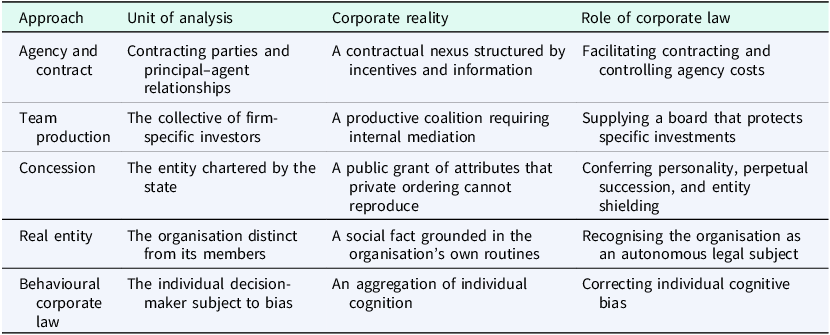
Several alternatives have expanded the field’s theoretical resources beyond agency and contract. Team production theory broadens the unit of analysis to participants committing firm-specific resources, recasting the board as a mediating hierarch that protects their investments and allocates team surplus (Blair and Stout, Reference Blair and Stout1999). Concession theory examines the corporation’s relation with the state, locating corporate reality in a public grant of attributes unavailable through private ordering, including perpetual succession and entity shielding (Bottomley, Reference Bottomley2024; Hardman, Reference Hardman2025; Padfield, Reference Padfield2014; Watson, Reference Watson2019). Real entity theory places the organisation itself at the centre of the inquiry. On this view, corporate reality arises from routines, decision processes, role structures, and procedures that shape participants’ conduct and persist across changes in membership. Legal personality formalises this organisation, supplying stable boundaries, continuity, and a framework for autonomous action (Gindis, Reference Gindis2009, Reference Gindis2016; Micheler, Reference Micheler2021, Reference Micheler2024). Behavioural corporate law addresses the cognitive dimension most directly, enriching the analysis of corporate behaviour by showing how heuristics, framing, and structural biases influence decision-making and governance (Langevoort, Reference Langevoort, Hill and McDonnell2012).
Table 1 compares these five approaches. Agency and contract theory, team production theory, and concession theory focus on incentives, productive coordination, and public constitution, respectively. Their accounts clarify central governance problems, although the cognitive effects of the resulting arrangements receive limited attention. Real entity theory provides the closest antecedent to the present account by recognising the organisation as a durable object of legal analysis. It nevertheless leaves cognition underdeveloped as a dimension of organisational reality. Behavioural corporate law offers a complementary analysis of cognition, but it generally focuses on individual actors and frequently frames its findings as deviations from a rational-choice benchmark. This tendency constrains its explanatory scope, a limitation that more recent scholarship has begun to address (Helleringer, Reference Helleringer, Gordon and Ringe2025). Across these approaches, the institutional mechanisms through which legal form enables cognitive capacities of the corporate entity remain insufficiently examined. The analysis developed here addresses this residual question within the real entity tradition while integrating the cognitive concerns of behavioural corporate law into an account of organisational reality. The following section sets out the conceptual foundations of this analysis.
Existing theories of corporate law

Table 1. Long description
A table with five rows and four columns. The columns are labeled Approach, Unit of analysis, Corporate reality, and Role of corporate law. Row 1: Approach, Agency and contract; Unit of analysis, Contracting parties and principal-agent relationships; Corporate reality, A contractual nexus structured by incentives and information; Role of corporate law, Facilitating contracting and controlling agency costs. Row 2: Approach, Team production; Unit of analysis, The collective of firm-specific investors; Corporate reality, A productive coalition requiring internal mediation; Role of corporate law, Supplying a board that protects specific investments. Row 3: Approach, Concession; Unit of analysis, The entity chartered by the state; Corporate reality, A public grant of attributes that private ordering cannot reproduce; Role of corporate law, Conferring personality, perpetual succession, and entity shielding. Row 4: Approach, Real entity; Unit of analysis, The organisation distinct from its members; Corporate reality, A social fact grounded in the organisation’s own routines; Role of corporate law, Recognising the organisation as an autonomous legal subject. Row 5: Approach, Behavioural corporate law; Unit of analysis, The individual decision-maker subject to bias; Corporate reality, An aggregation of individual cognition; Role of corporate law, Correcting individual cognitive bias.
Conceptual foundations of cognitive institutionalism
Developing a cognitive institutionalist theory of corporate law requires integrating various bodies of work. The argument begins with institutions. Institutions operate as systems of rules, including norms backed by enforcement capacities, that stabilise expectations and make patterns of interaction durable (Hodgson, Reference Hodgson2006; North, Reference North1990). They shape cognition by determining what actors attend to, how they interpret signals, and which courses of action appear feasible (Knight and North, Reference Knight and North1997). This cognitive interpretation allows rules to enter decision-making directly as internal operational components.
For institutions to shape cognition in this way, cognition must be capable of extending beyond the individual brain. This premise is supplied by the externalist turn in cognitive science, most notably the 4E account, which conceptualises cognition as embodied, embedded, enacted, and extended, arising from the continuous coupling between an agent and its environment (Newen et al., Reference Newen, Gallagher, De Bruin, Newen, De Bruin and Gallagher2018). In the corporate context, embodiment concerns the natural persons composing the corporation because embodiment involves bodily and sensorimotor processes, whereas enactivism directs attention to their active and continuing engagement with social and material environments (Gallagher, Reference Gallagher2023). Embedded and extended cognition provide the organisational connection by explaining how external structures used in settled practices enter reasoning, memory, and coordination (Clark, Reference Clark2008; Menary, Reference Menary2007). This establishes the possibility of organisational cognition. Furthermore, distributed cognition identifies the relevant unit of analysis by treating coordinated arrangements of persons and artefacts as ensembles across which cognitive functions are realised (Hutchins, Reference Hutchins1995). Group cognition then supports the attribution of organisation-dependent capacities to the collective (Theiner et al., Reference Theiner, Allen and Goldstone2010). Finally, ecological rationality evaluates decision procedures by their fit with environmental structures (Gigerenzer, Reference Gigerenzer2026; Smith, Reference Smith2008). Frolov (Reference Frolov2024) develops this account in enactive terms, treating fit as the ongoing coordination of cognitive capacities with their environment through context-specific cognitive norms that organise interpretation and response.
Recent institutional economics employs the concept of cognitive institutions to analyse this cognitive dimension of institutional arrangements. In general terms, Frolov (Reference Frolov2024) defines cognitive institutions as interactively co-produced cognitive norms. Complex cognitive institutions such as the legal system comprise heterogeneous systems of interrelated norms. At the level of rules, Greif and Mokyr (Reference Greif and Mokyr2017) describe cognitive rules as social constructs that convey information distilled from society’s beliefs and experience, providing a basis for interpretation and choice. Petracca and Gallagher (Reference Petracca and Gallagher2020) place cognitive institutions within socially extended cognition, in which agents and institutional resources can form a cognitive system through reciprocal coupling. An institutional resource is constitutive when it forms part of a cognitive process that would not exist without it.
To explain how separate actors develop compatible interpretations of a shared environment, Denzau and North (Reference Denzau and North1994) use shared mental models, understood as convergent internal representations, and treat institutions as mechanisms that structure and order the external environment. Petracca and Gallagher (Reference Petracca and Gallagher2025) develop a strictly externalist alternative that locates norms in the relation between agents and institutions and dispenses with mental models. By contrast, Frolov (Reference Frolov2023) retains shared mental models as properties of dynamic agent-environment couplings, a position he calls minimal representationalism. This article adopts Frolov’s formulation because content held in the coupling is shared without residing in private minds and persists beyond any single enactment.
Law supplies many of the durable institutional resources on which economic coordination depends. Legal institutionalism explains this role by treating law as integral to the institutional constitution of developed economies (Commons, Reference Commons1924; Deakin et al., Reference Deakin, Gindis, Hodgson, Huang and Pistor2017; Hodgson, Reference Hodgson2025a, Reference Hodgson2025b). Property acquires economic significance through legally recognised rights, exchange entails the transfer of legal title, and incorporation constitutes an organisation as a legal person with defined powers and boundaries. Public recognition and enforcement stabilise these positions, allowing dispersed actors to use them as shared premises for interpreting situations and coordinating conduct. By supplying authoritative legal categories that become operative components of socially extended cognitive processes, law functions as a constitutive cognitive institution.
The elements now combine into a unified theoretical framework. Institutions enter cognition by supplying the forms through which actors interpret their situation. Because cognition extends across persons and the external structures they share, organisation-dependent capacities can be attributed to an organised collective, and the rationality of the resulting arrangement lies in its fit with the environment in which it operates. Within this framework, law performs a constitutive cognitive function when organised collectives depend on legal categories to interpret situations and coordinate action.
The corporation as a legally constituted cognitive system
With the cognitive institutionalist framework in place, the corporation can be reconceived in its terms. The present section develops an account of the corporation as a legally constituted cognitive system. It traces the institutional foundations of corporate cognition, establishes the conditions and limits of its attribution, and examines the organisational architecture through which corporate judgement emerges, including the effects of power and its associated epistemic pathologies.
From cognitive constraints to organisational cognition
The conception of organisational cognition developed here draws on Herbert Simon, Friedrich Hayek, and Douglass North, whose analyses identify distinct but related cognitive constraints that organisations address through institutional structure. Simon’s account of bounded rationality examines how decision-makers use search, satisficing, and rules to act under uncertainty and within the limits of individual cognitive capacity (Simon, Reference Simon1955). By relating the performance of these procedures to environmental structure, he laid the foundations for the account of ecological rationality outlined above (Gigerenzer, Reference Gigerenzer2026; Simon, Reference Simon, Kastelein, Kuipers, Nijenhuis and Wagenaar1976). His concept of near decomposability extends this reasoning to complex systems by showing how modular structures distribute problems among semi-autonomous units, limiting the information each must process while preserving coordination across the system (Simon, Reference Simon1962). Hayek directs attention to a related constraint arising from the distribution of knowledge. Relevant knowledge is incomplete and situated, so coordination depends on institutions that make local knowledge usable across differentiated roles (Foss and Klein, Reference Foss, Klein, Adler, du Gay, Morgan and Reed2014; Hayek, Reference Hayek1945). Its use also depends on interpretation. Hayek’s theoretical psychology describes cognition as classification through patterns formed by experience (Hayek, Reference Hayek1952), helping explain the role of institutions as structured environments in which dispersed and tacit knowledge becomes usable (Oğuz, Reference Oğuz2010). North adds a temporal dimension by examining the cumulative character of cognition and the inherited frameworks that condition learning. Culture filters learning, which is deposited in an inherited ‘artifactual structure’ of beliefs, institutions, and techniques (North, Reference North2005). Institutional arrangements transmit interpretive commitments across generations and may reinforce cognitive rules that become self-confirming. Within organisations, routines, classification systems, and internal precedents carry this accumulated learning into subsequent judgement (Hodgson and Knudsen, Reference Hodgson and Knudsen2004). Together, these accounts explain why organisational cognition depends on structures that accommodate limited processing capacity, enable the use of dispersed knowledge, and preserve learning within historically conditioned interpretive frameworks.
The cognitive constraints identified by Simon, Hayek, and North recur in theories of the firm as problems of organising collective activity. Alchian and Demsetz (Reference Alchian and Demsetz1972) relate team production to specialised monitoring, while Ross (Reference Ross1973) analyses fee schedules that motivate action under uncertainty. Both demonstrate how information about contributions and outcomes shapes incentives. Malmgren (Reference Malmgren1961) brings the argument closer to organisational cognition by treating the firm’s information and decision apparatus as fundamental to its structure and examining how processing and decision functions are allocated among its members. Related organisational responses are documented in Chandler’s (Reference Chandler1977) history of managerial coordination and Kaplan’s (Reference Kaplan1984) account of management accounting. Drucker (Reference Drucker1988) examines how shared objectives, organised feedback, and information responsibilities enable specialists to coordinate their work within information-based organisations. Fransman (Reference Fransman1994) and Cohendet (Reference Cohendet and Petit2001) extend the analysis to knowledge creation, distributed learning, and the routines that preserve organisational competence. Biondi (Reference Biondi2020) supplies the institutional condition of continuity by treating the firm as a continuing system of collective activity sustained through legal, governance, and accounting arrangements. These accounts explain how firms manage cognitive constraints through incentives, decision structures, knowledge creation, and institutional continuity. Cognitive institutionalism further places their mechanisms within an attribution inquiry that asks when organised processes constitute an organisation-dependent cognitive capacity.
The conditions and scope of cognitive attribution
Attributing cognition to a corporation entails understanding cognition as a functional capacity of the organised system. This requires identifying the operations that realise cognition and explaining what makes them a capacity of the corporation as a whole. Mechanistic explanation connects these inquiries by explaining system-level capacities through the organised operations of the system’s components (Bechtel, Reference Bechtel2008), a strategy that Theiner et al. (Reference Theiner, Allen and Goldstone2010) apply to group cognition. At the process level, corporate information is filtered, compressed, and routed through reporting hierarchies, classified according to established schemas, and transformed through decision procedures. These operations distribute classification, memory, and inference across persons, documents, and technical systems. Their attribution to the corporation as a whole depends on three conditions. First, personnel, rules, artefacts, and routines operate within a bounded system and remain coupled through sustained interaction. Second, relevant information is dispersed among participants, so that no single participant commands the entire field. Third, the resulting judgements depend on the system’s organisation and would change with its authority structure, decision procedures, or reporting channels (List and Pettit, Reference List and Pettit2011; Wimsatt, Reference Wimsatt1997). These conditions also clarify the relationship between individual and corporate cognition. Participants contribute to corporate cognition insofar as their role-based activities form part of the relevant routines, information flows, or decision procedures, while continuing to exercise their individual cognitive capacities. Their participation is thus specific to particular organisational processes. The organisation’s architecture determines how their contributions are filtered and which interpretations acquire authority in forming corporate judgement. Corporate cognition is therefore a functional capacity generated by organisational structure, and attributing it to the corporation does not imply that the legal person possesses consciousness or subjective experience.
The preceding criteria establish cognitive capacity at the level of an organised system. The attribution inquiry then requires distinguishing the firm, the organisation, and the corporation to identify the institutional subject that bears that capacity. The firm denotes an economic unit of coordinated production (Robé, Reference Robé2011), whereas the organisation is the institutional arrangement through which members coordinate under an authority structure (Hodgson, Reference Hodgson2006). The corporate form combines legal personality, limited liability, transferable shares, board management, and investor ownership (Armour et al., Reference Armour, Hansmann, Kraakman, Pargendler, Kraakman, Armour, Davies, Enriques, Hansmann, Hertig, Hopt, Kanda, Pargendler, Ringe and Rock2017). Corporate cognition arises within the organisation, where personnel, rules, artefacts, and routines jointly process dispersed information. Incorporation provides organised activity with legal unity, boundaries, and continuity by establishing a distinct legal person to which corporate judgements can be attributed (Gindis and Micheler, Reference Gindis and Micheler2024; Micheler, Reference Micheler2021). Accordingly, the firm identifies the economic activity, the organisation supplies the structure required for system-level cognition, and the corporation is a legal subject to which relevant organisational judgements and actions can be attributed.
The attribution criteria also define the theory’s scope by distinguishing degrees of cognitive capacity across forms of economic coordination. Markets communicate dispersed information through prices without integrating it into unified judgement (Hayek, Reference Hayek1945). Coase (Reference Coase1937) locates the boundary between market and firm at a marginal-cost threshold; here, it falls where coordination among separate parties gives way to the judgement of a single organisation constituted in law. Relational contracting occupies an intermediate position, following Macneil’s (Reference Macneil1980) distinction between ongoing contractual relations and discrete transactions. Repeated dealings generate shared knowledge and practices beyond price signals (Williamson, Reference Williamson1985), yet the parties remain legally separate and free to exit, without a common authority to settle disagreement and consolidate collective judgement. In a sole proprietorship, productive activity is organised under the proprietor’s authority, whereas the organisation’s cognitive capacity may extend beyond the owner’s individual judgement through employees’ knowledge, routines, and information systems. Partnerships draw on their partners’ combined knowledge through collaboration, although financial capital remains less firmly locked in because the default rules permit withdrawal and a cash payout of individual interests. The corporate form supplies the most complete legal framework for sustaining cognitive capacities, providing a basis for assessing how the absence of particular corporate features affects cognition in other forms. Cognitive organisation may also extend across legal boundaries. In enterprise groups, shared routines, reporting channels, and decision procedures can sustain cognition across legally distinct entities, with the system’s scope determined by the integration of these processes. Shell companies and special purpose vehicles may hold assets or perform other legal functions within a wider cognitive system, whereas attribution of a distinct cognitive capacity to each entity depends on organisational processes satisfying the preceding criteria. The inquiry must therefore consider both legal constitution and the social organisation of cognitive activity.
The emergence and architecture of corporate cognition
With the conditions for attributing cognition to the corporation identified, the analysis now turns to the architecture that generates that capacity. Corporate cognition is an emergent property of a complex system whose judgements arise from the arrangement of its components and cannot be inferred from any component in isolation (Simon, Reference Simon1962; Smith, Reference Smith, Gold, Goldberg, Kelly, Sherwin and Smith2020). The corporation operates as an assemblage of heterogeneous units that retain operational autonomy while contributing to system-level outcomes (Frolov, Reference Frolov2021). Its cognitive architecture combines routines, interpretive frameworks, and modular information structures. Routines preserve procedural memory and stabilise recurrent processing (Hodgson, Reference Hodgson2023), and interpretive frameworks coordinate classification and inference (Frolov, Reference Frolov2023). Modularity performs the principal architectural function by distributing information processing among functionally distinct units, concentrating interaction within units and limiting communication across their boundaries to defined interfaces (Baldwin and Clark, Reference Baldwin and Clark2000; Smith, Reference Smith, Gold, Goldberg, Kelly, Sherwin and Smith2020). Each unit can therefore rely on the outputs of others without reproducing the processes that generated them. This informational encapsulation preserves specialised knowledge, reduces the information that must circulate across the corporation, and lowers the cognitive burden of coordination (Langlois, Reference Langlois, Alston, Alston and Mueller2025; Parnas, Reference Parnas1972). Corporate judgement thus emerges from the structured interaction of routines, interpretive frameworks, and partially autonomous units.
The modular design that makes emergent cognition tractable, however, also generates characteristic epistemic failures. Frolov’s (Reference Frolov2021) analysis of institutional assemblages shows that decentralised modular systems may coordinate heterogeneous units while exhibiting internal competition, opacity, and concentrated power. In corporations, modular units communicate through restricted interfaces, so conclusions may circulate without the evidence or reasoning that supports them. Other units must rely on outputs whose internal basis they cannot inspect, which can make interface errors less visible and slow their correction. Hierarchical authority intensifies this problem by determining which interpretations govern and which premises constrain further inquiry, and reporting lines shape the information available to decision-makers (Gavetti, Reference Gavetti2005; March and Simon, Reference March and Simon1993). Together, interface opacity and hierarchical filtering allow informational limitations to distort corporate judgements. Hierarchical pressure may produce groupthink when subordinates accommodate superiors (Bainbridge, Reference Bainbridge2002), whereas shared social ties or interpretive frameworks may generate structural bias in evaluation (Hill and McDonnell, Reference Hill and McDonnell2007). Selective reporting may sustain organisational myopia by allowing favourable information to reach senior decision-makers more readily than adverse information (Langevoort, Reference Langevoort1997). Given that organisational architecture does not inherently guarantee its own reliability, preserving epistemic integrity constitutes a distinct function that corporate law must perform.
The framework for a cognitive institutionalist theory of corporate law
The preceding analysis developed a cognitive institutionalist account of the corporation, explaining the organisational basis of cognition and its relationship to corporate legal form. This section examines corporate law’s constitutive role through legal devices that establish corporate boundaries and interfaces, structure the formation and attribution of corporate judgements, and safeguard the integrity of organisational cognition. It then derives an evaluative standard from this constitutive role and considers how legal arrangements persist and change in relation to cognitive practices.
Reconceptualising corporate law as constitutive infrastructure for organisational cognition
The corporation’s perception, memory, judgement, and learning are attributes of the organised system. Corporate law establishes the corporation as a single rights-bearing subject and provides infrastructure for organisational cognition. Drawing on Frischmann (Reference Frischmann2012), this article conceptualises infrastructure as a shareable, general-purpose resource whose value derives largely from the downstream activities it enables and structures without determining their content. Remic (Reference Remic2021) similarly presents institutional environments as shared resources for cognition, embodying knowledge that participants use to interpret situations and coordinate action. These resources help constitute cognitive processes and are maintained and transformed through use. Corporate law supplies such resources through legal form and decision-making structures, making its infrastructural function constitutive. The generality of legal form enables it to support organisations with diverse cognitive capacities and objectives (Raz, Reference Raz2023), which accounts for the broad scope of corporate law’s application.
Within the longstanding debate concerning the functions of corporate law, the theory of constitutive cognitive infrastructure is most closely aligned with two strands of scholarship. Hansmann and Kraakman (Reference Hansmann and Kraakman2000) identify asset partitioning as performing a constitutive function that contractual arrangements cannot replicate. This article extends that constitutive insight from the corporation’s asset base to its cognitive capacities. The literature on specific investment holds that corporate law should protect the firm- and match-specific knowledge that participants build through work, mutual adaptation, and familiarity with an organisation’s routines (Blair and Stout, Reference Blair and Stout2006; Rock and Wachter, Reference Rock and Wachter1999). Its focus is the vulnerability of participant-held knowledge to opportunism and the resulting effect on investment incentives. This article further places such knowledge within an organisational cognitive system. Corporate law enables dispersed knowledge to be combined into judgements attributable to the corporation and retained across changes in personnel.
Corporate law constitutes and sustains this organisational cognitive system through three families of legal devices: boundary and interface devices establish the corporation as a single legal actor; decision architecture supplies the authority and procedures that convert internal plurality into judgement attributable to the corporation; metacognitive governance protects the integrity of that judgement against epistemic vulnerabilities generated by this architecture. The first two kinds of devices establish corporate cognition by giving the organisation legal boundaries and decision capacity. The third preserves the conditions under which that cognition remains reliable. Together, these devices enable a complex organisation to cohere, act, and preserve its epistemic integrity over time.
Boundary and interface devices
Corporate law first makes organisational cognition operative by giving the corporation a legal boundary and a reliable interface with the surrounding market. Legal personality and asset partitioning perform this function jointly. They encapsulate internal complexity, locate rights and liabilities in a single actor, and stabilise the resource base around which attention and learning can be organised.
Legal personality extends the information-hiding principle of modular organisation to the corporation’s external boundary. Each module conceals its processing behind a defined interface; the corporate form similarly encapsulates hierarchy, modules, and knowledge flows behind a single legal interface (Smith, Reference Smith2013). The law identifies a bearer of rights and duties without assimilating it to a natural person, and collective cognition becomes legible and attributable to this actor. Third parties can contract with, enforce against, and rely on the corporation without bearing the cognitive burden of its internal complexity. The same legal person is a shared reference point for insiders and outsiders, whose dispersed dealings converge on one locus of attribution (Gindis and Cole, Reference Gindis, Cole and Gindis2026). Within the boundary, specialised units develop tacit knowledge and technical languages while interacting only through standard reporting and decision interfaces. This structuring of information flows enables perception and decision at the organisational level (Baldwin, Reference Baldwin2008; Langlois, Reference Langlois2002).
Asset partitioning further secures the resource base on which corporate cognition draws. Entity shielding holds the corporation’s assets apart from those of its members; limited liability confines each member’s exposure to the capital committed. While standard accounts emphasise creditor rights and risk allocation (Blair, Reference Blair2003; Hansmann and Kraakman, Reference Hansmann and Kraakman2000), the cognitive institutionalist perspective adds that the same separation allocates attention. For boundedly rational agents, as Simon (Reference Simon and Greenberger1971) argued, attention is scarce, and institutions economise on it by reducing the matters participants must keep in view. Limited liability allows many investors to withdraw from continuous operational monitoring and focus on portfolio and capital-allocation decisions. Entity shielding reduces the extent to which shareholder-specific liquidity shocks or creditor claims destabilise the corporate asset base. This protection supports cognitive autonomy for the organisation and its managers because strategic attention can be organised around corporate projects and capabilities. These projects and capabilities also depend on intangible resources, including technical knowledge and organisational routines that preserve accumulated experience for judgement and learning. Legal arrangements governing access and control interact with organisational practices for sharing and retaining knowledge, including tacit knowledge that may lack direct legal protection (Gorga and Halberstam, Reference Gorga and Halberstam2007). Asset partitioning supports these processes by stabilising the assets and access rights on which they depend.
The arrangements created by legal personality and asset partitioning may fail; to preserve the integrity of the corporate form, the law provides veil piercing as a remedy. Courts usually invoke alter ego, mere instrumentality, and disregard of corporate formalities to identify recurring forms of misuse, but their unifying rationale remains underdeveloped (Macey and Mitts, Reference Macey and Mitts2014). From a cognitive institutionalist perspective, that rationale lies in the boundary and interface functions of the corporate form. Recognition rests on encapsulation, which presents the organisation as a single actor and spares counterparties from analysing internal complexity. So long as the boundary conveys accurate information, a voluntary creditor can price the separation and has no basis for objection. Piercing is warranted when insiders defeat reliance on the declared separation through commingling or misleading representations about the resources available to meet corporate obligations. The form then projects an encapsulation that no longer exists, and the wrong is deception, understood as interference with the cognition of those who relied on the interface. Clark (Reference Clark1977) reaches a related conclusion by analogy with fraudulent conveyance law, whose governing principle is that a debtor may not deceive creditors to their detriment. The listed factors thus justify piercing only when they show that the boundary no longer provided counterparties with reliable information about the entity on which they relied. Undercapitalisation illustrates the point: disclosed capital inadequacy does not mislead creditors and should not result in piercing, whereas concealed or misstated inadequacy in obtaining credit constitutes deception and supports disregard of the corporate form.Footnote 2
The same focus on interface reliability clarifies the treatment of enterprise groups. A parent may, for example, hold patents and receive royalties from operating subsidiaries using the technology under licence (Robé, Reference Robé2011), whereas shared routines and technical collaboration sustain cognition across these entities. This organisational integration can coexist with distinct legal boundaries, provided that each entity’s assets, access rights, and liabilities remain identifiable (Iacobucci and Triantis, Reference Iacobucci and Triantis2007). Accurate entity-level accounts help meet this requirement by supporting creditors’ assessment of those boundaries and the enforcement of creditor-protection rules. However, where unrecorded transfers or misleading representations obscure the resources available to meet a subsidiary’s obligations, veil piercing provides a remedy for the resulting failure of its legal interface (Hansmann and Squire, Reference Hansmann, Squire, Gordon and Ringe2025).
Decision architecture devices
Boundary and interface devices present the corporation as a single legal actor; attribution further requires procedures for forming its position. Internally, knowledge is dispersed, interpretive frameworks differ, and the same information may support competing assessments. Corporate law supplies the required procedures through the organ structure and the decision rules governing each organ. Their importance grows with complexity, since differentiated units and extended reporting lines make institutionalised decision mechanisms necessary for forming a position.
In the neoclassical account, hierarchy reduces transaction costs by replacing market contracting with managerial direction (Williamson, Reference Williamson1985). From a cognitive institutionalist perspective, hierarchy also organises cognition. It resolves persistent disagreement within constrained timeframes, especially when heterogeneous interpretive frameworks generate conflicts that communication and bargaining cannot settle (Nooteboom, Reference Nooteboom2009). Corporate law performs this function through the organ structure. By allocating decisions between organs such as the board and shareholder meeting, it creates distinct spheres of membership, competence, and decision rule and then links them through election, proposal, ratification, and delegation. This design applies a modular organisational framework to corporate decision-making. Each organ deliberates internally and communicates conclusions that other organs may accept as authoritative premises without receiving the full evidential basis. The absorption of uncertainty is thereby embedded in institutional form (March and Simon, Reference March and Simon1993). Moreover, the composition of each organ reflects its cognitive function. The board integrates information transmitted through reporting lines, a task suited to small interactive groups (Bainbridge, Reference Bainbridge2002). The shareholder meeting, being larger and episodic, is better suited to decisions concerning the corporate framework. Organ structure thus concentrates organisational cognition while distributing cognitive authority across stages of corporate decision-making.
Within corporate organs, meeting and quorum requirements govern participation in deliberation. The time and effort devoted to these procedures can generate transaction benefits by supporting the development of routines for collective decision-making (Frolov, Reference Frolov2026). Voting rules specify how members’ positions are aggregated into a collective decision. Where majority rule applies, the organ can act despite continuing disagreement among its members. Together, these arrangements enable the organ to adopt resolutions that, within its competence, are legally attributable to the corporation. Once recorded, the resulting resolutions provide revisable organisational memory that guides subsequent action. This architecture can also incorporate specialised contributions from board committees exercising delegated powers and operational units with defined responsibilities. These modules focus inquiry on defined questions through procedures suited to their cognitive tasks. Audit committees, for example, scrutinise financial reporting, whereas R&D units test and revise technical proposals through experimentation and specialist assessment. Reporting and approval procedures connect their contributions to decisions by organs or authorised delegates, integrating specialised inquiry with legal authority.
Metacognitive governance devices
The preceding devices enable corporate cognition while generating epistemic vulnerabilities. Encapsulation conceals reasoning within units, uncertainty absorption limits independent scrutiny of reported conclusions, and majority closure may suppress dissent. Such vulnerabilities resist correction because any reviewing organ would itself decide and reproduce the problem. Groupthink, structural bias, and organisational myopia therefore require metacognitive governance. Cognitive science distinguishes the object-level, at which cognition occurs, from the meta-level, which models, monitors, and adjusts it (Nelson and Narens, Reference Nelson, Narens and Bower1990). In the corporation, boundary and interface devices together with decision architecture constitute the object-level. Fiduciary law institutionalises the meta-level by maintaining a normative model of adequately informed judgement directed towards the corporate interest. Its open-textured standards keep that interest salient during deliberation and evaluate conduct ex post through liability and calibrated judicial deference (DeMott, Reference DeMott2021; Feldman and Smith, Reference Feldman and Smith2014). Equity scholarship associates this second-order function with controlling opportunism (Gold and Smith, Reference Gold and Smith2025; Smith, Reference Smith2021). Cognitive institutionalism extends this analysis to epistemic pathologies generated by decision architecture even when fiduciaries lack opportunistic motives. In this metacognitive role, fiduciary law protects the epistemic integrity of collective judgement and sustains corporate cognition for coordinated action and long-term adaptation.
The duty of loyalty operates primarily as a form of metacognitive governance within organisational hierarchies and attaches to positions whose occupants establish the premises for decision-making. A conflict at this level can shape the premises on which later organisational reasoning proceeds, and lower-level participants and reviewing organs may lack the evidence needed to test them. Because contaminated premises are difficult to distinguish ex post from objective assessments, corporate law uses prophylactic rules directed at observable financial conflicts (Galoob and Leib, Reference Galoob and Leib2018). Where internal review cannot correct bias at superior levels, the remedy is to reconstruct the process through which the corporate judgement is formed. Cleansing rules carry out this reconstruction. Disclosure first renders the conflict observable, and approval then passes to decision-makers beyond its reach, through the deliberation of disinterested directors, a vote of the disinterested shareholders, or both. In the absence of such cleansing, review passes to the court, the final decision-maker insulated from the conflict.Footnote 3
The duty of care addresses the informational conditions under which corporate judgement is formed. As information moves upwards through hierarchy, communication channels may filter adverse signals, leaving deciding organs with an incomplete record. Corporate law responds through duties that require transmitting adverse information to those organs. The decisional standard governs when cognitive closure may occur. A vote taken before reasonably available material information is reviewed converts uninformed deliberation into the corporate position and may constitute gross negligence.Footnote 4 Reliance rules regulate uncertainty absorption by allowing directors to treat structured reports as decision premises, provided the directors rely in good faith.Footnote 5
The two duties therefore address complementary conditions of corporate cognition. Loyalty disciplines the normative orientation of decision-making, whereas care secures its informational basis, and both sustain the architecture created by boundary and decision-making mechanisms.
Evaluative standards and institutional dynamics
Reconceptualising corporate law as constitutive cognitive infrastructure directs evaluation towards the structural conditions of organisational cognition. Agency-cost minimisation remains useful for analysing opportunism, conflicted control, and measurable deviation from a defined mandate where the objective and optimum can be specified. Applying this benchmark throughout corporate decision-making assumes that a single maximand can explain business decisions, an assumption long questioned in the literature (Anthony, Reference Anthony1960). Under Knightian uncertainty, contingencies cannot be enumerated and payoffs cannot be fixed in advance, and corporate objectives are partly formed through organisational cognition. Evaluation must therefore address whether corporate law preserves conditions for learning, revising judgement, and adapting over time. North’s distinction between adaptive and allocative efficiency supplies the corresponding criterion for long-run institutional performance. Adaptive efficiency concerns whether institutions encourage experimentation, expose decisions to feedback, and enable unsuccessful responses to be discarded before inherited interpretations impede adaptation (North, Reference North1990, Reference North2005). Routines likewise preserve accumulated knowledge under uncertainty only if they can be varied, selected, and revised through experience (Nelson and Winter, Reference Nelson and Winter1982). Rules governing attribution, authority, and fiduciary review should accordingly be assessed by whether they preserve scope for experimentation and enable adverse signals to inform and revise the interpretations guiding organisational action.
For the requirement that corporate law preserve room for experimentation, the business judgement rule provides the central doctrinal example. The duty of care governs the informational basis of a decision; once that basis is adequate, the rule protects the merits from routine judicial substitution. Standard accounts justify this deference by reference to limited judicial expertise, hindsight bias, and the preservation of board authority (Bainbridge, Reference Bainbridge2004). Those reasons matter, but adaptive efficiency clarifies the doctrine’s learning function. Exploratory decisions involve error, failure, and payoffs that cannot be known in advance. A liability regime that invites retrospective, outcome-centred scrutiny of risk-taking decisions induces defensive decision-making. The rule therefore protects honest error as a cost of organisational learning and allows managers to deploy firm-specific knowledge under uncertainty (Keay and Loughrey, Reference Keay and Loughrey2019).
The other aspect of adaptive efficiency asks whether adverse signals can reach and revise prevailing interpretations. Board composition offers a doctrinal setting in which this question arises. In the monitoring model, independence checks managerial self-dealing (Eisenberg, Reference Eisenberg1997; Gordon, Reference Gordon2007). From a cognitive perspective, the board needs enough distance from management to question settled assumptions and enough proximity to understand the corporation’s tacit knowledge (Nooteboom, Reference Nooteboom2009). Independent directors can serve as cognitive outsiders when formal independence is accompanied by independence in judgement. Directors drawn from the same professional networks as managers may reproduce the same interpretive assumptions, leaving groupthink and structural bias intact (Dhir, Reference Dhir2015). Board design should therefore widen recruitment beyond prevailing managerial networks, give directors with different professional experience direct access to corporate information, and require procedures through which dissenting assessments are presented and addressed before decisions are adopted.
Adaptive efficiency also clarifies how the market for corporate control can accommodate exploratory learning and external correction of cognitive lock-in. When management adheres to obsolete interpretations, a takeover bid may offer a performance assessment that internal reporting no longer produces. Yet market metrics may be slow to register returns from capabilities built on tacit knowledge, so unrestricted exposure to short-term price signals can interrupt learning before its value becomes observable, providing a rationale for anti-takeover provisions and control-enhancing devices that protect idiosyncratic strategic vision (Cremers et al., Reference Cremers, Masconale and Sepe2016; Goshen and Hamdani, Reference Goshen and Hamdani2016). Adaptive efficiency addresses this tension by shifting evaluation from substantive business justifications to structural design. Governance should temporarily protect managerial autonomy so that exploratory trials can mature while ensuring that interpretive frameworks remain open to correction. Delaware takeover law reflects this compromise by deferring to the board’s informational advantage while preserving the shareholder franchise as the ultimate route to managerial displacement. In Airgas, for example, the court allowed the board to maintain a poison pill against a fully financed all-cash offer that the board judged inadequate on internal projections, because the staggered board still left the bidder a realistic path to control at the next annual election.Footnote 6
The interaction between cognition and institutional change presents an additional challenge for evaluating corporate law. Corporate law consists largely of enabling rules whose operation depends on shared mental models. These models carry practical knowledge about how governance powers and fiduciary standards are used, and they are reproduced through the interactions that corporate law supports. Rosenbaum (Reference Rosenbaum2022) argues that this stability allows rules to coordinate expectations, while slowing formal change because participants must re-learn the models through which amended rules operate. The same mechanism that preserves accumulated learning can keep a governance arrangement in place after its fit with the environment has weakened. Persistence therefore does not establish adaptiveness; each arrangement must be assessed anew. This inertia also limits convergence among corporate law systems. A transplanted rule cannot align governance when it lacks cognitive fit with local interpretive frameworks and complementary institutions (Kahan and Klausner, Reference Kahan and Klausner1996). The framework accordingly predicts persistent governance diversity, since different combinations of legal rules and cognitive practices can sustain adaptation within their own environments (Aoki, Reference Aoki2010).
Conclusions
This article has developed a cognitive institutionalist theory of corporate law by integrating legal institutionalism with externalist cognitive science. Cognitive attribution requires sustained coupling among personnel, rules, artefacts, and routines within a bounded system, information dispersed beyond any participant’s command, and judgements that depend on the system’s organisation. Under these conditions, perception, memory, judgement, and learning are capacities of the organised system. Distinguishing the firm, the organisation and the corporation clarifies the relation between economic activity, the social basis of cognition, and the legal subject to which that capacity is attributed. Corporate law provides the constitutive infrastructure through which these capacities are formed, attributed, and preserved. Legal personality and asset partitioning establish the system’s boundary and interface while stabilising its resource base; the organ structure and decision rules convert divergent positions into judgements attributable to the corporation; fiduciary duties institutionalise metacognitive governance to address epistemic vulnerabilities generated by this architecture. This constitutive account uses adaptive efficiency to evaluate whether corporate law sustains judgement, learning, and adaptation under Knightian uncertainty. It also relates legal persistence and change to the fit between legal arrangements and cognitive practices. For corporate law, the framework provides a unified cognitive explanation of its core institutions. For institutional economics, the framework develops a legal-organisational account of cognitive institutions by specifying how legal devices enter organisational cognition, providing a theoretical foundation for understanding the role of law in constituting economic organisations.

 Open access

