Implications
Long-chain n-3 polyunsaturated fatty acids (n-3 LC-PUFA) contribute to the normal growth of piglets. In this study, we demonstrated that supplementation of sow diet with extruded linseed, rich in precursor of n-3PUFA, α-linolenic acid (18:3n-3), is efficient in increasing the n-3 LC-PUFA proportion in piglet tissue. However, a minimal content of 18:3n-3 in the sow diet is necessary to observe these effects in piglet tissue. The present paper contributes to better understanding the n-3PUFA needs of the sow and piglets during gestation and lactation period.
Introduction
Polyunsaturated fatty acid (PUFA) such as linoleic acid (18:2n-6), α-linolenic acid (18:3n-3) and their longer-chain derivatives are essential components in cells of all tissues and are required for normal piglet growth. The metabolism of 18:3n-3 (n-3PUFA family) and 18:2n-6 (n-6PUFA family) by desaturation and elongation leads to a series of long chain-polyunsaturated fatty acid (LC-PUFA) including eicosapentaenoic acid (20:5n-3), docosapentaenoic acid (22:5n-3) and docosahexaenoic acid (22:6n-3) for the n-3 family and arachidonic acid (20:4n-6) for the n-6 family (Voss et al., Reference Voss, Reinhart, Sankarappa and Sprecher1991; Legrand, Reference Legrand2007). The pathway from n-3 or n-6 precursors to LC-PUFA involves two desaturase enzymes, the delta5 desaturase (D5D) and the delta6 desaturase (D6D), which are coded by the FADS1 and FADS2 genes, respectively. The expression of these genes can be regulated by diet and particularly downregulated by a high-PUFA diet (Raz et al., Reference Raz, Kamin-Belsky, Przedecki and Obukowicz1998; Tang et al., Reference Tang, Cho, Nakamura and Clarke2003).
The fatty acid composition of sow diet during the gestation and lactation period can affect the fatty acid composition of milk and, consequently, the composition of the piglet tissue. n-3PUFA contributes to normal piglet growth. Indeed, Rooke et al. (Reference Rooke, Sinclair and Edwards2001) demonstrated that a high-n-3PUFA level in the piglet brain at birth correlates with increased vitality, decreased latency to suckle and improved piglet growth. To increase the n-3PUFA content in piglet tissues, some vegetables sources such as linseed or rapeseed, rich in 18:3n-3, could be added to sow diet. In a previous study, we demonstrated that linseed oil in the sow diet during gestation and lactation increased LC-PUFA deposition in the carcasses and brains of piglets and maintained the proportion of 22:6n-3 in the brain of piglets during the postnatal period, as opposed to the control, low-n-3PUFA diet (de Quelen et al., Reference de Quelen, Boudry and Mourot2010). Extruded linseed could be a better 18:3n-3 source than linseed oil because of lower oxidation than oil (Hall et al., Reference Hall, Tulbek and Xu2006). However, data on the utilization of extruded linseed in sow diet during gestation and lactation are very limited. The main objective of the experiment was to investigate the postnatal evolution of the fatty acid composition of different piglet tissues in response to three different sow diets differing in their content of extruded linseed. Moreover, for the first time, we evaluated the impact of sow n-3PUFA intake on the evolution of the mRNA desaturase gene expression of piglets at different time points during the suckling period.
Material and methods
Animals and diets
The experimental protocol was designed in compliance with recommendations of French law (Decree: 2001-464 29/05/01) and EEC law (86/609/CEE) for the care and use of laboratory animals under the certificate of authorization to experiment on living animals #35 to 69. A total of 12 primiparous sows (Large White × Landrace, 212 ± 15 kg) and their piglets ((Large White × Landrace) × Pietrain) from the experimental herd of INRA (St Gilles, France) were used.
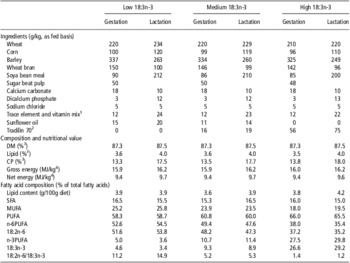
Diets were formulated according to the nutrient and energy needs of pregnant and lactating sows (Noblet et al., Reference Noblet, Dourmad and Etienne1990). They were composed of a standard gestation or lactation diet (Cooperl, Lamballe, France) supplemented with 40 mg/kg α-tocopherol and either sunflower oil (Cooperl) or extruded linseed (Valorex, France) (Table 1). The low 18:3n-3 diet was supplemented with sunflower oil only, the medium 18:3n-3 diet with both extruded linseed and sunflower oil and the high 18:3n-3 diet with extruded linseed only. Diets were iso-energetic and iso-lipidic. Sows were fed a standard gestation diet (Cooperl) until the 28th day of gestation. Then on the basis of body weight and back fat thickness, the sows were allocated to one of the three groups: the first group received the low 18:3n-3 diet throughout gestation and lactation, whereas the second group received the medium 18:3n-3 diet and the third one received the high 18:3n-3 diet. Sows were given 2.8 kg/day of feed during gestation and 7 kg/day during lactation. The transition from 2.8 to 7 kg/day was gradual within the 1st week of lactation. They were slightly restricted to minimize feed refusals. Indeed, they consumed all the feed they were offered daily.
Composition of diets

DM = dry matter; SFA = saturated fatty acids; MUFA = monounsaturated fatty acids; PUFA = polyunsaturated fatty acids.
1This premix (Cooperl, Lamballe, France) supplied per kg of diet: retinol 3 mg, cholecalciferol 37.5 μg, alpha-tocopherol 40 mg, menadione 2 mg, thiamine 2 mg, riboflavin 4 mg, niacin 20 mg, D-pantothenic acid 10 mg, pyridoxine 3 mg, D-biotin 0.2 mg, folic acid 3 mg, vitamin B12 20 μg, choline 500 mg, Fe 80 mg as ferrous carbonate, Cu 10 mg as copper sulphate, Mn 40 mg as manganese oxide, Zn 100 mg as zinc oxide, Co 0.1 mg as cobalt sulphate, I 0.6 mg as calcium iodate and Se 0.15 mg as sodium selenite.
2Tradilin 70 : 70% extruded linseed + 30% wheat bran.
3Values were calculated according to Sauvant et al. (Reference Sauvant, Perez and Tran2004).
4Values were calculated according to Noblet et al. (Reference Noblet, Fortune, Shi and Dubois1994).
Sows were weighed every 3 weeks. Parturitions were not induced. The number of piglets was adjusted to 10 to 12 piglets 48 h after parturition, by removing the extra piglets from the litter. Piglets were weighed weekly, starting at birth.
Tissue collection
Sows
Colostrum samples were collected on day 0 (within 12 h after the onset of parturition) and milk samples on days 7, 14, 21 and 28 (following the same sows throughout lactation) after oxytocin injection (1 ml of a 10 UI/ml solution) from four randomly selected teats (4 to 5 ml per teats). Samples from the different teats were pooled and kept at −20°C.
Piglets
One piglet per litter was killed at birth before suckling (day 0). As the piglets were killed just at birth before any suckling, we could not wait for the entire litter to be born to calculate the average weight of the piglets within the litter. Therefore, we selected piglets weighing between 1.2 and 1.5 kg, corresponding to the average weight of newborn piglets in our herd over the past 10 years. Other piglets from the same litter (with birth weights and weight gain until being killed close to the average weight and weight gain of the litter) were killed at days 7, 14, 21 and 28 of age. Piglets were separated from the sow (days 7, 14, 21 and 28) 1 h before being killed. Each piglet was killed by electronarcosis and exsanguination. After opening the abdominal cavity, 100 mg of liver were placed into RNAlater (Applied Biosystems, Carlsbad, CA, USA) at 4°C for 24 h and then maintained at −20°C for RNA analysis. The rest of the liver was frozen at −20°C for fatty acid composition analysis. Brains were dissected at the time of killing and immediately frozen at −20°C. The frozen brains were then homogenized in a meat grinder with 1 mm diameter screen (Hobart, Paris, France) before analysis.
Determination of fatty acid composition
Extractions of lipids from the liver and brain were performed using chloroform and methanol (2 : 1, v/v) as described by Folch et al. (Reference Folch, Lees and Stanley1957). Lipids from colostrum and milk were extracted using ethyl ether, petroleum ether and ammonium (25/25/2, v/v/v) as described by Roese-Gottlieb (Jensen and Clark, Reference Jensen and Clark1984). The lipid content of the different tissues was determined gravimetrically.
Fatty acid composition was determined after transmethylation of lipids with boron trifluoride/methanol solution (Morrisson and Smith, Reference Morrisson and Smith1964) and analysed on a Perkin-Elmer Autosystem XLgas chromatograph equipped with fused silica gel capillary column (0.25 mm × 30 m, Agilent Technologies, Santa Clara, CA, USA), with an 80% biscyanopropyl and 20% cyanopropyl stationary phase, using margaric acid (17:0) as an internal standard for the fatty acid composition analysis of tissues. For the analysis of fatty acid composition in milk, a mixed-standard with margaric acid and pelargonic acid (9:0) was used. The chromatography conditions were: temperature programme 45°C for 2 min, increased to 195°C over 7.5 min, held for 7 min, then raised to 220°C for 2 min and finally increased to 240°C for 2 min. The injector and detector temperatures were maintained at 220°C and 280°C, respectively. Retention times and peak areas were determined using dedicated chromatography software (Nelson Analytical, Manchester, NH, USA). Results were expressed as proportions of the total fatty acid composition in comparison with the internal standards.
Expression of desaturase (D5D and D6D) in liver by RT-PCR analysis
Total RNA was extracted from liver samples using Trizol reagent (Invitrogen, Carlsbad, CA, USA), according to the manufacturer's instructions. The concentration of RNA was quantified by measuring absorbance at 260 nm (Multiskan Spectrum, Thermo Fischer Scientific, Waltham, MA, USA), and RNA integrity was checked using an Agilent 2100 bioanalyser (Agilent Technologies).
The primers were designed using Primer Express Software (Applied Biosystems, France) based on sus scrofa published nucleotides sequences (Icare) and are described in Table 2. Reverse transcription was performed with 2 μg of total DNAse-treated RNA (DNase treatment performed by an Invitrogen kit, France). Real-time PCR was carried out on an ABI PRISM 7000 SDS thermal cycler (Applied Biosystems) by mixing 25 μl of PCR buffer (SYBRGreenTM PCR Master Mix; Applied Biosystems) with 500 nM of each primer, 5 μl of optimized concentration of the RT reaction product and 2 U of Uracyl DNA Glycosylase (Invitrogen). Forty cycles of PCR consisting of denaturation at 95°C for 15 s and annealing and extension at 60°C for 1 min were performed. Amplification product specificity was checked by dissociation curve analyses. Relative quantitative gene expression was calculated to the transcript level of glyceraldehyde 3-phosphate dehydrogenase, or GAPDH.
Primers sequences used in real-time PCR reactions

Statistical analysis
Data are expressed as least-square means ± RMSE. Owing to the large number of data, we concentrated our analysis on saturated fatty acid (SFA), monounsaturated fatty acid (MUFA), PUFA, n-3PUFA and n-6PUFA proportions in the different tissues, but not on the other classes of fatty acids. Data were analysed by analysis of variance using the General Linear Model procedure of SAS (SAS Institute Inc., 1989). For zootechnical data, the analysis of variance tested the maternal diet effect. For the other parameters (milk, piglet tissues from days 0 to 28), we used the following model:
 $$ {{\gamma }_{{\rm{(}}i{\rm{)}}}}\,{\rm{ = }}\,\mu \,{\rm{ + }}\,{{\alpha }_{{\rm{D(}}i{\rm{)}}}}\,{\rm{ + }}\,{{\beta }_{{\rm{A(}}i{\rm{)}}}}\,{\rm{ + }}\,{{\gamma }_{{\rm{D\times A(}}i{\rm{)}}}}\,{\rm{ + }}\,{{U}_{{\rm{sow(}}i{\rm{)}}}}\,{\rm{ + }}\,{{{\epsilon}}_{{\rm{(}}i{\rm{)}}}}$$
where γ (i ) is the dependent variable, μ the overall mean, α D(i ) the systemic effect of the maternal diet, β A(i ) is the systemic effect of the day of lactation (for milk) or the piglet age (for piglet tissues) and γD × A(i ) the systemic effect of interaction between maternal diet and the day of lactation or piglet age. U sow(i ) refers to the effect of sow/litter and ε (i ) denotes the error term. Post-hoc comparisons were made using a Student's t-test. Differences were considered significant at P ⩽ 0.05.
Results
Gestation outcomes and piglet growth
The maternal diet had no effect on the weight gain of sows throughout gestation (0.6 ± 0.1 g/day for low 18:3n-3 v. 0.5 ± 0.1g/day for medium 18:3n-3 v. 0.5 ± 0.1 g/day for high 18:3n-3, P > 0.05). Similarly, duration of gestation was not influenced by the diet (113.3 ± 1.2 days for low 18:3n-3 v. 113.5 ± 0.8 days for medium 18:3n-3 v. 114.2 ± 1.7 days for high 18:3n-3, P > 0.05).
There were no differences in litter size or mean birth weight of live piglets between low 18:3n-3, medium 18:3n-3 and high 18:3n-3 maternal diets (15.2 ± 1.8 piglets per litter v. 15.3 ± 1.0 v. 15.2 ± 3.4 and 1.4±0.1 kg v. 1.5±0.2 kg v. 1.4±0.2 kg, respectively, P > 0.05). Average piglet daily weight gain from birth to 28 days of age (0.26 ± 0.06 g/day for low 18:3n-3 v. 0.24 ± 0.07 g/day for medium 18:3n-3 v. 0.25 ± 0.05 g/day for high 18:3n-3, P > 0.05) did not differ among the three maternal diets.
Sow colostrum and milk fatty acid composition
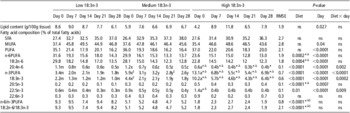
The lipid content of sow milk increased with time (day effect, P > 0.05; Table 3). There was no difference among diets for the proportion of SFA (P < 0.05; Table 3). The proportion of MUFA increased, whereas the proportion of PUFA decreased between day 0 and day 7 in all diets (day effect, P < 0.05 for MUFA and P < 0.001 for PUFA; Table 3).
Fatty acid composition of sow colostrum (day 0) and milk at 7, 14, 21 and 28 days of lactation with the low 18:3n-3, medium 18:3n-3 and high 18:3n-3 diets

SFA = saturated fatty acids; MUFA = monounsaturated fatty acids; PUFA = polyunsaturated fatty acids; ns = non-significant.
*Significantly different between low 18:3n-3 and high 18:3n-3 within time (P < 0.05).
ΔSignificantly different between medium 18:3n-3 and high 18:3n-3 within time (P < 0.05).
§Significantly different between low 18:3n-3 and medium 18:3n-3 within time (P < 0.05).
Means with different superscript (a, b for high 18:3n-3; x, y, z for medium 18:3n-3 and m, n, o for low 18:3n-3) are significantly different within a dietary group (P < 0.05).
Values are means for four sows.
The proportion of n-6PUFA, 18:2n-6 and 20:4n-6 decreased with time in the three diets (day effect, P < 0.001; Table 3) and was lower in the high 18:3n-3 diet compared with low 18:3n-3 and medium 18:3n-3 (diet effect, P < 0.001; Table 3).
The proportion of n-3PUFA decreased with time in the three diets and was greater in the high 18:3n-3 diet compared with low 18:3n-3 and medium 18:3n-3 over the whole lactation period (diet effect, P < 0.001 and diet × day effect, P < 0.001; Table 3). The proportion of 18:3n-3 decreased with time in all diets and was greater in high 18:3n-3 milk compared with low 18:3n-3 and medium 18:3n-3 over the whole period (diet effect, P < 0.001 and diet × day effect, P < 0.001; Table 3). Similarly, there was a greater proportion of 20:5n-3 in the high 18:3n-3 milk than in the low 18:3n-3 and medium 18:3n-3 (diet effect, P < 0.001; Table 3). The proportion of 22:5n-3 was greater in high 18:3n-3 colostrum compared with low 18:3n-3 and medium 18:3n-3 and decreased with time in the high 18:3n-3 diet (diet × day effect, P < 0.001; Table 3). There was no difference among diets for the proportion of 22:6n-3.
Piglet liver fatty acid composition
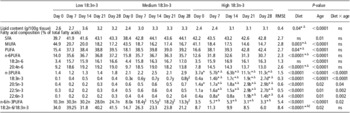
The lipid content was lower in the high 18:3n-3 piglet liver compared with the low 18:3n-3 and medium 18:3n-3 piglets liver (diet effect, P < 0.05; Table 4). The proportion of SFA increased with time (age effect, P < 0.05; Table 4). The proportion of MUFA decreased between day 0 and day 7 with all maternal diets (age effect, P < 0.01; Table 4) and was lower with the high 18:3n-3 maternal diet compared with the others (diet effect, P < 0.001; Table 4). The proportion of PUFA increased between day 0 and day 7 with all maternal diets (age effect, P < 0.05; Table 4) and was higher with the high 18:3n-3 maternal diet compared with the others (diet effect, P < 0.001; Table 4).
Fatty acid composition of piglet liver at 0, 7, 14, 21 and 28 days of age with the low 18:3n-3, medium 18:3n-3 and high 18:3n-3 maternal diets

SFA = saturated fatty acids; MUFA = monounsaturated fatty acids; PUFA = polyunsaturated fatty acids; ns = non-significant.
*Significantly different between low 18:3n-3 and high 18:3n-3 within time (P < 0.05).
ΔSignificantly different between medium 18:3n-3 and high 18:3n-3 within time (P < 0.05).
§Significantly different between low 18:3n-3 and medium 18:3n-3 within time (P < 0.05).
Means with different superscript (a, b, c for high 18:3n-3; x, y for medium 18:3n-3 and m, n for low 18:3n-3) are significantly different within a dietary group (P < 0.05).
Values are means for four piglets.
The proportion of n-6PUFA increased between day 0 and day 7 with all maternal diets (age effect, P < 0.001; Table 4) and was lower with the high 18:3n-3 maternal diet compared with the others (diet effect, P < 0.001; Table 4). The proportion of 18:2n-6 increased between day 0 and day 7 with all maternal diets (age effect, P < 0.001; Table 4). There was a lesser proportion of 20:4n-6 with the high 18:3n-3 maternal diet than in the low 18:3n-3 and medium 18:3n-3 over the whole lactation period (diet effect, P < 0.001; Table 4).
The proportion of n-3PUFA increased with time and was higher with the high 18:3n-3 maternal diet compared with the others over the whole period (diet × age effect, P < 0.001; Table 4). Within the n-3PUFA family, the proportion of 18:3n-3 increased with time with the medium 18:3n-3 and high 18:3n-3 maternal diets and was greater with the high 18:3n-3 maternal diet compared with the others over the whole period (diet effect, P < 0.001 and diet × age effect, P < 0.001; Table 4). The proportions of 20:5n-3, 22:5n-3 and 22:6n-3 increased from day 14 with the high 18:3n-3 maternal diet and were greater with this diet compared with the others (diet × age effect, P < 0.05; Table 4).
Piglet brain fatty acid composition
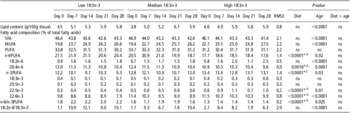
The lipid content of piglet brain increased with time with all maternal diets (age effect, P < 0.001; Table 5). The proportion of SFA decreased and the proportion of MUFA increased with time with all maternal diets (age effect, P < 0.001; Table 5). There was no difference among maternal diets for the proportion of PUFA (P > 0.05; Table 5).
Fatty acid composition of piglet brain at 0, 7, 14, 21 and 28 days of age with the low 18:3n-3, medium 18:3n-3 and high 18:3n-3 maternal diets

SFA = saturated fatty acids; MUFA = monounsaturated fatty acids; PUFA = polyunsaturated fatty acids; ns = non-significant.
*Significantly different between low 18:3n-3 and high 18:3n-3 within time (P < 0.05).
ΔSignificantly different between medium 18:3n-3 and high 18:3n-3 within time (P < 0.05).
§Significantly different between low 18:3n-3 and medium 18:3n-3 within time (P < 0.05).
Values are means for four piglets.
The proportion of n-6PUFA decreased with time with all maternal diets (age effect, P < 0.05; Table 5) and was lower in the high 18:3n-3 maternal diet compared with the others (diet effect, P < 0.001; Table 5). Within the n-6PUFA family, the proportion of 18:2n-6 increased between day 0 and day 7 with all maternal diets (age effect, P < 0.001; Table 5). The proportion of 20:4n-6 decreased between day 14 and day 21 with all maternal diets (age effect, P < 0.001; Table 5) and was lesser with the high 18:3n-3 maternal diet over the whole lactation period compared with the other maternal diets (diet effect, P < 0.001; Table 5).
The proportion of n-3PUFA decreased with time (age effect, P < 0.05; Table 5) and was lower with the low 18:3n-3 maternal diet compared with the others over the whole lactation period (diet effect, P < 0.001; Table 5). Within the n-3PUFA family, the proportions of 18:3n-3 and 20:5n-3 did not vary with time and did not differ among the three maternal diets. The proportion of 22:5n-3 increased with time with all maternal diets (age effect, P < 0.01; Table 5) and was greater with the high 18:3n-3 maternal diet compared with the others over the whole period (diet effect, P < 0.001; Table 5). The proportion of 22:6n-3 decreased with time with all maternal diets (age effect, P < 0.001; Table 5) and was greater with the high 18:3n-3 maternal diet compared with the others (diet effect, P < 0.001; Table 5).
Expression of desaturase (D5D and D6D) mRNA in the liver
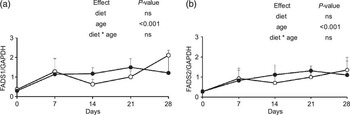
The mRNA relative expressions of D5D and D6D were not different in the low 18:3n-3 and high 18:3n-3 piglets’ liver over the whole lactation period. However, it increased between birth and day 7 with both maternal diets (age effect, P < 0.05; Figure 1).
Evolution of the relative mRNA expression of FADS1 (coding D5D) (a) and FADS2 (coding D6D) (b) in low 18:3n-3 (open circle) and high 18:3n-3 (solid circle) piglets’ liver at different postnatal ages. In each treatment, day 0 differs from day 7 to day 28 (P < 0.05).

Discussion
Our study demonstrated that extruded linseed in the sow diet modifies the fatty acid composition of the milk and the n-3LC-PUFA status of piglets at birth and during the postnatal period. However, a minimal content of 18:3n-3 in the maternal diet is necessary to increase the n-3LC-PUFA level in piglet liver and brain, as most of the changes were observed with the high 18:3n-3 diet but not with the medium 18:3n-3. Moreover, modifications in the n-3LC-PUFA fatty acid composition of piglet liver seem linked to the availability of 18:3n-3 in sow milk and not to any diet-induced modification of desaturase enzyme expression.
The maternal diet modified the fatty acid composition of the milk. Supplementation of the sow diet with extruded linseed during gestation and lactation increased the proportions of n-3PUFA compared with the other two experimental diets without modifying the proportion of 22:6n-3. The fatty acid composition of the milk reflected the nutritional status of the sows during gestation and lactation as previously described (Fritsche et al., Reference Fritsche, Huang and Cassity1993; Bazinet et al., Reference Bazinet, McMillan and Cunnane2003; de Quelen et al., Reference de Quelen, Boudry and Mourot2010). However, the content of 18:3n-3 in the diet seems to be important to increase n-3PUFA levels in sow milk. Indeed, we did not observe any differences in the fatty acid composition of sow milk between the diet with 3% of 18:3n-3 (low 18:3n-3) and the one with 9% of 18:3n-3 (medium 18:3n-3), suggesting that a minimal content of 18:3n-3 in the maternal diet is necessary to increase the n-3PUFA level in milk. Our experimental diets did not make it possible to specify this level, as there is too much difference in 18:3n-3 content between the medium 18:3n-3 and the high 18:3n-3 diet; intermediary levels of supplementation would be necessary to specify the 18:3n-3 threshold. In addition to the diet effect upon milk fatty acid composition, we also observed differences in the fatty acid composition of sow milk with time. The colostrum had greater proportions of n-3PUFA than mature milk with all diets. Similar results have already been reported in women but not in sows (Yu et al., Reference Yu, Duchen and Bjorksten1998; Molto-Puigmarti et al., Reference Molto-Puigmarti, Castellote, carbonell-Estrany and Lopez-Sabater2011). The high level of n-3 LC-PUFA in the colostrum covers the n-3LC-PUFA needs of the piglet that cannot rely on its own metabolism, as n-3LC-PUFA synthesis is very limited in piglets at birth and increases during the postnatal period (Clandinin et al., Reference Clandinin, Chappell, Heim, Swyer and Chance1981; Clandinin et al., Reference Clandinin, Wong and Hacker1984).
The lipid composition of the maternal diet influenced the fatty acid composition of piglet tissues during postnatal life as previously described (Rooke et al., Reference Rooke, Shanks and Edwards2000; Lauridsen and Jensen, Reference Lauridsen and Jensen2007; Farmer and Petit, Reference Farmer and Petit2009). Piglets suckling the high 18:3n-3 sows consumed high levels of 18:3n-3 through the milk. This resulted in increased liver proportions of 18:3n-3, 20:5n-3, 22:5n-3 and 22:6n-3, which also increased with time, whereas there were no differences in n-3PUFA proportions between the low 18:3n-3 and medium 18:3n-3 piglets liver. This suggests that high 18:3n-3 piglets efficiently absorbed 18:3n-3 derived from the maternal milk and were capable of transforming it to n-3LC-PUFA during the postnatal period. To further investigate the hepatic metabolism of PUFA, we measured D5D and D6D mRNA expression in the liver of low 18:3n-3 and high 18:3n-3 piglets. The level of desaturase expression in the piglet liver was low at birth, supporting the low LC-PUFA synthesis capacity of piglets at birth already described (Clandinin et al., Reference Clandinin, Chappell, Heim, Swyer and Chance1981; Clandinin et al., Reference Clandinin, Wong and Hacker1984). After birth, the postnatal pattern of expression of hepatic D5D and D6D mRNA did not corroborate the postnatal pattern of the fatty acid composition of low 18:3n-3 and high 18:3n-3 piglets liver. Indeed, we observed an increase in desaturase mRNA expressions between birth and 7 days of age in all piglets’ liver, but no increase of n-3LC-PUFA proportions between birth and day 7 in any piglet liver. The increase in n-3LC-PUFA with the high 18:3n-3 maternal diet occurred later, after day 21, concomitant with an 18:3n-3 proportion increase in the liver. This suggests that the increase in n-3LC-PUFA is a consequence of the increase in substrate availability.
Another major finding of our study is that desaturase expression was not affected by the diet. However, other studies have demonstrated that the expression of D5D and D6D genes or their enzymatic activities can be regulated by diet. Indeed, high LC-PUFA diets downregulated the gene expression of D6D in human hepatic cell culture (HepG2) (Tang et al., Reference Tang, Cho, Nakamura and Clarke2003) or inhibited the D6D activity in mice (Raz et al., Reference Raz, Kamin-Belsky, Przedecki and Obukowicz1998). Conversely, low PUFA diets upregulated the gene expression of D5D and D6D in rat liver (Tu et al., Reference Tu, Cook-Johnson, James, Mühlhäusler and Gibson2010) or in rat mammary gland (Rodriguez-Cruz et al., Reference Rodriguez-Cruz, Tovar, Palacios-Gonzalez, del Prado and Torres2006). In particular, a low n-3LC-PUFA diet upregulated desaturase and elongase mRNA level and enzymatic activities in rat liver (Igarashi et al., Reference Igarashi, Ma, Chang, Bell and Rapoport2007). However, in opposition to adults, it seems that maternal n-3PUFA-diet did not modify the mRNA desaturase expression of piglets, probably because of the significant need for LC-PUFA during the postnatal period. Our results are consistent with those reported by Missotten et al. (Reference Missotten, De Smet, Raes and Doran2009) who observed that sow 18:3n-3-rich diet during gestation and lactation period did not modify the protein expression of D5D and D6D in female piglet liver at 6 days of age.
The proportion of 22:6n-3 decreased between birth and day 7 in all piglets’ brain. Although it continued to decrease with time in the low 18:3n-3 and medium 18:3n-3 piglet brain, the proportion of 22:6n-3 was maintained in the high 18:3n-3 piglets’ brain over the lactation period. Moreover, the proportions of 22:5n-3 and 22:6n-3 were greater from birth to day 28 in the high 18:3n-3 piglet brain and from birth to day 7 in the medium 18:3n-3 piglet brain compared with the low 18:3n-3 piglet brain with no difference for 18:3n-3 and 20:5n-3. The high level of 22:6n-3 in medium 18:3n-3 and high 18:3n-3 piglet brain at birth could arise from placental transfer. Indeed, the activity of elongase and desaturase enzymes appears to be low before birth compared with the postnatal period (Clandinin et al., Reference Clandinin, Chappell, Heim, Swyer and Chance1981 and Reference Clandinin, Wong and Hacker1984), suggesting that the incorporation of n-3LC-PUFA in tissues at birth derives predominantly from placental transfer. Several studies demonstrated that 18:3n-3-rich diets increase n-3LC-PUFA accumulation in sow placenta and n-3LC-PUFA deposition in foetal tissue (Brazle et al., Reference Brazle, Johnson, Webel, Rathbun and Davis2009; de Quelen et al., Reference de Quelen, Boudry and Mourot2010), suggesting placental transfer of n-3LC-PUFA between the sow and foetuses. During the postnatal period, the 22:6n-3 in the high 18:3n-3 piglet liver could be mobilized via the circulation from the liver to the brain. This mobilization could maintain the 22:6n-3 proportion in the high 18:3n-3 piglet brain from birth until the end of the lactation period. This is an important finding as the content of 22:6n-3 in the brain during the postnatal period is crucial for the maturation of cerebral functions (Guesnet and Alessandri, Reference Guesnet and Alessandri2011). Moreover, a high 22:6n-3 level in piglet brain at birth correlates with increased vitality, decreased latency to suckle and improved piglet growth (Rooke et al., Reference Rooke, Sinclair and Edwards2001). Therefore, supplementing the sow diet with extruded linseed seems beneficial to the piglet cerebral function.
In conclusion, extruded linseed in the sow diet modifies the n-3LC-PUFA status of newborn piglets during the postnatal period. However, a minimal content of 18:3n-3 in the diet is necessary to increase the n-3LC-PUFA level in piglet liver and brain. Moreover, modifications in the n-3LC-PUFA fatty acid composition of piglet tissue seem linked to the availability of 18:3n-3 in maternal milk and not to desaturase enzyme expression.
Acknowledgments
The authors thank the technical staff for their help.
F. de Quelen declared a potential conflict of interest as she is employed by Valorex.