The size–fitness hypothesis has been addressed for decades, and a positive relationship has been interpreted as indicating that the larger the individual, the higher the fitness (Visser Reference Visser1994; Kazmer and Luck Reference Kazmer and Luck1995; West et al. Reference West, Flanagan and Godfray1996; Bennett and Hoffmann Reference Bennett and Hoffmann1998; Sagarra et al. Reference Sagarra, Vincent and Stewart2001; Kölliker-Ott et al. Reference Kölliker-Ott, Blows and Hoffmann2003). In Trichogramma spp. (Hymenoptera: Trichogrammatidae), a genus of insects reared in biofactories and used mainly in biological control, fitness is correlated with body size and is assessed by comparing the wasp body size distribution that successfully finds hosts in the field by the size distribution of the released population (Kazmer and Luck Reference Kazmer and Luck1995; West et al. Reference West, Flanagan and Godfray1996; Bennett and Hoffmann Reference Bennett and Hoffmann1998; Kölliker-Ott et al. Reference Kölliker-Ott, Bigler and Hoffmann2004). Evidence suggests that large Trichogramma spp. are more likely to find host eggs, which, from an applied perspective, means that larger parasitoids are more likely to control the pest.
The most common body parts measured to assess size are the wing and the tibia (Kazmer and Luck Reference Kazmer and Luck1995; Cônsoli and Parra Reference Cônsoli and Parra1996; Bennett and Hoffmann Reference Bennett and Hoffmann1998; Kölliker-Ott et al. Reference Kölliker-Ott, Blows and Hoffmann2003), but some controversies exist in assessing parasitoid size by wing or tibia lengths. For example, parasitoids with intermediate body size tend to have the lowest fitness (Bennett and Hoffmann Reference Bennett and Hoffmann1998), whereas, among large parasitoids, being extremely large has some disadvantages (Kazmer and Luck Reference Kazmer and Luck1995). This controversy could be caused by the different body parts examined in those studies and could be misleading. This leads us to question how we can define a large insect.
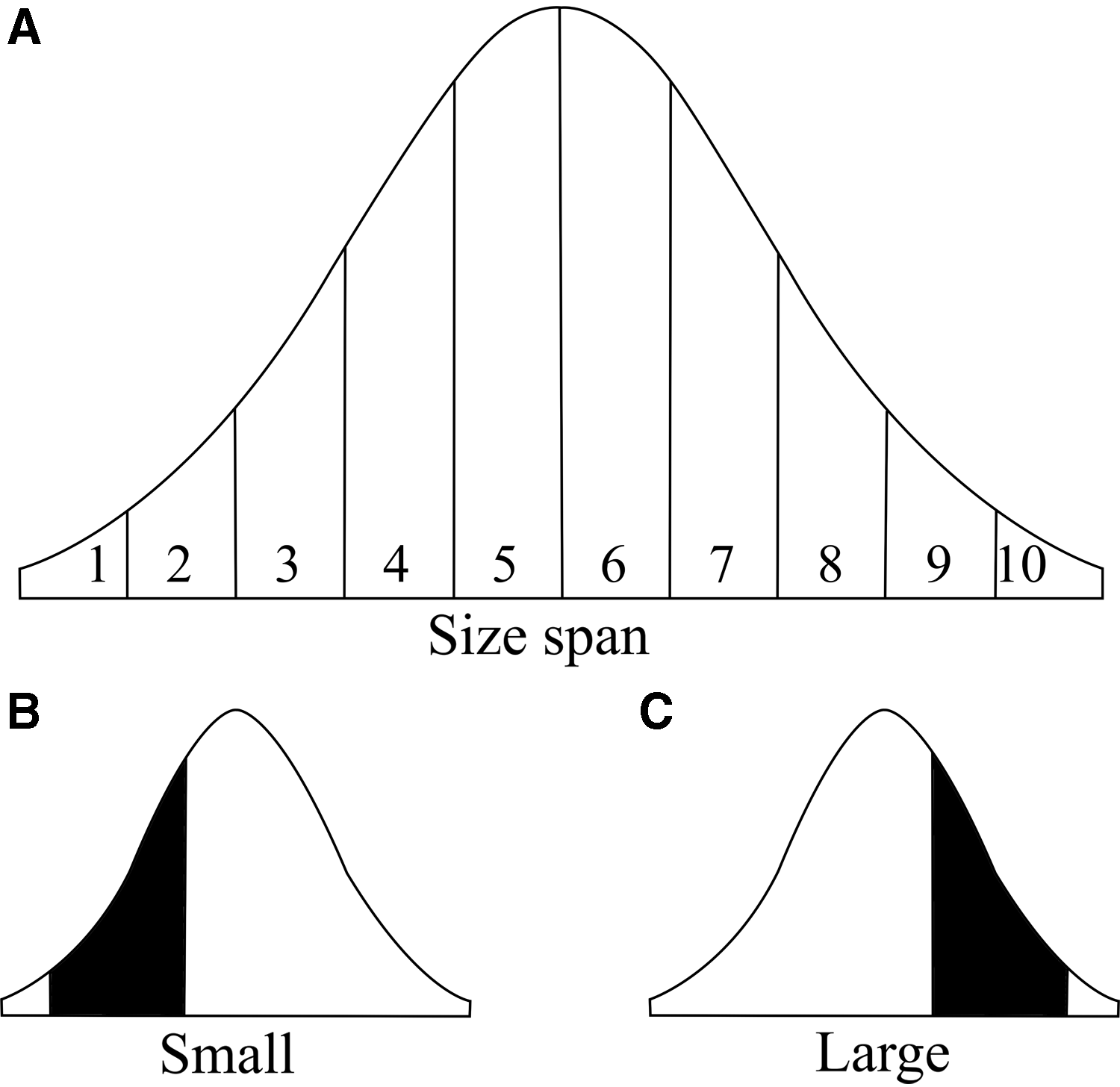
This paper aims to understand body size relationships in Trichogramma pretiosum Riley, 1879 (Hymenoptera: Trichogrammatidae) by studying the body span of this insect. We hypothesised that measuring the tibia or wing to classify insects in size categories could lead to multiple conclusions. To accomplish our objective, we used measurements of forewing length and hind tibia length from T. pretiosum females. Data are from a previous paper published, and for more information about insect rearing and body parts measurements, please see Souza et al. (Reference Souza, Monteiro and Faria2018). The 233 females obtained for the present study comprised our study population and were classified based on deciles, according to the “decile” function in the StatMeasures package (CRAN, by R; https://cran.r-project.org/web/packages/StatMeasures/index.html), using the size span of either of an insect’s wings or its tibias (Fig. 1A). This classification was used as criteria to classify the specimens into two size categories, small and large (Fig. 1B, C). Small specimens belong to the second to fourth deciles, and large specimens belong to the seventh to ninth deciles of the size span (Fig. 1). Six different groups were identified, based on the classification of their body part lengths: “SmallWing” (small specimens classified by wing; 74 specimens), “LargeWing” (large specimens classified by wing; 69 specimens), “SmallTibia” (small specimens classified by tibia; 71 specimens), “LargeTibia” (large specimens classified by tibia; 64 specimens), “BothSmall” (26 specimens), and “BothLarge” (17 specimens). The latter two groups comprised specimens that were classified in the same decile by either large-sized or small-sized wing and tibia (e.g., specimens classified in the second decile by wing and tibia at the same time). Regarding variation in body parts, it is important to highlight that some specimens were classified twice in the SmallWing, LargeWing, SmallTibia, and LargeTibia groups, yielding 321 samples – for example, some of the specimens had large wings and small tibia. However, specimens in the BothSmall and BothLarge groups were classified only once.
Size classification of Trichogramma pretiosum based on body size span. Size span decile classification, A, used to classify wing or tibia as, B, small or, C, large.

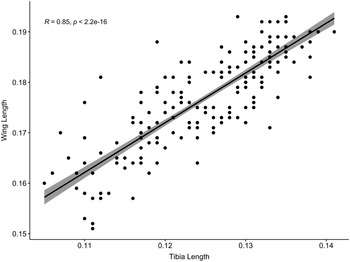
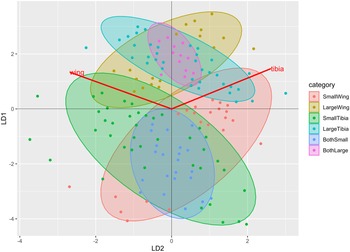
All analyses were performed using R, version 4.0.0 (R Core Team 2022). Data normality was assessed by fitting a probability distribution object to the data and groups, computing goodness-of-fit statistics for the parametric distribution fitted, and then comparing them to the smallest Akaike’s information criterion. Data and groups showed normal distribution for most of the body parts measured except for wings in LargeWing – for example, log-normal – and tibia in LargeTibia, BothSmall, and BothLarge groups – for example, gamma. Correlation between forewing length and hind tibia length was assessed by using the Pearson’s product moment correlation coefficient in R’s cor.test function. Even though the two body parts were highly correlated (r = 0.91; P < 2.2e–16; Fig. 2), indicating that we could use one or another to continue the analysis, we ended up with different conclusions if we used tibia or wing to make the size selection. Groups based on body part length were analysed by discriminant analysis, which is indicated when there is an a priori grouping structure, and it extracts a linear combination of two or more variables to explain the differences among groups. Considering the individual body parts composition of each group, the predicted distribution from discriminant analysis pointed to differences only for groups selected by wing and tibia together (Fig. 3). The discriminant analysis showed that groups selected using only one body part resulted in overlap, indicating no distinction among them. This means that the same individual that was classified as large by its wing size could be classified as small by its tibia size, which could misrepresent relationships in studies based on size span.
Correlation analysis between forewing length and hind tibia length.

Linear discriminant analysis predicted distribution for each group. Overlaps represent nondifferences among each group.

For Trichogramma spp., measuring tibia size has been used as a standard method to assess body size (Cônsoli and Parra Reference Cônsoli and Parra1996), but wing size is also a good body part to measure because it can relate to flight capacity (Kölliker-Ott et al. Reference Kölliker-Ott, Blows and Hoffmann2003). Using two body parts to obtain groups based on size span makes the selection more reliable. BothSmall and BothLarge groups have individuals that differ in size, making it possible to study size relationships in two different-sized specimen populations.
In conclusion, specificity in defining large or small individuals produces reliable and consistent conclusions about body size relationships, primarily if the body parts chosen are those that are important to studies about size–fitness relationships and relating body size to life parameters, such as longevity, fecundity, and flight capacity, that are used in quality assessments of mass-reared parasitoids. Finally, to classify T. pretiosum in size categories with the greatest potential impact, at least two body parts should be used. A more detailed morphological study of the Trichogramma genus needs to be undertaken to determine a standard method to classify size; such knowledge is needed to assess the benefits of manipulating the body sizes of parasitoids that are mass-reared for biological control (Kazmer and Luck Reference Kazmer and Luck1995; Bennett and Hoffmann Reference Bennett and Hoffmann1998). This could enhance the quality of mass-reared parasitoids and improve insects’ production quality.
Acknowledgements
The authors thank the Brazilian National Council for Scientific and Technological Development (CNPq – 306196/2018-2) and Minas Gerais Research Foundation (FAPEMIG – APQ-02700-17) for financial support.
Conflicts of interest
The authors declare they have no conflicts of interest.