Introduction
Cream skimming can be defined as the selective treatment of patients that demand few resources while providing high economic refunds. An assumption for cream skimming to occur is that health insurers or health providers are able to distinguish subgroups of individuals with different expected costs within a risk group for which the risk-adjusted payment is identical (de Ven and van Vliet, Reference de Ven, van Vliet, Zweifel and Frech III1992). Cream skimming may take on different forms, such as insurers avoiding high-risk individuals, or hospitals choosing low-risk patients from their waiting lists, and is usually assumed to prove a more significant problem in market-oriented than in non-market oriented systems (Le Grand, Reference Le Grand1991). Given that recent health reforms in many Western countries have led to the introduction of market-oriented hospital financing schemes (e.g. Newhouse, Reference Newhouse1994), there is consequently a growing interest in exploring the potential for protection against cream skimming, while at the same time preserving incentives to efficiency. Adapting to the increasing market-orientation in Western welfare systems, Norway put into operation an activity-based financing (ABF) scheme for the hospitals from 1 July 1997 (Biørn et al., Reference Biørn, Hagen, Iversen and Magnussen2003). A second major reform was implemented in 2002 as the central government took over responsibility and ownership of all public hospitals from the counties, and turned them into trusts (Hagen and Kaarbøe, Reference Hagen and Kaarbøe2006).
The study of cream skimming is mainly rooted in the economic literature, and builds on a theoretical rather than an empirical approach, with the main ambition being the development of financing systems that reduces the scope for such behaviour (e.g. Matsaganis and Glennerster, Reference Matsaganis and Glennerster1993; Jones and Cullis, Reference Jones and Cullis1996; Ellis, Reference Ellis1998; Barros, Reference Barros2003). The approach of the present paper is somewhat different, as our ambition is to explore the actual patient prioritization of Norwegian hospitals in the wake of the 1997 reform of the reimbursement system and the 2002 ownership reform.
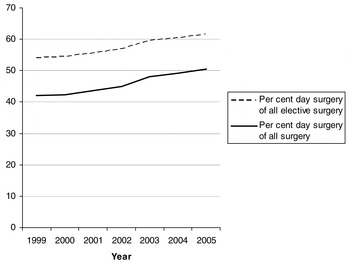
We concentrate on day surgery. Day surgery has gained increasing significance during the last decade. Norwegian public health policy objectives explicitly state an aim to move towards outpatient and same-day-surgical services, and this mode of treatment now constitutes more than 60% of all elective surgery (Martinussen, 2005). The main arguments for substituting inpatient care with day surgery are well known: it is assumed to be less traumatizing for the patient, involves lighter narcosis than in the case of traditional surgery, and implies shorter treatment time and faster convalescence. The underlying assumption is therefore that this mode of delivering surgery will ultimately increase the efficiency of hospitals as well as the quality of the patient treatment. Whereas studies of day surgery have addressed aspects such as patient satisfaction (Roberts et al., Reference Roberts, Peterson, Friesen and Beckett1995; Kangas-Saarela et al., Reference Kangas-Saarela, Ohukainen and Koivuranta1998; Mitchell, Reference Mitchell1999; Lau et al., Reference Lau, Poon and Lee2000), clinical outcomes (Pineault et al., Reference Pineault, Contandriopoulos, Valois, Bastian and Lance1985), cost efficiency (Russel et al., Reference Russel, Devlin, Fell, Glass and Newell1977; Pineault et al., Reference Pineault, Contandriopoulos, Valois, Bastian and Lance1985; Ancona-Berk and Chalmers, Reference Ancona-Berk and Chalmers1986; Keithley et al., Reference Keithley, Glandon, Llewellyn, Berger and Levin1989; Heath et al., Reference Heath, Ogg, Hall and Brownlie1990; Hollmann et al., Reference Hollmann, Rotzer and Lange1994; Janeke, Reference Hollmann, Rotzer and Lange1994; Clarke, Reference Clarke1996; Weale, Reference Weale2002; Martinussen and Midttun, Reference Martinussen and Midttun2004), and waiting time (Midttun and Martinussen, Reference Midttun and Martinussen2005), little attention has been paid to the actual patient priorities.
Cream skimming may occur both between and within diagnosis-related groups (DRGs). Cream skimming between DRGs may be the result if some DRGs are more profitable than others. A survey among Norwegian hospital physicians in 2006 uncovered that they experience ‘profitable’ diagnosis groups to be given higher priority since the hospital reform (Aasland et al., Reference Aasland, Hagen and Martinussen2007). However, hospital-level analyses of cream skimming between DRGs presuppose information of costs–revenue margins for each DRG at hospital level. Since these types of costs are unavailable in our setting, the focus is on the within DRG variation. Using patient data from 1999 to 2005, we analyze the relationship between patient severity and waiting time for day surgery within the actual DRGs. Do hospitals give priority to patients that can be treated and discharged on the same day over patients that need in-patient care over several days? Simply put, if a hospital can choose between patients that provide the same economic reimbursement, is it then more likely that low-severity patients will be chosen for treatment before high-severity patients? Given that length of stay (LOS) can be considered a proxy for the severity of the patient’s medical condition and thereby for the resource use associated with the hospital stay, the central question to be addressed is whether the waiting time for treatment within the same-day-surgical DRGs is shorter for patients with short LOS than for patients with long LOS.
The day-surgical DRGs are of particular interest in our setting, since the ABF system offers the same economic reimbursement for patients classified in day-surgical DRGs, and with the prices defined by the costs of day-surgical treatment, irrespective of whether the patient is actually treated the same day or as in-patients. The potential for cream skimming could consequently be high within these DRGs, since the hospitals will have an economic incentive for prioritizing patients suggesting the shortest LOS and lowest costs. Obviously, the waiting time for treatment is dependent upon other factors than patient severity alone, and our empirical analysis controls for the age and gender of the patient, the year of treatment, as well as hospital-specific effects.
The paper is organized as follows. The next section gives a brief introduction to the theoretical concept in question: the problem of patient selection. Section 3 discusses the operationalization of our main variables and describes the development of day surgery in Norwegian health care. In Section 4 we develop the empirical model. The empirical results are reported in Section 5, while Section 6 contains the concluding remarks.
Patient selection
Selection problems like cream skimming are usually related to health care systems where competing insurers receive a risk-adjusted premium per insured patient or providers receive risk-adjusted payments for treated patients. The essence of the problem on the provider side, as Newhouse (1989) puts it, is that a physician treating a patient will have more information about the patient's likely future spending than any risk-adjustment formula can incorporate. In such a context, cream skimming can be viewed as a form of preferred risk-selection, as the insurer or provider select patients with expected payments to be above the expected cost level. Cream skimming may thus occur if insurers are able to distinguish subgroups of individuals with different expected costs within a risk group for which the risk-adjusted per capita payment is the same (de Ven and van Vliet, 1992).
At hospital level, similar mechanisms prevail. The reimbursement incentives in a hospital financing system will influence the intensity of services and the selection of patients as patients differ in severity (Ellis, Reference Ellis1998) and two different forms of hospital behaviour may occur: hospitals may choose to concentrate on relatively profitable DRGs (i.e. prioritizing between DRGs) or they may select low-severity, low-cost patients within specific DRGs (i.e. prioritizing within DRGs).
It is usually separated between two kinds of hospital financing systems: prospective and retrospective financing. Retrospective financing is the type of traditional ‘cost-based’ reimbursement that was dominant in most countries until the early 1980s. In such a system, the hospitals' reported treatment costs are reimbursed by a third party. In a prospective payment system, on the other hand, the hospitals either receive a lump sum dependent on the demography and needs of the hospital’s catchment area (formula funding), a fixed payment for each patient dependent upon a diagnosis-related classification system, or a combination of these two systems. In a theoretical investigation of the implications of different payment incentives, Ellis (1998) compares cost-based reimbursement, prospective payment, and mixed payment systems. His conclusion that prospective payment may result in undesirable creaming, skimping, and dumping is not merely a theoretical possibility, it is also one that has been found empirically to occur. Real-world examples of such behaviour includes Newhouse and Byrne (Reference Newhouse and Byrne1988), Newhouse (Reference Newhouse1989), and Frank and Lave (Reference Frank and Lave1989). Furthermore, in a study of the relative profitability among DRGs under Medicare’s prospective payment system it is concluded that much of the potential benefit of selection comes from treating relatively low-severity patients within DRGs (Pettengill, Reference Pettengill2005).
Institutional set-up
Two major reforms in Norwegian secondary care during the last ten years, the introduction of activity-based financing (ABF) in 1997 and the ownership reform of 2002, may have affected the way patients are prioritized. The Norwegian reimbursement system prior to 1997 – which implied that hospitals received a global budget by the beginning of each year – could be characterized as a prospective payment system. The reimbursement system was combined with strong prioritizing signals, both from central government and from county politicians, which were compatible with basic medical ethics: patient severity should be the main prioritizing rule. It is generally believed that this rule was followed. Yet, as a result of relatively low growth in hospital budgets during the first part of the 1990s, waiting lists and waiting time for elective treatment was high. The implementation of ABF from 1 July 1997 implied that a proportion of the block grant from central government was replaced by a matching grant depending upon the number and composition of hospital treatments measured by the DRG system. Prices in the DRG system were set equal to average costs calculated on the basis of historical cost information from 12, later 20, hospitals. Using prices as prioritizing instruments, for instance by increasing the price for a certain DRG to increase activity, has not been desired. Instead, priorities between DRGs have been implemented mainly through capacity decisions.
Initially, 30% of the hospitals’ reimbursement was related to the number of DRG equivalents. The ABF share was gradually increased to 50% of the total budget in 2001. The introduction of ABF increased production and technical efficiency, while the effect on cost efficiency was more difficult to settle (Biørn et al., Reference Biørn, Hagen, Iversen and Magnussen2003). Waiting lists and waiting time was reduced. But has it also led to cream skimming? Will a shift from a low-powered to a higher-powered prospective payment system influence priorities? A survey conducted in 1999 on the consequences of the ABF system indicates that this may be the case. The results show that 10% of the chief surgeons in somatic hospitals had experienced pressure or instructions from the hospital management to give preference to profitable patients (Halvorsen, Reference Halvorsen1999). Also, in 10% of the outpatient departments the respondents held the opinion that the choice as to whether patient treatment were to take place via hospitalization, day treatment, or in outpatient departments was guided by revenue generation rather than medical evaluations. Moreover, 25% of the chief surgeons considered operations and treatment to be de-prioritized due to dependency of outpatient income.
The second major reform implied that the central state from 1 January 2002 took over ownership and responsibility of hospitals from the county governments, organized the hospitals as trusts within five regional health authorities (RHAs), and implemented private sector accounting systems, meaning that depreciation costs were included in the hospitals’ expenses. The central government should stand surety for the hospitals so hospitals still could not go bankrupt (Hagen and Kaarbøe Reference Hagen and Kaarbøe2006). The share of ABF financing was increased to 55% in 2002, 60% in 2003, reduced to 40% in 2004, and yet again increased to 60% in 2005.
The effect of the ownership reform on the level of cream skimming is harder to predict. On the one hand, the increase in ABF could lead to increased cream skimming. Even if central government has emphasized that prioritizations should be grounded in medical ethics rather than on the basis of economic evaluations, there has been growing concern – indicated for instance in several articles in the Journal of the Norwegian Medical Association (e.g. Haug, Reference Haug2001; Pettersen, Reference Pettersen2001; Øgar, Reference Øgar2001) – that the latter should be the case. A survey conducted in 2006 furthermore demonstrates that 60% of hospital physicians view the new organizational model as giving incentives for prioritizing profitable patients. One in three physicians reports that a businesslike way of deciding priorities – meaning that patients are prioritized according to the net revenues they generate – is emphasized in their department (Aasland et al., Reference Aasland, Hagen and Martinussen2007). On the other hand, and although the opposite was intended, the 2002 hospital reform led to softening of the hospitals’ budget constraints: production became far higher than planned from the central state, budget deficits higher than ever, and bailouts of the hospitals took place nearly every year in the period 2002–2007 (Tjerbo and Hagen, Reference Tjerbo and Hagen2008). The breakdown of fiscal discipline meant that elements of cost compensation were introduced into the reimbursement system. Theoretically, this should reduce the hospitals’ incentives for cream skimming.
Although different predictions can be put forward, in particular related to the effects during the second phase of the ABF-period (after the 2002 hospital reform), we state our two main hypotheses as such:
Hospitals partly reimbursed by DRG-based activity-based financing will with probability select low-severity patients over high-severity patients (low-risk over high-risk patients) within the actual DRG.
Turning the hospitals into trusts will increase the probability with which the hospitals select low-severity patients over high-severity patients within the actual DRG.
In addition to these two main structural reforms, a Patient Rights Act was implemented gradually from 2000 onwards. The act was partly a simplification and consolidation of already existing legislation, and partly an implementation of new rights. The act allots the patients a number of formal rights, including choice of hospitals, evaluation within 30 days, second opinion, access to medical records, and to assistance from the Patients’ Ombudsman (Johnsen, Reference Johnsen2006; Vrangbæk and Østergren, Reference Vrangbæk and Østergren2006; Vrangbæk et al., Reference Vrangbæk, Østergren, Birk and Winblad2007). The elements in the Patients Right Act were gradually implemented from year 2000. In 2003 and 2004, several amendments to the Patient Rights Act were made. Among others, free choice of hospital was extended to include private hospitals that were on contract with the Regional Health Authorities, patients were allotted individual time limits within which necessary treatment should be provided, and the patient was given the right to be transferred to a private or foreign healthcare provider if the responsible regional health authority failed to provide treatment within the time limit (Vrangbæk and Østergren, 2006; Vrangbæk et al., 2007). We discuss possible of effects of the Patient Rights Act at the end of the article.
Operationalization of main variables
We test our hypotheses by investigating the relationship between waiting time for treatment and severity for elective patients. Our dependent variable, waiting time for treatment (WT), is defined as the number of calendar days from when the patient is referred from the primary physician or private specialist to when the hospital treatment starts. If our hypotheses are confirmed, waiting time should be lower for low-severity than for high-severity patients.
The essential explanatory variable, patient severity, is operationalized as the patient’s length of stay (LOS). As already indicated, severity is hypothesized to affect waiting time positively. There are two underlying assumptions here. First, we assume that LOS within each DRG is a proxy for severity. This is documented in several studies for inpatients (e.g. van den Pool et al., Reference Van den Pool, van Houdenhoven, Hans, Boersma, Bax, Feringa, Schouten, van Sambeek and Poldermans2006), and now also for procedures that can be performed both in inpatient and outpatient departments (e.g. Latham et al. Reference Latham, Jette, Warren and Wirtalla2006). Second, we assume that hospitals in most cases hold relatively detailed information about a patient’s condition before the surgery takes place, obtained either through medical deliberations from the patient’s primary physician, through outpatient consultations at the hospital, or both. Norway makes for a particular case here, since the waiting time regulations guarantee that a hospital specialist will formally assess all patients within a maximum of 30 days after referral and before surgery. When organizing the waiting list, the hospital will therefore have a pretty good ex ante estimate on most patients’ LOS, and thereby on the resources that can be expected to be related to each case. Consequently, and although there will be exceptions, LOS registered ex post can be used as proxy for ex ante evaluations of severity. Exceptions will be related to for instance post-operational infections and other complications during the hospital stay. Given the ABF reform described above, we hypothesize that the hospitals will have an incentive to select the patients that can be assumed to have the shortest LOS, i.e. the patients demanding the least resources for a given economic refund.
We test our propositions on data from day surgery, since the ABF system offers the same economic reimbursement for day-surgical patients irrespective of their length of stay in the hospital. The data set consists of more than 1.2 million patients receiving day surgery during the period 1999–2005. Figure 1 shows the level of day-surgical activity during the period.
Per cent day surgery of all elective surgery and of all surgery, Norway, 1999–2005

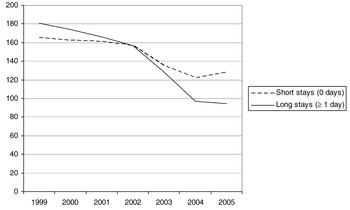
A first impression of the relationship between patient severity and waiting time for elective day surgery can be obtained by comparing the waiting time for short stays (LOS = 0 days) and long stays (LOS ≥ 1 day), respectively (Figure 2). The figure obviously lends little support to a hypothesis that more severe patients waited longer than less severe patients. Even though waiting time for short stays dropped during the period, the waiting time decreased more than double for long stays, with 38 days for the former type of patients and 87 days for the latter. Notice in particular the significant drop in short-stay waiting time from 2002 – the year of the hospital reform – to 2005, during which waiting time was reduced by 29 days.
Average waiting time and length of stay for day-surgical DRGs (elective stays), Norway, 1999–2005

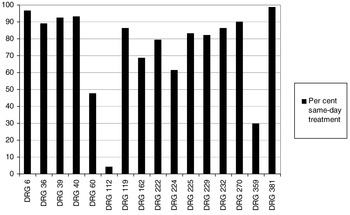
Treating all day-surgical activity as one naturally implies a vast over-simplification. Given that day surgery in 2005 comprised 151 different DRGs, involving a large number of various procedures, a more suitable approach is instead to focus on the specific day-surgical DRGs. Figure 3 therefore presents the actual share of same-day treatments performed within the day-surgical DRGs that had a patient volume of at least 2% of all day surgery during the 1999–2005 period. The table serves as a good illustration of why day surgery deserves special attention in the context of patient selection: within several of the day-surgical DRGs there is a surprisingly low share of patients that are actually treated by same-day treatment, while other DRGs have an almost 100% same-day treatment share. In fact, the percentage of same-day treatment is below 70% for one-third of the DRGs presented in Figure 3, and for DRGs 60, 112, and 359 the share of same-day treatment is even below 50%. At the other end of the scale, we find DRGs 6, 39, 40, and 381, with more than 90% same-day treatments (for a description of the DRGs, see Table 2). The large variation between the DRGs in terms of the actual use of same-day treatment is naturally related to the procedures’ level of complexity and patients’ convalescence period.
Per cent same-day treatment within specific day-surgical DRGs, Norway, 1999–2005

The potential for patient selection is naturally higher the larger and more heterogeneous the patient group. Hence, for the DRGs with near 100% same-day treatment there exists little room for making this kind of prioritization between patients based on assumed LOS, given that almost all patients are treated the same day. However, since it is difficult to decide exactly where to set the limit for which DRGs should be investigated, and in order to obtain as complete a picture as possible, we initially choose to include all of the major day-surgical DRGs in our analysis.
Empirical model
Although patient severity described by LOS is the variable of main interest in our study, a number of additional variables can be expected to influence waiting time (WT i) for patient i, and consequently need to be controlled for in the analysis. Our basic empirical model captures effects of patient-specific, hospital-specific, and time-specific variables within each DRG, and can be written

Age is patient is age measured in intervals of five years, and gender is a dummy variable for which the value of 1 is assigned to male patients, otherwise 0. D is a vector of dummies representing institutional and time-specific variables specified in alternative ways, while v is the error term. The structure of the error term is affected by the specifications of D, to which we now turn. First, and common to all empirical specifications, we estimate the impact of the 2002 hospital reform by a dummy variable, REFORM, that takes the value of 0 in the period from 1999 to 2001 and the value of 1 in the period from 2002 to 2005, and an interaction term between REFORM and LOS (LOS x REFORM). In one of our estimated models, we additionally include hospital-specific (H) and year-specific dummy variables (Y). Equation (2a) expresses this alternative specification for the dummy variables in (1)

β 1 gives us the effect of patient severity on waiting time under the financial regime of ABF (before the 2002 hospital reform), while (β 1 + β 6) gives us the estimated effects of patient severity on waiting time after the hospital reform. If turning hospitals into trusts increases cream skimming, the interaction term should take positive estimates (β 6 > 1). The time trend in waiting time will be captured by REFORM and the time-specific variables, Y. As Figure 2 indicates, there has been a strong reduction in waiting time during the seven-year-period studied. The reduction in waiting time for elective treatments started in 2000, mainly as the result of the introduction of ABF in 1997 and a general increase in hospital budgets from the same moment in time. After the responsibility for providing specialized health services was transferred to the central government in 2002, there has been a further reduction in average waiting time of more than 20%. The hospital-specific variables (H), included for both public and private hospitals, will work as ‘fixed effects’. The fixed effects will capture both observed and unobserved time-constant variables. In addition, by controlling for fixed effects we are able to study the within effects of the time-varying variables, for example LOS. The estimates of LOS in the fixed effects-models tell us how much WT changes as LOS changes, within the specific hospitals (and for the specific DRG).
Not all institutional variables are time-constant variables. Some variables that may affect WT change both between institutions and over time. The hospitals’ budget is one such variable. Another is a non-observed variable that describes the introduction of separate day-surgical units during the period analysed. Obviously, an increase in day-surgical units may stimulate treatments of less severe cases. To account for unobserved variables that change within hospitals and across time we include an interaction term between Y and H. Equation (2b) represents an alternative specification of the dummy variables in (1) that captures the challenges from observed and unobserved variables that are both varying between and within institutions

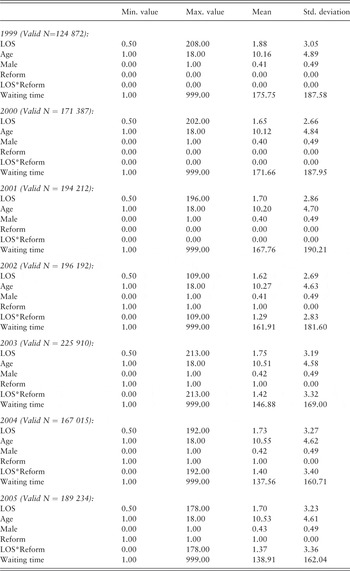
We report results from equation (1), specification (2a), in the tables, and comment upon the results from specification (2b) in the text. Descriptive statistics for the variables are presented in Table 1.
Descriptive statistics for the variables in the analysis: minimum and maximum values, mean and standard deviation

Empirical results
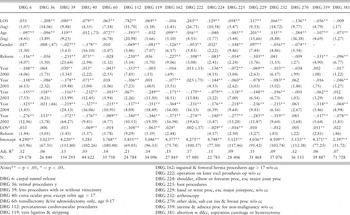
The analysis employs patient-data for the period from 1999 to 2005, and includes only day-surgical DRGs that represent a patient volume of at least 2% of all day-surgical stays during the period. By this criterion, we are left with 16 DRGs available for analysis, each DRG including between 22,785 and 154,293 patients. The basic model (equation (2a)) is estimated via OLS regression, and the results are reported in Table 2.
Determinants of waiting time for elective day surgery, Norway, 1999-2005. Estimates obtained from OLS regression. Unstandardised estimates with standardized t-values in parenthesis

Starting with the variables of main interest, the empirical results lend support to our first hypothesis, as we observe a positive relationship between severity – described by LOS – and waiting time for ten of the 16 DRGs analysed. In particular, for the light orthopaedic procedures (DRG 222: operations on knee; DRG 224: operations on shoulder, elbow, and forearm; DRG 225: foot procedures; DRG 229: hand and wrist procedures; and DRG 232: arthroscopy) there is a marked difference in waiting time. We also find the same pattern for lens procedures (DRG 39), extra ocular procedures (DRG 40), tonsillectomy (DRG 60), percutaneous cardiovascular procedures (DRG 112), and vein ligation and stripping (DRG 119). The estimates for the LOS variable are expressed as elasticities and should be interpreted as the percentage increase in waiting time for a one percentage increase in LOS. The tendency of patient selection due to severity is most pronounced for percutaneous cardiovascular procedures and knee operations, for which a 1% increase in LOS increases waiting time with 0.81% for the former and 0.24% for the latter. In practical terms, the effects amount to average increases in waiting time of 72 and 33 days, respectively.
Note, however, that the estimates of LOS on waiting time vary considerably between the DRGs: from 0.81% to 0.06%. In the cases of the weakest effects associated with LOS, one may therefore question the practical impact in terms of actual waiting time, but that would be jumping to conclusions. Consider for instance the LOS-estimate of 0.06% obtained for DRG 225 (foot procedures): given that the average waiting time is over 212 days for such treatment, a 1% increase in LOS would still imply that a patient on average stand to wait almost two weeks longer for treatment (when the other independent variables are held constant) – which could be considerable in cases of painful illnesses. However, the picture is not quite so clear-cut, as the results also indicate the opposite relationship for LOS and waiting time – i.e. prioritization according to severity – for three of the 16 DRGs analysed: DRGs 36 (retinal procedures), 270 (other skin, subcut tissue and breast procedures), and 359 (uterine and adnexa procedures). Nevertheless, we consider our first hypothesis – that hospitals reimbursed by DRG-based ABF-systems will select low-severity patients over high-severity patients within the actual DRG – as partly confirmed.
Our second hypothesis, that the 2002 ownership reform would further increase the probability of cream skimming, is not supported. The interaction variable (LOS x REFORM) indicates whether the hospitals after the trust reform select patients on different criteria than before the reform within the actual DRG. It takes negative values for five and non-significant estimates for nine of the 16 DRGs. This indicates that the problem of cream skimming is reduced after the reform. Only for two of the DRGs (DRG 162: inguinal and femoral hernia procedures and DRG 359: uterine and adnexa procedures) do we observe a positive relationship for the interaction variable, indicating increased cream skimming in this period.
Turing to the other variables, age does not seem to be systematically related to waiting time. It is, however, worth noting that the waiting time for DRG 112 (percutaneous cardiovascular procedures) is significantly lower for persons with high age than for those who are younger. The empirical results furthermore uncover relatively strong gender differences in waiting time, and, with a few exceptions, in favour of male patients: men waited shorter than women for treatment in as many as nine of the DRGs analysed. The differences are most pronounced for extra ocular procedures (DRG 40) and foot procedures (DRG 225). The advantages enjoyed by male patients are above 0.10% only in three of the nine DRGs. The opposite relationship only appears in two cases: male patients waited longer than female patients for DRG 224 (shoulder, elbow, or forearm procedures) and DRG 229 (hand or wrist procedures).
The effects of the variable that describes the 2002 hospital reform and the year-specific dummy variables reflect the strong reductions in waiting time during the period of analysis. As can be observed, in particular lighter orthopaedic procedures have had a strong decrease in waiting time from 1999 to 2005.
Finally, the alternative specification of the dummy variables – the inclusion of a year-specific and hospital-specific interaction terms in addition to the year-wise dummy variables (equation (2b)) – only marginally alters the results reported in Table 2 (the results are not reported here). This model increases the explanatory power of the model for all DRGs analysed, which is naturally to be expected. The estimates for the variable of main interest, LOS, appear robust, as we generally obtain estimates very close to those returned from the basic model (equation (2a)). In the cases for which LOS exerts the strongest positive effect on waiting time – DRGs 112 and 222 – the estimated effects are reduced somewhat for the former procedure, from 0.78 to 0.61%, and increased marginally for the latter, from 0.22 to 0.24%. As regards the interaction term (LOS x REFORM), it is worth noticing that the alternative specification returns a significant positive estimate for DRG 39, a significant negative estimate for DRG 60, while the significant positive estimate obtained for DRG 162 in the basic model becomes insignificant. Otherwise, the results basically remain the same.
Conclusions
In the setting of this paper, cream skimming is the kind of patient selection that occurs when patients that demand few resources for a given economic refund (low risks) are prioritized over patients that demand more resources for the same refund (high risks). We have investigated whether cream skimming takes place within day surgery after the introduction of ABF in Norway in 1997, and if the problem has increased following the 2002 ownership reform.
Our first hypothesis, that hospitals reimbursed by DRG-based ABF systems select low-severity patients over high-severity patients within the actual DRG, is confirmed. Our empirical investigation signifies that some form of patient selection occurs within several of the largest DRGs. Yet, our results should be interpreted with some caution. First of all, the practical impact of patient severity on waiting time is marginal for some of the DRGs studied. It must therefore be emphasized that the tendency of patient selection applies first and foremost to the light orthopaedic procedures: it is for these procedures that the positive LOS effects are most pronounced, with the waiting time disadvantages exceeding a week for each extra day LOS. Secondly, it is also important to bear in mind that our analyses concentrate on the ‘easiest’ of the ‘easy’ patients. In other words, these are patients that are better suited to wait than patients with more severe illnesses.
Our second hypothesis stated that the problem of cream skimming would increase after the 2002 ownership reform, as hospitals were turned into trusts. This hypothesis is not confirmed. Although there has been a huge increase in the treatment of patients with lighter diagnosis in the period after the 2002 reform (Martinussen, Reference Martinussen2005), the problem of cream skimming within the actual diagnosis is stable or even reduced for many of the DRGs during this period. Several mechanisms may explain this surprising result. First and as already indicated, there was a softening of the budget constraints following the ownership reform. As analyzed by Tjerbo and Hagen (Reference Tjerbo and Hagen2008), hospital production increased more than planned and the hospitals ended up in producing increasing deficits. The central state responded to this by bailing out the hospital every year in the period 2002–2006. Bailouts give the reimbursement system a retrospective character which should reduce problems of cream skimming (Ellis, Reference Ellis1998). Second, although deficits and bailouts have been a major governing problem following the reform, it could also be that stronger prioritizing signals from the Ministry of Health (MOH) have had the desired effect. Fear of cream skimming due to critique formulated by doctors’ associations have led the MOH to send stronger prioritizing signals than before both in political speeches and in the annual planning documents from the MOH to the regional health authorities. Third, the Patient Rights Act, gradually implemented from 2000, gave patients stronger defence against arbitrary prioritizing. A test of these three alternative explanations requires data from a longer period of time than what was available here.
Approaching cream skimming is not an easy task. We have concentrated on cream skimming within DRGs and found effects that are theoretically sound; the probability of cream skimming is higher when the reimbursement system is truly prospective than if the reimbursement system have retrospective, cost-based elements. Our findings are indicative, and future research should analyze cream skimming both within and between DRGs, develop better variables describing severity, model hospitals’ incentive systems more carefully, and probably also model the full market of the hospital sector carefully.
Acknowledgements
The authors would like to thank the two anonymous referees at Health Economics, Policy and Law for useful comments to the paper. An earlier version of the paper was presented at the 18th Nordic Conference in Business Studies, 18–20 August, 2005, Aarhus, Denmark, and we are thankful for comments from the participants in our workshop.
Appendix: Variable definitions
Data have been provided by the Norwegian Patient Register (NPR). NPR is not in any way responsible for how the data are used in this article.
Waiting time (Ln): The number of days from the patient being referred for hospital treatment until admission to a hospital takes place, logarithmic form.
Length of stay (Ln): The patient’s discharge date minus hospitalization date, logarithmic form.
Age (Ln): The patient’s age in logarithmic form, based on the following age cuts:
1: 0–4 years
2: 5–9 years
3: 10–14 years
4: 15–19 years
5: 20–20 years
6: 25–29 years
7: 30–34 years
8: 35–39 years
9: 40–44 years
10: 45–49 years
11: 50–54 years
12: 55–59 years
13: 60–64 years
14: 65–69 years
15: 70–74 years
16: 75–80 years
17: 80–84 years
18: 80+ years
Gender: Dummy variable for which the value of 1 is assigned to male patients.
Year 2000: Dummy variable for which the value of 1 is assigned to hospital stays in 2000.
Year 2001: Dummy variable for which the value of 1 is assigned to hospital stays in 2001.
Year 2002: Dummy variable for which the value of 1 is assigned to hospital stays in 2002.
Year 2003: Dummy variable for which the value of 1 is assigned to hospital stays in 2003.
Year 2004: Dummy variable for which the value of 1 is assigned to hospital stays in 2004.
Year 2005: Dummy variable for which the value of 1 is assigned to patients that were treated in 2004.
Reform: Dummy variable for which the value of 1 is assigned to hospital stays during the years after the hospital reform, i.e. 2002–2005.
LOS x Reform: Interaction term for length of stay and reform.
Hospital-specific dummies: Dummy variables for which the value of 1 is assigned to hospital stays in the respective health enterprise (the estimates for these dummy variables are not reported in the tables).