



Detection of methicillin-resistant Staphylococcus aureus (MRSA) colonization in the anterior nares (AN) using PCR is a promising tool for inpatient management of pneumonia with demonstrably high negative predictive value. Reference Dangerfield, Chung, Webb and Seville1–Reference Mergenhagen, Starr, Wattengel, Lesse, Sumon and Sellick4 Previous studies have demonstrated that a combined approach of AN and oropharynx (OP) MRSA screening increases the sensitivity of detecting carriers. Reference Boyce, Pop and Abreu-Lanfranco5,Reference McKinnell, Huang, Eells, Cui and Miller6 Thus, dual-site testing may improve detection of MRSA infection. However, the clinical utility of this approach has not been established. Since 2017, we recommended AN and OP MRSA PCR testing for patients with suspected lower respiratory tract (LRT) infection and without adequate LRT cultures. The goals of this study were to examine the concordance rates between dual site testing and to evaluate the clinical impact with respect to AN negative–OP positive results.
Methods
The University of Wisconsin hospital is an academic, tertiary-care center in the United States. An existing pneumonia order set included AN and OP MRSA PCR screening tests with instruction to order only in those with (1) suspected pneumonia and (2) inability to obtain LRT cultures. The latter was included because LRT culture is the preferred method to evaluate patients with suspected pneumonia. Additionally, we report whether MSSA or MRSA is present or absent in a culture as it can significantly improve antimicrobial therapy. Reference Mcbride, Schulz, Fox, Dipoto, Sippel and Osterby7,Reference Musgrove, Kenney and Kendall8
Upon order entry, specimens for MRSA PCR were collected from AN and OP sites using a BD CultureSwab (Becton Dickinson, Franklin Lakes, NJ). MRSA PCR tests were performed using Xpert SA Nasal Complete (Cepheid, Sunnyvale CA; FDA-cleared and modified). AN specimens were tested according to the manufacturer’s instructions. OP specimens required an additional incubation step in brain-heart infusion (BHI) broth for 4 hours prior to testing. Results were documented in the patient’s electronic health record (EHR).
We queried the EHR for adult patients who had AN and OP MRSA PCR tests performed on the same day from January 2017 through July 2018. Specimens collected from the same patient on different calendar days were considered independent events. Results were first evaluated for intrapatient result concordance between the specimen sites. Next, we examined AN negative–OP positive discordant cases. We performed chart reviews that included patient presentation, documented purpose for ordering, LRT cultures, and documentation of whether the PCR results affected clinical decisions. Two infectious disease physicians independently reviewed the charts of patients who were AN negative–OP positive to determine whether the discordant result may have identified a patient with probable MRSA pneumonia based on the clinical, microbiological, imaging, and hospital course data.
The absolute risk reduction (ARR) for missing a probable case of MRSA pneumonia and number needed to test (NNT) with OP MRSA PCR was calculated based on the total number of concurrent AN and OP MRSA PCR tests. Only cases who were AN negative–OP positive and with probable MRSA pneumonia were included in the risk reduction (ie, numerator). We also evaluated the difference in time to result between AN and OP testing. The local institutional review board deemed this study exempt from review.
Results
Dual-site AN and OP MRSA PCR assays were performed for 1,419 adult inpatients from January 2017 through July 2018. The intrapatient concordance between sites was 96.5% (n = 1, 370; κ coefficient, 0.71), with 1,306 instances (95.3%) of AN negative–OP negative results and 64 instances (4.7%) of AN positive–OP positive results (Table 1). Discordance was relatively similar between AN negative–OP positive results (n = 22, 1.6%) and AN positive–OP negative results (n = 27, 1.9%).
Results of Dual Anterior Nares and Oropharynx MRSA PCR Assays Performed from January 2017 to July 2018 on 1,419 Adult Inpatients

Note. AN, anterior nares; OP, oropharynx; MRSA, methicillin-resistant Staphylococcus aureus; PCR, polymerase chain reaction.
We focused on the clinical scenario of AN negative–OP positive discordant cases (Fig. 1) to determine the clinical utility of having a second anatomic screening site. There were 22 patients who had AN negative–OP positive test results, of whom 16 had testing done to evaluate for pneumonia etiology. Of these 16, 7 had LRT cultures to better guide therapy (i.e. PCR testing was unnecessary). Interestingly, in 4 of the 7 cases with LRT cultures, there was absence of MRSA in the culture; however, the medical team continued vancomycin, most likely due to the conflicting positive OP MRSA PCR result. Vancomycin was continued for an average of 6 additional days in these patients.
Diagram of dual AN and OP MRSA PCR testing results, illustrating subsequent diagnosis of pneumonia and culture results. Note. AN, anterior nares; OP, oropharynx; +, positive; −, negative; MRSA, methicillin-resistant Staphylococcus aureus. †Other conditions for which both AN and OP MRSA testing were performed in the same patient included mesenteric ischemia, atrial fibrillation with rapid ventricular response, gram-positive bacteremia, sinusitis, epiglottitis, and diabetic ketoacidosis. *Received an average of 6 days of unnecessary vancomycin.
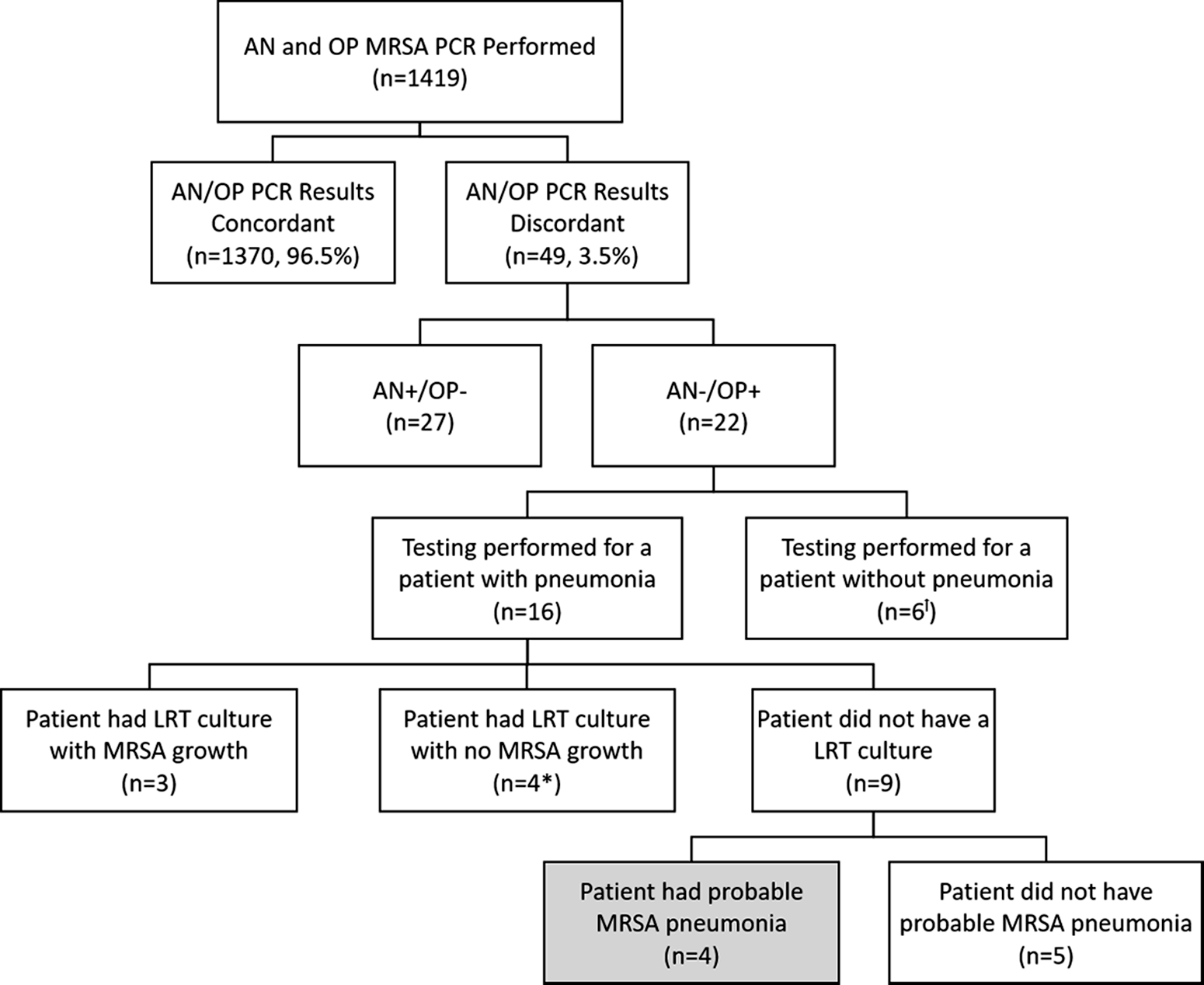
We observed 9 instances (<1% of total tests) of a patient being evaluated for pneumonia with an AN negative–OP positive PCR result without LRT cultures. Of these cases, MRSA coverage was stopped in 5 patients despite a positive OP PCR, all of whom continued to improve without MRSA-active therapy. In contrast, 4 patients had clinical improvement on MRSA coverage and on chart review had signs and symptoms reflective of probable MRSA pneumonia. This detection of 4 cases by additional OP testing correlated to an ARR of 0.3%, and an NNT of 355 to find 1 case of potential MRSA pneumonia. OP PCR results were reported to providers on average 13.7 hours after AN (range, 1–30 hours) given the additional processing steps in the laboratory.
Discussion
The 2019 Infectious Diseases Society of America (IDSA) guidelines for community-acquired pneumonia (CAP) recommends obtaining LRT cultures for any inpatient who is going to be treated empirically for MRSA, advising that negative culture results be used to deescalate therapy. Reference Metlay, Waterer and Long9 However, obtaining respiratory cultures may not be feasible in all patients. MRSA screening of the nares is an effective alternative to assist in de-escalation in these situations Reference Dangerfield, Chung, Webb and Seville1–Reference Mergenhagen, Starr, Wattengel, Lesse, Sumon and Sellick4,Reference Metlay, Waterer and Long9 ; however, the clinical utility of screening the oropharynx in addition to nares is more controversial.
In the current study, we detected a high rate of concordance between AN and OP MRSA PCR, suggesting limited utility of performing both. To this end, in situations when AN testing was negative and OP was discordantly positive, the OP positivity was rarely clinically meaningful with overall ARR of 0.3%. This estimate is conservative based on clinical improvement with broad-spectrum antimicrobials, not conclusively because of MRSA coverage.
These results are important when considering the context of resource utilization and unintended consequences. OP MRSA PCR testing is labor intensive; it requires additional laboratory resources and healthcare costs. The estimated costs to patients at our facility for this additional testing was >$100,000 to detect 1 probable case of MRSA pneumonia. The OP results are also delayed compared to AN due to laboratory processing requirements, which may result in delay to de-escalation of vancomycin. Finally, we observed that discrepant results may result in continuation of vancomycin despite negative LRT cultures, leading to unnecessary use and risk of toxicity. Reference Hammond, Smith, Li, Hayes, Lusardi and Bookstaver10
This study has several limitations, most notably generalizability. We have a relatively low prevalence of MRSA within the population we serve and amongst hospitalized patients. In areas where MRSA prevalence is much higher, the NNT might be much lower, thus making dual site screening more attractive. Additionally, this was a retrospective study in which the ordering of PCR testing was unregulated. We did note situations in which the test was likely clinically unnecessary, such as when LRT cultures were performed and when MRSA coverage was discontinued despite positive MRSA PCR results.
In conclusion, in a low-prevalence MRSA colonization population, dual site AN and OP MRSA PCR testing was highly concordant. When AN testing was negative, the clinical benefit of additional OP testing was limited. Given these findings, the significant resource utilization, and unintended consequences noted, we feel that the additional testing of oropharynx does not provide sufficient benefit in this clinical scenario.
Acknowledgments
Financial support
No financial support was provided relevant to this article.
Conflicts of interest
All authors report no conflicts of interest relevant to this article.



