Introduction
The birth of British savings banks sparked a contemporaneous debate about the extent to which access to banking could ameliorate the social problems faced by the poor. For the philanthropist, savings banks could aid the working classes by promoting a thrifty consciousness of the future, and thus improve the social security of workers. However, for their critics, savings banks were of limited social efficacy and were instead ripe for exploitation by the middle classes. In England and Wales, the founders of savings banks created them on a “savings-only” model, with the ostensible aim of pursuing social welfare outcomes. Savings banks paid interest to savers by using the deposits to purchase government bonds that paid guaranteed interest. In other countries, for example, Sweden, savings banks generated the funds to pay interest on deposits from the interest they charged on loans. The result of the deposit-only model has been to position English and Welsh savings banks within the history of humanitarian institutions, and not productive financialization.Footnote 1 As a consequence, the bulk of the literature concerning savings banks does not reside in the fields of economic and financial history but in philanthropy and historical social policy.
The lack of attention by financial historians shown toward the savings behavior of individuals in nineteenth-century Britain has weakened the social histories of working-class financial management,Footnote 2 and past studies of its banks.Footnote 3 The use of ledger data in the study of savings in the United States is more establishedFootnote 4 and, more recently, there have been studies using transaction data in respect of both Scottish (i.e., Glasgow) and Irish (i.e., Thurles) savings banks.Footnote 5 The lack of ledger-based research is regrettable. Without a body of historical research that uses transaction data, modern debates about savings—including those that discuss savings within a life-cycle or transitional income framework—lack a long-term perspective and fail to put savings behavior sufficiently in the frame.Footnote 6
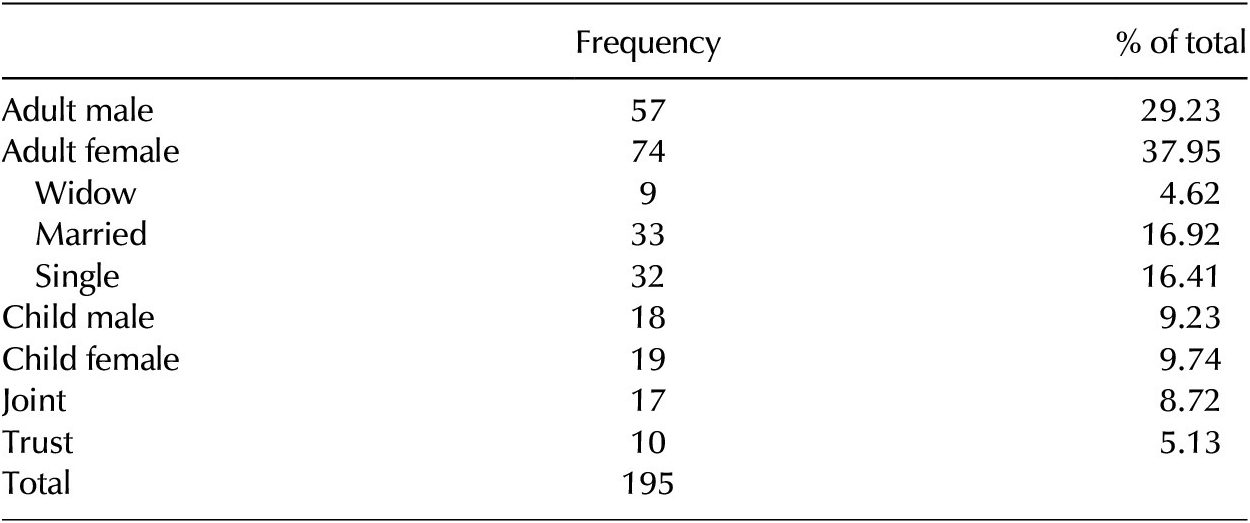
This paper puts the savers, and their behaviors, at the center of the analysis. It uses a recently constructed database of 3,625 individual account transactions from the Limehouse Savings Bank in London, which has a long unbroken run of ledger records available. We were able to capture data across the life span of all accounts opened in 1830, some of which are held in excess of forty years. Our 195 new account openers in 1830 comprised 57 adult men, 74 adult women—33 married, 32 single, and 9 widowed, and 37 children’s accounts—19 girls, and 18 boys. Seventeen accounts were held jointly, and ten in trust for other individuals—most often children. The accounts opened in 1830 contained sixteen family groups; four consisted of related adults, the remaining twelve were either child siblings, or a parent plus child(ren). The assembled database allows us to explore research questions and test propositions that studies that rely on official nineteenth-century government statistics based on reporting from each bank regarding account numbers and total deposits do not. We are able to link depositor characteristics such as gender, age, and marital status with transaction information, and thus identify the potential social determinants of depositor behavior. Furthermore, by focusing on previously overlooked factors such as opening deposit, proximity, and family-group accounts, we can provide insight into the likely strategic intentions of savers. The choice of 1830, despite the lack of census data for the same period, was in order to take advantage of the 1828 standardization of record keeping in English and Welsh savings banks and to have a benchmark year that was still in the period where the banks, and accessible banking, were established.
The paper is structured as follows: in the next section, we establish the historical reporting formats of the savings banks and the reasons why “class-of-depositor” tables became an extra-official category of reporting. The restrictive, and limiting, legacy of that reporting format on subsequent scholarship in relation to savings behavior is briefly discussed. In the following section, the Limehouse data and collection procedure are outlined, and three hypotheses are proposed. We then examine the social determinants of depositor behavior, focusing on gender, age, and marital status. Following this, we address our three novel hypotheses—focusing on the relevance of opening deposit, location, and linked accounts in transaction patterns. Finally, the paper concludes by considering the new insight gained from shifting the focus of the analysis from class-of-depositor to individual transaction patterns. Such an approach, we argue, is much more illuminating concerning the range of valid social and economic functions such banks fulfilled and crucially provides a more useful benchmark for further comparison with savings institutions in other times and places.
Reporting of Occupational Class
Savings banks, as initially conceived of in England and Wales, were a type of financial institution that was formed outside the private and limited joint-stock banking system of the period. Savings banks in England and Wales only offered deposit facilities, set limits on the amount that could be deposited annually, and would not extend credit. After 1817, all monies collected by savings banks were deposited with the government in bonds, known as Consols, and used to offset national debt.Footnote 7 Consol rates were generous and a near-constant source of complaint from critics. The suspicion was that affluent middle-class savers were exploiting banks that were created for the working poor. Parliament saw a number of further attempts by concerned representatives to lower deposit limits and interest rates to reduce the potential for exploitation after the more obvious loopholes were closed in 1828, but they remained largely as set at the end of the 1820s throughout the century. Newspapers were also keen to point out the colonization of the savings banks by the middle class—pointing to the practice of opening accounts for each child in the family and depositing the maximum annual amount or knowingly flouting the law that an individual could not hold more than one account by opening accounts in a number of separate banks.Footnote 8
Maltby’s paper on the reporting requirements of savings banks in England and Wales outlines the path dependency created by the perceived requirement of savings banks to defend themselves against the charge that they were institutions for the benefit of the monied middle class.Footnote 9 She identifies two different categories of reporting. The first set was created by the savings bank legislation itself. All banks had the same year end of November 20, which was also the date individual account interest was calculated and recorded. Each bank was required to produce an annual report and return and to have this report approved at an annual meeting of trustees and managers before its return to the National Debt Commissioner. The report was to include a statement of the total amounts received and withdrawn from savers in the year, the amount paid to the National Debt Commissioners for investment, and the total of balances held by the bank. The bank was also required to produce a breakdown of the number of depositor accounts in bands from those below £20 to those above £200.Footnote 10
The second type of reporting was that which the individual banks felt necessary to produce for local stakeholders, including the press, and which sought to present evidence as to the class of depositor the bank had. Unlike the state-mandated reporting categories, the class-of-depositor reporting by banks differed and was not directly comparable. Maltby provides four examples from banks across the United Kingdom and Ireland that showed the different descriptions used of savers in terms of their occupations and social classes.Footnote 11 The differences are probably representative of the different social mix applicable to the different countries and their local economies and social structures. However, Maltby suggests that the banks in her sample opted not to use the categories included by the parliamentary Select Committee for depositors at the “higher end” of social standing. Her inference is that the banks did so to shield themselves from criticism that they were not fulfilling their social mission of attracting the poor.Footnote 12
Our concern with occupational data is twofold. The occupational data we have for Limehouse accounts opened in 1830 show that even if an occupation is held in common, motivations to save are not, and neither is the amount of income available to save. Engineers, mariners, shipwrights, and watermen are occupations that appear across all savings categories and all deposit sizes. And so do married women. That observation leads to our second concern, that is, occupational data focus attention—to a greater extent than is justified—on adult male savers. Adult males do not represent the majority of savers in our Limehouse sample, and to categorize savers according to occupations in preference to demographic and behavioral characteristics is androcentric. As Folbre notes,Footnote 13 the gender bias inherent in definitions of economically productive activity has implications for the analysis of change in labor force participation and, we would argue, financial management.
Nonetheless, as a result of the social concerns about who was using the savings banks, it is class-of-depositor information, together with the annual reporting of the banks with regard to total deposits and standardized bands of account balances, that forms the bulk of the accessible British data available to savings historians. The problem with these data is that they restrict the researcher to a very narrow set of research questions. Existing research, especially in respect of English and Welsh, savings banks therefore tends to focus on who the savers were (according to broad occupational rather than social demographic categories) and the analysis of regional or nationally aggregated account balances.
In terms of surviving historical data, it has also (erroneously) been assumed that there is little extant material available regarding working-class savings in English and Welsh banks,Footnote 14 especially as the account ledgers of the Post Office Savings Banks have not been conserved. A survey of the Trustee Savings Bank material held in the Lloyds TSB Archive in 2015 suggests we are in a more fortunate position than previously thought. The TSB archive holds bank ledgers representing fifty-five banks, seventeen of which have continuous runs of data for forty-five years or more. There are individual bank account details from twenty-five individual banks that show transactions from 1818, and nineteen of those twenty-five banks have records that cover the entire 1818–1828 period that was assumed to be missing altogether.Footnote 15 Added to the official TSB holdings are those additional historical bank records held in county, city, and district archives—all of which represent a rich resource for examining nineteenth-century savings behavior.
Ledger data have been used in savings bank research in the United States and, more recently, have also been sampled in relation to a Scottish savings bank to establish the response of savers to financial crises in 1847 and 1857.Footnote 16 Payne also used transaction data for Glasgow, but in a limited way.Footnote 17 Although time-consuming and labor-intensive, the benefits of looking at transaction-level data are obvious. For example, Perriton and Maltby’s study of transaction patterns at four English savings banks was able to challenge long-standing assumptions about the conflictual nature of working-class financial management within marriage by looking at the number of married women accounts and the broad use patterns revealed by deposit-to-withdrawal ratios.Footnote 18 Studies using transaction data—even at a meta-level to allocate accounts to categories—create a richer picture of historical savings behavior.
We wanted to fully exploit the ledger data we have available by creating a database for all accounts opened in the calendar year 1830 in the savings bank in Limehouse, London, in order to look beyond occupational class analysis. The Limehouse Savings Bank (created as the Limehouse Provident Institution for Savings in 1816) was typical of the type of savings bank that survived into the twentieth century, because it served a diverse, urban population. The district of Limehouse is approximately two miles east of the medieval London Docks next to the Tower of London and formed the industrial and manufacturing hinterland to the east of the city. The East End of London, as the area is known generically, is situated at the junction of the road transport routes into the site of the “new” docks on the Isle of Dogs peninsula in the Thames and the older road routes out of the city toward the Essex coast. As a result of the growing transport infrastructure around the docks in the nineteenth century, the rapidly increasing population of Limehouse and its surrounding parishes specialized in trade and small manufacturing.Footnote 19
Limehouse—Data and Hypotheses
To explore the transaction patterns of individual savers, we accessed the individual account records of the Limehouse Savings Bank, extant in the year range 1828–1876, to examine the savings behavior of a cohort of savers who opened accounts in 1830. The sample year of 1830 was chosen because it represented a point at which savings bank record keeping and reporting were standardized and the accounts opened would be operating under the reforms of 1828, that is, maximum annual deposits and maximum account limits. John Tidd Pratt, the barrister advising the Commission for the Reduction of Public Debt, and Registrar of Friendly Societies, also published his History of the Savings Banks in England, Wales and Ireland in 1830.Footnote 20 This report contains a useful summary of the savings banks in existence at that date, including their total reported depositors and average account balances. Similar summaries and returns would be published in subsequent years by Parliament. However, 1830 also marked the end of an unstable period of Conservative government that had introduced the savings bank legislation and the start of parliamentary reforms. This included a debate as to whether savings bank balances could be used as the basis of suffrage. Clearly, by 1830, savings banks were an established part of the social landscape and had won acceptance, albeit often partial and grudging, across the political divide.
The 1830 sample comprises 195 new saver accounts, and a total of 3,625 individual transactions. Each account was given a unique identifier number, and the following were recorded: name(s) of account holder(s); residential address at account opening; occupation or status of the account holder(s); a note of whether the account was held individually, jointly, or in trust; and any marginal notes or interesting features of the account. Joint accounts are accounts that have two or more named account holders. Trust accounts are accounts opened by an individual “in trust” for a third party. Trust accounts have a named trustee, who is listed first, and then the words “in trust for” appear before the second name. Every individual account transaction (deposit, withdrawal, interest payment) was recorded over the life of each account together with the date the transaction occurred. Where accounts were closed and reopened at a later date, we have noted the years of closure but treat the account duration as being from the first deposit to the last withdrawal.Footnote 21
For the analysis, we amalgamated the depositor and transaction data to generate a spreadsheet of aggregate statistics by depositor. By identifying savers’ residential addresses on a map of Limehouse in 1851,Footnote 22 we were also able to consider the relevance of proximity to the bank in depositor behavior. In addition, we supplemented the ledger data with English census data (1841–1891) and data from the index of births, deaths, and marriages. This enabled us to establish approximate birth years of a small subsample of savers, which we use as illustrative cases.
Hypotheses
Using the Limehouse data, we aim to address three hypotheses that will provide a different perspective on the functionality of British savings banks and move the debate beyond the existing class-of-depositor perspective. These three hypotheses are now outlined.
Hypothesis 1: Opening deposit predicts subsequent depositor behavior
Opening deposit data have been used infrequently in savings bank research, and even less often in relation to the analysis of subsequent saver behavior. Alter, Goldin, and Rotella’s paper on the Philadelphia Savings Fund includes opening deposits as a category of analysis in examining the duration of accounts.Footnote 23 However, as the median opening deposit is consistent across sample, it is not a significant factor in their analysis. Pollock also notes the median and lower and upper quartile of opening deposits in his study of the Glasgow Savings Bank.Footnote 24 However, like the inclusion of the figure in the Philadelphia study, the opening deposit is merely noted in Pollock’s study rather than used in the analysis. Given the emphasis on who saved in many studies, it is often the maximum balance held that is deemed to be of greater significance.
Yet the size of the opening deposit often vexed the critics of English and Welsh savings banks. Savers were restricted to a total of £30 in deposits per annum. Those who deposited the whole £30 upon opening accounts in their own names—or via a trust, or across a number of family members’ accounts—were suspected of taking advantage of savings bank provision.Footnote 25 Transaction data allow us to categorize accounts using the opening deposit and to look closely at those accounts that caused consternation at the time, that is, those opened with £30. Unlike the Philadelphia study, which reported a consistent opening deposit of circa $50, Limehouse has a much wider spread of opening deposits from small to the maximum and has greater salience in this study as an analytical category.
Hypothesis 2: Depositor location affects behavior
At the time of the introduction of the Post Office Savings Bank in 1861, it was noted that much of the population did not have a local savings bank—fifteen counties had no provision at all, and many populous towns also lacked one.Footnote 26 The reliance on volunteer trustees to oversee the operation of the bank, and to be present during opening hours, limited the times that they were open. Limited opening times were therefore identified as a barrier to creating a regular savings habit—unless you lived in close proximity to a bank. The importance of proximity in encouraging savings behavior has been a feature of recommendations in relation to increasing savings in the general population from the late nineteenth century to the present day. Microfinance institutions, especially those that cater to the rural poor in developing countries, focus on proximity as one of their main priorities. Although there is no single measure that captures the determinants of saving in an institution, meta-analyses have established that locational convenience (i.e., distance covered to deposit and withdraw), low transaction costs, simplicity of transactions, ability to deposit small amounts, and convenience of service hours, are all positive indicators.Footnote 27 We anticipate being able to discern differential patterns of savings behavior based on residential location and distance from the Limehouse Savings Bank.
Hypothesis 3: Gaming of savings bank account holding existed, but was minimal
The potential for misuse of the savings banks, as noted earlier, was a concern of fiscal conservatives in government throughout the first half of the nineteenth century. Misuse in this context covered two main areas, that is, multiple account holding and profit seeking from middle-class depositors who were taking advantage of subsidized interest payments intended for the poor. Fishlow contends that the regulatory changes of 1828, which created a balance ceiling of £200, together with an annual maximum deposit limit of £30 and the disallowed practice of multiple account holding, effectively saw the end of systematic exploitation of the savings banks by the wealthy.Footnote 28 He points to the substantial reduction in accounts and deposits after the introduction of the 1828 regulations. There was still potential for masking multiple accounts. Individuals could do so by opening accounts in children’s names but operating them as their own, banking in a neighboring or distant bank in addition to holding single accounts at their local banks and not disclosing them, and/or by using trust accounts opened in the name of individuals unaware of the account or the transactions undertaken in their name.
Fishlow made the point that given the English joint-stock banks did not provide opportunities for those with modest cash surpluses, it was reasonable to conclude that English savings banks would attract a greater number of middle-class accounts than was the case elsewhere.Footnote 29 We accept Fishlow’s point. We do not see the existence of higher-balance accounts, or certain occupations among the depositors, as evidence of gaming of the savings bank system per se. We do, however, believe that transaction data will be able to identify accounts considered “problematic” from the nineteenth-century perspective. Perriton suggested that the “strategic” use of Limehouse trust accounts after 1844, the date in which changes were made to the regulations concerning such accounts, was circa 5 percent.Footnote 30 Because trust accounts were an unreformed feature of the system in 1830, we anticipate a higher rate of accounts that are potentially gaming the post-1828 rules by exploiting trusts, but that the incidence of such accounts will be minimal.
Summary Statistics
Before addressing our hypotheses, we first present some summary statistics relating to the demographic and transaction characteristics of our data set.
Individual Accounts
Table 1 shows the basic composition of our sample. In the individual depositor categories, there is a majority of female depositors (55 percent) to male depositors (45 percent). Most of the individual accounts (67 percent) are held by adults, although there is a significant minority of children. The sizable proportion of children is plausible—children were financially active either by their involvement in penny capitalismFootnote 31 or when in receipt of monetary gifts. An emphasis on thrift among the middle classes also makes the number of child accounts opened unsurprising and may reflect a prevailing social norm in the instruction of children on the benefits of saving. Nevertheless, statistics presented later in the paper do question whether some child accounts were being operated independently of those held by their parents.
Frequency of accounts
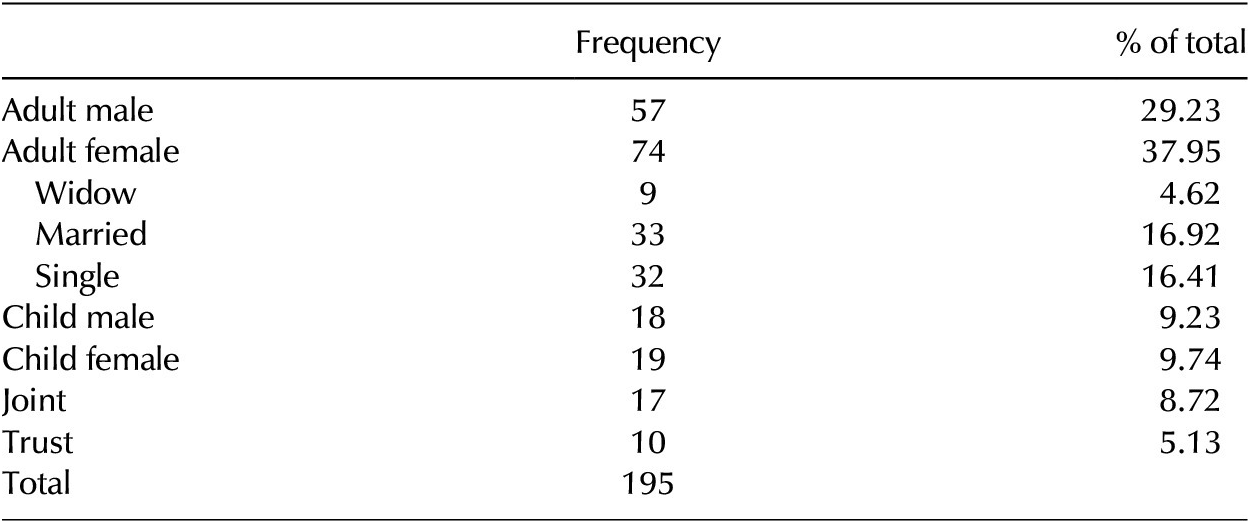
Non-individual Accounts
Non-individual accounts opened in Limehouse in 1830 are either joint (9 percent) or trust accounts (5 percent). Joint accounts are accounts that have two or more named account holders. In many cases the named individuals share a family name, but there are examples for which this is not the case and/or cases for which there is an additional marginal note that “any two to sign.” Trust accounts are accounts opened by an individual “in trust” for a third party. In the majority of cases in which a trust account is recorded, the named trustee does not share the family name of the individual the account is held in trust for—just four out of the eleven trust accounts are held for another (child or infant) family member. For example, Ruth Noble holds accounts in trust for Eleanor Walford and Hannah Packer, and Mary Ann Whitehead is trustee for a servant, Mary Ring, for a scant six months before Mary Ring takes full control of her own account and runs it independently for the next three years. There is also an example of an account held in trust for a widow by an individual male, who is not listed among the heirs to her estate (and passbook), and which we presume is a solicitor or some other legal representative.
Transaction Statistics
Adults
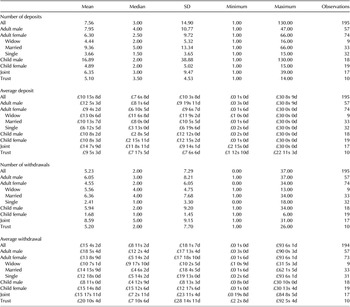
Table 2 shows the number and size of depositor transactions according to our main demographic categories.Footnote 32 On average, adult males make larger deposits and larger withdrawals than adult females. Furthermore, among both adults and children, males tend to conduct more transactions than females, with adult males noticeably transaction-heavy relative to others.
Number and size of transactions
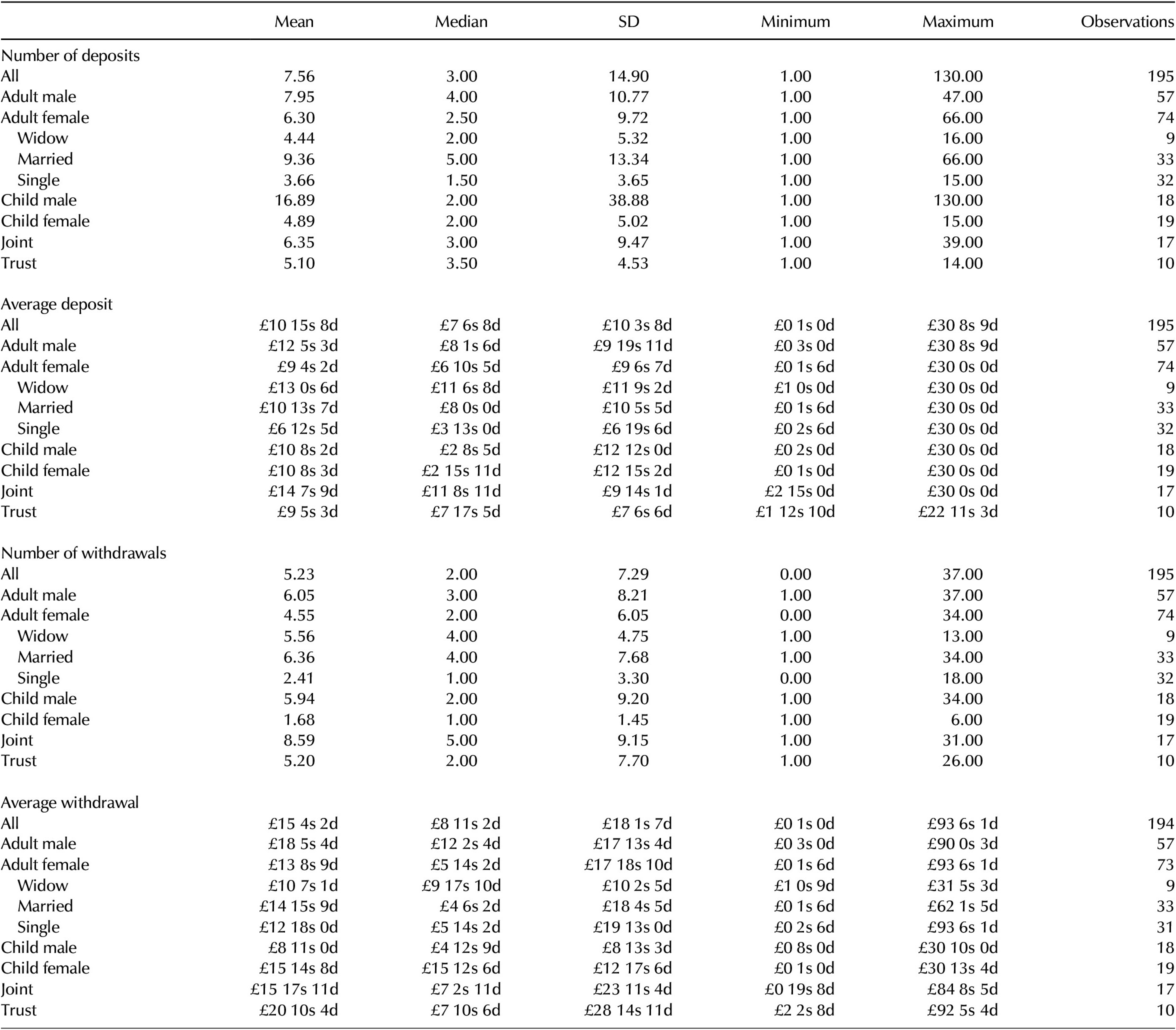
There are also pronounced differences between adult women’s savings behavior when we subdivide the adult females into widow, married, and single categories.Footnote 33 The widows in our sample tend to make a large opening deposit, then undertake multiple withdrawals, either to zero or a very small sum at account closure. This pattern can easily be made to fit a typical scenario wherein a widow opens an account with the inheritance from a deceased spouse and then runs that balance down in living expenses. However, that assumption is not borne out in the savers we have been able to trace through census and birth, death, and marriage data. For example, Margaret Leslie, a widow of 2 New Crane Place, Shadwell, does open her account relatively soon after her husband’s death. But Margaret is a small saver in terms of opening deposit (£2), and although she accumulates steadily for the next three years, she then enters an active period of deposits and withdrawals until 1838, and then only draws down on the account until the account closes in 1845. Margaret dies in 1870, so we cannot assume the period of drawdown is in anticipation of her death or last serious illness. Another widow in our sample, Sarah Hornzee,Footnote 34 opens her account with the maximum annual deposit of £30, but she opens her account at fifty-six years of age, and six years after the death of her husband. She makes one further deposit of £30 before commencing a period of drawing down from the account over the next four years. Again, this period does not correspond to her own decline, as she dies in 1842—eight years after the account is closed.
Single women, on average, tend to hold their accounts for relatively short periods of time, have a low number of transactions overall, and deposit the least among adult women. However, relative to their opening balance, they close their accounts at a relatively high level—their median closing balance (approximately £9) is more than twice their median opening balance (approximately £4). Taken together, this suggests a pattern of lower amounts available for saving, less frequent deposits, and the situation where the money is kept until needed for transfer elsewhere (perhaps to follow domestic employment) or for a definite purpose—also a finding of the Philadelphia Savings Fund study.Footnote 35
Married women tend to deposit significantly more money than single women, and also make more deposits and withdrawals. We agree with Perriton and Maltby in finding the number of accounts held by married women difficult to reconcile with a patriarchal, and controlling, model of working-class financial management. The number of joint married accounts and intrafamily accounts is indicative of a more egalitarian model of joint decision making on how to save pecuniary surplus.Footnote 36
Children
The account activity of children is one of the most confusing in the data. There is a large difference between the median and mean for both the opening and average deposits. Ironically, it is the children who do learn the lesson of thrift that may be the root cause of some of these differences. For example, Richard Hinderwell is a newborn child when an account is opened for him in 1830 with 15s. He becomes an active saver into adulthood—depositing a total of £14 17s over the next forty-three years and (probably) beyond, given that his account is still open at the end of the extant ledgers. His case reflects one of the two extremes of savers in this category, the other extreme being those children who are not aware of holding an account opened and operated by a parent.
Some children show little evidence for having learned the lessons of thrift in childhood but nonetheless become savers as adults. One such individual, Margaret Vesper, has an account opened for her aged 10 with an opening deposit of 17s. A further deposit of 13s is added in the same year, but after that point the account is untouched until 1842, a year before her marriage, when she makes her first adult deposit of £1 8s. However, the year after her marriage, her account appears to be used as a marital savings account. Over a period of eighteen months, the account balance reaches £23 and is then steadily withdrawn from in the next twelve months until it is closed.
Joint and Trust Accounts
Joint accounts were not a feature of all savings banks, but trust accounts were. Banks that served a diverse urban community, for example, Limehouse and Newcastle, were more amenable to nonstandard account types than were the smaller, regional banks such as Bury.Footnote 37 The trustees of the urban banks seemed to take the view that if a type of account was not explicitly prohibited, then they would allow it. As a result, we see joint accounts between two or more individuals representing different generations of the same family, work colleagues, and married couples.
In relative terms, joint accounts and trust accounts are held for significantly longer periods of time than individual accounts (means of nine and eleven years, respectively). Joint married accounts are active accounts, suggestive of a cycle of building up of pooled financial resources and then deploying cover for unexpected expenditure. Joint accounts have the highest mean deposit at £14 7s 9d (approximately £4 above the average for all accounts), and the most withdrawals. This is highly suggestive of the use of joint accounts to smooth the demands on domestic expenditure.
Typical of the trend for joint accounts to be held over a longer period of time is the account of Christopher and Margaret Morris, of 18 Farmer Street, Shadwell. Christopher, a shipwright, and Margaret Morris open a joint married account in 1830 with £10. The age of Christopher is unknown, but Margaret is twenty-seven at the time. This is a long-term account for the couple, lasting thirty years, and the account activity falls broadly into two patterns. In the first fifteen years of the account it is—for the most part—an accumulating account, although there are occasional withdrawals alongside the deposits. After 1847, the account functions as a draw down account, with a steady depletion of the account—significant in the first seven years in terms of totals but then slowing in the last seven. The only deposit that is made in the period 1846–1860 is £7 deposited in the year of Christopher’s death in 1857—suggestive of a small inheritance from him being deposited in the account. The account is closed nine years before Margaret’s own death.
In this period—and until the regulations were tightened in 1844—trust accounts are more suspect in terms of potential for evading the prohibition regarding multiple account holding. However, in the summary statistics, apart from a higher deposit-to-withdrawal ratio and the relatively long account duration, there are no striking differences between trust accounts and the “average” account.
Opening Deposit and Subsequent Behavior
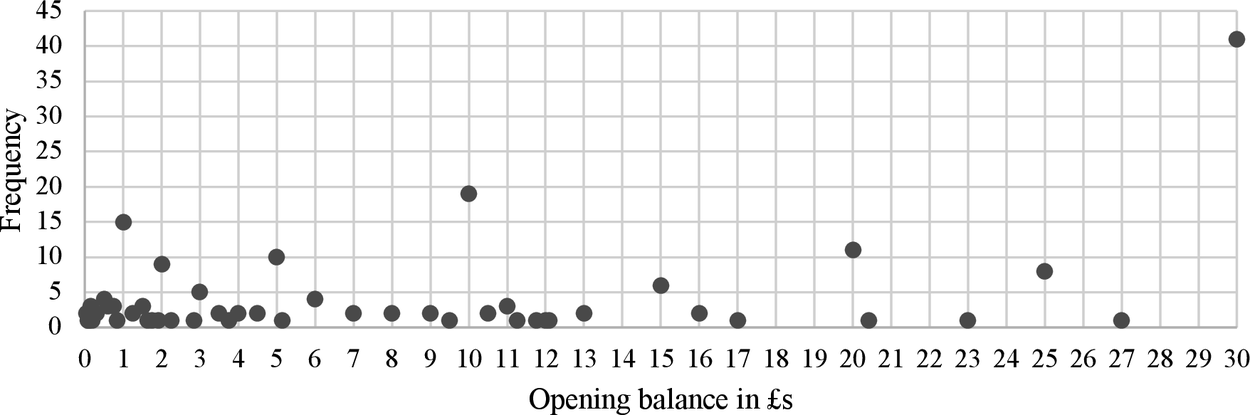
Savings banks in England and Wales in this period accepted deposits as low as 1s to a maximum of £30. The £30 figure was the maximum that could be deposited annually, but there was no bar to using that allowance in a single or first deposit. The result, in our Limehouse sample, is of a relatively wide spread of opening deposit amounts (see Figure 1). The data contain noticeable clusters at both ends of the deposit amount continuum.Footnote 38
Frequency of opening balances.
Notes: We have not included the one exception of an account opened with £60.
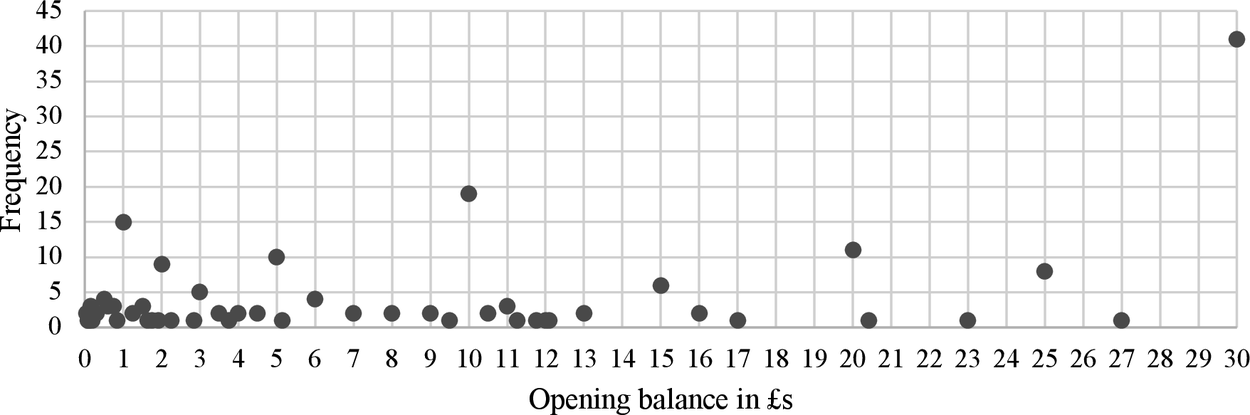
For the purpose of further comparison, we will divide our savers into three groups according to their account balances, which we have displayed as follows: £2 or less (small savers), between £2 and £30 (intermediate depositors), and £30 (maximum depositors). At the upper end, approximately 22 percent of our cohort opened their accounts at the maximum balance of £30.Footnote 39 This provides a natural subgroup, because those depositing the maximum balance are considered more suspect in terms of their use of the bank. At the lower end, we choose £2 as the small saver maximum deposit. This also seems a natural subgroup, as around 50 percent of savers deposit between £2 and £30, leaving approximately 29 percent classified as small savers.Footnote 40
Our hypothesis is that opening deposit is an indicator of subsequent depositor behavior. Our further assumption is that those who open an account with a small amount of money are primarily seeking an opportunity to save. However, the capacity to accumulate further savings, at least for the next twelve months, is denied for those who open their accounts with the £30 maximum. If these accounts were genuine savings accounts—as opposed to a holding or storing account—then we would expect to see them held over a longer period of time and until the maximum interest-bearing balance is reached. A shorter time period or a pattern of harvesting the interest payments on the balance would suggest that the objective of the £30 was to have ready access to liquid assets, a bonus in terms of interest generation (albeit of relatively small amounts relative to the capital committed to produce it), and secure storage.
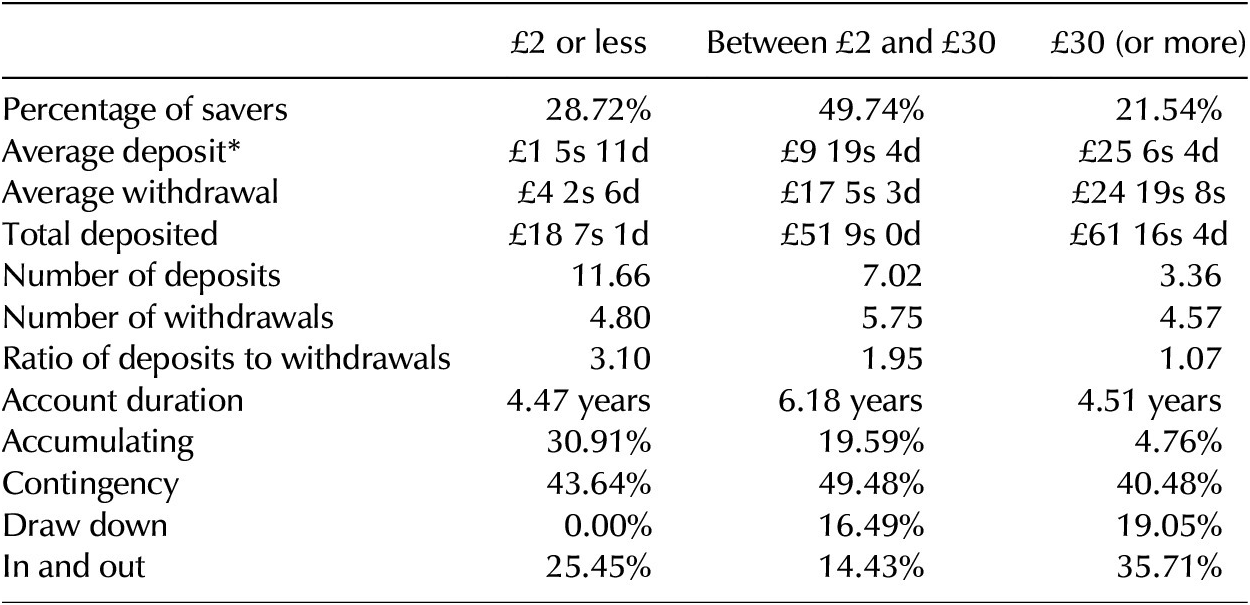
Table 3 shows the transaction differences between the account holders according to the three opening deposit categories: £2 or less (small savers), between £2 and £30 (intermediate depositors), and £30 (maximum depositors).
Depositor behavior by opening deposit category
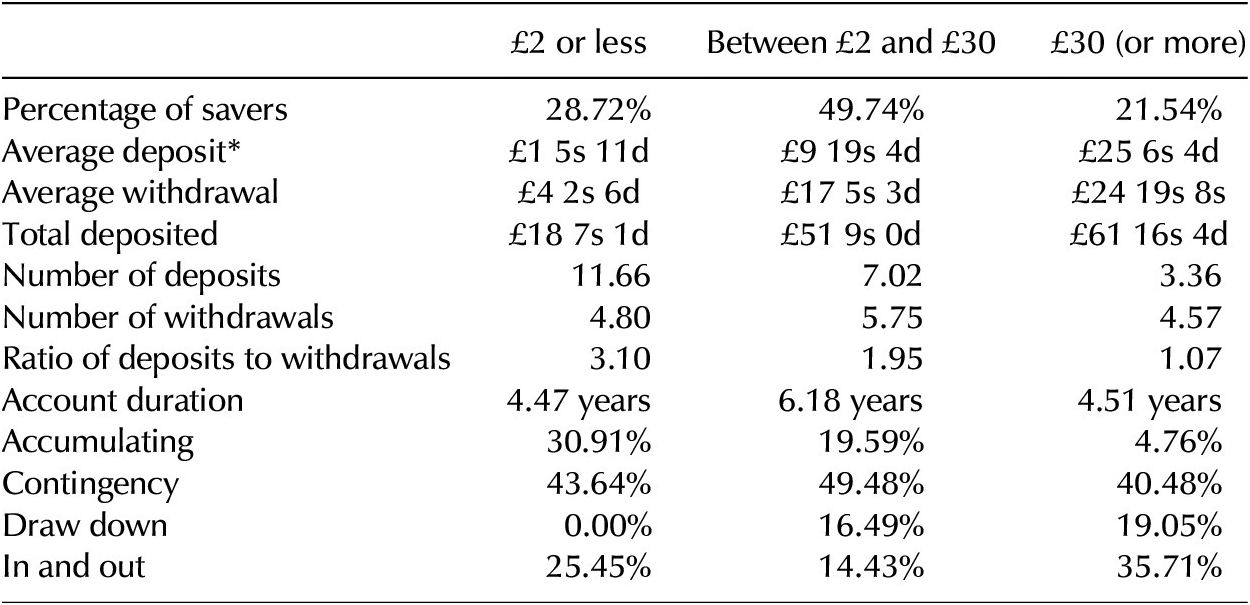
Note: The percentage of savers relates to the 195 savers. Non-percentage figures are means. (*Average deposit is the total deposited/number of deposits. This is calculated for each saver. The figure in the table is the mean of all these individual saver statistics.) For some of the statistics above, there are not 195 observations (e.g., where an account was not closed). In the case of the four account types—accumulating, contingency, draw down, and in and out—there is one account with just one deposit and it therefore does not fit into these classifications.
The transaction averages reveal clear differences between the three groups of savers based on opening deposit amount. Small savers continue to make comparatively small deposits and withdrawals once they open with their modest amounts. They also make a considerably higher number of deposits over the lifetimes of their accounts and have a noticeably high ratio of deposits to withdrawals (approximately three deposits to every one withdrawal). In relative terms, they are the most successful savers in terms of total deposited held relative to opening balance. Indeed, the behavior most often observed in this group is of savers steadily building up their accounts with small deposits over time and then withdrawing a large amount(s)—presumably to cover a planned or necessary one-off expenditure.
In contrast, as a group, the £30 depositors make the fewest deposits and withdrawals over the lifetimes of their accounts. Those who open their accounts with the maximum permitted tend to make much larger value deposits and withdrawals over the life of their account, but they accumulate the least in relative terms. In maximum deposit accounts, we witness very short-term and relatively insignificant profit taking (withdrawing the £30 principal, and—at best—a single full year’s interest payment of 15s, but often less than that amount), or the desire to hold a relatively modest amount of surplus cash, available at short notice, on a recurring annual basis. The failure of £30 opening deposit accounts to accumulate further significant savings in time supports an interpretation of individuals seeking a secure storage option over a pure profit-making/taking strategy.Footnote 41
Table 3 shows the classification of account types using Perriton and Maltby’s classification system.Footnote 42 Their system is useful, as it allocates accounts to one of four types based on the overall pattern of the account. The identifying criteria are as follows: (1) accumulating—the account has multiple deposits and then a lump-sum withdrawal, (2) contingency—the account has both deposits and withdrawals, (3) draw down—the account has a single lump-sum deposit that is depleted by multiple withdrawals, and (4) in and out—the account has only one deposit and one withdrawal. One could argue that this classification system oversimplifies depositor behavior. Indeed, depositor behavior may even be dictated by different motivations at different times. However, as a general indicator of behavior, the classification system enables us to usefully combine accounts for comparison purpose. Table 3 shows that contingency accounts represent the largest proportion of accounts regardless of opening balance—more than 40 percent in each opening band. For accumulating accounts, where deposits are built up before a lump sum is withdrawn, the incidence among small savers is particularly pronounced, suggesting they are aggregating their deposits in anticipation of a future need. By contrast, for draw down accounts small savers are completely lacking, which may reflect their small initial investment and related scope for depletion. At the other extreme, maximum depositors have a particularly high incidence of in and out accounts and lack representation in the accumulating category. This, again, suggests that such depositors are using the bank as a safe storage facility for their funds that has the benefit of interest added, rather than building up deposits over time.
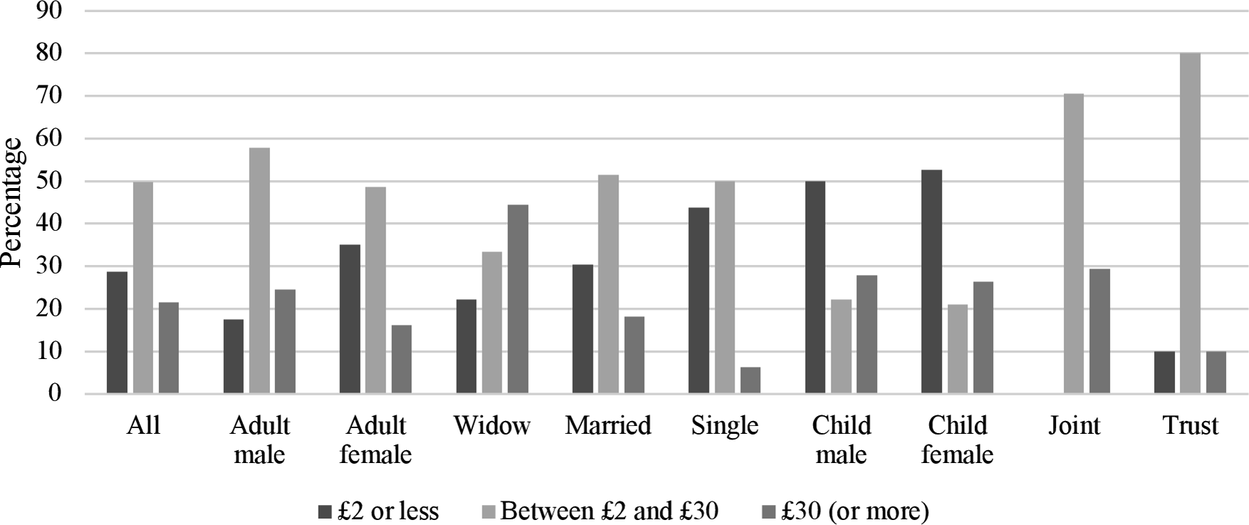
Figure 2 shows how the opening transaction amount relates to gender, age, and marital status (women only).
Percentage of depositors in each opening balance category.
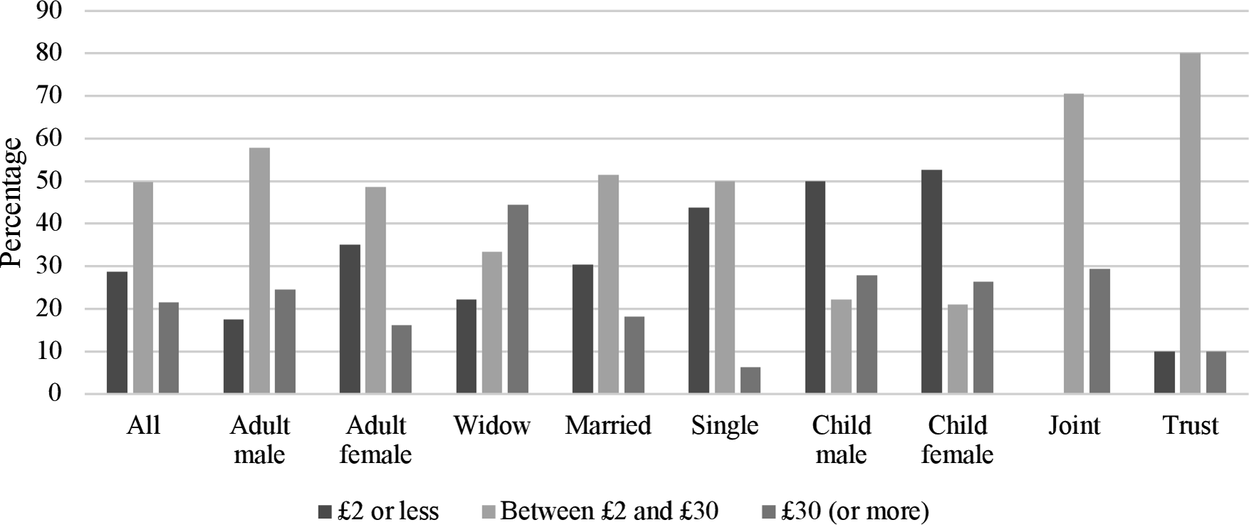
Figure 2 shows that children have the highest proportion of small opening balance accounts, which we might expect, given that they are not likely to be regular earners and are perhaps receiving deposit amounts as gifts. However, they are also overrepresented, relative to their total account holdings, in the £30 opening deposit category. The latter gives some credence to the belief that some child accounts were used by adults to get round deposit ceilings and/or the restriction on holding multiple accounts.Footnote 43 Among adults, women open a higher proportion of small accounts than their male counterparts, with single women overrepresented in this lower range. Single women lack significant representation in the maximum deposit category. The disaggregation of the adult women accounts shows the anomalous position of widows among the adult women sample, as widows alone are represented in increasing percentages as the opening balances increase. Joint and trust accounts tend not to have small opening balances; instead they are opened with amounts predominantly in the intermediate category.
Depositor Location and Behavior
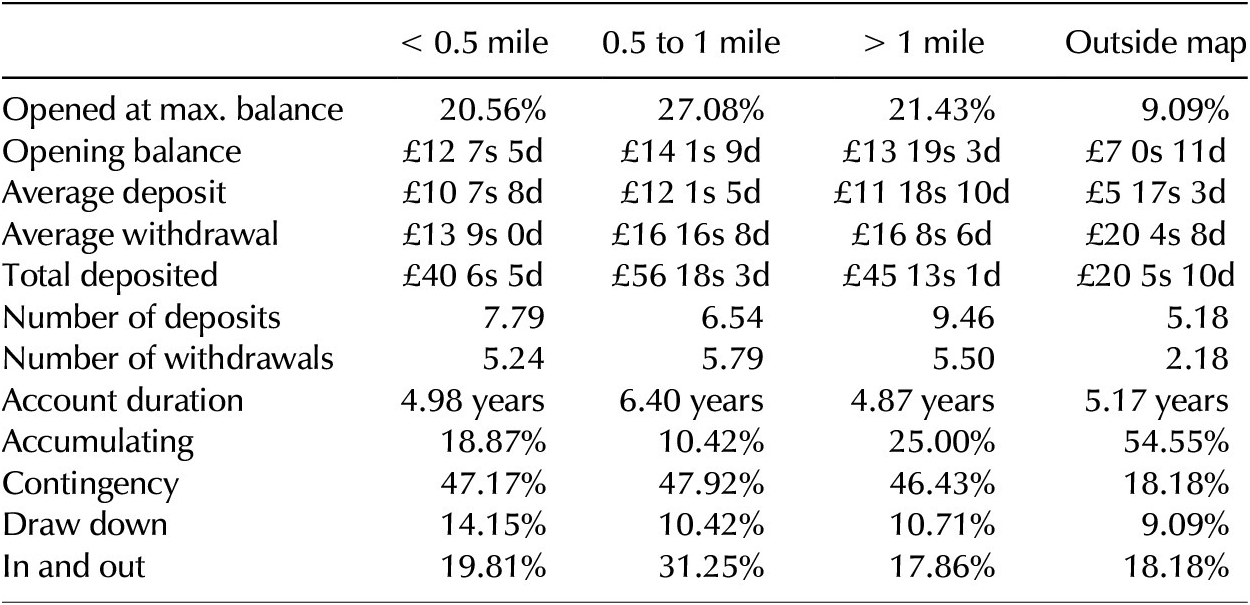
To consider the impact of distance on savings behavior, we allocate depositors to various groups according to how far their residential addresses are from the bank: within a half-mile radius (55 percent), between half a mile and one mile away (25 percent), more than one mile away (14 percent), or outside the map area (6 percent).Footnote 44 This enables us to consider the impact of distance on behavior. Table 4 presents summary statistics disaggregated by distance.
Depositor behavior by distance
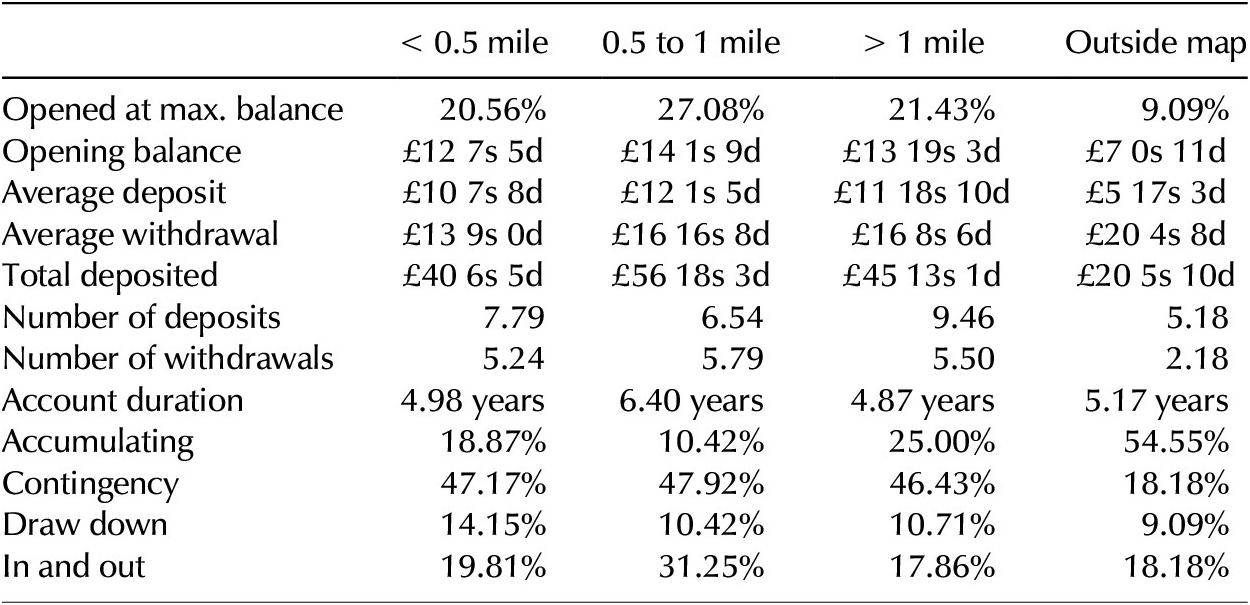
Note: Non-percentage figures are means. One depositor’s location could not be identified. For some of the statistics above, there are not 194 observations (e.g., where an account was not closed). In the case of the four account types—accumulating, contingency, draw down, and in and out—there is one account with just one deposit and it therefore does not fit these classifications.
If we consider the first three columns, there is evidence that those living within half a mile of the bank have a smaller opening balance, make smaller deposits and withdrawals, and deposit less altogether than their counterparts. This may reflect a heightened propensity among small savers to engage in saving when a bank is more local. We see no obvious difference in the number of withdrawals, and for the remaining variables there is a lack of clear differentiation according to distance. Those outside our map area are somewhat anomalous, perhaps due to the small number of savers in this category.
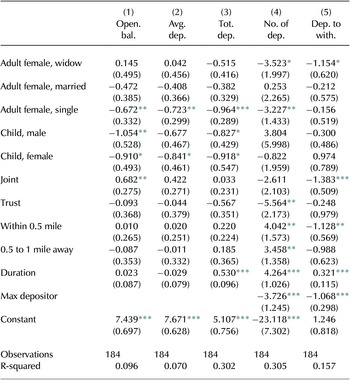
To better understand the impact of distance, we consider its association with various transaction indicators through regression analysis. We use an ordinary least squares (OLS) model and report the results in Table 5. The column headers indicate the respective dependent variables.
Determinants of depositor behavior
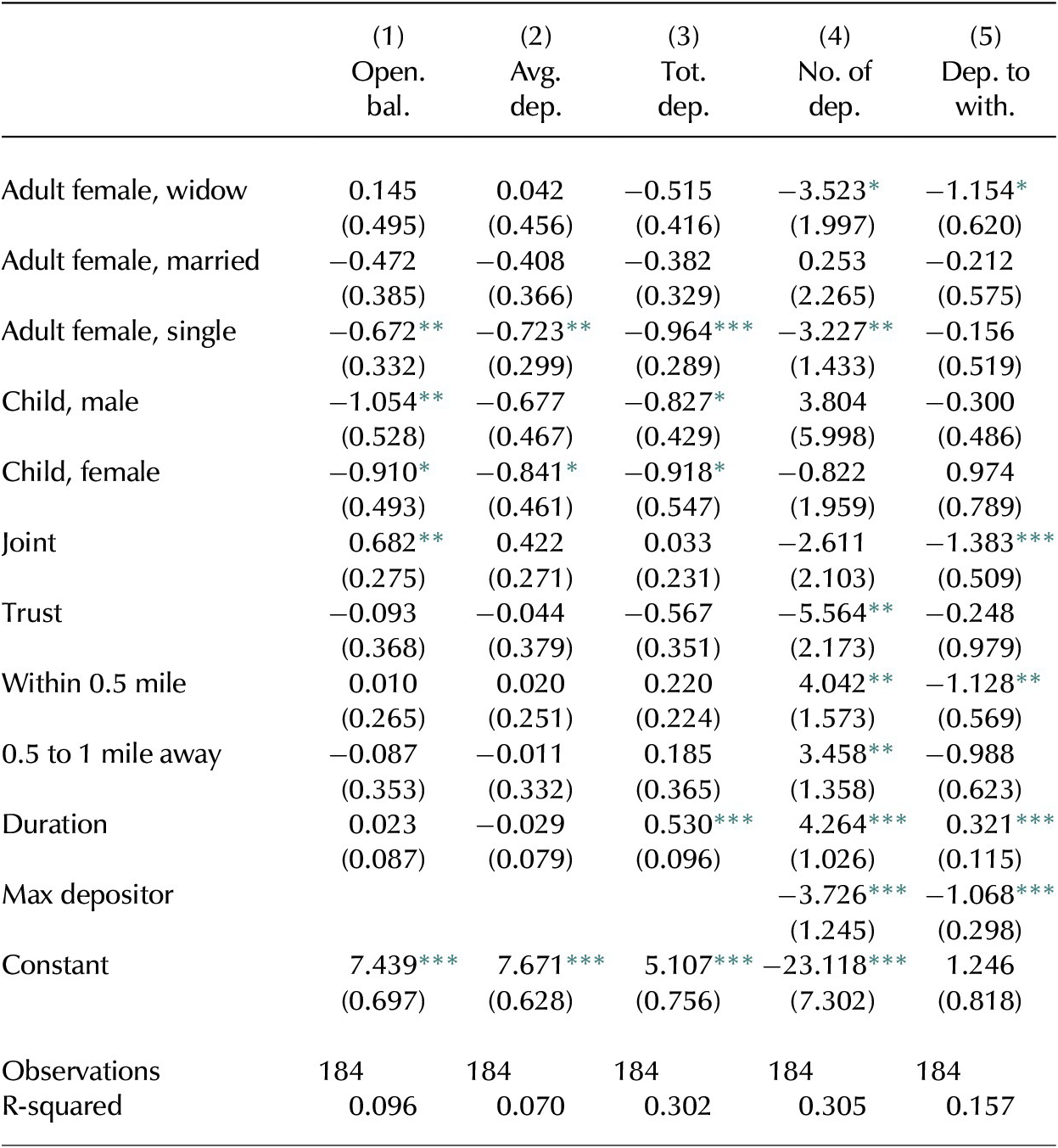
Notes: Ordinary least squares (OLS) model. Open. bal. = opening balance; Avg. dep. = average deposit; Tot. dep. = total deposited; No. of Dep. = number of deposits; Dep. to with. = ratio of deposits to withdrawals. The following are dummy variables: Adult female, widow; Adult female, married; Adult female, single; Child, male; Child, female; Joint; Trust; Within 0.5 mile; 0.5 to 1 mile away, Max depositor. Duration is the natural logarithm of account duration in days. Opening balance, average deposit and total deposited are the natural logarithm of the respective figures in pence. The number of deposits and the ratio of deposits to withdrawals are as their name suggests. Robust standard errors are in parentheses.
* p < 0.1.
** p < 0.05.
*** p < 0.01.
This analysis reveals that location is only statistically significant for two of the five transaction measures used, namely, the number of deposits and the ratio of deposits to withdrawals. We see that depositors who live within a half-mile of the bank make a significantly higher number of deposits, which suggests that closer proximity increases transactional activity. Furthermore, those residing near the bank tend to have a significantly lower ratio of deposits to withdrawals, with the effect more obvious within a half-mile radius.
Among the other significant variables, children and single women tend to have lower opening, average, and total deposits, which is consistent with their lower earnings potential. Perhaps unsurprisingly, accounts that are open longer tend to deposit a larger value of deposits and have more deposits; they also have more deposits vis-à-vis withdrawals. We also see that maximum depositors tend to make significantly fewer deposits and have a lower deposit-to-withdrawal ratio—possibly reflecting the storage aspect mentioned previously. This pattern for maximum depositors is also evident for widows, because they are frequently maximum depositors. In addition, and consistent with the earlier summary statistics, joint accounts have a significantly lower deposit-to-withdrawal ratio—which likely relates to the relatively high number of withdrawals we see with such accounts that we attribute to smoothing of domestic expenditure in joint married accounts. Joint accounts also tend to have a relatively high opening balance.
Gaming the System
Class-of-depositor analyses implicitly support the idea that evidence of middle-class depositors is evidence of, at best, an imposition on an institution set up to aid the poor to save and, at worst, deliberate misuse of the savings bank system.Footnote 45 Had there been alternative institutions offering safe, convenient, and low/no-cost banking options for those with middling amounts of savings, then these criticisms would hold greater weight. Although it had long been the practice of Scottish banks to offer interest on deposits, as late as 1826 the Bank of England, the Bank of Ireland, and the private London banks still did not. The English joint-stock banks formed after that period did offer interest in order to compete for deposits, but the operation of joint-stock banks were restricted within a sixty-five-mile radius of London until 1883.Footnote 46
The offer of interest on deposits by Scottish public and provincial banks was arguably a response to a capital-scarce economy and the need to incentivize cash deposits.Footnote 47 Under the deposit receipt system, any sum greater than £10 could be placed with the bank; interest was paid annually; and when a withdrawal was made, the existing receipt was voided and a new one added. By the 1840s, provincial banks were accepting deposits as low as £2. The deposit receipt was the main mechanism by which Scottish banks took deposits for a century and a half, and although they were also a feature of English country banks in the nineteenth century, not all receipts attracted interest.Footnote 48 In such a restrictive environment, the English saver had few other options than the savings banks if he or she wished to deposit small (relative to the expectations of joint-stock banks) amounts at interest.
Given the lack of options available to English middle-class savers of modest means, there is little to be gained by continuing to frame the presence of middle-class savers in English savings bank ledgers as problematic in and of itself. Instead, we have the data within the account ledgers to make better judgments about what behaviors were likely to represent an affront to the values of the system without being a substantial threat to its continuation. Problematic behaviors are, for obvious reasons, more likely to be found in the £30 opening deposit category and, in this section, we look in more detail at the accounts of these depositors.
We are confident that the 1830 cohort did not contain any depositors operating in the most obvious profit-seeking manner, that is, depositing the maximum amounts allowed in their accounts in the shortest period of time with the aim of harvesting the interest payments. There is no instance among our 1830 sample in which a depositor opens an account with £30 and continues to deposit £30 each year until the limit is met, although Amelia Ford, a married woman, might have done so if her banking had not been cut short by death. She deposits the £30 limit for four consecutive years, and when her husband inherits her bank account, he draws down from the balance. Twelve accounts are opened with the £30 maximum, attract interest for at least one year or part thereof, and close without another deposit. The surprise, in terms of this group of depositors, is the frequency with which we see £30 deposited, the same amount withdrawn after qualifying for the payment of interest (which is left in the account), and then another £30 deposited in the next period. This strategy of keeping the total amount invested at around £30 rather than building up a large balance from which to harvest a small (but increasing) annual bonus would appear to confirm Fishlow’s view that the 1828 deposit limits had done as intended, and removed the ability for interest payments to generate substantial profits for the depositor.Footnote 49 Interest rates could still generate an advantage from a middling size of deposit in an individual account, but this was not an obvious route to a profit or income.
With the removal of the potential for a single account to generate an income stream via interest payments in 1828, official attention then turned to the saver who might open multiple accounts to achieve the same end. Instead of being able to deposit £300 in an account, an individual wishing to gain the interest due on that amount would have to open ten separate £30 accounts. A change to the regulations in 1828 therefore tried to close this potential loophole by limiting individuals to one savings bank account in total, not one account in a single bank. With each savings bank being independent, and no capacity (or technology) that allowed cross-checking between banks, the legislators were reliant on the deterrent power of advertised penalties. Each depositor was required to sign a declaration on opening an account that he or she had no other savings bank account. If discovered to be in possession of multiple accounts, the depositor would forfeit the balances in both or multiple accounts.
The system was—obviously—open to abuse, especially if you lived in a city or traveled frequently. The East End of London was sufficiently populous that a depositor opening a second account in a neighboring district’s savings bank could be reasonably confident of not being caught. The East End supported three savings banks in 1830. At the northwest extreme, about a 1.8-mile walk from the location of the Limehouse Savings Bank, was the Whitechapel Savings Bank. Its advertised interest rate was £3.5.2. (per £100) rather than the percentage interest rate we are more familiar with. The other bank that East End depositors could bank with in 1830 was the Poplar Savings Bank—based less than a mile from Limehouse. Poplar was a much smaller establishment. Both Limehouse and Poplar offered interest rates of £3.6.8, which removed any incentive to chase a higher interest rate a little way down the road. Furthermore, as a correspondent for the Morning Chronicle newspaper explained, why go to the bother of banking at a less convenient location when the simplest method of gaining advantage was simply to open an account in your own name and then hold more “in trust” for fictitious individuals?Footnote 50
Some of the Limehouse sample year depositors chose to deposit at a bank that was not the closest to their residential address, yet do not appear to be trying to gain advantage. Among our 195 depositors of 1830, there are three account holders who provide addresses almost in the shadow of the Whitechapel Savings Bank, and eight in total within half a mile of that institution, suggesting that some found the longer walk to Limehouse worthwhile for their own personal reasons. Ruth Noble, who resides at an address close to the Whitechapel bank, appears to bank in Limehouse on a weekly basis for two other servants as their trustee. We cannot see that she profits in either case. One trust is dissolved and is taken over by the trustee, and the other account lapses.
There are no obvious accounts that are based “out of area,” that is, savers with addresses outside the East End, that appear to be gaming the system. There is a single out-of-area account that opens with £30 (account no. 83), but it belongs to a married woman who gives her address as a naval ship, so she is probably banking the annual wages of her husband. Some of the out-of-area accounts are those of single women in service, and we assume that they are banking close to their family homes rather than their places of employment and residence. There is one account (no. 137) in which £12 is banked per year for four years and then closed, but such regular deposits could easily be attributed to live-in employment elsewhere rather than indicating a second (prohibited) account.
Trust accounts are, however, problematic in this period. The nineteenth century saw the rapid spread of trusts. Formerly a legal mechanism used by the aristocracy to protect their wealth and land holdings through the male line, trusts were adopted by the middle class as a way of protecting more modest sums. Trusts required no registration and were considered a private arrangement, but their increasing use eventually required legal reform.Footnote 51 Legislators moved more quickly in respect of trust accounts in savings banks than they did in regulating trusts elsewhere. The 1844 Savings Bank Act, the draft of which proposed to disallow accounts held in trust for fear that they were being used to evade the prohibition against multiple account holding, eventually passed with the new regulation that the beneficiary must sign with the trustee for withdrawals.Footnote 52 The percentage of trust accounts opened in Limehouse does drop noticeably in 1845. In 1843, thirty-five trust accounts were opened and only six in 1846, but numbers recover later in the 1840s, and trust accounts only start to disappear as a common account type in Limehouse in the second half of the 1850s.
The trust accounts opened by our 1830 savers have a higher than average deposit-to-withdrawal ratio, that is, suggestive of an accumulation strategy. Only four of the ten trust accounts opened in Limehouse in 1830 were held by parents for children, but all four are operated in a way that is consistent with storing family money—not always in large amounts—as opposed to instructing a child in the habits of thrift. Solomon Richards—in addition to his own account—opens one in trust for his daughter, makes two deposits in one year that total the maximum annual deposit of £30, and withdraws it after interest is paid. Mark Pillar opens an account in trust for his daughter Harriet, deposits £3, and withdraws it four years later. Henry Stacey opens a trust account for his daughter Mary, age six, which runs alongside his own account until he dies in 1854, when Mary would have been thirty. The presumption is that Henry operates the trust account without Mary’s knowledge or benefit in order to supplement his own individual account.
An alternative to a trust account, should an individual wish to circumvent the one account rule, was to open an account in the name of your child/children and operate the child accounts in tandem with your own. Ledger data give us the ability to compare linked family accounts for mirrored transactions.Footnote 53 Family accounts are largely dismissed in class-of-depositor analysis. Fishlow, for example, refers to savers without a listed occupation as “otherwise unidentified women and children.” Parliamentary reports allocated wives to the husbands’ occupations and put all minors in a separate category.Footnote 54 We establish family groups by recording linked accounts when we encounter them in the ledgers—these are typically savers with the same family name and residential address and that we can see by the pattern of transactions are not operating their accounts independently. For example, we consider the accounts linked and potentially problematic if there are two child siblings who open accounts on the same day.
Our 1830 data contained sixteen family groups, of which four comprised related adults. The remaining twelve family groups (representing twenty-two accounts) were linked via child siblings in the same household or there was clearly an adult parent with an account alongside one or more accounts opened in a child’s name. Of those remaining twelve family groups, we identified two family groups whose accounts were being operated independently and without suspicion of being puppet accounts. In the ten remaining family groups, the amounts deposited and withdrawn and the dates these transactions were made were identical or very similar across the accounts within the family. We interpret this behavior as adults using child accounts as cover for multiple account holding.
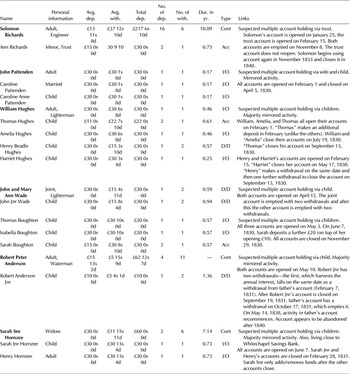
In summary, out of the 195 accounts examined in the 1830 cohort we flagged twenty that had transaction records that were suggestive of accounts that were operating outside the spirit (and letter) of the regulations.Footnote 55 If we assume that the ostensible owners of the puppet accounts—the children of adult savers—are not aware of the existence of these accounts, then the number of suspected individuals gaming the system falls to six in total. Only two of these savers kept the suspect accounts open for longer than a year. The majority of the suspect accounts were in existence for very short periods of time, suggesting a need to keep surplus resource safe until it was needed or reinvested elsewhere. Of course, there may be more individuals gaming the system than we identified who are hiding in plain sight and whose transaction history is more subtle than that of the account holders we identify in Table 6. It is equally the case that some of the individuals we have identified are possibly suspected without cause. For example, it is possible that Mary Stacey has a disability that prevented her from banking and that holding a trust account for her into adulthood is defensible. But our view is that a circa 10 percent rate in respect of suspect accounts should not be the basis of a moral panic or grounds for dismissing the undoubted benefits that the savings bank provided to its depositors.
Flagged accounts
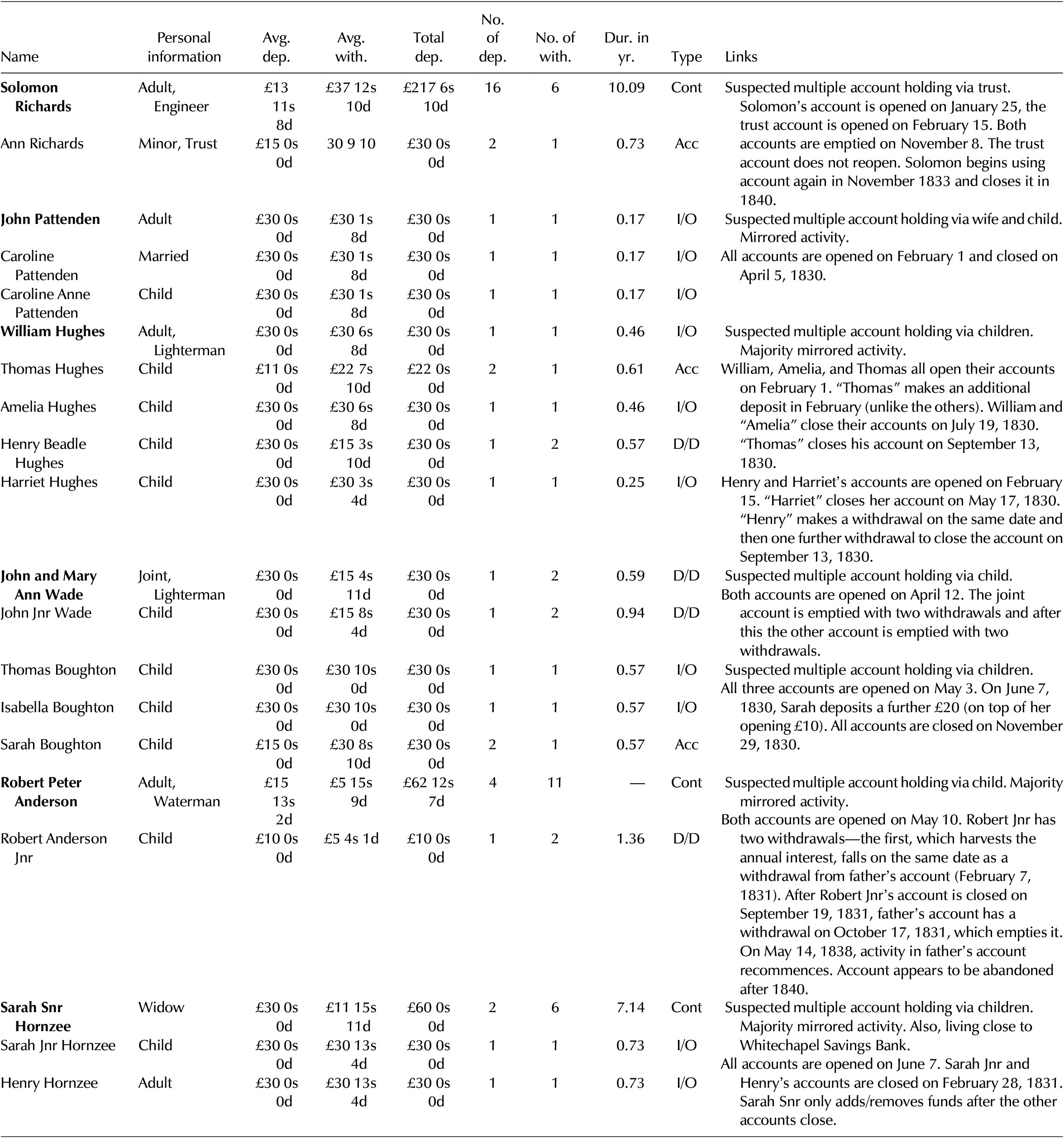
Note: Names in bold are the assumed principal account holders. No. of dep. = number of deposits; No. of with. = number of withdrawals; Total dep. = total deposited; Avg. dep. = average deposit; Avg. with. = average withdrawal; Dur. in yr. = duration in years; Type = account type; I/O = in and out; Acc = accumulating; D/D = draw down; Cont = contingency.
Conclusions
In this paper, we have shown the value provided by transaction data in the study of British savings banks in the nineteenth century. Although the data collection from handwritten ledgers is time-consuming, and therefore not without cost, there are significant benefits in adopting such an approach. Transaction data allow us to—finally—move away from occupational class as a way of recording and comparing British savings bank depositors. Occupational class and descriptions of savers who are not listed according to their employment—such as women and children—differ widely between institutions. They are an unsafe basis for comparisons of savers across institutions, or across time periods, or nations. Using transactions to characterize saver behavior will enable more intranational and international comparative work, especially if researchers can use a common framework of account categories and observation types, for example, opening deposits.
In respect of our working hypotheses for the 1830 cohort research, we find that opening deposit data are indicative of future savings behavior. The data suggest that where the opening deposit is small it is more likely to lead to a savings approach to the account. In contrast, where the opening deposit is at the annual deposit limit of £30, the account is more likely to be used for parking or storing money. Opening deposit may also indicate broad differences in motivation to have an account, with those opened at £30 arguably more strategic in their aims, particularly in the case of child accounts.
Our analysis of the 1830 cohort also reinforces the finding of contemporary microfinance and savings theory that proximity to banks matters. Savers in close proximity to the bank in our sample tend to make smaller transactions. This may reflect the greater uptake of savings services among less affluent clientele when a bank is closer to them. There is also some evidence that those living closest to the bank make more deposits, which again reflects locational convenience.
Finally, we examined the transactions to identify accounts that were potentially gaming the savings bank system. The presence of comparatively high numbers of middle-class savers, compared with those using savings banks in Ireland and Scotland, has—since the creation of the banks in the early nineteenth century—fueled the suspicion that a large number of depositors were exploiting the generous interest rates offered. Occupational class analyses of savings banks have continued this narrative despite the lack of alternative low-cost or interest-bearing deposit opportunities for those with small to middling amounts of money to save. The suspicion remained in the literature that English savings banks were prey to organized middle-class rentier behavior. Our cohort transaction analysis has revealed a low level of system gaming—affecting approximately 10 percent of the accounts opened in 1830. The most common strategy appeared to be opening an account(s) on behalf of your own child(ren) and using that account for short-term storage of money. There did not appear to be widespread rent-seeking behavior in regard to interest payments. Most of the accounts that show evidence of being operated by parents as puppet accounts are open for very short periods of time—typically six months—and do not generate interest payments of the size that make them viable sources of additional income.
Indeed, when we look at the transactions of the 1830 cohort overall, they tell a familiar and oddly comforting and human collective tale of short-term accumulations, long gaps between deposits, and a distinct lack of success in the long term. An analysis of the cohort transactions shows us the limitations of the contemporaneous debates about access to financial institutions. Neither the view that savings banks would lift the working class out of poverty through habits of thrift, nor the belief that savings banks were routinely exploited by the middle classes, is supported by the data. Rather, the savers at the Limehouse Savings Bank appear to be adapting its financial services to suit their individual needs. These behaviors were not those espoused by legislators, but nonetheless were valid in the absence of readily available alternatives. Examining transaction data enables us to better position English and Welsh savings banks within the history of retail banking and humanize the longitudinal behaviors of their diverse clienteles who used them for all their intents and purposes.