And now what? This anxious question torments many of us in the current socio-political moment: that of Trumpism and Brexit; of resurgent xenophobia and racism expressed through election results and policies around Europe; and of the return of fascism and Nazism. It is this moment that has prompted González-Ruibal et al. (above) to call for a new, politicised archaeology. In so doing, they urge archaeologists to abandon the soothing liberal but ineffective embrace of communities and the public. They also argue against identitarian politics and the discourse of apolitical and abstract multiculturalism. I am in broad agreement with them, and called some years ago for a shift from ethics to politics, and for an explicit, public political stance (Hamilakis Reference Hamilakis, Hamilakis and Duke2007). If the politicisation of archaeology was important 10 years ago, it is much more urgent now.
My slight unease with the authors’ manifesto, however, is that its prose is too universalising, while simultaneously betraying its specific origin in a southern European context. Their dismissal of identity discourses tout court obscures the fact that phenomena such as race, for example, do not simply denote identitarian concerns. Such discourses are instead fundamental to the understanding of the production of whiteness and blackness (cf. Mbembe Reference Mbembe and Dubois2017); to colonialist, nationalist and capitalist modernity, to the class system; and to the emancipatory aspirations of all humans—not just those classified as ‘coloured’. In another example, gender is not simply about certain identities. It primarily concerns the patriarchal and hetero-normative constitution of the current neoliberal order. Neither race nor gender can be disentangled from class or the genealogy of capitalist modernity. Another point of disagreement with the authors concerns their statement that “predatory capitalism does not need archaeologists, simply because it does not need legitimising” (González-Ruibal et al. above). Yet, colonialist and capitalist modernity is continually reproduced, partly through the genealogical and material narratives perpetuated by many scholars, including archaeologists.
To heed the call for a politically effective archaeology in the service of social justice, we must decolonise the discipline that emerged at the intersection of colonial, racial and national modernity. What does this entail specifically? First, in undoing colonial archaeology and anthropology, we must decolonise time. This can be achieved, for example, by arguing against teleology, rejecting cultural evolutionist narratives based on hierarchical thinking, and on time as closure, destiny and causation. A decolonised, non-teleological time works against the dominant neoliberal dogma that asserts there is no alternative. For example, engagement with the deep past and with global cultural and biological diversity could contribute to greater awareness of the cohabitation of plants, animals and humans on Earth. It could show that there are alternative possibilities, demonstrating that things have been, and could yet still be, different. Such decolonisation can also point to alternative modes of being and alternative ontologies beyond capitalism, even beyond the state.
Another way to decolonise time is to liberate ourselves from temporal linearity—an ethnocentric view of time imposed upon our discipline and on history as a whole. I have argued elsewhere that archaeologists should adopt an experiential, sensorial and affective mode of temporal imagination (e.g. Hamilakis Reference Hamilakis2013). In so doing, we allow materiality to enact simultaneously different moments and temporal states. A multi-temporal archaeology is not a presentist archaeology or an archaeology of the present. It is an archaeology that is grounded in the present, but attuned to the political effects of different co-existing times, to the material histories that surround us and demand to be heard. We thus foreground the potential of materiality to act and intervene in the present. “History is not the past. It is the present. We carry our history with us. We are our history”—these are the words of the African-American writer and activist James Baldwin, spoken in 1980 (Baldwin Reference Baldwin2010: 125). A multi-temporal archaeology can ally itself with trends such as the archaeology of the contemporary, without abandoning its multi-temporality.
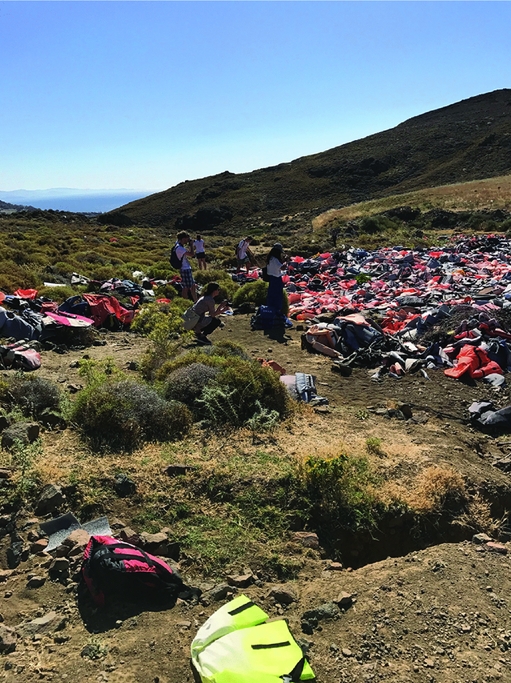
Further, such a multi-temporal archaeology can produce a forensic and affective analysis of the material, sensorial and bodily effects of contemporary policies andrhetoric. It can demonstrate the time-depth of such strategies and how they evoke other historical moments and material realities. For example, it allows us to dissect and demystify the material and sensorial assemblage of contemporary forced and undocumented migration, which produces illegality at borders and engenders a deportation regime that fractures lives (Hamilakis Reference Hamilakis2016). If the current deportation regime operates as a powerful machine, as a multi-sensorial assemblage (Hamilakis Reference Hamilakis2017) suspended between visibility and invisibility, and between spectacle and surveillance (Figure 1), a multi-temporal archaeology can forensically disassemble it. Further, a multi-temporal archaeology can dismantle the material apparatus of exclusion and deprivation, and engender the material and sensorial force, the ordinary affects of daily life, the deeply felt experiences, beyond and against the choreographed spectacles of power.
The so-called lifevest cemetery, near Molyvos on the Greek border island of Lesvos. This vast accumulation of border-crossing remnants, collected from the island's beaches by volunteers and municipal authorities, is fast becoming a spectacular, dark heritage site, frequented by many visitors (photograph: Yannis Hamilakis, July 2017).

If the decolonisation of time is the first task, the next is the decolonisation of the aesthetic or of the sensorial andaffective. In the previous example of undocumented migration, the politics of sensoriality structure and shape the whole phenomenon. The spectacle staged at certain borders—for example, between Greece and Turkey—goes hand in hand with surveillance in detention centres, or with the invisibility of those drowned en route from Africa to Italy. Images, materialities and objects that embody the brutality of the nation state or of ‘Fortress Europe’ must be exposed; but an archaeology of contemporary undocumented migration as resistance must decolonise our sensorial field by bringing forth other images, objects and materialities. Not just those that show migrants as victims, but also as agents and authors of their own destiny: the material worlds produced by migrants themselves, the materiality of cities shaped by migration and the projects created in home countries through migrant remittances. This process, however, needs to include the decolonisation of affect; in relation to migration, it would mean an archaeology engendering not pity and sympathy, but solidarity, which can lead to new, affective, trans-corporeal assemblages, and to new socialities.
Finally, an archaeology of resistance should decolonise the self. It can historicise the emergence of different notions of personhood and study processes of collective individuation. Simultaneously, it can foreground affective trans-corporeality, beyond the individual and the patriarchal anthropocentrism of Western modernity. More broadly, however, it should work against the privatisation of identities, of identity claims and the compartmentalisation of identity discourses. Along with González-Ruibal et al. (above), I argue against the segregatory discourse of a static politics of identity, in favour of a more inclusive emancipatory politics—both in archaeology and more broadly. If white nationalism and supremacism define the order that is attempting to dominate the present, such an order cannot be disentangled from patriarchy, from class or from capitalist modernity.