Introduction
In Pakistan, students from Christian, Hindu, and Sikh minority groups may have socially imposed identities that mark them as disadvantaged and affect how they are evaluated independently of their individual performance. This article treats those imposed identities as racial in the analytic sense developed in racialization scholarship: they are ascribed by descent, applied collectively, and held to be natural and heritable rather than chosen or achieved (Desmond and Emirbayer, Reference Desmond and Emirbayer2009; Omi and Winant, Reference Omi and Winant1994). Community-based marking takes place in different ways for each group: for Christian students, inherited occupational associations, based on the historical association of the community with sanitation work, are the vehicle for marking; for Hindu and Sikh students, religion-linked attribution, triggered by the presence of religious content in the curriculum, classroom practices, and visible religious identity, is the vehicle. This study investigates how these community-level marking processes affect school experiences across all three communities and suggests that the patterns reported by participants are not solely attributable to poverty or individual prejudices. It also asks what the Pakistani case contributes to the comparative study of race: how racial boundaries are drawn, policed, and reproduced in a society where skin color does not organize social classification.
Social marking theory explains how community identity is transferred from an individual to a group and how a marker of difference is collectively assigned to them (Meer Reference Meer2013; Murji and Solomos, Reference Murji and Solomos2005). In the South Asian context, social othering based on religion, caste, and region exemplifies inherited attribution and institutional reproduction (Jodhka Reference Jodhka2018; Mosse Reference Mosse2018). Approximately ninety percent of the Christian minority in Pakistan are descendants of groups positioned as so-called low castes under the colonial-era social order who converted to Christianity during British rule (Ispahani Reference Ispahani2017). That conversion history is itself a record of colonial racial classification. The enumerative apparatus of British rule fixed descent and occupation as inheritable kinds, and religious conversion did not dislodge the classification it was intended to escape, a pattern that parallels the racialization of caste documented elsewhere in South Asia (Natrajan Reference Natrajan2022). The change in formal religious identity did not affect socially allocated positions, as descent-based terms, serving as caste markers, were maintained and used collectively, irrespective of actual occupation or family history.
This study contributes to comparative racialization scholarship. In Pakistan, social classification is not mainly determined by physical appearance. However, the mechanisms delineated herein, including the assignment of status based on lineage, the collective categorization of individuals irrespective of their personal conduct, and the institutional reinforcement of group distinctions, are regarded as racializing processes as articulated in racialization studies (Meer Reference Meer2013; Murji and Solomos, Reference Murji and Solomos2005). On the definition that organizes this analysis, race is a symbolic category that sorts people into bounded groups on the basis of phenotype, ancestry, or both (Desmond and Emirbayer, Reference Desmond and Emirbayer2009); where ancestry rather than appearance supplies the signifier, the classification is no less racial for being invisible to the eye. Racism, correspondingly, is not primarily a property of individual attitudes but a feature of racialized social systems in which group placement allocates life chances (Bonilla-Silva Reference Bonilla-Silva1997). Religious identity, descent, occupational association, and inherited community status operate together to produce and reproduce group differences, as though they were natural and heritable, thereby ascribing a collective status that individual achievement cannot revise. The Pakistani case thus extends the study of racial formation (Omi and Winant, Reference Omi and Winant1994) beyond Western racial binaries by showing how racialized group boundaries are constituted through religion and caste-inflected descent, even where phenotype is not the principal basis of classification.
Framing the case in these terms yields three contributions to race scholarship. First, it isolates the mechanism of racialization from its most familiar marker. Because phenotype does not distinguish Pakistani Christians, Hindus, and Sikhs from the Muslim majority, the case makes visible the work that ancestry, religion, and inherited occupation perform on their own, work that is readily misattributed to appearance in settings where appearance is available. Second, it treats the school as a site of racial formation rather than a neutral setting in which pre-formed attitudes are expressed: the annual roll call of religion, the separate water container, and the missing column for religion in the enrollment register are the concrete practices through which group boundaries acquire durability. Third, comparing three minority communities marked through partly different pathways permits an internal comparison of racializing mechanisms that single-group studies cannot support. Together these moves respond to long-standing calls to provincialize the American racial paradigm without abandoning the analytic category of race (Baber Reference Baber2022; Gazdar Reference Gazdar2007; Meer Reference Meer2013).
This study attempts to fill the gap in the peer-reviewed qualitative literature on minority educational experiences by conducting semi-structured interviews with thirty-eight Christian, Hindu, and Sikh respondents at two urban sites with varying social densities. The questions used to guide the analysis were as follows: How do minority students describe their school experiences? What is their perception of the impact of community identity, occupational associations, and religion-related markings on these experiences? What are students’ and families’ reactions to the labeling and social distancing in schools? A fourth, analytic question runs through all three: what does a setting without phenotypic marking reveal about how racial classification is produced and sustained?
Theoretical Framework
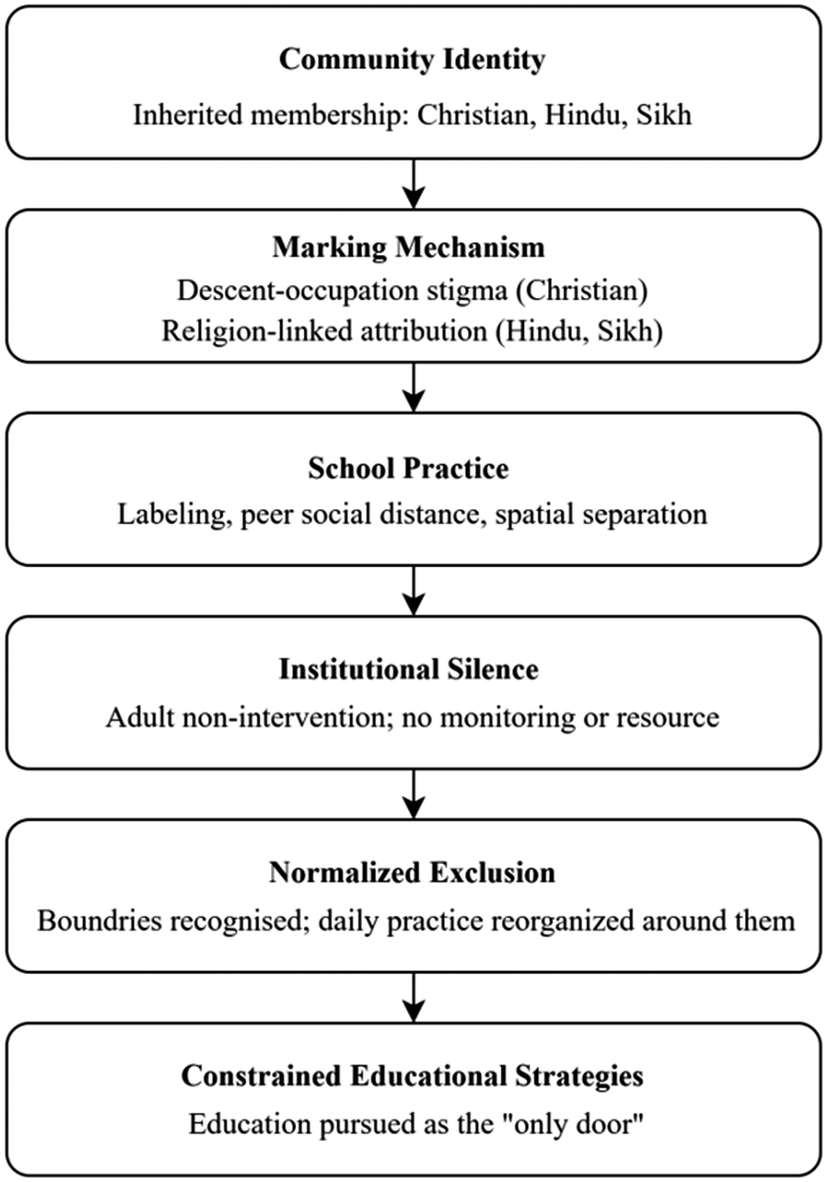
Social marking is the process by which inherited characteristics, especially descent and group membership, are imposed on social collectivities, marking them as different regardless of individual behavior (Murji and Solomos, Reference Murji and Solomos2005; Omi and Winant, Reference Omi and Winant1994). This idea focuses on the social and institutional processes that construct and reproduce group boundaries (see Figure 1).
The analytical sequence of the theoretical framework, which includes community identity, marking mechanisms, school practices, institutional silence, and normalized exclusion, leading to constrained educational strategies.

Figure 1. Long description
The flowchart consists of six stacked rectangular boxes connected by downward-pointing arrows.
* The first box at the top is titled Community Identity, with the subtext: Inherited membership: Christian, Hindu, Sikh.
* An arrow points down to the second box, Marking Mechanism, with the subtext: Descent-occupation stigma Christian or Religion-linked attribution Hindu, Sikh.
* An arrow points down to the third box, School Practice, with the subtext: Labeling, peer social distance, spatial separation.
* An arrow points down to the fourth box, Institutional Silence, with the subtext: Adult non-intervention; no monitoring or resource.
* An arrow points down to the fifth box, Normalized Exclusion, with the subtext: Boundries recognised; daily practice reorganized around them.
* The final arrow points to the bottom box, Constrained Educational Strategies, with the subtext: Education pursued as the "only door".
The use of social marking outside the traditional racial binary is firmly established. Robert Miles’ (1989) insistence that racialization is a process of signification rather than a property of bodies, and Nasar Meer’s (Reference Meer2013) demonstration that Jewish and Muslim populations have been racialized through descent-based and cultural rather than somatic markers, together establish that the analytic category of race travels beyond the color line without loss of precision. Religious identity can serve as a medium for socially assigned meanings in the absence of visible physical differentiation. Social othering based on religion, caste, and region in South Asia has the structural characteristics of inherited attribution, collective marking, and institutional reproduction (Guru Reference Guru2009; Jodhka Reference Jodhka2018). Applying the framework in Pakistan is therefore not an analogy to race but an instance of it: the same operation of naturalizing group difference, carried by different signs (Natrajan Reference Natrajan2022).
This study is based on social marking theory and minority students’ school experiences. This theory provides conceptual tools unavailable when caste discrimination and religious prejudice are considered separate frameworks. While caste theory sheds light on hierarchies based on descent (Mosse Reference Mosse2018) and frameworks of religious prejudice shed light on exclusion based on religious affiliation (Hussain et al., Reference Hussain, Salim and Naveed2011), neither naturally explains the intersection of descent and religious elements in a single analytical account.
This contribution is conceptual in two respects. First, the analysis reveals how a community-based marking mechanism operates in all three minority groups: descent-occupation stigma for Christian students and religion-linked attribution for Hindu and Sikh students. Second, this study presents a new concept, normalized exclusion, defined as a condition in which minority students recognize exclusionary boundaries but reorganize their daily school practices around them because credible institutional alternatives are absent. This is not the acceptance of exclusion but rather adaptation under constrained conditions. This concept is not the same as stigma management (Goffman Reference Goffman1963), in which people actively work on their identities to mask or deflect discreditable aspects. In normalized exclusion, such identity work is unnecessary because, when contestation appears unviable, students reorganize their practices around the boundary rather than challenge it directly. The subjects in this study were clearly aware of the limits within which they were operating, which distinguishes their experience from the symbolic violence (Bourdieu and Passeron, Reference Bourdieu and Passeron1977) associated with the social structure. The emphasis is on institutional precision so that remediation offers credible alternatives rather than merely a change in attitude. Situated within race scholarship, normalized exclusion names one way racial domination reproduces itself without overt racial ideology or continuous coercion. The boundary holds because the institution offers no credible route around it, so the rational adaptation of the marked party performs the maintenance work that explicit enforcement would otherwise require (Bonilla-Silva Reference Bonilla-Silva1997; Desmond and Emirbayer, Reference Desmond and Emirbayer2009).
Literature Review
Minority Education in Pakistan
The school system in Pakistan primarily caters to the majority community, thereby systematically marginalizing religious minorities. Previous research indicates that minorities are treated unfairly and that educational resources show the relationship between Christian communities and British colonialism (Centre for Social Justice 2025; United States Commission on International Religious Freedom 2016). Islamic religious content has been recorded in subjects that are officially secular in nature, which raises serious questions about the equitable treatment of non-Muslim students (Human Rights Commission of Pakistan and Institute of Development Research and Corresponding Capabilities 2019; Hussain et al., Reference Hussain, Salim and Naveed2011). Curricular arrangements of this kind are not incidental to racialization. They are among the routine institutional practices through which a majority religious identity is established as the unmarked civic norm and minority identity as the marked exception.
The interplay of descent, occupation, and socially assigned worth in Muslim-majority societies in South Asia remains underexplored (Baber Reference Baber2022; Gazdar Reference Gazdar2007). Community identity frequently supersedes individual family occupations, a phenomenon described as a partial class buffer, whereby class position modulates but does not override descent-based identity (Tamim and Tariq, Reference Tamim and Tariq2015). In Pakistan, informal but socially powerful categories operate through kinship and lineage networks (Lyon Reference Lyon2019).
Other Muslim-majority education systems document comparable dynamics, placing the Pakistani case in an international context. In Indonesia, multicultural education policies coexist with school practices that continue to reproduce majority religious norms, and religious minority students’ access to faith-consistent instruction remains inconsistent (Raihani Reference Raihani2018). In Turkey, compulsory religious-culture instruction organized around Sunni Islam renders the difference between Alevi, Christian, and Jewish students a recurring institutional fact, and minority youth report teacher-mediated discrimination and pressure to conceal identity (Tanyaş Reference Tanyaş2024). In Egypt, the requirement that students declare their religious affiliation and attend religiously segregated instruction institutionalizes a sense of otherness for Coptic Christian students from an early age (Isaac Reference Isaac2012). These cases parallel two of the mechanisms documented in the present study: curriculum-based religion-linked attribution and institutional silence, whereas the descent occupation pathway documented for Pakistani Christian students appears comparatively distinctive, reflecting the caste-inflected colonial history of sanitation employment. Situating Pakistan within this comparative frame suggests that religion-linked marking is a recurring structural feature of Muslim-majority school systems, while its combination with descent-based occupational stigma is context-specific.
For Pakistan’s Christian minority, the structural concentration of sanitation employment reinforces the association between community identity and occupational stigma (Amnesty International 2025; Dunne Reference Dunne2021). This creates the precondition for what participants described: a community-level occupational identity that follows Christian children into schools, regardless of individual family work. Occupational concentration of this kind supplies the material substrate of racialization: a group-level association between descent and degraded work that, once established, is read back onto individuals as an inherited property of the community (Bonilla-Silva Reference Bonilla-Silva1997).
Research indicates that structural stigmatization leads to lower school enrollment and retention among minority communities, as families weigh the expected returns of education against the anticipated social costs (Cheema and Naseer, Reference Cheema and Naseer2013; Naveed Reference Naveed2024). Children from marginalized communities are less likely to enroll in schools located in areas dominated by higher-status groups (Jacoby and Mansuri, Reference Jacoby and Mansuri2011). Evidence from Pakistan suggests that community-based social positions constrain educational returns independently of individual effort, with minority students being less likely to convert educational credentials into commensurate occupational outcomes (Cheema and Naseer, Reference Cheema and Naseer2013; Naveed Reference Naveed2024).
School Experience and Social Boundaries
Schools are social institutions that reinforce the inequalities of which they are part (Bourdieu and Passeron, Reference Bourdieu and Passeron1977). Individuals with stigmatized social identities must manage interactions that may reveal their identities, a process known as stigma management (Goffman Reference Goffman1963). In the context of education, this framework highlights how spatial and material arrangements (e.g., seating, food served, and access to water) affect participants’ lived experiences of social boundaries.
Research Context
The study was conducted at two purposively selected urban sites with varying social densities and institutional diversity. Site A was a larger urban area with a longer history of minority community organizations and higher levels of social anonymity. Site B was a smaller urban neighborhood with close-knit neighborhood networks and a small number of formal support systems for minority group members. On dimensions relevant to this study, the two sites differed in the extent of social anonymity and in the degree to which kinship networks extended to schools.
Methods
Research Design
Because the study examined participants’ subjective interpretations of school experiences shaped by descent, religion, and community identity, a qualitative design using semi-structured interviews was appropriate (Braun and Clarke, Reference Braun and Clarke2006). Data were collected from March to July 2023.
The recruitment process was a three-stage purposive process. In Stage 1, two registered minority community organizations at each site were contacted through institutional channels and agreed to serve as initial access points. In Stage 2, the community organization staff identified potential participants who met the inclusion criteria and obtained their contact information with prior consent. In Stage 3, the research team made direct contact with potential participants, explained the study, and invited them to participate. Snowball referrals were accepted from existing participants for up to two additional contacts, provided that they met the same criteria.
The inclusion criteria were as follows: 1) self-identified member of a Christian, Hindu, or Sikh minority community in Pakistan; 2) for students and young adults, completed at least Grade 10 and attended school in the selected urban area; 3) for parents, currently has a school-age child attending a government school in the selected urban area; and 4) for teachers and community leaders, currently or recently active in an educational or advocacy capacity in the selected urban area.
The exclusion criteria were as follows: age < eighteen years at the time of the interview, inability to provide informed consent, and unwillingness to have the interview recorded. Written informed consent was obtained from all participants before each interview. Participants were informed of their right to withdraw at any time without consequence, that interview data would be anonymized before analysis, and that no personal identifiers would be reported.
This study was approved by the School of International Education, Anhui University, P.R. China under approval no (LX202302149), prior to data collection.
Participants
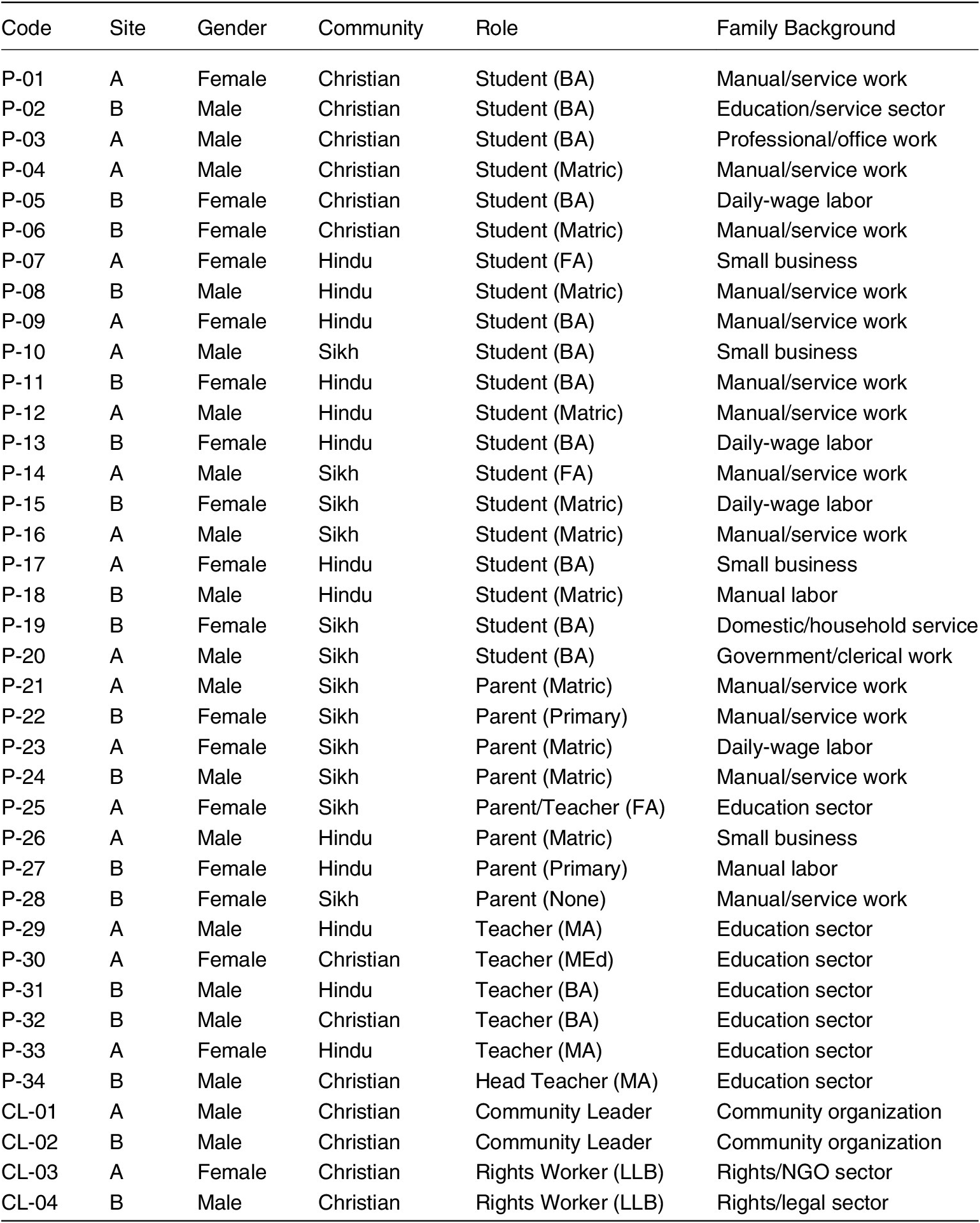
Thirty-eight semi-structured interviews were conducted: twenty-two at Site A and sixteen at Site B. The sample comprised twenty minority students or young adults aged eighteen to twenty-five with recent school experience (six Christian, seven Hindu, and seven Sikh); eight parents of school-age minority children (zero Christian, two Hindu, and six Sikh); six teachers or head teachers drawn from both Christian and Hindu minority backgrounds (three Christian and three Hindu); and four community leaders or minority rights workers (all Christian). All participants were assigned alphanumeric codes. The complete profiles of the participants are presented in Table 1. Student and young adult accounts constitute the core evidence base for the findings reported below; parent, teacher, and community leader accounts are used to provide contextual and institutional perspectives rather than direct evidence of student experience. The main interview protocol was the same for all three groups. Probes were included for the community-specific dimensions of occupational associations (Christian participants) and curriculum-based dimensions of religious marking (Hindu and Sikh participants). The interviews with teachers were conducted regarding general school practices and policies and not with regard to any specific named students. The student subsample was unevenly distributed across the three communities. Cross-community comparisons were interpretive only, as probes were added to the shared core protocol and should be viewed as structurally parallel patterns rather than as controlled contrasts.
Participant Profile (N = 38).

Table 1. Long description
The table consists of 38 rows of data under six headers: Code, Site, Gender, Community, Role, and Family Background.
* Codes P-01 through P-20 represent students from Sites A and B, including genders, Christian, Hindu, and Sikh communities, with roles ranging from Matric to B A students and family backgrounds in manual, service, or professional work.
* Codes P-21 through P-28 represent parents with education levels from None to F A, primarily from Sikh and Hindu communities, with backgrounds in manual labor or education.
* Codes P-29 through P-34 represent teachers and head teachers with B A, M A, or M Ed degrees from Christian and Hindu communities, all with family backgrounds in the education sector.
* Codes C L-01 through C L-04 represent community leaders and rights workers with L L B degrees, all from the Christian community, with backgrounds in community organizations or the N G O sector.
Note: Site A is a larger urban center (n = 22) and Site B is a smaller urban center (n = 16). The community distribution is Christian (n = 13), Hindu (n = 13), and Sikh (n = 12).
Note: Site A = larger urban center (n = 22); Site B = smaller urban center (n = 16). Community distribution: Christian (n = 13), Hindu (n = 13), Sikh (n = 12). Education abbreviations: Matric = Secondary School Certificate (Grade 10); FA = Higher Secondary School Certificate (Grade 12); BA = Bachelor of Arts; MEd = Master of Education; MA = Master of Arts; LLB = Bachelor of Laws. P = Participant; CL = Community Leader. Neighborhood names, school names, and personal identifiers are not reported.
Eligibility was restricted to participants who had completed at least Grade 10, including current students, graduates, and participants who left school after Grade 10. However, this approach has a limitation: students who left school earlier, perhaps the most affected by exclusion, are not reflected in the data. Therefore, this study examines educational persistence rather than minority school experience in its full severity. Recruitment through community organizations further overrepresented families with stronger connections to those organizations (see Table 1).
Data Collection
Semi-structured interviews covered school admission and early experiences, classmate relationships, teacher attitudes, the salience of religious identity, family background and community identity, occupational associations, experiences of social distance, everyday school practices, family responses to difficulties, and the role of education in participants’ aspirations. An adapted guide was used with teachers, who were specifically asked about institutional responses to minority students’ difficulties and the availability of guidance mechanisms.
Interviews were conducted in the participants’ preferred languages: Pashto, Urdu, and Hindko. These are the dominant spoken languages at the two selected urban sites in the study. Punjabi and Sindhi were not reported as preferred interview languages by any participant; where Punjabi was a home language, participants chose Urdu as their preferred formal interview medium. The interview records exclude Punjabi and Sindhi because most participants preferred other languages. The interviews lasted for an average of fifty-four minutes. Twenty-seven interviews were conducted in person, and eleven were conducted by telephone at participants’ request (average duration: forty-six minutes). Participants’ derogatory terms based on descent were documented in their original language, but throughout this manuscript, they have been replaced with “descent-based labeling” to protect participant identities.
The English translations were produced by the lead researchers. In total, twenty percent of the translated excerpts were independently back-translated by a second, bilingual researcher. Four lexical discrepancies were identified, and three excerpts were adjusted. No substantive differences in meaning were observed.
Data Analysis
Data were analyzed using codebook thematic analysis (Braun and Clarke, Reference Braun and Clarke2006; Braun et al., Reference Braun, Clarke, Hayfield and Terry2019), which involves a structured codebook applied consistently across the dataset and permits inter-analyst reliability checking, distinguishing it from fully reflexive thematic analysis, where researcher positionality rather than codebook consistency is the primary quality mechanism of the analysis. The analysis proceeded in two cycles: initially inductive, then interpreted through social marking theory and the normalized exclusion framework.
Both researchers independently coded the complete dataset without software assistance, working at the excerpt level. Each thematically coherent interview segment (a single utterance or a connected sequence of two to three exchanges) was treated as a single coding decision; 412 such decisions were made across the dataset. The initial codebook comprised thirty-one codes, which were subsequently consolidated through a joint theme review into five analytical themes reported as Findings 1 through 5. The inter-coder agreement was eighty-four percent (347 of 412 decisions), calculated as the proportion of excerpt-level decisions on which both researchers assigned the same code. Disagreements primarily arose at the boundary between descent-based attribution and occupational association; these were resolved by treating occupational association as a sub-mechanism within community-level attribution. All remaining disagreements were resolved by consensus after a joint rereading of the relevant excerpts.
Researcher Positionality
Research involving religious minorities in Pakistan necessitates a brief statement regarding the researchers’ positionality due to its sensitivity. At the time of the study, all three authors were PhD researchers studying abroad, and the fieldwork was conducted during the holidays in their hometowns. The first author, a Pakistani Muslim male sociologist of local Pashtun background who is fluent in Pashto, Urdu, and English, conducted the interviews with the assistance of local research assistants experienced in qualitative interviewing. The second author, also a Pakistani Muslim male researcher fluent in Pashto, Urdu, and English, translated the interview materials into English, independently coded the complete dataset, co-developed the codebook, and participated in resolving coding disagreements. The third author independently back-translated twenty percent of the translated excerpts to assess translation accuracy. Although the first and second authors shared national, linguistic, regional, and cultural familiarity with the research setting, neither is a member of the Christian, Hindu, or Sikh communities studied; they therefore occupied a position of partial contextual insider hood while remaining outsiders to the participants’ minority religious experiences. Access depended partly on community organizations and local research assistants acting as gatekeepers, and participants may have moderated their accounts of majority-group conduct when speaking with Muslim-majority-background researchers, potentially making the reported patterns conservative rather than exaggerated. These positional asymmetries were addressed through independent dual coding of the complete dataset, back-translation checks, consensual resolution of coding disagreements, and joint rereading of contested excerpts.
Findings
Community-based marking was the most commonly reported experience among the twenty student and young adult participants across all three communities in this study. The remaining six participants reported experiences of peer social distance, religion-linked marking without explicit labeling, and curiosity-driven questioning. The five findings below follow a shared analytical structure that emerged from the student accounts across all three communities. In each finding, community-specific pathways were identified and supported by evidence. The cross-community comparison is interpretive rather than statistically balanced: throughout the findings, patterns that appear across all three communities are distinguished from patterns that are especially pronounced in one community, and no claim of controlled contrast is made. All claims pertain to the persister subsample at the two urban sites. Read together, the five findings describe a racializing sequence: ascription by descent or religion, institutional non-recognition, spatial enforcement, adaptation without consent, and constrained educational investment.
Finding 1: Community-Level Marking and Inherited Attribution
1a. Descent–Occupation Stigma: Primary and Extended Evidence
For Christian student participants, inherited community membership triggered collective occupational assumptions that individual disclosure could not correct. The structural concentration of Christians in sanitation employment provided a communal referent. Class position modulated the frequency of attribution but did not eliminate it: participants from professional and clerical backgrounds reported the same mechanism with a somewhat lower frequency than those from manual-labor households. P-02 (Male, Christian, Site B) described this phenomenon directly: “My father was a teacher. Not a manual worker. However, at school, I was the son of a manual worker. My name, my face, my community—all of it together told them what I was supposed to be.” P-03 (Male, Christian, Site A) reported the same: “They did not care about my father’s actual work. I am from this community. That meant manual work. There was nothing I could do.” The primary mechanism documented here is specific to the Christian community, where the historical sanitation employment referent is well-established in local knowledge. Two cross-community extensions were noted. P-13 (Female, Hindu, Site B) found that her father’s shoe-selling occupation made no difference: “the image they had of our community was the same regardless.” P-14 (Male, Sikh, Site A) reported that his family’s lack of any connection to sanitation work likewise failed to alter the attribution in his school context. These cases suggest that when a communal occupational referent exists in local knowledge, descent–occupation stigma can extend beyond its primary community. They are noted as cross-community extensions, not as evidence that the mechanism operates identically across all three groups.
1b. Religion-Linked Attribution: Hindu and Sikh Students
Among Hindu student participants, marking was primarily religion-linked and institutionally produced rather than peer-driven. P-07 (Female, Hindu, Site A) described an annual classroom practice of religious identification: “At the start of each year, the teacher would go around the class and ask each child their religion. The room always changed when I answered.” P-08 (Male, Hindu, Site B) reported that curriculum materials systematically positioned Muslim identity as the Pakistani civic norm, making minority students’ differences a recurring institutional fact rather than a peer-generated label. Among the Sikh student participants, a small community size within school cohorts amplified the effect of visible religious markers. P-20 (Male, Sikh, Site A) described assumptions about his family forming on the very first day of school, before any information was shared: “My father had a government office job. But from the first day of school, the other boys had already decided what kind of family I came from.” P-10 (Male, Sikh, Site A) described the same effect as being “sorted from the very first day.” P-16 (Male, Sikh, Site A) was the only participant who temporarily left school for one semester before re-enrolling following support from a community organization. In student accounts, the operative unit of social classification was inherited community membership rather than the individual socioeconomic position.
Finding 2: Adult Non-Intervention and Institutional Silence
Social marking is produced not only through peer’s conduct but also by the non-action of institutional actors (Bourdieu and Passeron, Reference Bourdieu and Passeron1977). Non-intervention manifested in two ways: structural resource constraints, in which teachers knew of minorities’ needs but lacked the organizational resources to respond; and anticipated silence, in which minority families did not report incidents because they knew it would be difficult to obtain redress. The evidence for this finding comes from adult informants rather than students: teachers and a head teacher described institutional constraints within schools, and community leaders reported family-level responses.
“I know they do not have to join the religious class. But there is only one class. Where do I send them? There is no other room, no other teacher. So, they sit.” (P-29, Male, Hindu, Teacher, Site A)
“There is no column in the school register for the religion of a student. No one counts. What is not counted does not exist.” (P-34, Male, Christian, Head Teacher, Site B)
“Most families do not complain because they know it will not change anything, and the teacher will take it out on the child. So, families go silent.” (CL-01, Male, Christian, Community Leader, Site A)
P-29’s account, a teacher’s perspective on institutional constraints, highlights institutional exclusion due to resource constraints, suggesting a need for alternative teaching and compliance provisions. In the eyes of minority students, being forced to participate in a religious instruction class outside their faith represents a form of normalized exclusion, a social boundary reconfigured as a daily practice due to the lack of effective institutional alternatives. Not everything was non-interventionist in nature. P-25 spoke of colleagues who sometimes intervened and one school head who was known for taking incidents seriously. These were the only examples of supportive adult behavior in the entire dataset, both occurring at Site A, indicating that individual leadership can break the labeling cycle, but such behavior is not a result of institutional expectations but of personal disposition.
Finding 3: Peer Social Distance and Spatial Practices
Social marking leads individuals with non-stigmatized identities to maintain distance from others whose identities may affect their interactions (Goffman Reference Goffman1963). The present data document these findings through the spatial and material practices of everyday school life: who sits where, who shares food, and who uses the same water source. Differential water access was reported by five Christian, three Hindu, and two Sikh student participants, six at Site B and four at Site A, making it the most consistently reported spatial practice in this study.
“There was one tap. The teacher placed a separate container near me and asked me to use it. The other children then laughed. I understood what it meant. Every day after that, I used that container.” (P-06, Female, Christian, Student, Site B)
“I learned to bring my own water, my own lunch. I learned to sit a little away from them. It became normal. But it was not normal.” (P-15, Female, Sikh, Site B)
“At lunch, there were boys who would not sit near me. Not all of them, but some of them. When they moved, others moved too. I ate alone most days. After a while, I ate outside the classroom, behind the school. I told myself that I preferred it. But I knew why I was there.” (P-04, Male, Christian, Student, Site A)
“During group activities, I was rarely asked to join. No one directly stated anything. I was just left out. I noticed it every time.” (P-12, Male, Hindu, Site A)
P-06’s continued daily use of the separate container without seeking an alternative constitutes normalized exclusion: she retained critical recognition from the outset and never ceased to understand the social boundary but reorganized her daily practice around it. P-15’s “but it was not normal” and P-04’s “I knew why I was there” confirm the same pattern of retained critical awareness.
A gender pattern is discernible, although the sample size limits the strength of this assertion. Male participants more frequently described direct verbal labeling and explicit physical exclusion than did female participants. Female participants more frequently described social avoidance as being overlooked in group activities and subjected to quiet and diffuse distancing. P-19 described her primary experience as operating through silence, while her brother from the same household had been directly subjected to descent-based verbal labeling. This suggests a differently structured form of exclusion for girls than for boys, rather than a lesser one. This pattern is consistent with intersectional scholarship, which holds that intersecting systems of subordination are experienced jointly rather than additively (Crenshaw Reference Crenshaw1991). Minority girls’ exclusion was shaped simultaneously by community-based marking and by gendered norms governing confrontation and visibility, producing quieter, less nameable, and therefore less reportable forms of boundary maintenance. An intersectional reading also cautions against interpreting the lower frequency of direct labeling reported by female participants as lesser exposure; it may instead reflect gendered constraints on what can be voiced in schools and in interviews alike. Because the design was not stratified by gender, this observation is offered as a theoretically informed interpretation rather than a tested hypothesis. A gender-stratified design is identified below as a direction for future studies.
Finding 4: Normalized Exclusion as Adaptation Without Acceptance
Across all three communities, participants described recognizing the social boundaries they navigated as they reorganized their daily school practices rather than contesting them. This pattern of normalized exclusion was not acceptance of the boundary but a structural response to the lack of effective institutional recourse. The following accounts illustrate how participants from different communities arrived at structurally analogous adaptive postures through various pathways.
“You stop expecting them to change and start learning how to work around it. It is not that you agree with it; You just stop seeing a way to fight it.” (P-05, Female, Christian, Site B)
“I knew exactly what was happening. But what would I do? Tell the teacher? He was the one who made us identify ourselves every year.” (P-07, Female, Hindu, Site A)
“You cannot hide your true identity. Therefore, you learn to move carefully. You are always calculating who to sit near, when to speak, and when to remain quiet. It becomes automatic.” (P-10, Male, Sikh, Site A)
P-05’s account (Christian) clearly distinguished between understanding the boundary and accepting it. The focus in P-07 is on the absence of institutional recourse for the teacher who is expected to be a protector. According to P-10 (Sikh), the process of habituation in navigation is a subjective experience of normalized exclusion. This is a self-perpetuating situation; given the lack of credible alternatives to adaptation, it reinforces adaptation rationality. The three accounts attest that normalized exclusion is not community-specific but rather a structurally analogous adaptive outcome of community-level marking in the absence of institutional response.
Finding 5: Education as Constrained Strategy
Most persisters focused on education as a response strategy. The student, parent, and community perspectives indicate that education is a limited means rather than an open one. These accounts collectively acknowledge the impossibility of changing these marking processes individually and that the only legitimate institutional pathway for some change in social position is through education. All community leader accounts are Christian, while the parent accounts originate from a predominantly Sikh population. The pattern of education as a constrained strategy was consistent across all student accounts from all three communities.
“Education is the only door that is open to us. It is a narrow door, and it is guarded, but it is the only door.” (P-25, Female, Sikh, Parent/Teacher, Site A)
“My parents said they can use that label against you, but they cannot take your degree from you.” (P-05, Female, Christian, Student, Site B)
“My children attend despite everything because I see no other way forward. What else is there?” (P-21, Male, Sikh, Parent, Site A)
“The families who can pay send their children to fee-charging schools. Families who cannot pay send their children to government schools. In government schools, the difficulties are more intense. So limited resources and descent-based labeling compound one another.” (CL-03, Female, Christian, Rights Worker, Site A)
This evidence indicates that marginalized groups seek education not because of equality in the system but because it is considered the only viable institutional pathway (Bourdieu and Passeron, Reference Bourdieu and Passeron1977; Naveed Reference Naveed2024). Investment is well-thought-out and conscious. Education was seen as a defensive resource, a degree that “they can’t take from you” and “the only door,” but a narrow and constrained one. Three participants had been separated from their home schools (P-04, P-11, and P-16). In two instances, community organization support made a difference in their return, highlighting the role of minority community organizations’ welfare work.
Discussion
Theoretical Contribution
The results indicate that social marking theory (combining descent-like and religious aspects) can be a useful analytical tool for studying minority school experiences in contexts where the frameworks of caste discrimination and religious prejudice alone are insufficient. Three features support this argument. First, community-based marking persists even among families with non-manual or non-sanitary backgrounds, indicating a community-level mechanism rather than an individual one. This mechanism may vary in its pathway of occupational descent for Christian students and religion-linked attribution for Hindu and Sikh students, but it remains collective in nature. Second, this pattern persisted across two urban sites with different social densities. Third, institutional silence, the absence of disaggregated data, reproduces social boundaries at the administrative level, where they must be measured and addressed. Evidence is both interpersonal and discursive. It documents how inherited group marking shapes school-level experiences rather than structural labor market outcomes. Claims are bound to the school context and the persister subsamples. In this respect, the findings speak to comparative racialization scholarship: they document the production and reproduction of group differences through inherited social markers, descent, occupation, and religion in a setting where phenotype is not the principal basis of classification (Meer Reference Meer2013; Omi and Winant, Reference Omi and Winant1994). What the case adds is specificity about the alternative signifier. Where phenotype is unavailable, descent supplies permanence, religion supplies visibility, and occupational association supplies content; together they reproduce the defining property of a racial classification, namely that group position is treated as inherited and unalterable by individual conduct (Desmond and Emirbayer, Reference Desmond and Emirbayer2009).
The cross-community extensions noted in Finding 1 warrant explicit theoretical consideration. P-13 (Hindu) and P-14 (Sikh) reported occupation-inflected attribution despite belonging to communities whose primary mode of marking is religion-linked, indicating that the boundary between descent–occupation stigma and religion-linked attribution is porous rather than categorical. This porosity is consistent with the central claim of the social marking framework as used here: the operative unit is the marked community, and the specific content of the mark, whether occupational, religious, or both, is supplied by whatever referent circulates in local knowledge. Where a communal occupational referent is locally available, it can attach to other marked minority communities, not only to the community with which it is historically associated. Therefore, the two pathways identified in this study are best understood as analytically distinct but empirically combinable expressions of a single community-level marking mechanism. This intersection cannot be adequately captured when caste discrimination and religious prejudice are treated as separate analytical frameworks.
Racialization Without Phenotype
The findings bear on a question that has organized comparative race scholarship for three decades: whether the category of race retains analytic purchase outside societies structured by a color line. The present case answers affirmatively, and it does so by subtraction. Christian, Hindu, and Sikh students are not phenotypically distinguishable from their Muslim classmates, so no somatic cue is available to carry the classification. The accounts reported here nonetheless display every feature that racialization scholarship treats as definitive. Group membership is ascribed at birth and cannot be exited, as P-02 and P-03 describe when disclosure of a father’s profession fails to revise the attribution. It is applied collectively, overriding individual and family circumstance, so that a teacher’s son is nonetheless taken to be the son of a manual worker. It is treated as informative about character, capacity, and cleanliness, which is what licenses the separate water container reported by P-06. And it is naturalized: participants describe classmates and teachers behaving as though community position were a fact about persons rather than a social arrangement. On this evidence, race is better understood as a mode of classification than as a set of markers, and phenotype is one available marker among several (Desmond and Emirbayer, Reference Desmond and Emirbayer2009; Miles Reference Miles1989).
Two consequences follow for comparative work. The first is methodological. Studies that operationalize racialization through phenotypic difference will systematically fail to detect racialized systems in South Asia and elsewhere, and will reclassify them as religious conflict, caste hierarchy, or class disadvantage. The material reported here suggests that these are not alternatives to racialization but the local materials from which it is assembled: descent performs the work of heritability, religion the work of visibility, and occupational association the work of content. The second consequence is theoretical. If a racial system can be built without phenotype, then phenotype was never doing the explanatory work. What does that work is the institutional machinery that converts an ascribed marker into a durable allocation of standing and opportunity (Bonilla-Silva Reference Bonilla-Silva1997; Natrajan Reference Natrajan2022). Schools are a central component of that machinery. The absence of a religion column in the enrollment register, described by P-34, is not an administrative oversight but a mechanism of racial reproduction: a boundary that is never measured cannot be demonstrated, and a boundary that cannot be demonstrated cannot be remedied.
Two qualifications are warranted. First, the argument is not that Pakistani minority experience is equivalent to racial subordination organized around the color line. The histories, state formations, and forms of violence differ, and the comparison is offered at the level of mechanism rather than of experience or severity. Second, describing these processes as racializing does not displace caste and religious prejudice as descriptions of them; it identifies what the two share, which is what a comparative framework requires (Baber Reference Baber2022; Natrajan Reference Natrajan2022). The claim is narrower and more specific: racialization names a general process of naturalizing group difference, and the Pakistani case supplies an instance in which that process is unusually legible because its most familiar marker is absent.
Normalized Exclusion: Analytical Implications
Both overt discrimination and normalized exclusion can be used as analytical categories based on the data. Overt discrimination is apparent, externally imposed, and easily identifiable. For instance, P-06’s first encounter with being sent to a separate water container illustrated overt discrimination. Normalized exclusion is a social boundary that is recognized and becomes a part of everyday life because there is no effective alternative. P-06’s ongoing daily use of a separate container, P-15’s reorganization of routines, and P-04’s self-imposed outdoor eating illustrate this category.
This difference in the evidence has tangible consequences for institutional design. There needs to be an external intervention via monitoring mechanisms and formal reporting channels when overt discrimination occurs. Normalized exclusion requires credible alternatives, such as separate learning spaces for religious education with adequate staffing and alternative reporting systems that do not rely on classroom teachers, thereby making reporting safer than silence.
Education as Constrained Strategy
The “only door” formulation is part of social reproduction theory (Bourdieu and Passeron, Reference Bourdieu and Passeron1977). Education is the only institutional alternative for dominated groups, and consequently, they invest in it not because it provides equitable treatment, but simply because it is the only option available. Investment is described as strategic, suggesting that it is not made carelessly. Participants perceived education as a means of defense rather than a chance to generate new opportunities. This approach does not reflect false consciousness but rather the use of available means within a set of structural constraints.
Site Comparison
The site comparison showed that the same community-level marking mechanisms operated at both urban sites, but their expression and intensity differed with each site’s social density. At Site A, anonymity in the urban environment offered some protection, and institutional diversity led to varied reactions from adults. No supporting adult interventions were reported at Site B, where neighborhood network visibility made community-based marking more immediate and effective than at Site A. Teachers’ confirmation at each site of the absence of disaggregated data suggests that institutional silence is not site-specific.
Implications For Inclusive Schooling
School Level
Schools should adopt explicit inclusion guidelines that address community-based marking, religion-linked exclusion, differential spatial practices, and peer social exclusion as systemic problems. This study documents two mechanisms that lead to the failure of guidelines in the absence of structural support. First, the anticipated retaliation pattern indicates that students and families are unlikely to use complaint mechanisms; therefore, reporting pathways must maintain structural independence from the classroom. Second, the normalized exclusion dynamic reveals that minority students perceive practices that majority-background staff consider unremarkable as boundaries; effective monitoring requires active, systematic observation.
Community Level
Minority community organizations currently function as de facto support structures for families with children who encounter difficulties in school. This pattern is documented primarily through accounts of Christian community organizations in this dataset; whether Hindu and Sikh community organizations perform comparable functions in these contexts warrants dedicated investigation. Formal recognition and continued resourcing by appropriate government and civil society agencies are necessary to address these issues. In educational environments, the association between descent and occupation becomes apparent because of the significant presence of Christians in sanitation jobs, which form the backdrop of the adult labor market (Amnesty International 2025; Dunne Reference Dunne2021). It remains an empirical question whether changes in labor-market segregation would make occupational stigma less salient in schools.
Conclusion
This study argues that exclusion practices in schools are not just a product of poverty or individual prejudice but are linked to community-based marking, inherited group identity, class position, and the urban context. The analysis highlights five interwoven, structurally analogous patterns of inherited group marking that affect the school lives of Christian, Hindu, and Sikh minority children: 1) community-level marking and inherited attribution, which involves descent–occupation stigma for Christian children and religion-related attribution for Hindu and Sikh children; 2) adult non-intervention and administrative silence; 3) peer social distance through spatial practices; 4) normalized exclusion as an adaptive response to the structural absence of institutional alternatives; and 5) education as a limited strategy among those who persist. In this persister sample at the two urban sites, social classification is not an individual matter but is based on inherited group membership, as the participants’ accounts show. These are racializing processes in the analytic sense developed above: group position is ascribed by descent and religion, applied collectively, treated as natural, and reproduced institutionally rather than merely interpersonally.
Data from all three minority groups support the two analytical categories, overt discrimination and normalized exclusion, and have implications for institutional design. The evidence points to an interpersonal and institutional pattern rather than individual acts of prejudice, with direct implications for remediation.
The study’s contribution to race scholarship is therefore twofold. Empirically, it documents a functioning system of racial classification in a society where phenotype does not organize social difference, and it does so comparatively, across three minority communities marked through partly different pathways. Theoretically, it specifies what remains of race once phenotype is removed: ascription by descent, collective application, naturalization, and institutional reproduction. Normalized exclusion names the condition under which such a system sustains itself without overt ideology or continuous enforcement, because the institution supplies no credible alternative to adaptation. Taken together, these findings support a conception of racialization as a global rather than a distinctively Western process, and they identify schooling as one of its ordinary, everyday, and therefore easily overlooked sites (Bonilla-Silva Reference Bonilla-Silva1997; Desmond and Emirbayer, Reference Desmond and Emirbayer2009; Omi and Winant, Reference Omi and Winant1994).
Four constraints limit the generalizability of the findings. First, restricting participants to those who completed at least Grade 10 means that this study examines persistence strategies among a relatively resilient subsample; students who left before Grade 10 are absent, and they likely include those who experienced the most acute forms of exclusion. This persister focus also constrains the concept of normalized exclusion itself: normalization presupposes continued participation. Students who left school may have encountered forms of exclusion too acute to normalize, making exit rather than adaptation the only viable response. This design cannot answer whether such cases constitute a distinct category of exclusion that is unnormalizable. Second, community network recruitment over-represents families with stronger organizational connections. Third, all thirty-eight participants were sampled from two urban sites; rural and peri-urban school contexts were not represented. Speculatively, normalized exclusion may operate differently in rural settings, where kinship visibility is higher, alternative schools are scarcer, and the partial protection of urban anonymity observed at Site A is absent; under such conditions, the same marking mechanisms may more often foreclose adaptation altogether and produce early exit rather than reorganized persistence, so the urban persister data reported here likely capture the most navigable end of the phenomenon. Fourth, no Sikh or Hindu community leaders were interviewed; all four community leader and rights-worker participants were Christian. The account of community organizations as de facto support structures therefore rests on Christian organizational perspectives, and interpretations of the community-level support available to Sikh students in particular should be read with this asymmetry in mind. Future research should recruit students who did not complete Grade 10, adopt comparative designs that include majority-background students, and develop purpose-designed instruments to capture experiences in which no community-based marking was reported, thereby directly addressing the persister-selection constraint.