Introduction
Knowledge of germination patterns, establishment of weeds, and the factors that regulate these processes are crucial for optimization of long-term weed management. Successful weed management programs cannot be implemented without an understanding of weed biology and ecology (Norris Reference Norris2002) and acute timing of weed control strategies in early weed-emergence flushes (Guo and Al-Khatib Reference Guo and Al-Khatib2003; Sellers et al. Reference Sellers, Smeda, Johnson, Kendig and Ellersieck2003; Zimdahl Reference Zimdahl2004). Germination is a crucial moment in the life cycle of annual seeds. Weed seed germination is a key process, because it determines both the number of weeds and the timing of their appearance in the field (Gardarin et al. Reference Gardarin, Dürr and Colbach2011). The integration of this information with knowledge of their impact on crop yield loss will result in wise weed management (Kiniry et al. Reference Kiniry, Rosenthal, Jackson and Hoogenboom1991; Swanton et al. Reference Swanton, Mahoney, Chandler and Gulden2008).
Many studies have been carried out on the factors involved in germination patterns, such as temperature, soil salinity, pH, and moisture (Chauhan and Johnson Reference Chauhan and Johnson2008), and the importance of these factors in weed management. Emergence requirements vary among species (Taab and Andersson Reference Taab and Andersson2009), even for seeds of the same population matured under varying environmental conditions, and induce diversity in weed emergence timing and reduce damage to crops (Magyar and Lukacs Reference Magyar and Lukacs2002).
Temperature is one of the most important factors controlling plant germination and distribution in any region (Archibold Reference Archibold1995; Baskin and Baskin Reference Baskin and Baskin1988). The cardinal temperatures for germination are generally related to the environmental range of adaptation of a given species and serve to match the germination timing to favorable conditions for subsequent seedling growth and development (Alvarado and Bradford Reference Alvarado and Bradford2002). Germination studies have determined temperature thresholds (cardinal temperatures): the range of this environmental variable within which seeds of a particular species can germinate. Optimum germination usually occurs across a range of temperatures; however, there are extremes (low: base temperature [Tb]); high: ceiling temperature [Tc]) below or above which germination does not occur (Marcos and Jason Reference Marcos and Jason2006). The temperature at which the rate of germination is highest is called the optimum temperature (To) (Garcia-Huidobro et al. Reference Garcia-Huidobro, Monteith and Squire1982). According to Bradford (Reference Bradford2002), the best way to prevent the establishment of and control invasive species is to determine these parameters and find the best times for sampling and application of control methods; this information will also assist agricultural decision support systems (AgriDSS) (Jones Reference Jones1993; Swanton et al. Reference Swanton, Mahoney, Chandler and Gulden2008).
Water deficits and salt contamination are two major environmental factors controlling germination of plants (Geissler et al. Reference Geissler, Hussin and Koyro2009). In many weeds, such as Japanese brome (Bromus japonicus Houtt.), germination decreases as water stress and salt concentration increase, but it occurs over a broad range of osmotic potentials and salt concentrations, indicating some degree of tolerance to dry and saline conditions (Li et al. Reference Li, Tan, Li, Yuan, Du, Ma and Wang2015). Under drought stress, reduced water potential of the germination medium is reported as the cause of slow seed germination (Bradford Reference Bradford1995), which is similar to osmotic stress experienced under salt stress.
Seed germination also can be affected by soil pH. The response of plants to pH varies among species; many plants only can tolerate a pH range between 5 and 10 (Chachalis et al. Reference Chachalis, Korres and Khah2008; Ebrahimi and Eslami Reference Ebrahimi and Eslami2012). But studies have shown that some weeds may germinate outside this range; for example, a study of two Emex species, spiny amex [Emex spinose (L.) Campd.] and three-cornered jack (Emex australis Steinh.), indicated that pH is not a limiting factor for germination in the pH 5 to 10 range (Javaid and Tanveer Reference Javaid and Tanveer2014). Tolerance to a wide pH range is common in invasive weed species and allows them to invade diverse habitats, although high concentrations of ions can be directly toxic to plants (Chejara et al. Reference Chejara, Kristiansen, Whalley, Sindel and Nadolny2008). Widely variable soil pH exists in the agricultural regions of Iran (Mesgaran et al. Reference Mesgaran, Onofri, Mashhadi and Cousens2017b), and our current results indicate the potential of flax-leaf alyssum (Alyssum linifolium Steph. ex. Willd.) to continue to invade different regions of Iran.
The genus Alyssum contains about 100 to 170 species of flowering plants that belong to the subtribe Alyssinae, tribe Alysseae, and family Brassicaceae. This genus is a native of Europe, Asia, and northern Africa, with the highest weed species diversity in the Mediterranean region , and it seems to be most problematic genus in Iran. Alyssum linifolium is a winter annual weed species mostly found in irrigated and dryland farming systems of wheat (Triticum aestivum L.), chick pea (Cicer arietinum L.), lentil (Lens culinaris Medik.), and barley (Hordeum vulgare L.), as well as in rangelands, field margins, and orchards (Aryavand Reference Aryavand1996; Bolourian and Pakravan Reference Bolourian and Pakravan2011; Mozaffarian Reference Mozaffarian2007; Rechinger Reference Rechinger1968).
A better understanding of A. linifolium germination would contribute to developing better weed control measures and predicting its potential for spreading into new areas that are affected by various environmental factors that may determine its presence in the field. Therefore, the objective of this study was to determine the effects of salt and drought stress and pH on cardinal temperature of A. linifolium.
Materials and Methods
An experiment was performed to determine the cardinal temperatures of A. linifolium. Mature seeds were collected during August 2014 from a naturally occurring population in dryland fields in the northwest of East Azarbaijan province, Iran (latitude 38.05°N, longitude 46.17°E, altitude 1,360 m above sea level). The experiment was conducted using germinators with controlled environments at the Weed Science Laboratory of the Ferdowsi University of Mashhad, Mashhad, Iran, in 2016. All experiments were performed twice as a completely randomized design with four replications per treatment. The data were pooled for ANOVA, as there was no time by treatment interaction. Four replicates of 25 seeds (International Seed Testing Association 2010) were germinated in 9-cm-diameter petri dishes containing sterilized filter paper (Whatman No. 1) in the bottom, which was moistened with either distilled water or appropriate experimental solutions. Seeds were incubated under a 12-h photoperiod (160 μmol m−2 s−1).The germination responses to drought, salinity, and pH stress were evaluated at seven constant temperatures: 5, 10, 15, 20, 25, 30, and 35C. Germinated seeds (protrusion of radicle by 1 mm) were recorded and removed every day. Germination rate (S) was calculated using Equation 1 (Maguire Reference Maguire1962).]
 $$S\,{\equals}\mathop{\sum}{{{E_{n} } \over {N_{n} }}} $$
where E n is the number of seeds germinated in the nth daily counting, and N n is the number of days after the seeds were put to germinate in the nth counting.
Designated water potentials were 0, –0.2, –0.4, –0.6, –0.8, and –1 MPa, which were prepared using polyethylene glycol (PEG-6000, EM Science, Germany) (Michel Reference Michel1983). Salt (NaCl) solutions were prepared at 0, 4, 8, 12, 16, 20, and 24 dS m−1, according to the method described by Poliakoff-Mayber et al. (Reference Poliakoff-Mayber, Somers, Werker and Gallagher1994). pH solutions were prepared according to the method described by Gortner (Reference Gortner1949), using potassium hydrogen phthalate in combination with 0.1 M HCl to obtain solution pH levels of 4, 5, and 6. A 25 mM sodium tetraborate decahydrate solution was used in combination with 0.1 M NaOH to prepare solutions with pH levels of 7, 8, or 9 (Gortner Reference Gortner1949).
The cardinal temperatures were estimated by regression analysis on germination rate (GR) and temperature (T) using a dent-like model (Equation 2) and a quadratic polynomial model (Equation 3).
 $$\matrix{ {f\left( T \right)\,{\equals}\,{\rm }\left( {{\rm T {\minus} T}_{{\rm b}} } \right)/\left( {{\rm T}_{{{\rm o1}}} {\rm {\minus}T}_{{\rm b}} } \right)} & {{\rm if}} & {{\rm T}_{{\rm b}} {\rm \,\lt\, T}\leq {\rm T}_{{{\rm o1}}} } \cr {f\left( T \right)\,{\equals}\,\left( {{\rm T}_{{\rm c}} {\rm {\minus}T}} \right)/\left( {{\rm T}_{{\rm c}} {\rm {\minus}T}_{{{\rm o2}}} } \right)} & {{\rm if}} & {{\rm T}_{{{\rm o2}}} {\rm \,\lt\,T}\leq {\rm T}_{{\rm c}} } \cr {f\left( T \right)\,{\equals}\,1} & {{\rm if}} & {{\rm T}_{{{\rm o1}}} {\rm \,\lt\, T}\leq {\rm T}_{{{\rm o2}}} } \cr {f\left( T \right)\,{\equals}\,0} & {{\rm if}} & {{\rm T}\leq {\rm T}_{{\rm b}} \,{\rm or}\,{\rm T}\geq {\rm T}_{{\rm c}} } \cr } $$
 $$\eqalignno{ & f\,{\equals}\,a{\plus}{\rm bT}{\plus}{\rm cT} \cr & {\rm T}_{{\rm o}} \,{\equals}\,{\rm b}{\plus}{\rm 2cT} $$
where Tb, To1, To2, Tc, and T represent the minimum, lower optimum, upper optimum, ceiling, and tested temperatures, respectively; and a, b, and c are the regression constants.
The goodness of fit of the models was determined based on coefficient of determination (R2) and root mean square error (RMSE) calculations. Regression analyses were performed using SigmaPlot v. 12.3, and graphs were drawn in Excel 2013.
Results and Discussion
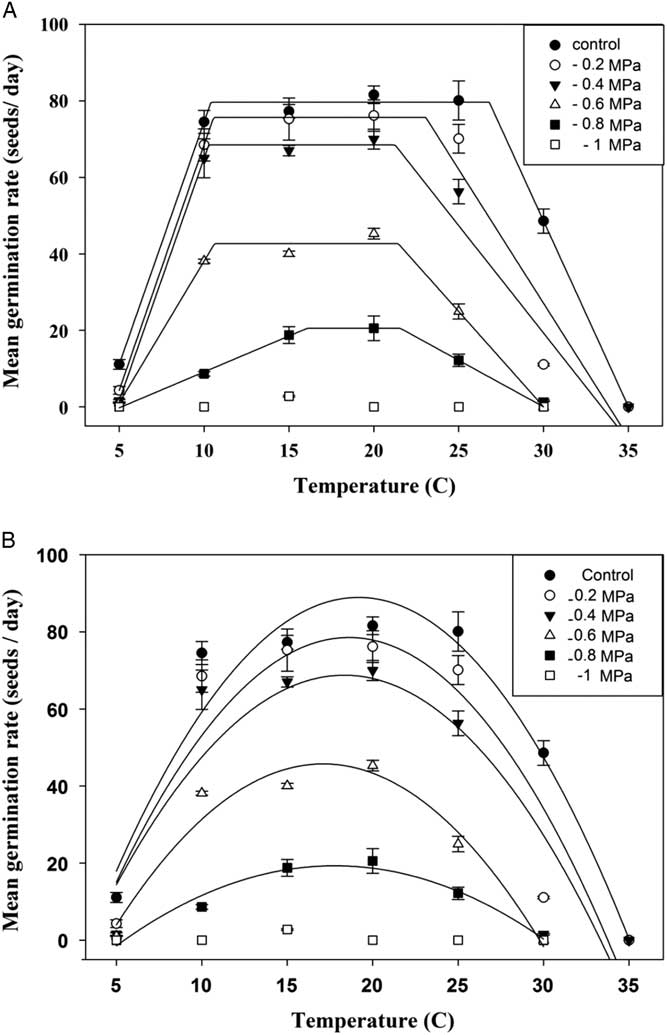
Dent-like and quadratic polynomial models were used to study the variation in germination rate at different water potentials (Figure 1A and B). The temperature at 20C provided the highest germination rate in all treatments; increasing the temperature up to 20C increased the germination rate, while there was a decreasing trend at temperatures higher than 20C. Increasing the osmotic potential of drought simulation decreased the rate of germination. In the –1 MPa treatment, germination was only observed at 15C (Figure 1A and B).
The changes of seed germination rate of flax-leaf alyssum (Alyssum linifolium) versus temperature at various water potential levels (MPa) for (A) dent-like model and (B) quadratic polynomial model. The experiment was conducted at the Weed Science Laboratory of the Ferdowsi University of Mashhad, Mashhad, Iran, in 2016. Each mean was calculated from eight replications. Vertical bars represent standard error (±SE). It was impossible to fit a curve for the −1 MPa water potential level, because the seed germination rate was zero at almost all temperatures.

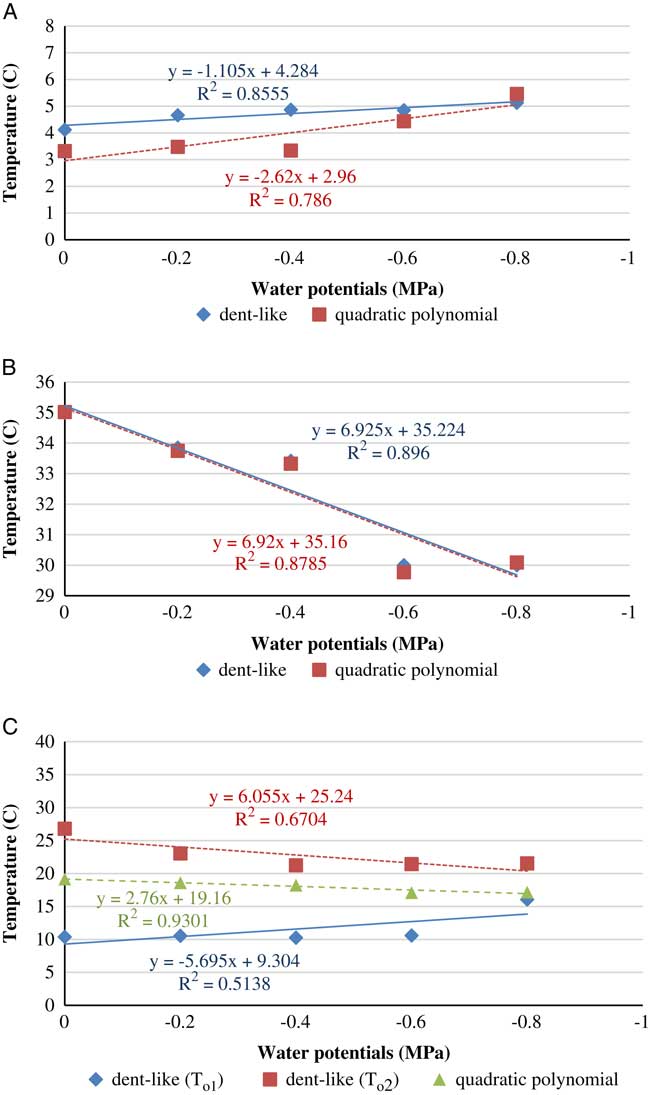
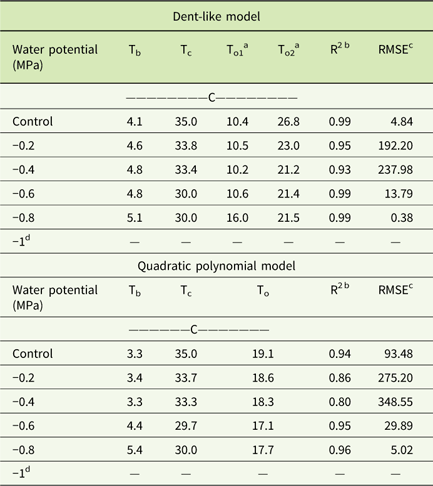
The minimum, optimum, and ceiling temperatures under different water potentials for the dent-like and quadratic polynomial models are shown in Table 1. Based on results obtained for the germination of A. linifolium in control treatments, the minimum, optimum, and ceiling temperatures in the dent-like model were 4.1 (upper=26.8, lower=10.0) and 35C, and in the quadratic polynomial model were 3.3, 19.1, and 35.0C, respectively. Increasing the water potential increased the minimum temperature, while optimum and ceiling temperatures decreased (Table 1; Figure 2). Figure 2 provides the results of the effects of water potentials on minimum, optimum, and ceiling temperatures. The minimum temperature response curve in response to drought stress treatments showed an increasing trend, rising from 4.1C in the dent-like model and 3.3C in the quadratic polynomial model to 5.1 and 46.5C, respectively. The optimum and ceiling temperatures were affected by different water potentials and showed a decreasing trend, being reduced by approximately 3 and 4C, respectively (Figure 2). Atashi et al. (Reference Atashi, Bakhshandeh, Zeinali, Yassari and Teixeira da Silva2014) reported 7.2, 28.9, and 40.1C as the minimum, optimum, and ceiling temperatures, respectively, for common balm (Melissa officinalis L.). Mesgaran et al. (Reference Mesgaran, Madani, Hashemi and Azadi2017a) claimed that the optimum temperature decreased proportionally with decreasing water potential. Wang et al. (Reference Wang, Bai and Tanino2005) showed that increasing available water causes a linear decrease in base temperature, which agrees with the findings of this research.
The effect of different levels of water potential (MPa) on the (A) estimated minimum (Tb), (B) ceiling (Tc), and (C) optimum (To) temperatures of flax-leaf alyssum (Alyssum linifolium) seed germination, according to different models. The experiment was conducted at the Weed Science Laboratory of the Ferdowsi University of Mashhad, Mashhad, Iran, in 2016. To1 and To2 are lower and upper optimum temperatures in dent-like model. Each mean was calculated from eight replications.

Estimation of minimum (Tb), optimum (To), and ceiling (Tc) temperatures of flax-leaf alyssum (Alyssum linifolium) seed germination at different levels of water potential using dent-like and quadratic polynomial models.

a To1 and To2 are lower and upper optimum temperatures in the dent-like model.
b Coefficient of determination.
c Root mean-square error.
d The cardinal temperature was not measurable.
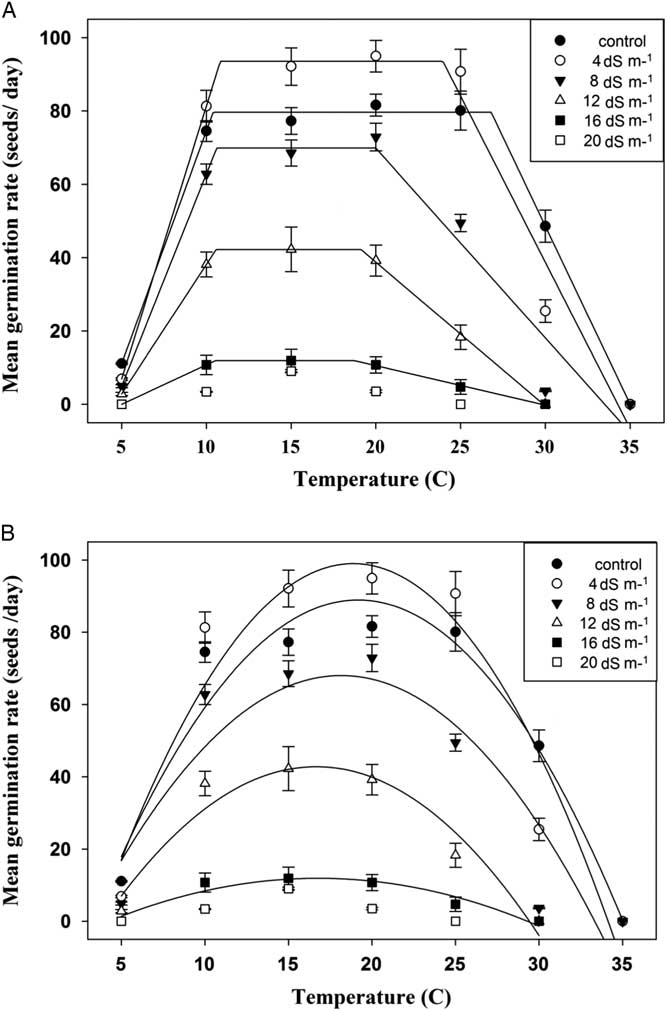
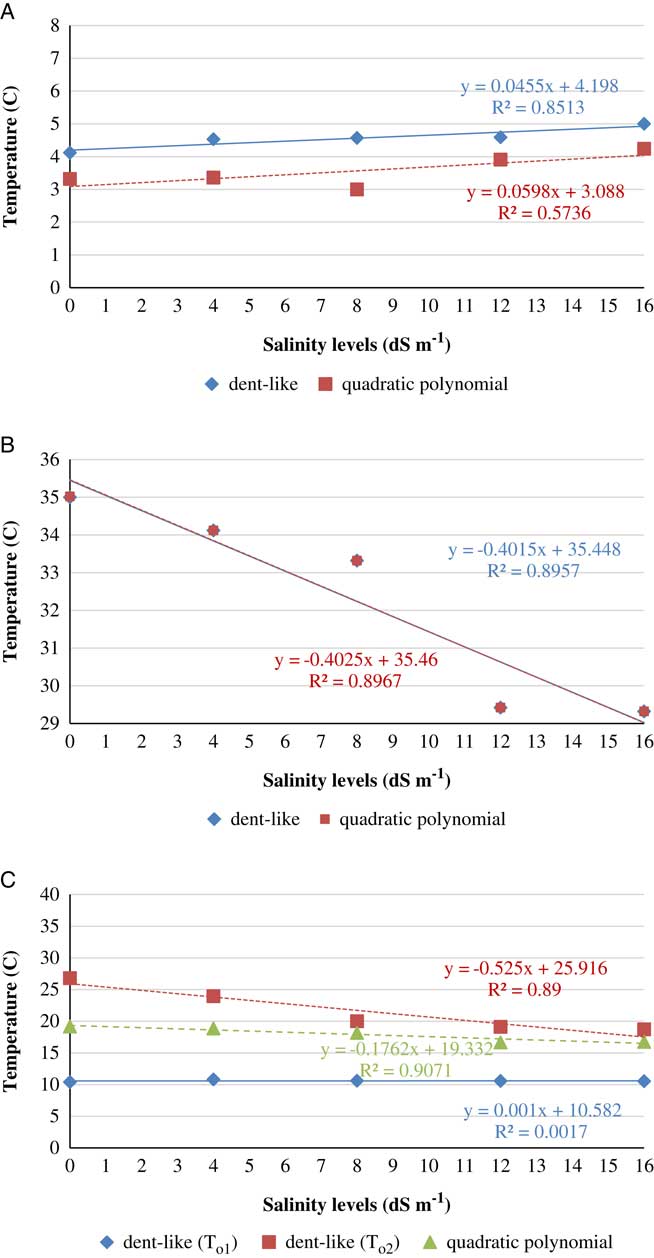
Cardinal temperatures for germination of A. linifolium, under different levels of salinity stress were determined using the dent-like and quadratic polynomial models. With increasing salinity, the rate of germination decreases. In the treatment at 20 dS m−1, seeds had the ability to germinate; however, the germination rate sharply decreased compared with treatments at all other temperatures. The greatest germination rate occurred in the control and 20C treatments (Figure 3A and B).
The changes of seed germination rate of flax-leaf alyssum (Alyssum linifolium) versus temperature at various salinity levels (dS m−1) for (A) dent-like model and (B) quadratic polynomial model. The experiment was conducted at the Weed Science Laboratory of the Ferdowsi University of Mashhad, Mashhad, Iran, in 2016. Each mean was calculated from eight replications. Vertical bars represent standard error (±SE). It was impossible to fit a curve for the 20 dS m−1 salinity level, because the seed germination rate was zero in some temperatures.

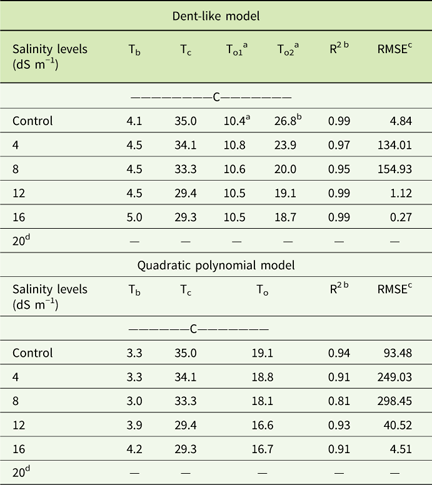
The results show that salinity stress causes the minimum seed germination temperature to increase, so that under nonstress conditions, the base temperature was estimated as 4.1C using a dent-like model and as 3.3C using a quadratic polynomial model. When salinity was increased to 16 dS m−1, the minimum temperature for these two models reached 5.1C and 5.4C, respectively. Likewise, ceiling temperatures decreased by 5C based on the estimations of the two models, with the same trend for the optimum temperatures. The ceiling seed germination temperature in the quadratic polynomial model, in the control treatment, was estimated as 35.0C, which decreased to 29.3C when salinity levels were raised. In the dent-like model, the optimum temperature in the control treatment was estimated to be 10.4 (lower) and 26.8 (upper) C, which was reduced to 10.5 (lower) and 18.7 (upper) C at higher salinity levels (Table 2; Figure 4). Singh et al. (Reference Singh, Ramries, Sharma and Jhala2012) found that tall morningglory [Ipomoea purpurea (L). Roth.] germination is reduced at higher NaCl concentrations and ceases at and above 250 mM (22.85 dS m−1). The reduced germination could be explained by the reduction of soil water potential due to dissolved salts and by the toxicity of some solutes on the living seed parts (Prado et al. Reference Prado, Boero, Gallardo and Gonzalez2000; Garg Reference Garg2010).
The effect of different levels of salinity on the (A) estimated minimum (Tb), (B) ceiling (Tc), and (C) optimum (To) temperatures of flax-leaf alyssum (Alyssum linifolium) seed germination, according to different models. The experiment was conducted at the Weed Science Laboratory of the Ferdowsi University of Mashhad, Mashhad, Iran, in 2016. To1 and To2 are lower and upper optimum temperatures in the dent-like model. Each mean was calculated from eight replications.

Estimation of minimum (Tb), optimum (To), and ceiling (Tc) temperatures of flax-leaf alyssum (Alyssum linifolium) seed germination at different levels of salinity using dent-like and quadratic polynomial models.

a To1 and To2 are lower and upper optimum temperatures in the dent-like model.
b Coefficient of determination.
c Root mean-square error.
d The cardinal temperature was not measurable.
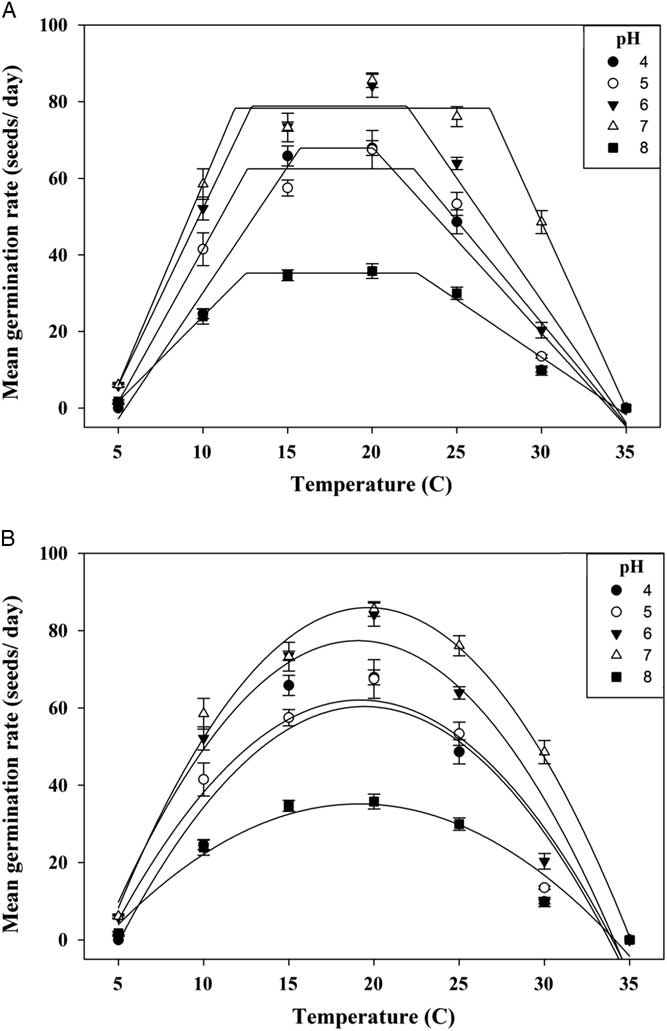
When studying the changes in germination rate at different pH values using dent-like and quadratic polynomial models, a pH of 7 and a temperature of 20C produced the highest germination rates. Increasing the pH from a neutral to alkaline condition significantly decreased germination rate, which halted at pH 9. Reducing pH values decreased the germination rate, which reached a minimum at pH 4 and ceased at pH 3 (Figure 5A and B).
The changes in seed germination rate of flax-leaf alyssum (Alyssum linifolium) versus temperature at various pH levels (4−8) for (A) dent-like model and (B) quadratic polynomial model. The experiment was conducted at the Weed Science Laboratory of the Ferdowsi University of Mashhad, Mashhad, Iran, in 2016. Each mean was calculated from eight replications. Vertical bars represent standard error (±SE).

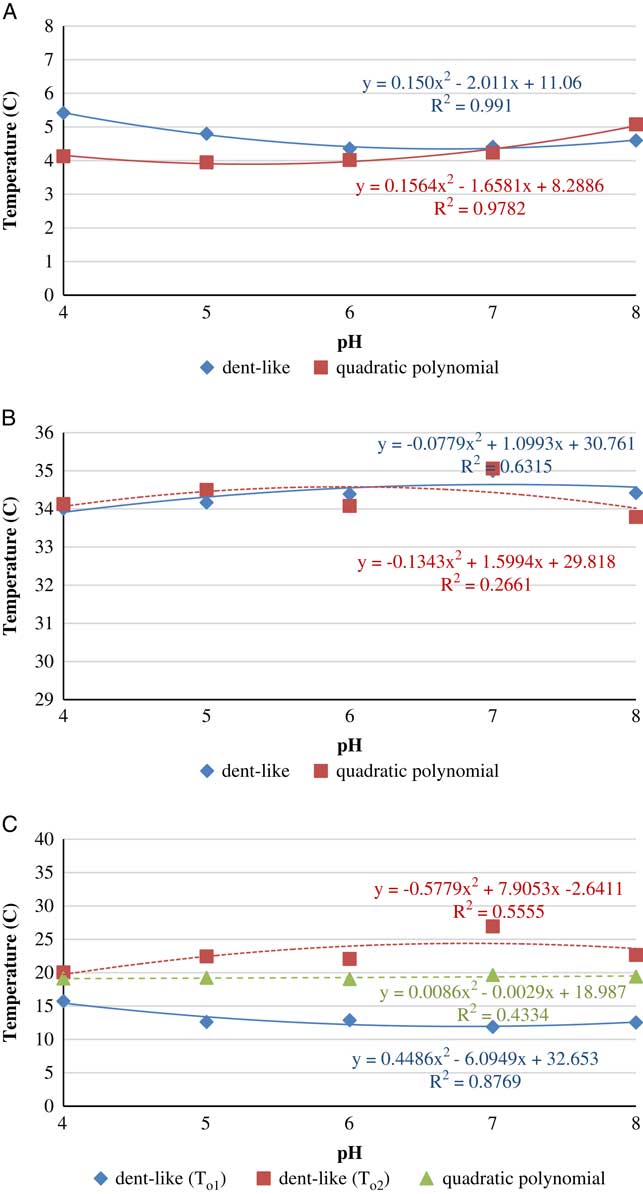
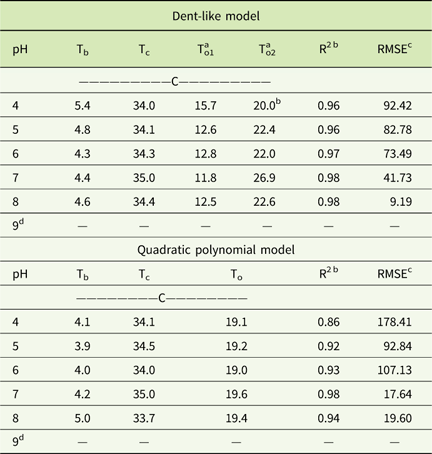
The minimum, optimum, and ceiling temperatures under different pH values for the culture medium for the dent-like and quadratic polynomial models are shown in Table 3. According to the results, the minimum, optimum, and ceiling temperatures for the germination of this weed at pH 7, were 4.41 (12.8=lower, 26.9=upper) and 35C in the dent-like model and 4.2, 19.6, and 35.0C for the quadratic polynomial model. When acidity is increased, the estimated minimum temperature for the two models increases and vice versa, reaching 5.4C at pH 4. In both models, the optimum and ceiling temperatures were highest at pH 7, and increasing the pH of the culture medium to 8 resulted in a reduction in the optimum and ceiling temperatures (Table 3; Figure 6). Laghmouchi et al. (Reference Laghmouchi, Belmehdi, Bouyahya, Senhaji and Abrini2017) reported the optimum germination temperature and pH for Origanum compactum Benth. as 15C and pH 7, respectively. They also argued that germination halts at pH 3.5 or lower. Cantaloupe (Cucumis melo L. subsp. Agrestis) is adaptable to a wide range of pH values, yet its germination rate tends to be higher at pH 5, compared with alkali pH values. The minimum, optimum, and ceiling temperatures for the germination of this plant have been reported as 20, 35, and 45C, respectively (Sohrabi et al. Reference Sohrabi, Ghanbari, Rasehd Mohassel, Gherekhloo and Vidal2016). Vleeshouwers et al. (Reference Vleeshouwers, Bouwmeester and Karssen1995) stated that acidic pH values might have direct influence over the germination of some fungal species by dissolving the seed coat. Acidic pH values also indirectly affect germination by inducing the fungi to pierce the seed coat.
The effect of different pH levels on the (A) estimated minimum (Tb), (B) ceiling (Tc), and (C) optimum (To) temperatures of flax-leaf alyssum (Alyssum linifolium) seed germination, according to different models. The experiment was conducted at the Weed Science Laboratory of the Ferdowsi University of Mashhad, Mashhad, Iran, in 2016. To1 and To2 are lower and upper optimum temperatures in the dent-like model. Each mean was calculated from eight replications.

Estimation of minimum (Tb), optimum (To), and ceiling (Tc) temperatures of flax-leaf alyssum (Alyssum linifolium) seed germination at different pH values using the dent-like and quadratic polynomial models.

a To1 and To2 are lower and upper optimum temperatures in the dent-like model.
b Coefficient of determination.
c Root mean-square error.
d The cardinal temperature was not measurable.
In this research, nonlinear regression models (dent-like and quadratic polynomial) were used to predict the cardinal temperatures of A. linifolium subjected to different levels of drought and salinity stress and pH of culture medium. In all tests, the dent-like model showed a better fit (greater R2 and lower RMSE) than the quadratic polynomial model. Any particular model used depends on a plant’s germination pattern. For example, Parmoon et al. (Reference Parmoon, Moosavi, Akbari and Ebadi2015) introduced the beta model as the best model for determining the cardinal temperature of blessed milkthistle [Silybum marianum (L.) Gaertn.]. The results of this study indicate that A. linifolium seeds do not tolerate high temperatures. The seeds stopped germinating at 35C. Salt and drought stress reduced seed germination, but the seeds had the ability to germinate up to 20 dS m−1 and −1 MPa, respectively, after which germination rate and percentage significantly decreased. At each cardinal temperature, seeds were subjected to environmental stresses. Contrary to expectations, the maximum temperature for germination decreased and the minimum temperature for germination increased with increased salt and drought stresses, thereby reducing the range of temperatures at which seed could germinate. Seeds had the ability to germinate in a wide range of pH values, but they did not tolerate a pH greater than 8. Higher temperatures provided better conditions for germination and also improved A. linifolium seedlings’ tolerance to environmental stresses. Temperature accelerated germination rate, which is very necessary for the establishment of seeds under environmental stress. Germination increased up to 20C and decreased as the temperature increased beyond that point.
To provide appropriate weed management solutions, gaining information on seed dormancy, germination patterns, and the effects of changes to environmental conditions (especially temperature) is very important, in particular in those areas where primary weed migration takes place through seeds. According to the results of this experiment, application of mulch and no-tillage systems may delay the emergence of weeds due to the potential of those approaches to reduce soil temperatures, thus improving the conditions for crop growth. However, further investigation is required to find best nonchemical control strategies. In addition, in developing countries like Iran, herbicides are currently the major option for weed management. Overreliance on herbicides has led to the emergence of many herbicide-resistant weed populations across the world (Gherekhloo et al. Reference Gherekhloo, Oveisi, Zand and De Prado2016). The results presented here provide information on the possibility of reducing the infestation of A. linifolium by appropriate nonchemical options that could be evolved through future research in line with these observations. Providing such information for managing farms and pastures can be beneficial in AgriDSS.
Acknowledgments
This research was based upon financial support from Ferdowsi University of Mashhad, Mashhad, Iran. No conflicts of interest have been declared.