On 28 March 2001, an indigenous woman from Chiapas stood before the Mexican Congress for the first time in Mexican history. She was there to present something of the realities of life for indigenous women in Chiapas that had led many of them to join the Zapatista Army of National Liberation. There, occupying the ‘symbolic platform’ of address to the nation, Comandanta Esther spoke of the contempt and marginalization such women suffer in their own communities and within the larger Mexican society:
as girls, they do not think we are worth anything. We do not know how to think, or work, how to live our lives. That is why many of us women are illiterate, because we did not have the opportunity to go to school. And then, when we are a bit older, our fathers force us to marry. It does not matter if we do not want to. They do not ask for our consent. They abuse our decisions. As women, they beat us; we are mistreated by our own husbands or relatives. We cannot say anything, because they tell us we do not have a right to defend ourselves. The mestizos and the wealthy mock us indigenous women because of our way of dressing, of speaking, our language, our way of praying and of curing, and for our color, which is the color of the earth we work.Footnote 1
Comandanta Esther has been hailed in scholarly and activist circles as the first indigenous woman to address the nation in such a public forum, not only for that precedent, but also because of its intervention into the politics of visibility for indigenous women within the Mexican national imaginary, where a century of official mestizaje (racial mixture as a defining characteristic of Mexican national subjecthood) has simultaneously produced a discursive erasure of indigenous peoples.Footnote 2 Marisa Belausteguigoitia has argued that throughout Mexican history, indigenous people in general and indigenous women in particular have had to choose between being seen and being heard; but before the Zapatista movement brought them to international attention, rarely if ever were they afforded the opportunity to enjoy both at the same time. Belausteguigoitia traces the evolution of what she calls un sujeto femenino indígena (a feminine indigenous subject) from the figure of Malinche (Cortes's mistress and translator, forced to speak forever through history with a forked tongue), through the 1997 massacre in Acteal Chiapas, whose victims were mostly women and children (their bodies spectacularized in martyrdom), to Comandanta Esther's 2001 live address to the state. Through this genealogy, Belaustegouigoitia argues that
[b]ody and tongue together, reclaiming access to modernity, citizenship and the nation, and furthermore speaking with a broken tongue and a body too full of signs of difference – gender and brownness in unison – constitute an excess that citizenship and its representation of ‘lo mexicano’ cannot digest.Footnote 3
But more than a decade before Esther's appearance before the national Congress, two Mayan women from Chiapas – Petrona de la Cruz Cruz (Tzotzil) and Isabel Juárez Espinosa (Tzeltal) – were already giving flesh and voice to these realities from another locus of enunciation – the stage.
The two actresses, who received their start with the San Cristóbal-based Mayan cultural collective Sna Jtz'ibajom (House of the Writer), had been working since 1988 to stage plays that preserved and promoted local culture in Mayan communities.Footnote 4 Frustrated in their efforts to centralize Mayan women's concerns in these plays, the two women formed the FOMMA collective in 1994. It may be a coincidence of timing that FOMMA formed in the same year as the Zapatista uprising, given that the organization does not formally ally itself to overt political causes, but it is worth remembering that the 1994 uprising and subsequent movement have called attention to the negative effects of neoliberalism in Mexico on indigenous communities in general and indigenous women in particular, which provides both context and subtext for most of FOMMA's work.
FOMMA, an acronym for the Spanish ‘Strength (or Empowerment) of the Mayan Woman’, is also based in the urban centre of San Cristóbal de las Casas, Chiapas, and involves itself in a number of enterprises designed to better the material circumstances facing indigenous women throughout Chiapas. Among these activities are literacy workshops, job training, day care for the women's children, and theatre, in Spanish and indigenous languages. Since their beginnings, the two women have worked with a core of six to eight other members (women come and go, depending on their other commitments), and have created a dozen plays that tour throughout local communities (often presented in that community's native tongue) as well as throughout the hemisphere through national and international circuits of theatre festivals and academic symposia. Such opportunities are facilitated through their international connections with such organizations as the Ford Foundation, the US-based Maya Educational Foundation, and the Hemispheric Institute of Performance and Politics.Footnote 5 In 2007, they formed the first Centro Hemisférico in Latin America as a collaborative arrangement with the Hemispheric Institute of Performance and Politics; the Centro sponsors special events designed to bring more visibility to indigenous performance throughout the Americas.
Like most of their plays, The Demon's Nun (La bruja monja, 2003) was developed collectively and based on the lived experiences of FOMMA members, with the directorial assistance of New York/Colombian theatre director Doris Difarnecio and final script development by de la Cruz Cruz and Espinosa; like most of their plays, this one concerns itself with politics on the personal and familial level; and like most of their plays, these issues are tacitly tied to larger matters of indigenous and gender equity in Mexico, which the play exposes without necessarily offering much in the way of a resolution, as if to suggest the intractability of these issues. Finally, like many of their offerings, The Demon's Nun is humorously presented, with de la Cruz Cruz and Espinosa playing all parts, including roles where they are cross-dressed as men, which is the understated source of much of the comedy. As a result, this play pokes gentle fun at the institutions, both familial and institutional, that overly determine indigenous women's choices within Mexico, while pointing to the darker realities these forces represent.
In this play, Domitila is a woman married (possibly without having had much say in the matter) to the alcoholic Elias, who claims they have never had sex. Her interests are directed elsewhere, to the santitos or the statues of little saints that adorn the domestic altar and upon whom she lavishes her attentions; she also is shown to have a semi-erotic dream about an angel whom she looks on ‘as if in love’.Footnote 6 Both she and Elias take their frustrations to the Catholic Church, with little result for Elias, and disaster for Domitila. For his part, Elias turns to an evangelical church, a growing phenomenon in indigenous communities throughout Mexico, as such churches often offer support in ending the pervasive alcoholism that plagues indigenous communities (where Catholic traditions and rituals often feature alcohol as part and parcel of their practice).Footnote 7 Newly sober, Elias chooses to abandon Domitila; he is fed up with her rejection as well as her devotion to her saints, a devotion that has led her also to neglect her personal hygiene and appearance (and which he claims has all the neighbours talking about her being a bruja, or witch). In desperation, without a viable means of support (a common occurrence for women abandoned by their husbands for other women, or for migratory work), Domitila turns to the Catholic priest who has been giving her reading lessons from the Bible.
Seeking sanctuary in the convent, it is not long before the amorous priest attempts to rape her and, at her resistance, ends up expelling her: ‘Nothing happened here. If you say anything about this, watch out. When they ask you “why are you leaving?” tell them it's your decision!’Footnote 8 This is the last we see of her, but we do learn, through a flashforward, of her fate. Two masked characters enter the scene, describing, as might a messenger in a Greek tragedy telling of offstage violence, what has happened to Domitila in the intervening years. The characters represent her now grown twin sons, borne to a man she met after returning to an empty house from the convent:
- pepito:
Even the mattress was taken by that scumbag Elias. He left behind only her saints. But then, when she started drinking heavily, she had to pawn her saints to buy alcohol. My mamá was a regular at the cantina run by the man who's my father. When he met her . . . he showed her respect, took care of her, and fell in love with her. They got married.
. . .
- pepito:
Our parents taught us to work the land . . .
- pedrito:
. . . to take care of it . . .
- pepito:
. . . and more than anything else, to respect it . . .
- pedrito:
. . . and not gossip . . .Footnote 9
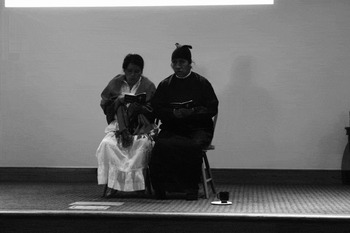
Isabel Júarez Espinosa (left) as Domitila and Petrona de la Cruz Cruz as Father Benjamin, sharing a reading lesson in The Demon's Nun, performed at UCLA on 21 November 2008. (Photo Courtesy of the UCLA Center for Performance Studies.)

Although the ending is more in line with a comedy than with a tragedy – Domitila finds security and respect within a traditional marriage, and the land, with which indigenous women have always been identified, is invoked as a grounding for indigenous identity and dignity – one is left wondering about her actual happiness. She has lost much: her sobriety, her place in her original community, her beloved saints, probably her faith in the religion that brought them to her, and her autonomy. As Taylor puts it in the introduction to the published play,
Alcoholism and family – announced almost in the same breath – are the afterthought, the postscript to a life gone wrong. While their audiences laugh at the characters and enjoy the acting, especially the constant cross-dressing, the play points to a dearth of options for native women.Footnote 10
In the uneasy laughter produced by this uneasy ending, audiences are asked to reflect critically on these matters. Inhabiting them in the flesh, giving voice to them, enacting them before publics both local and international – even absenting the main character at the key moment of the play's ‘resolution’ – FOMMA also enacts the evanescent indigenous female subject in Mexico. It may not be, in the Boalian sense, a rehearsal for the revolution that is taking place elsewhere in Zapatista-identified communities throughout Mexico, but it is an unmistakable embodiment of representational power that tells a necessary story fuelling those other, larger aims.