Women were severely underrepresented in Singapore's early politics. From 1970 to 1984, not a single female member was found in the Parliament. Unlike the experiences of Taiwan and South Korea in this issue, the ruling People's Action Party (PAP) of Singapore faced no similar pressure from the opposition parties or feminist groups to adopt gender quotas to “fast track” women into politics (Dahlerup and Freidenvall Reference Dahlerup and Freidenvall2005). Yet, the total number of women candidates increased from 0 in 1980 to 32 by 2011. And women's legislative representation reached a high of 23% after the 2011 general election.
What explains the rise of Singaporean women politicians in the last decade? Here, I present three explanatory factors. First, I contend that the PAP's declining popularity and political expedience led to the adoption of a party quota, which doubled the number of women candidates in subsequent elections. Second, I show how Singapore's unique electoral system also contains incentives for political parties to stand more women candidates in the larger multimember constituencies. Finally, based on public opinion data from the World Values Survey, I argue that the presence of more women politicians has improved the credibility and electability of women candidates in recent elections. However, parties still need to do more in developing both quota and non-quota strategies to foster gender equity norms and practices and to encourage more women to come forward.
WHY NO GENDER QUOTA?
Studies usually identify pressures from women's groups, contagion effects from the left-wing parties, strategic elite calculations, or international diffusion norms as explanatory factors for gender quota adoption (Caul Reference Caul2001; Krook Reference Krook2009). Having been in power for more than five decades, the PAP has faced no electoral pressures from the opposition or feminist groups to address the stark absence of women in politics. In fact, it has consistently rejected the option of legislating gender quotas at the national level. Yet, an ethnic quota was introduced in 1988 to ensure the legislative representation of ethnic minorities (Tan Reference Tan2014). The divergent treatment of the two groups suggests that the PAP was not a women-friendly party. The biases were clear given that ethnic minorities already enjoy an average of 23% legislative seat share from 1968 to 1988, mirroring that of the national population. Women who constituted less than 5% of all candidates and legislators for the same period received no similar provision.
The official reason for rejecting gender quotas stemmed from the concern with undermining women's credibility and the belief that Singaporean women have the equality of opportunity and resources to win office. For example, Prime Minister Lee Hsien Loong insists that “we have no affirmative action or quota system here in any field of endeavour ... [s]o, Singaporeans know that women who occupy senior positions are there on their own merits and they can become role models for younger ones” (2009). But paradoxically, these concerns do not apply to the ethnic minorities.
In reality, ideology is more likely the reason for Singapore's quota nonadoption. The PAP is a socially conservative party that promotes pro-family policies based on the patriarchal view of the man as the head of the family and woman as the family's caregiver (Doran and Jose Reference Doran and Jose2002; Haque Reference Haque2000). Some of their infamous pro-family policies include a 30% university admission quotaFootnote 1 that curbed the number of women medical students in the national medical school for 25 years and gave unequal citizenship rights and medical benefits to men and women.Footnote 2 These patriarchal policies were endorsed by former PAP leaders such as Lee Kuan Yew, who said “we shouldn't get our women into jobs where they cannot, at the same time be mothers … ” (Lee Reference Lee1983). Likewise, his successor, Goh Chok Tong, also believed that “[A]sian society has always held the man responsible for the child he fathered. He is the primary provider, not his wife” (Goh Reference Goh1993).
ADOPTING PARTY QUOTA OUT OF POLITICAL EXPEDIENCE
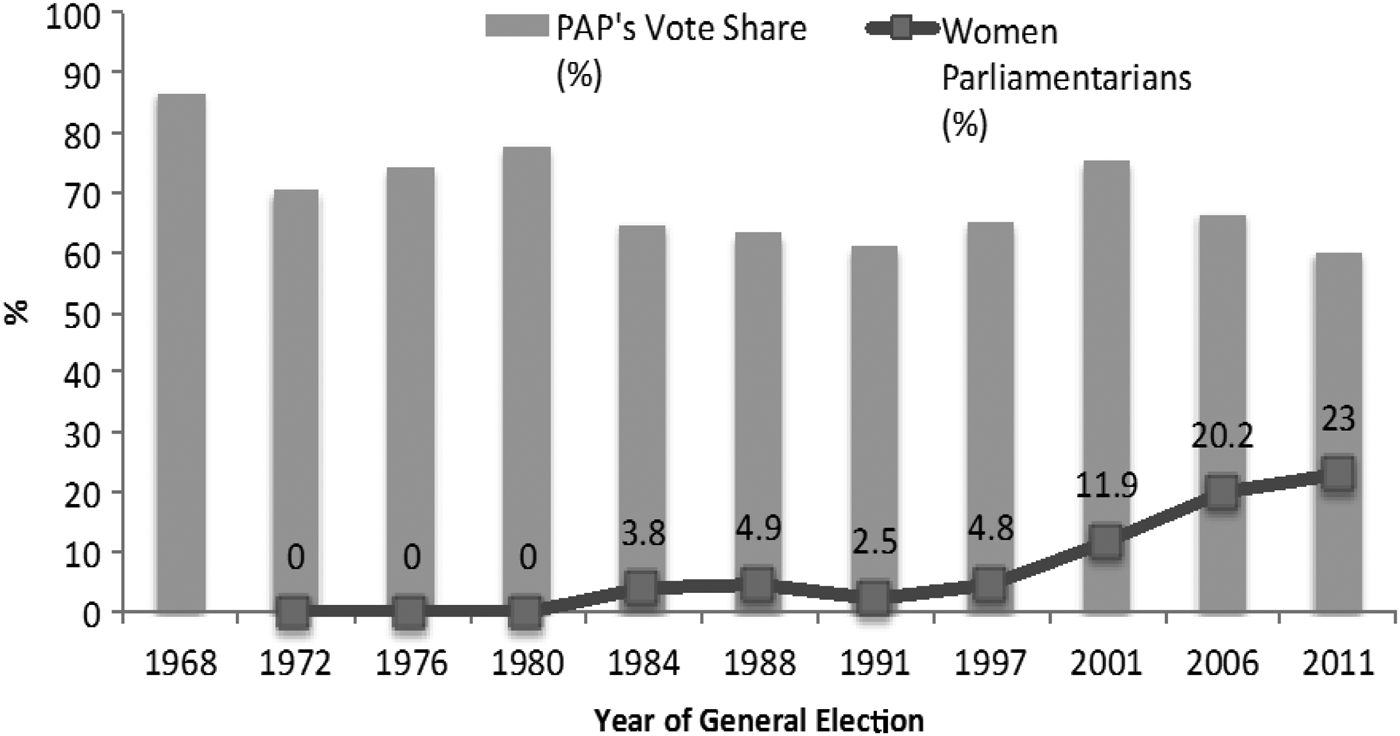
Given the PAP's longstanding patriarchal ideology and exclusion of women from politics, the voluntary adoption of a party quota in 2009 to ensure women are on the candidate list is especially puzzling. I contend that the policy U-turn and decision to adopt a party quota was a strategic calculation by party elites to court younger voters so as to stem its sliding vote share. As Figure 1 shows, the PAP's vote shares have been on a downward trend since 2001.
PAP's vote share and women's legislative representation.

A widening income gap and rising social inequalities have fueled disaffection toward the PAP, widely perceived to be too arrogant and detached from the common people. Faced with its declining popularity and a younger electorate, the PAP was in need of an image makeover. As one PAP leader said, “These younger Singaporeans, born after independence, now form the majority of our population. The political leadership must, therefore rejuvenate itself with the infusion of younger men and women who are able to connect and empathise with them” (Wong Reference Wong2004). Having more women on its party platform was a strategic calculation to make the party look more progressive, inclusive, and appealing to younger voters.
Consequently, in 2009, the PAP's Women's Wing chairperson proclaimed to “aim for a 30% share, or around 25 MPs in today's terms” in a party forum (Koh Reference Koh2009). This declaration is tantamount to a party quota to ensure that a certain proportion of women are on its candidate list (see Dahlerup Reference Dahlerup2009). Critics may dismiss this as a token gesture, as the party quota is not legally binding or formally written into the party constitution. However, I argue that the announcement is both symbolic and significant. In fact, accommodations have been made, albeit very slowly, to be more gender sensitive in candidate selection and policy formulations. The changes were especially visible under Lee Hsien Loong's leadership. Unlike his predecessors, Lee sees the strategic importance of women in politics: as he says, they “give a different perspective” and are more “forward-looking because women have children and they think for their children into the next generation” (Lee Reference Lee2009).
The behavioral and policy changes were first evident when the admission quota for female medical students was lifted in 2003 after 25 years. By 2005, medical benefits for male and female civil servants were equalized, and overseas-born children of Singaporean females were allowed to assume citizenship. In the 2006 general elections, a bumper crop of 17 PAP women candidates was nominated and elected into office. Other signs of concessions were the appointment of Lim Hwee Hua as the first woman cabinet minister in Singapore in 2009 and the selection of Halimah Yacob as the first woman Speaker of the House—making her one of the 41 female speakers in the world (14.8%) (IPU 2014).
CENTRALIZED CANDIDATE SELECTION
Singapore's experience exemplifies how political will is necessary to change the practical and normative institutions that regulate women's political life (Krook Reference Krook2009). While the party quota is not binding, the PAP altered candidate selection criteria and included more women in its candidate lists. Similar to trends in Latin America and other parts of the world, the PAP's centralized and institutionalized candidate selection methods facilitate the selection process (Hinojosa Reference Hinojosa2012; Matland and Studlar Reference Matland and Studlar1996).
The PAP does not hold primary elections to select its candidates. Instead, the party leader and a committee of senior party cadres who are also cabinet ministers have sole jurisdiction to determine the candidate list. Based nominally on the concept of meritocracy, potential nominees would undergo a series of “tea sessions” or meetings with the selection committee before being confirmed as a candidate. This centralized selection process suggests that the selection committee has the full autonomy to balance the candidate list without interference from other interest groups and can mediate any biases.
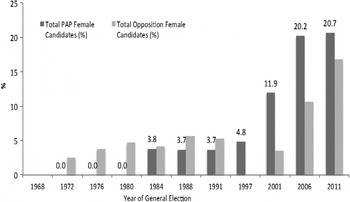
The sudden jump in the number of PAP woman candidates in 2006 and 2011 elections reflects how political will and party autonomy matters. In the 2006 elections, the PAP nominated an unprecedented number of 7 new women (29%) out of 24 candidates. All 17 PAP women candidates (20% of the total 87 candidates) were elected into office. In the following 2011 election, 18 PAP women were nominated, and 16 were elected. Thus far, the PAP shows a better record in standing women candidates than the opposition parties. As Figure 2 shows, the PAP has an average of 20% women candidates, five points more than the total number fielded by the opposition parties in the last two elections.
Total female PAP and opposition candidates (1968–2011).

The PAP is only one of seven key parties to have voluntarily committed to a quota. Yet, its decision to stand more women candidates already has a direct impact on women's overall legislative representation. This is primarily because Singapore has a hegemonic party system whereby the PAP enjoys a legislative supermajority and the opposition parties cannot compete with it in equal terms (Sartori Reference Sartori2005, 204). The PAP's hegemony means that it is the key gatekeeper and that its candidate selection is the “choice before the choice” that determines the legislative composition (Caul Reference Caul1999; Rahat Reference Rahat2007). Hence, for Singapore to achieve a critical mass of 30% women parliamentarians, the onus will be on the PAP to do more in recruiting, training, and nominating women in future elections.
LARGER MULTIMEMBER CONSTITUENCIES, MORE CONDUCIVE FOR WOMEN
In 1988, an ethnic quota was introduced that altered Singapore's electoral system to include both a single-member and multiseat plurality party bloc vote system. In the multimember or group representative constituency (GRC), a voter has to cast her vote for a team of four to six candidates with at least one ethnic minority member. The winning party with a plurality of votes takes all the seats in the GRC. Now, there are 12 single-member constituencies (SMCs) and 15 GRCs of four to six members, making up a total 87 elected seats in Parliament. Singapore's multiseat plurality party bloc-voting electoral system is conducive for standing women candidates in the multimember constituencies. Elsewhere, I have argued that the chances for nominating and electing women are higher in the multimember than in the SMCs (Tan Reference Tan2014). And larger multimember constituencies offer more “safe seats” for women candidates and improve their electability.
I contend that the GRCs work like a closed-list proportional representative system, which allows parties to include both ethnic minorities and women candidates to appeal to a wider range of voters (Matland and Studlar Reference Matland and Studlar1996; Norris Reference Norris1985). As we know, closed-list PR systems are typically more conducive than open-list systems in promoting women's representation because they mute any cultural bias against women, as voters have no choice in the selection of candidates but have to vote for a party (Moser and Scheiner Reference Moser and Scheiner2012, 211). This phenomenon is also evident in Singapore's GRCs.
The risk-averse PAP avoided standing women in the SMCs. When Singapore was under the single member plurality system from 1970 to 1984, only a handful of women, mostly from the opposition parties, contested. While it experimented with three women contesting in SMCs in 1984, the loss of a single seat by a senior woman candidate in the 1991 election shocked the PAP elites so much that no woman was fielded in the SMCs for 20 years. The creation of larger GRCs offers the parties the opportunity to balance their tickets and improve women's electability.
Standing in a GRC as a PAP candidate is a safe route to the Parliament. The GRCs are typically led by heavyweight cabinet ministers, who offer “safe seats” and allow inexperienced candidates to ride on their coattails. It is important to note that the PAP has not lost any multimember seats since the GRC scheme was introduced in 1988—until the 2011 election. As the sizes of the GRCs grew over time (from groups of three in 1988 to groups of four to six by 1997), more “safe seats” were available for women. Indeed when the number and sizes of the GRCs grew from 14 groups of four to six members to 15 groups of four to six members by 2011, the number of PAP women candidates also increased. The larger GRCs allow the parties to stand more than one woman. For example, the 2011 election saw three of the PAP's five-member teams with two women candidates in each team (Tanjong Pagar, Marine Parade, and Aljunied). The availability of more and larger GRCs offers the parties to stand more women and improve their electability.
CHANGING MASS ATTITUDES AND CRITICAL WOMEN ACTORS
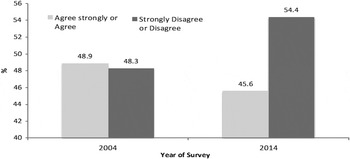
Singapore has not met the target of 30% women in Parliament. However, the increased presence of women politicians since 2001 has arguably improved public opinion of women's role in politics. Survey data show that Singaporeans' attitude toward women politicians has improved in the last decade. Based on the two waves of the World Values Survey (WVS) conducted in 2004 and 2014, the accumulated positive responses to the statement that “Men Make Better Political Leaders Than Women Do” have declined for Singapore (World Values Survey 2014). (See Figure 3.)
Accumulated responses to the statement, “Men Make Better Political Leaders Than Women Do” in Singapore, 2004 and 2014.

In contrast, the total percentage of responses that “strongly disagree” or “disagree” has risen from 48.3% in 2004 to 54.4% 2014. The increased negative responses suggest that there is a wider acceptance of women as politicians. Observed increased media coverage on women's work and their electoral performance in the last two elections may have contributed to the changing attitudes toward women as being unsuitable for politics. Clearly, a more systematic study will be necessary to confirm the correlation between the media coverage of women politicians and public opinion.
On the whole, women politicians have performed well. While women constituted only 20% in Parliament from May 2006 to March 2009, they were responsible for filing more than 42% of all the questions asked in the House (Lee Reference Lee2009). Electorally, in the SMCs contested by women in the 2011 general elections, women candidates have also performed better, earning, on average, five percentage points higher than their 17 male counterparts. In this election, a total of 32 women (18.8%) out of 170 candidates contested—ten more from the previous election. And one PAP woman, Dr. Amy Khor, won by a large margin and was the party's best performing candidate. Khor's achievement was significant, as it dispelled the myth that women are nonelectable in SMCs. In addition, opposition women candidates, such as Nicole Seah, also received extensive media coverage, outshining her male counterparts. In 2013, the sizeable win by another opposition woman candidate against her male PAP challenger in a by-election also showed that party identification, rather than gender, matters. Even without a critical mass, the achievements of these few critical women actors have helped to bring about attitudinal and behavioural changes (Childs and Krook Reference Childs and Lena Krook2006).
STILL MISSING IN HIGHER PLACES
In Singapore, women are still noticeably absent in higher politics. Presently, there is only one woman out of 18 ministers in Singapore's cabinet (5.5%). This is far lower than Japan's cabinet, where seven women were recently appointed to the cabinet (38.8%). Women are also missing at the PAP's highest party organization. In the PAP's Central Executive Committee formed in 2013, women constituted only 16.1%. In contrast, the opposition parties are better in placing women in leadership positions, as both the Worker's Party and National Solidarity Party are led by a woman. Additionally, these parties also have a combined average of 33% women in their central executive committees. This means the PAP has more catching up to do in promoting women within the party ranks.
In 18 chambers around the world where party quotas are used, women have gained around 28% of seats (IPU 2014). In Singapore, the total 25.3% of legislative representatives of both elected and nonelected women still lags below the global average. Politics aside, Singaporean women are also missing in the corporate world, taking up only 8.3% of directorship in the boards of companies.Footnote 3 The lack of women in the boardroom and higher political offices shows that they have not overcome all the sociocultural barriers to work and participate in politics. As two women, including Singapore's first female cabinet minister, lost in the last 2011 elections, more needs to be done to improve the supply of women to compete in the next election.
NON-QUOTA STRATEGIES
In the political front, parties need to invest more effort in recruiting, training, and nominating women as candidates. To address the lack of women in the boardrooms, a National Diversity Task Force was formed to study and offer a range of non-quota strategies to improve gender diversity for companies in Singapore. Some recommendations include (1) having government and corporate leaders to emphasize the importance of gender diversity; (2) creating a network of prominent business leaders to be public advocates of gender diversity and to set corporate targets; (3) introducing training programs for female directors; (4) using gender diversity as a criteria to evaluate corporate governance; (5) publishing research on the best practices to promote gender diversity; (6) formalizing search and nomination processes for board appointments (review process if short-listed candidates do not include females); and (7) creating programs to help qualified women assume senior management positions (BoardAgender 2013).
Surely, these non-quota strategies can be modified and used by parties to encourage women to join politics and contest in elections. To start, a similar national task force ought to be introduced to encourage gender equity in politics. Yet, the PAP government has not done so. Partisanship may be a reason keeping it from introducing equivalent national initiatives for women. Worries of increased electoral competition and opposition parties' “free-riding” on state-funded research may be holding the government back. Unlike the resource-poor opposition parties, the PAP has relied on its incumbency advantage to recruit women horizontally from the business, academic, and public service sectors. To scout for younger women, the PAP Women's Wing has accessed local universities to co-opt outstanding female undergraduates to its party's networking activities. Additionally, a mentorship program has been created to pair young women members with senior female politicians. Long-term incumbency has given the PAP a leg up in talent hunting. Opposition parties would need to be more innovative and learn and develop both quota and non-quota strategies to improve the supply of women candidates.
CONCLUSION
This essay has argued that political expedience explains why a socially conservative party like the PAP would adopt a party quota to address gender inequity in politics. Singapore shows that even without legislating candidate quotas, a party quota can be both symbolic and significant in raising the number of women politicians, especially given its hegemonic party system. Additionally, Singapore's unique electoral system also offers incentives for parties to stand more women and improve their electability in the larger multimember constituencies. Similar to the effects seen in closed-PR list system, its multiseat plurality party bloc vote system is also conducive to women.
Despite these institutional incentives, women are still missing in the higher political office. While positive media coverage and women's electoral performance have improved public attitudes toward women politicians, more work lies ahead. Sociocultural barriers and work-family balance issues have yet to be satisfactorily resolved. Parties still need to do more to recruit, train, and nominate women to contest. Developing both quota and non-quota strategies would be necessary to promote more gender equitable norms and to encourage more women to come forward.