Surgical site infections (SSIs) represent 20% of healthcare-associated infections; they are the primary contributor to costs of healthcare-associated infections.Reference Klevens, Edwards and Richards 1 , Reference Zimlichman, Henderson and Tamir 2 The treatment cost and length of stay of a patient with an SSI is, on average, twice that of a patient without an SSI.Reference Broex, van Asselt, Bruggeman and van Tiel 3 , Reference Shepard, Ward and Milstone 4
Depending on risk index category, SSIs occur in4%–26% of organ transplant procedures. 5 In liver transplantation, SSIs occur in 11%–20% of procedures, increase 1-year graft loss, and add an average of $131,000 in excess hospital charges.Reference Edwards, Peterson and Mu 6 , Reference Hollenbeak, Alfrey and Souba 7 In simultaneous pancreas–kidney (SPK) transplantation, SSI rates range from 30% to 46%.Reference Smets, van der Pijl, van Dissel, Ringers, de Fijter and Lemkes 8 , Reference Perdiz, Furtado, Linhares, Gonzalez, Pestana and Medeiros 9 Survival rates in pancreas transplantation are lowest, at nearly 45%, when SSIs with portal-hepatic drainage are present.Reference Reddy, Stratta, Shokouh-Amiri, Alloway, Egidi and Gaber 10 SSIs in kidney transplantation occur in 7.5% of procedures and increase graft loss and mortality.Reference Menezes, Wey, Peres, Medina-Pestana and Camargo 11 , Reference Lynch, Ranney, Shijie, Lee, Samala and Englesbe 12 In bile duct, liver, and pancreatic surgery, combined SSI rates range from 8% to 13% and increase hospital readmission.Reference Bratzler, Dellinger and Olsen 13 , Reference Ceppa, Pitt and House 14
In many surgical services, standard infection control measures are effective to reduce SSI rates. In addition, a combination of infection control and antibiotic stewardship interventions can improve patient outcomes.Reference Frenette, Sperlea, Tesolin, Patterson and Thirion 15 However, few studies have evaluated infection control bundles and antimicrobial stewardship in hepatobiliary surgery and liver, kidney, pancreas, and SPK transplantation. We describe here a long-term retrospective follow-up study of SSI rates following hepatobiliary surgery and liver, kidney, pancreas, and SPK transplantation after a serial infection control and antimicrobial stewardship intervention.
METHODS
Design and Setting
This quasi-experimental study to determine the impact of a serial infection control and antimicrobial stewardship intervention on SSIs was conducted in a tertiary-care public teaching institution with 1,081 beds.
Participants
All patients ≥18 years old undergoing elective or urgent hepatobiliary surgery or liver, kidney, pancreas, and SPK transplantation from January 2010 to December 2014 were included.
Outcome
The primary outcome was to determine the impact of the intervention on overall SSI rates in hepatobiliary surgery and liver, kidney, pancreas, and SPK transplantation. The secondary outcome was to determine the impact of the intervention on organ-space, deep incisional, and superficial incisional SSI rates. The impact of an antimicrobial stewardship intervention on global conformity to the 2013 internal antimicrobial prophylaxis guidelines was also evaluated.
Intervention
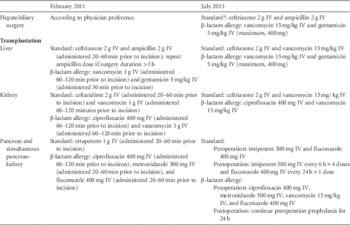
Infection control prior to intervention included the following measures: hair removal at the surgical site, preoperative shower and skin antisepsis, operating room ventilation, surgical team hand washing and sterile clothing, sterile operating room and equipment, and antimicrobial prophylaxis. Annual feedback to surgeons began in June 2011. The medical director of the infection prevention and control department and a nursing consultant reported individual SSI rates to each surgeon annually along with overall SSI rates for each type of procedure, and they presented recommendations to decrease these rates. For transplantation procedures, culture of Belzer fluid and prolonged administration of antibiotics if culture was positive with significant pathogens began in January 2011. Patient showers the night before and morning of surgery with 4% chlorhexidine sponges had already been implemented prior to the intervention. In January 2013, the sponges were replaced with 2% chlorhexidine-impregnated wipes applied the night before and morning of surgery. Prior to the intervention, antimicrobial prophylaxis was performed at the preference of the surgeon in the absence of a specific protocol for hepatobiliary surgery and liver, kidney, pancreas, and SPK transplantation. Changes to antimicrobial prophylaxis are summarized in Table 1. Prophylaxis recommendations for liver, kidney, pancreas, and SPK transplantation were introduced in February 2011 through preprinted orders. Vancomycin was selected because of the high rate of Enterococci resistant to β-lactams and the presence of coagulase-negative Staphylococcus infections. The changes to prophylaxis in July 2013 corresponded to the publication of internal antimicrobial prophylaxis guidelines based on general principles of the 2013 American Society of Health-System Pharmacists guidelines.Reference Bratzler, Dellinger and Olsen 13 The internal guidelines were developed in collaboration with infectious disease specialists, medical microbiologists, clinical pharmacists, and surgical teams to adapt them to local formulary practice and pathogens isolated from SSIs. These guidelines were part of a larger body of internal guidelines for the prevention of SSIs, published in July 2013, to emphasize infection control measures already present. As of January 2011, the infection prevention and control department periodically measured compliance with infection control measures in hepatobiliary surgery and liver, kidney, pancreas, and SPK transplantation. If compliance was lacking, the department intervened with feedback and recommendations to the surgical team.
Interventions on Antimicrobial Prophylaxis

NOTE. IV, intravenous.
a Cefazolin is used for high-risk cholecystectomy patients.
To determine the impact of the antimicrobial stewardship intervention on compliance with the 2013 internal antimicrobial prophylaxis guidelines, patients undergoing hepatobiliary surgery or transplantation between April 2012–March 2013 and March 2014–June 2014 were included for the pre- and postintervention periods, respectively. Exclusion criteria were multiple surgeries within 48 hours, surgeries involving multiple specialities, and surgeries for which antimicrobial prophylaxis was ordered but not delivered. The antimicrobial stewardship intervention took place between June 2013 and February 2014 with the approval of the McGill University Health Center Research Ethics Board and was directed toward surgeons, anaesthesiologists, and residents. In October 2013, a pilot audit and feedback project was performed. A feedback session was then organized with heads of surgical departments, and reminders were sent to address deficiencies in prophylaxis conformity identified during the pilot audit. During January and February 2014, a second audit and feedback session was conducted. Finally, new or updated preprinted orders were created.
Data Collection
Data collected included baseline patient characteristics (ie, American Society of Anesthesiologists score, body mass index, admission and discharge date) and procedure-specific data (ie, date of surgery, type, duration, given antimicrobial prophylaxis agent, and timing of administration). Data regarding date of SSI, its wound classification, its depth, and its causative organisms were collected. For transplantation procedures, Belzer solution contamination and causative organism were obtained. Data per patient were retrieved from surgical lists, patient charts, and hospital files. An infection control nurse consultant followed all patients for at least 30 days after surgery and confirmed possible SSIs through positive wound and blood culture results, antimicrobial usage, admission to wound care clinics and the emergency room, hospital readmission, and reoperation. SSIs were classified as organ-space, deep incisional, or superficial incisional according to the National Healthcare Safety Network (NHSN) SSI criteria. 16
Data collected for the antimicrobial stewardship intervention were the same as those collected by the infection control nurse consultant for SSI rates. Weight, medication allergies, and methicillin-resistant Staphylococcus aureus (S. aureus) and vancomycin-resistant Enterococcus statuses were also obtained. Antimicrobial prophylaxis agent selection, dosage, timing, and duration of administration were collected for each patient.
Sample Size Calculation
Using G-power 3.1, a sample size of 537 surgeries for the pre- and postintervention groups were necessary to identify a 50% decrease in SSI rates, with a power of 80% and a 2-sided α of 0.05%. A total of 1,424 surgeries were included: 453 surgeries in the preintervention period and 971 in the postintervention period. Statistical analyses were performed on superficial incisional, deep incisional, and organ-space SSI rates if a sufficient sample was available to detect a 50% change in infection rate. Using the same statistical assumptions, a sample size of 102 surgeries for the pre- and postintervention groups was necessary to detect a 20% change in global prophylaxis conformity.
Statistical Analysis
Statistical Tests
For the primary and secondary outcomes, Fisher’s exact test was used to determine statistical significance between sample groups. A 2-sided α of 0.05 or a 95% confidence interval (CI) was used in all analyses. Comparison of SSI rates was performed between preintervention (January 2010–December 2011) and postintervention (January 2012–December 2014) groups. For antimicrobial prophylaxis conformity analysis, the preintervention group (April 2012–March 2013) was compared with the postintervention group (March 2014–June 2014).
Antimicrobial Prophylaxis Global Conformity Score
Global conformity to the 2013 internal antimicrobial prophylaxis guidelines was determined by attributing a weight of 25% to each criterion (ie, antimicrobial selection, dosage, timing, and duration). Surgeries with ≥3 criteria were included in the analysis to avoid the exclusion of patients and a selection bias. If a criterion was missing, the weight per criterion was changed to one-third (33%).
RESULTS
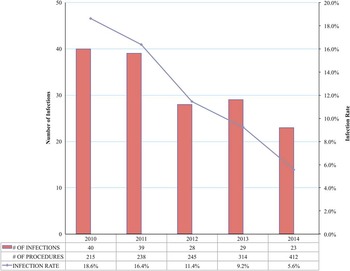
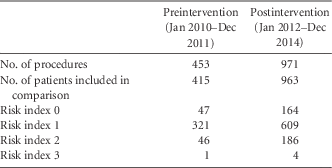
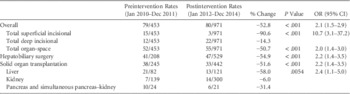
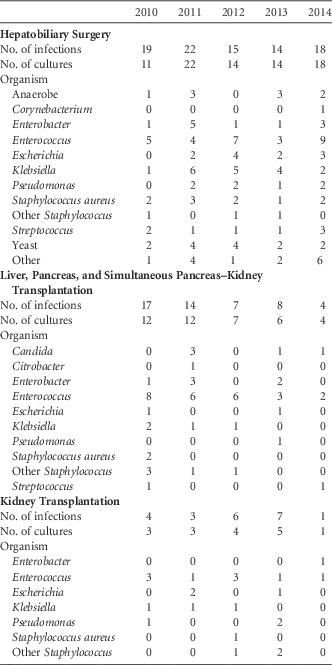
A total of 1,424 hepatobiliary surgeries and liver, kidney, pancreas, and SPK transplantations were performed between January 2010 and December 2014, with an overall SSI rate of 11.2%. Figure 1 presents annual SSI rates from 2010 through 2014. Table 2 summarizes patient risk indexes for the pre- and postintervention groups used for SSI analysis, while Table 3 summarizes SSI rate data. After the implementation of the interventions, the overall SSI rate decreased by 52.8% from 17.4% (79 of 453) to 8.2% (80 of 971) (P<.001; odds ratio [OR] 2.1; 95% CI, 1.5–2.9). A statistically significant decrease of >50% (relative rate) was observed in superficial incisional and organ-space SSI rates (P<.001). A sample size sufficient to observe statistical significance was not obtained for deep incisional SSI rates. A 54.9% decrease from 19.7% to 8.9% (P<.001; OR, 2.2; 95% CI, 1.4–3.5) and a 51.6% decrease from 15.5% to 7.5% (P=.001; OR, 2.2; 95% CI, 1.4–3.5) were observed for SSI rates in hepatobiliary surgery and solid organ transplantation, respectively. There was a statistically significant decrease of >50% (relative rate) in liver transplantations (P<.0054; OR, 2.4; 95% CI, 1.1–5.0), whereas a sufficient sample size was not obtained for group analyses in kidney, pancreas, and SPK transplantations. Yearly SSI microbiology culture results for hepatobiliary surgery and liver, kidney, pancreas, and SPK transplantations are presented in Table 4. Clostridium difficile infection (CDI) rates were measured in the surgical transplant ward dedicated primarily to hepatobiliary surgery and liver, kidney, pancreas, and SPK transplantation. The incidence remained stable with minor fluctuations throughout the study. Overall, 19 CDI cases per 10,000 patient days were reported prior to the study period and 17 CDI cases per 10,000 patient days were reported in 2014.
Annual surgical site infection (SSI) rate (%). Annual number of SSIs and infection rates for all patients undergoing hepatobiliary surgery or liver, kidney, pancreas, and simultaneous pancreas–kidney transplantations at a tertiary care institution. A serial infection control and antimicrobial stewardship intervention took place from 2012 through 2014.

Patient Risk Indexes for Pre- and Postintervention Surgical Site Infection Sample Groups

Impact of the Interventions on Surgical Site Infection Rates

NOTE. CI, confidence interval; OR, odds ratio.
Yearly Surgical Site Infection Microbiology Culture Results

To determine the impact of the stewardship intervention on global conformity to the 2013 internal antimicrobial prophylaxis protocol, a total of 71 surgeries were included: 24 in the preintervention group and 47 in the postintervention group. Conformity increased by 15.2% (absolute rate) from 45.1% to 60.3% (P<.003; 95% CI, 5.4–24.9); improvements were mostly observed in dosing and duration of antimicrobial prophylaxis.
DISCUSSION
In this study, we evaluated the impact of an infection control and antimicrobial stewardship intervention on SSI rates in hepatobiliary surgery and solid organ transplantation. In 2010, SSI rates averaged the NHSN’s ratesReference Edwards, Peterson and Mu 6 or were greater. Interventions were implemented between 2011 and 2013 with a global approach to decrease all SSI rates and improve patient outcomes. After the interventions, the overall SSI rate decrease by 52.8% from 17.4% to 8.2% (P<.001; OR, 2.1; 95% CI, 1.5–2.9). A statistically significant decrease of >50% (relative rate) was observed for solid organ transplantations, yet this improvement was mainly due to the decrease in the liver transplantation SSI rate. Kidney transplantations account for the majority of transplantations at this center, but a statistically significant decrease was not observed for SSI rates after the intervention. However, our rates were similar to those reported by the NHSN. For kidney transplantations, >80% of our patients had a risk index of 1. The postintervention SSI rate was 4.7%, while the NHSN SSI rates for risk indexes 0 and 1 and risk indexes 2 and 3 averaged 3.67% and 6.57%, respectively.
A limited number of studies have focused on a comprehensive infection control and antimicrobial stewardship intervention that focuses on reducing SSI rates in hepatobiliary surgery and solid organ transplantation. Few studies have evaluated the impact of individual interventions. We evaluated a bundled intervention that included antimicrobial prophylaxis, performance feedback on infection rates, use of chlorhexidine wipes, and treatment of positive Belzer fluid cultures with clinically significant pathogens. Throughout the study period, antimicrobial prophylaxis was administered for all hepatobiliary surgeries. For low-risk patients undergoing laparoscopic cholecystectomy, antimicrobial prophylaxis may not be required.Reference Choudhary, Bechtold, Puli, Othman and Roy 17 However, our results tend to demonstrate a role for antimicrobial prophylaxis, which is contrary to other observations. A randomized controlled trial demonstrated no reduction in the SSI rate in liver resection procedures.Reference Hirokawa, Hayashi and Miyamoto 18 When administered inappropriately, antimicrobial prophylaxis in hepatobiliary surgery does not improve SSI rates.Reference Ren, Bao, Niu, Wang and Ren 19 Antimicrobial prophylaxis is widely used in liver transplantation, and no studies have compared prophylaxis with no prophylaxis. The SSI rate for liver transplantation after the implementation of our program reached 10.7%, but a study that included antimicrobial prophylaxis had an SSI rate of 8.8%.Reference Asensio, Ramos and Cuervas-Mons 20 We were unable to identify recently published studies that evaluated the impact of antimicrobial prophylaxis in kidney transplantation. In a 1981 study, antimicrobial prophylaxis decreased the SSI rate from 10.1% to 1.5%.Reference Novick 21 In pancreas transplantation, SSIs occurred in 33% of procedures,Reference Everett, Wahoff and Statz 22 which is similar to our rate of 28.6%. The use of carbapenems is justified in our protocol for pancreas and SPK transplantation given the elevated rate of polymicrobial SSIs among our patients. Feedback regarding surgeon-specific SSI rates and standardization of patient management decreased SSI rates from 24.8% to 15.2% in hepatic, pancreatic, and complex biliary procedures;Reference Ceppa, Pitt and House 14 however, our SSI rates decreased from 19.7% to 8.9%.
Immunosuppression may increase the incidence of SSI in solid organ transplantation. Immunosuppressants are not independent risk factors for SSI in kidney transplantation,Reference Dantas, Kuboyama, Mazzali and Moretti 23 except for sirolimus.Reference Ramos, Asensio and Munez 24 However, changes to initial posttransplantation immunosuppression increase SSI rates.Reference Dantas, Kuboyama, Mazzali and Moretti 23 The use of mycophenolate mofetil compared to azathioprine is a risk factor for SSI rates in kidney transplantation.Reference Humar, Ramcharan, Denny, Gillingham, Payne and Matas 25 Throughout the study period, the use of immunosuppression did not vary at this center and may not have impacted SSI rates.
Belzer fluid culture and administration of antibiotics according to positive culture result with significant pathogens were introduced in January 2011. The administration of antibiotics may have had an impact in our study, as positive Belzer culture with significant pathogens has been associated with SSIs.Reference Yansouni, Dendukuri and Liu 26 No studies have evaluated the use of chlorhexidine wash or wipes in hepatobiliary surgery including solid organ transplantation. In other surgical services, their impact on SSI rates is not clear. Four percent chlorhexidine washes do not reduce SSI rates;Reference Webster and Osborne 27 however, 2% chlorhexidine wipes decrease SSI rates in hip arthroplasty.Reference Kapadia, Johnson, Daley, Issa and Mont 28 The rationale for switching from washes to wipes is that chlorhexidine skin concentrations are 13–27 times higher with 2% wipes than with 4% washes.Reference Edmiston, Krepel, Seabrook, Lewis, Brown and Towne 29
SSI rates at this center remain above NHSN and target rates. Increased rates are expected because this site is a tertiary referral center where patients have already received antimicrobials prior to surgery and are at a higher risk of being colonized and developing SSIs. Furthermore, all surgery patients are thoroughly screened by infection control nurses, which may increase reporting of SSIs.
The quasi-experimental design of this study had some limitations. It lacked randomization, blinding, and a control group, and we were unable to control for all interventions that might have had an impact on the outcomes. However, quasi-experimental designs best account for behavioural changes. A strength of this study is that all hepatobiliary surgeries and transplantations were made by the same surgical team at the same institution. Single high-dose aminoglycoside toxicity varies among surgeries.Reference Dubrovskaya, Tejada and Bosco 30 , Reference Nielsen, Fedosova, Hjortdal and Jakobsen 31 Given that aminoglycosides are used for patients allergic to β-lactams in our study, our patient sample was insufficient to detect nephrotoxicity associated with aminoglycoside prophylaxis.
In summary, a long-term, evidence-based, bundled, infection control and antimicrobial stewardship intervention reduced SSI rates in hepatobiliary surgery and liver, kidney, pancreas, and SPK transplantation. This study fills an important gap in the hepatobiliary surgery and solid organ transplantation literature.
ACKNOWLEDGMENTS
The authors would like to thank Audrey-Anne Longpré, PharmD, MSc, Rodolphe Kénol-Maurrasse, PharmD, MSc, Pierre Olivier Monast, PharmD, MSc, and Silva Vujanovic, PharmD, MSc, for their contributions on collecting data on antimicrobial prophylaxis. We would also like to thank Peter Metrakos, MD, CM, FRCS, FACS, and Prosanto Chaudhury, MD, MSc, FRCSC, FACS, for their direct contributions to improving patient care.
Financial support: No financial support was provided relevant to this article.
Potential conflicts of interest: C.F. reports that he has been a consultant to Merck Frosst Canada. D.T. reports that he has been a consultant to Merck Frosst Canada and Pendopharm and has received research funding from Merck Frosst Canada. All other authors report no conflicts of interest relevant to this article.