A QUESTION OF MAYA ORIGINS IN NORTHERN BELIZE: AN INTRODUCTION
Investigating the origins of the prehistoric Maya (Adams Reference Adams1977) and the early Maya in northern Belize has been of interest for many decades (Aebersold et al. Reference Aebersold, Valdez and Mitchell2018; Hester et al. Reference Hester, Iceland, Hudler and Shafer1996; Kelly Reference Kelly1993; MacNeish et al. Reference MacNeish, Wilkerson and Nelken-Terner1980). Recent research (Aebersold Reference Aebersold2018) has provided avenues for potential answers and inspired an increase of interest in this particular area of investigation. The identification of the earliest Maya in northern Belize remains a difficult and complex concern. Two aspects of research concerning the early Maya are: (1) their potential (Archaic) origins and (2) their (Maya) identification as seen in material culture. These two aspects are among the specific topics of interest for this article. Rather than attempting a historical reconstruction, this study follows a descriptive development, providing a perspective from research interests and findings that build to define the earliest Maya of northern Belize.
This article, as part of a Special Section, is intended to provide some context concerning early Maya activity in Belize, and northern Belize in particular. The northern Belize region is especially important for its long history of archaeological research and the identification of the presence of (pre-Maya) Archaic and early Maya activity and settlements. There is significant evidence from northern Belize that may substantiate the continuity of Archaic to Maya developments. These developments, in turn, may provide insights into the transition from semi-permanent occupation by the Archaic people to settled village life by the Maya. Although it is tempting to expand the intended parameters of this article, data and interpretations from other regions and the placement of northern Belize in the broader Maya region and Mesoamerica can be found elsewhere (Stemp et al. Reference Stemp, Awe, Marcus, Helmke and Sullivan2021; Cagnato Reference Cagnato2021; Prufer et al. Reference Prufer, Robinson and Kennett2021; Rosenswig Reference Rosenswig2021).
The appearance of pottery-producing villages across northern Belize is common by 1000 b.c. There are several locations in the region that provide evidence for earlier cultural developments, including resource procurement, semi-permanent occupation, and horticultural activity (Aebersold Reference Aebersold2018; Rosenswig Reference Rosenswig2004). The latter two aspects are in place by around 3400 b.c. (Aebersold and Valdez Reference Aebersold and Valdez2016; Iceland Reference Iceland1997). A site of great interest, for the period of 3400 b.c. as a Late Archaic component to the establishment of permanent villages around 1000 b.c., is Colha and its environs, including Cobweb Swamp. It seems that the Late Archaic people (or aceramic populations) continued occupying the area until the time of identifying the earliest Maya communities. It is the continued cultural practices of horticulture with the same crops, resource utilization of chert, and a similarity in technology that lead us to contemplate that the Late Archaic people may have been the earliest Maya. One aspect for which we lack specific data is housing. While possible Archaic platforms have been discussed by Iceland (Reference Iceland1997), and we have details of Preclassic house platforms, we remain uncertain as to the similarities and differences between Archaic and Maya house structures. Generally, we are left with the traditional attributes of defining “Maya” by the presence of ceramics and other features lacking or not, as well-defined for the Archaic populations.
CONTEXTUALIZING NORTHERN BELIZE
The biophysical environment of the northern Belize region is a contributing factor to the origins and identification of early Maya. Placing this region into an environmental context provides avenues for viewing cultural, social, and economic developments. The following observations of geography, topography, and geology provide pertinent details relevant to the discussion at hand.
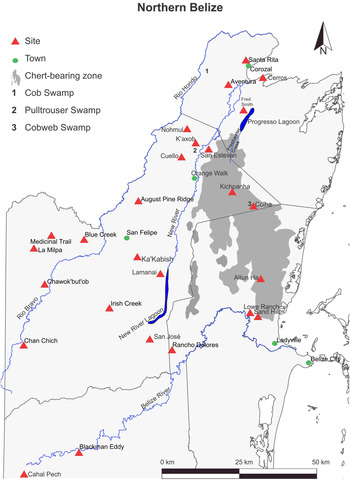
Geographically, northern Belize is the region north of the Maya mountains; however, we define the region archaeologically as the area lying north of Belize City (from Ladyville) extending west, just south of Rancho Dolores, continuing west and south to Chan Chich and to the Guatemala border. That east–west line marks the southern boundary of northern Belize that then extends north to the Rio Hondo, forming the international border with Mexico (Figure 1).
Map of northern Belize with sites mentioned in text. Map version courtesy of Aebersold.

Many small rivers and tributaries are located in northern Belize, though the significant drainages are the New River and the Rio Hondo that flow north/northeast into Chetumal Bay. For most of northern Belize, the annual rainfall is about 1,500–2,000 mm, with much of it falling between May and December (Dunning et al. Reference Dunning, Jones, Beach, Luzzadder-Beach, Scarborough, Valdez and Dunning2003). Rainfall in this region decreases as one progresses north from Belize City towards Corozal and the Mexico border, giving northern Belize a drier climate than the rest of the country.
The topography of northern Belize ranges from a coastal plain along the eastern portions to the escarpment region of the northwest area. All of northern Belize is underlain by ridges of folded and faulted Cenozoic limestone (Dunning et al. Reference Dunning, Jones, Beach, Luzzadder-Beach, Scarborough, Valdez and Dunning2003; King et al. Reference King, Baillie, Abell, Dunsmore, Gray, Pratt, Versey, Wright and Zisman1992). Northwest Belize is defined by karstic plateaus that result in rugged climbs onto the escarpments. This is manifested by haystack knolls to very rough escarpment faces, with heights reaching several hundred meters above sea level (Scarborough and Valdez Reference Scarborough, Valdez, Scarborough, Valdez and Dunning2003). The landscape is dominated by a deciduous and semi-deciduous forest of trees such as the ceiba, zapote, gumbo limbo, mahogany, and cedar, as well as various palms. As mentioned, the eastern areas of northern Belize are dominated by coastal plain as well as segments of forests and freshwater lagoons.
The geology of northern Belize played an important role in the development of this area. Along the Old Northern Highway, immediately north of Ladyville and extending north beyond Kichpanha, but short of the New River, is an area known as the chert-bearing zone, of high-quality chert (called flint by some; Hester et al. Reference Hester, Iceland, Hudler and Shafer1995, Reference Hester, Iceland, Hudler and Shafer1996; Iceland and Hester Reference Iceland, Hester, Hester, Laurencich-Minelli and Salvatori1996; Kelly Reference Kelly1993). This high quality chert resource is one of the reasons people exploited the area during Paleoindian and Archaic times, as well as through all Maya occupations.
Parts of northern Belize have zones of bleached sandy soils. Significant tracts of pine savanna are located within these sandy regions and are interspersed with comparatively restricted areas of low broadleaf forest. These pine savannas (or pine ridges) were not suitable for horticultural activity, and therefore not occupied by the prehistoric Maya. It is, however, in these sandy pine savannas that Paleoindian and early Archaic remains are often found. Thus, northern Belize saw its peopling by at least 12,000 b.c. and resource utilization through all of the Maya periods to the present day. The eastern parts of northern Belize include many small drainages, swamps, and the specialized resources located within those environments.
Environmentally, northern Belize experienced increased warmer and wetter conditions around 8500 b.c., and, as previously implied, these circumstances allowed for a tropical forest to grow across the region. By 3400 b.c., forest clearing as well as burning begins and there may be climatic regional drying (Anderson and Wahl Reference Anderson and Wahl2016; Brenner et al. Reference Brenner, Rosenmeier, Hodell and Curtis2002; Douglas et al. Reference Douglas, Brenner and Curtis2016). Similar climatic trends occur in the Peten, and along the Usumacinta areas (Anderson and Wahl Reference Anderson and Wahl2016; Solís-Castillo et al. Reference Solís-Castillo, Solleiro-Rebolledo, Sedov, Liendo, Ortiz-Pérez and López-Rivera2013; Wahl and Anderson Reference Wahl, Byrne and Anderson2014; Wahl et al. Reference Wahl, Byrne, Schreiner and Hansen2006). It is this vegetation (Islebe and Sánchez Reference Islebe and Sánchez2002; Islebe et al. Reference Islebe, Hooghiemstra, Brenner, Curtis and Hodell1996) and climate pattern (Hodell et al. Reference Hodell, Brenner, Curtis, Medina-González, Can, Albornaz-Pat and Guilderson2005, Reference Hodell, Brenner and Curtis2007) observed after 3400 b.c. that persists throughout the Maya occupation and continues to the present. It has been suggested that the chemical and physical characteristics of soil formation for an increased seasonality favoring agricultural activity is found in the warmer and wetter environment during the Archaic period (Solis-Castillo et al. Reference Solís-Castillo, Solleiro-Rebolledo, Sedov, Liendo, Ortiz-Pérez and López-Rivera2013). Related to these environmental changes is a cultural shift to more intensive strategies, including deforestation and fire regimes (Aebersold Reference Aebersold2018).
Paleoecological records show a long history of slash-and-burn horticulture connected to the earliest settlements, beginning in the Archaic and Preclassic periods (Iceland Reference Iceland1997; Jones Reference Jones1994b; Kennett and Beach Reference Kennett and Beach2013; Piperno et al. Reference Piperno, Ranere, Holst, Iraitre and Dickau2009; Pohl et al. Reference Pohl, Pope, Jones, Jacob, Piperno, de France, Lentz, Gifford, Danforth and Josserand1996; Rosenswig et al. Reference Rosenswig, Pearsall, Masson, Culleton and Kennett2014). The northern Belize region was widely and, in several areas, densely populated by the prehistoric Maya. While today significant areas are under forest, the region was prehistorically less forested, as the ancient Maya utilized and exploited the region's resources. The various environmental features discovered in the Maya region allowed for tropical forests and, by the Preclassic, open savannahs (see Brenner et al. Reference Brenner, Rosenmeier, Hodell and Curtis2002; Leyden Reference Leyden2002).
A BRIEF REVIEW OF NORTHERN BELIZE ARCHAEOLOGICAL RESEARCH
Northern Belize and the Colha area have been selected as the geographic focus of this article for two significant reasons: (1) northern Belize has been an area of much archaeological research that informs certain research interests, including the Archaic and Maya Preclassic; and (2) Colha, in particular, has produced evidence of both Archaic and early Maya activities. A review of previous archaeological research in northern Belize provides the backdrop and contextualizes the regional research interests at many locales. The earliest archaeological research in northern Belize is credited to Gann (Reference Gann1900, Reference Gann1918), with his most significant work being at the site of Santa Rita in Corozal. Gann, however, also visited many other sites in northern Belize often identified by the presence of a large trench or pit on top of the largest (or formerly tallest) structure. Colha is one of the northern Belize sites with a structure displaying a large central pit, likely the work of Gann. Other significant research interests in northern Belize were also pursued by Thompson (Reference Thompson1939; Adams et al. Reference Adams, Scarborough, Levi, Walling, Dunning, Lewis, Shaw, King, Sullivan, Reese-Taylor and Valdez2004), at San José in the 1930s, as well as his visits to various other sites, including La Milpa in northwest Belize (Adams et al. Reference Adams, Scarborough, Levi, Walling, Dunning, Lewis, Shaw, King, Sullivan, Reese-Taylor and Valdez2004).
Most of the early archaeological investigations in northern Belize began with serious efforts in the 1960s, the 1970s, and several projects extending into the 1980s. Among the significant projects were excavations at Altun Ha from 1964 to 1970 by Pendergast (Reference Pendergast1979, Reference Pendergast1982a, Reference Pendergast1982b). The Altun Ha research included data concerning the Preclassic Maya near the southern part of the chert-bearing zone. Regional interests were completed through the Corozal project, directed by Hammond (Reference Hammond1973), and an archaeological survey of northernmost Belize (Sidrys Reference Sidrys1983). Both regional programs provide valuable insights into Maya activity, and the Corozal project was especially informative concerning the earliest Maya at several sites, including Colha, Cuello, and San Estevan (Hammond Reference Hammond1973).
Site-specific programs increased in the late 1970s and 1980s. Among the earlier research programs was Cuello (Hammond Reference Hammond1991a), which would discover data related to the earliest Maya. At Cerro Maya (Friedel Reference Freidel, Stark and Voorhies1978), the significant aspect was a Preclassic focused settlement. Research at Colha (Hester Reference Hester1979; Hester et al. Reference Hester, Eaton and Shafer1980, Reference Hester, Shafer and Eaton1982, Reference Hester, Shafer and Eaton1994) was initiated with an interest in lithic production, but would quickly discover pre-Maya and very early Maya activities at the site and in neighboring areas. Lamanai (Pendergast Reference Pendergast1981), which would grow to be Belize's second largest Maya site, has an important Preclassic beginning, but is a location of a Paleoindian point (Lohse Reference Lohse2010). Nohmul (Hammond Reference Hammond1984) provided notable Preclassic data of comparative value. Pulltrouser Swamp (Turner and Harrison Reference Turner and Harrison1983) was a research program of tremendous value investigating aspects of early Maya horticultural activities along the swamp margins. Santa Rita (Chase and Chase Reference Chase and Chase1986) in northernmost Belize has an occupation that begins with the earliest Preclassic Maya. Each of these site-specific projects in northern Belize managed to identify and provide corroborative data concerning the Preclassic Maya.
Many of these same projects, Colha (Hester et al. Reference Hester, Iceland, Hudler and Shafer1996; Iceland Reference Iceland1997; Valdez and Aebersold Reference Aebersold2018), Cuello (Hammond Reference Hammond1991a; Hammond et al. Reference Hammond, Clarke and Donaghey1995), and Lamanai (Graham Reference Graham2004), as examples, continued to varying degrees through the 1990s to recent years. Other research programs were implemented as well, including Kichpanha (Gibson Reference Gibson, Hester, Shafer and Eaton1994), a site close to Colha, and produced Middle Preclassic data of valuable comparison with neighboring settlements. K'axob (McAnany Reference McAnany2004), Progresso Lagoon (Masson and Rosenswig Reference Masson, Rosenswig, Ferguson, Oland and Masson2003), San Estevan (Levi Reference Levi1993; Rosenswig Reference Rosenswig2008), Chau Hiix (Goldsmith Reference Goldsmith2005; Pyburn Reference Pyburn2005), and the Belize north coast (Mock Reference Mock1994, Reference Mock2004), all have well-documented Preclassic beginnings that indicate a well-established communication and interaction between the various northern Belize communities. Northwest Belize also saw significant research efforts, including work at the sites of La Milpa (Hammond et al. Reference Hamond, Tourtellot, Donaghey and Clarke2006; Tourtellot et al. Reference Tourtellot, Estrada-Belli, Rose, Hammond, Scarborough, Valdez and Dunning2003), Blue Creek (Guderjan Reference Guderjan2007), Chan Chich (Houk Reference Houk2016), and Punta de Cacao (Robichaux Reference Robichaux2004, Reference Robichaux2015), as well as a northwest Belize regional research effort, the Programme for Belize Archaeological Project (Scarborough et al. Reference Scarborough, Valdez and Dunning2003; Valdez Reference Valdez2007, Reference Valdez2018). The majority of sites and findings across northern Belize indicate a vibrant Maya civilization and that all of these early villages likely commenced with the Early Middle Preclassic. A resurgence of research in the last decade at sites in the northern Belize region includes Kakabish (Haines Reference Haines2008), Aventura (Robin et al. Reference Robin, Kosakowsky and Grauer2016, Reference Robin, Kosakowsky, Grauer and Nissen2018), Cuello (Fitzsimmons Reference Fitzsimmons2016; Fitzsimmons et al. Reference Fitzsimmons, Figueroa and Vankina2018), and Colha (Aebersold Reference Aebersold2018; Aebersold et al. Reference Aebersold, Valdez and Mitchell2018), and is contributing to a broader understanding of this region.
Research related directly to investigating pre-Maya remains commenced during the 1980s phase of Belize archaeology through the Belize Archaic Archaeological Reconnaissance (BAAR) Project (MacNeish Reference MacNeish1981, Reference MacNeish1982), in addition to broader research such as the Rio Hondo Project (Pohl Reference Pohl1990; Pohl et al. Reference Pohl, Pope, Jones, Jacob, Piperno, de France, Lentz, Gifford, Danforth and Josserand1996). Both programs opened up opportunities for documenting Archaic period material culture at several localities and provided radiocarbon dates validating early human activity. While details of findings are discussed elsewhere (Rosenswig Reference Rosenswig2021), these research programs were also hoping to connect Archaic and first-Maya developments.
Specifically related to the interests of this article is the research directed by Hester and the Colha-based initiatives (Aebersold Reference Aebersold2018; Aebersold et al. Reference Aebersold, Valdez and Mitchell2018; Hester et al. Reference Hester, Iceland, Hudler and Shafer1995, Reference Hester, Iceland, Hudler and Shafer1996; Iceland Reference Iceland1997; Iceland and Hester Reference Iceland, Hester, Hester, Laurencich-Minelli and Salvatori1996; Kelly Reference Kelly1993). The Colha program unearthed artifacts, particularly lithics such as bifacial points and constricted unifacial tools, that were utilized during different phases of the prehistoric past (Iceland Reference Iceland1997; Rosenswig Reference Rosenswig2021). Some of the specifics for Colha findings, including contexts, are discussed below.
The brief review of archaeological research in northern Belize, as presented above, is not intended as a comprehensive discussion. This overview is to emphasize the significant amount of research undertaken and the great value of northern Belize research to all of Belize's history and to the understanding of complex Maya society in the Eastern Lowlands, from origins to transformations.
It is archaeological projects from decades past, as well as recent investigations, that serve to inform the analysis and interpretation of how early societies may have developed in northern Belize. Various interests in and about the earliest communities in northern Belize (Iceland Reference Iceland1997; Iceland and Hester Reference Iceland, Hester, Hester, Laurencich-Minelli and Salvatori1996; Lohse Reference Lohse2010; Lohse et al. Reference Lohse, Awe, Cameron, Rosenswig and Valdez2006; Pohl et al. Reference Pohl, Pope, Jones, Jacob, Piperno, de France, Lentz, Gifford, Danforth and Josserand1996; Rosenswig Reference Rosenswig2004) are similar to the origins for settled life in other parts of the Maya world (Andrews and Robles Reference Andrews, Robles, Kathryn Brown and Bey2018; Awe and Lohse Reference Awe and Jon Lohse2007; Lohse Reference Lohse2010; Lohse et al. Reference Lohse, Awe, Cameron, Rosenswig and Valdez2006; Stemp et al. Reference Stemp, Awe, Prufer and Helmke2016) and for Mesoamerica in general (for example, MacNeish Reference MacNeish1958, Reference MacNeish1981, Reference MacNeish1982; Rosenswig Reference Rosenswig2006, Reference Rosenswig2021).
Questions surrounding the nature of the earliest communities and the first Maya in northern Belize are a significant component of this article. In addition to interests of Archaic to Preclassic developments as related to who the earliest Mya may have been, there are interests about how the earliest communities may have been structured and how they may have functioned. There have been archaeological investigations into pre-Maya and earliest Maya across northern Belize for decades (Aebersold Reference Aebersold2018; Hester et al. Reference Hester, Kelly and Ligabue1981, Reference Hester, Iceland, Hudler and Shafer1995; Iceland Reference Iceland1997; Pohl et al. Reference Pohl, Pope, Jones, Jacob, Piperno, de France, Lentz, Gifford, Danforth and Josserand1996). Again though, Colha serves as an important location because of the extensive research there (Hester et al. Reference Hester, Iceland, Hudler and Shafer1995; Iceland Reference Iceland1997), and it has a significant documented Archaic deposit found in a primary context and under Middle Preclassic debris (Iceland Reference Iceland1997; Rosenswig Reference Rosenswig2004). Several scholars (Aebersold Reference Aebersold2018; Aebersold and Valdez Reference Aebersold and Valdez2016; Hester et al. Reference Hester, Iceland, Hudler and Shafer1995; Iceland Reference Iceland1997, Reference Iceland and Powis2005; Iceland and Hester Reference Iceland, Hester, Hester, Laurencich-Minelli and Salvatori1996) have argued “that groups living by inland swamps and chert outcrops in northern Belize were the precursors to the Maya” (Iceland Reference Iceland1997, Reference Iceland and Powis2005).
NORTHERN BELIZE CHRONOLOGY
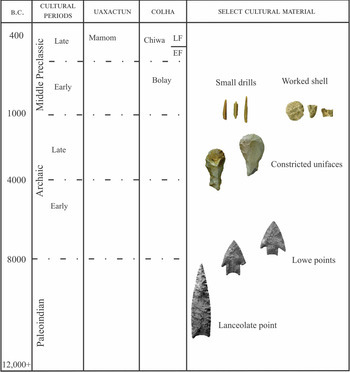
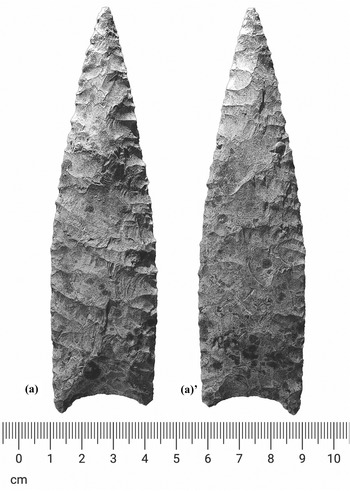
Prehistoric occupation for northern Belize begins with the Paleoindian period, possibly as early as around 15,000 b.c., and extends to approximately 8000 b.c. (Figure 2). All of the dating for various time periods is derived from previous research that included radiocarbon dating and stylistic dating, whether of stone tools or pottery (Aebersold Reference Aebersold2018; Iceland Reference Iceland1997; Lohse Reference Lohse2010; Rosenswig Reference Rosenswig2004, Reference Rosenswig2006, Reference Rosenswig2021). Evidence for Paleoindian presence or occupation in northern Belize is provided from several locations, including Ladyville, near the Goldson International Airport (Hester et al. Reference Hester, Kelly and Ligabue1981; Kelly Reference Kelly1993), the Lamanai area, and August Pine Ridge in the northwest Belize region (Awe and Lohse Reference Awe and Jon Lohse2007; Lohse Reference Lohse2005; Lohse et al. Reference Lohse, Awe, Cameron, Rosenswig and Valdez2006; Valdez and Aylesworth Reference Valdez and Aylesworth2005). Evidence for Paleoindian presence comes from four projectile points, two of them of the Clovis type or style, with one a near-complete specimen from Ladyville (Hester et al. Reference Hester, Kelly and Ligabue1981), and the second being a complete specimen from August Pine Ridge (Valdez and Aylesworth Reference Valdez and Aylesworth2005). The third Paleoindian point is an unfluted lanceolate form from August Pine Ridge (Valdez and Valdez Reference Valdez and Valdez2021; Figure 3), and the fourth point is identified as a fishtail variety, from the Lamanai area (Lohse Reference Lohse2005).
Colha chronology chart and select material culture. Image courtesy of Aebersold and Valdez.

(a) The obverse and (a') reverse of an unfluted Paleoindian point, August Pine Ridge, Belize. Photographs by Bruce Templeton. Courtesy of the PfBAP and Valdez.

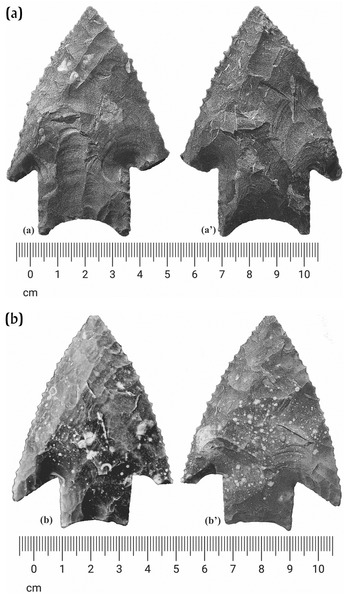
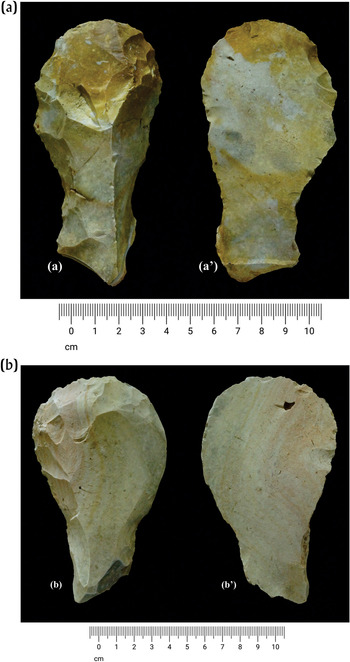
An interesting recent development has been the re-evaluation and placement of stemmed dart points of the Early Archaic as now beginning in the Paleoindian period (Prufer et al. Reference Prufer, Alsgaard, Robinson, Meredith, Culleton, Dennehy, Magee, Huckel, James Stemp, Awe, Capriles and Kennett2019). The specific point type, named Lowe (Figure 4), is known across Belize (Stemp et al. Reference Stemp, Awe, Prufer and Helmke2016). Given certain technological characteristics and good archaeological context from southern Belize, Lowe points specifically (and as mentioned above) are now considered to begin at least in the Paleoindian period (Prufer et al. Reference Prufer, Alsgaard, Robinson, Meredith, Culleton, Dennehy, Magee, Huckel, James Stemp, Awe, Capriles and Kennett2019). Unfortunately, most Lowe and related points of northern Belize are not from good contexts, but rather surface or disturbed locations. However, we argue that many of these stone tools likely overlap the Late Paleoindian and extend into the Early Archaic period—that is, not exclusively of the Paleoindian period.
Late Paleoindian to Early Archaic Lowe points of northern Belize: (a, b) the obverse and (a', b') the reverse of two example points. Photographs by Bruce Templeton. Courtesy of the PfBAP and Valdez.

The Archaic period for northern Belize dates from approximately 8000 to 1000 b.c. Evidence for Archaic occupation and settlement in northern Belize comes from a number of sites, including Sand Hill, Lowe Ranch, Colha, and August Pine Ridge, among others (Hester et al. Reference Hester, Iceland, Hudler and Shafer1996; Iceland Reference Iceland1997; Rosenswig Reference Rosenswig2021; Valdez Reference Valdez2007). The artifactual remains of Early Archaic populations include large blades and stemmed dart points sometimes referred to as Lowe or Sawmill points. Many northern Belize Lowe points in varying stages of use have been recovered from the August Pine Ridge area, but unfortunately they lack archaeological context. Late Archaic people were producing other types of chipped stone artifacts, as evidenced by the constricted uniface (Hester et al. Reference Hester, Iceland, Hudler and Shafer1996; Iceland Reference Iceland1997). Much of the material culture of the Archaic people was probably manufactured from easily resourced perishable materials, such as gourds or wood, which were also easily transportable. A fragment of a ground stone bowl, likely of Archaic date, recovered in an area west of Blue Creek, indicates that other types of artifacts were utilized by early occupants.
At Cobweb Swamp (Colha) and Cob Swamp evidence was found for the Late Archaic incipient horticulturalists, dating to about 3400 b.c. (Aebersold Reference Aebersold2018; Buttles Reference Buttles2002; Iceland Reference Iceland1997; Jacob Reference Jacob1995; Pohl et al. Reference Pohl, Pope, Jones, Jacob, Piperno, de France, Lentz, Gifford, Danforth and Josserand1996; see Cagnato Reference Cagnato2021 for a broader comment on food production during the Late Archaic in the Maya region). The pollen evidence indicates both deforestation occurring by 3400 b.c. and the presence of maize pollen. There is, however, no evidence for permanent settlement at either of these locations. This is not to say that such did not exist, but solid evidence for permanent villages/settlement has not been located for this early period. As mentioned above, the late part of the Archaic (Iceland Reference Iceland1997) produced, at several locations, a tool called the constricted uniface (Hester et al. Reference Hester, Iceland, Hudler and Shafer1996; Iceland Reference Iceland1997). This tool is thought to have functioned as a wood-working implement (Gibson Reference Gibson, Hester and Shafer1991) or a digging tool. The constricted uniface is contextually found dating closer to the period when the Maya are identified in the archaeological record, perhaps as populations were becoming more sedentary and settled (Iceland Reference Iceland1997).
New radiocarbon dates associated with Middle Preclassic ceramics and lithics at Colha indicate a possible earlier Maya settlement, towards the Early Preclassic at around 1127 b.c. (Aebersold Reference Aebersold2018). The Early Preclassic is used here as reference to a period that generally extends from 2000 to 1000 b.c., but not clearly present in the Maya Lowlands as yet. More data with good context are required for a definite claim of Early Preclassic, although there seems to be some indication that it may be present, even if at a minimal scale or perhaps as a blended component of Archaic and Preclassic. The new dating implies a shortened distance between the currently defined Archaic and Preclassic occupations at Colha. The Archaic inhabitants around Colha and northern Belize were widely engaged in wetland manipulation, as indicated by an early sequence of dates combined with clear anthropogenic impacts on the environment (Aebersold Reference Aebersold2018; Aebersold et al. Reference Aebersold, Valdez and Mitchell2018; Fedick Reference Fedick1996).
The first Maya in northern Belize are identified at about 1000 b.c. and begin the chronological period known as the Middle Preclassic. The Preclassic period is divided into two significant phases, Middle Preclassic and Late Preclassic. The Middle Preclassic dates from 1000 to 400 b.c., and the Late Preclassic dates from 400 b.c. to a.d. 250. Some researchers will overlap or separate the end of the Preclassic, from about a.d. 100 to 250, as the Terminal Preclassic, or sometimes the Protoclassic. In some scholarship, the term Formative is used rather than Preclassic. We do not engage in the semantics of these terms and will use Preclassic, although we recognize both terms interchangeably.
Maya settlements identified at 1000 b.c. represent the first villages with permanent occupation and a significant effort at horticulture. By the end of the Late Preclassic we see the implementation of agricultural intensification, including raised (or channelized) fields, as observed at Pulltrouser Swamp, Cobweb Swamp, and in northwest Belize along the Rio Bravo and Irish Creek (Beach et al. Reference Beach, Luzzadder-Beach, Dunning, Jones, Lohse, Guderjan, Bozarth, Millspaugh and Bhattacharya2009; Siemens Reference Siemens1983). Observed also by the Late Preclassic is terracing, occurring along escarpment zones and sites including Medicinal Trail, for example (Hyde et al. Reference Hyde, Walling and Valdez2019). This is the period that also introduces the many aspects of highly complex society, including monumental architecture (such as temples), increased evidence of ritual activity, and the intensification of specialization, as indicated by more uniform pottery in the Late Preclassic. Prehistoric Maya society becomes more stratified and more complex as the Preclassic period progresses.
TRANSITIONING FROM THE LATE ARCHAIC TO THE MAYA PRECLASSIC
About 8000 b.c., the Maya region generally, and northern Belize in particular, experienced increased warmer and wetter environmental conditions. These changing environments allowed a tropical forest to grow and flourish. As noted above, forest clearing and burning seems to commence by 3400 b.c. There may also be a regional climatic drying (Anderson and Wahl Reference Anderson and Wahl2016; Brenner et al. Reference Brenner, Rosenmeier, Hodell and Curtis2002; Douglas et al. Reference Douglas, Brenner and Curtis2016) by the middle of the Archaic period. Similar climatic trends occur at Lago Paixban and Lago Puerto Arturo in the Peten, as well as along the Usumacinta region (Anderson and Wahl Reference Anderson and Wahl2016; Solís-Castillo et al. Reference Solís-Castillo, Solleiro-Rebolledo, Sedov, Liendo, Ortiz-Pérez and López-Rivera2013; Wahl and Anderson Reference Wahl, Byrne and Anderson2014; Wahl et al. Reference Wahl, Byrne, Schreiner and Hansen2006).
Evidence indicates that periods of climate change occurring throughout the Archaic period had a great impact on the environmental history of the Maya Lowlands. The Archaic (or aceramic) populations adapted to these climate changes culturally, in part by the cultivation of key economic species, including maize, beans, squash, cotton, chili peppers, avocados, and cacao, among other possible cultigens (Jones Reference Jones1994a; Kennett and Beach Reference Kennett and Beach2013; Piperno and Pearsall Reference Piperno and Pearsall1998; Pohl et al. Reference Pohl, Pope, Jones, Jacob, Piperno, de France, Lentz, Gifford, Danforth and Josserand1996; Zizumbo-Villarreal et al. Reference Zizumbo-Villarreal, Flores-Silva and Marín2012). As has been discussed elsewhere (Rosenswig Reference Rosenswig2021), both climate change and cultural adaptation may explain or account for reliance on increased food production. The natural vegetation was further greatly affected by deforestation activities and swidden agricultural practices during the Archaic and throughout the Maya Preclassic. Early horticultural practices during the Archaic period are substantiated by the presence of maize pollen recovered from lake sediments and wetland peripheries across the Maya Lowlands (Jones Reference Jones1994a; Kennett et al. Reference Kennett, Piperno, Jones, Neff, Voorhies, Walsh and Culleton2010; Kennett and Beach Reference Kennett and Beach2013; Leyden Reference Leyden2002; Pohl et al. Reference Pohl, Pope, Jones, Jacob, Piperno, de France, Lentz, Gifford, Danforth and Josserand1996). Early resource exploitation is known, with Pohl and colleagues (Reference Pohl, Pope, Jones, Jacob, Piperno, de France, Lentz, Gifford, Danforth and Josserand1996) also commenting on the occurrence of maize and manioc utilization before 3000 b.c. and a mixed indigenous economy, including horticulture, trees, fish, and mammals, which has been proposed for at least a quarter of a century.
Horticultural practices may have been encouraged as a result of the positive reinforcement of controlled food production. Horticultural practices were also a likely product of the vast diversity of periphery biomes within the neotropics, including aquatic ecozones where wild species diversity is highly productive (Piperno and Pearsall Reference Piperno and Pearsall1998). The varied, resource-rich environments served the Archaic population well for hunting, fishing, and gathering, as well as small-scale horticulture (Aebersold Reference Aebersold2018; Aebersold et al. Reference Aebersold, Valdez and Mitchell2018; Smith et al. Reference Smith, Williams, Plucknett and Talbot1992).
An excellent discussion concerning the transition and some characteristics from Archaic to Preclassic can be found in Lohse (Reference Lohse2010). Lohse notes, for example, that the changes from the Archaic to the Early Middle Preclassic occurred over a brief period of time. He also repeats, as had been observed at many site-specific excavations, that the first (Maya) settlers generally cleared ground surfaces to bedrock. One of Lohse's most important comments is that the movement from Archaic to Preclassic (suggesting non-Maya to Maya) has its regional variations and not all occurred at the same time or under the same circumstances. These two points are quite significant and are reflective of human cultural adaptation strategies. While Lohse's (Reference Lohse2010) article is a valuable bevy concerning the Archaic to Preclassic in the Maya region, other details from recent research (Aebersold Reference Aebersold2018; Rosenswig Reference Rosenswig2021) may place us on more solid ground in defining the Archaic to Preclassic transition.
The beginnings of early Maya civilization are often observed in areas that include early hunter-gathers as semi-nomadic horticulturalists utilizing specialized stone tool technologies for exploiting select environments (Iceland Reference Iceland1997; Rosenswig Reference Rosenswig2006). These environments are often rich with resource advantages for Archaic and Middle Preclassic peoples, and their potential intersection. It is the identification of resource advantages that allow for a large concentration of Maya sites, with Middle Preclassic and even Archaic period components in Belize at localities that include Colha and San Estevan (in northern Belize), where a long-standing Archaic tradition continues into the Maya cultural and chronological sequence (Aebersold Reference Aebersold2018; Aebersold et al. Reference Aebersold, Valdez and Mitchell2018; Lohse Reference Lohse2010; Rosenswig et al. Reference Rosenswig, Pearsall, Masson, Culleton and Kennett2014)—a pattern that likely exists across the Maya area (Stemp et al. Reference Stemp, Awe, Marcus, Helmke and Sullivan2021). Another strong line of evidence supporting the proposed continuation of Archaic practices into Maya communities is the domestication of various plants and animals. The Late Archaic transitional period is known for deforestation, horticultural innovation (and later agricultural practices), changes in fire regimes, soil erosion, and concurrent climatic drying in the area (Aebersold et al. Reference Aebersold, Krause, Mitchell, Beach and Luzzadder-Beach2017; Beach et al. Reference Beach, Dunning, Luzzadder-Beach, Cook and Lohse2006, Reference Beach, Luzzadder-Beach, Dunning, Jones, Lohse, Guderjan, Bozarth, Millspaugh and Bhattacharya2009, Reference Beach, Luzzadder-Beach, Cook, Dunning, Kennett, Krause, Terry, Trein and Valdez2015a, Reference Beach, Luzzadder-Beach, Krause, Walling, Dunning, Flood, Guderjan and Valdez2015b).
The persistence of Archaic traditions and technologies into the Maya Preclassic in northern Belize, as seen at Colha, and other Belize regions (Stanchly Reference Stanchly, Awe and Healy1995; Wing and Scudder Reference Wing, Scudder and Norman1991), may be indicated by wild plant and animal exploitation. Evidence of complex food-processing, such as grinding, parching, and boiling, supports the use of important cultigens, first introduced and exploited during the Archaic period. There is also early evidence for economic fibrous materials such as cotton, which likely served as a significant contribution to early village life at Colha (Aebersold Reference Aebersold2018; Aebersold et al. Reference Aebersold, Valdez and Mitchell2018).
Research from paleobotanical, sedimentological, and archaeological findings at Colha has allowed for a slight refinement of the Archaic transition period to the Maya Preclassic. Critical for the transition from the Archaic into the Maya Preclassic is the transfer of knowledge. This includes knowledge and an understanding of what resources are available, when they are available, and how to best utilize those resources. Many of the resources, however, were new adaptations, and other knowledge gained over time certainly affected how some resources were acquired and utilized by Archaic and then Maya communities.
EARLY COMMUNITIES OF NORTHERN BELIZE
We start here by defining “communities” as a social group (or social groups) holding common interests. This is a broad definition, but seems applicable given the kinds of political organization found among hunter-gatherers and early complex societies. Early communities likely served to define social identity and provided a venue for the definition of (cultural) membership.
The earliest communities in northern Belize, therefore, would have been the Paleoindian bands for whom we have very limited evidence. The significant material evidence for Paleoindian activity, as previously noted, consists of a fluted Clovis point from Ladyville (Hester et al. Reference Hester, Kelly and Ligabue1981); a small Clovis point with a slight fishtail look (Valdez and Aylesworth Reference Valdez and Aylesworth2005) and a long lanceolate-form point with minor thinning flakes removed at its base, rather than the “traditional fluting” (Valdez and Valdez Reference Valdez and Valdez2021), both from August Pine Ridge; and a Paleoindian point from the Lamanai area (Lohse et al. Reference Lohse, Awe, Cameron, Rosenswig and Valdez2006).
The evidence for the Paleoindian (perhaps ca. 15,000–8000 b.c.) to Early Archaic (8000–4000 b.c.) for northern Belize is more robust, with numerous locations providing Lowe and related lithic tools. These tools may signify a transition that likely begins in Late Paleoindian and extends through the Early Archaic (ca. 12,000–4000 b.c.) as environments changed and required different adaptative strategies. In any case, these early populations were migrating bands exploiting available resources. While the evidence of early people in northern Belize is clear, no sites or artifacts of the general period have been found in good archaeological contexts. Among the lithics encountered for this Early Archaic phase are bifacial points (Figure 4), as well as unifacial tools and blades. Interestingly, neighboring regions report this early period as scarce, but represented also by lithics, including unifacial tools and blades (Andrews and Robles Reference Andrews, Robles, Kathryn Brown and Bey2018; MacNeish Reference MacNeish1958; Shafer et al. Reference Shafer, Hester, Kelly, Hester, Eaton and Shafer1980).
The Late Archaic (4000–1200 b.c.) communities are well-represented in northern Belize. Some of the known Archaic sites include Cob Swamp, Cobweb Swamp, Fred Smith, Progresso Lagoon, San Estevan, and the Blue Creek rejollada (Aebersold Reference Aebersold2018; Aebersold et al. Reference Aebersold, Beach, Luzzadder-Beach and Guderjan2015, Reference Aebersold, Beach, Luzzadder-Beach, Guderjan, Valdez, Aebersold and Krause2016; Rosenswig Reference Rosenswig2021). Details for several of the sites (in northern Belize) not discussed in detail here are provided by Rosenswig (Reference Rosenswig2021), and relevant data for sites outside of northern Belize are presented in other research (Stemp et al. Reference Stemp, Awe, Marcus, Helmke and Sullivan2021; Prufer et al. Reference Prufer, Robinson and Kennett2021).
The Blue Creek rejollada may have served as an early location utilized for the cultivation of select economic species by semi-nomadic hunter-gatherers in the Archaic (Aebersold Reference Aebersold2018). With the significant cultigens utilized across Mesoamerica during the Archaic, the rejollada would have been an ideal location for activities of cultivation. These Late Archaic localities provide varied material culture, as well as evidence for horticultural activities, but still seem to be communities of mobile or semi-mobile people.
Given the resource opportunities at many of these Late Archaic locations, it seems quite likely that these communities may have been able to remain at one location for longer periods, as compared to their Early Archaic ancestors (Iceland Reference Iceland1997, Reference Iceland and Powis2005). The Colha-Cobweb Swamp area may have the greatest potential thus far for exemplifying the Archaic-to-Maya transition (Aebersold and Valdez Reference Aebersold and Valdez2016; Aebersold et al. Reference Aebersold, Valdez and Mitchell2018; Iceland Reference Iceland and Powis2005). Just as in other periods, various developments of the Archaic did not occur in a vacuum, and each defined phase should be recognized as building on previous knowledge and new (physical and social) environmental adaptations. The great similarity in material culture and a general move towards horticulture across much of Mesoamerica, and the Maya region in particular, indicates broad communication, including knowledge transfer, and adaptation by many communities. While horticultural activities and the move to domestication may have begun at various times, the best evidence for these developments seems to center around 3400 b.c. The material culture of this Late Archaic period is matched regionally and beyond by chert tools for forest clearing, related, perhaps, to an adaptation that incorporates agricultural cropping (Iceland Reference Iceland1997, Reference Iceland and Powis2005; Rosenswig Reference Rosenswig2004, Reference Rosenswig2006; Sullivan et al. Reference Sullivan, Hyde, Robertson, Buttles and Valdez2018).
The valuable and plentiful chert resource in northern Belize prompts the appearance of the constricted uniface (Figure 5) during the Late Archaic. This tool functions as a wood-working implement or as a digging tool for land clearing or hoeing (Gibson Reference Gibson, Hester and Shafer1991; Valdez Reference Valdez2007; Sullivan et al. Reference Sullivan, Hyde, Robertson, Buttles and Valdez2018). Three constricted unifaces were recovered from the 2017 field season at Colha (Aebersold Reference Aebersold2018). Although they were recovered from construction fill, that context had also been documented in previous research seasons. In previous excavations, several constricted unifaces and well-patinated chert tools were also recovered from an aceramic horizon (Hester et al. Reference Hester, Iceland, Hudler and Shafer1996; King Reference King2000).
Late Archaic constricted unifaces: (a, b) the obverse and (a', b') the reverse of two example constricted unifaces from northern Belize. Photographs by Bruce Templeton. Courtesy of the PfBAP and Valdez.

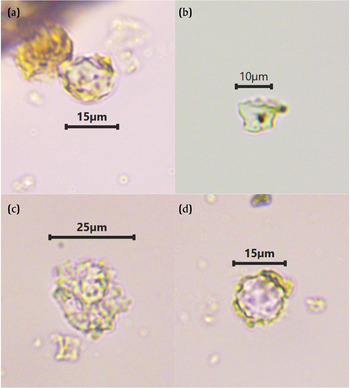
Indicators for complex food-processing and evidence for economic fibrous materials point to the use of important cultigens that were first introduced during the Archaic period. By 3400 b.c., we see a decrease in tree pollen and more disturbance of vegetation, and the presence of maize and manioc, followed by cotton and chili peppers (Jacob Reference Jacob1995; Jones Reference Jones1994b; Lentz Reference Lentz and White1999, Reference Lentz2000; Pohl et al. Reference Pohl, Pope, Jones, Jacob, Piperno, de France, Lentz, Gifford, Danforth and Josserand1996). Paleobotanical evidence for maize (Zea mays), beans (Phaseolus), squash (Cucurbita), cotton (Gossypium hirsutum), sweet potato (Ipomoea batatas), makilito (Sagittaria spp.), llerén (Calathea), yam (Dioscorea), palms, grasses, and other herbaceous taxa (Asteraceae) appear in the dental calculus of human remains excavated at Colha (Aebersold Reference Aebersold2018:216; Figure 6). Evidence for complex cooking techniques, including grinding, parching, and boiling, are indicated through the presence of starch granules. The consumption and likely use of palms, which thrive in disturbed landscapes, was also prominent in dental calculus samples (Aebersold Reference Aebersold2018). Cotton fibers also serve as examples of more complex niche construction behaviors since cotton serves multiple utilitarian purposes and has been documented in Archaic sites across the Lowlands (Jones Reference Jones1994a; Kennett et al. Reference Kennett, Piperno, Jones, Neff, Voorhies, Walsh and Culleton2010; Lohse Reference Lohse2009).
Microbotanical evidence from Colha (after Aebersold Reference Aebersold2018). (a) A scalloped Cucurbita phytolith or squash phytoliths from rinds; (b) a wavy top rondel indicative of Zea mays or maize phytoliths from cobs; (c) an irregular rhizome cylinder indicative of Calathea or arrowroot family phytoliths; and (d) a globular echinate typical of Arecaceae or palm family phytoliths.

All of the described activities of subsistence are indicative of efforts by communities as they strive to persist. Utilizing available resources, learning the direct uses of those resources, and inventing new methods of extracting more from any given item are aspects that communities experience over time. Most of the descriptions above focus on the Archaic and earlier communities. We now transition to Maya-specific communities and the adaptations accomplished as permanent settled life begins in northern Belize. There are numerous locations in northern Belize, where Middle Preclassic occupation is abundant, and many of these localities begin with the Early Middle Preclassic (ca. 1000 b.c.). Among sites with Early Middle Preclassic artifacts are Colha, Cuello, K'axob, Kakabish, Kichpanha, San Estevan, and Santa Rita, as well more general areas, including Pulltrouser Swamp, the Lamanai area, northwest Belize, Rockstone Pond (or Altun Ha), and the Progresso area. Colha will serve here as a model of an Early Middle Preclassic community, given its seemingly direct development from the Archaic.
The first evidence of settled Maya occupation at Colha, as mentioned, dates to the Early Middle Preclassic, Bolay ceramic phase (1000–600 b.c.). During this early period, Colha was probably comprised of a series of small, interactive, but dispersed households (Potter et al. Reference Potter, Valdez, Hester and Shafer1991; Valdez Reference Valdez1987). Evidence from Cobweb Swamp and the faunal assemblage indicate that the Early Middle Preclassic inhabitants utilized wetland agriculture and “garden hunting” as their means of subsistence (Jacob Reference Jacob1992; Shaw Reference Shaw1991). The majority of Early Middle Preclassic settlement data at Colha has been recovered from excavations at the site's central precinct (Aebersold Reference Aebersold2018; Anthony Reference Anthony1987; Buttles and Valdez Reference Buttles and Valdez2018; Potter Reference Potter, Hester, Shafer and Eaton1982; Sullivan Reference Sullivan1991). This permanent early occupation is represented by domestic architecture in the form of semicircular stone alignments with outer terrace alignments, which were erected directly upon the ground surface (Anthony Reference Anthony1987; Anthony and Black Reference Anthony, Black, Hester, Shafer and Eaton1994; Sullivan Reference Sullivan1991). No public architecture is attributed to this period at Colha or northern Belize in general.
Early Middle Preclassic features include postholes, interior ceramic-lined fire pits, primary middens, burials, and caches (Aebersold Reference Aebersold2018; Anthony Reference Anthony1987; Anthony and Black Reference Anthony, Black, Hester, Shafer and Eaton1994; Potter et al. Reference Potter, Hester, Black and Valdez1984; Sullivan Reference Sullivan1991; Sullivan et al. Reference Sullivan, Hyde, Robertson, Buttles and Valdez2018). Remodeling and multiple flooring episodes indicate a continued occupation for the duration of the Early Middle Preclassic.
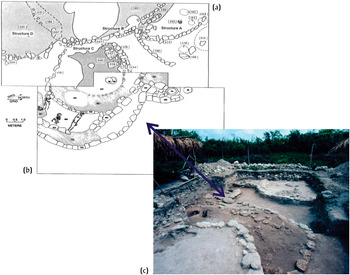
The Bolay phase architecture at Colha, its positioning on the original ground surface, and associated features are in keeping with the early deposits at other sites across northern Belize, at locations in central Belize, as well as in Guatemala, including Altar de Sacrificios, Seibal, and Nakbe (Hammond Reference Hammond1991a; Hansen Reference Hansen1991). Early Middle Preclassic architecture, thus far, is solely represented by domestic architecture (Sullivan Reference Sullivan1991; Figure 7). There may be exceptions where other architecture exists, but for northern Belize, these domestic architectural forms might be multifunctional at best, as currently understood.
Colha Main plaza (Op. 2031) Middle Preclassic structures. (a) Map from 1989 excavations, (b) map from 1983 excavations, and (c) photograph of exposed structures. Courtesy of the Colha project, Thomas R. Hester, and Valdez.

Similarities in general material culture across northern Belize are found in artifacts such as ceramics, stone tools, and shell beads, among other items. The earliest ceramic complex at Colha, the Bolay complex (ca. 1000–600 b.c.), is restricted to the Early Middle Preclassic and is currently placed in the Swasey Sphere (Sullivan et al. Reference Sullivan, Hyde, Robertson, Buttles and Valdez2018; Valdez Reference Valdez, Thomas, Harry and Jack1994). The dominant ceramic groups are the red monochromes Consejo Red and Ramgoat Red. The vessel forms for this period include tecomates, re-curving side dishes or bowls, slightly flaring-sided vessels with flat bases, and bottles (Valdez Reference Valdez, Thomas, Harry and Jack1994). These pottery attributes are commonly seen in similar phases at most sites in northern Belize.
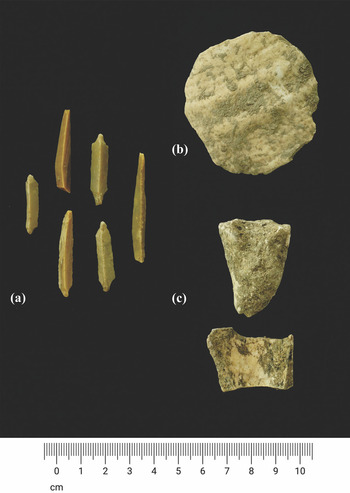
Lithic production during the Middle Preclassic was likely carried out as a cottage-level industry (Shafer and Hester Reference Shafer and Hester1983, Reference Shafer and Hester1991). Three technological sub-assemblages for this period have been suggested, based on the “Bolay” lithics from Operation 2012, blades, bifaces, and trimmed flakes/unifaces (Hester et al. Reference Hester, Shafer and Eaton1982; Potter Reference Potter, Hester and Shafer1991). Included in the early lithic production are burin spall drills that seem to be used in shell bead-making (Figure 8). Contextually, burin spall drills and other lithic drills are often found in association with shell fragments in various stages of bead production (Aebersold Reference Aebersold2018; Buttles Reference Buttles2002; Sullivan et al. Reference Sullivan, Hyde, Robertson, Buttles and Valdez2018).
Middle Preclassic Maya artifacts: (a) burin spall drills; (b) shell bead blanks; and (c) cut shell. Photographs by Bruce Templeton. Courtesy of the Colha Project and Valdez.

An indicator of a possible Early Middle Preclassic ideology (Rice Reference Rice2021) is seen in the recovery of cache deposits. The earliest evidence for the behavior of caching at Colha dates to the Bolay phase. Two caches are reported from domestic midden deposits at Operation 2012. The first comprised a Consejo Red bowl containing 97 disk shell beads, seven whole modified shell beads, and one clay bead (Potter Reference Potter, Hester, Shafer and Eaton1982). This cache represents the first use of a ceramic vessel as a cache containment unit at Colha. Two blue-green stone pendants constitute the second Early Middle Preclassic cache. The pendants were recovered from the original ground surface at the base of an Early Middle Preclassic midden (Potter Reference Potter, Hester, Shafer and Eaton1982). Early Middle Preclassic caches are also reported from the Lowland sites of Blackman Eddy, Cahal Pech, and Pacbitun (Awe Reference Awe1992; Garber Reference Garber2011; Hohmann and Powis Reference Hohmann, Powis, Healy and Awe1999). These caches are reported, however, as discrete groupings of artifacts, void of a containment unit. A similarity between the caches across Belize is the inclusion of disk shell beads (Buttles Reference Buttles2002; Hohmann and Powis Reference Hohmann, Powis, Healy and Awe1999). Items acquired through systems of trade first appear during the Bolay phase and include greenstone, obsidian, shell, and igneous and metamorphic rock. Shafer (Reference Gibson, Hester, Shafer and Eaton1994) suggests that at Colha these items were acquired through a reciprocal system of exchange.
At Colha, three extended supine, semi-flexed, and tightly flexed burials dating to the Early Middle Preclassic Bolay phase are reported from domestic contexts. The burials are relatively standard in placement and in accompanying furniture. Burial contents include ceramic vessels, normally placed over the head, and shell beads at the wrists and ankles. Non-standardized furniture includes an effigy ceramic vessel and one greenstone celt. The tradition of the inclusion of ceramic vessels and disk shell beads in burials was practiced by other Early Middle Preclassic communities in northern Belize, including Cuello (Hammond Reference Hammond1991a, Reference Hammond and Hammond1991b) and K'axob (Isaza Aizpurúa Reference Isaza Aizpurúa1997; Isaza Aizpurúa and McAnany Reference Isaza Aizpurúa and McAnany1999). An Early Middle Preclassic (Xe) burial is also reported from Altar de Sacrificios, but with no associated burial furniture (Saul Reference Saul1972). The importance of northern Belize burials in terms of ritual and ideology or its implied value during the Middle Preclassic is highly significant and has recently been discussed in great detail for the larger Maya region by Rice (Reference Rice2021).
The use of important cultigens at Colha is derived from dental calculus analysis of Colha occupants’ teeth. Maize, beans, squash, cotton, sweet potato, makilito, llerén, yam, palms, grasses, and other herbaceous taxa are among Colha's Middle Preclassic cultigen remains. Middle Preclassic contexts at Colha also include the remains of white-tailed deer, rabbit, spider monkey, domestic dog, ocellated turkey, fish, and turtle (Riegert and Gill Reference Riegert and Gill2018; Shaw Reference Shaw1991; White et al. Reference White, Pohl, Schwarcz and Longstaffe2001). While the majority of recovered faunal remains are most likely the result of consumption, there are examples of modified bone, including a deer bone tool and bone beads from various Middle Preclassic contexts (Buttles Reference Buttles2002; Riegert and Gill Reference Riegert and Gill2018).
These Middle Preclassic assemblages resemble Late Archaic faunal remains assemblages from Pulltrouser Swamp. Resembling Colha, the Pulltrouser Swamp environs also provided an abundance of faunal, wetland resources, fertile soils, and water for early occupants. As quoted by Aebersold (Reference Aebersold2018), “‘These disturbed landscapes favor ruderal cultivation and grazing for deer and other small game. Faunal assemblages in addition to botanical evidence support a variety of niche construction behaviors where people create ecological niches for their benefit either intentionally or inadvertently' (Smith Reference Smith2011).” Recent Colha research, particularly the 2017 field season, has provided further evidence that the prehistoric Maya diet was quite diverse and did not solely revolve around maize (Aebersold Reference Aebersold2018; Aebersold and Valdez Reference Aebersold and Valdez2016; Aebersold et al. Reference Aebersold, Valdez and Mitchell2018).
A more sedentary and increasingly ranked society by the Middle Preclassic is implied by the appearance of settled villages, the production of pottery, as well as other features, including, but not limited to cottage industry. There is, for example, botanical exploitation for foods and other needs, such as clothing items, as well as house construction, including thatching, and the acquisition of long-distance trade items. Similar occurrences may be seen across the Maya region (Inomata et al. Reference Inomata, MacLellan, Triadan, Munson, Burham, Aoyama, Nasu, Pinzón and Yonenobu2015) concerning sedentary versus mobile groups that are becoming more sedentary. The identification and definition of early societal features provide a mechanism for discussing the development of complexity and sustainability that is often used to describe Maya civilization.
OVERVIEW AND SUMMARY
As stated from the outset, investigating the origins and identification of the early Maya of northern Belize has been of great interest to many scholars for decades. Of particular importance is the more confident understanding and interpretations of the early communities as more data have been acquired from recorded excavations and analyses. There remains, at least for now, the question: Just who were the earliest Maya? Must we consider those settled communities at the beginning of the Preclassic to be “the Maya,” or are the Late Archaic horticulturalists the first Maya? Communities, as defined above, can be extended to societies well before settled Maya villages, and thus, the earliest Maya may have been among the early hunter-gatherer-horticulturalists. The Archaic holdovers of stone tool technology, plant selection and use, as well as animal exploitation, seem to indicate a transition of select complexity from one period to the next.
An important community aspect not addressed here concerns ritual or ideology. This concern is not discussed here in any detail because the evidence of such during the Archaic in northern Belize is nearly absent. The “nearly absent” assessment is to emphasize that ritual information might be extracted from Archaic localities, but the contexts are not secure, and therefore, any attempt at discussing ritual (or ideology) would be nothing less than speculation. Although much ritual activity during the Archaic exists in many other locations (the closest locale being southern Belize as related to human burials; Prufer et al. Reference Prufer, Alsgaard, Robinson, Meredith, Culleton, Dennehy, Magee, Huckel, James Stemp, Awe, Capriles and Kennett2019), as may be indicated by rock art and burial furniture, the hard evidence for northern Belize is not clearly present. While there is extensive information concerning ritual and beliefs for the Early Middle Preclassic Maya, as seen at Colha, Cuello, and other communities, there is not a clear connection for components being transitioned from or informed by earlier Archaic rituals. To be sure, Archaic populations had their ideology and ritual activities and it is quite probable that some, perhaps many of these activities, were passed down to the earliest Maya. One intriguing occurrence is the inception of the Maya calendar that extends back to before 3100 b.c., near the time of significant horticultural activity at places like Colha, Cobweb Swamp, and Cob Swamp. Could this be the result of oral histories, inherited knowledge to its origins, or counting back generations to the “founding” of the Maya? Or are these potential connections just coincidence? Either way, Late Archaic ritual(s) as related to horticultural needs would certainly have contained features that may be more easily observed in early Maya rituals. There is, however, the rather rapid widespread appearance of pan-Mesoamerican motifs observed in the period of around 1100 to 900 b.c. (Awe Reference Awe1992; Cheetham Reference Cheetham1990; Clark and Pye Reference Clark and Pye2000; Powis Reference Powis2005; Rice Reference Rice2021).
Unfortunately, the data are not yet available to confirm ritual in any particular composition for the Archaic that may have been inherited by defined early Maya communities, particularly in northern Belize. It is by around 1000 b.c. that symbolically charged artifacts are observed in various contexts, such as burials, architecture, and ceramics—although we use significant caution here in emphasizing that similar symbols (especially through time) do not necessarily equal the same meaning. Thus, while similar (even identical) symbols may remain important and perhaps sacred through time, their meaning may change or be modified. It is context that may lend credence to meaning, but knowing the meaning of certain symbols versus interpretations can be quite distant facts.
The earliest prehistoric communities of northern Belize range from early hunting-gathering bands to the early complex systems identified as Maya. The last few decades of research have provided data for the perspective of a local development of the Maya from their preceramic ancestors. Fortunately, many scholars have kept an open mind to understanding these early settlers. Certainly, we cannot find what we do not look for, or do not believe is possible or likely. Our hope is that continued research into these early and transition periods will provide more data for a better understanding of Maya origins and developments.
The earliest defined Maya have in common across most (perhaps all) of the region, settled villages, similar architecture, similar material culture (pottery, lithics, and more), and significant communication between regions. As in the presumed transfer of knowledge between Archaic and early Maya communities, it is the passing of information over time that remains a significant feature for Mesoamerica and the Maya. Over time, the Preclassic villagers at Colha intensified cultivation practices, increased tool production (in numbers and forms or types of tools), and practiced complex cooking techniques. These activities were critical, from the Archaic to the first village settlement, into the Late Preclassic, and throughout the site's history.
It seems that some technologies and traditions found throughout Maya occupations in northern Belize may have originated in Archaic times. Colha, for example, has evidence of early tool production, along with paleobotanical remains that are replicated, albeit in some modified form. The processing of wild species along with economic cultigens is noteworthy. One must, of course, consider Colha's location in the chert-bearing zone and next to Cobweb Swamp as critical to its very long history of occupation, beginning with hunter-gatherers and extending through all Maya cultural periods.
To further emphasize the value of inherited knowledge, an ethnographic study was completed by Aebersold (as part of her dissertation research), concerning plant knowledge in the northwest Belize community of San Felipe (Aebersold Reference Aebersold2018; Aebersold et al. Reference Aebersold, Hart, Valdez and Valdez2019). Her findings help to inform the current research and interpretations for Archaic and early Maya adaptations.
Aebersold's (Reference Aebersold2018:216) research demonstrated “that despite cultural and chronological distances between the ancient Maya and their descendants, there are continuities in knowledge systems regarding wild plant and animal use.” Species such as maize (Zea mays), beans (Phaseolus), squash (Cucurbitaceae) varieties, avocado (Persea americana), and chili peppers (Capsicum spp.), among others, are identified in modern household gardens and milpas, as well as in archaeological contexts. The various plants utilized today serve many purposes, including as foods, condiments, medicinal interests, and as construction material in addition to other common purposes. Archaeological finds of similar plants may indicate similar functions and/or uses in prehistoric Maya times. In addition to flora, there is the interest of faunal exploitation, both prehistorically and in contemporary communities. Various game, such as white-tailed deer, rabbit, paca, armadillo, and turkeys, while known from the prehistoric past in northern Belize, were commonly mentioned in conversations and interviews by Aebersold in the village of San Felipe (Aebersold Reference Aebersold2018).
The long list of plants and animals recovered from archaeological investigations has an interesting overlap with the wide range of resources that occurs naturally in northern Belize today. These findings and analyses are very important, as they allow for an understanding that the Maya (and certainly the pre-Maya) utilized a diverse diet, and not one solely focused on maize. The continued use of similar plants for presumed similar needs is based on knowledge that developed very early and seems to have been passed down from generation to generation, and perhaps community to community. Similar transfer of knowledge is known today among the Tzeltal Maya and others (Zarger and Stepp Reference Zarger and Stepp2004). Fortunately, perhaps fortuitously, Colha happens to be a location that serves as an ideal place to research the long human history of Belize and the Maya. Colha is unique in that it holds resources and environmental attributes that have been of great interest and value to humans throughout thousands of years of change in climate and population, social, economic, ideological, and political structures, and external influences thereon.
The original question of who the earliest Maya were remains generally unanswered, but definitely implied. Northern Belize remains a critical region to help to answer this question. We may and do, however, suggest that the Archaic populations became those we later identify as Maya. Many aspects of early (Middle Preclassic) Maya life have their origin in Archaic traditions. As Rice (Reference Rice2021) has commented, Middle Preclassic did not spring up in a vacuum and it is likely, if not apparent, that many early Maya activities are founded in much earlier versions. Aspects of cosmology, portable material culture, iconography, and foods such as maize all have connections from the Middle Preclassic back to the Late Archaic (Rice Reference Rice2021). With recent advances in aDNA as well as geo-DNA, and with better data from solid contexts, the ability to connect more directly Late Archaic populations and the earliest Maya seems inevitable.
RESUMEN
Las investigaciones sobre los primeros mayas han sido de interés arqueológico durante muchas décadas. El norte de Belice sirve como una región valiosa para investigar y comprender los primeros desarrollos mayas.
La investigación significativa sobre los orígenes mayas en el norte de Belice comenzó hace más de cuatro décadas con programas de investigación que incluyeron los sitios arqueológicos de Colha, Cuello, y San Estevan, entre otros, y el esfuerzo regional del Proyecto de Reconocimiento Arqueológico Arcaico de Belice. Varios proyectos se centraron en los inicios del asentamiento maya identificado, mientras que otros incluyeron investigaciones sobre la ocupación pre-maya o pre-cerámica. Los recursos seleccionados en la región, especialmente en la zona que contiene pedernal, han sido claramente de gran interés y atracción para las poblaciones que se remontan a los tiempos paleoindios y arcaicos. El norte de Belice, como muchas regiones del mundo, tiene entornos y recursos ambientales que habrían sido muy atractivos para los pueblos pre-mayas. Estos recursos incluían un suministro constante de agua dulce, mucha vegetación y alimentos marinos, incluidos peces, mariscos y aves. Los recursos locales probablemente permitieron una ocupación más permanente que a su vez pudo haber llevado a aspectos de la horticultura. Por lo tanto, no es de extrañar que estudios recientes hayan identificado a ocupantes mucho más antiguos en la región con desarrollos culturales significativos, incluida la ocupación semipermanente y la horticultura que se produce a finales del Arcaico, aproximadamente en el año 3400 a.C.
Aquí se proporciona una revisión sobre las primeras comunidades, aunque los datos directos son bastante limitados, especialmente para los primeros ocupantes, los paleoindios y los primeros pueblos arcaicos. Con el advenimiento de los asentamientos semipermanentes y la introducción de la horticultura, parece plausible, y quizás probable según nuestra evaluación, que los pueblos arcaicos tardíos pueden haber sido las primeras comunidades mayas. Los factores que definen a las comunidades, los aspectos de la horticultura y la transición del Arcaico al Formativo se revisan teniendo en cuenta la siguiente pregunta: ¿Quiénes fueron los primeros mayas?
Con la aparición de comunidades productoras de alfarería y aldeas asentadas permanentemente ocupadas es la afirmación común de que las sociedades mayas existen alrededor del año 1000 a.C. El inventario de artefactos para los mayas del Preclásico medio se revisa y se ubica en el contexto cronológico general del norte de Belice.
ACKNOWLEDGEMENTS
We thank Dr. John Morris (Director), Dr. Alan Moore, Dr. Melissa Badillo, and staff from the Institute of Archaeology in Belize for their continued interest in and encouragement of our research, and for the Research Permit. Mr. Andrew Wang deserves our appreciation for generous access to Colha. The workers and families from Santa Marta have been essential in all interests at Colha and Cobweb Swamp. Oscar Garcia has always been a great resource and voice of reason in all of our field logistics. For our research stays in northwest Belize, we thank PfB officers in Belize City, Edilberto Romero and Ramon Pacheco and the La Milpa Station members, especially Vladimir Rodriguez. We also thank families in Blue Creek, including the Rempels and Neufelds, who so often make our stays much more bearable. In our various camps and travels, our colleagues have helped keep us in line and here we identify Jaime Awe, Grant Aylesworth, Tim Beach, Nick Brokaw, Marisol Cortes-Rincon, Robyn Dodge, Tom Hart, Thomas Hester, Brett Houk, David Hyde, Harry Iceland, Eleanor King, Samantha Krause, Laura Levi, Brandon Lewis, Angelina Locker, Sheryl Luzzadder-Beach, Lauri Martin, Mike McBride, Rob Rosenswig, James Stemp, Rissa Trachman, Stan Walling, Sheila Ward, and Greg Zaro. Tim Beach also graciously reviewed an early version of this article—many thanks, and we hope you find this version a better product. We have benefitted from the lab supervision and processing of Sharon Hankins, and the phenomenal photography of Bruce Templeton. We are likely omitting several other influential scholars—our apologies for this error. The College of Liberal Arts at the University of Texas at Austin has generously supported and encouraged our continuing research in Belize. An important acknowledgement and thanks go to Luisa Aebersold, who prepared the Spanish abstract and the figures for this article. Finally, it was the professionalism, guidance, and great patience of Nancy Gonlin and Bruce Bruschi of Ancient Mesoamerica that made this process possible—we thank you both very much! This article went out to five reviewers initially and back out again to several for a re-review. We thank them all for their cogent views and we believe that with their advice this final version is a better product. We do, however, take all responsibility for any omissions and/or errors.