In the Lao People's Democratic Republic (Lao PDR), the rapid growth of rubber plantations was especially common in the 2000s, during the ‘rubber boom’.Footnote 1 Several studies have indicated that this was connected to the national government's long-standing wish to eradicate shifting cultivation, which is often seen as a cause for both poverty among the rural population and forest degradation, and that the granting of land concessions to rubber companies was considered an effective means of stopping shifting cultivation and bringing the rural population, many of whom live in a subsistence or semi-subsistence economy, into the market.Footnote 2 While contract farming and smallholder rubber production predominate in the north, large-scale plantations under land concessions are common in the south.Footnote 3 One such case, in Bachiang district, Champasak province, has been harshly criticised by various parties since its launch in 2005.Footnote 4 When the project began, the government took over 13,000 hectares through land concessions. The seized lands, which were originally agricultural fields and forests, were cleared and re-planted with rubber by Vietnamese companies. This inevitably resulted in the loss of the locals’ primary livelihoods, which were largely dependent on subsistence farming and forest products.
Over a decade-and-a-half has passed since then, during which time the livelihoods and lifestyles of the locals have changed. This study aims to highlight, through an ethnographic approach, how local views and livelihoods have been changing since the dispossession, especially since many villagers began to work as tappers in the rubber plantations.
Study setting
My study is based on a village situated along the main road, not far from Pakse, the largest town in southern Laos. The village (called K village here) was established by six families of the Ngae (Ngkriang) people, a Mon-Khmer group, who, according to the village elders, escaped violent bombings in Salawan province and moved to Champasak province in the second half of the 1960s. Since its establishment, K village has become multi-ethnic, with several families from other groups such as the Lao and the Taliang, another Mon-Khmer group, along with individuals who moved to the village, in most cases because of marriage.Footnote 5 In spite of its multi-ethnicity, the village festivals and rituals, including the buffalo sacrifice and the harvest ritual, were based on Ngae traditions, in which households from other groups were required to participate, for the sake of solidarity (samakkhi). All had to share the expenses of the sacrificial animal equally.
When I first conducted fieldwork in 1998–99 in K village, which then had 33 households and a population of approximately 180, almost all the households, including those which had a family member in the army, were engaged in swidden cultivation, with a few exceptions. Many were self-sufficient in rice production. The villagers planted several kinds of rice in addition to different types of tubers and maize to mitigate the risk of crop failure.Footnote 6 Given the village's geographical advantage, they were already accustomed to going to the market in Pakse to sell the banana leaves that were abundant in their fields or in the forests in order to purchase necessities, including seasoning and clothes. Occasionally, they sold surplus rice and cattle, which would earn them several million kip (several hundred US dollars) and enabled them to buy items such as house building materials or a TV set or to receive medical treatment at a hospital.Footnote 7 Their diet was largely derived from what they farmed in their fields, hunted or gathered in the forests and the streams flowing nearby. As their cash income was quite limited, they could not afford to procure expensive durables such as motorbikes or cars. K village was located in an area where livelihoods were based on swidden agriculture. Notably, the village was relatively egalitarian, as each household was endowed with its own agricultural land and livelihood standards were homogenous. In addition, labour exchange among households on farms and mutual aid for various occasions including house building, marriage, and funerals were social norms.Footnote 8
However, the area surrounding K village has been rapidly changing in the years following Laos’ economic expansion. Factories and shops are being built one after another. In K village, while festivals and rituals are maintained as before, the Ngae are increasingly participating in Buddhist festivals at the local temple. In 2005, the villagers informed me about the rubber plantation and said that the project would deprive them of much of their farmland. They expressed strong anxiety about their future.
The rubber plantation in question was run by Dak Lak Rubber Company, one of two Vietnamese companies (the other was the Viet-Lao Joint Stock Company) granted a land concession in 2004 by Bachiang district. A year later, another Vietnamese company, Dao Tieng, joined them. These three companies were granted 50-year concessions of 10,000 hectares each. The lands that the K villagers owned, which were converted to rubber plantations, were situated within the 3,500 hectares granted to Dak Lak Rubber in their area.Footnote 9
While researching socioeconomic conditions in K village since the coming of the rubber plantation, I noticed that the views and attitudes of the villagers towards the plantation had changed, as this article will show. This led me to explore how and why the villagers had changed over time, along with the progress of the rubber plantation.
Methodology
I collected data through interviews in Lao, as well as household surveys and observations in K village; in the plantation, I also met and interviewed staff of Dak Lak Rubber. I started fieldwork on this topic in February 2010 and subsequently visited the village quite regularly: four times in 2010, twice each in 2011 and 2012, once in 2013, twice in 2014, once each in 2015 and 2017, and thrice in 2018. Each visit lasted approximately ten days. Except for February 2014, I conducted household surveys on each visit, and tried to visit all the households, although this was sometimes not possible. I asked about their livelihoods and consumption patterns and tried to obtain concrete and detailed data on these issues. The household survey allowed me to grasp not only a relatively clear picture of the livelihood trends, but also note the growing differences among the households. The data on the tappers in the tables are based on the villagers’ self-assessments.
Visiting the same village repeatedly allowed me to track the process of change in the livelihoods, lifestyles, and views on the rubber company and plantation labour along with the plantation's progress (as the rubber trees grew) as well as Dak Lak Rubber's policies, which sometimes changed suddenly. The phase which began once the trees were ready for tapping was significant as a large number of workers were required and becoming a tapper held the promise of regular wages. Therefore, I will focus on this phase. Visiting regularly also helped me recognise the growing diversity and diversification among the village households in terms of their views and livelihood strategies, instead of treating the village as a monolithic and static entity.
Besides the changes in livelihood, I tried to understand other changes that could underlie or accompany those changes, that is, the villagers’ perspectives, values, and practices at the individual or household level and the social relations they engaged in. To explore these aspects, I use an ethnographic approach, which I define, following Sherry Ortner, as a commitment to ‘thickness’. Ortner, in her criticism of resistance studies, stressed the importance of thickness ‘on the internal politics of dominated groups, on the cultural richness of those groups, and on the subjectivity — the intentions, desires, fears, projects — of the actors engaged in these dramas’.Footnote 10 In my study, I will try to attain ‘thickness’ by demonstrating different strategies and manoeuvres that the village households devised in responding to the rubber plantation, based on their intentions, instead of treating them as an undifferentiated and dominated group. I will also describe how their strategies and manoeuvres were sometimes derived from their culture, knowledge, and practices, while the new conditions stirred them to have new desires and projects. I collected the data on these aspects through household surveys and informal conversations with the villagers, and by listening to them chat among themselves and observing their interactions in the village, fields, and the plantation.
Overview
There is an extensive literature on recent rubber plantation development in Laos, by scholars, NGOs, and others. The problem of land grabbing, typically by foreign investors through concession agreements, features often in the literature and is analysed in terms of Marx's concept of ‘primitive accumulation’ and David Harvey's concept of ‘accumulation by dispossession’, in which the peasants are deprived of their lands as the means of production are turned into capital.Footnote 11 They become landless proletariats as the land is released into the privatised mainstream of capital accumulation.Footnote 12 The term ‘exclusion’ is often used in reference to the work by Derek Hall, Philip Hirsch and Tania Murray Li which examines complex situations in which the exclusion of villagers from access to land and resources is influenced by various actors, including the state, non-state actors and the market.Footnote 13 In contrast to their assessments of large-scale plantations based on land concessions, researchers generally tend to have more positive opinions about smallholder production, which, as observed in northern Laos, leave locals with rights over the land.Footnote 14
The impacts of land grabbing and rubber plantation development on local livelihoods, the environment, society and culture have been widely examined. For example, the early phase of the rubber development in Bachiang has been described in detail, including the number of villages and inhabitants affected, the percentages of the area enclosed, and the area left to the locals.Footnote 15 James Chamberlain also referred to the rubber plantation in Bachiang by citing a villager who said that he did not know what to do without any land for growing crops.Footnote 16 Another study conducted later by Ian Baird in Bachiang reported more concrete negative impacts of the rubber plantation on the local population who encountered difficulties in maintaining their livelihoods, including collecting non-timber forest products (NTFPs) and livestock grazing.Footnote 17 He found that, as a result of the abandonment of agricultural rituals in some villages owing to the end of rice cultivation, social cohesion in these villages had deteriorated.Footnote 18 Baird also pointed out other negative impacts, including a loss of access to certain resources and the inability of the new rubber plantations to provide a stable and sufficient source of income for the villagers.Footnote 19
One rubber plantation in Attapeu province, where Hoang Anh Gia Lai Joint Stock Company (HAGL), a Vietnamese company, was reported to have coerced villagers into becoming plantation workers, by preventing them from accessing their former agricultural and foraging lands.Footnote 20 In northern Laos, a Chinese company's acquisition of land for a rubber plantation had negative effects on lowland paddy production and the composition of income sources by leading the inhabitants to abandon their buffalo rearing.Footnote 21
All these studies examine the situation before the rubber plantations became productive, that is, before tapping began. There have been comparatively fewer studies on the impacts of rubber monoculture after tapping started. Baird and Jefferson Fox examined large-scale land concessions in southern Laos and northeast Cambodia and found that the rubber plantations had neither offered the locals a sufficient income source nor acceptable working conditions, especially during the decline in rubber prices in 2013–14, when the Lao tappers preferred to look for other work, while the Vietnamese-owned companies imported Vietnamese tappers to replace them.Footnote 22 Baird et al. also demonstrated that the Vietnamese companies and workers in southern Laos, by introducing new labour norms, rules, and practices in the spaces of rubber plantations, made the local people feel uncomfortable and excluded.Footnote 23
Some studies have focused on the resistance of locals to these large-scale rubber plantations. Karen McAllister examined a case of resistance in a Khmu (a Mon-Khmer ethnic group) village in northern Laos facing territorial dispossession by a Chinese company, where the locals sought not only to maintain their land but also to gain better terms of employment with the company.Footnote 24 Baird's case studies of contestations to land concessions examined four types of resistance engaged in by the locals in southern Laos and northeastern Cambodia, one of which concerned a rubber plantation in Xekong province. In that case, a Katu village wanting to relocate to another place where they could have enough land to support themselves, occupied a large area of rubber trees adjacent to the village, as it was difficult to get their land back because it had all been planted with rubber.Footnote 25 Miles Kenney-Lazar also referred to local resistance to the land grabbing in Attapeu province, in which village leaders and armed village police stopped bulldozer operators and forced them to pay a fine for breaking the law and destroying village land.Footnote 26
Resistance was not the only reaction to land concessions among the affected locals. Gilda Senties Portilla explored the perspectives of youth in Bachiang and Paksong districts who were affected by land concessions for rubber and coffee plantations and demonstrated that despite the poor working conditions, they had relatively positive views of the plantations, as the employment offered allowed them to continue living in the village. Many of them considered having cash as better than having land that produced only food for the household, and that with somewhat regular wages, they were able to afford items of modernity such as motorbikes, clothes, and mobile phones.Footnote 27 Portilla's study took into consideration the influences of the changing values and cultures of wider society in Laos, including a longing for modernity and growing consumerism which affected locals’ perspectives on the plantations.
Analytical perspective
I do not intend to oppose the analytical viewpoint of previous studies that refer to concepts such as primitive accumulation, as it can be applicable to the rubber plantations in Bachiang district, as demonstrated by Pinkaew Laungaramsri, for example.Footnote 28 Nor am I against the argument claiming that the plantations have a great impact on the locals, either. This study, rather, should be deemed as complementary to the previous literature in that it focuses specifically on the locals’ perspectives, values, and practices, all of which may be changing, especially in the long term, based on the transformations brought about by the existence of the rubber plantations. Where the rubber plantation drew the locals into capitalist relations, I investigated their discourses and practices to examine how, where, and when those relations were observed. I analysed how the villagers actually coped with these impacts in order to survive, or to possibly improve their conditions.
Local inhabitants in rural Laos in general did not oppose the development itself, but rather searched for ways to improve their conditions. In K village in the late 1990s, when I first conducted fieldwork, I found that the villagers referred to phatthana (development) as something good and desirable.Footnote 29 Similarly, Holly High, in her ethnography of an island in the Mekong River, in southern Laos, demonstrated people's aspirations for infrastructure and other development projects, which they believed would bring them facilities such as roads and electricity, as well as their desires to connect with wider state and market networks.Footnote 30 High explored local desires, including their desire for development, by referring to Deleuze and Guattari's concept of ‘desiring-machines’, in which desire is deemed to be ‘both produced by and productive of wider social, political and economic context, in much the way that machines produce parts and components that go on to make up other machines’,Footnote 31 while insisting that ‘the functions and rationalities of desires are rooted in the specificity of particular symbolic cosmologies’.Footnote 32 Her theory of desire offers an insight into how people's desires have cultural traits of their own.
Outside Laos, Tania Murray Li's account of the Lauje highlanders in Sulawesi demonstrated how significant consequences were produced by the desires of the locals to prosper, without any intervention by state or corporate agencies.Footnote 33 Li tracked the process of the formation of capitalist relations among the locals who took the initiative to plant tree crops in the hope of prospering, while also recognising their lack of key elements associated with modern life, namely decent housing, clothing, roads, and schools.
While the case of Bachiang district is quite different from that of the Lauje highlanders, Li's study suggests how locals’ desires contribute to the formation of capitalist relations. Although my study does not aim to analyse the process of the formation of capitalist relations in Bachiang district, her analysis leads me to the assumption that people's desire for development can actually drive them to act in specific ways that then direct their livelihood strategies and lifestyles, regardless of whether development can fulfil their desires, and even if their desires may themselves be generated by capitalism or formed by power relations.
My study does not intend to contribute to the strand of political economy research by demonstrating how the rural people (or peasants) in Laos are rational or can have individualistic projects. Instead of starting with such presumptions, I will analyse how and under what conditions the locals, with their intentions, desires, and specific cultural traits, have been changing their livelihoods, lifestyles, values, and social relations mainly from 2010 to 2018, by observing them closely and listening to them carefully; in short, by pursuing an ethnographic approach while also taking into consideration the influences of wider society that can transform perspectives and landscapes progressively.
Villagers’ early responses to the rubber plantation
As mentioned, several studies have demonstrated the impacts of the rubber plantations on local livelihoods in Bachiang district before tapping began.Footnote 34 Thus, I will briefly describe K village during that period here, based on my fieldwork.
According to the villagers, they had no land title to most of the fields confiscated by the company, which paid nothing more other than a small sum to the landowners who were growing cash crops such as coffee or valuable trees such as teak.Footnote 35 For the first two years, the villagers were able to plant rice in the plantations between the lines of rubber saplings. After that, the company allotted a plot of 2 or 3 hectares in the plantation per household, which they could take care of and earn some money doing so.Footnote 36 The villagers do not generally complain much about this period. One villager, whose family had been allotted 7 hectares of plantation to take care of, bought several durable goods and had an electric water pump installed with the money they earned from working on the plantation. Many households also managed to continue growing rice on the remaining fields or by obtaining permission from friends to use their uncleared fields for a year.Footnote 37 Even if most were no longer self-sufficient in rice, they were still able to make ends meet by earning a cash income from the plantations.
A few years later, the company informed the households that they could no longer work on the plantations in this manner, and would be replaced by workers employed by the company.Footnote 38 This provoked significant discontent among the locals. Despite their distrust of the company, the villagers had little choice but to become plantation workers. Once employed, they found the work far from attractive. Their wages varied considerably, as the work decreased in the dry season, when a worker earned as little as 300,000 kip per month for about ten days of work, while in the rainy season, he/she worked almost every day and earned 800,000 kip per month.Footnote 39 Working conditions on the plantation also annoyed the villagers. They were not allowed to take leave to help their families harvest or thresh rice. Many workers quit to work in factories or sawmills nearby or in other regions.Footnote 40 The locals did not truly count on the rubber plantation to earn a living.
When rubber tapping began in 2012, the situation changed. The company held training sessions to teach tapping, in which hundreds of people from local villages participated, with a daily allowance paid by the company. Those who passed the final test were employed as tappers, while others were required to continue training until they passed.
Plantation labour and livelihoods after tapping began (2012–18)
Not all households in K village were engaged in plantation work even after tapping began. As the company principally employed people who were in good health and aged between 18 and 35 years, households whose members comprised only of older persons and children were excluded. However, many villagers outside the specified age range lied about their ages and were hired. The candidates were required to submit to the company documents, including a photo ID, a medical certificate and a certificate issued by the village chief. Those who could not read and write had to ask their relatives or neighbours for help to arrange for these documents.
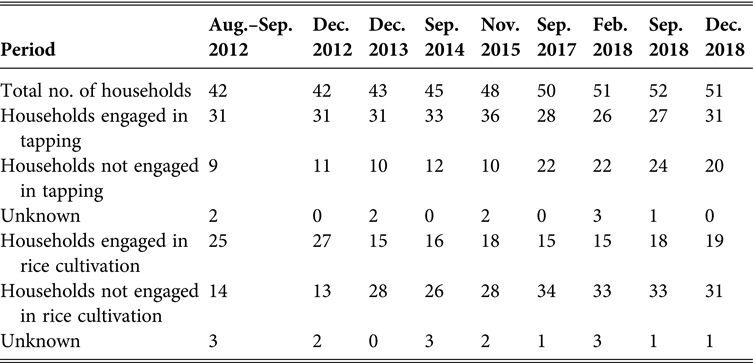
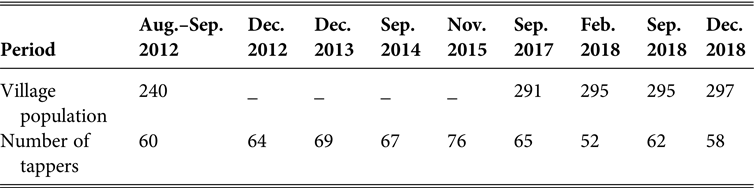
As tables 1 and 2 show, the number of households and tappers did not increase between 2012 and 2018.Footnote 41 Given the increase in the number of households and inhabitants, the proportion of tappers in the village has rather tended to decrease. There have consistently been many tappers who quit for various reasons, especially over the working conditions, while some were fired for absenteeism or lack of skill.
Livelihoods of village households, 2012–18

Village population and number of tappers, 2012–18

Note: For Dec. 2012 and Dec. 2013, Sep. 2014, and Nov. 2015, I do not have exact figures for the village population.
The villagers were generally well aware of the working conditions on the plantations, which was a topic of daily conversation among family members and neighbours.Footnote 42 The working conditions that tappers declared as annoying can be summarised in three points: working hours, labour discipline, and control exercised by the company. The tappers were assigned three plots of rubber groves, each of which comprised about one hectare of land containing 500 to 600 rubber trees. Each worker tapped one plot a day, so each plot was tapped once every three days. To finish tapping all trees, they had to leave for the plantations very early in the morning while it was still dark. After tapping all the trees allotted for the day, they rested, while waiting for the latex to gather in bowls attached to the trees. They then collected the latex from each bowl and placed it in buckets, which they carried to the roadside where they waited for a truck to arrive and collect the latex. They returned home at 11:00 a.m. when the truck came early, but sometimes it was not until the evening if the truck arrived late. Many of them complained, especially at the beginning, of fatigue and lack of sleep.
When I returned to the village in December 2013, a former tapper explained that the company had begun to order workers who worked on one plot to increase their workload to tap two plots on alternate days. Some tappers who could not tap fast enough left for work at 7:00 or 8:00 p.m. in order to tap through the night. Other workers stated that they had quit the job owing to the company's intensification of labour.
The difficulty in obtaining leave from work was another factor that troubled them. According to the company's regulations, the tappers were entitled to four days off per month,Footnote 43 but beyond that, they had to submit a certificate from the village head justifying their absence. Simple fatigue, for example, was not considered a justifiable reason, while illness could be. If they did not have a justifiable reason, and such an absence was repeated, their rubber groves could be confiscated and re-allotted to any other tapper who did not have their own plots yet. This implied that they were effectively dismissed.
The company was also very concerned with the quality of the workers’ tapping skills. If the tappers did not tap correctly, the trees could be damaged and even die. To protect the trees, the supervisors monitored the tappers’ performance and offered them daily advice, while a company inspector came to check every tapper's skill at the end of each month. Those who were judged to have problems were admonished and ordered to improve their skill, or at worst, were fired. In addition to these working conditions, being reprimanded by supervisors and the chief was another factor that caused offence to the villagers, who had rarely been controlled or had their work performance openly criticised by others while practising swidden cultivation.
Household income from tapping fluctuated largely based on the year and season. The company calculated the monthly wages for each tapper based on the quantity of dried latex that was determined by a percentage of raw latex collected. The percentage fixed by the company every month, taking into consideration variables such as rainwater mixed in with raw latex, for example, shifted between 20 to 30 per cent. The buying price of dried latex was also fixed by the company, and did not necessarily accord with global market trends.Footnote 44
As table 3 shows, the average income per tapper has not been stable. Sometimes it fell or rose sharply. The sharp drop in 2018 (from 1.94 million kip in February to 0.67 million kip in September) was caused by unusually heavy and constant rain that prevented workers from tapping. The productivity of rubber varies with the seasons and is dependent on the trees as well. This directly influences tappers’ wages. Every year, in February, tapping stops for approximately one month as the rubber trees become unproductive and their leaves fall off. In March, when tapping resumes, the amount of latex collected remains small, but increases later and begins to decrease again closer to the end of the season.
Average wage from tapping per tapper, 2012–18

In addition to these conditions that influenced all the tappers equally, various factors affected individual wages. Diligence in work and tapping skills varied greatly among tappers. Young men, for example, often went out with their friends at night, which caused them to skip work or show up late the following day. Wages were also deducted from those who were absent without notice as a penalty. Those who went to work every day without taking a day off, and collected a larger volume of latex naturally received higher wages than those who were absent for days. Tappers who were judged by the inspector as being less skilled had a certain amount of their wages deducted. These factors contributed towards increasing wage differentials among the tappers.
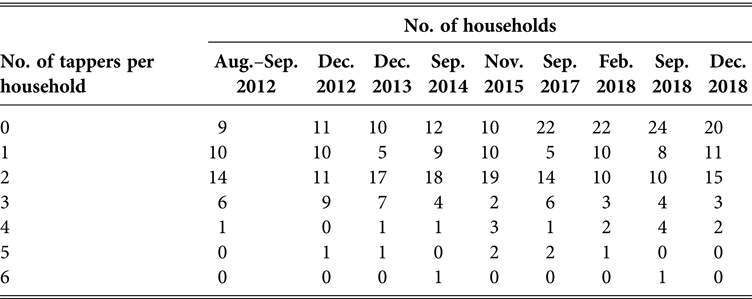
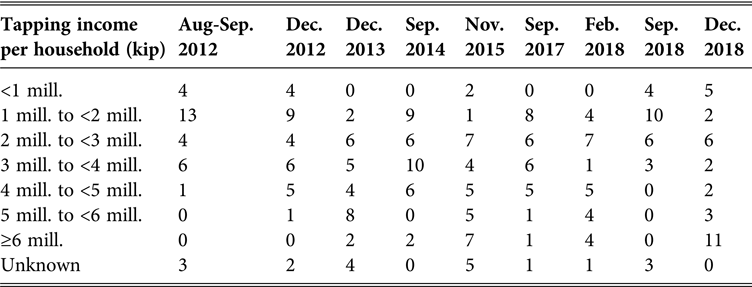
Wage differences could become much larger at the household level. There was a difference in the number of members engaged in tapping among the households, as shown in table 4. This can result in differences in household income from tapping (table 5). However, as other factors exist, for example, in many households, a couple or father/mother and a child tapped a plot together, hence household income did not simply increase in proportion to the number of tappers in the household.
Number of tappers per household, 2012–18

Distribution of household income from tapping, 2012–18

Households with at least one tapper were not necessarily exclusively involved in tapping. When tapping began, most households engaged in tapping continued to grow rice. However, as table 1 indicates, the number of rice-growing households decreased in 2013. This was partly because of Dak Lak Rubber's policies, which initially provided monthly incentives for each tapper on the condition that he/she worked over 22 days that month. The incentives comprised 18 kilograms of husked rice, to which 5 to 9 kilograms could be added if he/she had aged parent(s) or small children to support, in addition to other food staples such as sugar, salt, and monosodium glutamate (MSG), along with detergent. Although the rice provided by the company was insufficient for many tappers to nourish their families, certain households decided to abandon rice production owing to increased difficulties in finding fields and cultivating rice while working as tappers. When I returned to the village in December 2013, the company had stopped providing tappers with these incentives without any explanation.Footnote 45 Since 2014, the number of households planting rice has remained relatively stable with little fluctuation. However, from 2015 onward, there has been a new tendency among village households to plant other crops, especially cashew, as will be discussed later.
Labour arrangements and negotiations
The locals expressed their discontent and anger towards the rubber company in various moderate ways. Open protests or acts of resistance, such as those observed by McAllister and Baird, did not take place in K village.Footnote 46 However, some minor incidents can be listed as signs of protest: a household cut down a rubber tree in anger after the company refused to pay for the weeding they had done owing to dissatisfaction with the work, and ordered the plot to be weeded again; when tapping began, many of the latex-gathering bowls were found broken or dropped on the ground. Some villagers considered this to be the work of a trainee who could not pass the final test in the tapping course, but the ‘offender’ was not identified.
In most cases, when workers were angry or unhappy with the company or their supervisors, they either quit the job or tended to be content with gossiping about their supervisors or backbiting. The workers often thought that the company deducted too much from their wages under the guise of their skills being insufficient and suspected that the Vietnamese chief and/or a group supervisor had tried to ‘steal’ latex by recording a lesser amount than was actually collected by the tappers.Footnote 47 It was rare for the tappers to directly question the chief and supervisors and to openly show their anger to them. If they wanted or needed to continue tapping, gossiping and backbiting were the few options they had left to resist the company's and supervisor's views and attitudes.Footnote 48
In spite of complaining about the company and supervisors, many gradually grew accustomed to plantation labour. They came to understand the company's ways and demands and began organising their daily lives around tapping. Instead of merely following the company's instructions, they began inventing ways to adapt. One example of this was that young boys and girls, who were not strong enough to carry buckets filled with latex, were often assisted by their parents to carry the buckets to the roadside. By watching or helping their parents, some children learned to tap themselves. In other instances, older parents learned to tap by observing their daughters or sons at work. A similar practice could be observed in couples, who could substitute their older children or a parent or substituted for each other whenever one of them had to be absent due to sickness or other work. This practice has become very common among the villagers as it allows them to take a rest more easily while avoiding the risk of being fired. This has also prevented damage to their allotted rubber trees from neglect by a one-day substitute failing to care for them properly. If the company inspector detected any damage, wages were reduced. The company does not prohibit the workers from having their family members tap in their place as long as the rubber trees are not harmed.
Some villagers also managed to get some sleep by tapping in the evening and returning home approximately by 10 p.m. and leaving again for the plantations the next morning at around 7 a.m. to gather the latex that collected in the bowls. Those who did not want to consume gas on this round-trip by motorbike preferred staying on in the plantations. Those who worked with their family member(s) could return home after tapping all their trees, leaving the collection of latex to their family. Some women often left the latex collection to their husbands while they returned home to take care of their children.
One tapper told me that she sometimes left a portion of her allotted trees untapped when the supervisor was not watching or examining her work, because it was too hard to tap all the trees. Another tapper said that some Vietnamese supervisors overlooked it when some rubber groves were left untapped, whereas the stricter ones became angry. These accounts indicate that tappers, depending on the conditions, could evade some of their duties.
When tapping began, the workers were not accustomed to leaving for work in the dark and did not understand the wages they could earn. They were naturally very anxious and suspicious. However, they were encouraged once they realised that the wages were sufficient to support their families and even allowed them some extravagance. All the village households now have at least one motorbike, with many owning more than two. The number of reinforced concrete houses has also been on the rise, whereas only one existed before tapping began. The proliferation of mobile and smart phones is also impressive. Some villagers mentioned that while cultivating fields had only yielded them rice to eat, tapping earned them cash with which they could buy both rice and other goods. One villager declared that they could not earn their living by cultivating dry rice fields (het hay bo kum kin), whereas they could do so by tapping (khit yang kum kin). Nevertheless, those who had great difficulty accepting the company's conditions and regulations did not agree with this view, probably because plantation labour offered them no advantages.
Efforts were made to publicly negotiate the employment of those who quit plantation labour because it was impossible for them to get accustomed to it. The chief of K village,Footnote 49 although a member of the local administrative body, does not always take an adversarial stand against the project and the company. On occasion, he does not hesitate to overtly demand that the company should improve working conditions for the tappers. In 2015, in the presence of the provincial and district officials, he succeeded in obtaining a new contract with the company to prohibit the dismissal of a worker before discussing the problems with the village. According to the chief, the locals had no other jobs but plantation work, as almost all their fields had been appropriated for the plantations. He told the company that if it continued firing workers, the locals would want to reclaim their fields to return to swidden cultivation. The village chief and other villagers knew that many tappers from other districts within Laos and from Vietnam were entering the region,Footnote 50 and that the company did not need to depend entirely on local communities to recruit tappers. In making his demands, the chief was likely trying to defend the villagers against the threat of losing their plantation jobs on lands that were formerly owned by them.
Upon returning to K village in December 2018, I heard that this agreement had been neglected by the company, which had resumed dismissing tappers without notifying the village. The village chief spoke to the company again and the company decided to hold a training session for the locals who had quit. Those who had just entered into plantation labour at the time were those who had attended this four-day training session. This led to a slight increase in the number of households engaged in tapping.
The village chief's persistence in securing jobs for the villagers on the plantations may have been founded on his strong awareness of the locals’ rights over the land that the company had confiscated. He does not accept other people from other regions or countries coming to work on the village land at the cost of local livelihoods.
Introduction of new crops
Irrespective of whether they were engaged in tapping, the village households began shifting increasingly to cash crop production and away from dry rice cultivation. Households without tappers were the first to seek crops that could provide them with enough income to buy rice, which they now could not produce enough of. A plant called khem (Saccharum arundinaceum), used to make brooms, has been produced in the neighbouring villages for many years. In K village, a few households began to plant it several years ago, and others followed their lead. The household that first planted it earned 8 to 9 million kip from the harvest in 2015. However, as the commoditisation of this plant was found to be extremely labour-intensive, some households, especially those involved in tapping, abandoned or withheld its cultivation.
Dak Lak introduced cashew in the region. In the early stages of the rubber plantation, the company employed locals to plant cashew trees simultaneously. Those who worked for the company learned how to plant the crop and began planting it for themselves, as well. As this crop is far less labour-consuming than khem, more and more households began planting it each year. In December 2018, a total of 28 households planted cashew, and 6 planted khem. Of these, 14 were engaged in tapping. One household, for example, ran a grocery store and invested in cashew cultivation by purchasing 3 hectares of land, and had two members engaged in tapping at the time. Many households that did not have such capital planted trees on the tiny plots that remained.
Only one couple in K village planted rubber trees for themselves on half a hectare of land that they had bought over ten years before. Both of them had been tapping since the inception, but decided that one of them would quit tapping to work on their own rubber trees when the trees were ready. They maintained that rubber was much easier to produce than khem and a little easier than cashew. They said that rubber trees were productive almost all year round, and needed only about four hours of daily labour.
The other villagers observed these crops being sold at high prices and hoped to plant these trees for themselves. Some plantation workers considered it an insurance or a hedge against the risk of losing their jobs, as they explained that they did not know when the company would fire them. A villager also explained that he and his wife had resumed cultivating the remaining fields after several years of suspension, and had begun planting several crops including cashew, anticipating their retirement from tapping in the future.
Those who planted cashew around 2018 had a specific reason: a hydropower dam project was planned in the area. It had the potential to expropriate the fields that the local people had newly cleared and planted crops on. Some villagers deliberately cleared the land within the dam area and planted cashew with the expectation that they would receive compensation, as they knew from their experience with the rubber company that they would obtain a certain amount of compensation for land planted with perennial crops, but nothing for ricefields.Footnote 51
Households without tappers
The number of households that were not involved in tapping did not decrease, but rather increased since September 2017 (see table 1). From 2012 to 2015, the rates remained slightly higher than 20 per cent, while after September 2017, the rate rose to over 40 per cent. However, in December 2018, it decreased to slightly lower than 40 per cent, following the negotiations of the village chief with the company.
Households with no tappers had different reasons for their lack of involvement in plantation labour. In addition to households that could not engage in tapping owing to age or health conditions, those that had at least one family member working for the army, and thus earned a salary, tended not to be involved in plantation labour. Many preferred that their children go to school to obtain a good job in the future rather than have them abandon their education to become plantation workers. Among households with no tappers and no regular sources of income, one villager declared that he had refused to send his daughter to the plantation because of his resentment of the rubber company. However, those that had never engaged in tapping were smaller in number than those that had been involved in it but quit. In December 2018, for example, of the twenty households with no tappers, eight had members who drew salaries as they were in the army or schoolteachers. Of the remaining, nine households once had tappers, while only three never did.
Most households with no tappers and without wage earners continued to cultivate crops, including rice. Although job opportunities are increasing with new factories and shops being opened in the surrounding areas, it is not easy for the villagers to find steady jobs. Those who attended school for a few years or never went to school at all had no or doubtful levels of literacy and were excluded from certain kinds of jobs such as sales positions at franchised coffee shops. The only young woman in K village who worked for such a coffee shop had finished high school. Even after obtaining a factory job, which was supposed to be lower paying but less physically demanding than tapping, it was quite common for people to quit because of problems with the working conditions or salaries. Some of them were able to return to plantation labour if there were vacancies, as the company did not hesitate to re-employ skilled former tappers. The others could work on their own or parents’ remaining fields or could depend on their families who earned a living making charcoal. The last resort was collecting banana leaves for sale in the market or engaging in day labour, which was a hand to mouth existence.
However, not all households with no tappers and no wage-earners were doomed to lives of bare survival. Some of these households were the first to clear and cultivate areas in the protected forest (pa sangwan) which, in principle, was prohibited by the authorities. Despite the ban and difficulties in clearing the dense forest, they did not hesitate to go across the river to plant dry rice, and after seeing that the land there was likely to be exhausted quickly as others from surrounding villages had also arrived in pursuit of the limited land, they began cultivating cash crops. They started planting and harvesting cashew and khem earlier than others and earned enough income to buy rice. The head of one such household, for example, declared that they had earned 6.75 million kip from cashew nuts and 10 million kip from khem in addition to some money from selling banana leaves in the market in 2016. Although he maintained that his family was poor, he was able to spend 6 million kip on wages towards the construction of his new house. This case implies that those who were not working on the rubber plantation had not continued to subsist on dry rice cultivation, but had moved on to cash crop production.
Consumption and accumulation
Plantation labour has earned the locals a somewhat regular monthly income that has altered their consumption style.Footnote 52 Formerly, their sale of any product or labour was motivated by specific needs: when they needed something for daily use, they sold banana leaves or engaged in day labour. When they sold surplus rice or cattle, it was generally to buy something expensive or to raise money for medical treatment or to meet marriage expenses, including wedding dowries.Footnote 53 After buying or paying for their needs, they often had little money left. Thus, the villagers could not afford the luxury of impulse buying of non-essential items.
One major recent socioeconomic change was that the villagers had begun to buy on credit. Previously, this was very rare as the merchants did not offer credit. These days, however, the merchants visiting the village have begun to sell clothes or cheap jewellery, often telling the villagers, ‘You can pay later, so take it!’ Purchasing something more expensive such as furniture or a motorbike has also become easier because they can be paid for in instalments, whereas the villagers were once very anxious about making regular monthly payments.
Lending and borrowing money has become common among the villagers as well. The villagers, especially the young men, borrow money from their neighbours or relatives to spend on entertainment. That was practically impossible before, as few villagers could afford to lend money without a source of regular cash income, and if they knew that the money was to be spent on entertainment, they were not be eager to lend that amount. Since they began to earn a somewhat regular wage from tapping, many young men hardly hesitate to borrow money. Other villagers, therefore, came to lend money more willingly, as they knew that they could recover the funds from those who worked on the plantations. According to one villager, some tappers spent their entire earnings clearing their debts on payday and were thus forced to borrow money again.Footnote 54 The borrowers paid an interest of 30,000 kip a month for every 100,000 borrowed, which is a monthly interest of 30 per cent, or 360 per cent a year. The lenders were not limited to tappers on plantations. Other villagers, including a soldier and a shopkeeper, also lent money. As they were able to afford to lend money, they saw this as a profitable business.
Depositing money in the bank has become common among the villagers. Although they were often reluctant to admit it, according to one woman, many now had bank accounts and deposited money when they received their wages. She said that such deposits helped some households to make up for the substantial wage reduction during the rainy season in 2018. Another villager explained that a bank deposit was safer than leaving money in the house and running the risk of having it stolen, and noted that the gain from an annual interest of 6 to 10 per cent was an advantage.
Similar to the bank deposit, a more popular practice among the locals was a kind of tontine system, generally called huay in Lao, in which each member of a group, generally colleagues, provided a certain amount of money every month. Every month, one member would receive the whole sum of money in turn, while the others would continue to pay. This practice has been common among those in the army or schoolteachers as they receive regular salaries. However, groups of tappers are also using this system now.
When I asked villagers how they intended to use the money that they received from the huay or were saving up in a bank account, they were usually puzzled about how to answer or simply said that they did not know. When I asked one villager if he would buy a piece of land, he said that was one option. One hypothesis is that the bank deposit may be a substitute for the former practice of keeping cattle which could be sold in case of emergency or an important occasion such as a marriage or funeral, thus serving as a safeguard.Footnote 55 Although no one clearly stated this, it is possible that they unconsciously shifted to bank deposits.
The involvement in huay must be of a different kind as they cannot access their cash whenever they wanted or needed it. Whether the villagers really did not have a clear plan about how to use the accumulated money or just did not want to reveal it, it is probable that accumulating much money was now considered desirable. When I asked a mother of three who was engaged in tapping with her husband why she worked hard on her own fields after tapping, she said that she wanted (yak day) it for her children, without mentioning any specific purpose or use for that money. This recent use of banks and participation in huay, taken together, imply that local relationships with money have largely changed from those in the past, when the selling of goods or labour in this community was principally motivated by urgent or specific needs.
Differentiation and change
In the late 1990s, the villagers’ lives steadily revolved around swidden cultivation, with the sale of products in the market and wage labour occasionally engaged in during the off-season. Recently, however, their livelihoods have become quite variable and household economic conditions have become unstable, especially since the coming of the rubber plantation. A household's financial status and livelihood, for example, can change with a member going back and forth between tapping and other activities including farming and day labour. Life cycle events may have a direct influence on their livelihoods: a marriage can change the number of tappers in a household, depending on whether the son/daughter leaves home or brings another tapper in. The same is true of childbirth, as a result of which a mother has to stop tapping for several months.
Swidden cultivation is, in principle, practised by a household unit that can deal with fluctuations in the number of members relatively easily, while tapping is done on an individual basis and it is more difficult to deal with such fluctuations, since a tapper requires specific skills and is allocated fixed rubber plots. Although the villagers’ labour arrangements as mentioned above, with families substituting members when needed, represents their intention of transforming the work into household labour, there are certain limits to such arrangements.
In addition to this instability in livelihoods, economic differentiation has gained salience over time in the village. While reinforced concrete houses increased rapidly, some old, tiny houses with bamboo walls remain. Economic differences should not be merely attributed to whether a household is involved in plantation labour, as some households without tappers can sustain themselves relatively well. The households in the greatest difficulty were those that had once depended on one or two tappers in the family, who later left or lost their jobs and had neither land to cultivate nor another job to fall back on.
The economic differences among the households also derive from how hard family members work, regardless of their involvement in tapping. One of the most successful tappers was the head of a family with four tappers, which earned in total several million or sometimes over 10 million kip monthly. He referred to some ‘lazy’ (khi khan) tappers who could not earn enough, while he sometimes voluntarily worked on two plots instead of one to fill in for another tapper who was absent, thus increasing his harvest. Those whom he considered ‘lazy’ were often absent from work, showed up late, and took frequent breaks. In addition to tapping, he had various kinds of fruit trees from which his family could earn additional income each year. With the money that he had saved, he bought a truck (locally called Hyundai, whatever the make) to launch a side business in the future.
However, there were some households which, instead of focusing on accumulating wealth, devoted a part of it to supporting, willingly or unwillingly, their parents or relatives living in or outside the village. Unlike in the past, when all households had, in principle, fields of their own to cultivate, economic independence today is under threat. For example, a woman and her husband were supporting themselves as well as the wife's family, as her father had neither fields to cultivate nor a job. Another plantation-worker couple brought two relatives to work with them on their plots in order to pay each of them 1 million kip a month for their assistance, although the couple did not need any help with their work. Although mutual aid was common among relatives in the late 1990s, generally in the event of sickness or death, but I hardly observed or heard of such constant and substantial support from one household to another at the time.
As economic differentiation continues, social relations within the village are also being transformed. Relationships among village households tend to be increasingly mediated by money. As households no longer rely on dry rice cultivation as a means of livelihood, the practice of reciprocal labour exchange during sowing, for example, has disappeared. Now, when people need help clearing some land covered with large trees, they often have to pay for the labour, because of the impossibility of calling on neighbours to help, as the latter may not need to clear their land. Besides, those who worked on plantations may not have time to help others. Buying and selling farmland between the households in K village has become more common. This too was unthinkable in the late 1990s: a household could ask for permission to cultivate a piece of land owned by a neighbour who left it uncultivated because they had no one to do this, and the latter would agree with the former using it for free. Those who recently parted with farmland generally faced some form of difficulty or lacked labour, while those who bought it planted cash crops, including cashews. The commodification of land and labour is thus under way in the village.
Conclusion
I have described how these villagers in southern Laos changed between 2010 and 2018, in terms of livelihoods, lifestyle, perspectives, and values since the advent of the rubber plantation. More than half the households in the village have seemingly adapted to plantation labour, often by means of arrangements and manoeuvres that they devised. This adaptation also represents their acceptance, more or less, of the working conditions, wages, and discipline imposed by the company, and thus capitalist relations of production. The village chief's negotiation with the rubber company implies his acceptance of this relationship by recognising plantation labour as an important means of livelihood, although his intention is to obtain better conditions for the villagers.
This article also explains the villagers’ learning process over this period. They have learned, for example, how to make more money from the rubber company, which has introduced cashew growing in the area. They also learned, possibly from schoolteacher and soldier family members, the practice of ‘huay’ as a way to accumulate money. Their own experience with the rubber plantation taught them that planting perennial crops would be advantageous to claiming land rights, and thus they have gained knowledge on how to negotiate with power outside the village, including that of the state and corporations. Planting cashews can, however, also be understood as a practice equivalent to their traditional practice of dispersing the risk of crop failure. The more they depend on plantation labour, the more their fears of losing the job grows, hence their moves to plant cash crops to diversify their sources of income as a safeguard.
However, new desires coexist with fears among the villagers in driving their pursuit of accumulation, as they came to recognise tapping and cashew nut production as opportunities to become prosperous. Their desires have evolved over time. At first, they wanted enough income to buy rice to eat, then, to indulge in some items of luxury, and then to have money without any particular object in mind. This evolution that started with the desire to sustain themselves, then expanded to include consumption, and then to accumulation, should not be attributed entirely to the rubber plantation since the desire for accumulation is also found among villagers who are not involved in plantation labour. Even among those who are tappers, some spent part of their income helping their parents or relatives, rather than accumulating their excess earnings. In evaluating the changes in the villagers’ livelihoods and lifestyles, we should therefore take into consideration not just the coming of the rubber company and plantation, but also the influences of changes in wider society, especially the turn toward a market-based capitalist economy in Laos.
Regardless of their involvement in tapping, the polarisation of village households seems to be in progress: households who have been successful in accumulation at one end of the pole and unsuccessful households on the other. The former, sticking to their desires, pursue accumulation by circulating (mun vian), as several villagers put it, their capital gained through hard work, then investing it in land or a truck and/or moneylending, while the latter are squeezed after losing their fields to the rubber plantation first, then to uncertain work on the plantation, and eventually having to sell their last remaining field in order to sustain themselves. Among those who are in-between, some are ambivalent or hesitant about pursuing accumulation. Those who assist their parents or relatives do not dare to abandon them, as without such support, the latter could fall into a critical state of chronic indebtedness or even starvation. Assisting parents or relatives has some priority over accumulation.
One cultural factor that may make some villagers hesitant about their desire for accumulation is the Theravada Buddhism doctrine that teaches renunciation. Some villagers, if not all, are aware of the materialistic desires of successful persons. When I spoke to a woman in the village, I told her that her brother was a hard worker, but she said, ‘No, he is not, he desires (yak dai).’ As a Buddhist, she did not seem to fully admire his hard work motivated by such desires. High explained the ambivalence around desire among Buddhist Lao, and pointed out that while Buddhism doctrinally aims at freedom from desire, in practice, Buddhist societies are ‘some of the most openly avaricious and acquisitive’,Footnote 56 and not only is desire not condemned, but it is also treated as a basic explanation for human behaviour, sentiments, and motivations.Footnote 57 This explains why her brother and his wife, both Buddhist, are eager to accumulate. Buddhist doctrine may dampen desire for some, and barely suppress it for others. While the villagers have been increasingly participating in Buddhist festivals, only some are Buddhist. Therefore, only some, like this villager, are likely to have negative views of desire.
While the villagers’ practices and attitudes cannot be explained solely in terms of desire stirred by capitalism, the commoditisation of land and labour is changing the relations among the village households progressively. The sale of their last plot of land, however tiny or steep, by needy households can widen disparities within the village: the buyers can use these plots to gain more, although such transactions do not necessarily lead to the concentration of farmland in the hands of a few as there is limited available land for sale in the area. Those who neither have land nor crops to sell often sell their labour to other households that are short of hands to clear land or harvest crops. The economic independence of each household is thus weakening as the presupposition that each is endowed with a field to produce food to nourish its members has already collapsed. Without economic independence, labour exchange and mutual aid based on reciprocity, which had once contributed to village solidarity, cannot be maintained.
Those who have continued farming without depending on plantation labour cannot escape from the market economy as they switch from semi-subsistence rice production to market-oriented production mainly because of a shortage of fields. They are not able to stay unconcerned about market fluctuations. In sum, capitalist relations and the market economy continue to prevail in the village. Land concessions as a form of primitive accumulation in the region have definitely initiated this transformation. However, what has been happening since then may not be exactly what the Lao government or the rubber company expected or intended, perhaps because they did not take into consideration how the locals can change and adapt. While ‘desiring-machines’ have seemingly begun in K village, the reserve or restraint in pursuing such desires among some villagers reveals that the rules of competition and profit that govern the capacity to survive in capitalist relations have not yet been fully established amongst them for the time being.Footnote 58 However, how the locals will act cannot be predicted, as their desires are mediated through their culture, and hence will also change, based on what they are faced with.