


Introduction: Predicting policy tool choices
“Policies” are composed of a variety of elements which in some way work together, whether effectively or not, to give a policy “substance” or an impact on the ground (Howlett Reference Howlett2009). This includes not only policy goals and the institutions which articulate them but also the means deployed to achieve those goals. “Policy tools,” that is, the “levers” of government also known synonymously as “policy instruments” (Hall Reference Hall1993; Halpern et al. Reference Charlotte, Lascoumes and Le Galès2026) or the “tools of government” (Salamon Reference Salamon2002), comprise these means and are a prominent field of inquiry with a long history and research agenda in policy studies (Capano and Howlett Reference Capano and Howlett2020).
Policy tools are the specific mechanisms and devices through which governments employ their resources in the effort to achieve their policy objectives. They include, for example, regulation, financial incentives, government agencies, and information disclosure, which work by modifying the behavior of targeted groups of actors (Capano and Howlett Reference Capano and Howlett2024). They exist at the center of policy-making and understanding both how these tools work and how they are chosen is a central focus of research not only in themselves but also in the related fields of policy design and policy studies more generally (Howlett Reference Howlett2023). Without the deployment of such tools, a “policy” remains only a vague statement of aspired goals or expectations (Howlett Reference Howlett2009).
Given their importance, it is not surprising that a robust body of research examines both the merits and drawbacks of specific tools and the theoretical and actual criteria governments use to select among them. By clarifying the nature of the calculations and deliberations decision-makers conduct around them, this work is intended to help better understand, and improve, the decisions made to deploy specific kinds of tools in specific areas and circumstances (Bali et al. Reference Bali, Howlett and Ramesh2022; Howlett Reference Howlett2023; Taylor et al. Reference Taylor, Pollard, Angus and Rocks2013; Veselý Reference Veselý2021).
This is important work since different tools demand different institutional arrangements and expertise within government, and produce different relationships between the state and the private and non-profit sectors, among others. Unlike social or economic regulation, which imposes binding rules on private actors and requires enforcement capacity, for example, loan guarantees can often be used to accomplish the same end but work by reducing the financial risk borne by lenders. These latter efforts incentivize behavior toward government aims through the deployment of market mechanisms rather than the state ones used in regulation.
As Salamon (Reference Salamon2002, p. 1613) noted, in this sense each tool of government “has its own operating procedures, skill requirements, and delivery mechanism, indeed its own ‘political economy,’ emphasizing the ability of such choices not only to influence policy implementation and outcomes but also policy processes, including policy deliberation and formulation (Howlett and Mukherjee Reference Howlett, Mukherjee, Howlett and Mukherjee2017; Trebilcock and Hartle Reference Trebilcock and Hartle1982). In the case of the choice of loan guarantees as a policy tool in an area such as technology policy, for example, this can result in a distinctly different governance system compared to that created by a choice to use social or economic regulation and may reinforce or undermine any system for such efforts already in place. Understanding why each kind of tool is chosen or preferred in what circumstances is thus critical.
A subsequent key question with which the literature has grappled, independent of how tools are initially chosen, is if patterns of such choices exist and, if so, why and how they persist. Such long-term preferences represent an important, if oft-neglected, dimension of the study of governing tools and is the central subject of concern in this article.
Thinking about these patterns of tool choices raises questions about how policy tool use impacts upon and is impacted by other concepts developed in the policy sciences to understand long-term policy-making phenomena such as “policy styles” (Richardson et al. Reference Richardson, Gustafsson, Jordan and Richardson1982), “policy paradigms” (Hall Reference Hall1993), “regulatory regimes” (Eisner Reference Eisner1994) or “policy regimes” (Howlett Reference Howlett2009) to give only a few examples.
The notion of a policy paradigm or long-lasting set of dominant ideas about how a policy sector can and should operate suggests, for instance, that once adopted and put into practice, the choice and deployment of specific policy tools may become normalized, establishing themselves as the default or “standard” choice as long as that paradigm remains operative. Any such preferences would be neither incidental nor contingent on the details of the circumstances of the day, but rather deeply embedded in the logic of how officials and others approach a policy issue, reflecting the kinds of governing activity and modes of action that are considered legitimate, feasible, and appropriate within that logic (March and Olsen Reference March and Olsen1989).
In order to better clarify these temporal issues and relationships in policy instrument choices, this article elaborates upon the concept of policy tool choices over the long-term viewed from the perspective of how they both create and contribute to the maintenance of a long-term pattern of how policies are made and implemented or what Richardson et al. (Reference Richardson, Gustafsson, Jordan and Richardson1982) termed a “policy style.” The central argument of the article is that policy styles and policy tools are related dialectically as context and content: policy styles constitute the durable institutional, ideational, and procedural context within which tool choices are made, while policy tools constitute the substantive content that this context characteristically produces. In other words, a well-established policy style affects instrument preferences, and vice versa, and in so doing generates predictable and enduring preferences for both particular ways of acting and choices of particular kinds of tools (Richardson Reference Richardson2018).
In what follows, we set out and explain the basic vocabulary of the policy styles approach and how it relates to policy tools. We then review the existing literature on both these subjects, pointing out the existence of several different definitions of a policy style which are oriented towards either policy processes or outputs. Building on that foundation we apply the styles logic to instrument choices. In the final section we provide some concluding remarks and outline an agenda for future research in this area.
The significance of the policy styles concept to the study of the tools of government
Whether tools are selected in a “rational” or “technical” way, meaning through careful matching of expectations against theoretical propositions concerning the effects caused by the use of a tool or in a more haphazard one, such as due to electoral expediency, for example, is a question which has animated much research in the field (Howlett and Migone Reference Howlett and Migone2011). It has often been argued that the selection of a policy tool is based on appreciations of their merits but within the context of political, electoral, administrative, and other fairly short-term contextual variables which make their selection highly contingent, unstable, and difficult to predict (Colebatch Reference Colebatch2018; Dinan et al. Reference Dinan, Béland and Howlett2024; Howlett and Mukherjee Reference Howlett, Mukherjee, Howlett and Mukherjee2017; Trebilcock and Hartle Reference Trebilcock and Hartle1982).
Other studies retain a more technical perspective and provide some evidence of the application of more systematic and/or evaluative rationality driving choices, but still imply a similar outcome: short-term contingent choices based on short-term contextual variables and circumstances (Howlett et al. Reference Howlett, Ramesh and Capano2024; Taylor et al. Reference Taylor, Gallagher, Pollard, Rocks, Smith, Leinster and Angus2019). That is, for example, many argue that tool choices are made in the conscious and deliberate anticipation of criteria such as cost, feasibility, or visibility – and not simply short-term electoral advantage – but that they still change frequently as evidence of their (in)efficacy develops (Linder and Peters Reference Linder and Peters1989; Salamon Reference Salamon1989).
But longer-term patterns of choices are also noted in the literature on instruments and pose a challenge to this short-term contingency assumption. One example is Lowi’s (Reference Lowi1972) work on centuries of tool use in the United States. Lowi found that U.S. policy-makers across the political spectrum favored specific sets of instruments for long periods at different points in U.S. history. Such findings suggest something important: that historical and institutional considerations interact with shorter-term behavioral and other calculations in significant ways and affect the direction and content of tool choices and preferences in relatively coherent and predictable ways (Grohmann and Feindt Reference Grohmann and Feindt2024; Howlett et al. Reference Howlett, Ramesh and Capano2024).
This latter observation of the persistence of instrument preferences is intriguing. That is, despite the potential for almost daily change it is remarkable that policy tool choices would exhibit relative stability over long-term patterns of tool use. This is an important finding as the presence of any long-term pattern of policy tool preferences suggests that tool choices may be less context-specific than often thought, and linked to other long-term factors such as, for example, the state of economic development or the education, administrative training and recruitment of officials and civil servants empowered to enact them (Veselý Reference Veselý2021). The implication is that specific kinds of tools may be deployed more frequently than would otherwise be the case if choices were either purely technical or more idiosyncratically political (Grohmann and Feindt Reference Grohmann and Feindt2024; Howlett et al. Reference Howlett, Ramesh and Capano2024) and begs the question of what causes such patterns and how they can best be analyzed.
That is, the observation of the existence of distinct and fairly long-lasting preferences for particular kinds of tools on the part of many governments raises many questions about why this should be the case and how these patterns come about and are maintained (Howlett Reference Howlett2023). It reinforces the idea, for example, that tool configurations may be more path dependent than often assumed and that a persistent preference for certain kinds of tools can encourage or discourage the adoption of other kinds, even if some others might be more technically efficient, electorally salient or “rational” at any given moment of time. Such preferences would be important not only in themselves but would have follow-on characteristics and implications such as, for example, serving as barriers to innovation, sacrificing potential gains from new policy configurations if bureaucratic regimes and standard-operating processes prevail in instrument selection over more technical or evidentiary criteria (Acciai Reference Acciai and Acciai2023; Colebatch Reference Colebatch2018; Dinan et al. Reference Dinan, Béland and Howlett2024; Howlett and Mukherjee Reference Howlett, Mukherjee, Howlett and Mukherjee2017; Howlett et al. Reference Howlett, Ramesh and Capano2024).
Understanding long-term patterns in policy tool choices
Some suggestions have been put forward for why this should be the case, but none is fully adequate. Tsebelis’ (Reference Tsebelis2002) theory of veto players, for example, suggests that the accumulation of actors with the power to block policy change can create institutional inertia, making it progressively harder to deviate from established tool choices. Grossback et al.’s (Reference Grossback, Nicholson-Crotty and Peterson2004) work on ideology and policy diffusion, alternatively, points to the role of shared ideational frameworks in sustaining consistent preferences across jurisdictions and over time. Each of these accounts highlights important institutional, actor-centered, and ideational factors that may help hold policies and instrument choices in place. None, however, is sufficient on its own to explain very long-term policy stability such as a persistent preference for regulation, or a deep-seated antipathy toward public enterprises, that endures not merely across governments but across decades or more (de Vries Reference de Vries2010; Majone Reference Majone1997).
This is because explanations based on factors like veto players or ideology focus attention mainly on those instances and processes which block change while retaining the default position that stability in choices is unusual. Thus, the norm in policy diffusion studies is the constant exchange of new ideas; Grossback et al. (Reference Grossback, Nicholson-Crotty and Peterson2004), for example, treat political ideology as operating mainly to block options that violate ideological preferences, rather than as a positive determinant of choice. Similarly, veto player theory relies on a model of constant institutional churn, but one where some special actors like coalitional partners can block specific kinds of change for some length of time, although typically not for very long (Tsebelis Reference Tsebelis2002).
An alternate model exists, however, that focuses more centrally on stability in its own right, where it is argued that it is abnormal events which upset the status quo and require explanation, not a lack of change (Pierson Reference Pierson1993). This is in keeping with work in public administration and public policy, for example, where observations of patterns of policy stability predominate. This is true, for example, in early work on incrementalism (Hayes Reference Hayes2006; Lindblom Reference Lindblom1959), which highlighted the existence of long-term, institutionalized policy bargains, and decision-making processes limiting change.
This idea has been carried over into more recent work which also emphasizes institutional routines in helping explain the prevalence of punctuated equilibrium patterns of policy dynamics in areas such as public budgeting (Baumgartner and Jones Reference Baumgartner and Jones1993; Fernández-i-Marín et al. Reference Fernández-i-Marín, Knill and Steinebach2021; Howlett and Migone Reference Howlett and Migone2011). Path dependency models linked to this idea rely on similar understandings of the dynamics of policy movements, ones that feature deliberations and actions locked into certain routes or trajectories due to sunk costs and other positive feedback processes which generally limit alternative choices, leading to a norm of policy stability (Béland Reference Béland2010; Pierson Reference Pierson1993).
In this latter view, policies can be said to trend toward stability, and in some cases toward a kind of ultra-stability which is only upset by relatively rare factors such as a crisis, the collapse of a monopolistic policy subsystem or the emergence of new actors or ideas (Hogan et al. Reference Hogan, Howlett and Murphy2022). This can occur, for example, when policy stability is challenged by the “institutional friction” which can grow up over time as gaps emerge between the information and knowledge contained in an existing policy arrangement in the face of the persistence of the problems faced by decision-makers on the ground (Workman et al. Reference Workman, Jones and Jochim2009). This latter work has rarely been linked to policy tool choices. However, the idea of relatively long-term policy styles or path dependent patterns in the way governments “do business” can help illuminate this link.
The concept of policy style was first developed to capture something narrower and mostly procedural but with a similarly persistent and long-term nature that required explanation. Richardson et al.’s (Reference Richardson, Gustafsson, Jordan and Richardson1982) introduction to their foundational comparative volume, Policy Styles in Western Europe, thus used “style” to characterize how governments typically make decisions – anticipatory or reactive, consensus-seeking or imposed – rather than what kinds of tools those decisions produced. Subsequent work retained this process orientation and often treated instruments as a secondary or derivative feature of a style rather than as part of its defining content (Peters et al. Reference Peters, Doughtie, McCulloch, Lewis, Potter and Castles1978; van Waarden Reference van Waarden, Unger and van Waarden1997).
Over time, however, a second and less formalized usage emerged in parallel to that of Richardson et al., one in which “style” referred instead to the characteristic outputs a government produced, that is, for example, its recurring preference for regulation, or for treasury tools, regardless of the process by which those choices were reached (Howlett and Tosun Reference Howlett, Tosun, Howlett and Tosun2019). These two usages are rarely distinguished explicitly in the literature, yet they imply different things about how a style relates to tool choice: a process-oriented style constraining tool choice only indirectly, while an output-oriented style describing tool preferences directly. Reconciling these two usages, and identifying which one can generate testable predictions about instrument choices, is a central task of this article and is addressed in detail below.
That is, styles always include a significant tool component which shapes the substantive content of policy, whether this is thought to be done indirectly or directly by the style itself (Howlett and Tosun Reference Howlett, Tosun, Howlett and Tosun2019; Richardson et al. Reference Richardson, Gustafsson, Jordan and Richardson1982). This helps generate an analysis of policy-making based on the observation that many governments tend to define and approach problems in the same way for extended periods of time, transcending partisan divisions or other short-term factors, and that in so doing they choose similar policy tools over and over again.
Very similar to Lowi’s (Reference Lowi1972) original formulation, long-term patterns in policy choices can be said to both reveal and affect distinct long-term governmental preferences not only for how policies are made but how they are constructed, patterns which can be identified and predicted. Hence more recent observers of policy-making in the United States, for example, have argued that U.S. governments tend to make policy in the same adversarial way and with the same basic set of legal instruments, over and over again regardless of the actual issue at hand (Peters Reference Peters, Howlett and Tosun2019). In Kagan’s many works (Reference Kagan1991, Reference Kagan2019), for example, this style of “adversarial legalism” has been argued to be distinctive and persistent in U.S. policy-making, and to exist due to the specific policy-making environment and set of decision-making institutions found in the United States. This leads policy-making in the United States to be characterized by active courts and continual litigation between and among citizens and the state which define this style. In the U.S. case this style can be seen to lead to preferences for the deployment of regulation and other similar legal instruments, but other kinds of policy styles have also been observed which continually favor, for example, the use of treasury tools like subsidies and direct government expenditures by some governments rather than authoritative ones like regulation (Peters Reference Peters, Howlett and Tosun2019).
This general approach to understanding and conceptualizing policy dynamics and tool choices in terms of policy styles has many implications for analyses of government tool use and thinking about their deployment and choice (Majone Reference Majone1997; Richardson et al. Reference Richardson, Gustafsson, Jordan and Richardson1982; Salamon 2002, Reference Salamon2011). Some elements of this approach, however, require further clarification if they are to shed additional light on continuities or persistent preferences in instrument choices (Howlett and Tosun Reference Howlett, Tosun, Howlett and Tosun2019).
Process- versus output-oriented concepts of policy styles
At present, as noted above, policy studies draw on a standard set of concepts to describe different long-term elements of policy-making (Capano and Howlett Reference Capano and Howlett2026). Key concepts in longitudinal policy studies, for example, include policy regimes (Howlett Reference Howlett2009) or sets of unchanging policy-making institutions, actors, and practices (Esping-Andersen Reference Esping-Andersen1990); policy paradigms or long-term sets of cognitive and sometimes normative ideas which inform policy choices, such as following Keynesian precepts in macro-economic policy-making already noted previously (Hall Reference Hall1993; Hogan et al. Reference Hogan, Howlett and Murphy2022); and more or less fixed sets of policy actors as stressed by notions such as policy subsystems (McCool Reference McCool1998), policy networks (van Waarden Reference van Waarden1992) or policy monopolies (Baumgartner and Jones Reference Baumgartner and Jones1993).
While each of these concepts usefully illuminates some particular aspect of long-term policy-making – whether institutional, ideational, or actor-centered – none is oriented specifically toward explaining persistent long-term patterns of policy instrument choices. Each captures important background conditions of policy-making but none speaks directly to the question of why governments exhibit durable, identifiable preferences for particular genres of tools over others. Policy regimes tell us that certain institutions persist; policy paradigms tell us that certain ideas prevail; policy subsystems tell us that certain actors dominate. None, however, tells us systematically what kinds of tools these conditions tend to produce, nor why those tool preferences tend to endure.
The concept of policy style, by contrast, speaks directly to this question: as a framework concerned with identifying enduring, characteristic ways of making and delivering policy, it can be linked more readily to the identification and analysis of consistent tool preferences over time (van Waarden Reference van Waarden, Unger and van Waarden1997). As argued above, the concept of a policy style thus holds out promise in explaining persistent patterns of policy tools choices. Unlike many approaches to tools which suggest that at any particular moment in time, any tool might be deployed, this work expects to find great continuity in tool preferences and uses, and studies in this vein have focused on how this persistence reflects and continues to inform policy choices (Howlett Reference Howlett1991; Richardson Reference Richardson2018; Richardson et al. Reference Richardson, Gustafsson, Jordan and Richardson1982; van Waarden Reference van Waarden, Unger and van Waarden1997).
It is for this reason that the concept of a policy style offers a more productive analytical lens for understanding long-term instrument choices than the other temporal concepts discussed above. But what exactly the term “style” refers to, however, varies from author to author, and needs to be unpacked if it is to be of greater use in understanding and predicting long-term patterns of tool choices.
Process-related notions of policy styles
As noted above, the concept of policy style has itself been used in two distinct ways in the literature – sometimes referring to the processes through which policy is made, and sometimes to the substantive outputs it characteristically produces – and which aspect of a style concerns policy instrument choices requires analysis.
In the first, “process” orientation, the term “style” is used less to describe a set of policy outputs than a common or typical policy-making process or procedure (Howlett and Tosun Reference Howlett, Tosun, Howlett and Tosun2019). In this use of the concept, a policy regime is said to characterize the boundaries of policy-making inputs and outputs created over an extended period of time, and the “style” of policy-making describes how policy processes take place within this regime, with instruments generally considered to be either a part of a regime or a secondary phenomenon.
In this sense, as Simmons et al. (Reference Simmons, Davis, Chapman and Sager1974, p. 461) put it, key policy actors, especially those located in the bureaucracy and political arms of government, are thought to “take on, over a period of time, a distinctive style which affects…policy decisions, i.e. they develop tradition and history which constrain and refine their actions and concerns.” Many of the first modern studies of policy styles, in fact, argued precisely this, rejecting earlier ideas that policy outputs varied according to the nature of the national political system, and particularly its partisan composition, in favor of an explanation based on the development of regime-like policy institutions and processes (Peters et al. Reference Peters, Doughtie, McCulloch, Lewis, Potter and Castles1978).
The procedural constraints and preferences contained in a style are thus said to have an impact on instrument choices but an indirect one. An emphasis or desire for public approval, for example, might involve an effort to regularize or enhance public participation in policy-making and lead to a preference for consultation, but the specific techniques used in such participatory exercises are seen as secondary choices. Similarly, a preference for closed, internally-driven policy processes might favor the use of bureaucratic agencies and solutions to problems but, again, the specifics of agency type remain largely unspecified. Due to processual continuities, however, the choices of policy tools to be deployed in any particular case are expected to remain within a range of options compatible with the pillars of the regime and reflect and perpetuate this continuity.
The volume Policy Styles in Western Europe (Richardson Reference Richardson1982) was the first to attempt to address the concept of a policy style in a systematic comparative way, and its focus was precisely on such “styles-as-processes.” As the first major comparative treatment of such styles, this work has had an outsized influence on the definition and use of the topic over the past half century. It set the parameters for, and cemented a penchant toward, a procedural orientation and, by extension, determined how the styles concept has been related to instrument choices (indirectly).
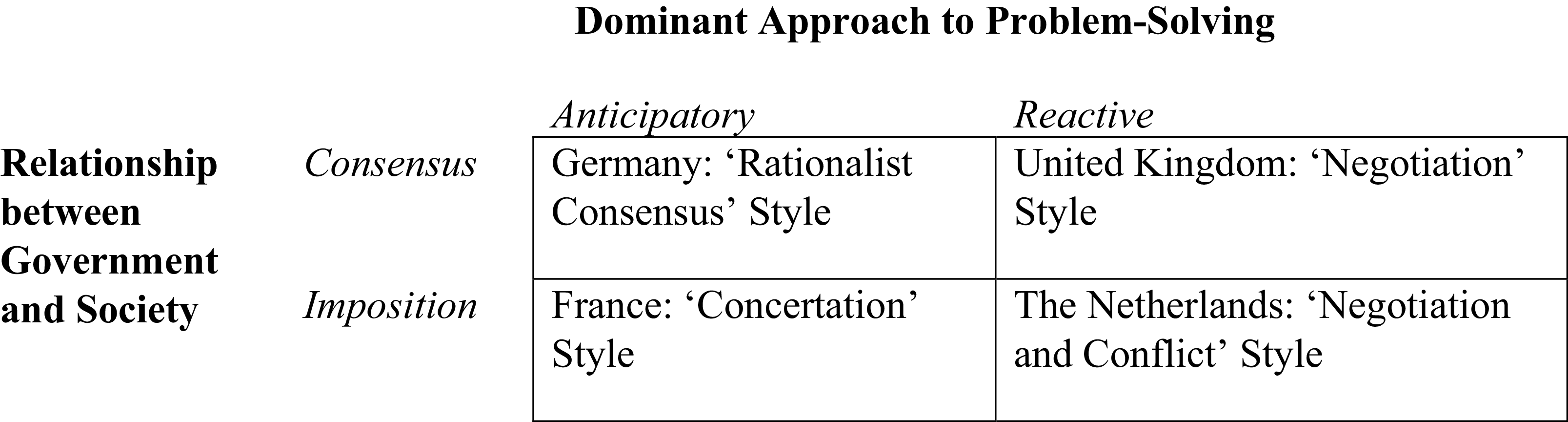
As is well known, the edited volume looked at the similarities and differences among a small subset of countries in Western Europe that all enjoyed democratic regimes and argued that significant differences in policy-making “styles” could be seen in terms of the propensity of different governments to take either anticipatory or reactive decisions and whether they tended to do so by seeking to reach consensus with organized groups, or by imposing decisions notwithstanding opposition from such groups (Richardson et al. Reference Richardson, Gustafsson, Jordan and Richardson1982).
The chapters of the book developed this process-oriented model looking at policy-making in France, West Germany, the Netherlands, Sweden, Norway, and the United Kingdom to generate the processual models of policy styles found in Figure 1.
An early model of national policy styles with examples. Notes: Taken from Richardson et al. (Reference Richardson, Gustafsson, Jordan and Richardson1982), Howlett and Tosun (Reference Howlett, Tosun, Howlett and Tosun2019), and Knill and Tosun (Reference Knill, Tosun and Caramani2023).

This early procedural way of thinking about a ‘style’ was intended mainly to describe the long-term and fairly stable set of relationships existing between states and societal actors important in policy-making which would directly influence how policies were made. But it also can be seen to have impacted thinking about policy instruments since the kinds of policy tool choices made in such systems in order to actually “be” anticipatory or reactive, or deliberative or impositional were said to follow from such processual concerns.
That is, general tool propensities and preferences need to fit process preferences and vice versa if a style, even just a procedural one, is to be implemented on the ground. Anticipatory styles, for example, require a high degree of government foresight and control, and therefore tend to favor tools such as direct regulation, state ownership, or public planning instruments that allow governments to steer outcomes proactively. Reactive styles, by contrast, tend to default to more market- or society-based tools such as voluntary agreements, tax incentives, or information campaigns, which place the burden of adjustment on private actors and are deployed in response to problems as they emerge rather than in advance (Kekez et al. Reference Kekez, Howlett and Ramesh2019).
Process-related styles in this sense are thus important not only in determining how policies are made but also in shaping general policy tool or output preferences. In this sense, process-oriented styles provide a necessary but not sufficient condition for understanding tool preferences: they establish the procedural boundaries within which tool choices are made and establish general preferences for specific kinds of tools, but do not generate specific predictions about exactly which kinds of tools will be preferred within those boundaries (Howlett et al. Reference Howlett, Ramesh and Perl2020). The same process style could, in principle, be compatible with several different kinds of tools such as when an impositional style might lead to regulation or to the nationalization of an industry or activity.
Output-oriented notions of policy styles
More output-oriented visions of policy styles have co-existed in the literature on the subject alongside more processual understandings and definitions. This can be seen, for example, in the specific kinds of administrative agencies and arrangements outlined in the foundational studies of bureaucracy developed by Max Weber and others in the late 19th and early 20th centuries which linked the growth of bureaucratic agencies and processes and other specific kinds of government organizational tools to their procedural superiority (Brubaker Reference Brubaker2010).
From this perspective, a policy style is thought of less as a stand-alone or independent variable existing alongside a policy regime and more as a part of a larger set of governance relationships that emerge over time and stabilize many aspects of policy-making, including both policy and administrative processes and instrument configurations (Adam et al. Reference Adam, Hurka and Knill2017; Tosun et al. Reference Tosun, Galanti and Howlett2022; Tosun and Howlett Reference Tosun and Howlett2022). This is the kind of analysis which informed Kagan’s (Reference Kagan1991) and Lowi’s (Reference Lowi1964, Reference Lowi1972) work on the U.S. congressional or republican system, for example, in which long-term, identifiable patterns in policy instrument choices are linked directly to specific kinds of actor, ideational and institutional relationships and are inseparable from them.
The same logic can be extended to other kinds of political regimes such as authoritarian ones. There, anti-democratic practices and prohibitions on non-governmental organizations and public participation are intrinsic to “centralized-authoritarian” styles (Burkhanov Reference Burkhanov, Howlett and Tosun2021). These styles favor statist tools of all kinds, whether for discouraging dissent, providing social services, or managing the economy.
This way of thinking suggests a great deal of continuity and longevity in system outputs, including choices and preferences for specific kinds of governing instruments. Here categories of instruments can be said to be congruent with specific types of governance arrangements and together with them comprise a policy style (see Figure 2).
Propensity for tool use by governance regime and tool category. Notes: Modified from Considine (Reference Considine2001) and English and Skellern (Reference English and Skellern2005); tool categories according to Hood (Reference Hood1986) and Hood and Margetts (Reference Hood and Margetts2007).
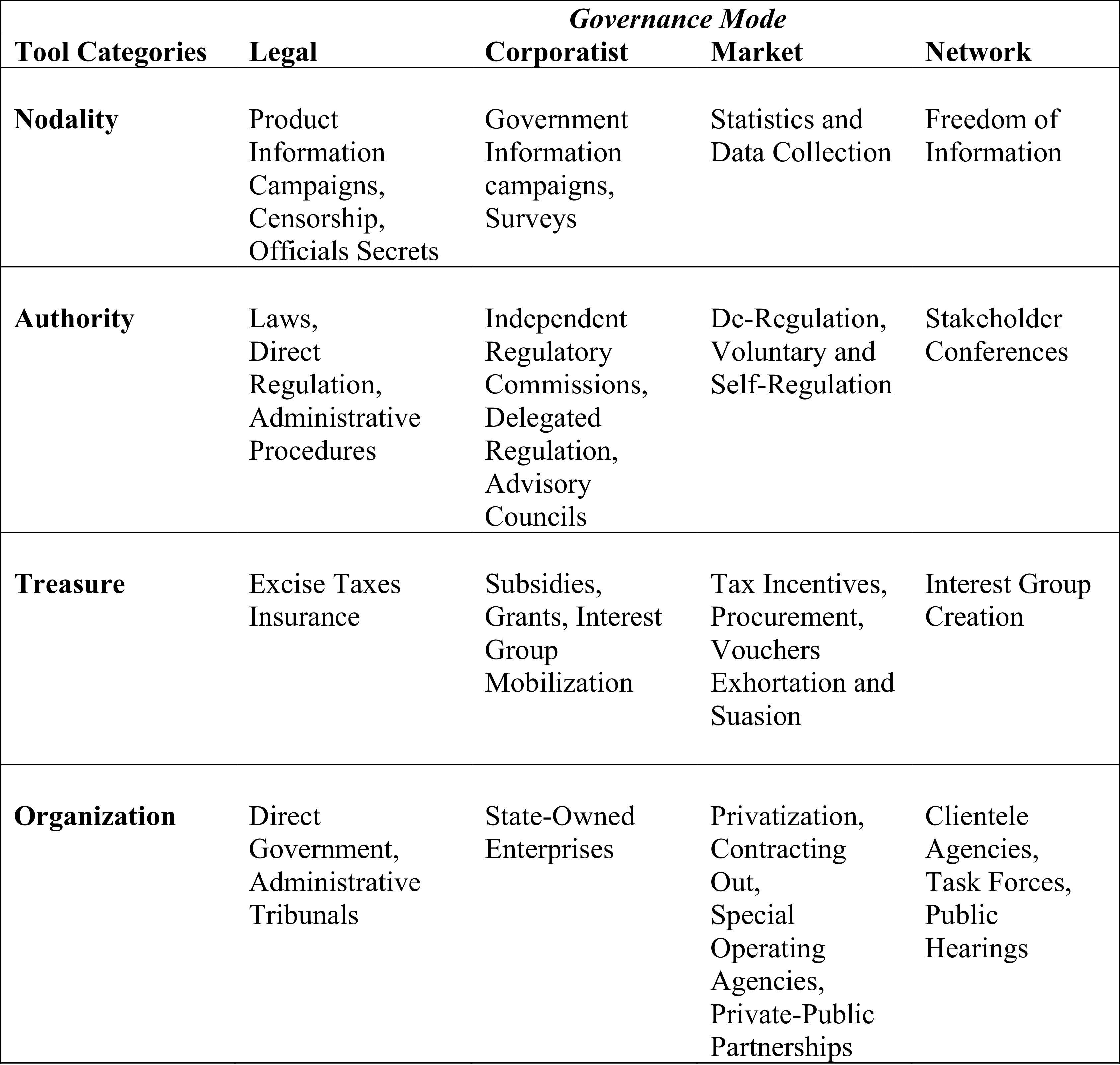
The causal logic connecting governance modes to such preferences runs through what March and Olsen (Reference March and Olsen1989, Reference March and Olsen2004) call the “logic of appropriateness.” Within any established governance regime, certain categories of instruments come to be seen as the natural, legitimate, and institutionally congruent means of public action. Put differently, such tools are not necessarily chosen because they are the most technically efficient, but because they are consistent with the prevailing understandings of what kinds of state action are acceptable, what capacities the state possesses, and what relationships between state and society are considered normal and acceptable.
In a legal governance mode characterized by active courts and adversarial process, for example, regulation and litigation-based tools are not merely chosen; they are expected. In a corporatist mode where state-industry bargaining is institutionalized, subsidies, delegated regulation, and state-owned enterprises are the instruments that fit the existing relational architecture. These expectations become self-reinforcing: bureaucratic capacity develops around preferred tools, expertise accumulates, interest groups orient themselves to existing instrument types, and the costs of switching to a different genre rise.
This resource-based logic also forecloses a circularity that might otherwise attach to a purely output-oriented conception of policy style and its relationship to instrument choices. Defined only as the recurring instrument preference itself, an output-oriented style risks reducing to the claim that governments prefer what they persistently choose, a re-description rather than an explanation. What breaks that circularity is the process-oriented mechanism specified above: a governance mode’s characteristic relationship between state and societal actors determines which kinds of governing resources – such as authority, treasure, organization, or nodality – are institutionally available and legitimated for routine use, and it is this resource congruence, not the observed pattern of choices itself, that predicts which specific tool a given mode would favor. Thus, an adversarial, court-centered mode of governance, for example, privileges authority: its characteristic state-society relationship already operates through binding, enforceable rules, and this is what constitutes its policy style. Similarly, a bargaining-centered corporatist mode privileges treasure as its participants have already eschewed more coercive tools or less relevant informational ones. Delegated authority is a characteristic feature of its style of operation because this relationship already colors the basis of negotiated material exchange. Its tool preferences are therefore also derived from its process characteristics rather than merely observed after the fact and relabeled as an explanation of that character.
Linking process styles to output styles in this way allows the notion of a policy style to become a more useful term for describing long-term patterns found in the substance of policy-making than does a more indirect process or output orientation on its own. In either form, however, the general idea is the same: that policy-making tends to develop in such a way that the same actors, institutions, instruments, and governing ideas dominate policy-making for extended periods of time, infusing a country or policy sector with both a consistent set of policy tools and a typical policy process (Howlett and Tosun Reference Howlett, Tosun, Howlett and Tosun2019; Tosun et al. Reference Tosun, Galanti and Howlett2022; Tosun and Howlett Reference Tosun and Howlett2022).
This distinction is not merely terminological: as we argue below, it has direct consequences for how clearly and specifically the styles concept can be linked to persistent policy tool preferences. The process-oriented conception, while valuable, is insufficient for this analytical task since it describes how decisions are reached rather than which instruments are chosen; a government’s decision-making process can remain stable for decades while still leaving open several compatible tool choices. The output-oriented conception, in turn, is more directly useful for present purposes because it names the recurring instrument preference itself, although on its own it offers no account for why that preference took hold or why it persists, treating the pattern of choices as an observation rather than as the outcome of an identifiable governing logic unless it is anchored, as set out above, to the resource-congruence logic of the governance mode itself.
Combining the process and output styles is therefore not simply additive; it is what converts an observed pattern into a testable claim. The process-oriented dimension supplies the causal mechanism, a governance mode’s characteristic way of making decisions, while the output-oriented dimension supplies the outcome to be predicted, the kind of tool that mode will favor. Read together, they can generate specific, falsifiable propositions about choices that neither account can produce on its own: for instance, that a given process style (e.g., an anticipatory, state-led mode of decision-making) should reliably co-occur with a given genre of tool (e.g., authority-based instruments), and that a persistent mismatch between the two, or a shift in one without the other, is itself often evidence of an unstable or transitional style. It is this combined formulation, developed further below through a distinction with respect to the nature of policy tools, that allows the concept of a policy style to move from a descriptive label for continuity to a source of testable predictions about future instrument choice.
Applying a styles logic to instrument choices: Distinguishing between tool genres, variations, and calibrations
Before proceeding any further, however, it is necessary to clarify the different aspects of policy tools and what it is that a style explains. Here we can note that a tool can be defined in several different ways. At one level, a tool’s genre relates to the broad category of governing resource it draws upon: regulation, public enterprise, treasury-based instruments such as subsidies or taxes, or informational instruments which rely, in turn, on the authoritative, organizational, financial or informational resources available to governments (Hood Reference Hood1986; Hood and Margetts Reference Hood and Margetts2007). A genre thus reflects the fundamental type of state action taken, independent of its specific institutional form.
A tool’s variation, on the other hand, is the specific institutional form through which a genre is operationalized in a given setting; for example, an authority-endowed independent regulatory agency and a system of delegated professional self-regulation are two different variations within the genre of regulation.
A tool’s calibration can then be said to be the set of specific design parameters operating within any given variation: such as the number of commissioners on a regulatory board, the length of their terms, the size of a subsidy, or the stringency of an emissions standard.
The three tiers are of course nested: each variation instantiates a genre, and each calibration adjusts a variation, but a change at one level does not necessarily imply a change at another: a government can recalibrate a tool, or even swap one variation for another, without altering its genre-level preference.
The categories used to populate each tier are not proposed here for the first time; they draw on and consolidate existing typologies in the tools-of-government literature. At the genre level, Hood’s (Reference Hood1986) and Hood and Margetts’ (Reference Hood and Margetts2007) NATO framework – distinguishing Nodality (information), Authority (law), Treasure (financial incentives), and Organization (institutional design) as the fundamental governing resources – is the direct precedent for the categories used in Figure 2, and we retain this structure rather than propose a new one.Footnote 1
Diversity at the variation level is also well documented, if not always labeled as such. Within the regulatory genre alone, for example, comparative regulation scholarship distinguishes independent regulatory agencies, delegated self-regulatory bodies, voluntary or co-regulatory arrangements that combine public oversight with industry rule-making, and performance-based regimes that specify outcomes rather than procedures, with each variation carrying distinct implications for enforcement capacity and industry buy-in. Within the treasury genre, variation is very extensive and ranges from direct cash transfers to insurance back-stops, tax expenditures, user charges, and loan guarantees, to name only a few, each mobilizing the same underlying resource but through a different institutional mechanism.
Calibration-level diversity is by nature even more granular and tends to surface in the literature as an implementation-stage concern rather than a subject in its own right, for instance, in work which emphasizes the large number of possible calibrations and specifications such as provisions related to regulatory stringency, sunset clauses, phased implementation schedules, and eligibility thresholds among others (Howlett et al. Reference Howlett, Ramesh and Capano2024).
While sometimes the impact of policy styles on tool choices is said to occur at the level of calibrations or variations, in general, what is being referred to here as style-induced (long-term) tool preferences is typically general preferences for a category or “genre” of tools.
This is true of Lowi’s (Reference Lowi1964, Reference Lowi1972) analysis, for example, and can be seen in other examples. The approaches of the United States and the European Union (EU) to the precautionary principle, for instance, offer a preview of this logic in action (Sunstein Reference Sunstein2005). Both systems nominally endorse precaution and rely on the same underlying genre of instrument, authority-based, legally binding rules, yet the EU’s anticipatory governance mode has produced pre-emptive rule-making that intervenes before harm occurs, while the U.S. reactive, legalistic mode relies on litigation-based responses after harm is demonstrated. This illustrates genre-level stability: both jurisdictions remain committed to authority-based instruments, combined with a persistent variation-level divergence in institutional form and timing that has also proven to be durable and predictable despite frequent calibration-level adjustments on both sides.
Lowi’s (Reference Lowi1972) analysis of U.S. policy history illustrates this well: the preference he identifies for distributive tools in the 19th century, regulatory tools from the late 19th century onward, and redistributive instruments in the 20th century are genre-level preferences, within each of which considerable variation in specific institutional designs exists. Like Lowi (Reference Lowi1972), Hood (Reference Hood1986) too does not explicitly describe why a preference for a specific category of tool might persist over time, but matching his model to thinking about a policy style suggests a major factor in instrument choices is the manner in which specific categories of tools match the overall logic of long-term institutional or governance arrangements and capacities. Genre preferences persist because bureaucratic expertise, interest group alignments, and legal frameworks all co-evolve around the preferred genre, creating resources, capacities, and path dependencies and raising the switching costs of adopting a different category of instrument, thereby entrenching the preference over time.
Genre-level preferences of this type are durable in a way that variation and calibration-level choices are not. A government may create or abolish a regulatory agency, raise or lower a tax rate, tighten or loosen a regulatory standard, or expand or contract a subsidy program without altering its underlying style. Such variation and calibration changes may be frequent, highly politicized, and responsive to short-term electoral or economic pressures. Genre-level preferences, by contrast, change rarely and typically only when the governance mode itself is reconfigured – as when a shift from corporatist to market-based governance, as documented in post-war Europe, is accompanied by a move away from state-owned enterprises and subsidies toward contracting-out, deregulation, and market mechanisms (Majone Reference Majone1997).
The COVID-19 pandemic provides a further illustration of this phenomenon at the genre level. Capano et al. (Reference Capano, Howlett, Jarvis, Ramesh and Goyal2020) and Zahariadis et al. (Reference Zahariadis, Petridou, Exadaktylos and Sparf2022), for example, each found that despite facing the same external shock, centralized, hierarchical governance systems in different countries consistently reached for authority-genre instruments – top-down mandates and direct state intervention – while more decentralized, high-trust systems, consistent with a network governance mode, drew on nodality- and treasure-genre tools such as voluntary compliance frameworks and broad fiscal transfers. Variation- and calibration-level choices, of course, differed widely within each cluster, but genre preferences remained stable and predictable.
In practice, identifying genre-level preferences requires looking beyond individual tool choices to the pattern of choices across policy domains and administrations. When the same broad category of instrument is repeatedly selected across sectors and over decades, this is evidence of a genre-level style preference. When variation within a genre changes substantially while the genre itself remains stable, this is evidence of stylistic continuity at the genre level with flexibility below it. And when a government begins systematically selecting instruments from a different genre, this signals a potential shift in governance mode and warrants investigation of the deeper institutional changes driving it.
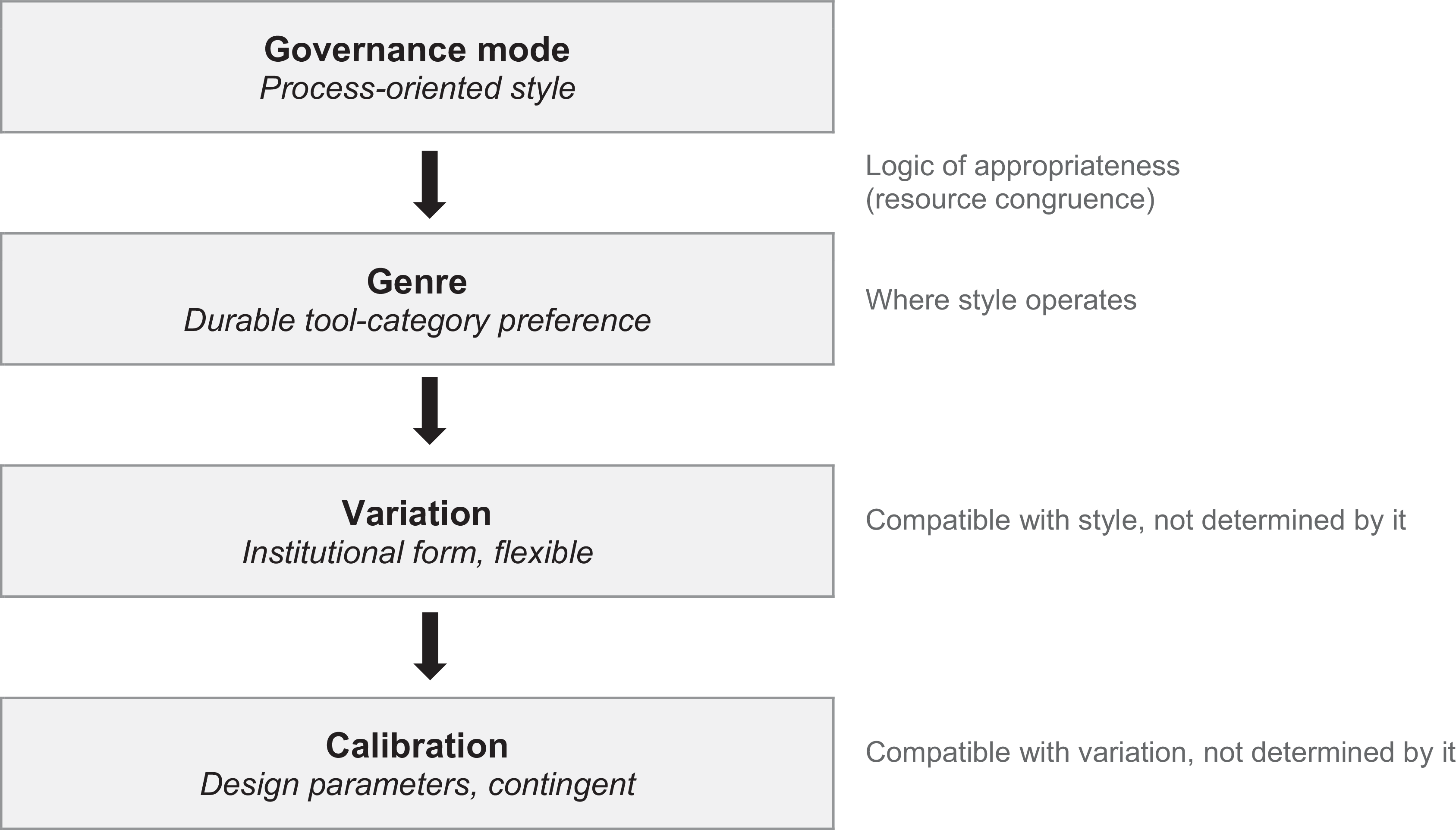
Figure 3 illustrates how a governance mode’s characteristic decision-making process (process-oriented style) generates, via the logic of appropriateness (March and Olsen Reference March and Olsen1989, Reference March and Olsen2004), a durable preference for a genre of tool (output-oriented style). Tool variation and calibration choices which operationalize that genre preference may vary widely but do so without signaling a change in style.
Linking process- and output-oriented policy styles to the typology. Notes: Own elaboration.

The logic cascades from top to bottom. A governance mode’s characteristic decision-making process or style – anticipatory or reactive, consensus-seeking or imposed – generates, via the logic of appropriateness, a durable preference for one genre of tool over others, thus explaining why an anticipatory, state-led mode gravitates toward authority-based instruments, for example, while a reactive, market-oriented mode gravitates toward treasury-based ones.
This is where a policy style operates, and where its influence on instrument choices is durable. Variation and calibration sit downstream of that genre-level preference: a government can switch from an independent regulatory agency to a system of delegated self-regulation, or tighten and loosen a subsidy’s terms, without either choice signaling a change in style, because both remain compatible with the genre-level preference above them.
Conclusion and the way forward
In this article we have argued that understanding the persistence of policy tool choices can be advanced by distinguishing carefully between two conceptions of a policy style, that is, process-oriented and output-oriented styles, and between the three levels at which tool choices are made: genre, variation, and calibration. These distinctions have direct consequences for how the styles concept helps explain and predict instrument preferences over time.
Traditional process-oriented conceptions of policy style found in the Richardson et al. inspired literature illuminate the procedural context within which tool choices occur. This perspective contends that policy-making is shaped by durable actor relationships, institutional arrangements, and decision-making routines that carry forward over time. However, it leaves the connection to specific tool choices underspecified. The same process style is, in principle, compatible with several different kinds of instruments, from direct regulation to nationalization. Process styles are thus best understood as background conditions for understanding why tool preferences persist, rather than sufficient explanations of it.
Output-oriented conceptions, on the other hand, can do the heavier explanatory lifting. By linking governance modes directly to characteristic instrument repertoires at the genre level, they generate specific predictions: such as that a legal governance regime will tend toward laws, direct regulation, and excise taxes; a corporatist one toward state-owned enterprises, delegated regulation, and subsidies; a market-based one toward contracting-out, tax incentives, and voluntary mechanisms; and a network-based one toward consultation instruments, clientele agencies, and access-to-information provisions (see Figure 2). However, they require a process component if this explanation is not to be tautological.
It is important to note, however, that the influence of policy styles operates foremost at the level of genres rather than at the level of specific design variations or the fine-grained calibrations of tools within those categories (see Figure 3). Recognizing this distinction is essential. A government may vary the stringency of its regulations or adjust the rate of a tax without changing its underlying style; but a sustained shift away from regulatory tools toward market-based mechanisms, or from direct delivery toward third-party governance, signals something deeper, namely a change in governance mode itself.
In this view, genre-level tool choices are neither contingent nor idiosyncratic ones. Rather, they reflect socially and often institutionally embedded understandings of which kinds of governing instruments are considered legitimate, feasible, and normal within a given governance regime. Tool types are selected not primarily because they are the most efficient means to a given end, but because they are congruent with the overall logic of how the state is expected to act in a given setting and in this sense are heavily path dependent.
This is not to say that they do not change, and changes in genres can be linked to changes in styles of the kind of transformation that Majone (Reference Majone1997) traced in post-war European governance, and that Salamon’s (Reference Salamon2002) third-party governance hypothesis anticipated more broadly in the United States and elsewhere in the late 20th and early 21st centuries. The kind of analysis developed here provides the clarifications and concepts needed to explain and assess the impact of such changes.
This perspective on instrument choices carries two important additional implications which merit repeating. First, it reframes the question of policy stability in tool choices. Rather than treating continuity as the outcome of blocking mechanisms, it positions stability as the default product of governmental arrangements, including tool preferences, whose internal logic consistently favors certain kinds of actions. Change, in this view, requires not merely a shift in political circumstances but a reconfiguration of a governance mode itself. Second, it provides a basis for forecasting tool use. The pattern noted above between the United States and the EU in their operationalization of the precautionary principle illustrates this: both systems nominally endorse precaution and rely on the same authority-based genre of instrument, but the EU’s anticipatory, state-led policy style produces pre-emptive rule-making that intervenes before harm occurs, while the U.S. reactive, legalistic style relies on litigation-based responses after harm is demonstrated (Sunstein Reference Sunstein2005). The genre remains constant across both systems; what differs, predictably and persistently, is the variation through which that genre is operationalized.
This analysis is useful not just for retroactive analyses but also for prospective ones. It is precisely this kind of genre-related pattern which is playing out concretely at the moment, for example, in discussions about the different kinds of tools being developed in each jurisdiction toward the regulation of artificial intelligence. The EU’s anticipatory style applies a comprehensive, pre-emptive rule set, while the United States intervenes legislatively only when specific risks are clearly demonstrated (Harcourt et al. Reference Harcourt, Radaelli and Trein2026), both remaining within an authority-based genre while diverging predictably at the variation level. An analysis based on policy styles predicts this pattern, and further systematic comparison across additional cases and policy domains, including cases where genre-level divergence, rather than variation-level divergence, is at stake, offers a productive research agenda for further empirical work in this area.
Data availability statement
This study does not employ statistical methods and no replication materials are available.
Acknowledgements
We are grateful to two anonymous reviewers for their constructive comments.


 Open access

