Introduction
In the 1990s, commercialization of rechargeable batteries containing metallic lithium anodes was abandoned due to unexpected and dangerous failures.Reference Brandt1 With rapid improvements in and development of Li-ion batteries, there was a good alternative that has satisfied the largest battery markets for the last two decades. Lithium metal batteries are now again being examined because of the potential to significantly improve the energy density and performance for a variety of applications.
This article explores some of the promising approaches to stabilize the lithium-metal anode, such that it will maintain low resistance, full capacity, dense and compact structure, and uniform distribution along the anode for a long and safe battery cycle life. Any tendencies of the lithium to roughen or form irregular features that allow for continuous reaction with the electrolyte or impurities need to be avoided. Such processes can lead to electrochemically dead or disconnected lithium, decreasing capacity and increasing the possibility of dangerous reactions under unforeseen circumstances. Before turning to solid-state batteries, recent work to stabilize lithium metal within conventional battery architecture through interface layers and new formulations of the liquid electrolytes are noted. The references cited throughout this article are just illustrative with no attempt to capture the entire scope of interesting activities and publications in this field.
Strategy to stabilize lithium within liquid electrolyte batteries
Typical liquid electrolyte lithium batteries are fabricated with extruded, rolled, or electroplated lithium as Cu/Li metal/liquid electrolyte in separator/cathode/Al. Since Li has high electronic conductivity, the Cu current collector may be omitted. During normal battery cycling, the Li dissolves and deposits at the anode, while reversibly reacting or intercalating at the cathode. For lithium, the relative kinetics of the side reactions, electrodeposition, and diffusion combine to make it nearly impossible to maintain a smooth, dense, unreacted surface, more so than for other electroplated metals, such as copper and zinc. The interface of the Li with the organic liquid electrolyte invariably reacts to form a layer, either native or engineered, often referred to as a solid-electrolyte interphase (SEI). The transport properties of this interphase are not well understood.Reference Choi and Aurbach2 For the SEI to passivate and protect the lithium from further reaction, it must be physically and chemically stable to survive large variations in the volume of lithium during battery cycling.
Because batteries are often constructed with a large excess quantity of Li, beyond that needed to balance the cathode capacity, problems at the Li metal anode often go undetected. Indeed, such batteries, referred to as half cells, are typically used to study the extended performance of battery cathode materials where loss of some lithium is inconsequential. But to develop commercial batteries with high energy density, the lithium-metal anodes must be balanced and well behaved for performance and safety.
Researchers have been thinking deeply about approaches to control the interface reactions, ion transport, and polarization effects at the lithium anode. Cycle life extends to hundreds of cycles in some examples, yet micrographs continue to show roughening of the lithium interface. In most cases, but not all, the electrolyte solvents are still flammable. Although researchers are aware that excess lithium must be avoided, it poses experimental difficulties to obtain and fabricate batteries with ultrathin lithium only a few tens of micrometers thick.
Adjusting the electrolyte chemistry
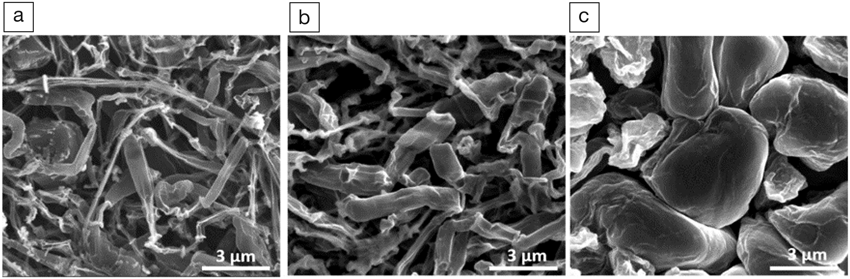
Adjusting the salts, concentrations, and additives of the liquid electrolyte is the simplest approach to maintain dense lithium and extend the cycle life. With highly concentrated electrolytes, the concentration of unassociated solvent molecules is low and limits the interface reactionsReference Qian, Henderson, Xu, Bhattacharya, Engelhard, Borodin and Zhang3,Reference Suo, Hu, Li, Armand and Chen4 Choosing different Li salts or using multiple salts is a means to control the polarization gradients and initiation of dendrites.Reference Li, Zheng, Ren, Engelhard, Zhao, Li, Zhang and Xu5 For example, improved lithium morphology with different electrolyte solutions is evident as variation in the surface area, size, and shape of the lithium particles shown in Figure 1. While the improved electrolyte maintains a denser lithium after 100 cycles, Figure1c, there was still significant roughening from the initial 250-µm-thick, dense lithium metal foil. Providing additives such as halides in the electrolyte is a way to enhance Li transport along the interface, while promoting smoother and denser Li deposition.Reference Lu, Tu and Archer6
Scanning electron microscope images showing a variation of roughened lithium morphology after 100 cycles in an ethylene carbonate + ethylmethyl carbonate (EC/EMC) electrolyte solution versus a Li-ion cathode. The electrolytes used two Li salts, different additives, and different blends of solvents. The difference between (a) and (b) is due to the additives in the electrolyte; the difference between (b) and (c) is due to a different ratio of the cosolvents EC/EMC. The lithium anode was fabricated of dense, 250-µm-thick Li foil from MTI Corporation. The anodes were washed with solvent and dried after removing from the battery. Reprinted with permission from Reference Reference Qian, Henderson, Xu, Bhattacharya, Engelhard, Borodin and Zhang3. © 2013 Nature Publishing Group.

Formation of barrier layers
Using a variety of materials, architectures, and processing methods, creative approaches have been proposed to stabilize the Li layer and interface. While many barriers are themselves electrolyte materials, some are conductors and insulators. For example, a layer formed by ionically and electronically conductive carbon nanospheres provides a stable, but flexible, structure to support the SEI layer and accommodate the volume cycling of Li.Reference Zheng, Lee, Liang, Lee, Yan, Yao, Wang, Li, Chu and Cui7 An insulating barrier of Al2O3, deposited by atomic layer deposition (ALD), was also found to seed formation of a stable SEI for an improved Li-S battery.Reference Kazyak, Wood and Dasgupta8 Novel gel electrolytes are being investigated as Li electrolyte coatings that have the ability to self-heal punctured holes or tears.Reference Munaoka, Yan, Lopez, To, Park, Tok, Cui and Bao9 This self-healing is quite new, so evidence of adequate cycling is not available.
An alternative to coatings formed on the lithium or separator surfaces prior to battery assembly is to form interphase layers in situ by controlling reaction of lithium with additives in the liquid electrolyte. When these layers are thicker, dense, homogeneous, single-ion conductors, the SEI proves to be an effective barrier against penetration of the liquid electrolyte. A good example is the addition of dissolved precursors to promote a limited reaction forming an amorphous 2-µm-thick SEI layer composed largely of Li3PS4.Reference Peng, Liang, Shyamsunder and Nazar10 Li3PS4 is known to be a highly conductive solid electrolyte. Because this is a single-ion conductor, the concentration polarization of anions is eliminated. When this barrier is formed in cells with a standard liquid electrolyte of a Li salt dissolved in a co-organic solvent solution, the cycling of both Li-Li and Li-Li4Ti5O12 cells exhibited lower resistance and longer life with less lithium roughening viewed by optical microscopy. Similarly, a sufficiently thick SEI layer has been formed by Li2S8 + LiNO3 addition to the liquid electrolyte;Reference Li, Yao, Yan, Zheng, Liang, Chiang and Cui11 this also stabilizes the Li anode interface and prolongs dendrite-free cycle life.
While these findings are encouraging, batteries may still be subject to failure as the electrolyte composition changes over the cycle life of the battery, or when the barrier is physically breached by, for example, lithium depositing through cracks in the SEI. Because these batteries still contain reactive and generally flammable liquids, it is hard to be fully confident of their safety. Solid-state batteries are the best option to ensure safety, and they may also provide for higher energy density if the volume and mass of the solid electrolyte is substantially less than that of the liquid-filled separator.
Strategy to stabilize lithium anodes in solid-state batteries
There is a great deal of discussion in the literature and press about the opportunities for solid-state batteries,Reference Reisch12,Reference Robinson13 some unfortunately exaggerated. The challenges to produce a practical solid-state battery are large and there is still no solid electrolyte material to fully satisfy the requirements. Nevertheless, the opportunity is compelling, and new and improved solid electrolytes and fabrication methods are being identified.
In a solid-state battery, the use of a thin, stable solid electrolyte at the active surface of the Li is a reliable means to limit the amount of extra Li. Further, it allows battery designers to maximize the energy density by avoiding other host or barrier materials, maintain a dense, uniform Li structure, use Li as the current collector to further save cost/mass, and eliminate dangerous liquids and finely divided lithium particulates from the system. It is important to control the other side of the lithium sheet as well—the side opposite the solid electrolyte —whether with a current collector, a second electrolyte layer, or a thin hermetic barrier coating. It is just as unacceptable to lose Li due to reaction, dissolution, or whisker formation at the current collector, as it is for the Li to roughen and react at the electrolyte interface.
Ideal lithium-solid-electrolyte performance
Before discussing specific materials and performance, it is worth considering what would be optimal. A rigorous answer is not available, to our best knowledge, so this view is qualitative. Ideally, Li would be added and removed at the interface layer by one full atomic layer at a time at high enough rates and duration to meet expectations for pulsed and continuous operation. The interface would effectively inhibit dendrite nucleation and growth. By maintaining a near perfect contact associated with good wetting and uniform transport, there may be no need for mechanical pressure (stack pressure) to force the Li against the solid electrolyte.
For uniform reaction along the interface with a low interface resistance, both sides of the interface should be homogeneous, free of impurities and voids, and have well-matched concentrations of mobile lithium with no large variation in lithium diffusivity due to the microstructure. The reaction requires available electrons for charge transfer and defect or lattice sites that can readily accommodate lithium as it moves across the interface. Topologically, the interface should be smooth with no cracks, crevices, pits, or grooves that could become sites for focused current and the resulting lithium pressure that may cause crack growth and failure. If the interface has a reaction layer, as most interfaces will, the ideal layer would be thin, passivating and provide a path for Li to move across and along the interface. Indeed, facile lithium diffusion along the interface and self-diffusion in the bulk are likely essential to compensate for the inhomogeneities of the interface.
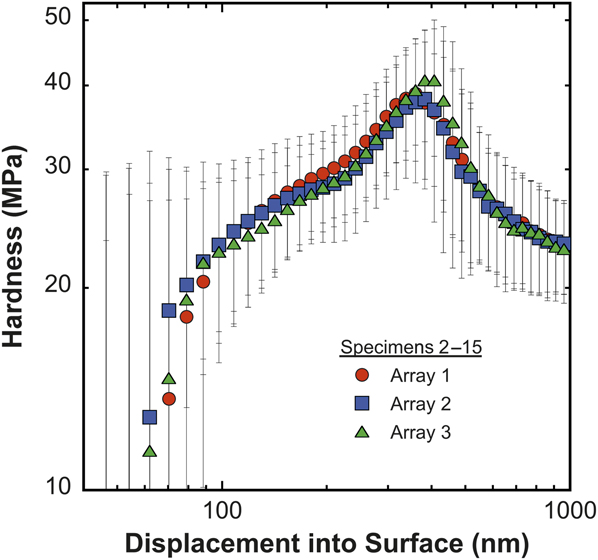
Considering the mechanical stability of the interface and its ability to inhibit lithium dendrite formation, the key guiding paper for many years has been the assessment of Monroe and Newman.Reference Monroe and Newman14 This model was intended to address, and works well for, lithium containing polymer electrolytes similar to poly(ethylene oxide).Reference Stone, Mullin, Teran, Hallinan, Minor, Hexemer and Balsara15 Newer works are being published to address the interfaces of inorganic crystalline and glassy electrolytes with lithiumReference Porz, Swamy, Sheldon, Rettenwander, Fromling, Thaman, Berendts, Uecker, Carter and Chiang16 and also the mechanical properties of lithium metal as functions of the length scale and strain rates.Reference Herbert, Hackney, Dudney and Phani17–Reference Xu, Ahmad, Aryanfar, Viswanathan and Greer20 These materials properties play important roles in stabilizing the lithium metal. An interesting observation is that the hardness determined for the thin lithium films using nanoindentation is much larger than the yield strength (∼0.5 MPa) of bulk polycrystalline lithium (see Figure 2).Reference Herbert, Hackney, Thole, Dudney and Phani18
Nanoindentation of thin lithium films revealing that the pressure lithium can support (i.e., the hardness), is surprisingly high and varies with depth from the surface. Results are averages for three different arrays, of 100 indents each, for different Li films and areas.Reference Porz, Swamy, Sheldon, Rettenwander, Fromling, Thaman, Berendts, Uecker, Carter and Chiang16

Thin-film batteries with lithium phosphorus oxynitride-stabilized lithium metal anode
Evidence for high ion currents over extended cycling at Oak Ridge National Laboratory (ORNL) and other laboratories suggest that thin-film batteries can come close to an ideal layer-by-layer exchange of lithium at the anode–solid-electrolyte interface. However, an important caveat is that these batteries are indeed very thin, so the amount of lithium moved per cycle is usually less than a micrometer. For many battery applications, the usable lithium capacity must be equivalent to a 10–50-µm-thick layer of lithium.
Thin-film batteries are fabricated by vapor deposition processes to yield battery components with thicknesses on the scale of micrometers. As developed at ORNL, the electrolyte is a lithium phosphorus oxynitride (LiPON) glass that is formed by sputter deposition in a nitrogen plasma or by alternative plasma assisted processes. More recently, the LiPON layer has been grown by ALD, with nitrogen addition from a plasma, which can achieve a conductive, amorphous, and conformal coating.Reference Kozen, Pearse, Lin, Noked and Rubloff21 The lithium layer in the thin-film battery is typically less than 3-µm thick, deposited by thermal vaporization in vacuum. This lithium is believed to be pure and dense, with full coverage of the electrolyte surface. Once deposited, the lithium protects the active solid-electrolyte interface from contamination.
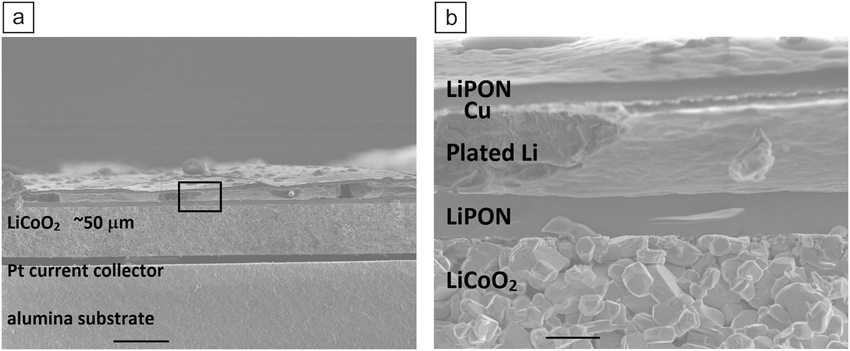
The lithium anode can also be formed as lithium from the thin-film cathode plates at the copper or nickel current collector.Reference Neudecker, Dudney and Bates22 The fact that such a battery, with no excess lithium, has good capacity retention for many cycles demonstrates the stability of the materials and structure. It is difficult to isolate the Li–LiPON interface resistance from the other bulk and interface components, but for a 1-cmReference Choi and Aurbach2 area, this interface resistance is likely only a few ohms. Typically, a thin-film battery has a total internal resistance of <100 ohms for a 1-cmReference Choi and Aurbach2 active area. Some literature claiming more resistive interfaces, or unusual features at the interfaces, may simply be poorly made interfaces. Figure 3 shows a cross section of an 8-µm-thick layer of Li plated during the first charge with a particularly thick, sintered cathode. While this battery did not cycle well, it shows that the plated Li is dense and uniform, with a thickness that agrees with the net charge passed through the battery.
(a) In situ lithium deposition from the LiCoO2 sintered cathode. The lithium is protected by overlying copper + lithium phosphorus oxynitride (LiPON) films. The lithium thickness corresponds to the charge capacity, achieving approximately a 50% state of charge for LiCoO2. Scale bar = 50 µm. (b) Box area in (a) is expanded for view of lithium plated between the LiPON and copper films upon charging the battery. Scale bar = 5 µm. Courtesy of Y. Kim and N. Dudney.

High current densities can be achieved with thin-film batteries,Reference Dudney23 again suggesting a well-behaved lithium anode with no dendrites formed through the electrolyte, but this is only demonstrated for relatively short times due to limited cathode film thicknesses. Companies are developing thin-film batteries with much thicker cathodes than those achieved at ORNL, greatly increasing the active lithium thickness. For example, Front Edge Technology Inc. has developed 0.5mAh/cm2 NanoEnergy cells.24
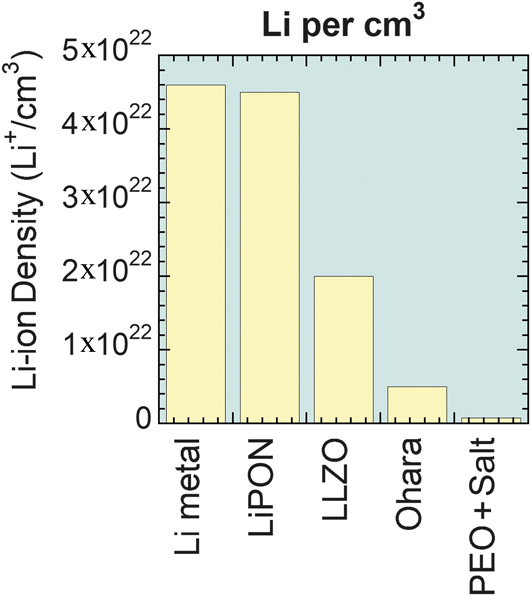
An interesting observation for LiPON and other solid electrolytes is shown in Figure 4, based on typical values for the composition and theoretical densities of the solid electrolytes. It is evident that the lithium-ion density in LiPON is nearly that of the atom density in lithium metal. Most other solid electrolytes have a lower lithium concentration. Experimental evaluation of the importance of this lithium concentration to the interface resistance and lithium cycling would be valuable, but likely difficult to separate from other factors that affect the performance.
The number of lithium ions per cm3 for selected solid electrolytes and lithium metal calculated from typical densities and compositions from the literature. Here, LLZO is a doped form of Li7La3Zr2O12; Ohara is a commercial form of Li1+x+yAlxTi2–xSiyP3–yO12; and PEO + salt is a generic composition of poly(ethylene oxide) with a dissolved salt, such as Li trifluoromethanesulfonate.

Block-copolymer stabilized lithium metal anodes
Another battery showing good stabilization and extended cycling of the lithium metal anode is fabricated with a polystyrene-block-poly(ethylene oxide) electrolyte, known as SEO or commercially as SEEO. Performance studies of this electrolyteReference Singh, Odusanya, Wilmes, Eitouni, Gomez, Patel, Chen, Park, Fragouli, Iatrou, Hadjichristidis, Cookson and Balsara25 with variations in the polymer molecular weights and hence the shear modulus have provided good evidence for the design rule identified by Monroe and Newman that the polymer electrolyte needs to have a shear modulus more than twice that of the lithium metal to mechanically suppress the growth of dendrites that can eventually form shorts.Reference Monroe and Newman14
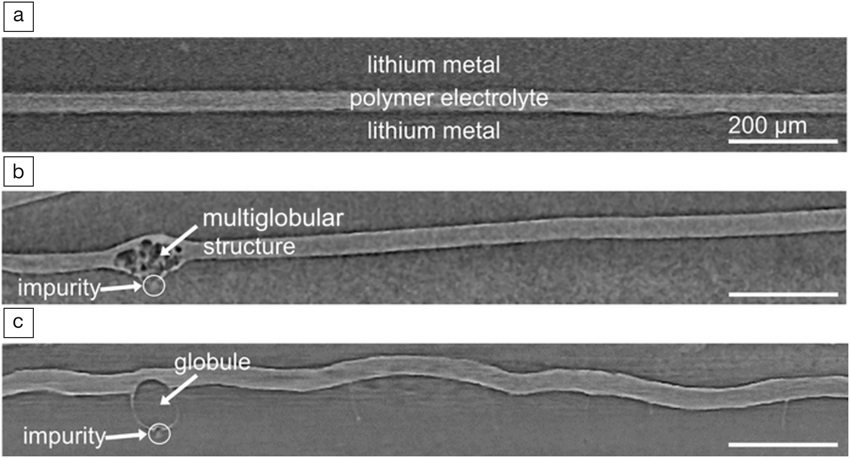
Another important issue demonstrated with this system is that the purity of the metal is critical for stabilizing the lithium. Balsara et al. present evidence that impurities in the lithium, triggered by oxygen-rich inclusions, grow to form larger and variously shaped globs during cycling and that these features eventually cause the shorts across the SEEO membrane.Reference Harry, Liao, Parkinson, Minor and Balsara26 Figure 5 shows the initiating defect and the structures that develop upon AC and DC cycling of the symmetric Li//Li battery. The commercial lithium used for this study is 99.9% purity, 150-µm thick,Reference Harry, Liao, Parkinson, Minor and Balsara26 which is about 5× thicker than required to balance most battery cathodes.
Cross-section slices from x-ray tomography imaging of the block-copolymer electrolyte sandwiched between thick lithium metal foils. The images show the structure prior to cycling (a), after cycling of lithium in both directions (b), and after cycling lithium in just one direction, top to bottom (c). Scale bars = 200 µm. Reprinted with permission from Reference Reference Harry, Liao, Parkinson, Minor and Balsara26. © 2015 The Electrochemical Society.

Inclusion of oxygen upon laminating metal-supported films of lithium to the electrolyte is probably inevitable, but we need to consider other sources of impurities in the lithium metal and how these may redistribute or segregate because of the battery cycling. For a typical Li ingot with 99.9% purity (metal-base), eventual segregation of the 0.1% impurity may constitute a significant barrier if accumulated at the solid–electrolyte interface. The highest purity lithium in a solid-state battery is likely that extracted from the cathode, as the lithium is purified by passing through the solid electrolyte. Indeed, a solid electrolyte has been used to purify Li from a brine solution.Reference Mashtalir, Nguyen, Bodoin, Swonger and O’Brien27
Lithium metal stabilized with polycrystalline ceramic solid electrolytes
Several ceramic oxide and sulfide electrolytes have remarkably high room-temperature Li ionic conductivities and good stability with lithium metal. These superionic electrolyte materials are discussed in other articles in this issue.Reference Ceder, Ong and Wang28,Reference Hao, Han, Liang, Wang and Yao29 The performance of these solid electrolytes in batteries has improved rapidly in recent years, but research has been focused more on performance of the solid electrolyte and elimination of failures, and less on the evolution of the lithium metal with cycling.
With regard to the oxide solid electrolytes with the garnet crystalline structure, particularly Al-doped LLZO (Li7La3Zr2O12), the interface resistance of the Li metal electrode to the LLZO was reduced by orders of magnitude in recent work. Initially in the range of thousands of ohms, with attention to carefully cleaning, polishing, and thermal treatment, the interfacial resistance is now just a few ohms for a 1-cmReference Choi and Aurbach2 active area.Reference Sharafi, Kazyak, Davis, Yu, Thompson, Siegel, Dasgupta and Sakamoto30 This low interfacial resistance correlates with a higher adhesion energy of the lithium metal to the ceramic surface, as probed under tension.Reference Wang and Sakamoto31 Separately, application of coatings to improve the wetting and ion transport at the Li interface have also proven useful.Reference Han, Gong, Fu, He, Hitz, Dai, Pearse, Liu, Wang, Rubloff, Mo, Thangadurai, Wachsman and Hu32,Reference Kato, Hayashi and Tatsumisago33 A third effective approach is to form a three-dimensional architecture to both provide a host structure for the lithium metal and also to increase the Li interface area and thereby reduce the current density.Reference Liu, Zhang, Xu, McOwen, Gong, Yang, Pastel, Xie, Fu, Dai, Chen, Wachsman and Hu34,Reference Thomas-Alyea35
This attention to reducing the LLZO–lithium interface resistance also correlates, but does not establish cause and effect, with decreases in the tendency for lithium to form conductive short-circuit paths. These shorts occur quite suddenly, spanning the millimeter-scale solid electrolyte thickness when the current or overpotential reaches a critical value. A reasonable model relates the mechanical pressure formed by lithium deposition confined within a surface flaw, such as a pit or scratch, with the fracture toughness and the critical size of the flaws.Reference Porz, Swamy, Sheldon, Rettenwander, Fromling, Thaman, Berendts, Uecker, Carter and Chiang16 The lithium simply cannot flow out of the flaw fast enough to relieve the pressure. There is also evidence for alternative models. For example, lithium may reduce to form metallic lithium clusters at defect sites within the ceramic, causing a sudden short-circuit path to form that is independent of initiation sites at the interface with the lithium metal.Reference Han, Westover, Yue, Fan, Wang, Chi, Leonard, Dudney, Wang and Wang36
It remains to be seen how the lithium morphology and distribution, and the interface structure evolve with extended cycling of batteries with the polycrystalline solid electrolytes under conditions that avoid the sudden short circuits. This has simply not been a focus of research so far. Work is underway to understand the effect of mechanical pressure to maintain the adhesion and density of the lithium metal contacting the ceramic surface. It is often presumed that stack pressure, the compressive force applied by the battery packaging or case, is needed to prevent formation of voids at the lithium near the interface, but direct evidence of such voids is hard to find, particularly along with relevant cycling at a low-resistance interface.
Cell designs to stabilize lithium-metal anodes
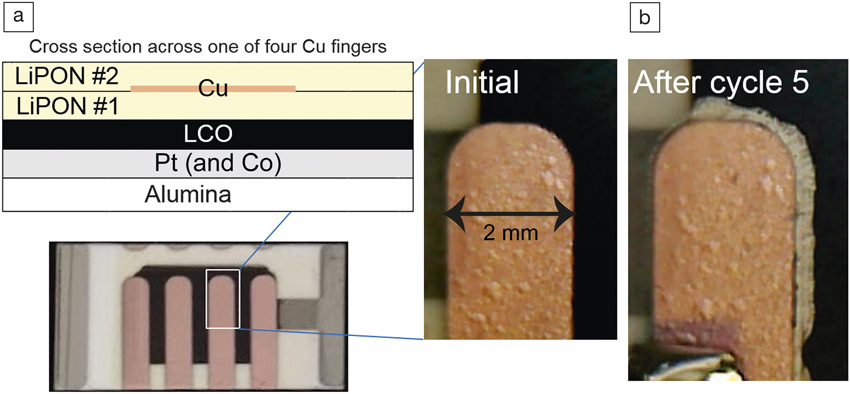
Redistribution of the lithium during cycling may occur on several length scales. Modeling has predicted a gradual movement of lithium along the 50-cm length of the lithium/separator interface for a liquid electrolyte cell.Reference Ferrese, Albertus, Christensen and Newman37 The Li moves toward the anode tab in response to the open-circuit voltage profile and concentration gradients in the cathode and electrolyte. While this is a small effect for most batteries, when the extra lithium in the cell is reduced to a minimum, such migration might become a factor altering the cycle life. Similarly, the lithium may spread laterally beyond the initial anode area if the cathode area is larger or offset from that of the anode. As shown in Figure 6, the lithium rim may extend rapidly along interfaces or surfaces, perhaps with unusual shapes that may become disconnected. At a smaller scale (∼100 µm), the lithium anode of the thin-film batteries gradually develops a modulated variation in the thickness with extended cycling that depends on the cathode and duty cycle.Reference Dudney38 While not fully understood, this instability is believed to require the formation and diffusion of lattice defects in the lithium metal for redistribution.
(a) Schematic cross section of the thin-film battery (not to scale) and a photograph of the uncycled battery with the black area being the LiCoO2 (LCO) cathode (2-µm thick), the transparent lithium phosphorus oxynitride (LiPON) (1 µm), and the four finger-shaped copper contacts. (b) After five cycles of the LiCoO2/LiPON/Cu battery, the photograph shows lithium plated well beyond the initial area of the copper contact. Courtesy of A. Westover and N. Dudney.

In other work, there is some evidence that lithium lattice defects, such as those that may coalesce to form voids, are created near the interface. The mechanisms need further study and testing of pragmatic solutions to control the lithium microstructure. For example, the question remains as to whether this effect can be reversed by completely stripping allReference Neudecker, Dudney and Bates22 of the lithium during battery discharge, as in Li-free batteries. A similar full removal of the lithium was also investigated to reform the lithium in liquid electrolyte cells. Periodic annealing or melting to reform the Li metal may also eliminate voids and other microstructural defects in the lithium. This could be accomplished with an embedded heater, as designed to facilitate rapid charge of Li-ion cells,Reference Yang, Zhang, Ge and Wang39 or without direct control by the use of gallium as a low melting temperature lithium alloy current collector.Reference Deshpande, Li, Cheng and Verbrugge40 These effects and others will be addressed as more lithium solid-state batteries are fabricated and cycled with thin lithium-metal anodes.
Summary
A recent publication by Albertus laid out the challenges for lithium-metal batteries to meet the performance requirements for grid and vehicle applications.Reference Albertus, Babinec, Litzelman and Newman41 This work identifies and evaluates four criteria: Li plating current density, capacity per charge, cumulative lifetime charge capacity, and fraction of available Li utilized per charge. Few batteries described in the literature come even close to the performance targets. The cost of electrolytes to stabilize the lithium metal are likewise far above what is needed to be marketable.
Albertus recommends that researchers restrict the amount of lithium used in their experimental batteries to better reveal the actual lithium stability and efficiency with cycling. It is also important to report cycling of lithium batteries to document the onset of failure. Particularly for lithium batteries containing liquid electrolytes, it is not enough to see that the cycle life is extended two or three times that of the baseline cells; it is also important to know when the cells fail and the nature of the lithium at failure, whether consumed or forming short circuit paths. This is true for solid-state batteries as well as we gain more experience with extended cycling. The cause of eventual battery failure tells a lot about the processes affecting the lithium metal and hence the safety of the device.
Acknowledgments
The author acknowledges US Department of Energy (DOE) supported work toward developing a fundamental understanding of the evolution and stabilization of the lithium metal anodes, directed by T. Duong who leads the Advanced Battery Materials Research and Battery500 Consortium programs of the Vehicles Technology Office, within the US DOE’s Office of Energy Efficiency & Renewable Energy.

Nancy Dudney is a researcher in the Materials Science and Technology Division at Oak Ridge National Laboratory (ORNL). She received her BS degree in chemistry from the College of William & Mary, and her PhD degree in ceramic materials science and engineering from the Massachusetts Institute of Technology. She began work at ORNL as a Wigner Fellow. Her research interests include lithium battery materials and architectures, thin-film materials, and composite electrolytes. She helped pioneer the discovery of lithium phosphorus oxynitride and the development of thin-film lithium batteries. She is a Fellow of The Electrochemical Society, an ORNL UT-Battelle Corporate Fellow, and a Battelle Distinguished Inventor. She has four R&D 100 Awards. Dudney can be reached by email at dudneynj@ornl.gov.