Introduction
The lexicon is an important domain of language that intersects with phonology, grammar, and literacy development. Growth in vocabulary is proposed to support phonological reorganization (Walley, Reference Walley1993), the emergence of grammar (Kohnert, Kan & Conboy, Reference Kohnert, Kan and Conboy2010; Marchman & Bates, Reference Marchman and Bates1994), and reading comprehension (Catts & Kamhi, Reference Catts and Kamhi2005). The central role of the lexicon in language and literacy development makes it an imperative goal in the study of bilingualism. The primary objective of this study is to profile lexical development in Mandarin–English bilingual children and to examine the effects of age, language, and modality on vocabulary growth. Two secondary objectives are to investigate the utility of parental rating of language proficiency and to study the relationship between language experience and lexical development. This study has implication for the assessment of bilingual Mandarin–English children, a rapidly increasing population in North America. In the following, we review the literature pertaining to each of the objectives.
Lexical development in bilinguals
Many studies on bilingual lexical development have focused on children who speak Spanish and English. In their pioneer work, Pearson, Fernández and Oller (Reference Pearson, Fernández and Oller1993) used The McArthur Communication Development Inventory (MCDI, Fenson et al., Reference Fenson, Dale, Reznick, Thal, Bates, Hartung, Pethick and Reilly1991) and its Spanish adaptation to document words known by bilingual toddlers. They calculated the children's total conceptual vocabulary by including all the words in one language plus the singlets in the other language (i.e., words representing concepts or linguistic functions not lexicalized in the first language). In other words, translation equivalents (e.g., the English word dog and its Spanish equivalent perro) were counted only once. The bilingual toddlers’ total conceptual vocabulary was comparable to the monolingual children's total vocabulary, indicating that children map concepts to lexical labels at a similar pace regardless of the number of languages they learn. In a follow-up study, Pearson, Fernández and Oller (Reference Pearson, Fernández and Oller1995) found that the degree of overlap (percent of translation equivalents) in a bilingual toddler's vocabulary is similar to the degree of overlap between the vocabularies of two monolingual children. Because bilingual children may use their two languages in different settings and for different purposes, lexical knowledge is distributed in the bilingual child's two languages. Distributed vocabulary knowledge was also evident in older children: in a category generation task, 68% of the responses generated by the 4–7-year-old Spanish–English bilingual children were singlets (Peña, Bedore & Zlatic-Giunta, Reference Peña, Bedore and Zlatic-Giunta2002). These results highlight the importance of assessing both languages in order to accurately capture the lexical knowledge of bilingual children.
A number of studies have investigated the rate of growth in vocabulary size (Cobo-Lewis, Pearson, Eilers & Umbel, Reference Cobo-Lewis, Pearson, Eilers, Umbel, Oller and Eilers2002; Hammer, Lawrence & Miccio, Reference Hammer, Lawrence and Miccio2008; Rodríguez, Díaz, Duran & Espinosa, Reference Rodríguez, Díaz, Duran and Espinosa1995; Winsler, Díaz, Espinosa & Rodríguez, Reference Winsler, Díaz, Espinosa and Rodríguez1999) and lexical processing skills (Kohnert & Bates, Reference Kohnert and Bates2002; Kohnert, Bates & Hernandez, Reference Kohnert, Bates and Hernandez1999) among Spanish–English bilingual children. The bilingual children in these studies demonstrated gains in both Spanish and English vocabulary size and lexical processing skills well into adolescence or even adulthood. Nevertheless, there was faster growth in English, the language of school and the greater community, than in Spanish, the home language, such that at some point in development there was a shift from Spanish dominance to English dominance. The timing of this shift is determined by factors such as onset of English schooling, home language usage patterns, modalities of testing (receptive versus expressive), and dependent measures (response accuracy versus speed).
Significant vocabulary growth in both languages was also found in a recent investigation of Welsh–English bilinguals (Gathercole & Thomas, Reference Gathercole and Thomas2009). However, growth in English was more robust in that regardless of home language background, speakers appeared to have developed equivalent and mature command of English. On the other hand, command of Welsh was directly correlated with the level of input in Welsh in the home and at school. The authors suggested that even though Wales has a stable bilingual community where children are exposed to both English and Welsh from an early age, either in the home or at school, or both, acquisition of the relatively non-dominant language may still be hampered when the level of input is suboptimal.
Lexical development in bilinguals who speak Asian languages has rarely been studied. An exception to this is Kan and Kohnert (Reference Kan and Kohnert2005), who compared picture naming and picture identification performance in younger and older preschoolers learning Hmong and English. Hmong is a Miao-Yao language spoken in Southeast Asia and Southern China. Similar to Mandarin, Hmong is a tonal language and has a classifier system for nouns. The participants were children of recent immigrants to the US and spoke Hmong at home, and were exposed to English through a bilingual preschool program. Results indicated that the older children outperformed the younger children in English, but not in Hmong. Differences between picture identification and picture naming were greater in Hmong than in English. These findings indicated rapid growth in English vocabulary after a relatively short period of English exposure; at the same time, lexical skills in Hmong stabilized. In addition, the children's composite vocabulary (or “total conceptual vocabulary”, Pearson et al., Reference Pearson, Fernández and Oller1993) was always higher than single language vocabulary, corroborating the distributed nature of the bilingual vocabulary. Finally, the authors calculated the percentage of translation equivalents and singlets in each child's composite vocabulary. The proportion of translation equivalents increased from the younger to the older children, suggesting that bilingual children may eventually possess translation equivalents for many concepts.
Parental rating of language proficiency
Parents are regarded as valuable and reliable sources of information in estimating a bilingual child's language development status. For example, in the domain of morphosyntax, Gutiérrez-Clellen and Kreiter (Reference Gutiérrez-Clellen and Kreiter2003) found significant correlation between parent reports of Spanish input at home and the percent of grammatical sentences in a story-telling task in eight-year-old bilingual Spanish–English children. In the domain of lexical semantics, Marchman and Martinez-Sussman (Reference Marchman and Martinez-Sussman2002) found high correlation between parent estimates (Spanish and English checklists) and behavioral measures (object naming, language sample) of vocabulary size in bilingual toddlers. Similarly, Bedore, Peña, Joyner and Macken (in press) found that parents were able to make judgments about Spanish and English, and their ratings were predictive of children's performance in both the lexical semantic and the morphosyntax domains. It is unclear whether these findings can be generalized to Mandarin–English bilinguals. However, the lack of appropriate assessment tools for this population renders parental reports particularly important.
The role of language experience in development
Language experience is comprised of both language exposure (in the form of input) and language practice (in the form of output). Although the two dimensions are highly correlated and are often treated as one unified variable in previous investigations, they appear to make independent contributions to different aspects of language and in different stages of development. Bohman, Bedore, Peña, Mendez-Perez and Gillam (Reference Bedore, Peña, Joyner and Macken2010) studied the contribution of language input and output together with other factors to language learning. They found that output in each language was related to higher scores on measures of semantics and morphosyntax but the relationships between language input and language scores were more complex. Spanish input correlated with Spanish semantics but did not significantly correlate with Spanish morphosyntax and English input correlated with English morphosyntax but did not significantly correlate with English semantics. These findings illustrate the value of breaking down language experience to investigate the contribution of each component to language growth.
The current study
The current study focuses on lexical development in a relatively understudied bilingual population – Mandarin–English – and samples a relatively wide age range – children between the ages of three and eight years. A picture naming task and a picture identification task were developed in Mandarin and in English to probe children's lexical knowledge. Similar to the Hmong–English bilingual community, the Mandarin–English community in the present study was young and dynamic. Mandarin, the minority language, is spoken mainly at home and receives very little support outside the home setting. We predicted that these factors may lead to stabilization in Mandarin skills at an early age. Specifically, whereas growth in English vocabulary was expected to be robust, growth in Mandarin vocabulary may be quite limited, especially in the expressive modality. To cast light on issues of assessment in this population, we calculated the size of composite vocabulary for each child and compared composite vocabulary with single language vocabulary. We also calculated the proportion of translation equivalents and singlets in the children's composite vocabulary system to track possible age-related changes in the cross-language distribution of lexical knowledge.
Second, to investigate the potential value of parent estimates of language proficiency, we examined the degree of correlation between parent ratings and child behavioral measures. Finally, we investigated the relationship between language experience (as indexed by age, input, and output) and vocabulary outcome to see how these various factors play out in the bilingual children's lexical learning.
Method
Participants
Thirty-five children (17 girls) participated in the study. All children resided in Austin, Texas, at the time of testing. Among them were 18 children between the ages of three and five (the younger group) and 17 children between the ages of six and eight (the older group). The primary caregiver (a parent) filled out a questionnaire (based on Gutiérrez-Clellen & Kreiter, Reference Gutiérrez-Clellen and Kreiter2003; and Restrepo, Reference Restrepo1998) regarding the child's language and educational history. Two children were raised in families where the father was a monolingual native speaker of English and the mother was a native speaker of Mandarin. All the other children were raised in families where both parents were native speakers of Mandarin or another Chinese dialect but spoke Mandarin fluently. All the parents except for the two monolingual English speakers reported speaking Mandarin only or a mixture of Mandarin and English to their children. For 33 out of the 35 children, English exposure began when the child was enrolled in daycare or preschool. According to the parents, some of the children also received Mandarin input at after-school Chinese language programs, where two-to-three–hour lessons (per week) were provided with the goal of teaching the children to read and write Chinese characters. As part of the questionnaire, the parents were asked to rate the child's Mandarin and English proficiency in the areas of vocabulary, grammar, sentence length, pronunciation, and listening comprehension using a five-point rating scale (1 = low proficiency, 5 = high proficiency). These ratings were averaged for each child to obtain an overall proficiency rating for each language. In addition, a bilingual investigator interviewed a parent to document the child's hour-by-hour language use on a typical weekday and a typical weekend day. Specifically, the parent was asked to describe the activities the child partakes of during every waking hour, who the other participant(s) is/are, if any, what language(s) the other participant uses, and what language(s) the child uses. This information was used to calculate the total number of waking hours in a typical week as well as the number of hours spent hearing and speaking each language. An estimate of the child's percentage of input and output in each language was subsequently derived. Detailed information about the participants is presented in Table 1.
Participant characteristics.

The two groups differed in age, t = 9.25, d.f. = 33, p < .001, but were comparable in maternal education, Mandarin input, Mandarin proficiency rating, and age of English exposure, all p > .10. The families were from middle socioeconomic backgrounds, as indexed by the mother's educational level. Despite a comparable level of Mandarin input, the older group tended to produce less output in Mandarin than the younger group, t = 1.95, d.f. = 33, p = .06. The older children also received higher English proficiency ratings than the younger children, t = 2.61, d.f. = 33, p = .01.
Stimuli and procedures
A picture identification task and a picture naming task were used to measure receptive and expressive vocabulary, respectively. The stimuli were selected from the MCDI (Fenson et al., Reference Fenson, Dale, Reznick, Thal, Bates, Hartung, Pethick and Reilly1991), two Chinese adaptations of the MCDI (Hao, Shu, Xing & Li, Reference Hao, Shu, Xing and Li2008; Tardif, Fletcher, Zhang, Liang & Zuo, Reference Tardif, Fletcher, Zhang, Liang and Zuo2008), a published study of English age of acquisition norms (Morrison, Chappell & Ellis, Reference Morrison, Chappell and Ellis1997), and existing studies of bilingual vocabulary test development for Armenian–English (Hovsepian & Johnson, Reference Hovsepian and Johnson2009) and Hmong–English (Kan & Kohnert, Reference Kan and Kohnert2005). The final set of target items meets the following criteria: (i) target items are labels of concrete objects or animate beings, (ii) target items have translation equivalents in Mandarin and English, and (iii) target items are culturally appropriate for Mandarin–English bilingual children growing up in North America according to the judgment of three adult bilinguals familiar with this population of children. A black-and-white line drawing was selected for each target using the International Picture Naming Project corpus (Szekely et al., Reference Szekely, Jacobsen, D'Amico, Devescovi, Andonova, Herron, Lu, Pechmann, Pléh, Wicha, Federmeier, Gerdjikova, Gutierrez, Hung, Hsu, Iyer, Kohnert, Mehotcheva, Orozco-Figueroa, Tzeng, Tzeng, Arévalo, Vargha, Butler, Buffington and Bates2004) and images from Google. The picture naming task consisted of 62 pictures. The picture identification task consisted of 65 arrays of pictures; each array included the target, a semantic foil, a phonological foil, and an unrelated foil. The target items were identical in Mandarin and English but different picture identification foils were selected in the two languages. None of the foils appeared more than once.
Target items for each task are presented in Appendices A and B.Footnote 1 An item analysis was conducted to examine inter-item variations. As seen in the appendices, there is a wide range of performance such that some items were correctly identified (e.g., “rice” in Mandarin and “paper” in English) or named (e.g., “flower” in English) by all participants and other items were not named by any children in one of the languages (e.g., “church” in Mandarin). Nevertheless, the items appeared to be within the scope of experience for these children. Therefore, no items were excluded in subsequent analyses.
The two tasks were administered in Mandarin and in English on two different days. The order of the tasks and languages of testing was counterbalanced within each participant group. Testing was conducted in a quiet space at the child's home, a research laboratory, or a public library by trained personnel who were native speakers of the respective language. In picture naming, the examiner pointed to the target picture and asked the child “What is it called?” in English or “ ” in Mandarin. The task began with five practice items to familiarize the child with the procedure. The number of correctly named items was recorded. The scoring allowed for alternative labels that reflect diminutive forms of speech (e.g.,
 and
 for the picture of a cup) or dialectal differences (e.g.,
 and
 for the picture of a star). In picture identification, the examiner pointed to four pictures of equal size, printed on letter-size paper and asked the child to “Point to ___.” in English or asked “
 ___?”(“Which one is ___?”) in Mandarin. The position of the targets and the foils on the page was rotated such that each type of items appeared in the four quadrants an equal number of times. There were three practice items.
Results
Mean scores on the two picture tasks for the younger and the older participants are shown in Table 2. A MANOVA was performed to examine the effect of age (younger, older), language (English, Mandarin, Composite), and modality (expressive, receptive) on vocabulary development. Composite scores were calculated by summing all correctly named/identified items in the two languages and counting translation equivalents only once. Results revealed three significant main effects and four interactions. The effect of age [F(1,33) = 17.32, p < .001, ŋ 2p = .34] indicated that the older children (M = .77, SE = .025) scored significantly higher than the younger children (M = .62, SE = .025). The effect of language [F(2,66) = 58.83, p < .001, ŋ 2p = .64] was attributed to a higher composite vocabulary score (M = .83, SE = .017) than the English score (M = .75, SE = .028), which was higher than the Mandarin score (M = .51, SE = .028). The effect of modality [F(1,33) = 437.88, p < .001, ŋ 2p = .93] reflected higher scores on the receptive task (M = .82, SE = .016) than on the expressive task (M = .57, SE = .021).
Mean proportion correct (standard deviation) in Picture Naming and Picture Identification as a function of age group and language.

Note: Within each group and each task, the presence and direction of significant differences (p < .01) among Mandarin, English, and Composite scores are denoted by the “<” and the “=” signs. Composite scores are significantly higher than Mandarin scores for both groups and both tasks.
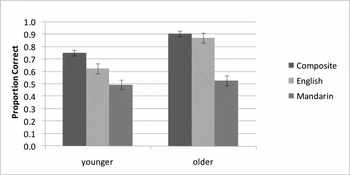
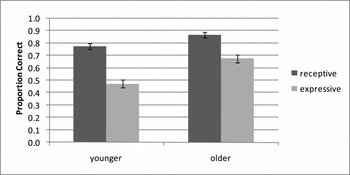
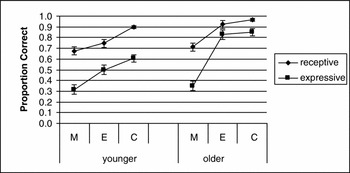
There were three two-way interactions between age and language [F(2,66) = 6.46, p = .003, ŋ 2p = .16], age and modality [F(1,33) = 21.54, p < .001, ŋ 2p = .39], and language and modality [F(2,66) = 45.95, p < .001, ŋ 2p = .58]. Pair-wise comparisons were conducted to further examine these interactions. The age × language interaction reflected a significant age group difference in English vocabulary (p < .001) and composite vocabulary (p = .03) and a lack of a difference in Mandarin vocabulary between the younger and the older groups. Furthermore, in the younger children, composite score was higher than both English (p = .05) and Mandarin scores (p < .001); in the older children, composite score was higher than Mandarin score (p < .001) but equal to English score (Figure 1). The age × modality interaction indicated a significant age group difference in picture naming scores (mean difference = .20, p < .001) and a non-significant age group difference in picture identification scores (mean difference = .09, p = .10) from the younger to the older group (Figure 2). The language × modality interaction was caused by a greater modality difference in Mandarin (.36) than in English (.17) and composite scores (.21) (Figure 3).
Mean proportion correct in the younger and older children by language of scoring. Error bars denote standard errors.

Mean proportion correct in the younger and older children by modality of testing. Error bars denote standard errors.

Mean proportion correct on picture identification (receptive task) and picture naming (expressive task) in the younger and older children. Error bars denote standard errors. M = Mandarin, E = English, C = Composite.

Furthermore, there was a three-way interaction among age, language, and modality [F(2,66) = 10.76, p < .001, ŋ 2p = .25]. As seen in Figure 3, between the younger and the older groups, the modality difference (.36 for both age groups) was consistently large in the children's weaker language (Mandarin); in the meantime, the modality gap decreased considerably across ages (.25 for younger children and .10 for older children) in the children's stronger language (English).
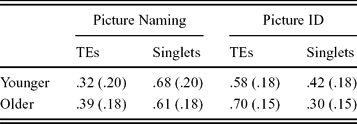
Next, the proportion of translation equivalents and singlets in each child's composite vocabulary was calculated. The means for the two groups are presented in Table 3. A 2 (age) × 2 (modality) ANOVA was conducted with the proportion of translation equivalents as the dependent variable. The younger and older children had roughly comparable proportions of translation equivalents in their vocabulary [F(1,33) = 2.89, p = .10, ŋ 2p = .08]. The effect of modality was significant [F(1,33) = 114.89, p < .001, ŋ 2p = .78], indicating a higher proportion of translation equivalents in the receptive (M = .64, SE = .028) than in the expressive modality (M = .35, SE = .032).
Mean proportion (standard deviations) of translation equivalents (TEs) and singlets as a function of age group and modality. ID = picture identification, Naming = picture naming.

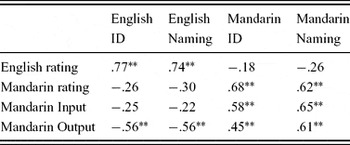
Correlational analyses were conducted to examine the relationship between parental rating of the children's proficiency and lexical outcome measures. The two age groups were collapsed in the correlation analyses. According to Table 4, there were significant within-language correlations between parent ratings and lexical performance. Parents were fairly good at evaluating their children's linguistic proficiency. The second set of correlations focused on the relationship between language experience and children's lexical knowledge. Mandarin input and output were entered as language experience variables and proportion correct on the four tasks were the lexical outcome variables. As shown in Table 4, input was correlated with performance on the Mandarin tasks, but not the English tasks. On the other hand, the effect of output was more widespread. Increased output in Mandarin (or inversely, decreased output in English) led to increased accuracy level on the Mandarin tasks and decreased performance on the English tasks.
Correlation coefficients between parental rating, language environment variables, and lexical performance. ID = picture identification, Naming = picture naming.

**p < .01
Last, two forward stepwise regressions were performed to investigate the factors that predicted performance in the two languages. In the first regression, age, English input, and English output were entered as predictors and English performance (with the identification and naming tasks combined) was the outcome variable. The model was significant [F(2,32) = 23.84, R2 = 59.8%, p < .001]. Age was entered in the first step, accounting for 47.5% of the variance; English output was entered in the second step, accounting for an additional 12.3% of the variance. English input was not a significant predictor. In the second regression, age, Mandarin input, and Mandarin output were entered as predictors and combined performance on the two Mandarin tasks was the outcome variable. The model was significant [F(2,32) = 19.48, R 2 = 54.9%, p < .001]. Mandarin input was entered in the first step, accounting for 48.7% of the variance; Mandarin output was entered in the second step, accounting for an additional 6.2% of the variance. Age was not a significant predictor.
Discussion
Mandarin–English bilingual children between three and eight years of age participated in a picture identification task and a picture naming task. Results revealed effects pertaining to age, language, and modality. Similar to previous studies of Hmong–English (Kan & Kohnert, Reference Kan and Kohnert2005), there was significant increase in English lexical comprehension and production but very limited evidence of growth in Mandarin skills. Furthermore, the receptive–expressive modality difference was greater in Mandarin, the weaker language, than in English, the stronger language. The modality difference in Mandarin was consistently wide from the younger to the older groups, but the modality difference in English became narrower with age and lexical growth. These cross-language discrepancies suggested a state of stagnation in the children's Mandarin lexical skills. Expressive language skills appeared to be especially vulnerable in the bilingual child's weaker language. Unlike the children in Kohnert and Bates (Reference Kohnert and Bates2002) and Kohnert et al. (Reference Kohnert, Bates and Hernandez1999), who were more proficient in Spanish at age 5 and gradually shifted to English dominance after 7–10 years of English exposure, the children in the present study were more proficient at naming pictures in English than Mandarin even at the age of 4 years 5 months. Also unlike the participants in previous studies of Spanish–English and Welsh–English bilinguals (e.g., Cobo-Lewis et al., Reference Cobo-Lewis, Pearson, Eilers, Umbel, Oller and Eilers2002; Gathercole & Thomas, Reference Gathercole and Thomas2009) who showed continued vocabulary growth even in their home language, the Mandarin–English bilinguals ceased to gain new Mandarin vocabulary during preschool years.
These differential patterns can be attributed to social-environmental differences experienced by these emerging bilinguals. The Welsh–English bilinguals grew up in a stable bilingual environment where there are many bilingual speakers of the two languages and where the minority language receives support in the educational system (Gathercole & Thomas, Reference Gathercole and Thomas2009). The Spanish–English bilinguals in some of the previous studies (e.g., Cobo-Lewis et al., Reference Cobo-Lewis, Pearson, Eilers, Umbel, Oller and Eilers2002) resided in strong Hispanic enclaves, where the minority language is vibrant, available, and spoken without social stigma (Pearson, Reference Pearson2007). In contrast, although the Mandarin–English bilingual children receive considerable and steady Mandarin input in the home, the lack of Mandarin exposure and practice in early-childhood educational programs and in the larger community poses great pressure of language assimilation and challenges for the maintenance of the home language (Wong-Fillmore, Reference Wong-Fillmore1991). Wong-Fillmore (Reference Wong-Fillmore1991) interviewed recent immigrant families of various linguistic and cultural backgrounds including families of Chinese descent. The parents expressed serious concerns regarding the retention of the home language as children came into contact with English through preschool programs. The parents reported progressive loss of the home language due to strong societal and peer influence towards a quick shift in language preference. The parents in our study echoed similar concerns on the decline of home language use in the face of increased English exposure. Many parents commented that their children retained some level of passive comprehension abilities in Mandarin but preferred to converse in English with their parents even when addressed in Mandarin.
De Houwer's (2007) study of Flemish families in Belgium and Pearson's (2007) summary report of Hispanic families in Miami, Florida, both suggested that approximately 75% of the children raised in bilingual households became bilingual. Our study, although not designed to yield such an estimate, suggests a much lower success rate in the current sample of Mandarin–English bilingual children despite that a majority of the households had two parents who spoke the minority language. This strikingly different pattern merits further investigations regarding the factors that affect bilingual outcomes. Beyond the obvious community support variable, there are numerous social (e.g., family structure, attitude towards the minority language), linguistic (e.g., language typology), and educational (e.g., literacy training, schooling) factors that likely bear an effect on language learning. The combined influence of these multiplex factors on Mandarin–English bilingualism in the US context warrants attention among bilingual researchers. Evidence in this regard may also prove valuable for a contrastive analysis on the routes to bilingualism in different societies.
An investigation of the cross-language distribution of vocabulary knowledge revealed that the younger and older children had similar proportions of translation equivalents in their composite vocabulary and both groups knew more translation equivalents in comprehension than in production. The modality difference replicated previous findings in Hmong–English bilinguals (Kan & Kohnert, Reference Kan and Kohnert2005) but the lack of developmental difference diverged from the Hmong–English study. This divergence may be due to differences in participant age and language experience. The current participants were older and had little bilingual preschool experience, both of which were associated with a shift to English preference. At this stage, the children appeared to concentrate on adding new English words to their lexicon and did not prioritize learning Mandarin labels for existing concepts.
Another important finding pertains to children's composite vocabulary. In the younger children, composite vocabulary was higher than either single language vocabulary. In the older children, composite vocabulary was almost identical to English vocabulary, suggesting that the older children's total conceptual vocabulary was driven by their vocabulary in English. Future investigations need to examine the effects of children's school experience as well as their literacy skills in English on bilingual children's vocabulary growth in both languages. This finding, although preliminary, suggests that it is imperative to assess both languages among preschoolers who speak Mandarin and English. In addition, when no assessment tools are available for children speaking minority languages, their English performance might serve as a baseline for ruling out (as opposed to “ruling in”) language disorders (Kohnert & Danahy, Reference Kohnert and Danahy2007).
The moderate correlations between parent ratings and children's performance on vocabulary tasks indicated that the parents were quite accurate in assessing their children's linguistic proficiency in both languages. These findings agree with previous studies (Bedore et al., in press Gutiérrez-Clellen & Kreiter, Reference Gutiérrez-Clellen and Kreiter2003; Marchman & Martinez-Sussman, Reference Marchman and Martinez-Sussman2002) and suggest that parents are reliable informants with respect to child language development. Teachers, second language educators, and special education personnel should take advantage of this information source and consult the parents when making decisions on educational placement and planning goals for learning.
The regression analyses revealed that different factors contributed to lexical growth in the two languages. Specifically, language input and output each made unique contributions to Mandarin lexical performance with input playing a primary role. Age was irrelevant to Mandarin performance. In contrast, language input was not a predictor in English lexical performance. Age and language output both predicted English performance with age explaining more variance than output. These results were similar to those in Bohman et al. (Reference Bohman, Bedore, Peña, Mendez-Perez and Gillam2010), where output played significant roles in both Spanish and English, and input only played significant roles in learning Spanish semantics. It may be that language output, or opportunities for practicing speaking a language, also contained opportunities in word retrieval, which was precisely the skill tested in the vocabulary tasks; hence its role in explaining performance in both languages. On the other hand, language input may serve a greater role in maintaining passive comprehension abilities in a non-dominant minority language; whereas age, an index of cumulative language experience, is the best predictor for performance in the dominant language.
The present study included a rather homogeneous sample of second-generation Chinese children from middle socioeconomic background. It is unclear if the current results can be generalized to Mandarin–English bilingual children from other socioeconomic backgrounds. Future studies with larger sample size may systematically examine the effects of multiple experiential factors, such as family socioeconomic status, type of bilinguals (simultaneous bilinguals, sequential bilinguals), age of English contact (early versus late sequential bilinguals), and home language use patterns (Mandarin only, mixed Mandarin and English) on language growth. Future studies may also examine specific parent–child interaction patterns as these have been found to influence children's maintenance of the heritage language (Oh, Reference Oh2003). In addition, future studies may target different geographic areas with higher concentration of Chinese speakers and possibly greater community support of the home language to examine the role of social-environmental factors on home language maintenance. Future studies of lexical retrieval in developing bilinguals may also want to control or systematically manipulate critical properties of the stimuli such as word class, name agreement, imageability, word frequency, age of acquisition, and visual complexity because these factors influence the accuracy and efficiency of word retrieval in both adults and children (e.g., Barry, Morrison & Ellis, Reference Barry, Morrison and Ellis1997; Cycowicz, Friedman & Rothstein, Reference Cycowicz, Friedman and Rothstein1997; Sheng & McGregor, Reference Sheng and McGregor2010).
To conclude, the present study revealed rapid growth in English vocabulary alongside swift language shift and early stagnation of Mandarin vocabulary skills among second-generation Chinese children. These findings are suggestive of home language disruption as a result of either school or community exposure to English. The present study has implications for language researchers and educators, and opens many avenues for future research.