In 1585, two Lutheran women marched into a Catholic church in Michelsdorf (Veliká Ves), a town in Bohemia near the border with Saxony.Footnote 1 One of them, Maria von Schenk, donned priestly vestments, grabbed a Gradual, and turned to face the altar. Opening the book, she began – mockingly – to sing: ‘He, he, he, he’. Next she directed her attention to the ciborium, the receptacle containing consecrated Communion wafers, and asked her companion, Eva Haslauer, what it held.Footnote 2 When Eva replied that it contained the Body of Christ, Maria retorted contemptuously: ‘What an impotent God these Papists have, that he lets himself be imprisoned so.’Footnote 3 The pair then danced around the altar, chanting ‘Chum, chum, chumperle, chumperle’.Footnote 4
The local priest indignantly reported the incident to the Prague archbishop, who was to receive many such complaints from towns around Bohemia in the following years. The flurry of reports reflects the frequency and intensity with which Lutherans and other non-Catholics responded to the resurgence of Catholic ritual, and the sounds that projected Catholic belief, in a region that had broken with Rome a century before Luther. The Michelsdorf incident highlights especially vividly the polyvalence of Catholic ritual in Central Europe after 160 years of religious reformations. It reveals the potential of ritual acts not only ‘to speak with many voices’, to borrow Edward Muir’s evocative formulation, but also to be heard in many ways.Footnote 5
Maria and Eva struck at the central rite of the Catholic church – the Eucharist – at a time when, as Bohemian Lutherans, they themselves were prohibited from worshiping publicly. Their performative protest, carried out in the public forum of a parish church rather than the privileged, mediated world of printed polemics, exemplifies how sound and gesture could both articulate and disrupt sacred space in post-Reformation Europe. They countered the strictly regulated patterns of Catholic ritual not only via the transparently subversive gesture of dressing up in priestly garb, but also through the movement of their bodies and the resonance of their voices. The Lutheran pair hopped and skipped through a space that regularly resounded with the Catholic liturgy, and they filled it with their own sounds. Whereas non-Catholics in the Low Countries defaced statues and scattered the contents of ciboria, Eva and Maria danced and sang.Footnote 6
No less powerful for being semantically empty, the performance serves as a reminder that in the confessional morass of Central Europe the sacred status of places and objects hinged on sound. Vocal pronouncements, trumpet blasts, the tolling of bells, gun salvos – all these sounds projected and amplified doctrinal and ritual prescriptions, reinforcing the claims of different communities of belief about the sacrality of churches and squares, and the extraordinary qualities (or not) of bread, bones, scraps of cloth. Still more powerful were specifically musical sounds: plainsong and polyphony, vernacular hymns and Latin motets. Set in motion in a resonating and harmonious universe, music’s power extended beyond the limits of hearing. Music deployed in a numerically ordered, pre-Enlightenment world was a ‘rational agent of enchantment’, as Daniel Chua puts it, singing its order into being.Footnote 7 Thus, where Bohemia’s Catholics sang to claim, sanctify, and enchant shared space, Maria and Eva sang to dis-enchant. Parodying Catholic ritual, they sought to displace the Catholic songs they could not un-sing.
Maria and Eva’s counter-ritual mirrors the Eucharistic ceremony they sought to undo. Reflecting on its surface, we catch a glimpse of the varying subjectivities of those who sang, those who listened, and those who were – by chance or by design – within earshot. In the pages that follow, I angle this ‘mirror’ towards Prague, capital of the Kingdom of Bohemia and of the Holy Roman Empire, and the ecclesiastical centre to which the outraged Michelsdorf priest sent his letter of complaint, in order to shed light on the intersection of sound, subjectivity, and movement in Eucharistic devotion in the decades preceding the 1618 outbreak of the Thirty Years War.
By the close of the sixteenth century, the once-flexible approach to Eucharistic practice within the Prague archdiocese had given way to standardisation. The new dogmatism was impossible to ignore. It was promoted in public processions that disrupted the locations of weekly markets and forced bystanders, regardless of their confessional persuasion, to doff their hats and genuflect, and it was communicated forcefully in music: in new hymns and in polyphonic settings of Eucharistic texts by composers at the Catholic Imperial court. On no occasion were the Eucharistic beliefs against which Maria and Eva vociferated celebrated with more sound and pageantry than on the Feast of Corpus Christi. Each year, on the Thursday following Trinity Sunday (i.e., in late May or early June), Prague’s small community of Catholics – like Catholics all over Europe – marched through their streets with a consecrated wafer, affirming and advertising their belief that the utterances of a priest transformed what had been ordinary bread into the Body of Christ (Corpus Christi). In the festal Mass that preceded the procession, the moment of transformation was signalled by the sounds of bells, voices, and musical instruments. Music and other extraordinary sounds likewise punctuated the wafer’s journey through the city’s streets and squares.
Two Corpus Christi processions staged by Prague’s Jesuits in 1583 and 1610 and two Eucharistic motets by the Imperial composers Philippe de Monte and Carolus Luython focus this study. The 1583 procession was staged at a moment of Catholic ascendancy, brought about in part by the relocation of the Catholic Imperial court from Vienna to Prague by Holy Roman Emperor Rudolf II (r. 1576–1612). The arrival of this powerful Catholic figurehead accelerated the existing, if fitful, movement towards Catholic reform. The 1610 procession took place under very different circumstances: it was just one year after the emperor signed the Imperial Letter of Majesty, an edict that drastically weakened the Catholic position. Ratified in an effort to retain the support of the Bohemian Estates, it extended freedom of religion to the Lutherans – the Marias and Evas – of Bohemia, and to a number of other non-Catholic sects. As Lutherans and other non-Catholics found their voices, the local Jesuits amplified their own, intensifying their sonic presence with the majestic and militant sounds of trumpets and drums. In the midst of all this, the emperor’s composers wrote motets that gave powerful voice to Catholic Eucharistic beliefs. Monte’s Fratres / O quam suavis est, printed in 1587, and Luython’s Pange lingua, printed in 1603, are representative of this renewed emphasis on the salvific power of the Host.
Analyses of music and other sounds connected to public demonstrations of faith have usually focused on the aims of those who deployed them. This is particularly evident in studies of musical culture in Habsburg Central Europe, where the primary interpretative lens remains the pietas austriaca (i.e., the piety of the House of Austria), a distinctive complex of Catholic beliefs, practices, and propaganda associated with the ruling dynasty.Footnote 8 Relatedly, analysis of sounds, whether of specific rituals or specific musical compositions, has usually assumed an ideal and fundamentally empathetic listener.Footnote 9
Yet sonically rich demonstrations of Eucharistic veneration, from the elevation of the Host during Mass, to Corpus Christi processions, to Forty Hours’ devotions, were flashpoints for controversy in the religiously and linguistically diverse Imperial capital, as they were throughout the Empire. Catholics deployed extraordinary sounds as evidence for a doctrine that had long been a matter of faith – but many listeners did not believe. What can be learned about the failures of religious co-existence by attending to those listeners who misheard, or did not want to hear? The parodic singing in the Michelsdorf church, the increasingly belligerent sounds of Prague’s Corpus Christi processions, and the publication of Imperial motets that hewed newly, and narrowly, to specifically Catholic Eucharistic doctrine, invite us to consider this question.
The sonic turn in history exemplified by the work of Alain Corbin, Richard Cullen Rath, Mark Smith and Emily Thompson has highlighted some ways in which attention to sound and listening can help answer historical questions.Footnote 10 Musicology’s own sonic turn, inaugurated over thirty years ago in Reinhard Strohm’s Music in Late Medieval Bruges, encompasses the still more distant past; among the music historians who have adopted questions and methodologies from sound studies are Alexander Fisher, who locates composed music in the militant soundscapes of Counter-Reformation Bavaria, and Emma Dillon, who pieces together a putative medieval Parisian soundscape from texts, illuminations, and music preserved in medieval manuscripts.Footnote 11 Meanwhile, the creative role of the informed listener has been taken up by a number of scholars working on early music, including Andrew Dell’Antonio, who analyses discourses about music in the elite musical circles of seventeenth-century Rome; Richard Freedman, who has tracked the ways French editors reworked Orlando di Lasso’s secular chanson texts to bring them into line with the needs of Protestant listeners; and Anna Zayaruznaya, who asks how listening to twentieth-century recordings of medieval polytextual motets has shaped the way scholars think about their intelligibility.Footnote 12 The rich potential of this renewed emphasis on the auditor and on listening communities is most recently demonstrated in the diverse contributions to the volume Listening to Early Modern Catholicism: Perspectives from Musicology, edited by Daniele Filippi and Michael Noone.Footnote 13
Sharing the sound- and listener-centred focus of these studies, this article is also informed by work on dissent and protest, specifically the strand that develops Michel Foucault’s theorisation of power relations and resistance as mutually constitutive and mutually reinforcing.Footnote 14 Foucault’s emphasis on the relationship between ‘power that conducts’ and resistant acts of ‘counter-conduct’ illuminates forms of dissent that are not explicitly political or even explicitly resistant, as well as the relations of power against which they strain.Footnote 15 This notion is particularly useful in the Bohemian context, where the sounds of Habsburg (i.e., Catholic) power and the sounds of Habsburg subjects (i.e., Czech music, ‘Protestant’ music, urban music) have usually been considered separately.Footnote 16 Thinking of Bohemia’s diverse auditors as being implicated in a mutually reinforcing relationship with sonically aggressive Catholics suggests some ways in which music and sound can help explain the eruption of sectarian conflict in a region whose inhabitants had long laboured to maintain a peaceful pluralism. More particularly, listening for the sounds of authority, while acknowledging that these sounds might elicit aural resistance, helps us understand how sacred music moved its listening subjects in the city that would soon stage the opening act of the Thirty Years War.Footnote 17
COMMON GROUND AND DISPUTED TERRITORY
Doctrinal disputes among Bohemia’s religious groups had long focused on the precise nature of the Host.Footnote 18 Were the consecrated Communion wafers that Maria and Eva mocked mere symbols of the Body and Blood of Christ, or was each one ‘der Sache selbs’ – the thing itself – to use a pet phrase of Catholic polemicists?Footnote 19 If the wafer was really the living, and life-giving, flesh of the Son of God, how did it become so, and did it remain so forever? Was the Host alone sufficient for salvation, or was consecrated wine also necessary? The answers to such questions, whether communicated in sermons or songs, were of paramount importance in the late sixteenth century, dictating ritual practice and functioning as markers of communal identity for the kingdom’s myriad Christian confessions: Catholics, Lutherans, and Hussites, followers of Jan Hus, the charismatic fifteenth-century Czech preacher executed at the Council of Constance in 1415. Attitudes towards the Host also determined how the Catholics’ increasingly ostentatious musical demonstrations of Eucharistic piety were received by their diverse witnesses.
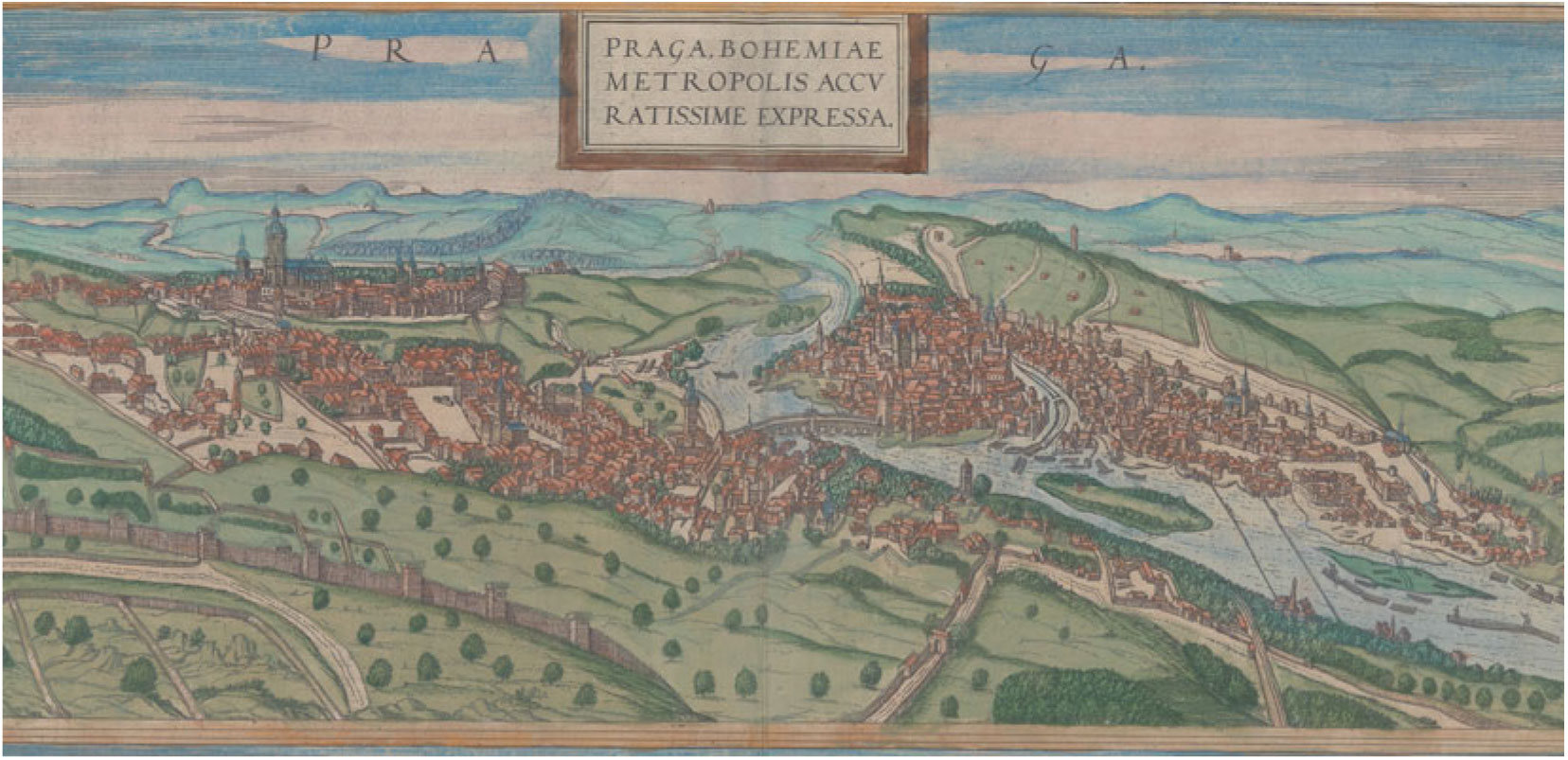
The various communities of belief jostled for supremacy in a city whose cohesiveness was already undermined by bureaucratic divisions.Footnote 20 By 1600, Prague was larger than such Central European centres as Nuremberg and Frankfurt, approaching the size of Amsterdam and Madrid, and it contained multiple sites suitable for public rituals, whether civic or religious.Footnote 21 Indeed, it was not a single city but rather an agglomeration of four distinct towns (Staré Město, Nové Město, Malá Strana, and Hradčany), each with its own coat of arms, governing body, laws, and prisons (see Figure 1).Footnote 22
View of Prague’s four towns, with Castle Hill (Hradčany) and the Small Side (Malá Strana) on the west bank of the Vltava River (left), and Old Town (Staré Město) and New Town (Nové Město) on the east bank (right). Charles Bridge (centre) links Small Side and Old Town. Detail of Georg Braun and Franz Hogenberg, ‘Praga’, from Civitates orbis terrarum (Cologne, 1575). Ghent University Library, BIB.HIST.005247. Reproduced with permission

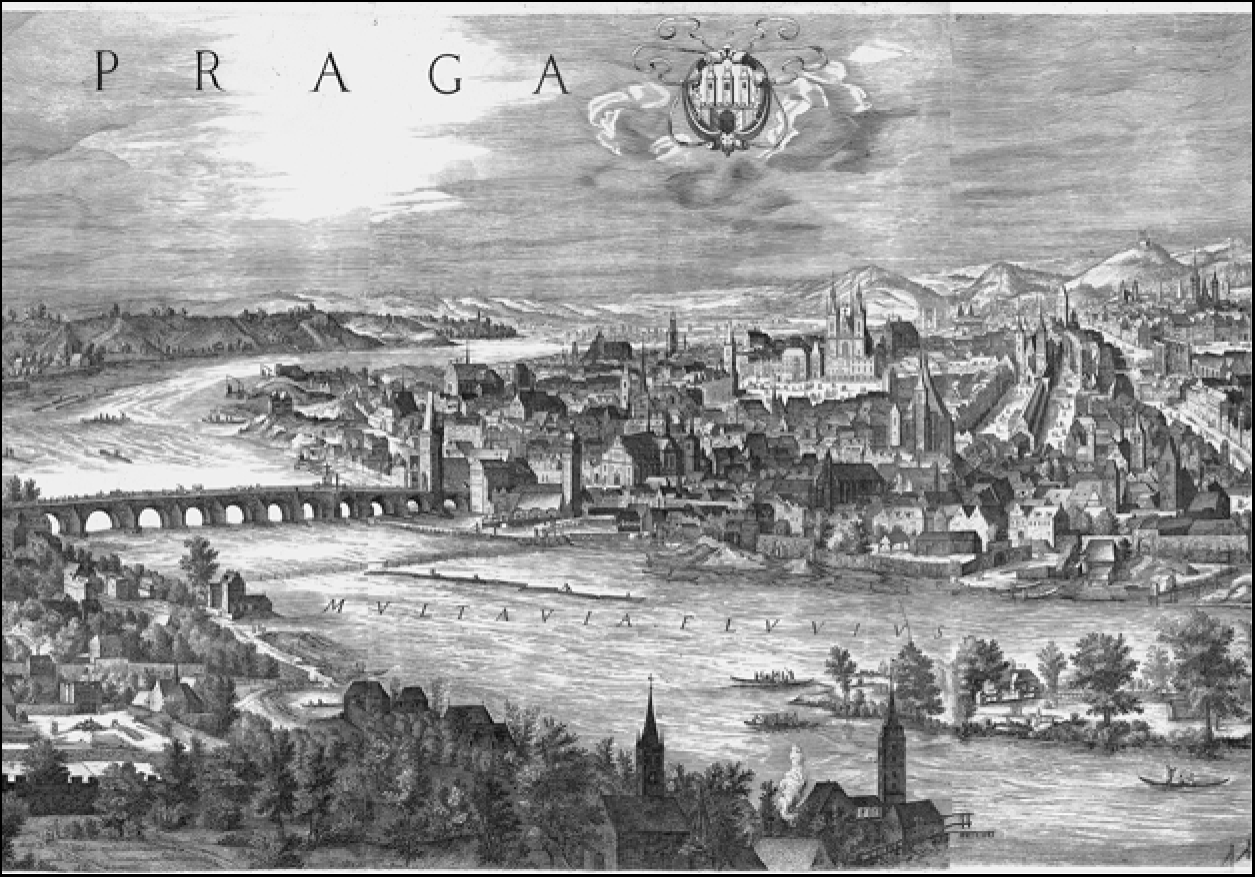
Jurisdictional and bureaucratic rifts, moreover, were reinforced by the urban topography. The Vltava (Moldau) River formed a natural division between the seats of state power and Catholic ecclesiastical authority on Castle Hill (Hradčany), and the more densely populated Old Town (Staré Město/Altstadt), in which the most prominent non-Catholic houses of worship were located. The houses and churches of the ‘Little Quarter’ or ‘Small Side’ (Malá Strana/Kleinseite) clustered just below Castle Hill on the west side of the river, below the seat of the Prague archbishop: the Cathedral of Saints Vitus, Sigismund, and Adalbert, whose spire – newly adorned with a gilt ‘R’ for Rudolf – reached heavenwards from the Prague Castle complex. On the east side lay the Old Town, described by a contemporary visitor as ‘the chief and principall [part], a place adorned with many ancient and goodly edifices, [and] a faire and spacious market place, with a stately and sumptuous Senate house’.Footnote 23 Overlooking this square was the most prestigious of Utraquist churches, the Church of the Virgin Mary before the Týn Courtyard (hereafter Týn Church; see Figure 2). Sprawling around this historic core was the New Town (Nové Město/Neustadt), established in the fourteenth century when, under the Luxembourg Emperor Charles IV (r. 1355–78), Prague was made Imperial capital for the first time.Footnote 24
Panorama of Prague’s Old Town, showing the proximity of the Jesuit College (foreground) to Charles Bridge (left) and the Utraquist Týn Church (background). Detail from Johannes Wechter, ‘Praga’, after Philip van den Bossche (etching by Aegidius Sadeler II, 1606). Holdings of The Metropolitan Museum of Art. Public domain

Upon arriving in Prague in 1556, the Jesuits had taken up residence in Old Town, in a former Dominican monastery just opposite the east tower of the Charles Bridge.Footnote 25 The astute head of the Jesuit German Province, Peter Canisius, selected the site at the behest of Ferdinand I (r. 1527–64), Rudolf’s grandfather and the first Habsburg King of Bohemia. As the Charles Bridge was the only means of crossing the Vltava on foot or by carriage, the doors for the new arrivals opened onto a route as essential to everyday traffic as it was to royal and civic ceremonial.Footnote 26 The Jesuits thus found themselves privy to the crossings of nobles and fishmongers alike, in a location ideal for evangelisation. Surrounded by non-Catholics, they preached and sang in Latin, German, Czech and Italian.
The Jesuits aimed their sermons and songs at Lutherans as well as the more populous Hussite confessions: the liturgically conservative Utraquists and the radical Unity of Brethren. While both Utraquists and Brethren followed the teachings of Jan Hus, they diverged considerably in belief and practice, and were treated differently under Bohemian law. Granted the right to worship freely in 1485, Utraquists retained their special status in Bohemia even after the 1555 Peace of Augsburg mandated the policy of cuius regio, eius religio throughout the Holy Roman Empire.Footnote 27 Whereas Utraquists retained many Catholic trappings and practices, evident especially in their retention and adaptation of Catholic plainchant and polyphony, the Brethren espoused a fundamentalist belief system that was increasingly influenced by Calvinism. They were prohibited from worshiping publicly and building churches and schools in edicts that were renewed as late as 1602. They nonetheless issued a series of influential vernacular (i.e., Czech and German) hymnals from printing presses in Moravia.Footnote 28
Crucially, Utraquists formed the majority of Prague’s population and controlled almost all the city’s churches until their defeat at the Battle of White Mountain in 1620.Footnote 29 Although they upheld the apostolic succession, insisting that their priests be ordained by Catholic bishops, they were not overseen by the Prague archbishop. They deferred instead to the ‘Lower Consistory’, a council housed in the Týn Church, which assiduously protected its jurisdictional independence from Rome. Because they retained so much of their Catholic heritage, Utraquists posed a unique challenge for Jesuit evangelisers, who viewed Eucharistic practice as a valuable piece of common ground. But it was also a contested terrain on which were waged increasingly heated battles for doctrinal supremacy. Utraquist Eucharistic beliefs and musical practices helped determine the kinds of sounds the Jesuits chose to deploy in their direction, while also – inevitably – shaping how Utraquists heard them.
Unlike Lutherans, Utraquists upheld the doctrine of transubstantiation, which held that bread and wine were transformed permanently into the Body and Blood of Christ when the priest uttered the words of consecration. Even more than Tridentine Catholics, they stressed the importance of regular Communion, so much so that they broke with Catholic practice to insist that Communion be dispensed to infants as well as adults. The main point of contention by the sixteenth century, however, concerned what exactly the laity needed to ingest for salvation: where Catholics taught that Christ was present complete in the Communion wafer (and thus that the laity did not to join priests in sipping consecrated wine, i.e., Christ’s Blood, for salvation), Utraquists drew on Scripture to argue that consecrated wine ought to be offered to the laity at Communion alongside consecrated bread (Christ’s Body). Indeed, this insistence on taking Communion sub utraque specie (‘in both kinds’) gave Utraquists their name.Footnote 30
Utraquist liturgical books reveal the close doctrinal and liturgical connections to the Catholic liturgy, and first-hand accounts confirm that the Utraquist Mass unfolded and sounded like a Catholic service, at least in Prague’s most prominent Utraquist churches.Footnote 31 When the French Catholic diplomat Pierre Bergeron travelled to Bohemia in 1600, for instance, he was struck by the outward similarities between Utraquist and Catholic ritual practice at the Týn Church. He noted the sonic resemblances in his diary, writing that although the Utraquist priest read the Epistle and Gospel in Czech, ‘there is no real difference in disposition from our [services]: the priests and the people sing the same words that we say in our church, and [they sing them] in the same language [i.e. Latin]’.Footnote 32 Even the zealous and reform-minded Prague Archbishop Zbyněk Berka z Dubé wrote in 1595 of the ‘good ancient ecclesiastical rite’ shared by Catholics and Utraquists.Footnote 33
Though reviled by most Protestant groups, the Feast of Corpus Christi was of great importance to both Utraquists and Catholics – even if they disagreed over which Communion elements were to be carried in procession. Utraquists were firm supporters of the solemnity they called ‘Slavnost Těla a Krve Páně’ (Feast of the Body and Blood of the Lord), viewing it as a celebration of the Real Presence of Christ in the consecrated Communion elements, as well as their incorruptibility. Utraquists were in fact more visually demonstrative than the Catholics, carrying both monstrance and chalice in their Corpus Christi processions, where Catholics carried the monstrance alone.Footnote 34
Bohemia’s Catholics responded to Utraquist Corpus Christi processions with a degree of circumspection that stood in marked contrast to their repeated and public condemnation of the devotional activities of Lutherans and Brethren. Indeed, by the late sixteenth century they had adopted a tolerant stance towards the Utraquist commitment to Communion in both kinds, an issue that had been a major sticking point in the previous century. Bergeron remarked on the peculiar situation as follows: ‘On the Feast Day of Corpus Christi [Utraquists] … conduct processions through the city and carry the Host in the streets. The Jesuits and the others of our faith [i.e., Catholics] judge that they should not be impeded in adoring the Host because … it is touched by the hands of a genuine priest.’Footnote 35 As Bergeron’s reference to the ‘genuine priest’ suggests, such flexibility was possible in part because of the Utraquists’ firm commitment to the apostolic succession. A precedent for tolerance had also been set some decades earlier by Pius IV, who had issued a dispensation in 1564 allowing the distribution of Communion in both kinds in the Holy Roman Empire, Austria, and the Bohemian lands.Footnote 36
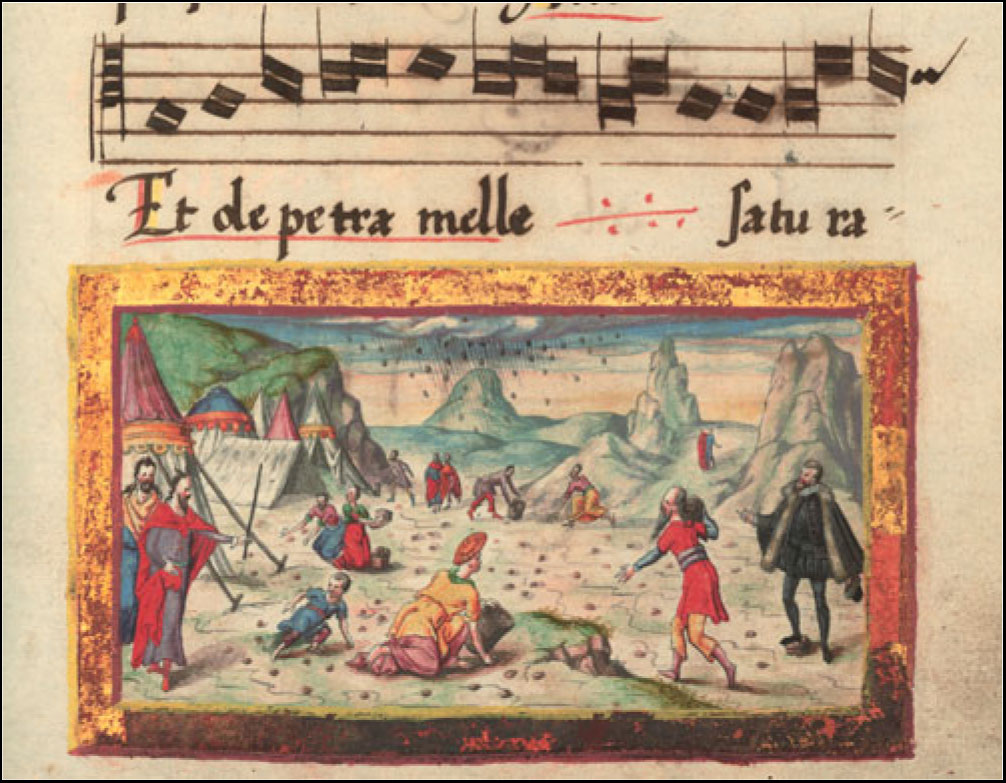
Thus on the Feast of Corpus Christi Prague’s streets echoed with both Catholic and Utraquist music. It is difficult to identify with certainty these rival Utraquist songs, due to the limited survival of Utraquist musical sources; most extant Utraquist sources are either deluxe manuscript Graduals, primarily transmitting music for the Mass, or kancionály (hymnals), which are rarely prescriptive with respect to ritual function. That the Feast was one of the most important in the Utraquist liturgical year is nevertheless evident from the sumptuous illuminations adorning the pages allotted the feast in manuscript sources. They typically rehearse standard Catholic visual tropes – the gathering of manna in the desert as a precursor to the true heavenly bread, for example (see Figure 3). In a few cases, a chalice appears as a reminder of the Utraquist belief in sub utraque Communion.
Israelites gather manna in the desert below the Introit for the Feast of Corpus Christi. Detail from National Library of the Czech Republic, MS XI. B. 1a (Graduale Latino-Bohemicum notis musicis quinque vocibus adaptis instructum et in usum litteratorum ecclesiae s. Michaelis Opatoviensis Neo-Pragae conscriptum, Tenor partbook), fol. 107r. Reproduced with permission

What the surviving sources do preserve are some of the sounds that projected Eucharistic belief in the mono-confessional spaces of Utraquist churches. A Mass setting in a polyphonic gradual compiled for use at the Týn Church gives a sense of how the solemn Corpus Christi liturgy sounded at the most prestigious of Utraquist churches at the turn of the seventeenth century.Footnote 37 The composer, Pavel Spongopaeus Jistebnický (c. 1560–1619), worked as a schoolteacher in the important mining town of Kutná Hora (Kuttenberg) and composed music that circulated widely among Utraquist institutions in Bohemia and Moravia.Footnote 38 His Corpus Christi Mass is a plenary setting (officium), providing polyphony for both Proper and Ordinary texts. It comprises settings of the Introit Cibavit eos, the Alleluia Caro mea vere est cibus, and the Sequence Ave caro Christi veneranda, in addition to all the Mass Ordinary movements save the Agnus Dei.Footnote 39
The eight-voice ad aequales setting – rare elsewhere in Europe, with the exception of pieces designed for use by monks or nuns – points to the unique infrastructure that subtended Utraquist church music. Having dissolved monastic establishments in the fifteenth century and facing a chronic shortage of priests in the sixteenth, Utraquists depended on school choirs and on skilled choirs of adult laymen (fraternitates litteratorum, or ‘literary brotherhoods’) to sing their services, especially for the solemn Masses celebrated on the major feast days.Footnote 40 Consequently, the performance of polyphony in Utraquist services involved the laity to an even greater degree than did the deliberately inclusive Jesuit services.
Jistebnický modelled his Mass Ordinary movements on a setting by the Roman composer Ruggiero Giovannelli (c. 1560–1625) of Exultate Deo (Psalm 80:2–4 and 17).Footnote 41 This jubilant text was already embedded in the liturgy in compressed form, as the antiphon and verse for the Introit Cibavit eos (see bold text below):

The compositional intertext would surely have escaped most listeners; the motet text was, after all, shorn from its musical setting in the course of reworking the pre-existing material for the parody Mass. Still, the titles of each movement (e.g. Kyrie super Exultate Deo, Gloria super Exultate Deo) silently reminded the singers – the members of the Mary Týn literary brotherhood who huddled around the manuscript partbooks – of the scriptural justification for celebrating the Body of Christ with all manner of voices and instruments.
Not least because of their fundamental commitment to celebrating the Feast of Corpus Christi, Utraquist authorities were discomfited by the number of Bohemians who fell under the sway of Luther over the course of the sixteenth century. German-speaking Bohemians such as Maria von Schenk and Eva Haslauer were particularly susceptible, but Lutheranism became increasingly popular among the kingdom’s Czech-speaking noble and burgher populations.Footnote 43 It left a mark even on the venerable Charles University, where in 1585 the Wittenberg-educated rector Petrus Codicillus à Tulechová omitted the beloved Feast of Jan Hus and Jerome of Prague (6 July), from the calendar.Footnote 44 A song circulated in the ensuing furore that accused Codicillus of having sold ‘the goose’ (‘Husa’ in Czech) to Germany.Footnote 45 In such a climate, the defence of Corpus Christi processions was also a defence of indigenous traditions in the face of a foreign reformation.
Utraquists such as the influential theologian Pavel Bydžovský imitated Catholic strategies, offering up localised anecdotes to bolster their claims about the necessity of Eucharistic veneration even outside the Mass.Footnote 46 In a polemical pamphlet first printed in 1559 but judged sufficiently topical almost three decades later to warrant a reprint, Bydžovský lamented the practices of the Bohemian Brethren and those Utraquists who followed the Lutherans in abandoning Eucharistic veneration.Footnote 47 ‘[They] do not light … candles for honoring the Body of God’, he complained, continuing that it was ‘as though in the procession the Body of God were not truly the Body of God’.Footnote 48 To make the case for a practice that critics equated with idolatry, Bydžovský informed his readers of miraculous Hosts all around Europe, including Bohemia, and the rites that had been developed to honour them. In a section entitled ‘Why each Thursday a procession is held in Kutná Hora in honour of Corpus Christi’, he traced that town’s affection for Eucharistic veneration to a consecrated Host ripped from a monstrance by heretics in 1482. Bydžovský writes that it was located two years later ‘in an unclean place, but miraculously undefiled, not even gnawed by mice’, noting with approval that local Utraquists responded by consecrating an altar to the Body of Christ and initiating weekly processions.Footnote 49
Such strategies lost their effectiveness as more and more Bohemians flocked to Wittenberg to be educated. The Chomutov (Chommotau) district where Eva Haslauer and Maria von Schenk lived was a noted hotbed of anti-Corpus Christi agitation. The situation was no better in Prague. In 1589, one year after Bydžovský’s pamphlet was reprinted and four years after Eva and Maria’s Michelsdorf protest, the Utraquist Consistory deemed the situation so dire that its members petitioned the emperor, requesting that he impel Prague’s ‘heretics’, whether guildsmen, professors, or students, to participate in Corpus Christi processions.Footnote 50
Thus Bohemia’s Catholics, mostly foreign and decidedly in the minority, found themselves surrounded by Utraquists and by less visible communities of Lutherans and Brethren. They compensated for what they lacked in numbers with the prestige of their adherents, even before the arrival of the emperor. The English Jesuit Edmund Campion, then stationed in Prague, put it in a letter to Rome in the 1570s: ‘Do you want to know about Bohemia? It is a mixen and hotch-potch of heresy. But all the chiefe people are Catholic.’Footnote 51 After the arrival of the Imperial court in 1583, papal nuncios and Jesuit brothers could report with no small amount of pride that in addition to members of the House of Habsburg, the Catholic community included Spanish, Flemish, and Italian noblemen, and the many Spanish noblewomen who married into the Bohemian nobility.Footnote 52 The Spanish presence in particular left an early mark on the local music scene, due in large part to the activity of Mateo Flecha the Younger, chaplain to Rudolf II’s mother, the dowager Empress Maria of Spain; Flecha returned to Prague in the mid-1580s, serving in the Imperial chapel from at least 1586, and retiring permanently to Spain in 1601. In 1581 he published a volume of polyphony for Compline, as well as his famous anthology of ensaladas, at the Old Town printing house of Georgius (Jiří) Nigrinus.Footnote 53
That the city’s chief musicians were Catholic was asserted through the activities of Imperial musicians not just at the castle but also in the city below. On the Sunday after Corpus Christi in 1580, for example, and on subsequent occasions, Imperial trumpeters (Tubicines Imperatoris) performed in a procession at the Jesuit College (commonly known as the ‘Clementinum’).Footnote 54 Furthermore, the frequent forays by Imperial composers into the European printing market contributed to Prague’s reputation as a Catholic centre. While the polyphony written by Utraquist composers such as Jistebnický and his compatriot Jan Trajan Turnovský (1550–1606) circulated exclusively in manuscript, Rudolf II’s chapelmaster Philippe de Monte ushered no fewer than seventeen collections of masses, motets and madrigali spirituali into print in Venice and Antwerp. Other Catholic composers, including Carolus Luython, Jacobus Handl (Gallus) and Jacobus de Kerle, targeted the central European market in high-quality prints issued by Nigrinus’s printing house, which was located just steps away from the Jesuit College.
For all that they were few in number, Prague’s Catholics promoted Eucharistic veneration on multiple fronts. The Jesuit College was an important venue for processions and Communion sub una specie on one side of the river, while on the other side, members of the court and the cathedral chapter modelled appropriate Eucharistic practice. In 1580, the emperor’s mother, Maria of Spain (1528–1603), co-founded an Imperial Corpus Christi brotherhood whose organisational structure asserted the pan-European appeal of Eucharistic worship: its membership, which included Imperial musicians, was divided into the four different ‘nations’ (Spain, Italy, Germany and the Low Countries) present at court.Footnote 55 The brotherhood met just below Prague Castle, at the Augustinian Church of St Thomas in the Little Quarter. Led by the Flemish Imperial Almoner, musician, and de facto head of the Imperial chapel, Jacobus Chimarrhaeus (1542–1614), the brotherhood staged Eucharistic processions there on the first Thursday of every month.Footnote 56
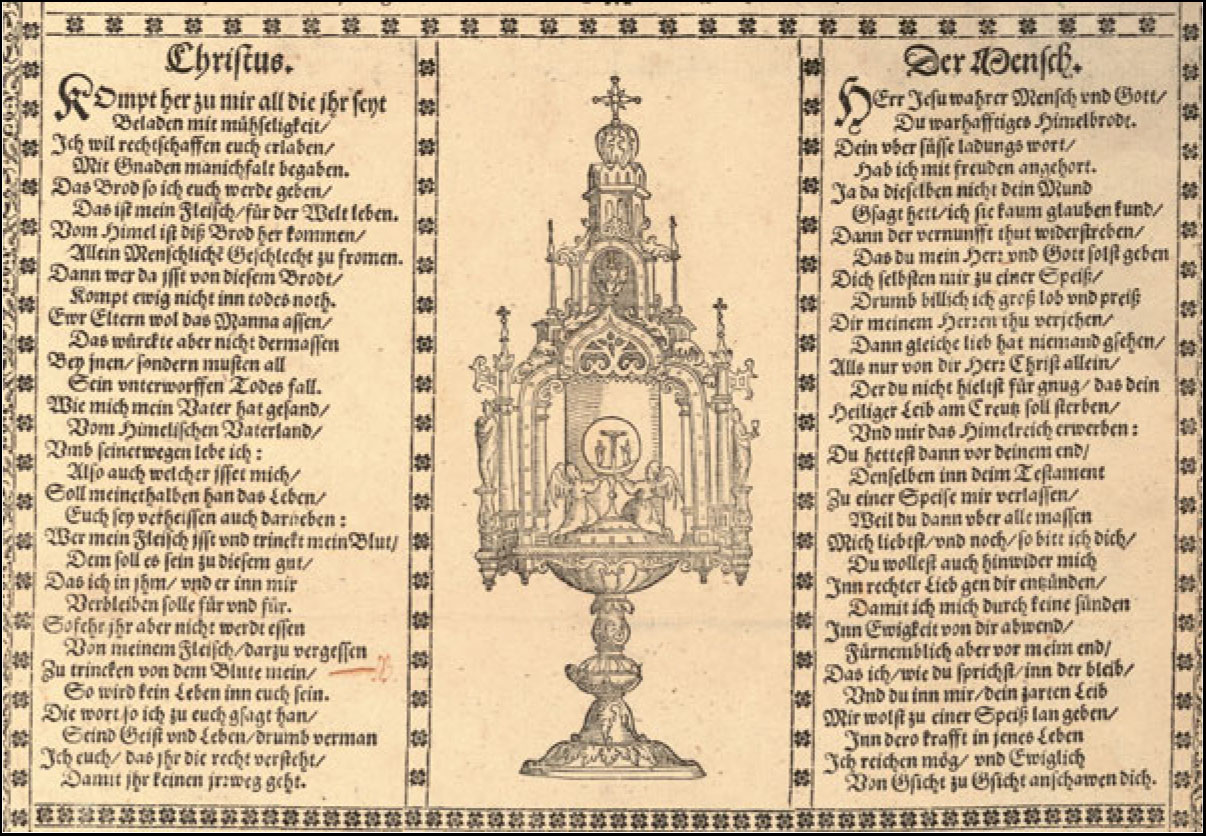
Catholics used a variety of media and a range of rhetorical registers to rally Prague’s inhabitants around the Body of Christ. On the elite end of the spectrum was Chimarrhaeus’s Sacrum Gazophylacium (Prague, 1588), a handbook of Latin prayers and guidelines for the Corpus Christi brotherhood, and anti-Utraquist polemics. It was successful enough to be reissued in 1594, this time with an anti-Lutheran screed. Philippe de Monte set several of the prayer texts to music, including them in his Sacrarum cantionum … liber septimus (Venice, 1600), a collection he dedicated to Chimarrhaeus. A vernacular broadsheet issued by the brotherhood in 1588 to mark the New Year offered a more accessible argument for Catholic Eucharistic doctrine: in a versified translation of John 6:52, Christ reminds ‘Der Mensch’, a stand-in for humankind, that the Communion wafer is his Body:Footnote 57

The dialogue runs for 64 lines and frames an image of a monstrance. A tiny crucifixion scene engraved on the Host reminds viewers that when they adore the consecrated wafer, they adore Christ himself. Conspicuously absent from image and text is the chalice, which was so central to Utraquist belief and identity (see Figure 4). Such broadsheets and the institution of Forty Hours’ (quarant’ore) devotions by the late 1580s made Catholic Eucharistic doctrine increasingly visible to burghers who disagreed on how to view it.Footnote 58 During these devotions, which originated in Milan and became increasingly widespread over the course of the late sixteenth century, the consecrated Host was solemnly displayed, typically on the high altar, for a period of roughly forty hours – the period of time Christ’s body lay in the tomb. A Mass of Exposition initiated the proceedings, and a Mass of Deposition concluded them two days later. The irruption of music-filled Corpus Christi processions at the Jesuit College made Eucharistic doctrine increasingly audible as well.
Monstrance with consecrated Host. Detail from anonymous broadsheet, ‘Vom Heiligen Sacrament’ (Prague: Nigrinus, 1588). Prague, Strahov Monastery Library (Dobřenský Collection of 16th-Century Broadsheets), DR I 21d, fol. 101r. Reproduced with permission

SOUNDING PRESENCE
These processions unfolded in Prague just as they did all over Catholic Europe.Footnote 59 Guilds and religious brotherhoods, noblemen and burghers, clerics and musicians lined up in front of and behind the monstrance that both protected and exposed the Body of Christ. Dressed in their finest, participants paraded within their churches or through their neighbourhoods, their feet crushing the leafy boughs and grass that marked the route. As they marched, they sang, and when they reached the stations erected along the way, they sang some more. When the procession returned to its starting point, the Host was placed on the high altar, and – in those institutions with sufficient musical forces – polyphony sounded in the crowded and richly decorated space.
The Feast and its procession were inherently anti-heretical, having been instituted in the thirteenth century (1264) to combat disbelief.Footnote 60 At the time of the feast’s inception, the doctrine of transubstantiation had only recently been formalised as dogma (1215), and the devout needed to be convinced of its veracity: they had to be persuaded that what looked like ordinary bread was in fact the Body and Blood of Christ, that it had been transformed as a result of the set of rituals performed by the celebrant at the altar, and that having been transformed, it remained so even after the Mass was over. The feast’s anti-heretical aspect took on new life in the face of post-Reformation disbelief. In Bohemia, old polemical texts were redeployed to answer new heresies. In 1584, for example, the Prague printer Nigrinus issued De veritate corporis et sanguinis Domini in Eucharistia, Alger of Liège’s twelfth-century salvo against the Berengarian heresy, which had questioned the doctrine of Real Presence.Footnote 61
The process through which the devout were convinced of the truth of miracles has been theorised by philosopher Arnold Davidson as one of repeated presentation. Repeated enough and viewed enough, texts and images that recounted and represented miracles became evidence for those miracles.Footnote 62 Although Davidson stresses the visual, sound was also an important component of this ‘accumulation’ of presentations, particularly in the context of the Eucharist. The ringing of the sacring bells (altar bells) during the celebration of Mass marked the moment of consecration, when flour and water became Body and Blood. The wafer that the priest held up for all to see showed no change in outward appearance. In the absence of any visible transformation, sounds made a case for divine presence.
An English visitor to one of the two churches at the Prague Jesuit College in the 1590s witnessed the celebration of Low Mass, and vividly described the confluence of sight, sound, and gesture at the Elevation, even in this pared-down rite. An avowed anti-papist, he noted with some derision that Catholics
after they have heard the masse, or only worshipped the Elevated hostie (walking up and down in the Church till that be Elevated to that ende with sounde of a little Bell), … little reguard to heare the Sermons or the rest of Divine service …, thinking themselves safe that day from all evill by that one bending of the knee and beating of the breast.Footnote 63
This account gives a sense of the role of sound in even the simplest of services, and its power in reinforcing belief and shaping behaviour. Sound’s ability to mark moments of transformation was greater still in the solemn masses and processions held on the feast of Corpus Christi and during its octave, particularly when that sound was specifically musical.
EXTRAORDINARY SOUNDS: LUYTHON, PANGE LINGUA
Catholic Corpus Christi motets promoted the shared Catholic and Utraquist belief in the miraculous and salvific quality of the Host; they did so in part by heightening the sense of awe that climactic ritual moments such as the Elevation were supposed to inspire. The symbolic and dramatic possibilities available to composers – even within the strictures of the style shortly to be labelled the stile antico – are easily apprehended in a six-voice (CCATTB) setting of the Corpus Christi Vespers hymn Pange lingua by the Imperial organist and composer Carolus Luython. Pange lingua appeared in his first book of motets, printed in Prague in 1603, with a dedication to the Prague cathedral provost, and sometime prefect of the Jesuit Marian sodality, Jiří Barthold Pontanus of Braitenberg (c. 1550–1614 or 1616).Footnote 64
A departure from the standard Pange lingua text evokes the ritual elevation of the Host in the liturgy, the moment at which, in the words of Miri Rubin, ‘God came into presence, to be addressed, gazed upon, supplicated, experienced’.Footnote 65 Luython supplements the first two verses of the text as written by Thomas Aquinas (Pange lingua / Nobis natus) with two verses (Ave caro Christi cara / Jesu summae pietatis) endowed with a 100-day indulgence when uttered at Elevation.Footnote 66 The text that Luython sets is as follows, with a loose translation, and with the added verses indicated with grey shading:

Processions offered other occasions for the performance of such motets. Indeed, Chimarrhaeus’s Sacrum gazophylacium and the Jesuit chronicles clarify that in Prague the Pange lingua hymn (if not Luython’s setting) was specifically associated with Eucharistic processions: both the monthly processions held by the Imperial Corpus Christi brotherhood and the yearly Corpus Christi processions held all over the city. Heard in this context, perhaps when processants halted at one of the stations erected along the route, the motet could have invoked in sound a sight that was not necessarily visible except to those standing in the immediate vicinity of the temporary altars.
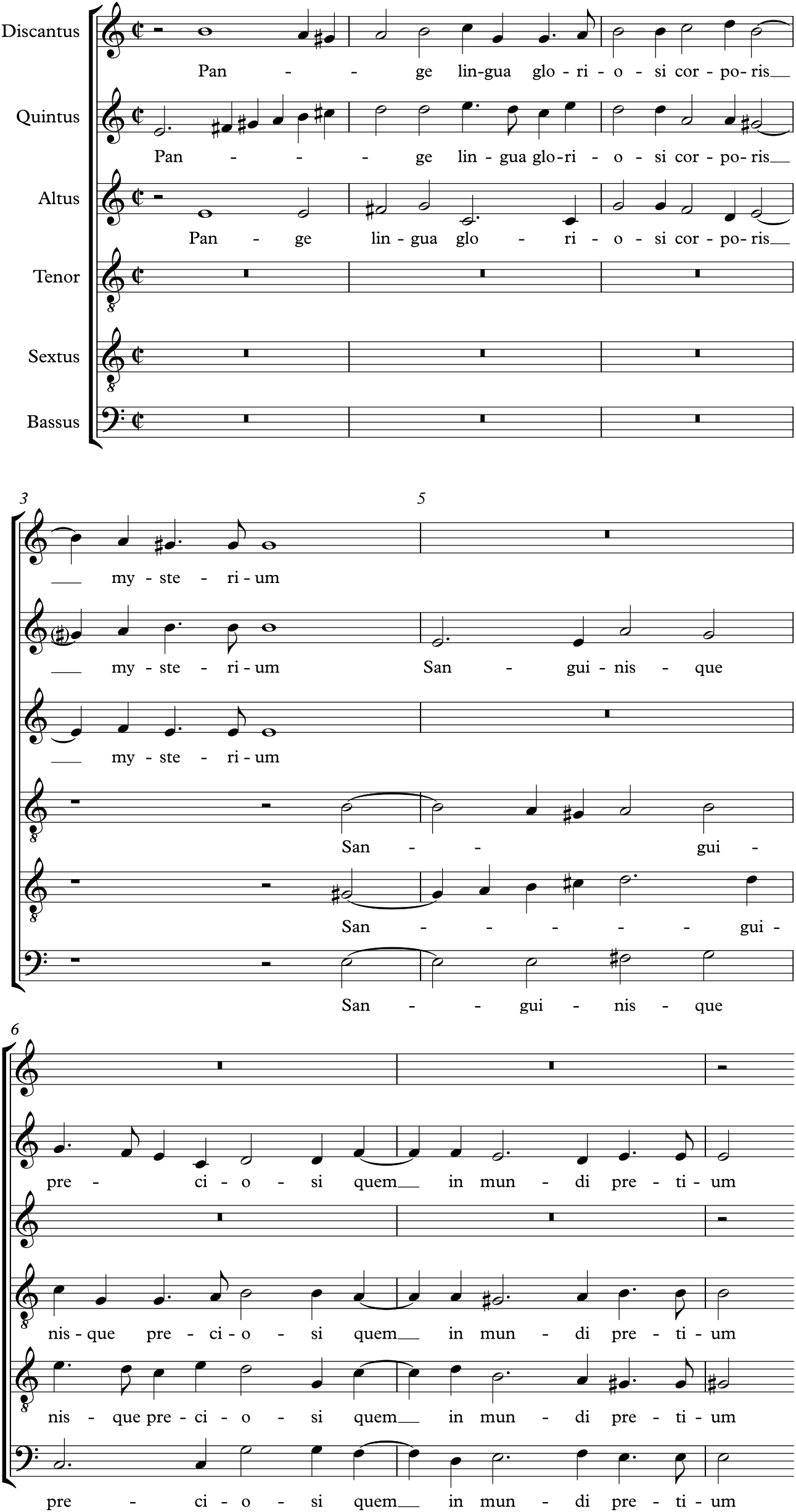
The motet opens with an arresting phrase that draws awareness to utterance: ‘Tell, O Tongue’ (Pange lingua) the voices sing, with the Quintus (functioning as a Cantus II part) ascending stepwise from e′ to e″. The Sextus partially repeats this scalar gesture (from g♯ to e′) on the words ‘and of the blood’ (sanguinisque). The striking twofold insistence on upward linear motion suggests (or, following Davidson, ‘re-presents’) in sound the twofold Elevation of the consecrated Communion elements at the climax of the Mass (see bb. 1–2 of Example 1).
Carolus Luython, Pange lingua, bb. 1–8, from Liber primus … sacrarum cantionum (Prague, 1603)

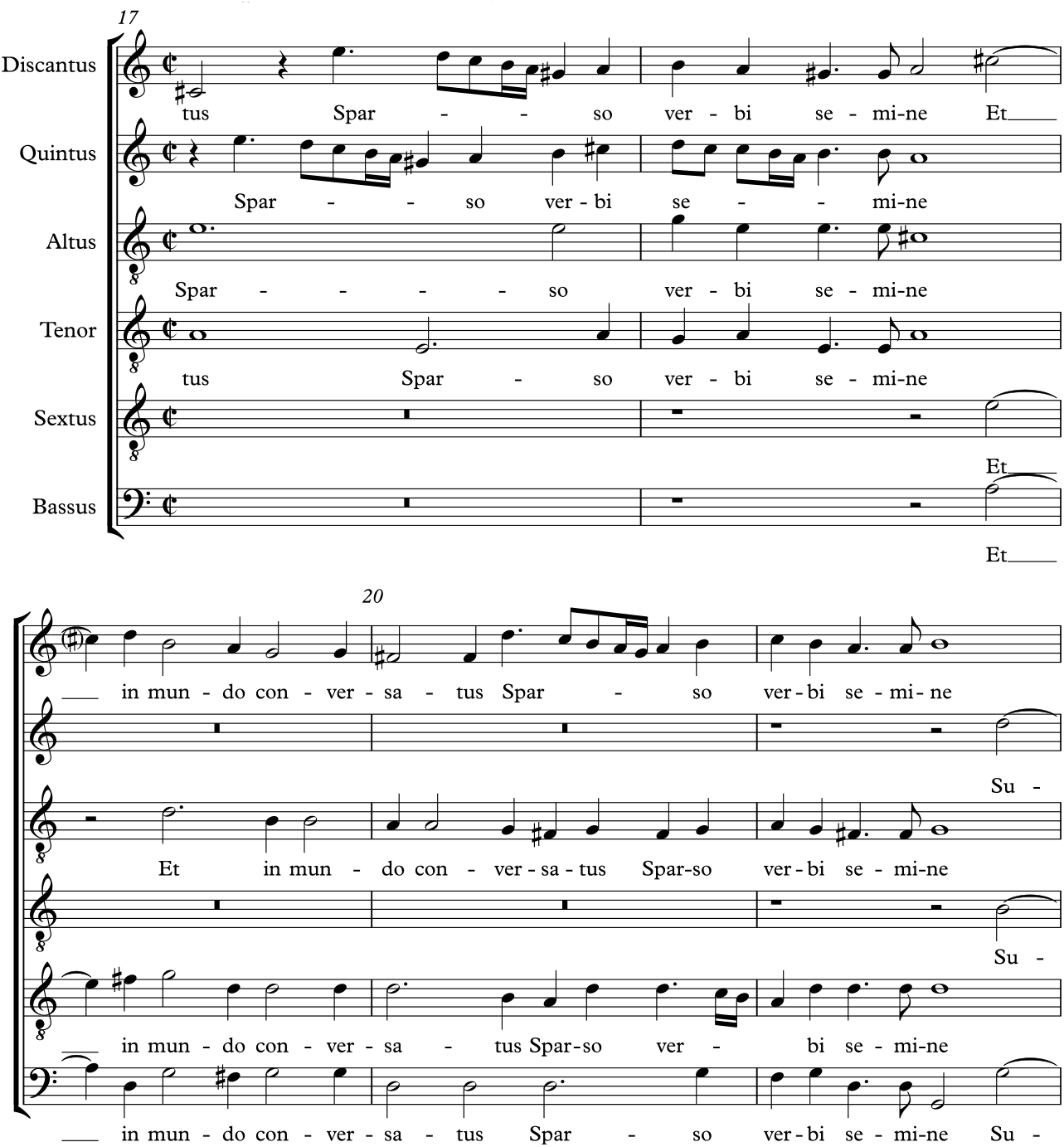
Pange lingua contains many such instances of what rhetorically-minded composers and theorists such as Joachim Burmeister would shortly term hypotyposis, and today is generally referred to as ‘word painting’; in this context they are sonic renditions of physical gestures. In the second stanza, for example, Luython sets the line ‘through the scattered seed of the word’ (sparso verbi semine) to an animated, dotted motif that he ‘scatters’ among the voices (see Example 2, bb. 17–18 and 20–1).
Carolus Luython, Pange lingua, bb. 17–21

Because such literal musical gestures were usually disruptive, introducing a new texture or new rhythmic pattern, they could easily be apprehended. Students and teachers at the Jesuit College, along with any Imperial singers and composers, clerics, diplomats and educated nobility in attendance, would no doubt have been able to connect these shifts in texture or mood to ‘cues’ in the Latin text.
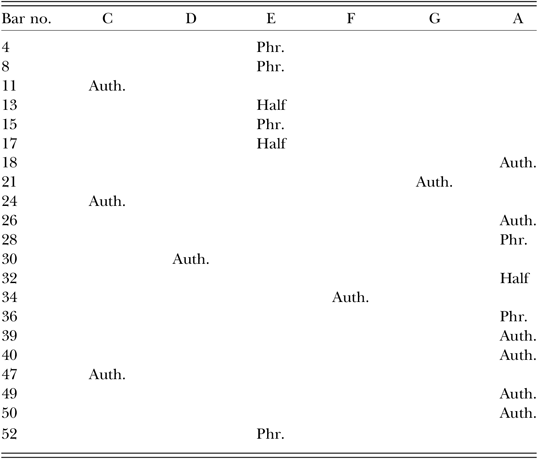
For these literati but also to those listeners with advanced musical training, less obvious sonic features of the piece would have carried meaning. Luython departs from conventional modal practice in order to bring out important doctrinal points, for example, such that his setting would have sounded unusual even to those singers and listeners with only a passive awareness of the way mode was usually projected.Footnote 68 Although the tenor concludes on E and ranges from e to e′, repeated cadences on A, most noticeably in the concluding verse, make it difficult to hear whether the piece unfolds in mode 3 (E authentic) or mode 10 (A plagal). To be sure, modal ambivalence is common among pieces with an E final, and Luython’s other compositions show him to be well versed in conventional modal practice; still, his projection of mode is curious.Footnote 69 Cadences are not restricted to the pitch classes that were, at least according to Zarlino, typical of mode 3 (E, G and C) or mode 8 (A, C and E). Instead, cadences and resting points seem to fall everywhere, on all the pitches of the natural hexachord (see Table 1), albeit with a clear, and stabilising, emphasis on E and A.Footnote 70
Locations of cadences in Luython’s Pange lingua

This extraordinary distribution of cadences suggests that Luython sought to convey in sound something of the supernatural, even totalising, nature of the Host, much as his Prague contemporary, Jacobus Handl/Gallus (1550–91), did in his celebrated chromatic celebration of God’s incarnation, Mirabile mysterium.Footnote 71
The abstraction given in Table 1 does not foreground which aspects of this unusual modal projection listeners might have picked up on as the piece unfolded in time. One of the features it leaves out is the easily perceptible contrast between the durus (sharp) and mollis (flat) manifestations of the tonal spectrum that plays out over the course of the piece. The durus sonorities that characterise the opening phrase (via sharps on F, C and G) prevail through the first two verses, but as the gaze shifts in the third verse to Christ suffering on the cross, B flats and E flats signal a shift to the mollis side of the spectrum. This move from durus to mollis underscores the move from the hortatory and explanatory mood of the first half to the contemplative and salutatory mood of the second half. The most distant point is reached in the middle of the third verse, with lines adumbrating a central Catholic tenet: that Christ suffered and died for the redemption of humanity, and that an individual’s redemption was made possible by his or her consumption of Christ’s flesh. On the passage ‘Morte tua nos amara, Fac frui luce clara’ (Through your bitter death / Make us delight in the bright light), which equates the Body of Christ on the cross with the ‘shining light’ (‘luce clara’) of the Body of Christ in the Host, the musical fabric is saturated with B flats, and the lines conclude with cadences on F.
Through such music Corpus Christi celebrations became something more than ostentatious displays of piety.Footnote 72 From poetry recited in Bohemian and German ‘rhythms’ to militant blasts of trumpets and drums to the rich polyphony of Eucharistic motets such as Pange lingua, sound transformed the spaces through which the procession moved. Like the flowers scattered on the cobblestones of paths traversed daily, extraordinary sounds – Chua’s agents of enchantment – made everyday spaces into sacred places.Footnote 73 The metaphysical powers of musical sounds were particularly important in processions held in the wake of the Reformation: they were harnessed in the service of a ritual performance directed not just at the Host that lay at the centre of the procession, but also outward to spectators gathered along the procession route. As they looked on, many were moved to join in, responding to the passing Host by praying audibly, dropping to their knees, singing hymns, intoning litanies.
The potency of such sounds – their ability to affect not only spaces, but also the people that inhabited or simply passed through these spaces – is not always noted by historians, who only rarely remark on the participatory features of sixteenth-century Catholic processions, and who tend to associate interest in the power of sound primarily with Lutherans. Muir writes of Lutheran worship, for example, that ‘[f]rom the walls of the churches now radiated God’s Word, which entered the mind of the viewer just as alluring idols had once projected infinite images of themselves into the viewer’s soul’.Footnote 74 As we shall see below, his statement need be adapted only slightly to account for the place of sound in Catholic worship. Following contemporary theories of hearing, music entered the mind in the same way that ‘alluring idols’ projected infinite images of themselves into the soul. It follows, then, that in a reverberating cosmos in which earthly harmonies still echoed the sounds of the planets, it was songs – more than speech or image – that had the potential to move the soul.
DISCIPLINING BODIES AND RE-FORMING COMMUNITIES: THE 1583 PROCESSION
Inner experiences were assumed to have external consequences or manifestations. ‘The greater the faith, the greater the celebration’, was how the firebrand Austrian court preacher Georg Scherer put it in a 1588 sermon, printed in both German and Czech, in which he defended Corpus Christi festivities.Footnote 75 Turning to Scripture, he described how King David danced and sang in front of the Ark of the Covenant, despite the ridicule of his wife Michol. If a mere prefiguration of God Incarnate could cause David to celebrate with such abandon, Scherer asked, why should not the Host – the realisation of the Covenant – inspire similar musical and bodily demonstrations in Christians?Footnote 76
Such demonstrations needed to be regulated, however. Anecdotes provided object lessons in the necessity of disciplining unruly bodies. Jiří Barthold Pontanus z Breitenberka (hereafter Pontanus), encountered above as the dedicatee of Luython’s 1603 motet print, included several cautionary tales in a Krafftbüchlein (handbook) he wrote for members of the Imperial Corpus Christi brotherhood. He reports that hundreds had drowned in the Maas River in Utrecht in 1277 when their disrespectful dancing and jumping brought down a bridge while a priest carried a Host across it.Footnote 77 Bringing the message closer to home, he describes how Drahomira, the heathen mother of St Wenceslas (907–35), was swallowed up by the earth when she mocked her carriage driver for stopping to kneel at the threshold of St Matthew’s Church, near Prague Castle, when they passed by at Elevation.Footnote 78
Since the perception of music was understood to influence deportment, it followed that the right sort of music could inspire the right sort of behaviour. Reverent sounds inspired reverence in the faithful, who responded with reverent acts: they genuflected, they bowed, they remained silent. Grayson Wagstaff’s observation that ‘the idea that music had the power to influence the behavior of participants in ritual was taken for granted in late-fifteenth- and sixteenth-century Spain’ holds true for Bohemia as well.Footnote 79 This capacity is precisely why Eva and Maria reached for the Gradual and skipped and sang around the altar in Michelsdorf rather than simply scattering the reserved hosts on the church floor. Just as iconoclasts ‘de-faced’ statues not to prove that statues had no power but because they had power, so too Eva and Maria sang ‘chum, chum, chumperle’ and kicked up their heels in order to take away music’s power, not to deny that it had power in the first place.
As demonstrations of corporate devotion, Corpus Christi processions and their music worked not only on individual bodies, but also on the collectivity of spectators and participants. The procession itself was not so much a circumscribed event as it was a transitional passage, the middle act of a performance that began with Vespers the evening before and concluded with the celebratory Mass on the day itself. As such, it conforms neatly to the models developed by anthropologists Victor and Edith Turner in their foundational work on ritual and pilgrimage.Footnote 80 Assuming that collective ritual movement works on the community just as a rite of passage works on an individual, the Corpus Christi procession can be understood to unfold in a liminal phase in which the normal social structure is set aside – Turner’s ‘betwixt and between’.Footnote 81 According to this model, the liminal phase gives rise to a feeling of ‘communitas’, or solidarity, among individuals. Consequently, when the procession ends and the community reintegrates and re-forms, it is as a more cohesive (and coherently structured) society. These theories were applied to Corpus Christi processions in ‘Ritual, Drama, and the Social Body in the Late Medieval English Town’, an influential study by the historian Mervyn James.Footnote 82 Viewing the collective movement of these processions as an outward manifestation of a latent communitas, James concluded that ‘the final intention of the cult [of Corpus Christi] was … to express the social bond and to contribute to social integration’.Footnote 83
Such functionalist analysis dominates scholarly treatments of Corpus Christi celebrations: whether dealing with pre-Reformation England or Counter-Reformation Bavaria, historians and musicologists have focused on the procession as a collective movement through space and time, by which means communities were formed and reformed. In this view, music – like the other components of the sensory spectacle – helped to integrate individual bodies into a collective social body, the corpus mysticum.Footnote 84 In this vein, Kate Van Orden posits that in late sixteenth-century French Saint Sacrement processions, ‘Catholics who sang hymns together enjoyed an enhanced sense of community and even spiritual empowerment’.Footnote 85 This ‘civic solidarity’ thesis works well to describe the cultural ‘work’ of processions where participants and civic community overlap exactly. In other words, theories of communitas illuminate the ways in which processions do their work within a single community of belief (e.g., Catholics). As such, they help us understand how early, relatively circumscribed Jesuit processions, including the first of the two under discussion here, affected their most proximate audience. Nonetheless, as we shall see, these theories are insufficient to describe the impact of processions that marched out into shared urban space and targeted a fragmented social body that was already beyond repair.
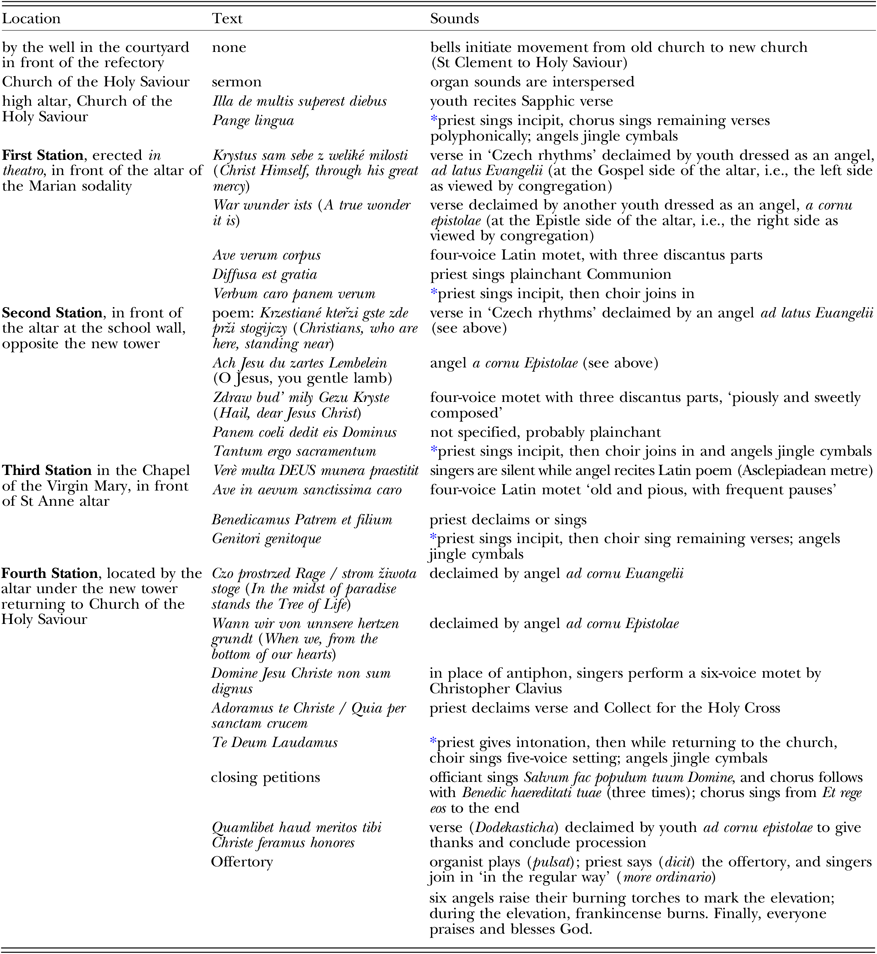
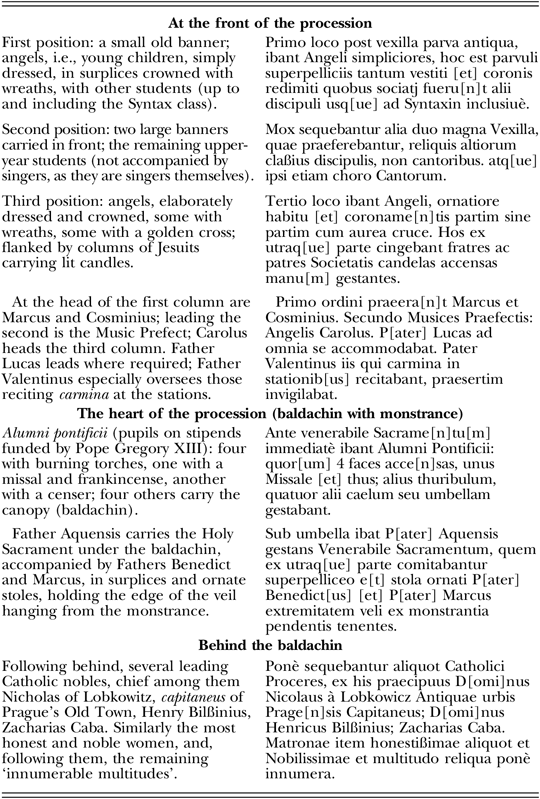
In 1583, the Jesuits staged their procession for a sympathetic gathering, choosing to remain within the bounds of their complex as they had in previous years.Footnote 86 Table 2 gives a sense of the range of sounds in the 1583 procession, as well as the tight choreography of the proceedings. Four stations were set up on the grounds of the college, and the walls of pre-existing buildings as well as those of new and partially constructed structures were bedecked with poems and tapestries. The processants formed three rows by a well in the refectory courtyard, listening for the signal to move.Footnote 87 When bells rang out from the new church, dedicated to the Holy Saviour, the orderly company moved towards it, passing through the old church (St Clement) and the scholars’ courtyard (area scholarum) along the way. There they adored the Host, which stood resplendent on the high altar, while the sounds of an organ filled the space.Footnote 88 That these preliminary rituals culminated in a sermon highlights the didactic function of this portion of the morning’s proceedings.
Sounds, texts and movement at the Prague Jesuit Complex for the 1583 Corpus Christi procession
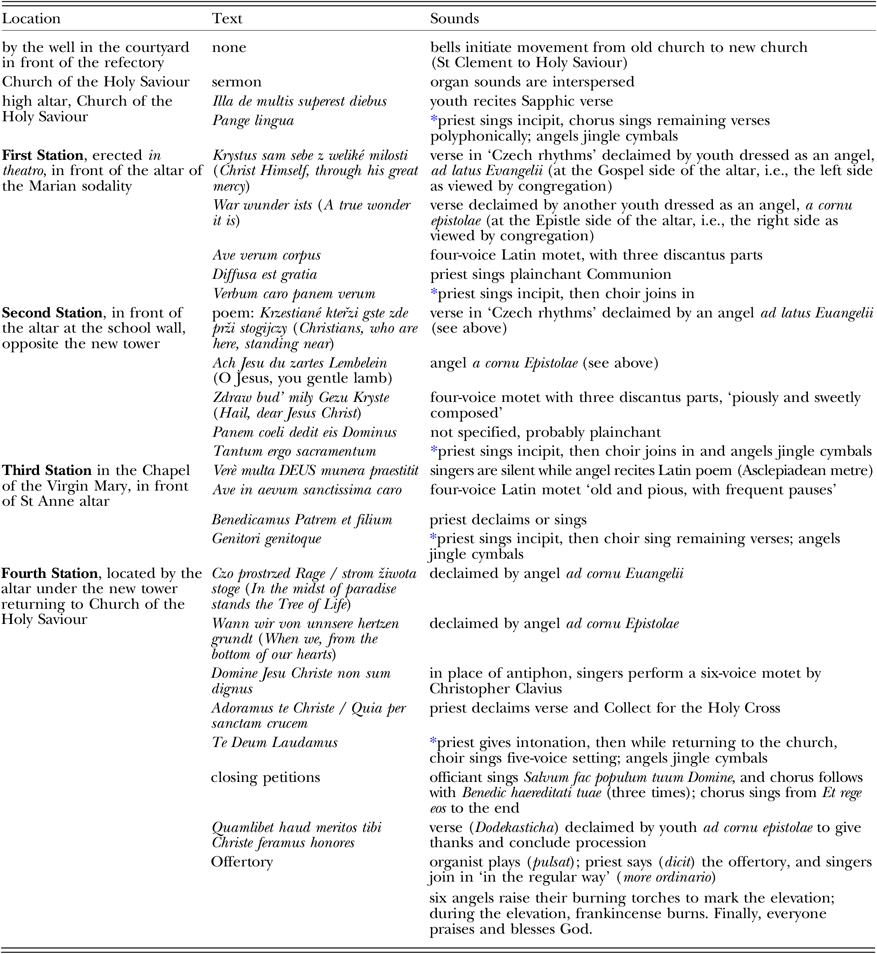
* indicates in each case that the priest elevates the Host and, facing the congregants, intones the incipit of a hymn.
Source: DC III 20, fols. 211r–215v
The transformation of the space and the gathered congregants began with the closing words of the sermon. The Jesuits distributed lit torches to the most important nobles. The students (alumni pontifici) swung censers and held torches, charting a sacred path using fragrance and light. The officiant approached the altar and lifted up the monstrance. The organist stopped playing, and a youth (primus puer) delivered a twelve-stanza Latin preamble (exordium) that made a case for the ritual that was about to take place. The opening lines, given below, evoke an imagined community of worshipers celebrating the major feasts of the liturgical year together:

Cast in Sapphic stanzas, the poem consecrates the entire proceedings to Christ. This dedicatory function is especially clear in the closing lines, which express hope that Christ will shower mercy upon those who celebrate him:

The poem is well suited to generating a sense of anticipation and involvement in its learned audience, particularly with its references to specific components of the ritual. The opening stanza describes what the participants would have beheld all around them: the ‘greening’ of sacred space with leafy boughs that was one of the visual hallmarks of Corpus Christi celebrations. The closing stanza draws attention to the ritual’s sonic components. It exhorts the faithful to approach Christ, and to do so in song: to ‘sing Gloria’ as they hasten to the Son of God. These words set up the ensuing actions: when the youth finished declaiming the preamble, the officiant turned the monstrance around so that it faced the congregants, and began to sing Pange lingua.Footnote 90 The choir joined in (probably monophonically), and the church space reverberated with music and with the jingling cymbals of children dressed as angels, as everyone, singing, hastened to the Body of Christ.Footnote 91
Thus primed, the line of participants began to move. They were carefully ordered by status, as Table 3 illustrates, with the most important people marching closest to the Host. At each station, the officiant set the monstrance down on the temporary altar, and the participants stopped to listen to youths dressed as angels recite or sing carmina in Czech and German (stations 1, 2, and 4) and in Latin (station 3). These carmina were followed in each case by polyphony: at the first station, a four-voice setting of Ave verum corpus, and at the second, a four-voice ‘Czech motet, piously and sweetly composed’.Footnote 92 Reflecting the Jesuit propensity for tapping into local practices, this vernacular motet sets Zdrav’ bud’ milý Jesu Kriste (‘Hail, beloved Jesus Christ’), a text that circulated in contemporary hymnals.Footnote 93 At the third station, the choir sang a four-voice setting of Ave in aevum sanctissima caro (‘Hail, for all time, the most sacred flesh’) in a ‘worshipful and gentle, old and pious’ style.Footnote 94 The chronicler’s note that it was sung with frequent pauses suggests that the mode of performance itself enhanced the solemnity of the moment.Footnote 95 At the fourth and last station, the performance of Domine Jesu Christe, non sum dignus (‘Lord Jesus Christ, I am not worthy’), a six-voice motet by the important Jesuit composer, astronomer and mathematician Christopher Clavius (1538–1612), reveals that the local and old-fashioned was complemented by the more recent and international.Footnote 96 The festivities concluded where they had started, in the Church of the Holy Saviour, with the triumphal sounds of a polyphonic Te Deum.
The order of students, teachers, priests, and dignitaries in the 1583 Jesuit Corpus Christi procession

Source: DC III 20, fols. 211r–215v
Models that foreground how Corpus Christi processions and their music promoted societal solidarity work well to describe the 1583 procession, where spectators and participants were all Catholics. With the exception of the bells that initiated the proceedings, few of the procession’s sounds would have reached the ears of non-Catholics in the surrounding area. Furthermore, because the procession took place within a relatively confined space, the sonic information reaching the listeners would have been approximately the same for everyone. Individual responses would certainly have been informed by previous experiences with such processions and such music, but it is easy to imagine that the diverse crowd of Italians, Spaniards, Czechs and Germans would, through walking together and listening together, have emerged and re-aggregated into a community reborn.
These theories of communitas align neatly – perhaps a little too neatly – with the goals of processions as laid out by Catholic apologists. Pontanus’s Krafftbüchlein for the Imperial Corpus Christi brotherhood, discussed briefly earlier, offers a representative example.Footnote 97 It is dedicated not to the emperor, but to Vilém of Rožmberk (1535–92), the Supreme Burgrave of Bohemia and scion of one of the few Bohemian noble families that remained Catholic throughout the Hussite period. Pontanus’s selection of a dedicatee from the ranks of the regional aristocracy, as well as his decision to write in German rather than Czech, suggest an interest in reaching those communities that were responding most enthusiastically to the draw of Lutheranism: the nobility and the German-speaking populations.Footnote 98
Pontanus chose as his epigram 1 Peter 2:17, a biblical passage that emphasises social cohesion and delineates social hierarchies in a way that resonates with the community-building thesis put forth by James and other historians. Appearing below an engraved monstrance held up by angels, the epigram reads:

Gazing upon a kingdom and empire fracturing along confessional lines, Pontanus proffered Eucharistic veneration – particularly public veneration – as a uniting force. In his eyes, the collective worship of the Body of Christ was an enactment of social harmony within a hierarchical society. Over and over he cited this trait in order to justify the practice of holding processions in honour of the Host and celebrating it in song.
Contemporary theories of vision and hearing shed light on the question of how someone like Pontanus – who wrote motet texts for Imperial composers such as Monte, Luython, and Jacob Regnart – understood the sights and sounds of processions to act on participants and spectators. As Edward Muir notes in an article entitled ‘The Eye of the Procession: Ritual Ways of Seeing in the Renaissance’, sixteenth-century optical theories were rooted in the Aristotelian notion that objects were apprehended by viewers through the ‘radiation of species’.Footnote 100 Such theories held that the physical object emits a series of images of itself that reaches the viewing eye, which then sees the object. Applying these theories to civic processions, Muir proposes that ‘[their] capacity … to create social harmony … was their ability to maximize the radiation of beneficial species … throughout the troubled atmosphere of the community’.Footnote 101 Understood in this way, those who saw Prague’s Corpus Christi processions were ‘irradiated’ with sonic representations not only of the Body of Christ, but also of a society marching in harmony.
Although theories of hearing rooted in Aristotelian thought were shortly to be reshaped, the idea that sounds travelled through the air and were received by the listening ear as a series of ‘images’ still held sway among the myriad acoustical theories of the late sixteenth and early seventeenth centuries.Footnote 102 The Jesuit chronicles that detail how Corpus Christi processions unfolded are revealing in this regard. Even as they frequently omit the titles and composers of the songs they sing, the chroniclers include suggestive descriptions: of a ‘sweetly modulated’ song, of motets that are ‘devoutly and piously composed’. Such turns of phrase hint at how they imagined their sounds – the sweetly modulated sounds of a harmonious, devout, pious society – affecting those who gathered along the procession route, as well as those in the vicinity who might have been unwilling to hear them, much less be moved by them.
Interpretations based entirely upon presumed intent, however, risk simply reiterating the claims (and aims) of procession organisers. As Miri Rubin has pointed out, even in the medieval world, to the extent that processions ‘expressed an underlying feeling of communitas’, this feeling was restricted to ‘the enfranchised and the active’.Footnote 103 In fact, Jesuit Corpus Christi processions left out the majority of Prague’s population, and the community they represented bore little resemblance to the larger community outside the walls of their complex.Footnote 104 As such, their processions offer vivid instances of what the anthropologist Jonathan Smith has identified as a defining characteristic of ritual: that it ‘is a means of performing the way things ought to be in conscious tension with the way things are’.Footnote 105
Since most civic officials in Prague were locals, they were mostly Utraquists. At the same time, more and more Bohemian nobles were drawn to Lutheranism. This meant that the top rung of the idealised social hierarchy that Jesuits presented in their processions was occupied by foreigners: Habsburg archdukes, Spanish and Italian diplomats, Imperial electors, representatives of the pope, and other important dignitaries who happened to be in town. They marched closest to the Body of Christ, and they were in the best position to hear the music written in its honour. These demographic and political realities, viewed in the light of the Michelsdorf incident, serve as reminders that there was more than one story, more than one way of hearing things, and that processions might expose rather than heal tensions. The resistance of Eva and Maria to a communitas arising from collective adoration of the Host exemplifies what Muir has called the ‘multivocality’ of early modern ritual: if it spoke with many voices, it also opened up a ‘labyrinth of dissonance’.Footnote 106
HEARING THE BODY OF CHRIST: THE 1610 PROCESSION
Acknowledging that ritual is multivocal means acknowledging that the cultural work of processions (and their sounds) is always contingent. A Jesuit procession held in 1610, near the end of Rudolf’s reign, illustrates this point. The energy and prestige of processional activity in Prague had by this time shifted decisively away from Castle Hill to the Little Quarter, where the Imperial Corpus Christi brotherhood staged monthly processions, and especially to the Old Town Jesuit complex.Footnote 107 The political situation had deteriorated dramatically. A few years previously, in 1606, the emperor had reached an unfavourable truce with the Ottoman Empire to end the so-called ‘Long Turkish War’ (1593–1606) that had drained Imperial coffers and tested Imperial alliances. In 1608, he had ceded the crown of Hungary to his brother, Matthias, and in the following year he had, under duress, extended freedom of worship to Bohemia’s Protestants via the Letter of Majesty. To make matters worse, any hopes that the emperor would prove to be an advocate for the Catholic cause had evaporated. Rudolf – the König who was to be honoured in Pontanus’s idealised, devout society – had long since stopped participating in religious processions of any kind. At this moment, with the House of Habsburg divided against itself and Bohemia’s newly enfranchised Protestants staging their own demonstrations of faith, the Jesuits staged a musically rich – a loud – Corpus Christi procession and took it out into the shared spaces of Old Town.
By reinscribing shared spaces as sacred places, even temporarily, processions that moved through city streets could make statements about dominance and power.Footnote 108 The historian S. Amanda Eurich writes that through expansionist Corpus Christi processions ‘the fixed, holy sites of the Catholic community expanded into the neutral spaces of the city, transforming the streets, squares and structures around them into “virtual” churches, visible manifestations of the Church triumphant’.Footnote 109 Although made in the context of early modern French cities, her statement aptly describes the effect of such processions in the religiously divided cities of Central Europe.
Resistance could take the form of trying to assert daily routines. In Vienna in 1576, for example, the newly crowned emperor marched in a Corpus Christi procession along with his brothers. Lutheran farmers tried with disastrous results to sell milk at their usual spot, which coincided with the procession route.Footnote 110 On 10 June 1610, Prague’s non-Catholics took a different tack. Four of the most important Catholic figures in Imperial politics were in town and eager to participate in Corpus Christi celebrations. All four – the elector of Mainz, Johannes Schweikhard von Kronberg (1553–1626), the elector of Cologne, Ernst of Bavaria (1554–1612), the emperor’s brother and sometime aspirant to the Polish throne, Archduke Maximilian III (1558–1618), and his aggressively pious cousin and future emperor, Archduke Ferdinand II – attended an early morning procession at St Vitus Cathedral. They planned on attending the Jesuit procession afterwards, and the Jesuits had deliberately delayed their own celebrations to accommodate their illustrious guests, preparing four silk-draped seats for them in the Church of St Clement.Footnote 111 The Imperial guardsmen – who had a well-deserved reputation for being Lutheran – were in such calculated disarray, however, that it was not possible to organise the carriages needed to carry the princes and other nobles down from the castle and across the river to the College.Footnote 112
This attempt at disruption nonetheless turned into something of a triumph for the Catholics, when the four princes jumped into the nearest coach and demanded to be taken to the Clementinum.Footnote 113 Catholic burghers who lived in the streets around the Clementinum gathered at their windows and along the route. They asserted the extraordinariness of the day by ‘greening’ the streets, displaying branches and scattering grass in front of their buildings. Finding that the crowds made it difficult for their carriage to proceed, the princes broke with custom: they disembarked from the carriage and entered the College on foot.Footnote 114
That day, the makeup of the Jesuit procession made a statement about the pan-European reach of Catholicism. The Host was carried by the papal nuncio, Antonio Caetano. In close proximity to the baldachin were the Supreme Burgrave of Bohemia, Adam of Sternberg, and the Supreme Hofmeister, Ferdinand à Dona, as well as the Florentine and Spanish ambassadors. That the procession included no fewer than 150 pupils from the domus pauperum, all dressed as angels, testifies to the rapid growth the College had undergone in the intervening years.Footnote 115
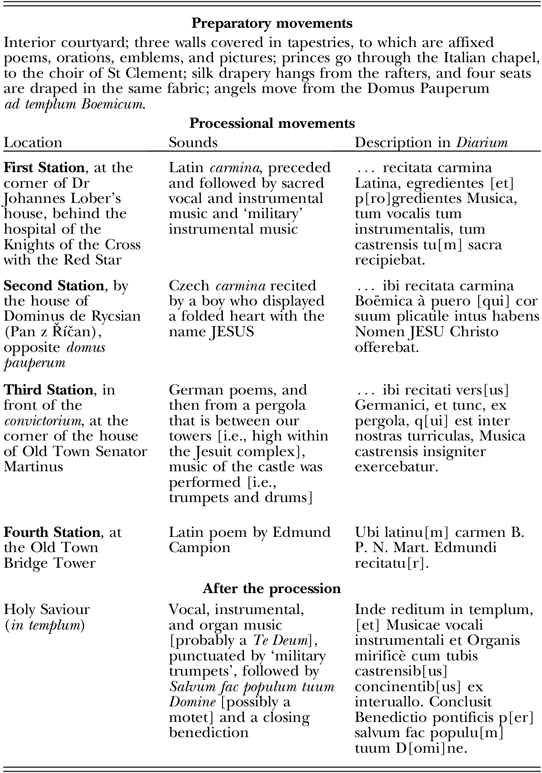
The procession departed from the now-completed Church of the Holy Saviour, which was located at the corner of the Clementinum closest to Charles Bridge.Footnote 116 Four stations had been erected not in the complex itself, but rather in the streets surrounding it (see Table 4). The first two stations abutted the houses of prominent Catholic citizens. The third was located by the printing house of Jiří Nigrinus, who printed almost all the polyphony written by composers working in Prague.Footnote 117 The final station was erected at the Old Town Bridge Tower, a perennial ‘hotspot’ in the political and sacred topography of the city. There, where each year the Utraquists paraded with an effigy of Jan Hus on the anniversary of his martyrdom, a youth recited a poem by the Jesuits’ own martyr, the Englishman Edmund Campion, who had returned to England in 1580 and was drawn and quartered for treason the following year.Footnote 118
Sounds, texts and movement in and around the Prague Jesuit complex for the 1610 Corpus Christi procession

Source: DC III 16, fols. 91v–92v
As with the 1583 procession, the 1610 procession featured monophonic songs not only in Latin, but also in the vernacular. And as in 1583, these songs were sung not in Italian and Spanish, the languages of the most stolidly Catholic of Prague’s ethnic groups, but in Czech and in German – the languages of the Utraquists and the Lutherans. In 1610, sung in the streets, these songs called out to those who were least likely to want to hear them.
The loudest sounds of this procession were literally belligerent. ‘Arriving and departing’, the chronicler wrote, ‘there sounded music – vocal, instrumental, and military.’Footnote 119 This last category – musica castrensis – refers to the music of trumpets and drums, which were closely associated with displays of secular power. Their sounds are the ones that would have travelled farthest; those unwilling to hear the sounds of vocal polyphony might have shut their windows, but they could not very well ignore the sounds of trumpets. Reports by Lutherans dealing with such displays elsewhere in Europe tell us that they got the message loud and clear: Alexander Fisher reports, for example, that a chronicler in Augsburg ‘lamented the presence of Protestant bystanders, who heard trumpets and drums [such] “as [are] used in warfare”’.Footnote 120
The Prague chronicler does not specify which pieces were sung in the 1610 procession or immediately afterward, but by this point, with the Imperial chapel having been resident in the city for some thirty years, there would have been no shortage of options (see Appendix). One possibility is Fratres/O quam suavis est by Philippe de Monte, who had given copies of his motets to the Jesuits on at least one occasion.Footnote 121 Printed in Monte’s 1587 collection of motets for six voices, Fratres draws upon Paul’s institution of the Eucharist (1 Corinthians 11:23–5) to cast the Host as an object of collective adoration by the brotherhood of Christianity.Footnote 122 Monte’s motet is striking for its insistence on the sufficiency of bread alone for salvation, as shown by a comparison with a Eucharistic motet by his contemporary Jacobus Handl (Gallus) that draws on the same biblical passage. Handl’s Dominus Jesus / Similiter et calicem (Lord Jesus / Similarly with the chalice), appeared in his Opus musicum (Prague, 1589–90), a collection of motets for the church year. Handl, a Catholic employed as choir director at a Prague Utraquist church from 1580 until his death in 1591, sets the text from the Vulgate complete and unadulterated. Monte, in contrast, combines scriptural and liturgical texts in order to counter Utraquist and Lutheran beliefs (boldface indicates the shared text, and the English translation appears below the Latin original):

Handl – an intimate of Prague’s Utraquist humanists and a devout Catholic who was not, however, affiliated with the Imperial chapel – invokes the chalice through his inclusion of verse 25 (‘similiter et calicem’) and gives this crucial verse considerable weight by setting it as his secunda pars. Monte, in contrast, omits this verse, which justified Utraquist ritual practice, replacing it with O quam suavis est: the Magnificat antiphon for Corpus Christi that celebrates the ‘most sweet bread from heaven’, the bread that satisfies the hungry, and ‘send[s] the disdainful away unsated’.
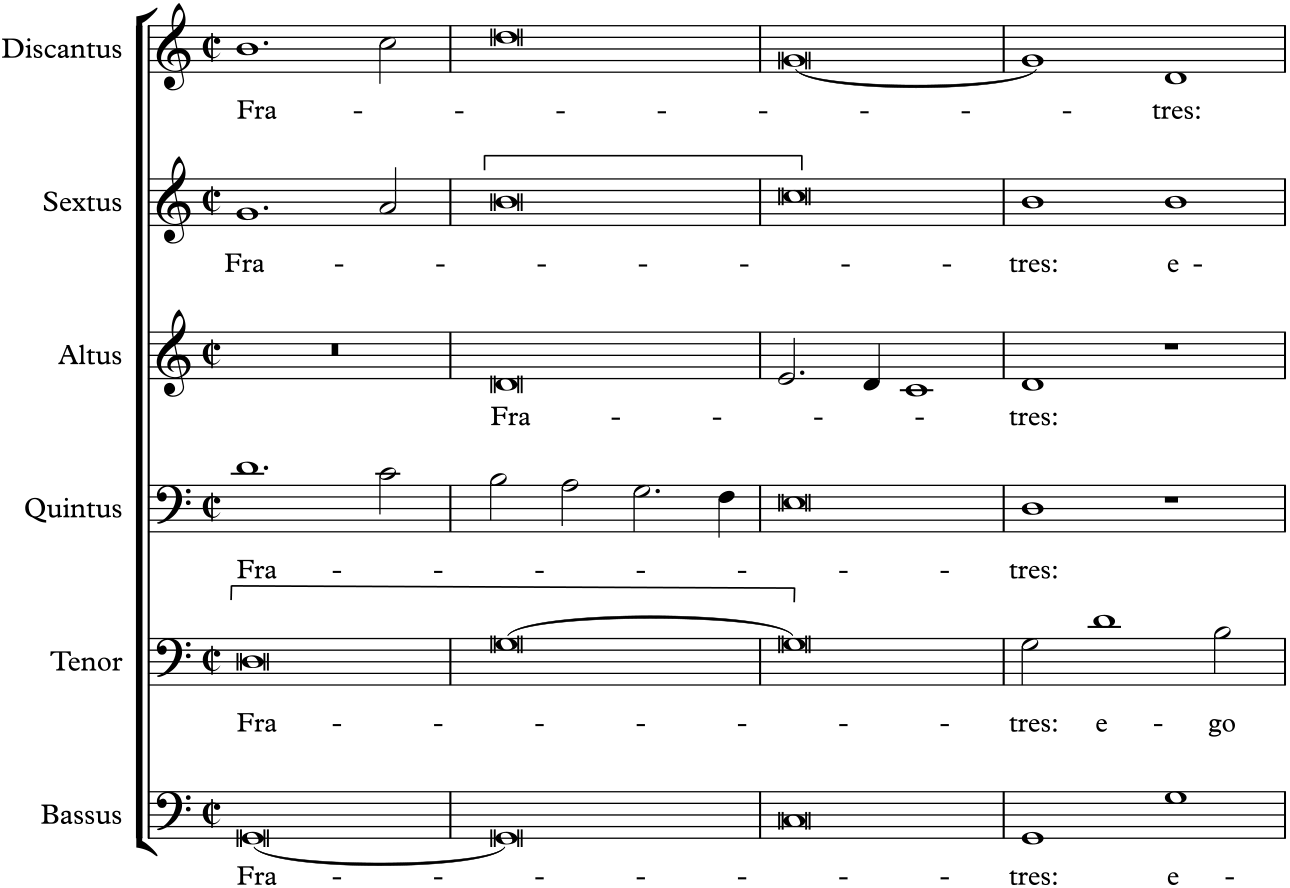
Monte’s combination of the Corpus Christi lectio with the Magnificat antiphon appears to have no counterpart in the sixteenth century: the texts were typically set separately.Footnote 123 His strategic juxtaposition of the two texts shifts the perspective of the speaker at the midpoint of the motet from scriptural authority to congregational response. More specifically, the prima pars provides biblical justification for the sacrament of the Altar, while the second half enacts collective praise. With the words ‘Fratres, ego enim accepi a Domino’, Paul narrates for his gathered ‘brothers’ the story of the Last Supper, concluding with Jesus’ instructions to his disciples to partake of his Body in his honour. Monte departs from his usual practice of opening with a point of imitation to have all the voices enter at once, although not homophonically. This, combined with a full scalar descent from d′ to d in the Quintus (bb. 1–4) on ‘Fratres’, give musical support to the text’s vocative address (see Example 3).
Philippe de Monte, Fratres ego enim accepi / O quam suavis est (prima pars), bb. 1–4, from Sacrarum cantionum, cum sex vocibus … liber secundus (Venice, 1587)

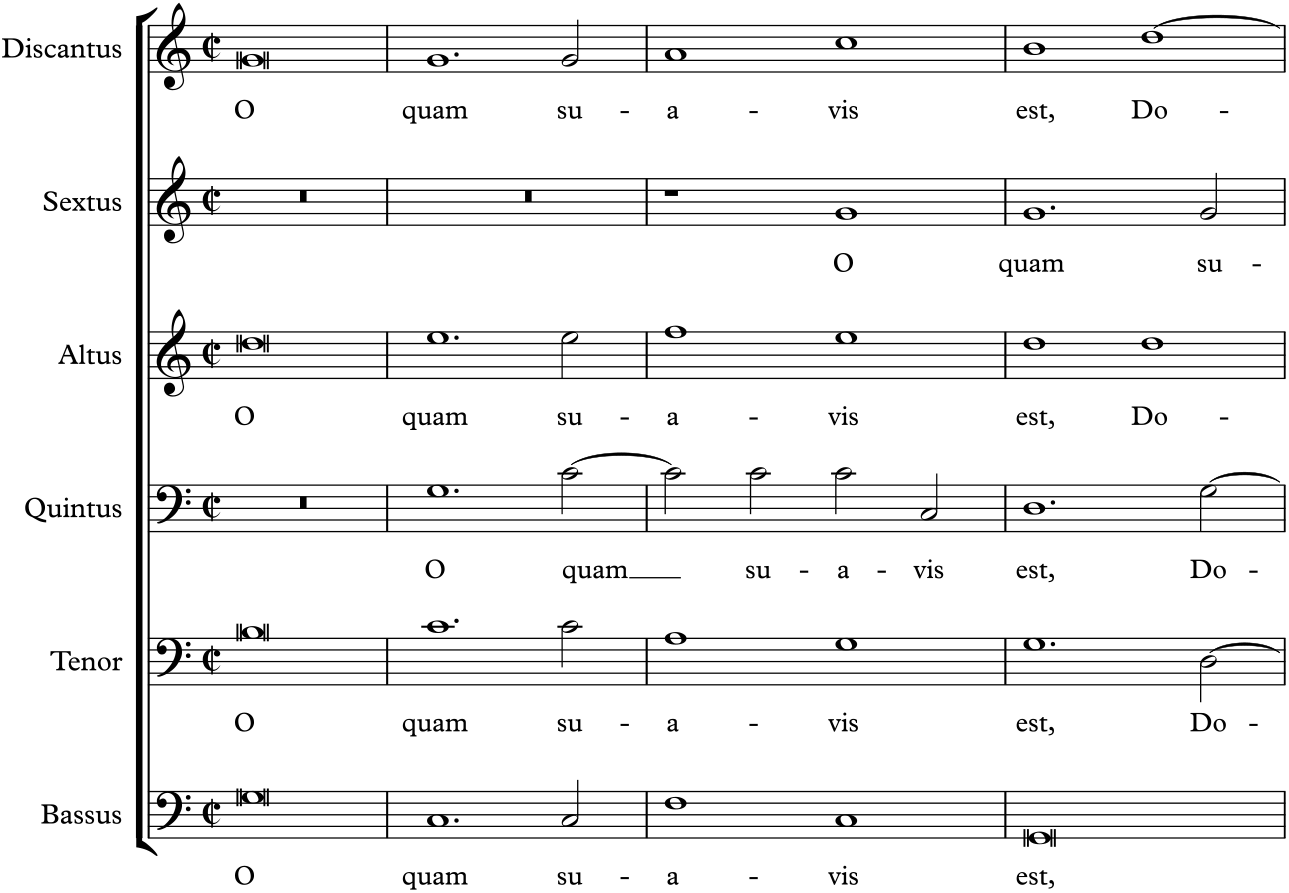
The prima pars concludes with Jesus’ words set in dense six-voice polyphony: the independently moving voices create a wash of sound. The comparatively homorhythmic setting of the opening words of the secunda pars (‘O quam suavis est’) sets them in relief from the preceding music and implies a unified response to Paul’s instructions (see Example 4). Monte casts O quam suavis est as a communal response to Paul’s directive. Heard this way, liturgy responds to Scripture, and the bitterness of earthly betrayal is supplanted by the sweetness of heavenly redemption.
Philippe de Monte, Fratres ego enim accepi / O quam suavis est (secunda pars), bb. 1–4

CONCLUSIONS
If Luython’s Pange lingua or Monte’s Fratres ego enim accepi were indeed performed in the context of Corpus Christi celebrations, how did Prague’s citizens, Catholic and non-Catholic, respond? Polyphony was sung at moments of stasis, sounding when the processions paused at stations and when they returned to the church. Silence, and the immobility of the bodies that had been moving just moments before, could have intensified its effect. Depending on proximity and education, some people would have been impressed purely by the sounds, others would have picked out important words, and those few that knew Latin and were well versed in the conventions of polyphony would have heard a motet as something like an oration.
That the sounds of ritual moved different people in different ways might seem to be something of a truism in the light of the illuminating studies of secular music (particularly opera) in the early modern and Enlightenment periods that have recently appeared.Footnote 124 Yet, with a few notable exceptions, the subjective experience of listening to sacred music, particularly sixteenth-century sacred music, remains unexplored. Stile antico settings of Latin sacred texts simply do not strike the twenty-first-century listener as being capable of arousing a visceral response – as being ‘moving’, we might say – in the way that later music is assumed to be. Yet studies by Alexander Fisher, among others, show us that early modern listeners reacted strongly and variously to music, not just because of the words, but also because of the sounds themselves.Footnote 125 And the documents that tell us how Eucharistic veneration sounded in a multi-confessional region also reveal what can be learned about the centre by listening to the margins: to Utraquists in Prague, to Czech burghers, to women in Michelsdorf.Footnote 126
If we are to recover this music’s power, then, we must take into account how pieces such as Fratres ego enim accepi were heard close up, by the Catholics who marched in the processions, by the Lutherans – Eva Haslauer’s father, Wolf, perhaps, who must certainly have visited Prague – and by the Utraquists who staged their own procession just a few blocks away. For these distant auditors the power of music, particularly polyphony, would not have resided in the specifics of text and musical setting.Footnote 127 After all, the words would probably have been inaudible to all but those within a relatively small radius, and the Latin texts would in any case have been understood by fewer people still, a subset of those who were positioned very close to the singers.
In the end, a piece such as Monte’s motet did not speak to those who did not want to hear it. Moreover, its message could be changed. A manuscript partbook in Prague’s National Museum of Czech Music transmits only the secunda pars, O quam suavis est, leaving off the essential first half, the prefatory scriptural instructions that transform the motet into a powerful, and performative, argument for the Catholic doctrine that man ought to live on bread alone.Footnote 128 Still, sounding in the context of a Jesuit procession such music was powerful. To most of those listening to it, its power lay not in its words nor in its carefully constructed musical phrases, but in the fact of its performance. Such music was extraordinary. It ensured that the Elevation of the Host was a transformative moment. It sacralised the wafer; it enchanted the streets.
APPENDIX Eucharistic Motets in Imperial Prague
The following table lists Eucharistic motets written by composers active in Prague during the reign of Rudolf II (marked *). To give a sense of the preconditions for Eucharistic music written by composers in Imperial Prague, I also include here selected Eucharistic motets that appeared in prints connected to the court of Maximilian II.